Article

Green Transformation of China’s Light Industry: Regulatory and Innovation Policy Scenarios, 2023–2036

1
School of Economics and Management, Northwest University, Xi’an 710127, China
2
School of Economics and Management, Shaanxi University of Science and Technology, Xi’an 710021, China
*
Author to whom correspondence should be addressed.
Sustainability 2025, 17(24), 11105; https://doi.org/10.3390/su172411105
Submission received: 18 October 2025 / Revised: 7 December 2025 / Accepted: 7 December 2025 / Published: 11 December 2025

Abstract

Accelerating the green transformation of China’s light industry is of great significance for addressing resource and environmental issues and promoting sustainable development. Based on data from 16 light industry sectors in China from 2004 to 2023, this paper employs a system dynamics model to systematically explore the pathways for the green transformation of China’s light industry. The study finds that the green transformation of China’s light industry will exhibit a trend of first declining and then rising in the future. Simultaneously implementing measures to increase environmental regulation, strengthen independent innovation, promote imitative innovation, and reduce technology acquisition represents the optimal pathway for driving the green transformation. Based on these findings, future efforts should focus on optimizing technological innovation pathways and scientifically setting environmental regulation intensities. This paper not only fills the gap in dynamic system analysis within the field of green transformation of the light industry, but also provides valuable reference for promoting the sustainable development of manufacturing in China and globally.

1. Introduction

In recent years, increasingly severe and frequent extreme climate events, such as the 2023 Canadian wildfires, the 2024 Indian heatwave, and the 2025 Pakistan floods, have threatened global human well-being and economic sustainability [1,2], with excess greenhouse gas emissions identified as the root cause [3]. To address this, nations worldwide have rolled out carbon mitigation policies: Brazil updated its national biofuel strategy [4], Turkey pledged net-zero emissions by 2053, ASEAN states submitted UN carbon neutrality roadmaps [5], and the EU enacted climate-focused legislative frameworks [6], while China launched its “dual carbon” goals and systematic green transformation policies [7,8]. Against the backdrop of the global low-carbon transition, the light industry, which combines livelihood attributes with resource consumption characteristics, has become a key sector for countries to achieve carbon reduction goals, and China is also facing urgent challenges in promoting low-carbon upgrades in its light industry.
As a traditional competitive industry and a significant livelihood-related sector within China’s national economy, the light industry not only plays a pivotal role in economic development and social stability but also stands as a key area for pollution prevention and control, as well as energy conservation and carbon reduction [9]. The green transformation of the light industry can effectively reduce resource consumption and environmental pollution during production processes, while also providing robust support for achieving the “dual carbon” goals and constructing a Beautiful China [10,11]. Since the 18th National Congress of the Communist Party of China, the innovation capacity of China’s light industry has markedly improved, playing a crucial role in meeting consumer demands, stabilizing exports, and expanding employment. Nevertheless, it still confronts numerous challenges, including weak independent innovation capacity, low resource utilization efficiency, and significant pressure for energy conservation and emission reduction [12]. At present, exploring multifaceted implementation pathways for the green transformation of the light industry is not only an urgent necessity to align with international low-carbon development trends, but also an essential component of accelerating the comprehensive green transformation of economic and social development [13].
Technological progress is the decisive factor in the green transformation of the light industry. However, characteristics of technological innovation, such as dual externality, sustained investment requirements, and output uncertainty, significantly undermine enterprises’ motivation. Therefore, the government needs to implement corresponding policies to guide enterprises toward green transformation. Currently, scholars have conducted in-depth research on the relationships among environmental regulation, technological innovation, and green transformation [14,15]. First, the relationship between environmental regulation and technological innovation. Scholars found that economic, social, and institutional environmental regulations could all promote technological innovation [16,17], but the effects of different types of environmental regulation on technological innovation vary significantly [18]. Moreover, some scholars have found that the relationship between environmental regulation and enterprise green innovation exhibits a U-shaped characteristic, with more pronounced effects in state-owned enterprises and clean industries [19]. Second, the relationship between technological innovation and the green transformation of the light industry. Scholars argued that technological innovation enhanced resource-use efficiency, propelled industrial-structure upgrading, and constituted the key to firms’ competitive advantage, thereby playing a vital role in achieving green transformation [20,21,22]. However, different modes of technological innovation also produced differentiated impacts on green transformation. For instance, Liu et al. pointed out that imitative innovation could exert positive effects in the short term, whereas independent innovation was the “long-term strategy” for promoting green transformation [23]. Third, the relationship between environmental regulation and the green transformation of the light industry. Scholars found that moderate environmental regulation could guide enterprises to transition toward more environmentally friendly and efficient production methods, and promote the transformation of the industrial structure toward greener and more sustainable pathways [24,25]. However, excessively stringent environmental regulation might adversely affect the green transformation of the light industry. For example, Ouyang et al. found that although environmental regulation could suppress sulphur dioxide emissions, it reduced economic efficiency and negatively impacted green total factor productivity through increased pollution treatment expenditure, reduced R&D investment, and crowding-out effects that undermined the quality of green innovation [26].
Reviewing previous studies, the following gaps remain: First, most previous studies have focused on the entire industrial sector or heavily polluting industries, with insufficient attention paid to the green transformation of the light industry. Second, prior research has predominantly explored the impact of individual factors, either technological innovation or environmental regulation, on the green transformation of the light industry, while rarely investigating the synergistic mechanism of these two factors in driving the transformation. Third, most previous studies have examined the realization pathways of the light industry’s green transformation from a static perspective, neglecting the adaptive evolution of the transformation process amid dynamic changes in multiple factors. Consequently, the policy recommendations derived from these studies lack forward-looking and systematic characteristics.
In view of this, this paper aims to address the uniqueness of the green transformation of the light industry and the deficiencies in existing research. From the perspective of the coupling and coordination between technological innovation and environmental regulation, we construct a system dynamics model tailored to the characteristics of China’s light industry. This model dynamically simulates the evolutionary trend of the green transformation of the light industry under the interaction of multiple factors and identifies the optimal transformation pathways under different development modes, thereby providing scientific and systematic decision support for the sustainable green development of the light industry.
The potential contributions of this paper are as follows: First, taking into account the unique characteristics of the light industry, such as its strong livelihood orientation and numerous sub-sectors, this paper establishes an industry-specific system dynamics model for green transformation. Second, it investigates the impacts of environmental regulation and technological innovation, both individually and in combination, on the green transformation of the light industry, clarifying the interrelationships among various factors during the transformation process. Third, using the system dynamics model, this paper simulates and predicts the development trend of green transformation from dynamic and systematic perspectives, conducts a comparative analysis of the optimal transformation pathways under different modes, and effectively enhances the scientificity and foresight of the green transformation pathways for the light industry.
The main research conclusions of this paper indicate that environmental regulation, independent innovation, and imitative innovation can promote the green transformation of the light industry, with independent innovation playing the strongest core leading role. Compared to solely strengthening environmental regulation or simply relying on technological innovation, the synergy between the two can better drive the green transformation of the light industry. In addition, the results of multi-scenario simulation show that the green transformation effect of the light industry is optimal when environmental regulation is strengthened, investment in independent innovation and imitative innovation is increased, and dependence on technology acquisition is reduced simultaneously.
This paper not only offers practical guidance for the green transformation of China’s light industry but also provides valuable insights for sustainable development in manufacturing sectors across other countries and globally. On one hand, as a foundational and livelihood-oriented industry in the industrialization process of many nations, the green transformation pathway of the light industry can provide direct exemplary reference for sectors such as food and textiles, thereby promoting the shift of industrial systems worldwide toward greening and high-quality development. On the other hand, the system dynamics model constructed in this paper can serve as a methodological reference for countries and industries facing similar transitional challenges while also offering decision-making support for the formulation of industrial policies that balance environmental protection and economic growth in other nations.
The structure of the article is as follows: Section 2 constructs the system dynamics model for green transformation. Section 3 designs diversified green transformation pathways and conducts simulation modeling and comparative analysis. Section 4 summarizes the research findings and proposes policy recommendations.

2. Materials and Methods

Technological innovation is the engine driving structural optimization and factor upgrading in the light industry. It is not only the key to guiding high-quality development in the light industry but also the “internal driving force” propelling its green transformation. Environmental regulation, by making pollution costs explicit, compels enterprises to adjust their structures, optimize processes, upgrade technologies, and improve efficiency to offset the increased costs resulting from such regulations, thus serving as the “external driving force” for green transformation. Furthermore, environmental regulation and technological innovation are closely intertwined. Environmental regulations can inspire enterprises to undertake technological innovation, while the changes in industrial structure brought about by technological innovation will, in turn, influence and modify environmental regulation policies [27]. In other words, environmental regulation and technological innovation can facilitate green transformation through mutual collaboration. Therefore, we explored the construction of a system dynamics model for green transformation, starting from the internal and external influencing factors in addressing resource and environmental issues, namely environmental regulations and technological innovation, and incorporating the reality of China’s light industry.

2.1. Data Sources

Green transformation encompasses information from various aspects, including economy, energy, technology, and environment. Referring to the classification approach in the China Statistical Yearbook, the light industry covered in this paper included 16 sub-sectors, such as the paper and leather industries. The data primarily originated from statistical materials, including the China Statistical Yearbook, China Industry Statistical Yearbook, China Statistical Yearbook on Environment, and China Energy Statistical Yearbook for the period from 2005 to 2024. Missing data were mainly obtained through the linear interpolation method.

2.2. Methodology

System dynamics is a simulation approach that integrates cybernetics, system theory, information theory, and computer simulation technology to study and address the relationships between the structure, functions, and dynamic behaviors of complex systems [28,29]. It demonstrates significant advantages in handling complex system issues that are nonlinear, involve multiple variables, are time-varying, and feature multiple feedback loops, such as those in social, economic, and resource–environmental contexts [30,31]. Here, based on the system dynamics methodology, this study utilized Vensim PLE 7.3.5 software (Ventana Systems, Inc., accessible at https://vensim.com) and data from 16 industries within China’s light industry to construct a system dynamics model for the green transformation of China’s light industry. This model was employed to compare and explore the development paths for the green transformation of China’s light industry.

2.3. Variable Selection

(1) Green transformation: Chen held that the core of green transformation lay in the continuous improvement of green total factor productivity (GTFP) [32]. To this end, in this paper, drawing on previous studies [33,34,35], we employed GTFP to reflect the degree of green transformation. Taking into account energy inputs and undesired outputs, this study employed the SBM-GML model to measure GTFP of the light industry [36,37]. Since GTFP is a chain-linked change index, in the subsequent analysis of pathway simulation results, we mainly referred to previous studies and converted it into a cumulative growth index through a cumulative multiplication method [38,39].
The indicators and data processing parameters selected for measuring the GTFP of the light industry were as follows: ① Energy input: measured by total energy consumption; ② labor input: measured by the annual average employees; ③ Capital input: measured by the net fixed assets; ④ Desired output: measured by the main business revenue; and ⑤ Undesired output: measured by the comprehensive environmental pollution index and carbon dioxide emissions. Specifically, the comprehensive environmental pollution index was primarily calculated using the entropy method, which integrates COD discharged, sulphur dioxide emissions, and solid wastes generated. Carbon dioxide emissions were primarily measured using the IPCC carbon emission inventory estimation method.
(2) Technological innovation: Following previous studies [40,41,42], we categorized technological innovation into three types: ① Independent innovation: measured by the proportion of the sum of “intramural expenditure on R&D” and “expenditure on technology assimilation” to the main business revenue; ② Imitative innovation: measured by the proportion of “expenditure on technical renovation” to main business revenue; and ③ Technology acquisition: measured by the proportion of “expenditure on technology acquisition” to the main business revenue.
(3) Environmental regulation: Referring to previous studies [43,44], and considering the sources of pollutants in the light industry as well as data availability, we constructed a comprehensive index of environmental regulation using wastewater treatment expenditure, waste gas treatment expenditure, and solid waste utilization rate as indicators, and used this index to measure the environmental regulation.

2.4. Determination of System Boundaries

The system boundaries in a system dynamics model refer to the setting that encompasses all elements within the system and their changing attributes across both temporal and spatial scales. Based on core indicators from variables such as green transformation, technological innovation, and environmental regulation, and combined with actual conditions, we constructed a system dynamics model of green transformation. The time span of the simulation model was from 2004 to 2035, with 2004 to 2023 representing historical reality and 2024 to 2035 representing the simulation period, with a simulation step size of one year.

2.5. Research Hypothesis

Drawing on previous studies [45,46,47,48] and taking into account the research object, system boundaries, as well as the actual situation of green transformation of China’s light industry, this paper proposes the following hypothesis:
H1. 
The system structure remains stable and persistent, with all variables evolving according to causal feedback relationships, and no structural breaks will occur.
H2. 
The political, economic, and social environments in the study area are stable, with no significant natural disasters, economic fluctuations, or policy changes.
H3. 
The influencing factors of green transformation of China’s light industry are numerous and complex. This model only considers the impact of technological innovation and environmental regulation, while other factors such as market demand, industry differences, institutional factors, and external shocks are outside the scope of discussion.
H4. 
In the process of promoting the green transformation of the light industry, there are significant differences in the effectiveness of different types of technological innovation.
H5. 
Due to the difficulty in collecting data on different types of environmental regulation at the industry level, this model only explores the impact of overall environmental regulation on the green transformation of the light industry.

2.6. Causality Analysis

The green transformation system of the light industry encompasses numerous elements, with complex causal feedback among them. By analyzing the various factors, we clarified the causal relationships within the green transformation system (Figure 1).
(1) Technology innovation expenditure → +Annual average employees → +Management expenses → −Net fixed assets → +Main business revenue → +Technology innovation expenditure: An increase in technology innovation expenditure will expand the production scale, thereby raising the annual average employees. The rise in labor costs will increase management expenses, squeezing profits and leading to a reduction in net fixed assets. The decline in fixed assets will compel enterprises to enhance efficiency through technological innovation. Coupled with the output growth brought by the increased workforce, these factors will collectively boost the main business revenue, thereby generating more abundant funds to be reinvested in technology innovation.
(2) Technology innovation expenditure → +Total energy consumption → +Carbon dioxide emissions → +Pollution treatment expenditure → −Technology innovation expenditure: An increase in technology innovation expenditure will expand the production scale, directly leading to a rise in total energy consumption, which in turn increases carbon dioxide emissions. The growth in carbon dioxide emissions intensifies environmental pressure on enterprises, compelling them to allocate more funds to pollution treatment expenditure. This crowds out financial resources for technological research and development, thereby exerting a negative inhibitory effect on technology innovation expenditure.
(3) Technology innovation expenditure → −Total profits → +Net fixed assets → +Main business revenue → +Technology innovation expenditure: An increase in technology innovation expenditure will raise costs and reduce total profits in the short term. However, to support long-term development, enterprises will allocate more resources to net fixed assets to enhance production capacity, thereby increasing main business revenue. In turn, the growth of the main business revenue will encourage enterprises to continuously increase investment in technology innovation [49].
(4) Technology innovation expenditure → +Number of enterprises → +Annual average employees → +Main business revenue → +Technology innovation expenditure: An increase in technology innovation expenditure will improve the business environment, attracting more enterprises to enter the industry and thereby increasing the number of enterprises, which in turn creates more employment opportunities and raises the annual average number of employees [50]. The growth in labor input will support the expansion of the main business revenue, thereby providing more funds for technological innovation.
(5) Pollution treatment expenditure → −Total profits → +Net fixed assets → +Main business revenue → +Technology innovation expenditure → −Carbon dioxide emissions → +Pollution treatment expenditure: An increase in pollution treatment expenditure will directly reduce total profits. To compensate for this, enterprises will augment net fixed assets to enhance main business revenue, thereby increasing technology innovation expenditure to reduce carbon dioxide emissions [51]. As carbon dioxide emissions decrease, pollution treatment expenditure will correspondingly decline.
(6) Pollution treatment expenditure → −Number of enterprises → +Annual average employees → +Management expenses → −Net fixed assets → +Main business revenue → +Technology innovation expenditure → −Carbon dioxide emissions → +Pollution treatment expenditure: An increase in pollution treatment expenditure will phase out backward enterprises, leading to a decrease in the number of enterprises. Surviving enterprises, however, may expand their market scale, resulting in a rise in the annual average number of employees and management expenses. Cost pressures will crowd out investment in fixed assets and compel enterprises to enhance production efficiency through technological innovation, thereby reducing carbon dioxide emissions and ultimately alleviating the burden of pollution treatment expenditure.
(7) Pollution treatment expenditure → −Total energy consumption → +Main business revenue → +Technology innovation expenditure → −Carbon dioxide emissions → +Pollution treatment expenditure: An increase in pollution treatment expenditure will compel enterprises to reduce their total energy consumption, thereby lowering operational costs and enhancing the green competitiveness of their products, which contributes to a rise in main business revenue [52]. Sufficient revenue enables enterprises to increase technology innovation expenditure, leading to a reduction in carbon dioxide emissions. The resulting emission reduction achievements can, to some extent, alleviate the corporate burden of pollution treatment costs [53].

2.7. Establishment of System Flow Diagram

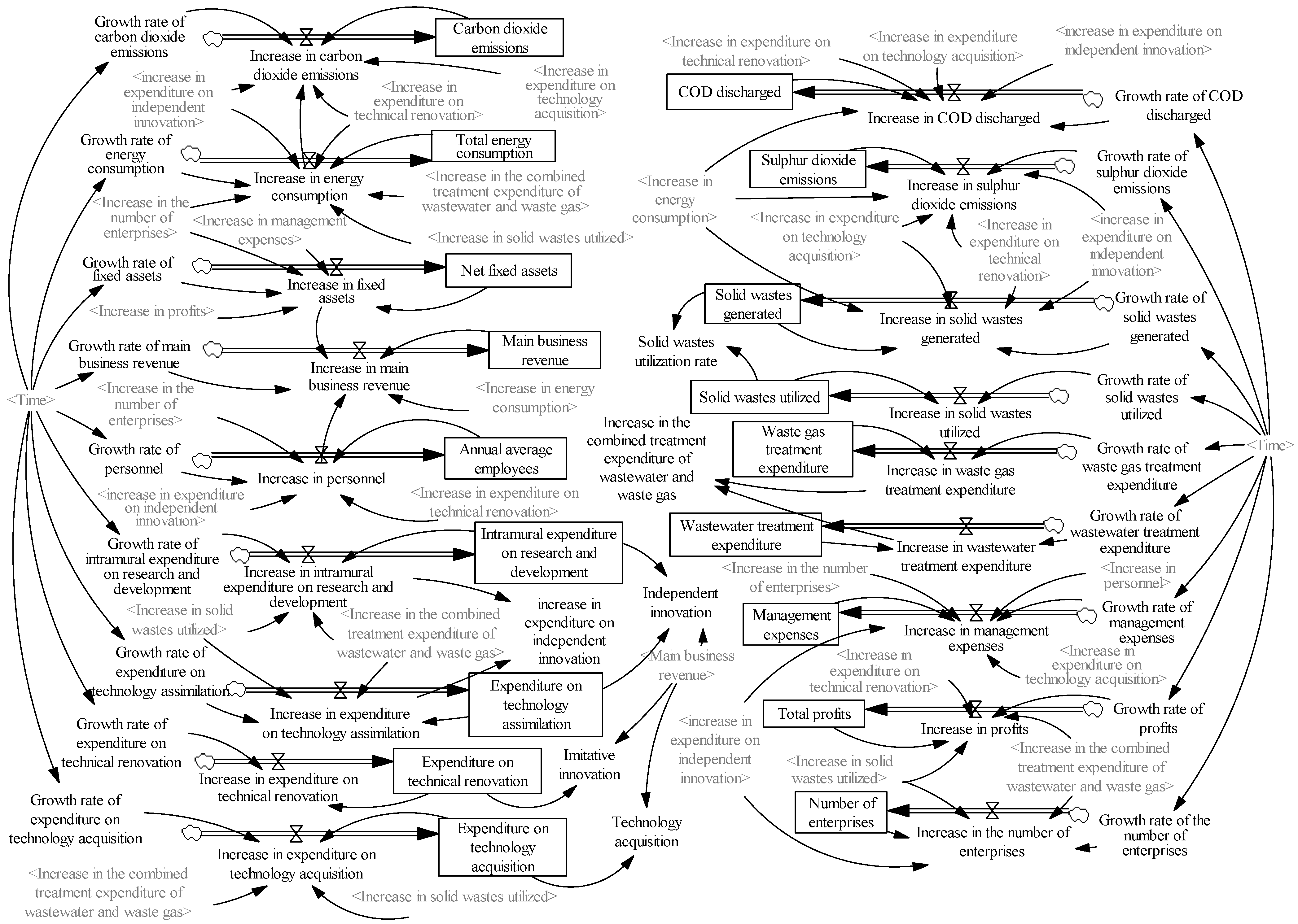
Based on the relationships among variables in the causal loop diagram, we constructed a system dynamics model of green transformation (Figure 2). The model involves the following three types of variables: first, state variables, which primarily include carbon dioxide emissions, total energy consumption, net fixed assets, main business revenue, and annual average employees; second, rate variables, mainly consisting of an increase in carbon dioxide emissions, an increase in energy consumption, an increase in fixed assets, and an increase in personnel; third, auxiliary variables, which primarily encompass the growth rate of carbon dioxide emissions, the growth rate of energy consumption, and the growth rate of fixed assets.

2.8. Design of Model Equations

Based on the interrelationships and mechanisms among variables, this study combined regression analysis, the arithmetic mean method, the comprehensive evaluation method, and table functions with data from 2004 to 2023 to estimate parameters and derive model equations. After repeated debugging and system operation, a system dynamics model of green transformation was established. Specifically, the growth rates of each variable from 2023 to 2035 were primarily based on the historical average values. The representative equations in the system dynamics model are as follows:
(1)
Carbon dioxide emissions = INTEG (Increase in carbon dioxide emissions, 1466.795), unit: ten thousand tons.
(2)
Total energy consumption = INTEG (Increase in energy consumption, 1190.920), unit: ten thousand tons of standard coal.
(3)
Net fixed assets = INTEG (Increase in fixed assets, 1091.938), unit: billion yuan.
(4)
Main business revenue = INTEG (Increase in main business revenue, 3154.210), unit: billion yuan.
(5)
Annual average employees = INTEG (Increase in personnel, 144.313), unit: ten thousand people.
(6)
COD discharged = INTEG (Increase in COD discharged, 19.488), unit: ten thousand tons.
(7)
Sulphur dioxide emissions = INTEG (Increase in sulphur dioxide emissions, 8.831), unit: ten thousand tons.
(8)
Solid wastes generated = INTEG (Increase in solid wastes generated, 331.563), unit: ten thousand tons.
(9)
Wastewater treatment expenditure = INTEG (Increase in wastewater treatment expenditure, 5.277), unit: billion yuan.
(10)
Waste gas treatment expenditure = INTEG (Increase in waste gas treatment expenditure, 2.055), unit: billion yuan.
(11)
Increase in the combined treatment expenditure of wastewater and waste gas = Increase in wastewater treatment expenditure + Increase in waste gas treatment expenditure, unit: billion yuan.
(12)
Solid wastes utilized = INTEG (Increase in solid wastes utilized, 299.188), unit: 10,000 tons.
(13)
Solid wastes utilization rate = Solid wastes utilized ÷ Solid wastes generated, unit: %.
(14)
Intramural expenditure on R&D = INTEG (Increase in intramural expenditure on R&D, 26.428), unit: billion yuan.
(15)
Expenditure on technical renovation = INTEG (Expenditure on technical renovation, 30.785), unit: billion yuan.
(16)
Expenditure on technology acquisition = INTEG (Increase in expenditure on technology acquisition, 4.364), unit: billion yuan.
(17)
Expenditure on technology assimilation = INTEG (Increase in expenditure on technology assimilation, 0.685), unit: billion yuan.
(18)
Independent innovation = (Intramural expenditure on R&D + Expenditure on technology assimilation) ÷ Main business revenue, unit: %.
(19)
Imitative innovation = Expenditure on technical renovation ÷ Main business revenue, unit: %.
(20)
Technology acquisition = Expenditure on technology acquisition ÷ Main business revenue, unit: %.

2.9. Model Validation

2.9.1. Stability Validation

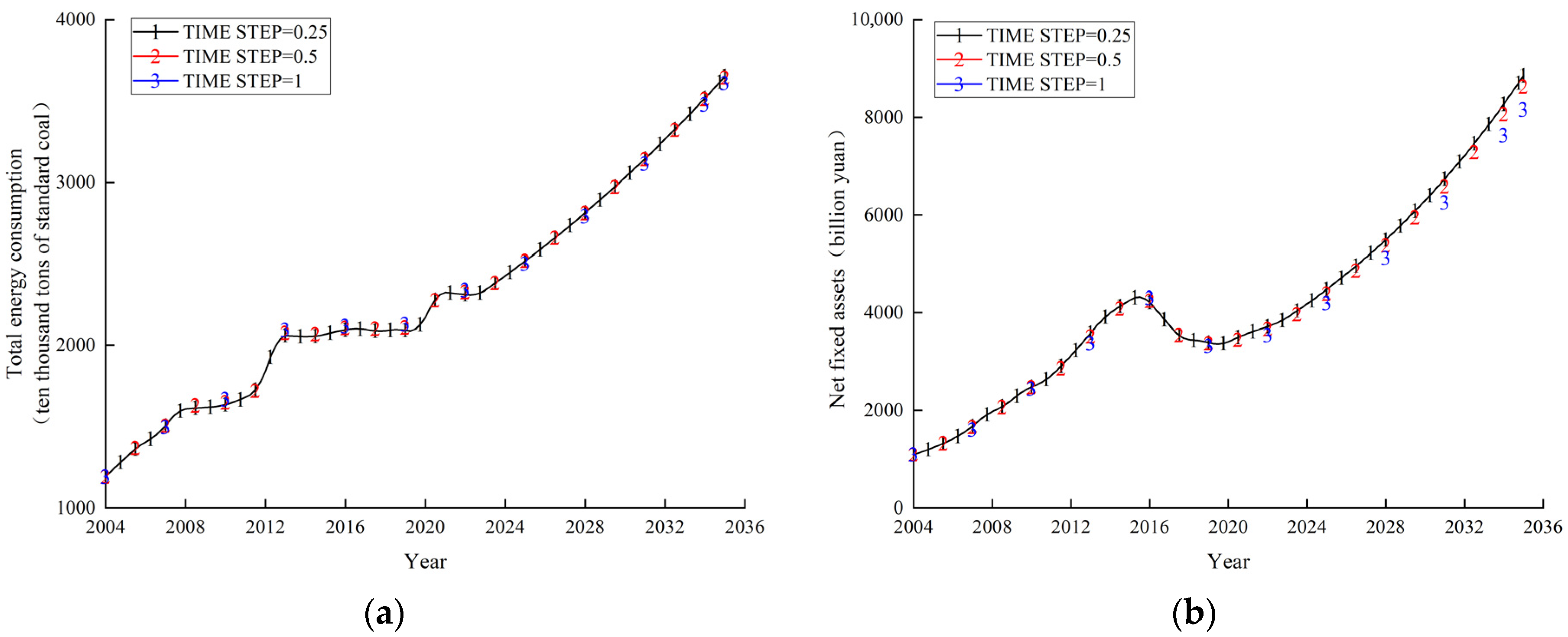
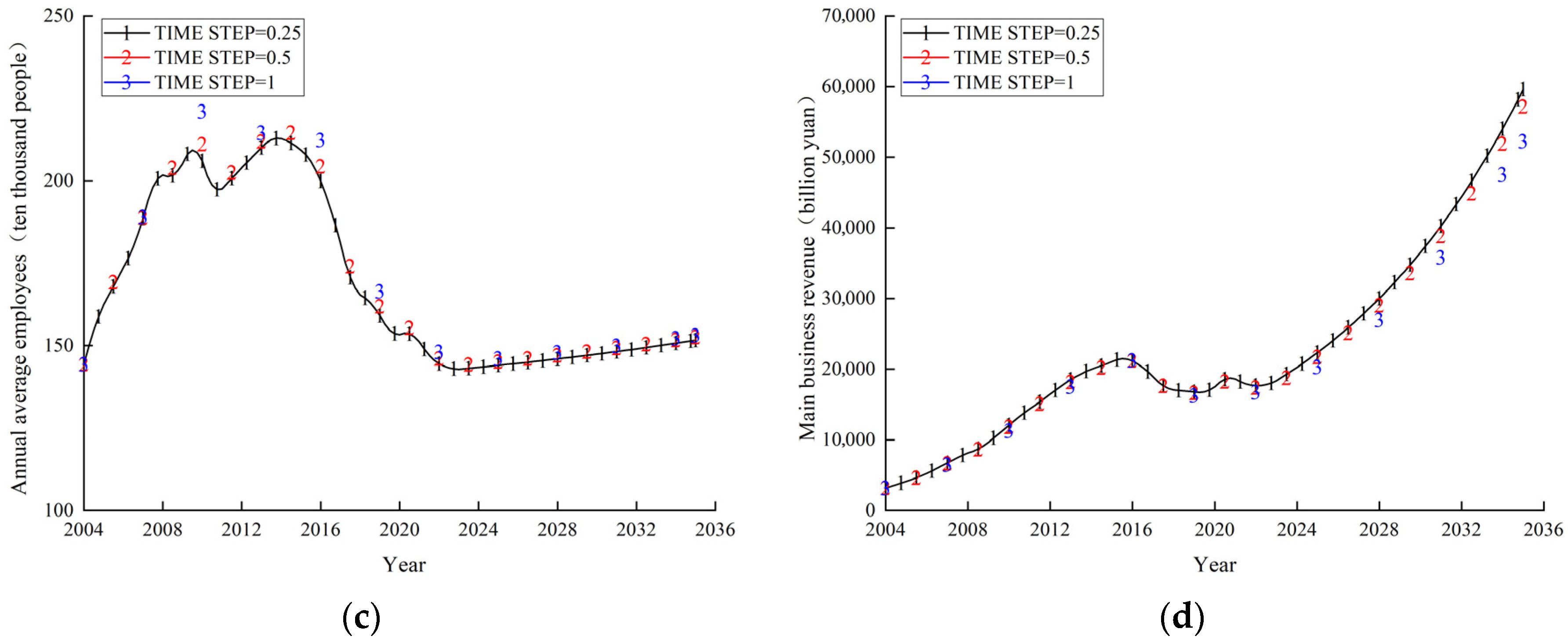
This study set three different simulation step sizes: TIME STEP = 1, TIME STEP = 0.5, and TIME STEP = 0.25, representing 12 months, 6 months, and 3 months, respectively, to examine the model’s stability. In this context, we adopted four variables, namely total energy consumption, net fixed assets, annual average employees, and main business revenue, as the objects of testing, and examined the output results of each variable under different simulation time steps (Figure 3). Results show that when the model is input with three different time steps, the change trends of each variable are consistent and the variation range is small. Therefore, it can be concluded that the model is stable.

2.9.2. Historical Validation

To further verify the validity and rationality of the model and ensure its alignment with reality, we selected representative variables for historical validation. Specifically, the period from 2004 to 2023 was chosen as the historical validation timeframe, and variables closely related to green transformation, such as annual average employees, total energy consumption, net fixed assets, main business revenue, carbon dioxide emissions, and solid wastes generated, were selected as historical validation indicators. These indicators were compared with the average values of historical data through system operation (Table 1). According to the historical validation results, the absolute error between the historical values and simulated values of the system model was less than 5%, which falls within the acceptable error range of 10%. This indicates that the model passes the validity test and can be used for simulation analysis.

2.9.3. Sensitivity Analysis

Sensitivity analysis is a crucial method for investigating the extent to which changes in model parameters affect system behavior. Its primary purpose is to test model stability, identify key influencing factors, and thereby provide a scientific basis for decision-making. In this study, technological innovation and environmental regulation are identified as the primary factors influencing the green transformation of the light industry. Here, we primarily examined the impact of various factors on technological innovation and environmental regulation by altering the values of relevant variables during the simulation period (2024—2035), thereby providing a reference for designing pathways for the green transformation of the light industry in the subsequent sections.
(1)
Sensitivity analysis of technological innovation
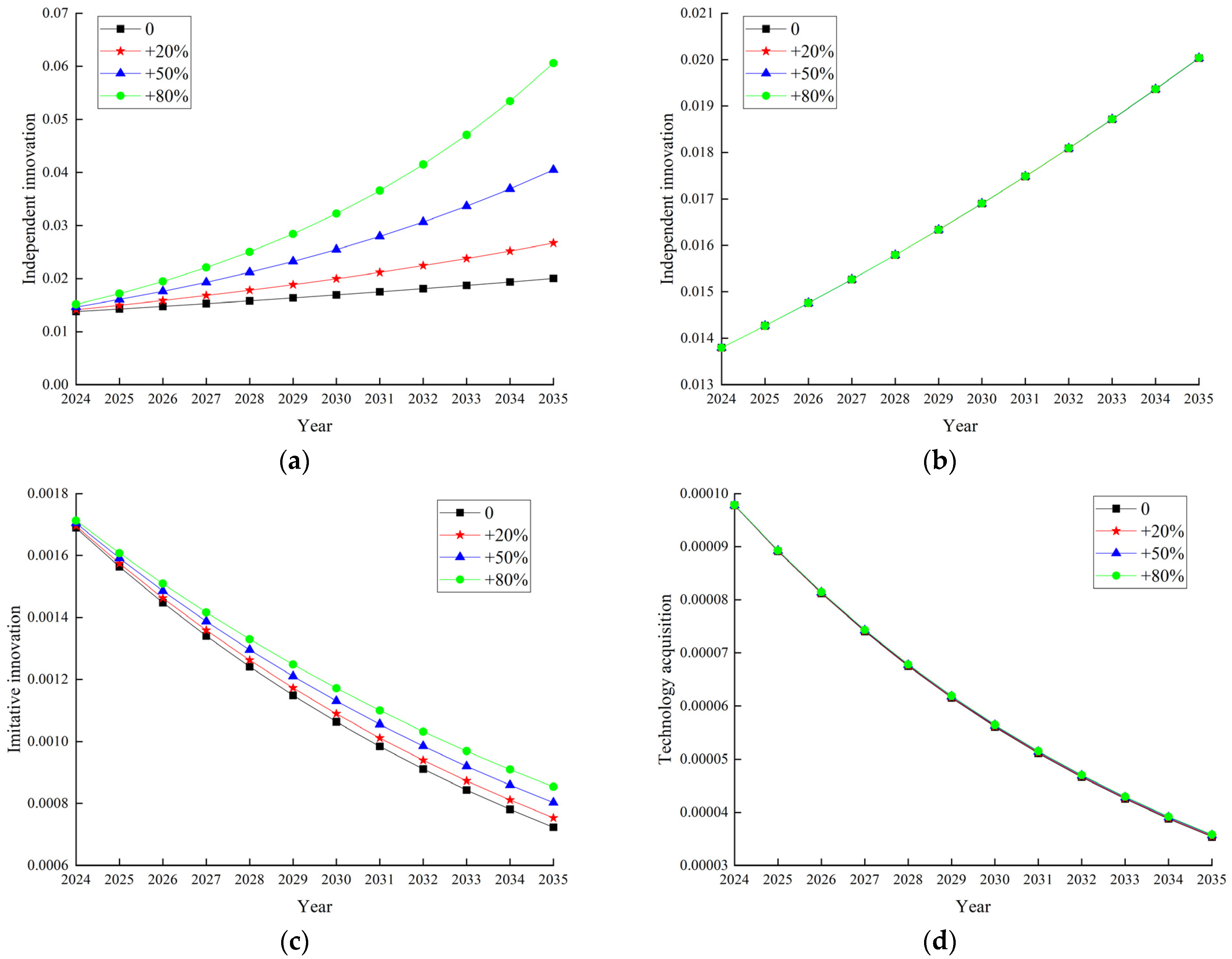
The technological innovation discussed in this paper mainly encompasses three types: independent innovation, imitative innovation, and technology acquisition. Among them, independent innovation is primarily influenced by the growth rate of intramural expenditure on R&D and the growth rate of expenditure on technology assimilation. Imitative innovation is mainly affected by the growth rate of expenditure on technological renovation, and technology acquisition is predominantly impacted by the growth rate of expenditure on technology acquisition. While maintaining the initial values and other factors constant, we adjusted each of these key parameters by increasing their baseline values by 20%, 50%, and 80%, respectively. The resulting trends of technological innovation are shown in Figure 4.
As shown in Figure 4, the trends of independent innovation, imitative innovation, and technology acquisition remain unchanged despite variations in each element, indicating that the system model constructed in this study is relatively stable. From Figure 4a,b, it can be observed that when the growth rate of intramural expenditure on R&D increases progressively, independent innovation improves significantly. However, when the growth rate of expenditure on technology assimilation increases gradually, the change in independent innovation is not pronounced. Evidently, the growth rate of intramural expenditure on R&D has the greatest impact on independent innovation and is the most sensitive factor. From Figure 4c, it can be seen that when the growth rate of expenditure on technical renovation increases progressively, the change in imitative innovation is relatively noticeable. From Figure 4d, it can be observed that when the growth rate of expenditure on technology acquisition increases gradually, the change in technology acquisition is relatively minor. This is because technology acquisition is measured as the ratio of expenditure on technology acquisition to the main business revenue. There exists a significant scale disparity between expenditure on technology acquisition and main business revenue, which means that changes in the growth rate of expenditure on technology acquisition only induce minor fluctuations in technology acquisition. Nevertheless, the growth rate of expenditure on technology acquisition remains a core influencing factor for technology acquisition and continues to be an indispensable component in the subsequent analysis.
(2)
Sensitivity analysis of environmental regulation
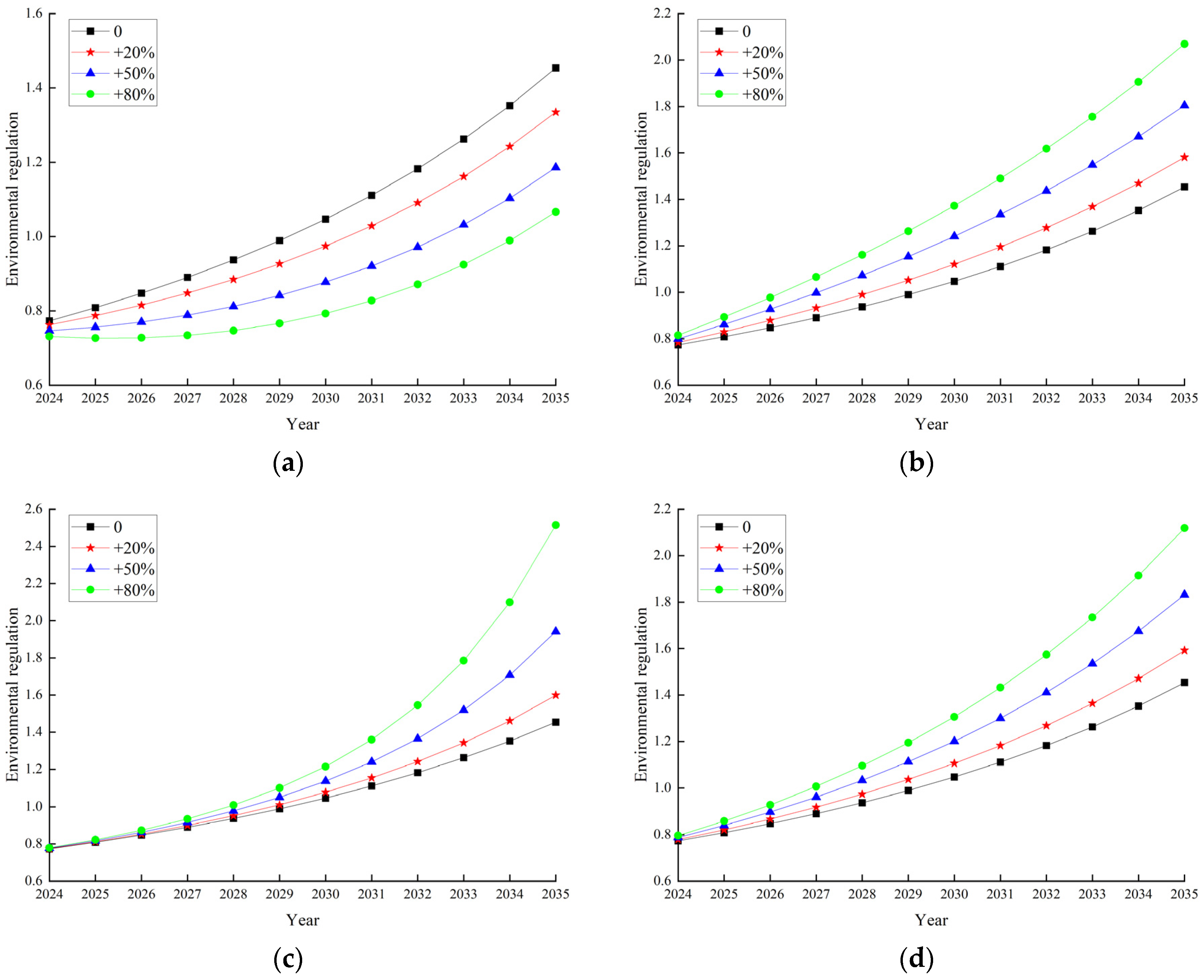
Environmental regulation is primarily influenced by the growth rate of solid wastes generated, the growth rate of solid wastes utilized, the growth rate of waste gas treatment expenditure, and the growth rate of wastewater treatment expenditure. While maintaining the initial values and other factors constant, this study adjusted each element by increasing the original values by 20%, 50%, and 80%, respectively. The resulting trends of environmental regulation are shown in Figure 5.
As shown in Figure 5, the trend of environmental regulation remains unchanged despite variations in each element, indicating that the system model constructed in this study is relatively stable. When the growth rate of solid wastes generated increases progressively, environmental regulation declines significantly. Conversely, when the growth rate of solid waste use, the growth rate of waste gas treatment expenditure, and the growth rate of wastewater treatment expenditure increase gradually, environmental regulation shows a notable rise. This is because the measurement index of environmental regulation is jointly composed of the solid waste utilization rate, waste gas treatment expenditure, and wastewater treatment expenditure. When the amount of solid wastes generated increases while the amount utilized remains unchanged, the solid waste utilization rate declines, thereby lowering the overall level of environmental regulation. Conversely, the increase in the amount of solid wastes utilized, waste gas treatment expenditure, and wastewater treatment expenditure indicates that enterprises have invested more in pollution control, reflecting stronger environmental regulation intensity, and thus the level of environmental regulation rises significantly. In other words, for environmental regulation, the growth rate of solid wastes generated, the growth rate of solid wastes utilized, the growth rate of waste gas treatment expenditure, and the growth rate of wastewater treatment expenditure are all sensitive factors. Compared to the other three indicators, the growth rate of solid wastes utilized, as an outcome-based indicator, is not only highly sensitive to environmental regulation, directly reflecting the core objectives of environmental regulation to reduce pollution and promote resource recycling, but also exhibits better data availability and stability due to its continuous disclosure and uniform measurement standards in industry statistics. Therefore, in the subsequent research, we selected the growth rate of solid waste utilization to represent environmental regulation for further investigation.

2.10. Design of Green Transformation Pathways

The controllable core variables within the green transformation system are crucial in influencing the system’s state. By regulating different development modes of these core variables, it provides an important reference value for simulating and predicting future green transformation conditions. Considering that changes in green transformation of China’s light industry are mainly influenced by its own inputs and various factors, we designed 44 green transformation pathways across four regulation modes—single development mode, government–enterprise collaboration mode, technology collaboration mode, and diversified collaboration mode—based on the situation from 2004 to 2023, from the perspectives of technological innovation and environmental regulation (Table 2). Furthermore, environmental regulation and technological innovation may involve multiple scenarios during the change process. To focus on key points, this paper only discusses the above 44 pathways, and other pathways, such as simultaneous changes in independent innovation and imitative innovation, or in independent innovation and technology acquisition, are not further analyzed. Here, the single development mode refers to the scenario where only one factor changes, while other factors remain constant. The government–enterprise collaboration mode refers to the scenario involving changes in environmental regulation and a single technological innovation method. The technology collaboration mode refers to the scenario involving combinations of multiple technological innovation methods. The diversified collaboration mode refers to the scenario involving changes in environmental regulation and multiple technological innovation methods simultaneously.
During the process of setting variable parameters, we primarily selected four regulatory factors based on the specific indicators related to environmental regulation, independent innovation, imitative innovation, and technology acquisition. These factors are the growth rate of solid waste utilization, the growth rate of intramural expenditure on R&D, the growth rate of expenditure on technological renovation, and the growth rate of expenditure on technology acquisition. In the baseline pathway, the values of these four regulatory factors from 2023 to 2035 were primarily derived from the average values observed between 2004 and 2022. Among the 44 designed green transformation pathways, the values of each regulatory factor in the baseline pathway during the simulation period were adjusted mainly by increasing or decreasing by 50% based on the original values. The parameter settings for different pathways are shown in Table 3.

3. Results

3.1. Baseline Pathway Analysis

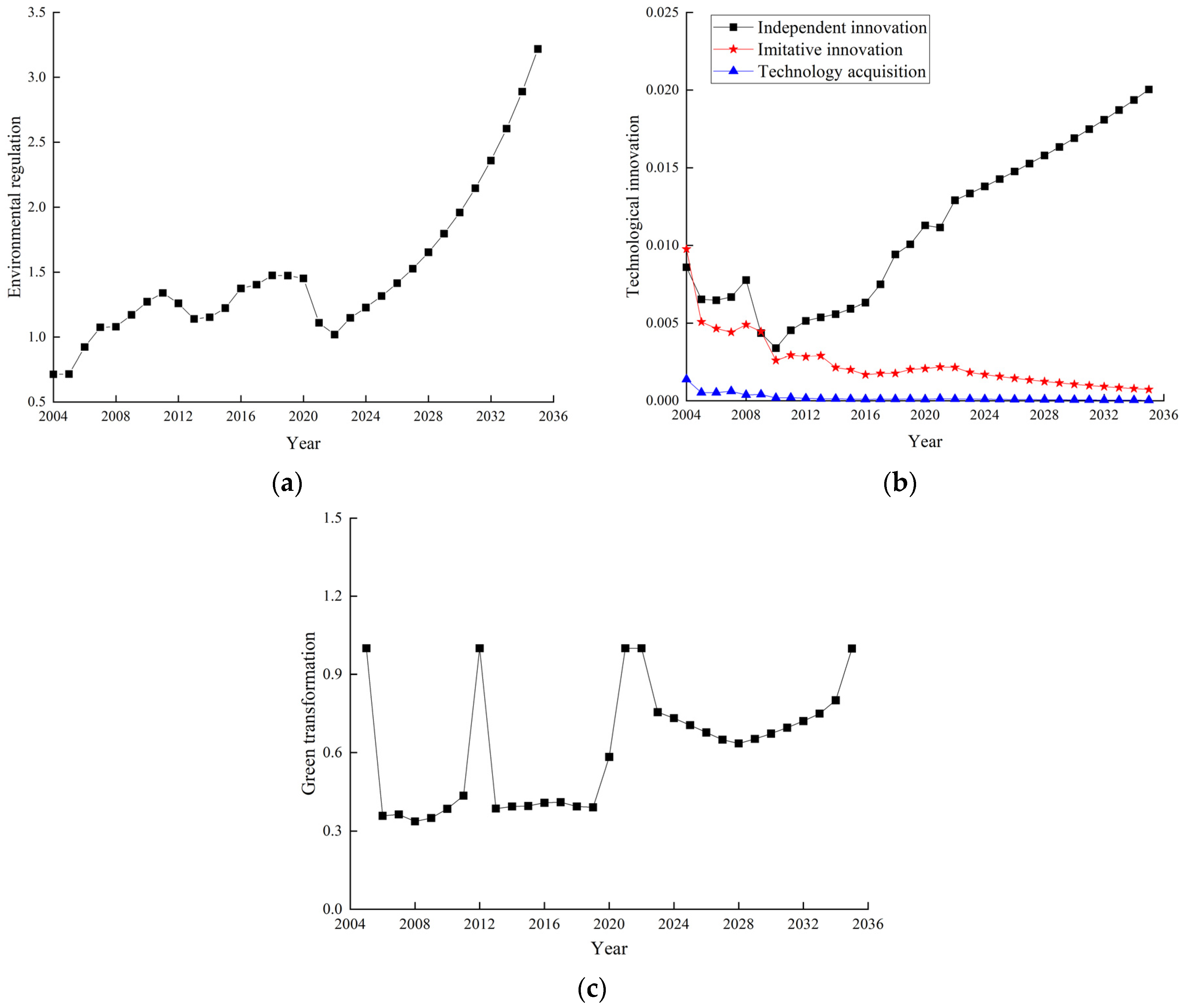
Using a system dynamics model, this paper investigates the evolutionary trends of China’s light industry. Under the existing variable relationships and parameter values, the development trends of technological innovation, environmental regulation, and green transformation are shown in Figure 6.
(1) Environmental regulation: As can be seen from Figure 6a, after 2023, environmental regulation in China’s light industry will show an upward trend. This is because, in recent years, China has issued numerous policy documents to address resource, environmental, and ecological issues and to promote the green development of the socio-economic. For example, the Opinions on Promoting Green and Low-Carbon Transformation and Strengthening the Construction of the National Carbon Market, and the Recommendations of the Communist Party of China Central Committee on Formulating the 15th Five-Year Plan for National Economic and Social Development, both issued in 2025, emphasize accelerating green transformation to ensure the timely achievement of the “dual carbon” goals. In other words, to achieve these goals, China may introduce more environmental protection policies in the future, which will further strengthen environmental regulation in China’s light industry. Similar findings have been documented in previous studies. For instance, Kou and Shi found that environmental regulation in China shows an overall upward trend, with regions at higher economic development levels experiencing faster growth in environmental regulation [54].
(2) Technological innovation: As can be seen from Figure 6b, after 2023, independent innovation in China’s light industry will show an upward trend, while imitative innovation and technology acquisition will decline. This is because, as living standards improve, consumers’ demands for light industrial products are increasing, prompting more and more enterprises to recognize the importance of technological innovation. Meanwhile, as the demographic dividend gradually disappears and resource and environmental constraints tighten, traditional development models have become unsustainable. Only through independent innovation, accelerating the cultivation of new growth drivers, and developing a new economy can sustained and healthy economic development be achieved. In relevant studies, scholars have conducted analyses on China’s high-tech industry and pointed out that China is currently entering an era of transition from secondary innovation to independent innovation, and relevant enterprises should attach importance to independent innovation [55].
(3) Green transformation: As can be seen from Figure 6c, after 2023, the green transformation of China’s light industry will show a trend of first declining and then rising. This is because environmental regulation may increase enterprise costs, thereby suppressing the green transformation of the light industry to some extent. At the same time, stricter environmental regulations will also force more and more enterprises to pursue independent innovation. As increasing numbers of green technologies are developed and applied, they will gradually offset the negative impacts of environmental regulation during the process of driving rapid development in the light industry, ultimately promoting its green transformation.

3.2. Simulation of Green Transformation Pathways

Using the Vensim PLE software, this paper conducts simulation modeling of a total of 44 pathways across four types of regulatory modes, namely single development mode, government–enterprise collaboration mode, technology collaboration mode, and diversified collaboration mode, from the perspectives of technological innovation and environmental regulation.

3.2.1. Single Development Mode

In the single development mode, we conducted simulation predictions for pathways 1–8 (Table 4). Among them, pathway 0 serves as the baseline pathway and is primarily used for comparative analysis.
① Analysis of environmental regulation change pathways: By comparing pathway 1, pathway 2, and the baseline pathway, it is observed that the annual average of green transformation for pathway 1 from 2024 to 2035 is higher than that of the baseline pathway, while pathway 2 is lower. This indicates that increasing environmental regulation has a positive impact on the green transformation. This is because stringent environmental regulation compels light industry enterprises to internalize environmental costs, forcing them to adopt cleaner production technologies, improve resource efficiency, and increase investment in green innovation, thereby promoting the green transformation of the entire industry. This conclusion is consistent with previous studies. For instance, scholars have found that formal, informal, and dual environmental regulations all significantly promote enterprises’ green transformation [56]. Additionally, some scholars have indicated that stringent environmental regulation facilitates the green transformation of manufacturing enterprises, and this facilitating effect is more pronounced for state-owned enterprises and those with higher production efficiency [57].
② Analysis of technological innovation change pathways: In terms of independent innovation, pathway 3 has a higher annual average of green transformation from 2024 to 2035 compared to the baseline pathway, while pathway 4 is lower. This indicates that increasing independent innovation will facilitate green transformation. Similar findings have been reported in previous studies. For instance, Jia et al. found that independent innovation has a positive effect on green growth across 29 provinces in China, with a more pronounced impact in the eastern regions [58]. In terms of imitative innovation, pathway 5 has a higher annual average of green transformation from 2024 to 2035 compared to the baseline pathway, while pathway 6 is lower. This indicates that increasing imitative innovation will facilitate green transformation. Previous studies have also explored this at the regional level, revealing that while imitative innovation generally exerts a negative impact on China’s green growth, it demonstrates a positive effect in eastern regions [58]. In terms of technology acquisition, pathway 8 has a higher annual average of green transformation from 2024 to 2035 compared to the baseline pathway, while pathway 7 is lower. This indicates that increasing technology acquisition will inhibit green transformation. Among the three types of technological innovation, independent innovation has the most significant impact on the green transformation of the light industry, followed by imitative innovation, and technology acquisition has the weakest impact. This is because independent innovation can target the specific needs of light industry enterprises and green development goals, developing tailored green technologies and processes from the source and accurately guiding the direction of green transformation, thus yielding the strongest positive impact. Although imitative innovation lacks originality, it enables the rapid adoption of mature green technologies, reducing trial-and-error costs and promoting green transformation to a certain extent. In contrast, technology acquisition often prioritizes short-term efficiency improvements over environmental compatibility, potentially leading to the introduction of energy-intensive or outdated equipment. However, due to its limited scale and the potential for subsequent upgrades, its negative impact is relatively weak. Previous scholars have also explored this issue. For example, Liu and Zhang found that independent innovation and imitative innovation are important channels through which the digital economy affects carbon emissions, whereas technology acquisition is not an effective pathway [59]. Beyond these three types of technological innovation, some scholars have explored digital technology innovation. For instance, research has shown that digital technological innovation can reduce transaction costs, enhance human capital, and alleviate information asymmetry to some extent, thereby facilitating the green transformation of the manufacturing industry [60]. Additionally, some scholars have pointed out that for enterprises in technology-intensive and capital-intensive industries, digital technology innovation can significantly reduce carbon emissions, helping enterprises achieve green transformation [61].
③ Analysis of single development mode. Among the eight pathways in the single development mode, pathway 3 is identified as the optimal, while pathway 4 is the least favorable. This indicates that increasing independent innovation has the greatest facilitative effect, while decreasing independent innovation has the greatest inhibitory effect. Concurrently, the annual average values for green transformation from 2024 to 2035 for pathways 1, 3, 5, and 8 are all higher than those of the baseline pathway. This indicates that increasing environmental regulation, increasing independent innovation, increasing imitative innovation, and decreasing technology acquisition will all promote green transformation. Furthermore, a comparison of pathways 1, 3, 5, and 8 reveals that the impact of environmental regulation and technological innovation on green transition is ranked as follows: independent innovation > environmental regulation > imitative innovation > technology acquisition. Independent innovation exerts a stronger promoting effect on the green transformation of the light industry than environmental regulation. This is because independent innovation can stimulate the endogenous motivation of light industry enterprises, thereby reconstructing the green production system from the source and forming long-term competitive advantages. In contrast, as an external constraint, environmental regulation mostly forces enterprises to adopt end-of-pipe treatment, making it difficult to fundamentally break through technical bottlenecks.

3.2.2. Government–Enterprise Collaboration Mode

In the government–enterprise collaboration mode, this paper primarily explores the scenario where environmental regulation and single technological innovation undergo concurrent changes (Table 5).
Among the 12 pathways in the government–enterprise collaboration mode, pathway 9 has the highest average annual value for green transformation from 2024 to 2035, indicating that the combination of increasing environmental regulation and increasing independent innovation is the best pathway. Conversely, pathway 16 has the lowest average annual value, indicating that the combination of decreasing environmental regulation and decreasing independent innovation is the worst pathway. This is because the external pressure of environmental regulation and the technological breakthroughs from independent innovation will form a synergy, thereby fundamentally advancing the green transformation of the light industry. Among pathways 9, 11, 12, 13, 14, 15, and 17, China’s light industry can achieve a certain degree of improvement in green transformation. By comparing pathways 9, 10, 15, and 16, it can be observed that when both environmental regulation and independent innovation are adjusted simultaneously, either increasing or decreasing environmental regulation may promote the green transformation of the light industry, but decreasing independent innovation will inhibit it. This indicates that independent innovation serves as the core driver for the green transformation of the light industry. While environmental regulation may exert some influence on green transformation, it cannot compensate for the lack of innovation. By comparing pathways 11, 12, 17, and 18, it can be observed that when both environmental regulation and imitative innovation decrease simultaneously, they hinder the green transformation of the light industry. However, when at least one of them increases, it promotes such a transformation. Furthermore, by comparing pathways 13, 14, 19, and 20, it can be found that when both environmental regulation and technology acquisition are adjusted simultaneously, increasing or decreasing technology acquisition will promote green transformation, but decreasing environmental regulation will inhibit it. In general, independent innovation is the cornerstone of the green transformation of the light industry and must not be diminished. Environmental regulation provides necessary constraints and is indispensable. Imitative innovation and technology acquisition serve as effective supplementary approaches that can assist in promoting the green transformation of the light industry, but they cannot be substituted.

3.2.3. Technology Collaboration Mode

In the technology collaboration mode, this paper mainly explores the scenario where three technological innovation methods (independent innovation, imitative innovation, and technology acquisition) change simultaneously (Table 6).
Among the eight pathways in the technology collaboration mode, pathway 22 has the highest average annual value for green transformation, indicating that the combination of increasing independent innovation, increasing imitative innovation, and decreasing technology acquisition is the optimal pathway. Conversely, pathway 27 has the lowest average annual value for green transformation, indicating that the combination of decreasing independent innovation, decreasing imitative innovation, and increasing technology acquisition is the worst pathway. In other words, the synergy of multiple technological innovations can promote the green transformation of the light industry. In previous studies, some scholars have also explored the relationships among different types of technological innovations. For instance, Qin explored the relationship between independent innovation and imitative innovation using game theory and found that enterprises can achieve higher returns by simultaneously adopting both independent innovation and imitative innovation [62]. In pathways 21–24, green transformation can achieve a certain degree of enhancement. However, when compared with pathways 26–28, which lead to decreased green transformation, it becomes evident that, in pathways where multiple technological innovation methods are undergoing simultaneous changes, decreasing independent innovation has a significant adverse impact on green transformation. This is because independent innovation serves as the fundamental endogenous driver for the green transformation of the light industry, and reducing it directly weakens the core technological capabilities of enterprises. This absence of a core driving force cannot be compensated for by other innovation approaches.

3.2.4. Diversified Collaboration Mode

In the diversified collaboration mode, this paper mainly explores the scenario where multiple factors change simultaneously (Table 7).
Among the 16 pathways in the diversified collaboration mode, pathway 30 has the highest average annual value for green transformation, indicating that the combination of increasing environmental regulation, increasing independent innovation, increasing imitative innovation, and decreasing technology acquisition is the optimal pathway. Conversely, pathway 43 has the lowest average annual value for green transformation, indicating that the combination of decreasing environmental regulation, decreasing independent innovation, decreasing imitative innovation, and increasing technology acquisition is the worst pathway. In pathways 29–32 and 37–40, green transformation improves to some extent. However, in contrast to pathways 33–36 and 41–44, where green transformation declines, it is evident that decreasing indigenous innovation exerts a significant inhibitory effect on green transformation under simultaneous changes in environmental regulation and multiple technological innovation methods. In previous studies, scholars have also explored the impact of technological innovation and environmental regulation on green transformation. For instance, Saeed et al., taking listed manufacturing companies in Japan as an example, found that environmental regulation could play a positive mediating role in the process of technological innovation, driving corporate green transformation [63]. Zhang et al. investigated China’s industry at the regional level and discovered that environmental regulation facilitates industrial green transformation, and this facilitating effect is significantly enhanced under the moderating influence of technological innovation [64].

4. Conclusions and Recommendations

4.1. Conclusions

Based on the statistical data of 16 light industry sectors in China from 2004 to 2023, we constructed a system dynamics model, designed a total of 44 green transformation pathways under four types of regulatory modes, and conducted simulation analyses. By comparing the development and evolution trends of green transformation under both the baseline pathway and the simulated pathways, this paper clarifies the comprehensive effects of various factors and proposes pathways for achieving green transformation. The research conclusions are as follows:
(1) After 2023, independent innovation and environmental regulation in the light industry show an upward trend, while imitative innovation and technology acquisition show a downward trend, and green transformation will show a trend of first declining and then rising.
(2) Among the factors influencing green transformation, environmental regulation, independent innovation, and imitative innovation all play a promoting role, while technology acquisition plays an inhibitory role. Notably, independent innovation has the most significant effect, while technology import has the least.
(3) Among the various pathways for green transformation, the synergistic combination of strengthened environmental regulation and technological innovation yields better results than relying solely on either stricter regulation or innovation alone. Furthermore, simultaneously implementing measures to increase environmental regulation, strengthen independent innovation, promote imitative innovation, and reduce technology acquisition represents the optimal pathway for driving the green transformation.

4.2. Recommendations

(1) Optimize the technological innovation pathway and promote diversified collaborative innovation. On the one hand, it is essential to optimize the investment structure of the technological innovation system. Enterprises should choose appropriate technological innovation pathways based on industry characteristics and their own development situations. For example, industries such as medicines and chemical fibres can further increase their investment in independent innovation and imitative innovation, while reducing the level of technology acquisition. Although imitative innovation can drive green transformation, the propelling effect of independent innovation is more pronounced in the long run. To this end, the government and enterprises should work together to encourage enterprises to increase investments in independent innovation through policy guidance, tax incentives, and other means. They should establish independent research institutions and increase investment in key core technologies, generic technologies, and frontier technologies. Meanwhile, they should strengthen intellectual property protection, raise the costs of infringement, lower the difficulty of safeguarding rights, and provide robust legal protection for innovators. On the other hand, it is necessary to enhance collaborative innovation involving multiple stakeholders. For the light industry, the synergistic cooperation of multiple technological innovation methods has a greater impact on its green transformation than a single technological innovation method. To this end, a stable and long-term cooperation mechanism needs to be established among governments, light industry enterprises, universities, scientific research institutions, and other entities to promote technological collaboration. For instance, a unified innovation platform can be built to facilitate information exchange, technological cooperation, technology transfer, and achievement transformation among multiple entities. At the same time, the goals of diversified collaborative participation, such as technological innovation, product innovation, and market innovation, should be clarified. Furthermore, risk management should be strengthened in terms of risk assessment, risk warning, and risk control. By reasonably sharing risks, the overall risk level of innovation activities can be reduced.
(2) Innovate the approaches to environmental regulation and scientifically determine its intensity. On the one hand, the government should take coordinated measures in legislation, law enforcement, supervision, and other aspects to formulate scientific and rational environmental protection laws and ensure their strict enforcement and oversight. In this process, the government should clarify the responsibilities and powers of environmental protection agencies to prevent abuse of power and corruption. For instance, a scientific evaluation mechanism can be established to regularly assess and provide feedback on the work of environmental protection agencies, thereby continuously enhancing their regulatory capabilities and efficiency. On the other hand, the government should comprehensively utilize various types of environmental regulation means, including economic, regulatory, and voluntary approaches, to form a policy synergy that incentivizes and constrains enterprises, individuals, and other parties to pursue green development. For example, for light industries with relatively severe pollution, such as the leather industry and paper industry, the government can strengthen environmental regulation standards and drive enterprises towards green transformation through policies, regulations, and other means. For light industries with relatively mild pollution, such as the cultural and educational industry, the government can offer preferential policies like green credit and financial subsidies to mitigate their risks.

4.3. Limitations and Future Directions

Based on the system dynamics model, this study reveals the evolution trends of the green transformation of China’s light industry under various pathways, yet certain limitations remain. First, while this paper provides an in-depth examination of the overall characteristics of the green transformation across 16 light industry sectors in China, the heterogeneity analysis of specific sub-sectors such as food, home appliances, and papermaking remains inadequate. Additionally, we have not fully accounted for regional disparities in the green transformation of the light industry. Second, the system dynamics model constructed for this study incorporates only elements directly related to green transformation, technological innovation, and environmental regulation. Other potential influencing factors, such as market demand, resource endowment, and investment environment, have not been included in the current analytical framework. Third, although the data employed were sourced from publicly available and authoritative statistical yearbooks, spanning over two decades, there may have been changes in statistical standards, coverage, and measurement methodologies during this period, which could affect the precision of the findings. For instance, the classification criteria for China’s light industry underwent a change in 2011. For the convenience of statistical analysis, in this study, we combined the rubber products industry and the plastic products industry into the rubber and plastic products industry.
In the future, we will explore the implementation pathways for the green transformation of China’s light industry from a comprehensive industry-region perspective, taking into account specific regional contexts. Simultaneously, we will further expand our research dimensions by incorporating factors such as digital technology and regional disparities into our analytical framework to explore diversified pathways for the green transformation of China’s light industry. Additionally, we will construct a more refined and unified thematic database on the green transformation of the light industry by integrating multi-source data from enterprises and industries, thereby further enhancing the reliability and generalizability of our research conclusions.

Author Contributions

Conceptualization, J.C. and F.S.; methodology, J.C.; software, J.C.; validation, J.C. and D.C.; formal analysis, J.C.; investigation, J.C.; resources, J.C.; data curation, J.C.; writing—original draft preparation, J.C.; writing—review and editing, J.C. and F.S.; visualization, J.C.; supervision, F.S. and D.C.; project administration, J.C. and F.S.; funding acquisition, J.C. and F.S. All authors have read and agreed to the published version of the manuscript.

Funding

This research was funded by the National Natural Science Foundation of China, grant numbers 42171281 and 72034007; Shaanxi Province Postdoctoral Science Foundation, grant number 2024BSHSDZZ013; and Shaanxi Provincial Social Science Fund Project, grant number 2025QBD049.

Institutional Review Board Statement

Not applicable.

Informed Consent Statement

Not applicable.

Data Availability Statement

The original contributions presented in this study are included in the article. Further inquiries can be directed to the corresponding author.

Conflicts of Interest

The authors declare no conflicts of interest.

References

  1. Deng, C.; Su, Z.; Feng, Y. Extreme climate and corporate financialization: Evidence from China. Econ. Anal. Policy 2024, 81, 306–321. [Google Scholar] [CrossRef]
  2. Zhao, Q.; Gao, L.; Meng, Q.; Zhu, M.; Xiong, M. Nonlinear causal relationships between urbanization and extreme climate events in China. J. Clean. Prod. 2024, 434, 139889. [Google Scholar] [CrossRef]
  3. Zheng, T.; Zhang, H.; Ye, S. Transition risks and industry connectedness under China’s dual carbon goal: Analysis based on high-dimensional time-frequency complex network. J. Quant. Tech. Econ. 2025, 42, 151–173. [Google Scholar] [CrossRef]
  4. Pereira, L.G.; Chagas, M.F.; Folegatti, M.I.S.; Seabra, J.E.A.; Ramos, N.P.; Scachetti, M.T.; Picoli, J.F.; Moreira, M.M.R.; Novaes, R.M.L.; Bonomi, A.M.; et al. RenovaCalc: Calculation of Carbon Intensities Under Brazil’s National Biofuel Policy. Sustainability 2025, 17, 10442. [Google Scholar] [CrossRef]
  5. Yang, F.; Li, C.; Zhang, S. Digital economy and carbon emission intensity: Evidence from ASEAN. Sustainability 2025, 17, 10266. [Google Scholar] [CrossRef]
  6. Madjar, R.M.; Vasile Scăețeanu, G.; Butcaru, A.-C.; Moț, A. Sustainable approaches to agricultural greenhouse gas mitigation in the EU: Practices, mechanisms, and policy integration. Sustainability 2025, 17, 10228. [Google Scholar] [CrossRef]
  7. Zhu, Y.; Hu, Y.; Zhu, Y. Can China’s energy policies achieve the “dual carbon” goal? A multi-dimensional analysis based on policy text tools. Environ. Dev. Sustain. 2024, 1–40. [Google Scholar] [CrossRef]
  8. Jing, Z.; Feng, H. Selection and application of China environmental sustainability policy instrumental: A quantitative analysis based on “dual carbon” policy text. Front. Environ. Sci. 2024, 12, 1418253. [Google Scholar] [CrossRef]
  9. Li, J.; Lin, B. Ecological total-factor energy efficiency of China’s heavy and light industries: Which performs better? Renew. Sustain. Energy Rev. 2017, 72, 83–94. [Google Scholar] [CrossRef]
  10. Chen, S.; Zhang, J.; Liu, C. Environmental regulation, financing constraints, and enterprise emission reduction: Evidence from pollution levy standards adjustment. J. Financ. Res. 2021, 495, 51–71. Available online: http://www.jryj.org.cn/CN/Y2021/V495/I9/51 (accessed on 20 March 2025).
  11. Yu, E.; Ni, Z. Can green transformation of enterprises improve the efficiency of financial assets allocation under carbon peaking and carbon neutrality goals? Stat. Res. 2025, 42, 66–78. [Google Scholar] [CrossRef]
  12. Tang, H. Accelerating high-quality development of the light industry. West Leather 2022, 44, 2. Available online: https://www.cnki.com.cn/Article/CJFDTOTAL-XBPG202213050.htm (accessed on 20 March 2025).
  13. Zhang, X.; Zhao, Y. Research on the green transformation path of light industry under the background of new-type industrialization. Digit. Transform. 2025, 2, 30–37. Available online: https://www.cnki.com.cn/Article/CJFDTOTAL-SZHZ202504004.htm (accessed on 10 October 2025).
  14. Zhao, J.; Wang, X.; Li, X. Impact mechanisms of green technology innovation and environmental regulation on the green development of cities in the Yellow River Basin. China Popul. Resour. Environ. 2024, 34, 132–141. Available online: https://www.cnki.com.cn/Article/CJFDTOTAL-ZGRZ202409013.htm (accessed on 8 October 2025).
  15. Wu, P.; Li, Y.; Ye, K. Environmental regulation, technological innovation and green total factor productivity of industrial enterprises: An analysis based on Chinese interprovincial panel data. Sci. Sci. Manag. S. T. 2024, 45, 110–128. Available online: https://www.cnki.com.cn/Article/CJFDTOTAL-KXXG202407006.htm (accessed on 8 October 2025).
  16. Blind, K. The influence of regulations on innovation: A quantitative assessment for OECD countries. Res. Policy 2012, 41, 391–400. [Google Scholar] [CrossRef]
  17. Zhang, G.; Feng, Y.; Wang, A. The heterogeneous effects of different types of environmental regulation on technological innovation of industrial enterprises. Manag. Rev. 2021, 33, 92–102. [Google Scholar] [CrossRef]
  18. Hu, J.; Huang, N.; Shen, H. Can market-incentive environmental regulation promote corporate innovation? A natural experiment based on China’s carbon emissions trading mechanism. J. Financ. Res. 2020, 1, 171–189. Available online: https://www.cnki.com.cn/Article/CJFDTotal-JRYJ202001010.htm (accessed on 20 March 2025).
  19. Wang, Z.; Cao, Y.; Lin, S. The characteristics and heterogeneity of environmental regulation’s impact on enterprises’ green technology innovation—Based on green patent data of listed firms in China. Stud. Sci. Sci. 2021, 39, 909–919. [Google Scholar] [CrossRef]
  20. Wang, J.; Yu, S.; Li, M.; Cheng, Y.; Wang, C. Study of the impact of industrial restructuring on the spatial and temporal evolution of carbon emission intensity in Chinese provinces—Analysis of mediating effects based on technological innovation. Int. J. Environ. Res. Public Health 2022, 19, 13401. [Google Scholar] [CrossRef]
  21. Wang, X.; Wang, Z.; Wang, R. Does green economy contribute towards COP26 ambitions? Exploring the influence of natural resource endowment and technological innovation on the growth efficiency of China’s regional green economy. Resour. Policy 2023, 80, 103189. [Google Scholar] [CrossRef]
  22. Wan, P.; Yang, M.; Chen, L. How do environmental technology standards affect the green transition of China’s manufacturing industry—A perspective from technological transformation. China Ind. Econ. 2021, 9, 118–136. [Google Scholar] [CrossRef]
  23. Liu, Q.; Cheng, H.; Shao, L.; Chen, H.; Liu, X. Empirical study on the effects of coordinated development of two-way FDI on regional green transformation under the carbon peaking and carbon neutrality goals: Local and spatial spillovers. China Soft Sci. 2024, 2, 104–112. Available online: https://www.cnki.com.cn/Article/CJFDTOTAL-ZGRK202402011.htm (accessed on 8 October 2025).
  24. Qi, Y. Energy conservation and emission reduction, environmental regulation, and China’s industrial green transformation. Jiangxi Soc. Sci. 2018, 38, 70–79. Available online: https://www.cnki.com.cn/Article/CJFDTotal-JXSH201803018.htm (accessed on 20 March 2025).
  25. Deng, H.; Yang, L. Haze governance, local competition and industrial green transformation. China Ind. Econ. 2019, 10, 118–136. Available online: https://link.cnki.net/urlid/11.3536.f.20191016.0911.014 (accessed on 20 March 2025).
  26. Ouyang, X.; Liao, J.; Wei, X.; Du, K. A good medicine tastes bitter: Environmental regulation that shapes China’s green productivity. Environ. Impact Assess. Rev. 2024, 105, 107423. [Google Scholar] [CrossRef]
  27. Huang, Q.; Hu, J.; Chen, X. Environmental regulation and green total factor productivity: Dilemma or win-win? China Popul. Resour. Environ. 2018, 28, 140–149. Available online: https://www.cnki.com.cn/Article/CJFDTOTAL-ZGRZ201811016.htm (accessed on 20 March 2025).
  28. Richardson, P.G. Mixed Blessings: Valedictory Thoughts on System Dynamics Practice. Syst. Dyn. Rev. 2025, 41, e70010. [Google Scholar] [CrossRef]
  29. Rhouma, A.; Mellios, N.; Brouwer, F.; Maria, G.J.; Laspidou, C. Assessing vineyard sustainability through a water-energy-food-ecosystems nexus indicator using system dynamics modelling. Clean. Environ. Syst. 2025, 19, 100346. [Google Scholar] [CrossRef]
  30. Osman, S.; Churruca, K.; Jalali, S.M.; Ellis, A.L.; Braithwaite, J. Conceptualising the impact of telehealth on rural workforce sustainability using system dynamics and the gartner hype cycle. Npj Health Syst. 2025, 2, 38. [Google Scholar] [CrossRef]
  31. Khan, N.; Khan, A.I.K.; Khan, H. System dynamics modeling of social sustainability in circular construction transitions: Causal loop analysis of stakeholder engagement mechanisms from selected developing countries’ perspective. Environ. Impact Assess. Rev. 2026, 117, 108197. [Google Scholar] [CrossRef]
  32. Chen, S. Green industrial revolution in China: A perspective from the change of environmental total factor productivity. Econ. Res. J. 2010, 45, 21–34. Available online: https://www.cnki.com.cn/Article/CJFDTotal-JJYJ201011005.htm (accessed on 8 October 2025).
  33. Oh, D.H. A global Malmquist-Luenberger productivity index. J. Prod. Anal. 2010, 34, 183–197. [Google Scholar] [CrossRef]
  34. Sun, H.; Liu, Z. Environmental regulation, clean-technology innovation and China’s industrial green transformation. Sci. Res. Manag. 2021, 42, 54–61. [Google Scholar] [CrossRef]
  35. Chen, Y. Research on the mediating and threshold effects of environmental regulation on industrial green transformation. Theor. Pract. Financ. Econ. 2023, 44, 130–137. [Google Scholar] [CrossRef]
  36. Chen, C. China’s industrial green total factor productivity and its determinants: An empirical study based on ML index and dynamic panel data model. Stat. Res. 2016, 33, 53–62. [Google Scholar] [CrossRef]
  37. Liu, C.Y.; Xu, J.; Zhao, J. Dual effects of outward foreign direct investment on industrial green transformation: Based on the bilateral stochastic frontier model. China Popul. Resour. Environ. 2024, 34, 126–137. [Google Scholar] [CrossRef]
  38. Zhao, Y.; Chen, H. Heterogeneous technological innovation and the improvement of green total factor productivity. Financ. Account. Mon. 2020, 18, 145–152. [Google Scholar] [CrossRef]
  39. Lan, Z.; Sun, Z. Research on the green productivity of China’s light industry and the influencing factors under the constraints of carbon emissions: Based on the panel data of 16 Chinese light industry sectors. China Popul. Resour. Environ. 2020, 30, 58–68. Available online: https://www.cnki.com.cn/Article/CJFDTOTAL-ZGRZ202005007.htm (accessed on 20 March 2025).
  40. Tao, F.; Zhao, J.; Zhou, H. Does environmental regulation improve the quantity and quality of green innovation: Evidence from the target responsibility system of environmental protection. China Ind. Econ. 2021, 2, 136–154. [Google Scholar] [CrossRef]
  41. Qian, H.; Tao, Y.; Cao, S.; Cao, Y. Theoretical and empirical analysis on the development of digital finance and economic growth in China. J. Quant. Technol. Econ. 2020, 37, 26–46. [Google Scholar] [CrossRef]
  42. Tang, S.; Wu, X.; Zhu, J. Digital finance and enterprise technology innovation: Structural feature, mechanism identification and effect difference under financial supervision. J. Manag. World 2020, 36, 52–66. [Google Scholar] [CrossRef]
  43. Song, D.; Song, P.; Chen, Z. The technological path choice of China’s industrial green transformation under environmental regulation: Independent innovation or technology outsourcing? Commer. Res. 2020, 2, 101–110. [Google Scholar] [CrossRef]
  44. Zhang, J.; Cai, N.; Mao, J.; Yang, C. Independent innovation, technology introduction and green growth of industry in China: An empirical research based on industry heterogeneity. Stud. Sci. Sci. 2015, 33, 185–194. [Google Scholar] [CrossRef]
  45. Han, D.; Hao, S. ESG, Innovation and the competitive advantage of construction enterprises in China—An analysis based on the system dynamics. Systems 2025, 13, 997. [Google Scholar] [CrossRef]
  46. Wu, Y.H.; Dai, Y. A system dynamics study on the relationship between financial flexibility and new product development performance. J. Syst. Sci. 2026, 1, 114–122. Available online: https://link.cnki.net/urlid/14.1333.N.20250722.1337.030 (accessed on 8 October 2025).
  47. Yang, Z.H.; Zhou, X.Y.; Lu, Y.Z.; Yang, A. Evolutionary State of AI-enabled smart library digital-Intelligent service system: A simulation analysis based on system dynamics model. Digit. Libr. Forum. 2025, 21, 21–32. Available online: https://link.cnki.net/urlid/11.5359.g2.20250818.0945.002 (accessed on 8 October 2025).
  48. Wu, R.; Yang, C.; Ma, Y.Z.; Yu, T.; Zhao, H. Analysis of synergistic effects of electricity-energy-carbon market based on system dynamics. Sci. Technol. Manag. Res. 2024, 44, 211–221. Available online: https://www.cnki.com.cn/Article/CJFDTOTAL-KJGL202420021.htm (accessed on 8 October 2025).
  49. Fan, H.; Zheng, Y.; Li, X.; Xu, Z.; Khan, H.; Khan, I. The nexus between technological innovations, foreign direct investment, and carbon emissions: Evidence from global perspective. J. Knowl. Econ. 2025, 1–27. [Google Scholar] [CrossRef]
  50. Jiang, L.; Shen, S. Opportunity or curse: Can green technology innovation stabilize employment? Sustainability 2024, 16, 5805. [Google Scholar] [CrossRef]
  51. Aldegheishem, A. Nexus between renewable energy, technological innovation, and carbon dioxide emissions in Saudi Arabia. Open Geosci. 2025, 17, 20250768. [Google Scholar] [CrossRef]
  52. Li, H.; Li, X.; Hu, Z.; Li, Y. Does industrial robot adoption inhibit environmental pollution in China? An empirical study on energy consumption and green technology innovation. J. Environ. Manag. 2025, 373, 123392. [Google Scholar] [CrossRef]
  53. Cieply, I.; Wang, F. Does pollution control foster innovation? Quasi-experimental evidence from China’s two-control zone policy. Rev. Dev. Econ. 2025, 29, 1808–1833. [Google Scholar] [CrossRef]
  54. Kou, P.; Shi, J. Dynamic evolution of China’s government environmental regulation capability and its impact on the coupling coordinated development of the economy-environment. Socio-Econ. Plan. Sci. 2024, 91, 101785. [Google Scholar] [CrossRef]
  55. Cao, B.; Han, Z.; Liang, L.; Liu, Y.; Wang, J.; Xie, J. Independent innovation or secondary innovation: The moderating of network embedded innovation. Sustainability 2022, 14, 14796. [Google Scholar] [CrossRef]
  56. Li, Q.; Cai, Y.; Qiao, Y.; Tan, H. Dual environmental regulation and corporate green transformation: How does digital leadership affect transformation effectiveness? Financ. Res. Lett. 2025, 86, 108690. [Google Scholar] [CrossRef]
  57. Meng, X.; Zhang, M.; Zhao, Y. Environmental regulation and green transition: Quasi-natural experiment from China’s efforts in sulfur dioxide emissions control. J. Clean. Prod. 2024, 434, 139741. [Google Scholar] [CrossRef]
  58. Jia, L.; Xu, R.; Shen, Z.Y.; Song, M. Which type of innovation is more conducive to inclusive green growth: Independent innovation or imitation innovation? J. Clean. Prod. 2023, 406, 137026. [Google Scholar] [CrossRef]
  59. Liu, T.; Zhang, K. Effects of the digital economy on carbon emissions in China: An analysis based on different innovation paths. Environ. Sci. Pollut. Res. 2023, 30, 79451–79468. [Google Scholar] [CrossRef]
  60. Liu, Q. Digital technology innovation empowers green transformation and upgrading of manufacturing industry. Sustain. Environ. 2025, 10. [Google Scholar] [CrossRef]
  61. Liu, Y.; Liu, N.; Huo, Y. Impact of digital technology innovation on carbon emission reduction and energy rebound: Evidence from the Chinese firm level. Energy 2025, 320, 135187. [Google Scholar] [CrossRef]
  62. Qin, S. The non-cooperative game and cooperative game between independent innovation firm and imitative innovation firm. J. Knowl. Econ. 2023, 15, 5443–5465. [Google Scholar] [CrossRef]
  63. Saeed, F.U.; Kamil, R.; Appiah, O.K. Leveraging green technological innovation for corporate value creation: The mediating role of environmental performance in the Japanese manufacturing sector. J. Knowl. Econ. 2025, 1–24. [Google Scholar] [CrossRef]
  64. Zhang, X.; Hou, Y.; Geng, K. Environmental regulation, green technology innovation, and industrial green transformation: Empirical evidence from a developing economy. Sustainability 2024, 16, 6833. [Google Scholar] [CrossRef]
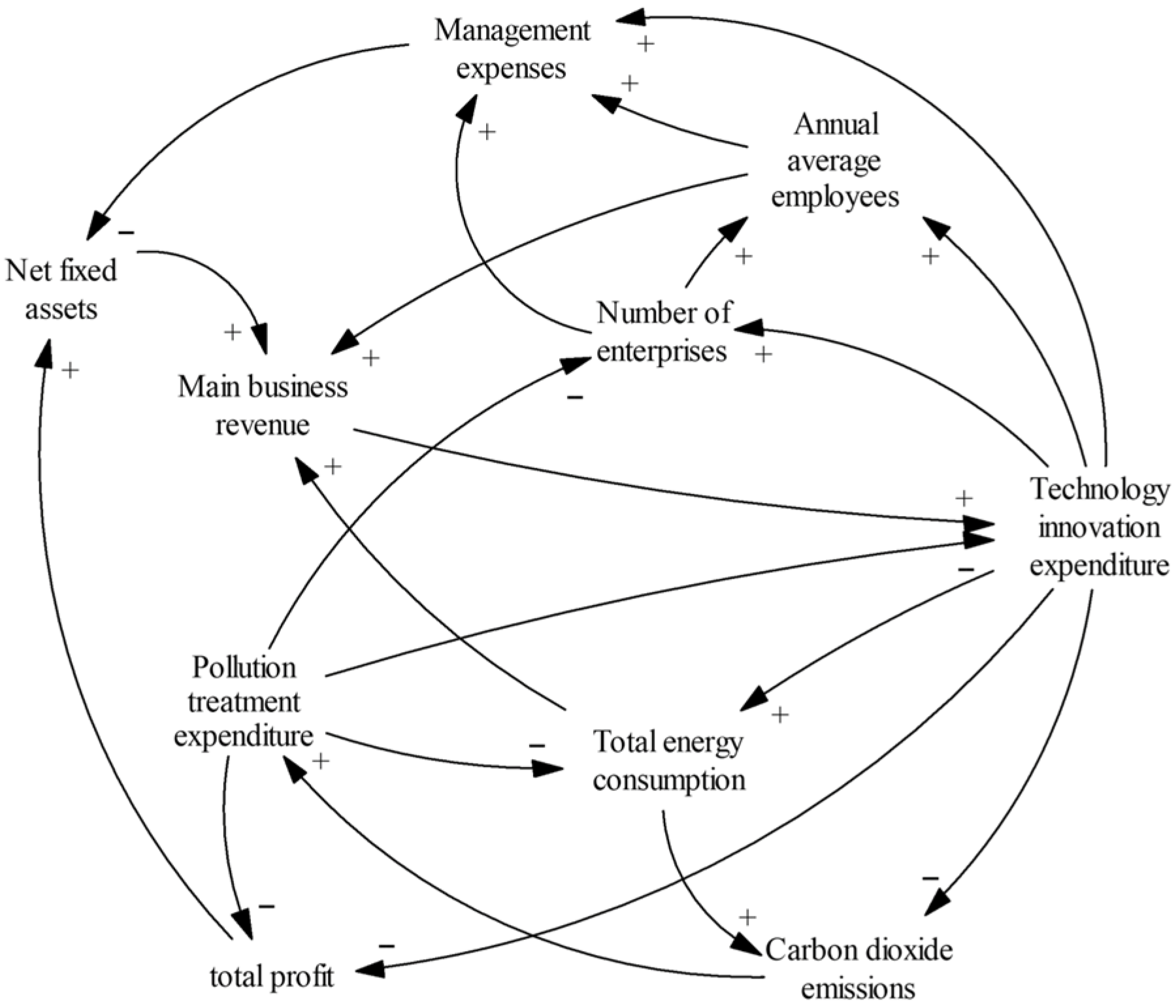
Figure 1. Causality diagram for the green transformation system of the light industry. (A plus sign (+) indicates a positive correlation, meaning that an increase in one variable leads to an increase in the other variable. A minus sign (−) indicates a negative correlation, meaning that an increase in one variable leads to a decrease in the other variable.).
Sustainability 17 11105 g001
Figure 2. Flow and stock diagram for the green transformation system of the light industry.
Sustainability 17 11105 g002
Figure 3. Simulation results at different time steps: (a) total energy consumption; (b) net fixed assets; (c) annual average employees; (d) main business revenue.
Sustainability 17 11105 g003aSustainability 17 11105 g003b
Figure 4. Trends in technological innovation: (a) growth rate of intramural expenditure on R&D; (b) growth rate of expenditure on technology assimilation; (c) growth rate of expenditure on technological renovation; (d) growth rate of expenditure on technology acquisition.
Sustainability 17 11105 g004
Figure 5. Trends in environmental regulation: (a) growth rate of solid wastes generated; (b) growth rate of solid wastes utilized; (c) growth rate of waste gas treatment expenditure; (d) growth rate of wastewater treatment expenditure.
Sustainability 17 11105 g005
Figure 6. Development and changes under the baseline pathway: (a) environmental regulation; (b) technological innovation; (c) green transformation.
Sustainability 17 11105 g006
Table 1. Results of historical validation.
YearAnnual Average Employees
(Ten Thousand People)
Total Energy Consumption
(Ten Thousand Tons of Standard Coal)
Net Fixed Assets
(Billion Yuan)
Historical ValueSimulated ValueError
(%)
Historical ValueSimulated ValueError
(%)
Historical ValueSimulated ValueError
(%)
2004144.313144.3130.0001190.9201190.9200.0001091.9381091.9400.000
2005164.688165.9320.7561311.9831313.1500.0891221.1881234.0801.056
2006175.250177.3601.2041423.9811425.9500.1381372.1881394.8601.652
2007185.875188.9991.6811492.8361495.7600.1961565.9381601.3302.260
2008205.063210.5252.6641644.4891649.8100.3241876.7501939.5303.345
2009202.938208.5372.7591655.2101660.4500.3172051.1252122.6403.487
2010214.625220.9672.9551662.4131667.8400.3262347.8752435.4903.732
2011199.125201.5981.2421698.9901701.5200.1492523.5632584.3302.408
2012205.156208.1281.4491759.4141762.7900.1922864.1882937.6802.566
2013211.188214.4861.5622088.9912093.5100.2163282.3133368.6402.630
2014216.500220.4971.8462075.8692080.9400.2443716.8753821.4502.814
2015213.750217.9261.9542076.4562081.8900.2623978.2504092.5002.872
2016208.250212.3121.9512113.1222116.5800.1644178.2504298.2702.872
2017192.063195.5751.8292131.5262135.1500.1703715.6253819.1402.786
2018167.088170.3011.9232107.5632111.0200.1643253.0293342.9302.764
2019163.813166.4361.6022125.8752128.5300.1253229.5633312.7202.575
2020152.813155.5161.7692102.5632108.5900.2873133.6253217.2302.668
2021153.813157.2752.2512341.5002349.0100.3213307.8753404.4602.920
2022144.288148.0512.6082328.9382336.9900.3463434.2973536.9602.989
2023140.931144.9312.8382316.3752324.5300.3523560.7193670.0303.070
YearMain business revenue
(billion yuan)
Carbon dioxide emissions
(ten thousand tons)
Solid wastes generated
(ten thousand tons)
Historical valueSimulated valueError
(%)
Historical valueSimulated valueError (%)Historical valueSimulated valueError
(%)
20043154.2103154.2100.0001466.7951466.8000.000331.563331.5630.000
20054128.0934144.0400.3861530.0391545.0800.983345.250345.4070.045
20065063.0725096.6900.6641597.2761621.0501.488376.625376.8860.069
20076416.3996469.2500.8241641.6081667.6201.585417.963418.2830.077
20087885.4417971.6401.0931875.2921909.8101.841455.813456.2270.091
20098914.7369014.6401.1211857.3651901.2802.364471.250471.7910.115
201011,135.66711,265.3001.1641931.6391981.6902.591520.269520.9010.121
201113,361.15913,520.1001.1901884.7781924.5602.111519.288519.8210.103
201215,216.73015,408.4001.2602127.9092170.5802.005498.069498.5380.094
201317,238.94117,494.2001.4812733.7932813.6002.919487.081487.7710.142
201418,838.16219,121.5001.5042545.2432616.0502.782495.000495.6880.139
201519,791.57520,091.6001.5162702.8362773.4302.612486.969487.6120.132
201620,889.74921,211.7001.5412617.5232684.5502.561975.706976.9670.129
201719,230.15919,522.9001.5222357.9112415.5302.444907.719908.8450.124
201816,200.83816,438.3001.4661871.1181912.5602.2151003.4061004.6000.119
201915,989.49416,225.7001.4771792.1891829.0402.0561151.1941152.5500.118
202015,665.41315,892.3001.4481635.3671660.5301.539482.725483.1770.094
202117,979.83818,265.6001.5891681.4741719.6602.271518.088518.7170.122
202216,446.10616,706.8001.5851567.6091598.4001.964504.650505.2340.116
202316,510.71916,771.7001.5811453.7441479.4801.770544.263544.8660.111
Table 2. Parameter changes under different pathways.
PathwayModeEnvironmental RegulationIndependent InnovationImitative InnovationTechnology Acquisition
1Single development modeIncrease
2Decrease
3 Increase
4 Decrease
5 Increase
6 Decrease
7 Increase
8 Decrease
9Government–enterprise collaboration modeIncreaseIncrease
10IncreaseDecrease
11Increase Increase
12Increase Decrease
13Increase Increase
14Increase Decrease
15DecreaseIncrease
16DecreaseDecrease
17Decrease Increase
18Decrease Decrease
19Decrease Increase
20Decrease Decrease
21Technology collaboration mode IncreaseIncreaseIncrease
22 IncreaseIncreaseDecrease
23 IncreaseDecreaseIncrease
24 IncreaseDecreaseDecrease
25 DecreaseIncreaseIncrease
26 DecreaseIncreaseDecrease
27 DecreaseDecreaseIncrease
28 DecreaseDecreaseDecrease
29Diversified collaboration modeIncreaseIncreaseIncreaseIncrease
30IncreaseIncreaseIncreaseDecrease
31IncreaseIncreaseDecreaseIncrease
32IncreaseIncreaseDecreaseDecrease
33IncreaseDecreaseIncreaseIncrease
34IncreaseDecreaseIncreaseDecrease
35IncreaseDecreaseDecreaseIncrease
36IncreaseDecreaseDecreaseDecrease
37DecreaseIncreaseIncreaseIncrease
38DecreaseIncreaseIncreaseDecrease
39DecreaseIncreaseDecreaseIncrease
40DecreaseIncreaseDecreaseDecrease
41DecreaseDecreaseIncreaseIncrease
42DecreaseDecreaseIncreaseDecrease
43DecreaseDecreaseDecreaseIncrease
44DecreaseDecreaseDecreaseDecrease
Table 3. Parameter values under different pathways.
PathwayGrowth Rate of Solid Wastes UtilizedGrowth Rate of Intramural Expenditure on R&DGrowth Rate of Expenditure on Technological RenovationGrowth Rate of Expenditure on Technology Acquisition
Baseline pathway0.05660.13740.01770.0013
Increase by 50%0.08490.20610.02660.0020
Decrease by 50%0.02830.06870.00890.0007
Table 4. Green transformation under the single development mode.
YearPathway 0Pathway 1Pathway 2Pathway 3Pathway 4Pathway 5Pathway 6Pathway 7Pathway 8
20240.73200.73200.73190.73860.72540.73210.73190.73200.7320
20250.70500.70500.70500.71880.69240.70510.70480.70500.7050
20260.67680.67680.67670.69850.65870.67700.67660.67680.6768
20270.64950.64960.64950.67980.62650.64980.64930.64950.6495
20280.63500.63510.63500.66480.63320.63500.63500.63500.6350
20290.65270.65270.65260.65670.65030.65270.65260.65270.6527
20300.67270.67280.67260.67880.66970.67270.67260.67270.6727
20310.69520.69530.69510.70500.69130.69530.69520.69520.6952
20320.72060.72070.72050.73710.71520.72070.72060.72060.7206
20330.74920.74930.74910.77940.74160.74920.74910.74920.7492
20340.80060.80070.80030.84470.83140.80040.80060.80060.8006
20350.99920.99960.99870.99800.99960.99930.99910.99920.9992
Mean0.72400.72410.72390.74170.71960.72410.72390.72400.7240
Table 5. Green transformation under the government–enterprise collaboration mode.
YearPathway 9Pathway 10Pathway 11Pathway 12Pathway 13Pathway 14Pathway 15Pathway 16Pathway 17Pathway 18Pathway 19Pathway 20
20240.73860.72540.73210.73190.73200.73200.73860.72540.73200.73190.73190.7319
20250.71890.69240.70510.70480.70500.70500.71880.69240.70510.70480.70500.7050
20260.69850.65880.67700.67660.67680.67680.69850.65870.67690.67650.67670.6767
20270.67990.62660.64980.64930.64960.64960.67980.62650.64980.64920.64950.6495
20280.66480.63320.63510.63500.63510.63510.66470.63320.63500.63490.63500.6350
20290.65680.65040.65280.65270.65270.65270.65670.65030.65260.65260.65260.6526
20300.67890.66980.67280.67270.67280.67280.67870.66960.67260.67260.67260.6726
20310.70510.69140.69540.69530.69530.69530.70490.69120.69520.69510.69510.6951
20320.73720.71530.72080.72070.72070.72070.73700.71510.72060.72050.72050.7205
20330.77950.74180.74940.74920.74930.74930.77930.74150.74910.74900.74910.7491
20340.84480.83160.80070.80090.80070.80070.84460.83110.80030.80050.80030.8003
20350.99990.99991.00000.99930.99960.99960.99810.99910.99920.99870.99870.9987
Mean0.74190.71970.72420.72400.72410.72410.74160.71950.72400.72390.72390.7239
Table 6. Green transformation under the technology collaboration mode.
YearPathway 21Pathway 22Pathway 23Pathway 24Pathway 25Pathway 26Pathway 27Pathway 28
20240.73870.73870.73850.73850.72550.72550.72540.7254
20250.71900.71900.71870.71870.69260.69260.69230.6923
20260.69870.69870.69830.69830.65890.65890.65850.6585
20270.68010.68010.67960.67960.62680.62680.62630.6263
20280.66510.66510.66440.66440.63320.63320.63320.6332
20290.65670.65670.65670.65670.65040.65040.65030.6503
20300.67880.67880.67870.67870.66970.66970.66960.6696
20310.70500.70500.70490.70490.69130.69130.69120.6912
20320.73720.73720.73700.73700.71520.71520.71520.7152
20330.77960.77960.77920.77920.74170.74170.74160.7416
20340.84520.84520.84420.84420.83130.83130.83140.8314
20351.00001.00000.99780.99780.99960.99960.99950.9995
Mean0.74200.74200.74150.74150.71970.71970.71950.7195
Table 7. Green transformation under the diversified collaboration mode.
YearPathway 29Pathway 30Pathway 31Pathway 32Pathway 33Pathway 34Pathway 35Pathway 36Pathway 37Pathway 38Pathway 39Pathway 40Pathway 41Pathway 42Pathway 43Pathway 44
20240.73870.73870.73850.73850.72550.72550.72540.72540.73870.73870.73850.73850.72550.72550.72540.7254
20250.71900.71900.71870.71870.69260.69260.69230.69230.71900.71900.71870.71870.69250.69250.69220.6922
20260.69880.69880.69830.69830.65890.65890.65850.65850.69870.69870.69820.69820.65890.65890.65850.6585
20270.68010.68010.67960.67960.62680.62680.62630.62630.68010.68010.67950.67950.62670.62670.62630.6263
20280.66510.66510.66450.66450.63330.63330.63320.63320.66500.66500.66440.66440.63320.63320.63310.6331
20290.65680.65680.65670.65670.65040.65040.65040.65040.65670.65670.65660.65660.65030.65030.65030.6503
20300.67890.67890.67880.67880.66980.66980.66970.66970.67880.67880.67870.67870.66960.66960.66960.6696
20310.70510.70510.70500.70500.69140.69140.69130.69130.70500.70500.70480.70480.69120.69120.69110.6911
20320.73730.73730.73710.73710.71530.71530.71530.71530.73710.73710.73690.73690.71510.71510.71510.7151
20330.77970.77970.77930.77930.74180.74180.74170.74170.77950.77950.77910.77910.74160.74160.74150.7415
20340.84530.84530.84440.84440.83160.83160.83150.83150.84510.84510.84420.84420.83110.83110.83120.8312
20351.00001.00001.00001.00001.00001.00001.00001.00001.00001.00000.99710.99710.99940.99940.99930.9993
Mean0.74210.74210.74170.74170.71980.71980.71960.71970.74200.74200.74140.74140.71960.71960.71950.7195
Disclaimer/Publisher’s Note: The statements, opinions and data contained in all publications are solely those of the individual author(s) and contributor(s) and not of MDPI and/or the editor(s). MDPI and/or the editor(s) disclaim responsibility for any injury to people or property resulting from any ideas, methods, instructions or products referred to in the content.