4.2.1. Independent Variables
This study creates a carbon finance development index (CF) to measure the level of carbon finance development in Chinese provinces. The carbon finance system encompasses multiple dimensions, including economics, finance, the environment, and energy. It is influenced by factors such as economic foundations, technological capabilities, and national policies. When selecting evaluation indicators, it is important to ensure comparability, scientific rigor, practicality, operability, systematicity, and a hierarchical structure while remaining grounded in objective realities that fully reflect the essence and uniqueness of carbon finance. Specifically, the indicator system is constructed from the following five dimensions. The entropy method is employed to evaluate the levels of carbon finance development in China’s 30 provinces based on the variability in each indicator. First, the data standardization process is conducted. To eliminate the impact of dimensional differences, range standardization is applied to both positive and negative indicators to ensure dimensionless processing of raw data. For positive indicators
. For negative indicators,
. Here, i denotes the enterprise under evaluation, and j denotes the evaluation indicator. Next, the data is normalized to obtain a standard matrix
. The entropy values for each indicator are calculated,
, where K = 1/ln n, and n is the number of companies to be evaluated. Finally, the coefficient of variation for each indicator is calculated,
, and the total weight for each indicator is calculated,
, where j = 1, 2, …, m, and m is the number of evaluation indicators. Therefore, the value of the carbon finance development level for the i enterprise is
. The specific indicators and their weights are shown in
Table 1.
Financial Environment (FE): This is a positive indicator measured by the financial sector’s value added. Value added by the financial sector refers to the outcomes generated by financial production activities within a specific period. It reflects the regional financial industry’s overall development level and dynamism. A vibrant and developed FE can provide richer, more efficient financial services and ample financial support, as well as diversified financing channels for low-carbon technology research and development (R&D), clean energy projects, and industrial green transformation [
53]. A more developed financial sector typically indicates greater depth, breadth, and efficiency in the region’s financial markets [
54]. This facilitates the attraction and allocation of capital toward green and low-carbon sectors, driving the formation and development of a carbon finance ecosystem. Thus, the magnitude of the financial sector’s value added directly reflects the quality and potential of the financial environment that underpins the development of carbon finance.
Technological Innovation (TI): TI is characterized and measured by the number of regional patent authorizations, a positive indicator. TI is the driving force behind reducing carbon emission intensity, improving energy utilization efficiency, and achieving green transformation [
55]. More patent authorizations lead to greater research and development (R&D) output and innovation capabilities [
56], which are directly related to breakthroughs and applications of energy-saving and carbon-reducing technologies. Progress in these technologies can directly reduce carbon emissions in the production process and spawn new green industries and business models [
57], providing a solid technical foundation and broad application scenarios for the carbon finance market. Thus, the number of regional patent authorizations reflects a region’s innovation vitality and its accumulation of low-carbon technology. It is also a key indicator of a region’s long-term potential for low-carbon transformation and technical support capabilities for carbon finance development.
Policy Support (PS): The green credit ratio, which is the proportion of interest expenditure of the six high-energy-consuming industries to the total interest expenditure of industrial industries, is a negative indicator used for characterization and measurement. It reflects the financial system’s support for green and low-carbon industries, as well as the degree to which high-carbon industries are restricted in the allocation of credit resources [
58]. It also reflects financial institutions’ response to the national green industry policy and the “dual-carbon” goal in credit investment. A lower ratio indicates a smaller proportion of credit funds flowing to high-carbon industries. This means that more credit resources are allocated to low-carbon or green industries and enterprises. It reflects financial institutions’ inclination toward green and low-carbon development, as well as restrictions on high-carbon activities in credit policy [
59]. Such behavior is an important indicator of the government’s promotion of carbon finance development.
Energy Efficiency (EE): This is measured by carbon emissions intensity per unit of GDP, calculated by dividing carbon emissions by regional GDP. This is a negative indicator. It reflects the degree to which economic development depends on resource and energy consumption, as well as the contribution of regional economic growth to carbon emissions [
60]. In theory, a lower carbon emissions intensity per unit of GDP leads to a smaller increase in carbon emissions as the same unit of GDP grows with technological and economic development. This reflects the level of science and technology, as well as the rationality of economic growth structures. This indicator is also related to the level of economic development and to carbon emissions from fossil fuel consumption. It directly reflects the utilization rate of carbon resources by society as a whole [
61] and the comprehensive development level of low-carbon technology over a given period. Because carbon emissions intensity is related to the economic structure, the size of the indicator reflects the obstacles and the potential for further reducing energy intensity when regional technical and monetary capital accumulation reaches a certain level.
Financial Decarbonization (FC): This indicator reflects the degree to which financial institutions participate in carbon finance. It is characterized and measured by financial carbon intensity, a negative indicator. Financial carbon intensity is the amount of carbon in the financial system. It is expressed as the ratio of a region’s total carbon emissions to its total social financing, or the amount of carbon emissions supported by total social financing per unit. FC depicts the relationship between regional financial development and carbon emissions and reflects sustainable financial development. Changes to this indicator reflect profound shifts, including modifications to the financial resource allocation mechanism, the capital utilization structure, and continuous innovation in environmental finance [
62]. Due to the unavailability of total social financing data for each province, this study uses the balance of financial institutions’ various loans as a proxy for total social financing.
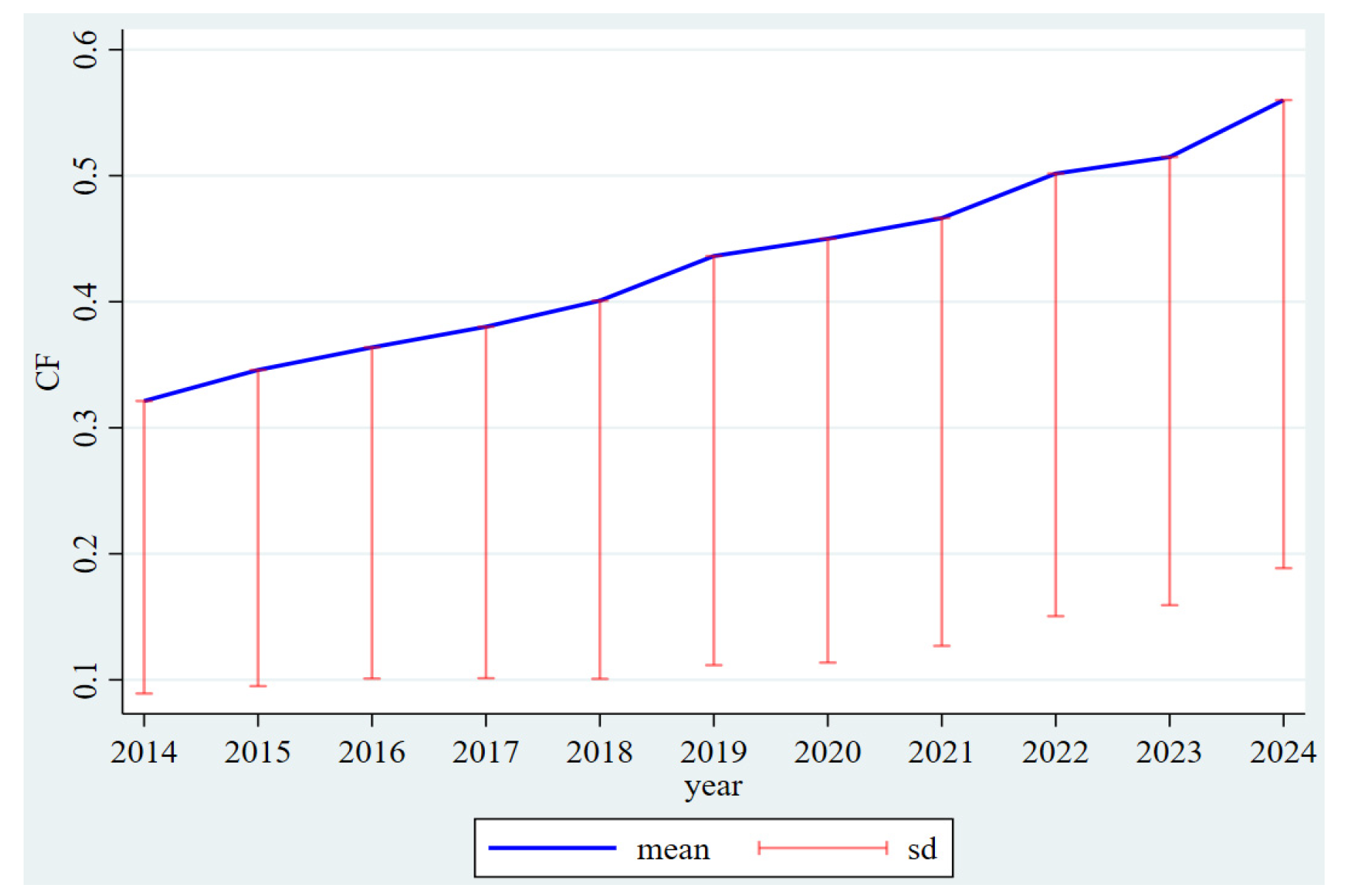
According to the aforementioned index system, the time-trend analysis of China’s carbon finance development is presented in
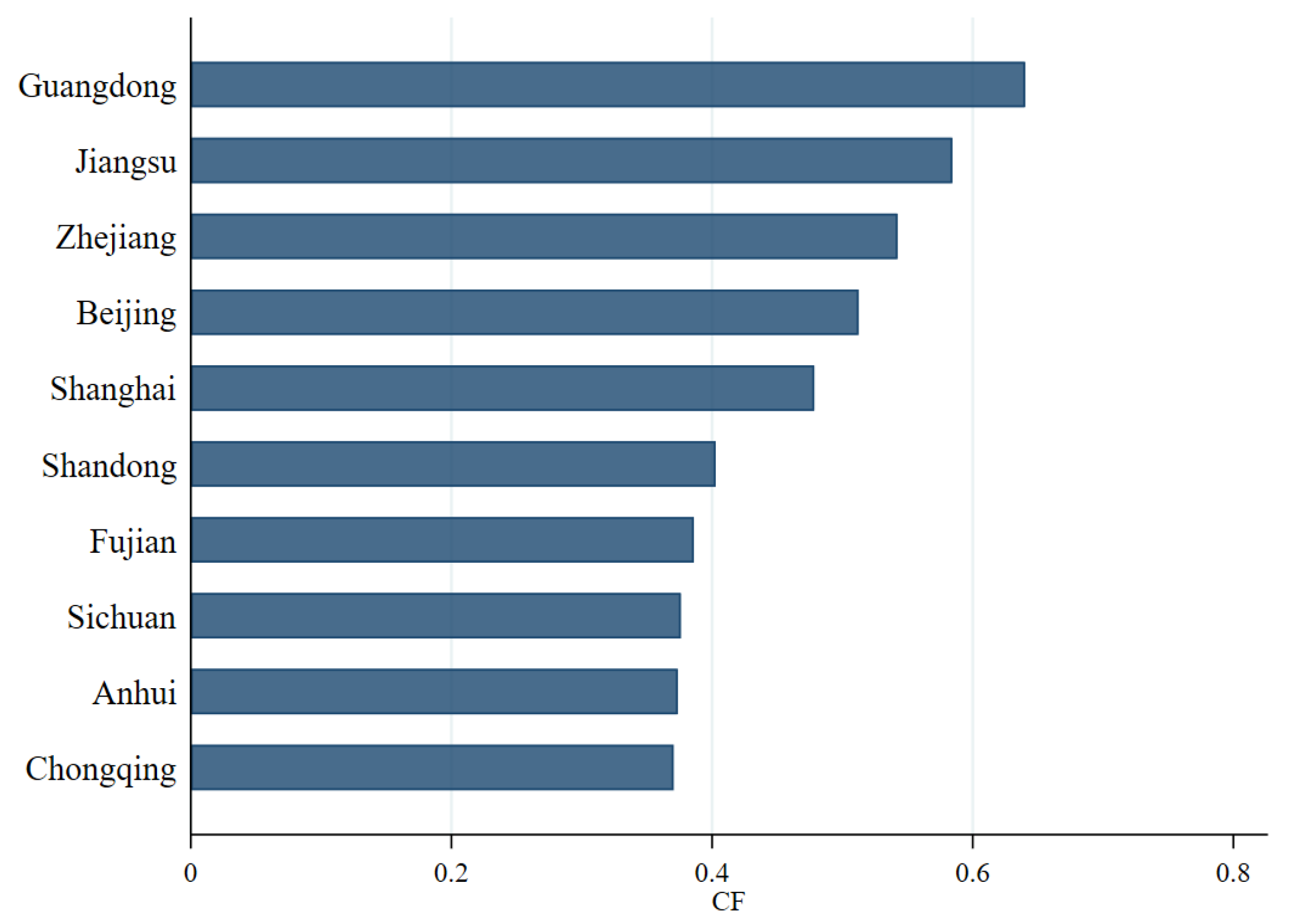
Figure 2. The results indicate that the national carbon finance development level index increased from 0.32 in 2014 to 0.56 in 2024, a 75% increase, indicating a continuous and steady upward trend. This indicator proves that China’s carbon finance system has undergone significant development and refinement over the past decade. From 2014 to 2024, the top ten provinces in the national carbon finance development index were Guangdong, Jiangsu, Zhejiang, Beijing, Shanghai, Shandong, Fujian, Sichuan, Anhui, and Chongqing, in that order.
Figure 3 shows the specific results. Guangdong province ranked first with an index value of 0.64. Geographically, eight of the top ten provinces are in the economically developed eastern coastal areas with abundant financial resources. This indicates that carbon finance development is closely related to regional economic levels and policy support. Additionally, Sichuan and Chongqing were selected as representatives of the western region, reflecting positive progress in carbon finance under the western development strategy.
4.2.2. Dependent Variable
Based on studies such as those by Byoun (2008) [
63] and Flannery and Rangan (2006) [
30], the partial adjustment model estimates the speed at which firms adjust their capital structures. We construct the following model:
where Lev
i,t represents the actual debt ratio of firm i in year t. Lev_p
i,t−1 denotes the adjusted debt ratio of firm i in the previous year t − 1. D
i,t is the book value of the firm’s interest-bearing liabilities at the end of year t. A
i,t indicates the book value of the total assets of firm i at the close of year t. NI
i,t refers to the net profit of firm i in year t. The term ε
i,t is a disturbance term. This study focuses on the coefficient γ in Equation (1), whose value typically lies between 0 and 1. Lev
i,t is the reduction in the gap between the actual and target debt ratios of firm i in year t at a rate of γ. A larger γ value indicates a faster adjustment rate to the firm’s capital structure. The literature has proved that a firm’s target capital structure is determined by factors such as the characteristics and continuous changes in response to changes in the firm’s internal and external environment [
30]. Therefore, a firm’s target capital structure is measured by model (2).
where β signifies the regression coefficient associated with a set of characteristic variables related to capital structure, and Controls
i,t−1 represents a characteristic variable influencing the target capital structure. This equation includes control variables such as firm size (Size), firm age (Age), and capital expenditure (Capex) while controlling for industry and year fixed effects. Equation (2) is incorporated into Equation (1) to estimate the target capital structure, resulting in Equation (3):
The firm’s target capital structure (
) is obtained by regressing Equation (3) and obtaining the estimated value of β, which is then brought into Equation (2). Substituting
into Equation (1) examines the impact of carbon finance on the speed of capital structure adjustment. The model adds the cross-multiplier term of the index of the level of development of carbon finance and the degree of deviation of the capital structure to Equation (1):
where
,
; CF
i,t−1 is the index of the level of carbon finance development. To alleviate the endogeneity problem, this study lags the independent variables by one period. The focus is on the γ
1 coefficient, which measures the impact of carbon finance on the speed of corporate recapitalization. If γ
1 is significantly greater than zero, it indicates that carbon finance accelerates the recapitalization process. Equation (4) controls for industry and year fixed effects and clusters standard errors at the firm level.
Based on this, the study goes on to analyze the impact of carbon finance on the degree of capital structure deviation. If carbon finance improves the speed at which firms adjust their capital structures, then, in practical terms, it will significantly reduce the deviation of firms’ capital structures from their target structures. Therefore, this study sets the AbsDev
i,t variable, representing the degree of capital structure deviation from the target, as the explanatory variable in Equation (2). At the same time, the index representing the level of carbon finance development (CF
i,t−1) is added to the right-hand side of the equation, resulting in the following model:
where AbsDev
i,t is the absolute value of the difference between the actual and target debt ratios for the period, with the same control variables as in Equation (4), and still controlling for industry and year fixed effects.
4.2.3. Control Variables
(1) Firm age (Age) is measured by the natural logarithm of the difference between the year of observation and the year of establishment. This variable reflects the firm’s historical experience, market maturity, and stability. (2) Firm size (Size) is measured by the natural logarithm of total assets. This variable indicates the enterprise’s resource endowment, market position, and the effects of economies of scale and risk mitigation. (3) Total return on assets (ROA) is measured by the ratio of total profit and interest expense to average total assets. This important measure of corporate profitability is useful in evaluating capital allocation decisions and investment policies. (4) Capital expenditures (Capex) are measured as the ratio of capital expenditures to total assets. This provides an estimate of company growth like asset expansion, asset replacement, and long-term strategic investments. (5) Selling general and administrative expenses (SG&A) are measured by the ratio of SG&A expenses to total assets. This indicates management efficiency, the structure of operating expenses, and the use of company resources. (6) Total asset turnover (AssetsCh) is measured by the ratio of net operating income to average total assets. This provides an estimate of operating efficiency and asset use, both of which are important in capital investment decisions. (7) Stock performance (return) is measured by the annual return of the individual stock, including the reinvestment of dividends. This variable reflects market recognition of the company and investor expectations and current market sentiment and valuations. (8) Institutional investor ownership (IO) is measured by the percentage of shares owned by institutional investors. This indicates the intensity of institutional supervision of corporate governance and the extent of specialization of shareholders, with the overall indication of the company’s outside environment of corporate governance. (9) Reported volatility of stock (Sigma) is measured with the standard deviation of weekly annual stock returns. This indicates the risk of the firm in the market and uncertainty, as well as the company’s risk in the opinion of the investor.
This study introduces control variables for each province to improve the model’s explanatory power and regression line strength. (1) Economic development level (GDP growth) is measured as the provincial gross per capita GDP growth, it is a representation of the general economic dynamism of each province and the cyclical oscillation thereof. (2) Financial development level (Loans) is measured as the percentage of loans of financial institutions to GDP, which is a measure of the availability of financing of regional financial resources, which plays a key role in the sources of financing and costs to companies relating to financing. (3) Industry structure (Industry) is measured as the ratio of the value added of the tertiary industry to that of the secondary. This indicator shows the advanced characteristics of the economic structure of each of the provinces, which again affects management performance, competitive position, and level of competitive advantage. By incorporating these provincial-level control variables, the study can more comprehensively assess the impact of provincial-level indicators on firms’ dynamic capital structure adjustments while controlling for the potential confounding effects of provincial characteristics.
4.2.5. Cross-Sectional Variables
To conduct cross-sectional tests, the following model was set up for this study:
where Mis
i,t represents Debt and GI. Debt is the difference between the firm’s capital structure at the beginning of year t. Lev
i,t and its target capital structure
are used to measure the level of corporate liabilities following Byoun (2008) [
63]. When Lev
i,t—
> 0, the real debt level of the company at the beginning of the year is higher than the target debt ratio for the year, and the company is over-indebted; debt takes the value of 1. Conversely, when Lev
i,t—
is less than zero, the company is under-indebted, and Scale takes the value of 0.
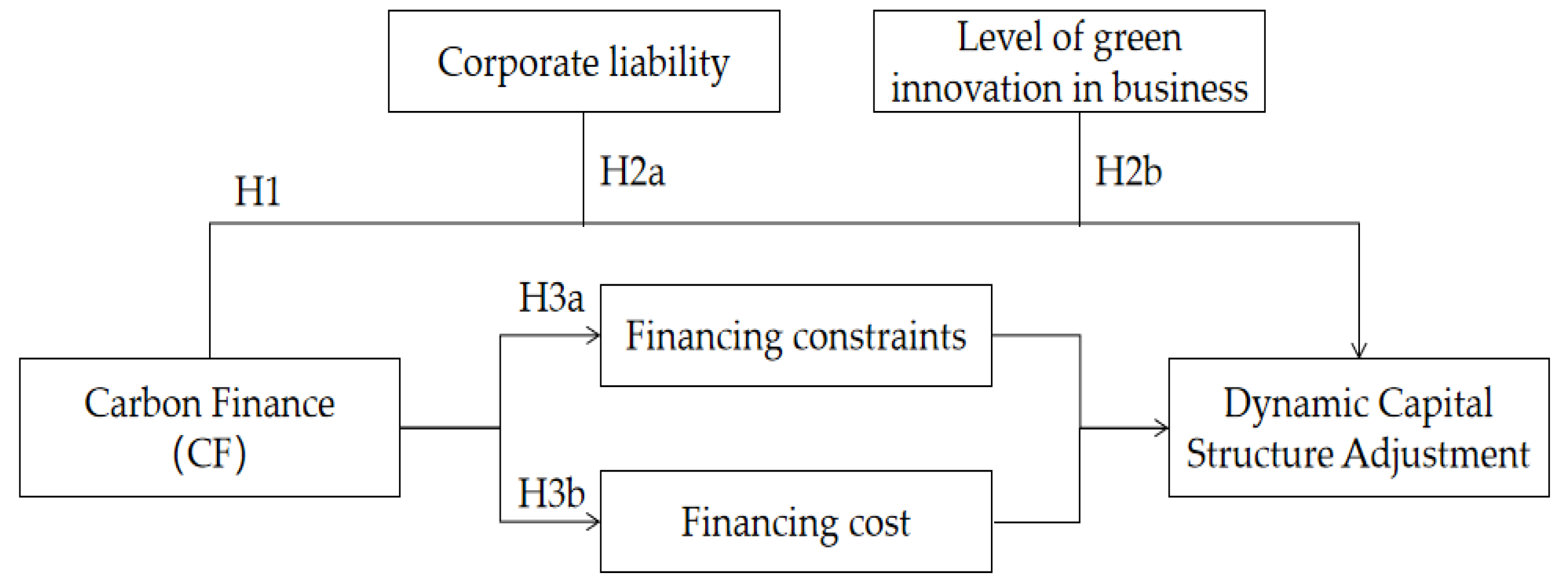
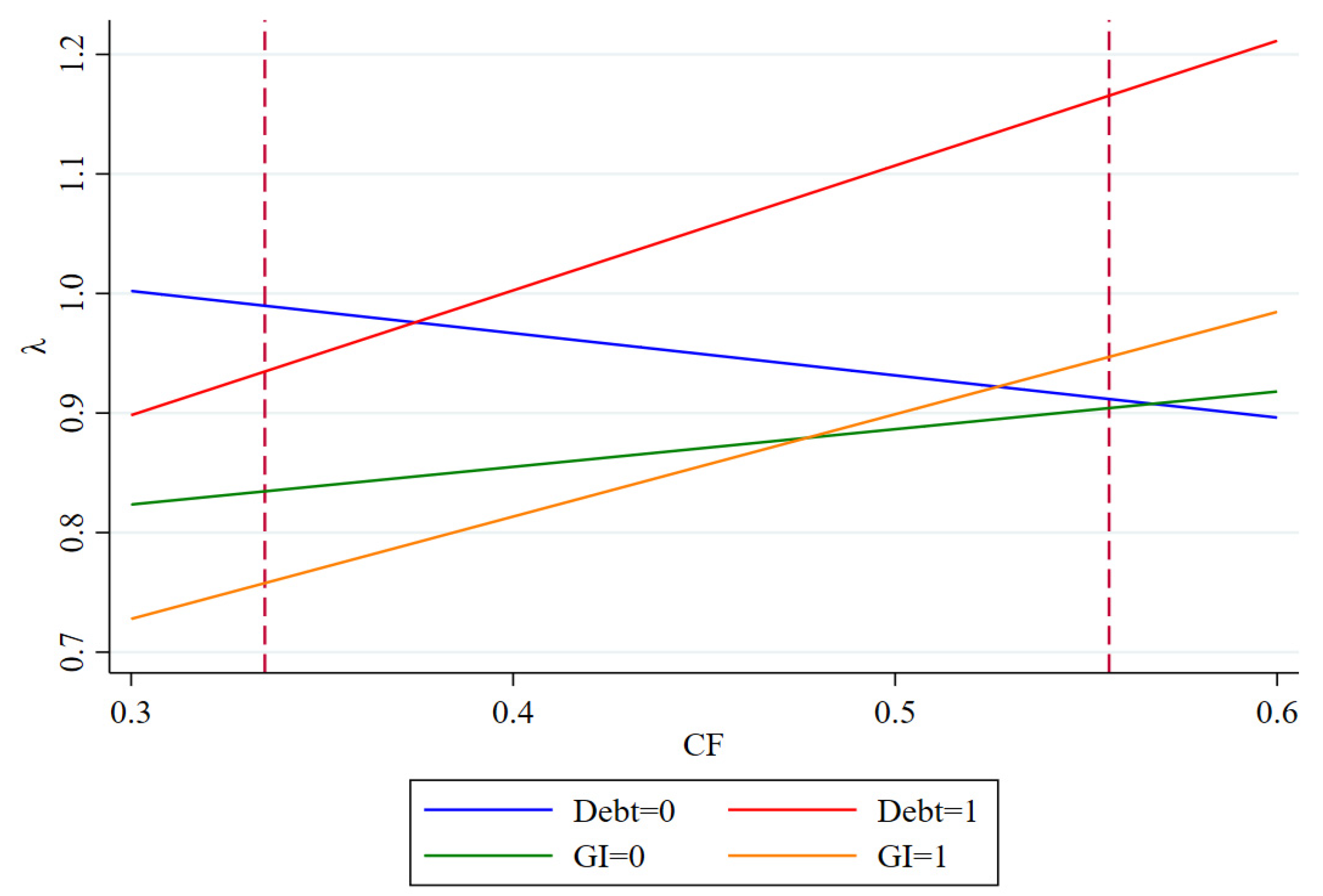
The green innovation level of the company (GI) is measured by the ratio of the number of green utility models independently filed by enterprises to the total number of patent applications in the same year. If this ratio is smaller than the median for that year, GI takes a value of 1; otherwise, it takes a value of 0. We are still controlling for industry and year fixed effects. If there is indeed a mismatch of credit resources, the coefficient ρ2 in Equation (8) should be significantly negative. Conversely, if carbon finance can alleviate this mismatch, the coefficient ρ3 in Equation (8) should be significantly positive.
4.2.6. Mediating Variables
To further validate this study’s theoretical logic and analyze how carbon finance influences the dynamic adjustment of corporate capital structure, the following mediation-effect model is set up, based on the mediation test by Glaveli and Geormas [
64].
In Equations (9)–(11), Med is the mediating variable. Specifically, Med includes two indicators: financing constraint (KZ) and financing cost (Cost). This study uses the KZ index to measure firms’ financing constraints and the cost of debt financing to measure financing costs. The latter is the ratio of total interest, fees, and other financial expenses to total liabilities at the end of the period. ϕ0, φ0, and θ0 are constant terms and ϕ1, ϕn, φ1, φ2, φ3, θ1, θ2, and θn are regression coefficients. The control variables are the same as in model (4). Industry and year fixed effects are still controlled for. Suppose carbon finance eases financing constraints and reduces financing costs for enterprises, thereby improving the speed of enterprise capital structure adjustment and reducing target capital structure deviation. In that case, this study expects the ϕ1 coefficient in Equation (9) to be significantly negative and the φ3 coefficient in Equation (10) to be significantly negative. It also expects the θ2 coefficient in Equation (11) to be significantly positive.
The definitions of the key variables are shown in
Table 2. Descriptive statistics are shown in
Table 3. This shows significant correlations among the variables, and the paper will conduct multivariate linear regression analyses based on the correlation results.