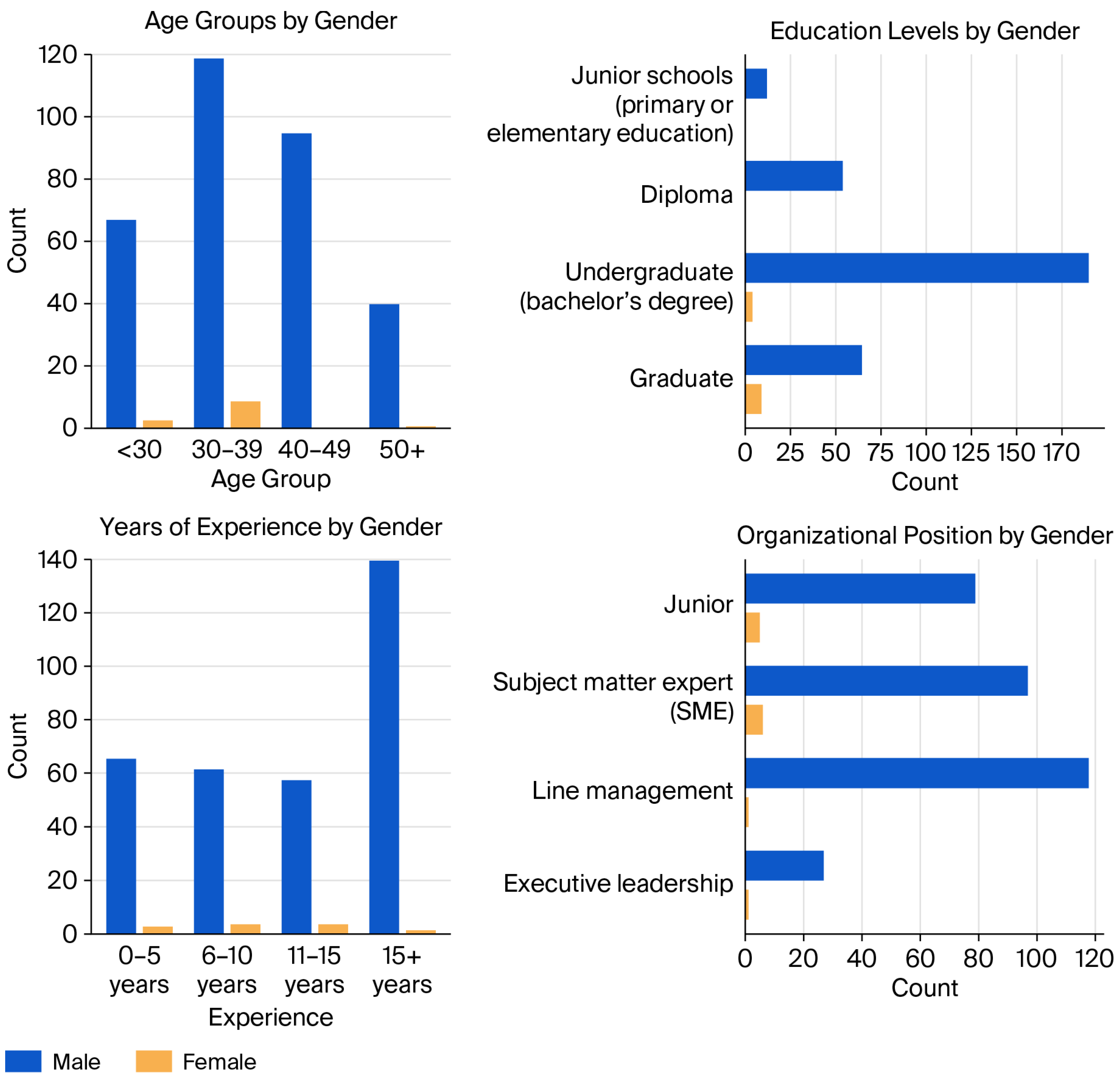
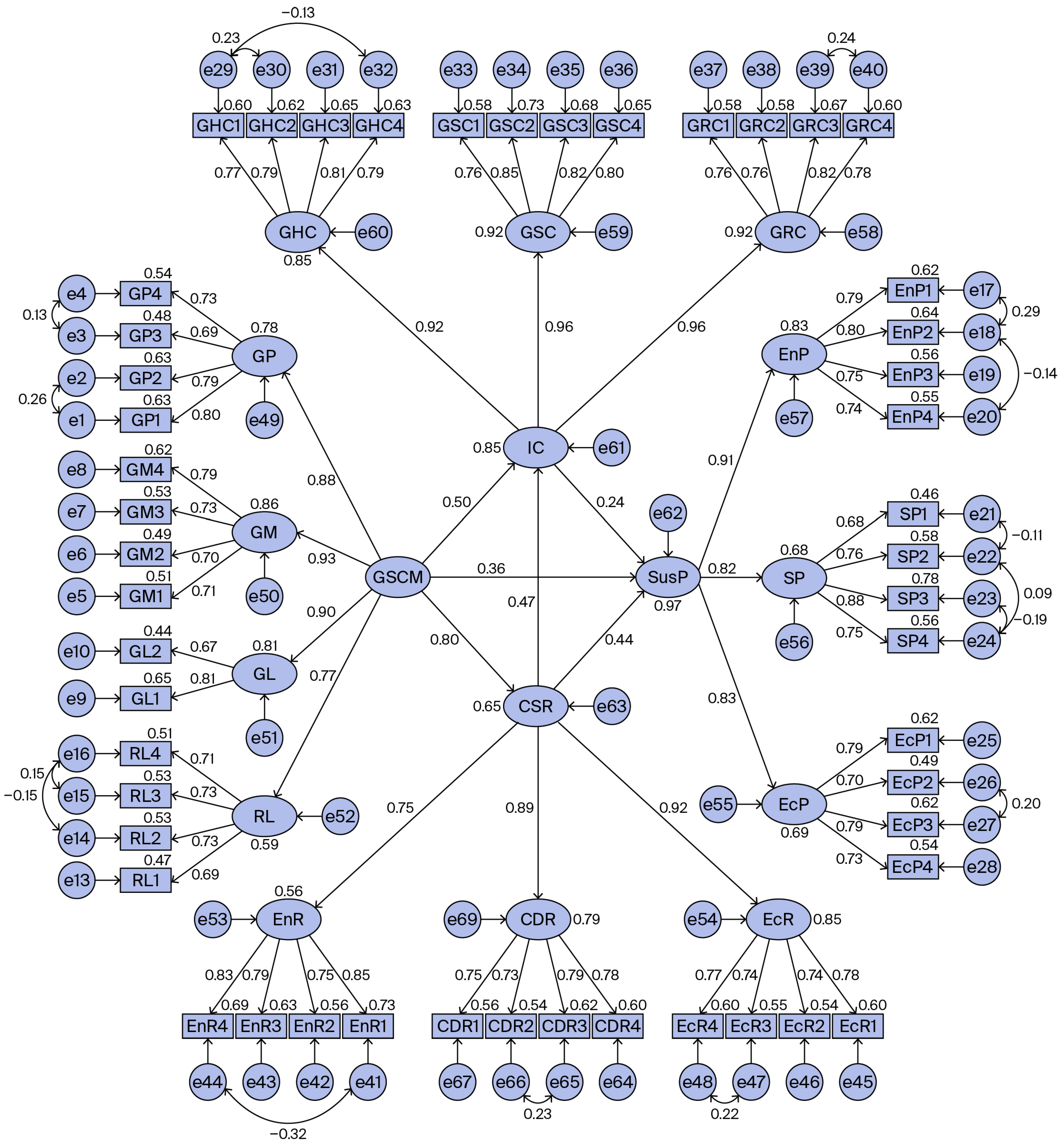
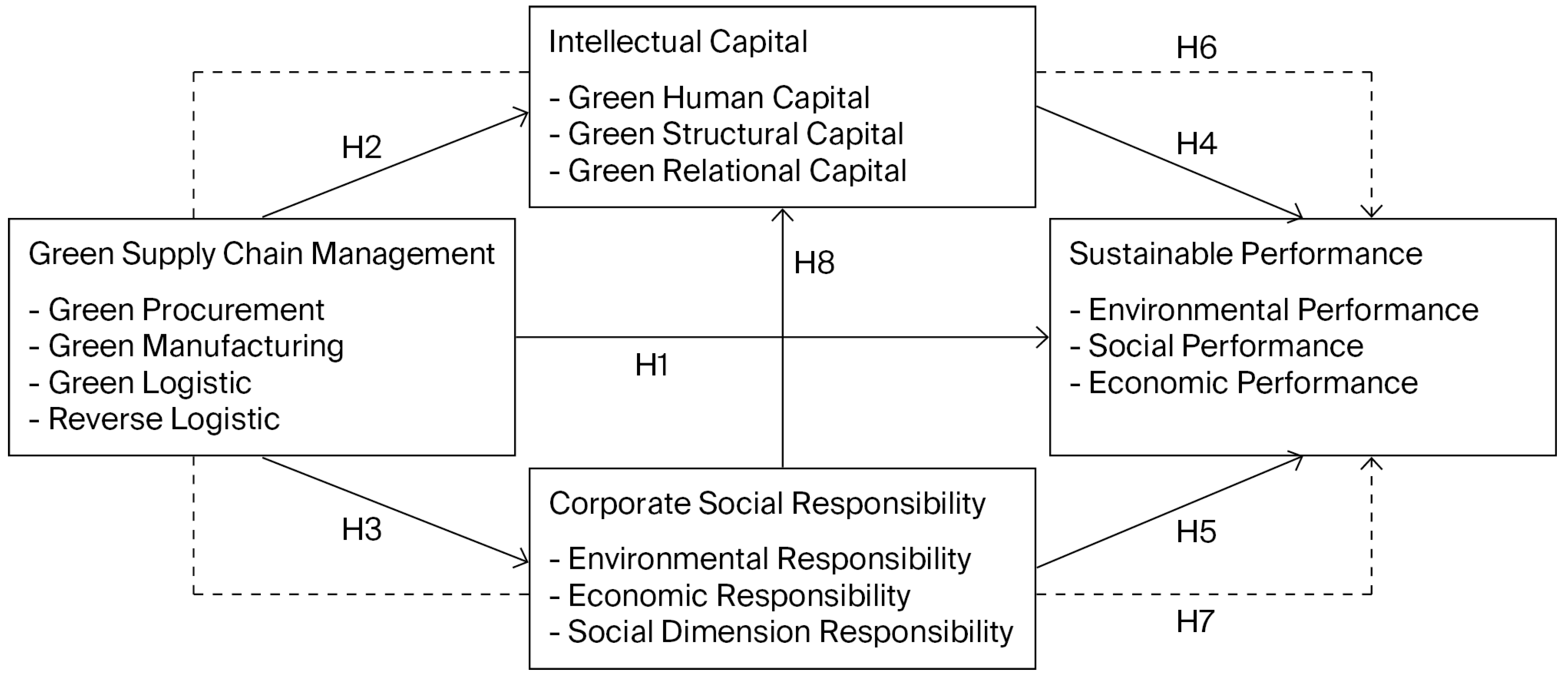
Green Supply Chain Management and Sustainable Performance: The Mediating Roles of Corporate Social Responsibility and Intellectual Capital in Saudi Arabia’s Drilling Sector—A Resource-Based View and Stakeholder Theory Perspective


Abstract
1. Introduction
- What is the relationship between GSCM and SP?
- How do IC and CSR mediate the relationship between GSCM and SP?
2. Review of Literature
2.1. Green Supply Chain Management
2.2. Sustainable Performance (SP)
2.3. Intellectual Capital (IC)
2.4. Corporate Social Responsibility (CSR)
2.5. Theoretical Framework and Hypothesis Development
2.5.1. GSCM and SP
2.5.2. GSCM and IC
2.5.3. GSCM and CSR
2.5.4. IC and SP
2.5.5. CSR and SP
2.5.6. IC Mediates the Relationship Between GSCM and SP
2.5.7. CSR Mediates the Relationship Between GSCM and SP
2.5.8. CSR’s Impact on IC
3. Methods, Sample, and Materials
4. Analysis and Results
4.1. Measurement Model Analysis
4.2. Model Fit Justification
4.3. Common Method Bias
4.4. Hypothesis Testing Results
5. Discussion
5.1. Theoretical Implications
5.2. Managerial Relevance
5.3. Limitations and Scope for Future Research
Funding
Institutional Review Board Statement
Informed Consent Statement
Data Availability Statement
Conflicts of Interest
Appendix A. Research Measurements
| Dimension | Variable | Code | Source(s) |
| Green Supply Chain Management | A—Green Procurement | ||
| 1. Includes environmental requirements for the purchased item in the purchase order. | GSCM-GP1 | [52,53] | |
| 2. Cooperates with suppliers for environmental objectives. | GSCM-GP2 | ||
| 3. Conducts environmental audits for suppliers’ internal management. | GSCM-GP3 | ||
| 4. Selects suppliers according to environmental criteria. | GSCM-GP4 | ||
| B—Green Manufacturing | |||
| 1. Has reduced noise pollution to a minimum. | GSCM-GM1 | [52,53] | |
| 2. Substitutes for polluting and hazardous materials/parts. | GSCM-GM2 | ||
| 3. Controls emissions and discharges. | GSCM-GM3 | ||
| 4. Implements green manufacturing practices by reducing energy and natural resource consumption in operations. | GSCM-GM4 | ||
| C—Green Logistics | |||
| 1. Implements environmental green packing materials. | GSCM-GL1 | [51] | |
| 2. Considers the location selection of the warehouse. | GSCM-GL2 | ||
| 3. Uses standardization of transport. | GSCM-GL3 | ||
| 4. Loading and unloading safety. | GSCM-GL4 | ||
| D—Reverse Logistics | |||
| 1. Use of remanufacturing. | GSCM-RL1 | [49] | |
| 2. Recovery of the company’s end-of-life products. | GSCM-RL2 | ||
| 3. Taking back packaging. | GSCM-RL3 | ||
| 4. Requires suppliers to collect their packaging materials. | GSCM-RL4 | ||
| Sustainable Performance | A—Environmental Performance | ||
| 1. Adopts practices aimed at reducing effluent waste. | SP-EP1 | [69,70] | |
| 2. Adopts practices aimed at reducing solid wastes. | SP-EP2 | ||
| 3. Adopts practices aimed at decreasing in consumption of hazardous/harmful/toxic materials. | SP-EP3 | ||
| 4. Adopts practices aimed at decreasing decrease in frequency of environmental accidents. | SP-EP4 | ||
| B—Social Performance | |||
| 1. Improved work safety. | SP-SocP1 | [69,70] | |
| 2. Improved the living quality of the surrounding community. | SP-SocP2 | ||
| 3. Improved the work environment. | SP-SocP3 | ||
| 4. Improved its relationship with the community and stakeholders. | SP-SocP4 | ||
| C—Economic Performance | |||
| 1. Achieves a decrease in the fee for waste treatment. | SP-EcoP1 | [69,70] | |
| 2. Achieves a decrease in the cost of materials purchasing. | SP-EcoP2 | ||
| 3. Achieves a decrease in the fee for waste discharge. | SP-EcoP3 | ||
| 4. Achieves a decrease in cost for energy consumption. | SP-EcoP4 | ||
| Intellectual Capital | A—Green Human Capital | ||
| 1. Employees have sufficient functional and scientific skills related to environmental protection. | IC-GHC1 | [82] | |
| 2. Is constantly training employees to provide them with new environmental skills and knowledge. | IC-GHC2 | ||
| 3. Employees have good environmental service performance. | IC-GHC3 | ||
| 4. Employees work as a team when carrying out environmental work and activities within the firm. | IC-GHC4 | ||
| B—Green Structural Capital | |||
| 1. Has an advanced management system to protect the environment. | IC-GSC1 | [82] | |
| 2. Is constantly spending on environmentally friendly facilities. | IC-GSC2 | ||
| 3. Has efficient processes that achieve resource savings, leading to environmental protection. | IC-GSC3 | ||
| 4. Applies knowledge management systems to share environmental knowledge among employees. | IC-GSC4 | ||
| C—Green Relational Capital | |||
| 1. Takes into consideration the environmental aspects of its customers when designing or manufacturing its products. | IC-GRC1 | [82] | |
| 2. Customers feel satisfied when the firm offers products of an environmentally friendly nature. | IC-GRC2 | ||
| 3. Has long-term, environmentally focused, collaborative relationships with suppliers. | IC-GRC3 | ||
| 4. Has long-term, environmentally focused, collaborative relationships with customers. | IC-GRC4 | ||
| Corporate Social Responsibility | A—Environmental Responsibility | ||
| 1. Products are more environmentally friendly. | CSR-ER1 | [28] | |
| 2. The production process requires fewer natural resources. | CSR-ER2 | ||
| 3. The production process decreases environmental pollution. | CSR-ER3 | ||
| 4. Products are easier to recycle for reuse. | CSR-ER4 | ||
| B—Economic Responsibility | |||
| 1. Improves the business industry. | CSR-EcoR1 | [17] | |
| 2. Generates employment through its operations. | CSR-EcoR2 | ||
| 3. Strives to activate the local economy. | CSR-EcoR3 | ||
| 4. Strives to achieve sustainable growth. | CSR-EcoR4 | ||
| C—Social Dimension Responsibility | |||
| 1. Values the contribution of disabled people to the business world. | CSR-SDR1 | [29] | |
| 2. Encourages employees to participate in volunteer activities. | CSR-SDR2 | ||
| 3. Participates in social projects for the community. | CSR-SDR3 | ||
| 4. Has standards of health and safety beyond the legal minimum. | CSR-SDR4 |
References
- Saudi Aramco. In-Kingdom Total Value Add (iktva) Program. 2017. Available online: https://iktva.sa/english/news/mou-signed-with-kbr-to-strengthen-companys-in-kingdom-procurement-of-services (accessed on 2 May 2025).
- Ministry of Industry and Mineral Resources. Initiatives. 2024. Available online: https://www.mim.gov.sa/en/initiatives-programs/industrial-sector-initiatives (accessed on 29 September 2025).
- Alkandi, I.; Helmi, M.A. The impact of strategic agility on organizational performance: The mediating role of market orientation and innovation capabilities in emerging industrial sector. Cogent Bus. Manag. 2024, 11, 2396528. [Google Scholar] [CrossRef]
- Zahoor, N.; Khan, H.; Donbesuur, F.; Khan, Z.; Rajwani, T. Grand challenges and emerging market small and medium enterprises: The role of strategic agility and gender diversity. J. Prod. Innov. Manag. 2023, 41, 473–500. [Google Scholar] [CrossRef]
- Le, T.T.; Vo, X.V.; Venkatesh, V.G. Role of green innovation and supply chain management in driving sustainable corporate performance. J. Clean. Prod. 2022, 374, 133875. [Google Scholar] [CrossRef]
- Khanna, T.; Palepu, K.G. Winning in emerging markets: Aroad map for strategy and execution. NHRD Netw. J. 2010, 3, 75. [Google Scholar] [CrossRef]
- Saudi Vision 2030. National Industrial Development and Logistic Program (NIDLP). Available online: https://www.vision2030.gov.sa/en/explore/programs/national-industrial-development-and-logistics-program (accessed on 29 September 2025).
- Pels, J.; Kidd, T. Characterizing emerging markets. Organ. Mark. Emerg. Econ. 2012, 3, 8–22. [Google Scholar] [CrossRef]
- Srivastava, S.K. Green supply-Chain management: A state-of-the-Art literature review. Int. J. Manag. Rev. 2007, 9, 53–80. [Google Scholar] [CrossRef]
- Yacob, P.; Wong, L.S.; Khor, S.C. An empirical investigation of green initiatives and environmental sustainability for manufacturing SMEs. J. Manuf. Technol. Manag. 2019, 30, 2–25. [Google Scholar] [CrossRef]
- Alkandi, I.; Alhajri, N.; Alnajim, A. Green Supply Chain Management, Business Performance, and Future Challenges: Evidence from Emerging Industrial Sector. Sustainability 2024, 17, 29. [Google Scholar] [CrossRef]
- El Saadany, A.M.A.; Jaber, M.Y.; Bonney, M. Environmental performance measures for supply chains. Manag. Res. Rev. 2011, 34, 1202–1221. [Google Scholar] [CrossRef]
- Rajabion, L.; Khorraminia, M.; Andjomshoaa, A.; Ghafouri-Azar, M.; Molavi, H. A new model for assessing the impact of the urban intelligent transportation system, farmers’ knowledge and business processes on the success of green supply chain management system for urban distribution of agricultural products. J. Retail. Consum. Serv. 2019, 50, 154–162. [Google Scholar] [CrossRef]
- Schaltegger, S.; Wagner, M. Integrative management of sustainability performance, measurement and reporting. Int. J. Account. Audit. Perform. Eval. 2006, 3, 1–19. [Google Scholar] [CrossRef]
- Del Río, P.; Peñasco, C.; Romero-Jordán, D. Distinctive features of environmental innovators: An econometric analysis. Bus. Strategy Environ. 2015, 24, 361–385. [Google Scholar] [CrossRef]
- Liu, S.; Chang, Y.-T. Manufacturers’ Closed-Loop Orientation for Green Supply Chain Management. Sustainability 2017, 9, 222. [Google Scholar] [CrossRef]
- Khan, A.; Chen, C.C.; Suanpong, K.; Ruangkanjanases, A.; Kittikowit, S.; Chen, S.C. The impact of CSR on sustainable innovation ambidexterity: The mediating role of sustainable supply chain management and second-order social capital. Sustainability 2021, 13, 12160. [Google Scholar] [CrossRef]
- Malik, S.Y.; Cao, Y.; Mughal, Y.H.; Kundi, G.M.; Mughal, M.H.; Ramayah, T. Pathways towards sustainability in organizations: Empirical evidence on the role of green human resource management practices and green intellectual capital. Sustainability 2020, 12, 3228. [Google Scholar] [CrossRef]
- Ullah, H.; Wang, Z.; Mohsin, M.; Jiang, W.; Abbas, H. Multidimensional perspective of green financial innovation between green intellectual capital on sustainable business: The case of Pakistan. Environ. Sci. Pollut. Res. 2021, 29, 5552–5568. [Google Scholar] [CrossRef]
- Yong, J.Y.; Yusliza, M.Y.; Ramayah, T.; Fawehinmi, O. Nexus between green intellectual capital and green human resource management. J. Clean. Prod. 2019, 215, 364–374. [Google Scholar] [CrossRef]
- Yusliza, M.Y.; Yong, J.Y.; Tanveer, M.I.; Ramayah, T.; Faezah, J.N.; Muhammad, Z. A structural model of the impact of green intellectual capital on sustainable performance. J. Clean. Prod. 2020, 249, 119334. [Google Scholar] [CrossRef]
- Freeman, R.E. Strategic Management: A Stakeholder Approach; Cambridge University Press: Cambridge, UK, 1984. [Google Scholar]
- Donaldson, T.; Preston, L.E. The stakeholder theory of the corporation: Concepts, evidence, and implications. Acad. Manag. Rev. 1995, 20, 65–91. [Google Scholar] [CrossRef]
- Post, J.E.; Preston, L.E.; Sauter-Sachs, S. Redefining the Corporation: Stakeholder Management and Organizational Wealth; Stanford University Press: Redwood City, CA, USA, 2002. [Google Scholar]
- Walker, H.; Di Sisto, L.; McBain, D. Drivers and barriers to environmental supply chain management practices: Lessons from the public and private sectors. J. Purch. Supply Manag. 2008, 14, 69–85. [Google Scholar] [CrossRef]
- Orlitzky, M.; Schmidt, F.L.; Rynes, S.L. Corporate social and financial performance: A meta-analysis. Organ. Stud. 2003, 24, 403–441. [Google Scholar] [CrossRef]
- Sen, S.; Bhattacharya, C.B. Does doing good always lead to doing better? Consumer reactions to corporate social responsibility. J. Mark. Res. 2001, 38, 225–243. [Google Scholar] [CrossRef]
- Chang, T.W.; Yeh, Y.L.; Li, H.X. How to shape an organization’s sustainable green management performance: The mediation effect of environmental corporate social responsibility. Sustainability 2020, 12, 9198. [Google Scholar] [CrossRef]
- Gallardo-Vázquez, D.; Sanchez-Hernandez, M.I. Measuring Corporate Social Responsibility for competitive success at a regional level. J. Clean. Prod. 2014, 72, 14–22. [Google Scholar] [CrossRef]
- El Mokadem, M.; Khalaf, A. Building sustainable performance through green supply chain management: Evidence from emerging markets. Int. J. Product. Perform. Manag. 2025, 74, 203–223. [Google Scholar] [CrossRef]
- Sayed, O.A.; Nefzi, A. The impact of intellectual capital on sustainable performance: Evidence from the Saudi banking sector. Sustainability 2024, 16, 4528. [Google Scholar] [CrossRef]
- Xi, M.; Fang, W.; Feng, T. Green intellectual capital and green supply chain integration: The mediating role of transformational leadership. J. Intellect. Cap. 2022, 24, 1089–1110. [Google Scholar] [CrossRef]
- Dubey, R.; Gunasekaran, A.; Childe, S.J. How intellectual capital builds supply chain resilience? Exploring mediation and interaction effects. Supply Chain Manag. Int. J. 2023, 28, 855–872. [Google Scholar] [CrossRef]
- Jaaffar, A.H.; Kaman, Z.K.; Razali, N.H.A.; Azmi, N.; Yahya, N.A. Employee’s past environmental related experience and green supply chain management practice: A study of Malaysian chemical-related industries. In AIP Conference Proceedings; AIP Publishing: Melville, NY, USA, 2019; Volume 2124. [Google Scholar]
- Li, Y.-H.; Huang, J.-W. The moderating role of relational bonding in green supply chain practices and performance. J. Purch. Supply Manag. 2017, 23, 290–299. [Google Scholar] [CrossRef]
- Lu, J.; Ren, L.; Yao, S.; Qiao, J.; Mikalauskiene, A.; Streimikis, J. Exploring the relationship between corporate social responsibility and firm competitiveness. Econ. Res.-Ekon. Istraz. 2020, 33, 1621–1646. [Google Scholar] [CrossRef]
- Khan, S.A.R.; Qianli, D. Impact of green supply chain management practices on firms’ performance: An empirical study from the perspective of Pakistan. Environ. Sci. Pollut. Res. 2017, 24, 16829–16844. [Google Scholar] [CrossRef]
- Saeed, A.; Jun, Y.; Nubuor, S.; Priyankara, H.; Jayasuriya, M. Institutional pressures, green supply chain management practices on environmental and economic performance: A two-theory view. Sustainability 2018, 10, 1517. [Google Scholar] [CrossRef]
- Shibin, K.T.; Dubey, R.; Gunasekaran, A.; Hazen, B.; Roubaud, D.; Gupta, S.; Foropon, C. Examining sustainable supply chain management of SMEs using resource-based view and institutional theory. Ann. Oper. Res. 2020, 290, 301–326. [Google Scholar] [CrossRef]
- Seuring, S.; Müller, M. From a literature review to a conceptual framework for sustainable supply chain management. J. Clean. Prod. 2008, 16, 1699–1710. [Google Scholar] [CrossRef]
- Fahimnia, B.; Sarkis, J.; Davarzani, H. Green supply chain management: A review and bibliometric analysis. Int. J. Prod. Econ. 2015, 162, 101–114. [Google Scholar] [CrossRef]
- Touboulic, A.; Walker, H. Theories in sustainable supply chain management: A structured literature review. Int. J. Phys. Distrib. Logist. Manag. 2015, 45, 16–42. [Google Scholar] [CrossRef]
- Aldakhil, A.M.; Nassani, A.A.; Awan, U.; Abro, M.M.Q.; Zaman, K. Determinants of green logistics in BRICS countries: An integrated supply chain model for green business. J. Clean. Prod. 2018, 195, 861–868. [Google Scholar] [CrossRef]
- Chiou, T.Y.; Chan, H.K.; Lettice, F.; Chung, S.H. The influence of greening the suppliers and green innovation on environmental performance and competitive advantage in Taiwan. Transp. Res. Part E Logist. Transp. Rev. 2011, 47, 822–836. [Google Scholar] [CrossRef]
- Geyer, R.; Jackson, T. Supply loops and their constraints: The industrial ecology of recycling and reuse. Calif. Manag. Rev. 2004, 46, 55–73. [Google Scholar] [CrossRef]
- Zhu, Q.; Sarkis, J.; Geng, Y. Green supply chain management in China: Pressures, practices and performance. Int. J. Oper. Prod. Manag. 2005, 25, 449–468. [Google Scholar] [CrossRef]
- Tseng, M.L.; Islam, M.S.; Karia, N.; Fauzi, F.A.; Afrin, S. A literature review on green supply chain management: Trends and future challenges. Resour. Conserv. Recycl. 2019, 141, 145–162. [Google Scholar] [CrossRef]
- Zhu, Q.; Sarkis, J.; Lai, K.H. Green supply chain management: Pressures, practices and performance within the Chinese automobile industry. J. Clean. Prod. 2007, 15, 1041–1052. [Google Scholar] [CrossRef]
- Rao, P.; Holt, D. Do green supply chains lead to competitiveness and economic performance? Int. J. Oper. Prod. Manag. 2005, 25, 898–916. [Google Scholar] [CrossRef]
- Rajeev, A.; Pati, R.K.; Padhi, S.S.; Govindan, K. Evolution of sustainability in supply chain management: A literature review. J. Clean. Prod. 2017, 162, 299–314. [Google Scholar] [CrossRef]
- Abdullah, R.; Mohamad, M.N.; Thurasamy, R. Enhancing sustainable performance through green supply chain management practices: A study of Malaysian manufacturing firms. Relig. Rev. De Cienc. Soc. Y Humanidades 2020, 5, 163–170. [Google Scholar] [CrossRef]
- Ahmad, A.F.; Karadas, G. Managers’ perceptions regarding the effect of leadership on organizational performance: Mediating role of green supply chain management practices. Sage Open 2021, 11, 21582440211018686. [Google Scholar] [CrossRef]
- Zhu, Q.; Sarkis, J.; Lai, K.-H. Confirmation of a measurement model for green supply chain management practices implementation. Int. J. Prod. Econ. 2008, 111, 261–273. [Google Scholar] [CrossRef]
- Jawahir, I.S.; Dillon, O.W. Sustainable manufacturing processes: New challenges for developing predictive models and optimization techniques. CIRP Ann.-Manuf. Technol. 2007, 56, 703–720. [Google Scholar]
- De Giovanni, P.; Vinzi, V.E. Covariance versus component-based estimations of performance in green supply chain management. Int. J. Prod. Econ. 2012, 135, 907–916. [Google Scholar] [CrossRef]
- Dües, C.M.; Tan, K.H.; Lim, M. Green as the new Lean: How to use Lean practices as a catalyst to greening your supply chain. J. Clean. Prod. 2013, 40, 93–100. [Google Scholar] [CrossRef]
- Eltayeb, T.K.; Zailani, S.; Ramayah, T. Green supply chain initiatives among certified companies in Malaysia and environmental sustainability: Investigating the outcomes. Resour. Conserv. Recycl. 2011, 55, 495–506. [Google Scholar] [CrossRef]
- Preuss, L. In dirty chains? Purchasing and greener manufacturing. J. Bus. Ethics 2001, 34, 345–359. [Google Scholar] [CrossRef]
- Appolloni, A.; Sun, H.; Jia, F.; Li, X. Green Procurement in the private sector: A state of the art review between 1996 and 2013. J. Clean. Prod. 2014, 85, 122–133. [Google Scholar] [CrossRef]
- Dekker, R.; Bloemhof, J.; Mallidis, I. Operations Research for Green Logistics–An overview of aspects, issues, contributions and challenges. Eur. J. Oper. Res. 2012, 219, 671–679. [Google Scholar] [CrossRef]
- Sarkis, J.; Zhu, Q.; Lai, K.-H. An organizational theoretic review of green supply chain management literature. Int. J. Prod. Econ. 2011, 130, 1–15. [Google Scholar] [CrossRef]
- Fleischmann, M.; Bloemhof-Ruwaard, J.M.; Dekker, R.; Van der Laan, E.; Van Nunen, J.A.; Van Wassenhove, L.N. Quantitative models for reverse logistics: A review. Eur. J. Oper. Res. 1997, 103, 1–17. [Google Scholar] [CrossRef]
- Dowlatshahi, S. Developing a theory of reverse logistics. Interfaces 2000, 30, 143–155. [Google Scholar] [CrossRef]
- Govindan, K.; Soleimani, H.; Kannan, D. Reverse logistics and closed-loop supply chain: A comprehensive review to explore the future. Eur. J. Oper. Res. 2015, 240, 603–626. [Google Scholar] [CrossRef]
- Pokharel, S.; Mutha, A. Perspectives in reverse logistics: A review. Resour. Conserv. Recycl. 2009, 53, 175–182. [Google Scholar] [CrossRef]
- Lozano, R. A holistic perspective on corporate sustainability drivers. Corp. Soc. Responsib. Environ. Manag. 2015, 22, 32–44. [Google Scholar] [CrossRef]
- Eccles, R.G.; Ioannou, I.; Serafeim, G. The impact of corporate sustainability on organizational processes and performance. Manag. Sci. 2014, 60, 2835–2857. [Google Scholar] [CrossRef]
- Searcy, C. Corporate sustainability performance measurement systems: A review and research agenda. J. Bus. Ethics 2012, 107, 239–253. [Google Scholar] [CrossRef]
- Afum, E.; Osei-Ahenkan, V.Y.; Agyabeng-Mensah, Y.; Amponsah Owusu, J.; Kusi, L.Y.; Ankomah, J. Green manufacturing practices and sustainable performance among Ghanaian manufacturing SMEs: The explanatory link of green supply chain integration. Manag. Environ. Qual. Int. J. 2020, 31, 1457–1475. [Google Scholar] [CrossRef]
- Green, K.W., Jr.; Zelbst, P.J.; Meacham, J.; Bhadauria, V.S. Green supply chain management practices: Impact on performance. Supply Chain Manag. Int. J. 2012, 17, 290–305. [Google Scholar] [CrossRef]
- Henriques, I.; Sadorsky, P. The relationship between environmental commitment and managerial perceptions of stakeholder importance. Acad. Manag. J. 1999, 42, 87–99. [Google Scholar] [CrossRef]
- Daily, B.F.; Huang, S.C. Achieving sustainability through attention to human resource factors in environmental management. Int. J. Oper. Prod. Manag. 2001, 21, 1539–1552. [Google Scholar] [CrossRef]
- Wood, D.J. Corporate social performance revisited. Acad. Manag. Rev. 1991, 16, 691–718. [Google Scholar] [CrossRef]
- Waddock, S.A.; Graves, S.B. The corporate social performance–financial performance link. Strateg. Manag. J. 1997, 18, 303–319. [Google Scholar] [CrossRef]
- Dyllick, T.; Hockerts, K. Beyond the business case for corporate sustainability. Bus. Strategy Environ. 2002, 11, 130–141. [Google Scholar] [CrossRef]
- Salzmann, O.; Ionescu-Somers, A.; Steger, U. The business case for corporate sustainability: Literature review and research options. Eur. Manag. J. 2005, 23, 27–36. [Google Scholar] [CrossRef]
- Elkington, J. Partnerships from cannibals with forks: The triple bottom line of 21st-Century business. Environ. Qual. Manag. 1998, 8, 37–51. [Google Scholar] [CrossRef]
- Figge, F.; Hahn, T.; Schaltegger, S.; Wagner, M. The Sustainability Balanced Scorecard–linking sustainability management to business strategy. Bus. Strategy Environ. 2002, 11, 269–284. [Google Scholar] [CrossRef]
- Bontis, N. Intellectual capital: An exploratory study that develops measures and models. Manag. Decis. 1998, 36, 63–76. [Google Scholar] [CrossRef]
- Nonaka, I.; Takeuchi, H. The Knowledge-Creating Company: How Japanese Companies Create the Dynamics of Innovation; Oxford University Press: Oxford, UK, 1995. [Google Scholar]
- Zack, M.H. Managing codified knowledge. Sloan Manag. Rev. 1999, 40, 45–58. [Google Scholar]
- AL-Khatib, A.W.; Shuhaiber, A. Green intellectual capital and green supply chain performance: Does big data analytics capabilities matter? Sustainability 2022, 14, 10054. [Google Scholar] [CrossRef]
- Chen, Y.S. The positive effect of green intellectual capital on competitive advantages of firms. J. Bus. Ethics 2008, 77, 271–286. [Google Scholar] [CrossRef]
- Jabbour, C.J.C.; Santos, F.C.A.; Nagano, M.S. Contributions of HRM throughout the stages of environmental management: Methodological triangulation applied to the case of a large Brazilian company. Int. J. Hum. Resour. Manag. 2010, 21, 1049–1069. [Google Scholar] [CrossRef]
- Renwick, D.W.S.; Redman, T.; Maguire, S. Green human resource management: A review and research agenda. Int. J. Manag. Rev. 2013, 15, 1–14. [Google Scholar] [CrossRef]
- Dumont, J.; Shen, J.; Deng, X. Effects of green HRM practices on employee workplace green behavior: The role of psychological green climate and employee green values. Hum. Resour. Manag. 2017, 56, 613–627. [Google Scholar] [CrossRef]
- Huang, C.L.; Kung, F.H. Drivers of environmental disclosure and stakeholder expectation: Evidence from Taiwan. J. Bus. Ethics 2010, 96, 435–451. [Google Scholar] [CrossRef]
- Lin, Y.H.; Chen, Y.S. Determinants of green competitive advantage: The roles of green knowledge sharing, green dynamic capabilities, and green service innovation. Qual. Quant. 2017, 51, 1663–1685. [Google Scholar] [CrossRef]
- Dahlsrud, A. How corporate social responsibility is defined: An analysis of 37 definitions. Corp. Soc. Responsib. Environ. Manag. 2008, 15, 1–13. [Google Scholar] [CrossRef]
- European Commission. Communication from the Commission to the European Parliament, the Council, the European Economic and Social Committee and the Committee of the Regions: A Renewed EU Strategy 2011-14 for Corporate Social Responsibility; European Commission: Brussels, Belgium, 2011. [Google Scholar]
- Carroll, A.B. The pyramid of corporate social responsibility: Toward the moral management of organizational stakeholders. Bus. Horiz. 1991, 34, 39–48. [Google Scholar] [CrossRef]
- Brammer, S.; Pavelin, S. Corporate reputation and social performance: The importance of fit. J. Manag. Stud. 2006, 43, 435–455. [Google Scholar] [CrossRef]
- Margolis, J.D.; Walsh, J.P. Misery loves companies: Rethinking social initiatives by business. Adm. Sci. Q. 2003, 48, 268–305. [Google Scholar] [CrossRef]
- Klassen, R.D.; McLaughlin, C.P. The impact of environmental management on firm performance. Manag. Sci. 1996, 42, 1199–1214. [Google Scholar] [CrossRef]
- Melnyk, S.A.; Sroufe, R.P.; Calantone, R. Assessing the impact of environmental management systems on corporate and environmental performance. J. Oper. Manag. 2003, 21, 329–351. [Google Scholar] [CrossRef]
- Daily, B.F.; Bishop, J.W.; Steiner, R. The mediating role of EMS teamwork as it pertains to HR factors and perceived environmental performance. J. Appl. Bus. Res. 2007, 23, 95. [Google Scholar] [CrossRef]
- Clarkson, M.B.E. A stakeholder framework for analyzing and evaluating corporate social performance. Acad. Manag. Rev. 1995, 20, 92–117. [Google Scholar] [CrossRef]
- Brammer, S.; Millington, A.; Rayton, B. The contribution of corporate social responsibility to organizational commitment. Int. J. Hum. Resour. Manag. 2007, 18, 1701–1719. [Google Scholar] [CrossRef]
- Jenkins, H. Corporate social responsibility and the mining industry: Conflicts and constructs. Corp. Soc. Responsib. Environ. Manag. 2005, 12, 23–34. [Google Scholar] [CrossRef]
- Turker, D. Measuring corporate social responsibility: A scale development study. J. Bus. Ethics 2009, 85, 411–427. [Google Scholar] [CrossRef]
- Windsor, D. The future of corporate social responsibility. Int. J. Organ. Anal. 2001, 9, 225–256. [Google Scholar] [CrossRef]
- Hahn, T.; Figge, F.; Pinkse, J.; Preuss, L. Trade-offs in corporate sustainability: You can’t have your cake and eat it too. Bus. Strategy Environ. 2010, 19, 217–229. [Google Scholar] [CrossRef]
- Shang, K.C.; Lu, C.S.; Li, S. A taxonomy of green supply chain management capability among electronics-related manufacturing firms in Taiwan. J. Environ. Manag. 2010, 91, 1218–1226. [Google Scholar] [CrossRef] [PubMed]
- Hart, S.L. A natural-resource-based view of the firm. Acad. Manag. Rev. 1995, 20, 986–1014. [Google Scholar] [CrossRef]
- Testa, F.; Iraldo, F. Shadows and lights of GSCM (Green Supply Chain Management): Determinants and effects of these practices based on a multi-national study. J. Clean. Prod. 2010, 18, 953–962. [Google Scholar] [CrossRef]
- Lai, K.H.; Wong, C.W. Green logistics management and performance: Some empirical evidence from Hong Kong. Transp. Res. Part E Logist. Transp. Rev. 2012, 48, 397–412. [Google Scholar]
- Younis, H.; Sundarakani, B.; Vel, P. The impact of implementing green supply chain management practices on corporate performance. Compet. Rev. 2016, 26, 216–245. [Google Scholar] [CrossRef]
- Jabbour, C.J.C.; Jugend, D.; Jabbour, A.B.L.D.S.; Gunasekaran, A.; Latan, H. Green product development and performance of Brazilian manufacturing firms: Measuring the role of human and technical aspects. J. Clean. Prod. 2015, 87, 442–451. [Google Scholar] [CrossRef]
- Seles, B.M.R.P.; Jabbour, A.B.L.D.S.; Jabbour, C.J.C.; Dangelico, R.M. The green bullwhip effect, the diffusion of green supply chain practices, and institutional pressures: Evidence from the automotive sector. Int. J. Prod. Econ. 2016, 182, 342–355. [Google Scholar] [CrossRef]
- Hsu, C.W.; Hu, A.H. Green supply chain management in the electronic industry. Int. J. Environ. Sci. Technol. 2008, 5, 205–216. [Google Scholar] [CrossRef]
- Graham, S.; Cadden, T.; Treacy, R. Examining the influence of employee engagement in supporting the implementation of green supply chain management practices: A green human resource management perspective. Bus. Strategy Environ. 2023, 32, 4750–4766. [Google Scholar] [CrossRef]
- Singh, S.K.; Del Giudice, M.; Chierici, R.; Graziano, D. Green innovation and environmental performance: The role of green transformational leadership and green human resource management. Technol. Forecast. Soc. Change 2020, 150, 119762. [Google Scholar] [CrossRef]
- Carter, C.R.; Rogers, D.S. A framework of sustainable supply chain management: Moving toward new theory. Int. J. Phys. Distrib. Logist. Manag. 2008, 38, 360–387. [Google Scholar] [CrossRef]
- Zhu, Q.; Sarkis, J. Relationships between operational practices and performance among early adopters of green supply chain management practices in Chinese manufacturing enterprises. J. Oper. Manag. 2004, 22, 265–289. [Google Scholar] [CrossRef]
- Alkandi, I.; Farooqi, M.R.; Hasan, A.; Khan, M.A. Green Products Buying Behaviour of Saudi Arabian and Indian Consumers: A Comparative Study. Int. J. Prof. Bus. Rev. 2023, 8, e03906. [Google Scholar] [CrossRef]
- Beske, P.; Seuring, S. Putting sustainability into supply chain management. Supply Chain. Manag. Int. J. 2014, 19, 322–331. [Google Scholar] [CrossRef]
- Grant, R.M. Toward a knowledge-based theory of the firm. Strateg. Manag. J. 1996, 17, 109–122. [Google Scholar] [CrossRef]
- Subramaniam, M.; Youndt, M.A. The influence of intellectual capital on the types of innovative capabilities. Acad. Manag. J. 2005, 48, 450–463. [Google Scholar] [CrossRef]
- Radu, L.D. Green Cloud Computing: A Literature Survey. Symmetry 2017, 9, 295. [Google Scholar] [CrossRef]
- Cabrilo, S.; Dahms, S. How strategic knowledge management drives intellectual capital to superior innovation and market performance. J. Knowl. Manag. 2018, 22, 621–648. [Google Scholar] [CrossRef]
- Januškaitė, V.; Užienė, L. Intellectual capital as a factor of sustainable regional competitiveness. Sustainability 2018, 10, 4848. [Google Scholar] [CrossRef]
- Delgado-Verde, M.; Amores-Salvadó, J.; Martín-de Castro, G.; Navas-López, J.E. Green intellectual capital and environmental product innovation: The mediating role of green social capital. Knowl. Manag. Res. Pract. 2014, 12, 261–275. [Google Scholar] [CrossRef]
- Hulaemah, E.; Mulyasari, W. Green Intellectual Capital and Financial Performance: The Role of Sustainable Growth Rate. Account. Sustain. 2025, 3. [Google Scholar] [CrossRef]
- Ashraf, S.; Sadiq, M.; Ferreira, P.; Almeida, A.M. Intellectual capital and a firm’s sustainable performance and growth before and during the COVID-19 crisis: A comparative analysis of small and large European hospitality firms. Sustainability 2023, 15, 9743. [Google Scholar] [CrossRef]
- Freeman, R.E.; Harrison, J.S.; Wicks, A.C.; Parmar, B.L.; De Colle, S. Stakeholder Theory: The State of the Art; Cambridge University Press: Cambridge, UK, 2010. [Google Scholar]
- Peloza, J.; Shang, J. How can corporate social responsibility activities create value for stakeholders? A systematic review. J. Acad. Mark. Sci. 2011, 39, 117–135. [Google Scholar] [CrossRef]
- Fombrun, C.; Shanley, M. What’s in a name? Reputation building and corporate strategy. Acad. Manag. J. 1990, 33, 233–258. [Google Scholar] [CrossRef]
- Turban, D.B.; Greening, D.W. Corporate social performance and organizational attractiveness to prospective employees. Acad. Manag. J. 1997, 40, 658–672. [Google Scholar] [CrossRef]
- Jo, H.; Harjoto, M.A. Corporate governance and firm value: The impact of corporate social responsibility. J. Bus. Ethics 2011, 103, 351–383. [Google Scholar] [CrossRef]
- Nidumolu, R.; Prahalad, C.K.; Rangaswami, M.R. Why sustainability is now the key driver of innovation. Harv. Bus. Rev. 2009, 87, 56–64. [Google Scholar]
- Porter, M.E.; Kramer, M.R. Strategy & society: The link between competitive advantage and corporate social responsibility. Harv. Bus. Rev. 2006, 84, 78–92. [Google Scholar] [PubMed]
- Friedman, M. The Social Responsibility of Business Is to Increase Its Profits; The New York Times Magazine: New York, NY, USA, 1970. [Google Scholar]
- Aupperle, K.E.; Carroll, A.B.; Hatfield, J.D. An empirical examination of the relationship between corporate social responsibility and profitability. Acad. Manag. J. 1985, 28, 446–463. [Google Scholar] [CrossRef]
- Barnett, M.L.; Salomon, R.M. Does it pay to be really good? Addressing the shape of the relationship between social and financial performance. Strateg. Manag. J. 2012, 33, 1304–1320. [Google Scholar] [CrossRef]
- Rehman, S.U.; Kraus, S.; Shah, S.A.; Khanin, D.; Mahto, R.V. Analyzing the relationship between green innovation and environmental performance in large manufacturing firms. Technol. Forecast. Soc. Change 2021, 169, 120834. [Google Scholar] [CrossRef]
- Alkandi, I. Nexus between green practices, green marketing, and business performance: The mediating role of corporate social responsibility in emerging economy. Discov. Sustain. 2025, 6, 329. [Google Scholar] [CrossRef]
- Zhu, Q.; Sarkis, J.; Lai, K.H. Institutional-based pressures and performance outcomes for internal and external green supply chain management practices. J. Purch. Supply Manag. 2013, 19, 136–147. [Google Scholar] [CrossRef]
- Aguilera, R.V.; Rupp, D.E.; Williams, C.A.; Ganapathi, J. Putting the S back in corporate social responsibility: A multilevel theory of social change in organizations. Acad. Manag. Rev. 2007, 32, 836–863. [Google Scholar] [CrossRef]
- Kim, A.; Kim, Y.; Han, K.; Jackson, S.E.; Ployhart, R.E. Multilevel Influences on Voluntary Workplace Green Behavior: Individual Differences, Leader Behavior, and Coworker Advocacy. J. Manag. 2014, 43, 1335–1358. [Google Scholar] [CrossRef]
- Surroca, J.; Tribó, J.A.; Waddock, S. Corporate responsibility and financial performance: The role of intangible resources. Strateg. Manag. J. 2010, 31, 463–490. [Google Scholar] [CrossRef]
- Gardberg, N.A.; Fombrun, C.J. Corporate citizenship: Creating intangible assets across institutional environments. Acad. Manag. Rev. 2006, 31, 329–346. [Google Scholar] [CrossRef]
- Branco, M.C.; Rodrigues, L.L. Corporate social responsibility and resource-based perspectives. J. Bus. Ethics 2006, 69, 111–132. [Google Scholar] [CrossRef]
- Gallardo-Vázquez, D.; Valdez-Juárez, L.E.; Lizcano-Álvarez, J.L. Corporate Social Responsibility and Intellectual Capital: Sources of Competitiveness and Legitimacy in Organizations’ Management Practices. Sustainability 2019, 11, 5843. [Google Scholar] [CrossRef]
- Negassa, G.J. The Effect of Corporate Social Responsibility on Brand Equity in the Banking Industry: The Mediating Role of Brand Credibility and Brand Image. Preprints 2023, 2023070125. [Google Scholar] [CrossRef]
- Kline, R.B. Principles and Practice of Structural Equation Modeling, 4th ed.; Guilford Press: New York, NY, USA, 2016. [Google Scholar]
- Hair, J.F.; Gabriel, M.; Patel, V. AMOS covariance-based structural equation modeling (CB-SEM): Guidelines on its application as a marketing research tool. Braz. J. Mark. 2014, 13, 44–55. [Google Scholar]
- Hu, L.T.; Bentler, P.M. Cutoff criteria for fit indexes in covariance structure analysis: Conventional criteria versus new alternatives. Struct. Equ. Model. 1999, 6, 1–55. [Google Scholar] [CrossRef]
- Browne, M.W.; Cudeck, R. Alternative ways of assessing model fit. In Testing Structural Equation Models; Bollen, K.A., Long, J.S., Eds.; Sage: Newbury Park, CA, USA, 1993; pp. 136–162. [Google Scholar]
- Wheaton, B.; Muthén, B.; Alwin, D.F.; Summers, G.F. Assessing reliability and stability in panel models. Sociol. Methodol. 1977, 8, 84–136. [Google Scholar] [CrossRef]
- Kenny, D.A.; McCoach, D.B. Effect of the number of variables on measures of fit in structural equation modeling. Struct. Equ. Model. 2003, 10, 333–351. [Google Scholar] [CrossRef]
- Sharma, S.; Mukherjee, S.; Kumar, A.; Dillon, W.R. A simulation study to investigate the use of cutoff values for assessing model fit in covariance structure models. J. Bus. Res. 2005, 58, 935–943. [Google Scholar] [CrossRef]
- Podsakoff, P.M.; MacKenzie, S.B.; Lee, J.Y.; Podsakoff, N.P. Common method biases in behavioral research: A critical review of the literature and recommended remedies. J. Appl. Psychol. 2003, 88, 879–903. [Google Scholar] [CrossRef]
- Kock, N. Common Method Bias in PLS-SEM: A Full Collinearity Assessment Approach. Int. J. E-Collab. 2015, 11, 1–10. [Google Scholar] [CrossRef]
- Anderson, J.C.; Gerbing, D.W. Structural equation modeling in practice: A review and recommended two-step approach. Psychol. Bull. 1988, 103, 411. [Google Scholar] [CrossRef]
- Fahy, J.; Smithee, A. Strategic marketing and the resource-based view of the firm. Acad. Mark. Sci. Rev. 1999, 10, 1–21. [Google Scholar]
- Aljaziracapital Annual Report. 2024. Available online: https://www.aljaziracapital.com.sa/media/yqjio55d/oil-and-gas-drilling-initiation-coverage-report-en.pdf (accessed on 29 September 2025).



| Variables | Reference | Cronbach’s α | CR | AVE | Std. Factor Loading |
|---|---|---|---|---|---|
| Green Supply Chain Management | 0.91 | ||||
| Green Procurement | [49,51,52,53] | 0.84 | 0.57 | 0.69–0.80 | |
| GP1–GP4 | |||||
| Green Manufacturing | 0.82 | 0.54 | 0.70–0.79 | ||
| GM1–GM4 | |||||
| Green Logistics | 0.71 | 0.55 | 0.66–0.81 | ||
| GL1–GL4 (Dropped GL3 and GL4) | |||||
| Reverse Logistics | 0.81 | 0.51 | 0.69–0.73 | ||
| RL1–RL4 | |||||
| Corporate Social Responsibility | 0.91 | ||||
| Environmental Responsibility | [17,28] | 0.88 | 0.65 | 0.75–0.85 | |
| EnvR1–EnvR4 | |||||
| Economic Responsibility | 0.84 | 0.57 | 0.74–0.78 | ||
| EcnR1–EcnR4 | |||||
| Social Dimension Responsibility | |||||
| CDR1–CDR4 | 0.85 | 0.58 | 0.73–0.79 | ||
| Intellectual Capital | [82] | 0.94 | |||
| Green Human Capital | 0.87 | 0.63 | 0.77–0.81 | ||
| GHC1–GHC4 | |||||
| Green Structural Capital | 0.89 | 0.66 | 0.76–0.85 | ||
| GSC1–GSC4 | |||||
| Green Relational Capital | 0.86 | 0.61 | 0.76–0.82 | ||
| GRC1–GRC4 | |||||
| Sustainable Performance | 0.91 | ||||
| Environmental Performance | [69,70] | 0.85 | 0.59 | 0.74–0.80 | |
| EnvP1–EnvP4 | |||||
| Social Performance | 0.85 | 0.60 | 0.67–0.89 | ||
| SP1–SP4 | |||||
| Economic Performance | 0.84 | 0.57 | 0.69–0.79 | ||
| EcnP1–EcnP4 |
| GOFI | GOFI Criteria | Results | Interpretation |
|---|---|---|---|
| RMSEA | ≤0.08 | 0.056 | Good fit |
| TLI | ≥0.90 | 0.890 | Good fit |
| CFI | ≥0.90 | 0.900 | Good fit |
| GFI | ≥0.90 | 0.762 | Poor fit |
| RMR | ≤0.08 | 0.053 | Good fit |
| Observed Variables | Direct Effect | Indirect Effect | p |
|---|---|---|---|
| GSCM → Sustainable Performance | 0.357 | - | 0.018 |
| GSCM → Intellectual Capital | 0.500 | - | 0.010 |
| GSCM → CSR | 0.805 | - | 0.010 |
| Intellectual Capital → Sustainable Performance | 0.243 | - | 0.283 |
| CSR → Sustainable Performance | 0.440 | - | 0.010 |
| CSR → Intellectual Capital | 0.470 | - | 0.010 |
| GSCM → Intellectual Capital → Sustainable Performance | - | 0.120 | 0.283 |
| GSCM → CSR → Sustainable Performance | - | 0.352 | 0.010 |
Disclaimer/Publisher’s Note: The statements, opinions and data contained in all publications are solely those of the individual author(s) and contributor(s) and not of MDPI and/or the editor(s). MDPI and/or the editor(s) disclaim responsibility for any injury to people or property resulting from any ideas, methods, instructions or products referred to in the content. |
© 2025 by the author. Licensee MDPI, Basel, Switzerland. This article is an open access article distributed under the terms and conditions of the Creative Commons Attribution (CC BY) license (https://creativecommons.org/licenses/by/4.0/).
Share and Cite
Alkandi, I. Green Supply Chain Management and Sustainable Performance: The Mediating Roles of Corporate Social Responsibility and Intellectual Capital in Saudi Arabia’s Drilling Sector—A Resource-Based View and Stakeholder Theory Perspective. Sustainability 2025, 17, 11015. https://doi.org/10.3390/su172411015
Alkandi I. Green Supply Chain Management and Sustainable Performance: The Mediating Roles of Corporate Social Responsibility and Intellectual Capital in Saudi Arabia’s Drilling Sector—A Resource-Based View and Stakeholder Theory Perspective. Sustainability. 2025; 17(24):11015. https://doi.org/10.3390/su172411015
Chicago/Turabian StyleAlkandi, Ibrahim. 2025. "Green Supply Chain Management and Sustainable Performance: The Mediating Roles of Corporate Social Responsibility and Intellectual Capital in Saudi Arabia’s Drilling Sector—A Resource-Based View and Stakeholder Theory Perspective" Sustainability 17, no. 24: 11015. https://doi.org/10.3390/su172411015
APA StyleAlkandi, I. (2025). Green Supply Chain Management and Sustainable Performance: The Mediating Roles of Corporate Social Responsibility and Intellectual Capital in Saudi Arabia’s Drilling Sector—A Resource-Based View and Stakeholder Theory Perspective. Sustainability, 17(24), 11015. https://doi.org/10.3390/su172411015