Article

Simulation of Fracture Propagation and Permeability Enhancement in Heterogeneous Coal Seams During Hydraulic Fracturing Using a Thermo-Hydro-Mechanical-Damage Coupling Model


1
Engineering Technology Research Institute, CNPC Xibu Drilling Engineering Co., Ltd., Urumqi 830011, China
2
School of Resources and Geosciences, China University of Mining and Technology, Xuzhou 221008, China
*
Authors to whom correspondence should be addressed.
Sustainability 2025, 17(24), 10935; https://doi.org/10.3390/su172410935
Submission received: 18 October 2025 / Revised: 26 November 2025 / Accepted: 5 December 2025 / Published: 7 December 2025

Abstract

The development of deep coalbed methane is hindered by the strong heterogeneity of coal mechanical properties and complex hydraulic fracturing behavior. To identify the key factors controlling fracture geometry and permeability enhancement, this study developed a thermo-hydro-mechanical-damage coupled model within a COMSOL Multiphysics 6.3-MATLAB R2022b co-simulation framework, incorporating a Weibull random field to characterize mechanical heterogeneity. Sensitivity analysis demonstrates that tensile strength is the predominant factor governing both the fracturing damage zone and permeability-enhanced area, with its damage area extreme difference (10.094) and coefficient of variation (0.85) significantly surpassing those of other parameters. Poisson’s ratio and elastic modulus emerge as key secondary parameters, while compressive strength shows the lowest sensitivity. The parametric influences exhibit distinct patterns: tensile strength shows a strong negative correlation with damage and permeability-enhanced areas (up to 85% reduction), whereas the maximum permeability enhancement rate follows a non-monotonic trend, peaking at 215 when tensile strength reaches 3.33 MPa. Compressive strength minimally affects the damage area (~15%) but steadily improves the maximum permeability enhancement rate (7.5% increase). Elastic modulus exhibits an optimal value (8.93 GPa) for maximizing damage area, while negatively correlating with maximum permeability enhancement rate (9.1% decrease). Fracture morphology is differentially controlled by multiple parameters: low compressive strength promotes fracture deflection and branching, elastic modulus regulates fracture network complexity, and low Poisson’s ratio enhances coal brittleness to effectively activate natural fractures, thereby facilitating complex fracture network formation.

1. Introduction

As an important unconventional natural gas resource, coalbed methane holds strategic significance for optimizing energy structure, ensuring coal mine safety, and promoting green and low-carbon energy transition [1,2,3]. However, most coal seams in China are characterized by low permeability, strong heterogeneity, and complex pore-fracture structures [4,5,6,7]. These characteristics severely restrict gas desorption, migration, and production. Hydraulic fracturing serves as the core technology for enhancing coal seam permeability. It aims to create complex fracture networks to fundamentally improve reservoir conductivity and gas recovery. Accurate simulation and optimization of this process not only concern technical effectiveness but also carry significant sustainability value. By increasing per-well production and resource extraction efficiency, we can obtain clean energy with a smaller ecological footprint. This approach also improves project feasibility economically and provides solid support for energy security and low-carbon transition socially. Nevertheless, coal’s heterogeneity, elastoplastic mechanical behavior, and its thermo-hydro-mechanical (THM) coupling with fracturing fluids make fracture propagation extremely complex and morphology highly unpredictable [8,9,10,11]. This complexity directly limits accurate evaluation and further improvement of fracturing effectiveness.
In recent years, researchers worldwide have conducted extensive studies on the mechanisms of hydraulic fracture propagation. In numerical simulation, numerous coupled multi-physics models have been developed to reveal the underlying physical mechanisms. For instance, one study employed a Thermo-Hydro-Mechanical (THM) model coupled with the Discrete Element Method and Computational Fluid Dynamics (DEM/CFD) [12]. This approach revealed significant influences of two-phase flow and temperature differences on fracture morphology at the pore scale, finding that the temperature difference between the rock matrix and injected fluid markedly alters fracture propagation patterns. Meanwhile, the phase-field method, based on variational principles, has been successfully extended to thermo-poro-elastic media, providing a continuum framework for simulating complex fracture networks [13]. Research using this method indicates that the initial formation temperature and in situ stress ratio play decisive roles in fracture initiation and propagation. Furthermore, studies on heterogeneous deep formations, such as glutenite, highlight that the presence of stiff inclusions (e.g., gravels) induces stress concentrations. This leads to fracture deflection, branching, or termination, significantly altering failure modes and wellbore stability [14]. These findings highlight the critical importance of accounting for material heterogeneity and multi-physical field coupling to accurately predict fracture behavior. Physical simulation studies have further synthesized the influence of key operational parameters, such as confining pressure, stress difference, and fracturing fluid viscosity, on fracture complexity [15].
Specifically for coal seam hydraulic fracturing, coal is a typical heterogeneous elastoplastic material. Its internal cleats, random distribution of mineral components, and varying mechanical properties collectively dominate the initiation and propagation paths of hydraulic fractures. Studies show that using the Finite-Discrete Element Method (FDEM) combined with a Weibull distribution to characterize coal heterogeneity can effectively simulate fracture branching and deflection. The heterogeneity degree coefficient is identified as the key parameter controlling fracture complexity [16]. Similarly, in shale reservoirs, the strength, spacing, and density of bedding planes intensely interact with hydraulic fractures. This directly influences the vertical propagation and complex morphology of the fracture network [17]. Furthermore, coupled simulations integrating hydraulic fracturing with subsequent gas–water two-phase flow demonstrate that the created complex fracture network effectively depressurizes coalbed methane and expands the productive area. This effect is controlled by multiple factors, including initial water saturation and adsorption characteristics [18]. Heterogeneous factors such as mineral composition and pore structure are also confirmed to be critical in controlling the final fracture morphology [19].
Despite the fruitful achievements in existing research, studies that integratively couple thermal effects, fluid flow, solid deformation, damage evolution, and heterogeneity, and systematically quantify their impacts on fracture propagation and the ultimate permeability enhancement in coal seams remain relatively scarce. Constructing a fully coupled thermal-hydraulic-mechanical-damage (THMD) model to precisely reveal the interaction mechanisms among temperature, seepage, stress, and damage fields in heterogeneous coal seams represents a current research challenge and frontier.
Based on this, this study establishes a fully coupled THMD numerical model. The heterogeneity of coal mechanical properties is characterized using a Weibull random field, and the model is solved via COMSOL-MATLAB co-simulation. By comparing fracture geometry, damage area, and permeability enhancement under different mechanical parameters, the dominant mechanical factors controlling fracture propagation in heterogeneous coal seams under multi-field coupling are revealed. This work provides a theoretical foundation and technical support for the efficient development of deep CBM.

2. Establishment and Verification of the THMD Coupling Model

2.1. Basic Assumptions of the Mathematical Model

The following assumptions are made:
(1) Coal is treated as a porous medium with strong heterogeneity and is assumed to follow the effective stress principle of poroelasticity; (2) The processes of gas adsorption/desorption and chemical reactions between the fracturing fluid and the coal matrix are neglected; (3) The fracturing fluid is an incompressible, single-phase Newtonian fluid; (4) The coal body undergoes only small displacements and strains during the fracturing process; (5) Fluid acceleration effects and non-Darcy flow in the porous medium are ignored; (6) The influence of gravity on fracture propagation is neglected.

2.2. Mathematical Models

2.2.1. Fluid Flow Governing Equation

Considering the influence of strain and thermal effects on seepage flow, the governing equation for fluid transport within the fractures, based on the mass conservation law [20,21], is formulated as
ρ w ( ϕ m χ + α B ϕ m 1 α B K d ) p t + ρ w k μ w p + ρ w α B ε V t = Q m
where ρw is the fluid density (kg/m3); ϕm is the coal matrix porosity; χ is the fluid compressibility coefficient (1/Pa); μw is the fluid dynamic viscosity (mPa·s); k is the coal permeability (m2); εV is the volumetric strain; Qm is the source/sink term; Kd is the drained bulk modulus (Pa).

2.2.2. Stress Field Governing Equation

Considering the strains induced by thermal effects and seepage flow, the stress–strain relationship for a non-isothermal coal seam [22,23,24] is expressed as
G 2 u i + G 1 2 ν u j , j i α B p , i α T K T , i T 0 + F i = 0
where G is the shear modulus (Pa); K is the bulk modulus (Pa); αB is the Biot coefficient (dimensionless); αT is the linear thermal expansion coefficient of the rock skeleton (K−1); v is Poisson’s ratio (dimensionless); Fi is the body force per unit volume (Pa/m).

2.2.3. Temperature Field Governing Equation

Accounting for heat convection between coal and the fluid, heat conduction, and the strain energy of the coal, the thermal energy balance governing the coal seam [24,25] is formulated as
ρ C p T t + ( T 0 + T ) K α T ε T t + ρ w C w ( T 0 + T ) k μ w p = ( λ m ( 1 ϕ m ) + λ w ϕ m ) 2 T
where ρCp is the effective volumetric heat capacity of the fluid-saturated porous medium (kJ·m−3·K−1); εT is the volumetric thermal strain; Cw is the specific heat capacity of the fluid (J·kg−1·K−1); λm is the thermal conductivity of the coal matrix (W·m−1·K−1); λw is the thermal conductivity of the fluid (W·m−1·K−1).
ρ C p = ρ m C s ( 1 ϕ m ) + ρ w C w ϕ m
where Cs is the specific heat capacity of the coal solid grains (J·kg−1·K−1).

2.2.4. Damage Evolution Equation

Under the high-temperature and high-pressure conditions of deep reservoirs, the Mohr–Coulomb criterion is suitable for describing the shear failure state of coal. Combined with the maximum tensile stress criterion to determine coal damage [23,24], the damage evolution is defined by Equation (5):
F T = σ 1 f T F C = σ 3 f C + 1 + sin θ 1 sin θ σ 1
Tensile failure occurs when FT ≥ 0; shear failure occurs when FC ≥ 0.
Where fT is the uniaxial tensile strength of the coal (Pa); fC is the uniaxial compressive strength of the coal (Pa); θ is the internal friction angle of the rock (°); σ1, σ2, σ3 are the first, second, and third principal stresses, respectively (MPa).
Within the damage evolution law, the extent of damage is characterized by the damage variable D [10,26,27], which is defined as
D = 0 ,       F T < 0 ,   F C < 0 1 ( ε t 0 ε 1 ) 2 ,     F T = 0 ,   d F T > 0 1 ( ε c 0 ε 3 ) 2 ,     F C = 0 ,   d F C > 0
where εt0 is the ultimate tensile strain at tensile failure, given by, εt0 = σt/E0; εc0 is the ultimate shear strain at shear failure, given by, εc0 = σc/E0; ε1, ε3 are the major and minor principal strains, respectively.

2.2.5. Coupling Relationship Equations

The degradation of the coal’s elastic modulus due to damage incurred during the fracturing process is accounted for by the following relationship [28]:
E = E 0 1 D
where E0 is the initial elastic modulus of the coal (Pa).
The evolution of coal porosity and permeability, influenced by both damage and stress changes during fracturing, is described by the following equations [29,30]:
ϕ m = ϕ m 0 ϕ m e exp α ϕ σ e f f ¯ + ϕ m e
k = k 0 ϕ m ϕ m 0 3 exp α k D
where ϕm0 is the initial coal porosity; αϕ is the porosity stress-sensitivity coefficient; ϕme is the residual porosity; σeff is the mean effective stress; k0 is the initial coal permeability (m2); αk is the permeability stress-sensitivity coefficient.
The variation in the coal’s thermal conductivity with damage is considered using the expression:
λ m ( T , D ) = λ m ( T ) exp D / α T
In summary, Equation (1) through (10) collectively constitute the fully coupled THMD mathematical model for deep coal seams.

2.3. Model Validation

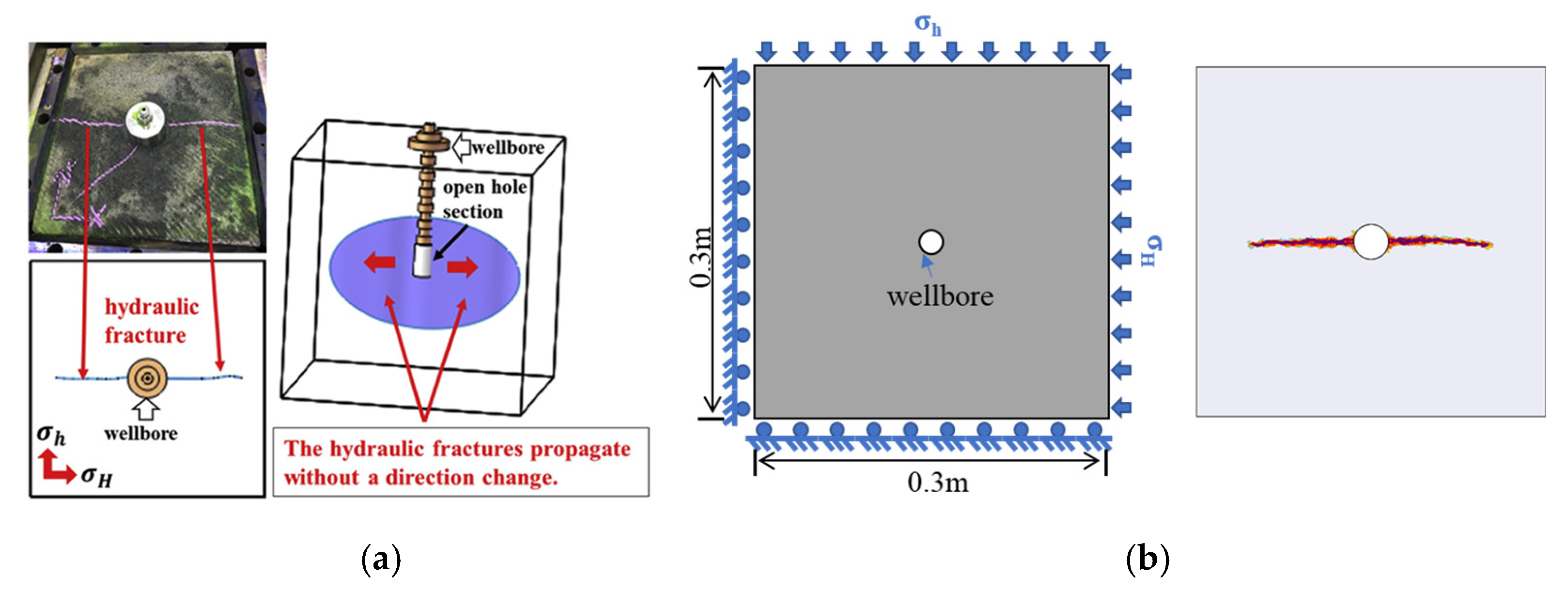
The accuracy of the model was verified by comparing experimental simulations with numerical simulations. Based on the experimental study by Zhou et al. [31]. (Figure 1a), this study established a 300 mm × 300 mm numerical model (Figure 1b), with initial conditions and boundary conditions (normal constraints on the left and bottom boundaries, application of the minimum and maximum horizontal principal stresses on the top and right boundaries, respectively) consistent with the literature. The simulation results show good agreement with the experimental outcomes: in both cases, fractures propagated perpendicular to the minimum principal stress direction.
The simulation results showed good agreement with the experimental data. Specifically, the fracture propagation zone in the numerical simulation aligned well with the actual fracture morphology observed in the physical experiment in terms of overall distribution and the upward/downward propagation trend from the borehole (Figure 1). This consistency indicates that the numerical model can accurately capture the initiation and propagation behavior of fractures during hydraulic fracturing. Thus, the proposed numerical approach is validated as a suitable and reliable tool for investigating hydraulic fracturing mechanisms and predicting fracture geometry.
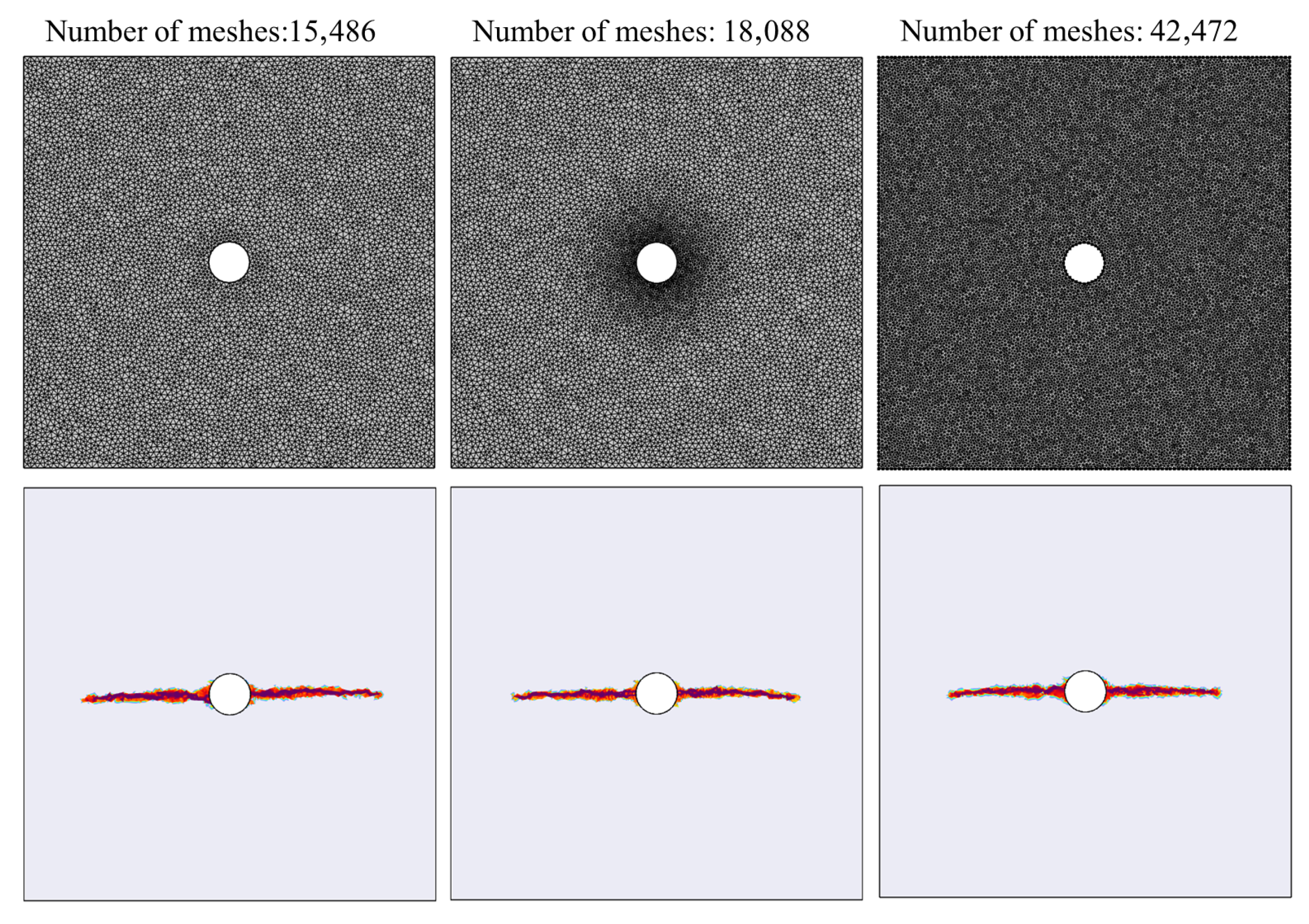
To verify the stability of the results, a mesh independence verification was conducted. As the number of mesh elements increased from 15,486 to 42,472 (through continuous mesh refinement), the simulated hydraulic fracturing damage results showed no significant variation (Figure 2). This demonstrates that the current mesh (with at least 15,486 elements) satisfies the “mesh independence” requirement. Subsequent simulations can therefore utilize this computationally efficient and stable mesh configuration without further refinement.
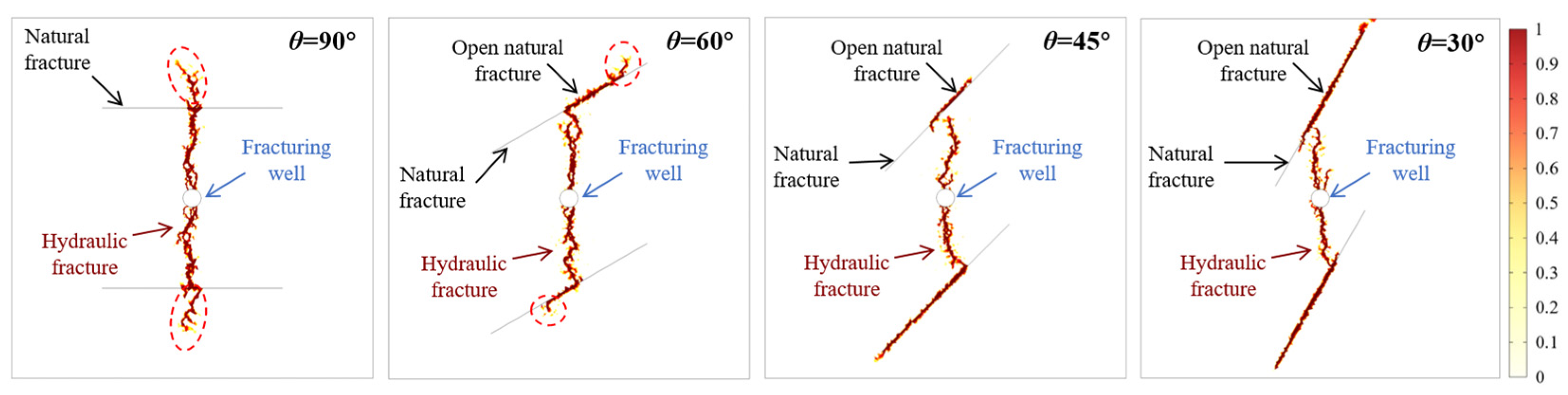
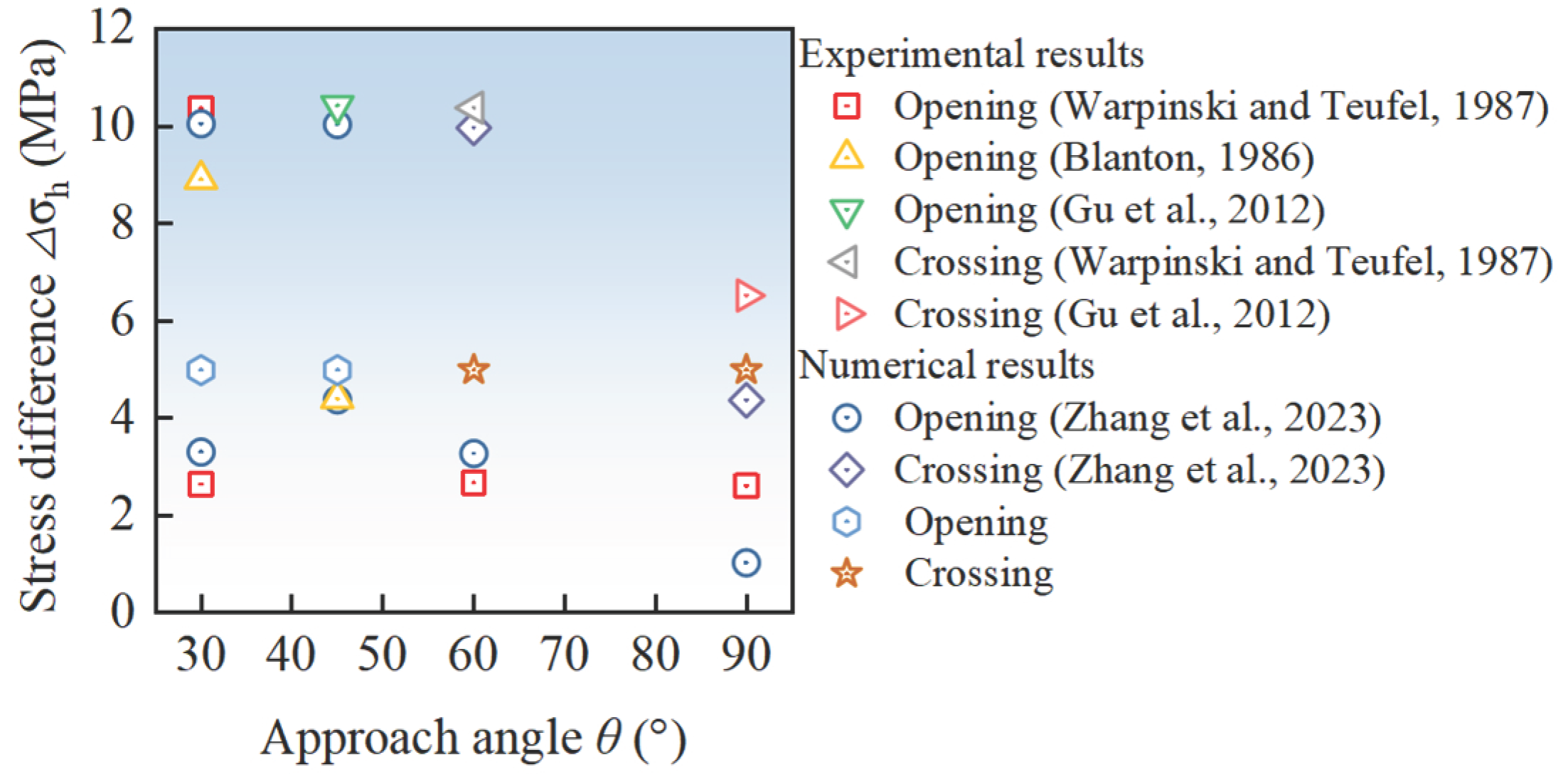
To further validate the model’s accuracy, a second numerical model (Model 2) was constructed. This model measured 200 mm × 200 mm, contained a wellbore with a diameter of 20 mm, and included two natural fractures. Roller supports were applied to the left and bottom boundaries, while the maximum and minimum horizontal principal stresses were applied to the top and right boundaries, respectively. The simulation parameters were consistent with those used in Model 1. To investigate the influence of the angle (θ) between the natural fractures and the maximum horizontal principal stress on hydraulic fracture propagation, four simulation scenarios with different natural fracture angles were designed. The results demonstrate that when the hydraulic fracture approaches a natural fracture, its propagation path is governed by the stress contrast and the orientation of the natural fracture. Specifically: When the natural fracture was oriented at 90° to the maximum principal stress direction, the hydraulic fracture crossed through it. At an angle of 60°, the hydraulic fracture propagated along the natural fracture but eventually broke through it at the fracture tip, continuing to propagate in the direction of the maximum principal stress. For angles of 45° and 30°, the hydraulic fracture primarily propagated along the natural fracture. Furthermore, a smaller angle between the natural fracture and the maximum principal stress direction resulted in a greater fracture length (Figure 3). These simulation results show good agreement with findings from previous studies (Figure 4) [32,33,34,35].

3. Construction of a Numerical Model for a Heterogeneous Coal Seam

3.1. Computational Model

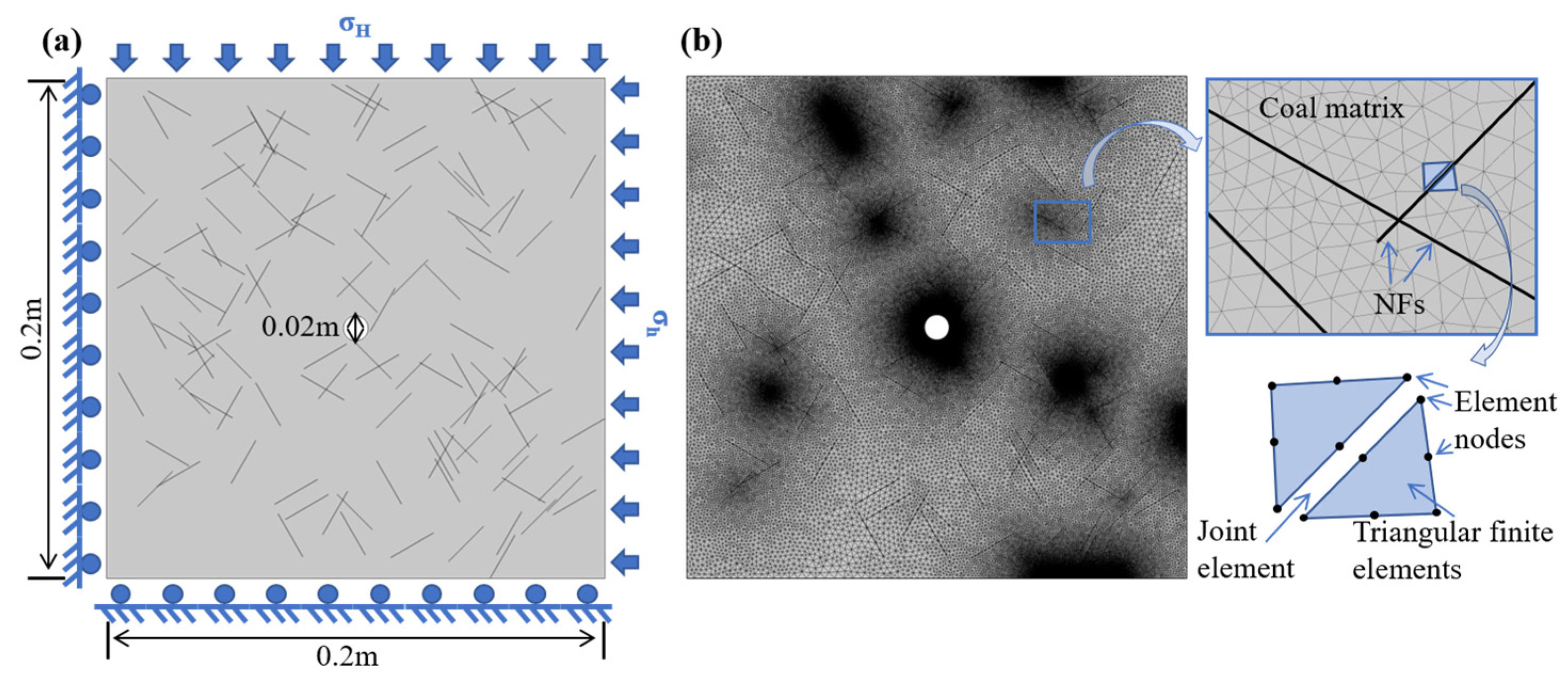
Referring to the geometric dimensions (200 mm × 200 mm) of Model 1 and Model 2, Model 3 was constructed incorporating the heterogeneity of coal’s natural fractures. To reconstruct the distribution of natural fractures in coal, 120 random natural fractures were generated using MATLAB R2022b based on the Monte Carlo method. Each fracture has a length of 20 mm and is randomly distributed within the geometric model, with a random field grid resolution of 0.5 mm. The left and bottom boundaries of the model are assigned roller supports, while the maximum horizontal principal stress is applied to the top boundary and the minimum horizontal principal stress to the right boundary (Figure 5a). The model was discretized using free triangular meshes, with local refinement around the wellbore. The mesh consists of 274,569 domain elements and 4632 boundary elements (Figure 5b), with an average element quality of 0.82 to ensure simulation accuracy.

3.2. Numerical Scheme

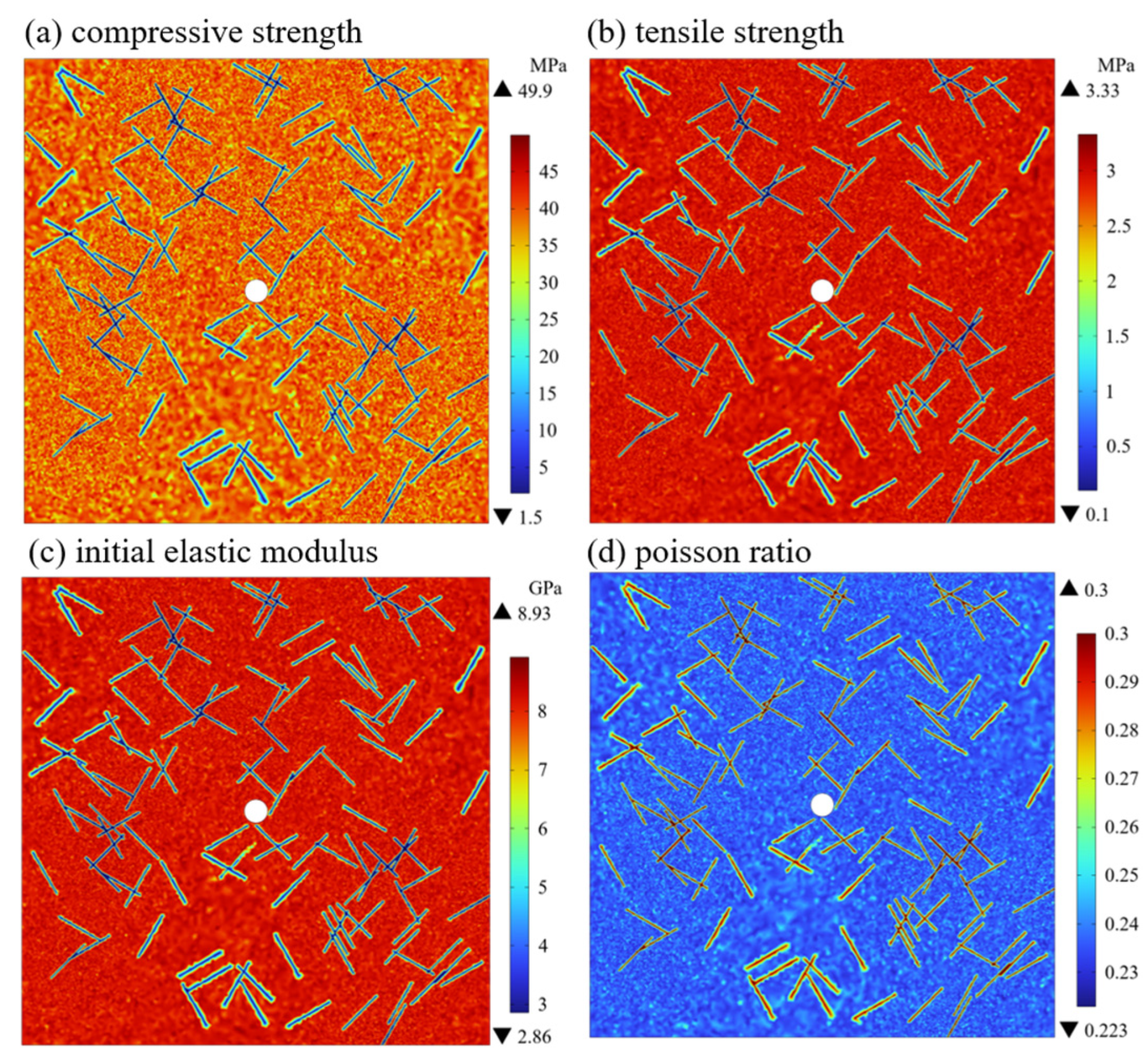
The development of natural fractures and the mechanical properties of coal exhibit significant heterogeneity [36]. Therefore, in this model, parameters including tensile strength, compressive strength, elastic modulus, and Poisson’s ratio were assigned random distributions following the Weibull distribution. According to the definition of the Weibull distribution, the shape parameter *m* must be greater than 1.0. The spatial distributions of tensile strength, compressive strength, elastic modulus, and Poisson’s ratio for a model with *m* = 5 are shown in Figure 6. Concurrently, the mechanical properties at the locations of natural fractures were weakened, while their permeability was enhanced [35].
To investigate the influence of coal mechanical properties on hydraulic fracture propagation, four key parameters—tensile strength, compressive strength, elastic modulus, and Poisson’s ratio—were selected for a sensitivity analysis based on previous research [15]. This analysis aims to identify the dominant mechanical parameters governing fracture growth in coal (Table 1).

3.3. Initial and Boundary Conditions

The initial and boundary conditions applied to the computational model for simulating the hydraulic fracturing process are defined as follows:
(1) Temperature Field: The initial reservoir temperature is set to 60 °C (Table 2). The outer boundaries maintain a constant temperature of 60 °C, while the fluid is injected at a temperature of 20 °C.
(2) Seepage Field: The initial reservoir pressure is 10 MPa. A constant pressure of 10 MPa is applied to the outer boundaries. The fracturing fluid is injected at a constant flow rate of 1 × 10⁻⁴ kg/s.
(3) Stress Field: Roller supports are applied to the left and bottom boundaries. The maximum horizontal principal stress (σH = 15 MPa) is applied to the top boundary, and the minimum horizontal principal stress (σh = 10 MPa) is applied to the right boundary.
(4) Damage Field: The initial damage state is set to 0.

4. Results

4.1. Influence of Tensile Strength

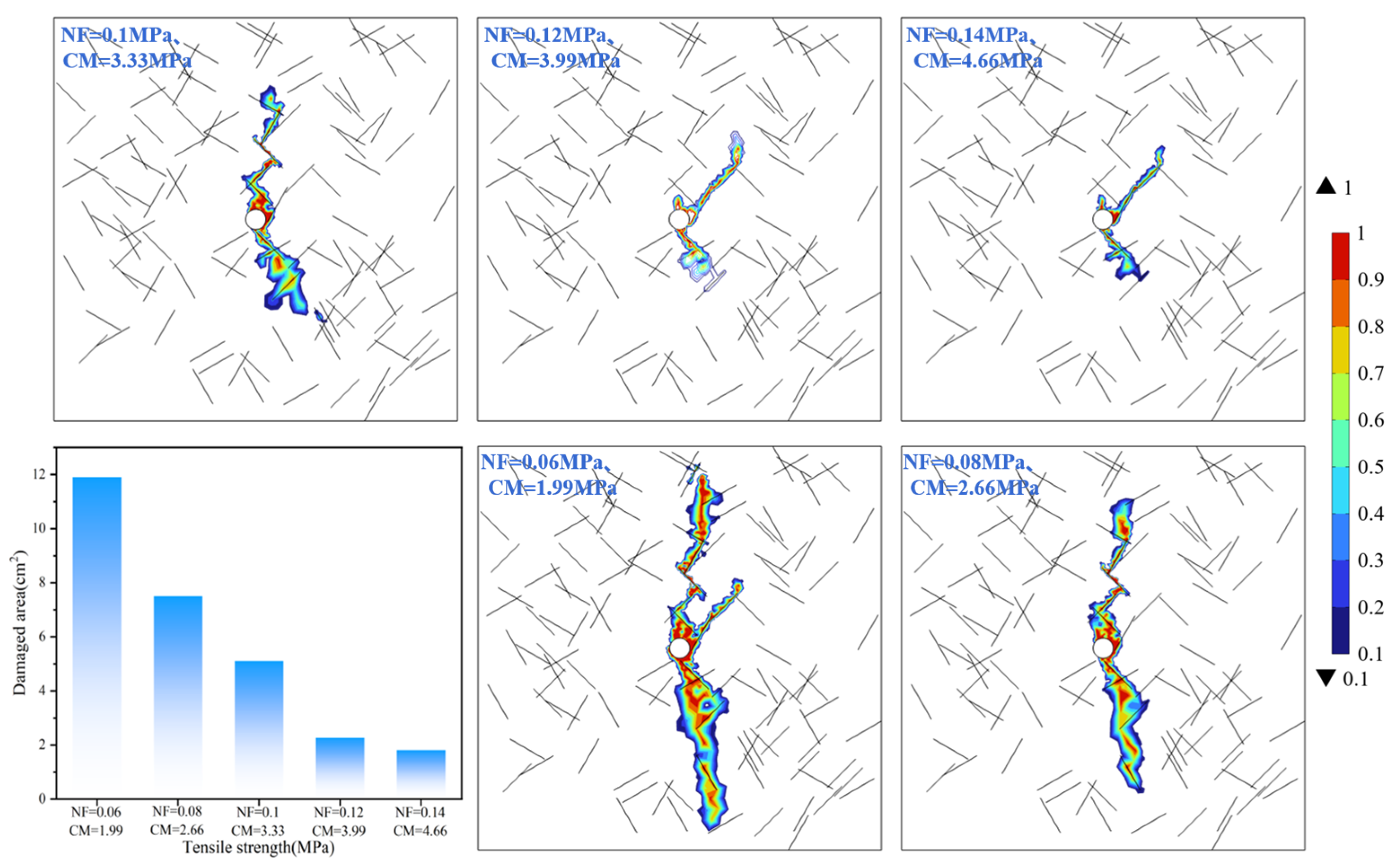
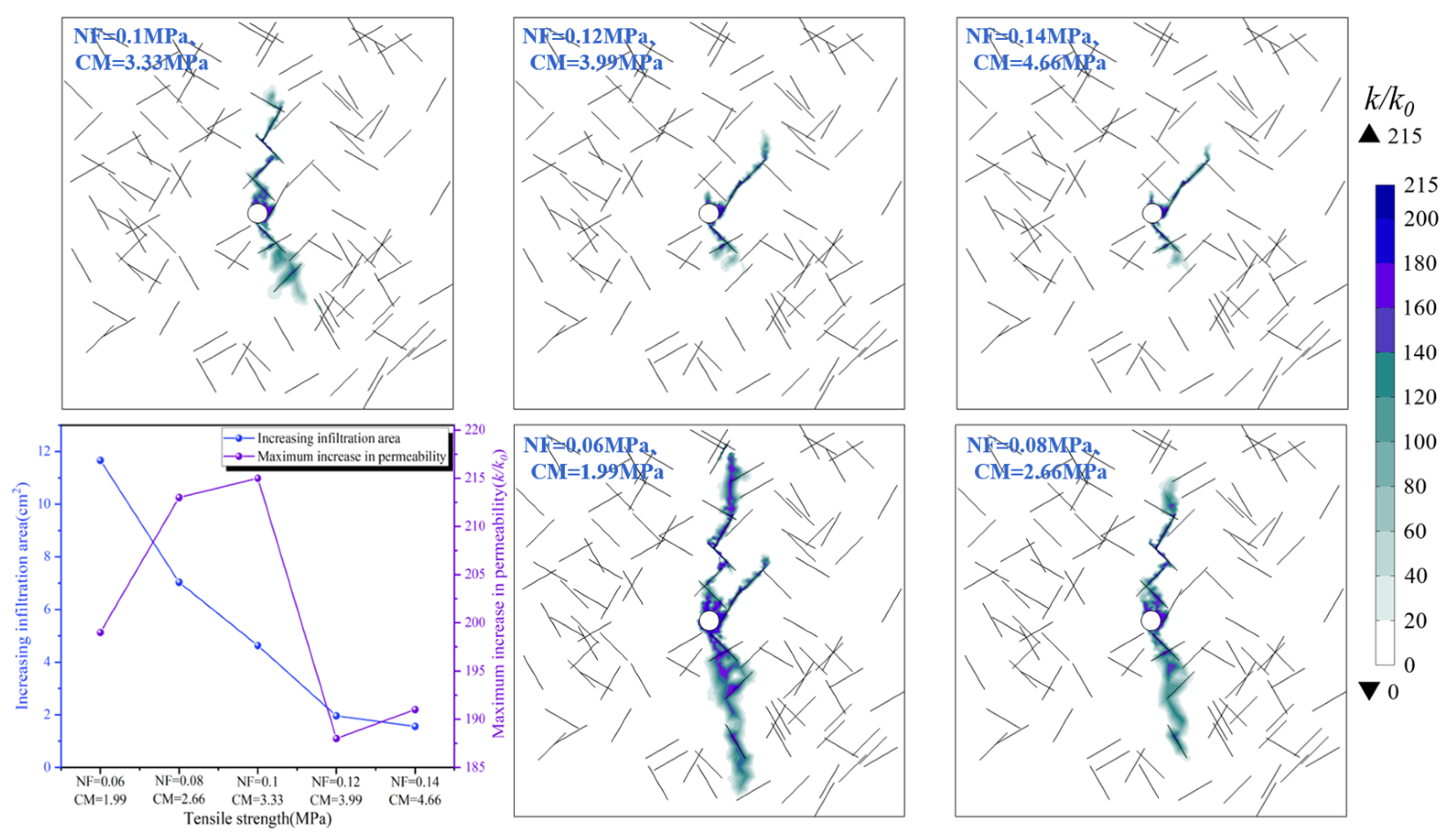
As shown in Figure 7 and Figure 8, a significant negative correlation exists between tensile strength and both the damage area and permeability-enhanced area. When the tensile strength increases from 1.99 MPa to 4.66 MPa, the damage area sharply decreases from 11.903 cm2 to 1.8088 cm2 (a reduction of 84.8%), while the permeability-enhanced area decreases from 11.666 cm2 to 1.5598 cm2 (a reduction of 86.6%). This indicates that coal rock with lower strength is more easily fractured, allowing fluid-driven fractures to more readily generate complex fracture networks, thereby forming extensive damage and permeability-enhanced zones. In contrast, high-strength coal exhibits greater resistance to fracturing, resulting in restricted fracture propagation and a reduced stimulation area.
The maximum permeability enhancement rate (k/k0) exhibits a non-monotonic trend with increasing tensile strength, first rising and then declining, reaching a peak value of 215 at 3.33 MPa. In the low-strength stage (1.99–3.33 MPa), although the damage zone is extensive, the fractures may be too widespread to open adequately, or the created fracture network may possess limited flow conductivity. An optimal balance is achieved around 3.33 MPa, resulting in effective fractures with high flow capacity. When the strength further increases (>3.33 MPa), fracture propagation becomes severely restricted, hindering the formation of efficient flow pathways and causing the maximum permeability enhancement rate (k/k0) to decrease by approximately 12%.

4.2. Influence of Compressive Strength

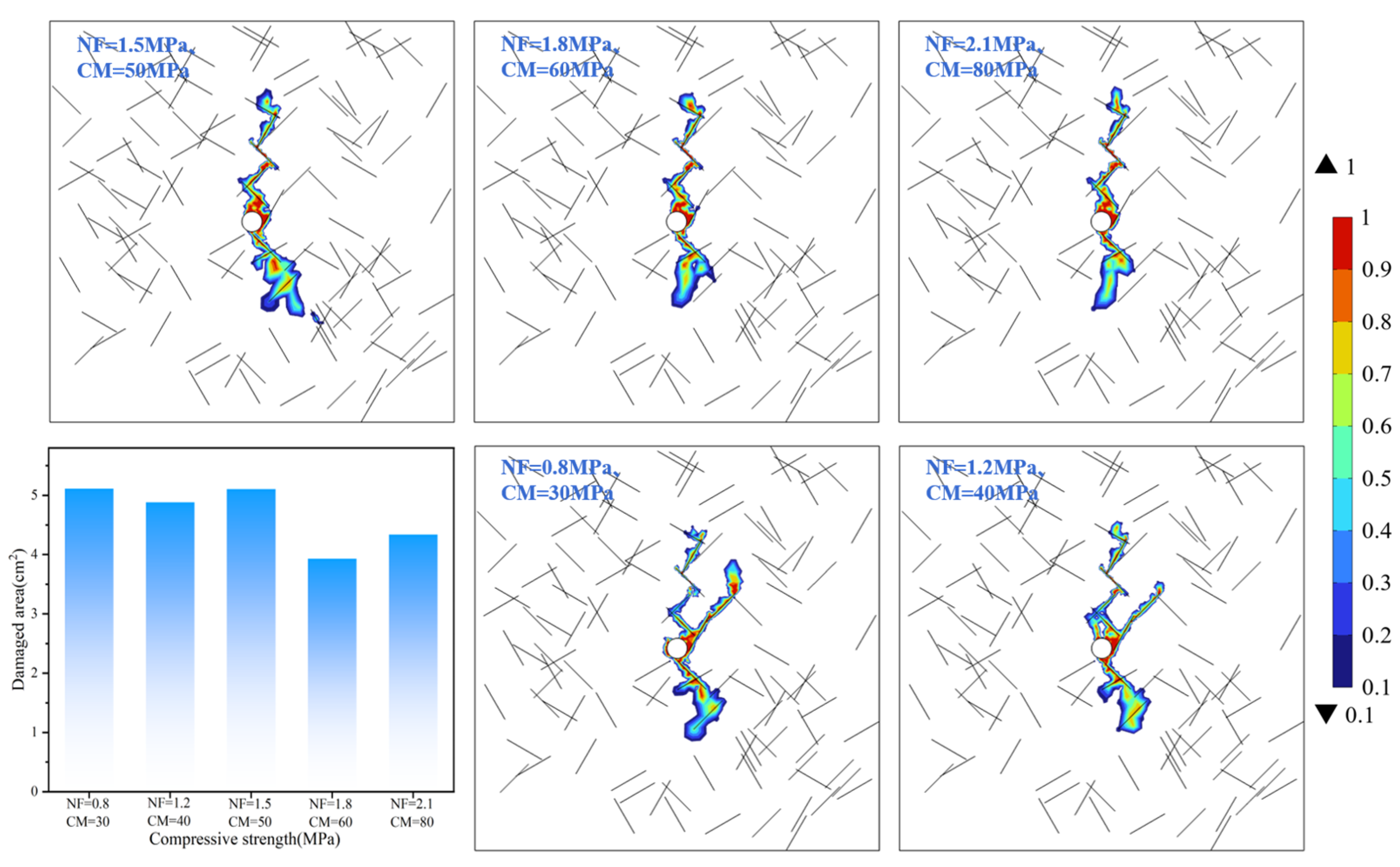
No clear monotonic trend was observed between compressive strength and the damage/permeability-enhanced areas. The data fluctuated around mean values (approximately 4.67 for damage area and 4.18 for permeability-enhanced area) with standard deviations of 0.49 and 0.50, respectively, indicating relatively stable variation. When compressive strength increased from 50 MPa to 80 MPa, the damage area changed by only about 15% (Figure 9). This suggests that within the investigated parameter range, compressive strength is not the dominant factor controlling the damage extent. Fracture propagation during hydraulic fracturing appears to be primarily governed by tensile stress, while the confining pressure effect may not have emerged as the dominant mechanism in this dataset.
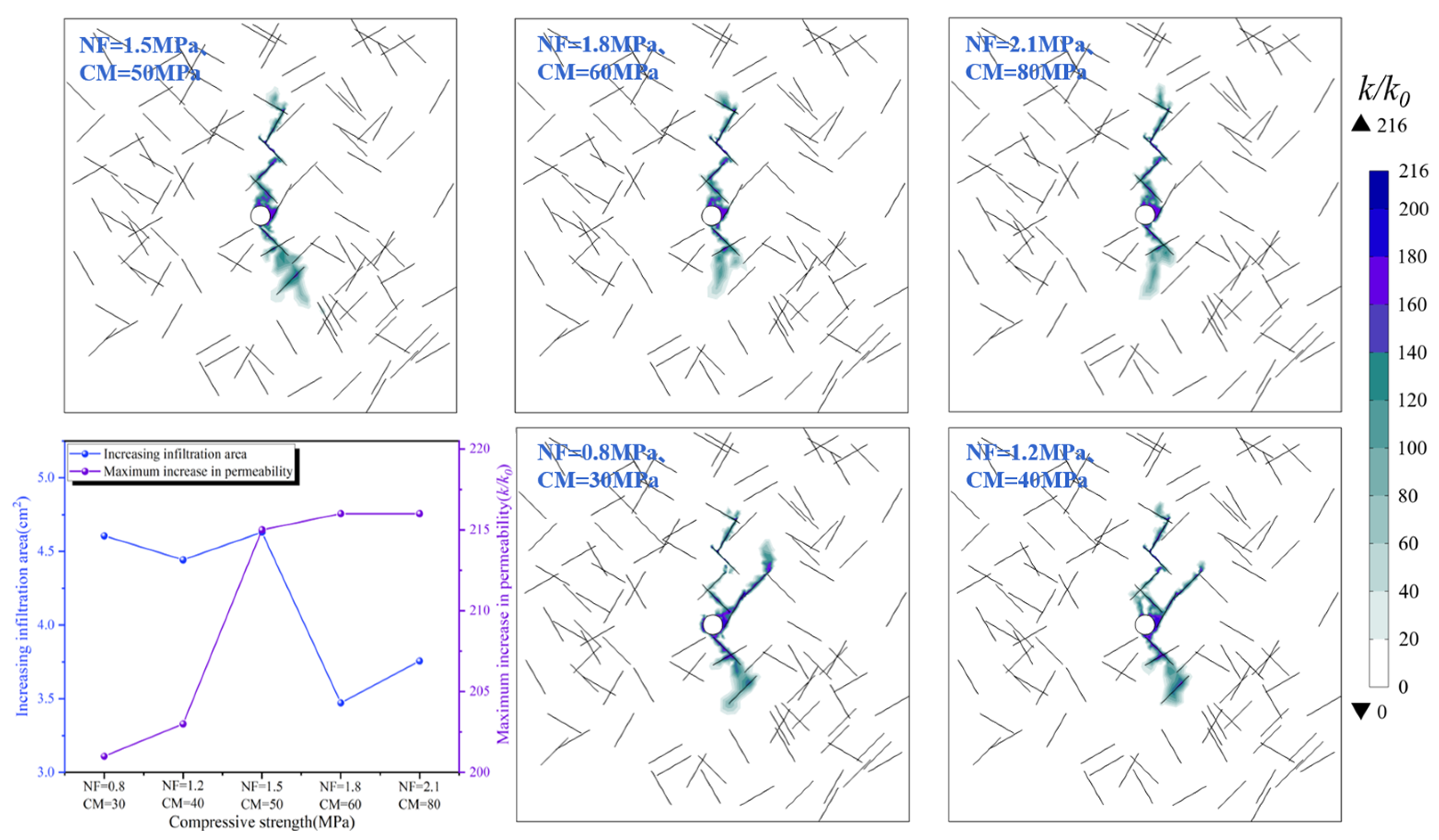
The maximum permeability enhancement rate (k/k0) showed a steady, slight increasing trend with rising compressive strength, growing from 201 (at 30 MPa) to 216 (stabilizing beyond 60 MPa), representing an increase of approximately 7.5%. This improvement can be attributed to the fact that higher compressive strength likely indicates a more robust coal matrix structure. Under closure stress, fractures created through hydraulic fracturing can better maintain their aperture in such stronger coal, thereby sustaining enhanced flow capacity (Figure 10).
In summary, higher compressive strength restricts the propagation of hydraulic fractures and results in a smaller damage area. However, under low compressive strength conditions, fracturing tends to generate short, wide fractures or even cause localized pulverization, leading to poor sustainability of the enhanced permeability.

4.3. Influence of Elastic Modulus

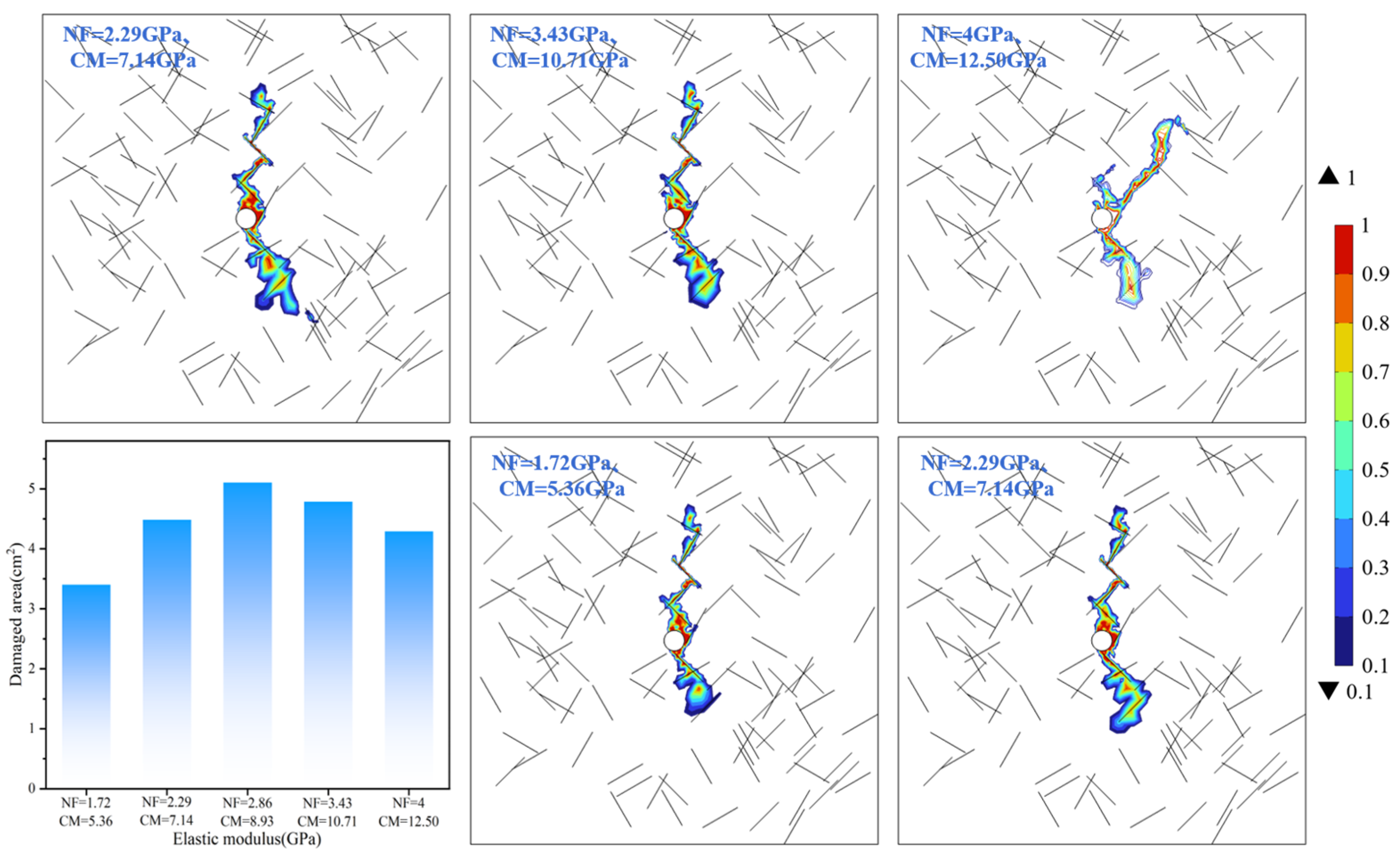
As the elastic modulus increased from 5.36 GPa to 8.93 GPa (a 66.6% increase), the damage area expanded from 3.403 to 5.1067 (peak value, representing a 50% growth). However, when the modulus further increased to 12.5 GPa, the damage area decreased to 4.2909. This pattern can be explained by different mechanical responses: low-modulus coal tends to undergo substantial deformation, absorbing more energy and consequently hindering far-field fracture propagation. Medium-modulus coal (8.93 GPa) achieves an optimal balance between energy transfer and fracture extension. In contrast, high-modulus coal exhibits stronger brittleness, potentially resulting in simpler fracture patterns with reduced branching, ultimately leading to a smaller damage zone (Figure 11).
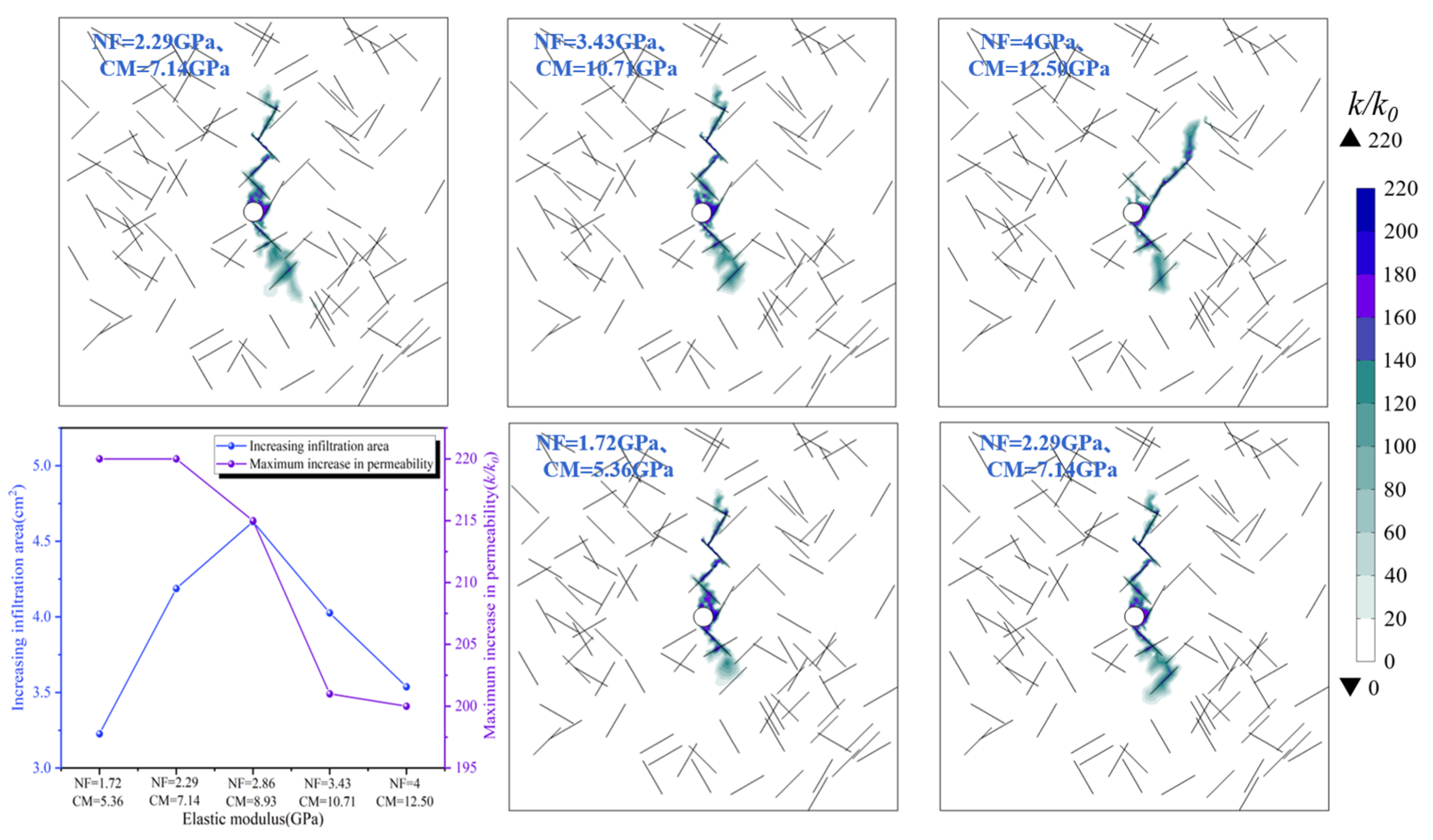
A distinct negative correlation is observed between the maximum permeability enhancement rate (k/k0) and the elastic modulus. The value decreased from 220 at 5.36 GPa to 200 at 12.5 GPa, representing a reduction of approximately 9.1% (Figure 12). Although low-modulus coal rock is less prone to developing long fractures, the fractures that do form tend to be wider, resulting in superior flow capacity and consequently higher maximum permeability enhancement rates (k/k0).

4.4. Influence of Poisson’s Ratio

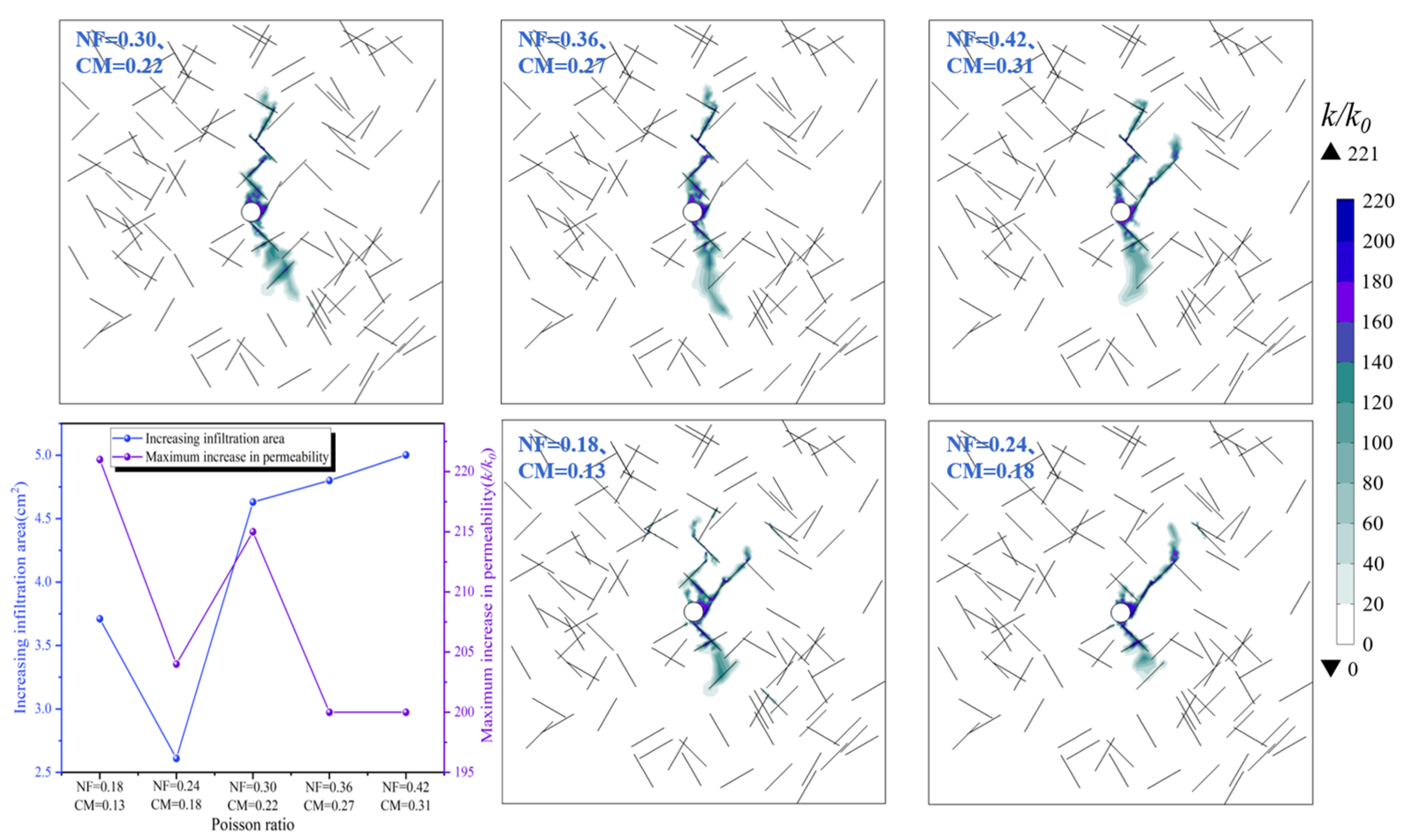
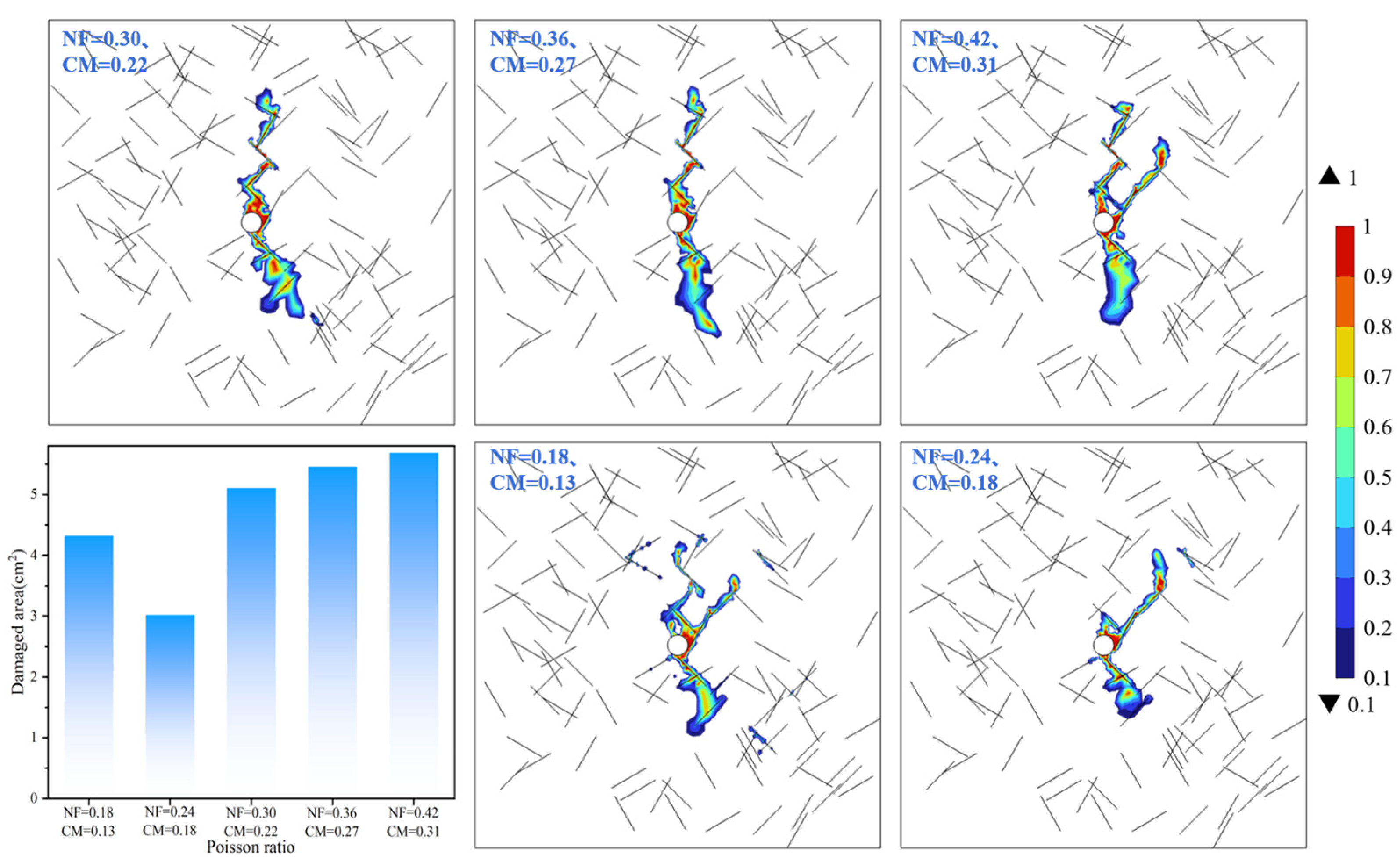
The relationship between Poisson’s ratio and the damage/permeability-enhanced areas exhibits a complex nonlinear pattern. Within the range of 0.13 to 0.18, both area metrics show a decreasing trend. Beyond this interval, they continuously increase with rising Poisson’s ratio, reaching maximum values at 0.3. An increase in Poisson’s ratio indicates that coal rock undergoes more significant lateral expansion under compression, potentially creating a larger compression zone at the fracture tip that inhibits initial fracture propagation (explaining the trough observed at 0.18). However, higher Poisson’s ratios (>0.22) may also promote shear failure and complex multi-fracture competition, thereby expanding the overall damage zone (Figure 13).
The maximum permeability enhancement rate (k/k0) exhibits an overall negative correlation with Poisson’s ratio. It reaches its peak value of 221 at a Poisson’s ratio of 0.13, then fluctuates and declines, eventually stabilizing at 200 for ratios of 0.27 and 0.3 (Figure 14). A lower Poisson’s ratio is typically associated with more pronounced tensile fracturing, which generates fractures with larger apertures and consequently higher flow capacity. In contrast, damage under higher Poisson’s ratios may predominantly result from shear and plastic deformation. Fractures formed through these mechanisms generally exhibit relatively lower flow capacity.
In summary, a low Poisson’s ratio enhances coal brittleness, facilitating the formation of a wider and more complex fracture network and leading to more effective reservoir stimulation. This significantly improves the efficiency of methane desorption and flow.

5. Discussion

5.1. Sensitivity Analysis

The preceding results demonstrate that various mechanical parameters of coal significantly influence the effectiveness of fracturing stimulation. Conducting a systematic analysis and sensitivity assessment of key mechanical parameters—including tensile strength, compressive strength, elastic modulus, and Poisson’s ratio—on fracture propagation is essential for elucidating the intrinsic mechanical mechanisms governing fracture initiation, propagation, and morphology. This understanding is crucial for the precise design and optimization of fracturing operations. Given that the data analysis is primarily factor-oriented, a combined methodology of range analysis and sensitivity coefficients is employed for quantitative comparison.
Through range analysis, the variation range of output results caused by each parameter within its variation range was calculated. A larger range indicates that the output result is more sensitive to changes in that parameter.
R = Maximum Value − Minimum Value
The range analysis results (Table 3) show that for both the damage area and the permeability-enhanced area, the range of tensile strength (>10) is significantly higher than those of the other parameters (<3), indicating its overwhelmingly dominant sensitivity. Poisson’s ratio and elastic modulus exhibit a secondary influence, while compressive strength has the weakest effect. For the maximum permeability enhancement rate, the ranges of the four parameters are relatively close (15–26), with tensile strength having the largest range (26), suggesting it also exerts the most significant influence on the maximum permeability enhancement rate.
To eliminate the influence of parameter dimensions and numerical ranges, we calculated the coefficient of variation for each parameter and conducted the sensitivity analysis based on this metric.
Cv = Standard Deviation/Mean
where Cv represents the coefficient of variation, i.e., the ratio of the standard deviation to the mean.
The results of the sensitivity coefficients (Table 4) indicate that: For the damage/permeability-enhanced area: The coefficient of variation for tensile strength (0.85) exceeded those of other parameters by an order of magnitude, further confirming it as the most sensitive and critical parameter controlling the fracturing extent. Poisson’s ratio (~0.25) ranked second in sensitivity, followed by the elastic modulus (~0.17), while compressive strength (~0.11) was the least sensitive.
For the maximum permeability enhancement rate: The coefficients of variation for all four parameters were relatively small (0.04–0.06), indicating that the maximum permeability enhancement rate itself exhibits relatively minor fluctuations across different parameter levels. Among them, the sensitivity coefficient for tensile strength (0.06) remained the highest, identifying it as the primary factor influencing the enhancement effect. The influence degrees of compressive strength, elastic modulus, and Poisson’s ratio were very similar.

5.2. Engineering Implications

This study demonstrates that coal mechanical parameters exert significantly different influences on hydraulic fracturing outcomes. Tensile strength emerges as the dominant factor, showing the highest sensitivity to both the stimulation area and permeability enhancement effectiveness, thereby serving as the core indicator for reservoir evaluation and interval selection. Poisson’s ratio functions as a key secondary parameter, exhibiting complex effects on fracture propagation morphology and necessitating the identification of its optimal range. The elastic modulus presents a dual effect: a trade-off exists between increasing the stimulated volume and reducing fracture conductivity, requiring balanced optimization. Compressive strength demonstrates the weakest influence and can be considered an auxiliary reference. Consequently, fracturing design should prioritize tensile strength and Poisson’s ratio, while carefully managing the bidirectional implications of the elastic modulus to guide the optimization of operational parameters. Thereby enhancing per-well production and resource extraction efficiency, obtaining clean energy with a smaller ecological footprint, and providing solid support for energy security and the low-carbon transition.

5.3. Limitations

Since the data were obtained from single-parameter variation simulations, it is recommended that future studies employ a full factorial design (such as Latin Hypercube Sampling) to acquire more comprehensive sensitivity analysis results. Additionally, as the simulation results are based on laboratory-scale models, further investigation is required for field-scale models.

6. Conclusions

This study established a fully coupled THMD model using the finite element method to investigate the influence of different mechanical parameters on fracture propagation and permeability enhancement during hydraulic fracturing in heterogeneous coal seams. The model’s accuracy was verified against physical experiments and numerical benchmarks. The main findings are summarized as follows:
(1) Tensile strength is the predominant factor controlling both the fracturing extent and permeability enhancement, with its damage area range (10.094) and coefficient of variation (0.85) significantly exceeding those of other parameters. Poisson’s ratio (range: 2.667, Cv: 0.25) and elastic modulus (range: 1.704, Cv: 0.17) are key secondary parameters, where the elastic modulus exhibits a trade-off relationship between stimulation volume and flow conductivity. In contrast, compressive strength (range: 1.183, Cv: 0.11) shows the lowest sensitivity.
(2) Tensile strength primarily governs fracture propagation. As it increases from 1.99 MPa to 4.66 MPa, both the damage area and permeability-enhanced area sharply decrease by approximately 85%. However, the maximum permeability enhancement rate peaks at 215 when tensile strength reaches 3.33 MPa, exhibiting a non-monotonic trend. Compressive strength has a minor influence on the damage area (~15% variation) but steadily improves the maximum permeability enhancement rate (7.5% increase). The elastic modulus exhibits an optimal range (peak at 8.93 GPa), where the damage area first increases and then decreases, while the maximum permeability enhancement rate declines by about 9.1% with increasing modulus. Poisson’s ratio also demonstrates a nonlinear influence, with lower values (e.g., 0.13) favoring the formation of highly conductive fractures (maximum permeability enhancement rate: 221).
(3) Different mechanical parameters govern the fracture morphology and propagation path through distinct mechanisms. Low compressive strength promotes fracture deflection and branch development, whereas high strength guides fractures to extend along the principal stress direction. The elastic modulus primarily regulates the complexity of the fracture network, with an optimal range existing for maximizing the permeability-enhanced area. A low Poisson’s ratio, by enhancing coal brittleness, facilitates the activation of natural fractures and the formation of a complex fracture network system, thereby significantly improving the effectiveness of reservoir stimulation.

Author Contributions

Conceptualization, S.W., L.Z. and S.L.; Data curation, L.Z., S.L., Y.L. (Yonglong Li), S.P. and L.S.; Formal analysis, S.W., S.L., Y.L. (Yonglong Li), S.P. and L.S.; Investigation, S.L., Y.L. (Yonglong Li), X.L. and W.L.; Method-ology, S.W., L.Z. and Y.L. (Yonglong Li); Project administration, S.W., L.Z. and S.L.; Resources, S.W., L.Z. and S.L.; Writing—original draft, S.W., W.L., X.L., Y.L. (Yan Liang), S.P., L.S. and W.W.; Writing—review and editing, S.W., W.L., X.L., Y.L. (Yan Liang), S.P., L.S. and W.W. All authors have read and agreed to the published version of the manuscript.

Funding

This research was funded by the Scientific Research and Technology Development Project of PetroChina Company Limited (2024DJ2303) and the National Natural Science Foundation of China (No. 42030810).

Institutional Review Board Statement

Not Applicable.

Informed Consent Statement

Not Applicable.

Data Availability Statement

The original contributions presented in this study are included in the article. Further inquiries can be directed to the corresponding authors.

Conflicts of Interest

Author Sukai Wang, Lipeng Zhang, Yonglong Li, Wei Liu, Xionghui Liu, Yan Liang, Songling Pu and Lei Sun is employed by the Engineering Technology Research Institute of CNPC Xibu Drilling Engineering Co. The remaining authors declare that the research was conducted in the absence of any commercial or financial relationships that could be construed as a potential conflict of interest.

Nomenclature

ρwfluid density (kg/m3)
ϕmcoal matrix porosity
χfluid compressibility coefficient (1/Pa)
μwfluid dynamic viscosity (mPa·s)
kcoal permeability (m2)
εVvolumetric strain
Qmsource/sink term
Kddrained bulk modulus (Pa)
Cwspecific heat capacity of the fluid (J·kg−1·K−1)
λwthermal conductivity of the fluid (W·m−1·K−1)
fTuniaxial tensile strength of the coal (Pa)
fCuniaxial compressive strength of the coal (Pa)
θinternal friction angle of the rock (°)
ϕm0initial coal porosity
αϕporosity stress-sensitivity coefficient
ϕmeresidual porosity
Gshear modulus (Pa)
Kbulk modulus (Pa)
αBBiot coefficient (dimensionless)
αTlinear thermal expansion coefficient of the rock skeleton (K−1)
vPoisson’s ratio (dimensionless)
Fibody force per unit volume (Pa/m)
ρCpeffective volumetric heat capacity of the fluid-saturated porous medium (kJ·m−3·K−1)
εTvolumetric thermal strain
λmthermal conductivity of the coal matrix (W·m−1·K−1)
Csspecific heat capacity of the coal solid grains (J·kg−1·K−1)
εt0ultimate tensile strain at tensile failure
εc0ultimate shear strain at shear failure
E0initial elastic modulus of the coal (Pa)
k0initial coal permeability (m2)
αkpermeability stress-sensitivity coefficient
σeffmean effective stress

References

  1. Zou, C.; Yang, Z.; Ma, F.; Sun, Q.; Li, F.; Pan, S.; Tian, W. Resource types, formation, distribution and prospects of coal-measure gas. Pet. Explor. Dev. 2019, 46, 451–462. [Google Scholar] [CrossRef] [Scilit]
  2. Sang, S.; Zheng, S.; Liu, S.; Zhou, X.; Han, S.; Huang, F.; Liu, T.; Dai, X. Research advances in efficient exploration and development of coal measure gases and deep coalbed methane. J. China Univ. Min. Technol. 2024, 54, 1–25. [Google Scholar]
  3. Xie, H.; Sang, S.; Li, X.; Yan, Z.; Zhou, X.; Liu, S.; Cai, J. Competitive adsorption-penetration characteristics of multi-component gases in micro-nano pore of coal. Chem. Eng. J. 2025, 506, 159965. [Google Scholar] [CrossRef] [Scilit]
  4. Wu, P.; Luo, X.; Chen, Y.; Lian, H.; Wang, J.; Wang, Z.; He, W. Cracks propagation and permeability enhancement caused by supercritical CO2 and water fracturing in natural coal-rock combination. Energy Fuels 2024, 38, 4010–4020. [Google Scholar] [CrossRef] [Scilit]
  5. Zhao, H.; Liu, C.; Xiong, Y.; Zhen, H.; Li, X. Experimental research on hydraulic fracture propagation in group of thin coal seams. J. Nat. Gas Sci. Eng. 2022, 103, 104614. [Google Scholar] [CrossRef] [Scilit]
  6. Zou, Y.; Zhang, S.; Ma, X.; Zhou, T.; Zeng, B. Numerical investigation of hydraulic fracture network propagation in naturally fractured shale formations. J. Struct. Geol. 2016, 84, 1–13. [Google Scholar] [CrossRef] [Scilit]
  7. Wang, T.; Hu, W.; Elsworth, D.; Zhou, W.; Zhou, W.; Zhao, X.; Zhao, L. The effect of natural fractures on hydraulic fracturing propagation in coal seams. J. Pet. Sci. Eng. 2017, 150, 180–190. [Google Scholar] [CrossRef] [Scilit]
  8. Cheng, L.; Luo, Z.; Xie, Y.; Zhao, L.; Wu, L. Numerical simulation and analysis of damage evolution and fracture activation in enhanced tight oil recovery using a THMD coupled model. Comput. Geotech. 2023, 155, 105244. [Google Scholar] [CrossRef] [Scilit]
  9. Wang, Y.; Wang, B.; Su, H.; Chang, T.; Dong, R.; Li, L.; Tang, W.; Jiang, T.; Zhou, F. Mechanisms of fracture propagation from multi-cluster using a phase field based HMD coupling model in fractured reservoir. Pet. Sci. 2024, 21, 1829–1851. [Google Scholar] [CrossRef] [Scilit]
  10. Wu, L.; Hou, Z.; Xie, Y.; Luo, Z.; Xiong, Y.; Cheng, L.; Huang, L. Fracture initiation and propagation of supercritical carbon dioxide fracturing in calcite-rich shale: A coupled thermal-hydraulic-mechanical-chemical simulation. Int. J. Rock Mech. Min. Sci. 2023, 167, 105389. [Google Scholar] [CrossRef] [Scilit]
  11. Zhao, J.; Lin, B.; Liu, T.; Liu, T.; Ma, S.; Tian, S. Mechanism of water adsorption and penetration at the coal interface under methane pressure and temperature. Phys. Fluids 2025, 37, 062018. [Google Scholar] [CrossRef] [Scilit]
  12. Krzaczek, M.; Tejchman, J. Hydraulic fracturing process in rocks–small-scale simulations with a novel fully coupled DEM/CFD-based thermo-hydro-mechanical approach. Eng. Fract. Mech. 2023, 289, 109424. [Google Scholar] [CrossRef] [Scilit]
  13. Wang, X.; Li, P.; Qi, T.; Li, L.; Li, T.; Jin, J.; Lu, D. A framework to model the hydraulic fracturing with thermo-hydro-mechanical coupling based on the variational phase-field approach. Comput. Methods Appl. Mech. Eng. 2023, 417, 116406. [Google Scholar] [CrossRef] [Scilit]
  14. Yang, K.; Liang, Y.; Li, Q.; Chen, Q.; Xu, H.; Sun, W.; Li, Z. An Enhanced Coalbed Methane Extraction Model of Coupled Hydraulic Fracturing and Two-Phase Flow in Heterogeneous Coal Reservoirs. Rock Mech. Rock Eng. 2025, 58, 10215–10240. [Google Scholar] [CrossRef] [Scilit]
  15. Yu, J.; Li, N.; Hui, B.; Zhao, W.; Li, Y.; Kang, J.; Hu, P.; Chen, Y. Experimental simulation of fracture propagation and extension in hydraulic fracturing: A state-of-the-art review. Fuel 2024, 363, 131021. [Google Scholar] [CrossRef] [Scilit]
  16. Li, Y.; Yang, H.; Li, B.; Li, Z. Interference Behaviour between Bedding Planes and Hydraulic Fractures and Its Influence on the Complex Fracture Network in Shale. Rock Mech. Rock Eng. 2025, 58, 181. [Google Scholar] [CrossRef] [Scilit]
  17. Cui, G.; Feng, X.; Ning, F.; Chen, Z.; Tian, H. Micro-cracks evolution process and borehole stability analysis in deep pebbly sandstone based on THM coupling method. Geoenergy Sci. Eng. 2024, 240, 213000. [Google Scholar] [CrossRef] [Scilit]
  18. Li, T.; Yao, M.; Xia, Y.; Feng, X.; Cong, W.; Shi, Y.; Tang, C.A. The influences of mineral components and pore structure on hydraulic fracture propagation in shale. Rock Mech. Rock Eng. 2025, 58, 2929–2952. [Google Scholar] [CrossRef] [Scilit]
  19. Qiu, Y.; Liang, W.; Li, J.; He, W. Study on fracture morphology of hydraulic fracturing in heterogeneous elastoplastic coal. J. China Coal Soc. 2022, 47, 3668–3679. [Google Scholar]
  20. Li, L.; Tang, C.; Wang, S.; Yu, J. A coupled thermo-hydrologic- mechanical damage model and associated application in a stability analysis on a rock pillar. Tunn. Undergr. Space Technol. 2013, 34, 38–53. [Google Scholar] [CrossRef] [Scilit]
  21. Xue, Y.; Liu, S.; Chai, J.; Liu, J.; Ranjith, P.; Cai, C.; Gao, F.; Bai, X. Effect of water-cooling shock on fracture initiation and morphology of high-temperature granite: Application of hydraulic fracturing to enhanced geothermal systems. Appl. Energy 2023, 337, 120858. [Google Scholar] [CrossRef] [Scilit]
  22. Li, L. Investigation on Numerical Model of Coupled Thermo-Hydro Mechanical-Damage (THM-D) for Rock Failure Process and Associated Application. Ph.D. Thesis, Northeastern University, Shenyang, China, 2006. [Google Scholar]
  23. Li, L.; Yang, T.; Tang, C. Coupling analysis of hydraulic fracturing process of rock. Chin. J. Rock Mech. Eng. 2003, 22, 1060–1066. [Google Scholar]
  24. Zhang, W.; Guo, T.; Qu, Z.; Wang, Z. Research of fracture initiation and propagation in HDR fracturing under thermal stress from meso-damage perspective. Energy 2019, 178, 508–521. [Google Scholar] [CrossRef] [Scilit]
  25. Wei, C.; Zhu, W.; Yu, Q.; Xu, T.; Jeon, S. Numerical simulation of excavation damaged zone under coupled thermalemechanical conditions with varying mechanical parameters. Int. J. Rock Mech. Min. Sci. 2015, 75, 169–181. [Google Scholar] [CrossRef] [Scilit]
  26. Akbari Rahimabadi, A.; Kerfriden, P.; Bordas, S. Scale selection in nonlinear fracture mechanics of heterogeneous materials. Philos. Mag. 2015, 95, 3328–3347. [Google Scholar] [CrossRef] [Scilit]
  27. Torabi, A.R.; Berto, F.; Sapora, A. Finite fracture mechanics assessment in moderate and large scale yielding regimes. Metals 2019, 9, 602. [Google Scholar] [CrossRef] [Scilit]
  28. Li, L.; Li, G.; Meng, Q.; Wang, H.; Wang, Z. Numerical simulation of propagation of hydraulic fractures in glutenite formation. Rock Soil Mech. 2013, 34, 1501–1507. [Google Scholar]
  29. Rutqvist, J.; Wu, Y.; Tsang, C.; Bodvarsson, G. A modeling approach for analysis of coupled multiphase fluid flow, heat transfer, and deformation in fractured porous rock. Int. J. Rock Mech. Min. Sci. 2002, 39, 429–442. [Google Scholar] [CrossRef] [Scilit]
  30. Zhang, W.; Wang, C.; Guo, T.; He, J.; Zhang, L.; Chen, S.; Qu, Z. Study on the cracking mechanism of hydraulic and supercritical CO2 fracturing in hot dry rock under thermal stress. Energy 2021, 221, 119886. [Google Scholar] [CrossRef] [Scilit]
  31. Zhou, Z.; Jin, Y.; Zeng, Y.; Zhang, X.; Zhou, J.; Zhuang, L.; Xin, S. Investigation on fracture creation in hot dry rock geothermal formations of China during hydraulic fracturing. Renew. Energy 2020, 153, 301–313. [Google Scholar] [CrossRef] [Scilit]
  32. Blanton, T. Propagation of hydraulically and dynamically induced fractures in naturally fractured reservoirs. In Proceedings of the SPE Unconventional Resources Conference/Gas Technology Symposium, Louisville, KY, USA, 18–21 May 1986; SPE: Richardson, TX, USA, 1986. [Google Scholar]
  33. Gu, H.; Weng, X.; Lund, J.; Mack, M.; Ganguly, U.; Suarez-Rivera, R. Hydraulic fracture crossing natural fracture at nonorthogonal angles: A criterion and its validation. SPE Prod. Oper. 2012, 27, 20–26. [Google Scholar] [CrossRef] [Scilit]
  34. Warpinski, N.R.; Teufel, L.W. Influence of geologic discontinuities on hydraulic fracture propagation (includes associated papers 17011 and 17074). J. Pet. Technol. 1987, 39, 209–220. [Google Scholar] [CrossRef] [Scilit]
  35. Zhang, B.; Guo, T.; Qu, Z.; Wang, J.; Chen, M.; Liu, X. Numerical simulation of fracture propagation and production performance in a fractured geothermal reservoir using a 2D FEM-based THMD coupling model. Energy 2023, 273, 127175. [Google Scholar] [CrossRef] [Scilit]
  36. Lu, S.; Wang, S.; Liu, H.; Li, R.; Domg, Q.; Xiao, Y.; Shen, P. Analysis of the influence of natural fracture system on hydraulic fracture propagation morphology in coal reservoir. J. China Coal Soc. 2020, 45, 2590–2601. [Google Scholar]
Figure 1. Comparison between Physical Simulation and Numerical Simulation. (a) Experimental result. (b) THMD model.
Sustainability 17 10935 g001
Figure 2. Mesh independence verification.
Sustainability 17 10935 g002
Figure 3. Fracture propagation under different angles between the natural fracture and the maximum principal stress.
Sustainability 17 10935 g003
Figure 4. Comparison between experimental and numerical results of the interaction between natural and hydraulic fractures [32,33,34,35].
Sustainability 17 10935 g004
Figure 5. Single-well physical model and mesh generation. (a) Boundary conditions. (b) Numerical mesh.
Sustainability 17 10935 g005
Figure 6. Distribution of mechanical parameters of coal. (a) Compressive Strength. (b) Tensile Strength. (c) Elastic Modulus. (d) Poisson’s Ratio.
Sustainability 17 10935 g006
Figure 7. Fracture propagation and damage area under different tensile strengths.
Sustainability 17 10935 g007
Figure 8. Permeability enhancement rate and permeability-enhanced area after fracturing under different tensile strengths.
Sustainability 17 10935 g008
Figure 9. Fracture propagation and damage area under different compressive strengths.
Sustainability 17 10935 g009
Figure 10. Permeability enhancement rate and permeability-enhanced area after fracturing under different compressive strengths.
Sustainability 17 10935 g010
Figure 11. Fracture propagation and damage area under different elastic moduli.
Sustainability 17 10935 g011
Figure 12. Permeability enhancement rate and permeability-enhanced area after fracturing under different elastic moduli.
Sustainability 17 10935 g012
Figure 13. Fracture propagation and damage area under different Poisson’s ratios.
Sustainability 17 10935 g013
Figure 14. Permeability enhancement rate and permeability-enhanced area after fracturing under different Poisson’s ratios.
Sustainability 17 10935 g014
Table 1. Simulation schemes.
Simulation ParametersValue
Tensile Strength/MPaNF = 0.06, CM = 1.99NF = 0.08, CM = 2.66NF = 0.10, CM = 3.33NF = 0.12, CM = 3.99NF = 0.14, CM = 4.66
Compressive Strength/MPaNF = 0.80, CM = 30NF = 1.20, CM = 40NF = 1.50, CM = 50NF = 1.80, CM = 60NF = 2.10, CM = 70
Elastic Modulus/GPaNF = 1.72, CM = 5.36NF = 2.29, CM = 7.14NF = 2.86 CM = 8.93NF = 3.43, CM = 10.71NF = 4.00, CM = 12.50
Poisson’s RatioNF = 0.18, CM = 0.13NF = 0.24, CM = 0.18NF = 0.30, CM = 0.22NF = 0.36, CM = 0.27NF = 0.42, CM = 0.31
Table 2. Key Parameters for numerical simulation.
ParameterValueParameterValue
Natural Fracture Permeability/m21.15 × 10−15Coal Thermal Expansion Coefficient/K−12.5 × 10−6
Matrix Permeability/m23.7 × 10−17Coal Thermal Conductivity/W·(m·K)−14
Porosity0.045Coal Specific Heat Capacity/J·(kg·K)−1960
Internal Friction Angle/°40Water Density/(kg/m3)1000
Initial Reservoir Temperature/°C60Water Viscosity/Pa·s1.0 × 10−3
Water Specific Heat Capacity/J·(kg·K)−14187Coal Density/(kg/m3)1350
Water Thermal Conductivity/W·(m·K)−10.6Residual Porosity0.039
porosity stress-sensitivity coefficient5permeability stress-sensitivity coefficient5
Table 3. Range analysis results.
Mechanical ParameterDamage Area RangePermeability-Enhanced Area RangeMaximum Permeability Enhancement Rate Range
Tensile Strength10.09410.10626
Compressive Strength1.1831.15815
Elastic Modulus1.7041.40420
Poisson’s Ratio2.6672.3922
Table 4. Sensitivity coefficients.
Mechanical ParameterCv of Damage AreaCv of Permeability-Enhanced AreaCv of Maximum Permeability Enhancement Rate
Tensile Strength0.850.880.06
Compressive Strength0.110.110.04
Elastic Modulus0.170.160.05
Poisson’s Ratio0.240.250.05
Disclaimer/Publisher’s Note: The statements, opinions and data contained in all publications are solely those of the individual author(s) and contributor(s) and not of MDPI and/or the editor(s). MDPI and/or the editor(s) disclaim responsibility for any injury to people or property resulting from any ideas, methods, instructions or products referred to in the content.