Article

From Experiment to Example: Evaluating the Sustainability of Shore Nourishment in the Southeastern Baltic (Palanga, Lithuania)


by
Donatas Pupienis
1,*,
Darius Jarmalavičius
2,
Gintautas Žilinskas
2 and
Dovilė Karlonienė
2
1
Institute of Geosciences, Faculty of Chemistry and Geosciences, Vilnius University, 21 Čiurlionio Str., 03101 Vilnius, Lithuania
2
Laboratory of Geoenvironmental Research, State Research Institute Nature Research Centre, 2 Akademijos St., 08412 Vilnius, Lithuania
*
Author to whom correspondence should be addressed.
Sustainability 2025, 17(24), 10931; https://doi.org/10.3390/su172410931
Submission received: 9 November 2025 / Revised: 28 November 2025 / Accepted: 5 December 2025 / Published: 7 December 2025

Abstract

Coastal erosion and increasingly severe storms present a growing challenge to the sustainable management of sandy shorelines. This study examines the geomorphological, sedimentological and geochemical responses of the Palanga coastal area in the Lithuanian Baltic Sea to beach nourishment projects implemented between 2006 and 2012. A multi-parameter approach was used, combining cross-shore profile monitoring with grain-size, magnetic susceptibility, mineralogical and geochemical analyses, in order to assess sediment redistribution and post-nourishment adjustments. The results demonstrate that nourishment projects substantially increased beach width, height and sand volume; however, the shoreline response was uneven in space and time. Subsequent years were characterised by gradual sediment redistribution along and across the coast, resulting in partial morphological stabilisation. Elevated concentrations of heavy minerals and trace elements immediately after nourishment indicated short-term enrichment from mineralogically distinct material, which was later diluted by natural reworking. The findings demonstrate that properly designed and monitored nourishment enhances coastal resilience, representing a human-induced adjustment within the prevailing coastal morphodynamic regime. While the socio-ecological effects were not directly evaluated, the identified geoindicators offer insights into the physical sustainability of coastal systems, emphasising the importance of evidence-based, adaptive management in line with the United Nations Sustainable Development Goals (SDGs 11, 13 and 14).

1. Introduction

In recent decades, extreme weather events have become more frequent and the sea level has continued to rise, intensifying shoreline dynamics and erosion worldwide [1,2]. Consequently, the sustainability of coastal systems, especially in densely populated, tourism-dependent areas, is now a central concern [3,4]. Degrading coastal ecosystems undermines livelihoods, erodes community resilience and puts long-term economic stability at risk.
Although traditional hard-engineering structures can provide a short-term solution, they often disrupt sediment transport and shift erosion problems down-drift. To avoid these issues, managers are increasingly turning to “soft”, nature-based solutions, particularly beach nourishment [5,6,7]. Among shoreline protection options, nourishment is widely considered to be one of the most sustainable and environmentally compatible approaches. Not only does it strengthen coastal resilience, but it also improves recreational quality [7,8,9,10,11], helping communities to adapt to rising sea levels and stronger storms by reducing flood and erosion risk [12,13,14].
Nevertheless, beach nourishment remains an artificial intervention that alters natural coastal dynamics. Early studies questioned whether adding sediment compromises the ecological integrity of sandy beaches [15], and more recent research indicates that it is not always ecologically neutral [16]. Therefore, evaluations need to consider ecological and socio-economic sustainability as well as engineering performance [17]. The outcomes vary depending on the compatibility of the fill and the native sediments [18,19,20,21], the local wave climate and the broader management context [22]. For this reason, integrated assessments that link sedimentology, geomorphology, ecology and society are increasingly necessary [23]. Changes in grain size can reshape the slope of a beach and the way in which wave energy is dissipated [24,25,26,27,28,29].
Despite there being many successful cases worldwide and in Europe [2,22,24], shore nourishment remains uncommon along the south-eastern Baltic coast [9,10,17,30,31,32,33], and the effects of nourishment are sparsely documented in this area. Coastal change arises from both natural and human factors and occurs over multiple spatial and temporal scales, making it difficult to understand and predict [22]. Insufficient resolution, gaps, and inconsistencies in coastal change data can hinder effective decision-making regarding the management and planning of coastal resources. Therefore, approaches requiring appropriate spatial and temporal scales, hierarchical relationships, and integrated assessment are essential, as emphasised by Capobianco [34]. In this context, the UN Sustainable Development Goals (SDGs 11, 13, and 14) offer guidance for resilient and sustainable coastal development [35].
The shore nourishment project undertaken on the Lithuanian coast, especially near Palanga, between 2006 and 2012 provides a rare opportunity to examine the medium-term effects of human intervention. Given the area’s distinctive geology and strong longshore sediment transport, these impacts may persist and offer meaningful indicators of coastal sustainability. The aim of this study is to determine how long nourishment-related signals remain detectable and how far they extend along the coast, thereby providing insights into the durability and effectiveness of such interventions. By defining the duration and spatial extent of the effects of nourishment, we provide evidence that is relevant to the sustainability of coastal interventions in the Baltic Sea, while also clarifying the environmental impact of human activities to inform more resilient coastal management.

2. Study Area

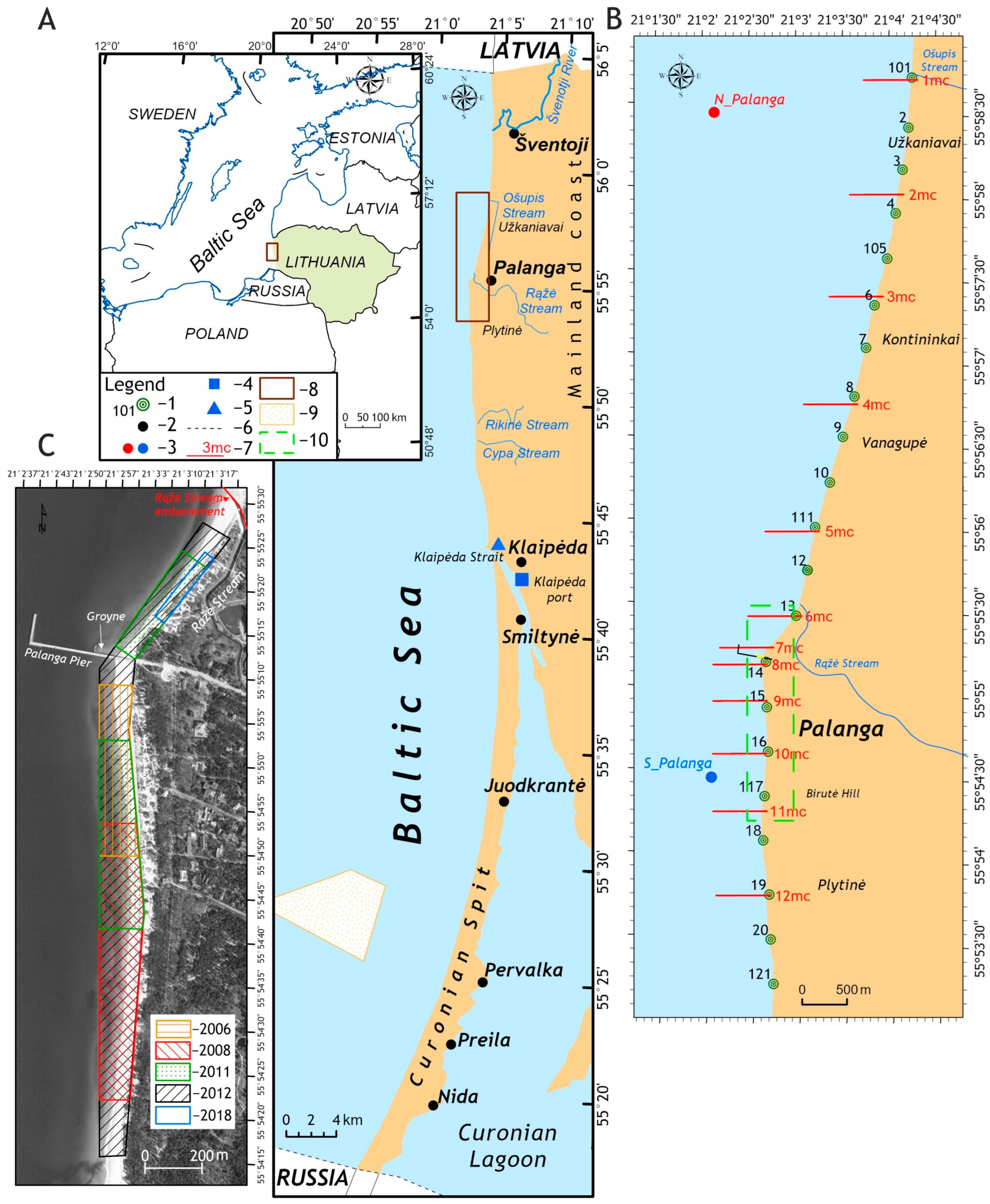
This study focuses on the Lithuanian Baltic Sea coast, which consists of two morphologically distinct sections: the 38.5 km mainland coast and the 51 km Curonian Spit. The two sections are separated by the 1.1 km-wide Klaipėda Strait, which connects the Baltic Sea and the Curonian Lagoon (Figure 1A). The study area covers approximately 10 km of shoreline near Palanga, Lithuania’s largest seaside resort and a major source of national tourism revenue. Beach and foredune deposits in the area are composed mainly of quartz-feldspathic sand with grains ranging from very fine to coarse. Before nourishment projects began, fine sand dominated to the north and south of the Palanga pier, forming beach layers up to 5 m thick. Aeolian sands, which are closely related to marine deposits, range from 4 to 10 m in thickness.
The Baltic Sea is a nearly non-tidal basin, with tidal amplitudes rarely greater than 4 cm, so coastal hydrodynamics are primarily driven by wind-generated waves. The strongest winds occur in the autumn and winter months, averaging 4.7 m s−1 [36]. During severe storms, wave heights can reach 4–6 m [12]. Prevailing westerly winds drive a dominant longshore drift from the Sambian Peninsula toward the northern Curonian Spit and the mainland coast, where it is interrupted by the Klaipėda Port jetties [37,38,39,40].
In 1890, a pier constructed from wooden poles and cast stones was built in Palanga to serve as a mooring facility. This impermeable structure interrupted longshore currents, leading to sand accumulation. The development of coastal infrastructure has significantly influenced local sediment dynamics. By 1913, the coast south of the pier had advanced seaward by 350–400 m, forming beaches 60–80 m wide with dunes rising 6–8 m behind them. However, intensive shoreline retreat began in the late 20th century when a new reinforced concrete pier was constructed south of the old one. The subsequent construction of an openwork pier in 1995 and the removal of old pile and stone remains in 1997 allowed sea currents to move freely along the shore again (Figure 1B). After the severe 1999 storm Anatol, large stones were placed at the former pier site to reduce erosion, but the measure proved ineffective.
In 2005, a 120 m-long stone groyne was built in the same area to trap sand moving longshore, but it was over three times shorter than the previous impermeable wooden–stone pier (400 m) and had limited success (Figure 1). Such structures are effective when sufficient sediment is available in the nearshore zone. In the case of Palanga, the interaction between the new permeable pier and the reconstructed groyne created a underwater channel beneath the pier. As a result, sand that would normally be transported northward through the permeable pier was diverted into the underwater channel and carried offshore into deeper water instead.
The history of shore nourishment in Lithuania began in 1991, when about 30,000 m3 of imported sand was placed along a 1 km stretch near Kunigiškiai [35]. Later, between 2006 and 2018, four additional nourishment projects and one foredune restoration (in 2018) were completed along the Palanga coast. In total, these efforts added roughly 584,000 m3 of sand, helping to rebuild and stabilise the eroded beaches (Figure 1C, Table 1).
The first nourishment, which took place in February–March 2006, involved the use of approximately 40,000 cubic metres of sand that was transported from the Kunigiškiai quarry and spread over an 800 m stretch south of the pier. The imported sand had a mean grain size more than twice as coarse as the native material due to its broader particle size distribution (Table 1).
In April 2008, two years later, roughly 111,000 m3 of dredged sand was placed along a 1 km section south of the pier. Subsequent campaigns in 2011 and 2012 added an additional 132,000 and 292,000 m3 of sand, extending the nourishment area to nearly two kilometrees on both sides of the pier. Between 2006 and 2012, about 575,000 m3 of sand was added [32], which widened the beaches to 80–110 m and lifted the foredune toe to approximately 3.5 m above mean sea level. The volume of sand per meter of shoreline increased from 25–40 m3 m−1 before nourishment to 160–210 m3 m−1 afterward. In 2018, an additional 9000 m3 of riverbed sand from Šventoji Port was used to reinforce a 200 m section of the foredune north of the pier [37]. These interventions significantly altered the local sediment budget and coastal morphology, as reflected in subsequent morphometric, grain-size, and geochemical analyses. New nourishment projects undertaken in 2018 and 2020 mark the beginning of a new phase in the coastal zone development.

3. Materials and Methods

In this study, a set of geoindicators was applied to evaluate the impact of nourishment and extreme events on coastal dynamics [41]. These included hydrometeorological parameters, morphological measurements, grain-size characteristics, magnetic susceptibility, and mineralogical–geochemical composition, collectively representing physical, sedimentological, and geochemical aspects of coastal change.
Hydro-meteorological data. Wind speed and sea level, was provided by the Lithuanian Hydrometeorological Service under the Ministry of Environment and the Environmental Protection Agency. To describe the local hydrodynamic regime, sea level data were taken from the water-level gauge at Klaipėda Port (55.713° N, 21.119° E), while wind speed was recorded at the nearby automatic meteorological station in Klaipėda (55.731° N, 21.092° E). Wave parameters for the period 1993–2018 were obtained from the Copernicus Marine Service (CMEMS) Baltic Sea wave reanalysis. This long-term hindcast is based on the WAM Cycle 4.7 model and is forced by ERA5 surface fields from ECMWF. It provides hourly simulations of significant wave height, period and mean direction at a spatial resolution of 1 nautical mile [42]. For this study, monthly averages were extracted from two grid points within the research area, one in the north (55.975° N, 21.069° E) and one in the south (55.908° N, 21.041° E), to represent the coastal sectors near Palanga.
Grain size analysis. Sand samples were collected at 21 sites within the study area (Figure 1B). Three samples were taken from each location during the spring months (April–May): one from the mid-beach, one from the foredune toe, and one from the foredune slope. Sampling locations were georeferenced using a Garmin Oregon 550 handheld GPS (Garmin Ltd., Olathe, KS, USA) device with an accuracy of ±3 m according to Garmin specifications. Although seasonal shoreline shifts were observed, the overall beach morphology remained relatively stable [12,37,43]. To maintain spatial accuracy, the sampling sites were aligned with cross-shore profile data referenced to fixed control points. A total of 240 surface sand samples were collected in 1993, 2011, 2014, and 2018. To assess changes in beach grain size over time, additional samples were collected at Site 15 every April from 1993, 1996, 2002, 2006, 2008, 2009, 2011 and 2012, and following shore nourishment in 2006, 2008, 2011, 2012, 2013, 2014, 2016, 2017, and 2018. This site was chosen because it lies within the section where all nourishment operations were carried out, making it ideal for tracking changes in sand composition over time. The sediment samples collected were air-dried and analysed at the Nature Research Center laboratory. Grain size distribution was determined using a Fritsch Analysette 3 Spartan Pulverisette 0 (FRITSCH GmbH—Milling and Sizing, Idar-Oberstein, Germany) vibratory sieve shaker with an 11-sieve set (ranging from <0.05 to 1.60 mm) over a 15 min mechanical sieving period.
Magnetic susceptibility and heavy mineral composition. Magnetic susceptibility (MS) was measured in 2011, 2014 and 2018 using a Bartington MS2K/MS3 (Bartington Instruments Ltd., Witney, Oxfordshire, UK) field scanning system at the same monitoring points where sediment samples were collected. This technique provides a quick and reliable method of evaluating low-field volume susceptibility [39,44]. As Sandgren and Snowball [45] (2001) noted, overall magnetic susceptibility is a useful proxy for the proportion of externally derived mineral material in sediments. These measurements reveal the relative presence of ferromagnetic and paramagnetic minerals within the deposit. Sediments rich in heavy minerals (ρ > 2.90 g cm−3) generally display higher magnetic susceptibility due to their elevated iron content. As grain-size variations influence the ratio of ferromagnetic, paramagnetic and diamagnetic minerals [46], changes in MS and grain size can highlight differences in sediment origin, geological setting and sediment transport processes such as deposition or erosion [18,19].
Heavy mineral composition was analysed from a representative sample (No.111) collected at the study site in 2014 and 2018 (Figure 1). Historical heavy-mineral datasets (1962, 2004, 2008) obtained by optical microscopy were compiled to provide long-term geological context (Table A1) [47,48,49]. The 1962 sample was collected at a location close to present-day Site 15, the 2004 sample corresponds to the vicinity of Site 13, and the 2008 dataset represents offshore sediment taken from the Juodkrantė–Preila sand-mining polygon (Figure 1A,B). Because microscopy and Raman spectroscopy differ in mineral identification precision, these datasets were not directly com-pared with the 2014 and 2018 Raman results; instead, they serve as background information to characterise pre-nourishment variability. The analyses were carried out at the University of Erlangen–Nuremberg in Germany. The heavy minerals were separated using a heavy liquid with a density of 2.92 g cm−3 and were then partially frozen using liquid nitrogen, in accordance with the methodology used by Andò [50]. The mineral composition was determined from the 0.125–0.25 mm fraction using Raman spectroscopy. Raman spectra were obtained using a Witec Alpha 300R spectrometer equipped with a Witec microscope (WITec GmbH, Ulm, Germany), a 532 nm diode laser and a motorised X–Y–Z stage. The spectrometer was calibrated to the 520.70 cm−1 band of Si, and the recorded spectrum was centred at 840 cm−1 (1800 g mm−1). Laser power was set to 24%. The spectra were evaluated using Raman-integrated True Match 5.3 software, and the minerals were identified by comparison with the RRUFF database.
Geochemical analysis. Geochemical analyses of beach sediments were carried out at five sampling sites where sand samples were collected in 2011, 2014 and 2018 (Figure 1 for locations, sites 101, 105, 111, 117 and 121). Laboratory analyses were performed at Bureau Veritas Commodities Canada Ltd. in Canada. For each sample, 0.5–2.0 g of material was digested using a modified aqua regia solution (1:1 HNO3:HCl) and analysed using inductively coupled plasma mass and emission spectrometry (ICP-MS/ES). The analytical quality was ensured through repeated measurements, recovery tests on spiked samples and the use of certified reference materials (OREAS45EA and DS11). Duplicates and blanks were also included to verify the accuracy and reliability of the results [39,44].
Beach morphology and sediment volume. We evaluated the impact of shore nourishment on shoreline dynamics using 12 monitored cross-shore profiles. Five of the profiles were located within the nourished area corresponded to transects 6 mc–11 mc, were spaced approximately 200 m apart. The remaining seven profiles were situated outside the nourished zone, including transects 1 mc–5 mc to the north and 12 mc to the south (Figure 1B). Cross-shore surveys were only conducted after major storm events in 1993 and 1999 during the late 20th century, but they have been carried out annually since 2002. Profile levelling was performed using a Topcon GTS-229 total station (accuracy ±3.0 mm) and a Topcon HiPer SR GNSS receiver (Topcon Positioning Systems, Inc., Livermore, CA, USA), providing horizontal and vertical accuracies of ±1.0 cm and ±1.5 cm, respectively. Beach height (the vertical distance from the mean annual sea level to the foredune toe) and beach width (the horizontal distance from the shoreline to the foredune toe) were measured at the beach toe [12,43].
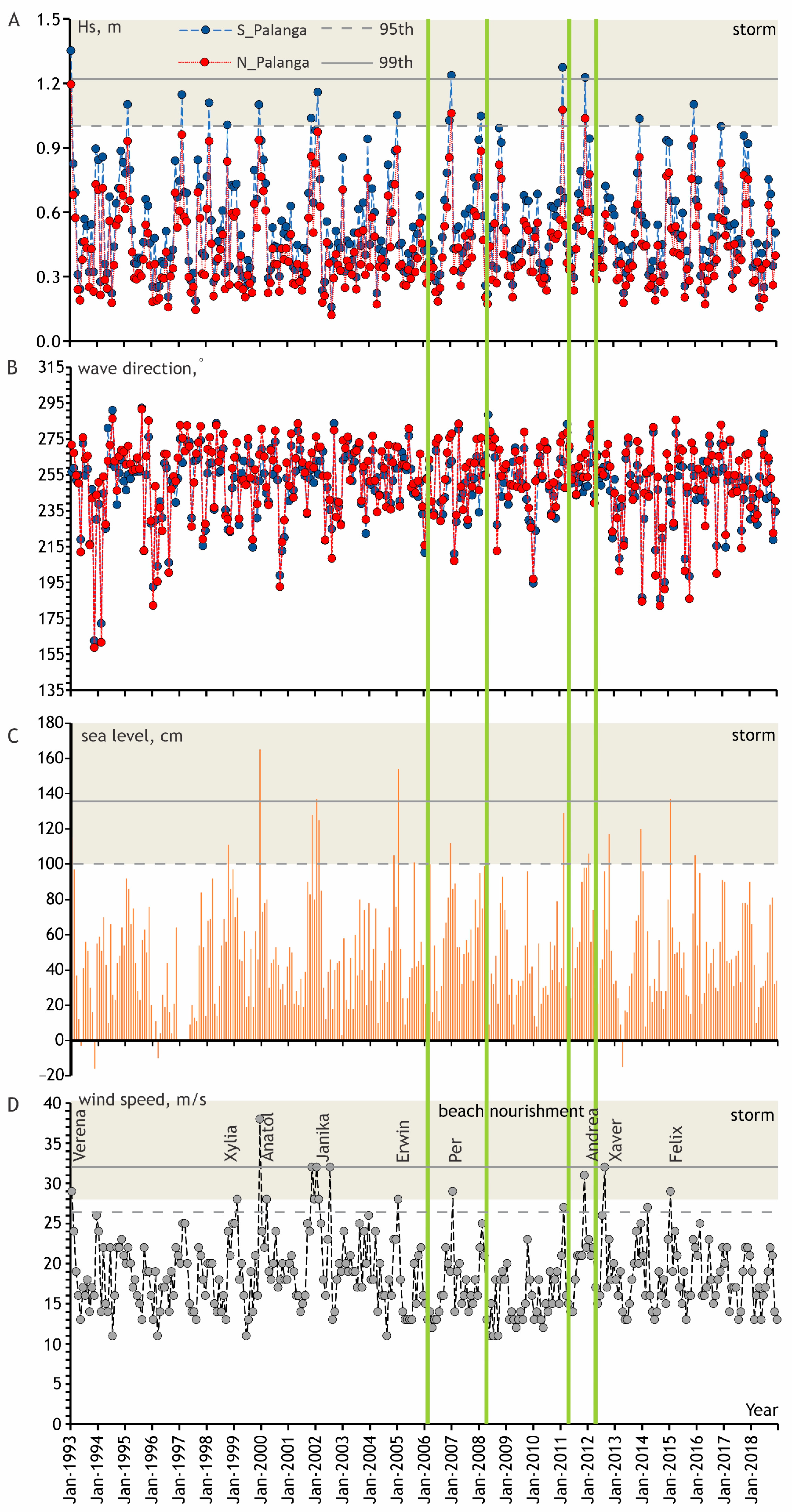
Data analysis. To characterise the extreme hydro-meteorological conditions that occurred between 1993 and 2018, the maximum monthly values of wind speed, sea level and mean maximum wave height and direction were analysed. Researchers use various criteria to identify storm events. For example, a storm is usually defined as occurring when the average wind speed reaches at least 15 m s−1 and the maximum sea level exceeds the 90th percentile at one or more tide-gauge stations [51]. According to national guidelines [52], a storm is defined as wind speeds exceeding 28 m s−1 and sea levels rising by more than 100 cm above the mean. Following common practice in storm-wave characterisation, where the 95th and 99th percentiles represent thresholds for the highest 5% and 1% of waves [53], we used monthly significant wave height percentiles to identify periods of enhanced wave energy. In our dataset, the 95th percentile corresponds to significant wave heights of approximately 1.0 m, while the 99th percentile corresponds to approximately 1.2 m. Monthly 99th percentiles are widely applied as reliable indicators of influential storm conditions [54]. Therefore, in this study, storm events were identified whenever monthly significant wave heights exceeded these percentile-based thresholds, which are known to be associated with notable beach reshaping and foredune erosion along the Lithuanian coast. Grain-size data were processed using GRADISTAT 8.0 software [55] and the geometric method of moments was used to calculate key statistical parameters. Sediments were classified according to Wentworth’s [56] grain-size scale, and sorting was evaluated using Trask’s [57] sorting coefficient.
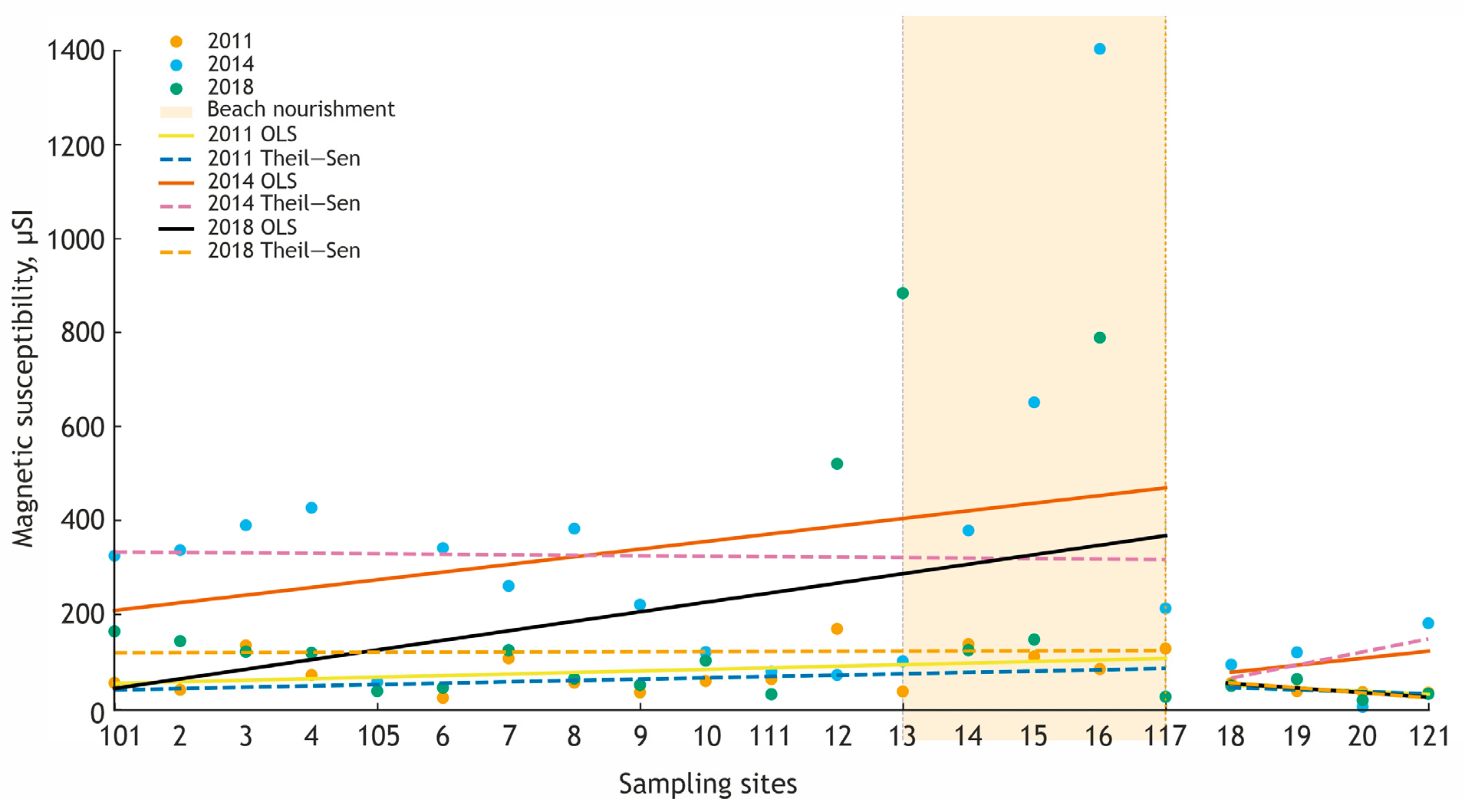
To evaluate longshore sediment transport, magnetic susceptibility (µSI) data were analysed using ordinary least squares (OLS) and Theil–Sen regression methods. The Theil–Sen estimator [58,59] is particularly suitable for datasets with non-normal distributions or isolated extreme values, which are common in coastal research, for example, measurements of beach morphology, sediment grain-size fractions, shoreline position changes, hydrodynamic parameters such as wave heights and water levels, and geochemical or magnetic susceptibility data. These variables often exhibit skewness, abrupt fluctuations, or outliers due to episodic storm events, seasonal variability, and human interventions. This makes it well-suited to identifying longshore transport trends [60]. The OLS approach was used to determine the overall linear gradient and its explanatory strength (R2), while the Theil–Sen method provided a more robust slope estimate that is less sensitive to outliers and local variability.
To distinguish the effects of human-induced nourishment from natural background variability and to better understand longshore sediment transport, the study area was divided into two sectors: sites 1–117 and sites 18–121. Magnetic susceptibility values in both sectors were analysed separately using the same statistical procedures. Grain-size trends were interpreted with MS data to assess the influence of beach nourishment on sediment transport patterns [61,62]. Differences in elemental concentrations between 2011, 2014 and 2018 were evaluated using the non-parametric Kruskal–Wallis (H) test.
The beach volume (Q, m3 m−1) for each profile was calculated from repeated cross-shore surveys conducted annually and after major storm events. This parameter represents the cross-sectional area of the coastal profile, extending from the landward base of the foredune (where vertical variation is minimal) to its intersection with the mean sea level [43,44].
The total beach volume was estimated using Equation (1):
Q = Q i + Q i + 1 × L i 2
where Q is the total volume (m3) within the coastal segment,  i = 1, 2, 3, … represents the profile number, Qi is the volume at an individual cross-shore profile (m3 m−1), and  L i  is the distance between two consecutive profile lines [44,63]. All additional statistical analyses and data visualisations were performed using SPSS 22.0, Microsoft Excel, ArcGIS Pro 3.5.3 and CorelDRAW 2025 software.

4. Results

4.1. Hydro-Meteorological Data

Between 1993 and 2018, twenty-three storm events were recorded along the Palanga coast that met at least one of the defined storm criteria. Of these, 12 met two criteria and 8 satisfied all three—the thresholds for mean maximum wave height, maximum sea level and maximum wind speed (Figure 2). The average wave approach angle in the southern sector (Plytinė–Palanga Pier) was approximately 248°, rising to 254° during storms. In contrast, in the northern sector (Palanga Pier–Ošupis Stream), the angle shifted from 252° to 264°. The shoreline orientation varies along the study area: Plytinė–Birutė Hill (sites 18–121) ~355°, Birutė Hill–Palanga Pier (sites 14–18) ~10–15°, Palanga Pier–Rąžė Stream (sites 13–14) ~20–25°, and Rąžė Stream–Ošupis Stream (sites 1–13) ~8–12° (azimuth, clockwise from north). Such spatial differences in shoreline orientation, combined with the prevailing WSW–W wave climate, result in a net northward-directed longshore sediment transport throughout the entire coastal sector. Importantly, even relatively small shifts in wave direction, such as those observed between the southern and northern sectors, can substantially modify longshore transport rates, as variations of only a few degrees in wave approach angle are known to produce noticeable changes in sediment flux [64].
On average, waves in the southern part of the study area were 16 cm higher than in the north, a difference that grew to 22 cm during storm conditions (Figure 2A,B). During the strongest storm events, sea levels ranged between 115 and 165 cm (Figure 2C). The most powerful winds, exceeding 30 m s−1, were recorded during the cold seasons of 1999, 2001 and 2002, as well as the warm seasons of 2002 and 2012. The most severe storm, Anatol, reached a peak wind speed of 38 m s−1 (Figure 2D). Major shoreline erosion followed the storms in January 1993 (Verena), December 1999 (Anatol), January 2005 (Erwin) and January 2015 (Felix).
Before coastal nourishment began in 2006, a total of ten storms were recorded with wind speeds of ≥28 m/s. During and after the coastal replenishment phase (2006–2018), only four storms were recorded: two during the nourishment works and two afterwards. The storm activity and coastal engineering interventions between 1993 and 2005 significantly impacted the longshore sediment transport and morphodynamic evolution of the Palanga coastal zone [9,31,32].

4.2. Grain Size Analysis

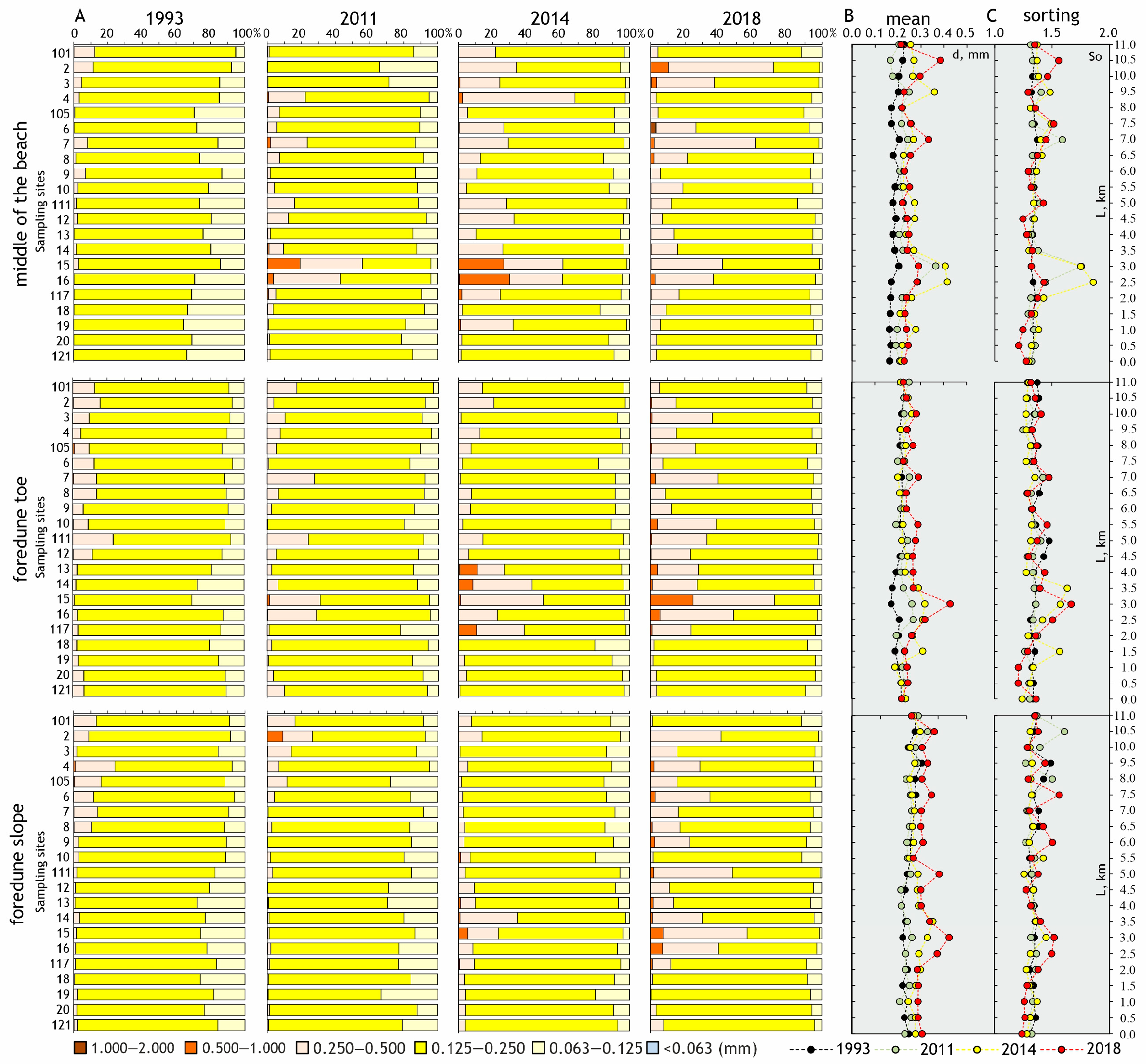
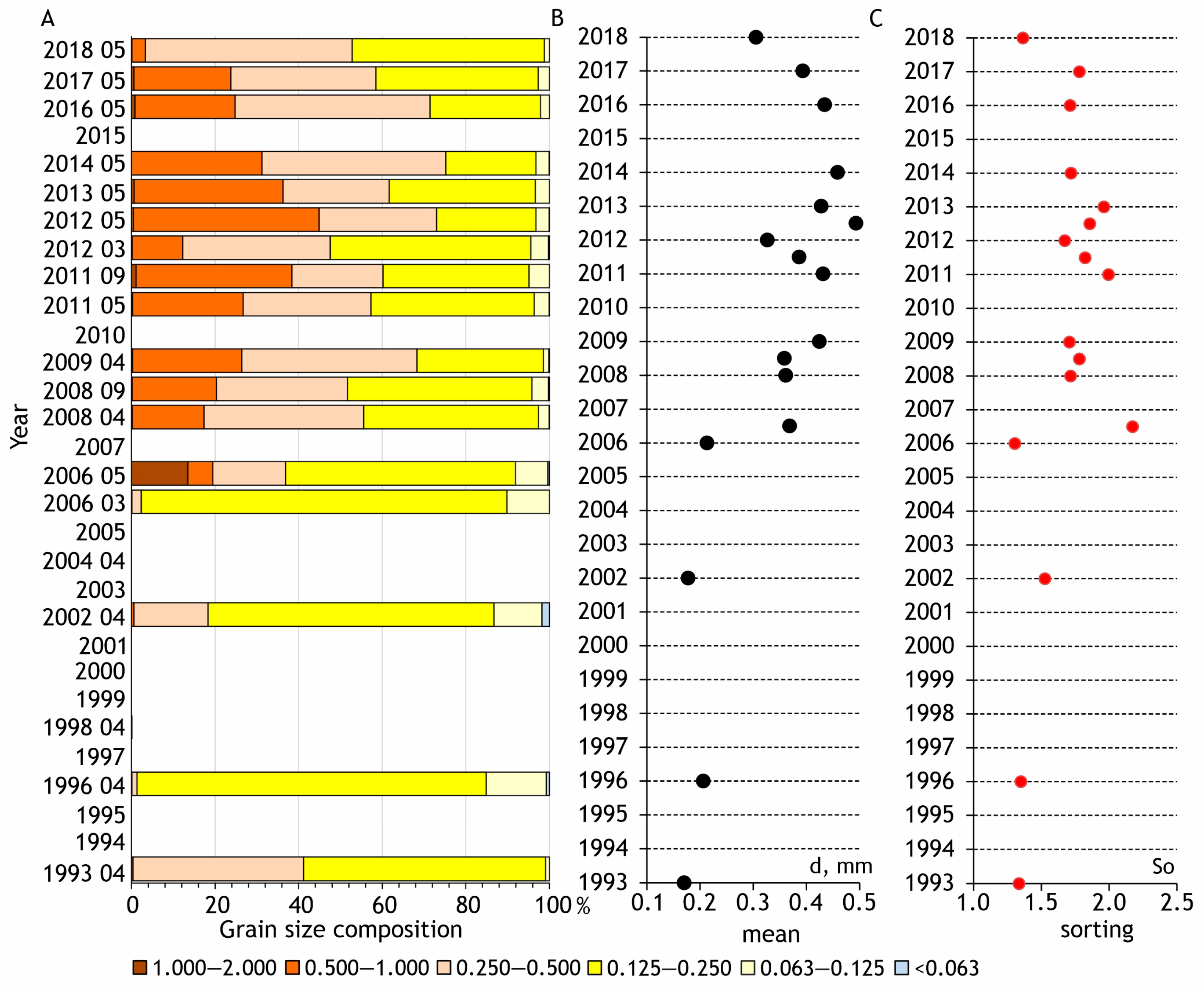
Analysis of grain-size variation between 1993 and 2018 revealed clear spatial and temporal trends along the Palanga coastal area (Figure 3A). Prior to nourishment (1993–2006), the beach consisted mainly of fine, well-sorted sand (mean grain size = 0.17–0.21 mm; sorting = 1.33–1.53). After nourishment in 2006, coarser material (0.315–1.600 mm) was introduced, increasing the mean grain size to 0.37 mm and reducing the degree of sorting (So = 2.17). Subsequent monitoring showed a gradual fining of sediments and an improvement in sorting by 2011 (d = 0.31 mm; So = 1.36), although pre-nourishment conditions were not fully restored.
Between 2011 and 2018, a consistent increase in the 0.250–0.500 mm fraction was recorded across all beach sampling sites, and by 2014 this trend was also evident at the foredune toe and slope (Figure 3). This suggests that sediment transport occurred not only longshore but also cross-shore. The nourished sand, being coarser, raised the beach surface at the foredune toe to nearly twice its previous height, altering the local beach slope. As a result, the relative elevation difference between the beach and the foredune was reduced, allowing coarser grains to be transported to the foredune more easily by aeolian processes.
Both longshore and cross-shore analyses revealed stable textural relationships between the beach, foredune toe, and foredune slope. In 1993, spatial patterns were relatively uniform; however, in the post-nourishment years, localised accumulations of coarser material were observed near sites 13–117, and to a lesser extent in the northern sector (sites 101–7). The increased variability in 2014 was linked to storm-induced reworking and enhanced longshore redistribution of the nourishment material (Figure 3B). By 2018, moderately sorted sands dominated the nourished sector, while well-sorted fine sands prevailed in the northern part, reflecting ongoing sediment redistribution and gradual textural adjustment toward a new morphodynamic state shaped by the altered sediment and wave conditions. Changes in grain size indicate that the prevailing westerly waves drive longshore sediment transport from south to north, accompanied by cross-shore movement from the beach toward the foredune-a pattern most clearly expressed in 2018.
Grain-size analysis of beach sediments at site No. 15 revealed pronounced compositional fluctuations between 1993 and 2018 (Figure 4A). Before nourishment, the sediments were dominated by fine sand (0.125–0.250 mm), with only a small proportion of coarser fractions. Following the 2006 nourishment, a clear coarsening trend emerged—fractions >0.500 mm increased notably, and the mean grain size exceeded 0.35 mm. Between 2008 and 2012, the sediments gradually became finer and better sorted, reflecting partial redistribution and mixing of the replenished material (Figure 4B,C). After 2013, grain-size variability increased again, driven by episodic reworking during storm events and the gradual stabilisation of nourishment effects. By 2018, the mean grain size had stabilised around 0.30 mm, and sorting (So = 1.36) had improved, although it had not fully returned to the pre-nourishment levels typical of natural beach sediments. These findings indicate that the nourished coastal stretch was approaching a more stable state under the prevailing hydrodynamic conditions.

4.3. Magnetic Susceptibility and Heavy Mineral Composition

Magnetic susceptibility (MS) measurements taken in 2011, 2014 and 2018 revealed clear spatial and temporal variability along the Palanga coast (Figure 5). The highest MS values were recorded within the nourished zone (sites 13–117), indicating an accumulation of heavy minerals following nourishment works. Lower values were dominant to the north and south. Segment-based regression analysis revealed weak yet consistent positive trends across sites 101–117, with ordinary least squares (OLS) slopes ranging from +18 to +42 µSI/km and Theil–Sen slopes from +15 to +38 µSI/km. The explanatory strength of the OLS regressions was very low (R2 < 0.01), reflecting the high local variability characteristic of magnetic susceptibility data and indicating that slope estimates are more informative for longshore sediment transport trends. This suggests a gradual northward decrease in magnetic susceptibility over time. In contrast, sites 18–121 exhibited nearly zero or slightly negative slopes (<5 µSI/km), reflecting diminishing mineral enrichment beyond the nourished area. While these variations were not statistically significant (p > 0.05), both regression approaches revealed the same overall spatial pattern, which supports the observed trend of sediment sorting and transport along the coast.
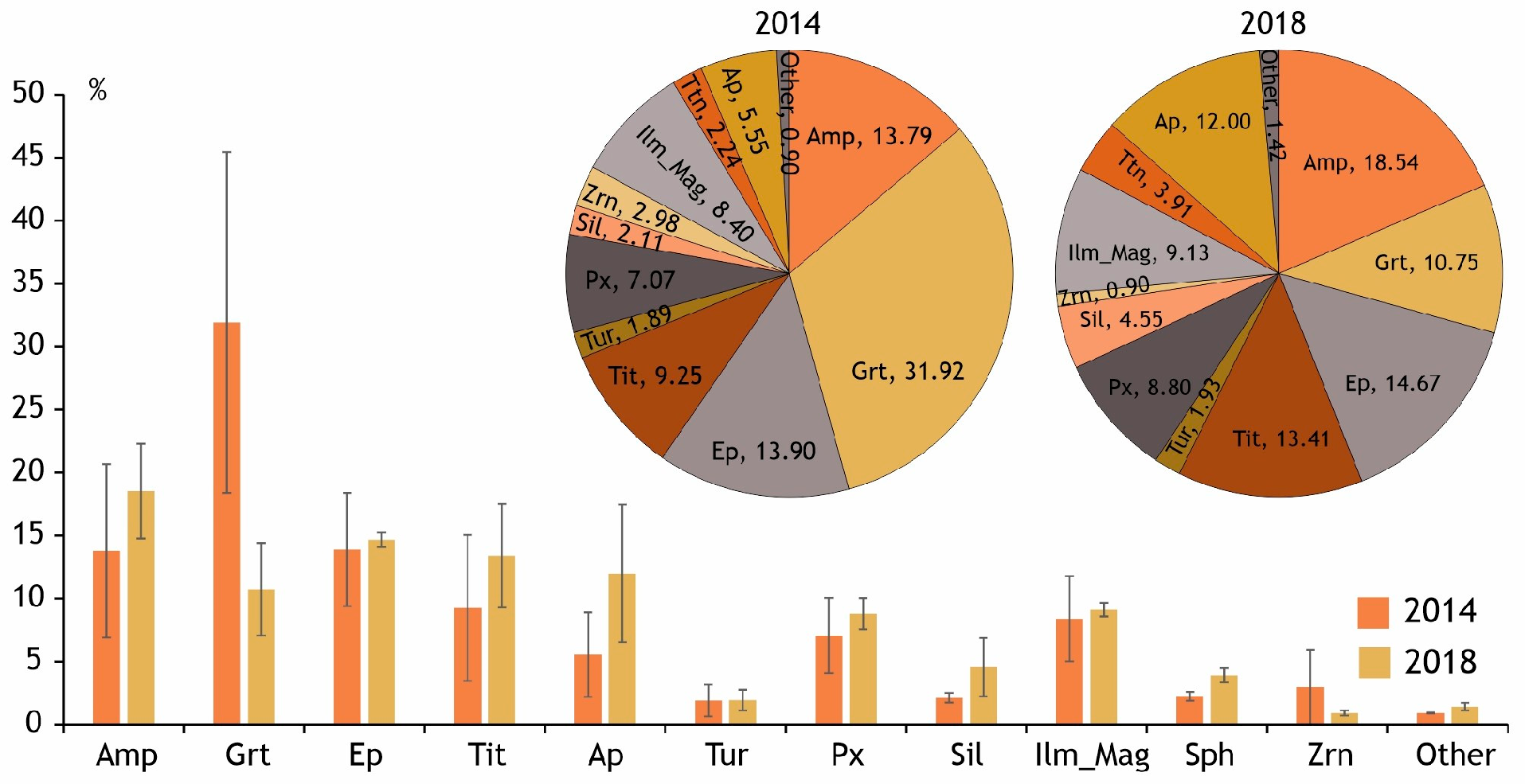
In 2014, the nourished beach contained a distinctly heavier mineral assemblage dominated by garnet, Fe–Ti oxides (ilmenite and magnetite) and titanite (Figure 6), reflecting the composition of the nourishment material, which introduced a higher proportion of dense minerals into the beach. By 2018, however, the heavy-mineral spectrum had shifted. Garnet content declined, while epidote, apatite, amphiboles and titanite, which are generally lighter than garnet, became relatively more abundant, consistent with the observed decrease in magnetic susceptibility values. Following nourishment, the denser heavy minerals remained primarily within the replenished zone, whereas lighter quartz grains were transported northwards by longshore currents. These changes represent natural post-nourishment redistribution. As denser HMs remain less mobile under typical hydrodynamic conditions, they tend to accumulate within the central part of the nourished sector. The storms Xaver (2013) and Felix (2015), which occurred after 2014, further amplified these mineralogical shifts by washing finer particles offshore and concentrating heavier, less mobile minerals within the beach.
Historical heavy-mineral datasets (1962, 2004, 2008) obtained by optical microscopy in 1962, 2004 and 2008 were compiled to provide long-term geological context (Table A1) [47,48,49]. The 1962 sample was collected at a location close to present-day Site 15; the 2004 sample corresponds to the vicinity of Site 13, and the 2008 dataset represents offshore sediment taken from the Juodkrantė–Preila sand-mining polygon (see Figure 1A,B). As the precision of mineral identification differs between microscopy and Raman spectroscopy these datasets were not directly compared with the 2014 and 2018 Raman results; instead, they serve as background in-formation to characterise pre-nourishment variability.
The observed patterns reflect the combined effects of artificial sediment input and natural hydrodynamic sorting. The enrichment of heavy minerals in 2014 likely originated from the borrow material used for nourishment. In contrast, the 2018 assemblage indicates dilution through northward sediment transport and storm-induced redistribution [25,31,32]. Overall, variations in MS values suggest that the nourished sector acted as a temporary source of mineral-enriched material which was gradually dispersed northwards by natural coastal processes, consistent with the spatial trends observed in grain size distribution.

4.4. Geochemical Analysis

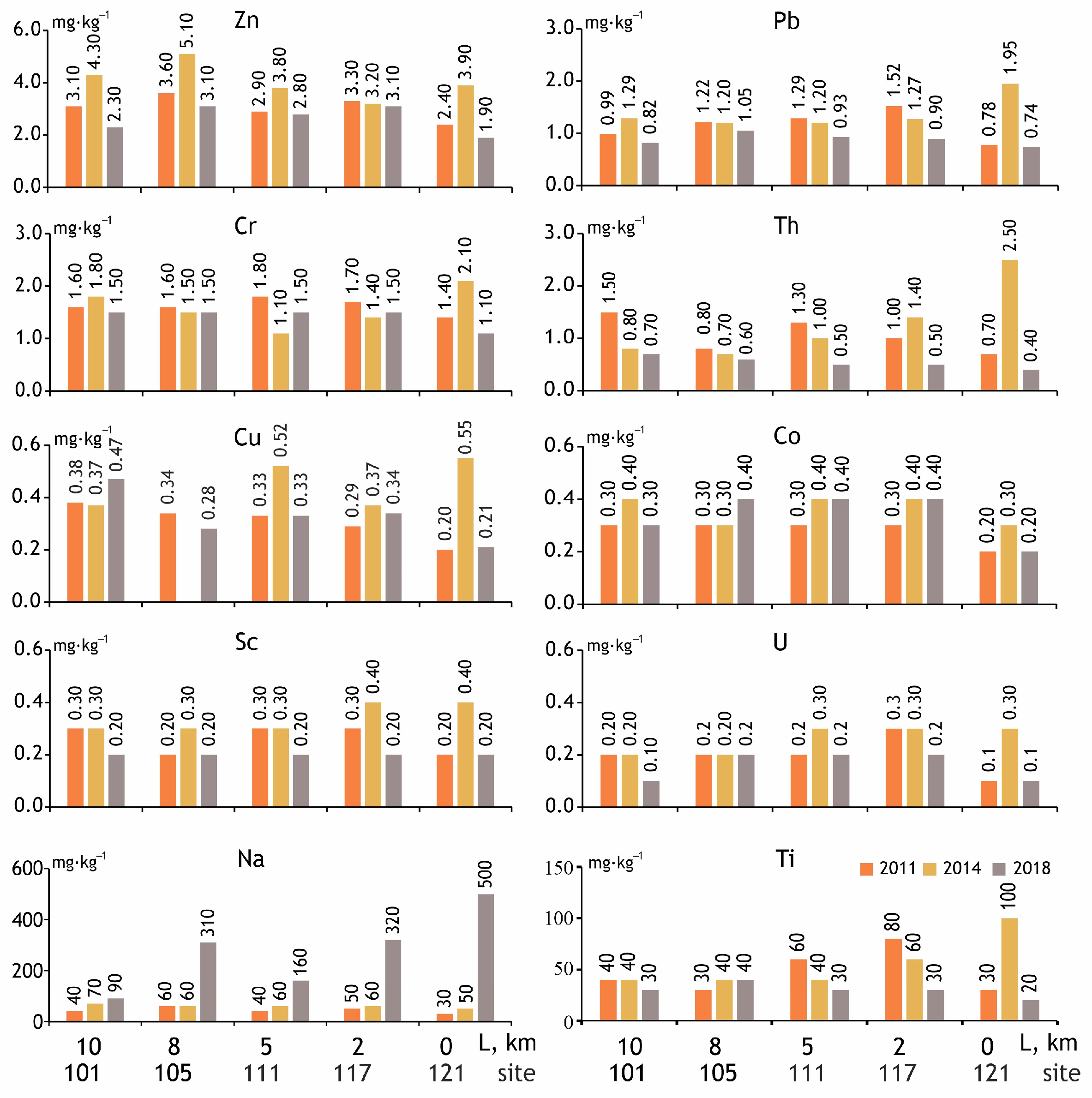
A comparative geochemical analysis of beach sediments revealed that the concentrations of the majority of elements remained relatively constant over time (2011, 2014 and 2018) in the context of shore nourishment activities. However, in 2014—two years following a significant beach nourishment project—the concentrations of several elements exhibited a notable increase (see Table 2). The short-term enrichment exhibited significant increases in copper (Cu), zinc (Zn), lead (Pb), cobalt (Co), thorium (Th), uranium (U), sodium (Na), scandium (Sc) and titanium (Ti) (K–H, p < 0.05). These findings are indicative of the influence of mineralogically distinct borrow material added to the shore (Figure 7).
By 2018, most of these elements had returned to or fallen below the concentrations observed during the nourishment period, suggesting dilution and redistribution through longshore sediment transport and post-storm reworking [39,44].
In 2014, several trace elements showed noticeable increases compared with 2011, particularly lead (Pb), chromium (Cr), thorium (Th) and titanium (Ti), with the highest values recorded at site 121 (0 km). Copper (Cu) and zinc (Zn) also increased, especially near site 105 (8 km), just north of the nourishment zone. Elements such as uranium (U) and scandium (Sc) exhibited only small absolute increases (Figure 7). Titanium (Ti) also showed a clear spatial pattern, with concentrations decreasing northward between site 117 (2 km) and site 105 (8 km) in both 2011 and 2014, indicating limited transport of Ti-rich minerals away from the nourishment area.
In contrast, chromium (Cr), cobalt (Co) and uranium (U) displayed relatively uniform distributions along the coastline across all sampling years. By 2018, most element concentrations had returned to or fallen below the values observed during the nourishment period, reflecting natural sediment equilibration driven by hydrodynamic sorting and northward longshore transport.

4.5. Beach Morphology and Sediment Volume

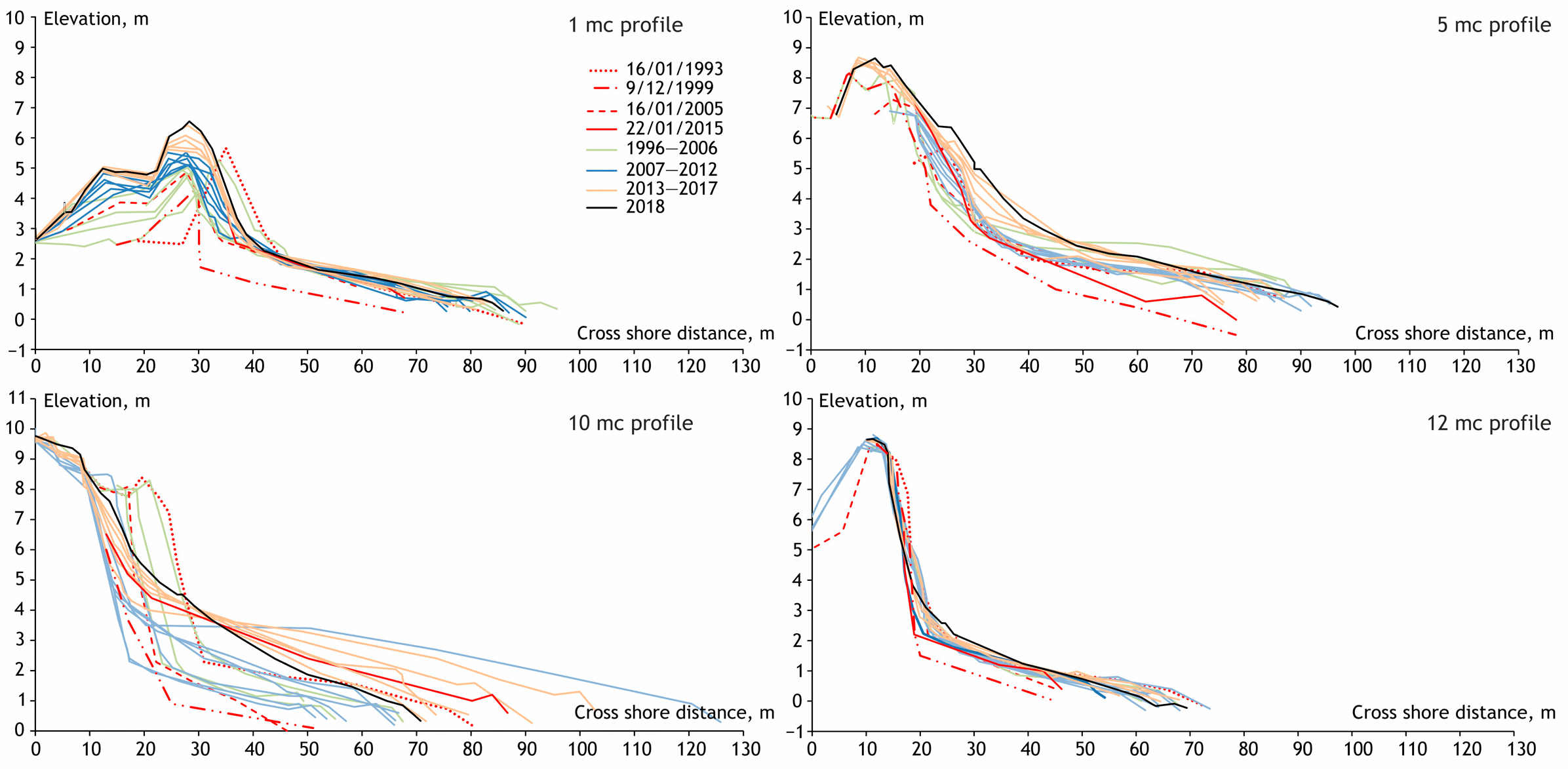
A comparison of the cross-shore profiles (Figure 8) shows clear morphological differences between coastal sectors. In the central, nourished Palanga sector between the Rąžė Stream and Birutė Hill (profile 10 mc), the beach and foredune initially became wider and higher after nourishment, followed by gradual readjustment. Profile 10 mc, in particular, exhibits landward migration of the foredune during 1993–1999 and slow growth of the foredune slope and toe during 2012–2018, as well as a progressive increase in beach slope (Figure 9). Although interannual variations in beach slope occur, the lower part of the beach increasingly resembles the shape and height range of the 1993 pre-nourishment profile. This adjustment is driven by cross-shore sediment redistribution and grain-size sorting under prevailing hydrodynamic forcing and aeolian processes.
In contrast, the northern sector between the Rąžė Stream and the Ošupis Stream (profiles 1 mc–5 mc) shows strong natural foredune growth, reflecting enhanced sediment supply transported northward. Meanwhile, the southern sector between Birutė Hill and Plytinė (profile 12 mc) displays retreat of the stoss slope, gradual accumulation at the foredune toe, and beach widening, consistent with long-term accretional tendencies unrelated to nourishment (Figure 8). This sector receives no additional sediment from the nourished area because the prevailing WSW–W wave regime directs longshore sediment transport northward. These patterns demonstrate that morphological adjustment toward pre-nourishment conditions is most pronounced within the nourished zone, whereas areas outside it evolve according to regional sediment transport gradients rather than nourishment activities.
Cross-shore profile analysis also showed that nourishment enhanced the beach’s resilience to storm impacts. By 2018, the nourished sector had largely stabilised, reflecting post-fill adjustment shaped by prevailing wave and sediment transport conditions. Overall, the morphometric response of the Palanga beach–foredune system indicates a continued adjustment consistent with local wind–wave dynamics and longshore sediment transport processes [12,27,37,38].
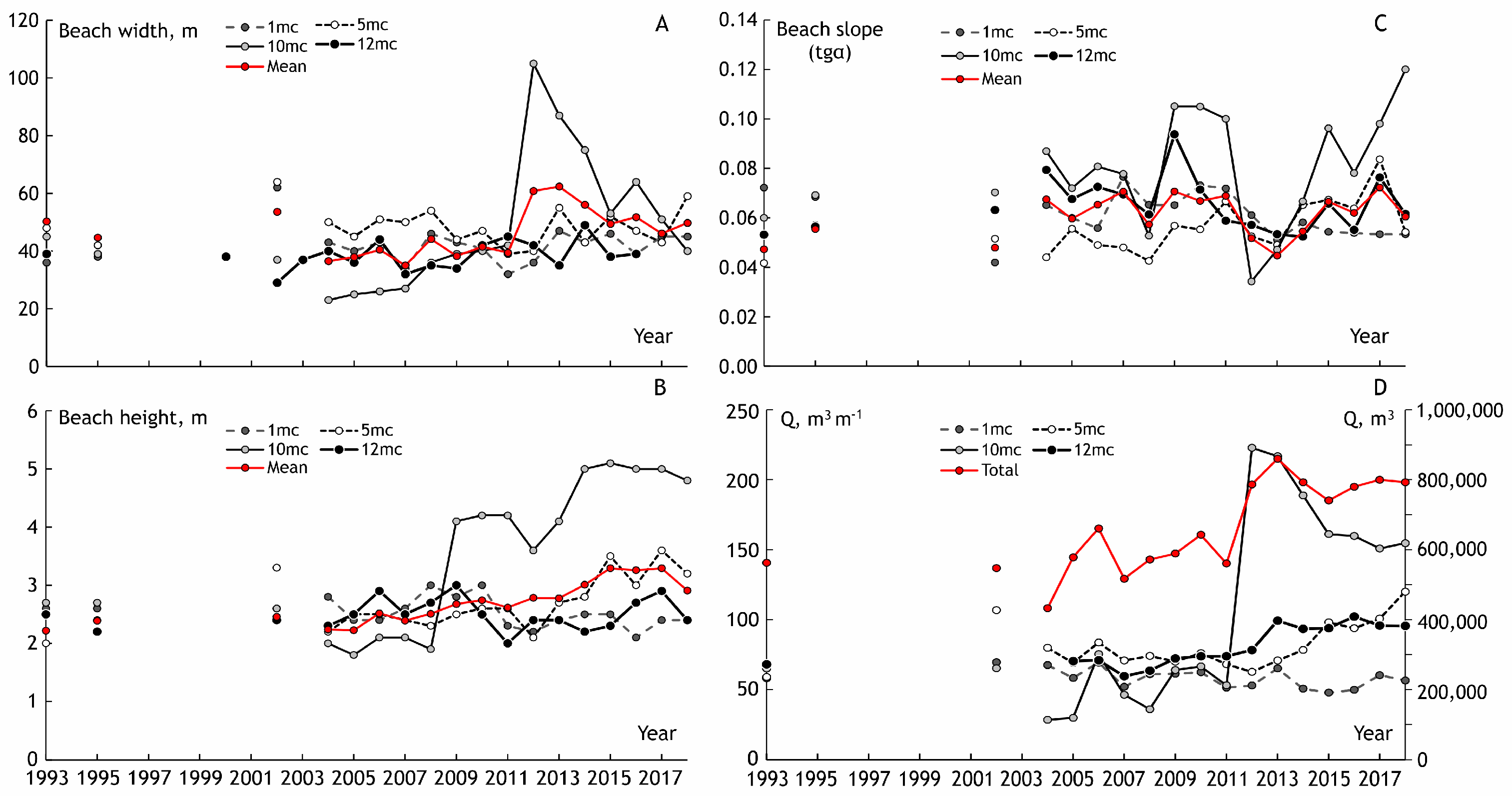
Long-term cross-shore monitoring data revealed clear temporal patterns in beach width, height, and accumulated sand volume along the Palanga coastal sector between 1993 and 2018 (Figure 9). Beach width (Figure 9A) exhibited marked year-to-year fluctuations, with no evident long-term trend prior to nourishment. The average width remained relatively stable, around 40–50 m, until 2002. Following the reconstruction of the Palanga Pier and the severe Erwin storm in 2005, the beaches began to narrow and flatten, particularly in the southern part of the study area (profiles 10–12 mc). The most pronounced widening occurred during the nourishment period: between 2006 and 2012, the beach expanded substantially in the southern sector (Plytinė–Palanga Pier, profile 10 mc), with some profiles reaching widths of 80–100 m. From 2008 to 2018, beach width fluctuated moderately but remained above pre-nourishment levels, stabilising at an average of about 50 m.
Mean beach elevation (Figure 9B) showed a slight but consistent upward trend throughout the study period. The most significant increase occurred after 2012, when a higher proportion of coarse-grained sand was deposited along the coast, resulting in a steeper beach profile. Before nourishment, the average elevation ranged from 2.0 to 2.5 m, whereas after nourishment it exceeded 3.0 m in most profiles and reached 5.0–5.5 m in the southern part between 2013 and 2015. This reflects ongoing sediment accumulation within the foredune–beach transition zone and partial morphological stabilisation during subsequent years.
Beach slope (Figure 9C) exhibited short-term fluctuations but no clear long-term directional trend over the 1993–2018 period. Slope values generally ranged between 0.04 and 0.07, reflecting alternating phases of beach steepening after nourishment and storm events, followed by gradual flattening during calmer conditions. The steepest slopes were recorded in 2012–2015, immediately after intensive nourishment, in the sector between the Rąžė Stream and Birutė Hill (profile 10 mc), where the added coarser material temporarily increased the beach gradient. Overall, after 2012 the slope became steeper in most profiles (0.05–0.08).
The volume of accumulated sand on the beach (Figure 9D) showed the most pronounced temporal variation. Before nourishment, the mean cross-sectional sediment volume (Q) averaged approximately 50–80 m3 m−1, while the total beach volume was about 530,100 m3. The volume of accumulated sand on the beach (Figure 9D) showed the most pronounced temporal variation. Following nourishment, sediment volume increased significantly, more than doubling in some profiles (up to 150–250 m3 m−1) and the total beach volume growing to 859,865 m3. The sharpest increase occurred between 2012 and 2013, after which the total volume remained relatively stable, reflecting natural post-nourishment redistribution under prevailing hydrodynamic conditions.
Overall, the 2006–2012 nourishment works significantly increased the width, height, and total sand volume of the beach (Figure 9). Although some local redistribution and moderate fluctuations occurred in the following years, the average morphometric values remained consistently higher than before nourishment, demonstrating the effectiveness and stability of the intervention.
Storms played a key role in shaping the morphodynamic response of the nourished coastal sector. During storm conditions, significant wave height increased and wave direction shifted more strongly into the SW–W–NW sector, intensifying the northward longshore sediment transport. These conditions accelerated the redistribution of the nourished sand alongshore and enhanced erosion of the lower beach, where finer fractions were washed offshore. Once wave energy decreased after storms, the previously eroded nourishment sand was gradually redistributed both alongshore and cross-shore. Thus, the observed spatial patterns of sediment accumulation and erosion directly reflect storm-driven hydrodynamic forcing acting in combination with nourishment-induced changes. Our wave-rose analysis shows that WSW–W-directed waves (240–280°) account for approximately 68–76% of all monthly mean wave directions between 1993 and 2018, consistently maintaining a net northward longshore sediment transport. This dominant wave regime explains both the spatial asymmetry of nourishment effects and the delayed, attenuated sediment signal observed in the northernmost profiles.
However, the northernmost profile (1 mc) shows almost no measurable response to the nourishment. This pattern reflects the limited spatial extent of nourishment-induced changes: the effects were strongest within the nourished sector (profiles 6–11 mc) and gradually diminished northward. At ~8–10 km from the nourishment area, longshore sediment transport becomes too weak to deliver significant volumes of nourishment sand, and local interruptions such as the Palanga Pier–groyne further reduce sediment continuity. Therefore, Profile 1 mc represents background natural variability rather than nourishment-driven change, confirming the spatial limitations of nourishment effects described in the introduction. Although the northernmost profile does receive sediment transported from the central nourished sector, this signal arrives with a delay and in strongly reduced magnitude due to decreasing longshore flux toward the north.

5. Discussion and Conclusions

The results of this study revealed that the Palanga coastal sector responded unevenly to beach nourishment in terms of both space and time. Immediately after the beach nourishment, the beach widened and increased in height; in some areas, the accumulated sand volume more than doubled. Over the following years, the material gradually redistributed itself alongshore (south–north) and cross-shore (from the beach towards the foredune). These patterns of short-term accumulation followed by late-stage adjustment as the beach adapted to the new sediment composition are consistent with the behaviour of other nourished sandy coasts around the world [23,24]. This indicates that, when properly designed, beach nourishment can enhance coastal resilience to storms and reduce recovery time after extreme weather events [12,13].
Changes in the approach angle of waves between the southern and northern sectors, which were particularly pronounced during storms, intensified northward-directed longshore transport [12,27,37,38]. Higher waves also promoted stronger sediment redistribution. These dynamics resulted in significant changes to the morphology of the beach and foredunes within and adjacent to the nourished zone [8,26,27]. However, localised erosion was also observed, particularly near the Palanga Pier–groyne area, where northward directed longshore sediment transport due to the groyne was diverted offshore. Consequently, sediment deficits and shoreline retreat were recorded north of the pier.
Grain-size data confirmed that the placement of coarser sand fractions between 2006 and 2012 modified the beach profile, shifting it from a gentler to a steeper configuration and resulting in increased beach height. After nourishment, gradual fining and better sorting took place, though the texture of the sediment before nourishment was not fully restored. This is characteristic of the adjustment phase following the addition of fill, during which the modified morphology facilitates the landward migration of coarser grains towards the foredune. Between 2011 and 2018, an increase in the 0.250–0.500 mm fraction in both the beach and foredune areas reflected an increased reliance on cross-shore sediment transport. Changes to the beach profile enabled coarser grains to move inland. Other researchers have also identified similar patterns and trends in magnetic susceptibility (MS) and grain-size distribution, which confirm the presence of longshore [39,44] and cross-shore sediment transport [37,61,62,65].
The northward decline in magnetic susceptibility (MS) confirmed the dominance of longshore sediment transport, indicating limited sediment connectivity between the nourished sector and the adjacent southern sediment source areas. Mineralogical results confirmed these findings. The nourished sand exhibited elevated concentrations of garnet and Fe–Ti minerals, suggesting that the borrow material had a different geological provenance to the native beach deposits [19]. The subsequent decline in garnet, accompanied by an increase in epidote, apatite and amphibole, and lower MS values, reflected the hydrodynamic differentiation of the nourished material. These processes intensified during storms, with finer, lighter grains being washed offshore and heavier minerals accumulating in the nearshore zone [19,20]. Consequently, the increased concentration of heavy minerals enhanced the stability of the nourished beach. Overall, the nourished sector acted as a temporary source of mineral-enriched sediments for some time, which were later dispersed northwards by natural transport processes. The mineralogical makeup of the sand is a key factor controlling how the shoreline evolves, stabilises, or responds to external forcing, as shown by [19,20,21,22]. These observations were further supported by the geochemical data. The significantly increased concentrations of Cu, Zn, Pb, Co, Th, U, Na, Sc and Ti in 2014 suggest short-term enrichment caused by the presence of mineralogically distinct borrow material. By 2018, most elemental concentrations had returned to or dropped below pre-nourishment levels, confirming that the redistribution of sediments was governed by hydro- and lithodynamic processes through dominant longshore transport and post-storm reworking [39,44,66].
From a sustainability perspective, the results suggest that shore nourishment could be used as a temporary, nature-based solution to enhance the coast’s resilience to storms [35]. However, such interventions disrupt the natural cycles of coastal evolution, forcing the system to transition to a new morphodynamic state. While this study did not directly evaluate the socioeconomic or ecological impacts, the range of geoindicators [41] used (morphodynamic, grain-size, magnetic, mineralogical and geochemical) provides indirect insights into the physical aspects of sustainability. This helps us to understand how long the intervention will be traceable within the coastal system and to what extent.
The findings emphasise that sustainable coastal management must be guided by scientific evidence in order to avoid unnecessary or untimely interventions. Although our mid-term observations of the 10 km Palanga coastal stretch (1993–2018), covering the pre-nourishment, nourishment and post-nourishment periods, indicated that additional nourishment was not required, the Palanga municipality implemented new nourishment and dune restoration works in 2018 and 2020. Such uncoordinated interventions, which are disconnected from scientific monitoring, risk depleting sediment sources [18,23] and disrupting the ecological balance [16].
The integrated monitoring and geoindicators approach adopted in this study is aligned with United Nations Sustainable Development Goals 11, 13 and 14 [35], as it promotes an adaptive, evidence-based approach to coastal management that balances ecological integrity, social value and long-term economic resilience. The Palanga case study shows that well-designed and systematically monitored beach nourishment can be an effective measure whose success depends on regional hydrodynamic conditions, the properties of the fill material, and the effectiveness of coastal management planning and implementation. The capacity of a coastal system to absorb human intervention and return to its characteristic morphodynamic behaviour is a key prerequisite for sustainability, one that can be undermined by actions that are either too frequent or inadequately planned.
Although the findings from the Palanga coastal sector provide valuable insights into the temporal and spatial expression of nourishment effects, their applicability is primarily limited to energetic, sediment-rich coasts with a dominant unidirectional longshore transport, such as those of the south-eastern Baltic [33]. On low-energy coasts or in environments with limited sediment supply, nourishment may behave differently, with slower post-fill redistribution, reduced cross-shore adjustment, and a shorter alongshore spreading distance [15]. Therefore, the conclusions presented here should be interpreted within the context of wave-dominated, medium- to high-energy sandy shorelines, and caution is required when extrapolating these results to morphologically or sedimentologically contrasting coastal settings.
The capacity of a coastal system to absorb human intervention and return to dynamic equilibrium is a key prerequisite for sustainability, one that can be undermined by actions that are either too frequent or inadequately planned.
In light of these results, we emphasise the need for long-term, integrated coastal monitoring, including post-storm surveys, and for policy decisions to be based on scientific recommendations and monitoring data [8,18]. This would facilitate the development of strategic nourishment plans with clearly defined performance indicators, specifying when, how much and where to replenish and when to allow natural recovery [67].
Based on the monitoring dataset, we propose several indicative geoindicator thresholds that may support nourishment decision-making on the Palanga coast. Intervention could be justified when one or more indicators fall below their characteristic post-nourishment ranges: beach width < 35–40 m, beach elevation < 1.8–1.9 m, beach slope < 0.05, and cross-shore sediment volume < 50–70 m3 m−1. Additional signals of sediment depletion include magnetic susceptibility returning toward pre-nourishment background values (<120 µSI) and pronounced grain-size fining (mean diameter < 0.20 mm). These thresholds help link nourishment timing to observed coastal conditions rather than fixed administrative cycles.
Moreover, nourishment cycles should be aligned with storm climatology and the longshore sediment budget, and the fill material should be selected to more closely match the native sand to reduce post-storm losses, minimise over-steepening, and ensure more efficient sediment retention. Furthermore, it is essential to ensure compatibility between the native and borrowed sand in terms of grain-size distribution, mineralogy, and density, as these parameters strongly determine the duration and spatial expression of nourishment effects. In this study, the fill material used for nourishment was significantly coarser than the natural beach sediment [5], which resulted in a more persistent morphological signal, slower redistribution, and an extended adjustment period. Had the borrowed sand been more similar to the native sediment, the duration, spreading distance, and overall behaviour of the nourishment would likely have differed, with faster alongshore dispersion, reduced profile steepening, and a shorter stabilisation period.
Therefore, sediment compatibility is crucial not only for ecological integrity and aesthetic requirements, but also for ensuring that nourishment outcomes align with management objectives and beach-user expectations [5,11,68], including those promoted under the Blue Flag principles.

Author Contributions

Conceptualization, D.P. and D.K.; methodology and fieldworks, D.P., D.K., D.J. and G.Ž.; software, D.K.; validation, D.P., D.K. and D.J.; formal analysis, D.P. and D.K.; investigation, D.P., D.K., and D.J.; resources, D.P., D.K., D.J. and G.Ž.; data curation, D.P., D.K., and D.J.; writing—original draft preparation, D.P. and D.K.; writing—review and editing, D.P., D.K., D.J. and G.Ž.; visualization, D.P. and D.K.; supervision, D.P.; project administration, D.P. and G.Ž.; funding acquisition, D.P. and G.Ž. All authors have read and agreed to the published version of the manuscript.

Funding

This research received no external funding.

Data Availability Statement

The data presented in this study are available on request from the corresponding author (the data are not publicly available due to privacy).

Acknowledgments

During the preparation of this manuscript, the authors used OpenAI’s ChatGPT-5.0 and the DeepL online translation service to enhance the clarity and readability of the text. The authors subsequently reviewed and revised all content as necessary and take full responsibility for the final version of the published article.

Conflicts of Interest

The authors declare no conflicts of interest.

Abbreviations

The following abbreviations are used in this manuscript:
UNUnited Nations
SDGSustainable Development Goals
CMEMSCopernicus Marine Service
WAMWave model
ECMWF ERA5European Centre for Medium-Range Weather Forecasts fifth generation atmospheric reanalysis of the global climate
MSMagnetic susceptibility
ICP-MS/ESInductively Coupled Plasma-Mass Spectrometry/Emission Spectroscopy
OLSOrdinary least squares

Appendix A

Table A1. Heavy-mineral composition (%) of Palanga beach sediments in 1962, 2004, 2008, 2014, and 2018. Data from 1962, 2004 and 2008 were obtained using optical microscopy [47,48,49], whereas the 2014 and 2018 datasets were analysed using Raman spectroscopy.
Mineral19622004200820142018
Ilmenite + magnetite10.222.219.611.789.13
Hematite3.50.66.8
Leucoxene0.65.26.8
Zircon0.22.02.20.000.90
Rutile7.51.20.4
Garnet2.323.422.218.3910.75
Tourmaline1.21.42.43.161.93
Sphene (Titanite)2.32.593.91
Epidote group16.310.85.618.3914.67
Amphiboles44.019.220.220.6918.54
Pyroxenes1.66.06.210.068.80
Kyanite0.60.61.4
Sillimanite0.8
Apatite1.08.9112.00
Andalusite0.4
Siderite0.8
Chlorite0.2
Weathered grains1.0
Ti-bearing minerals *3.4513.41
Glauconite4.82.80.6
Silica (SiO2)1.724.55
Other0.74.65.60.861.42
* Ti-bearing minerals in Raman datasets represent titanite and other Ti-rich phases that were not distinguished in optical microscopy.

References

  1. de Schipper, M.A.; Ludka, B.C.; Raubenheimer, B.; Luijendijk, A.P.; Schlacher, T.A. Beach nourishment has complex implications for the future of sandy shores. Nat. Rev. Earth Environ. 2021, 2, 70–84. [Google Scholar] [CrossRef]
  2. Staudt, F.; Gijsman, R.; Ganal, C.; Mielck, F.; Wolbring, J.; Hass, H.C.; Schimmels, S. The sustainability of beach nourishments: A review of nourishment and environmental monitoring practice. J. Coast. Conserv. 2021, 25, 34. [Google Scholar] [CrossRef]
  3. Vousdoukas, M.I.; Ranasinghe, R.; Mentaschi, L.; Plomaritis, T.A.; Athanasiou, P.; Luijendijk, A.; Feyen, L. Sandy coastlines under threat of erosion. Nat. Clim. Change 2020, 10, 260–263. [Google Scholar] [CrossRef]
  4. Yepes, V.; Medina, J.R. Land use tourism models in Spanish coastal areas: A case study of the Valencia region. J. Coast. Res. 2005, 94, 83–88. [Google Scholar]
  5. Dean, R.G. Beach Nourishment; Advanced Series on Ocean Engineering; World Scientific: Singapore, 2003; p. 399. [Google Scholar] [CrossRef]
  6. Sutton-Grier, A.E.; Gittman, R.K.; Arkema, K.K.; Bennett, R.O.; Benoit, J.; Blitch, S.; Burks-Copes, K.A.; Colden, A.; Dausman, A.; DeAngelis, B.M.; et al. Investing in natural and nature-based infrastructure: Building better along our coasts. Sustainability 2018, 10, 523. [Google Scholar] [CrossRef]
  7. Angnuureng, D.B.; Charuka, B.; Almar, R.; Dada, O.A.; Asumadu, R.; Agboli, N.A.; Ofosu, G.T. Challenges and lessons learned from global coastal erosion protection strategies. iScience 2025, 28, 112055. [Google Scholar] [CrossRef] [PubMed]
  8. Pinto, C.A.; Silveira, T.M.; Teixeira, S.B. Beach nourishment practice in mainland Portugal (1950–2017): Overview and retrospective. Ocean Coast. Manag. 2020, 192, 105211. [Google Scholar] [CrossRef]
  9. Karaliūnas, V.; Jarmalavičius, D.; Pupienis, D.; Janušaitė, R.; Žilinskas, G.; Karlonienė, D. Shore nourishment impact on coastal landscape transformation: An example of the Lithuanian Baltic Sea coast. J. Coast. Res. 2020, 95, 840. [Google Scholar] [CrossRef]
  10. Tõnisson, H.; Männikus, R.; Kont, A.; Palginõmm, V.; Alari, V.; Suuroja, S.; Vaasma, T.; Vilumaa, K. Application of shore sediments accumulated in navigation channel for restoration of sandy beaches around Pärnu City, SW Estonia, Baltic Sea. J. Mar. Sci. Eng. 2024, 12, 394. [Google Scholar] [CrossRef]
  11. Romero-Martín, R.; Garola, A.; Valdemoro, H.I.; Jiménez, J.A. Adapting beaches to sea level rise: A sediment-based strategy for protecting coastal tourism in Catalonia (NW Mediterranean). Ocean Coast. Manag. 2025, 267, 107729. [Google Scholar] [CrossRef]
  12. Jarmalavičius, D.; Žilinskas, G.; Pupienis, D.; Janušaitė, R. Resilience of beach morphometric characteristics on decadal time scale: A case study from the Lithuanian Baltic Sea. Oceanologia 2025, 67, 67301. [Google Scholar] [CrossRef]
  13. Oliveira, F.S.B.F.; Fortunato, A.B.; Freire, P. Beach nourishment protection against storms for contrasting backshore typologies. J. Mar. Sci. Eng. 2024, 12, 1465. [Google Scholar] [CrossRef]
  14. Leszczyńska, K.; Alexanderson, H.; Clemmensen, L.; Giza, A.; Lorenz, S.; Moskalewicz, D.; Wolski, T. A review of storms and marine coastal flooding in the Baltic Sea: Insights from instrumental, historical and sedimentary record. Earth-Sci. Rev. 2025, 266, 105137. [Google Scholar] [CrossRef]
  15. Sitkiewicz, P.; Moskalewicz, D.; Tysiąc, P.; Burdziakowski, P.; Michałek, M. Beach nourishment on low-energy coasts: Purpose and persistence (Puck Lagoon, Poland). Estuar. Coast. Shelf Sci. 2025, 326, 109543. [Google Scholar] [CrossRef]
  16. Speybroeck, J.; Bonte, D.; Courtens, W.; Gheskiere, T.; Grootaert, P.; Maelfait, J.-P.; Mathys, M.; Provoost, S.; Sabbe, K.; Stienen, E.W.M.; et al. Beach nourishment: An ecologically sound coastal defence alternative? a review. Aquat. Conserv. Mar. Freshw. Ecosyst. 2006, 16, 419–435. [Google Scholar] [CrossRef]
  17. Moskalewicz, D.; Winter, C. Identification of sandy nourished sediments using end-member analysis (EMMAgeo) applied to particle shape distributions, Sylt Island, North Sea. Mar. Geol. 2024, 467, 107201. [Google Scholar] [CrossRef]
  18. Bates, M.E.; Fox-Lent, C.; Seymour, L.; Wender, B.A.; Linkov, I. Life cycle assessment for dredged sediment placement strategies. Sci. Total Environ. 2015, 511, 309–318. [Google Scholar] [CrossRef]
  19. James, W.R. Techniques in Evaluating Suitability of Borrow Material for Beach Nourishment; No. 60. US Army Corps of Engineers Coastal Engineering Research Center: Fort Belvoir, VA, USA, 1975; p. 83. Available online: https://hdl.handle.net/11681/2871 (accessed on 12 July 2025).
  20. Eitner, V. Magnetic heavy mineral associations as sediment transport indicators on a beach of Norderney Island, Southern North Sea. Senckenberg. Marit. 1995, 25, 173–185. [Google Scholar]
  21. Eitner, V. The effect of sedimentary texture on beach fill longevity. J. Coast. Res. 1996, 12, 447–461. [Google Scholar]
  22. López, M.; López, I.; Aragonés, L.; Serra, J.C.; Esteban, V. The erosion on the east coast of Spain: Wear of particles, mineral composition, carbonates and Posidonia oceanica. Sci. Total Environ. 2016, 572, 487–497. [Google Scholar] [CrossRef]
  23. Hamm, L.; Capobianco, M.; Dette, H.H.; Lechuga, A.; Spanhoff, R.; Stive, M.J.F. A summary of European experience with shore nourishment. Coast. Eng. 2002, 47, 237–264. [Google Scholar] [CrossRef]
  24. Acciarri, A.; Bisci, C.; Cantalamessa, G.; Cappucci, S.; Conti, M.; Di Pancrazio, G.; Valentini, E. Metrics for short-term coastal characterization, protection and planning decisions of Sentina Natural Reserve, Italy. Ocean Coast. Manag. 2021, 201, 105472. [Google Scholar] [CrossRef]
  25. Kelaher, B.P.; Pappagallo, T.; Litchfield, S.; Fellowes, T.E. Drone-Based Monitoring to Remotely Assess a Beach Nourishment Program on Lord Howe Island. Drones 2023, 7, 600. [Google Scholar] [CrossRef]
  26. McLachlan, A. Physical factors in benthic ecology: Effects of changing sand particle size on beach fauna. Mar. Ecol. Prog. Ser. 1996, 131, 205–217. [Google Scholar] [CrossRef]
  27. Visakavičius, E.; Bučas, M.; Kelpšaite, L.; Figoras, A. Unexpected experiment of sediment transport and its effect on the benthic habitat on the Baltic Sea nearshore area of Lithuania. In Proceedings of the 2012 IEEE/OES Baltic International Symposium (BALTIC), Klaipeda, Lithuania, 8–10 May 2012. [Google Scholar] [CrossRef]
  28. Shim, K.-T.; Kim, K.-H. A Study on the Characteristics of Beach Profile Evolution According to the Particle Size Variation of Beach Nourishment. Water 2023, 15, 2956. [Google Scholar] [CrossRef]
  29. Liu, X.; Luo, X.; Lu, C.; Zhang, G.; Ding, W. The Impact of Foreshore Slope on Cross-Shore Sediment Transport and Sandbar Formation in Beach Berm Nourishment. Water 2024, 16, 2212. [Google Scholar] [CrossRef]
  30. Kirlys, V. The shallow nearshore and beaches stabilisation methods and tools of natural analogues example. Balt. Sea Coast Dyn. Palaeogeogr. Issues 1993, 2, 7–14. (In Lithuanian) [Google Scholar]
  31. Žilinskas, G.; Pupienis, D.; Jarmalavičius, D. Possibilities of regeneration of Palanga coastal zone. J. Environ. Eng. Landsc. Manag. 2010, 18, 92–101. [Google Scholar] [CrossRef]
  32. Pupienis, D.; Jarmalavičius, D.; Žilinskas, G.; Fedorovic, J. Beach nourishment experiment in Palanga, Lithuania. J. Coast. Res. 2014, 70, 490–495. [Google Scholar] [CrossRef]
  33. Boniecka, H.; Kubacka, M. Artificial Nourishment Schemes along the Polish Coast and Lagoon Shores between 1980 and 2020, with a Particular Focus on the Hel Peninsula. Water 2024, 16, 1005. [Google Scholar] [CrossRef]
  34. Capobianco, M.; Stive, M.J.F.; Jiménez, J.A.; Sanchez-Arcilla, A. Towards the definition of budget models for the evolution of deltas. J. Coast. Conserv. 1998, 4, 7–16. [Google Scholar] [CrossRef]
  35. United Nations. Transforming Our World: The 2030 Agenda for Sustainable Development; United Nations General Assembly, Resolution A/RES/70/1; United Nations: New York, NY, USA, 2015; Available online: https://sdgs.un.org/2030agenda (accessed on 1 September 2025).
  36. Galvonaitė, A.; Kilpys, J.; Kitrienė, Z.; Valiukas, D. Mean Climatic Indicators in Lithuania for the Period 1981–2010; Climatology Division, Lithuanian Hydrometeorological Service Under the Ministry of Environment: Vilnius, Lithuania, 2013; p. 24.
  37. Pupienis, D.; Dubikaltienė, A.; Karlonienė, D.; Žilinskas, G.; Jarmalavičius, D. Spatio-temporal variability in coastal sediment texture in the vicinity of hydrotechnical structures along a sandy coast: Southeastern Baltic Sea (Lithuania). J. Mar. Sci. Eng. 2025, 13, 1368. [Google Scholar] [CrossRef]
  38. Žaromskis, R.; Gulbinskas, S. Characteristics of sand transport migration on the mainland coast of the Lithuanian Baltic Sea. In Proceedings of the 5th Science–Practical Conference “Marine and Coastal Research—2011”, Palanga, Lithuania, 13–15 April 2011; Klaipėda University: Klaipėda, Lithuania, 2011; pp. 272–277. (In Lithuanian). [Google Scholar]
  39. Karlonienė, D.; Caracciolo, L.; Pupienis, D. Unveiling coastal dynamics: Investigating beach sediment distribution patterns along the Lithuanian Baltic Sea coast through heavy mineral analysis. Mar. Geol. 2024, 474, 107320. [Google Scholar] [CrossRef]
  40. Žilinskas, G.; Janušaitė, R.; Jarmalavičius, D.; Jukna, L.; Pupienis, D. Possibilities for mitigating coastal erosion in the downdrift zone of port jetties using nearshore nourishment: A case study of Klaipėda Port, Lithuania. J. Mar. Sci. Eng. 2025, 13, 628. [Google Scholar] [CrossRef]
  41. Cooper, J.A.G.; McLaughlin, S. Contemporary multidisciplinary approaches to coastal classification and environmental risk analysis. J. Coastal Res. 1998, 14, 512–524. [Google Scholar]
  42. Baltic Sea Wave Hindcast. E.U. Copernicus Marine Service Information (CMEMS), Marine Data Store (MDS). Available online: https://data.marine.copernicus.eu/product/BALTICSEA_MULTIYEAR_WAV_003_015/description (accessed on 15 July 2025).
  43. Jarmalavičius, D.; Pupienis, D.; Žilinskas, G.; Janušaitė, R.; Karaliūnas, V. Beach–foredune sediment budget response to sea level fluctuation, Curonian Spit, Lithuania. Water 2020, 12, 583. [Google Scholar] [CrossRef]
  44. Karlonienė, D.; Pupienis, D.; Jarmalavičius, D.; Dubikaltinienė, A.; Žilinskas, G. The impact of coastal geodynamic processes on the distribution of trace metal content in sandy beach sediments, south-eastern Baltic Sea coast (Lithuania). Appl. Sci. 2021, 11, 1106. [Google Scholar] [CrossRef]
  45. Sandgren, P.; Snowball, I. Application of mineral magnetic techniques to paleolimnology. In Tracking Environmental Change Using Lake Sediments: Physical and Geochemical Methods; Last, W.M., Smol, J.P., Eds.; Springer: Dordrecht, The Netherlands, 2001; pp. 217–237. [Google Scholar] [CrossRef]
  46. Hatfield, R. Particle size-specific magnetic measurements as a tool for enhancing our understanding of the bulk magnetic properties of sediments. Minerals 2014, 4, 758–787. [Google Scholar] [CrossRef]
  47. Stauskaitė, R. Mineralogical composition of sand from the Baltic Sea coastal stretch between Šventoji-Jantarnoe (Palvininkai). Proc. Sci. Acad. Lith. Ser. B 1962, 4, 83–105. [Google Scholar]
  48. Bitinas, A.; Aleksa, P.; Damušytė, A.; Gulbinskas, S.; Jarmalavičius, D.; Kuzavinis, M.; Minkevičius, V.; Pupienis, D.; Trimonis, E.; Šečkus, R.; et al. Geological Atlas of Lithuanian Coast of the Baltic Sea; Lithuanian Geological Survey Under Ministry of Environment: Vilnius, Lithuania, 2004; p. 94. (In Lithuania)
  49. BPATPI. Assessment of the Possibilities to Use Sand and Expediency of Using Hydrotechnical Constructions in Coastal Management: A Study of Possibilities; BPATPI: Klaipėda, Lithuania, 2006; p. 155. (In Lithuania) [Google Scholar]
  50. Andò, S. Gravimetric separation of heavy minerals in sediments and rocks. Minerals 2020, 10, 273. [Google Scholar] [CrossRef]
  51. Jaagus, J.; Suursaar, Ü. Long-term storminess and sea level variations on the Estonian coast of the Baltic Sea in relation to large-scale atmospheric circulation. Est. J. Earth Sci. 2013, 62, 73–92. [Google Scholar] [CrossRef]
  52. Parliament of the Republic of Lithuania. Law on the classification of emergency and disaster events (No. XI-2226). 2010. Available online: https://e-seimas.lrs.lt/portal/legalAct/lt/TAD/9cbe44a09ae811ef955ff95815eb5ce5?jfwid=inojht4gh (accessed on 30 September 2025).
  53. Soomere, T.; Räämet, A. Long-term spatial variations in the Baltic Sea wave fields. Ocean Science Discussions. Ocean Sci. 2011, 7, 141–150. [Google Scholar] [CrossRef]
  54. Suursaar, Ü. Analysis of wave time series in the Estonian coastal sea in 2003-2014. Est. J. Earth Sci. 2015, 64, 289–304. [Google Scholar] [CrossRef]
  55. Blott, S.J.; Pye, K. Gradistat: A grain size distribution and statistics package for the analysis of unconsolidated sediments. Earth Surf. Process. Landf. 2001, 26, 1237–1248. [Google Scholar] [CrossRef]
  56. Wentworth, C.K. A scale of grade and class terms for clastic sediments. J. Geol. 1922, 30, 377–392. [Google Scholar] [CrossRef]
  57. Trask, P.D. Origin and environment of source sediments of petroleum. Geol. Soc. Am. Bull. 1932, 43, 925–936. [Google Scholar] [CrossRef]
  58. Theil, H. A rank-invariant method of linear and polynomial regression analysis. In Henri Theil’s Contributions to Economics and Econometrics; Raj, B., Koerts, J., Eds.; Advanced Studies in Theoretical and Applied Econometrics; Springer: Dordrecht, The Netherlands, 1992; Volume 23, pp. 345–381. [Google Scholar] [CrossRef]
  59. Sen, P.K. Estimates of the regression coefficient based on Kendall’s tau. J. Am. Stat. Assoc. 1968, 63, 1379–1389. [Google Scholar] [CrossRef]
  60. Ibrahim, A.; El Molla, A.; Ahmed, H. Evaluation of human interventions on longshore sediment transport in Damietta Port area. J. Rehabil. Civ. Eng. 2024, 12, 85–96. [Google Scholar] [CrossRef]
  61. McCave, I.N. Grain-size trends and transport along beaches: Example from eastern England. Mar. Geol. 1978, 28, M43–M51. [Google Scholar] [CrossRef]
  62. McLaren, P.A.; Bowles, D. The effects of sediment transport on grain-size distributions. J. Sediment. Petrol. 1985, 55, 457–470. [Google Scholar] [CrossRef]
  63. Eberhards, G.; Lapinskis, J.; Saltupe, B. Hurricane Erwin 2005 coastal erosion in Latvia. Baltica 2006, 19, 10–19. [Google Scholar]
  64. Soomere, T. Numerical simulations of wave climate in the Baltic Sea: A review. Oceanologia 2023, 65, 117–140. [Google Scholar] [CrossRef]
  65. Hallin, C.; Almström, B.; Larson, M.; Hanson, H. Longshore transport variability of beach face grain size: Implications for dune evolution. J. Coast. Res. 2019, 35, 751–764. [Google Scholar] [CrossRef]
  66. Hanamgond, P.T.; Gawali, P.B.; Lakshmi, B.V.; Babu, J.L.V.M.; Deendayalan, K. Sediment texture and geochemistry of beaches between Redi–Vengurla, Sindhudurg, west coast of India. J. Coast. Res. 2017, 33, 1135–1147. [Google Scholar] [CrossRef]
  67. Stive, M.J.F.; Aarninkhof, S.J.C.; Hamm, L.; Hanson, H.; Larson, M.; Winjberg, K.; Nicholls, R.J.; Capobianco, M. Variability of shore and shoreline evolution. Coast. Eng. 2002, 47, 211–235. [Google Scholar] [CrossRef]
  68. Merino, F.; Prats, M.A. Are blue flags a good indicator of the quality of sea water on beaches? An empirical analysis of the Western Mediterranean basin. J. Clean. Prod. 2022, 330, 129865. [Google Scholar] [CrossRef]
Figure 1. The study area (A,B). 1—sand sampling sites (101, 105, 111, 117 and 121 denote numbers–mineral and geochemical analysis); 2—cities; 3—wave model grid points; 4—Klaipėda Port water-level gauge; 5—Klaipėda automatic meteorological station; 6–borders; 7—cross-shore levelling profiles; 8—study area; 9—Juodkrantė–Preila sand mining site; 10—shore nourishment sites in Palanga (years and polygons in the legend indicate the location and date of nourishment: yellow—February–March 2006; red—April 2008; green—April–May 2011; black—April–May 2012; blue—March 2018) (C).
Sustainability 17 10931 g001
Figure 2. Time series of hydro-meteorological parameters showing (A) mean significant wave height and (B) average wave direction in the southern (blue) and northern (red) sectors of the Palanga coastal stretch; (C) highest sea level; and (D) maximum wind speed. Shaded areas indicate storm conditions (grey lines–95th percentile (dashed) and 99th percentile), while green lines mark the periods of shore nourishment.
Sustainability 17 10931 g002
Figure 3. Alongshore and cross-shore variation in sediment grain size composition (A), mean grain size (d, mm) (B), and sorting (So) (C) in the beach, foredune toe, and foredune slope along the Palanga coastal stretch during 1993–2018.
Sustainability 17 10931 g003
Figure 4. Temporal variation in sediment grain size composition (A), mean grain size (d, mm) (B), and sorting (So) (C) at site No. 15 (Palanga coastal sector) during 1993–2018.
Sustainability 17 10931 g004
Figure 5. Changes in magnetic susceptibility (µSI) along the Palanga coastal sector. Linear (OLS) and robust (Theil–Sen) regression lines illustrate alongshore gradients during and after shore nourishment (2006–2012). The shaded zone (13–117 sampling sites) indicates the nourishment area. The sampling sites are shown in Figure 1.
Sustainability 17 10931 g005
Figure 6. Average composition of heavy minerals in beach sediments at site No. 111 in 2014 and 2018. Abbreviations: Amp—amphibole; Grt—garnet; Ep—epidote; Tit—titanium minerals; Ap—apatite; Tur—tourmaline; Px—pyroxene; Sil—silicates; Ilm_Mag—ilmenite and magnetite; Sph—sphene; Zr—zircon. The sampling site is shown in Figure 1.
Sustainability 17 10931 g006
Figure 7. Spatial variability of element concentrations along the Palanga coast in 2011, 2014, and 2018. The sampling sites are shown in Figure 1.
Sustainability 17 10931 g007
Figure 8. The cross-shore profile changes along the Palanga coastal stretch between 1993 and 2018. Green lines–profiles measured before nourishment; blue lines—during nourishment; orange lines—after nourishment; red lines—after major storms. Zero on the y-axis corresponds to the multiannual mean sea level. The cross-shore levelling profiles are shown in Figure 1.
Sustainability 17 10931 g008
Figure 9. Changes in beach width (A), height (B), slope (C) and beach volume (D) between 1993 and 2018. The cross-shore levelling profiles are shown in Figure 1.
Sustainability 17 10931 g009
Table 1. The Palanga beach sediments grain size composition and main characteristics (mean grain size and sorting) prior and after shore nourishment, nourished sector length and total volume of nourished sand in 1993–2018.
Grain Size Fraction, mm1993 (May)2006 (Feb)2008 (Apr)2011
(Apr–May)
2012
(Apr–May)
2018
(Apr) *
2018
(May)
Composition (%)1.000–2.0000.0013.490.140.260.452.680.09
0.500–1.0000.345.9517.2126.4444.436.072.75
0.250–0.50040.8517.4438.2130.6028.134.3749.48
0.125–0.25057.8955.0241.8439.1023.8134.9245.98
0.063–0.1250.927.732.593.593.1751.951.20
Mean grain size, mm 0.170.370.360.390.490.170.31
Sorting 1.332.171.721.821.861.861.36
Nourished sector length, mPlanned-800168012952250200-
(completed)−975−940
Total volume of nourished sand, m3 -40,000111,000131,631292,0179000-
*—the foredune replenishment.
Table 2. Temporal variations in the mean concentrations (±SD) of trace elements in beach sediments along the Palanga coastal sector (sites 101, 105, 111, 117, 121) during 2011–2018. The locations of the sampling sites are shown in Figure 1.
Element2011 (Mean ± SD)2014 (Mean ± SD)2018 (Mean ± SD)Change 2011–2018 (%)
Zn (ppm)3.06 ± 0.444.06 ± 0.752.64 ± 0.55↓ 14
Pb (ppm)1.16 ± 0.281.38 ± 0.310.89 ± 0.14↓ 23
Cr (ppm)1.62 ± 0.171.58 ± 0.371.44 ± 0.25↓ 11
Cu (ppm)0.31 ± 0.070.72 ± 1.230.31 ± 0.09
Th (ppm)1.04 ± 0.321.39 ± 0.660.68 ± 0.33↓ 35
Co (ppm)0.29 ± 0.050.37 ± 0.050.33 ± 0.08↑ 14
Sc (ppm)0.27 ± 0.050.34 ± 0.070.22 ± 0.07↓ 19
U (ppm)0.17 ± 0.040.25 ± 0.060.17 ± 0.05
Na (ppm)50 ± 1050 ± 10280 ± 160↑ 460
Ti (ppm)0 ± 2060 ± 2040 ± 10↓ 20
Disclaimer/Publisher’s Note: The statements, opinions and data contained in all publications are solely those of the individual author(s) and contributor(s) and not of MDPI and/or the editor(s). MDPI and/or the editor(s) disclaim responsibility for any injury to people or property resulting from any ideas, methods, instructions or products referred to in the content.