

The Cascade of Exclusion: A Mixed-Methods Study of Welfare Inequity and Its Foundational Determinants Among Thailand’s Homeless Population

Abstract
1. Introduction
- What is the level of access to healthcare, housing, employment, and education among individuals experiencing homelessness in Khon Kaen?
- How do access levels vary by gender, family status, and reasons for homelessness?
- Which demographic and structural factors are associated with significantly lower or higher access to welfare services?
- To what extent do education and housing access predict access to income-related welfare services?
- What does predictive modeling reveal about the structural determinants of welfare inequity within this population?
- How do the lived experiences of homeless individuals and the perspectives of state officials explain these structural patterns of exclusion?
2. Literature Review
2.1. Homelessness as a Sustainable Development and Quality of Life Challenge
2.2. The Welfare Paradox: How Universal Systems Reproduce Exclusion
2.3. Intersecting Vulnerabilities: Gender, Family, and Economic Shocks
2.4. Locating the Research: Urban Policy, Predictive Modeling, and the Thai Context
2.5. Research Gaps
3. Methodology
3.1. Research Design
3.2. Sampling and Participants
3.3. Instruments and Measures
3.4. Qualitative Data Collection and Analysis
3.5. Data Collection Procedure
3.6. Analytical Strategy
3.7. Ethical Considerations
4. Result
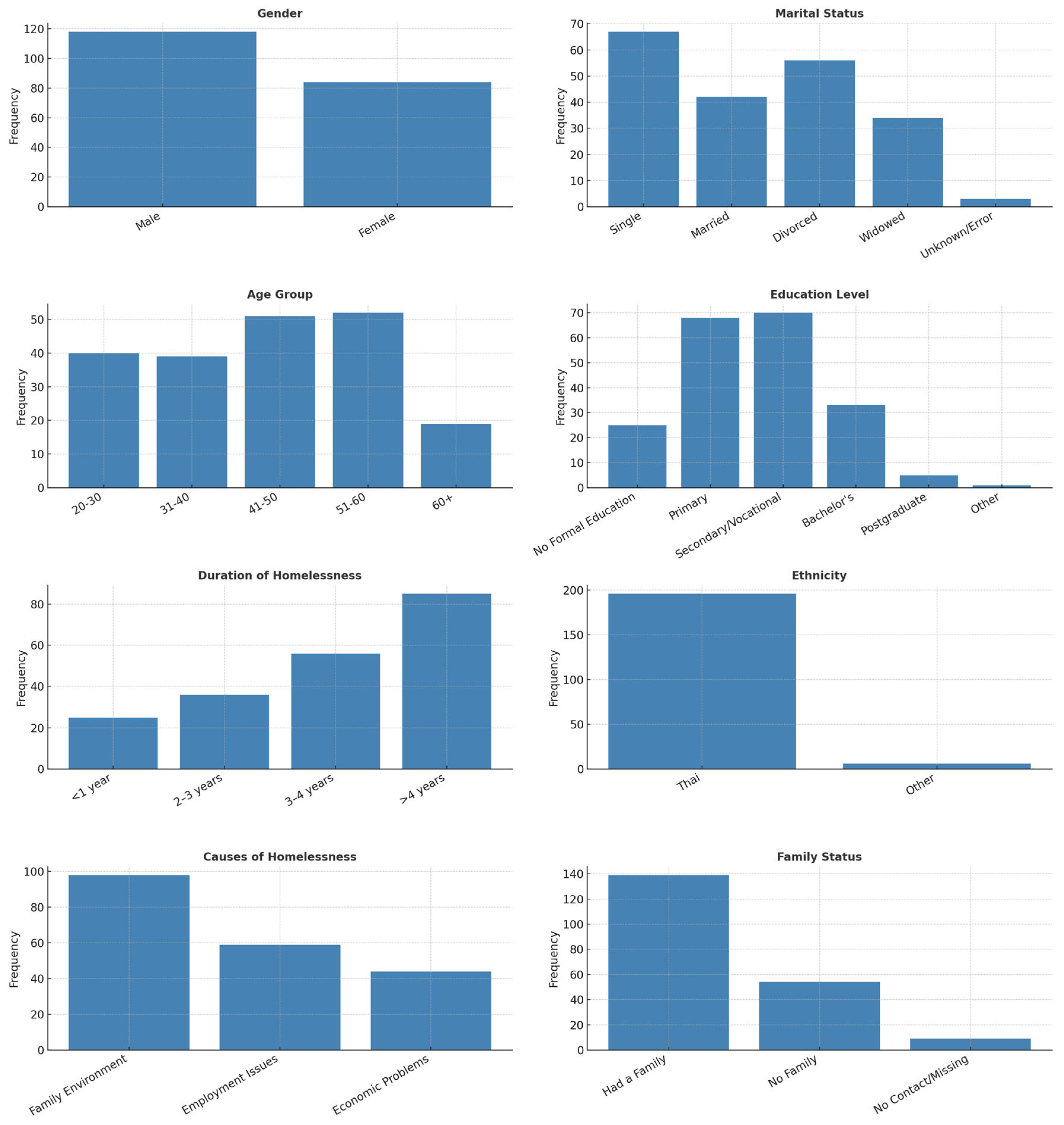
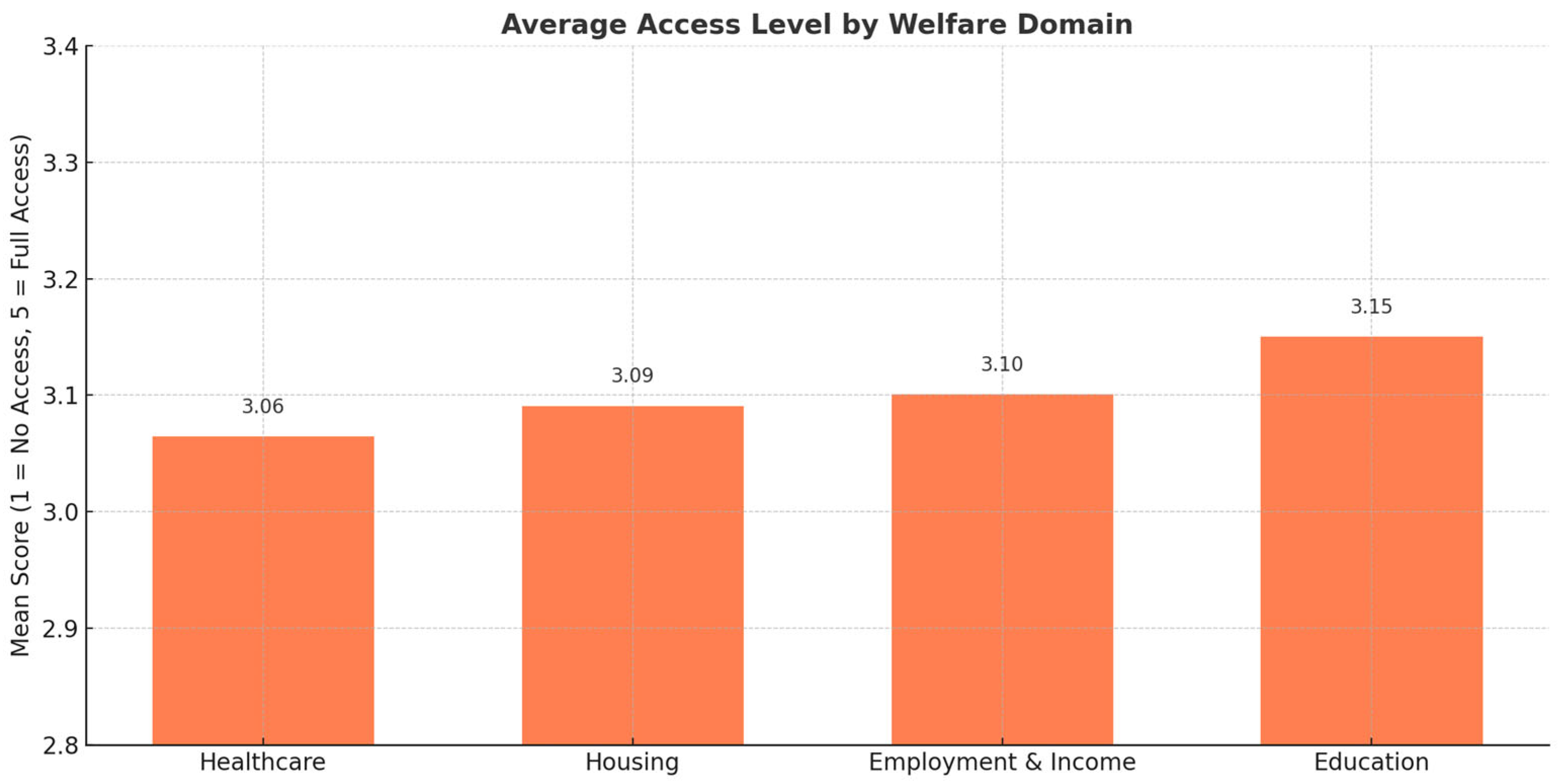
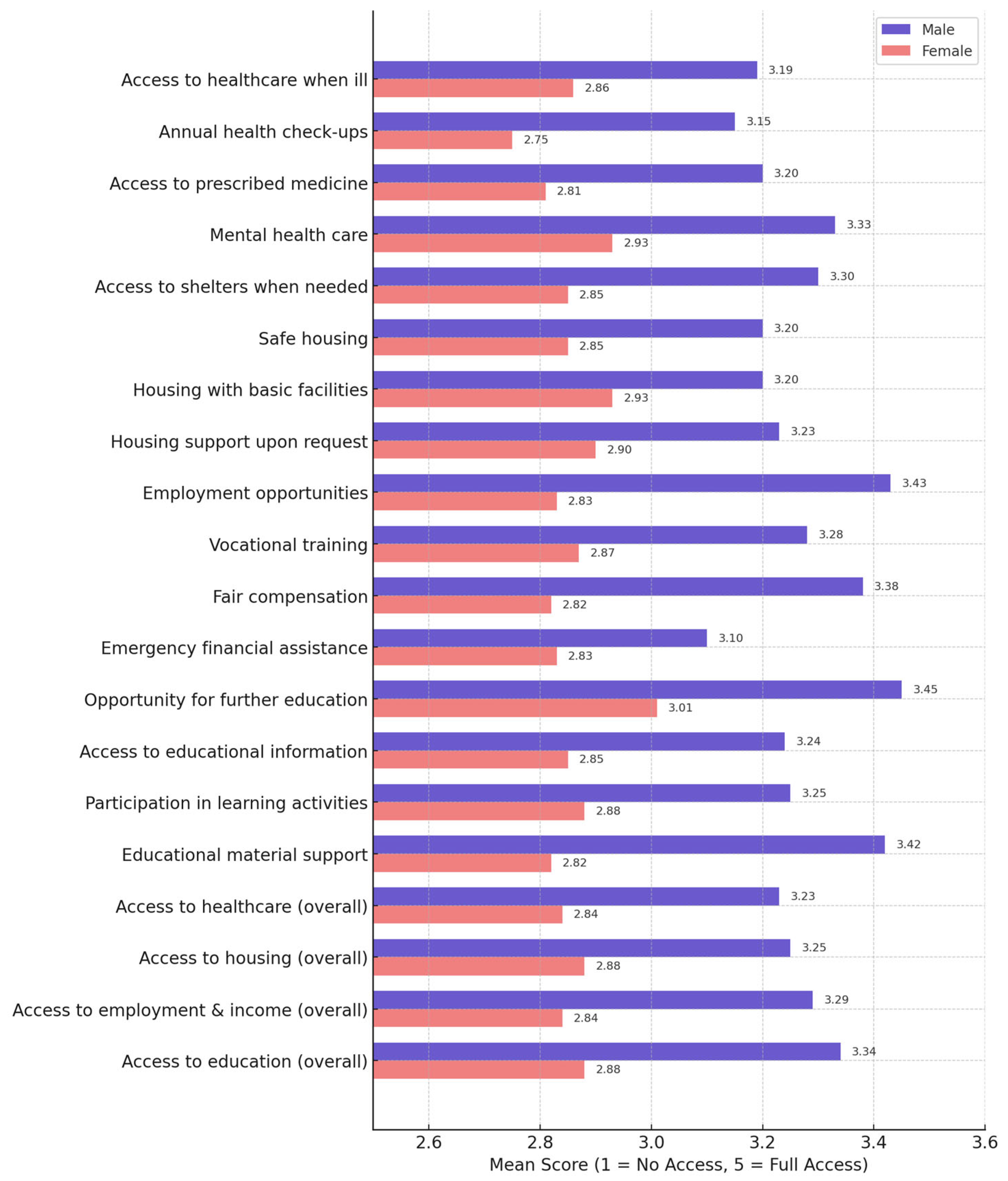
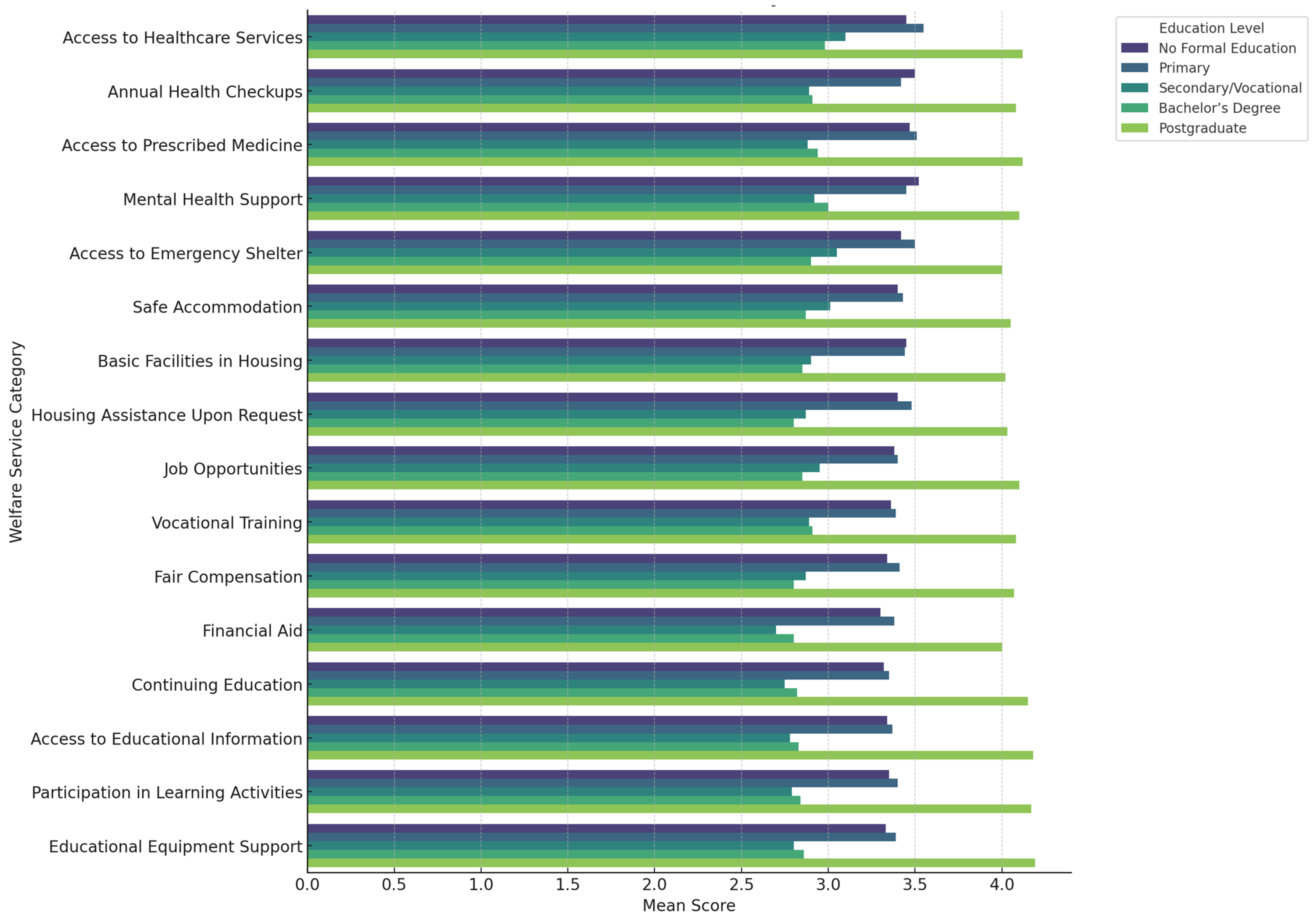
4.1. Predictive Model and Demographic Profile
4.2. Thematic Analysis of Exclusionary Barriers
4.2.1. Institutional Access: The Crisis of “Invisibility”
4.2.2. Housing: The Foundation of Safety and Dignity
4.2.3. The ‘Welfare Trap’ and Intersecting Disparities
4.2.4. Social Stigma: The Barrier of Perception
5. Discussion
5.1. Theorizing the ‘Foundational Capability Cascade’
5.2. Unpacking Systemic Failures: The ‘Welfare Trap’ and Policy Blind Spots
5.3. Contribution and Broader Implications
6. Conclusions
6.1. Summary of Findings and Contributions
6.2. Limitations and Future Research
6.3. Policy Implications
Author Contributions
Funding
Institutional Review Board Statement
Informed Consent Statement
Data Availability Statement
Acknowledgments
Conflicts of Interest
References
- Soyinka, O.; Siu, K.W.M. Urban informality, housing insecurity, and social exclusion; concept and case study assessment for sustainable urban development. City Cult. Soc. 2018, 15, 23–36. [Google Scholar] [CrossRef]
- Banks, J.; Disney, R.; Duncan, A.; Van Reenen, J. The internationalisation of public welfare policy. Econ. J. 2005, 115, C1–C13. [Google Scholar] [CrossRef]
- Hasanaj, V. Global Patterns of Contemporary Welfare States. J. Soc. Policy 2022, 51, 449–470. [Google Scholar] [CrossRef]
- Stephens, C. Revisiting urban health and social inequalities: The devil is in the detail and the solution is in all of us. Environ. Urban. 2011, 23, 29–40. [Google Scholar] [CrossRef]
- Thiyagarajan, A.; Bhattacharya, S.; Kaushal, K. Homelessness: An Emerging Threat. J. Fam. Med. Prim. Care 2018, 7, 600–603. [Google Scholar]
- Fotoula, B. Homeless: A high risk group for the public health. Health Sci. J. 2010, 4, 141–142. [Google Scholar]
- eClinicalMedicine. Equitable health care for people experiencing homelessness. eClinicalMedicine 2023, 65, 102242. [Google Scholar]
- Filippi, F.D.; Gambara, L. Housing is more than a shelter. Riflessioni intorno alla homelessness in una prospettiva globale. In La Città È La Casa. Politiche per l’Abitare, Contrasto Alla Povertà Abitativa e Housing First; Filippi, S.P.F.D., Ed.; FrancoAngeli: Milan, Italy, 2019; pp. 19–32. [Google Scholar]
- Jain, M. Bringing Human Rights Home: The DC Right to Housing Campaign. Hum. Rights Brief 2010, 17, 13–16. [Google Scholar]
- Polakow, V.; Brooks, M. Homelessness and Health Internationally. In The Wiley Blackwell Encyclopedia of Health, Illness, Behavior, and Society; Cockerham, W.C., Dingwall, R., Quah, S.R., Eds.; John Wiley & Sons, Ltd.: Chichester, UK, 2014; pp. 1–5. [Google Scholar]
- Mitchell, E.; O’Reilly, D.; O’Donovan, D.T.; Bradley, D. Predictors and consequences of homelessness: Cohort study design using linked routine data (Preprint). JMIR Res. Protoc. 2022, 11, e42404. [Google Scholar]
- de Snyder, V.N.S.; Friel, S.; Fotso, J.C.; Khadr, Z.; Meresman, S.; Monge, P.; Patil-Deshmukh, A. Social Conditions and Urban Health Inequities: Realities, Challenges and Opportunities to Transform the Urban Landscape through Research and Action. J. Urban Health 2011, 88, 1183–1193. [Google Scholar] [CrossRef] [PubMed]
- Broto, V.C.; Alves, S.N. Intersectionality challenges for the co-production of urban services: Notes for a theoretical and methodological agenda. Environ. Urban. 2018, 30, 599–616. [Google Scholar] [CrossRef]
- Cameron, S. Urban Inequality, Social Exclusion and Schooling in Dhaka, Bangladesh. Compare 2017, 47, 526–543. [Google Scholar] [CrossRef]
- Yörük, E.; Gençer, A.Ş. The Dynamics of Welfare State Regime Development in the Global South: Structures, Institutions, and Political Agency. J. Comp. Policy Anal. 2022, 24, 250–269. [Google Scholar] [CrossRef]
- Boonyabancha, S. Baan Mankong: Going to scale with “slum” and squatter upgrading in Thailand. Environ. Urban. 2005, 17, 21–46. [Google Scholar]
- Dwyer, R.; Palepu, A.; Williams, C.; Daly-Grafstein, D.; Zhao, J. Unconditional cash transfers reduce homelessness. Proc. Natl. Acad. Sci. USA 2023, 120, e2222103120. [Google Scholar] [CrossRef]
- Gillis, L.M.; Singer, J. Breaking through the barriers: Healthcare for the homeless. J. Nurs. Adm. 1997, 27, 30–34. [Google Scholar] [CrossRef]
- Plumb, J. Homelessness: Care, Prevention, and Public Policy. Ann. Intern. Med. 1997, 126, 973–975. [Google Scholar] [CrossRef]
- Ambrey, C.L. Homelessness and well-being: The role of support services. Int. J. Sociol. Soc. Policy 2025, 45, 1169–1186. [Google Scholar] [CrossRef]
- Glassman, J.; Sneddon, C. Chiang Mai and Khon Kaen as Growth Poles: Regional Industrial Development in Thailand and its Implications for Urban Sustainability. Ann. Am. Acad. Political Soc. Sci. 2003, 590, 93–115. [Google Scholar] [CrossRef]
- Bhandari, R.B.; Xue, W.; Virdis, S.G.; Winijkul, E.; Nguyen, T.L. Monitoring and Assessing Urbanization Progress in Thailand between 2000 and 2020 Using SDG Indicator 11.3.1. Sustainability 2023, 15, 9794. [Google Scholar] [CrossRef]
- Keeratikasikorn, C. A comparative study on four major cities in Northeastern Thailand using urban land density function. Geo-Spat. Inf. Sci. 2018, 21, 140–152. [Google Scholar] [CrossRef]
- Conway, D. Changing perspectives on squatter settlements, intraurban mobility, and constraints on housing choice of the third world urban poor. Urban Geogr. 1985, 6, 170–192. [Google Scholar] [CrossRef]
- Lysenko, O.B. Until the wilting day: An analysis of urban population changes in provincial cities in Thailand from 2010 to 2019. J. Asian Archit. Build. Eng. 2022, 21, 1789–1801. [Google Scholar]
- Elder, J.; King, B. Housing and Homelessness as a Public Health Issue: Executive Summary of Policy Adopted by the American Public Health Association. Med. Care 2019, 57, 401–405. [Google Scholar] [CrossRef] [PubMed]
- Pritchard, J.W.; Puzey, J.W. Homelessness–On the health agenda in Wales? Rev. Environ. Health 2004, 19, 363–380. [Google Scholar] [CrossRef] [PubMed]
- Fowler, P.J.; Hovmand, P.S.; Marcal, K.E.; Das, S. Solving Homelessness from a Complex Systems Perspective: Insights for Prevention Responses. Annu. Rev. Public Health 2019, 40, 465–486. [Google Scholar] [CrossRef]
- The Lancet Public Health. Homelessness in Europe: Time to act. Lancet Public Health 2023, 8, e743. [Google Scholar] [CrossRef]
- Oelke, N.D.; Thurston, W.E.; Turner, D. Aboriginal Homelessness: A Framework for Best Practice in the Context of Structural Violence. Int. Indig. Policy J. 2016, 7, 5. [Google Scholar] [CrossRef]
- Pablo, Z.; London, K. Sustainability through Resilient Collaborative Housing Networks: A Case Study of an Australian Pop-Up Shelter. Sustainability 2022, 14, 1271. [Google Scholar] [CrossRef]
- Hootegem, A.V.; Meuleman, B.; Abts, K. Two faces of benefit generosity: Comparing justice preferences in the access to and level of welfare benefits. Eur. Sociol. Rev. 2023, 39, 948–962. [Google Scholar] [CrossRef]
- Roosma, F.; Gelissen, J.; van Oorschot, W. The Multidimensionality of Welfare State Attitudes: A European Cross-National Study. Soc. Indic. Res. 2013, 113, 235–255. [Google Scholar] [CrossRef] [PubMed]
- Cabieses, B.; Bird, P. Glossary of access to health care and related concepts for low- and middle-income countries (LMICs): A critical review of international literature. Int. J. Health Serv. 2014, 44, 789–807. [Google Scholar] [CrossRef]
- Khan, A.A.; Bhardwaj, S.M. Access to health care. A conceptual framework and its relevance to health care planning. Eval. Health Prof. 1994, 17, 60–76. [Google Scholar] [CrossRef]
- Clark, C.; Perfit, C.; Reznickova, A. A multi-dimensional access index: Exploring emergency food assistance in New York City. Health Place 2024, 90, 103319. [Google Scholar] [CrossRef]
- Elliott, M.; Krivo, L.J. Structural Determinants of Homelessness in the United States. Soc. Probl. 1991, 38, 113–131. [Google Scholar] [CrossRef]
- Sarmento, M.; Huber, C.M.; Magalhães, C. Mapping Marginalization: A Multilevel Exploration of Chronic Homelessness. J. Community Appl. Soc. Psychol. 2025, 35, e70135. [Google Scholar] [CrossRef]
- Conley, D. Getting it together: Social and institutional obstacles to getting off the streets. Sociol. Forum 1996, 11, 215–233. [Google Scholar] [CrossRef]
- Cernadas, A.; Fernández, Á. Healthcare inequities and barriers to access for homeless individuals: A qualitative study in Barcelona (Spain). Int. J. Equity Health 2021, 20, 45. [Google Scholar] [CrossRef]
- Canham, S.L.; Weldrick, R.; Erisman, M.; McNamara, A.; Rose, J.; Siantz, E.; Casucci, T.; McFarland, M. A Scoping Review of the Experiences and Outcomes of Stigma and Discrimination towards Persons Experiencing Homelessness. Health Soc. Care Community 2024, 2024, 2060619. [Google Scholar] [CrossRef]
- Schiffler, T.; Carmichael, C.; Lehner, L.; Gil-Salmerón, A.; Kouvari, M.; Karnaki, P.; Grabovac, I. Barriers and facilitators to healthcare access for homeless people in four European countries. Eur. J. Public Health 2022, 32 (Suppl. S3), ckac129.068. [Google Scholar] [CrossRef]
- Thorndike, A.L.; Yetman, H.E.; Thorndike, A.N.; Jeffrys, M.; Rowe, M. Unmet health needs and barriers to health care among people experiencing homelessness in San Francisco’s Mission District: A qualitative study. BMC Public Health 2022, 22, 1113. [Google Scholar] [CrossRef] [PubMed]
- Ramsay, N.; Hossain, R.; Moore, M.; Milo, M.; Brown, A. Health Care While Homeless: Barriers, Facilitators, and the Lived Experiences of Homeless Individuals Accessing Health Care in a Canadian Regional Municipality. Qual. Health Res. 2019, 29, 1827–1839. [Google Scholar] [CrossRef]
- White, B.; Newman, S.D. Access to primary care services among the homeless: A synthesis of the literature using the equity of access to medical care framework. J. Prim. Care Community Health 2015, 6, 193–202. [Google Scholar] [CrossRef]
- North, C.S.; Smith, E.M. A comparison of homeless men and women: Different populations, different needs. Community Ment. Health J. 1993, 29, 159–168. [Google Scholar] [CrossRef]
- Brunette, M.F.; Drake, R.E. Gender Differences in Homeless Persons with Schizophrenia and Substance Abuse. Community Ment. Health J. 1998, 34, 627–642. [Google Scholar] [CrossRef] [PubMed]
- Cramer, H. Informal and Gendered Practices in a Homeless Persons Unit. Hous. Stud. 2005, 20, 587–603. [Google Scholar] [CrossRef]
- Winetrobe, H.; Wenzel, S.L.; Rhoades, H.; Henwood, B.F.; Rice, E.; Harris, T. Differences in Health and Social Support between Homeless Men and Women Entering Permanent Supportive Housing. Womens Health Issues 2017, 27, 327–334. [Google Scholar] [CrossRef]
- Tsai, J.; Lampros, A. Disproportionate Increases in Numbers and Rates of Homelessness Among Women in the United States, 2018–2022. Public Health Rep. 2024, 140, 103–107. [Google Scholar] [CrossRef]
- Benda, B.B.; Dattalo, P. Homeless Women and Men: Their Problems and Use of Services. Affilia 1990, 5, 43–57. [Google Scholar] [CrossRef]
- Biblarz, T.J.; Raftery, A.E. The Effects of Family Disruption on Social Mobility. Am. Sociol. Rev. 1993, 58, 97–109. [Google Scholar] [CrossRef]
- Roustit, C.; Chaix, B.; Chauvin, P. Family breakup and adolescents’ psychosocial maladjustment: Public health implications of family disruptions. Pediatrics 2007, 120, e984–e991. [Google Scholar] [CrossRef]
- Nallo, A.D.; Oesch, D. The Intergenerational Transmission of Family Dissolution: How it Varies by Social Class Origin and Birth Cohort. Eur. J. Popul. 2023, 39, 13. [Google Scholar] [CrossRef]
- Leonard, T.; Hughes, A.E.; Pruitt, S.L. Understanding how low-socioeconomic status households cope with health shocks: An analysis of multi-sector linked data. Ann. Am. Acad. Political Soc. Sci. 2017, 669, 168–187. [Google Scholar] [CrossRef]
- Vásquez, W.F.; Bohara, A.K. Household shocks, child labor, and child schooling: Evidence from Guatemala. Lat. Am. Res. Rev. 2010, 45, 146–167. [Google Scholar] [CrossRef]
- Reyes, C.; Randell, H.E. Household Shocks and Adolescent Well-Being in Peru. Popul. Res. Policy Rev. 2023, 42, 33. [Google Scholar] [CrossRef]
- Rossi, P.H.; Wright, J.D. The Urban Homeless: A Portrait of Urban Dislocation. Ann. Am. Acad. Political Soc. Sci. 1989, 501, 132–142. [Google Scholar] [CrossRef]
- Snow, D.A.; Mulcahy, M. Space, Politics, and the Survival Strategies of the Homeless. Am. Behav. Sci. 2001, 45, 149–169. [Google Scholar] [CrossRef]
- Veness, A.R. Home and Homelessness in the United States: Changing Ideals and Realities. Environ. Plan. D 1992, 10, 445–468. [Google Scholar] [CrossRef]
- Lancione, M. Homeless people and the city of abstract machines: Assemblage thinking and the performative approach to homelessness. Area 2013, 45, 356–362. [Google Scholar] [CrossRef]
- Iamtrakul, P.; Padon, A.; Chayphong, S.; Hayashi, Y. Unlocking Urban Accessibility: Proximity Analysis in Bangkok, Thailand’s Mega City. Sustainability 2024, 16, 3137. [Google Scholar] [CrossRef]
- Zaki, S.; Amin, A.T.M.N. Does Basic Services Privatisation Benefit the Urban Poor? Some Evidence from Water Supply Privatisation in Thailand. Urban Stud. 2009, 46, 2335–2361. [Google Scholar] [CrossRef]
- Boonyabancha, S. Land for housing the poor—By the poor: Experiences from the Baan Mankong nationwide slum upgrading programme in Thailand. Environ. Urban. 2009, 21, 309–329. [Google Scholar] [CrossRef]
- Duangputtan, P.; Mishima, N. Examining Dwelling Interior Conditions for Informal Settlement Upgrading Along the Mae Kha Canal, Chiang Mai. Interiority 2024, 7, 305–326. [Google Scholar] [CrossRef]
- Alderton, A.; Davern, M.; Nitvimol, K.; Butterworth, I.; Higgs, C.; Ryan, E.; Badland, H. What is the meaning of urban liveability for a city in a low-to-middle-income country? Contextualising liveability for Bangkok, Thailand. Global Health 2019, 15, 48. [Google Scholar] [CrossRef] [PubMed]
- Gillingham, P. Predictive Risk Modelling to Prevent Child Maltreatment and Other Adverse Outcomes for Service Users: Inside the ‘Black Box’ of Machine Learning. Br. J. Soc. Work 2016, 46, 1029–1045. [Google Scholar] [CrossRef] [PubMed]
- Serrano, E.; del Pozo-Jiménez, P.; Suárez-Figueroa, M.C.; González-Pachón, J.; Bajo, J.; Gómez-Pérez, A. Predicting the risk of suffering chronic social exclusion with machine learning. In International Conference on Practical Applications of Agents and Multi-Agent Systems; Springer: Berlin/Heidelberg, Germany, 2017; pp. 177–188. [Google Scholar]
- Rodriguez, M.Y.; DePanfilis, D.; Lanier, P. Bridging the gap: Social work insights for ethical algorithmic decision-making in human services. IBM J. Res. Dev. 2019, 63, 8:1–8:8. [Google Scholar] [CrossRef]
- Oak, E. A Minority Report for Social Work? The Predictive Risk Model (PRM) and the Tuituia Assessment Framework in addressing the needs of New Zealand’s Vulnerable Children. Br. J. Soc. Work 2016, 46, 414–430. [Google Scholar] [CrossRef]
- Breznau, N. Integrating Computer Prediction Methods in Social Science: A Comment on Hofman et al. (2021). Soc. Sci. Comput. Rev. 2022, 40, 519–527. [Google Scholar] [CrossRef]
- Putnam, R.D. Bowling Alone: The Collapse and Revival of American Community; Simon & Schuster: New York, NY, USA, 2000. [Google Scholar]
- Lipsky, M. Street-Level Bureaucracy: Dilemmas of the Individual in Public Services; Russell Sage Foundation: New York, NY, USA, 1980. [Google Scholar]



| Participant ID | Role/Category | Gender | Age (Approx.) | Background/Context |
|---|---|---|---|---|
| GOV-01 | State Official | Male | 40–50 | Policy oversight, involved in homelessness for >5 years. |
| GOV-02 | State Official | Male | 41 | Field operations, direct engagement with homeless individuals at transport hubs. |
| GOV-03 | State Official | Female | 38 | Social worker, specializes in family reconciliation and welfare access. |
| GOV-04 | State Official | Female | 40–50 | Public health coordinator for vulnerable populations. |
| CSO-01 | Civil Society | Male | N/A | Community volunteer, advocates for “opportunities not burden” perspective. |
| CSO-02 | Civil Society | Male | N/A | Local NGO leader, organizes food/supplies distribution. |
| H-01 | Homeless Individual | Male | N/A | Has ID card but lacks permanent address; history of service refusal due to appearance. |
| H-02 | Homeless Individual | Female | N/A | Has ID card; faces gender-specific safety risks; difficulty accessing healthcare queues. |
| H-03 | Homeless Individual | Male | N/A | No ID card (lost/stolen); chronic health issues (diabetes/hypertension); completely excluded from state welfare. |
| H-04 | Homeless Individual | Male | N/A | No ID card; relies solely on charity; desires state outreach for re-documentation. |
| Predictor Variable | B | Std. Error | β (Beta) | t | Sig. | VIF |
|---|---|---|---|---|---|---|
| (Constant) | 0.182 | 0.077 | – | 2.347 | 0.020 * | - |
| Access to Basic Welfare in Housing Domain | 0.447 | 0.054 | 0.451 | 8.304 | 0.000 *** | 5.564 |
| Access to Basic Welfare in Education Domain | 0.493 | 0.052 | 0.520 | 9.576 | 0.000 *** | 5.564 |
| Thematic Area | Key Barrier Identified | Proposed Solution | Supporting Quote (Example) |
|---|---|---|---|
| Institutional Access | Lack of national ID card blocks all services. | Proactive outreach by the state to issue documentation. | “It’s like being an invisible person. You can’t ask for help because you have no rights at all.” (Homeless Participant) |
| System Fragmentation | No central coordinating body; services are siloed. | Establish a province-level “Homelessness Task Force.” | “We need a permanent, integrated shelter… and a central coordinating body.” (State Official) |
| Housing | Lack of safe, temporary, and gender-appropriate shelters. | “Housing and Education First” strategy; develop women-only safe spaces. | “What I want is a temporary shelter for women that is safe.” (Homeless Participant) |
| Social Stigma | Pervasive negative attitudes prevent social reintegration. | Public awareness campaigns to frame homelessness as a structural issue. | “We must change our view from seeing them as a burden to seeing them as people who need a chance.” (Civil Society Member) |
Disclaimer/Publisher’s Note: The statements, opinions and data contained in all publications are solely those of the individual author(s) and contributor(s) and not of MDPI and/or the editor(s). MDPI and/or the editor(s) disclaim responsibility for any injury to people or property resulting from any ideas, methods, instructions or products referred to in the content. |
© 2025 by the authors. Licensee MDPI, Basel, Switzerland. This article is an open access article distributed under the terms and conditions of the Creative Commons Attribution (CC BY) license (https://creativecommons.org/licenses/by/4.0/).
Share and Cite
Kitkiwan, W.; Chaiya, C. The Cascade of Exclusion: A Mixed-Methods Study of Welfare Inequity and Its Foundational Determinants Among Thailand’s Homeless Population. Sustainability 2025, 17, 10929. https://doi.org/10.3390/su172410929
Kitkiwan W, Chaiya C. The Cascade of Exclusion: A Mixed-Methods Study of Welfare Inequity and Its Foundational Determinants Among Thailand’s Homeless Population. Sustainability. 2025; 17(24):10929. https://doi.org/10.3390/su172410929
Chicago/Turabian StyleKitkiwan, Warisara, and Chitralada Chaiya. 2025. "The Cascade of Exclusion: A Mixed-Methods Study of Welfare Inequity and Its Foundational Determinants Among Thailand’s Homeless Population" Sustainability 17, no. 24: 10929. https://doi.org/10.3390/su172410929
APA StyleKitkiwan, W., & Chaiya, C. (2025). The Cascade of Exclusion: A Mixed-Methods Study of Welfare Inequity and Its Foundational Determinants Among Thailand’s Homeless Population. Sustainability, 17(24), 10929. https://doi.org/10.3390/su172410929