Article

Spatial Dependence of Conditional Recurrence Periods for Extreme Rainfall in the Qiantang River Basin: Implications for Sustainable Regional Disaster Risk Governance

1
School of Marine Engineering Equipment, Zhejiang Ocean University, Zhoushan 316022, China
2
School of Hydraulic Engineering, Zhejiang University of Water Resources and Electric Power, Hangzhou 310018, China
*
Author to whom correspondence should be addressed.
These authors contributed equally to this work.
Sustainability 2025, 17(24), 10896; https://doi.org/10.3390/su172410896
Submission received: 24 October 2025 / Revised: 27 November 2025 / Accepted: 1 December 2025 / Published: 5 December 2025

Abstract

Climate change increases the intensity and frequency of extreme rainfall. Heavy rain is one of the main input sources for the complex water resources system in the watershed. Understanding its regional spatial correlation is of vital importance for promoting sustainable disaster management in the watershed. The Qiantang River Basin is a significant ecological and economic area in the Yangtze River Delta, yet systematic research on its multi-regional rainstorm-dependent structure remains insufficient. In this study, hourly rainfall data of the basin from 1950 to 2024 were used to construct marginal functions by using the peaks-over-threshold and the generalized Pareto distribution, and a mixed Copula model was established to describe the dependence structure of multi-regional extreme rainfall events. The model has been tested by RMSE and Cramér–von Mises statistics and shows reliable performance. The study reveals that the basin has a “double cluster” spatial pattern: the internal conditions of northern clusters (Hangzhou–Shaoxing) and southern clusters (Jinhua–Lishui–Quzhou) showed a strong dependence. On the contrary, under cluster conditions with low inter-regional dependence, all high-probability combinations occurred within the clusters, not outside them. This finding provides quantitative support for optimizing trans-regional emergency response, improving flood control resilience, and realizing precise allocation of resources, and is of great significance for promoting sustainable watershed governance.

1. Introduction

Establishing flood control projects, building drainage infrastructure, and creating regional disaster reduction policies are all directly tied to the precise estimation of the frequency and severity of extreme rainfall [1,2]. The Qiantang River Basin, Zhejiang Province’s largest water system, is where a range of weather systems, including typhoons, the Meiyu front, and strong convection, converge to form a complex pattern of rainstorm distribution [3,4]. A common feature of historical disaster records from recent years is that heavy rains tend to impact multiple regions in a short period of time rather than occurring in isolation in a single region [3,4,5]. The limitations of a single region’s autonomous response strategy can be seen by this spatial clustering feature, which additionally highlights the real need for cross-regional collaborative governance.
However, not nearly enough has been discovered concerning the conditional dependence of extreme rainfall across the Qiantang River Basin’s subregions. Technically speaking, current analyses prefer to assume that rainfall events in various locations are statistically independent and mostly focus on marginal distribution characteristics. This assumption may be inaccurate and fails to quantitatively capture the conditional dependence among regions directly, even though it makes statistical modeling much simpler. The accuracy of basin-wide coordinated flood control and management strategies is hampered by these quantitative assessment limitations.
Conventional methods for analyzing extreme values are well established. A strong basis for the frequency analysis of extreme rainfall events is provided by the peaks-over-threshold (POT) and annual maximum series (AMS) approaches [6]. The POT approach provides a more credible sample basis for regional dependence analysis than AMS because it can better capture the inherent features of rainfall extremes and retain more valuable extreme information [6,7]. In the POT method, the selection of the threshold is a key issue. Internationally, POT selections of threshold values on rainfall have no uniform standard, selecting characteristics using different strategies according to different research areas. Serinaldi and Kilsby [8] adopted a percentile-based threshold method in their study of extreme precipitation in the U.K., Zhai et al. [9] reported that the 95th quantile of daily precipitation is generally 20–40 mm in most eastern regions of China, while it can exceed 40 mm in the southeast coastal areas and the lower reaches of the Yangtze River, which is widely used as the threshold for extreme precipitation days. Fan et al. [10] adopted a 24 h cumulative precipitation of 50 mm as the threshold for rainstorm identification in the eastern region of China in his study, and this threshold selection demonstrated good adaptability.
Following the extraction of these extreme rainfall samples, researchers usually estimate the amount of rainfall for different recurrence periods via frequency analysis and fitting suitable extreme-value distributions. Because they mainly focus on marginal distribution properties, these methods are capable of accurately estimating the recurrence periods of extreme rainfall at individual stations but lack the ability to directly address the issue of conditional dependence among regions.
A fresh viewpoint on this issue has been made possible by the advancement of multi-station extreme-value analysis. Because it offers a great deal of flexibility in capturing the dependence structure between regions, the Copula function—which connects marginal and joint distributions—has been widely employed in studies of extreme rainfall. With the aim of sustaining the stability of extreme-value distributions under spatial aggregation, Cooley et al. developed a multi-station joint modeling framework [11]. The Copula approach was introduced to cope with nonlinear relationships between stations by Zhang and Singh [12]. As research continues to advance, scholars have reached the realization that a single Copula is sometimes insufficient to fully describe the intricate dependence structure of hydrological processes. The work of Zhao et al. [13] shows that a single Copula is insufficient to adequately capture the highly complex dependence patterns that hydrological processes display, including both correlation and tail dependence. In order to model and generate rainfall sequences using mixed distributions, Serinaldi [14] proposed a multi-station daily rainfall generator powered by a mixture of bivariate Copulas. Qian et al. [15] expanded the mixed Copula approach to extreme rainfall research and offered a multi-station risk assessment framework for extreme precipitation. Their model greatly increased the simulation accuracy of spatial dependence structures for extreme rainfall in central China by combining the work of Gumbel, Clayton, and Frank Copulas. The flexible integration of tail features from several Copula families made possible by such mixed-Copula approaches makes it possible to describe dependences more accurately over a range of probability levels and offers a useful tool for regional joint modeling of extreme precipitation.
Even with the ongoing development of theoretical tools, it is still tough to apply them to actual flood regulation decision-making. The bulk of the studies that exist right now focus on general interstation correlations or the spatial distribution of rainfall characteristics. Yet, knowing the conditional recurrence probability—that is, the probability that other cities will experience varying levels of rainfall given that a particular city is experiencing a rainfall event of a particular recurrence period—is vital to efficient flood control. Since prior studies mainly focus on general hydrological characteristics, there is still an obvious gap in the analysis of regional recurrence period correlation in conjunction with specific rainstorm processes in the Qiantang River Basin.
With the goal of generating the marginal distributions for each city, this study applies the peaks-over-threshold (POT) method in conjunction with the generalized Pareto distribution (GPD). A mixed Copula model is built to estimate the conditional recurrence periods based on these distributions. The mixture of architectures incorporates four Copula families: Gaussian, Gumbel, Joe, and t-Copula. Its weight is smoothly changed with the recurrence period using the Sigmoid function. At lower recurrence levels, information criteria play a major role in selecting models to ensure an optimal overall fitting performance. At higher recurrence levels, though, tail dependence becomes crucial so as to accurately capture the joint behavior of extreme events. This framework reveals the conditional dependence patterns among basin subregions by methodically estimating conditional probabilities for regional rainfall events with recurrence periods of 5, 10, 20, 50, and 100 years. The results offer quantitative information to help with priority-setting in emergency response, coordinated flood regulation, and the best possible distribution of cross-regional flood control resources. This study aims to provide quantitative scientific support for advancing cross-regional extreme rainfall risk assessment and enhancing the sustainability and resilience of flood disaster management in the Qiantang River Basin. It also offers a methodological reference for achieving hydrological risk management and sustainable development goals at the basin scale.

2. Overview of the Study Area and Data

2.1. Study Area

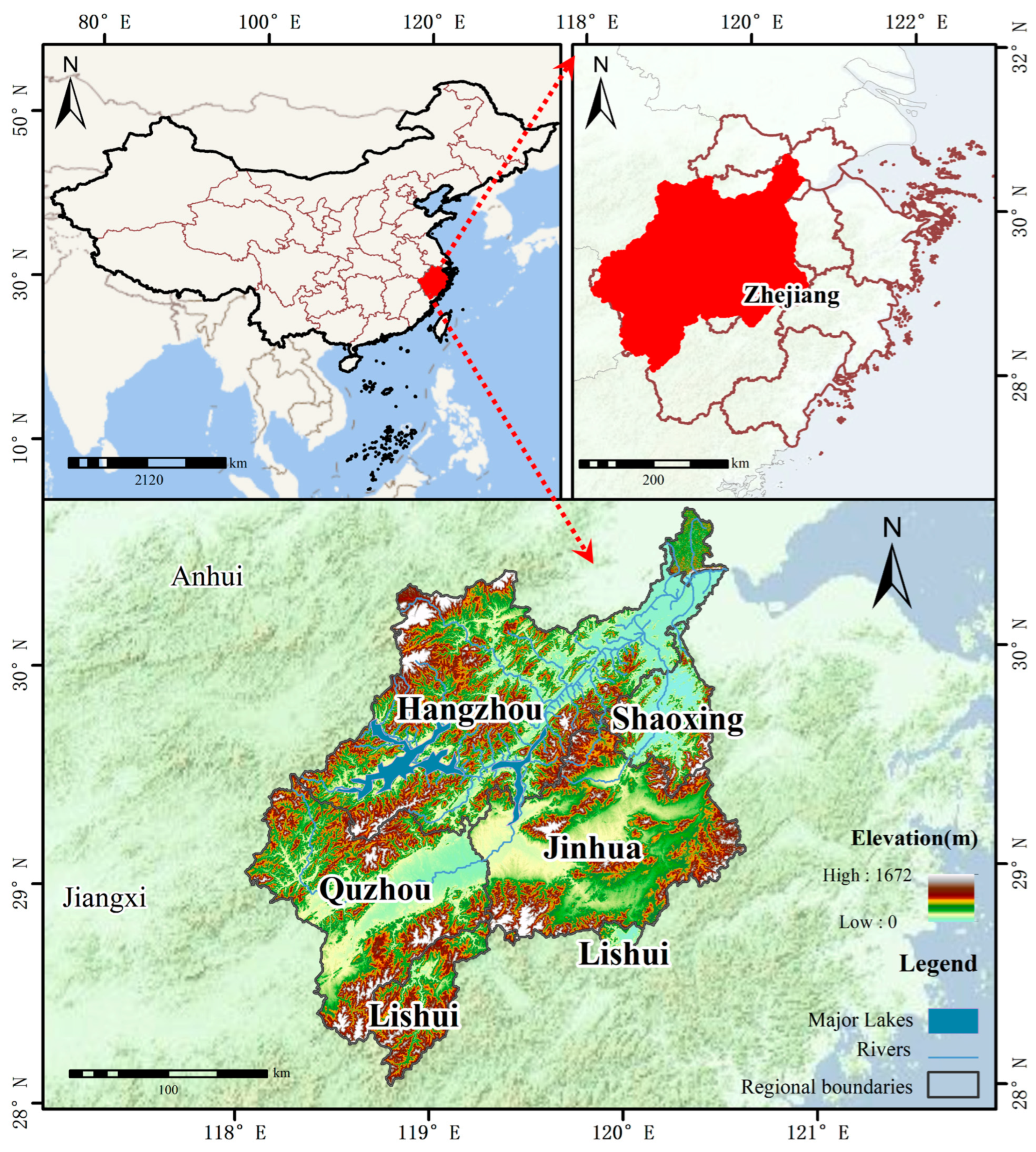
The Qiantang River Basin is located along the southeastern coast of China, within Zhejiang Province, approximately between 118 and 121° E and 28–31° N. It borders the East China Sea to the east, connects with the Anhui and Jiangxi Provinces to the west, and adjoins Shanghai and Jiangsu to the north. The total basin area is about 48,080 km2, of which mountainous and hilly terrain accounts for approximately 74.6%, while plains cover about 20.3%. The major cities within the Zhejiang portion of the basin include Hangzhou, Shaoxing, Jinhua, Lishui, and Quzhou. The main river, the Qiantang River, extends for 688 km, making it the longest river in Zhejiang Province [3]. With an average yearly precipitation of roughly 1531 mm, the basin has a subtropical monsoon climate, with the majority of rainfall falling between May and July. The study area’s geographic location is depicted in Figure 1.

2.2. Data Sources and Preprocessing

This study relies on the European Center for Medium-Range Weather Forecasts’ (ECMWFs) ERA5-Land hourly reanalysis dataset to guarantee data consistency and reliability. With hourly surface meteorological and hydrological variables like precipitation, air temperature, wind speed, and soil moisture, ERA5-Land is one of the most sophisticated global high-resolution reanalysis products [16,17,18,19]. It has a temporal resolution of an hour and a spatial resolution of 0.1° × 0.1°. The dataset is generated using a state-of-the-art numerical weather prediction model combined with satellite and ground-based data assimilation, which enables accurate representation of the spatiotemporal variability of precipitation across the Qiantang River Basin [16,17,18].
ERA5-Land can meet the specific requirements of this research objective. Hourly time resolution can capture rainfall information within the study area in detail to ensure reliable research samples are obtained. The dataset covers the years from 1950 to 2024 using a uniform approach, ensuring the time-series consistency required for analyzing extreme events. This consistency is maintained even in areas with limited station coverage or gaps in observations. ERA5-Land has been widely used in East Asia and China for studying rainfall and hydrology in watersheds, including monsoon-affected areas. Its overall performance is considered to meet the needs of hydrological studies, including analyzing rainfall distribution, extreme events, and watershed responses [18,19,20].
For this study, grid points spanning the 75-year period from 1950 to 2024 were used to collect hourly precipitation data for representative basin regions. Bilinear interpolation was used to obtain continuous hourly rainfall series for each region. Strict quality control was applied to all precipitation records so as to eliminate anomalies and guarantee reliability and temporal consistency. The Copernicus Climate Data Store (CDS) provided the information (https://cds.climate.copernicus.eu/, accessed on 31 May 2024).

3. Methodology

3.1. Definition of Extreme Rainfall Events

A 24 h rolling window approach was adopted to identify extreme rainfall events. In the first stage, the initial identification criterion was set at a threshold of 50 mm of total rainfall over a 24 h period. This threshold is in line with the rainstorm criteria set by China [10] and it is in accordance with the rainfall characteristics of southeast coastal China.
Throughout the 24 h sliding window, cumulative rainfall was computed on an hourly basis. A candidate rainfall event was deemed to have begun when the 24 h total surpassed 50 mm for the first time. The time frame was regarded as the same ongoing event if subsequent 24 h rolling totals stayed at or above the 50 mm threshold.
The catchment-specific concentration time was used as a reference to further refine event continuity while taking into account the hydrological features of the Qiantang River Basin. Only if the 24 h rolling total fell below 50 mm and the interruption lasted longer than the corresponding region’s concentration time was the event considered interrupted. In contrast, the entire period was recognized as a single continuous rainfall event if the intensity recovered and once more surpassed the threshold during the concentration time.
To build a concurrent rainfall dataset, the 50 most extreme rainfall events for each region were picked. Specifically, hourly rainfall data was extracted from all other areas in the basin in the same time window that a rainstorm occurred in a given region. This procedure created a multi-area concurrent rainfall matrix with the rainstorm area at its center, which served as a reliable foundation for later studies of correlations between intercity recurrence periods.

3.2. POT-GPD Marginal Distribution

3.2.1. Principle of the Peak-over-Threshold (POT) Sampling Method

Precipitation over the Qiantang River Basin is significantly uneven in both space and time due to the combined influence of the East Asian monsoon and typhoon systems. The annual maximum daily rainfall in some regions can be significantly less than the average in some years, while in others there may be several extreme daily rainfall events [21]. The intricate features of extreme precipitation in this basin cannot be adequately captured by the conventional annual maximum series (AMS) method since it only uses one maximum value annually [22,23]. The peaks-over-threshold (POT) method is used in this study to precisely identify extreme precipitation events to attempt to improve the robustness of parameter estimation and better capture the statistical features of these events within the basin.
The trend characteristics and potential change points of the exceedance data series were examined using the Mann–Kendall and Pettitt tests, respectively, prior to fitting the exceedance series with the generalized Pareto distribution (GPD) [24].

3.2.2. Threshold Selection

The POT method finds all rainfall data that surpass a preset threshold, u, in order to construct the exceedance sample series. The precision and dependability of the extreme-value distribution fitting are directly impacted by the choice of this threshold. A number of approaches have been developed to ascertain the desired threshold [25,26]. However, conventional approaches sometimes depend on a single criterion or advantage judgment, which makes it challenging to properly account for regional variations in precipitation features. In this paper, a multi-threshold comparative optimization approach is used to determine the optimal extreme precipitation thresholds for each site.
Specifically, in practical applications, the threshold for the POT analysis is primarily determined based on the heavy rainfall standard issued by the China Meteorological Administration (i.e., a 24 h cumulative precipitation of 50 mm), ensuring consistency with the criteria used for identifying heavy rainfall events. Meanwhile, percentile-based thresholds (the 90th, 95th, and 99th percentiles of daily precipitation) are also considered as candidate values.
Following that, the best threshold for every city is established by comparing the diagnostics of P-P and Q-Q plots and assessing the goodness of fit using the Kolmogorov–Smirnov test. Compared with a single fixed-threshold approach, this adaptive threshold selection strategy integrates the practical relevance of meteorological standards with the statistical rigor of data-driven methods. It effectively reduces subjectivity in threshold determination and allows for region-specific optimization, providing a more reliable basis for POT analysis.

3.2.3. Generalized Pareto Distribution Fitting

In 1975, Pickands first proposed the generalized Pareto distribution (GPD) based on the peaks-over-threshold (POT) model and introduced it into hydrometeorological studies [27]. According to extreme-value theory, when the threshold is sufficiently high, the exceedances above this threshold asymptotically follow the GPD. The cumulative distribution function (CDF) of the GPD is expressed as
F ( x ) = 1   -   ( 1 + ξ x   -   u σ ) -   1 ξ ξ 0 1   -   e x p ( - x   -   u σ ) ξ = 0
where u represents the threshold, σ is the scale parameter describing the degree of dispersion, and ξ is the shape parameter characterizing the tail behavior of the distribution.
Considering the research objectives and practical conditions, the parameters are estimated using the maximum likelihood estimation (MLE) method. The estimation is performed through the Newton–Raphson iterative algorithm, and parameter constraints are applied to ensure the stability and reliability of the estimation process.

3.3. The Mixed Copula Model

3.3.1. Copula Function

Based on Sklar’s theorem, any multivariate joint distribution can be expressed as a combination of its marginal distributions and a Copula function, thereby decoupling the marginal behavior from the dependence structure [28]:
F ( x 1 , x 2 , , x n ) = C ( F 1 ( x 1 ) , F 2 ( x 2 ) , , F n ( x n ) )
In this formulation, C(·) denotes the selected Copula function, F_i (x_i) represents the marginal distribution function of the i-th variable, and n is the dimension of the random vector.
This ability to separate the marginal distributions from the dependence structure converts a complex multivariate problem into two relatively independent components, effectively reducing the computational complexity associated with high dimensionality. In this paper, four Copula models, Gaussian, t, Gumbel, and Joe, are selected to cover the types of dependencies from symmetric light-tailed to asymmetric heavy-tailed. The specific formula expressions are shown in Table 1.
The Copula parameters are estimated using the maximum likelihood estimation (MLE) method [29], and the model performance is evaluated by the Akaike Information Criterion (AIC). In this study, the Joe Copula is introduced into multi-region extreme rainfall analysis to explore its applicability in hydrological contexts. Different Copula functions exhibit distinct behaviors in the tail regions, and this difference is quantified by the upper-tail dependence coefficient λu. The four Copula models employed in this study cover a wide range of dependence structures—from light-tailed to heavy-tailed and from symmetric to asymmetric—making them suitable for characterizing the spatial dependence of extreme rainfall events and providing a comprehensive framework for multivariate extreme-value analysis [30].

3.3.2. The Mixed Copula Strategy

In the conditional probability analysis of extreme rainfall, it is necessary to construct a joint distribution model capable of capturing the dependence structure among extreme rainfall events across multiple regions. Traditional studies have mostly employed a single type of Copula to model the dependence between variables. However, Abraj et al. [31] pointed out that a single Copula often fails to fully represent the tail dependence characteristics. In the context of extreme rainfall, some areas may experience simultaneous occurrences of intense rainfall, which is better described by upper-tail-dependent Copulas. Conversely, other region pairs may exhibit lower-tail dependence or approximately symmetric dependence, which correspond to different Copula types.
Unlike using a single fixed Copula function, this study combines multiple Copula functions through a mixed Copula approach. This method can better capture the different dependence patterns among various regional pairs. By integrating the strengths of different models, it improves the reliability of conditional probability estimates for extreme rainfall. Considering that rainfall events of different magnitudes may be driven by distinct formation mechanisms, the model weights are adaptively adjusted according to the recurrence period (T).
Let the four candidate Copulas be C 1 ,   C 2 ,   C 3 ,   and   C 4 , and the mixed Copula can be expressed as
C ( u , v ) = k = 1 4 w k C k ( u , v ) , k = 1 4 w k = 1 , w k     0
where the weight of the k-th Copula, which represents its contribution to the overall dependence structure, is indicated by the symbol w k .
Extreme-value characteristics and information criteria are used to determine the weights. Specifically, the weights transition smoothly with the recurrence period T through a Sigmoid function—with lower-recurrence periods primarily guided by the Akaike Information Criterion (AIC) and higher-recurrence periods dominated by the upper-tail dependence coefficient. Prior research has confirmed the efficacy of this continuous transition and multi-criteria weighting approach [31,32].
To evaluate the mixed Copula model fits, we used two metrics: RMSE and the Cramér–von Mises (CvM) test. RMSE measures the difference between the theoretical Copula and the empirical Copula. The CvM test uses a parametric bootstrap method to obtain p-values. At a significance level of α = 0.05, a p-value > 0.05 indicates that the model passes the goodness-of-fit test.

3.4. Conditional Probability Calculation

The recurrence period is a crucial metric in rainfall frequency analysis for determining the degree of risk associated with extreme events. A vital question in regional flood defense, though, is this: how likely is it that other regions will encounter rainfall events of varying magnitudes when a particular region experiences one with a given recurrence period? To address this issue, this study further calculates the intercity conditional probabilities under various recurrence periods, following the construction of the joint distribution and the marginal distributions for each city using the mixed Copula model. This approach characterizes the spatial dependence of extreme rainfall events within the basin.
P Y > y T X > x T = P ( X > x T , Y > y T ) P ( X > x T )
Let the marginal distribution functions of cities A and B be denoted as F A x ,   F B ( x ) , and x T ,   y T represent the T-year rainfall amounts at A and B, respectively. The conditional probability is then estimated through the Copula-based joint distribution, which incorporates both the marginal extremal behavior and the dependence structure between cities. This allows a more realistic depiction of the spatial linkage mechanism of rainfall risks across the basin.

4. Results and Discussion

4.1. Extreme Rainfall Event Screening Results

A total of 1302 heavy rainfall occurrences were recognized throughout the areas of the Qiantang River Basin between 1950 and 2024, using a 24 h rolling window and a threshold of 50 mm. The number of events varies among different regions. Hangzhou identified 232 rainstorm events, Shaoxing identified 239, Jinhua identified 224, Lishui identified 339, and Quzhou identified a total of 268.
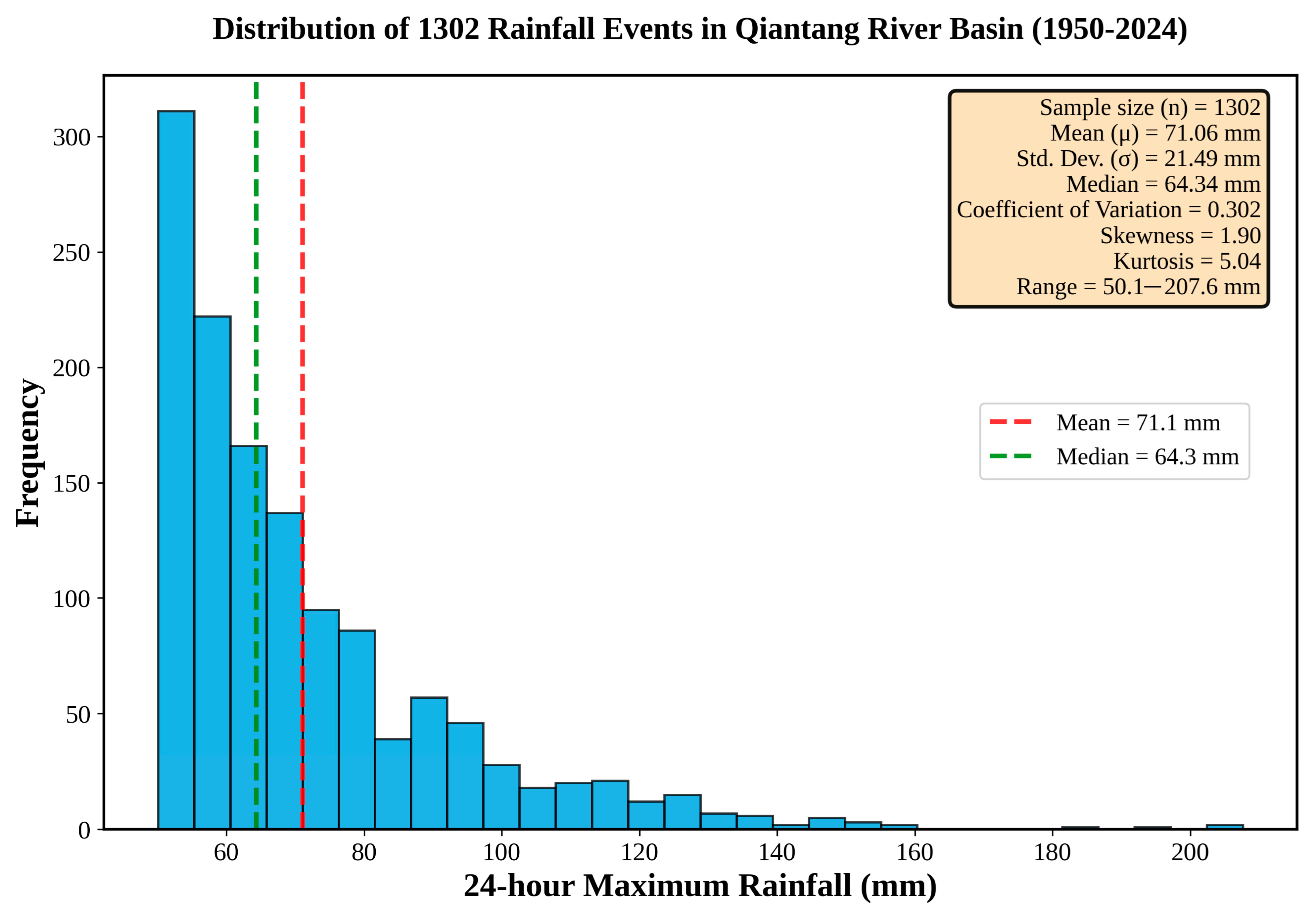
Figure 2 presents the 24 h maximum cumulative rainfall histogram and statistical characteristics of all 1302 events, with an overall mean of 71.1 mm and a median of 64.3 mm, showing a typical right-skewed distribution. More than 80% of the events were concentrated at around 85 mm or less, with only a very small proportion of the upper and lower ends representing truly extreme events.
To ensure the consistency of samples among cities and to focus on the most extreme rainfall events, the 50 events with the highest rainfall intensities were selected for each area as the basis for subsequent recurrence period analyses. This sample size accounts for approximately 15% to 20% of the total number of events in each region. It not only conforms to the extreme-value principle, avoiding the dependency structure bias caused by inconsistent sample sizes in each region, but also ensures the sufficient sample size required for the stability of Copula parameter estimation.
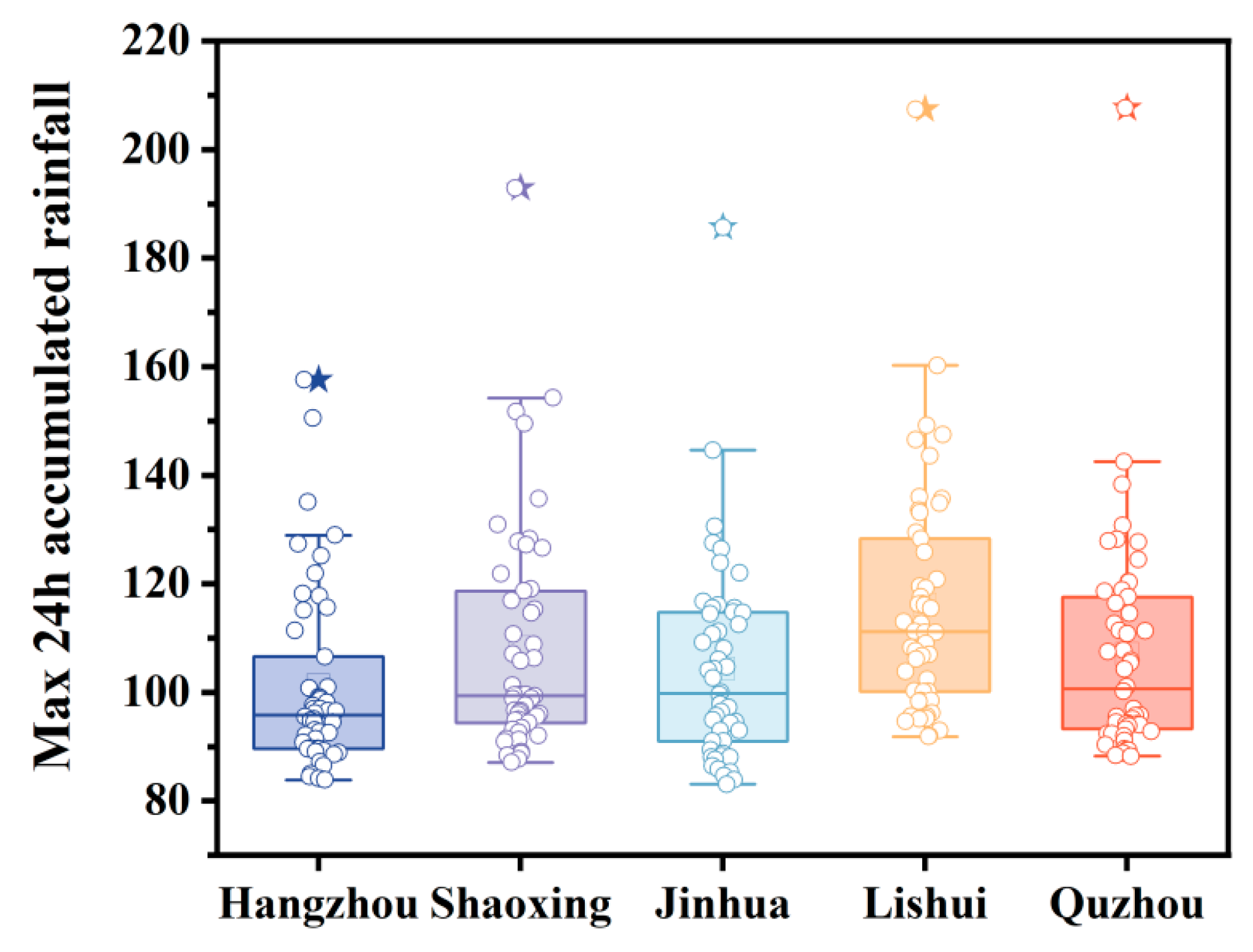
The ranges of the 24 h maximum cumulative rainfall for these 50 extreme events varied considerably among areas: Hangzhou (83.9–157.6 mm), Shaoxing (87.1–192.9 mm), Jinhua (83.1–185.7 mm), Lishui (91.9–207.4 mm), and Quzhou (88.3–207.6 mm) (see Figure 3).

4.2. Marginal Distribution Results

This study used the Mann–Kendall trend test and the Pettitt change-point test to assess the stationarity of several POT series across the five areas in Zhejiang Province in order to guarantee the accuracy of parameter estimation in the GPD model.
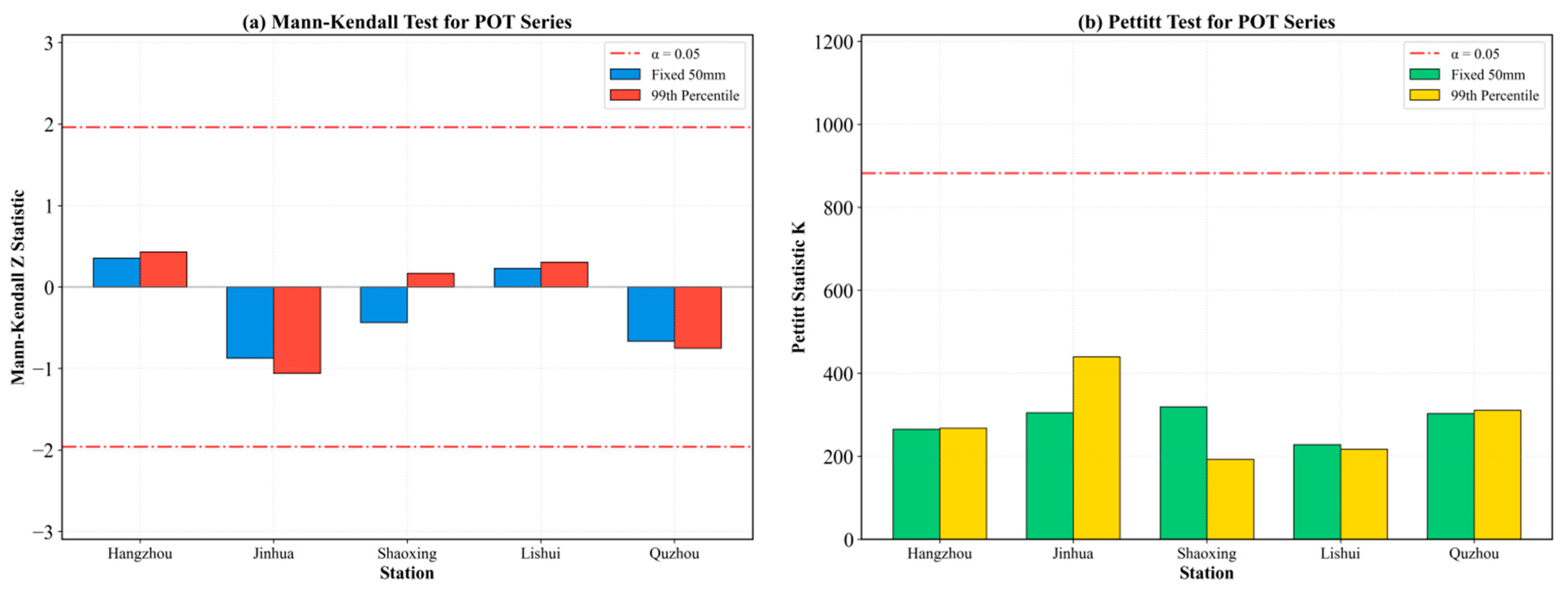
As shown in Figure 4, at the 0.05 significance level, no significant trends or abrupt shifts were detected in the POT series under either of the two threshold conditions, indicating that all series sufficiently satisfy the assumption of stationarity.
Four candidate POTs were compared: the 90th, 95th, and 99th percentile thresholds, and the fixed meteorological threshold of 50 mm. The choice of threshold had a notable effect on the fitting performance of the GPD. The Kolmogorov–Smirnov (K–S) test results indicated that the fits under the 90% and 95% quantile thresholds were rejected (p < 0.05) for all areas, suggesting that lower thresholds fail to adequately capture the tail behavior of extreme rainfall events.
The following are the ideal POTs based on the K-S test and graphical diagnostics: Jinhua and Lishui chose the 99th percentile criteria, whilst Hangzhou, Shaoxing, and Quzhou used the fixed 50 mm threshold. Table 2 presents the K-S test results under the effective thresholds of each region and the parameter estimation results of the GPD model under the optimal thresholds of each region. Parameter estimation results of the GPD model show that the shape parameter (ξ) ranges from 0.010 to 0.041, indicating a moderately heavy-tailed distribution.

4.3. The Mixed Copula Model Fitting Results

Four Copula models—Gaussian, Gumbel, Joe, and t-Copula—were employed to fit the inter-regional rainfall dependence structure within the Qiantang River Basin. Prior to model fitting, the data were converted into probability values based on a combined data matrix of 250 extreme rainfall occurrences. The parameter estimates and statistical indicators for all area pairs are summarized in Table 3 and Table 4 (Hz, Sx, Jh, Ls, and Qz represent Hangzhou, Shaoxing, Jinhua, Lishui, and Quzhou, respectively).
To evaluate the fitting effect of the mixed Copula model, this study conducted a comprehensive assessment using three dimensions: AIC, RMSE, and CvM test. The fitting evaluation indicators for all areas are shown in Table 3. Results show that the RMSE of the combination of five areas is less than 0.051, the Hangzhou–Jinhua (0.014) and Hangzhou–Quzhou precisions are highest (0.016), and that the mixed Copula models have good fitting precision.
The Joe Copula’s upper-tail dependence coefficient is notably higher than the Gumbel Copula’s, as Table 4 displays, suggesting that it is better suited to capturing extreme co-occurrence behavior. There exists a substantial variation in the inter-region rainfall dependence, as indicated by the correlation coefficient (ρ*), which varies from −0.23 to 0.61. As predicted by theory, pairs like Jinhua–Quzhou, Lishui–Quzhou, and Hangzhou–Shaoxing show comparatively strong linear correlations, primarily between geographically adjacent areas. Pairs like Shaoxing–Lishui, Hangzhou–Lishui, and Shaoxing–Quzhou, on the other hand, exhibit negative correlations.
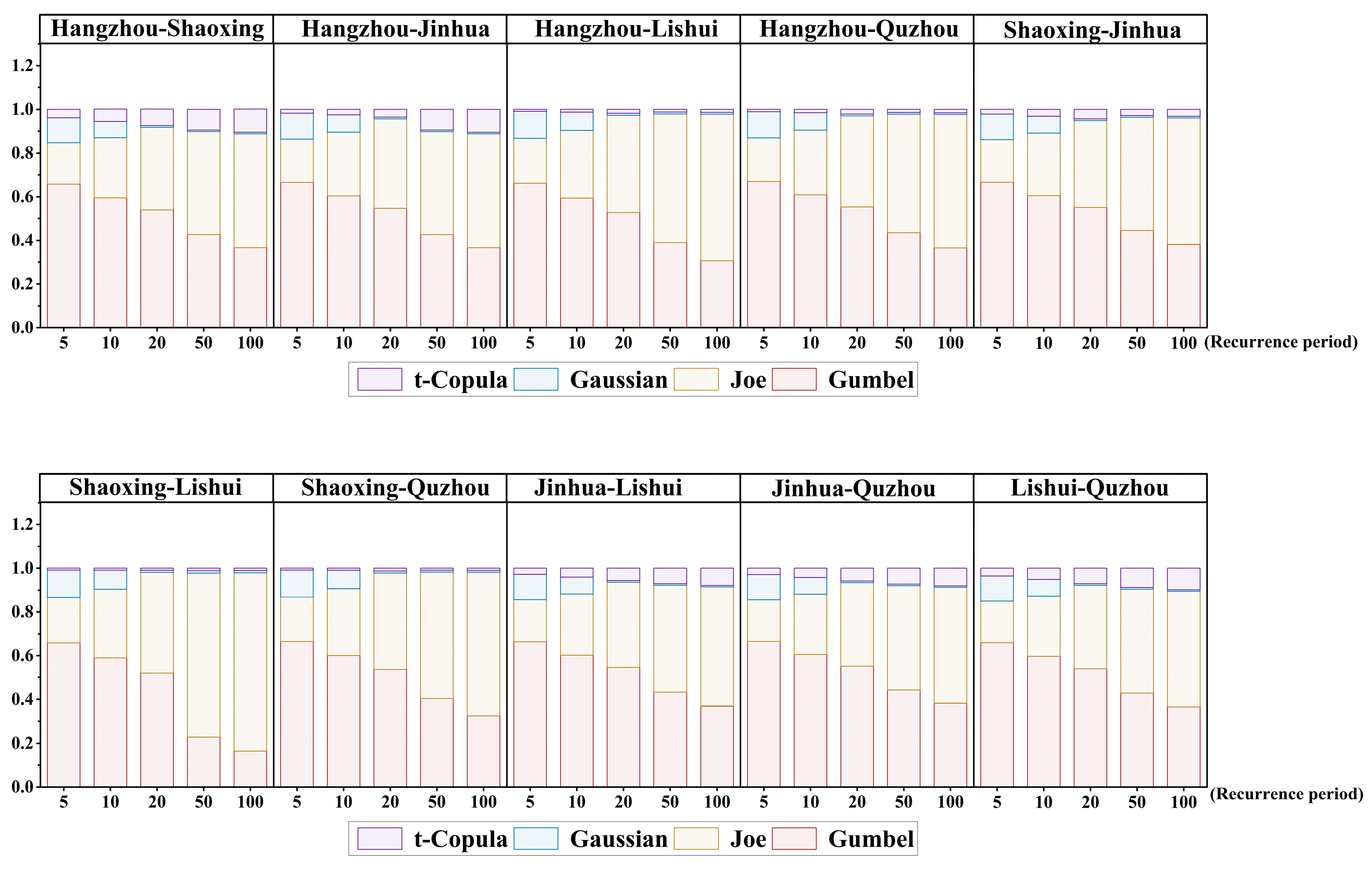
The Gumbel Copula dominates all area pairings at lower-recurrence periods, with the Joe Copula and Gaussian Copula playing supporting roles, according to the results seen in Figure 5, which are based on the suggested weight allocation approach. The Joe Copula model takes over as the recurrence period lengthens, but the distribution of weights varies greatly. Area pairs with negative correlations have much higher Joe Copula weights than strongly positive pairs. This finding suggests that even when ordinary rainfall shows negative correlation, extreme events can still display strong upper-tail dependence.

4.4. Conditional Probability Matrix for Recurrence Periods

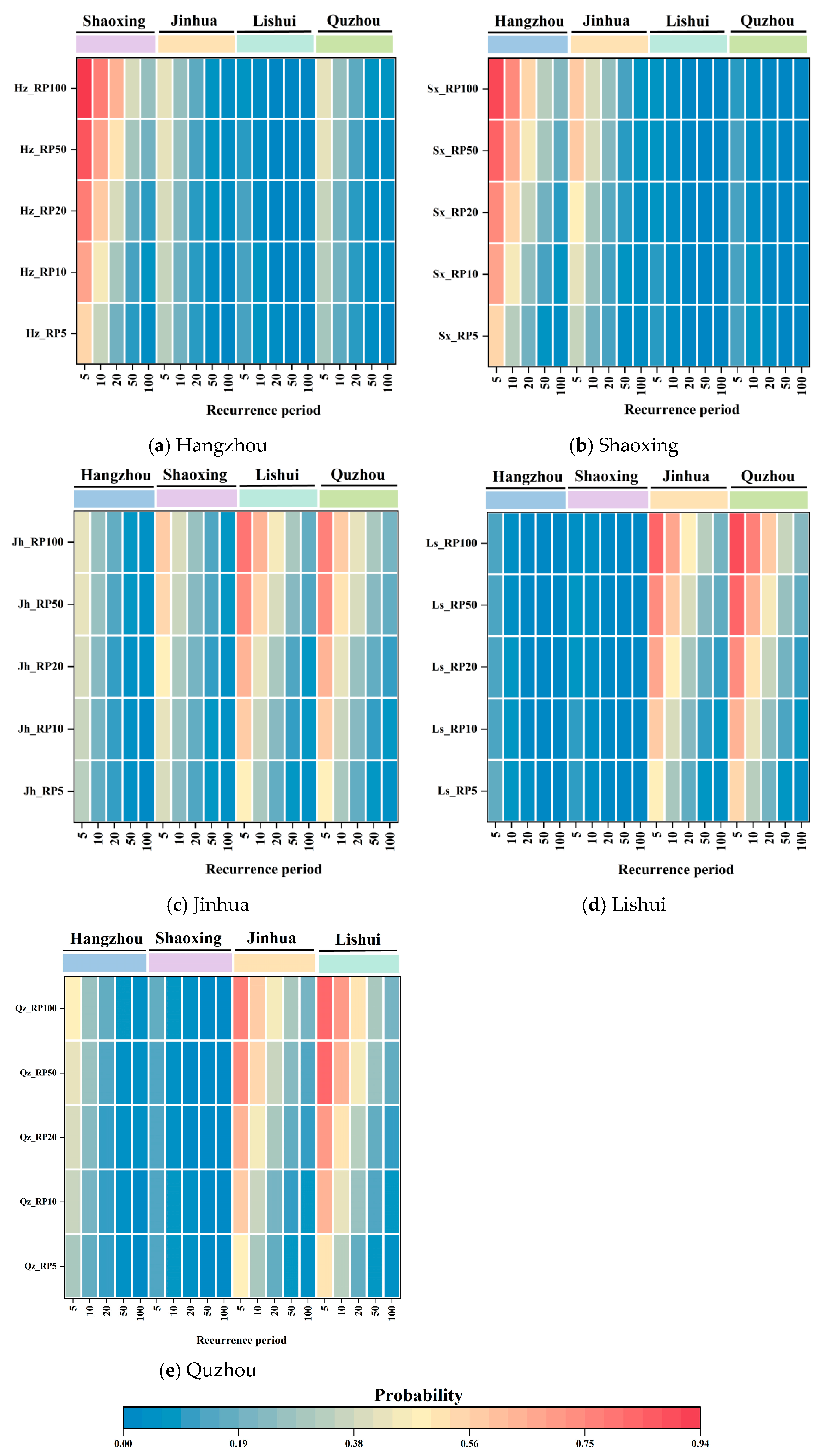
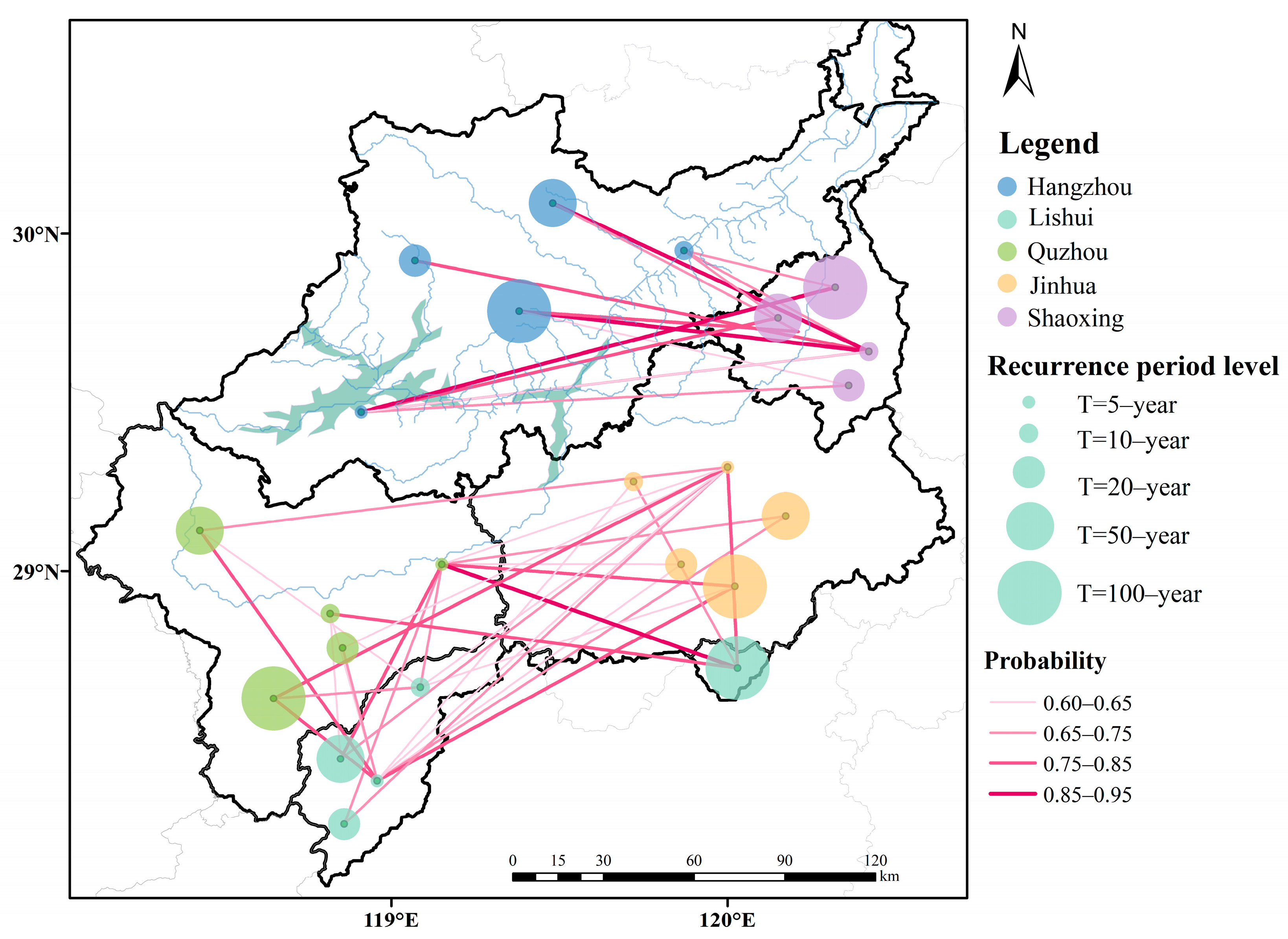
Conditional probabilities for various combinations of recurrence periods were computed using the mixed Copula model. The conditional probability matrices among area pairs and the spatial bubble maps of high conditional probabilities (>0.6) are presented in Figure 6 and Figure 7, respectively.
The two figures together clearly reveal a distinct dual-cluster spatial dependence structure of extreme rainfall across the Qiantang River Basin. The five areas form two relatively independent spatial clusters: a northern cluster (Hangzhou and Shaoxing) and a southern cluster (Jinhua, Lishui, and Quzhou). Strong conditional dependence is observed within each cluster, while cross-cluster correlations are notably weaker.
The Hangzhou-Shaoxing pair continuously showed high conditional probabilities under all combinations of recurrence periods within the northern cluster. Particularly, the conditional probabilities typically surpassed 0.6, with some combinations reaching 0.8–0.9, when low conditioning recurrence periods (5-year events) triggered high target recurrence periods (≥20-year events). As an example, when a 100-year event occurred in Hangzhou, the probability that a 5-year event would occur in Shaoxing was 0.936; if a 100-year event occurred in Shaoxing, the probability that a 5-year event would occur in Hangzhou was 0.896. A highly synchronized rainfall system in the northern cluster is indicated by this strong bidirectional dependence.
A triangular dependency structure was formed by Jinhua, Lishui, and Quzhou in the southern cluster. The Lishui–Quzhou pair presented the strongest conditional dependence. Considering Quzhou’s 20–100-year events when Lishui’s 5-year events happens, the probabilities range from 0.17 to 0.045. The probability of a 5-year event in Quzhou was 0.841 when a 100-year event occurred in Lishui. With conditional probabilities of 0.202 and 0.235 under the 100-year recurrence combination, the Jinhua–Lishui and Jinhua–Quzhou pairs showed similar dependency levels, indicating that Jinhua serves as a bridging node within the southern cluster. The conditional probability decay rate with increasing recurrence period is significantly slower in these three regions than in cross-cluster area pairs, forming a compact regional dependency network.
Compared to within clusters, the conditional probabilities between the northern and southern clusters were substantially lower. For instance, the Lishui-Hangzhou and Quzhou-Shaoxing pairs had conditional probabilities mostly below 0.30, declining to 0.05–0.27 at the 100-year recurrence period. Jinhua, located at the geographic center of the basin, showed slightly higher probabilities toward the northern cluster than Lishui and Quzhou, yet remained at a weak dependence level. All area pairs with conditional probabilities exceeding 0.60 occurred within clusters, with none crossing the north–south boundary, indicating a clear division of rainfall systems between the two clusters.

5. Discussion

The “dual-cluster” spatial dependence structure of extreme rainfall in the Qiantang River Basin was revealed by this study via the POT-GPD method in conjunction with the mixed Copula model: the southern cluster (Jinhua-Lishui-Quzhou) displays moderate dependence, while the northern cluster (Hangzhou-Shaoxing) displays strong conditional dependence. On the other hand, all high-probability (>0.6) combinations are limited to intra-cluster pairs, and cross-cluster conditional probabilities are significantly lower.
Although the existing research on rainfall in river basins focuses on the spatial correlation among stations, most of them remain at the level of Pearson or Spearman correlation coefficients [14,33,34]. These methods can show how strongly two variables are related, but they cannot directly provide the conditional probability information needed for risk management. In flood control dispatching practice, what needs to be answered is “the probability of different grades of extreme rainfall occurring in other areas when a specific recurrence period of heavy rain is known in one place”, rather than “the correlation coefficient of rainfall in two places is 0.7”. This study addresses this gap by calculating conditional return period probabilities. This approach transforms statistical correlation into decision-relevant probabilities. Such probabilities can be directly linked to flood response thresholds and emergency resource allocation. Compared to traditional correlation analysis or joint return periods, this method is more practical for real-world applications.
This study uses a dynamic-weight mixed Copula approach, combining four functions: Gumbel, Joe, Gaussian, and t-copula. This design enables the model to cope with the differences in various dependency patterns among rainfall events of different intensities. Traditional studies typically select a single best-fit model. For example, the Gumbel Copula is widely used in hydrological extreme analysis because it captures upper-tail dependence [4,35]. However, a single Gumbel model uses the same parameter θ for all recurrence periods. This implicitly assumes that the dependence structure is identical for both frequent and rare events. In reality, the dependence structure may differ between low- and high-return period events [36]. When rainfall intensity increases from a 10-year event to a 50-year event, the synchrony between two locations may change. This is because extreme events often differ in spatial scale, duration, and underlying physical mechanisms.
The use of the mixed model can hierarchically describe the dependency differences of events of different magnitudes. Additionally, the dynamic weight mechanism in our study reveals that Copula functions with tail dependence play a key role. All regional combinations are dominated by Gumbel Copula in low-recurrence periods and Joe Copula in high-recurrence periods. Gaussian Copula, which is less sensitive to tail-related changes, is more active in low-recurrence periods. This weight evolution is consistent with the extreme-value theory’s understanding that high-recurrence periods events are more dependent on tail joint characteristics. The study also explored the potential of the Joe Copula in hydrological extreme analysis, finding that it exhibits stronger upper-tail dependence than the traditional Gumbel Copula and achieves better fitting performance in the extreme range of this case study. The fitting evaluation results (Table 3) show that the mixed model performs well on all region pairs: RMSE is all less than 0.051, and the p-value of CvM test is all greater than 0.05, indicating that the model can effectively depict the joint distribution characteristics of the observed data and maintain good fitting quality under different dependency intensivities.
The Qiantang River Basin shows a “dual-cluster” pattern that matches its terrain and climate. The northern cluster (Hangzhou-Shaoxing) lies in a flat plain area. Rain systems can move freely across this region, leading to highly synchronized rainfall responses between the two areas. The southern cluster (Jinhua-Lishui-Quzhou) is located in mountainous terrain. Although mountains create some barriers, these areas share similar orographic lifting effects and moisture transport pathways. As a result, they maintain moderate correlations with each other. The two clusters show weak correlation with each other (p < 0.37). This reflects the blocking effect of the western Zhejiang mountains on rain systems moving between the north and south.
The spatial pattern of the “north–south dual core” reflects the regulatory role of its unique “plain–mountain” dual landform pattern on the rainfall system and has important implications for flood risk management and resource allocation decisions in the Qiantang River Basin.
Regions such Hangzhou and Shaoxing have strong conditional dependence, which suggests that they tend to exhibit “synchronous high-risk” characteristics during extreme events and that a single city’s ability to respond independently is constrained. Thus, the northern cluster needs coordinated emergency response plans and cooperative early warning systems, with careful consideration of inter-regional synchronicity in risk management planning. On the contrary, among different cluster regions, when an extreme event occurs in one cluster, the backup resources of another cluster can be invoked for support. This approach improves overall basin resilience without appreciably raising overall investment, which is consistent with the sustainable development principle of resource-intensive utilization. Furthermore, this finding provides quantitative scientific support for the risk management concept of ‘coordinated planning and regional collaboration’ at the basin scale, facilitating the transition from ‘single-point defense’ to ‘systemic resilience’ in governance approaches.
Despite the progress made in this study, there are still some limitations, and the limitations of this study at the same time indicate to the researcher important directions for future work:
  • The five selected regions cover the major climate and terrain zones of the basin: the northern plains (Hangzhou and Shaoxing), the central hilly basins (Jinhua), and the southern mountains (Lishui and Quzhou). This provides reasonable geographic representation. However, a zoning scheme based on natural features—such as terrain gradients or watershed boundaries—may better reveal the physical mechanisms of precipitation. This is a direction worth exploring in future research.
  • The ERA5-Land rainfall data used in this study meets the needs of most hydrological research. However, like all reanalysis products, it has inherent uncertainties and may contain regional biases. For more precise quantitative analysis, future work could compare ERA5-Land with other datasets (such as APHRODITE and MSWEP) to provide a more comprehensive assessment.
  • The mixed Copula approach performed well in this case study. However, its applicability to basins with different climate or terrain characteristics requires further testing. The optimal Copula combination and weight scheme may vary depending on regional precipitation mechanisms and may need basin-specific calibration. Future studies could apply this method to other basins to test its transferability and robustness.

6. Conclusions

Based on hourly rainfall data and a mixed Copula framework, this study systematically explored the conditional probability structure of extreme rainfall recurrence across five subregions of the Qiantang River Basin. The following key conclusions were drawn from an analysis of the selected extreme rainfall events:
(1)
The basin shows strong applicability of the POT-GPD method with region-specific threshold optimization. In the end, a differentiated threshold strategy was adopted, with fixed thresholds of 50 mm for Quzhou, Shaoxing, and Hangzhou and 99th percentile thresholds for Jinhua and Lishui. The significance of localized modeling in regional extreme-value analysis is highlighted by these threshold differences, which reflect the basin’s spatial heterogeneity in topography and climate. All areas, however, display shape parameters “ξ” within the moderately heavy-tailed range, despite the threshold variations, suggesting an inherent consistency in the statistical features of extreme rainfall throughout the basin.
(2)
Copulas with tail-dependent characteristics are dominant in the mixture; Joe Copula gains influence at longer recurrence periods, whereas Gumbel Copula dominates at shorter ones. In contrast, the Gaussian Copula, less sensitive to tail dependence, remains active at lower recurrence levels, achieving complementary performance across different recurrence periods.
(3)
A clear “dual-cluster” spatial pattern is revealed by conditional probability analysis. While the southern cluster (Jinhua-Lishui-Quzhou) displays notable internal coherence but noticeably weaker cross-cluster correlations, the northern cluster (Hangzhou-Shaoxing) displays extremely strong inter-region dependence. The spatial heterogeneity of rainfall systems throughout the basin is highlighted by the fact that all high-probability (>0.6) combinations only occur within clusters.
(4)
The “north–south dual-core” spatial pattern is basin-specific and closely matches the terrain and climate features of the Qiantang River Basin. In the flat north, storms move easily, so rainfall is highly synchronized. In the mountainous south, shared terrain lifting and moisture paths keep areas moderately correlated. The weak correlation between the two clusters is due to mountain barriers in western Zhejiang. This shows how the basin’s “plain versus mountain” landscape shapes rainfall patterns.
There is broad applicability of the methodological framework to other basins with comparable climatic and geographic conditions. These results offer significant technical assistance for the creation of regional strategies for climate change adaptation and sustainable development. While the southern regions can continue to have comparatively autonomous emergency responses within a coordinated regional framework, the remarkably high conditional dependence between Hangzhou and Shaoxing indicates the necessity for closely coordinated flood control measures. Differentiated distribution of flood control resources throughout the basin is further supported by the weak cross-cluster dependence.

Author Contributions

Methodology, Q.-T.Z., J.-L.Q. and X.-J.J.; Formal analysis, Q.-T.Z.; Data curation, Q.-T.Z.; Writing—original draft, Q.-T.Z.; Writing—review & editing, Q.-T.Z.; Supervision, J.-L.Q., X.-J.J., Y.-X.W. and P.-B.Y.; Project administration, J.-L.Q., Y.-X.W. and P.-B.Y.; Funding acquisition, J.-L.Q. All authors have read and agreed to the published version of the manuscript.

Funding

This research was supported by the Joint Fund of Zhejiang Provincial Natural Science Foundation of China under Grant No. LZJWZ24E090003, the “Unveiling the List and Taking Command” Project (No. JBGS2025006) of Zhejiang University of Water Resources and Electric Power.

Institutional Review Board Statement

Not applicable.

Informed Consent Statement

Not applicable.

Data Availability Statement

Public datasets from ERA5-Land utilized in this study are available at https://cds.climate.copernicus.eu/datasets/reanalysis-era5-land?tab=download (accessed on 31 May 2024).

Conflicts of Interest

The authors declare no conflict of interest.

References

  1. Westra, S.; Fowler, H.J.; Evans, J.P.; Alexander, L.V.; Berg, P.; Johnson, F.; Kendon, E.J.; Lenderink, G.; Roberts, N.M. Future changes to the intensity and frequency of short-duration extreme rainfall. Rev. Geophys. 2014, 52, 522–555. [Google Scholar] [CrossRef]
  2. Evans, C.P.; DeGaetano, A.T. A comparison of the rates of change associated with hourly and 24-hour precipitation extremes across the eastern United States. Water Resour. Res. 2025, 61, e2025WR040435. [Google Scholar] [CrossRef]
  3. Xia, C.; Xu, J.; Tian, H.; Liu, J.; Zhang, S.; Lin, S.; Chen, T. Quantitative hydrological response to climate change and human activities in North and South Sources in upper stream of Qiantang River Basin, East China. J. Hydrol. Reg. Stud. 2022, 44, 101222. [Google Scholar] [CrossRef]
  4. Gao, C.; Xu, Y.-P.; Zhu, Q.; Bai, Z.; Liu, L. Stochastic generation of daily rainfall events: A single-site rainfall model with Copula-based joint simulation of rainfall characteristics and classification and simulation of rainfall patterns. J. Hydrol. 2018, 564, 41–58. [Google Scholar] [CrossRef]
  5. Xu, Y.; Ma, C.; Pan, S.; Zhu, Q.; Ran, Q. Evaluation of a multi-site weather generator in simulating precipitation in the Qiantang River Basin, East China. J. Zhejiang Univ. Sci. A 2014, 15, 219–230. [Google Scholar] [CrossRef][Green Version]
  6. Madsen, H.; Rasmussen, P.F.; Rosbjerg, D. Comparison of annual maximum series and partial duration series methods for modeling extreme hydrologic events: 1. At-site modeling. Water Resour. Res. 1997, 33, 747–757. [Google Scholar] [CrossRef]
  7. Dodangeh, E.; Shahedi, K.; Solaimani, K.; Shiau, J.-T.; Abraham, J. Data-based bivariate uncertainty assessment of extreme rainfall-runoff using copulas: Comparison between annual maximum series (AMS) and peaks over threshold (POT). Environ. Monit. Assess. 2019, 191, 67. [Google Scholar] [CrossRef]
  8. Serinaldi, F.; Kilsby, C.G. Rainfall extremes: Toward reconciliation after the battle of distributions. Water Resour. Res. 2014, 50, 336–352. [Google Scholar] [CrossRef]
  9. Zhai, P.; Zhang, X.; Wan, H.; Pan, X. Trends in total precipitation and frequency of daily precipitation extremes over China. J. Clim. 2005, 18, 1096–1108. [Google Scholar] [CrossRef]
  10. Fan, Y.; Wang, Y.; Xie, W.; He, B. Risk assessment of heavy rain disasters using an interpretable random forest algorithm enhanced by MAML. Appl. Sci. 2025, 15, 6165. [Google Scholar] [CrossRef]
  11. Cooley, D.; Nychka, D.; Naveau, P. Bayesian spatial modeling of extreme precipitation return levels. J. Am. Stat. Assoc. 2007, 102, 824–840. [Google Scholar] [CrossRef]
  12. Zhang, L.; Singh, V.P. Bivariate rainfall frequency distributions using Archimedean copulas. J. Hydrol. 2007, 332, 93–109. [Google Scholar] [CrossRef]
  13. Zhao, L.; Xia, J.; Sobkowiak, L.; Wang, Z.; Guo, F. Spatial pattern characterization and multivariate hydrological frequency analysis of extreme precipitation in the Pearl River Basin, China. Water Resour. Manag. 2012, 26, 3619–3637. [Google Scholar] [CrossRef]
  14. Serinaldi, F. A multisite daily rainfall generator driven by bivariate copula-based mixed distributions. J. Geophys. Res. Atmos. 2009, 114, D10103. [Google Scholar] [CrossRef]
  15. Qian, L.; Wang, X.; Wang, Z. Modeling the dependence pattern between two precipitation variables using a coupled copula. Environ. Earth Sci. 2020, 79, 486. [Google Scholar] [CrossRef]
  16. Muñoz-Sabater, J.; Dutra, E.; Agustí-Panareda, A.; Albergel, C.; Arduini, G.; Balsamo, G.; Boussetta, S.; Choulga, M.; Harrigan, S.; Hersbach, H.; et al. ERA5-Land: A state-of-the-art global reanalysis dataset for land applications. Earth Syst. Sci. Data 2021, 13, 4349–4383. [Google Scholar] [CrossRef]
  17. Gomis-Cebolla, J.; Rattayova, V.; Salazar-Galán, S.; Francés, F. Evaluation of ERA5 and ERA5-Land reanalysis precipitation datasets over Spain (1951–2020). Atmos. Res. 2023, 284, 106606. [Google Scholar] [CrossRef]
  18. Xie, W.; Yi, S.; Leng, C.; Xia, D.; Li, M.; Zhong, Z.; Ye, J. The evaluation of IMERG and ERA5-Land daily precipitation over China with considering the influence of gauge data bias. Sci. Rep. 2022, 12, 8085. [Google Scholar] [CrossRef]
  19. Guo, C.; Ning, N.; Guo, H.; Tian, Y.; Bao, A.; De Maeyer, P. Does ERA5-Land effectively capture extreme precipitation in the Yellow River Basin? Atmosphere 2024, 15, 1254. [Google Scholar] [CrossRef]
  20. Xu, J.; Ma, Z.; Yan, S.; Peng, J. Do ERA5 and ERA5-Land precipitation estimates outperform satellite-based precipitation products? A comprehensive comparison between state-of-the-art model-based and satellite-based precipitation products over mainland China. J. Hydrol. 2021, 605, 127353. [Google Scholar] [CrossRef]
  21. Vondou, D.A.; Guenang, G.M.; Djiotang, T.L.A.; Kamsu-Tamo, P.H. Trends and Interannual Variability of Extreme Rainfall Indices over Cameroon. Sustainability 2021, 13, 6803. [Google Scholar] [CrossRef]
  22. Yue, Z.; Xiong, L.; Zha, X.; Liu, C.; Chen, J.; Liu, D. Impact of thresholds on nonstationary frequency analyses of peak over threshold extreme rainfall series in Pearl River Basin, China. Atmos. Res. 2022, 276, 106269. [Google Scholar] [CrossRef]
  23. Tabari, H. Extreme value analysis dilemma for climate change impact assessment on global flood and extreme precipitation. J. Hydrol. 2020, 593, 125932. [Google Scholar] [CrossRef]
  24. Mann, H.B. Nonparametric tests against trend. Econometrica 1945, 13, 245–259. [Google Scholar] [CrossRef]
  25. McBride, C.M.; Kruger, A.C.; Dyson, L. Changes in extreme daily rainfall characteristics in South Africa: 1921–2020. Weather Clim. Extrem. 2022, 38, 100517. [Google Scholar] [CrossRef]
  26. Silva Lomba, J.; Fraga Alves, M.I. L-moments for automatic threshold selection in extreme value analysis. Stoch. Environ. Res. Risk Assess. 2020, 34, 465–491. [Google Scholar] [CrossRef]
  27. Pickands, J., III. Statistical inference using extreme order statistics. Ann. Stat. 1975, 3, 119–131. [Google Scholar] [CrossRef]
  28. Tasena, S. On a distribution form of subcopulas. Int. J. Approx. Reason. 2020, 128, 1–19. [Google Scholar] [CrossRef]
  29. Zhang, J.; Gao, K.; Li, Y.; Zhang, Q. Maximum likelihood estimation methods for copula models. Comput. Econ. 2022, 60, 99–124. [Google Scholar] [CrossRef]
  30. Genest, C.; Favre, A.-C. Everything you always wanted to know about copula modeling but were afraid to ask. J. Hydrol. Eng. 2007, 12, 347–368. [Google Scholar] [CrossRef]
  31. Abraj, M.; Wang, Y.-G.; Thompson, M.H. A new mixture copula model for spatially correlated multiple variables with an environmental application. Sci. Rep. 2022, 12, 13867. [Google Scholar] [CrossRef]
  32. Chang, K.-L. A new dynamic mixture copula mechanism to examine the nonlinear and asymmetric tail dependence between stock and exchange rate returns. Comput. Econ. 2021, 58, 965–999. [Google Scholar] [CrossRef]
  33. Markonis, Y.; Batelis, S.C.; Dimakos, Y.; Moschou, E.; Koutsoyiannis, D. Temporal and spatial variability of rainfall over Greece. Theor. Appl. Climatol. 2017, 130, 217–232. [Google Scholar] [CrossRef]
  34. Svoboda, V.; Máca, P.; Hanel, M.; Pech, P. Spatial correlation structure of monthly rainfall at a mesoscale region of north-eastern Bohemia. Theor. Appl. Climatol. 2015, 121, 359–375. [Google Scholar] [CrossRef]
  35. Tootoonchi, F.; Sadegh, M.; Haerter, J.O.; Räty, O.; Grabs, T.; Teutschbein, C. Copulas for hydroclimatic analysis: A practice-oriented overview. Wiley Interdiscip. Rev. Water 2022, 9, e1579. [Google Scholar] [CrossRef]
  36. Coles, S.; Heffernan, J.; Tawn, J. Dependence measures for extreme value analyses. Extremes 1999, 2, 339–365. [Google Scholar] [CrossRef]
Figure 1. The study area’s geographic location.
Sustainability 17 10896 g001
Figure 2. All 1302 events’ 24 h maximum rainfall distribution.
Sustainability 17 10896 g002
Figure 3. Statistics of the maximum 24 h cumulative rainfall of 50 extreme rainstorm events in each area. Starts indicate the maximum value.
Sustainability 17 10896 g003
Figure 4. Trend and change-point tests for POT series. Since the thresholds based on the 90% and 95% quantiles failed the Kolmogorov–Smirnov test, only the results for the fixed 50 mm and 99% quantile thresholds are presented here.
Sustainability 17 10896 g004
Figure 5. Results of model weight allocation for every combination of regions.
Sustainability 17 10896 g005
Figure 6. Heat maps of conditional probability matrices. Subplots (ae) correspond to conditioning areas: Hangzhou, Shaoxing, Jinhua, Lishui, and Quzhou. RP represents the recurrence period, e.g., “Qz_RP50” is the 50-year recurrence period of Quzhou.
Sustainability 17 10896 g006
Figure 7. Spatial bubble maps of high conditional probabilities (p > 0.6). The spatial positions of the bubbles represent the geographic centroids of the five regions. These points are used solely for visualization and do not indicate station-level analysis. All analyses are conducted at the region scale.
Sustainability 17 10896 g007
Table 1. Copula function expression.
CopulaFunction FormulaDescription
Gaussian Copula C ( u 1 , u 2 , . . . , u m ; Σ ) = Φ Σ ( Φ 1 ( u 1 ) , . . . , Φ 1 ( u m ) ) Φ 1 ( · ) denotes the inverse function of the standard normal distribution and   Φ Σ ( Φ 1 ( u 1 ) , . . . , Φ 1 ( u m ) ) represents the multivariate normal distribution
Gumbel Copula C ( u 1 , u 2 ; θ ) = e x p [ ( l n u 1 ) θ + ( l n u 2 ) θ ] 1 / θ θ   ϵ   [ 1 , + )
T-Copula C ( u 1 , u 2 , . . . , u m ; Σ , υ ) = T Σ , υ ( T υ 1 ( u 1 ) , . . . , T υ 1 ( u m ) ) T υ 1 ( · )   denotes   the   inverse   function   of   the   t - distribution   with   degrees   of   freedom   υ and   T Σ , υ T υ 1 u 1 , . . . , T υ 1 u m   represents   the   multivariate   t - distribution   with   correlation   coefficient   Σ   and   degrees   of   freedom   υ .
Joe Copula C ( u 1 , u 2 ; θ ) = 1 [ ( 1 u 1 ) θ + ( 1 u 2 ) θ ( 1 u 1 ) θ ( 1 u 2 ) θ ] 1 / θ θ   ϵ   [ 1 , + )
Table 2. GPD model parameters under the optimal thresholds.
AreaOptimal Threshold (mm) ξ σ The p-Value of K-S Test
The 99% Percentile 50 mm
Hangzhou500.02116.5820.920.84
Shaoxing500.04119.4110.0086 *0.96
Jinhua440.028317.650.860.60
Lishui51.80.02318.810.890.94
Quzhou500.010717.1180.800.60
* Indicates p < 0.05, the fit is substandard.
Table 3. Goodness-of-fit metrics for mixed Copula models.
CombinationAICRMSECvM Statisticp-Value
Hz-Sx−139.060.0500.00250.084
Hz-Jh−42.500.0140.00021.000
Hz-Ls45.250.0270.00071.000
Hz-Qz−34.210.0160.00021.000
Sx-Jh−77.640.0190.00031.000
Sx-Ls73.630.0370.00140.988
Sx-Qz39.530.0310.00100.998
Jh-Ls−107.880.0290.00090.994
Jh-Qz−130.380.0350.00120.884
Ls-Qz−151.340.0380.00140.764
Hz, Sx, Jh, Ls, and Qz represent Hangzhou, Shaoxing, Jinhua, Lishui, and Quzhou, respectively.
Table 4. Model parameters for all regional combinations.
Combination ρ * θ G θ J v λ u _ G λ u _ J
Hz-Sx0.611.191.442.90.210.39
Hz-Jh0.201.111.353.80.140.33
Hz-Ls−0.131.061.353.60.070.32
Hz-Qz0.221.111.355.60.130.33
Sx-Jh0.371.141.384.10.170.35
Sx-Ls−0.231.041.355.80.050.33
Sx-Qz−0.161.071.344.00.090.32
Jh-Ls0.471.151.373.80.170.34
Jh-Qz0.491.171.373.80.190.34
Ls-Qz0.531.161.393.00.190.35
ρ * denotes the empirical correlation coefficient derived from normal scores and is used for the Gaussian and t-Copula models. λ u _ G and λ u _ J represent the upper-tail dependence coefficients of the Gumbel and Joe Copulas, respectively. Hz, Sx, Jh, Ls, and Qz represent Hangzhou, Shaoxing, Jinhua, Lishui, and Quzhou, respectively.
Disclaimer/Publisher’s Note: The statements, opinions and data contained in all publications are solely those of the individual author(s) and contributor(s) and not of MDPI and/or the editor(s). MDPI and/or the editor(s) disclaim responsibility for any injury to people or property resulting from any ideas, methods, instructions or products referred to in the content.