1. Introduction
As the global population continues to increase, we face ever-increasing energy demands. Moreover, the gradual depletion of fossil fuels has forced us to turn to more sustainable and environmentally friendly energy sources [
1]. To address the challenges of global warming and carbon neutrality, our needs are more urgent, which further highlights our urgent need to reduce carbon emissions and transform them into clean energy [
2]. Therefore, meeting the growing energy demand is not only an economic challenge but also an environmental issue that needs to be solved. To ensure that future energy needs can be met sustainably, we need to make unremitting efforts to find and develop renewable energy (RE) sources while improving energy efficiency to avoid exacerbating the occurrence of climate disasters [
3].
In addition, more and more people have opposed the operation of Taiwan’s nuclear power plant after the Fukushima event in March 2011. As a result, the Taiwanese government plans to shut down all of its nuclear power plants by 2025 (2021) [
4], which is the reason for the phase-out of nuclear power.
The basic violation of nuclear power generation to eco-sustainers is the high associated costs of backend disposal [
5]. In conclusion, a shift towards safer and more sustainable energy sources is urgently needed. In response to energy security and greenhouse gas-emission reduction issues, the expansion of RE supply and use, as well as the rapid development of the RE industry, are critical elements in Taiwan’s energy policy [
6]. In consequence, a rapid shift to safer and more sustainable energy resources is necessary.
In 2009, via the amended Renewable Energy Development Act (REDA), Taiwan introduced a series of policy measures to realize the concept and goals of sustainable energy. The goal of REDA was to reduce energy consumption, enhance the environment, and stimulate economic development [
7]. The law explicitly states that renewable energy refers to the energy obtained from nature, which is transformed into a usable form through appropriate technologies and which comes from sustainable or renewable sources. The main reason to encourage renewable energy is that it is considered a clean, endless, and sustainable energy source. Renewable energy is more abundant and cheaper than fossil fuels, which makes it more advantageous. Despite solar and wind energy being infinite and clean, their intermittent and variable nature limits their power generation and power capacity [
8].
Nevertheless, RE sources have limitations corresponding to production and capacity. More specifically, the electricity costs that are higher for RE compared to those for current fossil fuels create an obstacle to the smooth development of RE in Taiwan. The Bureau of Energy (BOE) (2023) [
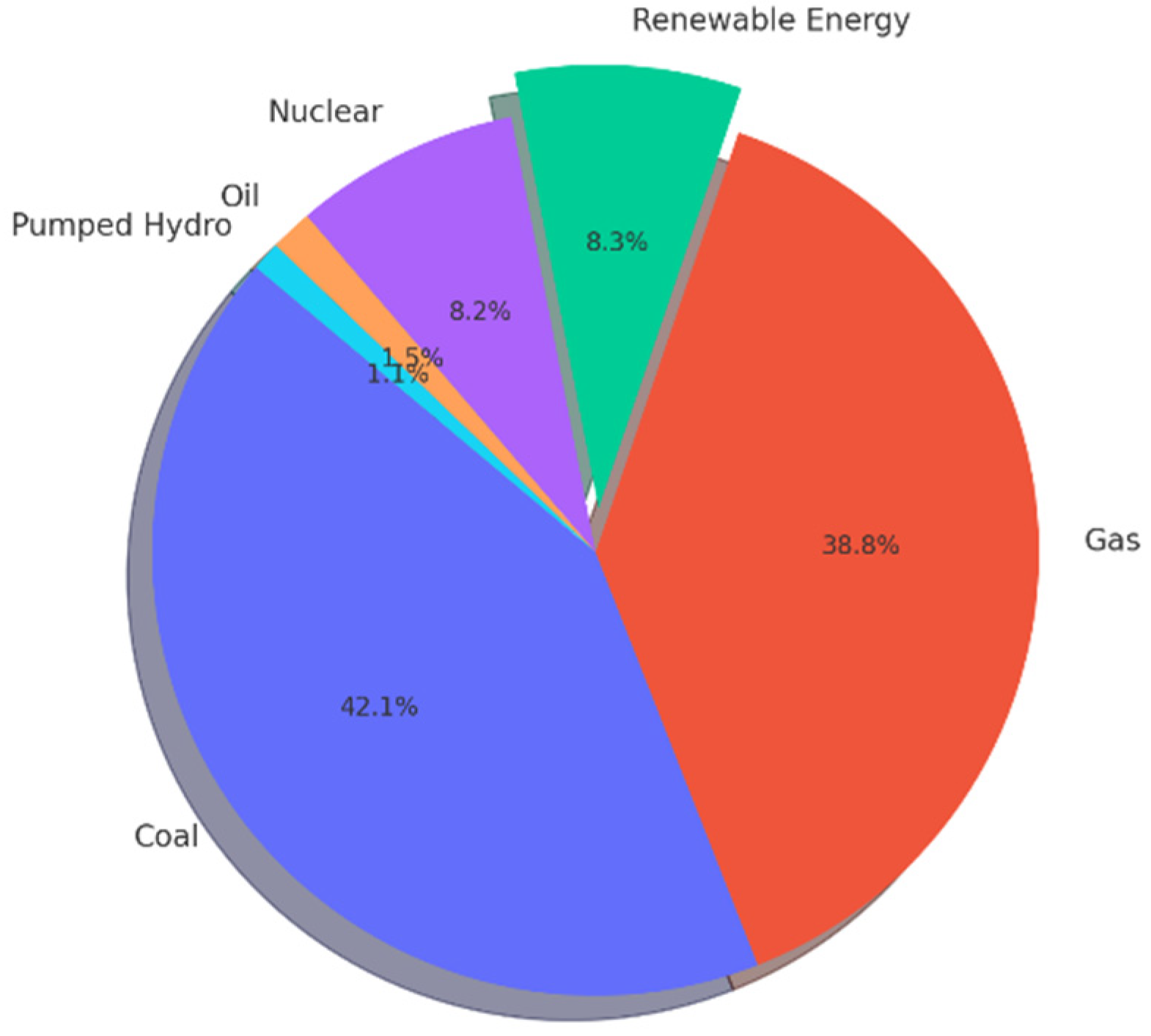
9] states that in 2022, the maximum amount of electricity generation was still from coal at 42.07%. This is followed by gas with 38.81%, whereas RE has contributed only 8.27% to the total electricity generation. Likewise, nuclear energy contributes 8.24% to the electricity generation, while oil contributes 1.54%. Finally, pumped storage hydro contributes 1.06% to electricity generation, according to
Figure 1. Furthermore, RE has shown a year-on-year growth of 36.59% in electricity generation. However, it only contributes 8.27% to the overall electricity generation, which signals that there are some constraints.
As Taiwan has limited resources and technological background, achieving the target of raising the share of RE generation to 20% by 2025 is a considerable challenge. Also, Taiwan has a long history of a low electricity pricing policy and greatly relies on centralized thermal power generation. This has made it hard to promote and expand renewable energy [
10].
This study uses 2019–2023 energy-related statistics to conduct a systematic analysis to explore the future development paths of Taiwan’s renewable energy. Since the existing literature is ambiguous in providing clear interpretation or recommendations regarding Taiwan’s renewable energy development patterns, the present research adopts a three-stage analysis framework.
Initially, correlation analysis is conducted to investigate the relationships between the various types of renewable energy and the total power generation. Next, we use a sequential relation analysis (SRA) model to obtain the optimal combination of renewable energy. The principal component analysis (PCA) model for data integration and dimensional analysis, which extracts the principal components with the largest variances, shows the latent relationship among renewable energy variables. Also, it verifies the most efficient configuration of RE sources.
The main aim of this paper is to find out the appropriate combinations of RE sources in Taiwan, to help the government and relevant decision-makers to design effective renewable energy policies, and to support the drive to move towards sustainable energy development.
Thus, our research seeks answers to the following:
Q1: How do different types of RE sources contribute to Taiwan’s total electricity generation during the period of 2019–2023?
Q2: What are the correlations among various RE sources, and how do they collectively influence total RE generation within the same period?
Q3: What constitutes the optimal combination of RE sources for electricity generation in Taiwan, considering their respective impacts on total RE generation and alignment with national energy policy goals?
Q4: What strategic implications can be derived from the identified optimal RE configuration to support Taiwan’s transition toward sustainable energy development by 2025 and beyond?
The remainder of this paper is organized as follows.
Section 2 outlines Taiwan’s energy policy framework.
Section 3 reviews the relevant literature.
Section 4 specifies the data sources and methodology.
Section 5 provides the data and analysis of the findings, whereas
Section 6 contains the conclusion and summary.
2. Taiwan Energy Policy
Taiwan’s carbon neutrality movement has gathered momentum in recent years. The Renewable Energy Development Act (REDA), modified in 2009, defines renewable energy as any kind of energy that can be generated from a natural source through the use of technology in such a way that energy can be derived from these sources and will not be depleted. Overall, the REDA serves to meet renewable energy targets.
As stated in the Energy Bureau’s published program announcement for 2019, Taiwan’s clean energy market development work has been operating in six areas of renewable energy, including hydropower, geothermal, solar photovoltaic, wind, biomass, and waste-to-energy. Through these efforts, we are establishing a clean and diverse energy structure that supports the transition to a green energy system and achieves a national goal of net-zero emissions.
Taiwan has sufficient rainfall each year for conventional hydropower. Further, it is estimated that the potential for conventional hydropower that can generate standard electricity in Taiwan is 25,700 gigawatts. Taiwan is located at the boundary of the Philippine Sea and Eurasian plates. This feature provides conditions that favor geothermal development. Solar PV makes use of high solar irradiation in Taiwan, while wind energy is a feasible alternative to fossil fuels through onshore and offshore sources. The biomass energy is mainly obtained from urban organic waste, wood waste, and biogas generated from livestock in solid and gaseous forms. In the end, waste-to-energy technologies transform municipal solid waste into electricity, further diversifying the renewable energy portfolio [
11].
Based on the ideals discussed above, Taiwan is now vigorously promoting the development of clean energy, which it considers one of six major forms of renewable energy—hydropower, geothermal, solar photovoltaic, wind, biomass, and waste-to-energy, leading to its core goal of sustainable development. This initiative aims to create a clean and mixed energy system, promote the transformation to green energy, and ultimately achieve the national vision of net-zero emissions.
3. Literature Review
Energy is not only an important engine for production and infrastructure in the economic development of a country, but also an important determinant of the quality of human life and societal progress [
12]. Nonetheless, fossil fuels have been used to great lengths for quite some time, which is now impacting the environment adversely. The rising emissions of GHG cause global warming and extreme climate events [
8,
13].
The Paris Climate Change Conference is likely to extend the negotiations of the Kyoto Protocol until the end of 2015. Thus, the international community will have a greater understanding of climate change threats [
8]. Consequently, nations came to the dire realization that a shift to better and greener energy sources is the way forward. As a result, RE or sustainable energy has become an important approach that can solve environmental problems [
13,
14,
15,
16,
17]. Countries have promoted the research and use of RE to achieve an energy shift and reduce environmental damage.
Moreover, RE is regarded as a clean and limitless energy source and has several benefits over traditional fossil fuels. Renewable sources such as solar and wind energy are free and abundant and are not geographically confined. This reduces dependence on natural resources that cannot be replenished over time. Despite the significant potential of RE to provide sustainable power, the production of which is dependent on weather conditions, factors such as sunlight and wind variability impose certain restrictions on the ultimate reliability of RE [
8].
High cost could be a barrier for RE, which has environmental benefits, but comes at high electricity costs. Evidence suggests that RE has greater production costs than what is primarily utilized for fossil fuels [
18,
19,
20,
21]. This means that, even though arguments for RE can be made based on good environmental and sustainable development initiatives, if technology and economics are improved any further, it would make them competitive and more affordable.
Due to the lack of additional pollutants produced during the energy conversion process, RE sources (that are more environmentally friendly) include solar energy, wind energy, geothermal energy, hydro energy, tidal energy, biomass energy, etc., which are now global RE sources currently in development [
22,
23]. As a result, the industry, government, and academia value studies related to renewable energy.
Studies currently underway on RE use big data, multicriteria decision analysis, and literature review extensively. For example, Shin et al. (2015) [
24] have used big data analysis techniques, such as text mining and multiterm topic modeling, on newspaper articles related to RE published in Korea in the last ten years. The aim of this study was to identify the principal issues, global trends in RE research, and the development potential of RE. As such, the research results based on information and communication technologies are anticipated to find active application in the RE sector.
Campos-Guzmán et al. (2019) [
25] employed multicriteria decision-making methods to evaluate the sustainability of renewable energy (RE) technologies. Estévez et al. (2021) [
26] conducted multicriteria decision analyses to study trends in RE and suggested the enhancement of the methods of participation of experts and the involvement of more stakeholders in shaping RE initiatives and policies.
Additionally, according to Arshad and Hussain (2022) [
27], they utilized machine learning techniques to forecast RE systems by modeling wind energy in RE systems. Other studies have mostly used literature metric analysis to examine RE-related issues. Hayati et al. (2023) [
28] use comparative evaluation on government incentive policy on RE power plant development to create an appropriate policy to optimize renewable resource use. The outcomes from these studies should be influential towards policy direction to overcome resource adequacy in their particular countries.
Over the last 35 years, there has been strong support in the state of Idaho (USA) for an increase in renewable electricity production, and that public support has especially acknowledged the important role of solar and wind energy [
29]. Mentel et al. (2023) [
30] performed a comprehensive metric analysis of the literature to reveal the scale, structure, and dynamics of innovative research in the green and RE domain. The primary objective of this paper was to find the subject matter and literature trends in RE.
In Taiwan, most research on RE pertained to the study of its policies and developmental trends. For instance, the works of Hsu (1994) [
31] and Liu et al. (2005) [
32]. On the other hand, some of the literature examines Taiwan’s energy supply and demand structure, along with some environmentally related issues, providing analyses and policy recommendations covering sustainable development policies [
33,
34].
Lee and Chang (2018) [
8] used the multiple criteria decision-making (MCDM) method to rank various RE sources and made specific suggestions for the development of RE in Taiwan. The researcher recommended developing hydropower as the first alternative energy source, followed by other energy sources: solar, wind, biomass, and geothermal energy. In their analysis of Taiwan’s power system in 2025, Hong and Magararu (2021) [
35] expect future RE generation to make up 17.26% of total electricity generation.
On the contrary, the SRA model is a statistical approach used in various fields. It involves the assessment of the connection between variables in terms of time or level. This methodology can be used in a variety of data contexts, such as industry analysis and software testing [
36]. Yan et al. (2007) [
37] underlined the importance of regression testing in software development, particularly regarding database applications. Gallet and Braun (2001) [
38] introduce new test procedures for gradual shifts in simple regression when applied to the Phillips curve. In a research article published by Boukezzoula et al. (2018) [
36], the SRA model was used to find the relationship between element analyses and industrial properties of anthracite coal in China. Liu et al. (2023) [
39] and Luo et al. (2023) [
40] demonstrate the SRA model’s ability to find important influencing factors in a system. One will come across further examples in the coming sections. As a whole, these studies provide insights into the application and benefits of the SRA model.
While regression analysis enables one to study the relationship between the variables, it does have certain limitations. For instance, multicollinearity, sensitivity to outliers, and restrictive assumptions (linearity, homoscedasticity, and normally distributed errors) might render the results less stable and less interpretable [
41,
42]. Traditional regression methods also struggle to identify nonlinear relationships and can only prove correlation, not causation. Thus, this study uses a PCA-based model approach to reduce dimension, eliminate multicollinearity, and integrate variables to identify the optimal mix of renewable energy development. The PCA model has been widely used in energy efficiency analysis, wind power performance evaluation, and multi-renewable energy strategy formulation. In all cases, the decisions are more reliable.
The literature review above shows that prolonged and high-intensity exploitation of non-RE sources has adverse effects, such as environmental pollution, global warming, irreversible depletion, etc. This highlights the demand and importance of RE sources. However, few studies have been conducted with quantitative analyses to find the best mix for the development of RE sources.
Consequently, this research will carry out a correlation analysis to assist in establishing the RE sources that have a good potential for development. Next, a regression analysis will be performed to determine the optimal development model.
Ultimately, a method powered by the PCA model is used to reduce the dimension, synthesize the data, and produce the best combination for the renewable energy development trend.
5. Empirical Results and Analysis
This part of the discussion undertakes an analysis to understand what is the best combination of trends in RE development. Accordingly, this section is divided into four parts. The first portion illustrates what the variables are and how the global RE predictive modeling works, the second part presents the correlation analysis, the third part applies the SRA model, and, finally, the fourth part employs a PCA-based model approach to validate the best combination of RE development trends. The details are as follows:
5.1. Variable Description and Prediction Models
5.1.1. Variable Description
As per the TPCSR (2021) [
4], the RE power generation of Taiwan can be classified into five major categories, including hydropower, geothermal, solar photovoltaic, wind, and biomass and waste.
The wind category is further subdivided into onshore and offshore wind power, and biomass is subdivided into solid biomass and biogas. Consequently, it identifies a total of eight types of renewable energy. Information on each of these types can be found in the list below:
Conventional hydropower: Electricity is generated through traditional hydropower systems that harness energy from flowing water, typically using dams or similar structures. (Unit: Thousand Degrees (MWh))
Geothermal: Energy derived from the Earth’s internal heat, commonly used for electricity generation or heating purposes. (Unit: Thousand Degrees (MWh))
Solar Photovoltaic: Electricity is generated through the direct conversion of sunlight into electrical power via solar panels. (Unit: Thousand Degrees (MWh))
Onshore Wind Power: Electricity generated from wind turbines installed on land. (Unit: Thousand Degrees (MWh))
Offshore Wind Power: Electricity generated from wind turbines located in offshore areas, typically in oceans or large bodies of water. (Unit: Thousand Degrees (MWh))
Solid Biomass: Energy derived from solid organic materials, such as wood chips, pellets, or waste wood, which serve as environmentally friendly energy sources. (Unit: Thousand Degrees (MWh))
Biogas: Energy produced through the anaerobic decomposition of organic matter, often used for power generation. (Unit: Thousand Degrees (MWh))
Waste-to-Energy: Electricity generated through the incineration or conversion of waste materials into usable energy. (Unit: Thousand Degrees (MWh))
Before the empirical model was constructed, an exhaustive compilation of preliminary assessment factors was conducted. In this context, the present study draws upon the TPCSR (2023) to identify the impact variables employed in the GRA methodology. The variables used in the analysis are defined as follows:
Total RE (Y1): Total electricity generation from all renewable energy sources. (Unit: Thousand Degrees (MWh))
Conventional hydropower (CH) (x1): Electricity generated from traditional hydropower methods. (Unit: Thousand Degrees (MWh))
Geothermal (GE) (x2): Energy derived from the Earth’s internal heat. (Unit: Thousand Degrees (MWh))
Solar Photovoltaic (SP) (x3): Energy produced by converting sunlight into electricity. (Unit: Thousand Degrees (MWh))
Onshore Wind Power (OWP) (x4): Energy generated from wind turbines located on land. (Unit: Thousand Degrees (MWh))
Offshore Wind Power (OSW) (x5): Energy generated from wind turbines situated offshore. (Unit: Thousand Degrees (MWh))
Solid Biomass (SB) (x6): Energy produced from solid biomass sources such as wood particles and waste wood. (Unit: Thousand Degrees (MWh))
Biogas (BG) (x7): Energy produced from organic matter decomposition. (Unit: Thousand Degrees (MWh))
Waste-to-Energy (WTE) (x8): Energy generated through waste incineration or conversion processes. (Unit: Thousand Degrees (MWh))
5.1.2. Prediction Models
The optimal group prediction model for RE power generation in Equation (8) is explained as follows:
where
Yj = Total power generation from RE.
α = The intercept.
β′s =Regression coefficients of the variables x1 …, x8.
x’s = Independent variables: Eight types of RE (e.g., CH, GE, SP, OWP, OSW, SB, BG, and WTE).
ej = random error.
5.1.3. Data Collection and Descriptive Statistics (2019–2023)
The descriptive statistical analysis of 60 monthly data points from 2019 to 2023 is presented in
Table 1 below.
Table 1 summarizes the descriptive statistics of total renewable energy generation (Y
1) and eight individuals RE sources, including conventional hydropower (CH, x
1), geothermal energy (GE, x
2), solar photovoltaics (SP, x
3), onshore wind power (OWP, x
4), offshore wind power (OSW, x
5), solid biomass (SB, x
6), BG (x
7), and waste-to-energy (WTE, x
8). The dataset consists of 60 monthly observations from 2019 to 2023.
In detail, the total RE generation (Y1) has a mean of 1,645,664.37 MWh, with a minimum of 953,753.92 MWh and a maximum of 2,827,060.93 MWh, indicating substantial variability over the period. Among the individual sources, CH (x1) and SP (x3) represent the major contributors, with mean values of 363,968.93 MWh and 694,126.21 MWh, respectively, reflecting their central role in Taiwan’s renewable energy mix. OWP (x4) and OSW (x5) exhibit moderate generation levels with notable fluctuations, suggesting growth potential in terms of wind energy. SB (x6) and BG (x7) contribute smaller but relatively stable outputs, whereas WTE (x8) maintains a consistent role, with a mean of 298,561.65 MWh.
On the other hand,
Table 1 (“Descriptive Statistics of Renewable Energy Variables, 2019–2023”) presents the standard deviation (SD) and standard error (SE) in its last two rows, calculated from 60 monthly observations. SD reflects the variability of each renewable energy source relative to its mean, with higher values indicating greater fluctuations. Notably, solar photovoltaic (SP, X
3) and conventional hydroelectric power (CH, X
1) exhibit higher SDs (96,782,825,661.517 and 36,926,424,638.142, respectively), likely influenced by seasonal factors or policy measures. SE measures the precision of the mean estimate, with smaller values indicating more stable averages; for example, the mean total renewable energy generation (Y
1) is 1,645,664.371 MWh, with an SE of 467,127.793.
Together, SD, SE, and the mean provide insights into central tendency, variability, and the reliability of average estimates. Based on these descriptive statistics, subsequent analyses, including correlation analysis, SRA, and PCA model, are conducted to evaluate the contributions of individual renewable energy sources to total generation and to identify the optimal combination strategy.
5.2. Correlation Analysis
This study provides a comprehensive definition of all variables in
Section 5.1.1 and is structured into two main sections regarding correlation analysis. The first section examines the interrelationships among different RE sources, investigating the strength and direction of their mutual correlations. The second section explores the relationship between each RE source and the total RE output, aiming to assess their respective contributions to the overall RE generation capacity.
5.2.1. Interrelationships Between RE Sources
The correlation analysis among RE sources in this study was conducted with the objective of obtaining a deeper understanding of the interrelationship among energy sources and also their impact on energy growth. This study seeks to determine the extent to which different RE sources are interrelated by examining their correlations with the aim of providing better indications for energy policies and developments.
Based on the data shown in
Table 2, according to CH, there is no significant relationship with other RE sources. GE and OWP share a significant positive correlation, indicated by r = 0.778 and
p = 0.01. OWP is also characterized by a high and significantly positive correlation with SP power (r = 0.609,
p = 0.01), with no other RE sources showing any significant correlation. OSW does not demonstrate any significant correlations with any of the other RE sources.
A significant negative correlation was observed between SB and WTE (r = −0.462, p = 0.05), which shows the opposite. Likewise, BG (x7) significantly and negatively relates to SB (r = −0.462, p = 0.05) while WTE does not significantly relate to the others.
In this study, SB refers to energy generated from solid organic materials such as wood chips, pellets, and waste wood, whereas WTE is produced through the combustion or conversion of municipal waste. Both are classified under Taiwan’s “Biomass and Waste” renewable category.
The observed negative correlation between SB and WTE may indicate a potential substitution effect in resource allocation or policy priorities. Periodic increases in waste availability or policy emphasis on WTE could reduce the availability or support for SB feedstocks, while shared constraints—such as seasonal supply patterns or logistics—may also contribute to their inverse relationship.
5.2.2. Analyzing the Correlation Between Diverse RE Sources and Total RE
For further analysis, the relationships between individual RE sources and total RE generation, including CH, GE, SP, OWP, OSW, SB, BG, and WTE, were examined. The correlation coefficients are presented in
Table 3:
Table 3 presents the correlation coefficients between total RE generation and the eight individual RE sources. The results reveal distinct patterns of relationships among the RE sources and total RE outputs.
GE and SP exhibit strong positive correlations with total RE generation (r = 0.85 **, r = 0.89 **, p < 0.01), indicating that increases in these two energy sources are closely associated with overall RE growth. This suggests that GE and SP are key drivers of Taiwan’s total RE capacity and likely reflect government policies or investment priorities that favor these technologies.
CH and OSW display moderate positive correlations with total RE generation (r = 0.43 and r = 0.673 **, respectively). While not as influential as GE or SP sources are, these sources still contribute meaningfully to the overall RE output. The moderate correlation for CH may reflect the limited expansion potential of conventional hydropower due to geographical and environmental constraints, whereas OSW’s moderate contribution could be related to ongoing development in offshore wind projects.
In contrast, OWP, SB, BG, and WTE do not exhibit significant correlations with total RE generation. This finding indicates that variations in these sources have a limited impact on the overall RE output. For OWP, the lack of significance may be due to its current installed capacity being relatively small compared with that of offshore wind. Similarly, SB, BG, and WTE might be constrained by technological, logistical, or policy factors that limit their scale relative to other RE sources.
Overall, the analysis highlights that GE and SP are the primary contributors to total RE generation, with CH and OSW providing moderate support. The remaining sources (OWP, SB, BG, WTE) have weaker or nonsignificant contributions. These findings provide important insights for energy planning and policy-making, suggesting that strategic investment in high-impact RE sources could optimize total RE generation while balancing the development of secondary sources.
5.3. SRA Method Analysis
Bardy et al. (2015) [
54] indicate that the correlation just indicates statistical similarity. However, it does not prove cause and effect. It is difficult to say that two variables are for certain causing one another if they are correlated. Analysis of correlation may lead to incorrect inferences of cause and effect due to external variables not currently analyzed that may impact correlation. In addition, biases related to sample size and selection can cause us to misinterpret correlations. A small or non-representative sample may cause us to come to wrong conclusions. Correlation presumes linear relationships and, as such, will not fully reflect nonlinear relationships or discrete relationships. It may not be determined which came first, and other factors may distort the connection.
Because of the limitations in correlation analysis as mentioned before, the present study also conducts a stepwise regression analysis to ascertain the best combination for renewable energy development. We use correlation analysis before the regression analysis to remove the variables that have negative correlations. We also remove variables that have insignificant effects so that the predictive accuracy can be successfully improved.
Through this step, the model can be improved by eliminating variables with weak correlation or insignificant nature, thus helping to produce a more compact and useful predictive model.
As the results of correlation analysis show in
Table 3, CH (x
1), GE (x
2), SP (x
3), and OSW (x
5) are positively associated with total RE generation. The variables GE (x2), SP (x3), and OSW (x
5) are statistically significant among the others. Consequently, the analysis using stepwise regression (SRA) will further be implemented to investigate four RE sources, namely, CH (x
1), GE (x
2), SP (x
3), and OSW (x
5), to determine optimal combination trends in total RE generation.
Table 4 presents the regression analysis conducted for the excluded variable, GE (x
2), from the previous regression of total RE across the three models. GE (x
2) was removed from the regression models due to its correlation with other independent variables, which creates multicollinearity problems that can distort estimations of the regression coefficients. By temporarily removing x
2, we can observe how other variables affect total RE more reliably. This improves the estimation stability of the model. The subsequent analyses then assessed the contribution of x
2 to total RE generation. The results for each model are presented below:
5.3.1. SRA Results of Model 1
The research findings (
Table 4) indicate that for the constant term, the coefficient (B) is 2,402,885.607, with a standard error of 307,461.120 and a t-value of 7.815 (
p < 0.001). In the case of SP, the coefficient (B) is 1.161, the standard error is 0.139, the standardized coefficient (Beta) is 0.897, and the t value is 8.377 (
p < 0.001).
Furthermore, the R-squared (R2) value is 0.805, indicating that the model explains 80.5% of the variability in the dependent variable. The adjusted R-squared (adjusted R2) is 0.794, providing a more accurate assessment of the model’s fit by considering the degrees of freedom. Concerning collinearity, the variance inflation factor (VIF) is 1.000, indicating a relatively low level of multicollinearity among the explanatory variables.
Finally, the equation for Model 1, derived from the research findings (
Table 4), can be written as follows (Equation (9)):
5.3.2. SRA Results of Model 2
According to the research findings (
Table 4), the analysis of Model 2 is as follows:
The regression results show that the intercept is statistically significant (B = 1,637,296.248, SE = 269,133.476, t = 6.084, p < 0.001). SP has a strong positive effect on total RE generation (B = 1.111, SE = 0.095, Beta = 0.858, t = 11.674, p < 0.001), whereas CH also contributes positively (B = 0.786, SE = 0.173, Beta = 0.333, t = 4.536, p < 0.001), although to a lesser extent. The model explains a substantial proportion of the variance in total RE generation, with R2 = 0.915 and adjusted R2 = 0.904. Collinearity diagnostics indicate minimal multicollinearity among predictors (tolerance = 0.986, variance inflation factor (VIF) = 1.01), confirming the robustness of the estimates.
Finally, the equation for Model 2, derived from the research findings (
Table 4), can be written as follows (Equation (10)):
Overall, these results indicate that Model 2 is statistically effective, with each explanatory variable significantly influencing the model, and the model performs well in terms of collinearity.
5.3.3. SRA Results of Model 3
According to the research findings (
Table 4), the analysis of Model 3 is as follows:
The regression results show that the intercept is statistically significant (B = 598,648.022, SE = 142,569.602, t = 4.199, p < 0.001). The SP has a strong positive effect on total RE generation (B = 1.191, SE = 0.036, Beta = 0.920, t = 33.137, p < 0.001), whereas CH also contributes positively (B = 0.952, SE = 0.066, Beta = 0.404, t = 14.443, p < 0.001). OSW also has a statistically significant positive impact (B = 1.565, SE = 0.154, Beta = 0.290, t = 10.141, p < 0.001). The model demonstrates an excellent fit, with R2 = 0.989 and adjusted R2 = 0.987, indicating that approximately 98.9% of the variance in total RE generation is explained by the independent variables. Collinearity diagnostics reveal minimal multicollinearity among the predictors, with a tolerance of 0.987 and a VIF of 1.014, confirming the robustness of the estimated coefficients.
Finally, the equation for Model 3, derived from the research findings (
Table 4), can be written as follows (Equation (11)):
In summary, Model 3 is statistically significant, and each explanatory variable significantly influences the model. The model performs well in terms of multicollinearity.
Based on the analysis results, out of four RE sources—CH (x1), GE (x2), SP (x3), and OSW (x5)—the combination of CH, SP, and OWP is the best and most efficient mix for power generation (i.e., total RE generation (Y1)). It follows that, in situations that limit the resources to adopt SPs, priority should be given to these SPs. This is owing to their contribution to the optimal combination. In other cases, when there are ample resources available, it is better to develop CHs, SPs, and OSWs concurrently for greater renewable energy uptake. It enhances the overall efficiency of the system, meets the energy requirement, and protects the environment. This shows that strategic planning plays a useful role in achieving the efficient use of resources and sustainable development.
5.4. PCA-Based Methods
Since the PCA model can condense quantitative data into a smaller number of underlying components that are commonly used for weight determination, this study further applied PCA to identify the optimal combination of factors for RE development. The analytical results are presented below:
5.4.1. Suitability Test and Purpose
Before applying the PCA model, the adequacy of the dataset was evaluated using the KMO measure and Bartlett’s test of sphericity. As presented in
Table 5, the KMO value was 0.673, suggesting that the data are suitable for PCA, as values between 0.6 and 0.7 are generally considered acceptable for factor analysis. Bartlett’s test of sphericity produced an approximate chi-square value of 582.565 with 28 degrees of freedom (
p < 0.001), confirming that the correlation matrix significantly differs from an identity matrix and that the dataset is appropriate for PCA.
As shown in
Table 6, three principal components were extracted. Component 1 had the highest eigenvalue (3.142), explaining 39.27% of the total variance, followed by Component 2 and Component 3, which accounted for 19.58% and 12.78%, respectively. Collectively, these three components explain a substantial portion of the total variance, indicating that the selected variables effectively capture the key patterns underlying RE development.
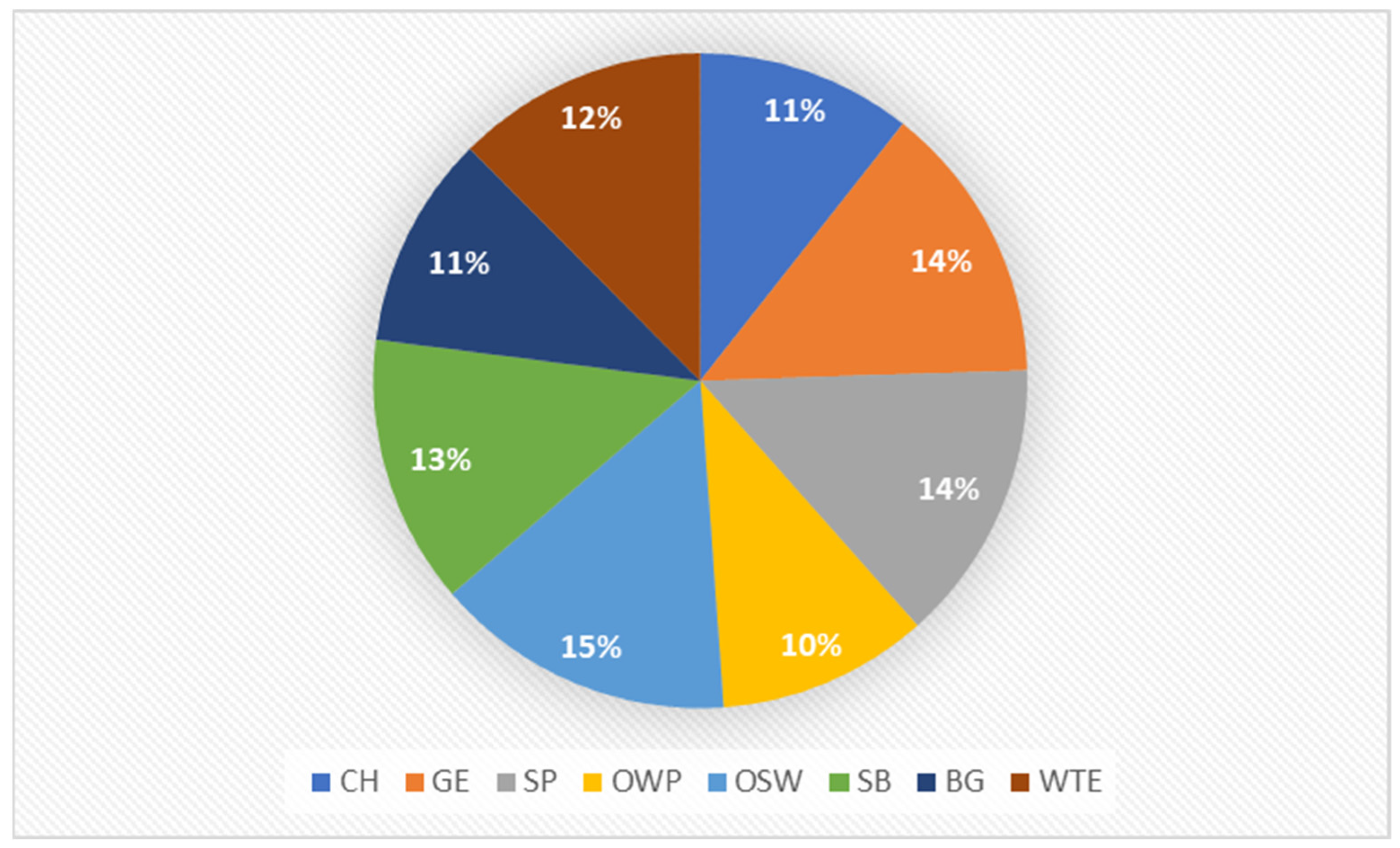
Given that the PCA model effectively reduces multidimensional quantitative data into a smaller set of underlying components and is frequently employed for weight determination, this study utilized PCA to identify the optimal combination of factors for RE development. Three principal components were extracted, with eigenvalues of 3.142, 1.566, and 1.023 (see
Table 6), accounting for 39.27%, 19.58%, and 12.78% of the total variance, respectively (see
Table 7 and
Figure 2).
5.4.2. Composite Score Coefficients and Weights
The composite score coefficients and weights for each RE source indicate their relative contributions to total RE generation. As shown in
Table 6, OSW has the highest composite score coefficient (0.3619) and weight (14.86%), followed by SP (0.3398; 13.95%) and GE (0.3375; 13.85%), indicating that these three sources are the leading contributors to total RE generation. SB (0.3238; 13.29%) also has a notable contribution, whereas WTE (0.3032; 12.45%) and CH (0.2592; 10.64%) contribute moderately. OWP (0.2540; 10.43%) and BG (0.2567; 10.54%) contribute relatively less.
5.4.3. Implications for the Optimal RE Mix
These results highlight that the optimal renewable energy mix should prioritize OSW, SP, and GE while incorporating other sources to achieve a balanced, efficient, and sustainable RE generation strategy. The PCA findings complement the stepwise regression analysis, providing a comprehensive perspective on the contributions of all RE sources and supporting informed decision-making for strategic energy development.
5.5. Comparison of the SRA Regression and PCA Results
Both stepwise SRA and PCA reveal complementary insights into contributions of RE sources to total RE generation, but differ in some salient ways. First, there is the difference in stress on and the ranking of sources.
Using SRA results, it is the case that SP contributes a dominant share to the total RE, followed by the OWP and CH. All three of these resources are statistically significant and positive in terms of total RE generation, which means they are impact factors under limited-resource and abundant-resource conditions. The SRA model does not include GE as a consideration due to multicollinearity constraints. It seemed not to contribute much to the regression model.
In contrast, the PCA results show the relative variance contribution of all eight RE sources, the top three being OSW, SP, and GE. Moreover, OSW has the highest composite score coefficient and weight. The difference is due to the fact that PCA captures all variables and their linear combinations that account for maximum variance. Meanwhile, SRA captures the effect of selected variables on total RE generation while controlling multicollinearity. In addition to the influence of other sources, PCA extends other contributions, such as that of SB and WTE, which are less significant than OSW, SP, or GE but are still non-negligible in the collective total RE generation mix.