Monitoring the Environmental Impact of the Bioeconomy: Indicators and Models for Ex-Post and Ex-Ante Evaluation in Agriculture

Abstract
1. Introduction
2. Materials and Methods
2.1. Framework for Assessing Environmental Indicators in the Agricultural Bioeconomy
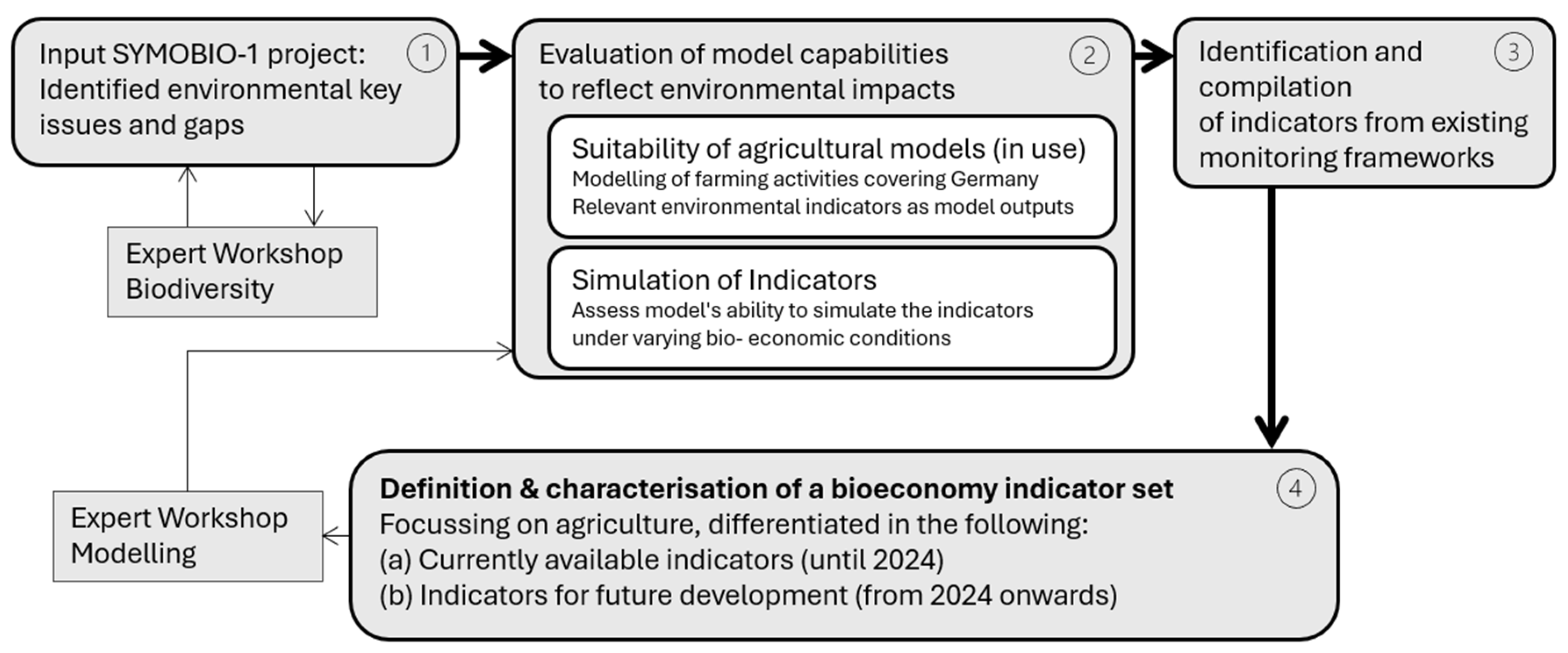
- Basis and further development of the monitoring concept: This step built on key issues identified in SYMOBIO-1 as a foundation for the monitoring concept while also addressing additional development needs.
- Evaluation of model capabilities to reflect environmental impacts: Step two assessed whether agricultural models are capable of modelling and predicting the environmental impacts of the bioeconomy using two steps:
- Identifying suitable agricultural models: Step 2a involved identifying suitable agricultural production models currently in use, which can simulate the environmental impacts of farming activities, including the generation of relevant environmental indicators as model outputs.
- Identification of environmental indicators represented in agricultural models: This step focused on determining which environmental indicators are already represented within these models, and it also assessed the model’s ability to simulate these indicators under varying bio-economic conditions.
- Identification and compilation of indicators from existing monitoring frameworks: Step 3 entailed compiling a comprehensive indicator set based on existing monitoring systems (e.g., EU-Bioeconomy, FAO-Bioeconomy, SDG indicators, G20 Bioeconomy principles, national sustainability metrics).
- Definition and characterisation of a bioeconomy indicator set: Step 4 included setting up an environmental indicator set relevant to the bioeconomy, with a focus on those that agricultural models can currently provide, those planned for future integration, and those identified as necessary for further development.
2.2. Basis and Further Development of the Monitoring Concept
2.2.1. DPSIR Concept
2.2.2. Key Objectives of an Environmentally Sustainable Bioeconomy
- Contribution to climate protection;
- Preservation of and improvement in air quality;
- Preservation of water balance and quality;
- Preservation and strengthening of biodiversity;
- Preservation of soil fertility and function.
2.3. Identification of Agricultural Models
2.4. Identification of Indicators
2.4.1. Evaluation of Existing Monitoring Systems
2.4.2. Method and Criteria for Selection
- Indicators within existing monitoring systems;
- Primary indicators;
- Indicators used in the models;
- Indicators that are already used for existing reporting requirements;
- New indicators for emerging environmental targets.
2.4.3. Development of an Operational Indicator List
2.5. Expert Workshops
3. Results
3.1. Identified Key Objectives and Indicators
3.2. Suitable Agricultural Models
- Agricultural market models simulate supply, demand, and price formation across agricultural sectors, often at national or global scales. They are primarily used for policy impact assessments and scenario analysis, focusing on economic interactions and trade dynamics. (MAGNET, Aglink-Cosimo, GLOBIOM).
- Agricultural production models include representations of production, markets, and often economic decisions. These models translate optimised farm management into input and output flows, supplies, production, and emissions on the farm or regional level. Most of them incorporate environmental modules (CAPRI, RAUMIS, FARMIS).
- Emission and accounting models quantify GHG emissions and pollutant emissions based on activity data and emission factors, providing inventories and scenario analysis without simulating production decisions. These models can be linked to agricultural production models using outputs such as livestock numbers, crop areas, and management data as inputs for emission calculations (PY-GAS-EM).
- Process-based/biophysical models simulate soil, crop, water, and environmental processes. They are often linked to agricultural production models using management and land use data as inputs (AGRUM Model Network for water, RUSLE model for soil erosion, ROTH-C for soil carbon, SYNOPS for risk of synthetic plant protection).
3.3. Selected Indicators and Application of Practical Example
3.3.1. Climate
3.3.2. Water Quality
3.3.3. Water Quantity
3.3.4. Air
3.3.5. Soil Fertility
3.3.6. Biodiversity
3.3.7. Land Use
3.3.8. Sustainable Agricultural Production and Use
3.3.9. Operational Indicator List
4. Discussion
4.1. Conceptual Framework
4.2. Indicator Selection Gaps and Weaknesses
4.3. Target Setting and Lack of Targets
4.4. Suitability of Models
4.5. Relevance of Scenarios, Spatial Resolution, and Existing Gaps
4.6. Research and Development Needs
4.7. Transferability of Results
5. Conclusions
Supplementary Materials
Author Contributions
Funding
Institutional Review Board Statement
Informed Consent Statement
Data Availability Statement
Acknowledgments
Conflicts of Interest
Abbreviations
| AGRUM | project title: Analysis of Agricultural and Environmental Measures in the context of agricultural water protection against the background of the EU Water Framework Directive in Germany |
| CAPRI | Common Agricultural Policy Regional Impact Analysis |
| DBFZ | Deutsches Biomasseforschungszentrum (German Biomass Research Center) |
| EXIOBASE | Multi-regional, Environmentally Enhanced Input–Output Database (for MRIO) |
| FARMIS | Farmgruppenmodell für die Agrarsektormodellierung (German Farm group model) |
| GHG | Greenhouse Gas |
| GLOBIOM | Global Biosphere Management Model |
| LandSHIFT | Land Simulation to Harmonise and Integrate Freshwater Availability and the Terrestrial Environment (Model) |
| LULUCF | Land Use, Land Use Change, and Forestry |
| MAGNET | Modular Applied GeNeral Equilibrium Tool |
| MoBi II | project title: Monitoring System for Bioeconomy in Germany |
| MonBio | project title: Further Development of the Bioeconomy Monitoring System with Special Consideration of Precautionary Environmental Protection |
| MRIO | Multi-Regional Input–Output (Model) |
| NEC | National Emission Reduction Commitments Directive |
| NUTS | Nomenclature des Unités Territoriales Statistiques (Eurostat regions) |
| PY-GAS-EM | German Agricultural Emission Model |
| RAUMIS | Regionalisiertes Agrar- und Umweltinformationssystem (German Regionalised Agricultural and Environmental Information System) |
| SMART | Specific, Measurable, Achievable, Relevant, Time-bound |
| SYMOBIO | project title: Systemic Monitoring and Modelling of the Bioeconomy |
| SYNOPS | Model for the synoptic assessment of the environmental risk potential of chemical plant protection products |
| TI | Thünen Institut |
| UBA | Umweltbundesamt (German Environmental Agency) |
| UNFCCC | United Nations Framework Convention on Climate Change |
| ZALF | Leibniz Centre for Agricultural Landscape Research |
References
- National Bioeconomy Strategy; Federal Ministry of Education and Research (BMBF) & Federal Ministry of Food and Agriculture (BMEL): Berlin, Germany, 2020.
- EEA. Opportunities for Innovation in the Bioeconomy; European Environment Agency (EEA): Copenhagen, Denmark, 2025. [Google Scholar]
- EC. A Sustainable Bioeconomy for Europe—Strengthening the Connection Between Economy, Society and the Environment: Updated Bioeconomy Strategy; Publications Office of the European Union: Luxembourg, 2018. [Google Scholar]
- EC. Report from the Commission to the European Parliament, the Council, the European Economic and Social Committee and the Committee of the Regions—EU Bioeconomy Strategy Progress Report European Bioeconomy Policy: Stocktaking and Future Developments: COM/2022/283 Final; Publications Office of the European Union: Luxembourg, 2022. [Google Scholar]
- Egenolf, V.; Bringezu, S. Conceptualization of an Indicator System for Assessing the Sustainability of the Bioeconomy. Sustainability 2019, 11, 443. [Google Scholar] [CrossRef]
- Bringezu, S.; Banse, M.; Ahmann, L.; Bezama, A.; Billig, E.; Bischof, R.; Blanke, C.; Brosowski, A.; Brüning, S.; Borchers, M.; et al. Pilotbericht zum Monitoring der Deutschen Bioökonomiel; Center for Environmental Systems Research (CESR): Kassel, Germany, 2020. [Google Scholar]
- Power, A.G. Ecosystem services and agriculture: Tradeoffs and synergies. In Philosophical Transactions of the Royal Society of London; Series B, Biological Sciences; The Royal Society: London, UK, 2010. [Google Scholar]
- Muscat, A.; Olde, E.M.; de Kovacic, Z.; Boer, I.; de Ripoll-Bosch, R. Food, energy or biomaterials? Policy coherence across agro-food and bioeconomy policy domains in the EU. Environ. Sci. Policy 2021, 123, 21–30. [Google Scholar] [CrossRef]
- Gomez San Juan, M. The Bioeconomy Toolbox—A Guide to Support the Development of Sustainable Bioeconomy Strategies and Policies; Food and Agriculture Organization of the United Nations (FAO): Rome, Italy, 2024. [Google Scholar]
- Directives—Directive (EU) 2016/2284 of the European Parliament and of the Council of 14 December 2016 on the Reduction of National Emissions of Certain Atmospheric Pollutants, Amending Directive 2003/35/EC and Repealing Directive 2001/81/EC; Publications Office of the European Union: Luxembourg, 2016.
- Paris Agreement: Conference of the Parties. Twenty-First Session Paris, 30 November to 11 December 2015; United Nations Framework Convention on Climate Change (UNFCCC): Paris, France, 2015. [Google Scholar]
- Directive 2000/60/EC: Establishing A Framework for Community Action in the Field of Water Policy; Publications Office of the European Union: Luxembourg, 2000.
- Council of the European Communities. Council Directive 1991/676/eec of 12 December 1991 Concerning the Protection of Waters Against Pollution Caused by Nitrates from Agricultural Sources; Council of the European Communities: Luxembourg, 1991. [Google Scholar]
- Resolution Adopted by the General Assembly on 25 September 2015: Transforming Our World: The 2030 Agenda for Sustainable Development; United Nations: New York, NY, USA, 2015.
- Convention on Biological Diversity (CBD). 15/4. Kunming-Montreal Global Biodiversity Framework; Convention on Biological Diversity (CBD): Montreal, QC, Canada, 2022. [Google Scholar]
- Egenolf, V.; Bringezu, S. Indikatorensystem zur Bewertung der Nachhaltigkeit der deutschen Bioökonomie; Arbeitspapier; CESR: Kassel, Germany, 2018. [Google Scholar]
- Treibhausgasemissionen Durch Landnutzung, Landnutzungsänderung und Forstwirtschaft (LULUCF). 2025. Available online: https://www.thuenen.de/de/themenfelder/klima-und-luft/emissionsinventare-buchhaltung-fuer-den-klimaschutz/treibhausgas-emissionen-lulucf (accessed on 24 September 2025).
- Doran, G.T. There’s a SMART way to write managements’s goals and objectives. Manag. Rev. 1981, 70, 35. [Google Scholar]
- Smeets, E.; Weterings, R. Environmental Indicators: Typology and Overview: Technical Report No 25; EEA: Copenhagen, Denmark, 1999. [Google Scholar]
- Environment Monographs: Oecd Core Set of Indicators for Environmental Performance Reviews; Organisation For Economic Co-Operation and Development (OECD): Paris, France, 1993.
- UN General Assembly. Transforming our world: The 2030 Agenda for Sustainable Development. In Refworld—UNHCR’s Global Law and Policy Database; UN General Assembly: New York, NY, USA, 2015. [Google Scholar]
- Kilsedar, C.; Patani, S.; Olsson, M.; Girardi, J.; Mubareka, S. EU Bioeconomy Monitoring System Dashboards: Extended with Trade-Related Indicators: Status and Technical Description as of December 2022; Publications Office of the European Union: Luxembourg, 2023. [Google Scholar]
- Bracco, S.; Tani, A.; Çalıcıoğlu, Ö.; Gomez San Juan, M.; Bogdanski, A. Indicators to Monitor and Evaluate the Sustainability of Bioeconomy: Overview and a Proposed Way Forward; FAO: Rome, Italy, 2019. [Google Scholar]
- Federal Statistical Office (Destatis). Sustainable Development in Germany: Indicator Report 2021. 2021. Available online: https://www.destatis.de/EN/Themes/Society-Environment/Sustainable-Development-Indicators/Publications/Downloads/indicator-report-0230002219004.html (accessed on 23 September 2025).
- UNFCCC. Report of the Conference of the Parties on Its Eighteenth Session, Held in Doha From 26 November to 8 December 2012 Addendum Part Two: Action Taken by the Conference of the Parties at Its Eighteenth Session; UNFCCC: Bonn, Germany, 2013. [Google Scholar]
- G20. G20 High-Level Principles on Bioeconomy. G20 Initiative on Bioeconomy. Available online: https://bioeconomyassociation.org/wp-content/uploads/2024-09-11-high-level_principles_on_bioeconomy-final_version.pdf (accessed on 24 September 2025).
- Tanneberger, F.; Wichmann, S.; Schröder, C. Saving Soil Carbon, Greenhouse Gas Emissions, Biodiversity and the Economy: Paludiculture as Sustainable Land Use Option in German Fen Peatlands; Springer Nature: Berlin, Germany, 2022. [Google Scholar]
- Schmidt, B.; Eysholdt, M.; Fischer, M.; Kreins, P.; Krüger, A.; Kunkel, R.; Nguyen, H.H.; Tetzlaff, B.; Trepel, M.; Venohr, M.; et al. AGRUM-DE als gemeinsames Instrument der Land- und Wasserwirtschaftsverwaltung für die bundesweite Nährstoffmodellierung in Deutschland. Hydrol. Water Resour. Manag. 2024, 68, 6–22. [Google Scholar]
- Panagos, P.; Ballabio, C.; Himics, M.; Scarpa, S.; Matthews, F.; Bogonos, M.; Poesen, J.; Borelli, P. Projections of soil loss by water erosion in Europe by 2050. Environ. Sci. Policy 2021, 2021, 380–392. [Google Scholar] [CrossRef]
- Common Agricultural Policy Regional Impact Analysis. Available online: https://web.jrc.ec.europa.eu/policy-model-inventory/explore/models/model-capri/#model-outputs (accessed on 24 September 2025).
- Offermann, F. Modellsteckbrief FARMIS. Available online: https://www.thuenen.de/de/thuenen-institut/verbundstrukturen/thuenen-modellverbund/modelle/farmis (accessed on 23 September 2025).
- Zinnbauer, M.; Wegmann, J. Modellsteckbrief RAUMIS. Available online: https://www.thuenen.de/de/thuenen-institut/verbundstrukturen/thuenen-modellverbund/modelle/raumis (accessed on 23 September 2025).
- Vos, C.; Rösemann, C.; Haenel, H.-D.; Dämmgen, U.; Döring, U.; Wulf, S.; Eurich-Menden, B.; Freibauer, A.; Döhler, H.; Steuer, B.; et al. Calculations of Gaseous and Particulate Emissions from German Agriculture 1990—2022: Report on Methods and Data (RMD) Submission 2024. Available online: https://git-dmz.thuenen.de/vos/emissionsagriculture2024/-/wikis/home (accessed on 25 April 2024).
- Haß, M.; Banse, M.; Eysholdt, M.; Gocht, A.; Laquai, V.; Offermann, F.; Pelikan, J.; Rieger, J.; Stepanyan, D.; Sturm, V.; et al. Thünen-Baseline 2024–2034: Agrarökonomische Projektionen für Deutschland; Johann Heinrich von Thünen Institut: Braunschweig, Germany, 2024. [Google Scholar]
- Förster, H.; Repenning, J.; Borkowski, K.; Braungardt, S.; Bürger, V.; Cook, V.; Emele, L.; Görz, W.K.; Haller, M.; Hennenberg, K.; et al. Treibhausgas-Projektionen 2025 für Deutschland (Projektionsbericht 2025); Umweltbundesamt (UBA): Dessau-Roßlau, Germany, 2025. [Google Scholar]
- Transition Pathway for the Agri-Food Industrial Ecosytem; Publications Office of the European Office: Luxembourg, 2024.
- Rieger, J.; Freund, F.; Offermann, F.; Geibel, I.; Gocht, A. From fork to farm: Impacts of more sustainable diets in the EU-27 on the agricultural sector. J. Agric. Econ. 2023, 74, 764–784. [Google Scholar] [CrossRef]
- André, E.; Bandy, J.; Brizay, A.; Chemnitz, C.; Dräger, T.; Grethe, H.; Hollander, T.; Kampermann, I.; Klümper, W.; Lemke, N.; et al. Agriculture, Forestry and Food in a Climate Neutral EU; Agora Agriculture: Berlin, Germany, 2024. [Google Scholar]
- Frank, S.; Havlík, P.; Stehfest, E.; van Meijl, H.; Witzke, P.; Pérez-Domínguez, I.; van Dijk, M.; Doelman, J.C.; Fellmann, T.; Koopman, J.F.L.; et al. Agricultural non-CO2 emission reduction potential in the context of the 1.5 °C target. Nat. Clim. Change 2019, 9, 66–72. [Google Scholar] [CrossRef]
- Haß, M.; Deblitz, C.; Freund, F.; Kreins, P.; Laquai, V.; Offermann, F.; Pelikan, J.; Sturm, V.; Wegmann, J.; Witte, T.; et al. Thünen-Baseline 2022–2032: Agrarökonomische Projektionen für Deutschland; Johann Heinricht von Thünen-Insitut: Braunschweig, Germany, 2022. [Google Scholar]
- Bundes-Klimaschutzgesetz: KSG; Bundesgesetzblatt (BGBI.I): Berlin, Germany, 2021.
- National Peatland Protection Strategy; Federal Ministry for the Environment, Nature Conservation, Nuclear Safety and Consumer Protection (BMUV): Berlin, Germany, 2022.
- Regulation (EU) 2018/1999 of the European Parliament and of the Council of 11 December 2018 on the Governance of the Energy Union and Climate Action, Amending Regulations (EC) No 663/2009 and (EC) No 715/2009 of the European Parliament and of the Council, Directives 94/22/EC, 98/70/EC, 2009/31/EC, 2009/73/EC, 2010/31/EU, 2012/27/EU and 2013/30/EU of the European Parliament and of the Council, Council Directives 2009/119/EC and (EU) 2015/652 and Repealing Regulation (EU) No 525/2013 of the European Parliament and of the Council; Publications Office of the European Union: Luxembourg, 2018.
- Umweltbundesamt (UBA). Submission Under the United Nations Framework Convention 2025: National Inventory Report for the German Greenhouse Gas Inventory 1990—2023; Umweltbundesamt (UBA): Dessau-Roßlau, Germany, 2025. [Google Scholar]
- Development of Agri-Environmental Indicators for Monitoring the Integration of Environmental Concerns into the Common Agricultural Policy: Communication from the Commission to the Council and the European Parliament; COM (2006) 508 final; Commission of the European Communities: Brussels, Belgium, 2006.
- European Commission (EC). Communication from the Commission to the European Parliament, the Council, the European Economic and Social Committee and the Committee of the Regions: A Farm to Fork Strategy for a Fair Healthy and Environmentally-Friendly Food System; European Commission (EC): Brussels, Belgium, 2020. [Google Scholar]
- Statistischer Monatsbericht des BMLEH: Kapitel A. Landwirtschaft; Tabelle 0111130-0000; Bundesministerium für Landwirtschaft, Ernährung und Heimat (BMLEH): Bonn, Germany, 2025.
- Eurostat. Gross Nutrient Balance (aei_pr_gnb). Available online: https://ec.europa.eu/eurostat/cache/metadata/EN/aei_pr_gnb_esms.htm (accessed on 26 September 2025).
- Döhler, H.; Döhler, S.; Häußermann, U. Berechnung von Phosphor-Überschüssen der Deutschen Landwirtschaft auf der Basis von Regionalisierten P-Flächenbilanzen: Beschreibung der Nationalen BVT in der Intensivtierhaltung unter der Berücksichtigung der BVT- Schlussfolgerungen (IRPP BREF 2017) im Bereich Aufbereitung von Gülle und Gärresten; Umweltbundesamt (UBA): Dessau-Roßlau, Germany, 2025. [Google Scholar]
- Länderinitiative Kernindikatoren (LiKi). B6 Stickstoffüberschuss—LiKi-Umweltindikatoren. Available online: https://www.liki.nrw.de/natur-und-landschaft/b6-stickstoffueberschuss (accessed on 26 September 2025).
- Özbek, F.Ş.; Leip, A.; Weiss, F.; Carmona Garcia, G.; Altobelli, F.; Grassart, L.; Hofmeier, M.; Kukucka, M.; Pallotti, A.; Patay, A.; et al. Regionalisation of Nitrogen Balances with the Capri Model (Regnibal): Pilot Project in Support of the Eurostat Working Group on Agri Environmental Indicators; Publications Office of the European Union: Luxembourg, 2015. [Google Scholar]
- Zinnbauer, M.; Eysholdt, M.; Henseler, M.; Herrmann, F.; Kreins, P.; Kunkel, R.; Nguyen, H.; Tetzlaff, B.; Venohr, M.; Wolters, T.; et al. Quantifizierung Aktueller und Zukünftiger Nährstoffeinträge und Handlungsbedarfe für ein Deutschlandweites Nährstoffmanagement—AGRUM-DE; Johann Heinrich von Thünen Institut: Braunschweig, Germany, 2023. [Google Scholar]
- Wendland, F.; Herrmann, F.; Kunkel, R.; Tetzlaff, B.; Wolters, T. AGRUM-DE—Modellbeschreibung: mGROWA-DENUZ-WEKU-MEPHOS; Forschungszentrum Jülich: Jülich, Germany, 2019. [Google Scholar]
- IFOAM Organics Europe. Environmental NGOs and Organic Movement Call on Commission to Develop a New Indicator to Measure Progress Towards the Farm to Fork Pesticide Reduction Target. Available online: https://www.organicseurope.bio/news/environmental-ngos-and-organic-movement-call-on-commission-to-develop-a-new-indicator-to-measure-progress-towards-the-farm-to-fork-pesticide-reduction-target/ (accessed on 26 September 2025).
- European Centre for Agricultural, Regional and Environmental Policy Research (EuroCARE). Modelling Policy Restrictions on Pesticides Use with CAPRI (Pesticides 2). Available online: https://www.eurocare-bonn.de/projects/capri_develop/Pest2/Pest2.htm (accessed on 26 September 2025).
- Indikator-Factsheet: Landwirtschaftliche Bewässerung; Umweltbundesamt (UBA): Dessau-Roßlau, Germany, 2023.
- Blanco, M.; Hristov, J.; Witzke, P.; Barreiro Hurle, J.; Martinez, P.; Salputra, G. CAPRI water 2.0: An Upgraded and Updated CAPRI Water Module. Available online: https://op.europa.eu/en/publication-detail/-/publication/6bacceb0-1233-11e9-81b4-01aa75ed71a1/language-en (accessed on 26 September 2025).
- Nationales Luftreinhalteprogramm der Bundesrepublik Deutschland nach Artikel 6 und Artikel 10 der Richtlinie (EU) 2016/2284 über die Reduktion der Nationalen Emissionen bestimmter Luftschadstoffe sowie nach §§ 4 und 16 der Verordnung über Nationale Verpflichtungen zur Reduktion bestimmter Luftschadstoffe (43. BImSchV); Umweltbundesamt (UBA): Dessau-Roßlau, Germany, 2024.
- Ammonia Emissions from Agriculture; Eurostat: Luxembourg, 2025.
- Indikator 2.1.a: Stickstoffüberschuss der Landwirtschaft. Available online: https://dns-indikatoren.de/2-1-a/ (accessed on 22 September 2025).
- Federal Government. German Sustainable Development Strategy: Update 2021; Bundespresseamt: Berlin, Germany, 2021. [Google Scholar]
- German Informative Inventory Report 2024 (IIR 2024); Umweltbundesamt (UBA): Dessau-Roßlau, Germany, 2024.
- Öko-Insititut. CAPRI → Py-GAS-EM (2): THG-Projektionen 2025 für Deutschland. Daten- und Modelldokumentation. Available online: https://thg-projektionen2025-daten-modell-dokumentation-788cd5.usercontent.opencode.de/Modellierungsprozess/capri__pygasem/ (accessed on 22 September 2025).
- Jacobs, A.; Flessa, H.; DON, A.; Heidkamp, A.; Prietz, R.; Dechow, R.; Gensior, A.; Poeplau, C.; Riggers, C.; Schneider, F.; et al. Landwirtschaftlich Genutzte Böden in Deutschland—Ergebnisse der Bodenzustandserhebung; Johann Heinrich von Thünen-Institut: Braunschweig, Germany, 2018. [Google Scholar]
- Coleman, K.; Prout, J.M.; Milne, A.E. RothC—A Model for the Turnover of Carbon in Soils: Model Description; Rotham Research: Harpenden, Hertfordshire, UK, 2024. [Google Scholar]
- Riggers, C.; Poeplau, C.; Don, A.; Frühauf, C.; Dechow, R. How much carbon input is required to preserve or increase projected soil organic carbon stocks in German croplands under climate change? Plant Soil 2021, 460, 417–433. [Google Scholar] [CrossRef]
- Gudelė, G.M.; Visockienė, J.S. Quantifying Soil Carbon Sequestration Potential Through Carbon Farming Practices with RothC Model Adapted to Lithuania. Land 2025, 14, 1497. [Google Scholar] [CrossRef]
- Proposal for a Regulation of the European Parliament and of the Council on Circularity Requirements for Vehicle Design and on Management of End-of-Life Vehicles, Amending Regulations (EU) 2018/858 and 2019/1020 and Repealing Directives 2000/53/EC and 2005/64/EC; 2023/0284 (COD); European Commission: Brussels, Belgium, 2023.
- Regulation (EU) 2024/1991 of the European Parliament and of the Council of 24 June 2024 on Nature Restoration and Amending Regulation (EU) 2022/869: 2024/1991; Official Journal of the European Union: Luxemburg, 2024.
- European Union. Regulation (EU) 2024/3012 of the European Parliament and of the Council Establishing a Union Certification Framework for Permanent Carbon Removals, Carbon Farming and Carbon Storage in Products; European Union: Brussels, Belgium, 2024. [Google Scholar]
- Eurostat. Agri-Environmental Indicators—Soil Erosion; Eurostat: Luxembourg, 2020. [Google Scholar]
- Proposal for a Directive of the European Parliament and of the Council on Soil Monitoring and Resilience (Soil Monitoring Law): 2023/0232 (COD); European Commission: Brussels, Belgium, 2023.
- Wirth, C.; Bruelheide, H.; Farwig, N.; Marx, J.M.; Settele, J. Faktenchek Artenvielfalt: Bestandsaufnahme und Perspektiven für den Erhalt der Biologischen Vielfalt in Deutschland; Zusammenfassung für die Gesellschaftliche Entscheidungsfindung; oekom verlag: München, Germany, 2024. [Google Scholar]
- MonViA. MonViA Indikatorenbericht 2024: Bundesweites Monitoring der Biologischen Vielfalt in Agrarlandschaften; Überarbeitete Version Dezember 2024; MonViA Konsortium: Bonn, Germany, 2024. [Google Scholar]
- Federal Ministry for the Environment, Nature Conservation and Nuclear Safety (BMUV). National Biodiversity Strategy 2030: (NBS 2030); Federal Ministry for the Environment, Nature Conservation and Nuclear Safety (BMUV): Bonn, Germany, 2024. [Google Scholar]
- Directory of Regionalized Small-Structure Shares: Supplement 2025; Federal Office of Consumer Protection and Food Safety (BVL): Braunschweig, Germany, 2025.
- Kasiske, T.; Dauber, J.; Harpke, A.; Klimek, S.; Kühn, E.; Settele, J.; Musche, M. Livestock density affects species richness and community composition of butterflies: A nationwide study. Ecol. Indic. 2023, 146, 109866. [Google Scholar] [CrossRef] [PubMed]
- EC. The European Green Deal: Communication from the Commission to the European Parliament, the European Council, the Council, the European Economic and Social Committee and the Committee of the Regions; COM(2019) 640 Final; EC: Brussels, Belgium, 2019. [Google Scholar]
- Regulation (EU) 2022/2379 of the European Parliament and of The Council of 23 November 2022: Regulation/EU) 2022/2379; Publication Office of the European Union: Luxemburg, 2022.
- Paracchini, M.L.; Britz, W. Quantifying Effects of Changed Farm Practise on Biodiversity in Policy Impact Assessment—An Application of CAPRI-Spat; Joint Research Center: Ispra, Italy, 2010. [Google Scholar]
- Strassemeyer, J.; Gutsche, V. The Approach of the German Pesticide Risk Indicator SYNOPS in Frame of the National Action Plan for Sustainable Use of Pesticides; Julius-Kühn-Institut: Kleinmachnow, Germany, 2010. [Google Scholar]
- JKI—Julius-Kühn-Institut, Ed. 213—Vergleich der Absatzmenge an Pflanzenschutzmittelwirkstoffen mit dem durch SYNOPS Berechneten Umweltrisiko; Julius-Kühn-Institut: Quedlinburg, Germany, 2023.
- Destatis. Nachhaltigkeitsstrategie für Deutschland: Indikator 2.1.b Ökologischer Landbau; Destatis: Wiesbaden, Germany, 2025. [Google Scholar]
- EuroCare. Introduction of Organic Farming into the CAPRI Supply Model (CAPRI Organic Farming). Available online: https://www.eurocare-bonn.de/projects/capri_develop/OrganicFarming/OrganicFarming.htm (accessed on 22 September 2025).
- Offermann, F. FARMIS in Brief. Available online: https://www.thuenen.de/en/thuenen-institute/compound-structures/the-thuenen-modelling-network/models/farmis (accessed on 26 September 2025).
- Wilkinson, J.M.; Lee, M.R.F. Use of human-edible animal feeds by ruminant livestockIntroduces the Human-Edible Feed Conversion Efficiency (HeFCE) metric. Animal 2018, 12, 1735–1743. [Google Scholar] [CrossRef] [PubMed]
- Helander, H.; Beck-O’Brien, M.; Lutz, C.; Schaldach, R.; Schomberg, A.; Többen, J.; Bringezu, S. Six Footprints to monitor the bioeconomy into a safe and just future. Front. Environ. Sci. 2025, 13, 1563666. [Google Scholar] [CrossRef]
- Steffen, W.; Richardson, K.; Rockström, J.; Cornell, S.; Fetzer, I.; Bennett, E.M.; Biggs, R.; Carpenter, S.; Vries, W.; de Wit, C.A.; et al. Planetary Boundaries: Guiding human development on a changing planet. Science 2015, 347, 736. [Google Scholar] [CrossRef] [PubMed]
- Geupel, M.; Heldstab, J.; Schäppi, B.; Reutimann, J.; Bach, M.; Häußermann, U.; Knoll, L.; Klement, L.; Breuer, L. A National Nitrogen Target for Germany. Sustainability 2021, 13, 1121. [Google Scholar] [CrossRef]
- Bringezu, S.; Distelkamp, M.; Lutz, C.; Wimmer, F.; Schaldach, R.; Hennenberg, K.J.; Böttcher, H.; Egenolf, V. Environmental and socioeconomic footprints of the German bioeconomy. Nat. Sustain. 2021, 4, 775–783. [Google Scholar] [CrossRef]
- UBA. Greenhouse Gas Projections 2025 for Germany—Data Table; Umweltbundesamt (UBA): Dessau-Roßlau, Germany, 2025. [Google Scholar]


| Indicator Groups for the Key Objective | Legal Framework or Strategy for Target Setting | Sum of Indicators | Recommended for Monitoring System | |
|---|---|---|---|---|
| With Overlap | Without Overlap | |||
| Climate | Paris Agreement | 11 | 9 | 3 |
| Air | Göteburg Protocol | 12 | 10 | 2 |
| Water Quality | Water Framework Directive Nitrate Directive | 22 | 11 | 2 + 1 new |
| Water Quantity | SDG Targets | 7 | 5 | 1 |
| Biodiversity | Kunming–Montreal Global Biodiversity Framework | 24 | 19 | 2 + 2 new |
| Soil Fertility | Future developments: Soil Monitoring Law, related to Paris Agreement | 7 | 6 | 2 |
| Land Use | No concrete targets, related to Paris Agreements due to emissions from land use change | 5 | 4 | 2 |
| Sustainable Production | SDG Targets | 14 | 10 | 2 + 2 new |
| Model Name | Model Type | Spatial Resolution | Institution | Reference to Model |
|---|---|---|---|---|
| CAPRI Common Agricultural Policy Regional Impact Analysis | Agricultural production model | NUTS2 | Co-ownership (EU and third parties) | Model CAPRI—Common Agricultural Policy Regional Impact Analysis|Modelling Inventory and Knowledge Management System of the European Commission (MIDAS) [30] |
| FARMIS Farmgruppenmodell für die Agrarsektor-modellierung | Agricultural production model | Farm Level | Thünen- Institut | Thuenen: FARMIS [31] |
| RAUMIS Regionalisiertes Agrar- und Umweltinformationssystem | Agricultural production model | NUTS3 | Thünen- Institut | Thuenen: RAUMIS [32] |
| Py-GAS-EM German Agricultural Emission Model | Emission accounting model | NUTS0, NUTS1, NUTS3 | Thünen- Institut | Calculations of gaseous and particulate emissions from German agriculture 1990–2022: Input data and emission results [33] |
| Indicator Groups | Indicators | Unit | Framework |
|---|---|---|---|
| Climate |
| kt CO2e | German Climate Law |
| kt CO2e | German Climate Law | |
| kt CO2e | German Climate Law | |
| Water quality |
| kg N/ha | EU Nitrate Regulation |
| kg P/ha | EU Nitrate Regulation | |
| Farm-to-Fork Strategy | ||
| Water quantity |
| % of UAA, m3 water | German Strategy for Adaptation to Climate Change |
| Air |
| kt NH3 | NEC Directive |
| kg N/ha | German Sustainable Development Strategy | |
| Soil fertility |
| Corg/ha | German Climate Law |
| t/ha | Soil Monitoring Law | |
| Biodiversity |
| LSU/ha | -/- |
| % of UAA | German Sustainable Development Strategy | |
| Farm-to-Fork Strategy | ||
| % of UAA | Nature Restoration Law | |
| Land use |
| ha | -/- |
| ha | -/- | |
| Sustainable agricultural production and use |
| % of UAA | German Sustainable Development Strategy |
| kt cereal units | -/- | |
| % of total production | -/- | |
| -/- |
Disclaimer/Publisher’s Note: The statements, opinions and data contained in all publications are solely those of the individual author(s) and contributor(s) and not of MDPI and/or the editor(s). MDPI and/or the editor(s) disclaim responsibility for any injury to people or property resulting from any ideas, methods, instructions or products referred to in the content. |
© 2025 by the authors. Licensee MDPI, Basel, Switzerland. This article is an open access article distributed under the terms and conditions of the Creative Commons Attribution (CC BY) license (https://creativecommons.org/licenses/by/4.0/).
Share and Cite
Scheffler, M.; Wiegmann, K.; Köppen, S. Monitoring the Environmental Impact of the Bioeconomy: Indicators and Models for Ex-Post and Ex-Ante Evaluation in Agriculture. Sustainability 2025, 17, 10867. https://doi.org/10.3390/su172310867
Scheffler M, Wiegmann K, Köppen S. Monitoring the Environmental Impact of the Bioeconomy: Indicators and Models for Ex-Post and Ex-Ante Evaluation in Agriculture. Sustainability. 2025; 17(23):10867. https://doi.org/10.3390/su172310867
Chicago/Turabian StyleScheffler, Margarethe, Kirsten Wiegmann, and Susanne Köppen. 2025. "Monitoring the Environmental Impact of the Bioeconomy: Indicators and Models for Ex-Post and Ex-Ante Evaluation in Agriculture" Sustainability 17, no. 23: 10867. https://doi.org/10.3390/su172310867
APA StyleScheffler, M., Wiegmann, K., & Köppen, S. (2025). Monitoring the Environmental Impact of the Bioeconomy: Indicators and Models for Ex-Post and Ex-Ante Evaluation in Agriculture. Sustainability, 17(23), 10867. https://doi.org/10.3390/su172310867