


Transforming Digital Signal and Image Processing Education: An AI-Driven Approach to Pedagogical Advancements

 ,
, 

Abstract
1. Introduction
- RQ1: What are the various teaching methodologies used in DSIP education?
- RQ2: How has AI-assisted pedagogy transformed the learning experience in DSIP?
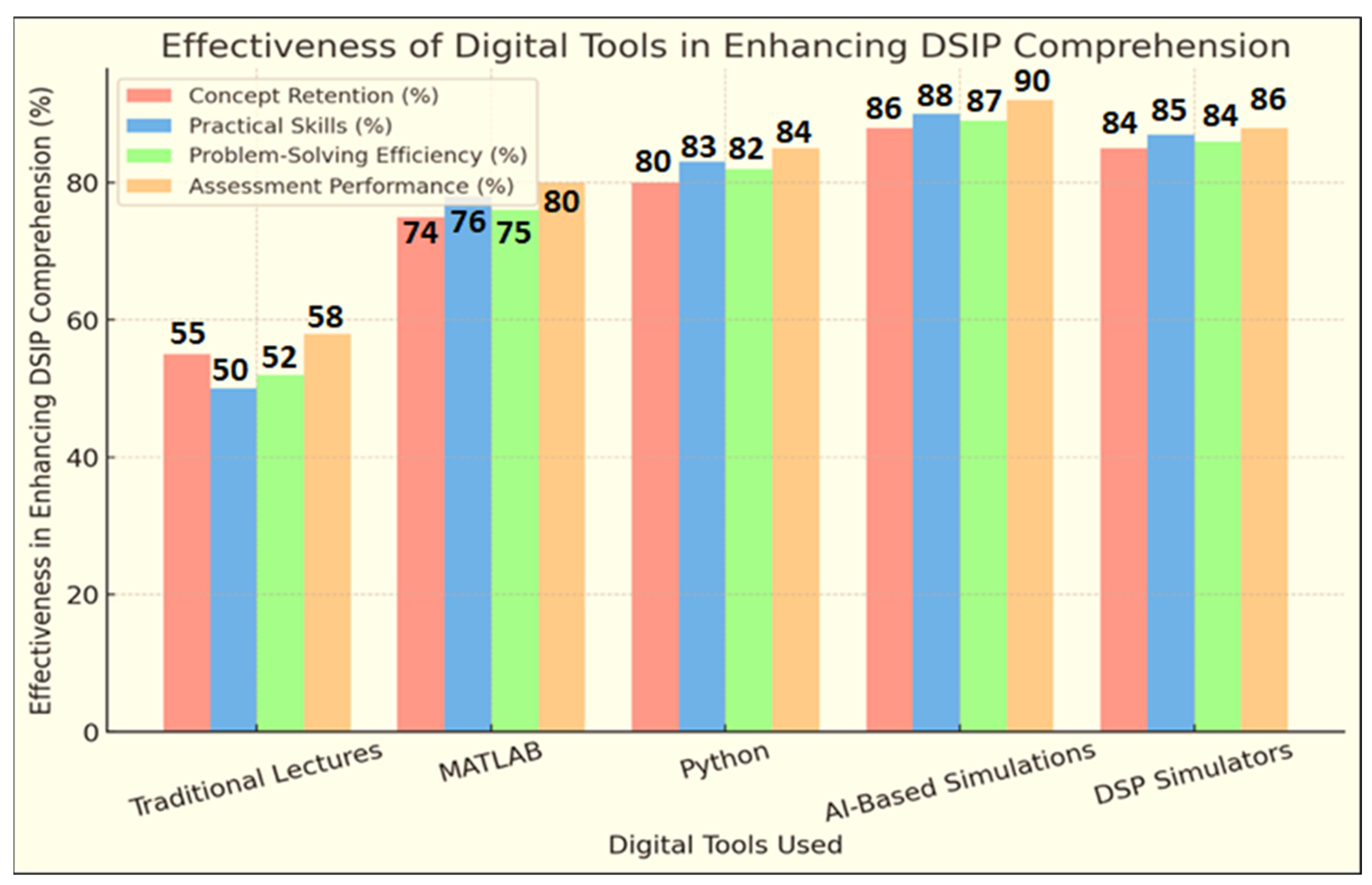
- RQ3: What digital tools and AI-driven platforms are most effective in teaching DSIP concepts?
- RQ4: What is the difference between modern techniques and the traditional ones as far as student engagement, knowledge retention, and practical skill development is concerned?
- RQ5: What are the key challenges and limitations in implementing AI-driven DSIP education?
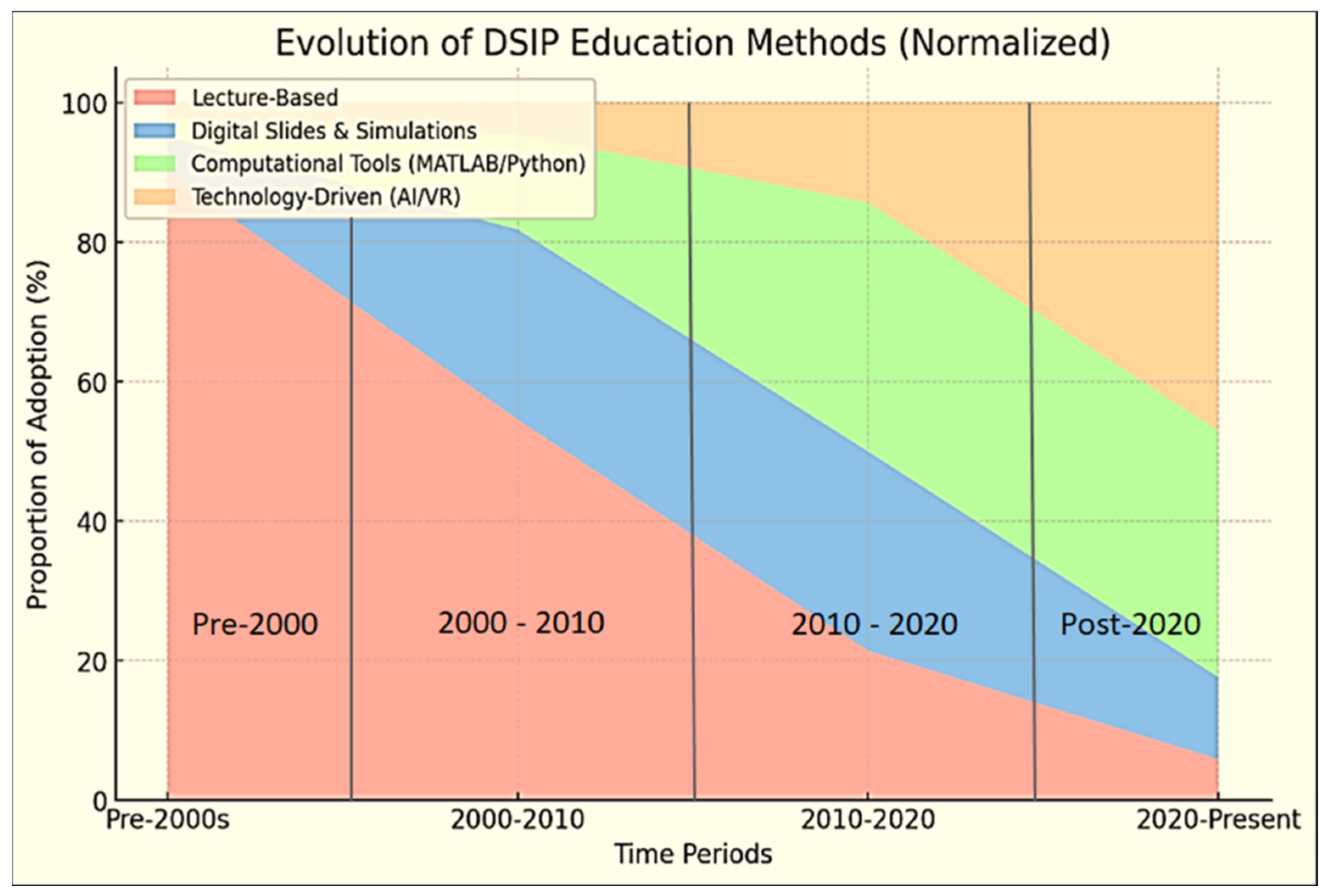
- Analyzing the evolution of DSIP teaching methodologies, from traditional approaches to AI-driven innovations to address RQ1.
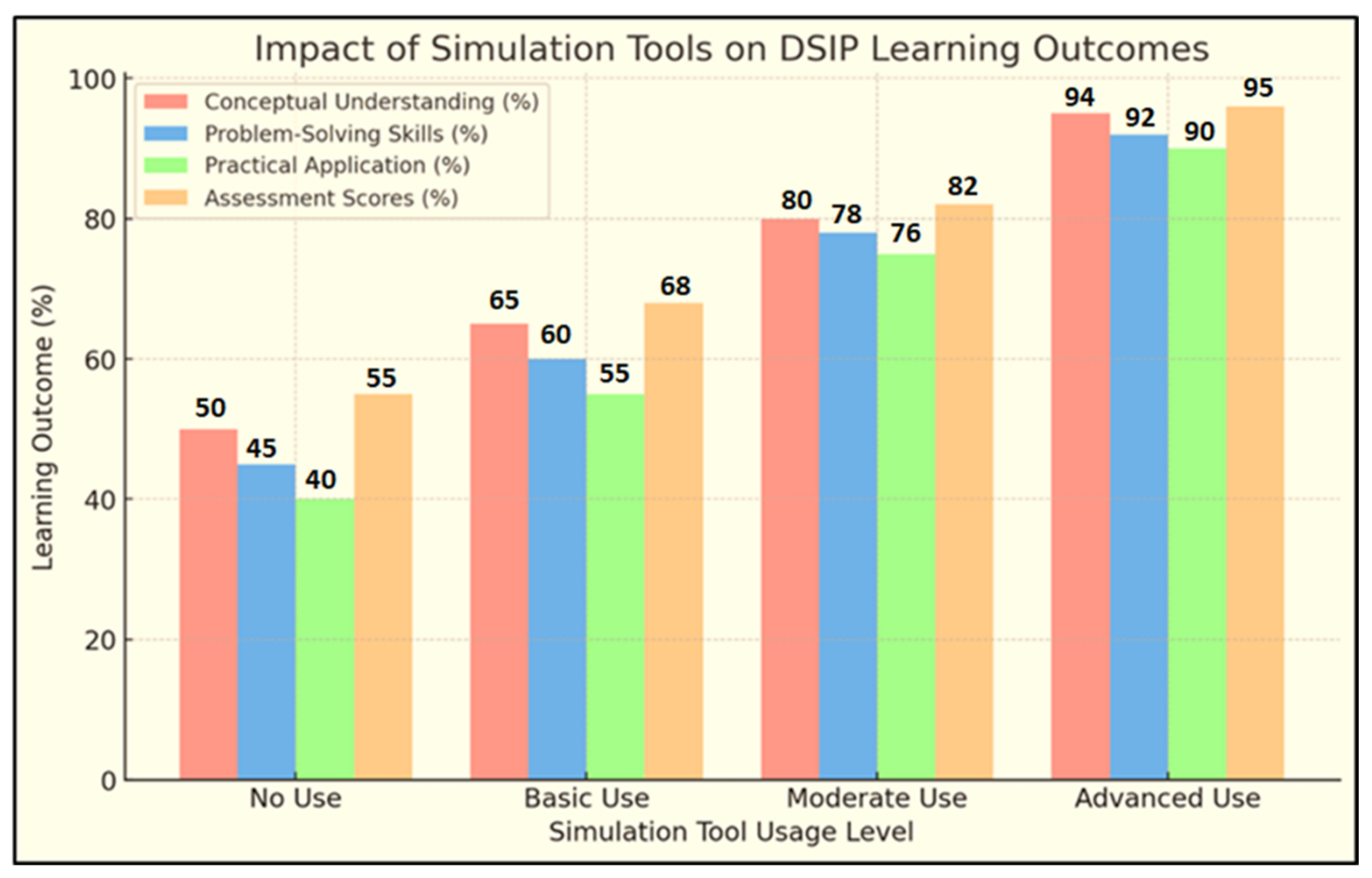
- Assessing the role of AI tools, such as intelligent tutoring systems (ITS), adaptive learning platforms, and automated grading systems, in improving learning outcomes of DSIP to analyze RQ2.
- Determining practical solutions in terms of best practices in the incorporation of AI-based learning models in DSIP curricula to address RQ3.
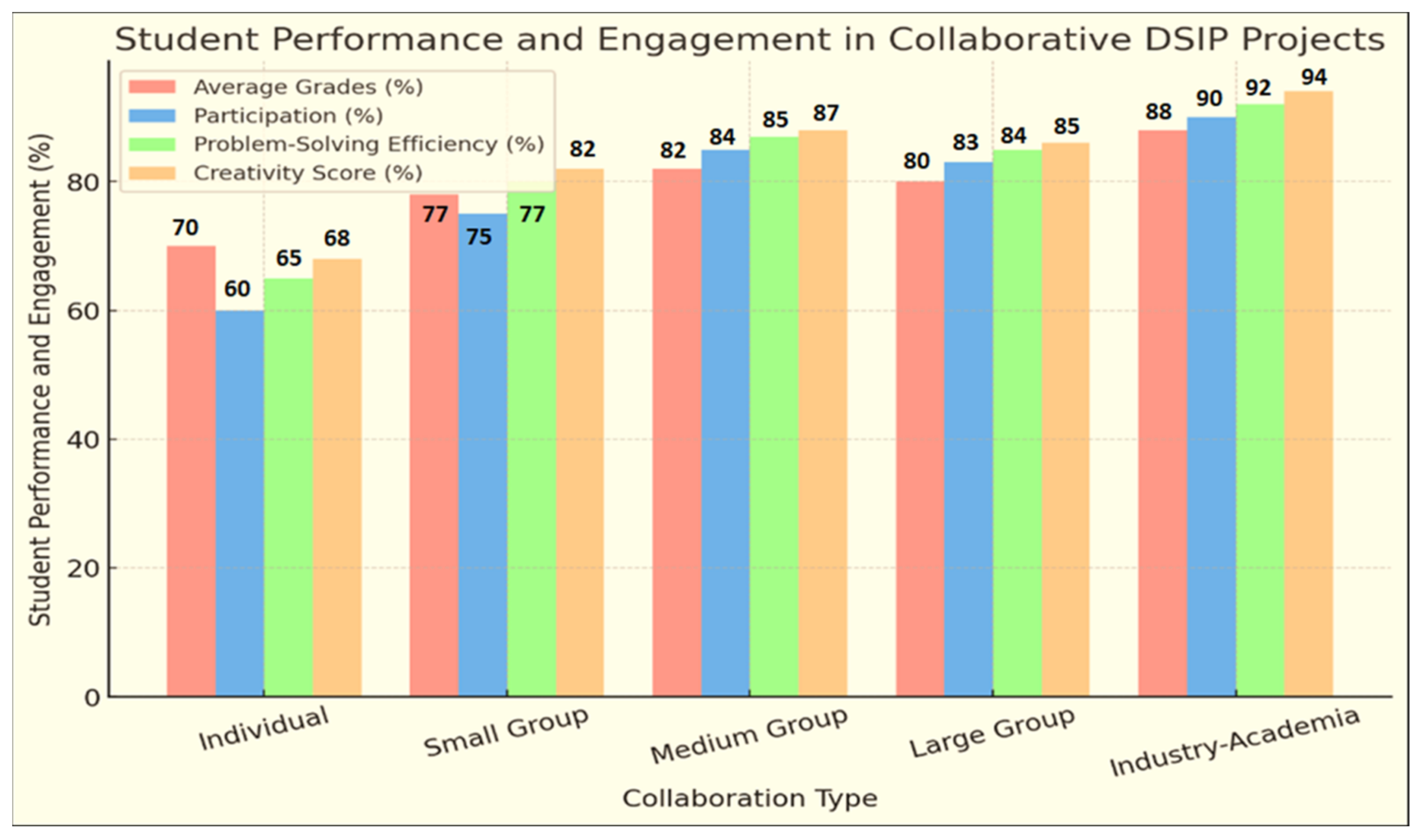
- Comparing AI-driven pedagogy with traditional methods in terms of student engagement, conceptual understanding, and industry readiness to address RQ4.
- Indicating the major issues, constraints, and ethical implications revolving around learning in DSIP education with the help of AI to address RQ5.
2. Materials and Methods
3. AI-Aided Innovation in DSIP Education
- Traditional pedagogical approaches in DSIP;
- AI-driven and digital learning methods;
- Experiential and hands-on learning techniques;
- Challenges and future trends in AI-Assisted DSIP education.
3.1. Traditional Pedagogical Approaches in DSIP
- High cognitive load due to mathematical complexity (e.g., Fourier Transform, Z-transform).
- Limited student participation in passive lecture-based learning.
- Lack of visualization tools to illustrate abstract DSP concepts.
3.2. AI-Driven and Digital Learning Methods
- Individualized learning paths that are anchored to student performance analytics.
- Real-time feedback and AI-based tutoring (e.g., DeepTutor, AutoTutor).
- Use of online tools like MATLAB Online, Python-based DSP simulations, and MOOCs (Coursera, EdX, Udemy).
3.3. Experiential and Hands-On Learning Techniques
- Remote and virtual labs: NI Multisim, WebDSP, Simulink DSP blocks.
- Hardware-in-the-loop (HIL): FPGA-based signal processing projects.
- Flipped Classroom Model: AI-driven video lectures combined with live DSP coding workshops.
3.4. Challenges and Future Trends in AI-Assisted DSIP Education
- Lack of faculty training in AI-integrated pedagogy.
- Resource-intensive implementation of AI-driven DSP labs.
- Ethical concerns regarding AI-based grading fairness.
4. Leveraging Digital Tools for Hands-On Learning in DSIP
- Programming-Based DSP Tools were designed for algorithm development, signal analysis, and numerical computing using programming languages such as MATLAB, Python, and GNU Octave.
- Graphical and Simulation-Based DSP Tools feature block-based simulation environments such as Simulink, GNU Radio, and LabVIEW, which allow students to model and test DSP systems without extensive coding.
- Cloud-Based and Virtual DSP Labs offer remote access to DSP experimentation, allowing students to carry out signal processing and simulations in real time through platforms such as MATLAB Online, WebDSP, and NI Virtual Bench.
4.1. Programming-Based DSIP Tools
4.1.1. MATLAB and Simulink
4.1.2. Python for DSP (SciPy, NumPy, Matplotlib)
4.2. Graphical and Simulation-Based DSP Tools
4.2.1. GNU Radio
4.2.2. LabVIEW: A Graphical Approach to DSP System Design
4.3. Cloud-Based and Virtual Labs for DSP: Enabling Remote and Interactive Learning
4.3.1. MATLAB Online
4.3.2. WebDSP
5. Conclusion: Shaping the Future of DSIP Education
Author Contributions
Funding
Institutional Review Board Statement
Informed Consent Statement
Data Availability Statement
Acknowledgments
Conflicts of Interest
References
- Mdletshe, S.; Wang, A. Enhancing medical imaging education: Integrating computing technologies, digital image processing and artificial intelligence. J. Med. Radiat. Sci. 2025, 72, 148–155. [Google Scholar] [CrossRef] [PubMed]
- Quirós-Alpera, S.; Roets, A.O.S.B.; Robina-Ramírez, R.; Leal-Solís, A. Bridging Theory and Practice: Challenges and Opportunities in Dual Training for Sustainability Education at Spanish Universities. Societies 2025, 15, 32. [Google Scholar] [CrossRef]
- Chen, L.; Chen, P.; Lin, Z. Artificial Intelligence in Education: A Review. IEEE Access 2020, 8, 75264–75278. [Google Scholar] [CrossRef]
- Vieriu, A.M.; Petrea, G. The Impact of Artificial Intelligence (AI) on Students’ Academic Development. Educ. Sci. 2025, 15, 343. [Google Scholar] [CrossRef]
- Vaidya, R.; Mittal, A.; Nanaware, G. Cloud based simulation platform (CSP): A novel way to democratize simulation based experimentation. In Proceedings of the Winter Simulation Conference, Orlando, FL, USA, 15–18 December 2024; Available online: https://www.amazon.science/ (accessed on 24 October 2025).
- Afzaal, M.; Xiao, S.; Yan, D.; Younas, M. Mapping Artificial Intelligence Integration in Education: A Decade of Innovation and Impact (2013–2023)—A Bibliometric Analysis. IEEE Access 2024, 12, 113275–113299. [Google Scholar] [CrossRef]
- Mittal, U.; Sai, S.; Chamola, V.; Sangwan, D. A Comprehensive Review on Generative AI for Education. IEEE Access 2024, 12, 142733–142759. [Google Scholar] [CrossRef]
- Ogunleye, B.; Zakariyyah, K.I.; Ajao, O.; Olayinka, O.; Sharma, H. A Systematic Review of Generative AI for Teaching and Learning Practice. Educ. Sci. 2024, 14, 636. [Google Scholar] [CrossRef]
- Zhang, F.; Wang, X.; Zhang, X. Applications of deep learning method of artificial intelligence in education. Educ. J. 2025, 30, 1563–1587. [Google Scholar] [CrossRef]
- Sajja, R.; Sermet, Y.; Cikmaz, M.; Cwiertny, D.; Demir, I. Artificial Intelligence-Enabled Intelligent Assistant for Personalized and Adaptive Learning in Higher Education. Information 2024, 15, 596. [Google Scholar] [CrossRef]
- Wang, S.; Wang, F.; Zhu, Z.; Wang, J.; Tran, T.; Du, Z. Artificial intelligence in education: A systematic literature review. Expert Syst. Appl. 2024, 252, 124167. [Google Scholar] [CrossRef]
- Bano, F.; Alomar, M.A.; Alotaibi, F.M.; Serbaya, S.H.; Rizwan, A.; Hasan, F. Leveraging Virtual Reality in Engineering Education to Optimize Manufacturing Sustainability in Industry 4.0. Sustainability 2024, 16, 7927. [Google Scholar] [CrossRef]
- Guaya, D.; Romero-Benavides, J.C.; Fierro, N.; Jiménez, L. Integrating Project-Based and Community Learning for Cross-Disciplinary Competency Development in Nutrient Recovery. Sustainability 2025, 17, 8820. [Google Scholar] [CrossRef]
- Zubair, M.U.; Khan, M.A.; Hassan, M.U.; Ahmed, K.; Aziz, T. Enhancing Student Active Engagement in Class through Game-Based Learning: A Case of Civil Engineering Education. Sustainability 2024, 16, 6010. [Google Scholar] [CrossRef]
- Magraner, T.; Gil-García, I.C.; Fernández-Guillamón, A. Linking SDGs, Competencies, and Learning Outcomes: A Tool for Curriculum Alignment in Higher Education. Sustainability 2025, 17, 8910. [Google Scholar] [CrossRef]
- Riordan, A.; Echeverria, V.; Jin, Y.; Yan, L.; Swiecki, Z.; Gašević, D.; Maldonado, R.M. Human-centred learning analytics and AI in education: A systematic literature review. Comput. Educ. Artif. Intell. 2024, 6, 215. [Google Scholar] [CrossRef]
- Akgun, S.; Greenhow, C. Artificial intelligence in education: Addressing ethical challenges in K-12 settings. AI Ethics 2022, 2, 431–440. [Google Scholar] [CrossRef]
- Yan, L.; Sha, L.; Zhao, L.; Li, Y.; Maldonado, R.M.; Chen, G.; Li, X.; Jin, Y.; Gašević, D. Practical and Ethical Challenges of Large Language Models in Education: A Systematic Scoping Review. Br. J. Educ. Technol. 2024, 55, 90–112. [Google Scholar] [CrossRef]
- Mallik, S.; Gangopadhyay, A. Proactive and reactive engagement of artificial intelligence methods for education: A review. Front. Artif. Intell. 2023, 6, 1151391. [Google Scholar] [CrossRef] [PubMed]
- Paladines, J.; Ramírez, J. A Systematic Literature Review of Intelligent Tutoring Systems with Dialogue in Natural Language. IEEE Access 2020, 8, 164246–164267. [Google Scholar] [CrossRef]
- Zawacki-Richter, O.; Marín, V.I.; Bond, M.; Gouverneur, F. Systematic review of research on artificial intelligence applications in higher education—Where are the educators? Int. J. Educ. Technol. High. Educ. 2019, 16, 39. [Google Scholar] [CrossRef]
- López, M.B. Evolving Pedagogy in Digital Signal Processing Education: AI-Assisted Review and Analysis. IEEE Access 2025, 13, 45559–45567. [Google Scholar] [CrossRef]
- Radke, R.J. A Signal Processor Teaches Generative Artificial Intelligence [SP Education]. IEEE Signal Process. Mag. 2024, 41, 6–10. [Google Scholar] [CrossRef]
- Ozgur, C.; Colliau, T.; Rogers, G.; Hughes, Z. MatLab vs. Python vs. R. J. Data Sci. 2022, 15, 355–372. [Google Scholar] [CrossRef]
- MathWorks Co. MATLAB Simulink. 2021. Available online: https://kr.mathworks.com/matlabcentral/?s_tid=gn_mlc (accessed on 18 May 2025).

| Parameter | MOOCs (Online Courses) | Traditional DSIP Pedagogy |
|---|---|---|
| Accessibility | Available to students globally, anytime | Restricted to enrolled students in specific institutions |
| Flexibility | Self-paced learning with flexible deadlines | Fixed schedule with classroom attendance requirements |
| Interactivity | Limited interaction with instructors; forum-based discussions | Direct faculty–student interactions and real-time feedback |
| Practical Learning | Uses virtual labs, pre-recorded demonstrations | Hands-on learning with physical DSP hardware and tools |
| Assessment Methods | Auto-graded quizzes, peer reviews, and online coding assignments | Examinations, lab evaluations, project-based assessments |
| Use of Simulation Tools | Extensive use of MATLAB, Python, and cloud-based DSP simulators | A combination of simulation tools and hardware experiments |
| Industry Collaboration | Limited direct industry involvement | Possible industry-led workshops and real-world projects |
| Cost-effectiveness | Generally lower costs, often free or affordable | Higher tuition fees, additional lab costs |
| Customization of Learning Path | Allows specialization and elective modules | Structured curriculum with limited flexibility |
| Experiment Title | Objective | Key Learning Outcomes | Tools/Software Used |
|---|---|---|---|
| Basic Signal Processing | Introduction to signals, sampling, and quantization | Understanding Nyquist rate, aliasing, and quantization error | MATLAB, C++ 23,2023 Python (NumPy, SciPy) |
| Fourier Transform Analysis | Applying Fourier Transform to signals | Frequency domain analysis, filtering concepts | MATLAB, C++, Python (FFT libraries) |
| Digital Filtering Techniques | Implementation of FIR and IIR filters | Design and application of digital filters | MATLAB, DSP simulators |
| Image Enhancement Techniques | Contrast stretching, histogram equalization | Enhancement of images for better visual interpretation | OpenCV, PyTorch, TensorFlow, MATLAB Image Processing Toolbox |
| Edge Detection and Segmentation | Implementing Sobel, Canny, and Laplacian edge detectors | Understanding gradient-based image segmentation | OpenCV, Python (scikit-image) |
| Noise Removal in Images | Implementing spatial and frequency domain noise filtering | Understanding noise types and denoising methods | MATLAB, Python, OpenCV |
| Compression Techniques | Implementing JPEG and wavelet-based compression | Learning lossy vs. lossless compression strategies | MATLAB, Python (PIL, OpenCV) |
| Speech Signal Processing | Feature extraction from speech signals | Understanding MFCC, LPC, and speech recognition basics | MATLAB, Python (Librosa) |
| AI-Based Image Classification | Training a CNN model for object recognition | Applying AI/ML in image processing | TensorFlow, Keras, Python (OpenCV) |
| Tool | Merits | Demerits |
|---|---|---|
| MATLAB and Simulink | Industry-standard, extensive toolboxes, real-time simulation | Expensive licensing |
| Python (SciPy, NumPy, Matplotlib) | Open source, widely used, powerful libraries | Steeper learning curve |
| GNU Radio | Excellent for real-time SDR applications | Requires DSP expertise |
| LabVIEW | Graphical interface, real-time DSP processing | Expensive, hardware-dependent |
| MATLAB Online | No installation needed, cloud-based | Internet dependency |
| WebDSP | Free, accessible DSP lab | Limited features compared to MATLAB |
Disclaimer/Publisher’s Note: The statements, opinions and data contained in all publications are solely those of the individual author(s) and contributor(s) and not of MDPI and/or the editor(s). MDPI and/or the editor(s) disclaim responsibility for any injury to people or property resulting from any ideas, methods, instructions or products referred to in the content. |
© 2025 by the authors. Licensee MDPI, Basel, Switzerland. This article is an open access article distributed under the terms and conditions of the Creative Commons Attribution (CC BY) license (https://creativecommons.org/licenses/by/4.0/).
Share and Cite
Bansal, D.; Mahajan, R.; Bansal, P.; Chaudhary, N.; Vimlesh; Himani; Luchesini, L.; Urooj, S. Transforming Digital Signal and Image Processing Education: An AI-Driven Approach to Pedagogical Advancements. Sustainability 2025, 17, 10741. https://doi.org/10.3390/su172310741
Bansal D, Mahajan R, Bansal P, Chaudhary N, Vimlesh, Himani, Luchesini L, Urooj S. Transforming Digital Signal and Image Processing Education: An AI-Driven Approach to Pedagogical Advancements. Sustainability. 2025; 17(23):10741. https://doi.org/10.3390/su172310741
Chicago/Turabian StyleBansal, Dipali, Rashima Mahajan, Priyanka Bansal, Neha Chaudhary, Vimlesh, Himani, Lorenzo Luchesini, and Shabana Urooj. 2025. "Transforming Digital Signal and Image Processing Education: An AI-Driven Approach to Pedagogical Advancements" Sustainability 17, no. 23: 10741. https://doi.org/10.3390/su172310741
APA StyleBansal, D., Mahajan, R., Bansal, P., Chaudhary, N., Vimlesh, Himani, Luchesini, L., & Urooj, S. (2025). Transforming Digital Signal and Image Processing Education: An AI-Driven Approach to Pedagogical Advancements. Sustainability, 17(23), 10741. https://doi.org/10.3390/su172310741

