Platform AI Resources and Green Value Co-Creation: Paving the Way for Sustainable Firm Performance in the Digital Age

 ,
,
Abstract
1. Introduction
2. Literature Review and Hypotheses
2.1. Platform AI Resources and Green Value Co-Creation
2.2. Platform AI Resources and Firm Performance
2.3. Green Value Co-Creation and Firm Performance
2.4. The Mediating Role of Green Value Co-Creation
2.5. The Moderating Role of Sustainable Development Orientation
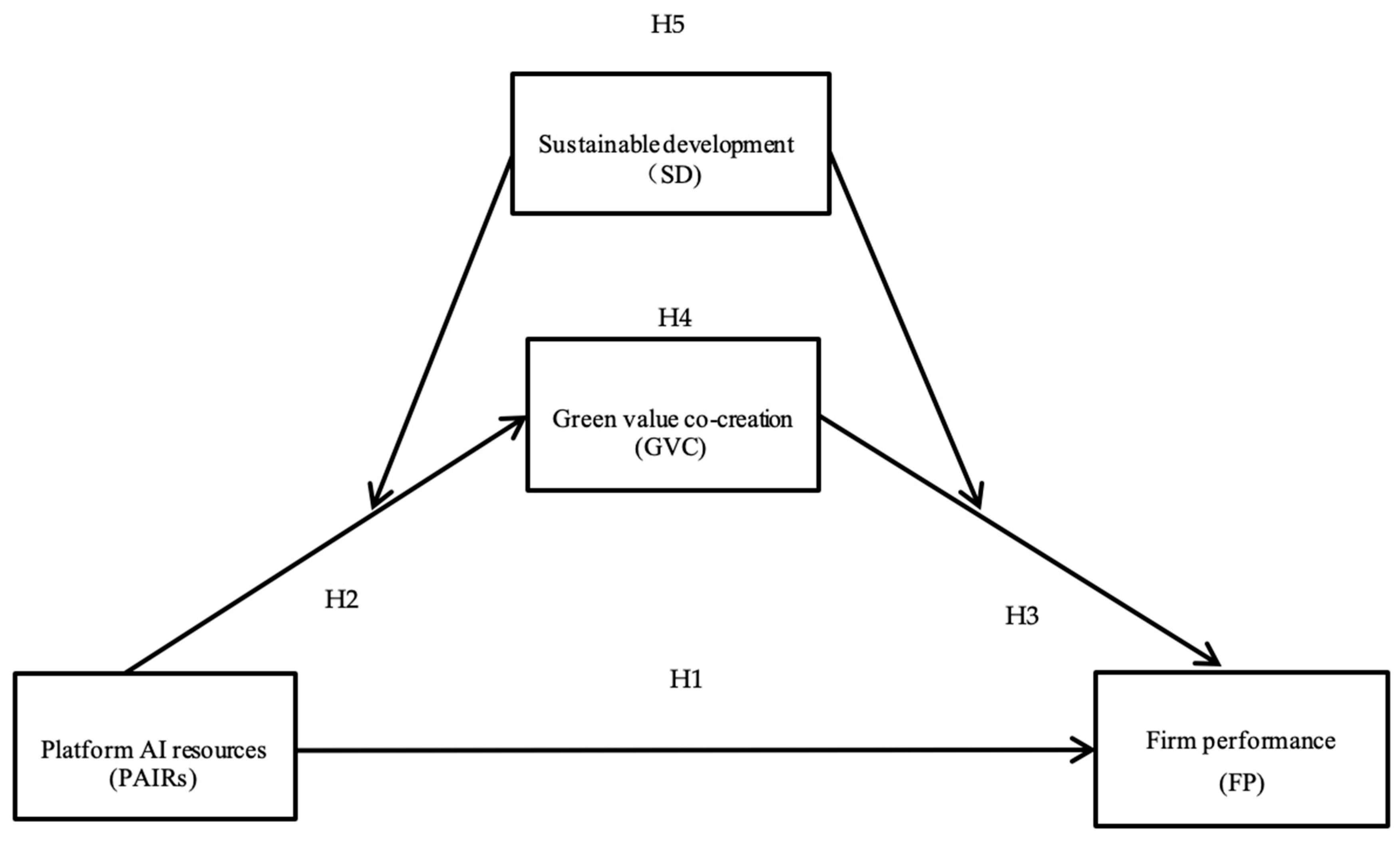
2.6. Conceptual Framework
3. Materials and Methods
3.1. Research Design and Theoretical Foundations
3.2. Measurement Instruments
3.3. Data Collection and Sample Profile
3.4. Data Analysis Procedures
3.5. Ethical Considerations
4. Results
4.1. Descriptive Statistical Analysis
4.2. Common Method Bias Testing
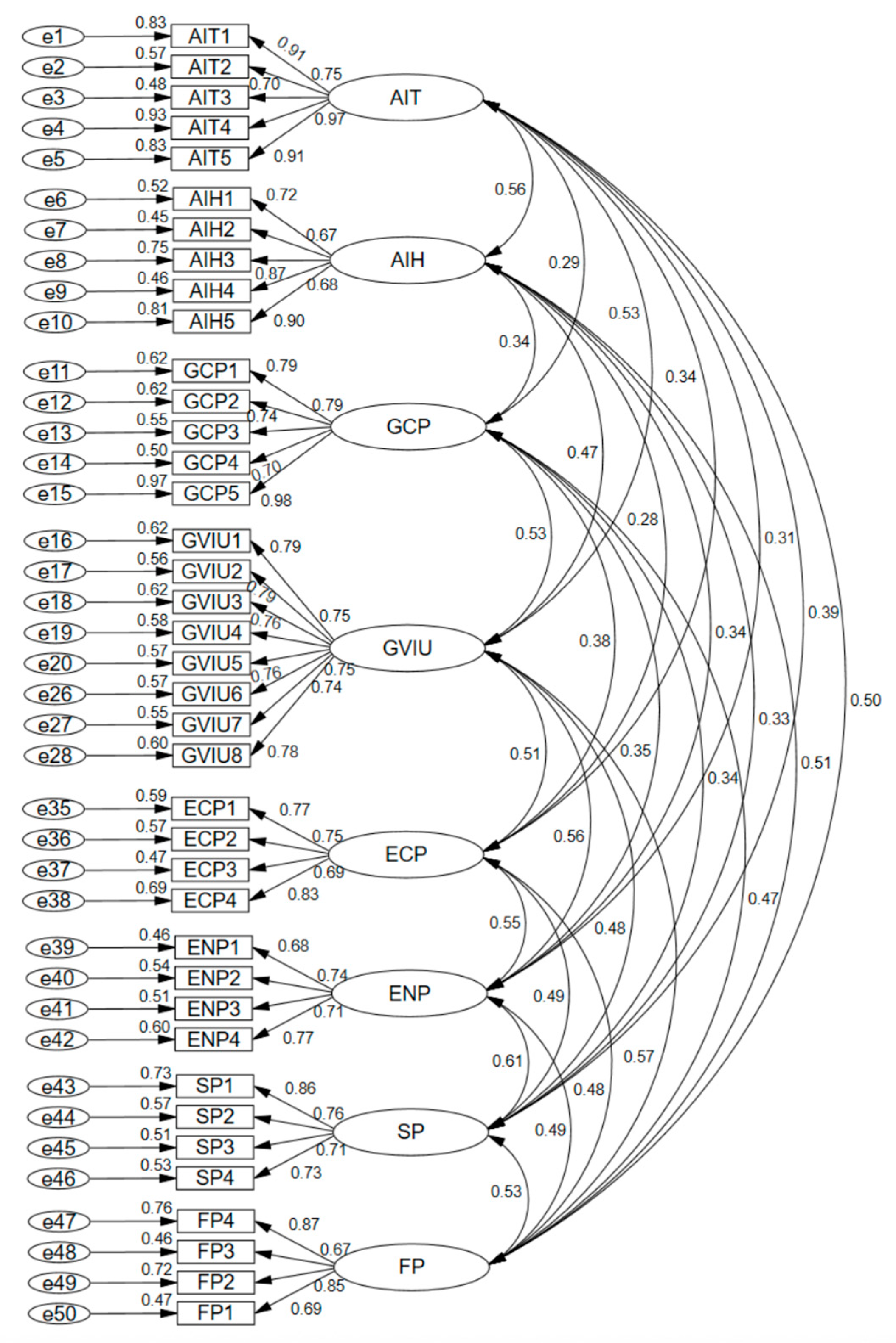
4.3. Reliability and Validity Analysis
4.4. Correlation Analysis
4.5. Regression Analysis
4.6. Mediation Effect
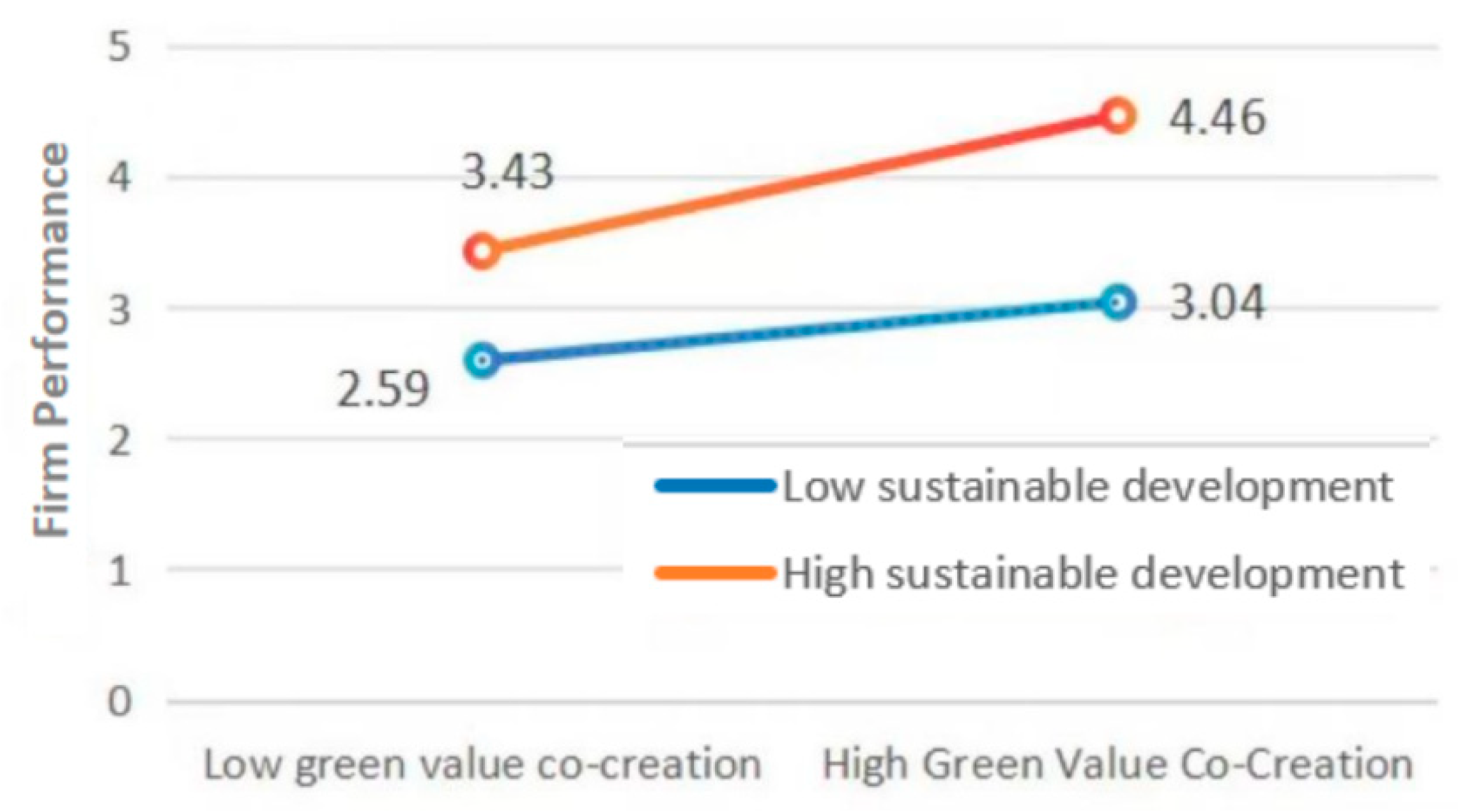
4.7. Moderation Effect
4.8. Insights into Psychological Mechanisms
5. Discussion
5.1. Theoretical Contributions
5.2. Practical Implications for Platform Managers
5.3. Policy Recommendations
6. Conclusions
7. Limitations and Future Research
Author Contributions
Funding
Institutional Review Board Statement
Informed Consent Statement
Data Availability Statement
Acknowledgments
Conflicts of Interest
Abbreviations
| PAIRs | Platform AI Resources |
| GVC | Green Value Co-creation |
| FP | Firm Performance |
| SD | Sustainable Development |
| RBV | Resource-Based View |
| TPB | Theory of Planned Behavior |
| SCT | Social Cognitive Theory |
| ESG | Environmental, Social, and Governance |
| XAI | Explainable Artificial Intelligence |
| EU | European Union |
| ASEAN | Association of Southeast Asian Nations |
Appendix A

| Constructs | Items | Sources |
|---|---|---|
| Firm performance | FP1: Green practices have increased our profitability. | [20] |
| FP2: Green practices have increased our operational efficiency. | ||
| FP3: Green practices have increased our market share. | ||
| FP4: Green practices have increased our sales. | ||
| Platform AI technology resources | AIT1: The platform has state-of-the-art AI devices and technologies. | [14,41,46] |
| AIT2: The platform has various types of specialized AI software or applications. | ||
| AIT3: The platform’s AI devices and technologies are constantly being upgraded and developed. | ||
| AIT4: The platform will continue to invest a large amount of money each year to promote the upgrading and development of AI technology or equipment. | ||
| AIT5: The platform’s AI technology or equipment has been widely used by the platform’s merchants. | ||
| Platform AI human resources | AIH1: The platform has a sufficient pool of AI-related talent. | [14,42,46] |
| AIH2: The platform’s AI experts have strong technical capabilities. | ||
| AIH3: The platform’s AI technology or management personnel can formulate technical solutions based on our business problems. | ||
| AIH4: The platform’s AI technology or management staff can ensure that the AI equipment, software, and programs are in good condition. | ||
| AIH5: The platform’s AI technology or management staff can ensure the normal operation of AI equipment, software, and programs. | ||
| Green co-production | GCP1: In the product development process, we are willing to share green suggestions with our partners. | [3,5] |
| GCP2: We are willing to spend time and effort to share our partners suggestions for improving green products or processes. | ||
| GCP3: We have easy access to information about our partners’ environmental preferences. | ||
| GCP4: We have aligned our practices with our partners’ environmental requirements. | ||
| GCP5: We consider ourselves as important as our partners in green product development. | ||
| Green value-in-use | GVIU1: In the green value development process, we have a good experience with our partners. | [3,5] |
| GVIU2: In the green value development process, we create different experiences by collaborating with our partners. | ||
| GVIU3: In the green value development process, we participate with our partners to make improvements through experimentation. | ||
| GVIU4: We participate with our partners to create green products that suit specific users and specific conditions of use. | ||
| GVIU5: We strive to meet the environmental needs of consumers. | ||
| GVIU6: In addition to the functional benefits of our products, we also provide a satisfying experience in terms of sustainability. | ||
| GVIU7: We help our partners participate in the green value development process. | ||
| GVIU8: Our reputation has improved as consumers positively rate our commitment to sustainability in social networks. | ||
| Environmental performance | ENP1: Does our company conduct regular environmental impact assessments? | [47] |
| ENP2: Have our production processes reduced the negative impact on the environment? | ||
| ENP3: Have we implemented effective waste management and recycling programs? | ||
| ENP4: Do we have clear goals for reducing energy consumption? | ||
| Social performance | SP1: Do we provide fair wages and benefits to our employees? | [47] |
| SP2: Are we actively involved in community service and charitable activities? | ||
| SP3: Do we ensure the safety and health of our workplace? | ||
| SP4: Do we offer career development opportunities for our employees? | ||
| Economic performance | ECP1: Does our financial performance meet the expected sustainable development goals? | [47] |
| ECP2: Have we managed the company’s resources effectively to achieve economic benefits? | ||
| ECP3: Have we maintained profitability while achieving sustainable development goals? | ||
| ECP4: Do we consider long-term sustainability in our economic decisions? |
References
- Huang, M.-H.; Rust, R.T. Artificial intelligence in service. J. Serv. Res. 2018, 21, 155–172. [Google Scholar] [CrossRef]
- Kaplan, A.; Haenlein, M. Siri, Siri, in my hand: Who is the fairest in the land? On the interpretations, illustrations, and implications of artificial intelligence. Bus. Horiz. 2019, 62, 15–25. [Google Scholar] [CrossRef]
- Huang, M.-H.; Rust, R.T. Artificial intelligence in service: A strategic framework. J. Acad. Mark. Sci. 2021, 49, 30–50. [Google Scholar] [CrossRef]
- Chang, C.H. Do green motives influence green product innovation? The mediating role of green value co-creation. Corp. Soc. Responsib. Environ. Manag. 2019, 26, 309–319. [Google Scholar] [CrossRef]
- Tian, H.-H.; Huang, S.-Z.; Cheablam, O. How green value co-creation mediates the relationship between institutional pressure and firm performance: A moderated mediation model. Bus. Strategy Environ. 2022, 31, 3309–3325. [Google Scholar] [CrossRef]
- Gillespie, N.; Lockey, S.; Ward, T.; Macdade, A.; Hassed, G. Trust, Attitudes and Use of Artificial Intelligence: A Global Study 2025; The University of Melbourne and KPMG: Melbourne, Australia, 2025. [Google Scholar] [CrossRef]
- Pew Research Center. How the U.S. Public and AI Experts View Artificial Intelligence. Available online: https://pewrsr.ch/3E6LmnE (accessed on 6 September 2025).
- Leal-Rodríguez, A.; Ariza-Montes, A.; Morales-Fernández, E.; AlbortMorant, G. Green innovation, indeed a cornerstone in linking market requests and business performance. Evidence from the Spanish automotive components industry. Technol. Forecast. Soc. Change 2018, 129, 185–193. [Google Scholar] [CrossRef]
- Clark, L.A.; Watson, D. Constructing validity: Basic issues in objective scale development. Psychol. Assess. 1995, 7, 309–319. [Google Scholar] [CrossRef]
- Ding, C.; Liu, C.; Zheng, C.; Li, F. Digital Economy, Technological Innovation and High-Quality Economic Development: Based on Spatial Effect and Mediation Effect. Sustainability 2022, 14, 216. [Google Scholar] [CrossRef]
- Bertini, M.; Koenigsberg, O. The Pitfalls of Pricing Algorithms: Be Mindful of How They Can Hurt Your Brand. Harv. Bus. Rev. 2021. Available online: https://hbr.org/2021/09/the-pitfalls-of-pricing-algorithms (accessed on 6 September 2025).
- Mikalef, P.; van de Wetering, R.; Krogstie, J. Building dynamic capabilities by leveraging big data analytics: The role of organizational inertia. Inf. Manag. 2021, 58, 103412. [Google Scholar] [CrossRef]
- O’Brien, L.V.; Meis, J.; Anderson, R.C.; Rizio, S.M.; Ambrose, M.; Bruce, G.; Critchley, C.R.; Dudgeon, P.; Newton, P.; Robins, G.; et al. Low carbon readiness index: A short measure to predict private low carbon behaviour. J. Environ. Psychol. 2022, 49, 102230. [Google Scholar] [CrossRef]
- Zhang, Y.; Sun, J.; Yang, Z.; Wang, Y. Critical success factors of green innovation: Technology, organization and environment readiness. J. Clean. Prod. 2021, 264, 121701. [Google Scholar] [CrossRef]
- Wang, K.; Bian, Y.; Cheng, Y. Exploring the spatial correlation network structure of green innovation efficiency in the Yangtze River Delta, China. Sustainability 2022, 14, 3903. [Google Scholar] [CrossRef]
- Barney, J. Firm resources and sustained competitive advantage. J. Manag. 1991, 17, 99–120. [Google Scholar] [CrossRef]
- Ajzen, I. The theory of planned behavior. Organ. Behav. Hum. Decis. Process. 1991, 50, 179–211. [Google Scholar] [CrossRef]
- Abu-Shanab, E.; Harb, Y. E-government research insights: Text mining analysis. Electron. Commer. Res. Appl. 2019, 38, 100892. [Google Scholar] [CrossRef]
- Huang, Y.-C.; Chen, C.T. Exploring institutional pressures, firm green slack, green product innovation and green new product success: Evidence from Taiwan’s high-tech industries. Technol. Forecast. Soc. Change 2022, 174, 121196. [Google Scholar] [CrossRef]
- Wang, M.-C.; Chen, P.-C.; Fang, S.-C. How environmental turbulence influences firms’ entrepreneurial orientation: The moderating role of network relationships and organizational inertia. J. Bus. Res. Indus. Mark. 2021, 36, 48–59. [Google Scholar] [CrossRef]
- Blum-Kusterer, M.; Hussain, S.S. Innovation and corporate sustainability: An investigation into the process of change in the pharmaceuticals industry. Bus. Strategy Environ. 2001, 10, 156–167. [Google Scholar] [CrossRef]
- Cialdini, R.B. Influence: The Psychology of Persuasion; William Morrow: New York, NY, USA, 1993. [Google Scholar]
- Cialdini, R.B.; Goldstein, N.J. Social influence: Compliance and conformity. Annu. Rev. Psychol. 2004, 55, 591–621. [Google Scholar] [CrossRef]
- Epstein, M.J.; Buhovac, A.R. Solving the sustainability implementation challenge. Organ. Dyn. 2010, 39, 306–315. [Google Scholar] [CrossRef]
- Montiel, I.; Delgado-Ceballos, J. Defining and measuring corporate sustainability: Are we there yet? Organ. Environ. 2014, 27, 113–139. [Google Scholar] [CrossRef]
- Baron, R.M.; Kenny, D.A. The moderator-mediator variable distinction in social psychological research: Conceptual, strategic, and statistical considerations. J. Pers. Soc. Psychol. 1986, 51, 1173–1182. [Google Scholar] [CrossRef] [PubMed]
- Aiken, L.S.; West, S.G. Multiple Regression: Testing and Interpreting Interactions; Sage Publications: Thousand Oaks, CA, USA, 1991. [Google Scholar]
- DiMaggio, P.J.; Powell, W.W. The iron cage revisited: Institutional isomorphism and collective rationality in organizational fields. Am. Sociol. Rev. 1983, 48, 147–160. [Google Scholar] [CrossRef]
- Larson, P.; Poist, R.F. Perspectives on logistics VS. SCM: A survey of SCM professionals. J. Bus. Logist. 2007, 28, 1–24. [Google Scholar] [CrossRef]
- Huang, Y.; Huang, C.-H.; Yang, M.-L. Drivers of green supply chain initiatives and performance. Int. J. Phys. Distrib. Logist. Manag. 2017, 47, 796–819. [Google Scholar] [CrossRef]
- Podsakoff, P.M.; MacKenzie, S.B.; Lee, J.-Y.; Podsakoff, N.P. Common method biases in behavioral research: A critical review of the literature and recommended remedies. J. Appl. Psychol. 2003, 88, 879–903. [Google Scholar] [CrossRef]
- Hair, J.F.; Black, W.C.; Babin, B.J.; Anderson, R.E. Multivariate Data Analysis: A Global Perspective; Pearson Education: New York, NY, USA, 2010. [Google Scholar]
- Kock, N. Media Richness or Media Naturalness? The Evolution of Our Biological Communication Apparatus and Its Influence on Our Behavior Toward E-Communication Tools. IEEE Trans. Prof. Commun. 2005, 48, 117–130. [Google Scholar] [CrossRef]
- Brown, T.J. Confirmatory Factor Analysis for Applied Research; Guilford Press: New York, NY, USA, 2022. [Google Scholar]
- Campbell, J.L. Why would corporations behave in socially responsible ways? An institutional theory of corporate social responsibility. Acad. Manag. Rev. 2007, 32, 946–967. [Google Scholar] [CrossRef]
- Wang, Y.; Wang, J.; Yao, T.; Li, M.; Wang, X. How does social support promote consumers’ engagement in the social commerce community? The mediating effect of consumer involvement. Inf. Process. Manag. 2020, 57, 102272. [Google Scholar] [CrossRef]
- Hatch, E.M. Research Design and Statistics for Applied Linguistics; Routledge: London, UK, 2021. [Google Scholar]
- Antonius, R. Interpreting Quantitative Data with SPSS; Sage Publications: London, UK, 2020. [Google Scholar]
- Wilson, D.S. Evolution for Everyone: How Darwin’s Theory Can Change the Way We Think About Our Lives; Delacorte Press: New York, NY, USA, 2019. [Google Scholar]
- Pongsakornrungsilp, S.; Pongsakornrungsilp, P.; Kumar, V.; Maswongssa, B. The art of survival: Tourism businesses in Thailand recovering from COVID-19 through brand management. Sustainability 2021, 13, 6690. [Google Scholar] [CrossRef]
- Vargo, S.L.; Lusch, R.F. Institutions and axioms: An extension and update of service-dominant logic. J. Acad. Mark. Sci. 2016, 44, 5–23. [Google Scholar] [CrossRef]
- Melville, N.; Kraemer, K.; Gurbaxani, V. Information technology and organizational performance: An integrative model of IT business value. MIS Q. 2004, 28, 283–322. [Google Scholar] [CrossRef]
- Massi, M.; Rod, M.; Corsaro, D. Is co-created value the only legitimate value? An institutional-theory perspective on business interaction in B2B-marketing systems. J. Bus. Ind. Mark. 2021, 36, 337–354. [Google Scholar] [CrossRef]
- Louis, D.; Lombart, C.; Durif, F. Packaging-free products: A lever of proximity and loyalty between consumers and grocery stores. J. Retail. Consum. Serv. 2021, 61, 102499. [Google Scholar] [CrossRef]
- Liakos, N.; Kumar, V.; Pongsakornrungsilp, S.; Garza-Reyes, J.A.; Gupta, B. Understanding circular economy awareness and practices in manufacturing firms. J. Enterp. Inf. Manag. 2019, 32, 563–584. [Google Scholar] [CrossRef]
- Bharadwaj, A. A resource-based perspective on information technology capability and firm performance: An empirical investigation. MIS Q. 2000, 24, 169–196. [Google Scholar] [CrossRef]
- Krajnc, D.; Glavič, P. A model for integrated assessment of sustainable development. Resour. Conserv. Recycl. 2005, 43, 189–208. [Google Scholar] [CrossRef]


| Dimensions | Factor | Min | Max | M | SD | Skewness | Kurtosis | Dimensional Mean |
|---|---|---|---|---|---|---|---|---|
| AITR | AIT1 | 1 | 5 | 3.78 | 1.270 | −0.818 | −0.481 | 3.63 |
| AIT2 | 1 | 5 | 3.71 | 1.260 | −0.765 | −0.377 | ||
| AIT3 | 1 | 5 | 3.79 | 1.220 | −0.710 | −0.442 | ||
| AIT4 | 1 | 5 | 3.42 | 1.275 | −0.559 | −0.770 | ||
| AIT5 | 1 | 5 | 3.48 | 1.215 | −0.549 | −0.566 | ||
| AIHR | AIH1 | 1 | 5 | 3.38 | 1.417 | −0.333 | −1.115 | 3.46 |
| AIH2 | 1 | 5 | 3.59 | 1.436 | −0.600 | −1.046 | ||
| AIH3 | 1 | 5 | 3.46 | 1.501 | −0.457 | −1.241 | ||
| AIH4 | 1 | 5 | 3.46 | 1.478 | −0.462 | −1.224 | ||
| AIH5 | 1 | 5 | 3.40 | 1.423 | −0.485 | −1.115 | ||
| GCP | GCP1 | 1 | 5 | 3.43 | 1.223 | −0.187 | −1.176 | 3.45 |
| GCP2 | 1 | 5 | 3.50 | 1.262 | −0.300 | −1.040 | ||
| GCP3 | 1 | 5 | 3.45 | 1.337 | −0.342 | −1.180 | ||
| GCP4 | 1 | 5 | 3.39 | 1.313 | −0.186 | −1.253 | ||
| GCP5 | 1 | 5 | 3.49 | 1.098 | −0.521 | −0.612 | ||
| GVIU | GVIU1 | 1 | 5 | 3.47 | 1.358 | −0.306 | −1.184 | 3.45 |
| GVIU2 | 1 | 5 | 3.52 | 1.325 | −0.330 | −1.197 | ||
| GVIU3 | 1 | 5 | 3.44 | 1.453 | −0.381 | −1.215 | ||
| GVIU4 | 1 | 5 | 3.47 | 1.490 | −0.502 | −1.161 | ||
| GVIU5 | 1 | 5 | 3.47 | 1.393 | −0.222 | −1.454 | ||
| GVIU6 | 1 | 5 | 3.48 | 1.411 | −0.488 | −1.001 | ||
| GVIU7 | 1 | 5 | 3.30 | 1.423 | −0.069 | −1.485 | ||
| GVIU8 | 1 | 5 | 3.43 | 1.294 | −0.397 | −0.928 | ||
| FP | FP1 | 1 | 5 | 3.52 | 1.314 | −0.360 | −1.005 | 3.57 |
| FP2 | 1 | 5 | 3.70 | 1.353 | −0.711 | −0.756 | ||
| FP3 | 1 | 5 | 3.67 | 1.318 | −0.599 | −0.880 | ||
| FP4 | 1 | 5 | 3.39 | 1.442 | −0.377 | −1.137 | ||
| ENP | ENP1 | 1 | 5 | 4.12 | 1.000 | −1.110 | 0.625 | 3.92 |
| ENP2 | 1 | 5 | 3.84 | 1.107 | −0.761 | −0.117 | ||
| ENP3 | 1 | 5 | 4.01 | 1.061 | −1.175 | 0.906 | ||
| ENP4 | 1 | 5 | 3.70 | 1.164 | −0.810 | 0.057 | ||
| SP | SP1 | 1 | 5 | 3.88 | 1.066 | −0.940 | 0.303 | 3.91 |
| SP2 | 1 | 5 | 3.91 | 1.116 | −1.048 | 0.409 | ||
| SP3 | 1 | 5 | 4.04 | 1.066 | −1.162 | 0.819 | ||
| SP4 | 1 | 5 | 3.80 | 1.119 | −0.765 | −0.230 | ||
| ECP | ECP1 | 1 | 5 | 3.91 | 1.104 | −1.068 | 0.685 | 3.94 |
| ECP2 | 1 | 5 | 3.93 | 1.054 | −1.086 | 0.857 | ||
| ECP3 | 1 | 5 | 3.96 | 1.042 | −0.990 | 0.620 | ||
| ECP4 | 1 | 5 | 3.97 | 1.084 | −1.073 | 0.697 |
| Component | Initial Eigenvalues | Extraction Sums of Squared Loadings | ||||
|---|---|---|---|---|---|---|
| Total | % of Variance | Cumulative % | Total | % of Variance | Cumulative % | |
| 1 | 13.455 | 34.500 | 34.500 | 13.455 | 34.500 | 34.500 |
| 2 | 3.193 | 8.187 | 42.686 | 3.193 | 8.187 | 42.686 |
| 3 | 2.542 | 6.517 | 49.203 | 2.542 | 6.517 | 49.203 |
| 4 | 2.070 | 5.307 | 54.510 | 2.070 | 5.307 | 54.510 |
| 5 | 1.664 | 4.266 | 58.776 | 1.664 | 4.266 | 58.776 |
| 6 | 1.611 | 4.131 | 62.907 | 1.611 | 4.131 | 62.907 |
| 7 | 1.358 | 3.483 | 66.390 | 1.358 | 3.483 | 66.390 |
| 8 | 1.179 | 3.022 | 69.413 | 1.179 | 3.022 | 69.413 |
| Construct | Item | Corrected Item –Total Correlation | Cronbach’s Alpha if Item Deleted | Cronbach’s α | |
|---|---|---|---|---|---|
| Platform AI resources | AI technology resources | AIT1 | 0.852 | 0.899 | 0.925 |
| AIT2 | 0.723 | 0.924 | |||
| AIT3 | 0.671 | 0.923 | |||
| AIT4 | 0.927 | 0.883 | |||
| AIT5 | 0.859 | 0.898 | |||
| AI human resources | AIH1 | 0.682 | 0.855 | 0.876 | |
| AIH2 | 0.621 | 0.869 | |||
| AIH3 | 0.769 | 0.834 | |||
| AIH4 | 0.644 | 0.864 | |||
| AIH5 | 0.819 | 0.822 | |||
| Green value co-creation | Green co-production | GCP1 | 0.721 | 0.874 | 0.894 |
| GCP2 | 0.696 | 0.880 | |||
| GCP3 | 0.704 | 0.879 | |||
| GCP4 | 0.703 | 0.879 | |||
| GCP5 | 0.902 | 0.839 | |||
| Green value-in-use | GVIU1 | 0.743 | 0.906 | 0.918 | |
| GVIU2 | 0.713 | 0.908 | |||
| GVIU3 | 0.753 | 0.905 | |||
| GVIU4 | 0.720 | 0.908 | |||
| GVIU5 | 0.722 | 0.908 | |||
| GVIU6 | 0.723 | 0.908 | |||
| GVIU7 | 0.713 | 0.909 | |||
| GVIU8 | 0.739 | 0.907 | |||
| Firm performance | Firm performance | FP1 | 0.658 | 0.833 | 0.856 |
| FP2 | 0.723 | 0.806 | |||
| FP3 | 0.656 | 0.833 | |||
| FP4 | 0.759 | 0.790 | |||
| Sustainable development | Environmental performance | ENP1 | 0.591 | 0.787 | 0.814 |
| ENP2 | 0.653 | 0.757 | |||
| ENP3 | 0.619 | 0.774 | |||
| ENP4 | 0.676 | 0.746 | |||
| Social performance | SP1 | 0.747 | 0.781 | 0.848 | |
| SP2 | 0.670 | 0.813 | |||
| SP3 | 0.651 | 0.821 | |||
| SP4 | 0.676 | 0.811 | |||
| Economic performance | ECP1 | 0.692 | 0.796 | 0.844 | |
| ECP2 | 0.665 | 0.808 | |||
| ECP3 | 0.615 | 0.828 | |||
| ECP4 | 0.745 | 0.772 | |||
| Total | 0.957 | ||||
| Statistical Test | χ2/df | RMSEA | IFI | TLI | CFI | GFI | AGFI |
|---|---|---|---|---|---|---|---|
| Adaptation criteria | 1~3 | <0.08 | >0.9 | >0.9 | >0.9 | >0.8 | >0.8 |
| Model values | 2.264 | 0.052 | 0.929 | 0.921 | 0.928 | 0.859 | 0.836 |
| Whether it meets the standards | yes | yes | yes | yes | yes | yes | yes |
| Construct | Item | Standard Load Factor | AVE | CR | Cronbach’s α |
|---|---|---|---|---|---|
| AI technology resources | AIT1 | 0.911 | 0.730 | 0.930 | 0.925 |
| AIT2 | 0.753 | ||||
| AIT3 | 0.696 | ||||
| AIT4 | 0.966 | ||||
| AIT5 | 0.913 | ||||
| AI human resources | AIH1 | 0.720 | 0.597 | 0.879 | 0.876 |
| AIH2 | 0.669 | ||||
| AIH3 | 0.866 | ||||
| AIH4 | 0.676 | ||||
| AIH5 | 0.902 | ||||
| Green co-production | GCP1 | 0.788 | 0.650 | 0.902 | 0.894 |
| GCP2 | 0.786 | ||||
| GCP3 | 0.742 | ||||
| GCP4 | 0.704 | ||||
| GCP5 | 0.983 | ||||
| Green value-in-use | GVIU1 | 0.787 | 0.585 | 0.918 | 0.918 |
| GVIU2 | 0.750 | ||||
| GVIU3 | 0.786 | ||||
| GVIU4 | 0.762 | ||||
| GVIU5 | 0.756 | ||||
| GVIU6 | 0.752 | ||||
| GVIU7 | 0.745 | ||||
| GVIU8 | 0.777 | ||||
| Environmental performance | ENP1 | 0.677 | 0.526 | 0.816 | 0.814 |
| ENP2 | 0.737 | ||||
| ENP3 | 0.712 | ||||
| ENP4 | 0.773 | ||||
| Social performance | SP1 | 0.856 | 0.586 | 0.849 | 0.848 |
| SP2 | 0.758 | ||||
| SP3 | 0.712 | ||||
| SP4 | 0.727 | ||||
| Economic performance | ECP1 | 0.768 | 0.579 | 0.846 | 0.844 |
| ECP2 | 0.754 | ||||
| ECP3 | 0.686 | ||||
| ECP4 | 0.830 | ||||
| Firm performance | FP1 | 0.688 | 0.602 | 0.857 | 0.856 |
| FP2 | 0.847 | ||||
| FP3 | 0.675 | ||||
| FP4 | 0.873 |
| Variable | AIT | AIH | GCP | GVIU | ECP | ENP | SP | FP |
|---|---|---|---|---|---|---|---|---|
| AIT | 0.854 | |||||||
| AIH | 0.558 | 0.773 | ||||||
| GCP | 0.289 | 0.338 | 0.806 | |||||
| GVIU | 0.530 | 0.472 | 0.534 | 0.765 | ||||
| ECP | 0.335 | 0.283 | 0.382 | 0.507 | 0.761 | |||
| ENP | 0.309 | 0.335 | 0.346 | 0.564 | 0.551 | 0.725 | ||
| SP | 0.389 | 0.326 | 0.335 | 0.478 | 0.487 | 0.610 | 0.766 | |
| FP | 0.503 | 0.515 | 0.468 | 0.572 | 0.478 | 0.490 | 0.534 | 0.776 |
| AVE | 0.730 | 0.597 | 0.650 | 0.585 | 0.579 | 0.526 | 0.586 | 0.602 |
| Average | Standard Deviation | 1 | 2 | 3 | 4 | 5 | 6 | 7 | 8 | 9 | 10 | 11 | |
|---|---|---|---|---|---|---|---|---|---|---|---|---|---|
| 1. AI technical resources | 3.63 | 1.095 | 1 | ||||||||||
| 2. AI human resources | 3.46 | 1.187 | 0.567 ** | 1 | |||||||||
| 3. Platform AI resources | 3.55 | 1.010 | 0.875 ** | 0.895 ** | 1 | ||||||||
| 4. Green co-production | 3.45 | 1.046 | 0.314 ** | 0.339 ** | 0.369 ** | 1 | |||||||
| 5. Green value-in-use | 3.45 | 1.111 | 0.523 ** | 0.446 ** | 0.546 ** | 0.512 ** | 1 | ||||||
| 6. Green value co-creation | 3.45 | 0.955 | 0.507 ** | 0.462 ** | 0.546 ** | 0.788 ** | 0.932 ** | 1 | |||||
| 7. Environmental performance | 3.92 | 0.869 | 0.295 ** | 0.321 ** | 0.349 ** | 0.319 ** | 0.492 ** | 0.487 ** | 1 | ||||
| 8. Social performance | 3.91 | 0.905 | 0.348 ** | 0.285 ** | 0.356 ** | 0.332 ** | 0.421 ** | 0.441 ** | 0.512 ** | 1 | |||
| 9. Economic performance | 3.94 | 0.884 | 0.319 ** | 0.256 ** | 0.323 ** | 0.336 ** | 0.454 ** | 0.467 ** | 0.467 ** | 0.415 ** | 1 | ||
| 10. Sustainable development | 3.92 | 0.710 | 0.400 ** | 0.358 ** | 0.427 ** | 0.410 ** | 0.568 ** | 0.579 ** | 0.819 ** | 0.806 ** | 0.782 ** | 1 | |
| 11. Firm performance | 3.57 | 1.134 | 0.479 ** | 0.453 ** | 0.525 ** | 0.477 ** | 0.523 ** | 0.576 ** | 0.430 ** | 0.471 ** | 0.423 ** | 0.551 ** | 1 |
| Firm Performance | Green Value Co-Creation | Firm Performance | ||||
|---|---|---|---|---|---|---|
| β | t | β | t | β | t | |
| Industry | 0.064 | 1.621 | 0.069 | 1.818 | 0.027 | 0.707 |
| Platform | −0.021 | −0.535 | −0.013 | −0.347 | −0.002 | −0.057 |
| Firm size | −0.026 | −0.564 | −0.020 | −0.444 | 0.008 | 0.175 |
| Firm age | 0.030 | 0.643 | 0.022 | 0.484 | −0.018 | −0.393 |
| Location | 0.034 | 0.868 | 0.033 | 0.857 | 0.049 | 1.274 |
| PAIRs | 0.527 | 13.310 *** | ||||
| PAIRs | 0.578 | 15.183 *** | ||||
| GVC | 0.563 | 14.553 *** | ||||
| R2 | 0.282 | 0.338 | 0.319 | |||
| Adjusted R-squared | 0.273 | 0.329 | 0.310 | |||
| F | 30.068 *** | 39.007 *** | 35.871 *** | |||
| Green Value Co-Creation | Firm Performance | Firm Performance | ||||
|---|---|---|---|---|---|---|
| β | t | β | t | β | t | |
| Interaction term | −0.023 | −0.594 | 0.064 | 1.621 | 0.074 | 2.038 * |
| Industry | −0.012 | −0.298 | −0.021 | −0.535 | −0.016 | −0.452 |
| Platform | −0.020 | −0.437 | −0.026 | −0.564 | −0.018 | −0.422 |
| Firm size | 0.018 | 0.393 | 0.030 | 0.643 | 0.023 | 0.528 |
| Firm age | 0.009 | 0.228 | 0.034 | 0.868 | 0.031 | 0.848 |
| PAIRs | 0.545 | 13.932 *** | 0.527 | 13.310 *** | 0.302 | 6.995 *** |
| GVC | 0.413 | 9.563 *** | ||||
| R2 | 0.300 | 0.282 | 0.402 | |||
| Adjusted R-squared | 0.290 | 0.273 | 0.392 | |||
| F | 32.727 *** | 30.068 *** | 43.916 *** | |||
| B | Se | t | p | LLCI | ULCI | R2 | F | |
|---|---|---|---|---|---|---|---|---|
| Constant | 3.380 | 0.174 | 19.414 | 0.000 | 3.038 | 3.722 | 0.419 | 41.205 *** |
| GVC | 0.388 | 0.058 | 6.733 | 0.000 | 0.275 | 0.501 | ||
| SD | 0.796 | 0.116 | 6.855 | 0.000 | 0.568 | 1.024 | ||
| Interaction term | 0.218 | 0.074 | 2.936 | 0.003 | 0.072 | 0.363 | ||
| Industry | 0.053 | 0.026 | 2.022 | 0.044 | 0.002 | 0.105 | ||
| Platform | −0.001 | 0.030 | −0.024 | 0.981 | −0.060 | 0.059 | ||
| Firm size | −0.037 | 0.044 | −0.829 | 0.408 | −0.123 | 0.050 | ||
| Firm age | 0.030 | 0.037 | 0.818 | 0.414 | −0.043 | 0.103 | ||
| Location | −0.003 | 0.027 | −0.103 | 0.918 | −0.056 | 0.051 |
| Sustainable Development | B | Se | t | p | LLCI | ULCI |
|---|---|---|---|---|---|---|
| −0.710 | 0.233 | 0.093 | 2.506 | 0.013 | 0.050 | 0.417 |
| 0.000 | 0.388 | 0.058 | 6.733 | 0.000 | 0.275 | 0.501 |
| 0.710 | 0.543 | 0.059 | 9.153 | 0.000 | 0.426 | 0.659 |
Disclaimer/Publisher’s Note: The statements, opinions and data contained in all publications are solely those of the individual author(s) and contributor(s) and not of MDPI and/or the editor(s). MDPI and/or the editor(s) disclaim responsibility for any injury to people or property resulting from any ideas, methods, instructions or products referred to in the content. |
© 2025 by the authors. Licensee MDPI, Basel, Switzerland. This article is an open access article distributed under the terms and conditions of the Creative Commons Attribution (CC BY) license (https://creativecommons.org/licenses/by/4.0/).
Share and Cite
Sun, Y.; Pongsakornrungsilp, S.; Pongsakornrungsilp, P.; Tonsakunthaweeteam, S.; Wongwaropakorn, W.; Chinchanachokchai, S. Platform AI Resources and Green Value Co-Creation: Paving the Way for Sustainable Firm Performance in the Digital Age. Sustainability 2025, 17, 8058. https://doi.org/10.3390/su17178058
Sun Y, Pongsakornrungsilp S, Pongsakornrungsilp P, Tonsakunthaweeteam S, Wongwaropakorn W, Chinchanachokchai S. Platform AI Resources and Green Value Co-Creation: Paving the Way for Sustainable Firm Performance in the Digital Age. Sustainability. 2025; 17(17):8058. https://doi.org/10.3390/su17178058
Chicago/Turabian StyleSun, Yan, Siwarit Pongsakornrungsilp, Pimlapas Pongsakornrungsilp, Sasawalai Tonsakunthaweeteam, Wari Wongwaropakorn, and Sydney Chinchanachokchai. 2025. "Platform AI Resources and Green Value Co-Creation: Paving the Way for Sustainable Firm Performance in the Digital Age" Sustainability 17, no. 17: 8058. https://doi.org/10.3390/su17178058
APA StyleSun, Y., Pongsakornrungsilp, S., Pongsakornrungsilp, P., Tonsakunthaweeteam, S., Wongwaropakorn, W., & Chinchanachokchai, S. (2025). Platform AI Resources and Green Value Co-Creation: Paving the Way for Sustainable Firm Performance in the Digital Age. Sustainability, 17(17), 8058. https://doi.org/10.3390/su17178058