Article

Perception of University Faculty Members on Providing Policy Recommendations for Disaster Risk Reduction and Sustainable Development: A Case Study of Aceh Province, Indonesia


1
International Research Institute of Disaster Science, Tohoku University, 468-1 Aoba Aramaki, Aoba, Sendai 980-8572, Japan
2
Graduate School of Mathematics and Applied Sciences, Universitas Syiah Kuala, Banda Aceh 23111, Indonesia
3
Department of Statistics, Faculty of Mathematics and Natural Sciences, Universitas Syiah Kuala, Darussalam, Banda Aceh 23111, Indonesia
*
Author to whom correspondence should be addressed.
Sustainability 2025, 17(17), 8033; https://doi.org/10.3390/su17178033
Submission received: 5 June 2025 / Revised: 19 August 2025 / Accepted: 28 August 2025 / Published: 6 September 2025

Abstract

The Sendai Framework for Disaster Risk Reduction 2015–2030 articulates the need for a clear understanding of responsibilities across public and private stakeholders, including academia. This study aimed to clarify how university faculty members in Aceh Province, Indonesia, devastated by the 2004 Aceh Tsunami, perceive the role of universities in suggesting policy recommendations for disaster risk reduction (DRR) and sustainable development, and their perspective on the relationship between those roles and the main functions of universities. A questionnaire survey was conducted with 400 respondents in Aceh Province from July 2023 to November 2023. The authors examined descriptive statistics, followed by Kruskal–Wallis tests and structural equation modeling (SEM). The authors found that most university faculty members were optimistic about the role of universities in providing policy recommendations for DRR. Furthermore, interest in DRR activities and relevant past experiences may influence their perception of these roles. The SEM analysis showed that faculty members perceive universities as key contributors to DRR policy recommendations. Based on the above, the authors posit that universities must adopt measures that empower faculty members to gain interest and experience in DRR activities. Steady progress in the main functions of universities is essential for articulating DRR policy recommendations.

1. Introduction

In March 2015, the Third United Nations World Conference on Disaster Risk Reduction (UNWCDRR), held in Sendai, Japan, adopted the Sendai Framework for Disaster Risk Reduction 2015–2030 (SFDRR). According to the UN International Strategy for Disaster Reduction [1], the guiding principles outlined in the SFDRR articulate the need for clearly communicating responsibilities across public and private stakeholders, including academia. One of the priorities for the action of the SFDRR is “Understanding disaster risk” (Priority 1), which explains the importance of science and technology in disaster risk reduction (DRR).
Aceh Province’s vulnerability to disasters is compounded by its unique geological setting. The region lies near the Sunda Trench, a subduction zone between the Australian and Eurasian plates, making it prone to earthquakes, tsunamis, and volcanic activity. Previous seismic events, including the 2004 Sumatra–Andaman Earthquake, which triggered the Aceh Tsunami (which caused widespread devastation and claimed 167,000 lives in the province), left a profound impact on the province, displacing thousands and disrupting communities [2,3,4].
These events underscore the urgent need for comprehensive disaster risk reduction and recovery strategies. Post-tsunami recovery efforts highlighted the critical role of local academic institutions, particularly Universitas Syiah Kuala (USK). Following the disaster, USK took on several crucial tasks, including leading research and data collection on disaster impacts, designing and implementing community-based disaster preparedness programs, and providing policy recommendations to local and national governments. The Tsunami and Disaster Mitigation Research Center (TDMRC) at USK played a pivotal role in coordinating interdisciplinary research efforts, producing detailed risk assessments, and developing disaster risk management strategies tailored to local needs. USK also collaborated with international agencies such as the United Nations Development Programme, contributing to the development of national resilience strategies. These efforts aligned with Indonesia’s Tri Dharma principles, emphasizing universities’ roles in research, education, and community service [5].
In this study, the authors sought to clarify how university faculty members in Aceh Province perceive the role of universities in articulating DRR-related policy recommendations and their perspective on the relationship between these roles and universities’ main functions. The study was conducted as part of the “Toward the Utilization of the Intermediate Function of Local Academic Institutions in the Field of Disaster Risk Reduction in Indonesia” research project and funded by the Grants-in-Aid for Scientific Research (KAKENHI) (Principal Investigator: Daisuke Sasaki). The questionnaire surveys, focusing on university faculty members’ perception of the role of universities in policy recommendations in DRR and other contributions, were conducted in Aceh Province and the western part of Java. This study analyzed the results of a survey conducted in Aceh Province, whereas Nakayama et al. [6] surveyed the western part of Java.
Chen and Adefila [7] have introduced university engagement for effective DRR education and recommended that the higher education sector develop models to enable universities to participate in collaborative networks that facilitate a more effective approach to DRR education. Meanwhile, Albris et al. [8] have noted that science and policy often operate in distinct domains with competing interests and differing modes of valuing knowledge. Weichselgartner and Pigeon [9] have also mentioned that knowledge production and implementation processes are rarely addressed extensively and systematically in disaster research and policy programs. However, the processes of knowledge production and implementation are critical to DRR. Thus, previous studies have clarified how universities can play a role in DRR education, as well as the relevant gaps between science and policy. In contrast, very few studies have focused on the perception of individual university faculty members.
Satake et al. [10] introduced the following description as one of the recommendations summarized after the Global Forum on Science and Technology for Disaster Resilience in Tokyo in November 2017: “In collaboration with the scientific community, disaster management authorities at regional, national, sub-national, and local levels should be engaged in the development of commonly agreed upon and standardized formulations for collection, analysis, management, application, and evaluation of disaster-related data, information, lessons learned, and best practices that can be shared and used for both research and policymaking purposes, based on the contexts of global indices and terminologies derived from the SFDRR.” Furthermore, several previous studies, such as those by Hiwasaki et al. [11] and Spiekermann et al. [12], have also explored these roles. Existing literature has highlighted the role of universities in DRR. Ahmad [13] stated that universities need to be involved in all the phases of the disaster cycle because they are charged with contributing broadly to society. Nomura et al. [14] emphasized that academic, scientific, and research entities should understand disaster risks, not only during the acute phase but also in the medium and long term, and facilitate applied research nationally and locally.
Scholars have also discussed the collaboration between academia and other sectors. Based on discussions at the UNWCDRR public forum by the Association of Pacific Rim Universities and the International Research Institute of Disaster Science at Tohoku University, Izumi [15] suggested enhancing multisectoral collaboration to make data and technologies useful, usable, and accessible. Richards et al. [16] investigated the disaster response after Hurricane Katrina, focusing on a model for an academic–community partnership in Mississippi, United States (US). Dunlop et al. [17,18] also examined the role and engagement of academic institutions in the community in response to disasters declared by the Federal Emergency Management Agency in the US. They concluded that the participation of academic institutions in community disaster responses had contributed a broad range of resources to community resilience. Some previous studies examined the roles of universities in terms of their security. For instance, Tanner and Doberstein [19] examined emergency preparedness among students at the University of Waterloo in Canada. Baytiyeh and Naja [20] investigated the impact of college programs on students’ disaster preparedness levels in Lebanon. Gibbs et al. [21] noted that new questions posed challenges to universities as they sought to ensure their safety, while also addressing their social mission. Meanwhile, some studies have investigated the barriers to research and innovation in disaster resilience within higher education institutions, including universities in Asia, as noted by Liyanage et al. [22].
Regarding Asian cases examining the role of academic partnerships in disaster risk management, Seifi et al. [23] introduced several previous studies focusing on Asian cases through a systematic review of the existing literature. Abedin and Shaw [24] clarified the role of university networks in DRR from the perspective of coastal Bangladesh. Hirunsalee et al. [25] conducted a case study of Thammasat University during the 2011 flood in Thailand, reviewing public attitudes toward the additional roles of universities in disaster management.
In the Indonesian context, previous studies, such as those by Chang Seng [26], Shannon et al. [27], and Darmawan et al. [28], explored the application of existing scientific knowledge to enable academia to play a more practical role in DRR. Hesti and Markos [29] underscores the benefits of Student Community Service Programs (“Kuliah Kerja Nyata” or KKN) in Indonesian higher education institutions for multiple stakeholders and considers that promoting community service in higher education would serve as an effective means of engaging university faculty members and students in disaster preparedness and community development. Tinggi [28] examines whether a collaborative program between Lecturer’s Community Service (PKM) and Student’s Community Service (KKN) at the State College of Meteorology, Climatology, and Geophysics (STMKG) in South Tangerang is effective or not. The author concludes that integrating community service efforts among university faculty members and students could be more effective in terms of activities, funding, and time consumption. Hanafi et al. [30] conducted a case study examining Mataram University’s involvement in the recovery process following the 2018 Lombok earthquakes. The authors emphasize the university’s role in catalyzing community recovery, underscoring the importance of collaboration among academic institutions, government agencies, and local communities during the disaster recovery phase. Rizal [31] conducted a holistic review of the role of universities in disaster management and recovery from the 2004 Aceh Tsunami. The author focused on how USK—the largest public university in Banda Aceh, which was significantly affected by the disaster—played a critical role in the province’s recovery process, accumulation of disaster knowledge, and DRR education. Syamsidik et al. [32] examined the recovery process assessments jointly conducted by the TDMRC at USK and other actors, i.e., the United Nations Development Program and the Aceh Provincial Disaster Management Agency. Sasaki et al. [33] assessed the intermediate function of universities during the disaster rehabilitation and reconstruction phases.
Based on the above literature review, the authors found that there are very few studies focusing on the perception of university faculty members on providing policy recommendations for DRR and sustainable development from a quantitative perspective. In this context, this study statistically investigates how university faculty members in Aceh Province perceive the role of universities in articulating policy recommendations in DRR and their perspective on the relationship between these roles and universities’ primary functions. This finding provides new insights into the literature.
This article comprises five sections. Section 2 describes the study area and the questionnaire survey design conducted in this study. Section 3 outlines the results, followed by a discussion in Section 4. Finally, Section 5 concludes the article.

2. Materials and Methods

2.1. Study Area

Aceh is an autonomous province in Indonesia, located in the northern part of the island of Sumatra. It spans 57,956 km2, with a population of approximately 4 million people. The Indian Ocean borders it to the west and north, and the Strait of Malacca to the east. The province has a tropical rainforest climate, with hot weather all year round and average monthly temperatures that vary between 26 and 28 degrees Celsius. The annual mean precipitation is approximately 2000 mm. The rainy season lasts from October to January, and there is no dry season. It is subdivided into 18 regencies (Kabupaten) and five cities (Kota).
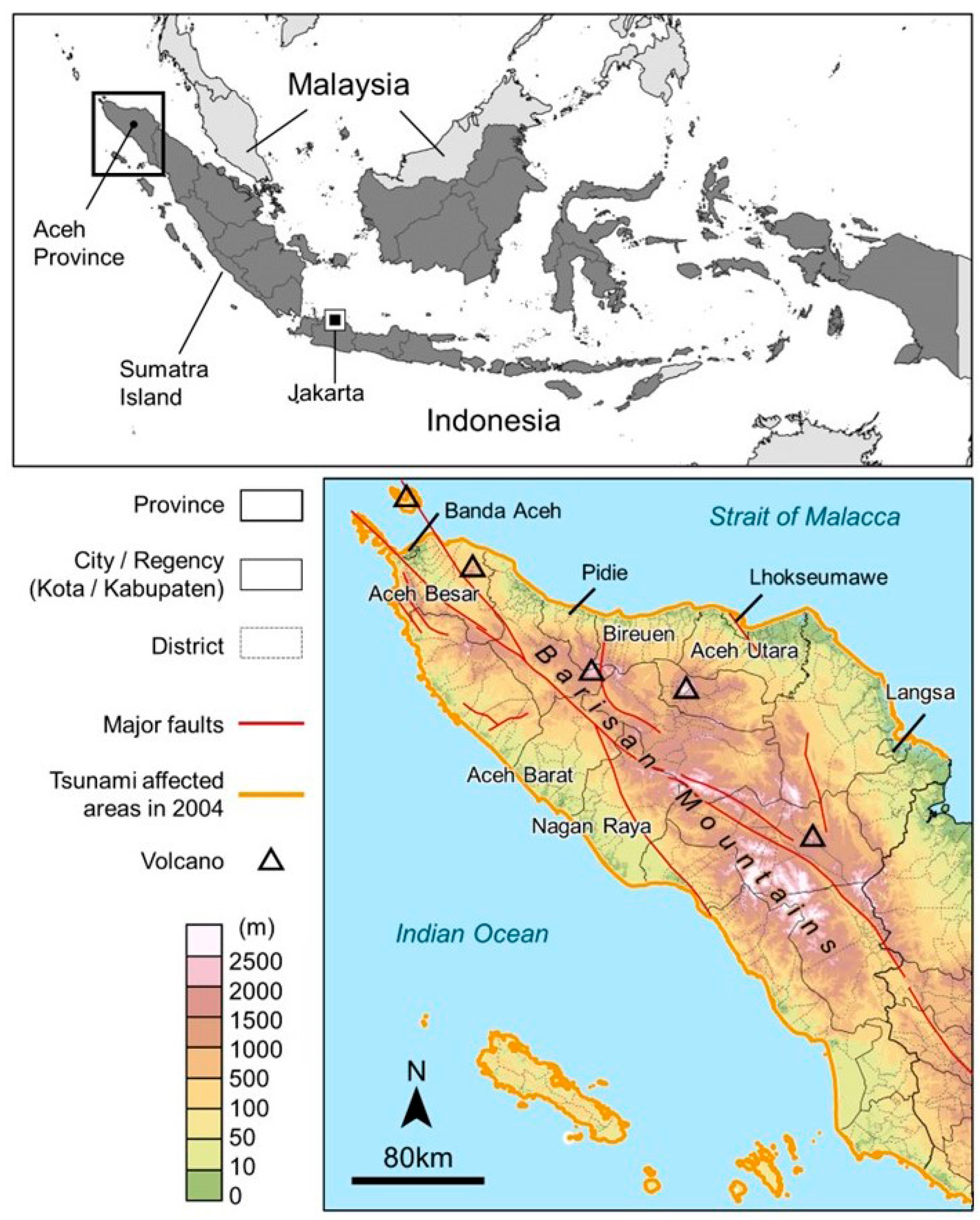
The island of Sumatra, where the Aceh Province is located, is at the boundary between the Australian and Eurasian plates, and the Sunda Trench runs parallel to the island’s west coast [34]. As a result, Sumatra is a region of orogenic activity, with the Barisan Mountains extending from north to south, aligned with active faults and several volcanoes [35,36]. The mountains in Aceh are over 2500 m high. The center of the northern edge of Aceh Province, which is sandwiched between fault lines, is flat, and the Aceh River flows from the southern mountain. The estuary and delta plains are low-lying areas in Banda Aceh City [37]. The Alue Naga Floodway Canal was constructed upstream just before it entered the city territory to mitigate the risk of flooding in urban areas [37]. Aceh Province is vulnerable to various disasters, including floods, landslides, earthquakes, volcanic eruptions, and tsunamis.
Additionally, rapid urbanization and unplanned urban sprawl render cities more vulnerable to floods and earthquakes [38]. Over 500 families were evacuated as the Kabupaten Aceh Besar’s heavily populated districts were affected by the most recent flood catastrophe in 2021 [39]. Urbanization in Banda Aceh has also introduced challenges, including inadequate drainage systems, which exacerbate flood risks. The Alue Naga Floodway Canal, constructed post-2004, exemplifies infrastructure interventions to mitigate such hazards.
Although the Acehnese comprise approximately 90% of the Aceh population, 12 ethnic groups and subgroups reside there. The coastal plains, including Banda Aceh City, are inhabited by the Acehnese; however, there are some areas on the west coast where the Minangkabau are the majority. Other ethnic groups, such as the Gayo, Alas, Singkil, Simeulue, and Nias, live in the mountainous region and remote islands, while the hinterlands are sparsely populated [40]. Each ethnic group has its local language. Paddy rice cultivation thrives in the plains, whereas coffee and cacao are grown in the mountains. The ethnic diversity in Aceh shapes localized disaster responses. Indigenous knowledge, such as the Smong tradition on Simeulue Island, has been integrated into modern DRR frameworks.
This study selected nine cities (Kota) and regencies (Kabupaten) as the target sites based on their geographic distribution across Aceh Province and their relevance to disaster risk profiles (e.g., coastal vs. mountainous regions) as shown in Figure 1. These areas are home to major universities where the surveyed faculty members are employed or reside. Additionally, these regions were heavily impacted by the 2004 Aceh Tsunami, which shaped their institutional and community engagement in DRR. This selection ensures the representation of diverse disaster risks (e.g., floods, earthquakes, tsunamis) and academic contributions across Aceh’s urban and rural landscapes. The list of selected cities and regencies is shown in Table 1.

2.2. Design of the Questionnaire Survey

In this study, a questionnaire survey was conducted in Aceh Province from July 2023 to November 2023. Concerning previous studies, such as those by Sasaki et al. [44], all respondents were recruited using a snowball sampling approach. Before employing snowball sampling, purposive sampling was utilized to identify the initial group of university faculty members. This purposive sampling targeted faculty members in Aceh Province directly impacted by the 2004 Tsunami, with a particular focus on USK. The institutions were selected based on their documented involvement in DRR initiatives following the 2004 disaster, including USK’s TDMRC, ensuring that the sample aligned with the study’s emphasis on academic institutions influencing policy in the realm of DRR. From this initial cohort, snowball sampling was employed to recruit additional participants through referrals, thereby expanding the sample size to 400 respondents, with a focus on faculty directly involved in DRR-related academic activities. In this research, university faculty members refer to those engaged in academic activities, excluding administrative personnel or support staff. This distinction ensures that this study focuses on the perspectives of individuals directly involved in knowledge production and academic discourse on DRR, as aligned with the core functions under Indonesia’s Tri Dharma principle, which emphasizes research, education, and community service. By focusing on faculty members, the study captures the academic and policy-related roles directly influencing DRR strategies. An initial group of university faculty members was identified and invited to participate in identifying a target sample. These participants were then asked to refer their colleagues within their academic network, facilitating the recruitment of 400 respondents. This approach allowed us to include university faculty members from different fields, ensuring diverse perspectives on DRR. Data were collected online and offline, with 200 respondents completing the questionnaire online and 200 participating offline, ensuring broader accessibility and data quality.
The sample size of 400 was determined using Cochran’s formula for binomial proportion sampling, a method commonly employed to estimate sample sizes in survey research. The formula is given by
n = Z 2 p 1 p e 2
where Z = 1.96 (representing a 95% confidence level), p = 0.5 (maximum variability), and e = 0.05 (the margin of error). Using these values, the calculation yielded a required sample size of 384, which was rounded up to 400 to account for potential subgroup analyses. Cochran’s formula for sample size calculation is primarily designed for infinite or large populations, where the population size is not a limiting factor in determining the sample size. While it can be adjusted for finite populations, its core application and most accurate results are achieved when dealing with a large or effectively unlimited number of sampling units.
The questionnaire included 16 questions about personal attributes, 32 main questions, and a few prescreening questions that verified the respondent’s qualifications (see Appendix A for details). All the questions were presented in Bahasa Indonesia (the national language of Indonesia). Of the 16 attribute questions (P4–10), 7 were scored on a five-point Likert scale ranging from Never (0), Little (1), Somewhat (2), and Much (3), to A great deal (4). Question P11 was scored on an eight-point Likert scale ranging from Less than 1 year (0), 1–2 years (1), 2–3 years (2), 3–4 years (3), 4–5 years (4), 5–6 years (5), and 6–7 years (6), to More than 7 years (7). All 32 main questions were scored on a five-point Likert scale ranging from Strongly disagree (0), Disagree (1), Neither agree nor disagree (2), and Agree (3), to Strongly agree (4). In this study, the authors assumed the following two questions as response variables because they were directly associated with the role of universities in articulating policy recommendations for central/local governments: “Faculty members of universities provide advice on policymaking for local or central governments about DRR.” (K20) and “Faculty members of universities assist in monitoring and evaluating plans, policies and measures about DRR for local or central government.” (K21). In the research, the authors analyzed how other variables are related to these two response variables, enabling us to clarify influential factors.
A reliability test was conducted with 12 university faculty members, each of whom is an expert in disaster-related research, ensuring clarity and validity. These experts included active university faculty members, researchers, and academics specializing in disaster management, environmental sciences, and public policy, all with extensive experience in DRR. Their academic roles involve participation in research projects, publications, and teaching related to DRR, ensuring that their feedback is highly relevant and valuable. The participants were asked to review the questionnaire and provide feedback on the clarity, appropriateness, and overall comprehensibility of the questions. Based on their responses, several adjustments were made to improve the questionnaire’s wording, structure, and clarity. This expert review process contributed to refining the questionnaire, ensuring it accurately captured the perspectives of university faculty members on DRR. The structured design and use of Likert-scale responses further supported consistency in measurement. As the primary focus of our study was to capture the expert-driven relevance and comprehensiveness of the questions, the authors prioritized content validity over statistical validity measures such as Cronbach’s α or exploratory factor analysis. This approach allowed us to ensure that the questionnaire’s items were appropriate and meaningful for the context of DRR. The authors also referred to relevant previous studies conducted in Indonesia, such as that by Harapan et al. [45].
First, descriptive statistics were examined to determine the overall trend in the results. Second, Kruskal–Wallis tests were conducted to elucidate factors that significantly influence university faculty members’ perception of the role of universities in suggesting policy recommendations for DRR. The authors detected statistically significant combinations with 13 attribute questions (JK, US, PD, PR, TT, P4–11) for all 32 main questions at a significance level of 5%. Third, structural equation modeling (SEM) clarified university faculty members’ perspectives on the relationship between the role of universities in DRR policymaking and universities’ primary functions. The SEM results indicate the causal relationships between the latent variables in the form of a path diagram. Tarka [46] has provided a brief overview of SEM and the application of some of its content in social sciences. In the context of DRR, Sasaki et al. [47] stated that previous studies related to disaster statistics have been conducted. Some previous studies, such as those by Chou et al. [48], Sasaki et al. [49], and Oktari et al. [50], have adopted SEM to analyze research questions related to DRR.
IBM SPSS Statistics (version 28.0) was used for descriptive statistics, and a Kruskal–Wallis test and Amos 28.0 were used to interpret and report the SEM results.

2.3. Respondents

The purpose of eligibility criteria for respondents in a study is multifaceted, aiming to ensure the quality, validity, and ethical conduct of research. The study’s inclusion criteria required participants to be full-time or part-time faculty members affiliated with a university in Aceh, ensuring a focus on individuals directly involved in DRR academic activities. Additionally, participants needed to possess experience with DRR-related topics, either through reading or writing materials on the subject or by demonstrating a general understanding of DRR. Non-academic staff, such as administrative personnel or support technicians, were excluded, as the study specifically sought the perspectives of faculty members engaged in knowledge production and academic discourse on DRR. Individuals affiliated with universities outside of Aceh were also excluded to maintain the study’s local context, as its primary aim was to understand the role of universities within Aceh in relation to disaster risk reduction. These criteria collectively ensured that the study concentrated on academically active stakeholders within the disaster-affected region.

3. Results

3.1. Descriptive Statistics

The study sample (respondents) included 205 men (51.2%) and 195 women (48.8%). The mean age was 30 s (35.5%) (20 s–60 s). About 262 (65.5%) respondents held a degree of Sarjana 2 (master’s), and 138 (34.5%) held a degree of Sarjana 3 (doctor); almost all the study respondents were faculty members (n = 398, 99.5%). Approximately three-fourths of the respondents (n = 302, 75.5%) answered that their annual household income before taxes was less than IDR 100 million. Approximately half the respondents resided in Kota Banda Aceh (n = 213; 53.3%).
The respondents were also grouped according to their academic fields, as shown in Table 2. The largest respondent group was from the science and engineering community, comprising 130 individuals (32.5%). The next group included 94 respondents (23.5%) who answered “other”, indicating that they belonged to fields not explicitly listed in the questionnaire. These respondents were then asked to specify their academic field in an open-ended format. Based on their responses, the authors identified that a significant portion of this group came from health-related disciplines, such as medicine, nursing, and public health.
Further analysis of the respondents’ affiliations reveals that most participants were affiliated with public universities, such as USK, Universitas Teuku Umar, and Universitas Malikussaleh, and a significant proportion came from universities located in areas affected by the 2004 Aceh Tsunami (see Table 3 for details). Respondents from institutions such as USK and Universitas Teuku Umar, both public and located in areas affected by the 2004 Aceh Tsunami, had a notable presence in the study. This interest indicated strong participation from regions and institutions significantly impacted by past disasters, reflecting their likely engagement in disaster-related research and education initiatives.
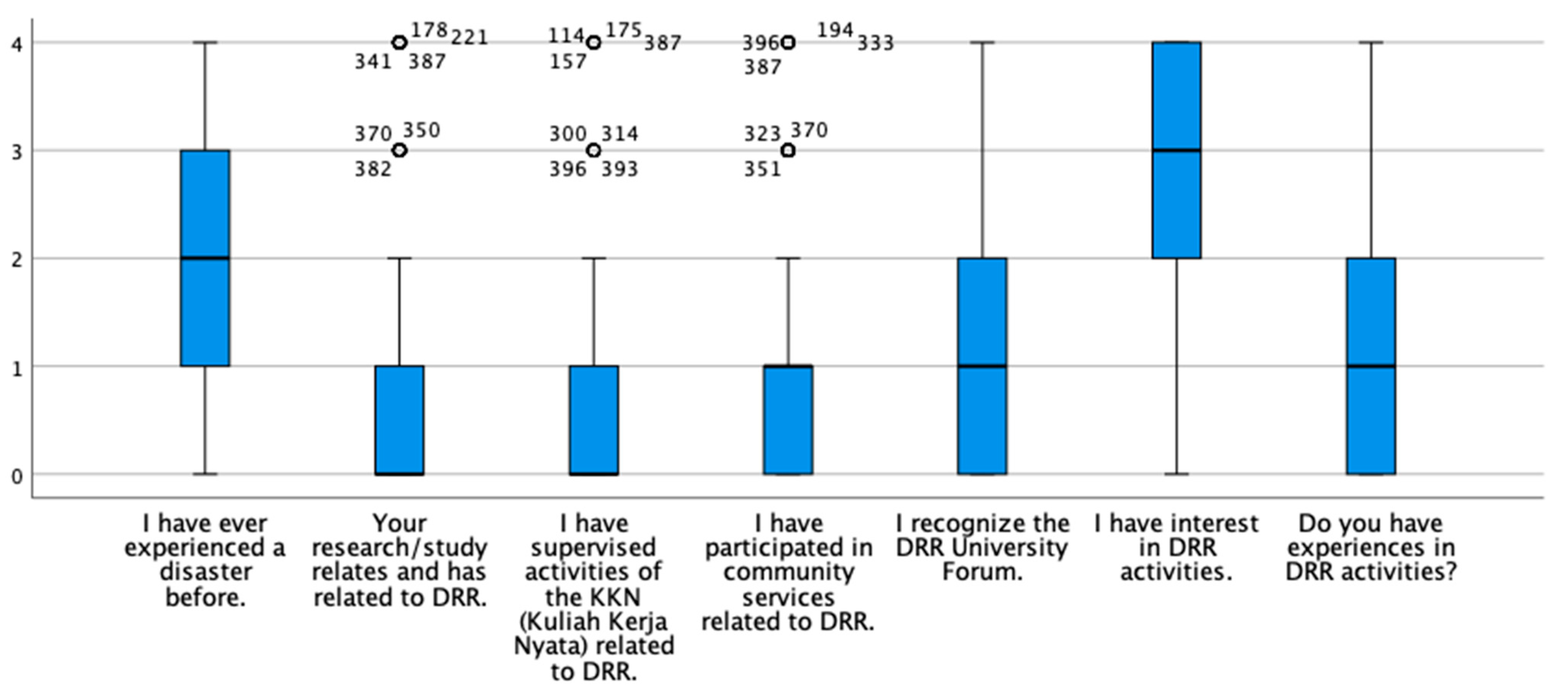
Figure 2 shows the box plot of the attribute questions (P4–10). Most respondents had never experienced a disaster before; however, the percentage of respondents who answered that their research/study related to DRR was small. Similarly, the percentage of respondents who had supervised KKN activities related to DRR and those who had participated in community services related to DRR was also low. More than half of the respondents recognized the DRR University Forum to some extent. By contrast, most of them demonstrated a strong interest in DRR activities, although few had extensive experience in DRR activities.
The answers to K20 and K21 are as follows. The respondents who answered Strongly disagree, Disagree, Neither agree nor disagree, Agree, and Strongly agree for K20 were 0 (0.0%), 2 (0.5%), 18 (4.5%), 164 (41.0%), and 216 (54.0%), respectively; those for K21 were 1 (0.3%), 0 (0.0%), 30 (7.5%), 179 (44.8%), and 190 (47.5%), respectively. More than 90% of the respondents responded positively to both questions. This response trend was also observed for other main questions. Overall, the university faculty members in Aceh Province were optimistic about the role of universities in suggesting policy recommendations in DRR.

3.2. Kruskal–Wallis Tests

The results of the Kruskal–Wallis tests are summarized in Table 4. Regarding P9 (I am interested in DRR activities), statistical significance was observed for all the main questions at a significance level of 5%. This interest suggests that DRR activities may significantly impact university faculty member’s perceptions of the role of universities in DRR. Additionally, PD (Education) P10 (Do you have experience in DRR activities?) and P11 (How many years have you been involved in DRR research and activities?) were found to be statistically significant for many of the main questions at a significance level of 5%. Conversely, TT (Residential area in Aceh) and P6 (I supervised the KKN activities related to DRR) showed statistical significance for some of the main questions.
Table 4 indicates that four attribute questions showed statistical significance at the 5% level for K20: JK (gender), US (age), P9, and P11. Regarding K21, there were three attribute questions: P7 (I have participated in community services related to DRR.), P9, and P11. Thus, P9 and P11 impacted K20 and K21, the main questions discussed in Section 3.1.
Based on the above results of the Kruskal–Wallis tests, the authors found that those who have interest in DRR activities and/or have been involved in DRR research and activities, which were reflected in P9 and P11, respectively, tend to recognize the role of universities in advising local or central governments about policymaking for DRR and/or assisting the local or central government in monitoring and evaluating DRR plans, policies, and measures, which were reflected in K20 and K21. Thus, the authors can conclude that interest in DRR activities and relevant past experiences of university faculty members may influence their perception of the role of universities in articulating DRR policies. Based on this result, the authors recommend considering measures that empower university faculty members to develop an interest in DRR activities and/or gain more experience in understanding the role of universities in proposing policy recommendations for DRR.

3.3. Structural Equation Modeling (SEM)

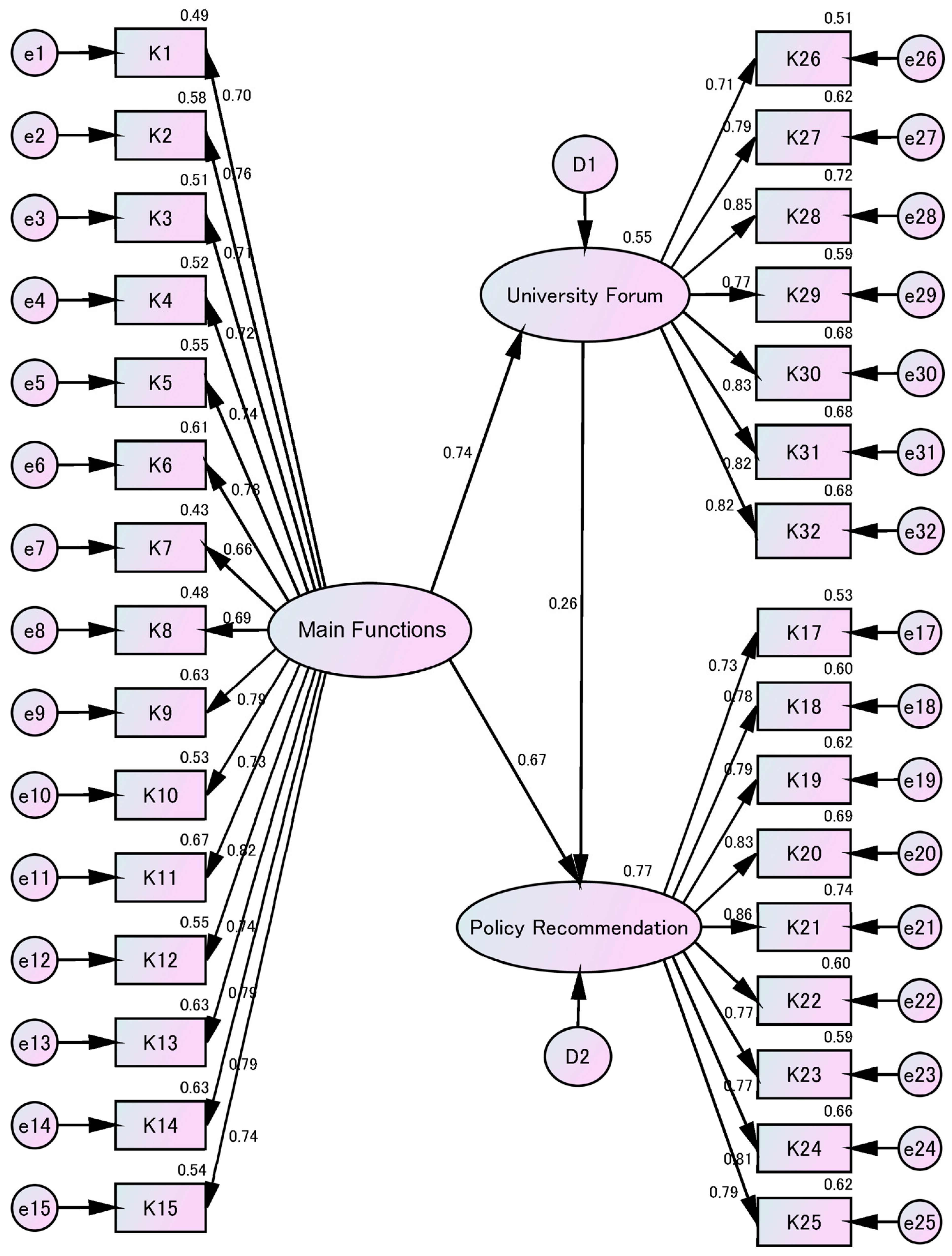
In the SEM analysis, based on the questionnaire, the authors hypothesized that the following three latent variables have causal relationships: Main Functions, Policy Recommendation, and University Forum. For instance, the Main Functions affect 15 main questions (observed variables), namely K1 to K15, which reflect DRR activities that relate directly to the main functions of universities in Indonesia. These functions are stipulated by Indonesia’s three principles of higher education (Tri Dharma Perguruan Tinggi): research, education, and community service. Similarly, the authors assumed that Policy Recommendation and University Forum affected the K17–K25 and K26–K32 cohorts.
Figure 3 shows the path diagram. All the path coefficients and variances were statistically significant at the 0.001 (0.1%) level. The authors confirmed the major goodness-of-fit indices, the comparative fit index, and the root mean square error of approximation. The values of these indices were 0.888 and 0.080, respectively, indicating that the model is acceptable, although it is not a good fit.
First, almost all the values of the path coefficients from latent variables to observed variables exceeded 0.7, implying that each observed variable is strongly affected by the corresponding latent variable. Specifically, K20 and K21, the main questions discussed in Section 3.1, appear to be affected by Policy Recommendation, as the values of the path coefficients from Policy Recommendation to K20 and K21 exceeded 0.8.
Focusing on the path coefficients between the latent variables, those from Main Functions to Policy Recommendation and those from Main Functions to University Forum are 0.67 and 0.74, respectively, which are high. Meanwhile, the path coefficient from University Forum to Policy Recommendation is low (0.26). More specifically, the direct effect of Main Functions on Policy Recommendation was 0.670, while the indirect effect of Main Functions on Policy Recommendation via University Forum was 0.193. The total effect, calculated as the sum of the direct and indirect effects, was 0.863, much of which stems from the direct effect.
As the total effect value (0.863) was high, Main Functions is considered the most significant factor affecting Policy Recommendation. This rationale also implies that university faculty members, as stipulated by Indonesia’s three higher education principles, contribute significantly to the role of universities in making policy recommendations in DRR. Furthermore, university faculty members in Aceh Province view their primary functions as the basis for articulating DRR policy recommendations.
Further analysis of the SEM results highlights specific DRR policy areas where universities can exert influence, particularly those addressing the long-term impacts of the 2004 Aceh Tsunami. These include policies on coastal infrastructure resilience, community-based early warning systems, and post-disaster mental health programs, which remain critical in Aceh’s recovery framework. However, obstacles such as fragmented coordination between local governments and academic institutions, limited funding for applied DRR research, and bureaucratic delays in policy implementation hinder deeper academic engagement. To enhance involvement, universities should prioritize partnerships with Badan Penanggulangan Bencana Daerah (BPBD) at the district level, where localized DRR strategies are formulated, and advocate for institutional mandates that formalize academia’s role in provincial disaster management plans.

4. Discussion

University faculty members in Aceh Province were optimistic about the role of universities in suggesting policy recommendations for DRR. These recommendations align with the guiding principles outlined in the SFDRR. The results of the Kruskal–Wallis tests also indicated the significance of considering measures that empower university faculty members to develop an interest in DRR activities and/or gain additional experience. While previous studies have analyzed the role of universities in DRR, few studies have provided findings from a quantitative perspective. Thus, the results of this study provide clear evidence to support the advocacy that universities should offer additional opportunities to faculty members, enabling them to integrate academic expertise into DRR efforts in practice.
Comparing the results of Nakayama et al.’s study [6], conducted in western Java, the authors observe a similar trend, as shown in Table 5. First, while interest in DRR was high among respondents, experience and the degree of participation in DRR activities were not necessarily sufficient. This finding implies that the gap between interest and action may be a challenge when the authors expand the role of university faculty members to DRR throughout Indonesia. Nakayama et al. [6] also suggested that the period during which university faculty members have been involved in DRR activities significantly influences their perceptions. As discussed in this study, there is no regional difference between Aceh Province and the western part of Java in terms of the significance of sustained engagement in DRR activities for university faculty members to gain further experience.
As discussed above, this study has clarified the causal relationships among main functions, policy recommendations, and university forums by conducting a SEM analysis, which adopted variables reflecting DRR activities directly related to the main functions of universities in Indonesia, namely K1 to K15. Previous studies, including those by Nakayama et al. [6] and Sasaki et al. [33], have hardly discussed the causal relationships regarding the perception of university faculty members on the role of universities in DRR. This study demonstrates that the primary functions of research, education, and community service in the DRR field form the foundation for policy recommendations, which should be developed and sustained in the future.
The legacy of the 2004 Aceh Tsunami underscores the need for academia to address policy gaps in land-use planning and ecosystem restoration, which are vital for mitigating future coastal disasters. Political barriers, including competing priorities among local stakeholders and insufficient recognition of academic expertise in policymaking, further complicate these efforts. A multi-tiered approach could bridge this gap by engaging municipalities (kabupaten) in community-driven initiatives while advising national agencies on standardized DRR frameworks. Universities must also leverage platforms like the DRR University Forum to train policymakers in evidence-based decision making, ensuring that academic insights translate into actionable policies at all governance levels.
These findings should be interpreted in the context of the study’s limitation: it presents little concrete discussion about how to materialize the platforms provided by universities. As mentioned, universities usually face difficulties, such as limited funding for applied DRR research. Thus, further research should be twofold, focusing on (1) measures to increase university faculty members’ interest in DRR that would enhance their efficiency and experience, and (2) the development of methods to effectively link universities’ main functions in making DRR policy recommendations, other than the DRR University Forum.

5. Conclusions

In this study, the authors elucidated how university faculty members in Aceh Province perceive the roles of universities in articulating policy recommendations for DRR. The authors examined their perceptions of the relationship between these roles and universities’ primary functions. Our analysis shows that most university faculty members in Aceh Province had a positive outlook on the role of universities in policy recommendations for DRR. Furthermore, interest in DRR activities and the degree of relevant past experiences of university faculty members may influence their perception of the role of universities in DRR policy recommendations. The SEM analysis results suggest that university faculty members perceive that the main functions of universities, as stipulated by Indonesia’s three higher education principles, contribute significantly to the role of universities in making DRR policy recommendations.
Based on the above results, the authors advocate adopting such measures in universities, so faculty members become more interested in DRR activities and/or gain more experience. By doing so, the role of universities in DRR policy recommendations can be perceived more positively and implemented across a wide range of university mandates in the future. Simultaneously, the steady progress of universities’ primary functions is an essential factor, as university faculty members in Aceh Province view their primary functions as the basis for making policy recommendations for DRR.
The limitations of this study are twofold. First, the verification of the results should be conducted in other areas of Indonesia. While the authors have compared their results with those of similar studies in Jakarta, further research is still needed to verify that the results of this study can be applied to other areas in Indonesia. Second, it should be discussed how to establish the concrete measures at universities in the future. Further investigation would be necessary through in-depth interviews with university faculty members and focus group discussions.
The authors believe that the study could contribute to enhancing the role of universities in articulating policy recommendations in DRR throughout Indonesia in the future.

Author Contributions

Conceptualization: D.S. and H.S.; materials and methods: D.S.; software: D.S.; validation: D.S. and H.S.; formal analysis: D.S. and Y.Y.; investigation: D.S., Y.Y., and N.R.S.; resources: D.S. and H.S.; data curation: Y.Y. and N.R.S.; writing—original draft preparation: D.S. and Y.H.; writing—review and editing: Y.Y., N.R.S., and H.S.; visualization: D.S. and Y.H.; supervision: H.S.; project administration: D.S.; funding acquisition: D.S. All authors have read and agreed to the published version of the manuscript.

Funding

This study was funded by the JSPS KAKENHI (grant numbers: JP 21H03680, JP 23K21789, JP 23KK0237, and JP 24KK0015).

Institutional Review Board Statement

This study was approved by the Ethics Committee of the International Research Institute of Disaster Science (IRIDeS), Tohoku University (protocol code 2022-043 and 17 October 2022).

Informed Consent Statement

Informed consent was obtained from all subjects involved in the study.

Data Availability Statement

The data presented in this study are available on request from the corresponding author due to the associated data include sensitive information such as annual household income before taxes.

Acknowledgments

The authors sincerely thank the questionnaire respondents and enumerators who made this research possible. The authors also thank the Global Infrastructure Fund Research Foundation Japan (GIF Japan) for supporting the data collection process. This study was also supported in part by the Uehiro Foundation on Ethics and Education.

Conflicts of Interest

Daisuke Sasaki received research grants from the Japan Society for the Promotion of Science. The authors declare that they have no conflicts of interest. The funders had no role in the study design, data collection, analysis, interpretation, manuscript writing, or decision to publish the results.

Correction Statement

This article has been republished with a minor correction to the Data Availability Statement. This change does not affect the scientific content of the article.

Appendix A

Table A1. Questionnaire with variable codes (language used is Bahasa Indonesia).
CodeQuestionnaire ItemCode
QQuestionnaire0 = Offline
1 = Online
PPStatement of consent0 = Disagree
1 = Agree
P1Do you understand the meaning of disaster risk reduction (DRR)?0 = No
1 = Yes
P2Have you ever read or written material on DRR?0 = No
1 = Yes
P3Have you previously completed this survey (either online or offline)?0 = No
1 = Yes
JKGender0 = Female
1 = Male
USAge0 = 20 s
1 = 30 s
2 = 40 s
3 = 50 s
4 = 60 s
PDEducation0 = S2
1 = S3
AFAffiliation0 = Universitas Syiah Kuala
1 = Politeknik Kesehatan Kemenkes Aceh
2 = Universitas Islam Negeri Ar-Raniry
3 = Universitas Abulyatama
4 = Universitas Muhammadiyah
5 = Universitas Malikussaleh
6 = Universitas Teuku Umar
7 = Universitas Iskandar Muda
8 = Universitas Samudra
9 = STIKes Muhammadiyah Lhokseumawe
10 = Politeknik negeri Lhokseumawe
11 = IAIN Lhokseumawe
12 = Universitas Bina Bangsa Getsempena
13 = STAIN Teungku Dirundeng Meulaboh
14 = AKN Aceh Barat
15 = Stisip Al Washliyah Banda Aceh
PFProfession0 = Non-permanent Faculty Member
1 = Faculty Member
2 = Post-Doctoral Researcher
BAAcademic field0 = Humanities
1 = Social Sciences
2 = Science and Engineering
3 = Biological Sciences
4 = Interdisciplinary Studies
5 = Other
PRAnnual household income before taxes0 = Less than Rp50.000.000
1 = Rp50.000.000-Rp100.000.000
2 = Rp100.000.000-Rp150.000.000
3 = Rp150.000.000-Rp200.000.000
4 = Rp200.000.000-Rp250.000.000
5 = Rp250.000.000-Rp300.000.000
6 = Rp300.000.000-Rp350.000.000
7 = Rp350.000.000-Rp400.000.000
8 = Rp400.000.000-Rp450.000.000
9 = Rp450.000.000-Rp500.000.000
10 = More than Rp500.000.000
TTResidential area in Aceh0 = Kabupaten Aceh Besar
1 = Kota Banda Aceh
2 = Kabupaten Pidie
3 = Kabupaten Bireuen
4 = Kota Langsa
5 = Kabupaten Aceh Barat
6 = Kota Lhokseumawe
7 = Kabupaten Nagan Raya
8 = Kabupaten Aceh Utara
P4I have never experienced a disaster before.0 = Never
1 = Little
2 = Somewhat
3 = Much
4 = A great deal
P5Your research/study relates to DRR.0 = Never
1 = Little
2 = Somewhat
3 = Much
4 = A great deal
P6I have supervised activities of the KKN related to DRR.0 = Never
1 = Little
2 = Somewhat
3 = Much
4 = A great deal
P7I have participated in community services related to DRR.0 = Never
1 = Little
2 = Somewhat
3 = Much
4 = A great deal
P8I recognize the DRR University Forum.0 = Never
1 = Little
2 = Somewhat
3 = Much
4 = A great deal
P9I am interested in DRR activities.0 = Never
1 = Little
2 = Somewhat
3 = Much
4 = A great deal
P10Do you have experience in DRR activities?0 = Never
1 = Little
2 = Somewhat
3 = Much
4 = A great deal
P11How many years have you been involved in DRR research and activities?0 = Less than 1 year
1 = 1–2 years
2 = 2–3 years
3 = 3–4 years
4 = 4–5 years
5 = 5–6 years
6 = 6–7 years
7 = More than 7 years
K11. University faculty members conduct and advance research and analysis on DRR.0 = Strongly disagree
1 = Disagree
2 = Neither agree nor disagree
3 = Agree
4 = Strongly agree
K22. Faculty members of universities enhance data availability related to DRR.
K33. University faculty members are keen to apply academic findings to practical DRR.
K44. University faculty members appear on television or other mass media to express their views on DRR.
K55. Faculty members of universities publish books on DRR.
K66. Faculty members of universities build collective efficacy for DRR.
K77. Faculty members of universities give lectures on DRR in primary and high schools.
K88. Faculty members of universities teach about DRR to teachers from primary to high school.
K99. Faculty members of universities contribute toward developing textbooks on DRR.
K1010. Through KKN activities, students and community members discuss DRR in the community.
K1111. Faculty members of universities serve as committee members of local communities on DRR.
K1212. Community members consult faculty members of universities about DRR as needed.
K1313. Faculty members of universities contribute to community events on DRR.
K1414. Faculty members of universities support local communities in implementing DRR-related projects.
K1515. Faculty members of universities strengthen communities in disaster preparedness.
K1616. Faculty members of universities facilitate community participation needed for DRR.
K1717. Faculty members of universities serve as members of local or central government committees on DRR.
K1818. University faculty members are consultants or facilitators to local or central governments on DRR.
K1919. The local or central government asks faculty members of universities to draft disaster management plans.
K2020. Faculty members of universities advise local or central governments about policymaking for DRR.
K2121. Faculty members of universities assist the local or central government in monitoring and evaluating plans, policies, and measures on DRR.
K2222. Faculty members of universities coordinate between the central government, local authorities, and communities regarding the assistance given by external aid agencies and organizations.
K2323. Faculty members of universities maintain contact with staff members of aid organizations and international donors/organizations in foreign countries.
K2424. University faculty members advise the government on strategy and planning for DRR aid coordination.
K2525. Faculty members of universities contribute to the assessment of disaster damages and provide technical inputs to the government and communities
K2626. Does your university have the University Forum for DRR or a similar type of unit for DRR to manage DRR activities in the university?
K2727. The DRR University Forum manages the university campus as a center for disaster resilience.
K2828. The DRR University Forum manages student volunteers for disaster events.
K2929. In the case of any event, the DRR University Forum coordinates with the local government office (BPBD), the Red Cross, and the Red Crescent to provide student volunteers.
K3030. The University Forum brings students to the field for practical DRR.
K3131. The DRR University Forum provides on-campus evacuation drill training to students and faculty members.
K3232. The DRR University Forum provides a capacity development opportunity for DRR to the local community.

References

  1. United Nations International Strategy for Disaster Reduction Secretariat. Sendai Framework for Disaster Risk Reduction 2015–2030; United Nations Office for Disaster Risk Reduction: Geneva, Switzerland, 2015. [Google Scholar]
  2. Doocy, S.; Rofi, A.; Moodie, C.; Spring, E.; Bradley, S.; Burnham, G.; Robinson, C. Tsunami mortality in Aceh Province, Indonesia. Bull. World Health Organ. 2007, 85, 273–278. [Google Scholar] [CrossRef] [PubMed] [PubMed Central]
  3. Ibrahim, M.; Rasyid, H.; Fritz, H. Tsunami fragility-based characterisation of mosques as alternative tsunami evacuation buildings: Reconstructing evidence from the 2004 Indian Ocean tsunami. Int. J. Disaster Risk Reduc. 2023, 80, 103264. [Google Scholar] [CrossRef]
  4. Syamsidik, T.; Tursina, S.; Suppasri, A.; Al’ala, M.; Luthfi, M.; Comfort, L.K. Assessing the tsunami mitigation effectiveness of the planned Banda Aceh Outer Ring Road (BORR), Indonesia. Nat. Hazards Earth Syst. Sci. 2019, 19, 299–312. [Google Scholar] [CrossRef]
  5. Fekete, A.; Garschagen, M.; Norf, C.; Stephan, C. (Eds.) Recovery After Extreme Events: Lessons Learned and Remaining Challenges in Disaster Risk Reduction (Vol. 2); TH Köln—University of Applied Sciences: Cologne, Germany, 2017; Available online: https://cos.bibl.th-koeln.de/frontdoor/index/index/docId/554 (accessed on 11 July 2025).
  6. Nakayama, M.; Sakamoto, A.; Pelupessy, D.; Sasaki, D. Bridging Academia and Practice: Role of University Lecturers in Strengthening Disaster Risk Reduction Capacity in the Western Region of Java Island, Indonesia. J. Disaster Res. in press.
  7. Chen, Y.-F.; Adefila, A. Enhancing School Safety Through University Engagement in DRR Education. Int. J. Disaster Risk Reduc. 2020, 44, 101386. [Google Scholar] [CrossRef]
  8. Albris, K.; Lauta, K.C.; Raju, E. Disaster Knowledge Gaps: Exploring the Interface Between Science and Policy for Disaster Risk Reduction in Europe. Int. J. Disaster Risk Sci. 2020, 11, 1–12. [Google Scholar] [CrossRef]
  9. Weichselgartner, J.; Pigeon, P. The Role of Knowledge in Disaster Risk Reduction. Int. J. Disaster Risk Sci. 2015, 6, 107–116. [Google Scholar] [CrossRef]
  10. Satake, K.; McLean, C.; Alcántara-Ayala, I. Understanding Disaster Risk: The Role of Science and Technology. J. Disaster Res. 2018, 13, 1168–1176. [Google Scholar] [CrossRef]
  11. Hiwasaki, L.; Luna, E.; Syamsidik, N.; Shaw, R. Process for Integrating Local and Indigenous Knowledge with Science for Hydro-meteorological Disaster Risk Reduction and Climate Change Adaptation in Coastal and Small Island Communities. Int. J. Disaster Risk Reduc. 2014, 10, 15–27. [Google Scholar] [CrossRef]
  12. Spiekermann, R.; Kienberger, S.; Norton, J.; Briones, F.; Weichselgartner, J. The Disaster-Knowledge Matrix—Reframing and Evaluating the Knowledge Challenges in Disaster Risk Reduction. Int. J. Disaster Risk Reduc. 2015, 13, 96–108. [Google Scholar] [CrossRef]
  13. Ahmad, R. Roles of the University in Disaster Management. Malays. J. Med. Sci. 2007, 14, 1–3. [Google Scholar] [PubMed]
  14. Nomura, S.; Parsons, A.J.Q.; Hirabayashi, M.; Kinoshita, R.; Liao, Y.; Hodgson, S. Social Determinants of Mid- to Long-Term Disaster Impacts on Health: A Systematic Review. Int. J. Disaster Risk Reduc. 2016, 16, 53–67. [Google Scholar] [CrossRef]
  15. Izumi, T. Science, and Practical Disaster Risk Reduction: Role of Universities and Academia in Disaster Risk Reduction—From the Discussions at the UNWCDRR Public Forum by APRU and IRIDES–. J. Disaster Res. 2016, 11, 454–458. [Google Scholar] [CrossRef]
  16. Richards, E.A.; Novak, J.C.; Davis, L.V. Disaster Response After Hurricane Katrina: A Model for an Academic–Community Partnership in Mississippi. J. Community Health Nurs. 2009, 26, 114–120. [Google Scholar] [CrossRef]
  17. Dunlop, A.L.; Logue, K.M.; Beltran, G.; Isakov, A.P. Role of Academic Institutions in Community Disaster Response Since September 11, 2001. Disaster Med. Public Health Prep. 2011, 5, 218–226. [Google Scholar] [CrossRef]
  18. Dunlop, A.L.; Logue, K.M.; Isakov, A.P. The Engagement of Academic Institutions in Community Disaster Response: A Comparative Analysis. Public Health Rep. 2014, 129 (Suppl. S4), 87–95. [Google Scholar] [CrossRef]
  19. Tanner, A.; Doberstein, B. Emergency Preparedness Amongst University Students. Int. J. Disaster Risk Reduc. 2015, 13, 409–413. [Google Scholar] [CrossRef]
  20. Baytiyeh, H.; Naja, M.K. Are Colleges in Lebanon Preparing Students for Future Earthquake Disasters? Int. J. Disaster Risk Reduc. 2015, 14, 519–526. [Google Scholar] [CrossRef]
  21. Gibbs, L.; Jehangir, H.B.; Kwong, E.J.L.; Little, A. Universities and Multiple Disaster Scenarios: A Transformative Framework for Disaster Resilient Universities. Int. J. Disaster Risk Reduc. 2022, 78, 103132. [Google Scholar] [CrossRef]
  22. Liyanage, C.; Thakore, R.; Amartunga, D.; Mustapha, A.; Haigh, R. The Barriers to Research and Innovation in Disaster Resilience in Higher Education Institutions in Asia. Procedia Eng. 2018, 212, 1225–1232. [Google Scholar] [CrossRef]
  23. Seifi, B.; Seyedin, H.; Ghanizadeh, G. The Role of Academic Partnership in Disaster Risk Management: A Systematic Review. Disaster Med. Public Health Prep. 2019, 13, 1047–1058. [Google Scholar] [CrossRef]
  24. Abedin, M.A.; Shaw, R. The Role of University Networks in Disaster Risk Reduction: Perspective from Coastal Bangladesh. Int. J. Disaster Risk Reduc. 2015, 13, 381–389. [Google Scholar] [CrossRef]
  25. Hirunsalee, S.; Denpaiboon, C.; Kanegae, H. Public Attitudes Toward the Additional Roles of the University in Disaster Management: Case Study of Thammasat University in the 2011 Thailand Floods. Procedia Environ. Sci. 2013, 17, 899–908. [Google Scholar] [CrossRef]
  26. Chang Seng, D.S.C.C. Tsunami Resilience: Multi-level Institutional Arrangements, Architectures and System of Governance for Disaster Risk Preparedness in Indonesia. Environ. Sci. Policy 2013, 29, 57–70. [Google Scholar] [CrossRef]
  27. Shannon, R.; Hope, M.; McCloskey, J.; Crowley, D.; Crichton, P. Social Dimensions of Science–Humanitarian Collaboration: Lessons from Padang, Sumatra, Indonesia. Disasters 2014, 38, 636–653. [Google Scholar] [CrossRef] [PubMed]
  28. Darmawan, Y.; Sagita, N.; Suharni, S.; Gustono, S.T. The Collaboration Between the Lecturer’s Community Service and Students’ Community Service for Disaster-Resilience in Pondok Aren District, South Tangerang, Indonesia. Bubungan Tinggi J. Pengabdi. Masy. 2022, 4, 1280–1289. [Google Scholar] [CrossRef]
  29. Hesti, M.; Markos, V. Exploring the Efficacy of Student Community Service Programs (KKN) in Higher Education Institutions: A Case Study in Indonesia. Különleges Bánásmód 2024, 10, 77–89. [Google Scholar] [CrossRef]
  30. Hanafi, E.A.; Hokugo, A.; Kondo, T.; Hilyana, S.; Suryani, E. University Involvement as a Catalyst for Post-Disaster Community Recovery: Case Study from KKN Activities in Lombok, Indonesia. SSRN Elect. J. 2022. [Google Scholar] [CrossRef]
  31. Rizal, S. Role of Universities in Disaster Management and Recovery from the Indian Ocean Tsunami: A Perspective from Aceh, Indonesia. In SpringerBriefs in Economics; Springer Singapore: Singapore, 2017; pp. 51–59. [Google Scholar] [CrossRef]
  32. Syamsidik, N.; Oktari, R.S.; Nugroho, A.; Fahmi, M.; Suppasri, A.; Munadi, K.; Amra, R. Fifteen Years of the 2004 Indian Ocean Tsunami in Aceh-Indonesia: Mitigation, Preparedness and Challenges for a Long-Term Disaster Recovery Process. Int. J. Disaster Risk Reduc. 2021, 54, 102052. [Google Scholar] [CrossRef]
  33. Sasaki, D.; Sofyan, H.; Sasmita, N.R.; Affan, M.; Nizamuddin, N. Assessing the Intermediate Function of Local Academic Institutions During the Rehabilitation and Reconstruction of Aceh, Indonesia. J. Disaster Res. 2021, 16, 1265–1273. [Google Scholar] [CrossRef]
  34. Benazir, N.; Oktari, R.S. Assessing Tsunami Risk Along the Aceh Coast, Indonesia: A Quantitative Analysis of Fault Rupture Potential and Early Warning System Efficacy for Predicting Arrival Time and Flood Extent. Nat. Hazards 2024, 120, 4875–4900. [Google Scholar] [CrossRef]
  35. Hady, A.K.; Marliyani, G.I. Updated Segmentation Model and Cumulative Offset Measurement of the ACEH Segment of the Sumatran Fault System in Northern Sumatra, Indonesia. J. Appl. Geol. 2020, 5, 84–100. [Google Scholar] [CrossRef]
  36. Malawani, M.N.; Lavigne, F.; Gomez, C.; Mutaqin, B.W.; Hadmoko, D.S. Review of Local and Global Impacts of Volcanic Eruptions and Disaster Management Practices: The Indonesian Example. Geosciences 2021, 11, 109. [Google Scholar] [CrossRef]
  37. Umitsu, M.; Tanavud, C.; Patanakanog, B. Effects of Landforms on Tsunami Flow in the Plains of Banda Aceh, Indonesia, and Nam Khem, Thailand. Mar. Geol. 2007, 242, 141–153. [Google Scholar] [CrossRef]
  38. Jena, R.; Pradhan, B.; Beydoun, G. Earthquake Vulnerability Assessment in Northern Sumatra Province Using a Multi-criteria Decision-Making Model. Int. J. Disaster Risk Reduc. 2020, 46, 101518. [Google Scholar] [CrossRef]
  39. Ferijal, T.; Fauzi, A. Analysis of Local Climate Change Impacts on the Rainfall Patterns and Dry Spells in Banda Aceh and Aceh Besar, Indonesia. Int. J. Des. Nat. Ecodyn. 2024, 19, 947–954. [Google Scholar] [CrossRef]
  40. Gaillard, J.-C.; Clavé, E.; Vibert, O.; Azhari, N.; Dedi, N.; Denain, J.-C.; Efendi, Y.; Grancher, D.; Liamzon, C.C.; Sari, D.R.; et al. Ethnic Groups’ Response to the December 26, 2004, Earthquake and Tsunami in Aceh, Indonesia. Nat. Hazards 2008, 47, 17–38. [Google Scholar] [CrossRef]
  41. United States Geological Survey (USGS). Shuttle Radar Topography Mission (SRTM) 1 Arc-Second Global; United States Geological Survey (USGS): Reston, VA, USA, 2018. [CrossRef]
  42. Munirwan, R.P.; Munirwansyah, M.; Jamaluddin, K.; Gunawan, H.; Mubarak, A.Z.; Ramadhansyah, P.J.; Youventharan, D. Liquefaction Potential Analysis of Reusep Prestress Bridge in Pidie Jaya due to 6.4 Mw Earthquake. IOP Conf. Ser. Mater. Sci. Eng. 2020, 712, 012010. [Google Scholar] [CrossRef]
  43. Matsumaru, R.; Nagami, K.; Takeya, K. Reconstruction of the Aceh Region following the 2004 Indian Ocean tsunami disaster: A transportation perspective. IATSS Res. 2012, 36, 11–19. [Google Scholar] [CrossRef]
  44. Sasaki, D.; Jibiki, Y.; Ohkura, T. Tourists’ Behavior for Volcanic Disaster Risk Reduction: A Case Study of Mount Aso in Japan. Int. J. Disaster Risk Reduc. 2022, 78, 103142. [Google Scholar] [CrossRef]
  45. Harapan, H.; Anwar, S.; Nainu, F.; Setiawan, A.M.; Yufika, A.; Winardi, W.; Gan, A.K.; Sofyan, H.; Mudatsir, M.; Oktari, R.S.; et al. Perceived Risk of Being Infected with SARS-COV-2: A Perspective from Indonesia. Disaster Med. Public Health Prep. 2022, 16, 455–459. [Google Scholar] [CrossRef]
  46. Tarka, P. An Overview of Structural Equation Modeling: Its Beginnings, Historical Development, Usefulness and Controversies in the Social Sciences. Qual. Quant. 2018, 52, 313–354. [Google Scholar] [CrossRef] [PubMed]
  47. Sasaki, D.; Moriyama, K.; Ono, Y. Main Features of the Existing Literature Concerning Disaster Statistics. Int. J. Disaster Risk Reduc. 2020, 43, 101382. [Google Scholar] [CrossRef]
  48. Chou, J.-S.; Yang, K.-H.; Ren, T.-C. Ex-Post Evaluation of Preparedness Education in Disaster Prevention, Mitigation, and Response. Int. J. Disaster Risk Reduc. 2015, 12, 188–201. [Google Scholar] [CrossRef]
  49. Sasaki, D.; Moriyama, K.; Ono, Y. Hidden Common Factors in Disaster Loss Statistics: A Case Study Analyzing the Data of Nepal. J. Disaster Res. 2018, 13, 1032–1038. [Google Scholar] [CrossRef]
  50. Oktari, R.S.; Latuamury, B.; Idroes, R.; Sofyan, H.; Munadi, K. Validating Knowledge Creation Factors for Community Resilience to Disaster Using Structural Equation Modelling. Int. J. Disaster Risk Reduc. 2022, 81, 103290. [Google Scholar] [CrossRef]
Figure 1. Location of Aceh Province showing the study sites. Data sources: Digital Elevation Model (DEM): USGS [41], Major faults: Munirwan et al. [42], Tsunami-affected areas in 2004: Matsumaru et al. [43].
Sustainability 17 08033 g001
Figure 2. Box plot of attribute questions (P4–10).
Sustainability 17 08033 g002
Figure 3. SEM path diagram.
Sustainability 17 08033 g003
Table 1. Geographical conditions and disaster risks in the study areas.
Place NameAdministrative District TypeLandformLocationMajor Disaster Risks
Aceh BesarRegencyIncluding a mountainous areaNorthEarthquakes, landslides, flooding, and volcanic eruptions
Banda AcehCity NorthTsunami, flooding, earthquakes, and coastal erosion
PidieRegencyIncluding a mountainous areaEastEarthquakes, landslides, and flooding
BireuenRegencyIncluding a mountainous areaEastEarthquakes, landslides, and flooding
LangsaCity EastFlooding, coastal erosion, and storms
Aceh Barat (West Aceh)RegencyIncluding a mountainous areaWestEarthquakes, volcanic eruptions, and flooding
LhokseumaweCity EastFlooding, coastal erosion, and earthquakes
Nagan RayaRegencyIncluding a mountainous areaWestEarthquakes, landslides, and flooding
Aceh Utara (North Aceh)RegencyIncluding a mountainous areaWestEarthquakes, landslides, flooding, and tsunamis
Table 2. Academic fields.
Academic FieldTotalPercentage
Humanities4711.75%
Social Sciences9122.75%
Science and Engineering13032.50%
Biological Sciences307.50%
Interdisciplinary Studies82.00%
Other9423.50%
Table 3. Affiliation.
AffiliationTotalPercentageWhether the University Is a Public UniversityWhether the 2004 Aceh Tsunami Affected the Area
Universitas Syiah Kuala24360.75%YesYes
Politeknik Kesehatan Kemenkes Aceh123.00%YesYes
Universitas Islam Negeri Ar-Raniry112.75%YesYes
Universitas Abulyatama51.25%NoNo
Universitas Muhammadiyah4711.75%NoNo
Universitas Malikussaleh205.00%YesYes
Universitas Teuku Umar225.50%YesYes
Universitas Iskandar Muda10.25%NoYes
Universitas Samudra30.75%YesNo
STIKes Muhammadiyah Lhokseumawe205.00%NoNo
Politeknik negeri Lhokseumawe82.00%YesNo
IAIN Lhokseumawe41.00%YesNo
Universitas Bina Bangsa Getsempena10.25%NoYes
STAIN Teungku Dirundeng Meulaboh10.25%YesYes
AKN Aceh Barat10.25%YesYes
Stisip Al Washliyah Banda Aceh10.25%NoYes
Table 4. Results of Kruskal–Wallis tests.
JKUSPDPRTTP4P5P6P7P8P9P10P11
K1* * * * ****
K2 * * ***
K3 * * * ***
K4 * * **
K5 * ***
K6 * ** * ***
K7 *
K8 * *
K9* * ****
K10 * ** **
K11 ** * **
K12 * * *
K13 * * *
K14 * ** ***
K15 * * ***
K16 * ** *
K17 * *
K18 * *
K19* * * *
K20** * *
K21 * * *
K22 **
K23 *****
K24 * * ***
K25* ** * *
K26*** ** ***
K27 * ***
K28 * ** ****
K29 * * ***
K30 ** * ***
K31 * * ***
K32 ****
* Indicates that the distribution of the main question was not the same across the various categories of the attribute question at a significance level of 5%.
Table 5. Comparison with the main results of the study conducted in Western Java.
Aceh Province (This Study, n = 400)Western Java (Nakayama et al.’s Study [6], n = 411)
Educational level
Doctoral degree138 (34.5%)133 (32.4%)
Master’s degree262 (65.5%)278 (67.6%)
Past disaster experience [5-point Likert scale]
Mean (SD)3.1 (1.2)2.8 (1.2)
Minimum11
Median33
Maximum55
How many years have you been involved in DRR research and activities?
1 year or more116 (29.0%)174 (42.3%)
Less than 1 year284 (71.0%)237 (57.7%)
Interest in DRR [5-point Likert scale]
Mean (SD)3.6 (1.1)3.5 (1.2)
Minimum11
Median44
Maximum55
Perception of university faculty members’ assistance in monitoring and evaluation of plans, policies, and measures on DRR for local or central governments [5-point Likert scale]
Mean (SD)4.4 (0.6)4.2 (0.8)
Minimum11
Median44
Maximum55
Disclaimer/Publisher’s Note: The statements, opinions and data contained in all publications are solely those of the individual author(s) and contributor(s) and not of MDPI and/or the editor(s). MDPI and/or the editor(s) disclaim responsibility for any injury to people or property resulting from any ideas, methods, instructions or products referred to in the content.