
Review

From Microbial Heuristics to Institutional Resilience: Principles for Ecosystem Stewardship in the Anthropocene


by
Salvador Sánchez-Carrillo
* and
David G. Angeler
Museo Nacional de Ciencias Naturales, Spanish Research Council (MNCN-CSIC), 28006 Madrid, Spain
*
Author to whom correspondence should be addressed.
Sustainability 2025, 17(17), 8035; https://doi.org/10.3390/su17178035
Submission received: 20 June 2025 / Revised: 29 August 2025 / Accepted: 5 September 2025 / Published: 6 September 2025
(This article belongs to the Section Social Ecology and Sustainability)

Abstract

This essay proposes a transdisciplinary framework that positions cooperation as a foundational principle for ecosystem stewardship in the Anthropocene. Drawing from microbial ecology, evolutionary theory, and sustainability science, we argue that cooperation, rather than competition, is a robust and scalable strategy for resilience across biological and institutional systems. In particular, microbial behaviors such as biofilm formation, quorum sensing, and horizontal gene transfer are especially pronounced in extreme environments, where cooperation becomes essential for survival. These strategies serve as functional analogues that illuminate the structural logics of resilience: interdependence, redundancy, distributed coordination, and adaptation. As the Anthropocene progresses toward increasingly extreme conditions, including potential “Hothouse Earth” scenarios driven by climate disruption, such ecological heuristics offer concrete insights into how human institutions can adapt to stress and uncertainty. Rather than reiterating familiar calls for hybrid governance, we use microbial cooperation as a heuristic to reveal the functional architecture already present in many resilient governance practices. These microbial strategies emerging from life in extreme environments demonstrate how interdependence, redundancy, and distributed coordination can create system resilience and sustainability in the long run. By translating microbial survival strategies into institutional design principles, this framework reframes ecosystem stewardship not as a normative ideal, but as an ecological imperative grounded in the evolutionary logic of cooperation.

1. Introduction

For much of modern science, the natural world has been interpreted through the lens of competition. Rooted in Darwinian evolutionary theory and popularized by the phrase “survival of the fittest” [1], this paradigm has shaped ecological thought and institutional design for over a century. It has also resonated with broader societal ideologies, reinforcing narratives of individualism, scarcity, and zero-sum dynamics in both biological and economic systems [2,3]. However, this competition-centric worldview is increasingly being challenged by empirical evidence and theoretical advances across disciplines.
The Anthropocene, the current epoch in which human activity has become a dominant force shaping Earth’s systems, exposes the limitations of this paradigm. Climate change, biodiversity loss, and resource degradation are not merely ecological symptoms, but manifestations of deeper institutional and epistemological failures [4,5]. These failures are evident in multiple governance contexts. For instance, centralized water management in California has led to inequitable resource distribution and ecological degradation [6], while top-down deforestation policies in the Amazon have ignored local knowledge and land rights, exacerbating environmental and social vulnerabilities [7]. Such cases illustrate how competitive, efficiency-driven governance models often fail to address the complexity and interdependence of social-ecological systems.
As the planet risks tipping into an irreversible “Hothouse Earth” regime with substantial negative repercussions for the biosphere and the human health and welfare [8], the need for alternative models of resilience becomes urgent. Recent empirical studies have demonstrated that cooperative governance models, such as polycentric water management and community-based conservation, tend to outperform competitive, top-down approaches in terms of resilience, equity, and long-term sustainability [9,10]. For example, adaptive co-management in fisheries and watershed governance has shown greater capacity to respond to ecological feedbacks and stakeholder needs than centralized regimes [11]. These findings underscore the need to reframe governance not merely as a contest for control, but as a collaborative process grounded in ecological interdependence.
To explore such alternatives, we turn to microbial life that has long persisted in extreme environments through cooperation, not competition. In microbial ecology, cooperation is not an anomaly but a fundamental organizing principle. Behaviors such as metabolic cross-feeding, quorum sensing, and biofilm formation illustrate how interdependence enhances survival and functionality under stress [12,13]. These strategies offer powerful heuristics for rethinking how human institutions might deal with ecological disruption.
This paper offers a transdisciplinary synthesis that repositions and primes cooperation as a generative force in both natural and institutional systems. Rather than proposing entirely new governance frameworks, we draw on microbial strategies to illuminate the structural logic already present in many successful practices of ecosystem stewardship, including adaptive management and governance. By bridging microbial ecology, evolutionary theory, and sustainability science, we argue that ecosystem stewardship must be understood not merely as a normative aspiration but as an ontological imperative: cooperation is a deep structuring principle of living systems, continuously re-emerging across scales as the design logic that sustains resilience. Crucially, in microbial systems, cooperation is not a marginal strategy: it becomes dominant under conditions of extreme and fluctuating stress [12,13]. As the Anthropocene increasingly reproduces such extreme conditions, this principle surfaces as more than analogy: it discloses the same underlying design logic through which life persists. Our contribution is therefore to move beyond the general recognition of cooperation in governance literature and foreground a distinct ecological insight: cooperation under stress is not contingent but ontological, a survival necessity that reveals structural parallels between microbial systems and human institutions. In this sense, microbial heuristics do not simply inspire; they uncover the deep architecture of resilience, offering a design logic for re-organizing institutions to endure systemic social-ecological stress.

2. Microbial Survival in Extremes: The Logic of Cooperation

Microbial communities offer some of the most compelling evidence that cooperation is a foundational principle of life. Far from being isolated, self-sufficient entities, microorganisms often exist in dense, metabolically interdependent consortia that challenge the classical view of organisms as autonomous competitors. These systems provide a powerful model for rethinking ecological and evolutionary dynamics, particularly in the context of sustainability and resilience [14].
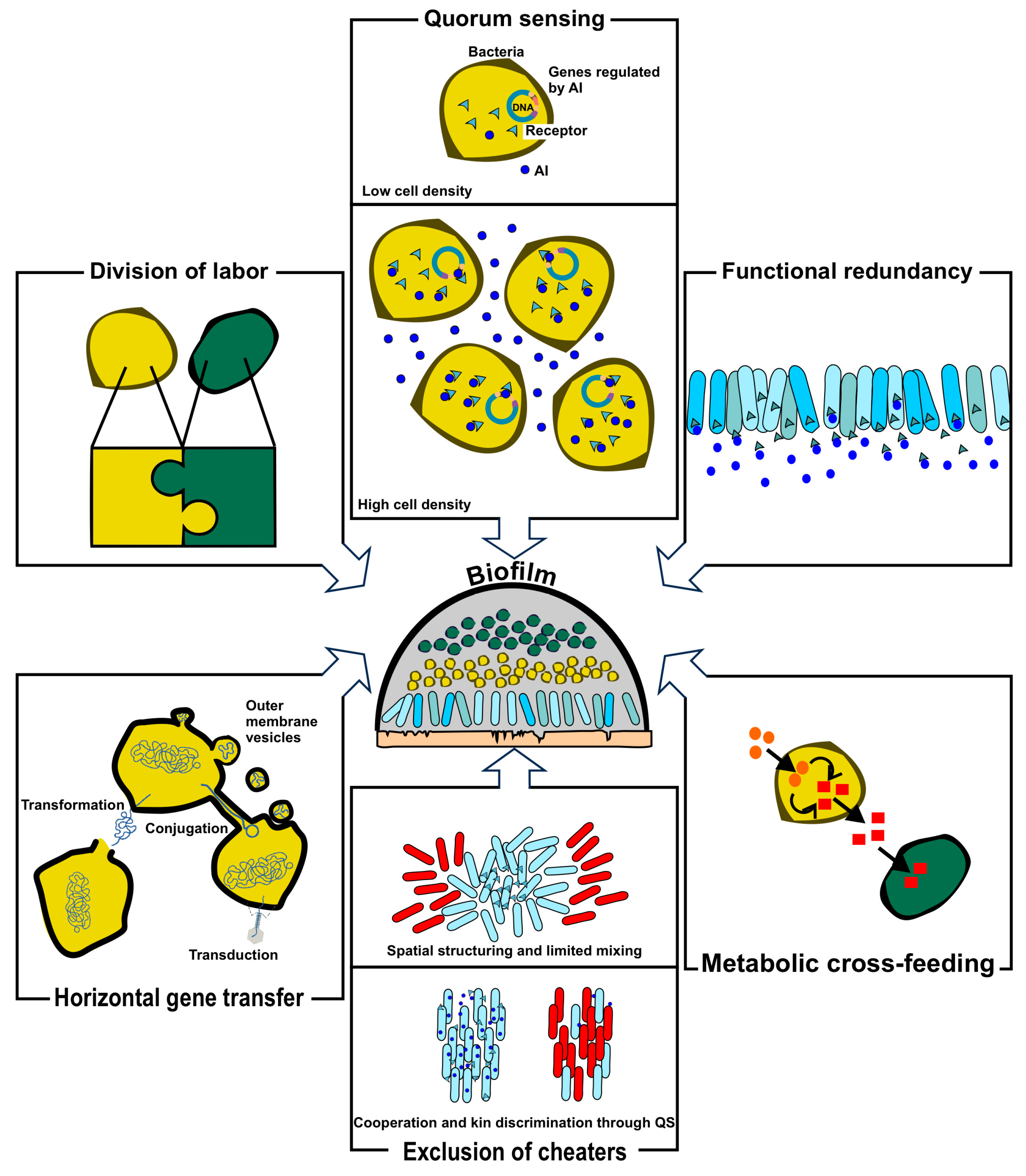
One of the most striking examples of microbial cooperation is the formation of biofilms; surface-attached communities embedded in a self-produced matrix of extracellular polymeric substances (EPS). These structures provide physical protection, facilitate nutrient exchange, and enable coordinated behavior [12]. Within biofilms, microbial species often exhibit division of labor, with different taxa specializing in complementary metabolic roles [15]. This spatial organization mirrors the functional compartmentalization seen in multicellular organisms and underscores the evolutionary continuity between microbial cooperation and higher-order biological complexity. These interactions illustrate how cooperation at the microscale can scale up to influence ecosystem-level processes, offering a model for understanding how interdependence across scales enhances ecological resilience [16] (Figure 1).
Cooperation in microbial systems is also mediated by quorum sensing, a form of chemical communication that allows bacteria to detect population density and coordinate gene expression accordingly. This decentralized mechanism enables collective behaviors such as biofilm formation, virulence regulation, and resource sharing [13]. Quorum sensing exemplifies how microbial communities achieve distributed coordination without centralized control, offering a conceptual parallel to resilience in complex adaptive systems [10] (Figure 1).
Another key mechanism is horizontal gene transfer (HGT), which allows genetic material to move between unrelated organisms. HGT facilitates rapid adaptation by enabling microbes to acquire beneficial traits, such as antibiotic resistance or novel metabolic capabilities, from their neighbors (Figure 1). This process represents a form of open-source innovation, where genetic information is shared across lineages to enhance collective survival under stress [19]. In extreme environments, HGT can be a critical driver of resilience and functional redundancy.
Metabolic cross-feeding is another hallmark of microbial cooperation (Figure 1). In these interactions, the metabolic byproducts of one species serve as essential nutrients for another, creating tightly coupled networks of mutual dependence [13,20]. This division of labor increases efficiency while reinforcing functional redundancy, thereby stabilizing community structure. In nutrient-limited or fluctuating environments, such cooperative dynamics buffer communities against stress and enhance their adaptive capacity [21]. These interactions reflect a form of distributed intelligence, where collective functionality emerges from interdependence rather than individual optimization.
The Black Queen Hypothesis (BQH) further illustrates how cooperation can emerge through adaptive gene loss. According to this hypothesis, some microbial species lose costly metabolic functions and rely on others to perform them, creating obligate dependencies that stabilize community structure [20]. Rather than being a sign of weakness, this loss of function represents a strategic outsourcing of metabolic labor, reducing individual energetic costs while enhancing collective efficiency. However, when this logic is applied to environmental governance or institutional design, caution is warranted. In human systems, outsourcing critical ecological functions—such as water regulation, biodiversity monitoring, or land stewardship—to external actors or sectors can create structural vulnerabilities. These dependencies may become problematic under conditions of political instability, uneven power relations, or weak regulatory frameworks. Unlike microbial systems, which often evolve internal mechanisms to buffer and stabilize cooperative interactions, human institutions may lack equivalent safeguards, making them more susceptible to breakdown or exploitation. This concern is echoed in global environmental governance literature, which highlights how power asymmetries and weak institutional integration can undermine collective action and resilience, particularly in developing regions [22]. Moreover, sustainability scholars have warned that outsourcing environmental responsibilities without robust oversight can lead to accountability gaps and systemic fragility [23]. Thus, the BQH serves as a conditional heuristic: it illustrates how interdependence can stabilize systems under stress, but also underscores the importance of ensuring that such dependencies remain reciprocal, transparent, and resilient to exploitation.
Moreover, microbial systems challenge the notion that cooperation is inherently fragile or easily undermined by “cheaters”. In microbial populations, public goods (extracellular enzymes, signaling molecules) are often shared communally, making them susceptible to exploitation by non-cooperating individuals. These “cheaters” benefit from the cooperative outputs without contributing to their production, thereby avoiding the associated metabolic costs [18]. However, many microbial communities have evolved robust mechanisms of enforcement and exclusion such as quorum sensing, spatial structuring, and metabolic interdependence that preserve cooperative integrity and limit the success of cheaters [19] (Figure 1). These dynamics parallel social mechanisms in human communities, where norms, institutions, and spatial organization help sustain cooperation in the face of individual incentives to defect. In human governance systems, analogous mechanisms to microbial cheater control include legal enforcement, institutional accountability, and social norms that discourage free-riding and exploitation of public goods. Regulatory frameworks, transparency protocols, and participatory oversight can function as safeguards to preserve cooperative integrity [24]. Moreover, trust-building processes such as inclusive decision-making, equitable benefit-sharing, and conflict resolution platforms, are essential to maintaining cooperation in complex, multi-actor settings [25]. These mechanisms, while more context-dependent and culturally mediated than microbial strategies, serve a similar purpose: to ensure that collective action remains viable and resilient in the face of opportunistic behavior [26].
Importantly, microbial cooperation is not merely a biological curiosity, it has profound implications for biogeochemical cycling and ecosystem functioning. Cooperative microbial networks drive key processes such as nitrogen transformation, methane oxidation, and carbon sequestration, forming the biochemical backbone of the biosphere [10]. These processes underpin critical ecosystem services and contribute to planetary resilience.
Beyond microbial systems, cooperation is a widespread strategy across biological domains, from mutualistic plant-animal interactions to eusocial insect colonies and cooperative hunting in mammals. These examples reinforce the evolutionary continuity of cooperation as a resilience-enhancing mechanism. While human institutions introduce additional layers of complexity through reflection, ethics, and intentionality, these features do not negate the structural parallels but rather enrich the heuristic value of biological analogies in institutional design.
In sum, microbial ecosystems provide a living laboratory for exploring the principles of cooperation. They reveal that interdependence—not independence—is the evolutionary norm, and that cooperation, far from being an exception, is a robust and scalable strategy for survival in complex, dynamic environments. These insights not only challenge long-standing assumptions in evolutionary theory but also offer conceptual tools for reimagining how human institutions might organize for resilience under environmental stress.

3. From Biology to Governance: Microbial Heuristics as a Unifying Lens

Microbial cooperation does not arise from moral intention but from the structural demands of survival, especially in extreme environments. While such cooperation emerges from evolutionary pressures and structural necessity, it also reveals a fundamental design logic of resilience—redundancy, distributed coordination, and shared functions—that sustains persistence under constraint. Human institutions operate within a fundamentally different domain: one shaped by intentionality, ethics, and sociopolitical agency. Unlike microbes, human actors can reflect, deliberate, and make normative choices that transcend immediate survival. Therefore, although microbial heuristics offer valuable structural insights, their role is best understood as analogical scaffolds that illuminate resilience principles rather than literal models of human behavior. Their application to governance must account for the complexity of human decision-making, cultural diversity, and institutional design rooted in values and negotiated power. This distinction reinforces the value of microbial cooperation as a heuristic for thinking about how human institutions might adapt under escalating environmental pressures. By studying how microbes persist through interdependence, redundancy, and shared functions, governance scholars can draw lessons about how cooperation under constraint generates adaptive capacity, offering structural insights into how governance systems could be organized to remain resilient under stress.
Microbial communities have evolved to persist in some of the most inhospitable environments on Earth, from hydrothermal vents to hypersaline lakes. Their survival is not solely based on individual robustness, although this plays a critical role. In microbial systems, certain taxa function as keystone species that significantly influence community structure and ecosystem functioning (e.g., [27]). Similarly, in institutional contexts, the resilience of individual actors such as local leaders or agencies can be pivotal in sustaining cooperative dynamics [11]. Ultimately, survival depends on interdependence, redundancy, and distributed coordination, principles that resonate with the needs of human institutions managing ecosystems under stress [12,15].
We do not suggest that microbial systems should serve as literal templates for human governance. Rather, we propose that they function as heuristic analogues: conceptual scaffolds that help us see how cooperation under constraint can generate adaptive capacity across very different domains. These analogues do not imply equivalence between microbes and human institutions, but highlight functional convergences, such as distributed coordination, redundancy, and shared functions, that recur at multiple scales. By tracing these convergences, we gain a bridge between evolutionary logics in biology and design challenges in governance. This analogical approach is grounded in systems thinking and evolutionary logic, which allow for the identification of structural patterns that support resilience in both biological and institutional systems. Drawing on the concept of “pattern language” [28], we emphasize that microbial strategies, such as biofilm formation, quorum sensing, and metabolic interdependence, are not prescriptive models but generative heuristics. These heuristics reveal underlying design principles that can be adapted across domains to inform ecosystem governance under stress. Just as microbial consortia rely on cooperative architectures to remain resilient under extreme conditions, human institutions may require similar features to maintain functionality in the face of climate disruption, biodiversity collapse, and social-ecological instability.

3.1. Translating Microbial Strategies into Institutional Design

Microbial strategies such as biofilm formation, quorum sensing, horizontal gene transfer, and division of labor offer powerful heuristics for reimagining how cooperation can be structured and sustained in human institutions. These strategies evolved not through conscious intent, but under conditions of extreme stress and unpredictability, mirroring the emerging dynamics of the Anthropocene. By treating these biological processes as analogical templates, we can derive structural insights into governance systems that must operate under deep uncertainty, cross-scale interactions, and ethical complexity. Table 1 summarizes these mappings between microbial logics and institutional design principles. To enhance the generalizability of our conceptual scaffolding, we have included case studies from both developing and developed regions. For instance, fire management in Australia and wind energy governance in Germany illustrate how cooperative governance principles can be successfully implemented in high-capacity institutional contexts. These examples demonstrate that the logic of cooperation is not geographically constrained but structurally relevant across diverse governance settings.

3.1.1. Biofilms: Nested, Redundant, Self-Structuring Institutions

Biofilms exemplify how spatially organized, cooperative communities persist under stress. They consist of microenvironments that function semi-autonomously but are embedded within a larger matrix of interdependence. This mirrors the logic of nested governance systems, where local, regional, national, and global institutions interact across scales [9,10]. Specifically, in governance terms, biofilm logic supports institutional architectures that are: (i) redundant: multiple actors perform overlapping functions, enhancing robustness; (ii) self-organizing: institutions adapt dynamically to environmental feedback; and (iii) polycentric: authority is distributed across levels and sectors.
This structure is particularly relevant for managing common-pool resources such as watersheds or migratory species habitats where ecological processes transcend administrative boundaries [29]. Importantly, redundancy in this context is not inefficiency but resilience: overlapping mandates and parallel monitoring systems provide backup capacity in times of crisis [30].
Table 1. Contrasting governance logics in social-ecological systems by comparing competitive and cooperative governance models across key institutional dimensions. For each dimension, an environmental case is provided where competitive governance has failed or underperformed, and where cooperative approaches offer more promising pathways for resilience and sustainability.
DimensionCompetitive
Governance Model
Cooperative Governance ModelEnvironmental Case Example
Decision-making processCentralized, top-downParticipatory, bottom-upAmazon deforestation: centralized policies often ignore local knowledge and land rights [31]
Wind energy governance in Germany: collaborative planning processes involving municipalities, citizens, and regional authorities have improved social acceptance and policy coherence [32]
Resource allocationMarket-based, efficiency-drivenNeeds-based, equitableWater scarcity in California: water markets favor large users over small farmers or ecosystems [6]
Conflict resolutionLegalistic, adversarialMediation, consensus-basedHydropower conflicts in the Mekong River: litigation fails to resolve transboundary tensions [33]
Stakeholder engagementSelective, power-drivenInclusive, deliberativeEU marine protected areas: exclusion of fishers leads to resistance and non-compliance [34]
AdaptabilityRigid, rule-boundFlexible, learning-orientedFire management in Australia: rigid suppression policies worsened fire regimes [35]
TransparencyOpaque, limited disclosureOpen, accessiblePalm oil certification: lack of transparency undermines trust in sustainability claims [36]
EU marine conservation policy: strict conservation targets guide cooperative governance across member states [34]
AccountabilityHierarchical, punitiveMutual, distributedOverfishing in the high seas: weak enforcement and blame-shifting among states [37]

3.1.2. Quorum Sensing: Distributed, Real-Time Decision-Making

Quorum sensing enables microbes to detect population density and synchronize behavior based on collective thresholds. In governance terms, this logic parallels systems that enable decentralized actors to monitor ecological change and respond when critical thresholds are crossed [38]. Key institutional features include: (i) local monitoring, enhancing early detection of environmental signals; (ii) threshold-based activation, enabling timely and proportionate responses; and (iii) context sensitivity, tailoring interventions to local socio-ecological realities.
While quorum sensing offers a compelling model for distributed coordination, its application to human governance must account for structural inequalities. In many real-world contexts, decentralized systems are constrained by power asymmetries, uneven access to information, and disparities in institutional capacity [39]. To address these challenges, governance systems must incorporate mechanisms such as inclusive stakeholder platforms, legal protections for marginalized groups, and investments in data accessibility and digital infrastructure [40,41]. These measures help ensure that decentralized governance is not only responsive but also equitable and representative. This heuristic supports adaptive governance approaches that emphasize flexibility, local empowerment, and real-time responsiveness, while maintaining coordination across scales [42].
However, it is important to recognize the limitations of decentralized sensing. In microbial systems, quorum sensing operates through local chemical cues, enabling coordination at the microscale but without integration across broader system levels. This localized responsiveness can generate outcomes that, when amplified by external disturbances, appear maladaptive at larger scales. For example, under human-driven nutrient enrichment, microbial growth dynamics may contribute to harmful algal blooms or excessive biofilm formation. In such cases, the apparent “ecological myopia” does not stem from microbial processes alone, but from the interaction between localized coordination and broader environmental pressures. In human governance, similar risks arise when local actors optimize for short-term or localized benefits without considering cross-scale impacts, resulting in problem shifting where interventions displace harm across time, space, or groups [43,44,45]. To mitigate this, decentralized systems must be complemented by meta-governance structures, early warning mechanisms, and integrative feedback loops that align local decisions with broader ecological and societal goals.

3.1.3. Horizontal Gene Transfer: Open Knowledge Sharing and Institutional Learning

Horizontal gene transfer (HGT) allows microbes to acquire adaptive traits rapidly through lateral exchange, bypassing vertical inheritance. In institutional settings, this highlights the value of: (i) knowledge mobility: ideas, practices, and innovations flow across institutional boundaries; (ii) openness: systems that are permeable to new information are more adaptive; and (iii) reflexivity: institutions revise rules and norms based on emerging insights. Such dynamics are central to adaptive co-management and social learning frameworks [46,47]. They underscore the importance of enabling institutions to evolve through experimentation, cross-sectoral collaboration, and integration of diverse knowledge systems, including Indigenous and local perspectives.
While HGT offers a compelling analogy for rapid and distributed learning, its application to human institutions must account for the complexity of knowledge governance. Human knowledge systems are shaped by epistemic hierarchies, cultural biases, and institutional gatekeeping that often marginalize local and Indigenous perspectives [48,49]. To foster truly adaptive and inclusive governance, it is essential to embrace knowledge justice—ensuring equitable recognition, access, and integration of diverse epistemologies [50,51]. This requires not only open data platforms, but also deliberative processes that validate experiential, traditional, and community-based knowledge alongside scientific expertise [48,52].

3.1.4. Division of Labor: Polycentric Governance and Functional Specialization

Microbial consortia often exhibit division of labor, with different species performing complementary roles. This mirrors polycentric governance systems, where multiple actors (local communities, NGOs, and agencies) contribute distinct capacities. Key features of such systems include: (i) functional differentiation, where actors specialize based on context and expertise; (ii) institutional diversity, which enhances problem-solving capacity; and (iii) redundancy with specialization, allowing overlapping roles to provide backup while maintaining unique contributions.
However, polycentric systems must remain responsive to changing conditions and power asymmetries. Without adequate coordination, they risk becoming rigid, fragmented, or inequitable. Institutional reflexivity and cross-actor collaboration are essential to prevent these outcomes and to maintain legitimacy [53,54]. Mechanisms such as trust-building, inclusive deliberation, and conflict resolution help ensure that cooperation remains adaptive and inclusive [55].
Despite their advantages, polycentric governance arrangements face challenges related to unclear mandates, overlapping responsibilities, and institutional fragmentation [56]. These issues can lead to inefficiencies, jurisdictional conflicts, and reduced accountability [57]. To mitigate such risks, institutional design must incorporate role clarification, coordination protocols, and meta-governance structures that align efforts across actors and scales. Tools such as actor mapping, shared monitoring frameworks, and deliberative platforms can help ensure that redundancy enhances resilience rather than generating confusion or competition for authority [53,58].

3.2. A Nested Logic of Cooperation Across Scales

The interplay between cooperation and competition follows a nested, hierarchical logic that recurs across biological and institutional systems. From genes to cells, organisms, and social groups, cooperation enables the emergence of higher-order organization by integrating diverse components into functional wholes [59,60]. At the same time, competitive dynamics such as resource conflict must be modulated to prevent fragmentation or dysfunction. This balance between cooperation and regulated competition is essential for maintaining system coherence and resilience across levels of organization [61].
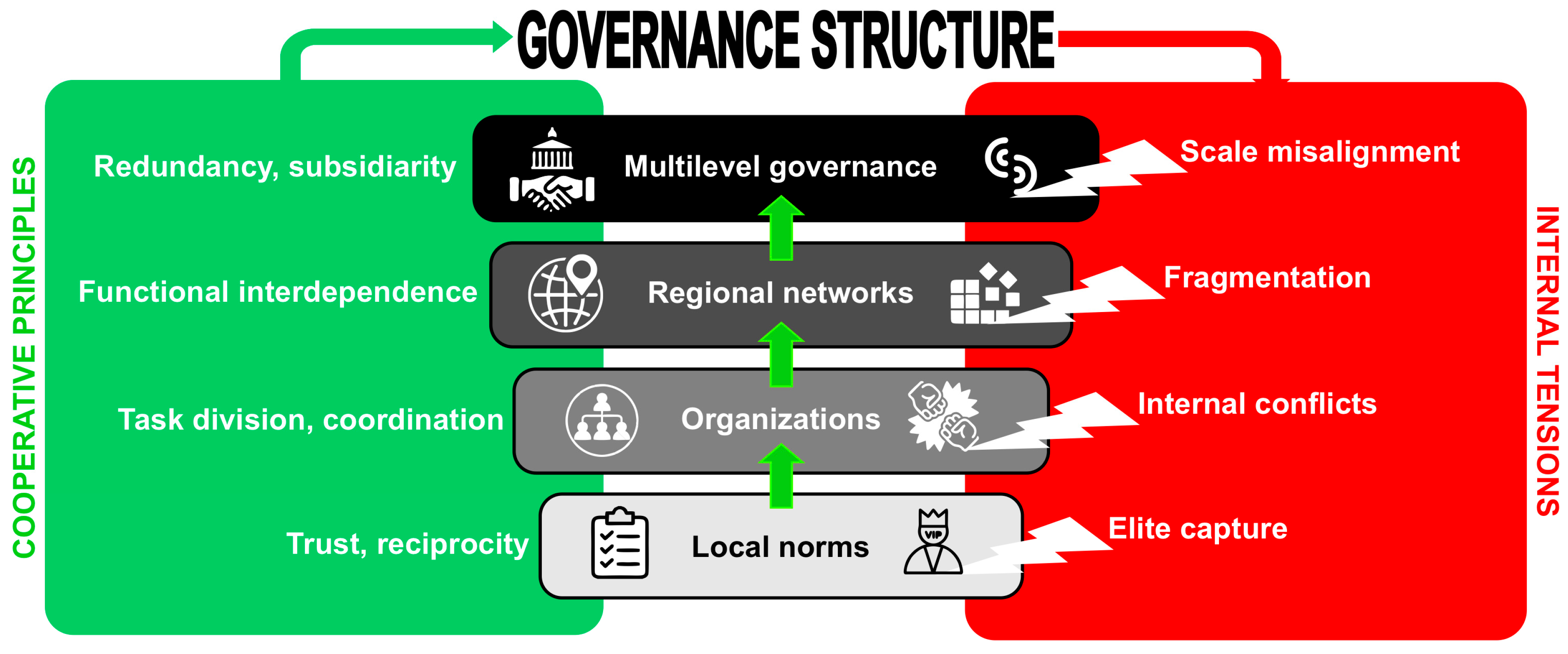
Figure 2 represents a conceptual model for ecosystem stewardship. Each level reflects core principles such as functional specialization, mutual regulation, and distributed coordination that are equally relevant to institutional systems managing complex social-ecological challenges. These features parallel microbial strategies evolved under extreme environmental conditions: biofilm formation for structural redundancy, quorum sensing for threshold-based coordination, horizontal gene transfer for adaptive learning, and division of labor for functional efficiency and resilience.
This nested logic reinforces a central insight of this paper: cooperation is not only scalable but structurally essential. Whether in microbial consortia or governance networks, resilience emerges from the capacity to integrate differentiated roles, manage internal tensions, and maintain coherence across levels of organization. Such coherence does not stem from static equilibrium or uniform consensus, but from tensions in the dynamic interplay of diversity, feedback, and adaptive coordination (see [62]). These processes enable systems to reorganize and evolve in response to stress and change.
Just as microbial systems remain robust through feedbacks and interdependence, governance systems can enhance their resilience by fostering cross-scale connectivity, reflexive adaptation, and collaborative learning [63,64]. These mechanisms allow institutions to navigate volatility, reconfigure relationships, and sustain integrity even as conditions shift.
While these analogies are not prescriptive templates, they offer a powerful heuristic for reimagining governance in the Anthropocene where volatility, inequality, and ecological thresholds increasingly define the policy landscape. The following section explores how these microbial principles are already reflected, often implicitly, in real-world practices of ecosystem stewardship.

4. Real-World Echoes: Governance Practices Aligned with Microbial Logic

The cooperative strategies observed in microbial systems are not confined to the microscopic world. Their underlying logic (interdependence, redundancy, distributed coordination) can be reflected in a wide range of real-world governance practices. Although these practices emerged independently of biological theory, they exhibit a deep structural convergence with microbial cooperation. Recognizing this convergence can help unify fragmented approaches under a shared framework of adaptive governance and resilience.

4.1. Watershed Co-Management: Biofilm-Inspired Nested Institutions

Watershed governance offers a clear example of biofilm-like institutional architecture. In systems such as the Sanjiangyuan National Park in China or the Lerma-Chapala basin in Mexico, nested, participatory institutions coordinate across local, regional, and national levels. These arrangements mirror the spatial organization and functional redundancy of biofilms: local water user associations, municipal authorities, and basin-wide councils operate semi-autonomously while remaining interdependent through shared hydrological systems and governance frameworks [65,66,67]. This nested structure enhances both responsiveness and resilience, particularly in the face of climate variability and competing demands. Here, redundancy serves as a structural buffer that enhances resilience, allowing overlapping institutions to provide continuity and backup capacity when others are stressed or disrupted.

4.2. Agroecological Systems: Division of Labor and Metabolic Interdependence

Agroecological and circular land-use systems embody the principles of specialization, mutualism, and redundancy found in microbial consortia. Practices such as intercropping, agroforestry, composting, and soil microbiome management create functionally diverse systems where different species and actors perform complementary roles [68]. These systems reflect microbial division of labor and metabolic cross-feeding: they close nutrient loops, reduce reliance on external inputs, and enhance resilience to climatic variability. In contrast to top-down, coercively managed agricultural systems which often suppress local autonomy, reduce functional diversity, and erode long-term resilience [69], agroecological approaches foster cooperation through self-organization and ecological embeddedness. Community-supported agriculture models further reinforce this logic by fostering direct, trust-based relationships between producers and consumers, enabling co-designed food networks that prioritize ecological integrity and social equity [30].

4.3. Citizen Science and Open Monitoring: Quorum Sensing at Scale

Citizen-based environmental observatories and open science platforms function as distributed sensing systems, akin to quorum sensing in microbial communities. Initiatives like eBird, iNaturalist, and GEOSS enable real-time data collection, decentralized decision-making, and rapid feedback across scales [70]. These platforms rely on threshold-based responses and collective awareness to trigger coordinated action. Like microbial signaling networks, they depend on participation density and information flow to detect ecological change and inform adaptive management. By integrating local ecological knowledge with scientific protocols, they enhance both the granularity and legitimacy of governance [52].

4.4. Decentralized Infrastructure: Modular Resilience and Adaptive Capacity

Decentralized energy systems and disaster response networks exemplify the logic of distributed control and adaptive capacity. Community-based microgrids, renewable energy cooperatives, and modular emergency systems operate independently but can interconnect and reconfigure in response to stress [71,72]. Operationally, these systems rely on modular design principles that allow components to function autonomously while remaining interoperable. For example, microgrids can operate in island mode during grid failures and reconnect seamlessly when conditions stabilize, enhancing energy resilience [71]. Similarly, decentralized disaster response networks—such as modular emergency shelters and local coordination hubs—enable rapid deployment and flexible reconfiguration in crisis scenarios [72]. These systems are supported by enabling institutions, including local cooperatives, municipal authorities, and bridging organizations that facilitate coordination, resource sharing, and adaptive learning. Their resilience stems not only from technical modularity but also from institutional arrangements that promote distributed authority and collaborative problem-solving, mirroring microbial strategies of redundancy, modularity, and rapid coordination observed in extreme environments.

4.5. The Architecture Behind Resilient Practices

Despite their diverse origins, the governance practices described above converge around a common structural logic that mirrors the cooperative strategies of microbial life (Figure 3). This architecture is characterized by nested organization, functional redundancy, distributed coordination, and adaptation—principles that underpin both microbial consortia and resilient social-ecological systems [10,30]. In watershed co-management, agroecological mosaics, citizen science platforms, and decentralized infrastructure, we observe systems that are modular yet interconnected, autonomous yet interdependent.
While nested governance structures offer resilience through modularity and redundancy, they also face coordination challenges across levels. Misaligned mandates, conflicting priorities, and information bottlenecks can hinder effective collaboration. To address these tensions, bridging organizations, multi-level forums, and meta-governance arrangements are essential. These mechanisms facilitate vertical integration, promote mutual accountability, and enable adaptive alignment of goals and actions across institutional scales [54,63]. Such arrangements enhance responsiveness to local conditions while maintaining coherence across scales—much like microbial communities that reorganize dynamically in response to environmental stress [73].
Redundancy emerges here as a vital buffer against uncertainty and disturbance [74]. Similarly, the capacity for horizontal knowledge exchange and real-time sensing enhances institutional learning and collective adaptability, key features of adaptive governance and polycentric systems [46,75]. Moreover, the vertical and horizontal integration of governance efforts across levels and sectors [58] is essential to overcoming fragmentation and building institutional resilience.
These cooperative principles are not merely technical features; they reflect a deeper epistemological shift from command-and-control paradigms (e.g., [76]) to ones rooted in mutualism, redundancy, and relational interdependence. Recognizing this shared architecture across microbial and institutional systems enables a transition from fragmented interventions to integrated models of ecosystem stewardship that are ecologically grounded, socially inclusive, and structurally resilient. While temporary hierarchical coordination may be warranted in acute crises, sustained reliance on coercive or optimization-driven approaches can undermine trust and suppress local knowledge (e.g., [77]). Recent global events, such as the COVID-19 pandemic, have highlighted how governance strategies, especially those lacking transparency and responsiveness, can erode public trust and exacerbate societal polarization and fragmentation [7,78]. These lessons are equally relevant for environmental governance, where legitimacy and cooperation are essential for long-term resilience.
Rather than framing governance as a binary between control and care, we advocate for cooperation as the primary design logic, supplemented where appropriate by context-sensitive coordination mechanisms. The microbial analogies explored in this paper are not literal templates but functional heuristics that offer insight into how distributed, feedback-sensitive systems persist under stress. They invite a rethinking of institutional design that embraces flexibility, diversity, and ethical interdependence as foundational to resilience in the Anthropocene.

5. Institutionalizing Cooperation: Governance Lessons from Microbial Systems

The Anthropocene presents a profound challenge not only to the resilience of social-ecological systems but also to the conceptual foundations of governance itself. Traditional models—rooted in assumptions of competition, optimization, and centralized control—often falter under conditions of nonlinearity, feedback amplification, and deep uncertainty [10,75]. These paradigms tend to prioritize efficiency over resilience, control over adaptability, and individualism over interdependence, limiting their capacity to respond effectively to complex crises such as climate disruption, biodiversity collapse, and resource degradation.
In contrast, microbial systems offer a compelling alternative logic. In extreme and fluctuating environments, cooperation—not competition—is what endures. Strategies such as biofilm formation, quorum sensing, and metabolic interdependence are not anomalies but foundational principles of resilient life [12,13]. These biological strategies provide more than metaphor: they offer a functional blueprint for rethinking ecosystem stewardship. Rather than relying solely on rigid hierarchies or market-based incentives, resilient governance systems must embrace distributed authority, functional diversity, and adaptive feedbacks [75].
This perspective builds on advances in adaptive, polycentric, and participatory governance (e.g., [79,80,81,82]), making explicit the ecological logic already embedded in many successful practices. By aligning microbial heuristics with resilience-based governance innovations, we highlight deep structural and functional parallels between biological and institutional systems—parallels that are both epistemologically and practically relevant. What follows is a synthesis of five governance principles inspired by microbial cooperation, offering a flexible framework for institutional design in the Anthropocene.

5.1. Governance Principles Inspired by Microbial Cooperation

Drawing from microbial strategies, we propose five governance principles that can inform the design of resilient stewardship systems in the Anthropocene (Figure 4). These principles are not prescriptive blueprints, but a pattern language (sensu [28]) that reveals the systemic logic already underpinning many governance practices.

5.1.1. Design for Interdependence: Facilitate Institutional Complementarity

Just as microbial consortia rely on metabolic interdependence to maintain functionality under stress [19], resilient governance systems must be designed to foster institutional complementarity. This principle emphasizes enabling diverse actors—local communities, NGOs, scientists, and governmental agencies—to contribute distinct but synergistic capacities to ecosystem stewardship.
However, implementing this principle faces significant structural and cultural barriers. Governance systems are often shaped by path-dependent trajectories, bounded rationality [83,84], and entrenched economic interests that resist reform. These dynamics result in outdated policies, fragmented jurisdictions, and siloed sectors that obstruct cross-scale integration and adaptive transformation [83,84,85,86,87]. Many institutions rely on single-loop learning, adjusting actions without revisiting foundational paradigms, which reinforces rigidity and limits innovation [85].
To overcome these challenges, governance design should incorporate: (i) functional actor mapping to identify complementary roles and capacities; (ii) deliberative co-production platforms for joint problem framing and learning; (iii) collaborative funding mechanisms that incentivize cooperation over competition; and (iv) professional facilitation to mediate between institutional cultures and build relational infrastructure. These strategies can help unlock latent potential and foster meaningful cooperation across diverse governance actors, enhancing responsiveness to complex, multi-scalar challenges [10,88,89].
Conceptually, this principle can be enriched by adopting an institutional ecology perspective, viewing institutions as functionally differentiated species within a governance ecosystem (Figure 4). This framing encourages attention to niche complementarity, mutual dependencies, and the dynamic interactions that sustain system-level resilience. By designing for interdependence, governance systems can move beyond isolated interventions toward integrated, adaptive networks capable of enduring and evolving under conditions of environmental uncertainty (Figure 4).

5.1.2. Institutionalize Redundancy: Value Inefficiency for Robustness

In microbial biofilms, multiple species often perform overlapping functions, creating a form of functional redundancy that enhances system robustness and buffers against environmental perturbations [90]. Analogously, in governance systems, redundancy—manifested through overlapping mandates, parallel monitoring mechanisms, or multiple actors fulfilling similar roles—should not be dismissed as inefficient. Rather, it constitutes a critical design feature for resilience, particularly under conditions of uncertainty, complexity, and crisis [74].
Despite its value, institutionalizing redundancy faces significant implementation challenges. Prevailing governance paradigms are often shaped by efficiency-oriented logics that prioritize streamlining, cost-cutting, and optimization. Within such frameworks, redundancy is frequently perceived as duplication or bureaucratic excess [91]. Moreover, overlapping responsibilities can lead to jurisdictional disputes, regulatory confusion, and competition for authority or resources [92]. Without deliberate coordination, redundancy may generate friction rather than resilience.
To address these challenges, redundancy must be intentionally designed and strategically managed. This involves establishing clear protocols for coordination among actors with overlapping functions, creating meta-governance structures that facilitate alignment and learning, and promoting diversity in approaches to monitoring, enforcement, and problem-solving. For instance, combining community-based monitoring with state-led assessments can generate richer, more robust data and foster mutual accountability (Figure 4). While cooperation is central, it often depends on enabling structures including legal mandates, coordination platforms, and facilitation mechanisms that ensure coherence and accountability across actors [58]. Crucially, policy narratives and funding frameworks must evolve to recognize redundancy not as inefficiency, but as a form of institutional insurance—an investment in system durability and adaptive capacity [93].
Nonetheless, redundancy must be carefully calibrated to avoid inefficiencies and resource waste. In governance contexts, overlapping mandates and duplicated efforts can lead to bureaucratic friction, competition for authority, and confusion among stakeholders [53]. Moreover, resource-constrained institutions may struggle to sustain parallel systems without compromising effectiveness. Drawing from systems biology, the concept of “degeneracy”—where structurally different components perform similar functions—offers a useful lens: it emphasizes functional overlap without strict duplication, allowing for flexibility and robustness without excessive cost [94]. In governance, this translates into designing diverse yet complementary pathways for fulfilling critical functions, ensuring resilience while maintaining operational feasibility.
Conceptually, this principle can be further enriched by drawing on the notion of “resilience through degeneracy”, which refers to the capacity of structurally different components to perform similar functions [94]. This distinction clarifies that redundancy is not about duplication per se, but about ensuring that critical functions are supported by multiple, diverse pathways [30]. In governance, such degeneracy enables systems to adapt, reorganize, and persist even when individual components fail. By institutionalizing redundancy, governance systems can build the structural slack and functional diversity necessary to absorb shocks, maintain continuity, and support long-term social-ecological resilience.

5.1.3. Enable Knowledge Ecosystems: Foster Rapid, Lateral Learning

Horizontal gene transfer allows microbes to rapidly acquire adaptive traits across lineages. Analogously, resilient governance systems must support horizontal knowledge exchange across institutions, disciplines, and knowledge systems. This includes open-access data platforms, peer-to-peer learning, and the integration of Indigenous and local knowledge (Figure 4; [46]). Such knowledge ecosystems enhance adaptive capacity and innovation [95]. However, implementing such ecosystems faces several structural and cultural barriers. Knowledge fragmentation, technological disparities, and epistemological hierarchies often inhibit meaningful exchange [96,97]. In particular, local and traditional knowledge systems are frequently marginalized or undervalued, limiting their contribution to adaptive governance [98,99,100]. To overcome these challenges, governance systems must invest in open, accessible, and multilingual platforms that enable real-time knowledge exchange and peer-to-peer learning (Figure 4). These platforms should be complemented by protocols for cross-validation and mutual recognition of different knowledge systems, ensuring that contributions are not only visible but also actionable. Institutional cultures must also evolve to embrace learning as a continuous, iterative process that values experimentation, tolerates failure, and rewards adaptation. Mechanisms such as living labs, citizen observatories, and transdisciplinary networks can serve as vehicles for this transformation, fostering relational trust and shared understanding across diverse actor groups.
Conceptually, this principle can be enriched by drawing on the notion of “ecologies of knowledge” [48], which frames knowledge not as a linear or hierarchical resource, but as a dynamic, pluralistic web of relationships. This perspective emphasizes epistemic diversity as a key source of resilience, enabling governance systems to respond more effectively to complex and evolving social-ecological challenges. By fostering knowledge ecosystems, governance can shift from static information management to dynamic learning systems capable of sensing, interpreting, and responding to change in ways that are inclusive, context-sensitive, and anticipatory.
In parallel, accountability in distributed systems requires enabling legal and institutional structures. These include legal frameworks, performance-based monitoring, and multi-level feedback mechanisms that ensure transparency, coherence, and responsiveness across actors. As human population increases and social complexity deepens, informal mechanisms of regulation may erode. Legal systems thus become essential for maintaining legitimacy and coordination. For a detailed discussion on the role of legal capacity in adaptive governance, see [101].

5.1.4. Support Distributed Authority: Empower Subnational and Local Actors

Quorum sensing exemplifies how microbial communities coordinate behavior through decentralized sensing and response. In governance, this translates into polycentric systems that rely on distributed authority (Figure 4). In social-ecological contexts, resilience is enhanced when decision-making power is devolved to subnational and local actors who possess contextual knowledge, are embedded in place-based realities, and can respond swiftly to emerging challenges [102]. Polycentric governance arrangements, characterized by multiple centers of authority operating at different scales, have been shown to foster adaptability, legitimacy, and innovation [42,75]. However, implementing distributed authority is not without challenges. Centralized governance structures often resist devolution due to concerns over consistency, control, and accountability [103]. Local institutions may lack the technical capacity, financial resources, or legal mandates to exercise meaningful authority [104]. Moreover, decentralization without coordination can lead to fragmentation, duplication of efforts, or uneven policy implementation [104]. Power asymmetries between actors at different scales can also undermine the effectiveness of distributed systems, particularly when local voices are excluded from national or global decision-making arenas [103].
To address these challenges, resilience-based governance requires institutional arrangements that are both polycentric and adaptive, capable of learning, responding to feedback, and evolving over time. Legal and policy frameworks must enable experimentation, support cross-scale coordination, and foster institutional diversity to sustain governance under conditions of uncertainty [105].
To address these challenges, distributed authority must be supported by enabling conditions. These include legal frameworks that recognize and protect local governance rights; capacity-building programs that strengthen institutional competencies; and information infrastructures that ensure equitable access to data and knowledge. Mechanisms for vertical coordination such as nested governance structures, bridging organizations, and multi-level forums are essential to align actions across scales while preserving local autonomy (Figure 4). For example, in Kenya’s Turkana County, devolved governance enabled inclusive, cross-sectoral resilience planning supported by evidence-based decision-making [102]. Similarly, the European Union’s environmental governance architecture demonstrates how nested institutions and legal harmonization can support local action while maintaining coherence across member states [106]. At the global level, [107] highlights how multi-level climate governance benefits from legal clarity, shared data systems, and coordinated accountability mechanisms. Importantly, distributed authority should not be equated with institutional isolation; rather, it requires relational connectivity and mutual accountability among actors operating at different levels.
Conceptually, this principle can be enriched by drawing on the idea of “subsidiarity”, which holds that decisions should be made at the lowest level capable of addressing an issue effectively [108]. This framing emphasizes not only the efficiency of local action but also its normative value in terms of democratic participation and cultural relevance. By supporting distributed authority, governance systems can become more responsive, inclusive, and resilient, capable of sensing and responding to change in ways that are grounded in local realities yet coordinated across broader scales.

5.1.5. Facilitate Adaptive Feedbacks: Monitor, Learn, and Respond Dynamically

Microbial systems continuously adjust to environmental cues through embedded feedback mechanisms. Similarly, governance systems must institutionalize adaptive feedback loops through participatory monitoring, iterative planning, and flexible rule-making (Figure 4). These mechanisms allow systems to learn from experience and adjust dynamically to change [38,58].
Many governance institutions are designed for stability and control rather than adaptation, and often lack the procedural flexibility, data infrastructure, or political incentives to support iterative change. Feedback mechanisms may also be undermined by information bottlenecks, lack of trust, or insufficient stakeholder engagement. To address these barriers, adaptive feedbacks must be embedded in governance architectures through both technical and relational means. Technically, this includes real-time data systems, scenario planning tools, and performance-based evaluation frameworks. Relationally, it requires fostering cultures of reflexivity, transparency, and shared learning across institutions and communities. However, legal systems must evolve to support these adaptive capacities [109,110]. While traditional legal frameworks often prioritize stability and uniformity, they also contain untapped potential for fostering resilience [110]. By creatively interpreting and applying existing laws, particularly through administrative and judicial mechanisms, governance actors can enable experimentation, support cross-scale coordination, and institutionalize feedback mechanisms without requiring wholesale legal reform. Embedding resilience thinking into legal practice is thus essential for enabling governance systems to adapt and transform in response to accelerating environmental change [111]. These principles are already reflected in practice. For example, adaptive co-management arrangements in fisheries and watershed governance have demonstrated how iterative cycles of monitoring, deliberation, and adjustment can enhance both ecological outcomes and institutional legitimacy [46]. Similarly, climate adaptation planning in cities like Melbourne has incorporated flexible regulatory instruments and participatory foresight processes to remain responsive to evolving risks [112].
Conceptually, this principle can be enriched by drawing on theories of complex adaptive systems, which emphasize the importance of feedback, nonlinearity, and emergent behavior in shaping system dynamics [113]. From this perspective, governance is not a linear process of implementation and control, but a recursive process of sensing, interpreting, and adapting to change [114]. By facilitating adaptive feedbacks, governance systems can move beyond reactive crisis management toward anticipatory, learning-oriented approaches that enhance resilience in the face of uncertainty and transformation, especially in social-ecological situations that may become increasingly extreme [115,116] (Figure 4).

6. Conclusions: Learning to Endure—From Microbial Cooperation to Planetary Resilience

In the Anthropocene, humanity faces a paradoxical challenge: to sustain life on a planet increasingly shaped by human activity and extreme environmental situations, we must learn to live as if we were a species among many, embedded in dynamic, interdependent, and often hostile environments. This condition mirrors the ecological reality of microbial life in extreme habitats, where survival depends not on dominance and competition, but on cooperation, redundancy, and adaptation [117,118].
Microbial communities thrive in such conditions by forming resilient consortia that distribute risk, share resources, and coordinate responses to stress [12,19]. These systems are governed not by centralized control or competitive exclusion, but by distributed coordination and mutual support. Although microbes lack human agency, they nevertheless offer a powerful heuristic analogue for rethinking how human institutions might be structurally and functionally designed to endure in a rapidly changing world.
The microbial lens helps unify a wide array of governance innovations (e.g., polycentric management in Turkana County, participatory monitoring through citizen science platforms like eBird and GEOSS, and knowledge co-production in watershed co-management in Sanjiangyuan and Lerma-Chapala) by revealing their shared structural logic. These practices are not only socially desirable; they are ecologically coherent strategies for navigating complexity and uncertainty [42,46,119]. Rather than representing a wholesale replacement of traditional governance models, they reflect an ongoing shift toward more adaptive, networked systems that are capable of learning and transformation, while still retaining elements of hierarchical coordination and regulatory control where appropriate [105]. In this sense, the movement from governance as control to governance as care should [120,121] not be seen as a binary, but as a rebalancing that integrates both stability and flexibility in response to social-ecological complexity. This rebalancing also entails recognizing that cooperation and competition are not mutually exclusive but, through their dynamic tensions, rather lead to higher-order emergent system behavior [62]. In pluralistic governance systems, both dynamics can coexist and be modulated to enhance resilience, depending on institutional context, actor diversity, and resource pressures. As highlighted in the literature on institutional diversity and collaborative governance [10,53,54], pluralistic systems often rely on a dynamic interplay between cooperation and regulated competition. This interplay can foster innovation, accountability, and adaptive capacity in complex social-ecological settings.
This vision also invites a deeper epistemological revision. The historical emphasis on competition has shaped the questions we ask, the models we build, and the institutions we design, often underestimating the stabilizing role of cooperation [120,121]. Embracing a more pluralistic and transdisciplinary perspective that draws from ecology, systems theory, and the social sciences can help align institutional design with the principles of interdependence and reciprocity that underpin both microbial survival and planetary resilience.
Ultimately, cooperation is not merely an ethical aspiration or a metaphorical ideal; it is a functional imperative. Just as microbial consortia endure through distributed networks of mutual support, human societies must learn to build institutions that reflect this same logic: resilient, inclusive, and capable of reorganizing in the face of disruption. This requires not only incremental reform, but transformative change in how we conceptualize and practice governance [122].
While these microbial heuristics offer conceptual clarity, their practical application requires careful consideration of feasibility. Institutional transformation is often constrained by legal rigidity, political inertia, and uneven capacity across governance contexts. In fact, sweeping redesign is rarely viable [110]. However, existing legal frameworks may hold untapped potential for adaptive reform through strategic interpretation, administrative flexibility, and incremental innovation. In this light, the challenge is not to discard current institutions, but to activate their latent capacity for transformation.
To operationalize this latent potential, several mechanisms can be employed. These include: (i) adaptive legal interpretation that allows existing laws to be applied in flexible, context-sensitive ways; (ii) administrative experimentation through pilot programs and regulatory sandboxes [122]; (iii) cross-sectoral coordination platforms that bridge fragmented mandates; (iv) participatory foresight processes to anticipate emerging risks and guide institutional evolution; and (v) capacity-building initiatives that strengthen institutional reflexivity and learning. These approaches do not require wholesale reform but leverage existing structures to foster resilience through incremental, adaptive change.
Moreover, the feasibility of cooperative governance is highly context-dependent. Institutional capacity, legal flexibility, governance culture, and levels of social trust vary widely across regions and sectors. In some settings, entrenched hierarchies, fragmented jurisdictions, or low civic engagement may hinder the implementation of cooperative strategies. Historical legacies and political dynamics can also shape the receptivity of institutions to participatory and adaptive approaches. Recognizing these contextual limitations is essential for tailoring governance reforms to local realities and avoiding one-size-fits-all prescriptions.
Cooperation, then, is not merely a luxury or ideal. It represents a viable design logic for resilience, particularly when embedded within pluralistic governance architectures that balance cooperation with constructive competition and institutional diversity, and especially when supported by enabling conditions and contextual adaptation. As microbial life teaches us, resilience is not resistance to disruption, but the art of sustaining life through dynamic interdependence, a lesson that must be interpreted with care, contextual nuance, and institutional realism.

Author Contributions

Conceptualization, S.S.-C.; methodology, S.S.-C. and D.G.A.; validation, S.S.-C. and D.G.A.; formal analysis, S.S.-C. and D.G.A.; investigation, S.S.-C. and D.G.A.; resources, S.S.-C. and D.G.A.; data curation, S.S.-C. and D.G.A.; writing—original draft preparation, S.S.-C. and D.G.A.; writing—review and editing, S.S.-C. and D.G.A.; visualization, S.S.-C. and D.G.A.; supervision, S.S.-C. and D.G.A.; project administration, S.S.-C. and D.G.A.; funding acquisition, S.S.-C. and D.G.A. All authors have read and agreed to the published version of the manuscript.

Funding

This research was funded by the Spanish Ministry of Science and Innovation (MCIN/AEI) through the “European Union NextGenerationEU/PRTR”, Grant PID2020-116147GB-C21/AEI/10.13039/501100011033.

Data Availability Statement

The original contributions presented in this study are included in the article. Further inquiries can be directed to the corresponding author.

Acknowledgments

We are grateful to A. Garmestani for his critical reading of the manuscript and for his valuable suggestions and discussions, which significantly improved several aspects of this work. Microsoft Copilot (GPT-4) was employed during the preparation of this manuscript to support improvements in its structural organization. The authors critically reviewed and approved all content.

Conflicts of Interest

The authors declare no conflicts of interest.

References

  1. Darwin, C. On the Origin of Species by Means of Natural Selection, or the Preservation of Favoured Races in the Struggle for Life, 5th ed.; John Murray: London, UK, 1869. [Google Scholar]
  2. Bergstrom, C.T.; Godfrey-Smith, P. The major transitions in evolution revisited. Nature 2005, 433, 389–396. [Google Scholar]
  3. Piketty, T. Capital in the Twenty-First Century; Harvard University Press: Cambridge, MA, USA, 2014. [Google Scholar]
  4. Lawrence, M. Polycrisis in the Anthropocene: An invitation to contributions and debates. Glob. Sustain. 2024, 7, e5. [Google Scholar] [CrossRef]
  5. Stubblefield, C. Managing the Planet: The Anthropocene, good stewardship, and the empty promise of a solution to ecological crisis. Societies 2018, 8, 38. [Google Scholar] [CrossRef]
  6. Fernández, F.J. Water variability and the economic impacts on small-scale farmers. Water Resour. Manag. 2016, 30, 1357–1373. [Google Scholar] [CrossRef]
  7. Grossman, D. We are killing this ecosystem: The scientists tracking the Amazon’s fading health. Nature 2023, 7975, 712–716. Available online: https://www.nature.com/immersive/d41586-023-02599-1/index.html (accessed on 19 June 2025). [CrossRef]
  8. Steffen, W.; Richardson, K.; Rockström, J.; Cornell, S.E.; Fetzer, I.; Bennett, E.M.; Biggs, R.; Carpenter, S.R.; de Vries, W.; de Wit, C.A. Planetary boundaries: Guiding human development on a changing planet. Science 2015, 347, 1259855. [Google Scholar] [CrossRef]
  9. Ostrom, E. Governing the Commons: The Evolution of Institutions for Collective Action; Cambridge University Press: Cambridge, UK, 1990. [Google Scholar]
  10. Folke, C.; Hahn, T.; Olsson, P.; Norberg, J. Adaptive governance of social-ecological systems. Annu. Rev. Environ. Resour. 2005, 30, 441–473. [Google Scholar] [CrossRef]
  11. Olsson, P.; Folke, C.; Berkes, F. Adaptive comanagement for building resilience in social–ecological systems. Environ. Manag. 2004, 34, 75–90. [Google Scholar] [CrossRef]
  12. Flemming, H.-C.; Wingender, J.; Szewzyk, U. Biofilms: An emergent form of bacterial life. Nat. Rev. Microbiol. 2016, 14, 563–575. [Google Scholar] [CrossRef]
  13. Kehe, J.; Ortiz, A.; Kulesa, A.; Gore, J.; Blainey, P.C. Positive interactions are common among culturable bacteria. Sci. Adv. 2021, 7, eabi7159. [Google Scholar] [CrossRef]
  14. Trivedi, S.; Butani, N.; Patel, H.; Nath, M.; Bhatt, D. Microbial Consortia and Their Application for the Development of a Sustainable Environment. In Microbial Technology for Sustainable Environment; Springer: Singapore, 2021; pp. 191–202. [Google Scholar]
  15. Ren, A.; Zhou, Y.; Xu, Z.; Jia, T.; Yang, L. Multiple-species biofilms as structuralized microbial communities for modulating microbiota homeostasis in humans. Curr. Med. 2024, 3, 12. [Google Scholar] [CrossRef]
  16. Allen, C.R.; Angeler, D.G.; Garmestani, A.S.; Gunderson, L.H.; Holling, C.S. Panarchy: Theory and application. Ecosystems 2014, 17, 578–589. [Google Scholar] [CrossRef]
  17. Brito, I.L. Examining horizontal gene transfer in microbial communities. Nat. Rev. Microbiol. 2021, 19, 442–453. [Google Scholar] [CrossRef]
  18. Smith, P.; Schuster, M. Public goods and cheating in microbes. Curr. Biol. 2019, 29, R442–R447. [Google Scholar] [CrossRef] [PubMed]
  19. Morris, J.J.; Papoulis, S.E.; Lenski, R.E. Coexistence of evolving bacteria stabilized by a shared Black Queen function. Evolution 2014, 68, 2960–2971. [Google Scholar] [CrossRef]
  20. Morris, J.J.; Lenski, R.E.; Zinser, E.R. The Black Queen Hypothesis: Evolution of dependencies through adaptive gene loss. mBio 2012, 3, e00036-12. [Google Scholar] [CrossRef]
  21. Kiprotich, K.; Muema, E.; Wekesa, C.; Ndombi, T.; Muoma, J.; Omayio, D.; Ochieno, D.; Motsi, H.; Mncedi, S.; Tarus, J. Unveiling the roles, mechanisms and prospects of soil microbial communities in sustainable agriculture. Discov. Soil 2025, 2, 10. [Google Scholar] [CrossRef]
  22. Puppim de Oliveira, J.A.; Qian, H. Perspectives in Global Environmental Governance. Glob. Perspect. Public Gov. 2023, 3, 5–11. [Google Scholar] [CrossRef]
  23. Akbari, M. Sustainable Outsourcing: Managing Global Responsibilities. In The Road to Outsourcing 4.0; Palgrave Macmillan: Singapore, 2024. [Google Scholar] [CrossRef]
  24. Lee, S.; Ospina, S.M. A Framework for Assessing Accountability in Collaborative Governance: A Process-Based Approach. Perspect. Public Manag. Gov. 2022, 5, 63–75. [Google Scholar] [CrossRef]
  25. Agbodzakey, J. Collaborative Governance Primer: An Antidote to Solving Complex Public Problems; Springer Briefs in Political Science; Springer: Cham, Switzerland, 2024. [Google Scholar] [CrossRef]
  26. Hanlon, J.; Olivier, T.; Schlager, E. Suspicious Collaborators: How Governments in Polycentric Systems Monitor Behavior and Enforce Public Good Provision Rules Against One Another. Int. J. Commons 2019, 13, 977–992. [Google Scholar] [CrossRef]
  27. Jia, L.; Wang, Z.; Ji, L.; De Neve, S.; Struik, P.C.; Yao, Y.; Lv, J.; Zhou, T.; Jin, K. Keystone microbiome in the rhizosphere soil reveals the effect of long-term conservation tillage on crop growth in the Chinese Loess Plateau. Plant Soil 2022, 473, 457–472. [Google Scholar] [CrossRef]
  28. Alexander, C.; Ishikawa, S.; Silverstein, M. A Pattern Language: Towns, Buildings, Construction; Oxford University Press: New York, NY, USA, 1977. [Google Scholar]
  29. Garmestani, A.; Allen, C.R.; Angeler, D.G.; Gunderson, L.; Ruhl, J.B. Multiscale adaptive management of social–ecological systems. BioScience 2023, 73, 800–807. [Google Scholar] [CrossRef]
  30. Biggs, R.; Schlüter, M.; Schoon, M.L. (Eds.) Principles for Building Resilience: Sustaining Ecosystem Services in Social-Ecological Systems; Cambridge University Press: Cambridge, UK, 2015. [Google Scholar]
  31. Grossman, G.; Kim, S.; Rexer, J.M.; Thirumurthy, H. Political partisanship influences behavioral responses to governors’ recommendations for COVID-19 prevention in the United States. Proc. Natl. Acad. Sci. USA 2020, 117, 24144–24153. [Google Scholar] [CrossRef]
  32. Karapin, R. Wind-Power Development in Germany and the United States: Structural Factors, Multiple-Stream Convergence, and Turning Points. In State and Environment: The Comparative Study of Environmental Governance; Duit, A., Ed.; MIT Press: Cambridge, MA, USA, 2014. [Google Scholar] [CrossRef]
  33. Laohasiriwong, S.; Oishi, M. Managing the Mekong River Conflicts: Political Stability at the Cost of Local Communities. In Managing Conflicts in a Globalizing ASEAN; Springer: Singapore, 2019; pp. 143–163. [Google Scholar]
  34. Horta e Costa, B.; Stephenson, F.; Claudet, J. European Union’s strict conservation targets should guide global marine policy. Nature 2025, 642, 38. [Google Scholar] [CrossRef] [PubMed]
  35. Brunner, R.D. Adaptive governance as a reform strategy. Policy Sci. 2010, 43, 301–341. [Google Scholar] [CrossRef]
  36. Teow, Y.H.; Takriff, M.S.; Masdar, M.S.; Abdul Mutalib, S.; Abdul, P.M.; Md. Jahim, J.; Yaakob, Z.; Harun, S.; Mohammed Yunus, M.F. Zero-Waste Technologies for the Sustainable Development of Oil Palm Mills. In Sustainable Technologies for the Oil Palm Industry; Springer: Singapore, 2022; pp. 249–273. [Google Scholar]
  37. Boonstra, W.J.; Österblom, H. A chain of fools: Or, why it is so hard to stop overfishing. Marit. Stud. 2014, 13, 15. [Google Scholar] [CrossRef]
  38. Chaffin, B.C.; Gosnell, H.; Cosens, B.A. A decade of adaptive governance scholarship: Synthesis and future directions. Ecol. Soc. 2014, 19, 56. [Google Scholar] [CrossRef]
  39. Andersson, K.P.; Ostrom, E. Analyzing decentralized resource regimes from a polycentric perspective. Policy Sci. 2008, 41, 71–93. [Google Scholar] [CrossRef]
  40. Morrison, T.H.; Adger, W.N.; Brown, K.; Lemos, M.C.; Huitema, D.; Phelps, J.; Evans, L.; Cohen, P.; Song, A.M.; Turner, R.; et al. The black box of power in polycentric environmental governance. Glob. Environ. Change 2019, 57, 101934. [Google Scholar] [CrossRef]
  41. May, C.K. Complex adaptive governance systems: A framework to understand institutions, organizations, and people in socio-ecological systems. Socio-Ecol. Pract. Res. 2022, 4, 39–54. [Google Scholar] [CrossRef]
  42. Berkes, F.; Colding, J.; Folke, C. Navigating Social-Ecological Systems: Building Resilience for Complexity and Change; Cambridge University Press: Cambridge, UK, 2003. [Google Scholar]
  43. Wood Hansen, O.W.; Van Den Bergh, J. Environmental Problem Shifting from Climate Change Mitigation: A Mapping Review. PNAS Nexus 2024, 3, pgad448. [Google Scholar] [CrossRef]
  44. Kim, R.E.; Van Asselt, H. Global Governance: Problem Shifting in the Anthropocene and the Limits of International Law. In Research Handbook on International Law and Natural Resources; Morgera, E., Kulovesi, K., Eds.; Edward Elgar: Cheltenham, UK, 2016; pp. 473–495. [Google Scholar]
  45. Craig, R.K. Fish, Whales, and a Blue Ethics for the Anthropocene: How Do We Think About the Last Wild Food in the 21st Century? South. Calif. Law Rev. 2022, 95, 1307–1343. [Google Scholar] [CrossRef]
  46. Armitage, D.; Berkes, F.; Doubleday, N. (Eds.) Adaptive Co-Management: Collaboration, Learning, and Multi-Level Governance; UBC Press: Vancouver, BC, Canada, 2008. [Google Scholar]
  47. Berkes, F. Evolution of co-management: Role of knowledge generation, bridging organizations and social learning. J. Environ. Manag. 2009, 90, 1692–1702. [Google Scholar] [CrossRef]
  48. de Sousa Santos, B. Epistemologies of the South: Justice Against Epistemicide; Routledge: London, UK, 2014. [Google Scholar]
  49. Onyango Ouma, S. Conceptual Decolonization and the Struggle for African Epistemic Liberation: Reclaiming Indigenous Thought in a Post-colonial World. In Indigenous Systems, Colonialism, Colonial Legacies, and Africa’s Economic Challenges; Palgrave Macmillan: Cham, Switzerland, 2025. [Google Scholar] [CrossRef]
  50. David-Chavez, D.; Gavin, M.C. A global assessment of Indigenous community engagement in climate research. Environ. Res. Lett. 2018, 13, 123005. [Google Scholar] [CrossRef]
  51. Gewin, V. How to include Indigenous researchers and their knowledge. Nature 2021, 589, 315–317. [Google Scholar] [CrossRef]
  52. Tengö, M.; Hill, R.; Malmer, P.; Raymond, C.M.; Spierenburg, M.; Danielsen, F.; Elmqvist, T.; Folke, C. Weaving knowledge systems in IPBES, CBD and beyond—Lessons learned for sustainability. Curr. Opin. Environ. Sustain. 2017, 26, 17–25. [Google Scholar] [CrossRef]
  53. Duit, A.; Galaz, V. Governance and complexity—Emerging issues for governance theory. Governance 2008, 21, 311–335. [Google Scholar] [CrossRef]
  54. Voß, J.P.; Bornemann, B. The politics of reflexive governance: Challenges for designing adaptive management and transition management. Ecol. Soc. 2011, 16, 9. [Google Scholar] [CrossRef]
  55. Ansell, C.; Gash, A. Collaborative governance in theory and practice. J. Public Adm. Res. Theory 2008, 18, 543–571. [Google Scholar] [CrossRef]
  56. Lubell, M.; Morrison, T.H. Institutional navigation for polycentric sustainability governance. Nat. Sustain. 2021, 4, 664–671. [Google Scholar] [CrossRef]
  57. Jordan, A.J.; Huitema, D.; Hildén, M.; van Asselt, H.; Rayner, T.J.; Schoenefeld, J.J.; Tosun, J.; Forster, J.; Boasson, E.L. Emergence of polycentric climate governance and its future prospects. Nat. Clim. Change 2015, 5, 977–982. [Google Scholar]
  58. Cejudo, G.M.; Michel, C.L. Addressing fragmented governance from a resilience perspective: The importance of horizontal and vertical integration. Policy Sci. 2021, 54, 253–273. [Google Scholar]
  59. Smith, J.M.; Szathmary, E. The Major Transitions in Evolution; OUP Oxford: Oxford, UK, 1997. [Google Scholar]
  60. Bowles, S. A Cooperative Species: Human Reciprocity and Its Evolution; Princeton University Press: Princeton, NJ, USA, 2011. [Google Scholar]
  61. Ulanowicz, R.E. A Third Window: Natural Life Beyond Newton and Darwin; Templeton Foundation Press: West Conshohocken, PA, USA, 2009. [Google Scholar]
  62. Angeler, D.G.; Maybee, J.E. Dialectical ecosystems: Theory and applications. Adv. Ecol. Res. 2025, 72, 39–90. [Google Scholar]
  63. Cash, D.W.; Adger, W.N.; Berkes, F.; Garden, P.; Lebel, L.; Olsson, P.; Pritchard, L.; Young, O. Scale and cross-scale dynamics: Governance and information in a multilevel world. Ecol. Soc. 2006, 11, 8. [Google Scholar] [CrossRef]
  64. Ostrom, E. Understanding Institutional Diversity; Princeton University Press: Princeton, NJ, USA, 2005. [Google Scholar]
  65. Huitema, D.; Mostert, E.; Egas, W.; Moellenkamp, S.; Pahl-Wostl, C.; Yalcin, R. Adaptive water governance: Assessing the institutional prescriptions of adaptive (co-)management from a governance perspective and defining a research agenda. Ecol. Soc. 2009, 14, 26. [Google Scholar] [CrossRef]
  66. Li, W.; Huntsinger, L. China’s grassland contract policy and its impacts on herder ability to benefit in Inner Mongolia: Tragic feedbacks. Ecol. Soc. 2011, 16, 1–15. [Google Scholar] [CrossRef]
  67. Wester, P.; Hoogesteger, J.; Vincent, L. Local IWRM organizations for groundwater regulation: The case of the Lerma-Chapala basin, Mexico. Nat. Resour. Forum 2009, 33, 29–38. [Google Scholar]
  68. Altieri, M.A.; Nicholls, C.I. Agroecology and the emergence of a post COVID-19 agriculture. Agric. Hum. Values 2020, 37, 525–526. [Google Scholar] [CrossRef]
  69. Sundstrom, S.M.; Angeler, D.G.; Allen, C.R. Resilience theory and coerced resilience in agriculture. Agric. Syst. 2023, 206, 103612. [Google Scholar] [CrossRef]
  70. Fraisl, D.; Hager, G.; Bedessem, B.; Gold, M.; Hsing, P.-Y.; Danielsen, F.; Hitchcock, C.B.; Hulbert, J.M.; Piera, J.; Spiers, H.; et al. Citizen science in environmental and ecological sciences. Nat. Rev. Methods Primers 2022, 2, 64. [Google Scholar]
  71. Sovacool, B.K. Deploying off-grid technology to eradicate energy poverty. Science 2012, 338, 47–48. [Google Scholar] [CrossRef]
  72. Bidwell, D.; Sovacool, B.K. Uneasy tensions in energy justice and systems transformation. Nat. Energy 2023, 8, 1041–1050. [Google Scholar] [CrossRef]
  73. Gao, L.; Liu, Y.; Sun, H.; Li, C.; Zhao, Z.; Liu, G. Advances in mechanisms and modifications for rendering yeast thermotolerance. J. Biosci. Bioeng. 2016, 121, 599–606. [Google Scholar] [CrossRef] [PubMed]
  74. Elmqvist, T.; Folke, C.; Nyström, M.; Peterson, G.; Bengtsson, J.; Walker, B.; Norberg, J. Response diversity, ecosystem change, and resilience. Front. Ecol. Environ. 2003, 1, 488–494. [Google Scholar] [CrossRef]
  75. Ostrom, E. Polycentric systems for coping with collective action and global environmental change. Glob. Environ. Change 2010, 20, 550–557. [Google Scholar] [CrossRef]
  76. Holling, C.S.; Meffe, G.K. Command and control and the pathology of natural resource management. Conserv. Biol. 1996, 10, 328–337. [Google Scholar] [CrossRef]
  77. DeCaro, D.A.; Chaffin, B.C.; Schlager, E.; Garmestani, A.S.; Ruhl, J.B. Legal and institutional foundations of adaptive environmental governance. Ecol. Soc. 2017, 22, 1. [Google Scholar] [CrossRef]
  78. Gozgor, G. Global evidence on the determinants of public trust in governments during the COVID-19. Appl. Res. Qual. Life 2022, 17, 559–578. [Google Scholar] [CrossRef]
  79. Samaddar, S.; Oteng-Ababio, M.; Dayour, F.; Ayaribila, A.; Obeng, F.K.; Ziem, R.; Yokomatsu, M. Successful Community Participation in Climate Change Adaptation Programs: On Whose Terms? Environ. Manag. 2021, 67, 747–762. [Google Scholar] [CrossRef]
  80. Salvador, M.; Sancho, D. The role of local government in the drive for sustainable development public policies. An analytical framework based on institutional capacities. Sustainability 2021, 13, 5978. [Google Scholar] [CrossRef]
  81. ElDidi, H.; Rawat, S.; Meinzen-Dick, R.; Chaturvedi, R.; Sanil, R. Polycentric governance of commons through multi-stakeholder platforms: Insights from two case studies in India. In Environment, Development and Sustainability; Springer: Berlin/Heidelberg, Germany, 2024. [Google Scholar] [CrossRef]
  82. Staub, T.; Tirmizi, S.A. Navigating Emerging Climate Crises Through Adaptive Polycentric Meta-networks. Hum. Manag. J. 2025, 10, 165–181. [Google Scholar] [CrossRef]
  83. Simon, H.A. Bounded rationality and organizational learning. Organ. Sci. 1991, 2, 125–134. [Google Scholar] [CrossRef]
  84. Pierson, P. Increasing returns, path dependence, and the study of politics. Am. Polit. Sci. Rev. 2000, 94, 251–267. [Google Scholar] [CrossRef]
  85. Argyris, C.; Schön, D.A. Organizational Learning: A Theory of Action Perspective; Addison-Wesley: Reading, MA, USA, 1978. [Google Scholar]
  86. Hood, C.; Rothstein, H.; Baldwin, R. The Government of Risk: Understanding Risk Regulation Regimes; OUP Oxford: Oxford, UK, 2001. [Google Scholar]
  87. Howlett, M.; Cashore, B. The dependent variable problem in the study of policy change: Understanding policy change as a methodological problem. J. Comp. Policy Anal. 2009, 11, 33–46. [Google Scholar] [CrossRef]
  88. Olsson, P.; Folke, C.; Hahn, T. Social-ecological transformation for ecosystem management: The development of adaptive co-management of a wetland landscape in southern Sweden. Ecol. Soc. 2004, 9, 2. [Google Scholar] [CrossRef]
  89. Emerson, K.; Nabatchi, T.; Balogh, S. An integrative framework for collaborative governance. J. Public Adm. Res. Theory 2012, 22, 1–29. [Google Scholar] [CrossRef]
  90. Wang, Y.; Bian, Z.; Wang, Y. Biofilm formation and inhibition mediated by bacterial quorum sensing. Appl. Microbiol. Biotechnol. 2022, 106, 6365–6381. [Google Scholar] [CrossRef]
  91. Fernández-I-Marín, X.; Knill, C.; Steinbacher, C.; Steinebach, Y. Bureaucratic Quality and the Gap between Implementation Burden and Administrative Capacities. Am. Polit. Sci. Rev. 2024, 118, 1240–1260. [Google Scholar] [CrossRef]
  92. Schmidt, R. Regulatory Interactions as a Means to Manage Authority in a Complex Transnational Context. In Regulatory Integration Across Borders: Public–Private Cooperation in Transnational Regulation; Cambridge University Press: Cambridge, UK, 2018; pp. 34–70. [Google Scholar]
  93. Mahé, A.L.; Martel, S. Crisis narratives and institutional resilience: A framework for analysis. J. Int. Relat. Dev. 2023, 26, 505–529. [Google Scholar] [CrossRef]
  94. Whitacre, J.M. Degeneracy: A link between evolvability, robustness and complexity in biological systems. Theor. Biol. Med. Model. 2010, 7, 6. [Google Scholar] [CrossRef]
  95. Abbate, T.; Codini, A.; Aquilani, B.; Vrontis, D. From Knowledge Ecosystems to Capabilities Ecosystems: When Open Innovation Digital Platforms Lead to Value Co-creation. J. Knowl. Econ. 2022, 13, 290–304. [Google Scholar] [CrossRef]
  96. Crewe, E.; Axelby, R. Hierarchies of knowledge. In Anthropology and Development: Culture, Morality and Politics in a Globalised World; Cambridge University Press: Cambridge, UK, 2012; pp. 131–156. [Google Scholar]
  97. Muller, S.M. Epistemic Hierarchies, Decolonisation and the Periphery. In The Incentivised University. Debating Higher Education: Philosophical Perspectives; Springer: Cham, Switzerland, 2021; Volume 9. [Google Scholar]
  98. Orlovic Lovren, V. Traditional and Indigenous Knowledge: Bridging Past and Future Sustainable Development. In Life on Land. Encyclopedia of the UN Sustainable Development Goals; Springer: Cham, Switzerland, 2019. [Google Scholar]
  99. Tom, M.N.; Sumida Huaman, E.; McCarty, T.L. Indigenous knowledges as vital contributions to sustainability. Int. Rev. Educ. 2019, 65, 1–18. [Google Scholar] [CrossRef]
  100. Brittain, S.; Tugendhat, H.; Newing, H.; Milner-Gulland, E.J. Conservation and the rights of Indigenous peoples and local communities: Looking forwards. Oryx 2021, 55, 641–642. [Google Scholar] [CrossRef]
  101. Harvey, N.A.; Garmestani, A.; Allen, C.R.; Buijze, A.W.G.J.; van Rijswick, H.F.M.W. Identifying untapped legal capacity to promote multi-level and cross-sectoral coordination of natural resource governance. Sustain. Sci. 2024, 19, 325–346. [Google Scholar] [CrossRef] [PubMed]
  102. Neely, C.L.; Bourne, M.; Chesterman, S.; Vågen, T.-G.; Lekaram, V.; Winowiecki, L.A.; Prabhu, R. Inclusive, cross-sectoral and evidence-based decision-making for resilience planning in a devolved context. Eur. J. Dev. Res. 2021, 33, 1057–1078. [Google Scholar] [CrossRef]
  103. Houlihan, E.C.; Hickey, S.P. Constitutional Approaches to Decentralization: Elements, Challenges and Implications; International IDEA: Stockholm, Sweden, 2023. [Google Scholar] [CrossRef]
  104. Taj, A.; Jamal, W.; Wali Khan, S. Issues and perspectives in decentralisation: Challenges in democratic transitions and local governance in Global South. J. Humanit. Soc. Sci. 2016, 24, 1–20. [Google Scholar]
  105. Garmestani, A.S.; Benson, M.H. A framework for resilience-based governance of social-ecological systems. Ecol. Soc. 2013, 18, 9. [Google Scholar] [CrossRef]
  106. Paavola, J. Governing atmospheric sinks: The architecture of entitlements in the global commons. Int. J. Commons 2008, 2, 313–336. [Google Scholar] [CrossRef]
  107. United Nations Department of Economic and Social Affairs (UN DESA). World Public Sector Report 2023: Transforming Institutions to Achieve the SDGs; UN DESA: New York, NY, USA, 2023. [Google Scholar]
  108. Drew, J.; Grant, B. Subsidiarity: More than a principle of decentralization—A view from local government. Publius 2017, 47, 522–545. [Google Scholar] [CrossRef]
  109. Green, O.O.; Garmestani, A.S.; Allen, C.R.; Gunderson, L.H.; Ruhl, J.B.; Arnold, C.A.; Graham, N.A.J.; Cosens, B.; Angeler, D.G.; Chaffin, B.C.; et al. Barriers and bridges to the integration of social-ecological resilience and law. Front. Ecol. Environ. 2015, 13, 332–337. [Google Scholar] [CrossRef]
  110. Garmestani, A.; Ruhl, J.B.; Chaffin, B.C.; Craig, R.K.; van Rijswick, H.F.M.W.; Angeler, D.G.; Folke, C.; Gunderson, L.; Twidwell, D.; Allen, C.R. Untapped capacity for resilience in environmental law. Proc. Natl. Acad. Sci. USA 2019, 116, 19899–19904. [Google Scholar] [CrossRef]
  111. Cheong, B.C. Bending the Arc of Law: Positivism Meets Climate Change’s Intergenerational Challenge. In Transnational Environmental Law; Cambridge University Press: Cambridge, UK, 2025; pp. 1–27. [Google Scholar]
  112. Radhakrishnan, M.; Löwe, R.; Ashley, R.M.; Gersonius, B.; Arnbjerg-Nielsen, K.; Pathirana, A.; Zevenbergen, C. Flexible adaptation planning process for urban adaptation in Melbourne. Proc. Inst. Civ. Eng. Eng. Sustain. 2019, 172, 393–403. [Google Scholar] [CrossRef]
  113. Carmichael, T.; Hadžikadić, M. The fundamentals of complex adaptive systems. In Understanding Complex Systems; Hadžikadić, M., Avdaković, P., Eds.; Springer: Cham, Switzerland, 2019; pp. 1–16. [Google Scholar]
  114. Van Assche, K.; Beunen, R.; Verweij, S.; Evans, J.; Gruezmacher, M. Policy Learning and Adaptation in Governance: A Co-evolutionary Perspective. Adm. Soc. 2021, 54, 1226–1254. [Google Scholar] [CrossRef]
  115. Hurlbert, M.A. Adaptive Governance (Management, Co-management and Anticipatory). In Adaptive Governance of Disaster; Springer: Cham, Switzerland, 2018; pp. 15–34. [Google Scholar] [CrossRef]
  116. ESCAP; ADB; UNDP. Rethinking Development through Anticipatory, Agile and Adaptive Governance. In Asia-Pacific SDG Partnership Report; United Nations Economic and Social Commission for Asia and the Pacific: Bangkok, Thailand, 2023; Available online: https://sdgasiapacific.net/stories/rethinking-development-through-anticipatory-agile-and-adaptive-governance (accessed on 27 August 2025).
  117. Egamberdieva, D.; Birkeland, N.-K.; Li, W.-J.; Panosyan, H. (Eds.) Microbial Communities and Their Interactions in the Extreme Environment, 2nd ed.; Springer: Singapore, 2021. [Google Scholar]
  118. Han, J.-R.; Li, S.; Li, W.-J.; Dong, L. Mining microbial and metabolic dark matter in extreme environments: A roadmap for harnessing the power of multi-omics data. Adv. Biotechnol. 2024, 2, 26. [Google Scholar] [CrossRef] [PubMed]
  119. Angeler, D.G.; Allen, C.R.; Carnaval, A. Convergence science in the Anthropocene: Navigating the known and unknown. People Nat. 2020, 2, 96–102. [Google Scholar] [CrossRef]
  120. Bachelot, B.; Uriarte, M.; McGuire, K. Interactions among mutualism, competition, and predation foster species coexistence in diverse communities. Theor. Ecol. 2015, 8, 297–312. [Google Scholar] [CrossRef]
  121. Folke, C.; Kofinas, G.P.; Chapin, F.S. Principles of Ecosystem Stewardship: Resilience-Based Natural Resource Management in a Changing World; Springer: New York, NY, USA, 2009. [Google Scholar]
  122. Westley, F.; Olsson, P.; Folke, C.; Homer-Dixon, T.; Vredenburg, H.; Loorbach, D.; Thompson, J.; Nilsson, M.; Lambin, E.; Sendzimir, J.; et al. Tipping toward sustainability: Emerging pathways of transformation. Ambio 2011, 40, 762–780. [Google Scholar] [CrossRef]
Figure 1. Microbial cooperation strategies within biofilms as a model for resilience. The central biofilm structure illustrates bacteria embedded in an extracellular polymeric matrix, functioning as a cooperative consortium. Surrounding panels depict key cooperative mechanisms: (1) Quorum sensing enables population-density-dependent gene regulation via autoinducers (AI; receptors are enzymes or siderophores); (2) Division of labor reflects functional specialization among cells; (3) Functional redundancy ensures robustness through multiple taxa performing similar roles (distinct colors represent different microbial taxa); (4) Horizontal gene transfer facilitates rapid adaptation via transformation, conjugation, transduction, and vesicle-mediated exchange (see [17], for further details); (5) Metabolic cross-feeding supports mutualistic nutrient exchange; and (6) Exclusion of cheaters—non-cooperative individuals that exploit public goods (red microbial)—is highlighted as a key mechanism preserving cooperative integrity (siderophores are represented in spatial structuring, and QS signals in kin discrimination examples; additional mechanisms of cheater control are discussed in [18]).
Sustainability 17 08035 g001
Figure 2. From microbial cooperation to institutional resilience: a trans-scalar heuristic. This diagram illustrates how cooperative microbial strategies—such as spatial organization, metabolic cross-feeding, and functional diversity—scale up to support key ecosystem functions like nutrient cycling, carbon sequestration, and resilience. These functions, in turn, inform governance principles including distributed sensing, redundancy, and adaptive feedback. The bottom row anchors each level with real-world analogues: biofilms (microbial), wetland nutrient retention (ecosystem), and watershed co-management (institutional). The figure synthesizes the article’s central argument: that microbial cooperation offers a generative heuristic for designing resilient social-ecological systems in the Anthropocene.
Sustainability 17 08035 g002
Figure 3. Nested institutional architecture: cooperation and internal tensions. This figure illustrates a multi-level governance structure grounded in cooperative principles—trust, coordination, interdependence, and subsidiarity—across four institutional scales: local norms, organizations, regional networks, and multilevel governance. Each level is also associated with potential internal tensions—such as elite capture, scale misalignment, or mandate overlap—that can undermine resilience. The diagram reflects the shared architecture described in the text: modular yet interconnected systems that enable responsiveness to local conditions while maintaining coherence across scales.
Sustainability 17 08035 g003
Figure 4. Microbial cooperation strategies serve as heuristics for institutional design in ecosystem stewardship. Each row links a microbial mechanism to a governance principle, a corresponding institutional adjustment, and enabling mechanisms that support implementation. Together, these principles form a coherent framework for fostering adaptive, inclusive, and polycentric governance systems capable of sustaining social-ecological resilience under conditions of global change.
Sustainability 17 08035 g004
Disclaimer/Publisher’s Note: The statements, opinions and data contained in all publications are solely those of the individual author(s) and contributor(s) and not of MDPI and/or the editor(s). MDPI and/or the editor(s) disclaim responsibility for any injury to people or property resulting from any ideas, methods, instructions or products referred to in the content.