Article

Pesticide Pollution of Surface Waters: Investigating Agricultural Transformations and Community Exposure in Chile’s Central Valley


by
Patricia Sigoña
1,
Alexander Panez-Pinto
2,* and
Fany Lobos-Castro
3
1
Faculty of Earth Sciences, University of Barcelona, 08028 Barcelona, Spain
2
Department of Social Sciences, University of Bio-Bio, Concepción 4050231, Chile
3
Doctoral School, University of the Basque Country, 48940 Leioa, Spain
*
Author to whom correspondence should be addressed.
Sustainability 2025, 17(17), 7911; https://doi.org/10.3390/su17177911
Submission received: 19 June 2025 / Revised: 11 August 2025 / Accepted: 12 August 2025 / Published: 3 September 2025

Abstract

This study investigates the presence of pesticides in rivers in Chile’s Central Valley, taking a socioecological approach that seeks to create a dialogue between scientific analysis and community perceptions of those who live in rural territories. Exploratory sampling was carried out in three river basins in the Maule and Ñuble Regions (Putagán-Loncomilla, Ñiquén and Changaral rivers) during the southern summer of 2024. Samples were tested for 535 pesticides using gas and liquid chromatography techniques coupled with mass spectrometry. Diuron was quantified in the Putagán-Loncomilla and Ñiquén basins (≥LOQ = 0.01 mg/L), with concentrations in some cases exceeding international drinking water standards. Fosetyl-Al and its degradation byproduct, phosphonic acid, were also quantified in all samples analyzed. These findings confirm the persistence of certain agrochemicals in aquatic ecosystems and reveal the need for stricter regulations in Chile. This study also highlights the importance of integrating community knowledge in the identification of possible sources of pollution. Continuous monitoring of pesticides in the Central Valley’s rivers is recommended, in addition to a standard regulating their presence in surface waters and the adoption of mitigation strategies to reduce the impacts of pesticides on human health and the environment and further development of sustainable agriculture.

1. Introduction

Global agriculture has changed dramatically over the last 40 years, thanks to the accelerated growth of export agriculture. While the export of agricultural food products is not a recent phenomenon, what makes the current context unique is the diversification of agricultural products that are part of global trade and are transported long distances to their destination households [1]. Seeking to characterize the type of agriculture that predominates in the world, critical rural sociology studies of contemporary agriculture have highlighted the deepening commodification as a central feature of the current mode of food production [2].
One of the critical aspects of the predominant form of agriculture is the socio-ecological impacts the activity has on the places where it has become installed and intensified. There is scientific evidence of export agriculture’s negative effects on ecosystem reproduction [3]. Recent evidence is contained in the Intergovernmental Panel on Climate Change (IPCC) report on “Climate Change and Land,” which notes that CO2 emissions from agricultural activities increased almost twofold between 1961 and 2016 and estimates that agriculture, combined with the forestry sector, was responsible for 23% of total anthropic greenhouse gas emissions between 2007 and 2016 [4]. The most significant socio-ecological impacts of export agriculture that have been subjected to scientific analysis include: (i) its contribution to the loss of biodiversity from deforestation to obtain new arable lands [3,4], (ii) pollution of ecosystems due to intensive use of agrochemicals [5], (iii) soil degradation from intensified use, (iv) greenhouse gas emissions, focusing on the use of fossil fuels in food production and distribution [4], and (v) overexploitation of surface- and/or groundwaters [6].
In Latin America, Chile has been a country in which agricultural business associations and the state have defended an agro-export model deemed successful due its increased share in the Gross Domestic Product and the modernization of production processes. However, this self-proclaimed productive success has significant socio-ecological impacts that research in Chile has not properly analyzed [7], one of which is water pollution from pesticides. Official data from the Agricultural and Livestock Service (SAG), compiled by the Latin American Network for Action on Pesticides and their Alternatives (RAP-AL), show a sharp increase in pesticide imports, which rose from 26,728 tons in 2006 to 54,206 tons in 2023 [8]. A review of previous research on pesticide pollution in Chile reveals that these studies focus on the human health effects [9,10]. Epidemiological studies carried out in Talca Province (Maule, Empredrado, San Clemente and Talca) detected organophosphate pesticide (OP) metabolites via DEAP in the urine of school children between the ages of 6 and 12, with 76% of samples showing a presence [9]. They also identified chlorpyrifos, diazinon, n-nitrophenol, pyrethroid and 2.4-D metabolites, associated with the proximity to application areas, consumption of fruits at school and domestic exposure [11]. In Curicó (Maule Region), an increased frequency of micronuclei in agricultural workers was reported, indicating genotoxic damage. The exposed agricultural workers were 40 times more likely to present reproductive alterations compared to people who were not exposed [12].
While these studies focused on human health are highly relevant, few recent studies have been devoted to studying agricultural pesticides in surface water bodies [13,14]. Both the study by Montory et al. [13] as well as the one by Climent et al. [14] conclude by asserting the need to expand water studies and monitoring in areas where agro-industrial activity predominates. This reality of scant Chilean research on pesticides in water bodies contrasts with other Latin American countries where there is an abundance of literature on surface and groundwater pollution from agrochemicals [13,14]. For this reason, this article proposes a socio-ecological analysis of potential pesticide pollution in the waterbodies where export agriculture has expanded in Chile’s Central Valley. It takes a socio-ecological approach because of the relevance of going beyond the sampling and analysis of agrochemicals as a scientific research process to include the experiences and concerns of nearby communities as a prior indicator of these agricultural activities’ potential impacts. This study considers research that points to the problem of “undone science” in areas and fields identified by civil society where has been no production of knowledge or there is deficient production requiring further research [15]. For this reason, the selection of surface water bodies for this study is based on the results of semi-structured interviews with residents of rural sectors between 2022 and 2023, presenting a transdisciplinary work proposal for the study of watersheds.

2. Materials and Methods

2.1. Description of the Study Area

Chile’s Central Valley spans from the northern Valparaiso Region to the Bio Bio River, in the region by the same name. The area currently represents 65.5% of the country’s Gross Domestic Product (GDP). One economic pillar in the period of neoliberal agrarian modernization begun under the military dictatorship (1973–1990) was the promotion of “non-traditional agricultural exports,” especially fruits (citrus fruits, table grapes, avocados, etc.), which are concentrated in the Central Valley. Agricultural Census data show that the area planted with fruit crops increased by 364% between 1976 and 2007, evidence of the intensified cultivation of such crops in Chile [16].
Data from the Agricultural Census [17,18,19] and the Fruit Registry [20,21,22,23,24] were analyzed to identify the Central Valley regions with the fastest growth in the area dedicated to fruit crop cultivation between 1997 and 2019, which were found to be the Maule (115%) and Ñuble (155%) Regions. In addition, according to the Chilean Agricultural and Livestock Service [25], these regions are among the ones with the highest pesticide sales, with highly toxic products such as chlorpyrifos and diazinon leading sales despite their partial or temporary prohibition. Within the Maule and Ñuble Regions, the basins that have undergone a major transformation in agricultural land use were selected; those which have moved from traditional crops (grains, legumes and vegetables) to fruit crops destined for export. The river basins chosen were: (i) the Putagán-Loncomilla Rivers (Maule region), (ii) the Ñiquén River (Ñuble Region), and (iii) the Changaral River (Ñuble region).
Most of the basins studied are in the Intermediate Depression and are underlain by geologically young, permeable, and alluvial–fluvial soils that support intensive agriculture, with the main crops being grains and fruits. Both regions have a predominantly Mediterranean climate, with at least two consecutive months of water deficit in the summer and the low water mark in the month of March for all basins studied in this work. They have a well-defined winter, with minimum temperatures below 0 °C and maximums of over 28 °C. The recorded precipitation is highest in the winter, especially in the months of June, July and August.
The vegetation in the Intermediate Depression between the Maule and Biobio Regions is an extension of the spiny forest noted in the center-north, corresponding to vegetation levels 35 and 43. According to Leubert and Pliscoff [26], vegetation level 34 corresponds to inland Mediterranean spiny forest (Acacia cavenLithrea caustica), while vegetation level 43 is inland Mediterranean sclerophyllous forest (Lithrea causticaPeumus boldus).
The sclerophyllous forest spreads across the lower foothills of the mountains but now accompanied by new species such as Lomatia hirsuta and, in higher areas, Austrocedrus chilensis. As on the coast, deciduous forest (vegetation level 51, Mediterranean deciduous Nothofagus glaucaN. obliqua forest) begins to appear, spreading continually along the foothills of the Andes Mountains to the south of the country [26]. Vegetation level 48 extends along the higher foothills, corresponding to Mediterranean-temperate Andean deciduous Nothofagus obliqua—Austrocedrus chilensis forest [26].
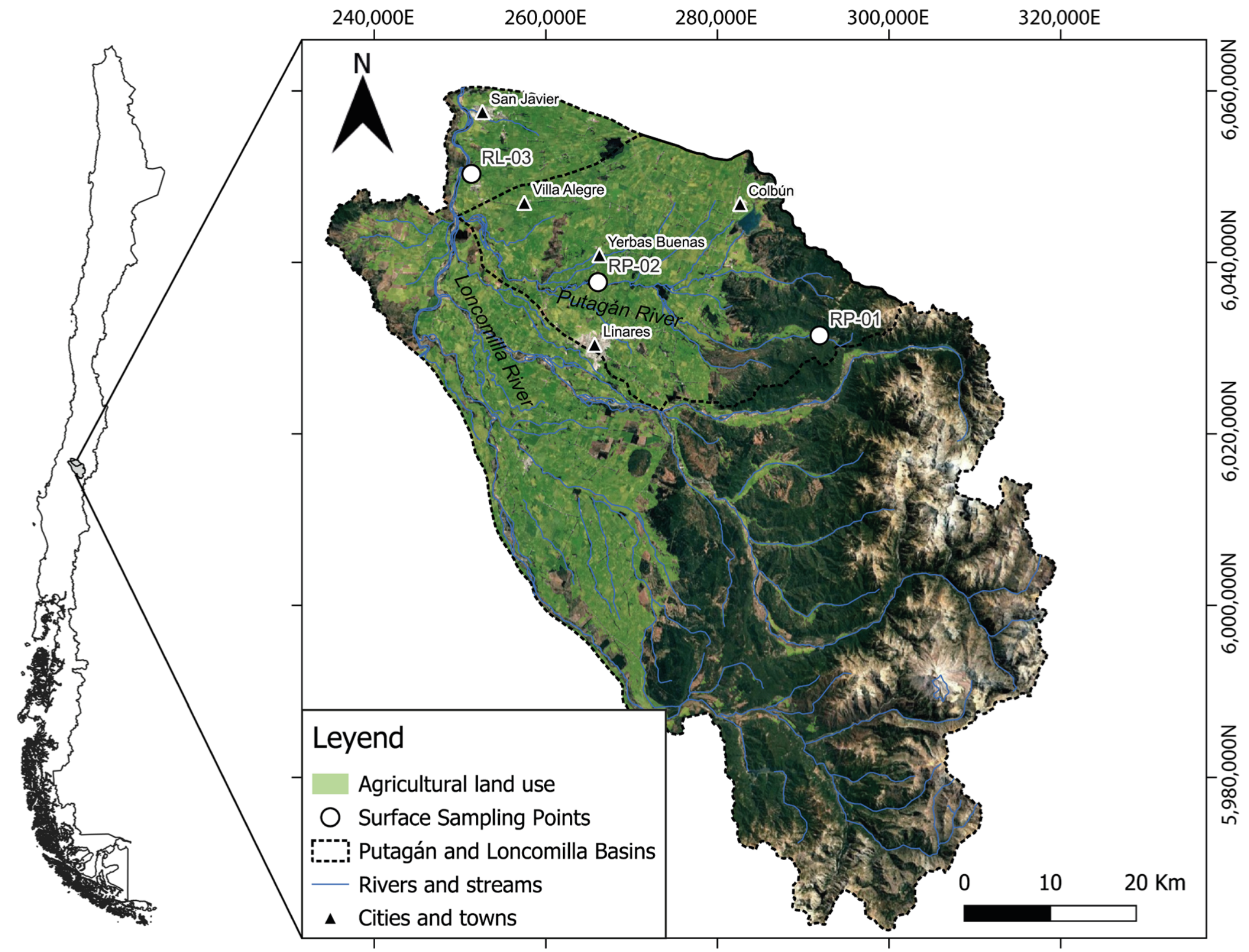
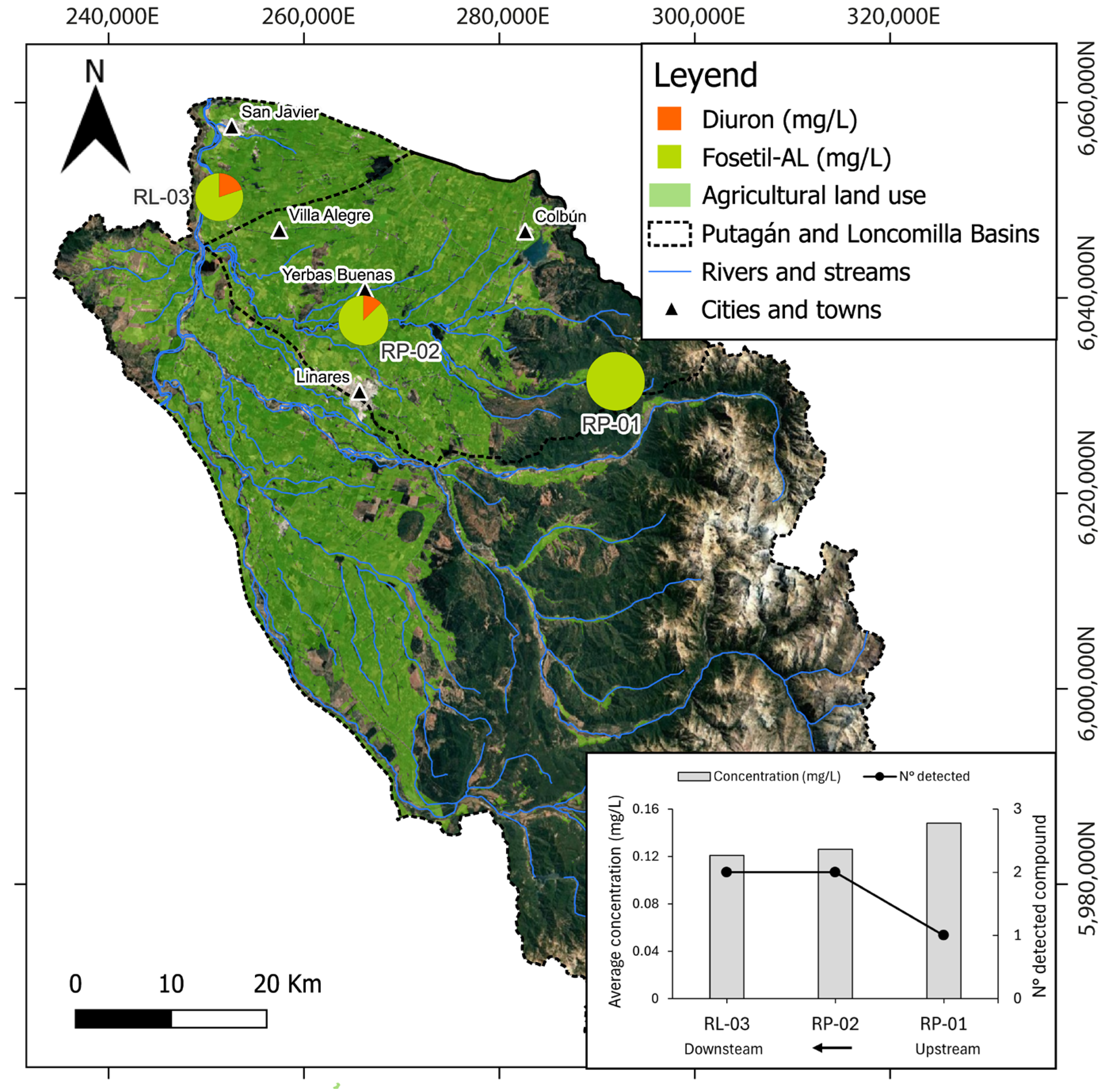
The Putagán River basin is a sub-sub-basin of the Loncomilla River sub-basin. It is in the Maule Region and its coordinates range from 35°38′24.00″ S to 35°54′36.00″ S latitude and 71°12′25.61″ W to 71°45′36.00″ W longitude. The basin has an area of 952.71 km2 and covers 52.07 km from the Andes Mountains to the Central Valley, with an average width of 30.75 km (Figure 1). Its source is 1875 masl and it is the main tributary of the Loncomilla River, joining it in the Villa Alegre sector at 35°42′0″ S latitude and 71°45′36″ W longitude. Agriculture dominates the consumptive use of water in the basin, using irrigation canals, and the Colbún reservoir is in the northern sector, with non-consumptive water rights granted.
The Loncomilla River basin, also in the Maule Region, is in coordinates ranging from 35°31′6.98″ S to 36°27′26.23″ S latitude and 71°6′16.61″ W to 71°55′55.04″ W longitude. It covers an area of 4390 km2 and runs 91.3 km from the Andes Mountains to the Central Valley, with an average width of 90.33 km (Figure 1). It originates at 2363 masl and has five main tributaries: the Putagán River, the Achibueno River, the Ancoa River, the Longaví River and the Perquilauquén River, which together form the Loncomilla River. Agriculture and forestry dominate water consumption in the basin, using irrigation canals and with the presence of reservoirs at the head its tributaries.
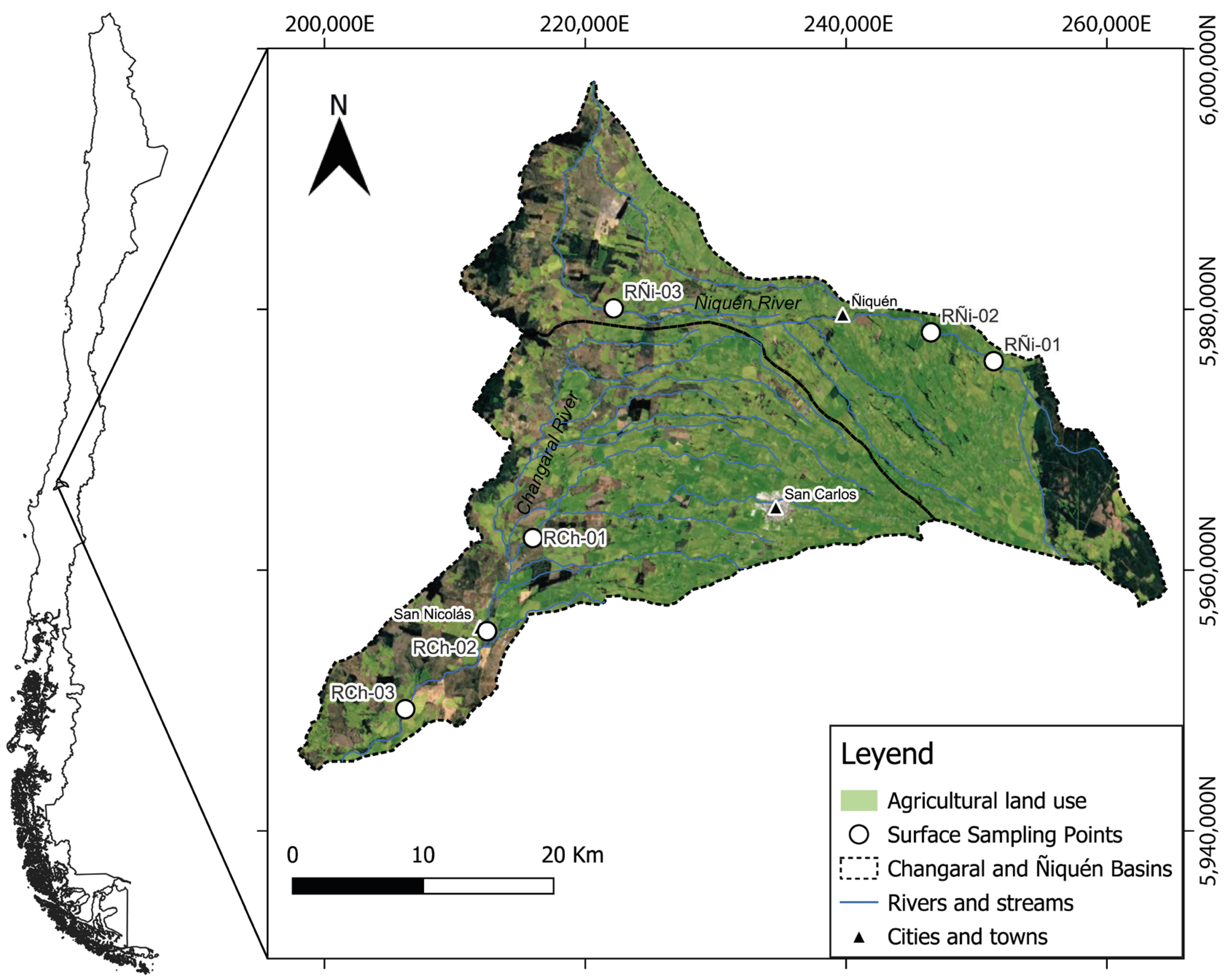
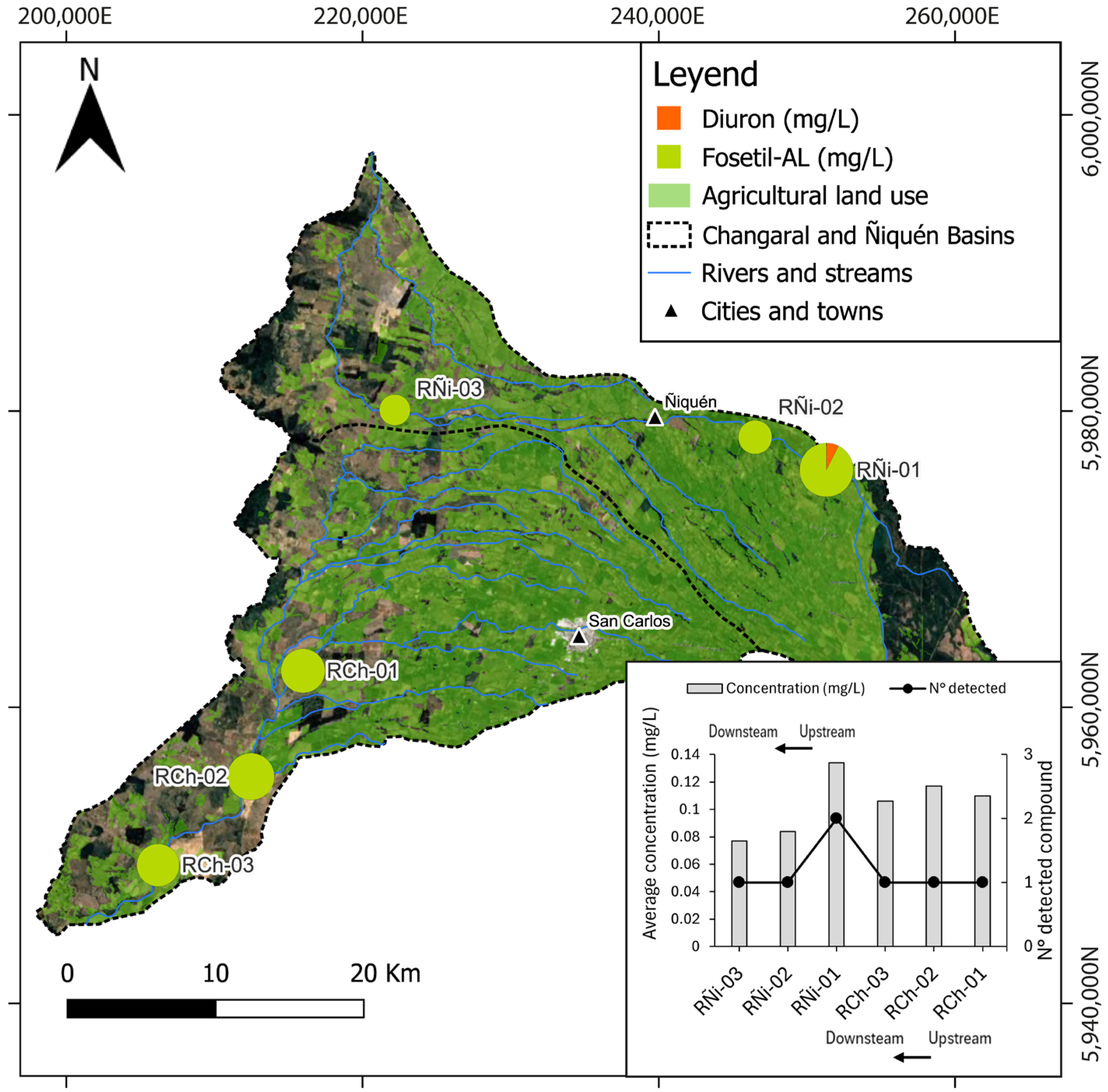
The Changaral River basin is a sub-sub-basin of the Ñuble Bajo sub-basin. It is in the Ñuble Region, and its coordinates range from 36°18′12.06″ S to 36°35′13.38″ S latitude and 71°49′21.22″ W to 72°22′15.67″ W longitude. The basin has an area of 683.14 km2 and covers around 35.54 km from the Andes Mountains to the Central Valley, with an average width of 42.88 km (Figure 2). Its source is 244 masl and it is a tributary of the Ñuble River, which it joins in the El Peumo-El Naranjo sector at 36°36′0″ S latitude and 72°20′24″ W longitude. Agriculture dominates consumptive water use in the basin, using numerous irrigation canals.
The Ñiquén River basin is a sub-sub-basin of the Perquilauquén Alto sub-basin. It is in the Ñuble Region, and its coordinates range from 36°8′11.51″ S to 36°30′13.89″ S latitude and 71°36′54.93″ W to 72°13′33.70″ W longitude. It has an area of 580.60 km2 and covers around 58.09 km from the Andes Mountains foothills to the Central Valley, with an average width of 18.61 km (Figure 2). Its source is 574 masl and it is the main tributary of the Perquilauquén River, which it joins on the border between the Maule and Ñuble Regions, at 36°07′12″ latitude and 72°05′59″ W longitude. Agriculture and forestry crops predominate consumptive water use in the basin, using numerous irrigation canals.

2.2. Agrochemicals

The sampling is defined as exploratory, considering that there are no preliminary data indicating the presence of a specific problem or sources of emissions in the rivers studied in this work. Thus, an analysis service was commissioned to screen 532 pesticide residues using LC-MS MS and GC-MS MS, in addition to three polar pesticides using LC-MS MS, carried out by the laboratory DavisLab SA, Santiago, Chile. The list of compounds and their quantification limits are summarized in Appendix A. In addition, the Declarations of Pesticide Sales published by the Chilean Agricultural and Livestock Service (SAG), under the current SAG Exempt Resolution No. 942/2025, were analyzed between 1998 and 2023, to determine the use of pesticides in the basins studied and obtain an estimate of the amounts used. Some of the drawbacks of this analysis were the lack of continuity in the information, as despite the institution’s obligation to report annual pesticide sales, there were 11 years, consecutive and non-consecutive, in which the declaration was not published and there is therefore a gap in the information, which the SAG is aware of. Given the above, the amount of pesticides sold in 2001 (the first year that the sales declaration report was published) was compared to 2023 (the last year that the sales declaration report was published) [25,28]. It should be noted that the Ñuble Region was part of the Biobío region prior to 2018. Consequently, the before and after assessment considers the Biobío region for 2001 and the sum of reports for the Ñuble and Biobío Regions for 2023. In addition, the results of the agricultural census for 2007 and 2021 [18,19] were compared to cross-reference information on the magnitude of pesticides sold, and the area cultivated in the municipalities located in the basins studied. For this, census data for Linares Province in the Maule Region were used, which covers the Loncomilla and Putagán basins, in addition to data for the municipalities of Ñiquen, San Fabián, San Carlos and San Nicolás, which cover the Ñiquén and Changaral basins in the Ñuble Region. While the 2021 agricultural census provides information on the types of Agricultural Production Unit by activity (agriculture, livestock and/or forestry), the distinction between irrigated and unirrigated agricultural areas, the classification of crops by category and area covered by these classifications, the monitoring points did not allow performing an analysis connecting specific crops with the respective use of pesticides on them. The main reasons for this are farmers’ privacy and the National Statistics Institute’s refusal to provide precise information on the location of the types of crops registered in the agricultural census.

2.3. Selection of Surface Water Sampling and Collection Sites

As mentioned in the previous paragraph, the sampling is defined as exploratory, considering that there are no preliminary data indicating the presence of a specific problem or sources of emissions. Three samplings were carried out in nine sites distributed across the three study basins studied, all in the low water season (March 2024 and early April 2024), as recommended by Climent et al. [14] and Rodríguez Aguilar et al. [29]. Repetitions were not considered because the rivers are dynamic and the sites are not independent, as discharges upriver affect the entire watercourse and can be accumulated or diluted. The sampling points were selected in consideration of the dimension of the crops in the sub-basins chosen for this study, the type of crop and the type of agrochemical used, according to point 2.1 of this section (Figure 1 and Figure 2). In addition, as mentioned above, pre-sampling fieldwork was carried out in 2022 and 2023 to identify community organizations and concerns related to the use of agrochemicals and choose sub-basins of interest to carry out this work. During this fieldwork, 20 semi-structured interviews with residents of rural sectors were carried out in accordance with the academic standards required for interaction with human subjects, including the use of informed consent. Lastly, in choosing the sub-basins for this study and subsequently the sampling points, those points that appeared in the fieldwork as places that the community suspected of intensive use of pesticides were prioritized and identified as points of special interest, including a sampling upstream and downstream of these points to assess agrochemical concentration and dilution processes. All water samples were collected from the water column at a depth of 15 cm using PET bottles with a 500-ml capacity, transported in a cooler at no more than 4 °C and stored in a refrigerator at 4 °C to keep them at low temperatures before sending them to the laboratory.

2.4. Laboratory Analysis of Water Samples

A total of 532 pesticide residues and 3 polar pesticides were analyzed using liquid chromatography coupled with tandem mass spectrometry (LC-MS/MS; Waters Xevo TQ-micro, Waters Corporation, Milford, MA, USA). Data acquisition and processing were performed with MassLynx V4.2 software (Waters Corporation, Milford, MA, USA). Additionally, for some of the 532 pesticide residues, gas chromatography coupled with tandem mass spectrometry (GC-MS/MS; Shimadzu TQ8050 NX, Shimadzu Corporation, Kyoto, Japan) was employed, and data were processed using GCMS 4.53 software (Shimadzu Corporation, Kyoto, Japan). Water samples were extracted directly, without prior filtration, following the QuEChERS methodology (UNE-EN 15662:2019 [30]) with acetonitrile extraction, followed by analysis using both liquid and gas chromatography coupled with tandem mass spectrometry (LC-MS/MS and GC-MS/MS, triple quadrupole detectors). Only analytes with responses above the validated limit of quantification (LOQ = 0.01 mg/L, determined individually for each compound) were quantified and reported in mg/L.
Diuron analysis was performed by LC-MS/MS using an Acquity UPLC HSS T3 column (Waters Corporation, Milford, MA, USA), with a mobile phase composed of 5 mM ammonium formate in water and a mixture of methanol and acetonitrile with 0.1% formic acid. The mobile phase flow was 0.5 mL/min, using ESI+ ionization mode, with a retention time of 6.5 min. For fosetyl-Al and phosphonic acid, an Anionic Polar Pesticide column (Waters Corporation, Milford, MA, USA) was used, with a mobile phase of water and acetonitrile with 0.9% formic acid. The mobile phase flow was 0.5 mL/min, using ESI- ionization mode and with retention times of 10.2 and 8.8 min, respectively. Calibration ranges were 0.004–0.20 µg/mL for fosetyl-Al and phosphonic acid, and 0.005–0.20 µg/mL for diuron, with determination coefficients (R2) ≥ 0.9965. Recoveries ranged between 78–103% (78% (fosetyl-Al), 103% (phosphonic acid) and 93% (diuron)) and coefficients of variation in 12 replicates ranged between 3.4–10.3% (3.4% (fosetyl-Al), 8.7% (phosphonic acid) and 10.3% (diuron)). These data are included in detail in Appendix A (Table A1).
Although the reported LOQ is 0.01 mg/L for all compounds, this value is a standardized reporting threshold provided by the laboratory. Internal validation confirmed that the calculated LOQ for each analyte was of the same order of magnitude, allowing a common reporting value. Standard deviations at the limit of quantification (0.01 mg/kg) were 0.00026 for fosetyl-Al, 0.00090 for phosphonic acid and 0.00096 for diuron. This value corresponds to the laboratory’s reporting criterion and may vary between compounds within the same order of magnitude.

3. Results

3.1. Declaration of Pesticide Sales and Land Use Changes

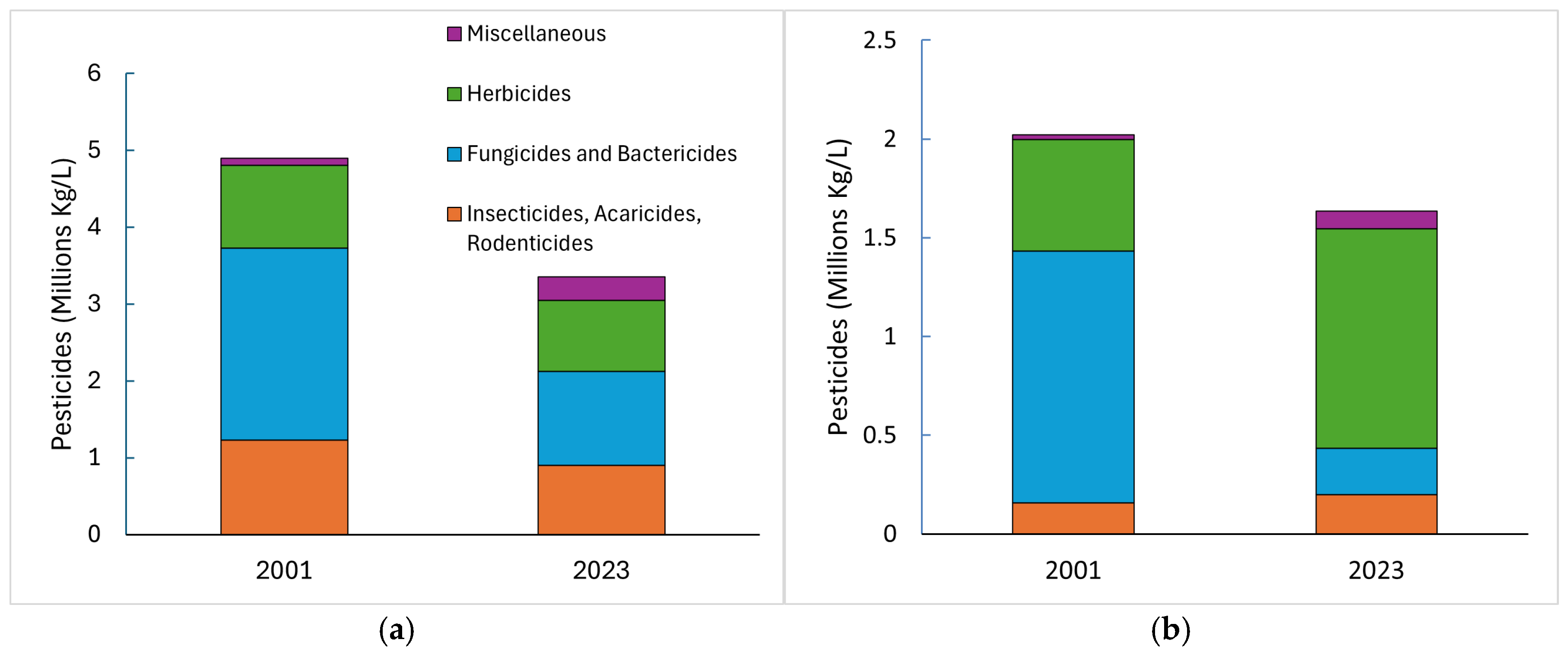
The comparison of pesticide sales for the Maule and Ñuble Regions shows that total pesticide sales in the former fell by 31% between 2001 and 2023, while increasing 22% in the latter (Table 1 and Figure 3).
In particular, the Maule Region registered a decline in the sale of insecticides, acaricides and rodenticides (−20%), fungicides and bactericides (−50%) and herbicides (−15%). In contrast, the sale of miscellaneous pesticides increased by 237%. According to the Chilean Agricultural and Livestock Service (SAG) classification, miscellaneous pesticides are phytosanitary products that do not clearly fit into traditional pesticide categories (such as insecticides, fungicides or herbicides). Such products include plant growth regulators, attractants and repellents and defoliants and desiccants, among others.
As for the sale of pesticides in the Biobío Region, there has been an increase in the sale of insecticides, acaricides and rodenticides (59%), herbicides (189%) and miscellaneous pesticides (342%). In contrast, sales of miscellaneous pesticides fell by −65%.
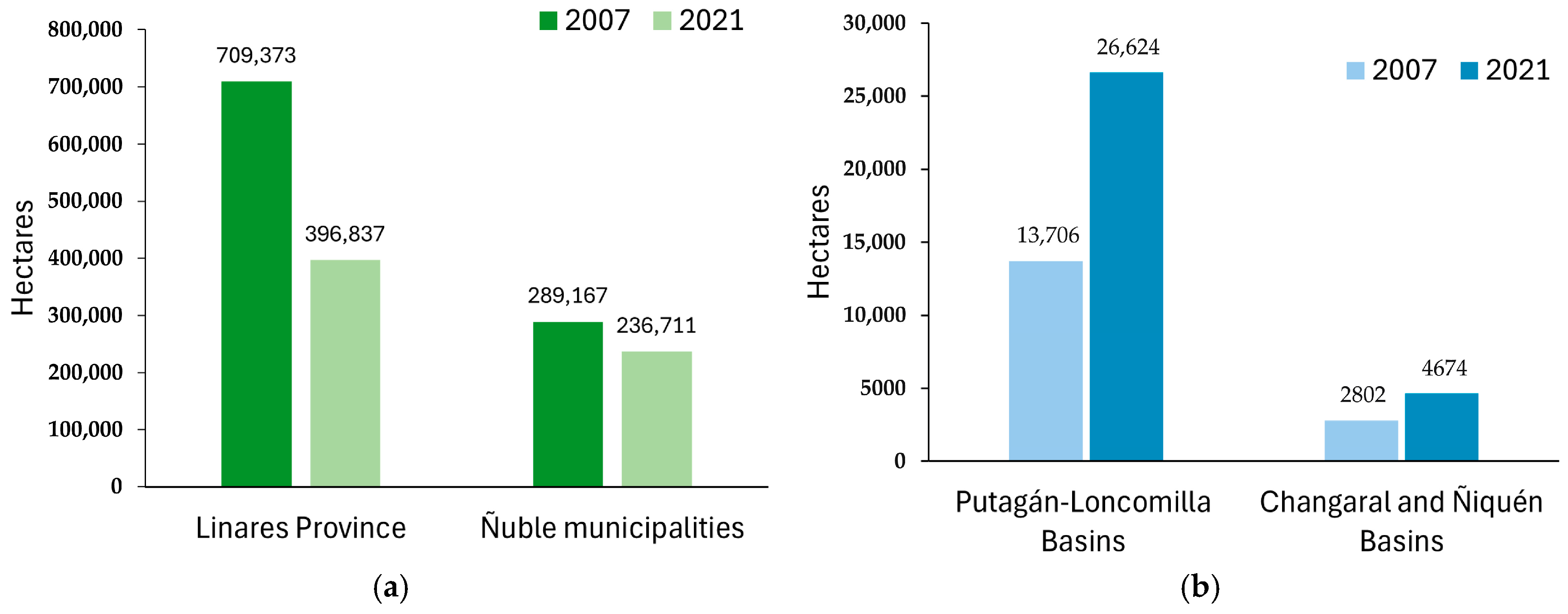
The results of the land use change analysis, according to the agricultural census results between 2007 and 2021, show that the area of land dedicated to agricultural production declined in both Regions. Linares Province showed a 44% decline in the area dedicated to agricultural production, while there was an 18% decline in the municipalities analyzed in the Ñuble Region. (Figure 4a) shows the variations in productive agricultural area by property size. In particular, the municipalities analyzed in Ñuble saw an 81% increase in the agricultural lands covering between 1000 ha and 2000 ha.
Despite this general decrease in the land dedicated to agricultural production, the area used for fruit cultivation in Linares Province and the municipalities analyzed in Ñuble increased between 2007 and 2021 (Figure 4b). The area dedicated to fruit crops in Linares Province increased 94%, while in the Ñuble municipalities it did so by 67%.
Official pesticide sales data [25,28] show a significant decline in the total use of agrochemicals in both regions: −31% in Maule and −19% in Biobío (including Ñuble). This overall reduction hides significant changes in composition, as pesticides are classified according to the series type. Series 1000 covers insecticides/acaricides/rodenticides, 2000 fungicides, 3000 herbicides and 4000 miscellaneous pesticides. The variations by series between 2001 and 2023 are included in Table 1.
These percentages, obtained from SAG sales declarations, indicate that there has been a drastic reduction in overall fungicide use in both regions, while herbicides fell moderately in Maule but increased almost twofold in Biobío. The explosive increase in the “miscellaneous” category (series 4000) reflects the massive introduction of new inputs (e.g., Biostimulants, growth regulators and bioprotectors) in recent years.
The sharp drop in fungicides suggests a reorientation of crops or an increased use of integrated management practices that replace chemical applications (e.g., vegetation covers, biofungicides). In contrast, the growth in herbicide use in Ñuble could be related to weed control in extensive monocultures or in new high-value fruit crops. The remarkable increase in miscellaneous inputs coincides with sectoral reports: Chilean agricultural agribusinesses have incorporated biostimulants and adjuvants based on extracts, amino acids and microorganisms (series 4000 Miscellaneous), seeking to improve plant yield and health in intensive systems. These changes in the input portfolio are consistent with productive modernization: Ref. [31] note that agricultural intensification tends to increase aggregate pesticide use (each additional 1% of yield/ha is associated with ~1.8% more pesticide use/ha), though with internal compensations (fewer insecticides versus increased high-tech herbicides/fungicides). In fact, recent studies indicate that intensification and monoculture, especially fruit crops, tend to increase agro-ecosystems’ exposure to combinations of agrochemicals [32]. In summary, the sales data show less dependence on conventional fungicides and a simultaneous increase in alternative products (bio-inputs) in a context of transformation toward fruit cultivation.
National agricultural censuses reveal profound territorial reconfigurations in Maule and Ñuble/Biobío. According to preliminary results of the 8th Census of 2021, carried out by the Chilean National Statistics Institute (INE) [19], the total area dedicated to agricultural production was drastically reduced in areas with traditional rural roots. For example, the area dedicated to agriculture fell by 44% in Linares Province (Maule) between 2007 and 2021, while in Ñuble it did so by 18%. However, a sharp increase in specialized crops can be observed in the same period: the area dedicated to fruit crops grew by +94% in Linares and +67% in Ñuble. This sharp growth reflects the reconversion to intensive irrigated fruit cultivation (citrus fruits, grapes, walnuts, berries, etc.), supported by investments and export markets. At the same time, concentration of land ownership has grown: in Ñuble the number of large properties (1000–2000 ha) increased by 81%, indicating a consolidation of areas for agribusiness purposes and lower plot fragmentation.
These structural changes point to an agriculture that is increasingly oriented toward high-value monocultures. International studies suggest that this specialization increases demand for inputs: by reducing biodiversity, monoculture crops tend to be more susceptible to pests and disease, which leads to the increased use of specific pesticides [33,34,35]. At the same time, the transfer of labor and resources to permanent crops could explain the overall drop in the cultivated area (especially annual crops and grasses) and the decline in smaller agricultural plots. Thus, the INE census data confirm an agricultural reconversion pattern in these regions: extensive cultivation areas are replaced by intensive plantations, with few producers managing larger areas.
The combination of the above findings suggests that reconversion to fruit crops is closely related to the change in the profile of agrochemical use. The displacement of livestock husbandry or pasturelands with fruit crops allows the use of conventional pesticides to be reduced, but at the same time it increases the specific phytosanitary pressure. In other words, the new intensive fruit growing activity requires more focused applications (for example, treatments against fruit flies, complex fungi or specific insects) while simultaneously incorporating state-of-the-art technology (drip irrigation, ferti-irrigation and biostimulants).
The international literature on the subject backs this interpretation. For example, Schreinemachers and Tipraqsa [31] show that increased yields per hectare are associated with rising large-scale use of pesticides. Furthermore, recent agricultural ecology studies have documented how intensification, especially in the form of fruit monocultures, reduces support biodiversity (pollinizers, natural enemies) and increases exposure to pesticides [32].
Thereby, the updated pesticide sales data together with the change in land use reveal the reconversion of agriculture into more intensive and specialized systems. While the aggregate use of conventional agrochemicals has declined, intensive fruit plantations require new specific biological and chemical inputs that explain the increase in the miscellaneous series. These trends are aligned with the global agricultural transition observed in other countries, where the intensification of production leads to high levels of pesticide use and the search for more comprehensive practices.

3.2. Interviews with Residents of Rural Sectors

As noted above, 20 semi-structured interviews with residents of rural sectors were carried out. The leaders of rural drinking water cooperatives, peasant women and small- and medium-scale farmers were interviewed. The objective of the interviews was to delve into the territorial transformations experienced in the last two decades, in line with our review of SAG data on pesticide use between 2001 and 2023. They also aimed to gain an understanding of rural residents’ perception of pesticide use in nearby areas and the socio-ecological impacts that they identify as coming from those pesticides. Table 2 shows the main results:
The first thing that comes to one’s attention is that several of the interviewees allege a lack of formal warning on the use of pesticides by nearby agricultural companies, which is in breach of current regulations demanding that companies provide formal notice that must be received by residents. The “self-identification” of pesticide use through indications such as strong smells is what raised concerns among interviewees. As one of the women interviewed commented, “we arrived home and there was a very strong smell, very pungent…they use liquid (colloquial name for pesticides) there, but we don’t know which liquid. I’m a chronic patient but no, they don’t put up a mesh (protection)” (interviewee 8).
After these first observations, most of the interviewees noted a loss of biodiversity in two areas: in the bee population and the vegetation near plantations. In the case of bees, peasant beekeeper women say that there is a connection between the installation of agricultural plantations that use pesticides and the decline in the bee population. As a beekeeping leader in Ñuble said, “the bees were the first to suffer with the use of poisons; they’re very sensitive and I realized right away that something was happening with these liquids when I began to notice that more bees were dying” (interviewee 11). This is consistent with the specialized literature, which gives account of changes in the composition of biological communities due to pesticide exposure, where bees are particularly sensitive to these chemical compounds [36]. The loss of vegetation adjacent to plantations that, according to local perception, use large amounts of pesticides is also noted. A peasant from Ñiquén said that “some of our trees and those of our neighbors have been drying up from the liquids they dump on the plantations” (interviewee 7).
Regarding human health, the interviewees do not mention these impacts emphatically. The symptom that appears is the increase in headaches identified with increased pesticide use. Despite failing to perceive clear major impacts, the consequences for human health are a major concern for the interviewees and one of the main reasons for requesting that studies be carried out on pesticide exposure in the territories studied.
In short, while these community perceptions have not yet been scientifically proven, they seemed relevant starting points for sampling on the exposure to pesticides in nearby surface waters.

3.3. Pesticide Residues

The analysis results for water samples collected in the Putagán-Loncomilla, Changaral and Ñiquén Rivers during the summer of 2024 are summarized in Table 3. Screening for 532 pesticide residues was performed using LC-MS/MS and GC-MS/MS. Among all compounds screened, only diuron was quantified above the validated limit of quantification (LOQ = 0.01 mg/L). A concentration above the LOQ indicates a reliably quantified result with adequate analytical accuracy. However, such quantification does not necessarily imply a direct risk to human health or the environment, nor does it constitute a regulatory violation in itself. Interpretation of the environmental or health relevance of these quantified concentrations must be made in relation to existing regulatory reference values (e.g., guideline values or maximum permissible limits).
One third of the samples analyzed contained diuron at concentrations above the LOQ (0.01 mg/L; samples RP-02 and RL-03 in the Putagán-Loncomilla River basin and sample RÑi-01 in the Ñiquén River basin; Table 3). Diuron is a long-lasting, non-photosensitive herbicide used to control broad-leaved weeds and some grasses (wheat, rice, barley, among others). According to the label approved by the Chilean Agricultural and Livestock Service (SAG, Authorization No. 3495), diuron is mainly applied during autumn-winter. Its quantification in water samples collected during summer (March 2024) suggests that this herbicide is highly persistent or that application may not fully comply with SAG label recommendations.
Diuron is not regulated in Chile but is included in the Australian drinking water guidelines [37], which set a maximum allowable concentration of 0.02 mg/L. In this context, only sample RL-03 (0.024 mg/L) exceeded this value, indicating that using this water for human consumption could be of concern (Table 3). In addition, all pesticides are regulated under the European Union Water Framework Directive (WFD), which defines maximum limits for individual pesticides and total pesticide concentrations in both drinking water and Environmental Quality Standards (EQS). The European Union Water Framework Directive (WFD) establishes a limit of 0.1 μg/L for each pesticide individually and 0.5 μg/L for the sum of pesticides in drinking water. The quantified diuron concentrations in our study exceeded the LOQ in all relevant samples and, in some cases, surpassed the EU WFD guideline values for drinking water and EQS.
Recent studies have shown that diuron degradation products can exert significant toxic effects on human cells, particularly in the liver and kidneys, by crossing the placental barrier that normally protects fetuses from external toxins [38]. Exposure to these metabolites poses potential risks to fetal growth and to the health of future generations through the production of reactive oxygen species (ROS) [39]. This oxidative stress is recognized as a contributing factor to neurodegenerative and metabolic diseases (ibid.). Furthermore, research on the health impacts of diuron has revealed that its degradation products, such as 3,4-DCA and DCPMU, persist in groundwater, as observed in studies conducted in California [40]. These findings underline the cytotoxicity of the DCPU metabolite in urothelial cells and its potential role in carcinogenic processes in the urinary bladder [41]. This type of toxicity represents a mechanism of action that disrupts the biological balance and could have long-term consequences in exposed organisms, thus adding a new layer of complexity when assessing chemical risks [41]. Other studies have examined how diuron disrupts key liver metabolic processes, such as gluconeogenesis and ammonia elimination.
Table 3. Quantified pesticide concentrations (≥LOQ = 0.01 mg/L) in surface water samples and comparison with international water quality standards *.
SampleRP-01RP-02RL-03RCh-01RCh-02RCh-03RÑi-01RÑi-02RÑi-03Chilean Standards (NCh. 409 [42] and NCh. 1333 [43])Australian Drinking Water Guidelines, 2011EU Drinking Water Standard for Individual PesticideEU Drinking Water Standard for Total PesticidesEU EQS (Freshwater)
UTM E291,892266,074251,326753,791749,842743,211251,311246,500761,070
UTM N6,031,4916,037,7036,050,3235,963,4075,956,5025,950,9255,976,0315,978,2425,980,601
Zone19 S19 S19 S18 S18 S18 S19 S19 S18 S
SamplingDate9 March 20249 March 20249 March 202416 March 202416 March 202417 March 20244 April 20244 April 20244 April 2024
Hour11:5013:1014:1112:2814:1913:3613:4513:1317:46
Diuron (mg/L)<LOQ0.0160.024<LOQ<LOQ<LOQ0.01<LOQ<LOQNot specified0.02 mg/L0.1 µg/L0.5 µg/L0.049 µg/L (AA); 0.27 µg/L (MAC)
Fosetyl-AL (mg/L)0.1480.110.0970.110.1170.1060.1240.0840.077Not specifiedNot specified0.1 µg/L0.5 µg/LNot specified
Phosphonic acid (mg/L)0.1110.0830.0730.0830.0880.080.0930.0630.058Not specifiedNot specified0.1 µg/L0.5 µg/LNot specified
* The concentration values correspond to averages obtained from validated analyses in 12 replicates by the laboratory. Standard deviations and validation parameters for the quantified analytes are presented in Appendix A (Table A1). Only concentrations above the validated LOQ are reported. Screened pesticides below the LOQ are not listed.
These alterations in mitochondria not only deprive cells of the necessary energy but also have systemic effects, such as metabolic disorders like acidosis [44].
From an ecological perspective, studies have shown that diuron and its degradation products persist in aquatic ecosystems for extended periods [45], creating a problematic cycle in which their resistance to decomposition and accumulation potential generate progressive toxic effects. Diuron has also been shown to persist under oxygen-free conditions [46], and recent research has reported significant toxicity levels in aquatic organisms such as shrimp [47], which play a crucial role in the marine food chain. The scientific community has expressed concern about the lack of adequate risk assessments, underscoring the urgent need to establish clear baselines for these substances and to design effective strategies to mitigate their impact on the environment and human health. Currently, there is no standard in Chile to ensure the biological or ecological quality of watersheds.
The spatial distribution of the quantified diuron concentrations observed in this study is also of interest. Our working hypothesis considered possible enrichment or dilution along the river flow, where upstream pesticide discharges may propagate downstream, leading to either accumulation or dilution of residues.
In the Putagán-Loncomilla River basin, diuron followed this expected pattern: it was not quantified above the LOQ in RP-01 (the uppermost sampling point), while the maximum quantified concentration was observed in RL-03 (the lowermost point in the basin) (Figure 5). This is consistent with the agricultural use of diuron described in the SAG label, which authorizes its application against weeds in fruit trees (including citrus), vineyards, and vine arbors. It is likely that the concentration of such crops increases toward the central valley, leading to greater use of this agrochemical and consequently higher residue levels in downstream waters.
The Ñiquén River basin behaves in the opposite way to the distribution of concentrations in the Putagán-Loncomilla River, allowing one to hypothesize that the substance is diluted by the water flow. The analysis results show the maximum concentration at point RÑi-01 and the minimum concentration in point RÑi-03 (Figure 6). This suggests that the main use and discharge of diuron in the Ñiquén River basin occurs at point RÑi-01, or upstream of it, and that it is gradually diluted by the flow, which indicates that this pesticide is not added downstream of point RÑi-01 in the summer, thus ruling out its use in European hazelnut plantations. While there are no gauging stations that could validate this hypothesis, there are certain geomorphological features that support it. The watercourse at the downstream site RÑi-03 is twice as wide as the upstream site (30 m vs. 14 m) and its elevation is 73 m lower (220 m vs. 147 m above sea level). These characteristics tend to be associated with an increased water flow downstream as the river is fed by tributaries and lateral contributions [48,49]. In addition, observations made in the field confirm the presence of irrigation canals that empty into the river between these two points. To rule out a possible short-term termporal variation, all samples on this river were taken on the same day, reducing the likelihood that this variability might explain the concentration gradient.
It should be noted that diuron is not quantified above the LOQ in the Changaral River basin during the low water season, which suggests that it is not applied to the crops grown in this basin (Figure 6), at least not in the summer.

3.4. Polar Pesticide Residues

The analysis results for polar pesticides in water samples collected from the Putagán-Loncomilla, Changaral, and Ñiquén Rivers during the summer of 2024 are summarized in Table 3. Screening for three polar pesticides was performed. Among these, only fosetyl-Al and its degradation byproduct, phosphonic acid, were quantified at concentrations above the validated limit of quantification (LOQ = 0.01 mg/L).
All water samples analyzed in this study showed quantified concentrations of fosetyl-Al and phosphonic acid above the LOQ (Table 3). Fosetyl-Al is a fungicide used to treat diseases caused by oomycete fungi, particularly mildew, phytophthora, and pythium in fruit trees, berries, gourds, and bulbs, and it is not authorized for organic farming. According to the Chilean Agricultural and Livestock Service (SAG) label, this agrochemical is typically applied three times per season: at the beginning of active growth, mid-season, and at the end of growth. Fosetyl-Al degrades into phosphonic acid in plants; thus, quantification of fosetyl-Al in water samples actually reflects the combined presence of fosetyl-Al, phosphonic acid, and their salts. This study specifically reports the quantified concentrations of fosetyl-Al and phosphonic acid.
The European Union authorized the use of phosphonates, such as fosetyl-Al, as plant protection products until 2013. Studies conducted in Europe have shown that current quantified residues of phosphonic acid can persist long after past applications, particularly in perennial or woody crops, resulting in long-lasting residues in soil and water [50]. This evidence suggests that fosetyl-Al and its degradation products are persistent agrochemicals. Their reported effects on human health include negative impacts on cellular energy metabolism, immunosuppression, and potential genotoxicity [51]. Despite being banned in the EU and despite its potential health impacts, there is no established standard in Chile or in the Australian drinking water guidelines regulating its concentration in surface waters [52]. In contrast, the EU Water Framework Directive (WFD) sets strict limits for individual and total pesticide concentrations in drinking water and for Environmental Quality Standards (EQS). The quantified concentrations of fosetyl-Al and phosphonic acid observed in this study exceeded these EU guideline values in several samples (Table 3). Given the absence of Chilean regulatory thresholds for fosetyl-Al and phosphonic acid in surface waters, it is not possible to directly assess whether the quantified concentrations observed in this study comply with water quality standards at the national level. Nevertheless, it is important to emphasize that fosetyl-Al continues to be used in Chile despite being prohibited in several countries. Moreover, its quantification in all water samples suggests widespread and consistent use throughout the study area.
Regarding the distribution of fosetyl-Al (mg/L) and phosphonic acid concentrations in the rivers studied, it was found that the distribution of fosetyl-AI concentrations coincides with the distribution of phosphonic acid concentrations in all samples, which is consistent with the fact that phosphonic acid is a product of fosetyl-AI degradation and, apparently, degrades in the same proportion.
The Putagán-Loncomilla River basin reveals a distribution contrary to the hypothesis of enrichment or dilution from the highest to the lowest point of the study basin in accordance with the flow direction. In the Putagán-Loncomilla river, this substance is enriched at the highest point in the basin (RP-01) when compared to the other two and its concentration diminishes until reaching its minimum in point RL-03. This can be interpreted as a generous application of Fosetyl-Al to crops upriver of point RP-01, possibly in the Roblería sector, which has the highest crop density in the area, and less intensive use down river of RP-01, causing the substance to be diluted as the river flow increases along the way.
In the Ñiquén River basin, the same distribution is observed as in the Putagán-Loncomilla River basin, contrary to the hypothesis posed: the concentration of fosetyl-Al is higher in point RÑi-01 (highest in the basin) and diminishes along the way until reaching the minimum concentration in point RÑi-03 (Figure 5 and Figure 6). As in the Putagán-Loncomilla River, it is very likely that fosetyl-Al application and use is intensive upriver or at point RÑi-01 and that it diminishes in the direction of the flow, thus ruling out its use—at least, intensively and at this date—for European hazelnut crops.
The Changaral River basin shows a tendency contrary to the hypothesis and the distribution of concentrations in other basins studied. Here, a maximum concentration was observed in the intermediate point, RCh-02, and the minimum concentration at point RCh-03, the lowest point in the basin (Figure 6). Given the fluvial morphology of the Changaral River, in the form of a comb, point RCh-03, which is the point that channels together all the Changaral River’s water flows, was expected to have the highest concentration of agrochemicals considering that all of these watercourses pass through a large number of agricultural lands. However, this decline in concentration in point RCh-3 compared to the higher concentration in RCh-02 could be due to Fosetyl-Al dilution processes considering the river’s increased flow at this point (RCh-03).
Work carried out in several Spanish rivers, such as that of Ccanccapa et al. [53] and Pascual Aguilar et al. [54], can be taken as a reference to analyze the spatial variations of diuron and fosetyl-AI in the samples analyzed from the rivers studied here. Ccanccapa et al. [53] found that the most polluted areas in the Turia and Júcar Rivers were at the river mouths (downriver), with a strong correlation between pesticide concentrations and river hydrology, revealing that the greater the flow, the larger the number of agrochemicals quantified, albeit at a lower concentration. In contrast, where the flow is lower, the number of agrochemicals declines but their concentration increases. Pascual Aguilar et al. [54] showed that, as the percentage of irrigated areas around the Júcar, Cabriel and Magro Rivers increased, so did the number and concentration of agrochemicals in the rivers. In contrast to these authors’ conclusions, this study did not identify an increase in the number of agrochemicals used in points downriver: only the presence of diuron, fosetyl-Al and its degradation, phosphonic acid, was detected in the three rivers studied. However, in the case of fosetyl-al in the Putagán-Loncomilla River, there is a correlation between lower flow and higher agrochemical concentration, as noted by Pascual Aguilar et al. [54].
Previous work, such as Palma et al. [55], Cooman et al. [56], Giordano et al. [57] and Montory et al. [13] quantified the presence of other agrochemicals in different rivers around the country, without detecting the presence of diuron or fosetyl-Al in them. Climent et al. [14] quantified the presence of diuron in the Cachapoal basin, both in the dissolved phase as well as the particulate phase in the water samples analyzed, and concluded that concentrations of this herbicide, together with other agrochemicals, exceeded those allowed by the European Union in water for human consumption (0.1 ug/L for an individual agrochemical and 0.5 ug/L for total agrochemical concentration [58,59].
Considering that our results exceed these thresholds for compounds such as diuron and Fosetyl-Al, we recommend that future Chilean regulations consider these values as international guidelines. This requires updating standards NCh 1333/1978, NCh 409/02 and Decree 90/2000 to include emerging pesticides that are detected and define lists of priority substances for monitoring (in line with EU practices and the standards or organizations like the WHO or EPA).
Our results reaffirm the importance of improving regulations on pesticide use in Chile. The lack of updated standards from state regulatory and oversight agencies in the country is worrying. Chile has a formal semiannual pesticide sales declaration system, which is mandated and systematized by the SAG. However, its current design gives the mechanism a statistical nature and it lacks binding regulatory force: the data reported are used to elaborate statistics and internal reports, but the report does not enable restrictions or automatically eliminate pesticides according to toxicity or environmental risk criteria. It is therefore of limited use as a control at the source. It is recommended that this system evolve into an active territorial risk management instrument, incorporating toxicological criteria in reporting and associating it with plans to reduce or gradually eliminate hazardous substances, as is the case in other places, such as the European Union.
This is directly related to the importance of furthering the sustainability of food production [60], using evidence to question the current agricultural model’s cumulative impact on human communities and ecosystems. In this context, producing applied research that allows moving toward more sustainable agroecological systems becomes an imperative to promote productive alternatives without toxic effects that are built on agrobiodiversity [61].
For its part, Chilean standard No. 1333 sets a water quality standard in terms of physical, chemical and biological aspects and depending on use—for human consumption, water for livestock, irrigation, recreation, esthetics and aquatic life—but is insufficient when it comes to pesticides. The standard, which dates to 1978 (amended in 1987), states that “pesticides do not have harmful effects on irrigation water.” For its part, Decree 90 of 2000, which regulates the discharge of pollutants in Chilean rivers, lakes and seas and verifies that concentrations do not exceed certain limits established by law, is a decree that excludes all main pesticides that are registered and in use, except pentachlorophenol, whose import, manufacture, sale, distribution and use have been forbidden since 2004 under SAG Resolution No. 78. Nor to the few existing standards mention the monitoring of pesticides that are classified as very persistent in the water, soil or sediment and/or very toxic to aquatic organisms, as is the case with the pesticide diuron. In short, there are no updated standards that include parameters allowing pesticide pollution of the waters in these territories to be measured. This shortcoming is added to the lack of available information, studies, monitoring and oversight of residues from pesticides registered and used in Chile in environmental matrixes such as irrigation or drinking water.
This work’s hypothesis, which indicates an enrichment or dilution from the highest to the lowest point in the basin studied in accordance with the flow direction, where agro-toxic discharges upriver impact the entire river and can be accumulated or diluted, is consistent with what both authors propose and only supported by a few samples in the different rivers of this study. As an exploratory and time-constrained study, its results constitute a snapshot of the rivers considered in this work. Thus, there is a need to monitor them over time, considering the dates on which certain agrochemicals are used, the date of the first rains and the date of these rivers’ maximum flows to be able to study and analyze the seasonal variations in these agrochemicals and rule out the presence/absence of other compounds. Considering this study’s findings, future research needs to study the influence of soil type and its impact on surface runoff, irrigation techniques and the type of crop in the river basins studied, in addition to considering their tributaries.

4. Conclusions

This work is the first to quantify the presence of diuron and fosetyl-Al in rivers in the Maule and Ñuble Regions, of Chile’s Central Valley. Diuron was detected above the limit of quantification (LOQ = 0.01 mg/L) in one third of samples from the Putagán-Loncomilla and Ñiquén River basins. Fosetyl-Al and its degradation byproduct, phosphonic acid, were quantified in all samples analyzed, indicating widespread use throughout the study area. The spatial distribution patterns observed suggest that pesticide concentrations are influenced by agricultural practices upstream and dilution processes along river flows.
Moreover, these pesticides were detected in several water samples at concentrations exceeding the European Union’s drinking-water limits (0.1 µg/L per pesticide). These results confirm that pesticide residues are present in local surface waters, confirming community suspicions about the presence of pesticides in the water bodies of the regions studied and underscoring the need for ongoing monitoring and regulation of agrochemicals. Furthermore, these results imply that the presence of these agrochemicals in water is poorly studied, as are its impacts on human health and on river ecology, meaning that there is an urgent need for more detailed analysis of the presence of these pesticides, their concentration and their impacts over a longer time frame and increased area.
Chile’s existing water quality standards currently lack limits for many commonly used pesticides, revealing a significant regulatory gap, which waters is concerning, particularly given that some detected concentrations exceed European Union guidelines for drinking water quality and Environmental Quality Standards (EQS). So, there is an urgent need for continuous monitoring of pesticides in the Central Valley’s rivers and the establishment of national standards regulating their presence in surface waters.
We recommend updating these standards (e.g., NCh 1333/1978 and related regulations) to include priority substances like diuron and to align with international guidelines. Integrating community observations with scientific monitoring can help identify pollution hotspots and guide policy. Adoption of mitigation measures and more sustainable agricultural practices is also necessary to reduce the impacts of pesticide pollution on human and ecosystem health.
Finally, our findings highlight the value of incorporating local knowledge into environmental research. The agreement between local’ perceptions and our analytical data suggests that community input can improve the identification of pollution sources. It is fundamental to recognize and value this knowledge, as it contributes key visions to understanding the context of environmental pollution and its effects.
While this study focuses on analyzing potential pesticide pollution of water bodies in Chile’s Central Valley, where export agriculture has expanded, its exploratory nature does not delve into the role played by specific crops in pollution phenomena, nor the effects of precipitation, land use changes or pesticide application seasons. It is therefore important to examine this component in greater depth in future research to strengthen studies on the productive transformations of agriculture and their socio-ecological implications. There is a need for further progress toward a greater integration of scientific and community practices with the political sphere to transform territories from a perspective of coexistence and profound regeneration. The approach goes beyond the presence of chemicals in the water and implies an opportunity to reinvent a connection based on respect and care for nature and all its inhabitants—human or non-human. This method would open up spaces for reflection and enable our territories in a resignifying way.

Author Contributions

Conceptualization, P.S., F.L.-C. and A.P.-P.; methodology, P.S. and A.P.-P.; validation, P.S. and A.P.-P.; formal analysis, P.S. and A.P.-P.; investigation, A.P.-P., P.S. and F.L.-C.; resources, A.P.-P.; data curation, P.S.; writing—original draft preparation, A.P.-P., P.S. and F.L.-C.; writing—review and editing, A.P.-P., P.S. and F.L.-C. project administration, A.P.-P.; funding acquisition, A.P.-P. All authors have read and agreed to the published version of the manuscript.

Funding

This research was funded by the National Agency for Research and Development (ANID) of Chile, grant number FONDECYT N°11220783 and ANILLO Pluriversos Climáticos ATE230072.

Institutional Review Board Statement

All procedures performed in this research were in compliance with relevant laws and institutional guidelines. Ethical approval for this research was obtained from the Bioethics Committee of the University of Bio-Bio, Chile on April 18th of 2022.

Informed Consent Statement

Informed consent was obtained from all subjects involved in this study.

Data Availability Statement

The raw data supporting the conclusions of this article will be made available by the authors on request.

Acknowledgments

The authors appreciate the comments and reflections received by Dharma Reyes and María Elena Rozas. We also appreciate the support of the communities of the Maule and Ñuble regions that took part in this research. The authors have reviewed and edited the output and take full responsibility for the content of this publication.

Conflicts of Interest

The authors declare no conflicts of interest.

Appendix A

Appendix A provides the analytical validation parameters for the pesticides quantified in this study. These data summarize the calibration ranges, linearity (R2), recovery percentages, coefficients of variation (CV) and standard deviations used to establish the limit of quantification (LOQ) for each analyte. The values presented are based on 12 replicate analyses performed by the accredited laboratory (DavisLab SA, Santiago, Chile), ensuring the reliability and reproducibility of the reported concentrations in water samples.
Table A1. Analytical validation parameters for quantified pesticides in water samples.
PesticideCalibration Range (µg/mL)R2Recovery (%)Coefficient of Variation (CV %)Standar Deviation (mg/kg)Reported LOQ (mg/L)
Fosetil-Al0.004–0.200.9990783.40.000260.01
Phosphonic Acid0.004–0.200.99851038.70.000900.01
Diurón0.005–0.200.99659310.30.000960.01

References

  1. McMichael, P. A food regime genealogy. J. Peasant Stud. 2009, 36, 139–169. [Google Scholar] [CrossRef]
  2. Giarracca, N.; Palmisano, T. Tres lógicas de producción de alimentos: ¿Hay alternativas al agronegocio? In Actividades Extractivas en Expansión ¿Reprimarización de la Economía Argentina? Giarracca, N., Teubal, M., Eds.; Antropofagia: Buenos Aires, Argentina, 2013. [Google Scholar]
  3. Rasmussen, L.V.; Coolsaet, B.; Martin, A.; Mertz, O.; Pascual, U.; Corbera, E.; Dawson, N.; Fisher, J.A.; Franks, P.; Ryan, C.M. Social-ecological outcomes of agricultural intensification. Nat. Sustain. 2018, 1, 275–282. [Google Scholar] [CrossRef]
  4. Intergovernmental Panel on Climate Change (IPCC). Special Report on Climate Change, Desertification, Land Degradation, Sustainable Land Management, Food Security, and Greenhouse Gas Fluxes in Terrestrial Ecosystems; IPCC: Ginebra, Switzerland, 2019; Available online: https://www.ipcc.ch/srccl/ (accessed on 11 August 2025).
  5. Zúñiga-Venegas, L.A.; Hyland, C.; Muñoz-Quezada, M.T.; Quirós-Alcalá, L.; Butinof, M.; Buralli, R.; Cardenas, A.; Fernandez, R.A.; Foerster, C.; Gouveia, N.; et al. Health Effects of Pesticide Exposure in Latin American and the Caribbean Populations: A Scoping Review. Environ. Health Perspect. 2022, 130, 96002. [Google Scholar] [CrossRef]
  6. Zaveri, E.; Grogan, D.S.; Fisher-Vanden, K.; Frolking, S.; Lammers, R.B.; Wrenn, D.H.; Prusevich, A.; Nicholas, R.E. Invisible water, visible impact: Groundwater use and Indian agriculture under climate change. Environ. Res. Lett. 2016, 11, 8. [Google Scholar] [CrossRef]
  7. Panez, A.; Olea, J. Agribusiness Moving through the Capitalocene: Slow Violence and Renewed Strategies of Capitalist Agriculture in Chile. J. Peasant Stud. 2023, 51, 1164–1184. [Google Scholar] [CrossRef]
  8. Red de Acción en Plaguicidas y sus Alternativas de América Latina (RAP-AL). Reporte Anual Sobre el uso de Plaguicidas en Chile; RAP-AL: Santiago, Chile, 2024. [Google Scholar]
  9. Muñoz-Quezada, M.T.; Iglesias, V.; Lucero, B.; Steenland, K.; Barr, D.B.; Levy, K.; Ryan, P.B.; Alvarado, S.; Concha, C. Predictors of exposure to organophosphate pesticides in schoolchildren in the Province of Talca, Chile. Environ. Int. 2012, 47, 28–36. [Google Scholar] [CrossRef]
  10. Muñoz-Quezada, M.T.; Iglesias, V.; Zúñiga-Venegas, L.; Pancetti, F.; Foerster, C.; Landeros, N.; Lucero, B.; Schwantes, D.; Cortés, S. Exposure to pesticides in Chile and its relationship with carcinogenic potential: A review. Front. Public Health 2025, 13, 1531751. [Google Scholar] [CrossRef]
  11. Muñoz-Quezada, M.T.; Lucero, B.A.; Gutiérrez-Jara, J.P.; Buralli, R.J.; Zúñiga-Venegas, L.; Muñoz, M.P.; Ponce, K.V.; Iglesias, V. Longitudinal exposure to pyrethroids (3-PBA and trans-DCCA) and 2,4-D herbicide in rural schoolchildren of Maule region, Chile. Sci. Total Environ. 2020, 749, 141512. [Google Scholar] [CrossRef]
  12. Landeros, N.; Duk, S.; Márquez, C.; Inzunza, B.; Acuña-Rodríguez, I.S.; Zúñiga-Venegas, L.A. Genotoxicity and Reproductive Risk in Workers Exposed to Pesticides in Rural Areas of Curicó, Chile: A Pilot Study. Int. J. Environ. Res. Public Health 2022, 19, 16608. [Google Scholar] [CrossRef]
  13. Montory, M.; Ferrer, J.; Rivera, D.; Villouta, M.V.; Grimalt, J.O. First report on organochlorine pesticides in water in a highly productive agro-industrial basin of the Central Valley, Chile. Chemosphere 2017, 174, 148–156. [Google Scholar] [CrossRef]
  14. Climent, M.J.; Herrero-Hernández, E.; Sánchez-Martín, M.; Rodríguez-Cruz, M.S.; Pedreros, P.; Urrutia, R. Residues of pesticides and some metabolites in dissolved and particulate phase in surface stream water of Cachapoal River basin, central Chile. Environ. Pollut. 2019, 251, 90–101. [Google Scholar] [CrossRef]
  15. Navas, G. ‘If there’s no evidence, there’s no victim’: Undone science and political organisation in marginalising women as victims of DBCP in Nicaragua. J. Peasant Stud. 2022, 50, 1569–1592. [Google Scholar] [CrossRef]
  16. Panez, A.; Mansilla, P.; Moreira, A. Agua, tierra y fractura sociometabólica del agronegocio. Actividad frutícola en Petorca, Chile. Bitácora Urbano Territ. 2018, 28, 153–160. [Google Scholar] [CrossRef]
  17. Instituto Nacional de Estadísticas (INE). VI Censo Nacional Agropecuario, Año 1997; Zajer Ayub, M., Ed.; Departamento de Comunicaciones, INE: Santiago, Chile, 1998; Available online: https://www.fao.org/fileadmin/templates/ess/ess_test_folder/World_Census_Agriculture/Country_info_2000/Reports_2/CHILE_ESP_REP_1997.pdf (accessed on 11 August 2025).
  18. Instituto Nacional de Estadísticas (INE). Censo Agropecuario y Forestal 2007; Centro de Documentación CEDOC: Santiago, Chile, 2007; Available online: https://www.ine.gob.cl/estadisticas/economia/agricultura-agroindustria-y-pesca/censos-agropecuarios (accessed on 11 August 2025).
  19. Instituto Nacional de Estadísticas(INE). Censo Agropecuario 2021; Centro de Documentación CEDOC: Santiago, Chile, 2021; Available online: https://www.ine.gob.cl/estadisticas/economia/agricultura-agroindustria-y-pesca/censos-agropecuarios (accessed on 11 August 2025).
  20. Oficina de Estudios y Políticas Agrarias (ODEPA); Centro de Información de Recursos Naturales (CIREN). Catastro Frutícola: Región del Maule—Principales Resultados Julio 2016; Ministerio de Agricultura: Santiago, Chile, 2016; Available online: https://bibliotecadigital.ciren.cl/items/5dfbf033-6dff-4040-b456-b3db3fb166e2 (accessed on 11 August 2025).
  21. Oficina de Estudios y Políticas Agrarias (ODEPA); Centro de Información de Recursos Naturales (CIREN). Catastro Frutícola: Región del Biobío—Principales Resultados Julio 2016; Ministerio de Agricultura: Santiago, Chile, 2016; Available online: https://bibliotecadigital.ciren.cl/items/043aa6a1-d7a1-4849-8a49-7124a8dda86b (accessed on 11 August 2025).
  22. Oficina de Estudios y Políticas Agrarias (ODEPA); Centro de Información de Recursos Naturales (CIREN). Catastro Frutícola: Región del Maule—Principales Resultados Julio 2019; Ministerio de Agricultura: Santiago, Chile, 2019; Available online: https://bibliotecadigital.ciren.cl/items/17ea8d0d-d6c1-422e-99e7-f163017c5ad9 (accessed on 11 August 2025).
  23. Oficina de Estudios y Políticas Agrarias (ODEPA); Centro de Información de Recursos Naturales (CIREN). Catastro Frutícola: Región del Biobío—Principales Resultados Julio 2019; Ministerio de Agricultura: Santiago, Chile, 2019; Available online: https://bibliotecadigital.ciren.cl/items/40576cfc-0c95-4295-a682-badadd985422 (accessed on 11 August 2025).
  24. Oficina de Estudios y Políticas Agrarias (ODEPA); Centro de Información de Recursos Naturales (CIREN). Catastro Frutícola: Región del Ñuble—Principales Resultados Julio 2019; Ministerio de Agricultura: Santiago, Chile, 2019; Available online: https://bibliotecadigital.ciren.cl/items/8126834b-c07c-4cb8-9ecd-c7ffc49fff0e (accessed on 11 August 2025).
  25. Servicio Agrícola y Ganadero (SAG). Reporte General de las Declaraciones de Ventas de Plaguicidas Año 2023; Ministerio de Agricultura: Santiago, Chile, 2023; Available online: https://www.sag.gob.cl/ambitos-de-accion/declaraciones/publicaciones (accessed on 11 August 2025).
  26. Luebert, F.; Pliscoff, P. Sinopsis Bioclimática y Vegetacional de Chile; Editorial Universitaria: Santiago, Chile, 2017; 377p. [Google Scholar]
  27. Corporación Nacional Forestal (CONAF). Catastros de Uso de Suelo y Vegetación; Ministerio de Agricultura: Santiago, Chile, 2016. [Google Scholar]
  28. Servicio Agrícola y Ganadero (SAG). Declaración de Ventas Plaguicidas Agrícolas Año 2001; Subdepartamento de Plaguicidas y Fertilizantes, SAG: Santiago, Chile, 2005; Available online: https://www.sag.gob.cl/ambitos-de-accion/declaraciones/publicaciones (accessed on 11 August 2025).
  29. Rodríguez Aguilar, B.A.; Martínez Rivera, L.M.; Peregrina Lucano, A.A.; Ortiz Arrona, C.I.; Cárdenas Hernández, O.G. Análisis de residuos de plaguicidas en el agua superficial de la cuenca del río Ayuquila-Armería, México. Terra Latinoam. 2019, 37, 151–161. [Google Scholar] [CrossRef]
  30. UNE-EN 15662:2019; Foods of Plant Origin—Multimethod for the Determination of Pesticide Residues Using GC- and LC-Based Analysis Following Acetonitrile Extraction/Partitioning and Clean-Up by Dispersive SPE—Modular QuEChERS-Method. European Committee for Standardization (CEN): Brussels, Belgium, 2019.
  31. Schreinemachers, P.; Tipraqsa, P. Agricultural pesticides and land use intensification in high, middle and low income countries. Food Policy 2012, 37, 616–626. [Google Scholar] [CrossRef]
  32. Guzman, L.M.; Elle, E.; Morandin, L.A.; Cobb, N.S.; Chesshire, P.R.; McCabe, L.M.; Hughes, A.; Orr, M.; M’Gonigle, L.K. Impact of pesticide use on wild bee distributions across the United States. Nat. Sustain. 2024, 7, 1324–1334. [Google Scholar] [CrossRef]
  33. Letourneau, D.K.; Armbrecht, I.; Rivera, B.S.; Lerma, J.M.; Carmona, E.J.; Daza, M.C.; Escobar, S.; Galindo, V.; Gutiérrez, C.; López, S.D.; et al. Does plant diversity benefit agroecosystems? A synthetic review. Ecol. Appl. 2011, 21, 9–21. [Google Scholar] [CrossRef]
  34. Aizen, M.A.; Aguiar, S.; Biesmeijer, J.C.; Garibaldi, L.A.; Inouye, D.W.; Jung, C.; Martins, D.J.; Medel, R.; Morales, C.L.; Ngo, H.; et al. Global agricultural productivity is threatened by increasing pollinator dependence without a parallel increase in crop diversification. Glob. Change Biol. 2019, 25, 3516–3527. [Google Scholar] [CrossRef]
  35. Guinet, M.; Adeux, G.; Cordeau, S.; Courson, E.; Nandillon, R.; Zhang, Y.; Munier-Jolain, N. Fostering temporal crop diversification to reduce pesticide use. Nat. Commun. 2023, 14, 7416. [Google Scholar] [CrossRef] [PubMed]
  36. Tosi, S.; Sfeir, C.; Carnesecchi, E.; vanEngelsdorp, D.; Chauzat, M.P. Lethal, sublethal, and combined effects of pesticides on bees: A meta-analysis and new risk assessment tools. Sci. Total Environ. 2022, 844, 156857. [Google Scholar] [CrossRef] [PubMed]
  37. National Health and Medical Research Council (NHMRC); Natural Resource Management Ministerial Council (NRMMC). Australian Drinking Water Guidelines Paper 6: National Water Quality Management Strategy; Version 3.9; Commonwealth of Australia: Canberra, Australia, 2011. [Google Scholar]
  38. Mohammed, A.M.; Huovinen, M.; Vähäkangas, K.H. Toxicity of diuron metabolites in human cells. Environ. Toxicol. Pharmacol. 2020, 78, 103409. [Google Scholar] [CrossRef]
  39. Huovinen, M.; Loikkanen, J.; Naarala, J.; Vähäkangas, K. Toxicity of Diuron in human cancer cells. Toxicol. In Vitro 2015, 29, 1577–1586. [Google Scholar] [CrossRef]
  40. United States Environmental Protection Agency (EPA). Diuron Draft Human Health Risk Assessment for Registration Review; EPA-HQ-OPP-2015-0077-0044; Office of Pesticide Programs, Health Effects Division: Washington, DC, USA, 2021; pp. 1–73. Available online: https://www.regulations.gov/document/EPA-HQ-OPP-2015-0077-0044 (accessed on 11 August 2025).
  41. Da Rocha, M.S.; Arnold, L.L.; Dodmane, P.R.; Pennington, K.L.; Qiu, F.; De Camargo, J.L.V.; Cohen, S.M. Diuron metabolites and urothelial cytotoxicity: In vivo, in vitro and molecular approaches. Toxicology 2013, 314, 238–246. [Google Scholar] [CrossRef]
  42. NCh 409/Of.2005; Agua Potable—Parte 1: Requisitos. Instituto Nacional de Normalización (INN): Santiago, Chile, 2005.
  43. NCh 1333/Of.1978; Requisitos de Calidad del agua para Diferentes Usos. Instituto Nacional de Normalización (INN): Santiago, Chile, 1978.
  44. Simões, M.S.; Bracht, L.; Parizotto, A.V.; Comar, J.F.; Peralta, R.M.; Bracht, A. The metabolic effects of diuron in the rat liver. Environ. Toxicol. Pharmacol. 2017, 54, 53–61. [Google Scholar] [CrossRef]
  45. Dragone, R.; Cheng, R.; Grasso, G.; Frazzoli, C. Diuron in water: Functional toxicity and intracellular detoxification patterns of active concentrations assayed in tandem by a yeast-based probe. Int. J. Environ. Res. Public Health 2015, 12, 3731–3740. [Google Scholar] [CrossRef] [PubMed]
  46. Giacomazzi, N.C. Environmental impact of diuron transformation: A review. Chemosphere 2004, 56, 1021–1032. Available online: https://www.sciencedirect.com/science/article/abs/pii/S0045653504004047 (accessed on 11 August 2025). [CrossRef]
  47. Cházaro-Olvera, S.; Montoya-Mendoza, J.; Castañeda-Chávez, M.R.; Lango-Reynoso, F.; Chaparro-Medina, V. Acute toxicity of the herbicide Karmex (diuron) in Macrobrachium acanthurus and M. olfersii prawns. Rev. Int. Contam. Ambient. 2022, 38, 54610. [Google Scholar] [CrossRef]
  48. Knighton, D. Fluvial Forms and Processes: A New Perspective; Routledge: London, UK, 2014. [Google Scholar]
  49. Leopold, L.B.; Wolman, M.G.; Miller, J.P.; Wohl, E.E. Fluvial Processes in Geomorphology; Courier Dover Publications: Mineola, NY, USA, 2020. [Google Scholar]
  50. Malusà, E.; Tosi, L. Phosphorous acid residues in apples after foliar fertilization: Results of field trials. Food Addit. Contam. 2005, 22, 541–548. [Google Scholar] [CrossRef]
  51. Silva, V.; Yang, X.; Fleskens, L.; Ritsema, C.J.; Geissen, V. Environmental and human health at risk–Scenarios to achieve the Farm to Fork 50% pesticide reduction goals. Environ. Int. 2022, 165, 107296. [Google Scholar] [CrossRef]
  52. Australian Pesticides and Veterinary Medicines Authority. Diuron Environmental Assessment Report; Australian Pesticides and Veterinary Medicines Authority: Canberra, Australia, 2011. Available online: https://www.apvma.gov.au/sites/default/files/publication/15391-diuron-human-health.pdf (accessed on 11 August 2025).
  53. Ccanccapa, A.; Masiá, A.; Navarro-Ortega, A.; Picó, Y.; Barceló, D. Pesticides in the Ebro River basin: Occurrence and risk assessment. Environ. Pollut. 2016, 211, 414–424. [Google Scholar] [CrossRef]
  54. Pascual-Aguilar, J.; Andreu, V.; Campo, J.; Picó, Y.; Masiá, A. Pesticide occurrence in the waters of Júcar River, Spain from different farming landscapes. Sci. Total Environ. 2017, 607–608, 752–760. [Google Scholar] [CrossRef] [PubMed]
  55. Palma, G.; Sánchez, A.; Olave, Y.; Encina, F.; Palma, R.; Barra, R. Pesticide levels in surface waters in an agricultural–forestry basin in Southern Chile. Chemosphere 2004, 57, 763–770. [Google Scholar] [CrossRef] [PubMed]
  56. Cooman, W.; Barra, R.; Urrutia, R.; Barra, C.; Parra, O. Pesticide residues in surface waters from a Chilean basin. Chemosphere 2005, 59, 1237–1245. [Google Scholar] [CrossRef]
  57. Giordano, A.; Barra, R.; Parra, O.; Focardi, S. Presence of organochlorine pesticides in the Itata River basin, Central Chile. Chemosphere 2011, 84, 1540–1548. [Google Scholar] [CrossRef]
  58. European Commission (EC). Council Directive 98/83/EC of 3 November 1998 on the Quality of Water Intended for Human Consumption. Off. J. Eur. Communities 1998, L 330, 32–54. Available online: https://eur-lex.europa.eu/legal-content/EN/TXT/?uri=celex%3A31998L0083 (accessed on 11 August 2025).
  59. European Commission (EC). Directive 2006/118/EC of the European Parliament and of the Council of 12 December 2006 on the protection of groundwater against pollution and deterioration. Off. J. Eur. Union 2006, L 372/19, 19–31. [Google Scholar]
  60. Muñoz-Quezada, M.T.; Pasten, P.; Landeros, N.; Valdés, C.; Zúñiga-Venegas, L.; Castillo, B.; Lucero, B.; Castillo, A.; Buralli, R.J. Bioethical Analysis of the Socio-Environmental Conflicts of a Pig Industry on a Chilean Rural Community. Sustainability 2024, 16, 5457. [Google Scholar] [CrossRef]
  61. Charoenratana, S.; Anukul, C.; Rosset, P.M. Food Sovereignty and Food Security: Livelihood Strategies Pursued by Farmers during the Maize Monoculture Boom in Northern Thailand. Sustainability 2021, 13, 9821. [Google Scholar] [CrossRef]
Figure 1. Land use map of Putagán and Loncomilla River basins and sampling points (as part of the VII Región del Maule, Central Chile). Self-elaboration based on data of Land Use and Land Cover Cadastre [27].
Sustainability 17 07911 g001
Figure 2. Land use map of Changaral and Ñiquén River basins and sampling points (as part of the XVI Región de Ñuble, Central Chile). Self-elaboration based on data of Land Use and Land Cover Cadastre [27].
Sustainability 17 07911 g002
Figure 3. Historical variation in the volume of pesticides in the Maule and Biobío regions (which includes the Ñuble Region), based on the Declaration of Pesticide Sales of the chilean Agricultural and Livestock Service in 2001 and 2023 [25,28]: (a) Maule Region; (b) Biobío Región (including Ñuble).
Sustainability 17 07911 g003
Figure 4. (a) Historical variation of land dedicated to agricultural production between 2007 and 2021 in the study watersheds, and (b) Historical variation in fruit crop cultivated area between 2007 and 2021 in the study watersheds, both based on agricultural census data [17,18].
Sustainability 17 07911 g004
Figure 5. Total concentration of pesticides (mg L−1), number of quantified compounds and spatial distribution of different pesticide groups (%) of water samples collected along Putagán and Loncomilla Rivers.
Sustainability 17 07911 g005
Figure 6. Total concentration of pesticides (mg L−1), number of quantified compounds and spatial distribution of different pesticide groups (%) of water samples collected along Changaral and Ñiquén Rivers.
Sustainability 17 07911 g006
Table 1. Percentage decrease or increase in pesticide sales in the Maule and Biobío regions (including the Ñuble region) between 2001 and 2023, according to the analysis of the Pesticide Sales Declaration conducted by the Chilean Agricultural and Livestock Service [25,28].
SerieMaule RegionBiobío Region (Including Ñuble)
1000 Insecticides, Acaricides, Rodenticides−27%25.80%
2000 Fungicides and Bactericides−50.80%−81.50%
3000 Herbicides−14.60%97.20%
4000 Miscellaneous236%283.50%
Table 2. Rural inhabitants’ perceptions on the socio-ecological impacts of pesticides.
Rural Inhabitants’ Perceptions
Impacts on biodiversityIncreased mortality in bee population (interviewees 5, 7, 8 and 10)
Overall decline in insect communities (interviewees 2, 8 and 10)
Loss of trees (interviewees 8, 10, 14 and 16)
Impacts on human healthHeadaches (interviewees 7 and 8) 1
1 Source: authors’ compilation.
Disclaimer/Publisher’s Note: The statements, opinions and data contained in all publications are solely those of the individual author(s) and contributor(s) and not of MDPI and/or the editor(s). MDPI and/or the editor(s) disclaim responsibility for any injury to people or property resulting from any ideas, methods, instructions or products referred to in the content.