Article

Assessment and Prediction of Land Use and Landscape Ecological Risks in the Henan Section of the Yellow River Basin


by
Lu Zhang
*,
Jiaqi Han
,
Jiayi Xu
,
Wenjie Yang
,
Bin Peng
and
Mingcan Wei
College of Surveying and Geo-Informatics, North China University of Water Resources and Electric Power, Zhengzhou 450046, China
*
Author to whom correspondence should be addressed.
Sustainability 2025, 17(17), 7890; https://doi.org/10.3390/su17177890
Submission received: 15 July 2025 / Revised: 25 August 2025 / Accepted: 26 August 2025 / Published: 2 September 2025

Abstract

To accurately grasp the land and ecological dynamics in the Henan section of the Yellow River Basin (YRB) and provide detailed local data for the ecological protection of the YRB, this article takes the Henan segment within the YRB as the research area, explores the spatio-temporal evolution of land use (LU) and landscape ecological risks (LERS), and predicts LU and LERS under various scenarios in the future based on the PLUS model. We found that: (1) From 2000 to 2020, object types in research area were given priority with cultivated land, forest land, and construction land, with construction land and cultivated land experiencing the largest changes of 5.71% and −6.34%, respectively. Changes in other land types varied within a ±3% range. The expansion of construction land principally encroached upon cultivated land, indicating significant urban sprawl. (2) The high-ecological-risk areas were clustered in the area centered in Zhengzhou, and the low-ecological-risk areas were distributed in the edge of the study area. As risk levels increased, the risk center gradually shifted towards the central regions, particularly around Luoyang and at the junction of Luoyang, Zhengzhou, and Jiaozuo. (3) The LU status in 2030 was projected using the PLUS model under three varied scenarios. The Kappa coefficient of the model was 0.81, and the overall accuracy was about 88.13%. Cultivated land, forest land, and construction land still accounted for the main part, and the area of cultivated land and construction land changed significantly. Based on this analysis of LERS prediction, the distribution of risk levels in different scenarios was different, but in general, high-ecological-risk areas and higher-ecological-risk areas accounted for the main part, while the study area’s edges were where low-ecological-risk zones were situated. Research can offer scientific and technological support for the sensible utilization and administration of resources, along with the protection of the ecological environment and regional sustainable development.

1. Introduction

Within the context of climate change, alterations in land utilization have become a key factor influencing ecological and environmental changes. Dynamic shifts in LU patterns are a result of the intricate interplay between human activities and natural processes [1,2], which in turn have far-reaching consequences for ecosystems as well as sustainable development. Understanding spatiotemporal patterns and ecological implications of land use change (LUC) has become a key focus in environmental science. Different types of ground objects show a complex evolutionary pattern in time and space, such as scale adjustment of traditional agricultural land, ongoing enlargement of construction land, exploitation and utilization of water bodies, and gradual compression of ecological land [3]. This evolution will not only impact the region’s ecological structure and function but also lead to fragmentation of landscape pattern and other problems, resulting in different degrees of LERS [4,5]. Through comprehensive research, ecologically vulnerable regions and critical areas affected by LUC within the ecosystem can be precisely identified [6]. This will contribute to formulation of targeted ecological restoration and protection strategies [7]. Meanwhile, the spatiotemporal dynamics of LUC offer a scientific foundation for optimal allocation of land resources [8] and provide empirical cases and data support for landscape ecology research and related disciplines at the regional level.
Extensive research efforts have been dedicated to investigating changes in land utilization as well as its associated LERS. Numerous studies have been conducted on LUC and LERS abroad [9,10], with many enlightening results. For example, the “patch–corridor–matrix” theory [11] helps us to understand the spatial patterns along with interrelationships between different LU types and their impacts on ecological processes, thereby better analyzing the formation mechanism of LERS [12,13,14]. Many countries have applied their research findings on LUC and LERS to the formulation of land planning and ecological protection policies, providing a valuable decision-making basis for river management [15,16]. With the rapid development of remote sensing technology in our country, data processing and spatial analyses have been continuously deepened, providing data support for LERS assessment. Meanwhile, a series of policies issued by the Chinese government has promoted related research [17,18]. However, despite these technological advancements, regional studies on LUC and LERS within specific sub-basins, such as the Henan section of the YRB, remain relatively scarce. Most of them focus on the ecological impact on the whole or single LU category of the basin but lack assessment and prediction of LUC and LERS in various provinces within the basin to realize the sub-regional fine governance of each province. Moreover, previous studies have mostly focused on the assessment and prediction of LERS, while the transfer and change in the centroid of LERS have been largely overlooked. In fact, the LERS within a region exhibit characteristics such as heterogeneity, instability, and complexity, which often lead to different manifestations of the LERS pattern, such as aggregation or dispersion. Studying the transfer and change in the centroid of LERS is particularly important for clarifying the responding mechanism between regional LU and LERS.
The Henan section of the YRB is located in the “soft spot” of the Yellow River and is a key area for water and sediment regulation and governance. It holds an important position in ecological protection of the YRB and the “Ten Major Strategies” of Henan Province. Moreover, the region’s agricultural productivity plays a vital role in safeguarding food security in the YRB. It is crucial in the ecology, food security, and social pattern of the whole basin [19,20]. Actively responding to the national strategy of the Yellow River, research on LUC and LERS in the research area has extremely urgent practical needs and profound strategic significance [21].
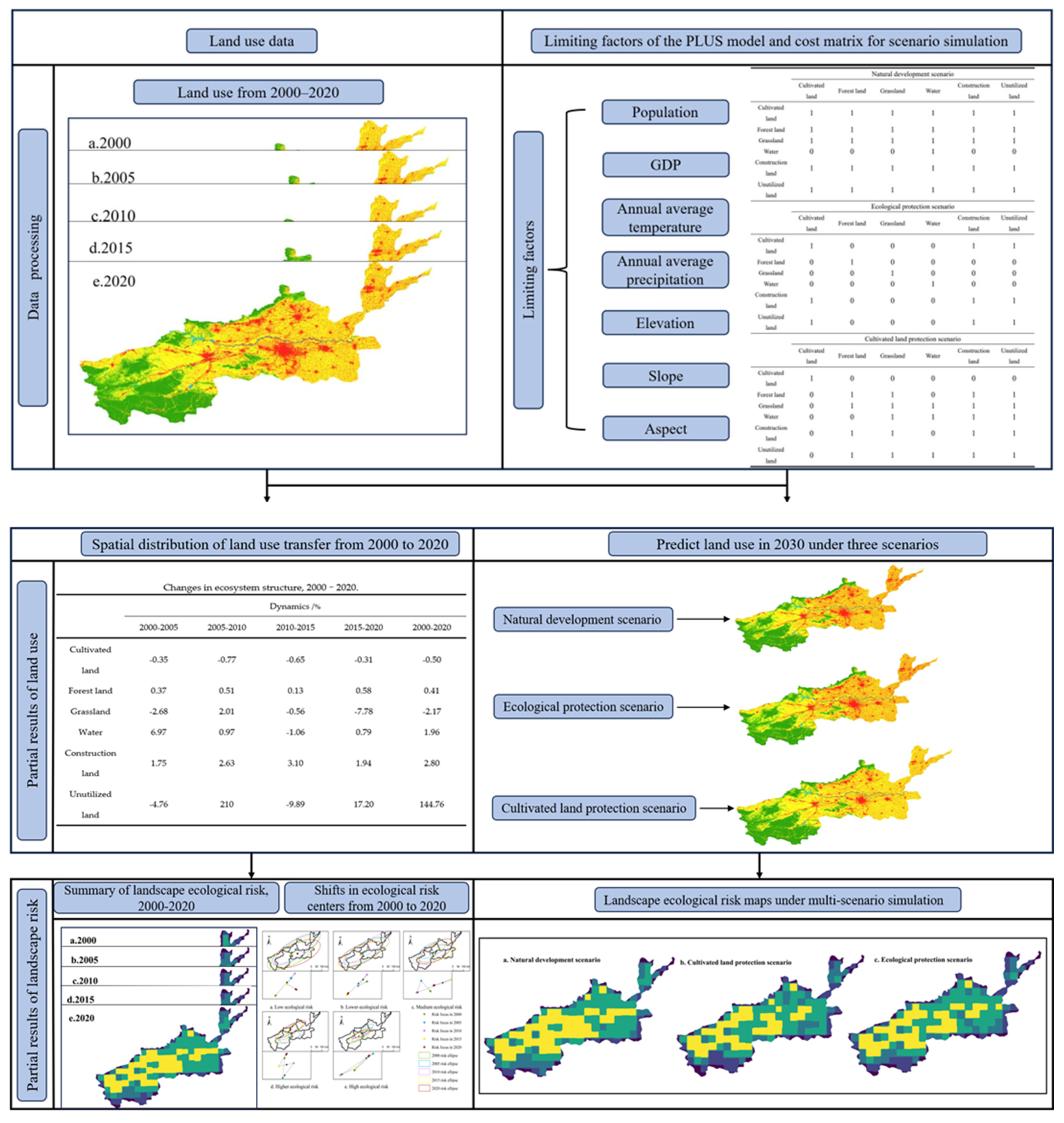
To evaluate and predict LU and LERS status, this study focuses on the Henan section of the YRB, utilizing LU data from 2000 to 2020; analyzes the transfer and change patterns in land utilization; constructs an ecological risk assessment index system from the perspective of landscape pattern; and uses ArcGIS spatial analysis and the PLUS prediction model to conduct in-depth research on the movement patterns of the center of gravity of LERS and its response mechanism to LU (Figure 1). This study aims to: (1) Quantify the historical spatio-temporal evolution (2000–2020) of LU and LERS within the Henan section of the YRB; (2) Employ the PLUS model to project future LU patterns and associated LERS distributions under multiple development scenarios for 2030; (3) Provide spatially explicit insights and an empirical basis to inform sustainable land resource management and ecological conservation strategies specific to this critical region of the YRB. This research tests the following hypotheses: (1) Rapid urbanization (construction land expansion) has been the dominant LUC driver, primarily at the expense of cultivated land, leading to significant alterations in landscape structure over the past two decades; (2) These LUCs and associated landscape fragmentation have resulted in spatially clustered patterns of ecological risk, with intensifying risks concentrating in core urbanizing areas (e.g., Zhengzhou, Luoyang, and their confluences); (3) Future LU trajectories and LERS distributions will exhibit significant divergence under different policy-driven scenarios (e.g., natural development, cultivated land protection, ecological conservation), highlighting the critical role of strategic planning in mitigating regional ecological risk. For instance, the natural development scenario corresponds to the pilot policy of comprehensive land consolidation in the entire region, focusing on the optimization of existing LU through corresponding spatial control measures. The ecological protection scenario aligns with the strategy of building a sustainable Yellow River, implementing rigid control of ecological red lines and approval of facilities in protected areas. The cultivated land protection scenario can be mapped to the “three-in-one” cultivated land protection policy, achieving coordinated protection through spatial control measures and policy tools. This study offers a scientific foundation for the optimal allocation of local LU and is instrumental to strengthening regional ecological security and fostering ecological conservation alongside sustainable development in the YRB.

2. Study Area Description

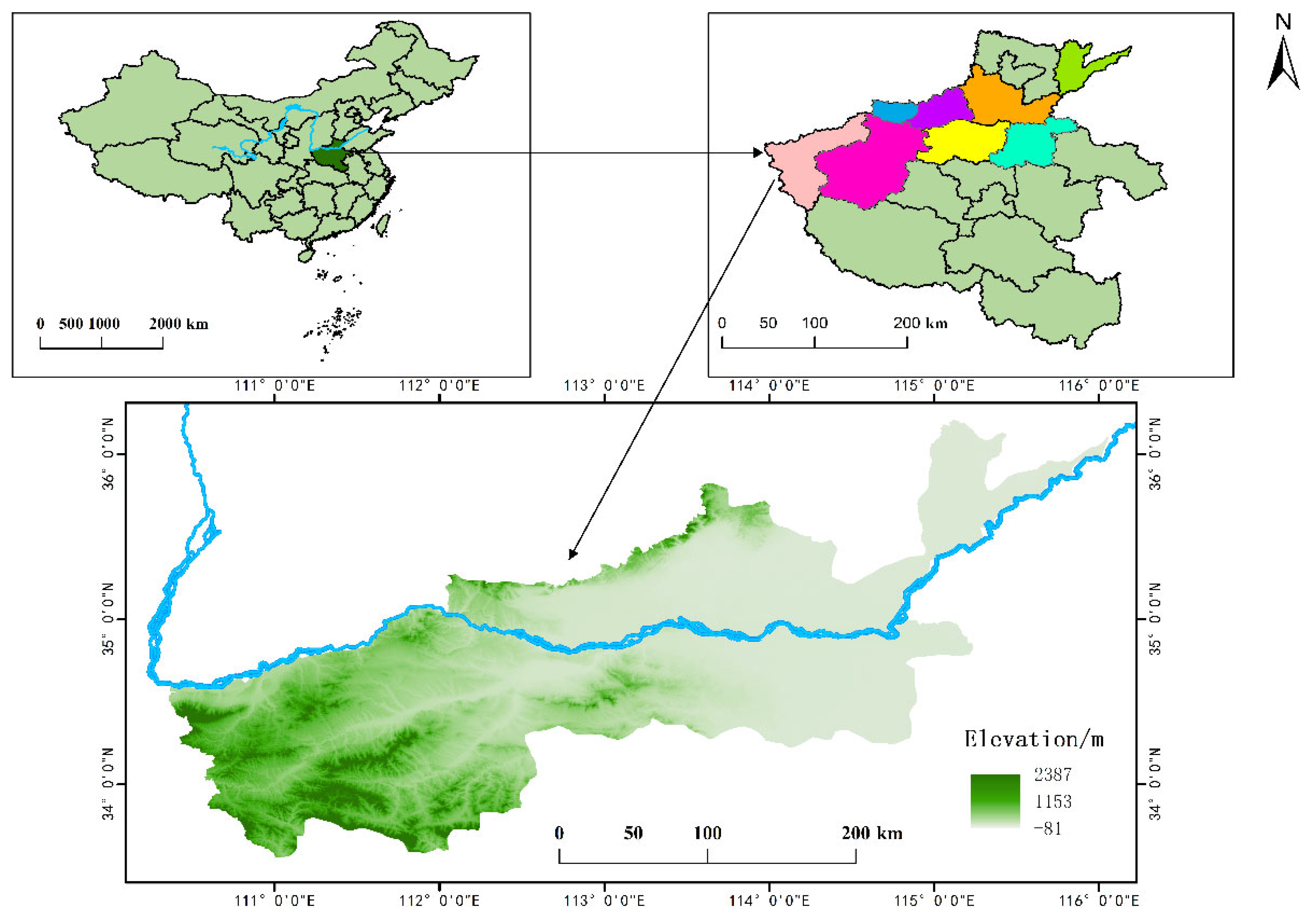
The investigated zone extends over 711 km, constituting 13% of the river’s entire length, with a total area of about 68,048 km2, situated in its mid–lower reaches known as the “waist” of the river (Figure 2). The research area falls within a warm temperate to subtropical zone, characterized by a humid to semi-humid monsoon climate, average annual precipitation of about 983.0 mm, and obvious seasons suitable for agriculture, with terrain mainly plain. The proportion of the permanent resident population and land area in the study area in the province is approximately 42.52% and 33.83%, respectively. Proximity to the Yellow River ensures abundant water flow, making cultivated land the predominant LU. It passes through eight prefecture-level cities: Puyang, Xinxiang, Kaifeng, Jiaozuo, Zhengzhou, Jiyuan, Luoyang, and Sanmenxia. Henan Province, with its dense population and concentrated LU, serves as a national key agricultural area and a strategic area for national grain security and the Yellow River strategy.

3. Sources of Data and Methodology for Research

3.1. Data Sources

Landsat 4/5 TM and Landsat 8 OLI satellite images from the United States were selected, all acquired between May and August with cloud cover less than 5% (30 m resolution). This research covers a period of 30 years from 2000 to 2030, with each five-year period as a phase. The study area is approximately 58,020 square kilometers, focusing on LUC and associated risks. Original remote sensing GeoTIFF data processing utilized ENVI5.6 and ArcGIS10.8 software, and initial preprocessing in ENVI included radiometric, atmospheric, and geometric calibration. False-color composites were generated using bands 4, 3, and 2 of preprocessed Landsat TM data and bands 5, 4, and 3 of Landsat OLI data. In accordance with the land use classification system established by the Institute of Geographic Sciences and Natural Resources Research, Chinese Academy of Sciences, we implemented a three-tier classification hierarchy. The interpretation was conducted through an integrated approach combining supervised classification and visual interpretation, categorizing the research area into six types of land cover: forest land, grass land, cultivated land, construction land, water, and unutilized land. The spatial resolution is 30 m. ArcGIS and Fragstats 4.2 were employed to study patterns in LU evolution and the alterations in LERS. The PLUS model projected LERS for 2030 (based on the baseline data of 2020). Driving factors included socioeconomic and climate/environmental data (see Table 1 for specifics).

3.2. Dynamic Changes in Land Use

Land utilization changes and transitions are evaluated through a single LU dynamic degree trend along with status index [22]. It can directly indicate the extent and rate of change among different types of LU, while the change trend and state index of categories of land utilization can more clearly and intuitively reflect the process and direction of alterations in LU categories. This formula quantifies the annual rate of change in area of a specific land type within a unit of time. The formula for calculating the single dynamics of land utilization is as follows:
k = U b     U a U a × 1 T × 100 %
Within the research area during the research period, k represents the dynamic degree of a specific LU type; U a   and U b  represent the amount of this LU type at the start and conclusion of the study period; and T indicates the duration of the study.
The changing trend and state index of LU types characterizes the comprehensive change status and the degree of pattern evolution of the overall LU structure in a region during a specific period. The approach to computing the changing tendency of LU categories and current situation indicators is as follows:
D i = U i n     U o u t Δ U i n   +   Δ U o u t
where D i represents trend and status index of a LU type; U i n and Δ U o u t represent the total area transferred in and out of the specific LU type during the study period, respectively.
The above two formulas are the fundamental formulas for studying the dynamic changes in LU. The time scale of this study is 30 years. Considering the common choice of time intervals in most studies, the significant degree of change in the actual study area, and the sensitivity of the time interval selection, the LUC situation is ultimately studied at an interval of every five years.

3.3. Development of Landscape Ecological Risk Index (ERI)

Based on the 30 m resolution land use data, the study area was divided into 193 evaluation units using a 20 km × 20 km grid. Within each evaluation unit, landscape pattern indices were calculated and a landscape ERI was comprehensively generated. To construct a continuous spatial risk distribution, Kriging interpolation was performed on the landscape ERI values of the 193 units, with an output resolution of 30 m. Finally, the interpolation results were classified into risk levels using the natural breaks method. The landscape ERI initially involves calculating landscape disturbance, fragility, and loss within the research area. Specifically, the landscape loss index is calculated as follows:
R i = E i × V i
where R i represents the landscape loss index of the i-th risk unit, E i denotes the landscape disturbance index of the i-th risk unit, and V i stands for the fragility index of the i-th risk unit. Based on literature and characteristics of the research area, we usied an expert grading method to classify landscape types into six vulnerability levels: unutilized land—6, construction land—5, water—4, grass land—3, forest land—2, and cultivated land—1 [23,24,25]. After normalization, weights were assigned to each landscape type’s fragility index V i , with cultivated land at 0.05, forest land at 0.10, grass land at 0.14, water at 0.19, construction land at 0.24, and unutilized land at 0.29. The calculation formula for landscape disturbance and the definitions of the parameters are given in Table 2.
The construction of the landscape loss index relied on the disturbance and fragility of the landscape, followed by calculating the landscape ERI using ArcGIS 10.8 and Fragstats 4.2 software [26,27,28]. The detailed calculation formula is presented as follows:
E R I i = i = 1 n A k i A k × R i
R i stands for the index measuring landscape loss, A k i denotes the area of landscape type i in the k-th risk unit, A k is the total area of the k-th risk unit, and n is the number of landscape types.

3.4. Prediction Using the PLUS Model

The PLUS model integrates the rule mining framework for land expansion analysis (LEAS) and the improved CA model with multi-type random seeds (CARS) [29,30]. It provides a comprehensive explanation of influence factors of various kinds of LUC, and it achieves higher simulation accuracy [31,32]. The model extracts expansions of various LU in two phases of land change, sampling from an increased portion, and it employs a random forest algorithm to systematically examine connections between land utilization expansion and the forces behind it. This approach determines the development likelihoods of different LU and the weights of driving factors. The algorithm formula is as follows:
P i , k d x = n   =   1 M I ( h n x   =   d ) M
where P i , k d x  represents the probability of land parcel i converting to LU type k, where d takes values of 0 or 1. Here, d = 0 signifies that conversion to type k is not possible, while d = 1 indicates it is possible. The variable x denotes the driving factor, I indicates the decision tree’s index function, and M represents the aggregate number of decision trees.
In light of the constraints of the development probabilities for each LU category, an improved cellular automaton was employed. This model incorporates a stochastic generation of multi-class patch seeds and a threshold decrement mechanism to dynamically simulate future LU scenarios. The expression for the CARS transformation is:
O P i , k d = 1 , t =   P i , k ( x ) d   ×   Ω i , k t   ×   D k t
where OP denotes the overall conversion probability; Ω represents the neighborhood effect of land parcels; and D signifies the effect of anticipated demand for LU category k.
We conducted spatially constrained multi-scenario simulations with consistent future land quantities in different scenarios, but with varying spatial locations. The spatial transfer matrix was primarily modified, or spatial constraints were imposed using a limit layer [33,34,35]. The cost matrix represents the conversion rules among various types of LU and is used to reflect whether different types of LU can be converted into each other. When a certain type of LU is not allowed to be converted into other types of LU, the corresponding value in the matrix is 0; when it is allowed to be converted, the corresponding value is 1. Based on the actual situation of the study area, the transfer probability is evaluated by the proportion of LU transfer. Meanwhile, under the natural development scenario, since the study area is located in the YRB, the transfer out of rivers is restricted. Under the cultivated land protection scenario, the transfer out of cultivated land is strictly restricted. The simulation cost matrix of specific scenarios is shown in Table 3. Scenario 1 was a natural progression scenario derived from LUC patterns, adhering to the existing model of urban development without setting any restrictions on the conversion between types other than water of LU and without considering government and market intervention. Scenario 2 was an ecological protection scenario, considering ecological protection for the YRB and the study’s research on LERS. The natural development scenario was modified to include ecological protection factors. Scenario 3 was a cultivated land protection scenario, considering that Henan Province is a major cultivated land province in China, where the amount and quality of essential arable land are vital for ensuring national food security. Therefore, the LUC simulation should integrate farmland protection considerations within the natural development scenario. The conversion of basic cultivated land to alternative LU is subject to stringent controls, mitigating its encroachment by urban development. This regulated approach provides valuable insights for future regional planning of the urban agglomeration, anchored in the principle of cultivated land conservation.
Considering the practical situation in the research area and using the LEAS module, the probabilities for various landscape types in the research area were computed. Then, combined with relevant parameters such as target pixel number, transfer cost matrix, probability of random patch seed, and neighborhood factor, the CA model based on a multi-class random patch seed was used to simulate landscape type change in the study area [36,37]. This study set the probability of random patch seeds to 0.1 and achieved a Kappa coefficient of 0.81. The Kappa coefficient varied between 0 and 1, where values greater than 0.7 indicate high consistency and accuracy of the simulation results. The overall accuracy is about 88.13%. The resolution of LU simulation results in 2030 was 30 m × 30 m.

4. Results

4.1. Spatio-Temporal Evolution of Land Use

4.1.1. Changes in Land Use Area

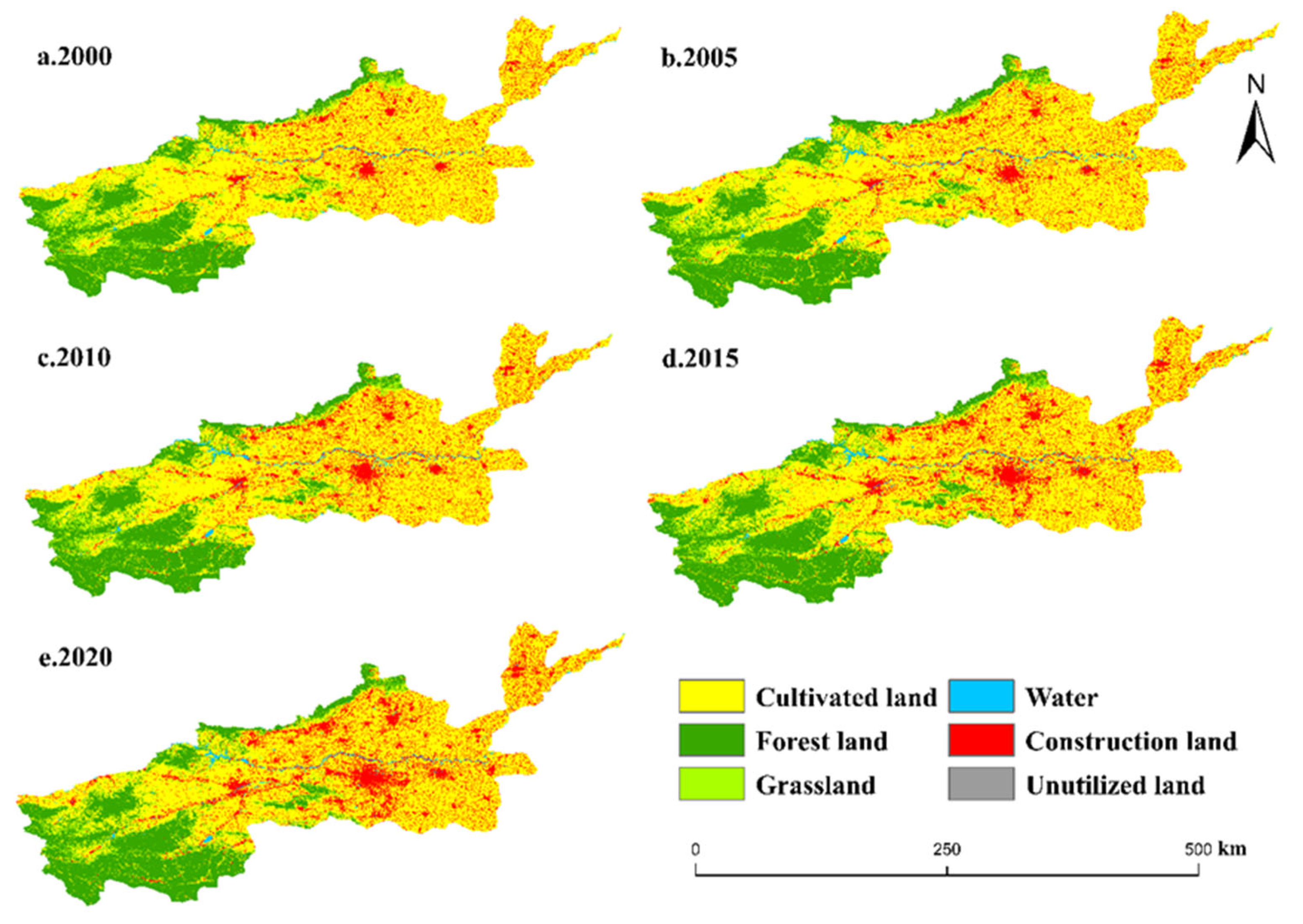
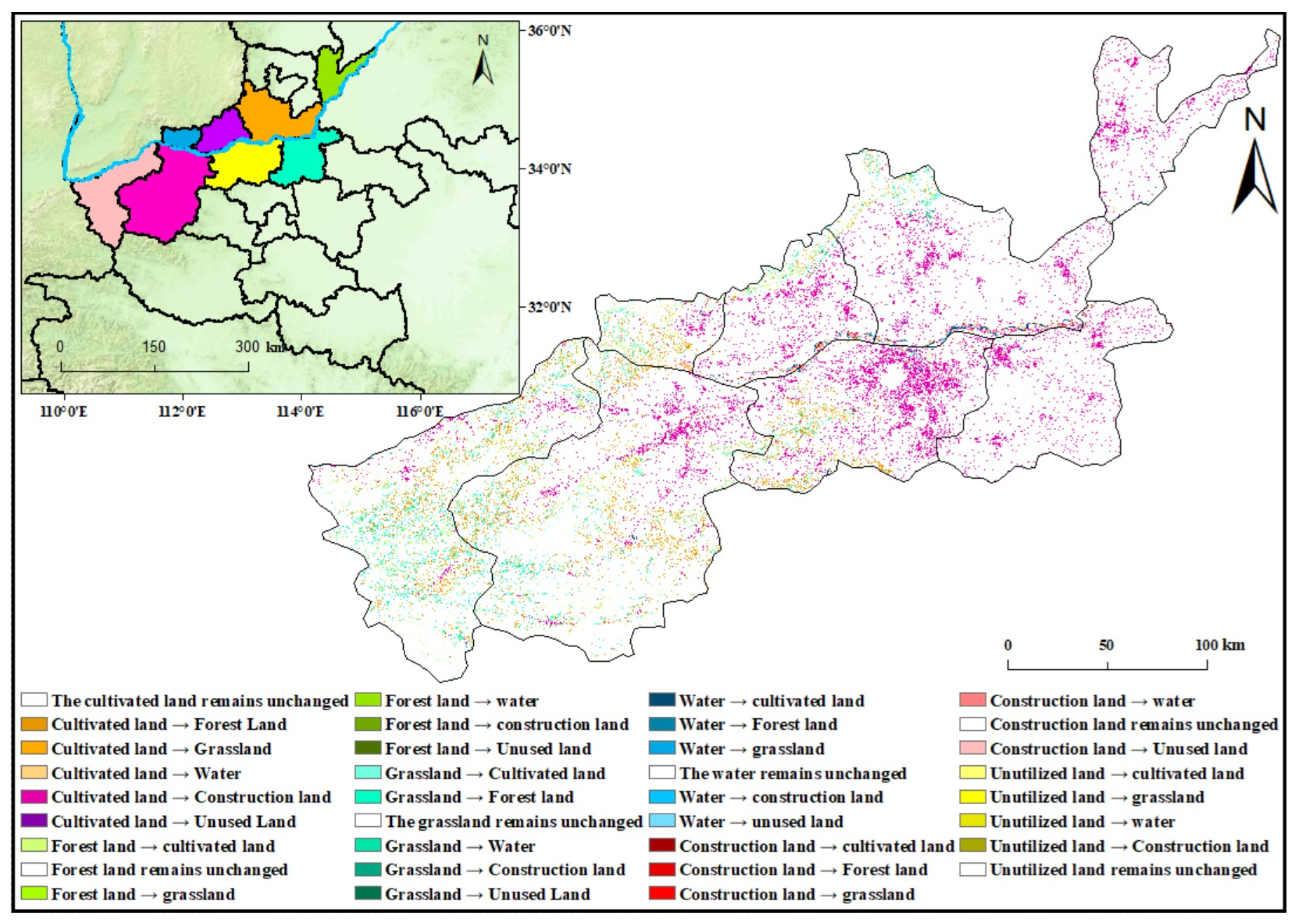
It was shown that the area of cultivated land and construction land changed significantly from a spatial perspective (Figure 3). The cultivated land was mainly distributed in low-elevation plain areas, while the forest land was concentrated in the southwest mountainous and northern fringe. Towns were mostly concentrated in central plain area, along main traffic lines and the Yellow River trunk, with tributaries distribution. As depicted in Table 4, from 2000 to 2020, the study area saw remarkable growth in construction land, rising from 6933.37 km2 to 10,816.26 km2, with an increase of 5.71%. Conversely, cultivated land decreased notably from 42,989.74 km2 to 38,676.77 km2, a decline of 6.34%. Changes in other land types varied within a ±3% range. The primary LU type was cultivated land, accounting for over 56%. There were clear urbanization trends, with significant urban expansion in the study area.
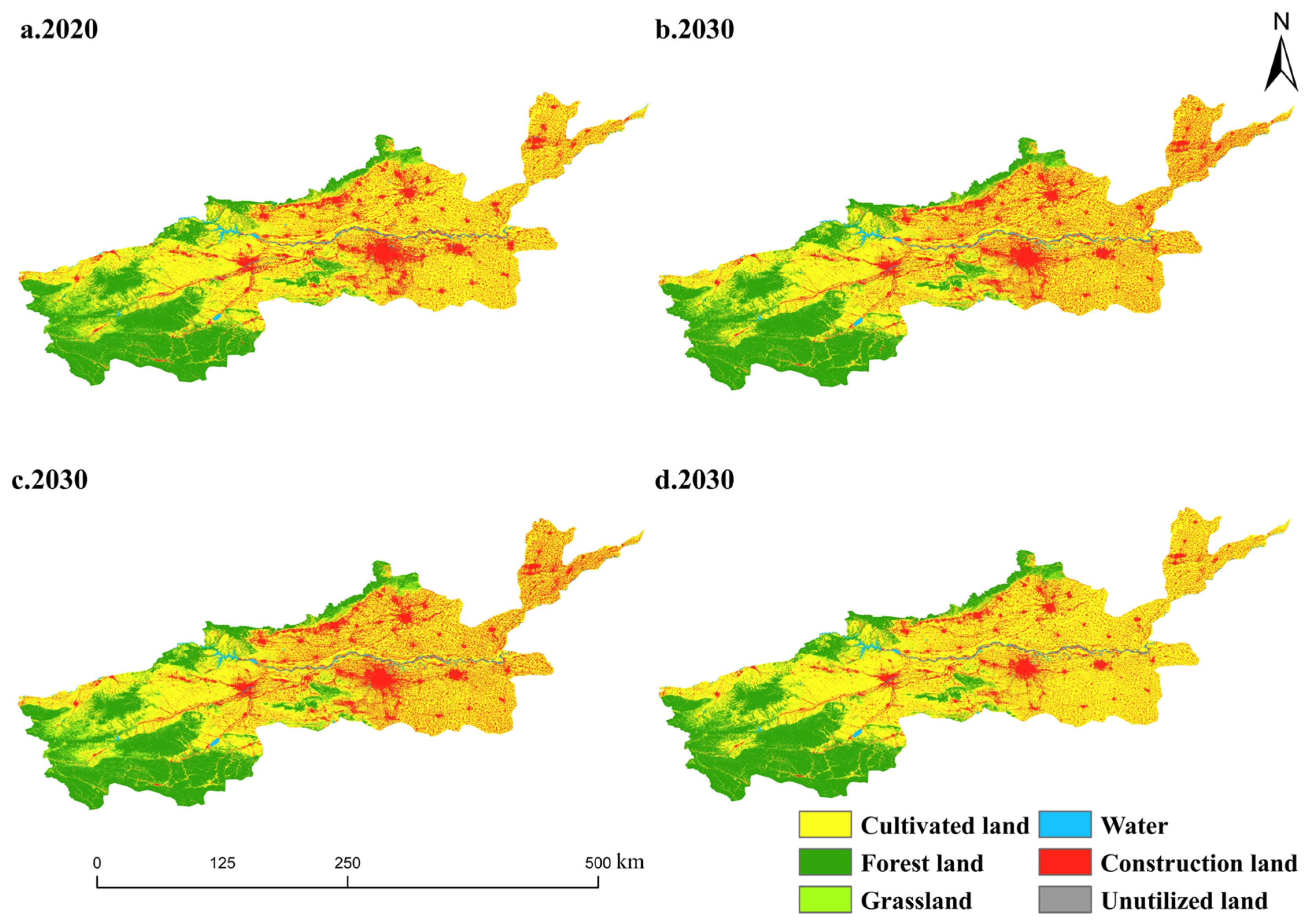
Figure 4 provides a comparison among LU predictions in 2020 and 2030 across the three given scenarios. According to the scenario simulation cost matrix of diverse scenarios, maps of LU types for 2030 were acquired under various scenarios. Changes in cultivated and construction land areas were substantial in the natural development scenario, which was in line with the expectation of urbanization development in comparison to 2020. The ecological protection scenario gave priority to ecological protection, strictly restricted the transfer of forest, grass, and water with ecological functions to other land types, and significantly changed the area of cultivated land and construction land in land resources. As Henan Province was a major province in terms of cultivated land, conversion of such land was strictly restricted under the scenario of cultivated land protection.

4.1.2. Land Use Transfer

From 2000 to 2020, the LU pattern in the research area changed obviously according to Table 5, where different types of land underwent mutual transformations, except for unutilized areas. During this period, cultivated land predominated in the field of study, occupying over 56% of the overall area, steadily declining each year by 0.65%. The decrease was particularly notable between 2005 and 2010. Meanwhile, with the acceleration of urbanization, the areas of forest as well as land for construction gradually increased, where construction land exhibited the highest annual change rate at 3.06%. The dynamics of grass land, water, and unutilized land showed rates of change of −2.17%, 1.96%, and 36.19%, respectively. In combination with Figure 5, the flow categories of dynamic changes in LU were mainly concentrated in cultivated land, forest land, grass land, and construction land, among which cultivated land, forest land, and grass land were the main roll-out types, and construction land was the main roll-in type. During 2000 to 2020, cultivated land consistently decreased annually, but the most significant transformation was the shift to construction land. This study underscored the need to maintain cultivated land area and uphold the agricultural land redline to ensure food security amidst accelerating urbanization.

4.2. Assessment of Landscape Ecological Risks

4.2.1. Spatial Pattern of Landscape Ecological Risks

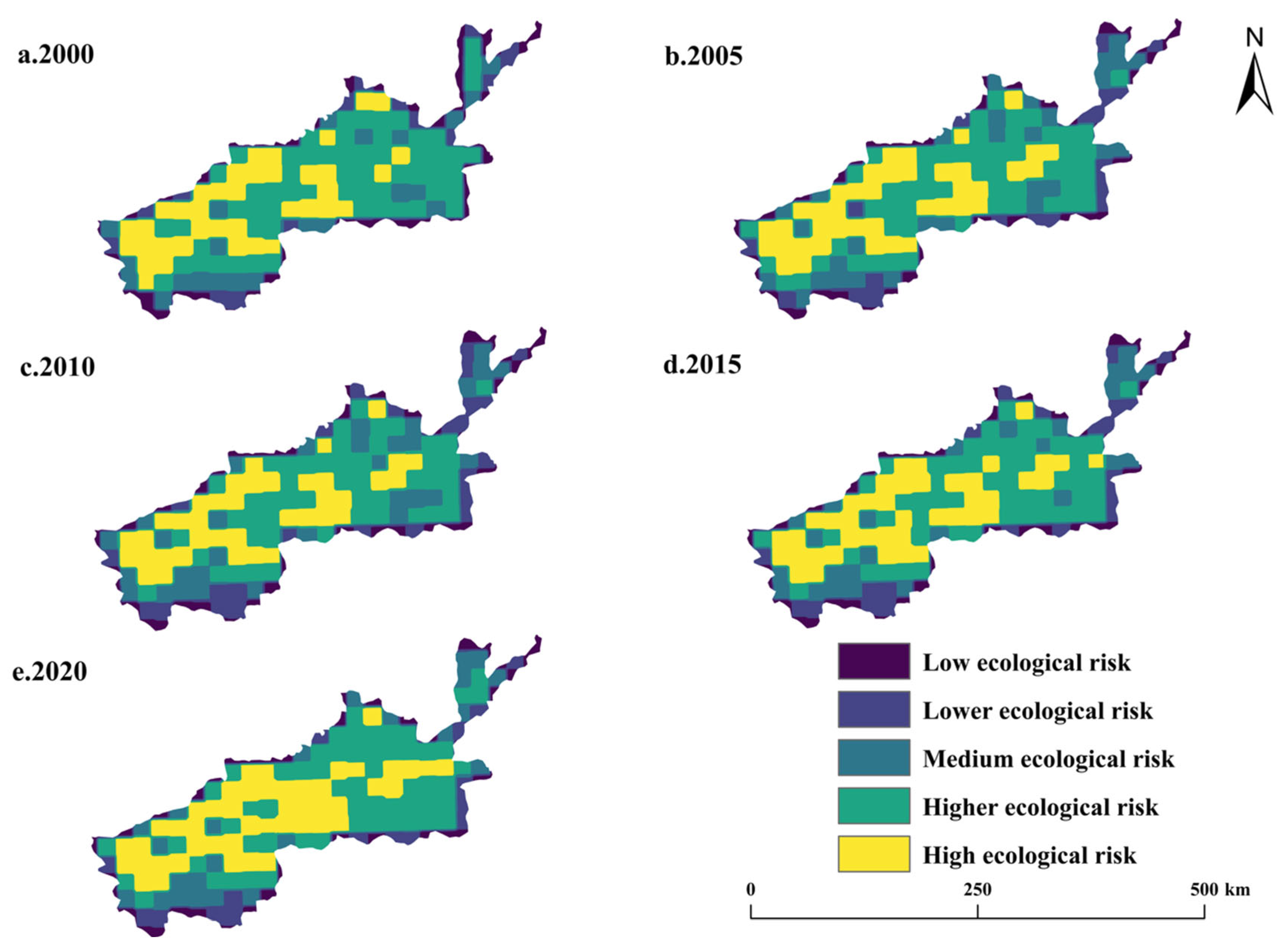
According to the various landscape pattern indices and formulas in Table 2 above, the indices of different landscape genres of this area in 5 periods were calculated. The specific results are shown in Table 6. Based on the range of ERI in various ecological risk zones in this area, and employing the natural breaks (Jenks) method provided by ArcGIS, ecological risk was categorized into five levels. For instance, in the year 2000, these levels were low ecological risk (<0.04), lower ecological risk (0.04~0.06), medium ecological risk (0.06~0.09), higher ecological risk (0.09~0.11), and high ecological risk (0.11~0.14). In Figure 6, the results of specific LERS levels in five periods obtained via Kriging interpolation are shown. Throughout 2000–2020, high-ecological-risk areas increased and gradually converged to the middle cities of the study area. High-ecological-risk areas and higher-ecological-risk areas occupied the main part of the study area, while low-ecological-risk areas were mainly located at the edge of the study area.

4.2.2. Temporal and Spatial Changes in Landscape Ecological Risks

Table 7 displays the findings regarding the areas and proportions associated with various ecological risk levels. Low-ecological-risk areas showed fluctuating trends, consistently occupying less than 7% of the gross area from 2000 to 2020. These areas were primarily situated on the periphery of the research zone, experiencing minimal human disturbance and maintaining relatively favorable ecological conditions. Areas of lower ecological risk surrounded the low-risk zones, peaking in 2010 with an overall increasing trend. Starting from 4347.32 km2 in 2000, these areas expanded to 5206.65 km2 by 2020, representing a growth from 7.98% to 9.09%. The area of medium ecological risk mirrored trends of the lower-risk zones, reaching its peak in 2010 and consistently occupying 15% to 21% of the total area. Conversely, higher-ecological-risk areas decreased steadily from 2000 to 2010 and then began to increase again from 2010 to 2020. These high-risk areas, which represented the largest proportion across this area, averaging more than 35%, were concentrated in the northeast. In the research zone, the combined areas of relatively higher as well as high-ecological-risk zones accounted for over 60%, showing a consistent increase in all years except for a decrease observed in 2010. These areas constituted a proportion second only to the higher-risk zones. In 2010, notable changes included the lowest areas of higher as well as high-ecological-risk zones observed in two decades, while the other three risk categories reached their peak values for the period. This indicated a transformation of high-risk areas into lower-risk categories, suggesting an improvement in ecological conditions during that year.

4.2.3. Shift of Focal Points in Landscape Ecological Risks

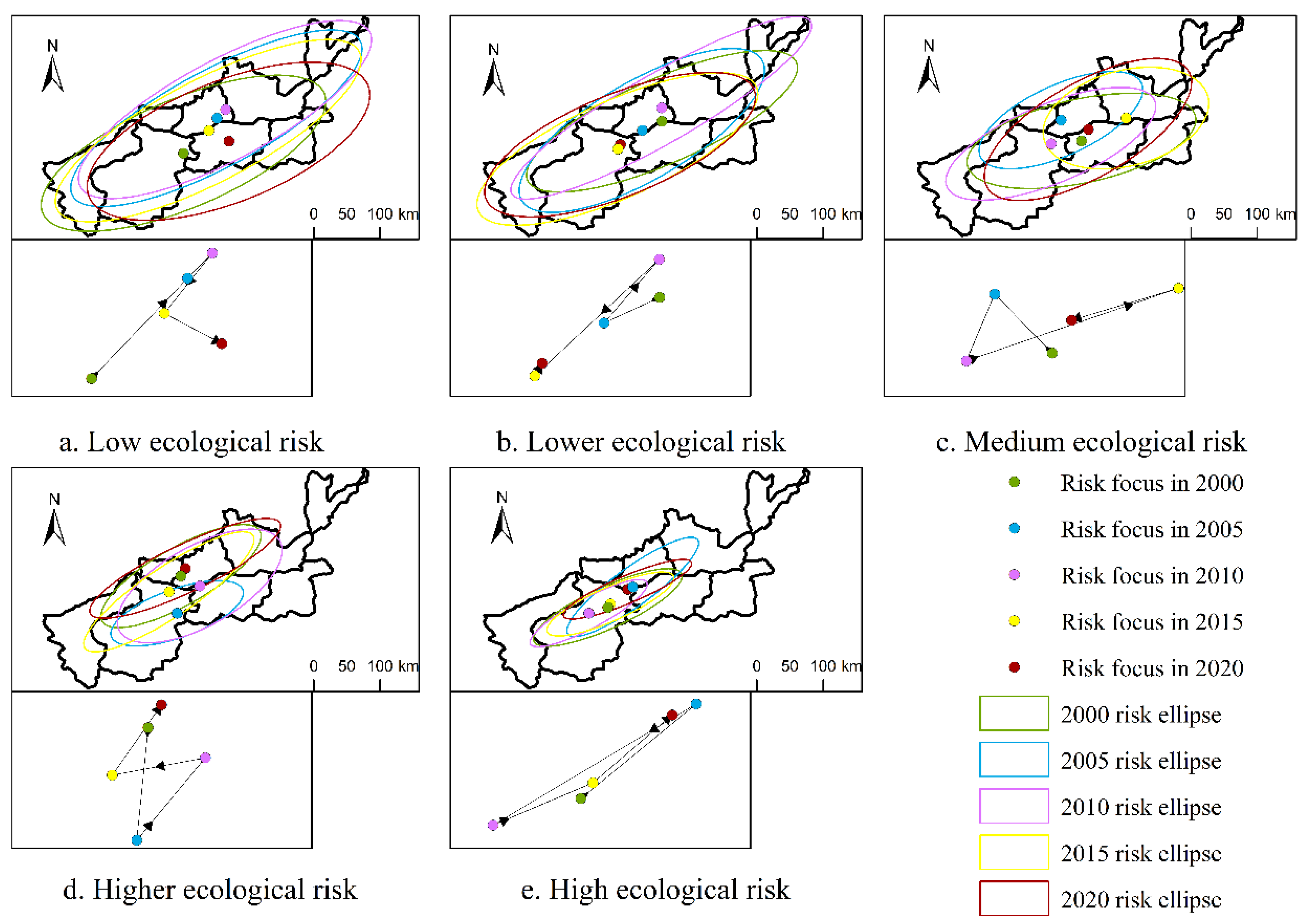
As shown in Figure 7, using ArcGIS spatial statistical tools, different levels of risk centroids and risk ellipses were calculated. The figure shows that within the study period, as risk level increased, the risk centroids gradually aggregated towards the central region. The movement distance during 2010–2015 was larger than in other periods, indicating significant risk changes during that period. The risk ellipses oriented from northeast to southwest gradually contracted inward. Apart from the low ecological risk centroid in 2020, centroids of lower and low ecological risks in other years were in the middle of research area. Centroids of moderate as well as higher ecological risks showed a trend of shifting towards both sides. Centroids of high ecological risk were concentrated in Luoyang, as well as at the junction of Luoyang, Zhengzhou, and Jiaozuo.
A quantitative analysis was conducted on the shift and distance of ecological risk centers (Figure 7). The center of low ecological risk shifted notably faster from 2000 to 2005, moving 73.20 km northeast. From 2005 to 2010, the ecological risk center continued northeastward, but at a reduced speed. Subsequently, from 2010 to 2015, it shifted southwestward by 41.65 km, and from 2015 to 2020, it moved southeastward by 35.15 km, resulting in an overall northeastward shift. The center of lower ecological risk shifted southwestward by 32.65 km from 2000 to 2005, northeastward by 46.08 km from 2005 to 2010, and significantly accelerated southwestward by 93.24 km from 2010 to 2015. However, from 2015 to 2020, the shift slowed drastically to just 7.96 km southwestward, resulting in an overall southwestward movement. The center of medium ecological risk shifted northwestward by 43.91 km from 2000 to 2005, southwestward by 39.64 km from 2005 to 2010, and markedly accelerated northeastward by 122.68 km from 2010 to 2015. From 2015 to 2020, it moved southwestward by 61.13 km, resulting in an overall northeastward shift. The center of higher ecological risk moved approximately southward by 56.50 km from 2000 to 2005, northeastward by 54.87 km from 2005 to 2010, nearly westward by 48.44 km from 2010 to 2015, and eastward by 43.89 km from 2015 to 2020, resulting in an overall northeastward movement. The center of high-ecological-risk areas shifted rapidly overall, moving northeastward by 48.85 km from 2000 to 2005, southwestward by 79.33 km from 2005 to 2010, accelerating notably northeastward by 36.34 km from 2010 to 2015, and further northeastward by 35.00 km from 2015 to 2020, resulting in an overall northeastward shift. Consequently, except for the moderately low ecological risk center, which shifted overall southwestward, centers of ecological risk at other levels all moved northeastward.

4.2.4. Multi-Scenario Landscape Ecological Risks Prediction Based on PLUS

The validation results demonstrated that the overall accuracy of the simulation in this study reached 88.13%, with a Kappa coefficient of 0.81, significantly exceeding the conventional reliability thresholds for models (Kappa > 0.7 and overall accuracy > 85%). This indicates a high level of consistency between the simulation results and the actual situation. The current errors primarily originate from two inherent characteristics of the model: firstly, the predefined conversion rules have limitations in representing complex dynamic processes (such as the periodic conversion between cropland and construction land); secondly, the identification accuracy in transition zones with significant spectral mixing effects (e.g., the forest–grass transition zone in the western mountainous area) is constrained by technical limitations. Future research will focus on ongoing optimization through dynamic calibration of conversion rules and multi-source remote sensing collaborative interpretation to enhance accuracy.
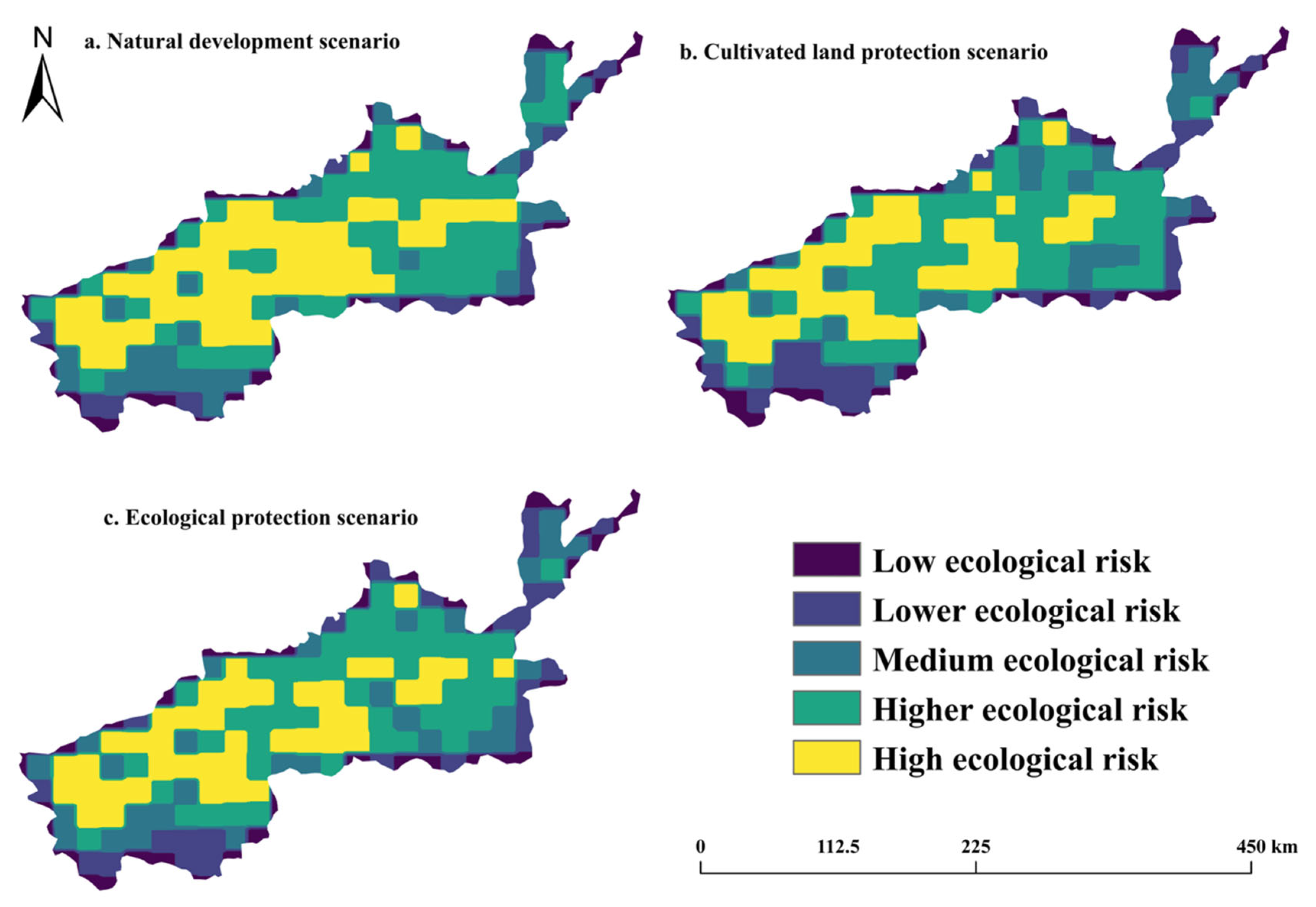
Based on the PLUS model, LUC in 2030 was predicted under three scenarios, including a natural development scenario, ecological protection scenario, and cultivated land protection scenario, then LERS were analyzed, as shown in Figure 8. Scenario 1 is a natural development scenario based on LUC patterns, following current urbanization development patterns without government or market intervention. The ecological risks in the research zone are mainly concentrated in the two highest levels in 2030, and the peripheral areas primarily exhibit low ecological risks. The ecological protection scenario of scenario 2 gives priority to ecological protection and strictly restricts the transfer of forest and grass land with ecological functions to other land types. The ecological risk regions shown in the figure are still concentrated in high ecological risk and higher ecological risk, but they are not as concentrated as in the natural development scenario, and the area of high ecological risk is reduced, indicating that ecological protection can reduce development of landscape high ecological risk to a certain extent. Scenario 3 is cultivated land protection scenario. Given that Henan Province is a large-cultivated-land province, the quality and quantity of basic cultivated land is crucial to national food security. The LERS of the main cultivated land in the study area was reduced to a higher ecological risk than that under the natural development scenario, and the two highest levels of LERS areas were reduced. Therefore, LUC modeling needs to incorporate the concept of farmland protection in the natural development scenario and strictly control the transition of basic farmland to other types of LU. But, all three scenarios have their own problems. Natural development scenarios oversimplify complex realities, tend to ignore key factors, and lack adaptation. Ecological protection scenarios may overemphasize the objectives of ecological protection while ignoring the mutually restrictive relationship amidst ecological conservation and socioeconomic advancement. The cultivated land protection scenario is similar to the ecological protection scenario, which only concentrates on the protection of cultivated land quantity without comprehensive consideration. In general, each scenario has its appropriate hypothesis state and is in line with the research expectations. In particular, appropriate scenarios should be selected to simulate future LU situations as needed. Scenario analysis can provide risk prediction and a forward-looking scientific basis under different scenarios.

5. Discussion

5.1. Interpretation of Research

In terms of LUC, the expansion of urban construction land and the decrease in cultivated land present obvious trends, and this alteration is directly associated with the dynamics of LERS. For instance, disorderly urban sprawl of construction land has resulted in intensified landscape fragmentation. Many originally continuous ecological patches have been segmented, impeding the exchange of substances and energy within the ecosystem and thereby increasing ecological risk value in local areas [38]. This phenomenon echoes the research findings in numerous rapidly urbanizing regions worldwide, once again highlighting the significant pressure that LU transformation dominated by human activities exerts on the ecosystem. Analysis of landscape pattern index provides a quantitative basis for ecological risk assessment. Meanwhile, human activities have accelerated the urbanization process. The conversion of cultivated land to construction land has intensified the fragmentation of the landscape, thereby increasing the ecological risks of the landscape.
In relation to spatial distribution, ecological risks exhibit a gradient feature from the urban center to surrounding areas, and with increased risk levels, the risk center gradually shifts to the central areas. Therefore, we should implement zoning protection and focus on ecologically fragile areas. The forecast results show that if the current LU trend remains unchanged, the ecological risk of the central urban zone will continue to rise in the future. This provides an early warning for policy formulation, and effective measures should be taken to reduce risks, including enhancing the structure of LU and reinforcing ecological restoration and conservation efforts. In addition, the LU and LERS predictions under the three scenarios visually demonstrate the conditions of the study zone under different future circumstances, providing data support for responding to various future scenarios and facilitating the formulation of targeted countermeasures in advance [39].
In line with the current highly targeted ecological protection policies and management actions being implemented in Henan Province, the spatial differentiation patterns of ecological risks revealed in this study are highly consistent with the core ecological policies of Henan Province at present. The “Three Lines and One List” zoning control in Zhengzhou; the mountain and water projects in the provincial land space restoration planning focusing on the junction of Luoyang, Zhengzhou, and Jiaozuo; and the “Happy River and Lake” action are leaving blank spaces and increasing greenery in the central urban area, providing policy tools for suppressing high-risk areas, governing junction areas, and optimizing LU structures. The construction of forest characteristic towns activates the economic resilience of the low-risk areas on the periphery, forming a closed-loop governance system of “core restoration–peripheral activation”. These policies provide a practical implementation framework for the suggestions of zoning protection, core regulation, and peripheral activation proposed in this study.

5.2. Proposals for Future Development

Future development requires a multi-pronged approach. In the context of land usage, given the urban expansion and agricultural development needs in the research area, it is necessary to strategically organize urban and agricultural LU, tightly regulate the boundaries of urban construction land, and ensure food security. Simultaneously, ecological land conservation and rehabilitation along the Yellow River must be enhanced, and scientific plans must be formulated to restore degraded forests and wetlands. In addition, active exploration of multi-functional utilization models is essential, such as developing ecological and leisure agriculture around cities. In terms of LERS prevention and control, considering the complexity and fragility of the regional ecosystem, satellite remote sensing and other technologies should be utilized to establish a long-term dynamic monitoring network and early warning model to promptly grasp risk changes. Ecological compensation mechanisms should be implemented, and increased investment should be made in water and soil conservation, mine restoration, and other projects. In terms of regional coordinated development, given the overall nature of YRB, it is essential to strengthen coordination with other provinces and establish cross-regional ecological, resource, and industrial cooperation mechanisms. At the same time, it is important to promote urban–rural integration, drive rural industrial development with urban areas, and protect rural ecology. It is also necessary to promote the green transformation of industries, phase out high-pollution industries, and develop green industries—for instance, new energy and eco-tourism—to enhance the ability of the region to sustain development.
In conclusion, when addressing the issues of LU and LERS in the research area, the future should focus on ecological protection as the core, optimize the LU structure in a coordinated manner, and strictly control the ecological red line and urban development boundaries [40]. A multi-scale ecological risk early warning system should be established, combining dynamic monitoring with intelligent model predictions to forecast risk trends. At the policy level, innovative cross-administrative region coordination mechanisms should be developed, relying on technological support to build a smart management platform, ultimately achieving enhanced regional ecological resilience and coordinated development of people, land, and water [41,42].

5.3. Limitations and Future Work

The accuracy of LU data may be affected by the resolution of remote sensing images. Higher-resolution data might provide more detailed understanding of LUC at a smaller scale. Additionally, ecological risk is assessed according to a series of selected indicators, and there may be other factors that are not fully considered but could potentially influence the ecological risk. Traditional models exhibit deviations between predicted and actual outcomes due to their neglect of nonlinear driving factors and dynamic feedback mechanisms within ecosystems. Furthermore, the high subjectivity in assigning indicator weights and insufficient multi-scale coupling analyses limit the generalizability of the evaluation results. Additionally, conventional approaches face challenges in precisely modeling policy adjustments and micro-level entity behaviors while frequently overlooking the lag effects inherent in socioeconomic factors.
Future research could focus on integrating more comprehensive data sources and advanced models to improve the accuracy of LUC detection and ecological risk assessment. Furthermore, exploring interaction mechanisms among diverse LU categories and ecological processes in more depth would help to formulate more effective land utilization planning as well as ecological protection strategies for the Henan section of the YRB [43]. To enhance predictive utility, contemporary methodologies should incorporate policy scenario simulations and systematic uncertainty analyses. This necessitates interdisciplinary collaboration to develop multi-scale synergistic governance frameworks that account for cross-system interactions and temporal–spatial heterogeneity in decision-making processes. This would contribute to the area’s sustainable advancement and provide ponderable references for ecological restoration as well as management in similar river basins [44,45,46].

6. Conclusions

According to the LU data from 2000 to 2020, this study evaluated and predicted the LU and LERS status of the Henan portion of the YRB. The conclusions derived were as follows: (1) The study area was mainly cultivated land, forest land, and construction land. Among all land types, construction land and cultivated land had the greatest change. The flow types of LU dynamic change were mainly concentrated in cultivated land, forest land, grass land, and construction land. (2) The high-risk ecological zones were gradually concentrated in the area centered on Zhengzhou City, while the low-ecological-risk areas were distributed in the edge of research zone. With the increase in risk grade, the risk ellipse in the direction of northeast to southwest gradually contracted inward, and the risk center of gravity concentrated in Luoyang and the junction of Luoyang, Zhengzhou, and Jiaozuo. (3) The LU status in 2030 was projected using the PLUS model under three varied scenarios. The three dominant LU types remained cultivated land, forest land, and construction land. Notably, the area of cultivated land and construction land changed significantly. Based on this analysis of LERS prediction, the distribution of risk levels in different scenarios was different, but in general, high-ecological-risk areas and higher-ecological-risk areas accounted for the main part, while low-ecological-risk areas were distributed at the edge of research region. Based on the current policy framework of Henan Province and the conclusions of this study, the following operational suggestions are proposed: (1) Deepen the dynamic management of the “three lines and one list” in Zhengzhou, and strictly control the high-risk central area through quantitative indicators for brownfield restoration. (2) Rely on the provincial landscape project to establish a joint restoration fund for the junction of Luoyang, Zhengzhou, and Jiaozuo, and specifically address the issues of mining and soil erosion. (3) Promote the integration of “rivers and lakes + industry” in the “Happy Rivers and Lakes” initiative to activate the economic resilience of the low-risk peripheral areas. (4) Pilot flexible environmental law enforcement and guide enterprises to undergo green transformation to reduce the risk of new pollution. Studying recent LUC and LERS here is beneficial for optimizing regional LU regulation. Meanwhile, this research also offers experience for similar studies in other river basins, facilitating the construction of a systematic and comprehensive ecological security guarantee system that aligns with the requirements of the high-quality development era of the YRB. This research is of great significance to the sustainable development of the YRB.

Author Contributions

Conceptualization, J.H.; methodology, J.H.; software, J.H., J.X., W.Y., B.P. and M.W.; validation, J.H.; formal analysis, J.H.; investigation, J.H., J.X., W.Y., B.P. and M.W.; resources, J.H.; data curation, J.H.; writing—original draft preparation, J.H.; writing—review and editing, J.H. and L.Z.; visualization, J.H.; supervision, L.Z.; project administration, L.Z.; funding acquisition, L.Z. All authors have read and agreed to the published version of the manuscript.

Funding

This research was funded by the National Natural Science Foundation of China “Mechanisms of Micro-Topography-Soil-Vegetation Spatial Coupling in Slope-Gully Systems of Pisha Sandstone Areas” (Grant No. 32101591); National Key Research and Development Program of China “Synergistic Prevention Mechanisms for Wind-Water Compound Erosion” (Grant No. 2022YFF1300805); Research on the Spatiotemporal Coupling Pattern and Multi-dimensional Optimal Regulation Mechanism of Water and Soil Resources in the Yellow River Basin (Henan Section), Henan Province Scientific Research Project (No. 232102321108).

Institutional Review Board Statement

Not applicable.

Informed Consent Statement

Not applicable.

Data Availability Statement

The raw data supporting the conclusions of this article will be made available by the authors on request.

Conflicts of Interest

The authors declare no conflict of interest.

References

  1. Chen, W.; Yang, L.; Chi, G.; Zeng, J. Ecosystem degradation or restoration? The evolving role of land use in China, 2000–2020. Environ. Monit. Assess. 2024, 196, 304. [Google Scholar] [CrossRef]
  2. Liang, J.; Chen, C.; Sun, W.; Yan, G.; Liu, Z.; Zhang, Z. Spatio-temporal land use/cover change dynamics in Hangzhou Bay, China, using long-term Landsat time series and GEE platform. Natl. Remote Sens. Bull. 2023, 27, 1480–1495. [Google Scholar] [CrossRef]
  3. Zhao, L.; Su, M.; Wang, X.; Li, X.; Chang, X.; Zhang, P. Spatial-temporal evolution and prediction of habitat quality in Beijing–Tianjin–Hebei region based on land use change. Land 2023, 12, 667. [Google Scholar] [CrossRef]
  4. Liu, Y.; Cao, W.; Wang, F. Spatiotemporal evolution of land cover and landscape ecological risk in Wuyishan National Park and surrounding areas. Land 2024, 13, 646. [Google Scholar] [CrossRef]
  5. Zhang, Q.; Tang, F.; Chen, H.; Li, F.; Chen, Z.; Jiao, Y. Assessing landscape fragmentation and ecological connectivity to support regional spatial planning: A case study of Jiangsu province, China. Ecol. Indic. 2024, 162, 112063. [Google Scholar] [CrossRef]
  6. Zhang, J.; Chen, Y.; Zhu, C.; Huang, B.; Gan, M. Identification of potential land-use conflicts between agricultural and ecological space in an ecologically fragile area of southeastern China. Land 2021, 10, 1011. [Google Scholar] [CrossRef]
  7. Wen, G.; Wu, B.; Wang, L.; Wang, X.; Xie, H. Analysis of eco-environmental geological problems and their driving forces in the Henan section of the Yellow River Basin, China. Sustainability 2023, 15, 6818. [Google Scholar] [CrossRef]
  8. Zhu, C.; Yuan, S.; Yang, L. Spatial optimization of land use pattern and trade-off analysis in Hangzhou City by coupling MOP and FLUS model. Trans. Chin. Soc. Agric. Eng. 2023, 39, 235–244. [Google Scholar]
  9. Gomes, D.; da Silva Pinto, T.; Raymundo, L.; da Fontoura Sperandei, V.; Daam, M.; Moreira, R.; Rocha, O. Ecological risk assessment for metals in sediment and waters from the Brazilian Amazon region. Chemosphere 2023, 345, 140413. [Google Scholar] [CrossRef]
  10. Viglizzo, E.; Pordomingo, A.; Castro, M.; Lértora, F. Environmental assessment of agriculture at a regional scale in the Pampas of Argentina. Environ. Monit. Assess. 2003, 87, 169–195. [Google Scholar] [CrossRef]
  11. Zhang, Z.; Tong, Z.; Zhang, L.; Liu, Y. Nonlinear Effects of Landscape Pattern on Ecosystem Services and Threshold Regulation: A Case Study of Eco-Efficient Synergistic Zone in Fujian Province. Acta Ecol. Sin. 2024, 44, 9535–9551. [Google Scholar]
  12. Brakstad, O.G.; Sørensen, L.; Hakvåg, S.; Føre, H.M.; Su, B.; Aas, M.; Ribicic, D.; Grimaldo, E. The fate of conventional and potentially degradable gillnets in a seawater-sediment system. Mar. Pollut. Bull. 2022, 180, 113759. [Google Scholar] [CrossRef] [PubMed]
  13. Cammerer, H.; Thieken, A.H.; Verburg, P.H. Spatio-temporal dynamics in the flood exposure due to land use changes in the Alpine Lech Valley in Tyrol (Austria). Nat. Hazards 2013, 68, 1243–1270. [Google Scholar] [CrossRef]
  14. Zhu, Z.; Mei, Z.; Xu, X.; Feng, Y.; Ren, G. Landscape Ecological Risk Assessment Based on Land Use Change in the Yellow River Basin of Shaanxi, China. Int. J. Environ. Res. Public Health 2022, 19, 9547. [Google Scholar] [CrossRef]
  15. Barnieh, B.A.; Jia, L.; Menenti, M.; Jiang, M.; Zhou, J.; Lv, Y.; Zeng, Y.; Bennour, A. Quantifying spatial reallocation of land use/land cover categories in West Africa. Ecol. Indic. 2022, 135, 108556. [Google Scholar] [CrossRef]
  16. Sequeira, A.M.; Bates, A.E.; Hays, G.; Sims, D.W.; Andrzejaczek, S.; Audzijonyte, A.; Baum, J.K.; Beal, M.; Block, B.; Cinner, J. A framework for optimising opportunistic collaborative syntheses to propel ecological conservation. Biol. Conserv. 2024, 298, 110717. [Google Scholar] [CrossRef]
  17. Li, M.; Hu, F.; Bao, D.; Yu, J.; Zhang, Y.; Chen, Z. Multi-scenario simulation on habitat quality in Yichang City considering the balance of urban development and ecological protection. J. Hubei Univ. (Nat. Sci.) 2024, 46, 320–329. [Google Scholar] [CrossRef]
  18. Zuo, Q. Research Framework for Ecological Protection and High-Quality Development in the Yellow River Basin. Yellow River 2019, 41, 1–6+16. [Google Scholar]
  19. Lindan, D.; Chun, D.; Xiaochen, K.; Xinglong, Q.; Lingxiao, G. Spatiotemporal evolution of land cover changes and landscape ecological risk assessment in the Yellow River Basin, 2015–2020. J. Environ. Manag. 2023, 332, 117149. [Google Scholar] [CrossRef]
  20. Liu, J.; Wang, G.; Fu, X.; Yu, S.; Ren, M.; Shi, H.; Deng, X.; Chen, K. Evaluation of Ecological Protection and High-Quality Development Level inHenan Section of the Yellow River Basin. Yellow River 2023, 45, 7–13. [Google Scholar]
  21. Wang, C.; Hou, P.; Liu, X.; Yuan, J.; Zhou, Q.; Nv, N. Spatiotemporal changes in vegetation cover of the national key ecosystem protection and restoration project areas, China. Acta Ecol. Sin. 2023, 43, 8903–8916. [Google Scholar] [CrossRef]
  22. Hao, J.; Tian, Y.; Ge, F.; Liu, J. Correlational relationship between land use and landscape ecological risks in Inner Mongolia section of middle Nenjiang River. China Environ. Sci. 2023, 43, 1–10. [Google Scholar] [CrossRef]
  23. Geng, J.; Cheng, C.; Shen, S.; Dai, K.; Zhang, T. STAPLE: A land use/-cover change model concerning spatiotemporal dependency and properties related to landscape evolution. Environ. Model. Softw. 2024, 178, 106059. [Google Scholar] [CrossRef]
  24. Ye, H.; Bai, D.; Wang, J.; Tan, S.; Liu, S.; Wu, X. Landscape ecological risk assessment study of the Yunnan section of the Tropic of Cancer. Ecol. Indic. 2024, 158, 111517. [Google Scholar]
  25. Yu, H.; Liu, X.; Zhao, T.; Zhang, M.; Nian, L.; Li, X. Landscape ecological risk assessment of Qilian Mountain National Park basedon landscape pattern. Ecol. Sci. 2022, 41, 99–107. [Google Scholar] [CrossRef]
  26. Qing, X.; Li, W.; Lu, Z. Land use change and ecological risk assessment of the urban agglomerations in the Yellow River Basin. China Environ. Sci. 2024, 44, 984–991. [Google Scholar] [CrossRef]
  27. Song, X.; Chang, X.; Ding, C. Analysis of the Changes in Wetland Landscape Pattern and Driving Factors in the Genhe Basin Over the Past 30 Years. J. Soil Water Conserv. 2024, 38, 294–303. [Google Scholar] [CrossRef]
  28. Tian, Y.; Ma, L.; Wu, Q. Landscape ecological risk assessment in Inner Mongolia reaches of Yellow River based on land use evolution. Ecol. Sci. 2023, 42, 103–113. [Google Scholar] [CrossRef]
  29. Cheng, S.; Pan, S. Land Use Change and Scenario Simulation Based on PLUS Model: A Case Study of Central Kaifeng. J. Henan Univ. (Nat. Sci.) 2024, 54, 303–313. [Google Scholar] [CrossRef]
  30. Du, Z.; Niu, J.; Fan, D.; Zhang, Z.; Yang, Z. Simulation and Driving Force Analysis of Land Use Change in the Sandy and Coarse Region of the Middle Reaches of the Yellow River Based on PLUS Model. Res. Soil Water Conserv. 2024, 31, 309–318. [Google Scholar]
  31. Chen, X.; Xie, G.; Zhang, J. Landscape ecological risk assessment of land use changes in the coastal area of Haikou City in the past 30 years. Acta Ecol. Sin. 2021, 41, 975–986. [Google Scholar] [CrossRef]
  32. Du, W.; Li, X.; Song, J.; Meng, C.; Wang, Z. Analysis and Prediction of Landscape Ecological Risk in Yellow River Basin. Bull. Soil Water Conserv. 2022, 42, 105–113. [Google Scholar] [CrossRef]
  33. Hu, J.; He, H.; Chen, Z. Multi-scenario simulation and spatial-temporal analysis of landuse based on PLUS model. Bull. Surv. Mapp. 2023, 28–33. [Google Scholar] [CrossRef]
  34. Li, C.; Gao, B.; Wu, Y.; Zheng, K.; Wu, Y. Dynamic simulation of landscape ecological risk in mountain towns based on PLUS model. J. Zhejiang AF Univ. 2022, 39, 84–94. [Google Scholar] [CrossRef]
  35. OuYang, X.; He, Q.; Zhu, X. Simulation of Impacts of Urban Agglomeration Land Use Changeon Ecosystem Services Value under Multi-Scenarios: Case Study in Changsha-Zhuzhou-Xiangtan Urban Agglomeration. Econ. Geogr. 2020, 40, 93–102. [Google Scholar] [CrossRef]
  36. Hou, X.; Song, B.; Zhang, X.; Wang, X.; Li, D. Multi-scenario Simulation and Spatial-temporal Analysis of LUCC in China’s Coastal Zone Based on Coupled SD-FLUS Model. Chin. Geogr. Sci. 2024, 34, 579–598. [Google Scholar] [CrossRef]
  37. Wang, Y.; Hu, X.; Wei, B.; Luo, Z.; Wang, Z.; Chen, C. Assessing landscape ecological risk in the Southern Hill and Mountain Belt of China: A 30-year analysis and future projection. Ecol. Indic. 2024, 166, 112283. [Google Scholar] [CrossRef]
  38. Wu, J. Landscape sustainability science: Ecosystem services and human well-being in changing landscapes. Landsc. Ecol. 2013, 28, 999–1023. [Google Scholar] [CrossRef]
  39. Campos, E.V.R.; Proença, P.L.F.; Oliveira, J.L.; Bakshi, M.; Abhilash, P.C.; Fraceto, L.F. Use of botanical insecticides for sustainable agriculture: Future perspectives. Ecol. Indic. 2019, 105, 483–495. [Google Scholar] [CrossRef]
  40. Wang, Z.; Zhong, A.; Li, Q. Optimization of Land Use Structure Based on the Coupling of GMOP and PLUS Models: A Case Study of Lvliang City, China. Land 2024, 13, 1335. [Google Scholar] [CrossRef]
  41. Qiao, Z.; Xu, X.; Zou, W.; Huang, Y. Urban sustainable development goals and ecosystem services: Pathways to achieving coordination. Land Use Policy 2024, 146, 107317. [Google Scholar] [CrossRef]
  42. Song, Z.; Bao, Y.; Zhang, J.; Ersi, C.; Riao, D.; Bao, Y.; Bao, Y. Threshold-determined ecological risk early warning models are effective tools for conservation strategies guiding. J. Clean. Prod. 2024, 462, 142630. [Google Scholar] [CrossRef]
  43. Wang, S.; Jin, X.; Han, B.; Liu, J.; Song, J.; Zhou, Y. Understanding the process and mechanism of agricultural land transition in China: Based on the interactive conversion of cropland and natural ecological land. J. Environ. Manag. 2025, 376, 124585. [Google Scholar] [CrossRef] [PubMed]
  44. Martin, A.K.; Root, K.V. Examining Land Use Changes to Evaluate the Effects of Land Management in a Complex, Dynamic Landscape. Environ. Manag. 2020, 66, 333–347. [Google Scholar] [CrossRef]
  45. Obateru, R.O.; Okhimamhe, A.A.; Fashae, O.A.; Schürmann, A.; Teucher, M.; Conrad, C. Insights into Landscape Structure Change in Urbanising Rainforest and Guinea Savanna Ecological Regions of Nigeria. Environ. Manag. 2025, 75, 1216–1238. [Google Scholar] [CrossRef]
  46. Xia, Y.; Tian, Z.; Ding, C. Collaborative governance in action: Driving ecological sustainability in the Yangtze River basin. Front. Environ. Sci. 2024, 12, 1463179. [Google Scholar] [CrossRef]
Figure 1. Study workflow.
Sustainability 17 07890 g001
Figure 2. Study area location.
Sustainability 17 07890 g002
Figure 3. Comparative changes in land use in the Henan section of the Yellow River Basin.
Sustainability 17 07890 g003
Figure 4. Comparison of land use projections for three scenarios in 2020 and 2030 ((b) Natural development scenario; (c) Ecological protection scenario; (d) Cultivated land protection scenario).
Sustainability 17 07890 g004
Figure 5. Spatial distribution of land use changes, 2000–2020.
Sustainability 17 07890 g005
Figure 6. Summary of landscape ecological risks, 2000–2020 (the risk level is based on the ERI interpolation result of the 20 km evaluation unit, displayed with a 30 m pixel size).
Sustainability 17 07890 g006
Figure 7. Shifts in ecological risk centers from 2000 to 2020.
Sustainability 17 07890 g007
Figure 8. Landscape ecological risks maps under multi-scenario simulation.
Sustainability 17 07890 g008
Table 1. Predicted impact factor data from the PLUS model.
Data TypeSecondary
Classification
Spatial
Resolution
Key MetadataData Sources
Socio-economic dataPopulation1 kmData platform acquisitionResource and Environmental Science Data Platform
(https://www.resdc.cn)
GDP1 kmData platform acquisition
Climate and environmental dataAnnual average temperature1 kmInterpolated from station data
Annual average precipitation1 kmInterpolated from station data
Elevation30 mGDEM v3 Geospatial Data Cloud
Slope30 mCalculated via ArcGIS 10.8Generated from Elevation
(https://www.gscloud.cn)
Aspect30 mCalculated via ArcGIS 10.8
Table 2. Calculation and significance of landscape pattern indices.
Index NameCalculation FormulaSignificance
Landscape fragmentation index C i = n i A i A i  represents the area of landscape type i, and n i  denotes the number of patches.
Landscape isolation index N i = A 2 A i n i A i A i  represents the total area of landscape type i, A is the total landscape area, and  n i  denotes the number of patches of landscape type i.
Landscape fractal dimension index F i = 2 ln ( p i / 4 ) / ln A i p i  denotes the perimeter of landscape type i.
Landscape disturbance index E i = a C i + b N i + c F i a, b, c are weights assigned to respective landscape indices such that a + b + c = 1; based on literature references, they are assigned weights of 0.5, 0.3, and 0.2 respectively.
Table 3. Scenario simulation cost matrix.
Natural Development Scenario
Cultivated landForest landGrass landWaterConstruction landUnutilized land
Cultivated land111111
Forest land111111
Grass land111111
Water000100
Construction land111111
Unutilized land111111
Ecological protection scenario
Cultivated landForest landGrass landWaterConstruction landUnutilized land
Cultivated land100011
Forest land010000
Grass land001000
Water000100
Construction land100011
Unutilized land100011
Cultivated land protection scenario
Cultivated landForest landGrass landWaterConstruction landUnutilized land
Cultivated land100000
Forest land011011
Grass land011111
Water001111
Construction land011011
Unutilized land011111
Table 4. Land use area statistics in the Henan section of the Yellow River Basin, 2000–2020.
Cultivated LandForest LandGrass LandWaterConstruction LandUnutilized Land
2000/km242,989.7415,319.932326.06478.336933.370.21
Area Percentage/%63.1822.513.420.7010.190
2005/km242,240.7415,606.182014.20645.067541.300.16
Area Percentage/%62.0822.932.960.9511.080
2010/km240,615.4316,003.072216.89676.308534.121.84
Area Percentage/%59.6923.523.260.9912.540
2015/km239,290.4416,103.692154.41640.379857.790.93
Area Percentage/%57.7423.673.170.9414.480
2020/km238,676.7716,570.311316.80665.7610,816.261.73
Area Percentage/%56.8424.341.940.9815.900
Table 5. Changes in ecosystem structure, 2000–2020.
Dynamics/%
2000–20052005–20102010–20152015–20202000–2020
Cultivated land−0.35−0.77−0.65−0.31−0.50
Forest land0.370.510.130.580.41
Grass land−2.682.01−0.56−7.78−2.17
Water 6.970.97−1.060.791.96
Construction land1.752.633.101.942.80
Unutilized land−4.76210−9.8917.20144.76
Table 6. Changes in landscape indices in the study area, 2000–2020.
Landscape TypeYearFragmentationSeparationDimensionalityDisturbanceVulnerabilityLoss
Cultivated land20002.590.200.820.480.190.09
20052.400.200.680.370.190.07
20102.490.200.850.490.190.09
20152.600.210.870.520.190.10
20202.220.200.870.450.190.09
Forest land20001.290.240.980.390.100.04
20051.090.220.980.360.100.03
20101.080.210.980.360.100.03
20151.170.220.980.370.100.04
20200.980.200.980.340.100.03
Grass land20002.610.881.000.730.140.10
20052.390.901.000.700.140.10
20102.290.841.000.670.140.10
20152.430.881.000.700.140.10
20202.331.101.000.730.140.10
Water 20000.170.461.000.280.240.07
20050.190.421.000.270.240.06
20100.190.411.000.270.240.06
20150.220.461.000.280.240.07
20200.170.391.000.260.240.06
Construction land20003.270.571.000.770.050.04
20053.240.541.000.760.050.04
20103.190.511.000.740.050.04
20153.160.471.000.730.050.03
20203.080.441.000.720.050.03
Unutilized land20000.001.601.000.460.290.13
20050.001.801.000.500.290.14
20100.001.251.000.400.290.11
20150.001.791.000.500.290.14
20200.001.181.000.380.290.11
Table 7. Spatial scope and share of different ecological risk levels (2000–2020).
Ecological Risk Levels20002005201020152020
Area/km2Percentage/%Area/km2Percentage/%Area/km2Percentage/%Area/km2Percentage/%Area/km2Percentage/%
Low3515.466.453286.195.743525.116.163439.676.013140.205.48
Lower4347.327.986003.2310.487628.2113.326587.3111.505206.659.09
Medium8568.9915.7310,756.2618.7811,741.6720.509556.2616.698364.4014.61
Higher23,634.5343.3921,934.9238.3120,003.2034.9321,455.2837.4722,203.4238.77
High14,403.7026.4415,283.0226.6914,365.4125.0916,225.1128.3318,348.9632.04
Disclaimer/Publisher’s Note: The statements, opinions and data contained in all publications are solely those of the individual author(s) and contributor(s) and not of MDPI and/or the editor(s). MDPI and/or the editor(s) disclaim responsibility for any injury to people or property resulting from any ideas, methods, instructions or products referred to in the content.