Review

Radiation-Resistant Bacteria: Potential Player in Sustainable Wastewater Treatment

School of Civil Engineering, Heilongjiang University, Harbin 150080, China
*
Authors to whom correspondence should be addressed.
Sustainability 2025, 17(17), 7864; https://doi.org/10.3390/su17177864
Submission received: 1 August 2025 / Revised: 22 August 2025 / Accepted: 25 August 2025 / Published: 1 September 2025
(This article belongs to the Special Issue Research on Sustainable Wastewater Treatment)

Abstract

Radioactive wastewater generated from nuclear energy, medical, and industrial sectors poses persistent ecological and health risks, necessitating the development of safe and sustainable treatment strategies. Compared with conventional physicochemical approaches, bioremediation using radiation-resistant bacteria (RRB) provides distinct advantages, including lower energy requirements, reduced secondary pollution, and superior ecological compatibility. This review synthesizes current knowledge on RRB’s biological characteristics, molecular resistance mechanisms, and applications in radioactive wastewater treatment. Moreover, potential applications in non-radioactive wastewater treatment—such as selective removal of heavy metals, degradation of refractory organics, and mitigation of antibiotic resistance—are discussed. Evidence from existing studies indicates that RRB share fundamental adaptive traits, including extraordinary radiotolerance, unique morphological modifications, and cross-tolerance to multiple stressors, which are underpinned by specialized DNA repair systems, potent antioxidant defenses, and radiation-responsive regulatory networks. These mechanisms collectively confer the ability to withstand and mitigate radiation-induced damage. Future research should responsibly prioritize the genetic engineering of RRB and its integration with complementary technologies, such as microbial fuel cells, to achieve synergistic pollutant removal and energy recovery. This synthesis provides a theoretical basis and technical reference for advancing RRB-enabled bioremediation toward sustainable wastewater management.

1. Introduction

Radiation-resistant bacteria (RRB) exhibit remarkable resilience to ionizing radiation, positioning them as promising candidates for radioactive and non-radioactive wastewater treatment [1]. These microorganisms deploy multifaceted defense strategies—including efficient DNA repair mechanisms, scavenging reactive oxygen species (ROS), and maintenance of cell integrity—to mitigate radiation-induced damage [2]. Their complex adaptive mechanisms have garnered significant attention, driving advances in biological treatment technologies for radioactive and non-radioactive wastewater.
Radioactive wastewater is characterized by high concentrations of radionuclides, often accompanied by other heavy metals. Conventional treatment methods include evaporation enrichment, membrane separation, chemical precipitation, ion exchange, and adsorption [1]. Evaporation enrichment works by heating water to leave radioactive isotopes in a concentrated liquid. However, this energy-intensive method is unsuitable for wastewater containing volatile radionuclides [3]. Membrane separation technology utilizes the selective permeability of semipermeable membranes to separate radioactive substances, offering advantages like high efficiency and low energy consumption. Nevertheless, membrane fouling and concentration polarization, particularly at high salinity, limit its applicability [4,5]. Chemical precipitation methods exhibit relatively low purification efficiency and necessitate further treatment for the generated sludge [6,7]. Ion exchange can effectively separate and extract specific ions from radioactive wastewater, such as Cs+ and Sr2+. However, competing ions (Na+, K+, Mg2+, Ca2+) can reduce the selectivity and efficiency of ion exchange materials [8]. While widely applied, adsorption methods suffer from limited adsorption capacity, high material consumption, and challenges in spent adsorbent disposal [9]. Treating radioactive wastewater presents considerable challenges due to its diverse chemical properties and varying radioactivity levels, which require tailored approaches and high cost [10].
In addition, heavy metal ions in non-radioactive industrial wastewater influence environmental integrity and human health because of inherent toxicity, environmental persistence, and bioaccumulation tendency through the food chain [11]. RRB offer a promising biological avenue for synthesizing metallic nanoparticles, which can be subsequently employed in treating non-radioactive wastewater [12]. This review synthesizes current knowledge on RRB’s biological characteristics, molecular resistance mechanisms, and applications in wastewater treatment. It further aims to establish a foundational reference for scaling RRB-based treatment systems, supporting the development of sustainable solutions for managing radioactive pollutants.

2. Radiation-Resistant Bacteria

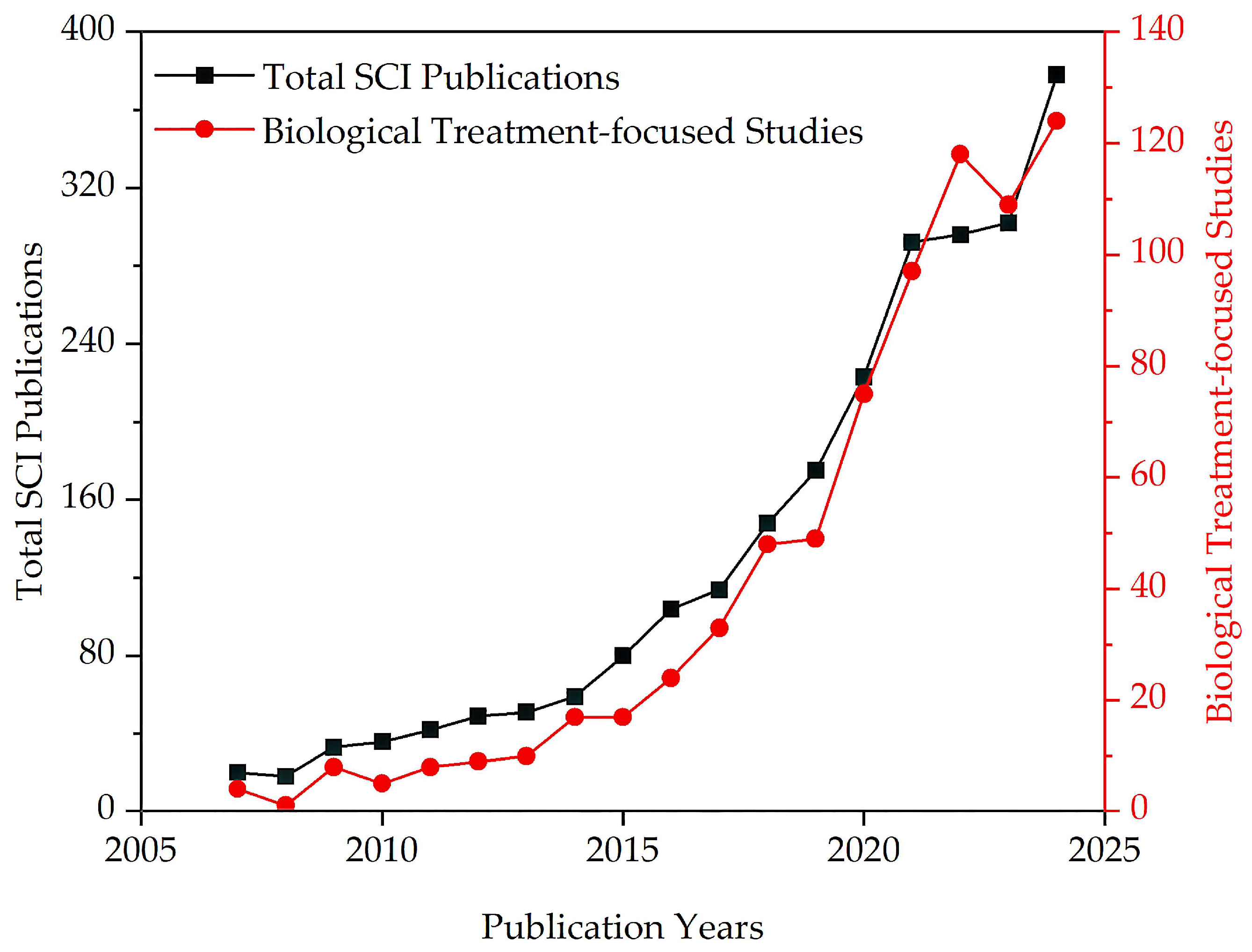
Research interest in radioactive wastewater treatment has recently surged significantly. From 2007 to 2024, the annual number of SCI publications on this topic increased by 57.5%. Concurrently, publications specifically focusing on the biological treatment of radioactive wastewater grew to 124, reflecting an average annual growth rate of 20.3% (Figure 1). This substantial growth underscores the increasing recognition of biological approaches, particularly those utilizing RRB, as promising strategies for remediation.

2.1. Characteristics of Radiation-Resistant Bacteria

Radiation-resistant bacteria (RRB) encompass diverse taxonomic groups, including Deinococcus, Bacillus, halophiles (e.g., Halobacterium salinarum), and other extremophiles such as Kineococcus and Thermus (Table 1). Despite their phylogenetic and ecological diversity, they exhibit convergent characteristics, such as high tolerance capacity in radiation environments, unique morphological and structural features, and cross-tolerance to multiple extreme conditions, and share common adaptive mechanisms, including efficient DNA repair, robust antioxidant defenses, and radiation sensing and regulatory systems.
  • Tolerance capacity in radiation environment
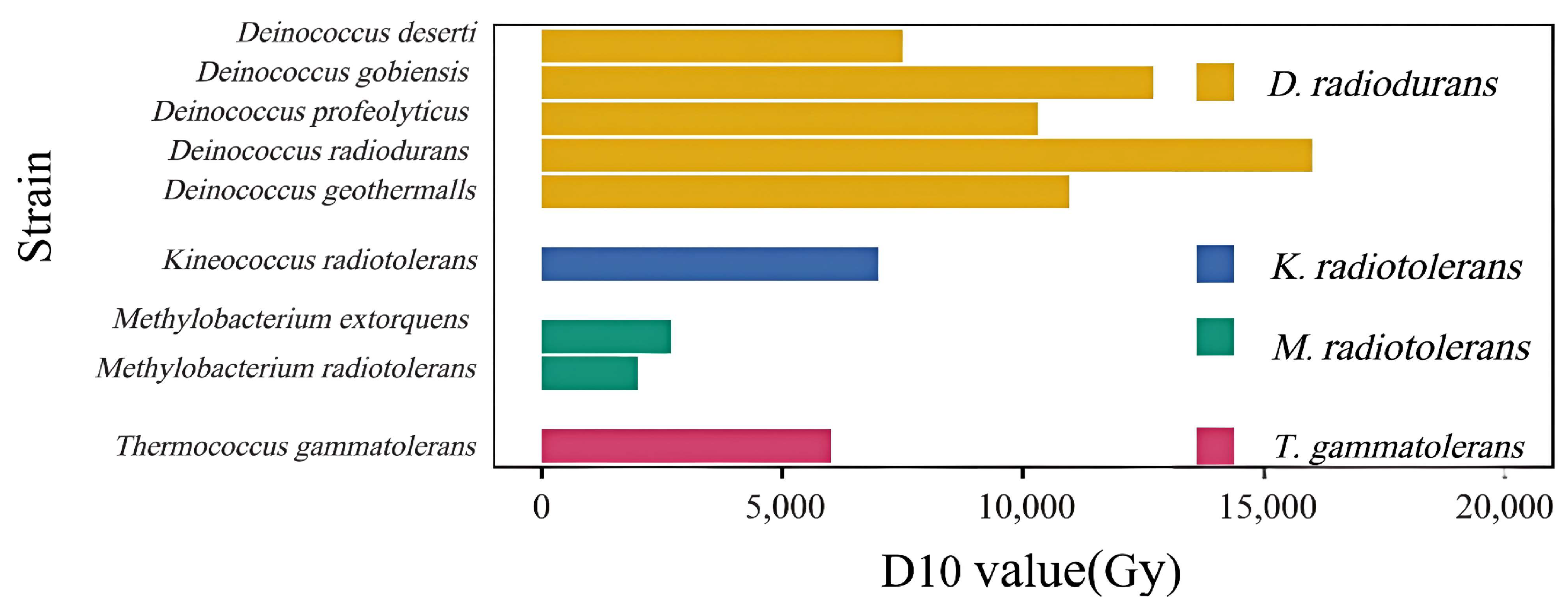
RRB’s most distinctive characteristic is extreme radioresistance. As shown in Figure 2, Deinococcus radiodurans, Deinococcus gobiensis, Deinococcus proteolyticus, and Deinococcus geothermalis exhibit only ~1 log reduction in CFU survival after exposure to more than 10,000 Gy of gamma radiation, especially over 1000 times the lethal dose for humans (10 Gy) and roughly 3000 times that for most mammals [13,14,15,16,17]. In addition to the well-studied Deinococcus species, other genera such as Kineococcus, Methylobacterium, and Thermococcus have also demonstrated remarkable resistance to ionizing radiation, highlighting the broad phylogenetic diversity of microorganisms capable of thriving under extreme radiological stress [18,19,20,21]. However, the molecular mechanisms underlying radioresistance in these non-Deinococcus species remain comparatively less explored, yet they hold significant potential for future applications in bioremediation and biotechnology. In contrast, common bacteria such as Pseudomonas putida and Shewanella oneidensis are highly radiosensitive and unable to persist in high-radiation environments [22]. It is worth noting that intrinsic cellular components can also profoundly influence radioresistance, extending beyond the functional expression of heterologous genes. Subsequent studies demonstrated that a protein-free ultrafiltrate from Halobacterium salinarum could confer significant radioprotection (up to 12 kGy) to radiosensitive species, such as Escherichia coli and Pseudomonas putida [23]. Further investigation into its defense mechanisms showed that the perA gene protects against ROS-induced oxidative stress, such as hydrogen peroxide and superoxide anions [23]. Despite these promising characteristics, Halobacterium salinarum is currently employed in industrial biotechnology primarily for biohydrogen production with hydrogenase donors, and its potential for radioactive wastewater bioremediation remains an unexplored frontier [24].
2.
Unique Morphological and Structural Features
The distinctive morphology and cellular architecture of radiation-resistant bacteria constitute fundamental adaptations that underpin their exceptional survival capabilities under radioactive stress. Deinococcus radiodurans, for instance, characteristically assembles into tetrad structures. This multicellular configuration potentially enhances radioprotection through collective defense mechanisms, including reduced per-cell exposure cross-section and synergistic intercellular resource sharing [25]. In addition to the tetrad arrangement, Deinococcus radiodurans exhibits a highly compacted and toroidal nucleoid structure, restricting the diffusion of DNA fragments and providing a scaffold for DNA repair through high-fidelity DNA end-joining processes [26]. Another distinctive structural feature is the presence of a thick, multilayered cell envelope, consisting of an inner membrane, a robust peptidoglycan layer, and an unusually complex outer membrane enriched with carotenoid pigments [27]. These pigments provide coloration and function as antioxidants, quenching reactive oxygen species (ROS) generated by radiation [28]. The cell envelope further incorporates manganese complexes, critical in reducing oxidative protein damage and thereby maintaining cellular functionality under stress conditions [29,30]. Beyond morphological features, genetic determinants critically shape cellular structures for radiation resilience. In practical engineering applications, the inherent radioresistance of Deinococcus radiodurans, conferred by multiple genes including pprI, pprM, ddrA, and recA, results in a significantly thicker cell envelope than that of typical bacteria. This robustness allows for its direct inoculation into radionuclide-contaminated wastewater for treatment [31].
Collectively, these structural and morphological adaptations—tetrad structures, toroidal nucleoid, multilayered cell envelope, protective pigments, and manganese-dependent antioxidative systems—provide a comprehensive basis for the exceptional radiation resistance observed in RRB and substantiate their classification as uniquely adapted extremophiles.
3.
Cross-Tolerance to Multiple Extreme Environments

Radiation-resistant bacteria often exhibit “broad-spectrum stress resistance”. This includes tolerance to desiccation, extreme temperatures, ultraviolet (UV) radiation, and chemical toxins, among other stressors. Desiccation causes DNA damage similar to radiation, so their tolerance to desiccation often coincides with their radiation resistance [32]. Laurence et al. observed that Deinococcus can repair their fragmented genomes with remarkable fidelity following exposure to extreme radiation doses or prolonged desiccation [33]. Some species (such as thermophilic radiation-resistant Archaea) can survive in high-temperature environments (50–80 °C) while withstanding high-intensity radiation, such as hot springs and deep-sea hydrothermal vents. For example, Deinococcus geothermalis exhibits remarkable radioresistance (3700 Gy) and thermotolerance, rendering it suitable for decontaminating radioactive industrial effluents at elevated temperatures [34]. Similarly, Thermus thermophilus not only survives in high-radiation environments but also possesses the ability to grow at temperatures of about 80 °C [35]. Many radiation-resistant bacteria are UV-resistant, as shown in Table 1. In particular, Halobacterium salinarum can tolerate up to 12,000 Gy of gamma radiation and 17.0 kJ/m2 of UV radiation [23]. Additionally, some radiation-resistant bacteria tolerate high salinity, heavy metals (e.g., uranium and lead), or chemical oxidants (e.g., hydrogen peroxide), enabling them to colonize complex extreme environments such as nuclear waste sites and industrial pollution areas. Salinibacter ruber and Halobacterium salinarum can survive in saline environments with concentrations as high as 3M [23,36]. Rok et al. reported that Rhodotorula taiwanensis MD1149 can grow under a radiation flux of 66 Gy/h at pH 2.3, in the presence of high concentrations of mercury and chromium compounds, and even form biofilms under conditions of high-level chronic radiation and low pH [37].
Table 1. Radiation-tolerant dose of radiation-resistant bacteria.
GenusBacterial StrainRadiation TypesTolerable DoseReference
BacillusBacillus subtilisGamma rays, UV raysTolerates up to 3351.5 ± 146.6 J/m2 UV;
tolerates about 4 kGy of gamma radiation.
[38,39]
DeinococcusDeinococcus radioduransGamma rays, X-rays, UV raysTolerates about 10,000 Gy of gamma radiation; tolerates up to 64.1 kJ/m2 UV.[40,41]
Deinococcus murrayiGamma rays, X-raysTolerates about 8000 Gy of gamma radiation.[42]
Deinococcus desertiGamma rays,
UV rays
Tolerates up to 750 J/m2 UV; tolerates about 7.5 kGy of gamma radiation.[43]
Deinococcus indicusUV raysTolerates about 5.9 J/cm2 UV.[44]
Deinococcus proteolyticusGamma rays, X-raysTolerates up to 1.5 Mrad of gamma radiation.[45]
Deinococcus piscis sp. nov.Gamma raysTolerates about 7400 Gy of gamma radiation.[46]
Deinococcus humi sp. nov.Gamma raysTolerates about 9000 Gy of gamma radiation.[47]
Deinococcus geothermalisGamma raysTolerates about 3700 Gy of gamma radiation.[42]
HaloarculaHalobacterium salinarumUV rays, Gamma raysTolerates up to 12,000 Gy of gamma radiation; tolerates up to 17.0 (± 0.65) kJ/m2 UV.[23]
KineococcusKineococcus radiotoleransGamma raysTolerates about 3000 Gy of gamma radiation.[48]
SpirosomaSpirosoma radiotolerans sp. nov.Gamma rays, UV raysTolerates about 3000 Gy of gamma radiation; tolerates up to 800 J/m2 UV.[49]

2.2. Radiation Resistance Mechanisms of Radiation-Resistant Bacteria

2.2.1. DNA Repair Mechanisms

Radiation can induce various forms of DNA damage, including double-strand breaks (DSBs), base damage, and DNA interstrand cross-links. Several well-characterized DNA repair pathways have been identified in RRB, including direct damage reversal (DR), base excision repair (BER), nucleotide excision repair (NER), mismatch repair (MR), and homologous recombination (HR).
DR primarily involves photolyase-mediated repair of UV-induced pyrimidine dimers, such as cyclobutane dimers and photoproducts. These lesions distort the DNA helix, hindering replication and transcription. In RRB, photolyase enzymes absorb light energy and cleave the covalent bonds within these dimers, restoring the original base structure without introducing strand breaks [50,51]. BER is mainly responsible for correcting oxidative or alkylated base damage. It is initiated by DNA glycosylases, which recognize and remove damaged bases, creating apurinic/apyrimidinic (AP) sites. These sites are then processed by AP endonucleases and exonucleases, followed by gap-filling and ligation mediated by DNA polymerase and DNA ligase. In Halobacterium salinarum, oxidative base damage induced by 2.5 kGy radiation was restored within 2 h by BER [52]. NER targets bulky DNA lesions, such as those caused by UV irradiation. NER involves six key proteins: UvrA, UvrB, UvrC, UvrD, DNA polymerase, and DNA ligase. UvrA initially recognizes the damage, then recruits UvrB to form a pre-incision complex. UvrC performs dual incisions flanking the lesion, excising a 12–13-nucleotide fragment. UvrD then removes the damaged strand, and the gap is filled and sealed [53]. After exposure to 500 J/m2 of UV light, Deinococcus radiodurans showed 1.7% thymine damage, which was reduced to 0.3% within 90 min through NER, whereas the same dose was lethal to Escherichia coli [54]. MR corrects replication errors such as base mismatches and insertion–deletion loops. While not as extensively characterized in RRB as other pathways, MR is believed to contribute to overall genomic stability under radiation stress by ensuring high-fidelity DNA replication and repair. HR plays a central role in repairing DSBs, particularly those caused by high doses of ionizing radiation. In Deinococcus radiodurans, the RecA protein is essential for HR. Approximately 11,000 RecA molecules are present per cell [55], and RecA gene expression increases eightfold following 15 kGy of radiation [56]. Protein levels rise 2–2.5-fold after 2 kGy and fourfold after 7 kGy exposure [56,57]. These RecA proteins repair nearly two-thirds of radiation-induced DSBs in Deinococcus radiodurans [58]. HR proceeds through five key steps: (i) recognition of break sites and formation of repair centers, (ii) processing of broken ends, (iii) RecA-mediated strand invasion, (iv) branch migration and resolution of recombination intermediates, and (v) disassembly of repair complexes and chromosome segregation [59]. Genome reconstitution in Deinococcus radiodurans is achieved through an extended synthesis-dependent strand annealing (ESDSA) process followed by HR [60]. In addition to HR, alternative RecA-independent DSB repair pathways exist. Non-homologous end joining (NHEJ), although not confirmed in Deinococcus radiodurans, is observed in other RRB such as Mycobacterium and Bacillus subtilis. NHEJ relies on the Ku protein to bind DNA ends and the multifunctional LigD enzyme for end processing and ligation. When LigD is absent, alternative ligases such as LigC can compensate [61,62]. Experimental studies using mutant strains lacking specific repair pathways have demonstrated that cells deficient in NHEJ are approximately ten times more sensitive to ionizing radiation than wild-type strains, highlighting NHEJ’s critical role in protecting genomic integrity [63]. Furthermore, alternative end joining (A-EJ) mechanisms have been observed in Deinococcus radiodurans, providing additional flexibility in its DNA repair [64].

2.2.2. Antioxidant Mechanism in Radiation-Resistant Bacteria

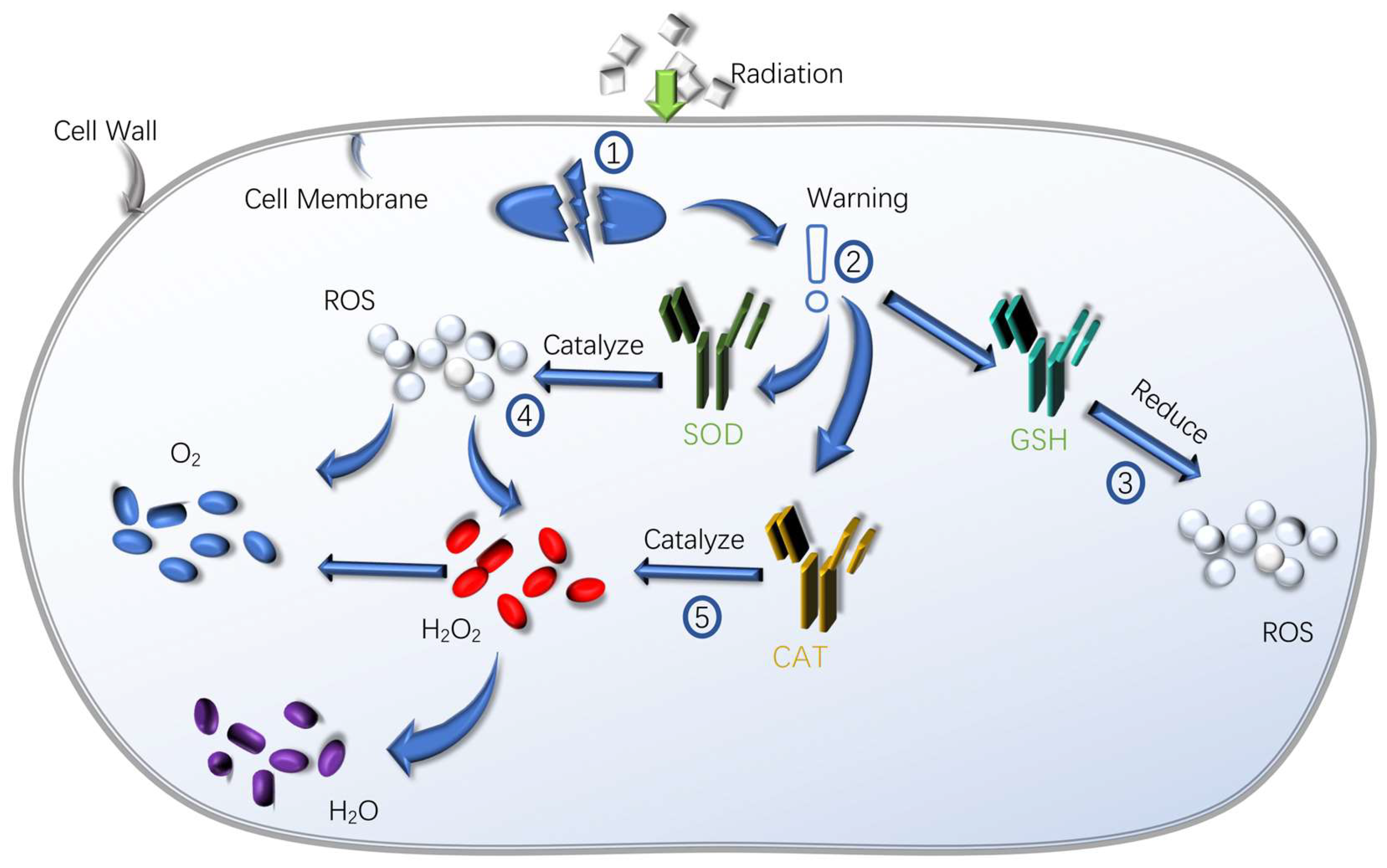
The excessive accumulation of intracellular ROS following radiation exposure primarily results from water radiolysis. Given that water (H2O) constitutes the most abundant component of biological tissues, it serves as the primary target for energy absorption upon exposure to ionizing radiation [65]. The absorbed energy ionizes and excites water molecules, leading to the generation of various ROS, including hydroxyl radicals (•OH), hydrated electrons (eaq), superoxide anion radicals (O2), and hydrogen peroxide (H2O2). These ROS subsequently interact with vital macromolecules such as DNA, proteins, and lipids, triggering oxidative damage and cellular dysfunction [66]. Importantly, indirect damage mediated by ROS is often more detrimental than the direct impact of radiation itself [67].
In RRB, intracellular ROS homeostasis is tightly regulated by both enzymatic and nonenzymatic antioxidant systems. Key enzymatic antioxidants include superoxide dismutase (SOD) and catalase (CAT), while nonenzymatic defenses involve molecules such as carotenoids and glutathione (GSH), as shown in Figure 3.
Within the enzymatic antioxidant system, both SOD and CAT operate via dismutation reactions. SOD catalyzes the conversion of O2 into molecular oxygen (O2) and hydrogen peroxide (H2O2) [68]. Subsequently, CAT facilitates the decomposition of H2O2 into water and oxygen [69]. These enzymes act synergistically to neutralize ROS and protect cellular components from oxidative stress. The SOD family includes Cu/Zn-SOD, Mn-SOD, and EC-SOD, with Mn-SOD identified as the predominant isoform contributing to antioxidant defense in RRB [70]. Ilizarov et al. [71] engineered stable cell lines overexpressing Mn-SOD, CAT, or both enzymes to evaluate the protective role of Mn-SOD. Under hyperoxic conditions, cells expressing Mn-SOD alone, or co-expressing Mn-SOD and CAT, exhibited 25.0–50.0% higher survival rates than control cells (MLE-12). Moreover, following paraquat exposure, Mn-SOD-overexpressing cells showed 31.0–46.0% greater survival. These results underscore the essential role of Mn-SOD in cellular defense against oxidative stress. Notably, co-expression of CAT further enhanced protection, indicating a synergistic interaction between the two enzymes. Supporting this, CAT activity in Deinococcus radiodurans was found to be 16–50 times higher than that in Escherichia coli, which likely contributes to the superior oxidative stress tolerance observed in RRB [72].
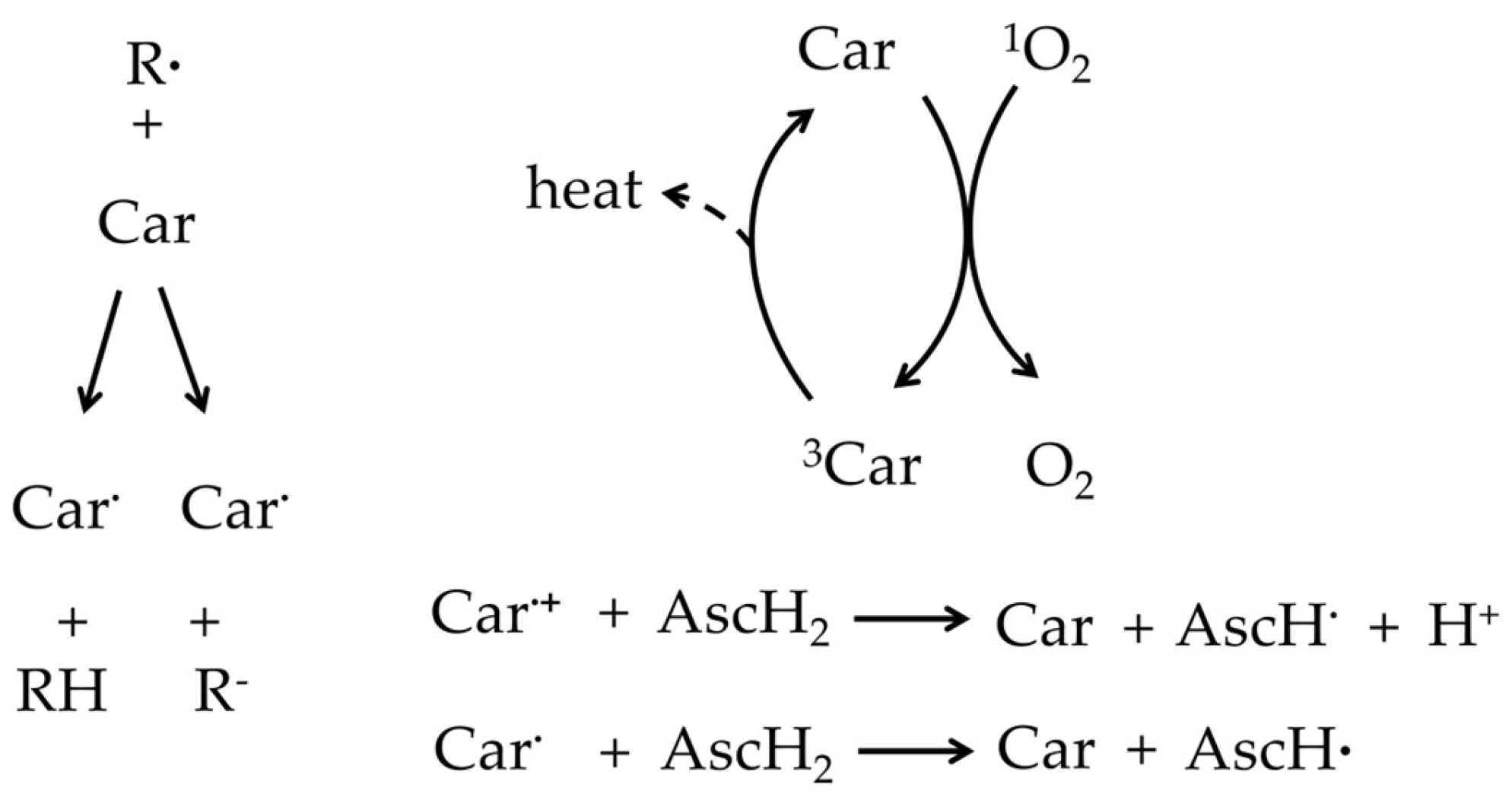
Carotenoids represent another critical line of defense against ROS. Their polyene chains, composed of numerous conjugated double bonds, enable them to scavenge ROS efficiently. As depicted in Figure 4, carotenoids neutralize singlet oxygen via physical quenching by converting its energy into heat and detoxifying free radicals through direct electron transfer reactions. Then, they are regenerated by ascorbate [73,74]. In Deinococcus radiodurans, a unique carotenoid known as deinoxanthin plays a central role in antioxidative defense. As shown in Figure 5, this molecule contains 12 conjugated double bonds, a distinctive double bond at the C-3’,4’ position, and a hydroxyl group at C-1’. These structural features extend its conjugated π-system and increase the electron density near the C-3’ hydroxyl group, enhancing its reactivity with ROS. As a result, deinoxanthin exhibits superior ROS-scavenging ability compared to other common carotenoids such as lycopene, β-carotene, zeaxanthin, and lutein. In one study, deinoxanthin removed up to 69.7% of H2O2 at high concentrations and was capable of quenching singlet oxygen by up to 99.0% at concentrations above 0.0625 mM [75].
GSH, a tripeptide with a reactive thiol group, is another crucial nonenzymatic antioxidant. Its sulfhydryl moiety allows direct interaction with ROS and free radicals via electron donation, thereby terminating radical chain reactions that could otherwise damage DNA, lipids, and proteins [76].
The coordinated cooperation among these various antioxidant pathways leads to a more effective cellular defense. GSH frequently cooperates with glutathione peroxidase (GPx) to exert its antioxidant effects. When GSH is oxidized through its reaction with ROS, it forms oxidized GSH, glutathione disulfide (GSSG), and O2. Additionally, GSH does not react directly with hydroperoxides in a nonenzymatic manner. Instead, its role as a co-substrate for selenium-dependent GPx is recognized as the most critical mechanism for reducing H2O2 and lipid hydroperoxides [77]. Ultimately, the combined actions of SOD and CAT are essential to interrupt the free radical chain reaction, thereby ensuring the complete elimination of free radicals [78].

2.2.3. Radiation Sensing and Regulation

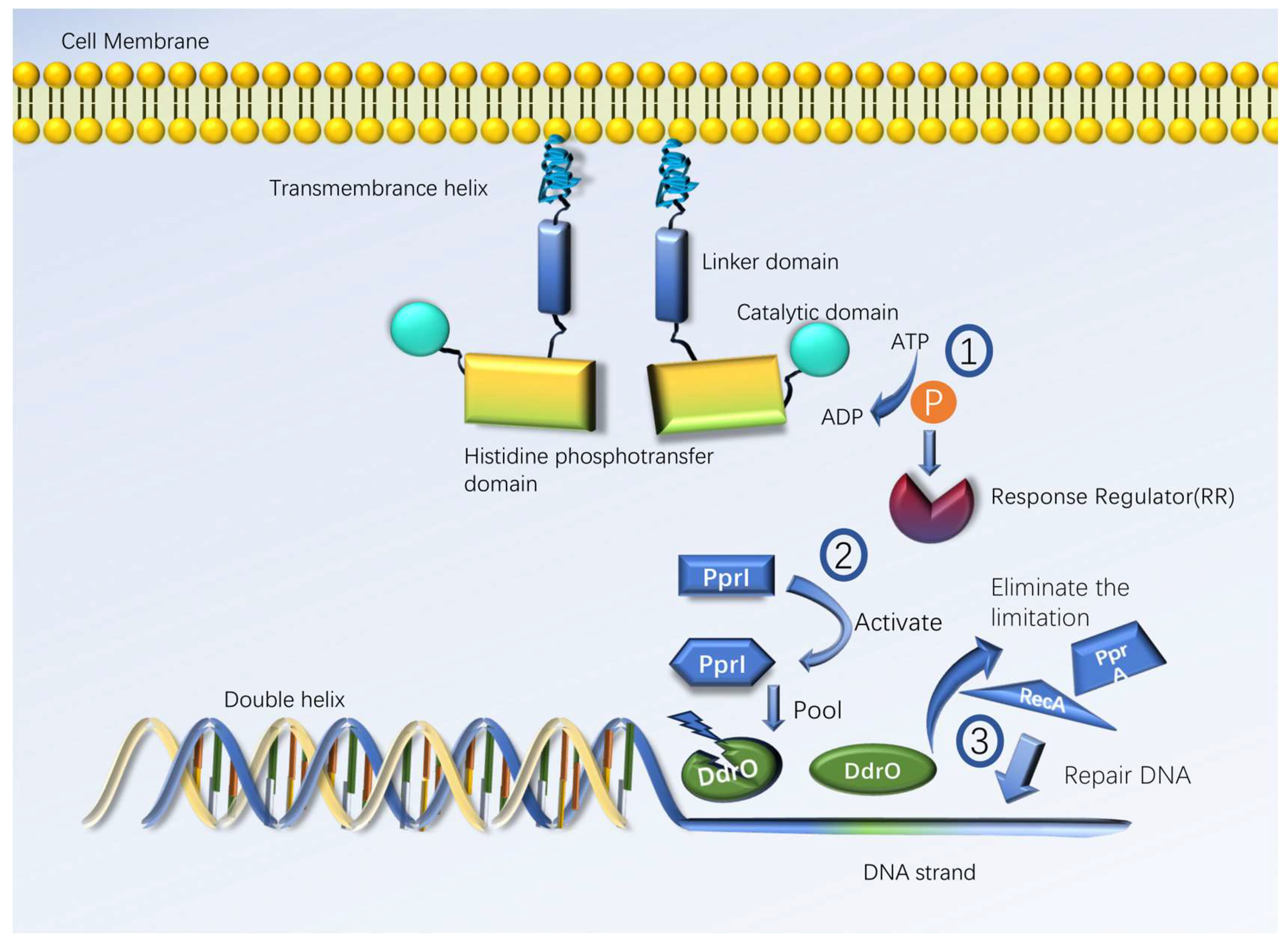
In RRB, the cellular response to ionizing radiation is primarily initiated by recognizing signals generated due to radiation-induced cellular damage. The core of this tolerance mechanism relies on sophisticated signal transduction and gene expression regulatory networks. Figure 6 describes the principal gene regulatory networks identified in RRB, particularly those contributing to its extreme stress resistance: the PprI/DdrO, Two-Component Systems (TCS), and the DdrI-mediated system.
PprI (also known as IrrE) is a key regulatory protein identified as a metal-dependent protease [79]. Under physiological homeostasis or basal conditions, the activity of the PprI protein within Deinococcus radiodurans is maintained at a basal level or subjected to inhibitory regulation. However, upon sensing severe DNA damage signals, PprI activity is significantly induced or activated, presumably to initiate downstream repair mechanisms [80]. Current evidence confirms that single-stranded DNA (ssDNA) physically binds to the PprI protein, stimulating its protease activity in a length-dependent manner [81]. DdrO is characterized as a DNA-binding transcriptional repressor. It exhibits specific binding affinity for a conserved cis-regulatory sequence, designated the Radiation/Desiccation Response Motif (RDRM), typically located within the promoter regions of genes integral to DNA repair and stress response pathways [82]. DdrO functions as a repressor by binding to RDRM elements in the promoters of key DNA repair genes. Following severe DNA damage, PprI activation leads to the proteolytic degradation of DdrO. The loss of functional DdrO results in its dissociation from RDRM sites, thereby derepressing target genes (including ddrA, ddrB, ddrC, pprA, and recA) and causing their substantial upregulation [83]. This inducible gene expression program, mediated by the PprI-DdrO pathway, is essential for the remarkable radio resistance of Deinococcus radiodurans.
TCS in RRB typically consists of a histidine kinase (HK) and a cognate response regulator (RR). The fundamental mechanism involves the HK perceiving a specific environmental signal. Upon activation, the HK undergoes autophosphorylation on a conserved histidine residue. This phosphoryl group is subsequently transferred to a conserved aspartate residue on the cognate RR. Phosphorylation generally activates the RR, which often functions as a transcription factor, binding to specific DNA sequences to modulate the expression of target genes, thereby orchestrating an adaptive response [84]. Recent research has found DrRRA (encoded by the gene dr2418) is identified as a crucial response regulator within a two-component signal transduction system in Deinococcus radiodurans. Experimental analysis revealed that the DrRRA null mutant of Deinococcus radiodurans exhibited significantly reduced radiation resistance, with only a 1.0% survival rate following exposure to 2kGy of ionizing radiation. Transcriptomic analysis showed the suppression of multiple DNA damage response genes and antioxidant proteins directly involved in ROS removal in the mutant. The transcription levels of genes associated with DNA replication and repair in the mutant were adversely affected; transcription levels of recA and pprA were reduced by 4-fold and 3.3-fold, respectively, compared to the wild-type cells. These findings underscore the critical importance of DrRRA for the radio resistance of Deinococcus radiodurans [85].
DdrI (DR0997) is a transcriptional activator for a broad set of stress-response genes [86]. Yang et al. [87] identified at least 18 genes directly regulated by DdrI, including recN (encoding a cohesion-like factor for DSBs repair) [88], pprA (encoding an RecA-independent repair protein) [89], and uvsE (encoding a UV-endonuclease) [90]. Deleting the ddrI gene resulted in a marked increase in sensitivity to DNA damage and oxidative stress. When challenged with 50 mM H2O2 for 20 min, the ddrI mutant showed over a 10-fold decrease in survival compared to wild-type Deinococcus radiodurans R1 cells. Exposure to 200 J/m2 of UV radiation resulted in only approximately 5.0% survival for the ddrI mutant, whereas over 90.0% of wild-type cells survived under the same dose. Consistent with these phenotypic observations, transcriptomic analysis indicated that the absence of ddrI led to the downregulation of multiple genes involved in DNA damage and stress responses, underscoring the importance of ddrI in these pathways.
Interactions occur among these regulatory factors within the cell. DrRRA has been shown to bind the promoter region of ddrI directly, significantly enhancing its transcription levels. This mechanism facilitates the rapid accumulation of the DdrI protein after radiation exposure, enabling its downstream regulatory functions [91]. The PprI/DdrO system derepresses DNA repair genes [92]. Experiments showed that in a ddrI mutant, DdrO levels are reduced by approximately 4-fold, while DrRRA levels are nearly 2.9-fold lower compared to wild-type cells [87].

3. Application of Radiation-Resistant Bacteria in Radioactive Wastewater Treatment

The concentrations of radioactive substances in wastewater vary considerably by source and location. For instance, tritium levels in surface waters near nuclear plants may reach 100 Bq/L, while cesium−137 in nuclear facility effluents ranges from 0.1 to 10 Bq/L. In uranium-rich regions of the U.S., radium−226 in drinking water can reach up to 1 Bq/L. To mitigate such risks, regulatory thresholds—such as the 0.185 Bq/L maximum for combined radium−226 and radium−228 in drinking water—serve as critical safeguards for human and environmental health [93], underscoring the need for targeted treatment technologies to ensure water quality and community safety. In addition, radioactive uranium-containing wastewater, primarily generated from various industrial activities including nuclear fuel processing, uranium mining, and nuclear reactor operations, represents one of the most hazardous types of industrial effluent. Worse, other heavy metals and elevated total dissolved solids often accompany the radioactive wastewater. These chemical and radiological features underscore the complexity, toxicity, and long-term environmental risks, highlighting the need for safe and effective treatment strategies. Direct discharge of untreated uranium-rich effluent into the environment can contaminate soil and water bodies, causing long-term ecological deterioration and severe health risks to humans [94]. Moreover, uranium can migrate into groundwater systems, further exacerbating contamination and complicating subsequent remediation efforts. Istok et al. investigated a shallow unconfined aquifer, where uranium(VI) concentration reaches up to 4.8 mg/L [31]. However, the relevant regulations in China stipulate that the uranium concentration discharged from each nuclear isotope wastewater outlet should not exceed 0.3 mg/L [95]. Conventional treatment strategies—such as chemical precipitation and ion exchange—although effective in removing contaminants, often suffer from high operational costs, intensive energy consumption, and the generation of secondary pollutants [96]. In contrast, bioremediation has garnered increasing interest due to its cost-effectiveness, environmental compatibility, and sustainability [97]. RRB, particularly Deinococcus radiodurans, have emerged as promising candidates owing to their exceptional survivability in extreme radiation environments.
Current RRB-based treatment strategies for uranium-contaminated wastewater include biosorption, bioreduction, and biomineralization. For example, the cell surface of Deinococcus radiodurans possesses various functional groups, including amide, hydroxyl, carboxyl, and phosphate moieties. These groups facilitate interaction with positively charged metal ions, such as the uranyl ion (UO22+), via ion exchange and surface complexation, thereby enabling uranium removal from wastewater [98]. Experimental data indicate that Deinococcus radiodurans possesses a notable biosorption capacity, with reported uranium removal efficiencies of up to 86.0%, the initial concentration of uranyl ions ranged from 0 to 100 mg/L, and a maximum biosorption capacity of 230 mg/g [99]. Kinetic studies have shown that the biosorption process follows a pseudo-second-order model [100]. Despite its efficiency, a key limitation of using suspended bacterial cells is the challenge of post-treatment separation. Biofilm-based approaches have been explored to address this. Deinococcus radiodurans strongly tends to form biofilms—structured microbial communities encased in extracellular polymeric substances (EPS). These biofilms provide protective microenvironments that enhance microbial resistance to heavy metals and radiation. Moreover, EPS components, such as polysaccharides and proteins, offer additional binding sites for uranyl ions, thereby boosting removal efficiency [101]. Research indicates a positive correlation between the rate of uranium removal by Deinococcus radiodurans biofilms and biofilm age, suggesting that more established biofilms possess enhanced uranium sequestration capacity [102]. To overcome challenges associated with biomass separation, immobilization techniques—such as entrapment in sodium alginate or incorporation into magnetic nanocomposites—are widely employed [103]. These methods improve operational stability and reusability and facilitate rapid recovery through magnetic separation, particularly when carriers such as Fe3O4 are used [104,105].
In addition to biosorption, RRB can reduce soluble U(VI) to the less mobile and soluble U(IV) through enzymatic processes. This redox transformation—mediated by membrane-bound cytochromes or reductases—utilizes U(VI) as a terminal electron acceptor in cellular respiration [106]. Biomineralization represents another effective strategy, whereby microbial phosphatases promote the formation of stable uranium phosphate precipitates. Although U(IV) formed via bioreduction can be reoxidized under certain conditions, enzymatic precipitation into autunite-group minerals offers greater long-term stability [94,107].
Despite its promise, wild-type RRB has limitations in practical wastewater applications. Genetic engineering has therefore been explored to enhance its performance. Engineered strains with enhanced biofilm formation and uranium immobilization capabilities have shown remarkable results. For instance, recombinant strains expressing phosphatase genes such as phoN (non-specific acid phosphatase) and phoK (extracellular alkaline phosphatase) have been developed to catalyze the hydrolysis of phosphate-containing substrates, releasing inorganic phosphate that reacts with UO22+ to form insoluble uranium phosphate minerals [31,108]. PhoN-expressing Deinococcus radiodurans strains have demonstrated significant uranium precipitation under acidic to neutral pH conditions. Appukuttan et al. [109] reported that their engineered strain (Deino-PhoN) retained enzymatic activity even after kGy-level gamma irradiation, achieving 90.0% uranium removal from a 0.8 mM solution within hours. Promoter optimization studies by Misra et al. [110] revealed that using a radiation-inducible promoter (Pssb) significantly outperformed the constitutive PgroESL promoter. Strains harboring the Pssb-driven plasmid (pSN4) achieved uranium precipitation rates of 1.8 g/g and 3.6 g/g biomass within 24 and 48 h, respectively, from 5–10 mM uranyl nitrate solutions. Even at 20 mM concentrations, 70.0% uranium removal was attained within four days. Similarly, the Deino-PhoK strain, engineered to express phoK, has extended the applicability of bioprecipitation into alkaline conditions. Kulkarni et al. [111] demonstrated that this strain achieved over 80.0% uranium removal within one hour across a 1–10 mM concentration range, with a uranium loading capacity of 10.7 g/g biomass. Xu et al. [112] found that hexavalent chromium (Cr(VI)) impaired uranium precipitation by Deino-PhoN, reducing removal efficiency by 45.0% in the presence of 0.2 mM chromate. Co-expression of a chromate reductase gene (yieF) alongside phoN significantly enhanced Cr(VI) reduction and uranium removal, improving respective efficiencies by 25.0% and 28.0% over 24 h. It proves that genetic strategies have also targeted mixed contaminant interference.
These findings highlight that radiation-resistant bacteria provide effective mechanisms for radionuclide removal through biosorption, bioreduction, and biomineralization, but also demonstrate significant potential for genetic engineering strategies to enhance performance further. Such integrated approaches suggest a viable and sustainable alternative to conventional physicochemical methods for treating radioactive wastewater.

4. Application of Radiation-Resistant Bacteria in Non-Radioactive Wastewater Treatment

While the previous section addressed radioactive wastewater, non-radioactive systems require distinct consideration due to fundamental differences in contaminant profiles, treatment objectives, and regulatory frameworks [113,114]. Radioactive wastewater primarily requires the removal and secure immobilization of non-degradable radionuclides (e.g., uranium, cesium), with treatment strategies relying on mechanisms such as bioadsorption and bioaccumulation for concentration and isolation. In contrast, non-radioactive industrial wastewater, containing organic toxins or heavy metals, aims for complete detoxification through biodegradation (e.g., phenol decomposition) or chemical transformation (e.g., reduction of Cr(VI) to Cr(III)). Ultimately, these divergent treatment objectives also dictate distinct regulatory priorities: long-term radiological safety and geological isolation for radioactive effluents, versus strict compliance with chemical pollutant discharge standards (e.g., COD, BOD limits) for non-radioactive wastewater. In this context, the radiotolerance of RRB serves a dual purpose: providing protection against residual radioactivity while supporting the efficient degradation of contaminants via their robust antioxidant systems (e.g., catalase, superoxide dismutase). These properties enable RRB to remove the hazardous contaminants efficiently. This distinction underscores the diverse functional roles of RRB in environmental remediation applications.
As we all know, heavy metal ions in non-nuclear industrial wastewater threaten environmental integrity and human health. Unlike radionuclides, these metal ions do not decay radioactively; however, their high inherent toxicity, environmental persistence, and bioaccumulation tendency categorize them as hazardous pollutants [115]. These metals such as As (>2300 µg/L), Pb (180–500 µg/L), Cu (5.8–600 µg/L), and Cd (10–1000 µg/L) [116] exert direct acute toxic effects on aquatic organisms, disrupting ecological balance and reducing biodiversity. Owing to their resistance to natural degradation, heavy metals persist in ecosystems and progressively accumulate through the food chain—a process known as biomagnification—which leads to increasingly elevated concentrations at higher trophic levels [117,118]. RRB offers a promising biological avenue for synthesizing metallic nanoparticles, which can be subsequently employed in treating heavy metal-containing wastewater. A key feature of these biogenic nanoparticles is their high specific surface area, which significantly enhances their adsorption efficiency for aqueous heavy metal ions [119]. El-Tawil et al. [120] synthesized a silver-based nanocomposite that achieved approximately 96.0% removal efficiency of mercuric ions (Hg2+) within one hour at pH = 6 and a dosage of 0.5 g. Similarly, nanocomposites developed by Al-Sherbini et al. [121] demonstrated a 97.0% removal efficiency for copper ions (Cu2+) with an initial concentration of 100 mg/L. Beyond passive adsorption, AuNPs have also been employed in catalytic applications. Jimenez et al. [122] utilized AuNPs to catalyze the reduction of Hg2+, with the added benefit of straightforward nanoparticle recovery due to the inherent hydrophobicity of gold. A constant AuNP concentration was used (1.7 nM AuNPs; 7.1 ppm Au).
Metal oxide nanoparticles biosynthesized by RRB—particularly titanium dioxide (TiO2)—exhibit vigorous photocatalytic activity, especially under UV irradiation [123,124]. This property enables the degradation of various organic contaminants, including phenols, benzene derivatives, and pesticide residues [125]. The photocatalytic mechanism primarily involves the generation of ROS, such as •OH and O2, which oxidize and break down recalcitrant organic compounds into harmless end-products [126]. In a representative study, Kulal et al. [127] synthesized Ag2O/AgO-TiO2 nanocomposites extracellularly using metabolites from Alcaligenes aquatilis and evaluated their photocatalytic degradation of the dye Active Blue 220 under visible light. The nanocomposites achieved approximately 96.0% degradation of a 100 ppm dye solution within 90 min, in contrast to just 20.0% degradation in control conditions lacking light or nanocomposites, highlighting their significant photocatalytic efficiency. Using biogenically synthesized nanomaterials in water treatment offers high efficiency and rapid kinetics and provides superior environmental compatibility and sustainability [128]. Compared to conventional chemical synthesis routes, these biologically derived nanomaterials are considered more eco-friendly in aquatic systems, as their production avoids toxic chemical reagents and minimizes the risk of secondary pollution [129].
Radioactively contaminated sites are often co-contaminated with organic pollutants like benzene, toluene, ethylbenzene, and xylene (BTEX), which can serve as substrates for organisms like Pseudomonas putida. Genetic engineering offers a promising approach to overcoming the limitations of individual strains. For example, the toluene dioxygenase genes (todC1C2BA) from Pseudomonas putida have been functionally expressed in Deinococcus radiodurans, enabling the degradation of organic compounds in highly radioactive wastewater [130,131]. Deinococcus radiopugnans and Thermus aquaticus effectively degrade long-chain organic compounds [132,133]. Notably, the lipase produced by Thermus aquaticus exhibits extraordinary thermal stability, and the dibutyl adipate degradation rate is observed from 120 to 145 µmol min−1 at 95 °C [133]. It suggests its potential for effectively degrading residual long-chain organic esters and hydrocarbons in nuclear wastewater under the combined stresses of radionuclide exposure and high temperatures, conditions characteristic of a nuclear accident.
In addition to chemical contamination, wastewater treatment plants have been increasingly identified as reservoirs and dissemination hubs for antibiotic-resistant bacteria (ARB) [134]. The proliferation of ARB in these systems constitutes a growing global health concern due to the potential for waterborne transmission and subsequent human infections, which are often difficult to treat with conventional antibiotics [135,136]. Staphylococcus aureus is a clinically significant ARB responsible for various skin and soft tissue infections. Its resistance is partly attributed to its ability to form biofilms—structured microbial communities encased in protective extracellular matrices—which enhance tolerance to antibiotics and immune defenses, rendering infections persistent and difficult to eradicate [137]. Recent studies have identified DeinoPol, an exopolysaccharide secreted by Deinococcus radiodurans, as a novel anti-biofilm agent against Staphylococcus aureus. DeinoPol has been shown to inhibit biofilm formation by downregulating the ica gene cluster, which is responsible for synthesizing polysaccharide intercellular adhesin (PIA)—a key biofilm component. Furthermore, DeinoPol enhances the susceptibility of established Staphylococcus aureus biofilms to antibiotic treatment and promotes macrophage-mediated clearance [138]. RRB also holds promise for energy applications. Microbial fuel cells (MFCs) harness microbial metabolism to degrade recalcitrant pollutants while producing electrical power [139]. Pimprapa et al. enriched an Acinetobacter sp. community from fermented pork sausage by incubating the samples for 3 days under 5 kGy irradiation at 30 °C in the presence of 50 mg/L nystatin. Then, they deployed this consortium in a ceramic-separator microbial fuel cell to treat medical wastewater. The system achieved a power density of 168.9 ± 3.9 mW/m2 and removed 90.1 ± 0.3% of COD [140].
While these cases demonstrate the metabolic versatility of extremophiles, their relevance lies in the broader implication that radiation-resistant bacteria can be engineered or adapted not only for radioactive environments but also for complex wastewaters containing organic pollutants. It establishes a conceptual bridge between radioactive and non-radioactive wastewater bioremediation, underscoring these organisms’ unique ecological and biotechnological value.

5. Conclusions and Perspective

With continuous advancements in the theory and practical applications, radiation-resistant bacteria are expected to play a crucial role in sustainable wastewater treatment and radioactive waste remediation. Emerging developments in genetic engineering offer the potential to enhance the specificity and efficiency of these microorganisms, enabling them to selectively recognize, adsorb, and biotransform radionuclides such as Cs (137Cs) and Sr (90Sr). This approach holds promise for effectively detoxifying and decomposing high-concentration nuclear wastewater. At the same time, sustainable water management emphasizes the reuse of treated non-radioactive wastewater to alleviate water scarcity and improve water security [141]. Such effluents can be applied in industrial operations (e.g., cooling, sanitation), urban non-potable uses (e.g., toilet flushing, vehicle washing), and agricultural or ecological applications, highlighting how integrated treatment and reuse strategies can enhance environmental protection and long-term water availability.
Beyond conventional bioremediation, the application of RRBs is expected to expand with emerging technologies. For instance, nanotechnology may improve the interactions between RRBs and radionuclides, facilitating the design of nanoscale biohybrid materials with enhanced adsorption and removal efficiencies. Moreover, coupling MFCs with radioactive waste treatment could achieve synergistic benefits by enabling simultaneous pollutant degradation and energy recovery.
Integrating genomics, systems biology, and synthetic biology will enable the rational design of microbial strains with improved resistance and metabolic capacity, facilitating more precise remediation under extreme environmental conditions. These advances will collectively drive RRBs toward broader and more impactful applications in environmental biotechnology.
However, it is worth noting that the environmental release of genetically engineered microorganisms entails significant ecological risks. One primary concern is the potential disruption of indigenous microbial communities. Enhanced strains may outcompete native species, altering ecosystem function and processes vital to nutrient cycling and soil health [142]. Furthermore, horizontal gene transfer (HGT) could facilitate the spread of engineered genetic elements—including antibiotic resistance markers—to environmental or pathogenic bacteria, potentially exacerbating public health challenges such as antimicrobial resistance [143]. Therefore, while prudent oversight and risk mitigation are essential, the responsible advancement of RRB-based technologies represents a promising frontier for addressing complex environmental contamination and supporting a sustainable future.

Author Contributions

Data collection and summary, Z.T., D.Y. and K.Q.; Manuscript preparation, Z.T., J.M., Y.L., D.Z., J.H., D.Y., Y.B. and K.Q.; Supervision, Z.T., D.Y. and K.Q.; Funding Acquisition, D.Y. and K.Q. All authors have read and agreed to the published version of the manuscript.

Funding

This research was funded by the National Natural Science Foundation of China (22206048), the Basic Research Program for Provincial Universities of Heilongjiang Province (2023-KYYWF-1488), the Basic Research Program for Provincial Universities of Heilongjiang Province (2023-KYYWF-1442), and the National Natural Science Foundation of Heilongjiang (LH2024E110).

Data Availability Statement

No data were used for the research described in this article.

Acknowledgments

We would like to express gratitude to Heilongjiang University for their support in completing this work.

Conflicts of Interest

The authors declare no conflicts of interest.

Abbreviations

The following abbreviations are used in this manuscript:
radiation-resistant bacteriaRRB
acute radiation syndromeARS
double-strand breaksDSBs
damage reversalDR
base excision repairBER
nucleotide excision repairNER
mismatch repairMR
homologous recombinationHR
extended synthesis-dependent strand annealingESDSA
non-homologous end joiningNHEJ
alternative end joiningA-EJ
reactive oxygen speciesROS
hydroxyl radicals•OH
hydrated electronseₐq
superoxide anion radicalsO2
superoxide dismutaseSOD
catalaseCAT
glutathioneGSH
glutathione peroxidaseGPx
glutathione disulfideGSSG
Two-Component SystemsTCS
Radiation/Desiccation Response MotifRDRM
histidine kinaseHK
response regulatorRR
uranyl ionUO22+
silver nanoparticlesAgNPs
gold nanoparticlesAuNPs
extracellular polymeric substancesEPS
titanium dioxideTiO2
polysaccharide intercellular adhesinPNAG
microbial fuel cellsMFCs
hexavalent chromiumCr(VI)
benzene, toluene, ethylbenzene, and xyleneBTEX
antibiotic-resistant bacteriaARB

References

  1. Ma, H.; Shen, M.; Tong, Y.; Wang, X. Radioactive Wastewater Treatment Technologies: A Review. Molecules 2023, 28, 1935. [Google Scholar] [CrossRef]
  2. Daly, M.J. Modulating Radiation Resistance: Insights Based on Defenses Against Reactive Oxygen Species in the Radioresistant Bacterium Deinococcus radiodurans. Clin. Lab. Med. 2006, 26, 491–504. [Google Scholar] [CrossRef]
  3. McCullough, G.E. Concentration of Radioactive Liquid Waste by Evaporation. Ind. Eng. Chem. 1951, 43, 1505–1509. [Google Scholar] [CrossRef]
  4. Ambashta, R.D.; Sillanpaa, M.E. Membrane purification in radioactive waste management: A short review. J. Environ. Radioact. 2012, 105, 76–84. [Google Scholar] [CrossRef]
  5. Rana, D.; Matsuura, T.; Kassim, M.A.; Ismail, A.F. Radioactive decontamination of water by membrane processes—A review. Desalination 2013, 321, 77–92. [Google Scholar] [CrossRef]
  6. Luo, X.; Zhang, G.; Wang, X.; Gu, P. Research on a pellet co-precipitation micro-filtration process for the treatment of liquid waste containing strontium. J. Radioanal. Nucl. Chem. 2013, 298, 931–939. [Google Scholar] [CrossRef]
  7. Ikeda-Ohno, A.; Harrison, J.J.; Thiruvoth, S.; Wilsher, K.; Wong, H.K.; Johansen, M.P.; Waite, T.D.; Payne, T.E. Solution speciation of plutonium and Americium at an Australian legacy radioactive waste disposal site. Environ. Sci. Technol. 2014, 48, 10045–10053. [Google Scholar] [CrossRef]
  8. Sylvester, P.; Milner, T.; Jensen, J. Radioactive liquid waste treatment at Fukushima Daiichi. J. Chem. Technol. Biotechnol. 2013, 88, 1592–1596. [Google Scholar] [CrossRef]
  9. Attallah, M.F.; Hassan, H.S.; Youssef, M.A. Synthesis and sorption potential study of Al2O3-ZrO2-CeO2 composite material for removal of some radionuclides from radioactive waste effluent. Appl. Radiat. Isot. 2019, 147, 40–47. [Google Scholar] [CrossRef] [PubMed]
  10. Salbu, B.; Lind, O.C.; Skipperud, L. Radionuclide speciation and its relevance in environmental impact assessments. J. Environ. Radioact. 2004, 74, 233–242. [Google Scholar] [CrossRef] [PubMed]
  11. Thakur, S.; Chandra, A.; Kumar, V.; Bharti, S. Environmental Pollutants: Endocrine Disruptors/Pesticides/Reactive Dyes and Inorganic Toxic Compounds Metals, Radionuclides, and Metalloids and Their Impact on the Ecosystem. In Biotechnology for Environmental Sustainability; Verma, P., Ed.; Springer Nature: Singapore, 2025; pp. 55–100. [Google Scholar] [CrossRef]
  12. Srinath, N.; Vivek, P.; Rajakumari, K.; Meenambiga, S.S.; Yuvaraj, D.; Ivo Romauld, S. Biotechnological Innovations in Radioactive Waste Management Technologies. In Radioactive Pollutant: Sources, Issues and Remediation; Kumar, N., Ed.; Springer: Cham, Switzerland, 2025; pp. 137–173. [Google Scholar]
  13. Daly, M.J.; Minton, K.W. Interchromosomal recombination in the extremely radioresistant bacterium Deinococcus radiodurans. J. Bacteriol. 1995, 177, 5495–5505. [Google Scholar] [CrossRef]
  14. Daly, M.J.; Minton, K.W. Recombination between a resident plasmid and the chromosome following irradiation of the radioresistant bacterium Deinococcus radiodurans. Gene 1997, 187, 225–229. [Google Scholar] [CrossRef]
  15. Yuan, M.; Zhang, W.; Dai, S.; Wu, J.; Wang, Y.; Tao, T.; Chen, M.; Lin, M. Deinococcus gobiensis sp. nov., an extremely radiation-resistant bacterium. Int. J. Syst. Evol. Microbiol. 2009, 59, 1513–1517. [Google Scholar] [CrossRef]
  16. Shashidhar, R.; Kumar, S.A.; Misra, H.S.; Bandekar, J.R. Evaluation of the role of enzymatic and nonenzymatic antioxidant systems in the radiation resistance of Deinococcus. Can. J. Microbiol. 2010, 56, 195–201. [Google Scholar] [CrossRef]
  17. Makarova, K.S.; Omelchenko, M.V.; Gaidamakova, E.K.; Matrosova, V.Y.; Vasilenko, A.; Zhai, M.; Lapidus, A.; Copeland, A.; Kim, E.; Land, M.; et al. Deinococcus geothermalis: The pool of extreme radiation resistance genes shrinks. PLoS ONE 2007, 2, e955. [Google Scholar] [CrossRef]
  18. Dulermo, R.; Fochesato, S.; Blanchard, L.; De Groot, A. Mutagenic lesion bypass and two functionally different RecA proteins in Deinococcus deserti. Mol. Microbiol. 2009, 74, 194–208. [Google Scholar] [CrossRef]
  19. Bagwell, C.E.; Bhat, S.; Hawkins, G.M.; Smith, B.W.; Biswas, T.; Hoover, T.R.; Saunders, E.; Han, C.S.; Tsodikov, O.V.; Shimkets, L.J. Survival in nuclear waste, extreme resistance, and potential applications gleaned from the genome sequence of Kineococcus radiotolerans SRS30216. PLoS ONE 2008, 3, e3878. [Google Scholar] [CrossRef]
  20. Nogueira, F.; Luisa Botelho, M.; Tenreiro, R. Radioresistance studies in Methylobacterium spp. Radiat. Phys. Chem. 1998, 52, 15–19. [Google Scholar] [CrossRef]
  21. Jolivet, E.; L’Haridon, S.; Corre, E.; Forterre, P.; Prieur, D. Thermococcus Gammatolerans sp. nov., a hyperthermophilic archaeon from a deep-sea hydrothermal vent that resists ionizing radiation. Int. J. Syst. Evol. Microbiol. 2003, 53, 847–851. [Google Scholar] [CrossRef] [PubMed]
  22. Thornley, M.J. Radiation Resistance among Bacteria. J. Appl. Bacteriol. 1963, 26, 334–345. [Google Scholar] [CrossRef]
  23. Robinson, C.K.; Webb, K.; Kaur, A.; Jaruga, P.; Dizdaroglu, M.; Baliga, N.S.; Place, A.; Diruggiero, J. A major role for nonenzymatic antioxidant processes in the radioresistance of Halobacterium salinarum. J. Bacteriol. 2011, 193, 1653–1662. [Google Scholar] [CrossRef] [PubMed]
  24. Ye, J.-Y.; Pan, Y.; Wang, Y.; Wang, Y.-C. Enhanced hydrogen production of Rhodobacter sphaeroides promoted by extracellular H+ of Halobacterium salinarum. Ann. Microbiol. 2021, 71, 15. [Google Scholar] [CrossRef]
  25. Jin, M.; Xiao, A.; Zhu, L.; Zhang, Z.; Huang, H.; Jiang, L. The diversity and commonalities of the radiation-resistance mechanisms of Deinococcus and its up-to-date applications. AMB Express 2019, 9, 138. [Google Scholar] [CrossRef]
  26. Slade, D.; Radman, M. Oxidative stress resistance in Deinococcus radiodurans. Microbiol. Mol. Biol. Rev. 2011, 75, 133–191. [Google Scholar] [CrossRef]
  27. Farci, D.; Haniewicz, P.; Piano, D. The structured organization of Deinococcus radiodurans’ cell envelope. Proc. Natl. Acad. Sci. USA 2022, 119, e2209111119. [Google Scholar] [CrossRef] [PubMed]
  28. Tian, B.; Hua, Y. Carotenoid biosynthesis in extremophilic Deinococcus-Thermus bacteria. Trends Microbiol. 2010, 18, 512–520. [Google Scholar] [CrossRef] [PubMed]
  29. Daly, M.J. A new perspective on radiation resistance based on Deinococcus radiodurans. Nat. Rev. Microbiol. 2009, 7, 237–245. [Google Scholar] [CrossRef]
  30. Daly, M.J.; Gaidamakova, E.K.; Matrosova, V.Y.; Vasilenko, A.; Zhai, M.; Venkateswaran, A.; Hess, M.; Omelchenko, M.V.; Kostandarithes, H.M.; Makarova, K.S.; et al. Accumulation of Mn(II) in Deinococcus radiodurans facilitates gamma-radiation resistance. Science 2004, 306, 1025–1028. [Google Scholar] [CrossRef]
  31. Li, S.; Zhu, Q.; Luo, J.; Shu, Y.; Guo, K.; Xie, J.; Xiao, F.; He, S. Application Progress of Deinococcus radiodurans in Biological Treatment of Radioactive Uranium-Containing Wastewater. Indian J. Microbiol. 2021, 61, 417–426. [Google Scholar] [CrossRef]
  32. Khan, A.; Liu, G.; Zhang, G.; Li, X. Radiation-resistant bacteria in desiccated soil and their potentiality in applied sciences. Front. Microbiol. 2024, 15, 1348758. [Google Scholar] [CrossRef]
  33. Blanchard, L.; de Groot, A. Coexistence of SOS-Dependent and SOS-Independent Regulation of DNA Repair Genes in Radiation-Resistant Deinococcus Bacteria. Cells 2021, 10, 924. [Google Scholar] [CrossRef] [PubMed]
  34. Brim, H.; Venkateswaran, A.; Kostandarithes, H.M.; Fredrickson, J.K.; Daly, M.J. Engineering Deinococcus geothermalis for bioremediation of high-temperature radioactive waste environments. Appl. Environ. Microbiol. 2003, 69, 4575–4582. [Google Scholar] [CrossRef] [PubMed]
  35. Ohtani, N.; Tomita, M.; Itaya, M. An Extreme Thermophile, Thermus thermophilus, is a Polyploid Bacterium. J. Bacteriol. 2010, 192, 5499–5505. [Google Scholar] [CrossRef]
  36. Anton, J.; Oren, A.; Benlloch, S.; Rodriguez-Valera, F.; Amann, R.; Rossello-Mora, R. Salinibacter ruber gen. nov., sp. nov., a novel, extremely halophilic member of the Bacteria from saltern crystallizer ponds. Int. J. Syst. Evol. Microbiol. 2002, 52, 485–491. [Google Scholar] [CrossRef]
  37. Tkavc, R.; Matrosova, V.Y.; Grichenko, O.E.; Gostincar, C.; Volpe, R.P.; Klimenkova, P.; Gaidamakova, E.K.; Zhou, C.E.; Stewart, B.J.; Lyman, M.G.; et al. Prospects for Fungal Bioremediation of Acidic Radioactive Waste Sites: Characterization and Genome Sequence of Rhodotorula taiwanensis MD1149. Front. Microbiol. 2017, 8, 2528. [Google Scholar] [CrossRef]
  38. Riesenman, P.J.; Nicholson, W.L. Role of the Spore Coat Layers in Bacillus subtilis Spore Resistance to Hydrogen Peroxide, Artificial UV-C, UV-B, and Solar UV Radiation. Appl. Environ. Microbiol. 2000, 66, 620–626. [Google Scholar] [CrossRef]
  39. Huhtanen, C.N. Gamma Radiation Resistance of Clostridium botulinum 62A and Bacillus subtilis Spores in Honey. J. Food Prot. 1991, 54, 894–896. [Google Scholar] [CrossRef]
  40. Bauermeister, A.; Moeller, R.; Reitz, G.; Sommer, S.; Rettberg, P. Effect of Relative Humidity on Deinococcus radiodurans Resistance to Prolonged Desiccation, Heat, Ionizing, Germicidal, and Environmentally Relevant UV Radiation. Microb. Ecol. 2011, 61, 715–722. [Google Scholar] [CrossRef]
  41. Bauermeister, A.; Bentchikou, E.; Moeller, R.; Rettberg, P. Roles of PprA, IrrE, and RecA in the resistance of Deinococcus radiodurans to germicidal and environmentally relevant UV radiation. Arch. Microbiol. 2009, 191, 913–918. [Google Scholar] [CrossRef]
  42. Ferreira, A.C.; Nobre, M.F.; Rainey, F.A.; Silva, M.T.; Wait, R.; Burghardt, J.; Chung, A.P.; Da Costa, M.S. Deinococcus geothermalis sp. nov. and Deinococcus murrayi sp. nov., Two Extremely Radiation-Resistant and Slightly Thermophilic Species from Hot Springs. Int. J. Syst. Evol. Microbiol. 1997, 47, 939–947. [Google Scholar] [CrossRef] [PubMed]
  43. De Groot, A.; Chapon, V.; Servant, P.; Christen, R.; Saux, M.F.; Sommer, S.; Heulin, T. Deinococcus deserti sp. nov., a gamma-radiation-tolerant bacterium isolated from the Sahara Desert. Int. J. Syst. Evol. Microbiol. 2005, 55, 2441–2446. [Google Scholar] [CrossRef]
  44. Suresh, K.; Reddy, G.S.N.; Sengupta, S.; Shivaji, S. Deinococcus indicus sp. nov., an arsenic-resistant bacterium from an aquifer in West Bengal, India. Int. J. Syst. Evol. Microbiol. 2004, 54, 457–461. [Google Scholar] [CrossRef]
  45. Copeland, A.; Zeytun, A.; Yassawong, M.; Nolan, M.; Lucas, S.; Hammon, N.; Deshpande, S.; Cheng, J.F.; Han, C.; Tapia, R.; et al. Complete genome sequence of the orange-red pigmented, radioresistant Deinococcus proteolyticus type strain (MRPT). Stand. Genom. Sci. 2012, 6, 240–250. [Google Scholar] [CrossRef] [PubMed]
  46. Shashidhar, R.; Bandekar, J.R. Deinococcus piscis sp. nov., a radiation-resistant bacterium isolated from a marine fish. Int. J. Syst. Evol. Microbiol. 2009, 59, 2714–2717. [Google Scholar] [CrossRef]
  47. Srinivasan, S.; Lee, J.J.; Lim, S.; Joe, M.; Kim, M.K. Deinococcus humi sp. nov., isolated from soil. Int. J. Syst. Evol. Microbiol. 2012, 62, 2844–2850. [Google Scholar] [CrossRef] [PubMed]
  48. Phillips, R.W. Kineococcus radiotolerans sp. nov., a radiation-resistant, Gram-positive bacterium. Int. J. Syst. Evol. Microbiol. 2002, 52, 933–938. [Google Scholar] [CrossRef]
  49. Lee, J.J.; Srinivasan, S.; Lim, S.; Joe, M.; Im, S.; Bae, S.I.; Park, K.R.; Han, J.H.; Park, S.H.; Joo, B.M.; et al. Spirosoma radiotolerans sp. nov., a gamma-radiation-resistant bacterium isolated from gamma ray-irradiated soil. Curr. Microbiol. 2014, 69, 286–291. [Google Scholar] [CrossRef] [PubMed]
  50. Yi, C.; He, C. DNA repair by reversal of DNA damage. Cold Spring Harb. Perspect. Biol. 2013, 5, a012575. [Google Scholar] [CrossRef]
  51. Jones, D.L.; Baxter, B.K. DNA Repair and Photoprotection: Mechanisms of Overcoming Environmental Ultraviolet Radiation Exposure in Halobacterium salinarum. Front. Microbiol. 2017, 8, 1882. [Google Scholar] [CrossRef]
  52. Kish, A.; Kirkali, G.; Robinson, C.; Rosenblatt, R.; Jaruga, P.; Dizdaroglu, M.; DiRuggiero, J. Salt shield: Intracellular salts provide cellular protection against ionizing radiation in the halophilic archaeon, Halobacterium salinarum NRC-1. Environ. Microbiol. 2009, 11, 1066–1078. [Google Scholar] [CrossRef]
  53. Seck, A.; De Bonis, S.; Saint-Pierre, C.; Gasparutto, D.; Ravanat, J.L.; Timmins, J. In vitro reconstitution of an efficient nucleotide excision repair system using mesophilic enzymes from Deinococcus radiodurans. Commun. Biol. 2022, 5, 127. [Google Scholar] [CrossRef]
  54. Minton, K.W. DNA repair in the extremely radioresistant bacterium Deinococcus radiodurans. Mol. Microbiol. 1994, 13, 9–15. [Google Scholar] [CrossRef]
  55. Bonacossa de Almeida, C.; Coste, G.; Sommer, S.; Bailone, A. Quantification of RecA protein in Deinococcus radiodurans reveals involvement of RecA, but not LexA, in its regulation. Mol. Genet. Genom. 2002, 268, 28–41. [Google Scholar] [CrossRef]
  56. Liu, Y.; Zhou, J.; Omelchenko, M.V.; Beliaev, A.S.; Venkateswaran, A.; Stair, J.; Wu, L.; Thompson, D.K.; Xu, D.; Rogozin, I.B.; et al. Transcriptome dynamics of Deinococcus radiodurans recovering from ionizing radiation. Proc. Natl. Acad. Sci. USA 2003, 100, 4191–4196. [Google Scholar] [CrossRef]
  57. Narumi, I.; Satoh, K.; Kikuchi, M.; Funayama, T.; Yanagisawa, T.; Kobayashi, Y.; Watanabe, H.; Yamamoto, K. The LexA Protein from Deinococcus radiodurans Is Not Involved in RecA Induction following γ Irradiation. J. Bacteriol. 2001, 183, 6951–6956. [Google Scholar] [CrossRef] [PubMed]
  58. Daly, M.J.; Minton, K.W. An alternative pathway of recombination of chromosomal fragments precedes recA-dependent recombination in the radioresistant bacterium Deinococcus radiodurans. J. Bacteriol. 1996, 178, 4461–4471. [Google Scholar] [CrossRef] [PubMed]
  59. Ayora, S.; Carrasco, B.; Cardenas, P.P.; Cesar, C.E.; Canas, C.; Yadav, T.; Marchisone, C.; Alonso, J.C. Double-strand break repair in bacteria: A view from Bacillus subtilis. FEMS Microbiol. Rev. 2011, 35, 1055–1081. [Google Scholar] [CrossRef]
  60. Bentchikou, E.; Servant, P.; Coste, G.; Sommer, S. A major role of the RecFOR pathway in DNA double-strand-break repair through ESDSA in Deinococcus radiodurans. PLoS Genet. 2010, 6, e1000774. [Google Scholar] [CrossRef]
  61. Bertrand, C.; Thibessard, A.; Bruand, C.; Lecointe, F.; Leblond, P. Bacterial NHEJ: A never ending story. Mol. Microbiol. 2019, 111, 1139–1151. [Google Scholar] [CrossRef]
  62. Natarajan, A.T.; Palitti, F. DNA repair and chromosomal alterations. Mutat. Res. 2008, 657, 3–7. [Google Scholar] [CrossRef] [PubMed]
  63. Shuman, S.; Glickman, M.S. Bacterial DNA repair by non-homologous end joining. Nat. Rev. Microbiol. 2007, 5, 852–861. [Google Scholar] [CrossRef]
  64. Repar, J.; Zahradka, D.; Sovic, I.; Zahradka, K. Characterization of gross genome rearrangements in Deinococcus radiodurans recA mutants. Sci. Rep. 2021, 11, 10939. [Google Scholar] [CrossRef]
  65. Riley, P.A. Free radicals in biology: Oxidative stress and the effects of ionizing radiation. Int. J. Radiat. Biol. 1994, 65, 27–33. [Google Scholar] [CrossRef] [PubMed]
  66. Juan, C.A.; Pérez de la Lastra, J.M.; Plou, F.J.; Pérez-Lebeña, E. The Chemistry of Reactive Oxygen Species (ROS) Revisited: Outlining Their Role in Biological Macromolecules (DNA, Lipids and Proteins) and Induced Pathologies. Int. J. Mol. Sci. 2021, 22, 4642. [Google Scholar] [CrossRef] [PubMed]
  67. Reisz, J.A.; Bansal, N.; Qian, J.; Zhao, W.; Furdui, C.M. Effects of Ionizing Radiation on Biological Molecules—Mechanisms of Damage and Emerging Methods of Detection. Antioxid. Redox Signal. 2014, 21, 260–292. [Google Scholar] [CrossRef]
  68. Palma, F.R.; He, C.; Danes, J.M.; Paviani, V.; Coelho, D.R.; Gantner, B.N.; Bonini, M.G. Mitochondrial Superoxide Dismutase: What the Established, the Intriguing, and the Novel Reveal About a Key Cellular Redox Switch. Antioxid. Redox Signal 2020, 32, 701–714. [Google Scholar] [CrossRef]
  69. Yuan, F.; Yin, S.; Xu, Y.; Xiang, L.; Wang, H.; Li, Z.; Fan, K.; Pan, G. The Richness and Diversity of Catalases in Bacteria. Front. Microbiol. 2021, 12, 645477. [Google Scholar] [CrossRef] [PubMed]
  70. Abreu, I.A.; Hearn, A.; An, H.; Nick, H.S.; Silverman, D.N.; Cabelli, D.E. The Kinetic Mechanism of Manganese-Containing Superoxide Dismutase from Deinococcus radiodurans: A Specialized Enzyme for the Elimination of High Superoxide Concentrations. Biochemistry 2008, 47, 2350–2356. [Google Scholar] [CrossRef]
  71. Ilizarov, A.M.; Koo, H.C.; Kazzaz, J.A.; Mantell, L.L.; Li, Y.; Bhapat, R.; Pollack, S.; Horowitz, S.; Davis, J.M. Overexpression of manganese superoxide dismutase protects lung epithelial cells against oxidant injury. Am. J. Respir. Cell Mol. Biol. 2001, 24, 436–441. [Google Scholar] [CrossRef]
  72. Wang, P.; Schellhorn, H.E. Induction of resistance to hydrogen peroxide and radiation in Deinococcus radiodurans. Can. J. Microbiol. 1995, 41, 170–176. [Google Scholar] [CrossRef]
  73. Tatsuzawa, H.; Maruyama, T.; Misawa, N.; Fujimori, K.; Nakano, M. Quenching of singlet oxygen by carotenoids produced in Escherichia coli—Attenuation of singlet oxygen-mediated bacterial killing by carotenoids. FEBS Lett. 2000, 484, 280–284. [Google Scholar] [CrossRef] [PubMed]
  74. Sandmann, G. Antioxidant Protection from UV- and Light-Stress Related to Carotenoid Structures. Antioxidants 2019, 8, 219. [Google Scholar] [CrossRef] [PubMed]
  75. Tian, B.; Xu, Z.; Sun, Z.; Lin, J.; Hua, Y. Evaluation of the antioxidant effects of carotenoids from Deinococcus radiodurans through targeted mutagenesis, chemiluminescence, and DNA damage analyses. Biochim. Biophys. Acta 2007, 1770, 902–911. [Google Scholar] [CrossRef]
  76. Aquilano, K.; Baldelli, S.; Ciriolo, M.R. Glutathione: New roles in redox signaling for an old antioxidant. Front. Pharmacol. 2014, 5, 902–911. [Google Scholar] [CrossRef]
  77. Cnubben, N.H.P.; Rietjens, I.M.C.M.; Wortelboer, H.; van Zanden, J.; van Bladeren, P.J. The interplay of glutathione-related processes in antioxidant defense. Environ. Toxicol. Pharmacol. 2001, 10, 141–152. [Google Scholar] [CrossRef] [PubMed]
  78. Winterbourn, C.C. Superoxide as an intracellular radical sink. Free Radic. Biol. Med. 1993, 14, 85–90. [Google Scholar] [CrossRef]
  79. Lu, H.; Hua, Y. PprI: Key Protein Response DNA Damage Deinococcus. Front. Cell Dev. Biol. 2021, 8, 609714. [Google Scholar] [CrossRef]
  80. Ludanyi, M.; Blanchard, L.; Dulermo, R.; Brandelet, G.; Bellanger, L.; Pignol, D.; Lemaire, D.; de Groot, A. Radiation response in Deinococcus deserti: IrrE is a metalloprotease that cleaves repressor protein DdrO. Mol. Microbiol. 2014, 94, 434–449. [Google Scholar] [CrossRef]
  81. Lu, H.; Chen, Z.; Xie, T.; Zhong, S.; Suo, S.; Song, S.; Wang, L.; Xu, H.; Tian, B.; Zhao, Y.; et al. The Deinococcus protease PprI senses DNA damage by directly interacting with single-stranded DNA. Nat. Commun. 2024, 15, 1892. [Google Scholar] [CrossRef]
  82. Anaganti, N.; Basu, B.; Mukhopadhyaya, R.; Apte, S.K. Proximity of Radiation Desiccation Response Motif to the core promoter is essential for basal repression as well as gamma radiation-induced gyrB gene expression in Deinococcus radiodurans. Gene 2017, 615, 8–17. [Google Scholar] [CrossRef]
  83. de Groot, A.; Siponen, M.I.; Magerand, R.; Eugenie, N.; Martin-Arevalillo, R.; Doloy, J.; Lemaire, D.; Brandelet, G.; Parcy, F.; Dumas, R.; et al. Crystal structure of the transcriptional repressor DdrO: Insight into the metalloprotease/repressor-controlled radiation response in Deinococcus. Nucleic Acids Res. 2019, 47, 11403–11417. [Google Scholar] [CrossRef]
  84. Kansari, M.; Idiris, F.; Szurmant, H.; Kubar, T.; Schug, A. Mechanism of activation and autophosphorylation of a histidine kinase. Commun. Chem. 2024, 7, 196. [Google Scholar] [CrossRef]
  85. Wang, L.; Xu, G.; Chen, H.; Zhao, Y.; Xu, N.; Tian, B.; Hua, Y. DrRRA: A novel response regulator essential for the extreme radioresistance of Deinococcus radiodurans. Mol. Microbiol. 2008, 67, 1211–1222. [Google Scholar] [CrossRef]
  86. Wang, Y.; Hu, J.; Gao, X.; Cao, Y.; Ye, S.; Chen, C.; Wang, L.; Xu, H.; Guo, M.; Zhang, D.; et al. cAMP-independent DNA binding of the CRP family protein DdrI from Deinococcus radiodurans. mBio 2024, 15, e01144-24. [Google Scholar] [CrossRef] [PubMed]
  87. Yang, S.; Xu, H.; Wang, J.; Liu, C.; Lu, H.; Liu, M.; Zhao, Y.; Tian, B.; Wang, L.; Hua, Y. Cyclic AMP Receptor Protein Acts as a Transcription Regulator in Response to Stresses in Deinococcus radiodurans. PLoS ONE 2016, 11, e0155010. [Google Scholar] [CrossRef] [PubMed]
  88. Funayama, T.; Narumi, I.; Kikuchi, M.; Kitayama, S.; Watanabe, H.; Yamamoto, K. Identification and disruption analysis of the recN gene in the extremely radioresistant bacterium Deinococcus radiodurans. Mutat. Res. DNA Repair. 1999, 435, 151–161. [Google Scholar] [CrossRef] [PubMed]
  89. Kota, S.; Charaka, V.K.; Ringgaard, S.; Waldor, M.K.; Misra, H.S. PprA contributes to Deinococcus radiodurans resistance to nalidixic acid, genome maintenance after DNA damage and interacts with deinococcal topoisomerases. PLoS ONE 2014, 9, e85288. [Google Scholar] [CrossRef]
  90. Earl, A.M.; Rankin, S.K.; Kim, K.P.; Lamendola, O.N.; Battista, J.R. Genetic evidence that the uvsE gene product of Deinococcus radiodurans R1 is a UV damage endonuclease. J. Bacteriol. 2002, 184, 1003–1009. [Google Scholar] [CrossRef]
  91. Meyer, L.; Coste, G.; Sommer, S.; Oberto, J.; Confalonieri, F.; Servant, P.; Pasternak, C. DdrI, a cAMP Receptor Protein Family Member, Acts as a Major Regulator for Adaptation of Deinococcus radiodurans to Various Stresses. J. Bacteriol. 2018, 200, e00129-18. [Google Scholar] [CrossRef]
  92. Eugenie, N.; Zivanovic, Y.; Lelandais, G.; Coste, G.; Bouthier de la Tour, C.; Bentchikou, E.; Servant, P.; Confalonieri, F. Characterization of the Radiation Desiccation Response Regulon of the Radioresistant Bacterium Deinococcus radiodurans by Integrative Genomic Analyses. Cells 2021, 10, 2536. [Google Scholar] [CrossRef]
  93. Sharma, S.; Sharma, V.; Mittal, A.; Das, D.K.; Sethi, S.; Yadav, S.; Vallamkonda, B.; Vashistha, V.K. Radioactive elements in wastewater and potable water: Sources, effects, and methods of analysis and removal. Water Environ. Res. 2024, 96, e11106. [Google Scholar] [CrossRef]
  94. Zhang, X.; Gu, P.; Liu, Y. Decontamination of radioactive wastewater: State of the art and challenges forward. Chemosphere 2019, 215, 543–553. [Google Scholar] [CrossRef]
  95. Wu, H.X.; Di, R.J.; Liu, Y.B.; Liu, Y.J.; Xiong, C.; Shi, Y.K. Investigation of Environmental Radioactivity at a Decommissioned Uranium Mine in Southern China. Radiat. Prot. Dosim. 2022, 198, 109–118. [Google Scholar] [CrossRef] [PubMed]
  96. Crini, G.; Lichtfouse, E. Advantages and disadvantages of techniques used for wastewater treatment. Environ. Chem. Lett. 2018, 17, 145–155. [Google Scholar] [CrossRef]
  97. Kaushal, M.; Ahlawat, S.; Kondusamy, D.; Muthuraj, M. Chapter 21—Sustainable Bioremediation of Radionuclides from Wastewater: Recent Trends and Bottlenecks. In The Future of Effluent Treatment Plants; Elsevier: Amsterdam, The Netherlands, 2021; pp. 385–406. [Google Scholar] [CrossRef]
  98. Kaur, B.; Rana, P.; Singh, P.; Singh, A.; Chaudhary, V.; Kaya, S.; Le, Q.V.; Nguyen, V.-H.; Raizada, P. Unveiling new horizons of progress on manipulating the structure and characterization of phosphate-modified polymer for selective uranium adsorption. Coord. Chem. Rev. 2024, 518, 216057. [Google Scholar] [CrossRef]
  99. Liu, M.X.; Dong, F.Q.; Zhang, W.; Kang, W.; Nie, X.Q.; Wei, H.F.; Sun, Y.; Du, X.G. Biosorption of Uranium by Deinococcus radiodurans Cells under Culture Conditions. Adv. Mater. Res. 2012, 535–537, 2446–2449. [Google Scholar] [CrossRef]
  100. Manobala, T.; Shukla, S.K.; Rao, T.S.; Kumar, M.D. Kinetic modelling of the uranium biosorption by Deinococcus radiodurans biofilm. Chemosphere 2021, 269, 128722. [Google Scholar] [CrossRef]
  101. Lin, S.M.; Baek, C.Y.; Jung, J.H.; Kim, W.S.; Song, H.Y.; Lee, J.H.; Ji, H.J.; Zhi, Y.; Kang, B.S.; Bahn, Y.S.; et al. Antioxidant Activities of an Exopolysaccharide (DeinoPol) Produced by the Extreme Radiation-Resistant Bacterium Deinococcus radiodurans. Sci. Rep. 2020, 10, 55. [Google Scholar] [CrossRef]
  102. You, W.; Peng, W.; Tian, Z.; Zheng, M. Uranium bioremediation with U(VI)-reducing bacteria. Sci. Total Environ. 2021, 798, 149107. [Google Scholar] [CrossRef] [PubMed]
  103. Kulkarni, S.; Ballal, A.; Apte, S.K. Bioprecipitation of uranium from alkaline waste solutions using recombinant Deinococcus radiodurans. J. Hazard. Mater. 2013, 262, 853–861. [Google Scholar] [CrossRef] [PubMed]
  104. Najim, A.A.; Radeef, A.Y.; al-Doori, I.; Jabbar, Z.H. Immobilization: The promising technique to protect and increase the efficiency of microorganisms to remove contaminants. J. Chem. Technol. Biotechnol. 2024, 99, 1707–1733. [Google Scholar] [CrossRef]
  105. Bilal, M.; Zhao, Y.; Rasheed, T.; Iqbal, H.M.N. Magnetic nanoparticles as versatile carriers for enzymes immobilization: A review. Int. J. Biol. Macromol. 2018, 120, 2530–2544. [Google Scholar] [CrossRef]
  106. Thatoi, H.; Das, S.; Mishra, J.; Rath, B.P.; Das, N. Bacterial chromate reductase, a potential enzyme for bioremediation of hexavalent chromium: A review. J. Environ. Manag. 2014, 146, 383–399. [Google Scholar] [CrossRef]
  107. Zhang, D.; Chen, X.; Larson, S.L.; Ballard, J.H.; Knotek-Smith, H.M.; Ding, D.; Hu, N.; Han, F.X. Uranium Biomineralization with Phosphate—Biogeochemical Process and Its Application. ACS Earth Space Chem. 2020, 4, 2205–2214. [Google Scholar] [CrossRef]
  108. Dai, S.; Xie, Z.; Wang, B.; Yu, N.; Zhao, J.; Zhou, Y.; Hua, Y.; Tian, B. Dynamic Polyphosphate Metabolism Coordinating with Manganese Ions Defends against Oxidative Stress in the Extreme Bacterium Deinococcus radiodurans. Appl. Environ. Microbiol. 2021, 87, e02785-20. [Google Scholar] [CrossRef] [PubMed]
  109. Appukuttan, D.; Rao, A.S.; Apte, S.K. Engineering of Deinococcus radiodurans R1 for bioprecipitation of uranium from dilute nuclear waste. Appl. Environ. Microbiol. 2006, 72, 7873–7878. [Google Scholar] [CrossRef] [PubMed]
  110. Misra, C.S.; Mukhopadhyaya, R.; Apte, S.K. Harnessing a radiation inducible promoter of Deinococcus radiodurans for enhanced precipitation of uranium. J. Biotechnol. 2014, 189, 88–93. [Google Scholar] [CrossRef] [PubMed]
  111. Kulkarni, S.; Misra, C.S.; Gupta, A.; Ballal, A.; Apte, S.K. Interaction of Uranium with Bacterial Cell Surfaces: Inferences from Phosphatase-Mediated Uranium Precipitation. Appl. Environ. Microbiol. 2016, 82, 4965–4974. [Google Scholar] [CrossRef]
  112. Xu, R.; Wu, K.; Han, H.; Ling, Z.; Chen, Z.; Liu, P.; Xiong, J.; Tian, F.; Zafar, Y.; Malik, K.; et al. Co-expression of YieF and PhoN in Deinococcus radiodurans R1 improves uranium bioprecipitation by reducing chromium interference. Chemosphere 2018, 211, 1156–1165. [Google Scholar] [CrossRef]
  113. Boro, D.; Chirania, M.; Verma, A.K.; Chettri, D.; Verma, A.K. Comprehensive approaches to managing emerging contaminants in wastewater: Identification, sources, monitoring and remediation. Environ. Monit. Assess. 2025, 197, 456. [Google Scholar] [CrossRef]
  114. Atomic Energy Regulatory Board. Regulatory Control of Radioactive Discharges to the Environment and Disposal of Solid Waste; Atomic Energy Regulatory Board: Mumbai, India, 2021. [Google Scholar]
  115. Ali, H.; Khan, E.; Ilahi, I. Environmental Chemistry and Ecotoxicology of Hazardous Heavy Metals: Environmental Persistence, Toxicity, and Bioaccumulation. J. Chem. 2019, 2019, 6730305. [Google Scholar] [CrossRef]
  116. Chandel, M.; Sharma, A.K.; Thakur, K.; Sharma, D.; Brar, B.; Mahajan, D.; Kumari, H.; Pankaj, P.P.; Kumar, R. Poison in the water: Arsenic’s silent assault on fish health. J. Appl. Toxicol. 2024, 44, 1282–1301. [Google Scholar] [CrossRef] [PubMed]
  117. Saidon, N.B.; Szabo, R.; Budai, P.; Lehel, J. Trophic transfer and biomagnification potential of environmental contaminants (heavy metals) in aquatic ecosystems. Environ. Pollut. 2024, 340, 122815. [Google Scholar] [CrossRef]
  118. Mahurpawar, M. Effects of heavy metals on human health. Int. J. Res. Granthaalayah 2015, 530, 1–7. [Google Scholar] [CrossRef]
  119. Li, J.; Tian, B.; Li, T.; Dai, S.; Weng, Y.; Lu, J.; Xu, X.; Jin, Y.; Pang, R.; Hua, Y. Biosynthesis of Au, Ag and Au-Ag bimetallic nanoparticles using protein extracts of Deinococcus radiodurans and evaluation of their cytotoxicity. Int. J. Nanomed. 2018, 13, 1411–1424. [Google Scholar] [CrossRef] [PubMed]
  120. El-Tawil, R.S.; El-Wakeel, S.T.; Abdel-Ghany, A.E.; Abuzeid, H.A.M.; Selim, K.A.; Hashem, A.M. Silver/quartz nanocomposite as an adsorbent for removal of mercury (II) ions from aqueous solutions. Heliyon 2019, 5, e02415. [Google Scholar] [CrossRef]
  121. Al-Sherbini, A.A.; Ghannam, H.E.A.; El-Ghanam, G.M.A.; El-Ella, A.A.; Youssef, A.M. Utilization of chitosan/Ag bionanocomposites as eco-friendly photocatalytic reactor for Bactericidal effect and heavy metals removal. Heliyon 2019, 5, e01980. [Google Scholar] [CrossRef]
  122. Ojea-Jiménez, I.; López, X.; Arbiol, J.; Puntes, V. Citrate-Coated Gold Nanoparticles As Smart Scavengers for Mercury(II) Removal from Polluted Waters. ACS Nano 2012, 6, 2253–2260. [Google Scholar] [CrossRef]
  123. Dhandapani, P.; Maruthamuthu, S.; Rajagopal, G. Bio-mediated synthesis of TiO2 nanoparticles and its photocatalytic effect on aquatic biofilm. J. Photochem. Photobiol. B 2012, 110, 43–49. [Google Scholar] [CrossRef]
  124. Landage, K.S.; Arbade, G.K.; Khanna, P.; Bhongale, C.J. Biological approach to synthesize TiO2 nanoparticles using Staphylococcus aureus for antibacterial and antibiofilm applications. J. Microbiol. Exp. 2020, 8, 36–43. [Google Scholar] [CrossRef]
  125. Shanaah, H.H.; Alzaimoor, E.F.H.; Rashdan, S.; Abdalhafith, A.A.; Kamel, A.H. Photocatalytic Degradation and Adsorptive Removal of Emerging Organic Pesticides Using Metal Oxide and Their Composites: Recent Trends and Future Perspectives. Sustainability 2023, 15, 7336. [Google Scholar] [CrossRef]
  126. Wang, D.; Zhao, L.; Ma, H.; Zhang, H.; Guo, L.H. Quantitative Analysis of Reactive Oxygen Species Photogenerated on Metal Oxide Nanoparticles and Their Bacteria Toxicity: The Role of Superoxide Radicals. Environ. Sci. Technol. 2017, 51, 10137–10145. [Google Scholar] [CrossRef] [PubMed]
  127. Kulal, D.; Shetty Kodialbail, V. Visible light mediated photocatalytic dye degradation using Ag2O/AgO-TiO2 nanocomposite synthesized by extracellular bacterial mediated synthesis—An eco-friendly approach for pollution abatement. J. Environ. Chem. Eng. 2021, 9, 105389. [Google Scholar] [CrossRef]
  128. Chen, A.; Contreras, L.M.; Keitz, B.K. Imposed Environmental Stresses Facilitate Cell-Free Nanoparticle Formation by Deinococcus radiodurans. Appl. Environ. Microbiol. 2017, 83, e00798-17. [Google Scholar] [CrossRef]
  129. Zhang, X.; Liu, Y. Nanomaterials for radioactive wastewater decontamination. Environ. Sci. Nano 2020, 7, 1008–1040. [Google Scholar] [CrossRef]
  130. Lange, C.; Wackett, L.; Minton, K.; Daly, M.J.N.B. Engineering a recombinant Deinococcus radiodurans for organopollutant degradation in radioactive mixed waste environments. Nat. Biotechnol. 1998, 16, 929–933. [Google Scholar] [CrossRef]
  131. Venkateswaran, K.; Moser, D.P.; Dollhopf, M.E.; Lies, D.P.; Saffarini, D.A.; MacGregor, B.J.; Ringelberg, D.B.; White, D.C.; Nishijima, M.; Sano, H.; et al. Polyphasic taxonomy of the genus Shewanella and description of Shewanella Oneidensis sp. nov. Int. J. Syst. Evol. Microbiol. 1999, 49, 705–724. [Google Scholar] [CrossRef]
  132. Kim, M.D.; Jung, D.H.; Seo, D.H.; Jung, J.H.; Seo, E.J.; Baek, N.I.; Yoo, S.H.; Park, C.S. Acceptor Specificity of Amylosucrase from Deinococcus radiopugnans and Its Application for Synthesis of Rutin Derivatives. J. Microbiol. Biotechnol. 2016, 26, 1845–1854. [Google Scholar] [CrossRef]
  133. López, E.; Alonso, B.; Deive, F.J.; Sanromán, M.Á.; Longo, M.A. On the hyperthermostability of lipolytic enzymes from Thermus aquaticus YT-1: Exploring their application to polymer degradation. J. Chem. Technol. Biotechnol. 2011, 86, 838–844. [Google Scholar] [CrossRef]
  134. Glady-Croue, J.; Niu, X.Z.; Ramsay, J.P.; Watkin, E.; Murphy, R.J.T.; Croue, J.P. Survival of antibiotic resistant bacteria following artificial solar radiation of secondary wastewater effluent. Sci. Total Environ. 2018, 626, 1005–1011. [Google Scholar] [CrossRef] [PubMed]
  135. Bouki, C.; Venieri, D.; Diamadopoulos, E. Detection and fate of antibiotic resistant bacteria in wastewater treatment plants: A review. Ecotoxicol. Environ. Saf. 2013, 91, 117–121. [Google Scholar] [CrossRef]
  136. Andersson, D.I. Persistence of antibiotic resistant bacteria. Curr. Opin. Microbiol. 2003, 6, 452–456. [Google Scholar] [CrossRef]
  137. Idrees, M.; Sawant, S.; Karodia, N.; Rahman, A. Staphylococcus aureus Biofilm: Morphology, Genetics, Pathogenesis and Treatment Strategies. Int. J. Environ. Res. Public Health 2021, 18, 7602. [Google Scholar] [CrossRef] [PubMed]
  138. Chen, F.; Zhang, J.; Ji, H.J.; Kim, M.K.; Kim, K.W.; Choi, J.I.; Han, S.H.; Lim, S.; Seo, H.S.; Ahn, K.B. Deinococcus radiodurans Exopolysaccharide Inhibits Staphylococcus aureus Biofilm Formation. Front. Microbiol. 2021, 12, 712086. [Google Scholar] [CrossRef]
  139. Lee, J.J.; Srinivasan, S.; Lim, S.; Joe, M.; Lee, S.H.; Kwon, S.A.; Kwon, Y.J.; Lee, J.; Choi, J.J.; Lee, H.M.; et al. Hymenobacter swuensis sp. nov., a gamma-radiation-resistant bacteria isolated from mountain soil. Curr. Microbiol. 2014, 68, 305–310. [Google Scholar] [CrossRef] [PubMed]
  140. Chaijak, P.; Lertworapreecha, M.; Changkit, N.; Sola, P. Electricity Generation from Hospital Wastewater in Microbial Fuel Cell using Radiation Tolerant Bacteria. Biointerface Res. Appl. Chem. 2021, 12, 5601. [Google Scholar] [CrossRef]
  141. Biedunkova, O.; Kuznietsov, P.; Korbutiak, V. Evaluation of return cooling water reuse in the wet cooled power plant to minimise the impact of water intake and drainage. Sustain. Chem. Environ. 2024, 7, 100151. [Google Scholar] [CrossRef]
  142. Prakash, D.; Verma, S.; Bhatia, R.; Tiwary, B.N. Risks and Precautions of Genetically Modified Organisms. Int. Sch. Res. Not. 2011, 2011, 369573. [Google Scholar] [CrossRef]
  143. Soucy, S.M.; Huang, J.; Gogarten, J.P. Horizontal gene transfer: Building the web of life. Nat. Rev. Genet. 2015, 16, 472–482. [Google Scholar] [CrossRef]
Figure 1. Annual publication trends in radioactive wastewater treatment research (2007–2024), based on Web of Science core collection data. Articles were identified by searching topic, title, and abstract fields using the following queries: (1) “radioactive wastewater treatment” OR “nuclear wastewater treatment”; (2) (“radioactive wastewater treatment” OR “nuclear wastewater treatment”) AND “bioremediation”.
Sustainability 17 07864 g001
Figure 2. The doses of gamma radiation that reduce survival of a prokaryotic population to 10% (the D10 values) obtained from the literature for radiation-resistant bacteria [13,14,15,16,17,18,19,20,21].
Sustainability 17 07864 g002
Figure 3. Summary of the antioxidant mechanism in radiation-resistant bacteria. ➀ Induced protein damage ➁. Radiation exposure enhances the intracellular expression of antioxidant enzymes, such as SOD, GSH, and catalase ➂. GSH is capable of non-enzymatically neutralizing hydrogen peroxide ➃. SOD catalyzes the dismutation of ROS into O2 and H2O2 ➄. Catalase catalyzes H2O2 into H2O2 and O2.
Sustainability 17 07864 g003
Figure 4. Reaction of carotenoids with singlet oxygen or radicals and regeneration by ascorbate.
Sustainability 17 07864 g004
Figure 5. Structures of deinoxanthin.
Sustainability 17 07864 g005
Figure 6. Summary of radiation sensing and regulation in radiation-resistant bacteria. ➀. The HK autophosphorylates on a conserved histidine residue. This phosphoryl group is subsequently transferred to a conserved aspartate residue on the cognate RR, activating the RR. ➁. The HK autophosphorylates on a conserved histidine residue. This phosphoryl group is subsequently transferred to a conserved aspartate residue on the cognate RR, activating the RR. ➂. In response to severe DNA damage signals, the activity of PprI is significantly induced or activated. ssDNA physically binds to the PprI protein, stimulating its protease activity in a length-dependent manner. In this figure, PprI is a regulatory protein, DdrO is a DNA-binding transcriptional repressor, PprA and RecA are proteins generated by the target genes recA and pprA.
Sustainability 17 07864 g006
Disclaimer/Publisher’s Note: The statements, opinions and data contained in all publications are solely those of the individual author(s) and contributor(s) and not of MDPI and/or the editor(s). MDPI and/or the editor(s) disclaim responsibility for any injury to people or property resulting from any ideas, methods, instructions or products referred to in the content.