A Decadal Assessment of the Coordinated Relationship Between Heat Risk and Cooling Resources in Guangzhou, China


Abstract
1. Introduction
2. Study Area and Materials
2.1. Study Area
2.2. Data Sources
3. Methodology
3.1. Assessment of Heat Risk
3.2. Coupling Coordination Degree
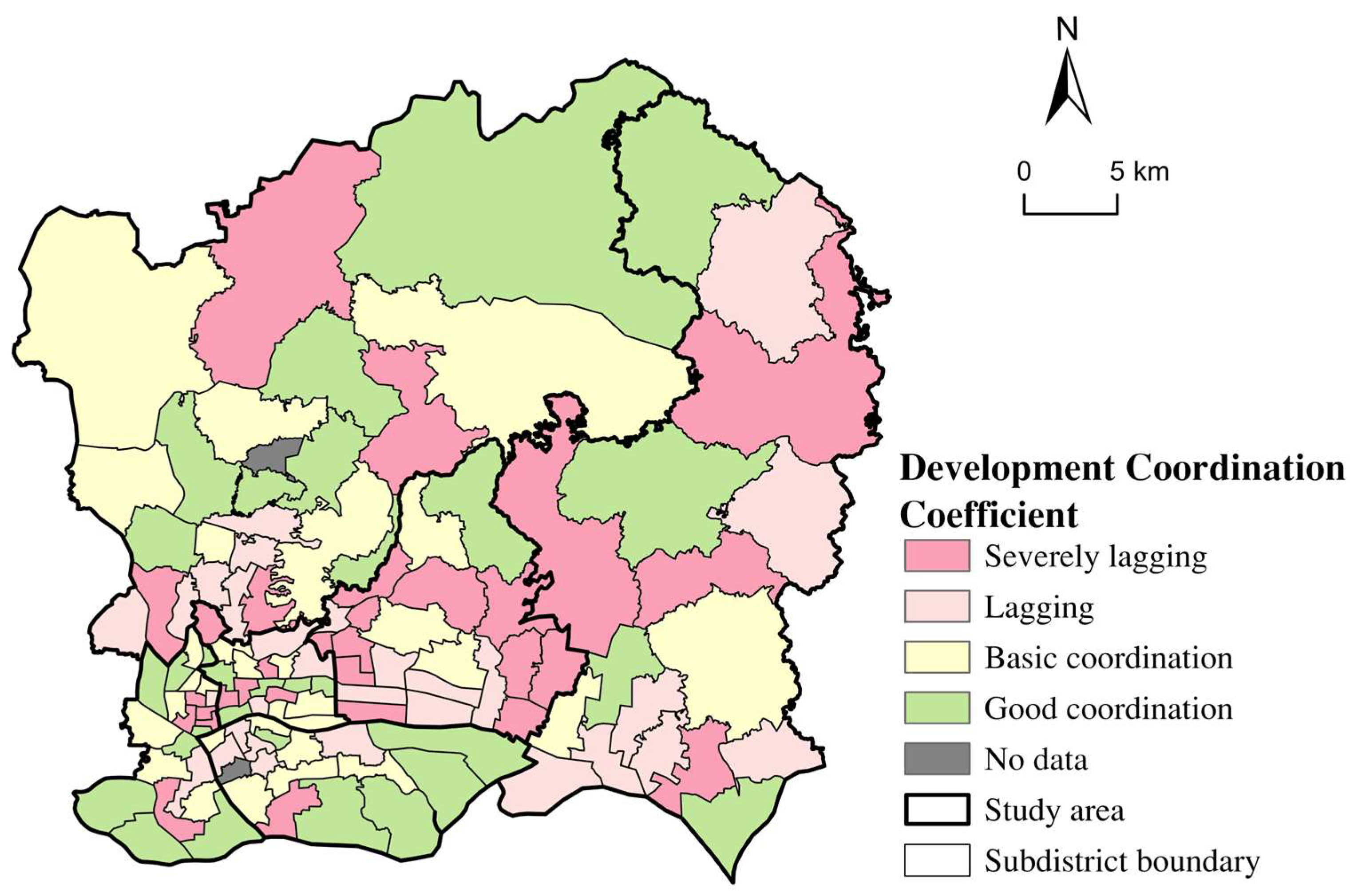
3.3. Development Coordination Coefficient
4. Results
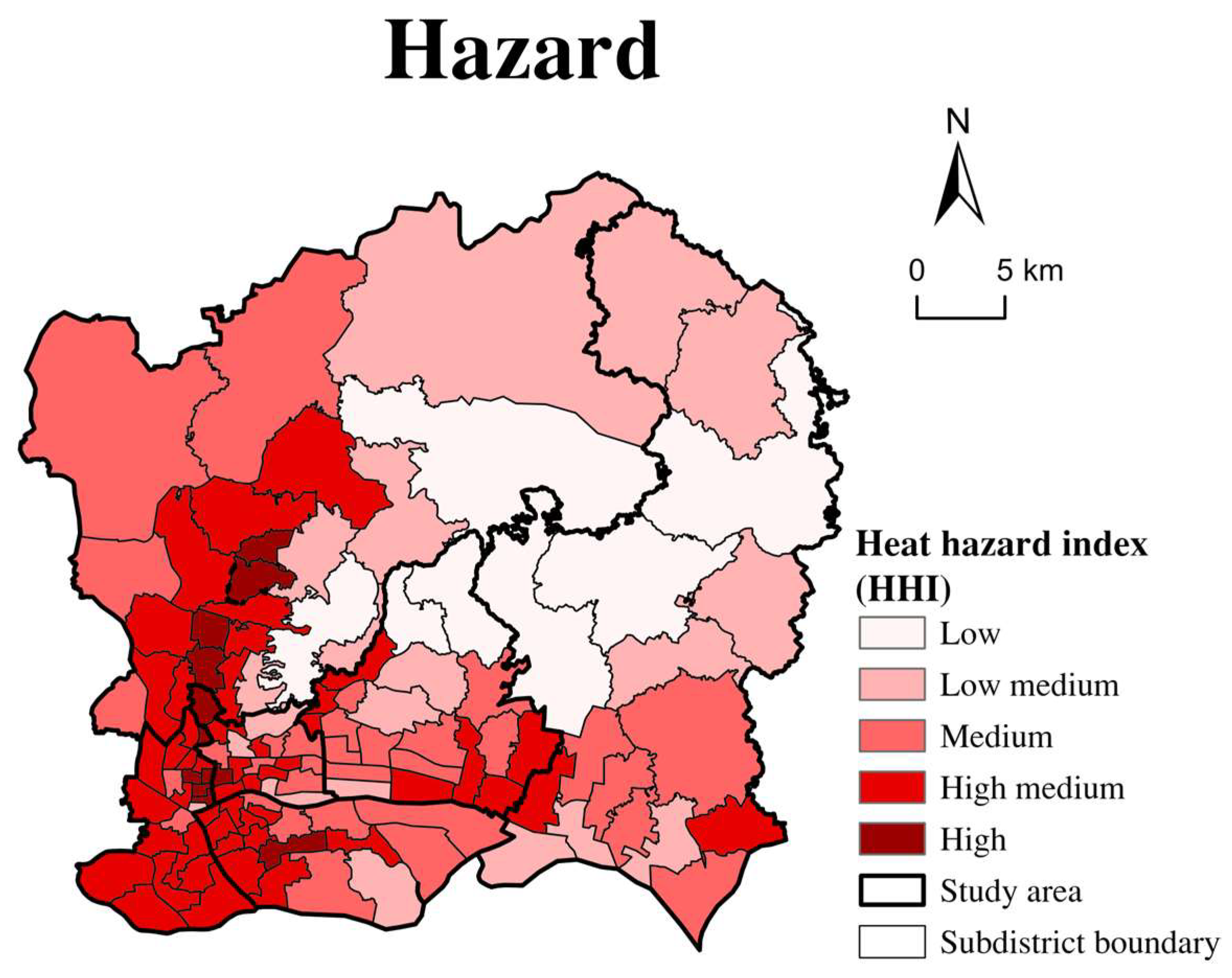
4.1. Heat Hazard
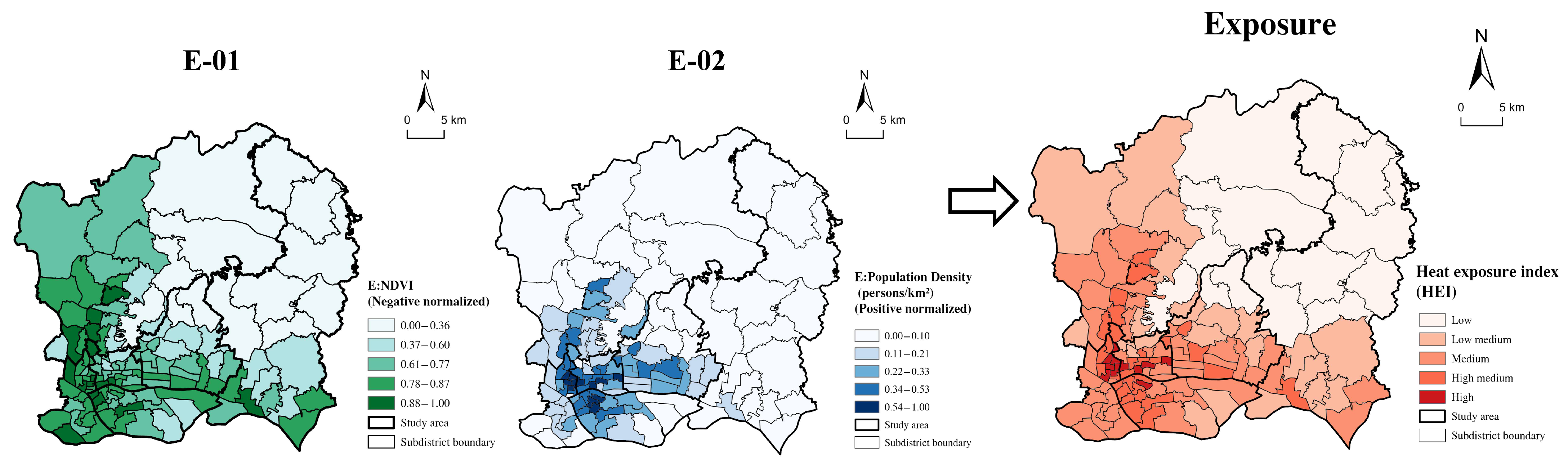
4.2. Heat Exposure
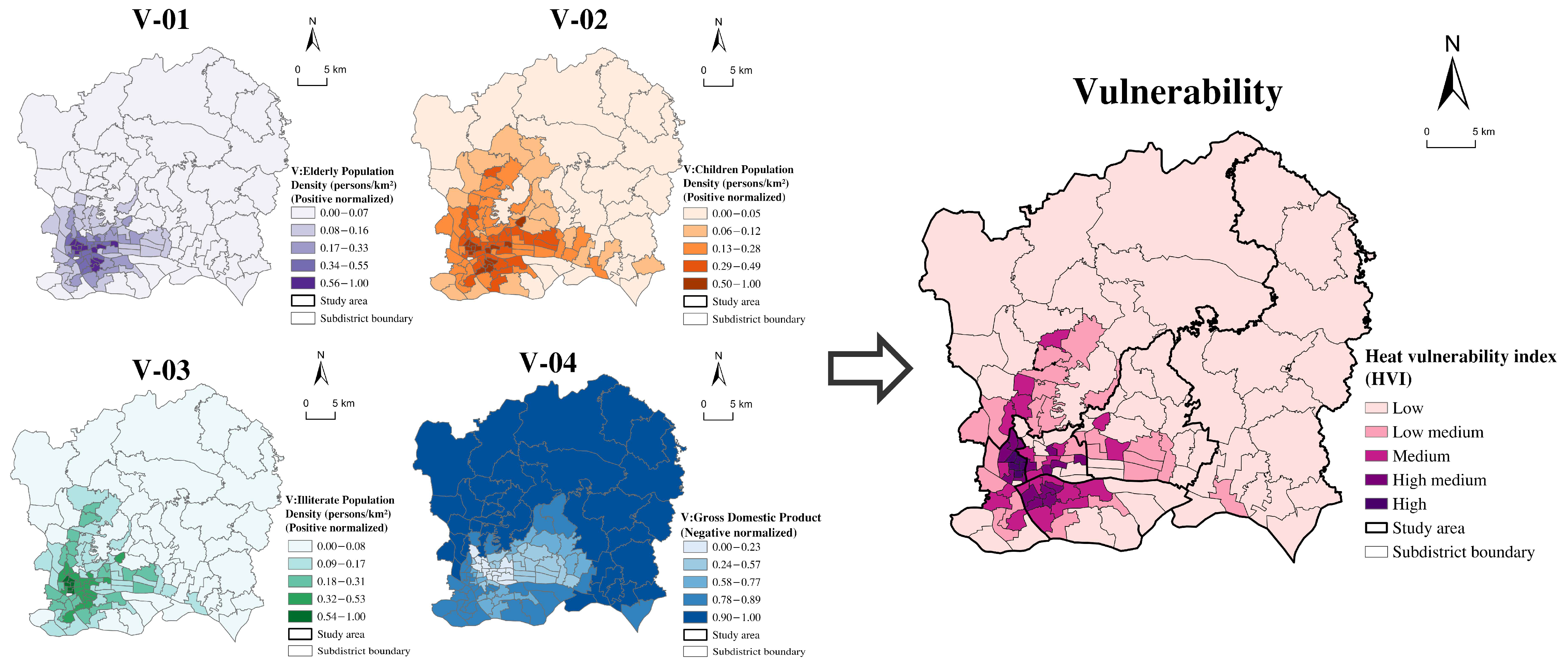
4.3. Heat Vulnerability
4.4. Heat Risk Analysis
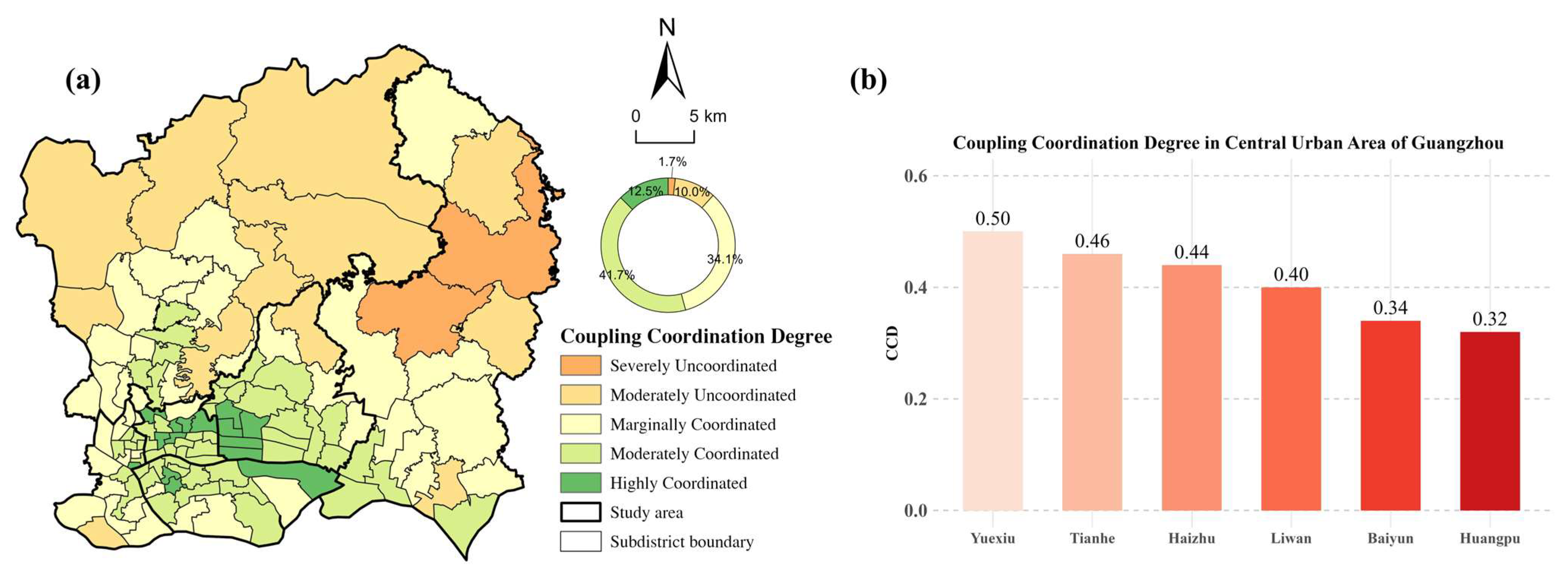
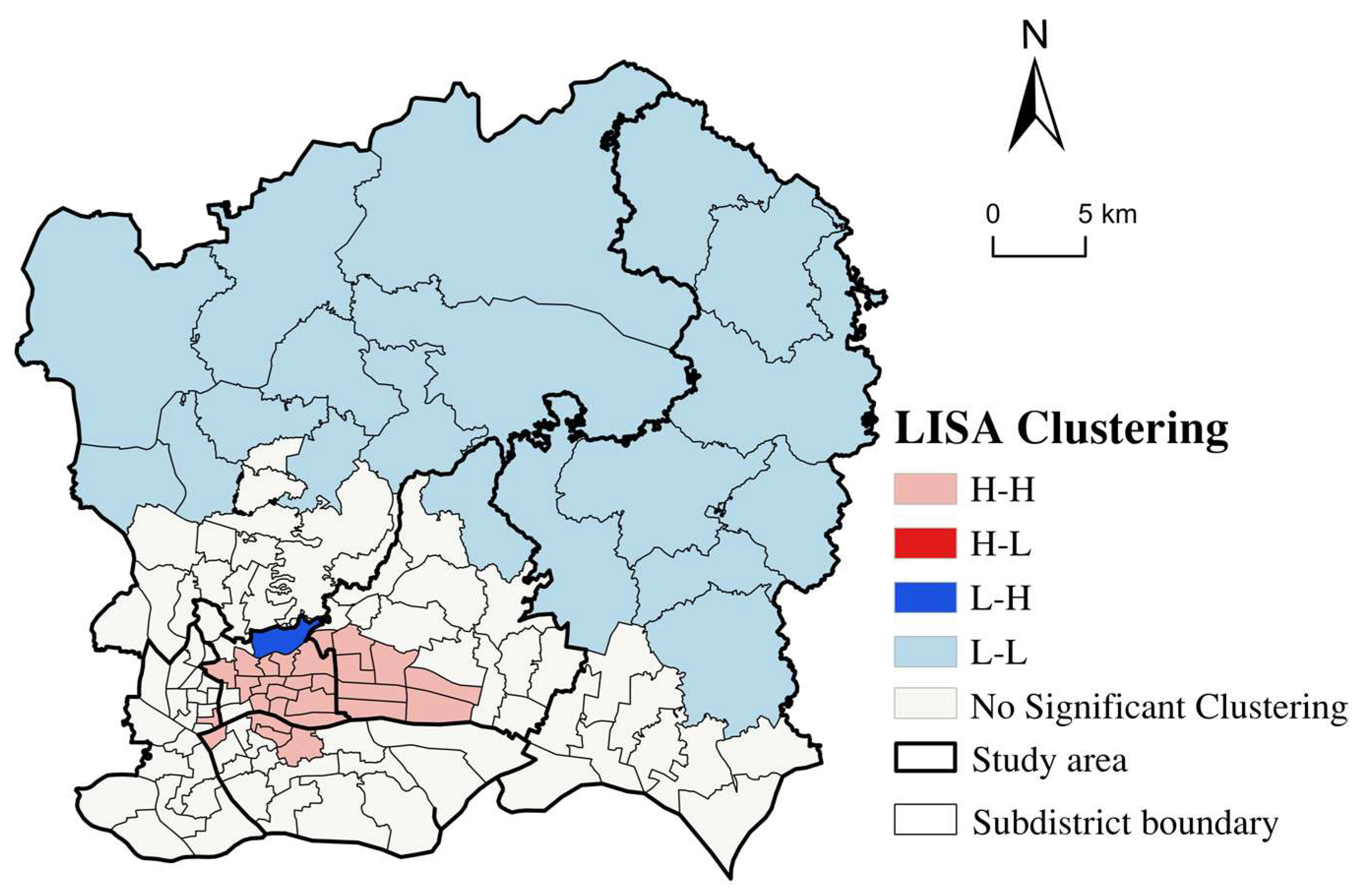
4.5. Coupling Coordination Degree Analysis
5. Discussion
5.1. Heat Risk Under the Hazard–Exposure–Vulnerability Framework
5.2. Implications of the CCD and DCC for Urban Planning
5.3. Practical Implications for the General Public
5.4. Limitations
6. Conclusions
Supplementary Materials
Author Contributions
Funding
Institutional Review Board Statement
Informed Consent Statement
Data Availability Statement
Acknowledgments
Conflicts of Interest
References
- Bell, M.L.; Gasparrini, A.; Benjamin, G.C. Climate Change, Extreme Heat, and Health. N. Engl. J. Med. 2024, 390, 1793–1801. [Google Scholar] [CrossRef]
- Matthews, T.; Raymond, C.; Foster, J.; Baldwin, J.W.; Ivanovich, C.; Kong, Q.; Kinney, P.; Horton, R.M. Mortality Impacts of the Most Extreme Heat Events. Nat. Rev. Earth Environ. 2025, 6, 193–210. [Google Scholar] [CrossRef]
- Heat and Health. Available online: https://www.who.int/news-room/fact-sheets/detail/climate-change-heat-and-health (accessed on 14 June 2025).
- Chenciner, L.; Cohen, F.; Pouwels, K.B.; Fahr, P.; Perera, R. Associations between Extreme Heat and Hospital Length of Stay among Those Hospitalised with Cardiovascular Disease in Greater London: A Population-Based Longitudinal Study between 2007–2019. Lancet 2024, 404, S25. [Google Scholar] [CrossRef]
- Zhu, Z.; Ji, B.; Tian, J.; Yin, P. Heat Exposure and Respiratory Diseases Health Outcomes: An Umbrella Review. Sci. Total Environ. 2025, 970, 179052. [Google Scholar] [CrossRef]
- Goto, H.; Kinoshita, M.; Oshima, N. Heatstroke-Induced Acute Kidney Injury and the Innate Immune System. Front. Med. 2023, 10, 1250457. [Google Scholar] [CrossRef]
- Morris, A.; Patel, G. Heat Stroke. In StatPearls; StatPearls Publishing: Treasure Island, FL, USA, 2025. [Google Scholar]
- Nations, U. Extreme Heat. Available online: https://www.un.org/en/climatechange/extreme-heat (accessed on 28 June 2025).
- Cai, W.; Zhang, C.; Suen, H.P.; Ai, S.; Bai, Y.; Bao, J.; Chen, B.; Cheng, L.; Cui, X.; Dai, H.; et al. The 2020 China Report of the Lancet Countdown on Health and Climate Change. Lancet Public Health 2021, 6, e64–e81. [Google Scholar] [CrossRef] [PubMed]
- IPCC. Global Warming of 1.5 °C: IPCC Special Report on Impacts of Global Warming of 1.5 °C Above Pre-Industrial Levels in Context of Strengthening Response to Climate Change, Sustainable Development, and Efforts to Eradicate Poverty, 1st ed.; Cambridge University Press: Cambridge, UK, 2022; ISBN 978-1-009-15794-0. [Google Scholar]
- Huang, H.; Ma, J.; Yang, Y. Spatial Heterogeneity of Driving Factors for Urban Heat Health Risk in Chongqing, China: A New Identification Method and Proposal of Planning Response Framework. Ecol. Indic. 2023, 153, 110449. [Google Scholar] [CrossRef]
- Estoque, R.C.; Ooba, M.; Seposo, X.T.; Togawa, T.; Hijioka, Y.; Takahashi, K.; Nakamura, S. Heat Health Risk Assessment in Philippine Cities Using Remotely Sensed Data and Social-Ecological Indicators. Nat. Commun. 2020, 11, 1581. [Google Scholar] [CrossRef] [PubMed]
- Yu, J.; Castellani, K.; Forysinski, K.; Gustafson, P.; Lu, J.; Peterson, E.; Tran, M.; Yao, A.; Zhao, J.; Brauer, M. Geospatial Indicators of Exposure, Sensitivity, and Adaptive Capacity to Assess Neighbourhood Variation in Vulnerability to Climate Change-Related Health Hazards. Environ. Health 2021, 20, 31. [Google Scholar] [CrossRef] [PubMed]
- Yao, X.; Jin, S.; Zhao, Z.; Sun, R.; Wang, C.; Yu, Z. A Novel Integrated Socio-Ecological-Economic Index for Assessing Heat Health Risk. Ecol. Indic. 2024, 169, 112840. [Google Scholar] [CrossRef]
- Wu, H.; Xu, Y.; Zhang, M.; Su, L.; Wang, Y.; Zhu, S. Spatially Explicit Assessment of the Heat-Related Health Risk in the Yangtze River Delta, China, Using Multisource Remote Sensing and Socioeconomic Data. Sustain. Cities Soc. 2024, 104, 105300. [Google Scholar] [CrossRef]
- Man, C.; Liu, Y.; Tan, W. Spatial Pattern and Influencing Factors of Heat Vulnerability: The Case of Guangzhou City. Prog. Geogr. 2024, 43, 1798–1810. [Google Scholar] [CrossRef]
- Fastl, C.; Arnberger, A.; Gallistl, V.; Stein, V.K.; Dorner, T.E. Heat Vulnerability: Health Impacts of Heat on Older People in Urban and Rural Areas in Europe. Wien. Klin. Wochenschr. 2024, 136, 507–514. [Google Scholar] [CrossRef]
- Tian, T.; Liang, B.; Zhang, Y.; Huang, T.; Shi, C.; Wang, P.; Chen, S.; Guo, T.; Li, Z.; Zhang, W.; et al. Extreme Heat and Heatwaves Are Linked to the Risk of Unintentional Child Injuries in Guangzhou City. Commun. Earth Environ. 2024, 5, 665. [Google Scholar] [CrossRef]
- Arsad, F.S.; Hod, R.; Ahmad, N.; Ismail, R.; Mohamed, N.; Baharom, M.; Osman, Y.; Radi, M.F.M.; Tangang, F. The Impact of Heatwaves on Mortality and Morbidity and the Associated Vulnerability Factors: A Systematic Review. Int. J. Environ. Res. Public Health 2022, 19, 16356. [Google Scholar] [CrossRef] [PubMed]
- Millyard, A.; Layden, J.D.; Pyne, D.B.; Edwards, A.M.; Bloxham, S.R. Impairments to Thermoregulation in the Elderly During Heat Exposure Events. Gerontol. Geriatr. Med. 2020, 6. [Google Scholar] [CrossRef]
- Itani, M.; Ghaddar, N.; Ghali, K.; Laouadi, A. Bioheat Modeling of Elderly and Young for Prediction of Physiological and Thermal Responses in Heat-Stressful Conditions. J. Therm. Biol. 2020, 88, 102533. [Google Scholar] [CrossRef] [PubMed]
- Reid, C.E.; O’Neill, M.S.; Gronlund, C.J.; Brines, S.J.; Brown, D.G.; Diez-Roux, A.V.; Schwartz, J. Mapping Community Determinants of Heat Vulnerability. Environ. Health Perspect. 2009, 117, 1730–1736. [Google Scholar] [CrossRef]
- Song, J.; Huang, B.; Kim, J.S.; Wen, J.; Li, R. Fine-Scale Mapping of an Evidence-Based Heat Health Risk Index for High-Density Cities: Hong Kong as a Case Study. Sci. Total Environ. 2020, 718, 137226. [Google Scholar] [CrossRef]
- Goal 10|Department of Economic and Social Affairs. Available online: https://sdgs.un.org/goals/goal10 (accessed on 29 June 2025).
- Goal 11|Department of Economic and Social Affairs. Available online: https://sdgs.un.org/goals/goal11 (accessed on 29 June 2025).
- Transforming Our World: The 2030 Agenda for Sustainable Development | Department of Economic and Social Affairs. Available online: https://sdgs.un.org/2030agenda (accessed on 24 June 2025).
- Nayak, S.G.; Shrestha, S.; Sheridan, S.C.; Hsu, W.-H.; Muscatiello, N.A.; Pantea, C.I.; Ross, Z.; Kinney, P.L.; Zdeb, M.; Hwang, S.-A.A.; et al. Accessibility of Cooling Centers to Heat-Vulnerable Populations in New York State. J. Transp. Health 2019, 14, 100563. [Google Scholar] [CrossRef]
- Han, S.; Lee, H. The spatial analysis of the relationship between cooling centers and vulnerable areas to heat waves in Seoul. Int. J. Sustain. Build. Tech. 2022, 13, 472–487. [Google Scholar] [CrossRef]
- Allen, M.J.; Vecellio, D.J.; Hoffman, J.S. Evaluating the Relationship between Heat-Related Illness and Cooling Center Location in Virginia. Nat. Hazards 2025, 121, 4293–4308. [Google Scholar] [CrossRef]
- Bedi, N.S.; Adams, Q.H.; Hess, J.J.; Wellenius, G.A. The Role of Cooling Centers in Protecting Vulnerable Individuals from Extreme Heat. Epidemiology 2022, 33, 611–615. [Google Scholar] [CrossRef]
- Widerynski, S.; Schramm, P.J.; Conlon, K.C.; Noe, R.S.; Grossman, E.; Hawkins, M.; Nayak, S.U.; Roach, M.; Hilts, A.S. Use of Cooling Centers to Prevent Heat-Related Illness: Summary of Evidence and Strategies for Implementation. Available online: https://stacks.cdc.gov/view/cdc/47657 (accessed on 23 June 2025).
- Azmeer, A.; Tahir, F.; Al-Ghamdi, S.G. Progress on Green Infrastructure for Urban Cooling: Evaluating Techniques, Design Strategies, and Benefits. Urban Clim. 2024, 56, 102077. [Google Scholar] [CrossRef]
- Wang, Y.; Ouyang, W.; Zhang, J. Matching Supply and Demand of Cooling Service Provided by Urban Green and Blue Space. Urban For. Urban Green. 2024, 96, 128338. [Google Scholar] [CrossRef]
- Wang, Z.; Liu, Y.; Wang, T.; Tang, S.; Wu, X. Supply and Demand Analysis of Urban Thermal Environments Regulation Services from an Accessibility Perspective: A Coupled Thermal Risk and Green Space Cooling Assessment Model. Urban Clim. 2025, 60, 102356. [Google Scholar] [CrossRef]
- Shan, L.; Jiang, Y.; Liu, C.; Zhang, J.; Zhang, G.; Cui, X. Conflict or Coordination? Spatiotemporal Coupling of Urban Population–Land Spatial Patterns and Ecological Efficiency. Front. Public Health 2022, 10, 890175. [Google Scholar] [CrossRef]
- Li, H.; Wang, Q.; Zang, X.; Gao, T.; Gu, H. Spatiotemporal Differentiation and Influencing Factors of the Degree of Resilience Coupling Coordination in the Beijing–Tianjin–Hebei Region, China. Sci. Rep. 2024, 14, 26394. [Google Scholar] [CrossRef] [PubMed]
- Hu, H.; Shao, H.; Li, Y.; Guan, M.; Tong, J. GIS-Based Analysis of Elderly Care Facility Distribution and Supply–Demand Coordination in the Yangtze River Delta. Land 2025, 14, 723. [Google Scholar] [CrossRef]
- Tang, Y.; Xie, Y.; Sun, B.; Hao, Z.; Pei, N. Greenway Service Supply and Public Demand in Guangzhou City, China. Urban For. Urban Green. 2022, 76, 127711. [Google Scholar] [CrossRef]
- Li, X. The Distribution and Accessibility of Cooling Resources in Low-Income Communities: Comparative Analysis of Beijing and Los Angeles. Adv. Econ. Manag. Political Sci. 2025, 186, 104–110. [Google Scholar] [CrossRef]
- Summer in the Field: Cooling Down Urban Neglect with Heat Mitigation Strategies in Guangzhou, China | Global Development Policy Center. Available online: https://www.bu.edu/gdp/2023/09/06/summer-in-the-field-cooling-down-urban-neglect-with-heat-mitigation-strategies-in-guangzhou-china (accessed on 23 June 2025).
- Guangzhou Weather Records. Available online: https://www.extremeweatherwatch.com/cities/guangzhou (accessed on 30 June 2025).
- How Nature-Based Urban Solutions Can Help Cities to Stay Cool: The Case of Guangzhou. Available online: https://blogs.worldbank.org/en/eastasiapacific/how-nature-based-urban-solutions-can-help-cities-stay-cool-case-guangzhou (accessed on 30 June 2025).
- Adams, Q.H.; Chan, E.M.G.; Spangler, K.R.; Weinberger, K.R.; Lane, K.J.; Errett, N.A.; Hess, J.J.; Sun, Y.; Wellenius, G.A.; Nori-Sarma, A. Examining the Optimal Placement of Cooling Centers to Serve Populations at High Risk of Extreme Heat Exposure in 81 US Cities. Public Health Rep. 2023, 138, 955–962. [Google Scholar] [CrossRef]
- He, C.; Ma, L.; Zhou, L.; Kan, H.; Zhang, Y.; Ma, W.; Chen, B. Exploring the Mechanisms of Heat Wave Vulnerability at the Urban Scale Based on the Application of Big Data and Artificial Societies. Environ. Int. 2019, 127, 573–583. [Google Scholar] [CrossRef] [PubMed]
- Ma, L.; Huang, G.; Johnson, B.A.; Chen, Z.; Li, M.; Yan, Z.; Zhan, W.; Lu, H.; He, W.; Lian, D. Investigating Urban Heat-Related Health Risks Based on Local Climate Zones: A Case Study of Changzhou in China. Sustain. Cities Soc. 2023, 91, 104402. [Google Scholar] [CrossRef]
- Wang, C.; Ren, Z.; Guo, Y.; Zhang, P.; Hong, S.; Ma, Z.; Hong, W.; Wang, X. Assessing Urban Population Exposure Risk to Extreme Heat: Patterns, Trends, and Implications for Climate Resilience in China (2000–2020). Sustain. Cities Soc. 2024, 103, 105260. [Google Scholar] [CrossRef]
- Estoque, R.C.; Ishtiaque, A.; Parajuli, J.; Athukorala, D.; Rabby, Y.W.; Ooba, M. Has the IPCC’s Revised Vulnerability Concept Been Well Adopted? Ambio 2023, 52, 376–389. [Google Scholar] [CrossRef]
- Guo, R.; Guo, F.; Dong, J.; Wang, Z.; Zheng, R.; Zhang, H. Finer-Scale Urban Health Risk Assessment Based on the Interaction Perspective of Thermal Radiation, Human, Activity, and Space. Front. Archit. Res. 2024, 13, 682–697. [Google Scholar] [CrossRef]
- Zhang, H.; Wang, C.; Yang, H.; Ma, Z. How Do Morphology Factors Affect Urban Heat Island Intensity? An Approach of Local Climate Zones in a Fast-Growing Small City, Yangling, China. Ecol. Indic. 2024, 161, 111972. [Google Scholar] [CrossRef]
- Li, X.; Ma, X.; Lyu, F.; Song, Y. Examine the Environmental Inequity Impact of Urban Heat Mitigation on Redlining Legacy: Case Study of Charlotte’s Retrofitting, 2001–2020. Front. Environ. Sci. 2023, 11, 1218819. [Google Scholar] [CrossRef]
- Chen, J.; Shi, X.; Shi, Y.; Delina, L.L. Assessing Heat Vulnerability Risk of Jinan and Guangzhou’s Older Populations Based on Multisource Remote Sensing Data. Build. Environ. 2025, 271, 112622. [Google Scholar] [CrossRef]
- Kim, H.-S.; Lee, G.-E.; Lee, J.-S.; Choi, Y. Understanding the Local Impact of Urban Park Plans and Park Typology on Housing Price: A Case Study of the Busan Metropolitan Region, Korea. Landsc. Urban Plan. 2019, 184, 1–11. [Google Scholar] [CrossRef]
- Coccolo, S.; Pearlmutter, D.; Kaempf, J.; Scartezzini, J.-L. Thermal Comfort Maps to Estimate the Impact of Urban Greening on the Outdoor Human Comfort. Urban For. Urban Green. 2018, 35, 91–105. [Google Scholar] [CrossRef]





| Factors | Id | Indicators | Expected Impact | Refs. |
|---|---|---|---|---|
| Hazard | - | Land Surface Temperature (LST) | Positive | [44] |
| Exposure | E-01 | Population Density | Positive | [45] |
| E-02 | Normalized Difference Vegetation Index (NDVI) | Negative | [43] | |
| Vulnerability | V-01 | Population Density over 60 years | Positive | [13] |
| V-02 | Population Density under 15 years | Positive | [13] | |
| V-03 | Low Education Level Density | Positive | [23] | |
| V-04 | Total community GDP | Negative | [46] |
| Category Value | Value |
|---|---|
| Moran’s I | 0.59 |
| Z-value | 10.85 |
| p-value | <0.01 |
Disclaimer/Publisher’s Note: The statements, opinions and data contained in all publications are solely those of the individual author(s) and contributor(s) and not of MDPI and/or the editor(s). MDPI and/or the editor(s) disclaim responsibility for any injury to people or property resulting from any ideas, methods, instructions or products referred to in the content. |
© 2025 by the authors. Licensee MDPI, Basel, Switzerland. This article is an open access article distributed under the terms and conditions of the Creative Commons Attribution (CC BY) license (https://creativecommons.org/licenses/by/4.0/).
Share and Cite
Hu, W.; Guo, D.; Wang, J.; Bao, S. A Decadal Assessment of the Coordinated Relationship Between Heat Risk and Cooling Resources in Guangzhou, China. Sustainability 2025, 17, 7735. https://doi.org/10.3390/su17177735
Hu W, Guo D, Wang J, Bao S. A Decadal Assessment of the Coordinated Relationship Between Heat Risk and Cooling Resources in Guangzhou, China. Sustainability. 2025; 17(17):7735. https://doi.org/10.3390/su17177735
Chicago/Turabian StyleHu, Weiwei, Darong Guo, Jianfang Wang, and Shitai Bao. 2025. "A Decadal Assessment of the Coordinated Relationship Between Heat Risk and Cooling Resources in Guangzhou, China" Sustainability 17, no. 17: 7735. https://doi.org/10.3390/su17177735
APA StyleHu, W., Guo, D., Wang, J., & Bao, S. (2025). A Decadal Assessment of the Coordinated Relationship Between Heat Risk and Cooling Resources in Guangzhou, China. Sustainability, 17(17), 7735. https://doi.org/10.3390/su17177735