Industrial Intellectual Property Reform Strategy, Manufacturing Craftsmanship Spirit, and Regional Energy Intensity


Abstract
1. Introduction
2. Literature Review, Mechanism Analysis, and Research Hypotheses
2.1. Literature Review on the Impact of Intellectual Property Policy on Energy Systems
2.1.1. Intellectual Property Protection and the Incentive Mechanism of Energy Technology Innovation
2.1.2. The Regulatory Role of Intellectual Property Institutions in Energy Market Competition
2.1.3. Intellectual Property and the Synergistic Path to Energy Sustainability
2.2. Literature Review on the Impact of Entrepreneurial Spirit on Energy Systems
2.2.1. Entrepreneurial Spirit and Energy Technology Breakthroughs
2.2.2. Entrepreneurial Spirit and the Restructuring of Energy Market Structures
2.2.3. Entrepreneurial Spirit and the Interactive Logic of Energy Policy
2.3. Research Review and Critical Gaps
2.3.1. Insufficient Linkages Between National IP Strategy and Regional Energy Systems
2.3.2. Neglect of Craftsmanship Spirit in Regional Energy Systems
2.3.3. Fragmentation of Multidimensional Research Frameworks
2.4. The Impact Mechanism of Industrial IP Reform Strategies on Regional Energy Intensity and the Research Hypothesis
2.5. The Impact Mechanism of Manufacturing Craftsmanship Spirit on Regional Energy Intensity and the Research Hypothesis
- (1)
- The Effect of Excellence in Detail on Regional Energy Intensity
- (2)
- The Effect of Persistent Dedication on Regional Energy Intensity
- (3)
- The Effect of Breakthrough Orientation on Regional Energy Intensity
- (4)
- The Effect of Innovation Inheritance on Regional Energy Intensity
2.6. Spatial Effects of Industrial Intellectual Property Reform Strategies and Manufacturing Craftsmanship Spirit
2.6.1. Spatial Effects of Industrial Intellectual Property Reform Strategies
2.6.2. Spatial Effects of Manufacturing Craftsmanship Spirit
2.7. Mechanism Effects of Craftsmanship Spirit in Manufacturing
2.7.1. Mechanism Effects of the Pursuit of Excellence
2.7.2. Mechanism Effects of Dedicated Commitment
2.7.3. Mechanism Effects of Breakthrough Innovation
2.7.4. Mechanism Effects of Inherited Innovation
3. Experimental Design, Model Construction, and Data Sources
3.1. Indicator Design and Data Sources
3.1.1. Dependent Variable (EI)
3.1.2. Industrial Intellectual Property Reform Strategy Treatment Variable (IIP)
3.1.3. Manufacturing Craftsmanship Spirit (CSM)
3.1.4. Control Variables
3.1.5. Correlation Analysis and Multicollinearity Test
3.1.6. Spatial Weight Matrix
3.2. Model Construction
3.2.1. Construction of the Spatial Difference-in-Differences (SDID) Model
3.2.2. Construction of the Double Machine Learning (DML) and Mediated DML Model
4. Empirical Analysis
4.1. Empirical Analysis Based on the Spatial Difference-in-Differences Model
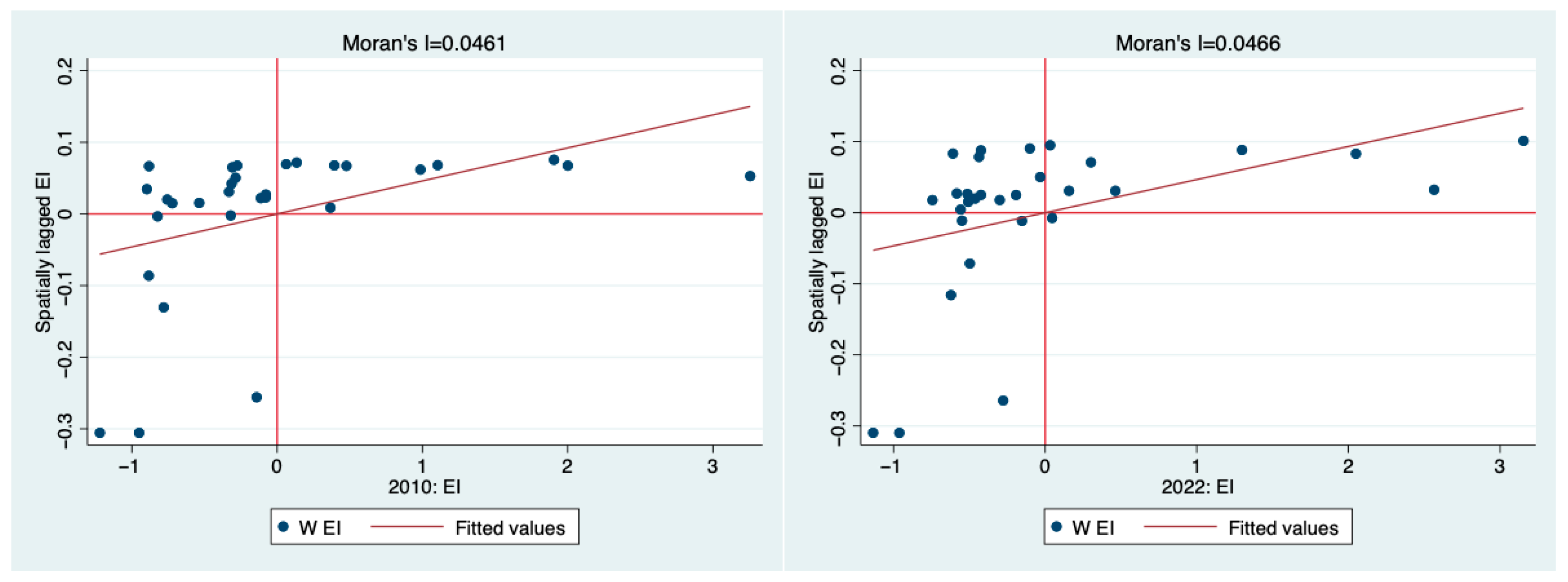
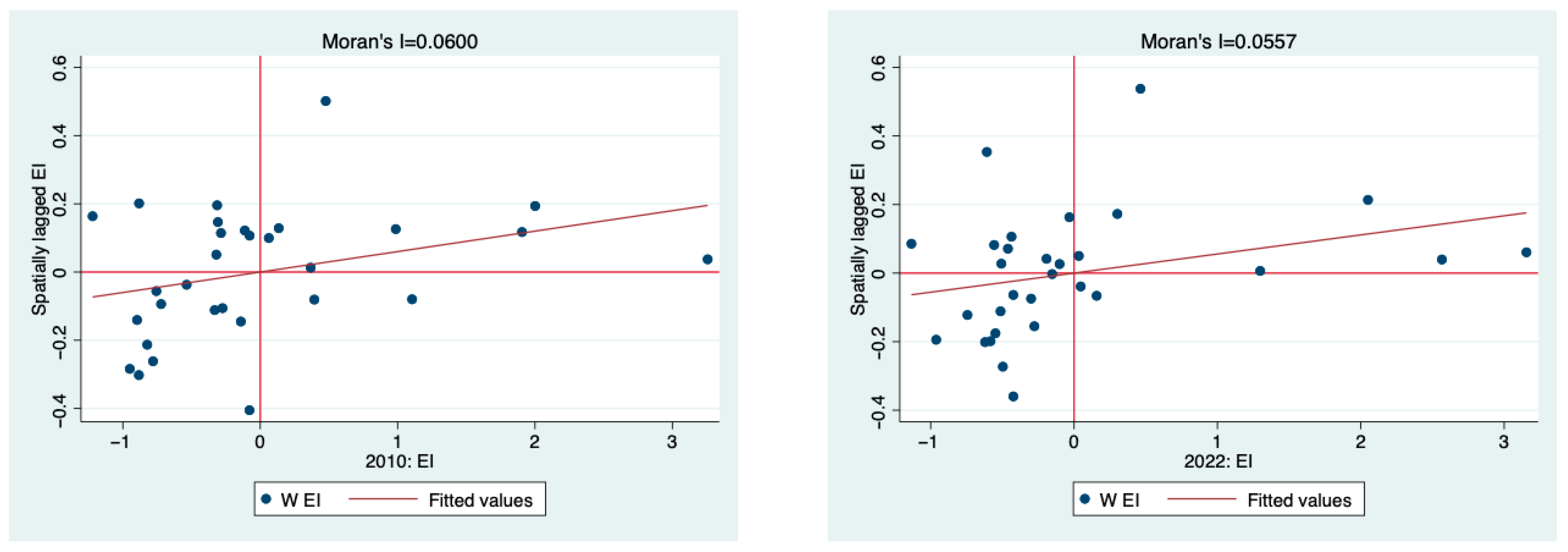
4.1.1. Spatial Autocorrelation Test
4.1.2. Model Selection and Diagnostic Tests of the Spatial Difference-in-Differences Models
4.1.3. Analysis Based on the Spatial Durbin Difference-in-Differences Model with Heterogeneous Spatial Weight Matrices
4.1.4. Robustness Test Based on Sensitivity to Spatial Weights
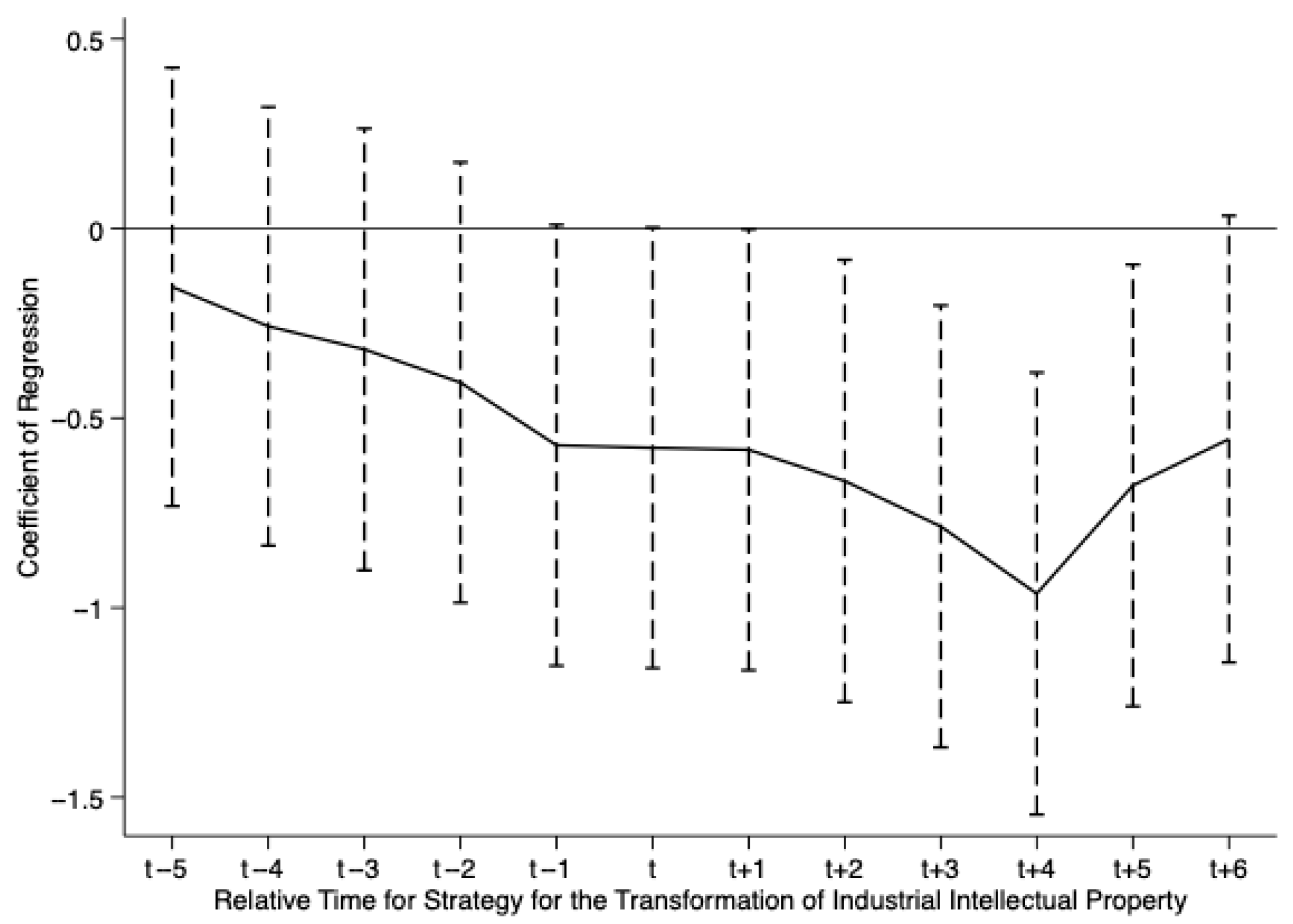
4.1.5. Parallel Trend Test
4.2. Empirical Analysis Based on the Double Machine Learning Model
4.2.1. Baseline Regression Using the Double Machine Learning Model
4.2.2. Mechanism Analysis: Total Path Analysis
4.2.3. Heterogeneity Analysis
- (1)
- Heterogeneity in Intellectual Property Protection Intensity
- (2)
- Heterogeneity in High Technology Input Intensity
4.2.4. Moderating Effects of Parallel Policies
4.2.5. Mechanism Analysis: Path-Specific Effects
5. Conclusions and Policy Implications
5.1. Main Findings
- (1)
- Direct effects of IIP: IIP directly reduces regional energy intensity (supporting H1). Both SDID and DML models confirm that clarifying and optimizing IP rights promotes green technology diffusion, reduces adverse selection in technology imitation, and enhances energy efficiency.
- (2)
- Indirect effects of CSM: CSM mitigates EI via three validated mechanism pathways:Striving for excellence (SPM): Enhances attention to detail and process refinement through IP protection, reducing EI (supporting H5).Dedication and perseverance (FCM): Accumulated expertise along stable technological trajectories lowers marginal energy costs, improving regional EI controllability (supporting H6).Inheritance and innovation (IIM): Combines traditional experience with modern technology, accelerating the cross-regional diffusion of energy-saving innovations and promoting dynamic regional EI convergence (supporting H8).
- (3)
- Non-significance of a breakthrough orientation (BTM): BTM does not significantly affect EI due to the following:Technological life cycle constraints: Radical innovations (e.g., hydrogen storage, carbon capture) remain in their early stages and are not yet scalable.Short-term inefficiency: Intensive R&D can temporarily increase EI through trial and error.Rebound effects (Jevons’ paradox): Efficiency gains may increase overall energy demand.Despite this, long-term potential exists; phased subsidies and compatibility-focused standards can facilitate BTM’s transformation and eventual positive impact.
- (4)
- Heterogeneous spatial spillovers: Under economic distance matrices, IIP can increase EI in adjacent regions via technological competition, whereas under economic-geographic nested matrices, it decreases adjacent EI through collaborative synergy. CSM shows limited spatial spillover, highlighting the need for both geographic proximity and economic complementarity to trigger synergistic effects.
- (5)
- Broader applicability and technology lifecycle considerations:International relevance: Similar energy- and industry-intensive economies (e.g., India, Brazil) can draw lessons from China’s IIP–CSM integration. Policies emphasizing IP protection, regional coordination, and artisan-oriented incentives can improve energy efficiency while fostering technological diffusion.Technology lifecycle effects: The limited short-term impact of BTM illustrates lifecycle dependence. For mature industries like traditional manufacturing, incremental innovations (SPM, FCM) are more effective, whereas for emerging technologies (renewable energy, carbon capture), early-stage radical innovations require dynamic incentives to overcome inefficiencies.
- (6)
- Sustainability and global goals: While this study focuses on EI, its implications extend to carbon emissions reduction and environmental externalities. Aligning IIP and CSM strategies with the Sustainable Development Goals (SDGs) can support climate action (SDG 13), responsible production (SDG 12), and sustainable industry transformation (SDG 9).
5.2. Policy Recommendations
- (1)
- Deepen IIP strategies to build a technology–culture co-innovation ecosystem:Develop cross-regional patent-sharing platforms and compatibility-oriented standards for green technology clusters.Establish compensation mechanisms for interregional technology transfers to balance interests.Enhance dynamic IP protection, e.g., extending patent duration during early stages of radical innovations.Impact on CSM: Empowers SPM through patent iteration; reinforces FCM via stable trajectories; incentivizes BTM; and promotes IIM through knowledge codification.
- (2)
- Strengthen regional policy coordination to prevent lock-in:Build a gradient framework linking geographic proximity with economic complementarity.Tailor IP and technology policies to regional capabilities.Introduce technology adaptability assessments for early-stage innovations (e.g., hydrogen storage, carbon capture).Outcome: Avoids excessive EI due to path dependency; ensures effective diffusion and application of all CSM traits.
- (3)
- Forge CSM core traits through systemic incentives aligned with EI goals:Integrate EI metrics into CSM evaluations.Embed artisan traits into technical standards, linking process optimization to energy efficiency.Enhance full-chain energy management via digital monitoring.Mechanism: Creates micro-level feedback loops where SPM supports FCM; FCM underpins BTM; BTM enables IIM; and IIM deepens knowledge iteration.
- (4)
- Guide BTM toward long-term orientation via dynamic incentives:Implement phased subsidies and market-entry incentives.Design modular, compatibility-focused technical standards.Establish risk-hedging and dynamic evaluation systems to prevent rebound effects.Effect: Facilitates BTM’s maturation and eventual positive impact on EI.
5.3. Theoretical Contributions and Limitations
Author Contributions
Funding
Institutional Review Board Statement
Informed Consent Statement
Data Availability Statement
Acknowledgments
Conflicts of Interest
Appendix A
References
- Li, M.; Zhang, M.; Yuan, J.; Zhao, M.; Zhang, M. The correlation analysis of patent output and economic efficiency in intellectual property rights intensive industries. J. Interdiscip. Math. 2015, 18, 987–1002. [Google Scholar] [CrossRef]
- Xu, X.; Chen, X.; Xu, Y.; Wang, T.; Zhang, Y. Improving the innovative performance of renewable energy enterprises in China: Effects of subsidy policy and intellectual property legislation. Sustainability 2022, 14, 8169. [Google Scholar] [CrossRef]
- Wei, X.; Yu, G.; Li, Y. How Mentoring Cultivates the Craftsman Spirit of Protégés—A Moderated Mediation Model. Sustainability 2023, 15, 6384. [Google Scholar] [CrossRef]
- Li, Y.; Zhang, Q.; Yang, W. Crucial role of craftsmanship spirit in fostering innovative behavior among skilled talents in the manufacturing sector. Front. Psychol. 2025, 15, 1407426. [Google Scholar] [CrossRef]
- Rodrigues, A.O.A.; Marques, C.S.; Ramadani, V. Artisan entrepreneurship, resilience and sustainable development: The quintuple helix innovation model in the low-density and cross-border territories. J. Enterp. Inf. Manag. 2024, 37, 1603–1626. [Google Scholar] [CrossRef]
- Zhao, Q.; Wu, W.; Ge, Y.; Xu, J. Can intellectual property protection policy enhance enterprise innovation capability? Quasi-natural experimental study. Int. Rev. Financ. Anal. 2025, 103, 104163. [Google Scholar] [CrossRef]
- Zhen, J.; Wang, Y.; Pan, H. The coupling coordination of energy technology and energy allocation efficiency in China: Based on efficiency decomposition modeling. Environ. Dev. Sustain. 2025, 1–29. [Google Scholar] [CrossRef]
- Swan, P.L. Market structure and technological progress: The influence of monopoly on product innovation. Q. J. Econ. 1970, 84, 627–638. [Google Scholar] [CrossRef]
- Gu, J. Sharing economy, technological innovation and carbon emissions: Evidence from Chinese cities. J. Innov. Knowl. 2022, 7, 100228. [Google Scholar] [CrossRef]
- Li, M.; Chi, X.; Su, J.; Sun, H.; Anaba, O.A.; Khan, A.U.; Qadri, S.U. Evolutionary game theory in patent alliance dynamics: Strategy and policy implications. Technol. Anal. Strateg. Manag. 2024, 1–16. [Google Scholar] [CrossRef]
- Sun, Q.; Li, C.; Ma, X. Regional equity in the energy transition: Assessing the role of productivity gaps and technology selection. Energy Econ. 2025, 147, 108531. [Google Scholar] [CrossRef]
- Zhu, G.; Xia, M. Intellectual Property Protection and Enterprise Collaborative Innovation. Int. Rev. Econ. Financ. 2025, 102, 104319. [Google Scholar] [CrossRef]
- Wu, Y.; Li, Z. Digital transformation, entrepreneurship, and disruptive innovation: Evidence of corporate digitalization in China from 2010 to 2021. Humanit. Soc. Sci. Commun. 2024, 11, 163. [Google Scholar] [CrossRef]
- Yiu, D.W.; Lau, C.M. Corporate entrepreneurship as resource capital configuration in emerging market firms. Entrep. Theory Pract. 2008, 32, 37–57. [Google Scholar] [CrossRef]
- Pitelis, A.T.; Vasilakos, N.; Chalvatzis, K.; Pitelis, C.N. Can industrial policy foster innovation in renewable energy technologies in the OECD and in EU regions? Camb. J. Reg. Econ. Soc. 2019, 12, 271–292. [Google Scholar] [CrossRef]
- Roundy, P.T.; Bonnal, M. The singularity of social entrepreneurship: Untangling its uniqueness and market function. J. Entrep. 2017, 26, 137–162. [Google Scholar] [CrossRef]
- Furubotn, E.G. The new institutional economics and the theory of the firm. J. Econ. Behav. Organ. 2001, 45, 133–153. [Google Scholar] [CrossRef]
- Squicciarini, M. Entrepreneurship, innovation and enterprise dynamics. Small Bus. Econ. 2017, 48, 273–278. [Google Scholar] [CrossRef]
- Nebus, J.; Chai, K.-H.; Subramanian, A.M. Protecting intellectual property and appropriating value from innovations in weak appropriability regimes. Res.-Technol. Manag. 2021, 64, 37–47. [Google Scholar] [CrossRef]
- Shi, X.; Wang, J.; Wang, Y. Research on Cascade Propagation of Collaborative Innovation Risks in Industrial Clusters Considering Entities Heterogeneity. Int. J. Comput. Intell. Syst. 2025, 18, 65. [Google Scholar] [CrossRef]
- Feng, T.; Wang, X.; Shi, Y.; Tu, Q. The role of carbon price signal in green innovation: Evidence from China. J. Environ. Manag. 2024, 370, 122787. [Google Scholar] [CrossRef] [PubMed]
- Zhang, H.; Li, H.; Zheng, X.; Liu, H.; Liu, M.; Li, B. Dynamic evolution of the global copper trade dependency network structure and influence mechanism in the context of energy transition: An industrial chain perspective. Renew. Sustain. Energy Rev. 2025, 212, 115318. [Google Scholar] [CrossRef]
- Kong, X.; Zhao, X.; Wang, C.; Duan, Q.; Sha, G.; Liu, L. Promote the international development of Energy Internet technology standards based on key competition mode. Sustain. Cities Soc. 2022, 86, 104151. [Google Scholar] [CrossRef]
- Alnour, M.; Önden, A.; Hasseb, M.; Önden, İ.; Rehman, M.Z.; Esquivias, M.A.; Hossain, M.E. The Asymmetric Role of Financial Commitments to Renewable Energy Projects, Public R&D Expenditure, and Energy Patents in Sustainable Development Pathways. Sustainability 2024, 16, 5503. [Google Scholar] [CrossRef]
- Ma, B.; Yu, D. Balancing regional integration and national diversity in IP harmonization: Lessons from the EU and ASEAN. Asian J. Technol. Innov. 2025, 1–20. [Google Scholar] [CrossRef]
- Zhao, J.L.; Li, X.H.; Shields, J. Optimizing the relationship between job autonomy and knowledge workers’ satisfaction: The roles of crafting and value congruence. Asia Pac. J. Hum. Resour. 2022, 60, 608–631. [Google Scholar] [CrossRef]
- Rodrigues, A.O.; Marques, C.S.; Ramadani, V. Artisan entrepreneurship: Influence and network in the development of sustainable strategies in cross-border low-density territories through a Quintuple Helix paradigm. Rev. Int. Bus. Strategy 2023, 34, 1–23. [Google Scholar] [CrossRef]
- Shabur, M.A.; Shahriar, A.; Ara, M. From automation to collaboration: Exploring the impact of industry 5.0 on sustainable manufacturing. Discov. Sustain. 2025, 6, 341. [Google Scholar] [CrossRef]
- Vokony, I.; Taczi, I.; Szalmane Csete, M. Agile digitalization evolution in the energy sector, taking into account innovative and disruptive technologies. Renew. Energy Power Qual. J 2022, 20, 584–589. [Google Scholar] [CrossRef]
- Yin, X.; Qi, L.; Ji, J.; Zhou, J. How does innovation spirit affect R&D investment and innovation performance? The moderating role of business environment. J. Innov. Knowl. 2023, 8, 100398. [Google Scholar] [CrossRef]
- Liu, X.; Sun, W.; Chen, T.; Xu, X.; Huang, T. Energy and environmental performance of iron and steel industry in real-time demand response: A case of hot rolling process. Appl. Energy 2025, 389, 125717. [Google Scholar] [CrossRef]
- Gao, C.; Lin, J.; Zeng, J.; Han, F. Wind-photovoltaic co-generation prediction and energy scheduling of low-carbon complex regional integrated energy system with hydrogen industry chain based on copula-MILP. Appl. Energy 2022, 328, 120205. [Google Scholar] [CrossRef]
- Liu, J.; Siano, P.; Wu, K. Exploration of drivers for energy regulatory process reengineering in the digital era: The grounded theory approach. Energy 2025, 316, 134620. [Google Scholar] [CrossRef]
- Sagar, A.D.; Van der Zwaan, B. Technological innovation in the energy sector: R&D, deployment, and learning-by-doing. Energy Policy 2006, 34, 2601–2608. [Google Scholar] [CrossRef]
- Li, D.; Tang, Z.; Gao, H.; He, S.; Liu, Y.; Su, F.; Liu, J. Distributed optimal frequency control in networked microgrids using distributed energy resources. Electr. Power Syst. Res. 2025, 246, 111697. [Google Scholar] [CrossRef]
- Luo, Q.; Zhao, X. Exploring the spatial spillover effects of intellectual property protection and influencing factors. China Econ. Q. Int. 2023, 3, 260–272. [Google Scholar] [CrossRef]
- Adomako, S.; Tran, M.D. Intellectual property rights protection and sustainable innovation performance: The mediating role of technology spillover. Sustain. Dev. 2025, 33, 1879–1891. [Google Scholar] [CrossRef]
- Löfsten, H.; Isaksson, A.; Rannikko, H.; Tornikoski, E.; Buffart, M. Impact of initial business model on the growth trajectory of new technology-based firms: A path dependency perspective. J. Technol. Transf. 2025, 50, 29–61. [Google Scholar] [CrossRef]
- Peng, W.; Hu, Z.; Li, J.; Li, C. Urban Agglomeration Technology Innovation Networks, Spatial Spillover, and Agricultural Ecological Efficiency: Evidence from the Urban Agglomeration in the Middle Reaches of the Yangtze River in China. Sustainability 2025, 17, 5109. [Google Scholar] [CrossRef]
- Dong, X.; Dong, D.; Huang, L. Enhancing corporate total factor productivity: The dual drivers of inclusive finance and technological progress. Int. Rev. Financ. Anal. 2025, 103, 104213. [Google Scholar] [CrossRef]
- Delerue, H. Shadow of joint patents: Intellectual property rights sharing by SMEs in contractual R&D alliances. J. Bus. Res. 2018, 87, 12–23. [Google Scholar] [CrossRef]
- Xu, S.; Alturki, R.; Rehman, A.U.; Tariq, M.U. BP neural network combination prediction for big data enterprise energy management system. Mob. Netw. Appl. 2021, 26, 184–190. [Google Scholar] [CrossRef]
- Bstieler, L.; Hemmert, M.; Barczak, G. Trust formation in university–industry collaborations in the US biotechnology industry: IP policies, shared governance, and champions. J. Prod. Innov. Manag. 2015, 32, 111–121. [Google Scholar] [CrossRef]
- Xie, P.; Wang, J.; Tang, S.; Shahzadi, I.; Bilan, Y. How does intergenerational transmission affect green innovation? Evidence from Chinese family businesses. Struct. Chang. Econ. Dyn. 2025, 73, 158–169. [Google Scholar] [CrossRef]
- Ferri, L.M.; De Bernardi, C.; Sydow, A. Intra-family succession motivating eco-innovation: A study of family firms in the German and Italian wine sector. J. Clean. Prod. 2024, 434, 140261. [Google Scholar] [CrossRef]
- Wei, F.; Feng, N.; Liu, X.; Ruan, F.; Yang, S. A complementor selection framework to nurture R&D ecosystems based on multidimensional patent data. Int. J. Technol. Manag. 2023, 92, 159–183. [Google Scholar]
- Hu, R.; Bao, Z.; Lin, Z.; Lv, K. The Innovative Construction of Provinces, Regional Artificial Intelligence Development, and the Resilience of Regional Innovation Ecosystems: Quasi-Natural Experiments Based on Spatial Difference-in-Differences Models and Double Machine Learning. Sustainability 2024, 16, 8251. [Google Scholar] [CrossRef]
- Triguero, A.; Córcoles, D. Understanding innovation: An analysis of persistence for Spanish manufacturing firms. Res. Policy 2013, 42, 340–352. [Google Scholar] [CrossRef]
- Yanling, L.; Weiwei, Z.; Hao, G. Strategic Responses of Manufacturing Firms under Innovation Dilemmas: Based on Performance Expectation Gap and Responsive Search Behavior. China Ind. Econ. 2023, 174–192. [Google Scholar] [CrossRef]
- Martínez-Noya, A.; García-Canal, E. Innovation performance feedback and technological alliance portfolio diversity: The moderating role of firms’ R&D intensity. Res. Policy 2021, 50, 104321. [Google Scholar] [CrossRef]
- Bin, S.; Qilin, M. Trade Openness, Domestic Market Integration and Interprovincial Economic Growth in China: 1985–2008. World Econ. 2011, 11, 44–66. [Google Scholar]
- Zheng, X.; Yu, L.; Liu, Q.; Xu, R.; Tang, J.; Yu, X.; Lv, K. Digital Government Construction, Bidirectional Interaction Between Technological and Spiritual Civilization, and Achieving Dual Control of Sustainable Energy: Causal Inference Using Spatial DID and Dual Machine Learning. Sustainability 2025, 17, 4975. [Google Scholar] [CrossRef]
- Lu, T.; Li, H. Can China’s Regional Industrial Chain Innovation and Reform Policy Make the Impossible Triangle of Energy Attainable? A Causal Inference Study on the Effect of Improving Industrial Chain Resilience. Energies 2024, 17, 2301. [Google Scholar] [CrossRef]
- Chen, D.; Huang, Q. The New Policy for Innovative Transformation in Regional Industrial Chains, the Conversion of New and Old Kinetic Energy, and Energy Poverty Alleviation. Energies 2024, 17, 2667. [Google Scholar] [CrossRef]
- Beck, T.; Levine, R.; Levkov, A. Big bad banks? The winners and losers from bank deregulation in the United States. J. Financ. 2010, 65, 1637–1667. [Google Scholar] [CrossRef]



| Module | Core Objective | Method | Output/Indicators |
|---|---|---|---|
| Data and Indicator Design | Construct research variables | Indicator system + Data collection (Statistical Yearbooks, CNDRS, firm-level data, etc.) | Dependent variable: EI; Independent variables: IIP/CSM; Control variables |
| Spatial Difference-in-Differences (SDID) | Capture policy impact and spatial spillovers | SAR-DID/SEM-DID/SDM-DID | Direct effects/Indirect effects |
| Double Machine Learning (DML) | High-dimensional controls, nonlinear relationships | Lasso/Neural Networks + Auxiliary regressions | Bias reduction, precise estimation of policy effects |
| Mediated Analysis (Mediated DML) | Detect IIP→CSM→EI pathway | Stepwise regression + DML-based mediation model | Mediation effects of four CSM dimensions |
| Sub-Index | Dimension | Specific Indicators |
|---|---|---|
| Spirit of Precision in Manufacturing (SPM) | Process Design | Number of applications for utility model patents in China (+); Number of applications for industrial design patents in China (+) |
| Technological Upgrading | Expenditure on technological upgrading (+) | |
| Industry Standards | Number of national-level standards formulated (+) | |
| Spirit of Focus and Perseverance in Manufacturing (FCM) | Professional Capability | Ratio of certified technicians and senior technicians to total certifications in the current year (+); Proportion of scientists and engineers among R&D personnel (+) |
| Talent Attraction Intensity | Government attention to scientific research talent (+) | |
| Industry Commitment | Proportion of manufacturing growth rate (+); Innovation input persistence of manufacturing enterprises (+); Innovation output persistence of manufacturing enterprises (+); Historical expectation gap in innovation performance of manufacturing enterprises (−); Industry expectation gap in innovation performance of manufacturing enterprises (−) | |
| Spirit of Breakthrough in Manufacturing (BTM) | Entrepreneurial Innovation | Number of unicorn enterprises in manufacturing (+); Number of gazelle enterprises in manufacturing (+); Number of seed (fledgling) enterprises in manufacturing (+) |
| Cutting-edge Breakthrough | Number of National Natural Science Awards received by manufacturing enterprises (+); Number of National Technological Invention Awards (+); Number of National Science and Technology Progress Awards (+) | |
| Industry Disruption | Number of disruptive innovations in manufacturing enterprises (+) | |
| Spirit of Inheritance and Innovation in Manufacturing (IIM) | Innovation Input | Full-time equivalent of R&D personnel in large and above-scale industrial enterprises (+); Internal R&D expenditure (+) |
| Innovation Output | Number of PCT international patent applications (+); Proportion of new product sales revenue to main business income in large-scale industrial enterprises (+); Technology market transaction volume (+) | |
| Technological Impact | Number of valid invention patent citations of manufacturing enterprises within China (+) |
| EI | RIS | lnR&D | AIS | Seg | Ele | IIP | SPM | FCM | BTM | IIM | |
|---|---|---|---|---|---|---|---|---|---|---|---|
| EI | 1 | ||||||||||
| RIS | −0.2753 *** | 1 | |||||||||
| (0.000) | |||||||||||
| lnR&D | −0.4576 *** | 0.5745 *** | 1 | ||||||||
| (0.000) | (0.000) | ||||||||||
| AIS | −0.2311 *** | 0.3525 *** | 0.3547 | 1 | |||||||
| (0.000) | (0.000) | (0.000) | |||||||||
| Seg | 0.0711 *** | −0.1211 ** | −0.1388 *** | 0.111 ** | 1 | ||||||
| (0.1609) | (0.0167) | (0.006) | (0.0284) | ||||||||
| Ele | 0.5085 *** | −0.6136 *** | −0.552 *** | −0.1013 ** | 0.1838 *** | 1 | |||||
| (0.000) | (0.000) | (0.000) | (0.0455) | (0.0003) | |||||||
| IIP | −0.2208 *** | 0.2184 *** | 0.2467 *** | 0.0139 | −0.1249 ** | −0.2585 *** | 1 | ||||
| (0.000) | (0.000) | (0.000) | (0.7847) | (0.0136) | (0.000) | ||||||
| SPM | −0.3651 *** | 0.388 *** | 0.4723 *** | −0.0611 | −0.1328 *** | −0.287 *** | 0.3032 *** | 1 | |||
| (0.000) | (0.000) | (0.000) | (0.2287) | (0.0086) | (0.000) | (0.000) | |||||
| FCM | −0.2847 *** | 0.222 *** | 0.4812 *** | 0.3479 *** | −0.1971 *** | −0.1155 ** | 0.0288 *** | 0.476 *** | 1 | ||
| (0.000) | (0.000) | (0.000) | (0.000) | (0.0001) | (0.0225) | (0.5711) | (0.000) | ||||
| BTM | −0.3853 *** | 0.4559 *** | 0.6045 *** | 0.5419 *** | −0.0229 | −0.2643 *** | −0.0019 | 0.4076 *** | 0.5333 *** | 1 | |
| (0.000) | (0.000) | (0.000) | (0.000) | (0.6521) | (0.000) | (0.9705) | (0.000) | (0.000) | |||
| IIM | −0.3596 *** | 0.4949 *** | 0.6745 *** | 0.4463 *** | −0.0945 *** | −0.3172 *** | 0.2814 *** | 0.6868 *** | 0.6473 | 0.6218 | 1 |
| (0.000) | (0.000) | (0.000) | (0.000) | (0.0622) | (0.000) | (0.000) | (0.000) | (0.000) | (0.000) |
| Year | Moran’s I | p-Value | Year | Moran’s I | p-Value |
|---|---|---|---|---|---|
| 2010 | 0.046 *** | 0.000 | 2017 | 0.049 *** | 0.000 |
| 2011 | 0.043 *** | 0.000 | 2018 | 0.045 *** | 0.000 |
| 2012 | 0.043 *** | 0.000 | 2019 | 0.042 *** | 0.000 |
| 2013 | 0.046 *** | 0.000 | 2020 | 0.040 *** | 0.000 |
| 2014 | 0.047 *** | 0.000 | 2021 | 0.045 *** | 0.000 |
| 2015 | 0.046 *** | 0.000 | 2022 | 0.047 *** | 0.000 |
| 2016 | 0.047 *** | 0.000 |
| Year | Moran’s I | p-Value | Year | Moran’s I | p-Value |
|---|---|---|---|---|---|
| 2010 | 0.060 * | 0.061 | 2017 | 0.067 ** | 0.047 |
| 2011 | 0.054 * | 0.076 | 2018 | 0.063 * | 0.053 |
| 2012 | 0.055 * | 0.073 | 2019 | 0.055 * | 0.074 |
| 2013 | 0.065 * | 0.052 | 2020 | 0.053 * | 0.075 |
| 2014 | 0.065 * | 0.051 | 2021 | 0.057 * | 0.067 |
| 2015 | 0.069 ** | 0.044 | 2022 | 0.056 * | 0.070 |
| 2016 | 0.066 * | 0.051 |
| Test Items | Economic Distance Spatial Weight Matrix | |
|---|---|---|
| Test Statistic | p-Value | |
| Robust LM (SAR) | 14.605 *** | 0.000 |
| Robust LM (SEM) | 85.891 *** | 0.000 |
| Wald (SAR) | 46.32 *** | 0.0000 |
| Wald (SEM) | 21.55 *** | 0.0030 |
| LR (SAR) | 47.01 *** | 0.0000 |
| LR (SEM) | 48.14 *** | 0.0000 |
| (1) | (2) | |||
|---|---|---|---|---|
| Economic Distance Spatial Weight Matrix | Economic Distance Spatial Weight Matrix | |||
| Direct Effect | Indirect Effect | Direct Effect | Indirect Effect | |
| Industrial IP Reform Strategy | −0.355 *** | 0.450 * | −0.271 ** | −0.793 * |
| (−3.10) | (1.92) | (−2.27) | (−1.88) | |
| Manufacturing Craftsmanship | −1.888 ** | 5.295 ** | −1.683 ** | −2.805 |
| (−2.51) | (2.01) | (−2.43) | (−0.58) | |
| RIS | 0.293 | 0.422 | 0.293 | −3.112 * |
| (1.17) | (0.50) | (1.30) | (−1.76) | |
| lnR&D | 0.0980 | 0.535 | 0.236 | 0.356 |
| (0.41) | (0.86) | (0.99) | (0.37) | |
| AIS | −0.725 *** | 0.814 * | −0.581 *** | 3.582 *** |
| (−3.80) | (1.83) | (−3.44) | (4.23) | |
| Seg | 62.15 | −232.5 | 23.49 | 287.8 |
| (0.32) | (−0.63) | (0.12) | (0.43) | |
| Ele | 2.427 | 2.043 | 1.754 | −16.18 * |
| (1.33) | (0.52) | (0.92) | (−1.90) | |
| Spatial Fixed Effects | Yes | Yes | Yes | Yes |
| Time Fixed Effects | Yes | Yes | Yes | Yes |
| Spatial | ||||
| ρ | −0.736 ** | 0.255 * | ||
| (−2.50) | (1.91) | |||
| Variance | ||||
| σ2e | 0.324 *** | 0.294 *** | ||
| (12.32) | (13.34) | |||
| N | 390 | 390 | ||
| R2 | 0.151 | 0.182 | ||
| (1) | (2) | |||
|---|---|---|---|---|
| Economic Distance Spatial Weight Matrix | Economic Distance Spatial Weight Matrix | |||
| Direct Effect | Indirect Effect | Direct Effect | Indirect Effect | |
| Industrial IP Reform Strategy | −0.342 *** | 0.458 ** | −0.261 ** | −0.766 * |
| (−3.10) | (1.98) | (−2.27) | (−1.86) | |
| Manufacturing Craftsmanship | −1.833 ** | 4.885 * | −1.640 ** | −2.430 |
| (−2.53) | (1.88) | (−2.45) | (−0.52) | |
| RIS | 0.307 | 0.223 | 0.302 | −3.206 * |
| (1.27) | (0.27) | (1.39) | (−1.86) | |
| lnR&D | 0.100 | 0.571 | 0.227 | 0.329 |
| (0.43) | (0.93) | (0.99) | (0.35) | |
| AIS | −0.682 *** | 0.783 * | −0.547 *** | 3.478 *** |
| (−3.70) | (1.79) | (−3.35) | (4.20) | |
| Seg | 76.07 | −288.8 | 42.05 | 302.4 |
| (0.40) | (−0.80) | (0.23) | (0.46) | |
| Ele | 2.234 | 1.190 | 1.633 | −16.80 ** |
| (1.27) | (0.30) | (0.89) | (−2.02) | |
| Spatial Fixed Effects | Yes | Yes | Yes | Yes |
| Time Fixed Effects | Yes | Yes | Yes | Yes |
| Spatial | ||||
| ρ | −0.671 ** | 0.264 ** | ||
| (−2.37) | (2.00) | |||
| Variance | ||||
| σ2e | −2.635 *** | −2.599 *** | ||
| (−17.18) | (−17.20) | |||
| N | 390 | 390 | ||
| R2 | 0.148 | 0.179 | ||
| (1) | (2) | |||
|---|---|---|---|---|
| Economic Distance Spatial Weight Matrix | Economic Distance Spatial Weight Matrix | |||
| Direct Effect | Indirect Effect | Direct Effect | Indirect Effect | |
| Industrial IP Reform Strategy | −0.337 *** | 0.400 * | −0.254 ** | −0.763 * |
| (−3.05) | (1.83) | (−2.21) | (−1.90) | |
| Manufacturing Craftsmanship | −1.947 *** | 4.701 * | −1.689 ** | −1.688 |
| (−2.68) | (1.93) | (−2.53) | (−0.37) | |
| RIS | 0.282 | −0.0294 | 0.264 | −3.083 * |
| (1.17) | (−0.04) | (1.22) | (−1.84) | |
| lnR&D | 0.106 | 0.627 | 0.212 | 0.296 |
| (0.46) | (1.09) | (0.92) | (0.32) | |
| AIS | −0.613 *** | 0.870 ** | −0.462 *** | 3.332 *** |
| (−3.33) | (2.10) | (−2.83) | (4.16) | |
| Seg | 88.39 | −294.0 | 51.28 | 349.9 |
| (0.47) | (−0.86) | (0.28) | (0.54) | |
| Ele | 2.004 | 0.00478 | 1.401 | −16.35 ** |
| (1.14) | (0.00) | (0.76) | (−2.02) | |
| Spatial Fixed Effects | Yes | Yes | Yes | Yes |
| Time Fixed Effects | Yes | Yes | Yes | Yes |
| Spatial | ||||
| ρ | −0.795 *** | 0.245 * | ||
| (−2.67) | (1.83) | |||
| Variance | ||||
| σ2e | −2.628 *** | −2.598 *** | ||
| (−17.18) | (−17.26) | |||
| N | 390 | 390 | ||
| R2 | 0.120 | 0.151 | ||
| (1) | (2) | |
|---|---|---|
| EI | EI | |
| Industrial Intellectual Property Reform Strategy | −0.430 *** | |
| (−4.53) | ||
| Manufacturing Craftsmanship Spirit | −1.358 *** | |
| (−3.11) | ||
| _cons | −0.00828 | −0.00776 |
| (−0.28) | (−0.26) | |
| High−Dimensional Covariates | Controlled | Controlled |
| Individual Fixed Effects | Controlled | Controlled |
| Time Fixed Effects | Controlled | Controlled |
| N | 390 | 390 |
| R2 | — | — |
| Baseline Model Specification | Algorithm Replacement | ||
|---|---|---|---|
| IIP→CSM→EI | IIP→CSM→EI | ||
| EI | Craftsmanship Spirit | ||
| Industrial Intellectual Property Reform Strategy | −0.430 *** | 0.0231 *** | |
| (−4.53) | (2.79) | ||
| Manufacturing Craftsmanship Spirit | |||
| _cons | −0.00828 | 0.000843 | |
| (−0.28) | (0.37) | ||
| High−Dimensional Covariates | Controlled | Controlled | |
| Individual Fixed Effects | Controlled | Controlled | |
| Time Fixed Effects | Controlled | Controlled | |
| Algorithm | Lasso (Lassoic) | Neural Network (NN) | |
| Sample Split Ratio | 1:5 | 1:5 | |
| Policy Shock | Not Controlled | Not Controlled | |
| Mediation Share | 5.3% | 17.0% | |
| Sobel−Z | −1.873 * | −1.801 * | |
| Aroian−Z | −1.810 * | −1.742 * | |
| Goodman−Z | −1.943 * | −1.868 * | |
| N | 390 | 390 | |
| R2 | — | — | |
| Change in Sample Split Ratio I | Change in Sample Split Ratio II | ||
| IIP→CSM→EI | IIP→CSM→EI | ||
| EI | CSM | ||
| Industrial Intellectual Property Reform Strategy | −0.341 *** | 0.0220 *** | |
| (−3.39) | (2.63) | ||
| Manufacturing Craftsmanship Spirit | |||
| _cons | −0.00495 | 0.000213 | |
| (−0.16) | (0.10) | ||
| High−dimensional Covariates | Controlled | Controlled | |
| Individual Fixed Effects | Controlled | Controlled | |
| Time Fixed Effects | Controlled | Controlled | |
| Algorithm | Lasso Regression (Lassoic) | Lasso Regression (Lassoic) | |
| Sample Split Ratio | 1:7 | 1:3 | |
| Interfering Policy Events | Not Controlled | Not Controlled | |
| Mediation Share | 6.9% | 7.6% | |
| Sobel−Z | −1.882 * | −2.067 ** | |
| Aroian−Z | −1.819 * | −2.010 ** | |
| Goodman−Z | −1.952 * | −2.130 ** | |
| N | 390 | 390 | |
| R2 | — | — | |
| Excluding Interfering Policy Events | |||
| IIP→CSM→EI | |||
| EI | Manufacturing Craftsmanship Spirit | EI | |
| Industrial Intellectual Property Reform Strategy | −0.428 *** | 0.0289 *** | −0.402 *** |
| (−4.12) | (3.19) | (−4.04) | |
| Manufacturing Craftsmanship Spirit | −0.896 ** | ||
| (−2.12) | |||
| _cons | −0.0126 | 0.000241 | −0.0124 |
| (−0.42) | (0.10) | (−0.41) | |
| High−dimensional Covariates | Controlled | Controlled | Controlled |
| Fixed Effects (Individual) | Controlled | Controlled | Controlled |
| Fixed Effects (Time) | Controlled | Controlled | Controlled |
| Algorithm | Lasso Regression (Lassoic) | ||
| Sample Splitting Ratio | 1:5 | ||
| Confounding Policy Events | Controlled | ||
| Mediation Proportion | 6.0% | ||
| Sobel−Z | −1.767 * | ||
| Aroian−Z | −1.710 * | ||
| Goodman−Z | −1.831 * | ||
| N | 390 | 390 | 390 |
| R2 | — | — | — |
| High IP Protection Intensity Sample | Low IP Protection Intensity Sample | |||||
|---|---|---|---|---|---|---|
| IIP→CSM→EI | IIP→CSM→EI | |||||
| EI | Manufacturing Craftsmanship | EI | EI | Manufacturing Craftsmanship | EI | |
| Industrial IP Reform Strategy | −0.361 *** | 0.0203 *** | −0.330 *** | −0.376 *** | 0.0283 *** | −0.351 *** |
| (−3.48) | (2.63) | (−3.35) | (−3.77) | (3.15) | (−3.63) | |
| Manufacturing Craftsmanship | −1.551 *** | −0.912 ** | ||||
| (−3.08) | (−2.34) | |||||
| _cons | −0.00798 | 0.000933 | −0.00653 | 0.00520 | 0.000669 | 0.00581 |
| (−0.25) | (0.43) | (−0.21) | (0.17) | (0.28) | (0.19) | |
| High−dimensional Covariates | Controlled | Controlled | Controlled | Controlled | Controlled | Controlled |
| Fixed Effects (Individual) | Controlled | Controlled | Controlled | Controlled | Controlled | Controlled |
| Fixed Effects (Time) | Controlled | Controlled | Controlled | Controlled | Controlled | Controlled |
| Algorithm | Lasso Regression (Lassoic) | Lasso Regression (Lassoic) | ||||
| Sample Splitting Ratio | 1:5 | 1:5 | ||||
| Confounding Policy Events | Not Controlled | Not Controlled | ||||
| Mediation Proportion | 8.7% | 6.9% | ||||
| Sobel−Z | −2.001 ** | −1.876 * | ||||
| Aroian−Z | −1.942 ** | −1.818 * | ||||
| Goodman−Z | −2.065 ** | −1.940 * | ||||
| N | 195 | 195 | 195 | 195 | 195 | 195 |
| R2 | — | — | — | — | — | — |
| High Technology Investment Intensity Sample | Low Technology Investment Intensity Sample | |||||
|---|---|---|---|---|---|---|
| IIP→CSM→EI | IIP→CSM→EI | |||||
| EI | Manufacturing Craftsmanship | EI | EI | Manufacturing Craftsmanship | EI | |
| Industrial IP Reform Strategy | −0.472 *** | 0.0172 ** | −0.445 *** | −0.896 ** | 0.0882 ** | −1.173 *** |
| (−4.37) | (2.20) | (−4.30) | (−2.44) | (1.97) | (−3.13) | |
| Manufacturing Craftsmanship | −1.562 *** | −0.640 * | ||||
| (−3.01) | (−1.82) | |||||
| _cons | −0.000913 | −0.000126 | −0.00111 | 0.0101 | −0.00185 | 0.00239 |
| (−0.03) | (−0.06) | (−0.04) | (0.35) | (−0.60) | (0.08) | |
| High−dimensional Covariates | Controlled | Controlled | Controlled | Controlled | Controlled | Controlled |
| Fixed Effects (Individual) | Controlled | Controlled | Controlled | Controlled | Controlled | Controlled |
| Fixed Effects (Time) | Controlled | Controlled | Controlled | Controlled | Controlled | Controlled |
| Algorithm | Lasso Regression (Lassoic) | Lasso Regression (Lassoic) | ||||
| Sample Splitting Ratio | 1:5 | 1:5 | ||||
| Confounding Policy Events | Not Controlled | Not Controlled | ||||
| Mediation Proportion | 5.7% | — | ||||
| Sobel−Z | −1.778 * | −1.334 | ||||
| Aroian−Z | −1.717 * | −1.250 | ||||
| Goodman−Z | −1.845 * | −1.438 | ||||
| N | 195 | 195 | 195 | 195 | 195 | 195 |
| R2 | — | — | — | — | — | — |
| Interaction between Comprehensive Innovation Reform Pilot (D1) and IIP | Interaction between Innovative Province (D2) and IIP | |||||
|---|---|---|---|---|---|---|
| IIP × D1→CSM→EI | IIP × D2→CSM→EI | |||||
| EI | Manufacturing Craftsmanship | EI | EI | Manufacturing Craftsmanship | EI | |
| IIP × D (D1/D2) | −0.196 *** | 0.0484 ** | −0.152 * | −0.281 *** | 0.0512 *** | −0.235 *** |
| (−2.60) | (2.37) | (−1.85) | (−3.96) | (3.76) | (−3.09) | |
| Manufacturing Craftsmanship | −1.295 *** | −1.082 ** | ||||
| (−2.65) | (−2.19) | |||||
| _cons | −0.00257 | 0.000216 | −0.00176 | −0.000772 | 0.000179 | −0.000391 |
| (−0.08) | (0.10) | (−0.06) | (−0.03) | (0.08) | (−0.01) | |
| IIP | Controlled | Controlled | Controlled | Controlled | Controlled | Controlled |
| D (D1/D2) | Controlled | Controlled | Controlled | Controlled | Controlled | Controlled |
| High−dimensional Covariates | Controlled | Controlled | Controlled | Controlled | Controlled | Controlled |
| Fixed Effects (Individual) | Controlled | Controlled | Controlled | Controlled | Controlled | Controlled |
| Fixed Effects (Time) | Controlled | Controlled | Controlled | Controlled | Controlled | Controlled |
| Algorithm | Lasso Regression (Lassoic) | Lasso Regression (Lassoic) | ||||
| Sample Splitting Ratio | 1:5 | 1:5 | ||||
| Mediation Proportion | 32.0% | 19.7% | ||||
| Sobel−Z | −1.765 * | −1.894 * | ||||
| Aroian−Z | −1.699 * | −1.846 * | ||||
| Goodman−Z | −1.839 * | −1.946 * | ||||
| N | 390 | 390 | 390 | 390 | 390 | 390 |
| R2 | — | — | — | — | — | — |
| Sub−Path (1) | Sub−Path (2) | |
|---|---|---|
| IIP→SPM→EI | IIP→FCM→EI | |
| EI | Manufacturing Spirit of Excellence (SPM) | |
| Industrial Intellectual Property Transformation Strategy | −0.430 *** | 0.0357 *** |
| (−4.53) | (3.06) | |
| Mechanism Variable | −0.549 ** | |
| (−2.06) | ||
| _cons | −0.00828 | −0.000612 |
| (−0.28) | (−0.21) | |
| High−dimensional Covariates | Controlled | Controlled |
| Fixed Individual Effects | Controlled | Controlled |
| Fixed Time Effects | Controlled | Controlled |
| Mediation Proportion (%) | 4.6% | 16.3% |
| Sobel−Z | −1.709 * | −1.716 * |
| Aroian−Z | −1.650 * | −1.654 * |
| Goodman−Z | −1.776 * | −1.785 * |
| N | 390 | 390 |
| R2 | — | — |
| Sub−Path (3) | Sub−Path (4) | |
| IIP→BTM→EI | IIP→IIM→EI | |
| EI | Manufacturing Spirit of Bold Breakthrough (BTM) | |
| Industrial Intellectual Property Transformation Strategy | −0.430 *** | −0.00987 |
| (−4.53) | (−1.23) | |
| Mechanism Variable | −0.251 | |
| (−0.69) | ||
| _cons | −0.00828 | −0.000754 |
| (−0.28) | (−0.28) | |
| High−dimensional Covariates | Controlled | Controlled |
| Fixed Individual Effects | Controlled | Controlled |
| Fixed Time Effects | Controlled | Controlled |
| Mediation Proportion (%) | — | 13.5% |
| Sobel−Z | — | −2.640 *** |
| Aroian−Z | — | −2.594 *** |
| Goodman−Z | — | −2.689 *** |
| N | 390 | 390 |
| R2 | — | — |
Disclaimer/Publisher’s Note: The statements, opinions and data contained in all publications are solely those of the individual author(s) and contributor(s) and not of MDPI and/or the editor(s). MDPI and/or the editor(s) disclaim responsibility for any injury to people or property resulting from any ideas, methods, instructions or products referred to in the content. |
© 2025 by the authors. Licensee MDPI, Basel, Switzerland. This article is an open access article distributed under the terms and conditions of the Creative Commons Attribution (CC BY) license (https://creativecommons.org/licenses/by/4.0/).
Share and Cite
Liu, S.; Jia, J.; Yu, C.; Lv, K. Industrial Intellectual Property Reform Strategy, Manufacturing Craftsmanship Spirit, and Regional Energy Intensity. Sustainability 2025, 17, 7725. https://doi.org/10.3390/su17177725
Liu S, Jia J, Yu C, Lv K. Industrial Intellectual Property Reform Strategy, Manufacturing Craftsmanship Spirit, and Regional Energy Intensity. Sustainability. 2025; 17(17):7725. https://doi.org/10.3390/su17177725
Chicago/Turabian StyleLiu, Siyu, Juncheng Jia, Chenxuan Yu, and Kun Lv. 2025. "Industrial Intellectual Property Reform Strategy, Manufacturing Craftsmanship Spirit, and Regional Energy Intensity" Sustainability 17, no. 17: 7725. https://doi.org/10.3390/su17177725
APA StyleLiu, S., Jia, J., Yu, C., & Lv, K. (2025). Industrial Intellectual Property Reform Strategy, Manufacturing Craftsmanship Spirit, and Regional Energy Intensity. Sustainability, 17(17), 7725. https://doi.org/10.3390/su17177725