Article

Dietary Fiber Levels as a Sustainability Strategy in Lamb Production: Impacts on Digestion, Behavior, and Rumen Function

by
Rodrigo Neiva Santos
1,
Stefanie Alvarenga Santos
1,
Luís Gabriel Alves Cirne
2,
Douglas dos Santos Pina
1,
José Esler de Freitas Junior
1,
José Augusto Gomes Azevedo
3,
Robério Rodrigues Silva
4,
Henry Daniel Ruiz Alba
1,
Maria Leonor Garcia Melo Lopes de Araújo
1,
Thaís Neri de Souza
1,
Bruna Mara Aparecida de Carvalho Mesquita
5 and
Gleidson Giordano Pinto de Carvalho
1,*
1
Department of Animal Science, Universidade Federal da Bahia, Av. Milton Santos, 500, Salvador 40170110, Brazil
2
Institute of Biodiversity and Forestry, Universidade Federal do Oeste do Pará, Santarém 68040255, Brazil
3
Department of Agricultural and Environmental Sciences, Universidade Estadual de Santa Cruz, Ilhéus, Bahia 45662900, Brazil
4
Department of Animal Sciences, Universidade Estadual do Sudoeste da Bahia, Itapetinga, Bahia 45700000, Brazil
5
Institute of Agricultural Sciences, Universidade Federal De Minas Gerais, Montes Claros, Minas Gerais 39404547, Brazil
*
Author to whom correspondence should be addressed.
Sustainability 2025, 17(17), 7598; https://doi.org/10.3390/su17177598
Submission received: 1 August 2025 / Revised: 16 August 2025 / Accepted: 19 August 2025 / Published: 22 August 2025

Abstract

Defining appropriate dietary fiber levels is essential for enhancing the sustainability of feedlot lamb production. Optimal dietary fiber levels can enhance meat yield, improve nutrient retention and utilization, and reduce environmental impact. This study aimed to determine the optimal level of dietary fiber to enhance nutrient intake, digestibility, feeding behavior, and rumen fermentation in feedlot lambs. Five rumen-fistulated Santa Inês male lambs (40 kg, 7 months old) were used in a 5 × 5 Latin square design. Diets contained increasing levels of neutral detergent fiber (NDF): 200, 320, 440, 560, and 680 g/kg dry matter (DM), with each period lasting 21 days (total 105 days). Nutrient intake responded quadratically to NDF levels (p < 0.05). Apparent digestibility was significantly affected (p < 0.05), except for crude protein. Feeding (p = 0.001) and rumination times (p = 0.002) increased linearly, while idling time decreased (p < 0.001). Feeder visits declined (p = 0.002), and idling events followed a quadratic trend. Feeding and rumination efficiencies for DM decreased (p = 0.006 and p = 0.010), while NDF rumination efficiency increased (p = 0.014). The ruminal pH rose (p < 0.001), and propionate decreased (p = 0.019); acetate and butyrate showed quadratic responses. Based on intake, digestibility, and fermentation patterns, dietary NDF should be included at 400 g/kg DM to optimize nutrient utilization and rumen function in confined lambs.

1. Introduction

The strategic use of adequate fiber levels in diets for feedlot lambs contributes not only to optimizing animal production performance and ruminal health but also to promoting more sustainable production systems, with better resource use efficiency and lower environmental impact.
Sheep production in Brazil is predominantly practiced under extensive systems; however, it is characterized by low productivity indices [1]. As an alternative, intensive system (feedlot) has become a viable option due to its benefits, such as less area used, reducing growth and finishing days, improved production efficiency, and enhanced carcass quality [2,3].
In both production systems, dry matter intake (DMI) is the most critical factor influencing animal performance, as it determines the animal’s ability to meet its nutritional requirements [4]. Dietary intake may be influenced by many mechanisms, one of which is the physical or gut-fill satiety mechanism [5,6]. The rumen and abomasum contain vagal mechanoreceptors that are stimulated by distension resulting from feed intake. These receptors transmit satiety signals to the hindbrain, regulating feed intake [7]. In diet composition, neutral detergent fiber (NDF) is highly correlated with the physical satiety mechanism and consequently with the DMI due to the low degradability rate of this nutrient [8,9]. Higher amounts of NDF in the diet promote a slower passage rate through the gastrointestinal tract [10]. Consequently, the rumen remains distended for longer periods. This ruminal distension generates a physical stimulus that activates mechanoreceptors located in the cranial region of the reticulo-rumen [11]. The signal is then interpreted by the nervous system as a sensation of satiety. Therefore, it can be stated that the higher fiber content in a diet, the lower the expected feed intake [12].
However, the ruminal and physiological responses vary depending on the source of neutral detergent fiber (NDF). When the primary source of fiber originates from concentrate feeds, the NDF degradability may remain low, but the passage rate through the reticulo-rumen can increase due to the smaller particle size of concentrates [13].
Furthermore, with higher levels of concentrate in the diet, ruminal fermentation processes may lead to a reduction in the ruminal pH, which—when it falls below a critical threshold (6.0)—negatively affects the growth and activity of fibrolytic bacteria responsible for NDF degradation [14]. Furthermore, if this decline is below 5.8, it can result in acute acidosis, impairing DMI and causing metabolic disorders in the animals [15]. The decline in pH is associated with the accumulation of higher concentrations of organic acids in the rumen environment, including lactic acid (pka 3.86), butyric acid (pka 4.82), propionic acid (pka 4.87), and acetic acid (pka 4.76), decreasing the rumen pH [16].
In this context, it is essential to determine both the optimal concentration and appropriate source of NDF to stimulate adequate saliva production through chewing and rumination, which plays a key role in buffering the ruminal pH. This capacity promotes a more stable ruminal environment and enhances fermentative efficiency. Consequently, animals can reach their maximum productive performance. In this sense, this study aimed to determine the optimal level of neutral detergent fiber in the diet to enhance nutrient intake and digestibility, feeding behavior, and rumen fermentation parameters in feedlot lambs.

2. Materials and Methods

2.1. Location and Ethical Considerations

The experiment was conducted at the Experimental Farm of the Federal University of Bahia, located in the municipality of São Gonçalo dos Campos—Bahia, Brazil (12°23′57.51″ in the south latitude and 38°52′44.66″ in the west longitude).
All procedures were performed with authorization and strict accordance with the Committee for Animal Use (CEUA) of the School of Veterinary Medicine and Animal Science of the Federal University of Bahia.

2.2. Animals, Experimental Design, and Diets

Five male, rumen-fistulated, non-castrated Santa Inês male lambs, with an average body weight of approximately 40 kg, were distributed in a 5 × 5 Latin square design. The design refers to the use of five experimental diets containing different inclusion levels of NDF (200, 320, 440, 560, and 680 g/kg DM) and 5 periods of 21 days each. Each period consisted of 15 days for diet adaptation and 6 days for data collection.
The animals were housed in covered individual pens with a slatted wood floor (1.2 m2), equipped with individual feeders and drinkers. Prior to the start of the study, the animals were identified, dewormed, weighed, and randomly assigned to treatments in a 10-day pre-adaptation period. In this phase, the animals were adapted to increasing amounts of concentrate in some diets as follows: 80:20 (roughage/concentrate; day 1–5), 50:50 (day 6–10), and 20:80 (day 11–15).
Diets and water were supplied ad libitum twice daily (8:30 and 15:30), and the supplied diet was adjusted daily to allow 15–20% leftovers. The roughage source used was Tifton-85 (Cynodon spp.) hay, chopped into particles of approximately 5 cm in length. Diets were calculated to meet the sheep requirements for an average daily weight gain of 200 g [17] (Table 1).

2.3. Intake and Apparent Digestibility of Nutritional Compounds

The diet intake was obtained by the difference between the amount of feed supplied and the amount of refusals. The nutrient intake was obtained between the difference in the amount of nutrients in the supplied diet and in the refusals.
The digestibility trial was carried out between days 16 and 20 of each experimental period. On these days, samples of the supplied diets, refusals, and feces of each animal were collected to estimate the apparent digestibility of the nutrients. Refusals were collected prior to the first meal of each day, immediately weighed, and stored. At the end of each period, a composite sample was prepared by combining the daily refusals in a homogeneous proportion for subsequent analysis. Feces were collected by the total collection method using collection bags that were opened three times a day. The collected samples were weighed and stored at −20 °C for further analysis.

2.4. Feeding Behavior

The feeding behavior was carried out on day 16 of each experimental period starting at the moment of feeding (8:30 h). The evaluation was carried out by nine experienced observers (they were distributed in three groups that evaluated feeding, rumination, and idling behavior for three consecutive hours per group), strategically placed so as not to disturb the animal’s comfort using the technique of visual observation every 5 min for 24 h [18].
The feeding and rumination efficiencies were obtained using the average daily intake of DM and NDF and the total time spent in 24 h considering feeding and rumination [19]. In three different periods (10:00–12:00, 14:00–16:00, and 18:00–20:00 h), the number of chews and the time spent ruminating the bolus were recorded for each animal. To determine the number of daily cuds, the total rumination time was divided by the average time spent ruminating each cud [20].

2.5. Ruminal Fermentation Parameters

On day 20 of each experimental period, samples of rumen content were collected at different times (−2, 0, 2, 4, 6, 8, 10, and 12 h, relative to the morning feeding) and in nine places in the rumen to consider a representative sample. The rumen contents were strained through four layers of gauze to obtain approximately 100 mL of rumen fluid. Rumen fluid samples (10 mL) were immediately used to measure pH, using a digital potentiometer (ORP 8651, AZ Instrument Corp., Tanzi District, Taichung City, Taiwan). The remaining rumen fluid samples (90 mL) were stored in plastic vials and kept at −10 °C for further analysis.
To analyze the volatile fatty acid content, the rumen fluid was thawed in a water bath and centrifuged at 3500 rpm for 10 min. The supernatant (1 mL) was collected and placed in Eppendorf vials (5 mL) containing 1 mL metaphosphoric acid. These were stored in a freezer at −20 °C until further analysis.
Volatile fatty acids (acetic, propionic, and butyric acids) were analyzed by high performance liquid chromatography (HPLC) using a Bio-Rad HPX 87H ion-exchange column (300 × 7.8 mm) (Bio-Rad Laboratories Ltd., Watford, UK) on a Shimadzu chromatograph. The eluting solvent was 0.005 mol/L H2SO4, and the chromatograph was operated at 50 °C at a flow rate of 0.8 mL/min. To determine the peak detection, an external standard was used [21].

2.6. Chemical Analyses

The collected samples of ingredients, diets, leftovers, and feces were dried in an oven with forced air circulation, at 55 °C, for 72 h. Subsequently, all samples were processed in a Willey mill, using a 1 mm sieve, and analyzed for DM (method 930.15) [22], crude protein (CP; method 976.05), ether extract (EE; method 920.39), and ash (method 942.05) contents according to the methods of the Association of Official Analytical Chemist [23]. Organic matter (OM) was obtained considering the ash content of the diet.
Neutral detergent fiber corrected to protein and ash (NDFpa), neutral detergent insoluble protein (NDIP), and acid detergent insoluble protein (ADIP) contents were estimated according to the method described by van Soest et al. [24]. The contents of acid detergent fiber corrected to protein and ash (ADFap) and lignin were calculated as proposed by the AOAC (method 973.18) [23]. Non-fibrous carbohydrate (NFC) content was estimated according to Hall [25], and total digestible nutrients (TDN) were estimated according to the methodology of Da Cruz et al. [26].

2.7. Statistical Analyses

The results were submitted to statistical analysis according to a 5 × 5 Latin square design using the PROC MIXED of SAS 9.4 considering the analysis of variance and regression, with the freedom degrees evaluated by linear and quadratic effects. The following mathematical model was used:
Yijk = µ + αi + NDFj + βk+ εijk,
where Yijk = dependent variable; µ = general mean; αi = effect of the animal; Tj = effect of the treatment j; βk = effect of the period k; and εijk = experimental random error NID ~ (0, σ2).
Ruminal fermentation results were analyzed as repeated measures over time (−2, 0, 2, 4, 6, 8, 10, and 12 h relative to the morning feeding) using the MIXED procedure of SAS following the model used below:
Yijk = µ + αi + NDFj + βk+ εijk, + Tl + Tl × NDFj + ωijkl,
where Yijk = dependent variable; µ = general mean; αi = effect of the animal; Tj = effect of the treatment j; βk = effect of the period k; Tm = effect of the sampling time m; Tm × NDFj = effect of the interaction between treatment and time m; and ωijkl = random error associated with the time effect assumed NID ~ (0, σ2).
For all evaluations, a 0.05 probability was considered for the type-I error.

3. Results

3.1. Intake and Apparent Digestibility of Nutritional Compounds

The intake of nutritional compounds exhibited a positive quadratic response to increasing levels of NDF in the diet (Table 2). The maximum intakes of DM (1460.0 g), OM (1337.1 g), CP (180.5 g), EE (57.1 g), NDF (756.9 g), and DM as a percentage of body weight (3.76% BW) were estimated at NDF inclusion levels of 399.9, 398.6, 399.1, 304.5, 624.4, and 530.0 g/kg DM, respectively.
The apparent digestibility of the nutritional compounds was significantly affected (p < 0.05) by increasing dietary NDF levels, except for CP digestibility, which was not significantly influenced (p > 0.05) (Table 2). A linear decrease was observed in the apparent digestibility of DM (p = 0.001), OM (p < 0.001), and EE (p < 0.001), with reductions of 0.4668%, 0.4626%, and 0.4478%, respectively, for each 1 g/kg DM increase in NDF content. Apparent digestibility of NDF (p = 0.015) demonstrated quadratic responses, with maximum estimated digestibility of 760.33 g/kg DM at NDF levels of 505.8 g/kg DM.

3.2. Feeding Behavior

The time spent on feeding (p = 0.001) and rumination (p = 0.002) increased linearly in 0.2939 min and 0.3997 min by each increasing NDF level in the diet; meanwhile, the idling time (p < 0.001) decreased linearly in 0.7372 min. The number of visits to the feeder (p = 0.002) was significantly reduced, and the number of events of idling (p = 0.014) showed a positively quadratic behavior, with the maximum number of events (29.5 events/day) at the NDF level of 390.0 g/kg DM. The time spent on the events showed that the rumination time (p = 0.067) did not show significant effects. On the other hand, an increase in the spent time in the feeders (p = 0.001) was observed, and the spent time in idling events (p = 0.014) was reduced according to the increasing levels of NDF in the diet (Table 3).
The feeding efficiency of DM (p = 0.006), expressed in grams per hour, decreased linearly. Rumination efficiencies were linearly significant; meanwhile, DM rumination efficiency decreased (p = 0.010), and NDF rumination efficiency increased (p = 0.014) as a function of dietary NDF levels. Increasing NDF levels in the diet of feedlot lambs did not significantly affect the number of chews or the time spent chewing rumen boluses (p > 0.05). However, the number of boluses per day increased (p = 0.008) as a function of NDF levels in the diet (Table 3).

3.3. Ruminal Fermentation Parameters

The increase in NDF levels promoted changes in the ruminal fermentation parameters that can affect the performance of the animals. In the current experiment, for every gram increase in the NDF level, the pH increased (p < 0.001) by 0.0014 units and the propionate concentration decreased (p = 0.019) by 0.0136 mol/100 mol. The concentrations of acetate (p = 0.026) and butyrate (p = 0.016) showed quadratic behaviors as a function of the increase in NDF levels in the diet with higher concentrations (56.5 mol/100 mol and 9.7 mol/100 mol, respectively) at NDF levels of 523.0 and 402.5 g/kg DM, respectively (Table 4).
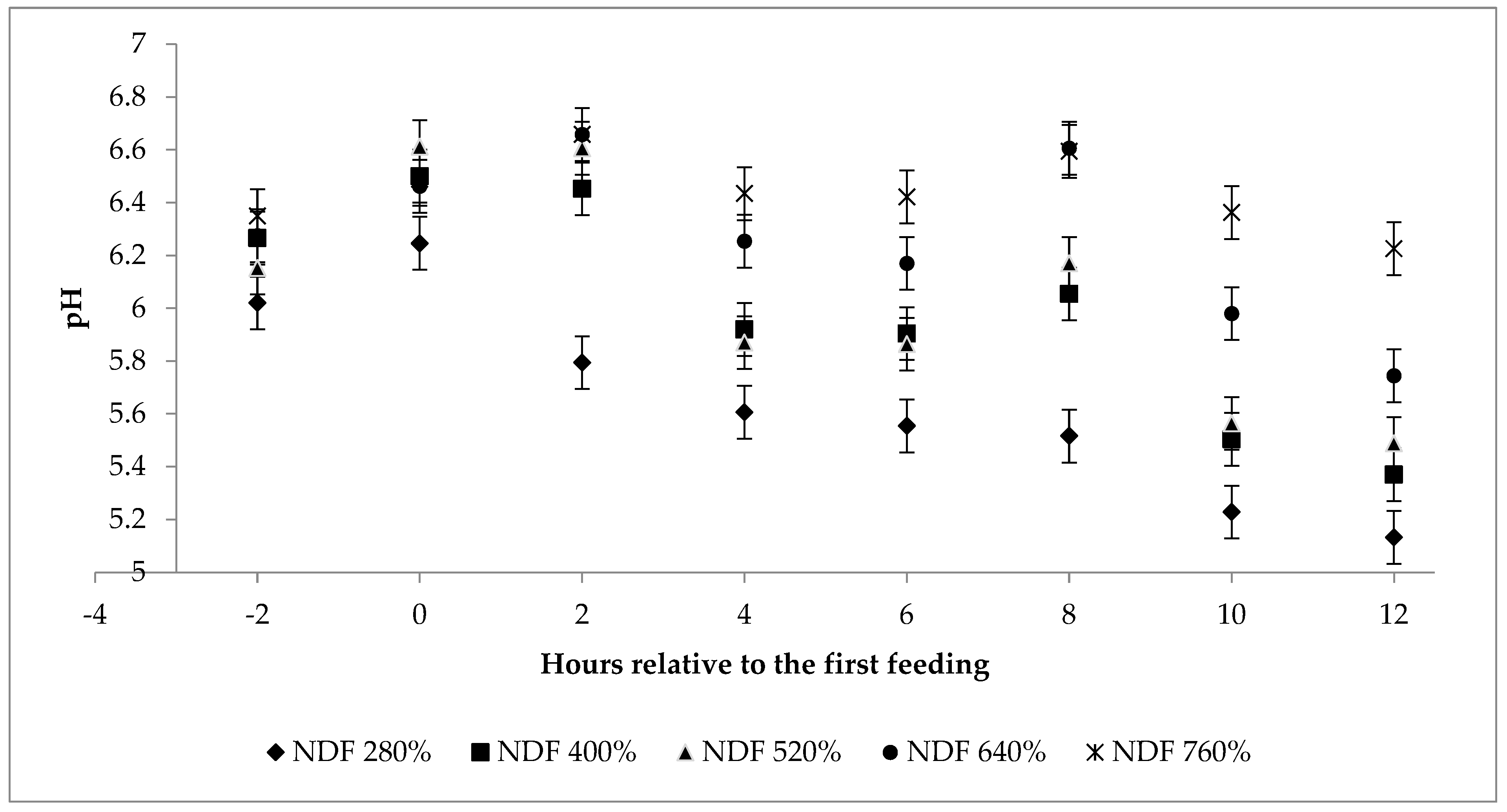
There was an interaction effect of the NDF level and time (hours) referent to the pH level (p < 0.001), showing decreasing pH values in relation to the time with the lower level of NDF (760 g NDF/kg DM) (Figure 1). On the other hand, the higher level of NDF (760 g NDF/kg DM) promoted pH levels close to the ideal value (Figure 1).

4. Discussion

4.1. Intake and Apparent Digestibility of Nutritional Compounds

The quadratic pattern of DM intake indicated that intake increased up to an NDF level of 479.7 g/kg DM in the diet, after which DM intake declined. This behavior can be explained by the differing degradation rates of carbohydrate types within the rumen. Non-fibrous carbohydrates exhibit a higher degradation rate (0.120–0.163 %/h) compared to fibrous carbohydrates (0.023 %/h) [27]. Consequently, diets with higher NDF content result in reduced feed degradability at the rumen level [9], accompanied by a decreased passage rate through the gastrointestinal tract [26]. This reduction can trigger physical mechanisms associated with gut-fill satiety [5,6]. Specifically, rumen distension stimulates mechanoreceptors located in the cranial region of the reticulo-rumen [11], which transmit satiety signals to the central nervous system. Therefore, beyond the observed NDF level threshold, DM intake in feedlot lambs decreases due to these physiological responses. This behavioral response also affects the intake of OM and CP.
The quadratic effect observed for EE intake is not solely associated with DM intake but is also influenced by the level of NDF inclusion in the diet. As noted by Moura et al. [28], high-concentrate diets (70%) contain higher EE levels compared to low-concentrate diets (30%), primarily due to differences in the ether extract content of the ingredients. Concentrate ingredients, such as soybean meal, generally have higher EE concentrations than roughage sources.
As the proportion of roughage in the diet increases, the inclusion of concentrate ingredients correspondingly decreases. However, the initial intake of concentrate tends to be higher, as lambs, being semi-selective feeders, prefer concentrates over roughage [29]. Consequently, the EE intake initially increases due to the higher preference and availability of concentrate. Nevertheless, as the roughage proportion continues to rise—reducing the amount of concentrate in the diet—the EE intake subsequently declines.
Although dry matter intake begins to decline at an NDF inclusion level of 399.9 g/kg DM, animals continue to consume feed to meet their nutritional requirements [30]. At this point, the concentrate portion of the diet was likely fully consumed. The subsequent reduction in overall intake is attributed to the excess NDF and its relatively low ruminal degradability, which triggers physical satiety mechanisms. These physiological responses help explain the observed pattern in the NDF intake, which increased up to an inclusion level of 530 g/kg DM, after which it declined.
Considering that the digestibility of tropical forages is lower than 60% DM [31] and the digestibility of concentrates is approximately 90% DM [32], it is possible to affirm that the increase in the NDF content in the diet not only affects the DM intake but also changes the nutrients’ digestibility. This change is associated with the alteration of the carbohydrate source, as the concentrate provides highly degradable carbohydrates that enhance microbial growth efficiency [33]. This explains the decrease in DM, OM, and EE digestibility observed when higher levels of NDF are included in the diet of lambs. No effects on CP digestibility were observed, which is likely attributable to changes in the rumen microbiota and to nitrogen recycling—a key physiological mechanism in diets with limited protein content or availability [34,35].
The NDF digestibility showed a quadratic behavior that can be explained by the carbohydrate source, because when the NDF content in the diet increased, the NFC content decreased. According to our results, after the inclusion level of NDF of 505.8 g/kg, the NDF digestibility decreased. This can be explained by changes in the composition and growth of specific rumen microbiota species and their respective degradability rates, considering that fibrolytic bacteria—characterized by lower degradability rates—are the most abundant in high-forage diets [36]. Thus, up to this level of NDF in the diet, the reduction in NFC content limits nutrient availability for rumen microbial growth, resulting in decreased NDF digestibility.

4.2. Feeding Behavior

Feeding behavior is a group of parameters that are highly correlated with the animal’s performance [37]. Although this is observed in accordance with the NDF level content in diets, when the DM intake decreases, it does not influence the time spent feeding, which continuously increased. This is because the feeding intake was influenced by the increased fiber content in the diet [38]. With higher levels of NFC in the diet—and given their higher digestibility—more fuel metabolites are produced, contributing to increased ATP production and resulting in hypophagic effects [39]. In high-forage diets, the production of these fuel metabolites occurs more slowly, which increases the animal’s need for intake. However, due to the larger particle size and the associated mastication requirements, animals are unable to consume large quantities in a short period, thus requiring more time and increasing the total feeding duration [40]. This can be corroborated by the reduction in DM feeding efficiency, which decreased by 0.63 g of DM/hour as the NDF levels increased in the lambs’ diets.
Similar to the increase in time spent feeding, the rumination time also increased by 0.4 min per day and was positively correlated with the elevated NDF levels in the diet. As the NDF content in the diet increased—considering the nature of the fiber source—a greater proportion of feed with a larger particle size was provided, resulting in an extended rumination time, as observed by Monteiro et al. [38]. This is further supported by the number of rumination boluses per day, which increased by 0.5 bolus/day as the NDF content in the diet increased. As the particle size increased, more time was required for rumination [41]. Although the number of rumination events was not affected, the DM rumination efficiency decreased, indicating a smaller amount of DM per bolus and a greater number of boluses. However, as fiber intake increased, the rumination efficiency of NDF improved with higher dietary NDF levels.
As the time spent feeding and ruminating increased with the inclusion of higher NDF levels in the diet, a reduction in idling time was expected, as reported by Monteiro et al. [38].

4.3. Ruminal Fermentation Parameters

An increase of 0.0014 units in the ruminal pH is associated with higher levels of neutral detergent fiber (NDF) in lamb diets and can be attributed to enhanced rumination activity. As observed, the time spent ruminating increased with higher NDF intake, which in turn stimulated saliva production due to prolonged chewing. It is important to note that saliva contributes approximately 37% of the total buffering capacity in the rumen, primarily through its bicarbonate and phosphate content [42]. Sheep are reported to produce between 6 and 16 L of saliva per day [43], and this volume increases with higher NDF levels in the diet.
The ruminal pH also plays a critical role in modulating the microbial population. The linear reduction in the propionate concentration observed in this study may be explained by the rising ruminal pH. It is described that pH values below 6.0 favor the growth of amylolytic bacteria [44] and inhibit fibrolytic bacteria [45], with the optimal range for microbial development being between 6.1 and 6.8 [46,47]. Therefore, as the pH increases under high-forage conditions, the abundance of amylolytic bacteria decreases, leading to reduced propionate production, as corroborated by Plaizier et al. [47] and supported by the findings from Goularte et al. [48] in studies on fiber levels in cow diets.
Acetate and butyrate concentrations demonstrated quadratic responses, with plateaus occurring at NDF inclusion levels of 523 g/kg DM and 402 g/kg DM, respectively. When these values were applied to the pH regression equation, the corresponding pH values were 6.3 and 6.1. Given the linear increase in pH across treatments, the subsequent decline in acetate and butyrate beyond these points does not appear to be directly caused by pH alone [45]. Rather, this reduction is likely due to limited nutrient availability for microbial growth under high-NDF diets [9]. This hypothesis is further supported by the slower degradation rates of fibrous carbohydrates (0.023 %/h) compared to non-fibrous carbohydrates (0.120–0.163 %/h) [27]. In high-forage diets, the slower nutrient release constrains microbial proliferation, ultimately reducing the synthesis of acetate and propionate [35].

5. Conclusions

It can be concluded that NDF levels should be included at 400 g/kg DM to enhance nutrient intake and digestibility, feeding behavior, and rumen fermentation parameters. Optimizing fiber use in diets for confined lambs will contribute to increased meat yield, improved nutrient retention and utilization, reduced environmental impact, and promoting sustainability.
We suggest that future studies consider including the evaluation of methane production, microbial communities, meat quality, and economic data. Although the main limitation for conducting such evaluations—also encountered in the present study—is financial, we recommend that these aspects be incorporated into project planning whenever possible.

Author Contributions

Conceptualization, G.G.P.d.C., D.d.S.P., L.G.A.C. and S.A.S.; Methodology, G.G.P.d.C., J.E.d.F.J. and D.d.S.P.; Validation, G.G.P.d.C., D.d.S.P., L.G.A.C. and S.A.S.; Formal Analysis, G.G.P.d.C., D.d.S.P., B.M.A.d.C.M. and H.D.R.A.; Investigation, R.N.S., T.N.d.S. and J.A.G.A.; Resources, G.G.P.d.C.; Data Curation, G.G.P.d.C. and D.d.S.P.; Writing—Original Draft Preparation, R.N.S., J.E.d.F.J., J.A.G.A., T.N.d.S. and R.R.S.; Writing—Review and Editing, G.G.P.d.C., D.d.S.P., L.G.A.C., S.A.S., H.D.R.A., B.M.A.d.C.M. and M.L.G.M.L.d.A.; Visualization, G.G.P.d.C., D.d.S.P., H.D.R.A. and M.L.G.M.L.d.A.; Supervision, G.G.P.d.C., D.d.S.P., R.R.S. and M.L.G.M.L.d.A.; Project Administration, G.G.P.d.C. All authors have read and agreed to the published version of the manuscript.

Funding

This research received no external funding.

Institutional Review Board Statement

The experimental protocol was approved by the Ethics Committee for Animal Use (CEUA) of the School of Veterinary Medicine and Animal Science of the Federal University of Bahia (Protocol number: 68/2018) and all animal experiments were performed according with the Directive 2010/63/EU.

Data Availability Statement

The original contributions presented in this study are included in the article. Further inquiries can be directed to the corresponding author(s).

Acknowledgments

The authors thank the “Fundação de Amparo à Pesquisa do Estado da Bahia—FAPESB”, the “Conselho Nacional de Desenvolvimento Científico e Tecnológico—CNPq”, and the “Coordenação de Aperfeiçoamento de Pessoal de Nível Superior—CAPES-Brazil” for granting the students scholarships.

Conflicts of Interest

The authors declare no conflicts of interest.

References

  1. Bolfe, É.L.; Victoria, D.D.C.; Sano, E.E.; Bayma, G.; Massruhá, S.M.F.S.; de Oliveira, A.F. Potential for agricultural expansion in degraded pasture lands in Brazil based on geospatial databases. Land 2024, 13, 200. [Google Scholar] [CrossRef]
  2. Gallo, S.B.; Arrigoni, M.D.B.; Lemos, A.L.D.S.C.; Haguiwara, M.M.H.; Bezerra, H.V.A. Influence of lamb finishing system on animal performance and meat quality. Acta Sci. Anim. Sci. 2019, 41, e44742. [Google Scholar] [CrossRef]
  3. Pereira, M.D.A.; Bungenstab, D.J.; Euclides, V.P.; Malafaia, G.C.; Biscola, P.H.; Menezes, G.R.; Abreu, U.G.P.; Laura, V.A.; Nogueira, E.; Mauro, R.A.; et al. From traditionally extensive to sustainably intensive: A review on the path to a sustainable and inclusive beef farming in Brazil. Animals 2024, 14, 2340. [Google Scholar] [CrossRef]
  4. Gurgel, A.L.C.; Difante, G.S.; Neto, J.V.E.; Santana, J.C.S.; Fernandes, P.B.; Dos Santos, G.T.; Dias, A.M.; Ítavo, L.C.V.; Ítavo, C.C.B.F.; Medeiros, H.R. Prediction of dry matter intake by meat sheep on tropical pastures. Trop. Anim. Health Prod. 2021, 53, 479. [Google Scholar] [CrossRef]
  5. Fregulia, P.; Neves, A.L.A.; Dias, R.J.P.; Campos, M.M. A review of rumen parameters in bovines with divergent feed efficiencies: What do these parameters tell us about improving animal productivity and sustainability? Livest. Sci. 2021, 254, 104761. [Google Scholar] [CrossRef]
  6. Oba, M.; Kammes-Main, K. Symposium review: Effects of carbohydrate digestion on feed intake and fuel supply. J. Dairy Sci. 2023, 106, 2153–2160. [Google Scholar] [CrossRef]
  7. Pulina, G.; Avondo, M.; Molle, G.; Francesconi, A.H.D.; Atzori, A.S.; Cannas, A. Models for estimating feed intake in small ruminants. Rev. Bras. Zootec. 2013, 42, 675–690. [Google Scholar] [CrossRef]
  8. Mertens, D.R. Regulation of forage intake. In Forage Quality, Evaluation, and Utilization; Fahey, G.C., Jr., Ed.; The American Society of Agronomy: Madison, WI, USA, 1994; pp. 450–493. [Google Scholar] [CrossRef]
  9. Åby, B.A.; Dønnem, I.; Jakobsen, J.; Steinheim, G. Effects of sheep breed and grass silage quality on voluntary feed intake and enteric methane emissions in adult dry ewes. Small Rumin. Res. 2023, 227, 107081. [Google Scholar] [CrossRef]
  10. Zhang, Z.; Wang, L.; Li, Q.; Li, F.; Ma, Z.; Li, F.; Wang, Z.; Cheng, L.; Yang, X.; Wang, X.; et al. Effects of dietary forage neutral detergent fiber and rumen degradable starch ratios on chewing activity, ruminal fermentation, ruminal microbes and nutrient digestibility of Hu sheep fed a pelleted total mixed ration. J. Anim. Sci. 2024, 102, skae100. [Google Scholar] [CrossRef]
  11. Attia, N.S.; Eisa, E.F.; Bayoumi, Y.H. Clinical, ruminal, hematobiochemical alterations and ultrasonographic examination of vagal indigestion in cow calves. Adv. Anim. Vet. Sci. 2021, 9, 1400–1407. [Google Scholar] [CrossRef]
  12. Vivares, G.; Dijkstra, J.; Bannink, A. Modeling diurnal rumen metabolism dynamics in dairy cattle: An update to a mechanistic model representing eating behavior, rumen content, rumination, and acid-base balance. J. Dairy Sci. 2025, 108, 6934–6957. [Google Scholar] [CrossRef]
  13. Galyon, H.; Corl, B.A.; Ferreira, G. Ruminal passage rate and digestibility of fiber from dairy cows consuming diets containing alfalfa and orchardgrass hays with different concentrations of undegradable neutral detergent fiber. J. Dairy Sci. 2024, 107, 10751–10760. [Google Scholar] [CrossRef]
  14. Matthews, C.; Crispie, F.; Lewis, E.; Reid, M.; O’Toole, P.W.; Cotter, P.D. The rumen microbiome: A crucial consideration when optimising milk and meat production and nitrogen utilisation efficiency. Gut Microbes 2019, 10, 115–132. [Google Scholar] [CrossRef] [PubMed]
  15. Coon, R.E.; Tucker, C.B. Short Communication: Feeding behaviors are not correlated with area under the curve for reticulorumen pH below 5.8 and 5.6 in finishing steers. J. Anim. Sci. 2025, 103, skaf058. [Google Scholar] [CrossRef]
  16. Golder, H.M.; Lean, I.J. Ruminal acidosis and its definition: A critical review. J. Dairy Sci. 2024, 107, 10066–10098. [Google Scholar] [CrossRef]
  17. NRC—National Research Council. Nutrient Requirements of Small Ruminants: Sheep, Goats, Cervids, and New World Camelids; National Academic Press: Washington, DC, USA, 2007. [Google Scholar]
  18. Johnson, T.R.; Combs, D.K. Effects of prepartum diet, inert rumen bulk, and dietary polyethylene glycol on dry matter intake of lactating dairy cows. J. Dairy Sci. 1991, 74, 933–944. [Google Scholar] [CrossRef]
  19. Bürger, P.J.; Pereira, J.C.; De Queiroz, A.C.; Da Silva, J.F.C.; Filho, S.D.C.V.; Cecon, P.R.; Casali, A.D.P. Ingestive behavior in Holstein calves fed diets with different concentrate levels. Rev. Bras. Zootec. 2000, 29, 236–242. [Google Scholar] [CrossRef]
  20. De Carvalho, G.G.P.; Rebouças, R.A.; Campos, F.S.; Santos, E.M.; Araújo, G.G.L.; Gois, G.C.; De Oliveira, J.S.; Oliveira, R.L.; Rufino, L.M.A.; Azevedo, J.A.G.; et al. Intake, digestibility, performance, and feeding behavior of lambs fed diets containing silages of different tropical forage species. Anim. Feed Sci. Technol. 2017, 228, 140–148. [Google Scholar] [CrossRef]
  21. Rooke, J.A.; Borman, A.J.; Armstrong, D.G. The effect of inoculation with Lactobacillus plantarum on fermentation in laboratory silos of herbage low in water-soluble carbohydrate. Grass Forage Sci. 1990, 45, 143–152. [Google Scholar] [CrossRef]
  22. AOAC—Association of Official Analytical Chemists. Official Methods of Analysis of the Association of Official Analytical Chemists, 15th ed.; Association of Official Analytical Chemists Inc.: Washington, DC, USA, 1990. [Google Scholar]
  23. AOAC—Association of Official Analytical Chemists. Official Methods of Analysis of the Association of Official Analytical Chemists, 18th ed.; Association of Official Analytical Chemists Inc.: Gaithersburg, MD, USA, 2005. [Google Scholar]
  24. van Soest, P.V.; Robertson, J.B.; Lewis, B.A. Methods for dietary fiber, neutral detergent fiber, and nonstarch polysaccharides in relation to animal nutrition. J. Dairy Sci. 1991, 74, 3583–3597. [Google Scholar] [CrossRef]
  25. Hall, M.B. Calculation of Non-Structural Carbohydrate Content of Feeds That Contain Non-Protein Nitrogen; University of Florida: Gainesville, FL, USA, 2000. [Google Scholar]
  26. Da Cruz, C.H.; Santos, S.A.; de Carvalho, G.G.P.; Azevedo, J.A.G.; Detmann, E.; Filho, S.D.C.V.; Mariz, L.D.S.; Pereira, E.S.; Nicory, I.M.C.; Tosto, M.S.L.; et al. Estimating digestible nutrients in diets for small ruminants fed with tropical forages. Livest. Sci. 2021, 249, 104532. [Google Scholar] [CrossRef]
  27. Cabral, Í.D.S.; Oliveira, S.S.; Azevêdo, J.A.G.; Souza, L.L.; Lima, R.F.D.; Lopes, C.D.C.; Otani, F.S.; Reis, S.M.; Sousa, C.A.F.D. Ruminal fermentation kinetics of by-products using the semi-automatic technique of in-vitro gas production. Rev. Bras. Saúde Prod. Anim. 2020, 21, e2121242020. [Google Scholar] [CrossRef]
  28. Moura, C.S.; Araújo, G.G.L.; Oliveira, B.Y.S.; Azevêdo, J.A.G.; Pimenta Filho, E.C.; Azevedo, P.S.; Santos, E.M. Different roughage: Concentrate ratios and water supplies to feedlot lambs: Carcass characteristics and meat chemical composition. J. Agric. Sci. 2020, 157, 643–649. [Google Scholar] [CrossRef]
  29. Rahman, M.A.; Xia, C.; Ji, L.; Cao, B.; Su, H. Nutrient intake, feeding patterns, and abnormal behavior of growing bulls fed different concentrate levels and a single fiber source (corn stover silage). J. Vet. Behav. 2019, 33, 46–53. [Google Scholar] [CrossRef]
  30. Faisca, L.D.; Peres, M.T.P.; Fernandes, S.R.; Bonnet, O.J.F.; Batista, R.; Deiss, L.; Monteiro, A.L.G. A new insight about the selection and intake of forage by ewes and lambs in different production systems on pasture. Small Rumin. Res. 2023, 221, 106949. [Google Scholar] [CrossRef]
  31. Feitosa, O.D.S.; Leite, R.D.C.; Alexandrino, E.; Pires, T.D.J.S.; Oliveira, L.B.T.D.; Paula, J.J.D.; Santos, A.C.D. Forage performance and cattle production as a function of the seasonality of a Brazilian tropical region. Acta Sci. Anim. Sci. 2022, 44, e53779. [Google Scholar] [CrossRef]
  32. Ítavo, L.C.V.; Gurgel, A.L.C.; Ítavo, C.C.B.F.; Cunha, C.S.; Longhini, V.Z.; Difante, G.D.S.; Dias, A.M.; Santana, J.C.S.; Arcanjo, A.H.M.; Niwa, M.V.G.; et al. In vitro digestibility and models of cumulative gas production of forage-free diet. Animals 2023, 13, 3515. [Google Scholar] [CrossRef]
  33. Hanlon, M.E.; Simoni, M.; Moorby, J.M.; Righi, F.; Tsiplakou, E.; Kantas, D.; Foskolos, A. Effects of the addition of non-fibre carbohydrates with different rumen degradation rates in dairy cow high-forage diets using the Rumen Simulation Technique. Animal 2023, 17, 100732. [Google Scholar] [CrossRef]
  34. Rufino, L.M.A.; Rodrigues, J.P.P.; Franco, M.O.; Lima, N.S.A.; Sousa, L.C.O.; Sampaio, C.B.; Detmann, E. Effects of amount and frequency of nitrogen supplementation on nutritional performance and metabolism in cattle fed medium-quality tropical forage. Discov. Anim. 2025, 2, 39. [Google Scholar] [CrossRef]
  35. Zhang, X.; Liu, X.; Xie, K.; Pan, Y.; Liu, F.; Hou, F. Effects of different fiber levels of energy feeds on rumen fermentation and the microbial community structure of grazing sheep. BMC Microbiol. 2025, 25, 180. [Google Scholar] [CrossRef]
  36. Wang, S.; Tang, W.; Jiang, T.; Wang, R.; Zhang, R.; Ou, J.; Wang, Q.; Cheng, X.; Ren, C.; Chen, J.; et al. Effect of dietary concentrate-to-forage ratios during the cold season on slaughter performance, meat quality, rumen fermentation and gut microbiota of Tibetan sheep. Animals 2024, 14, 3305. [Google Scholar] [CrossRef]
  37. Ferreira, J.; Crisóstomo, C.; Marques, N.M.; Corrêa, L.S.; González, A.L.; Asensio, L.A.B.; Lugo, F.C.; Costa, R.L.D. Residual feed intake and behavior of sheep: Besides being classified as’ nibblers’ or ‘binge eaters’, can they also be considered ‘low water drinkers’ or ‘binge drinkers’? Appl. Anim. Behav. Sci. 2025, 284, 106547. [Google Scholar] [CrossRef]
  38. Monteiro, G.O.A.; Difante, G.S.; Júnior, M.A.F.; Roberto, F.F.S.; Araújo, C.M.C.; da Silva, H.R.; Santana, J.C.S.; Rodrigues, J.G.; Longhini, V.Z.; Ítavo, C.C.B.F.; et al. Effects of dietary supplementation on ingestive behavior and consumption of grazing sheep: A systematic review. Trop. Anim. Health Prod. 2025, 57, 81. [Google Scholar] [CrossRef]
  39. Allen, M.S. Control of feed intake by hepatic oxidation in ruminant animals: Integration of homeostasis and homeorhesis. Animal 2020, 14 (Suppl. 1), s55–s64. [Google Scholar] [CrossRef]
  40. Chishti, M.F.A.; Rahman, M.A.U.; Jatta, K.; Khan, S.; Riaz, M.; Bilal, Q.; Anwar, U.; Ahmad, S.; Bajwa, H.M.; Rasul, F. Effect of forage to concentrate ratio on growth performance and feeding behavior of Thalli lambs. Trop. Anim. Health Prod. 2022, 54, 236. [Google Scholar] [CrossRef]
  41. Teixeira, W.S.; Carvalho, S.; Manzoni, V.G.; Simões, R.R.; Oliveira, M.D.F.A.D.; Moraes, M.L.D.; Galvani, D.Z. Intake, performance and ingestive behaviour in lambs finished in confinement with wet brewery residue used as roughage. Ciênc. Rural 2024, 54, e20230089. [Google Scholar] [CrossRef]
  42. Zhang, Z.; Li, F.; Li, F.; Wang, Z.; Guo, L.; Weng, X.; Sun, X.; He, Z.; Meng, X.; Liang, Z.; et al. Influence of dietary forage neutral detergent fiber on ruminal fermentation, chewing activity, nutrient digestion, and ruminal microbiota of hu sheep. Animals 2025, 15, 314. [Google Scholar] [CrossRef]
  43. Zeng, F.; Li, Z.; Zhu, Q.; Dong, R.; Zhao, C.; Li, G.; Li, G.; Gao, W.; Jiang, G.; Zheng, E.; et al. Production of functional human nerve growth factor from the saliva of transgenic mice by using salivary glands as bioreactors. Sci. Rep. 2017, 7, 41270. [Google Scholar] [CrossRef]
  44. Therion, J.J.; Kistner, A.; Kornelius, J.H. Effect of pH on growth rates of rumen amylolytic and lactilytic bacteria. Appl. Environ. Microbiol. 1982, 44, 428–434. [Google Scholar] [CrossRef]
  45. Firkins, J.L.; Henderson, E.L.; Duan, H.; Pope, P.B. International Symposium on Ruminant Physiology: Current perspective on rumen microbial ecology to improve fiber digestibility. J. Dairy Sci. 2024, 108, 7511–7529. [Google Scholar] [CrossRef]
  46. Fernando, S.C.; Purvis, H.T.; Najar, F.Z.; Sukharnikov, L.O.; Krehbiel, C.R.; Nagaraja, T.G.; Roe, B.A.; Desilva, U.J.A.E.M. Rumen microbial population dynamics during adaptation to a high-grain diet. Appl. Environ. Microbiol. 2010, 76, 7482–7490. [Google Scholar] [CrossRef] [PubMed]
  47. Plaizier, J.C.; Mulligan, F.J.; Neville, E.W.; Guan, L.L.; Steele, M.A.; Penner, G.B. Invited review: Effect of subacute ruminal acidosis on gut health of dairy cows. J. Dairy Sci. 2022, 105, 7141–7160. [Google Scholar] [CrossRef] [PubMed]
  48. Goularte, S.R.; Ítavo, L.C.V.; Ítavo, C.C.B.F.; Dias, A.M.; Morais, M.G.; Santos, G.T.; Oliveira, L.C.S. Ingestive behavior and nutrient digestibility in cows fed different levels of concentrate. Arq. Bras. Med. Vet. Zootec. 2011, 63, 414–422. [Google Scholar] [CrossRef]
Figure 1. Ruminal pH values in feedlot lambs fed different levels of neutral detergent fiber.
Sustainability 17 07598 g001
Table 1. Proportion of ingredients and chemical composition of experimental diets with different levels of neutral detergent fiber in diets for feedlot lambs.
Neutral Detergent Fiber Level (g/kg DM)
200320440560680
Ingredients (g/kg DM)
Tifton-85 hay120.0310.0500.0690.0880.0
Soybean meal72.074.076.080.080.0
Ground corn778.0586.0394.0200.010.0
Urea 15.015.015.015.015.0
Mineral mixture 115.015.015.015.015.0
Chemical composition (g/kg DM) 2
Dry matter (g/kg as-fed basis)919.0910.9905.8900.9895.8
Organic matter866.8863.9861.0858.1855.2
Crude protein141.0141.2141.3142.3145.0
Ether extract36.633.430.226.923.7
Neutral detergent fiber200.8320.8440.7560.7680.6
aNDFomp180.8288.0395.2502.4609.6
Acid detergent fiber104.2155.1206.0256.8307.8
Non-fibrous carbohydrates621.6504.6387.8270.1154.2
Total digestible nutrients805.4769.8734.2698.6662.9
1 Assurance levels (per kilogram of active elements): Calcium—240.00 g; Phosphorus—71.00 g; Potassium—28.20 g; Sulfur—20.00 g; Magnesium—20.00 g; Copper—400.00 mg; Cobalt—30.00 mg; Chromium—10.00 mg; Iron—250.00 mg; Iodine—40.00 mg; Manganese—1350.00 mg; Selenium—15.00 mg; Zinc—1700.00 mg; and Fluorine (max)—710.00 mg. 2 aNDFomp, neutral detergent fiber assayed with a heat-stable amylase and expressed exclusive of residual ash and protein.
Table 2. Intake and apparent digestibility of nutrients in feedlot lambs fed different levels of neutral detergent fiber.
ItemNeutral Detergent Fiber Level (g/kg DM)SEMp-Value 1
200320440560680LQ
Intake of nutritional compounds (g/kg DM)
Dry matter 21293.01302.11544.11335.41027.6106.40.1270.017
Organic matter 31189.31193.51420.41222.9948.781.30.1390.019
Crude protein 4169.2170.6214.3205.7116.920.30.1580.005
Ether extract 557.345.451.039.321.72.49<0.0010.004
Neutral detergent fiber 6223.7359.6672.6794.5700.842.1<0.001<0.001
Intake of nutritional compounds (% body weight)
Dry matter 72.732.603.462.912.200.240.3470.023
Digestibility of nutritional compounds (g/kg DM)
Dry matter 8797.6796.8758.5690.6570.63.330.0010.065
Organic matter 9802.8802.8765.5695.7578.83.26<0.0010.061
Crude protein705.4754.4734.0708.2779.33.160.1770.652
Ether extract 10927.4876.8857.5802.2696.03.07<0.0010.008
Neutral detergent fiber 11674.4669.8788.9744.4707.65.140.0900.015
1 Linear (L) and quadratic (Q) effects (p-values were considered significant at < 0.05). Regression equations: 2 DMintake, g/kg diet = −0.0054x2 + 4.3193x + 596.32, R2 = 0.80; 3 OMintake = −0.0049x2 + 3.9065x + 558.53, R2 = 0.79; 4 CPintake = −0.0012x2 + 0.9578x − 10.6, R2 = 0.74; 5 EEntake = −0.0001x2 + 0.0609x + 47.822, R2 = 0.88; 6 NDFntake = −0.0032x2 + 3.9962x − 490.69, R2 = 0.93; 7 DMintake, %BW = −0.00001x2 + 0.0106x + 0.9541, R2 = 0.62; 8 DMdigestibility = −0.4668x + 928.23, R2 = 0.86; 9 OMdigestibility = −0.4626x + 932.66, R2 = 0.86; 10 EEdigestibility = −0.4478x + 1029, R2 = 0.93; 11 NDFdigestibility = −0.0011x2 + 1.1127x + 478.94, R2 = 0.57.
Table 3. Feeding behavior of feedlot lambs fed different levels of neutral detergent fiber.
ItemNeutral Detergent Fiber Level (g/kg DM)SEMp-Value 1
200320440560680LQ
Daily spent time (min/day)
Feeding 2155.3203.1207.4265.8300.335.60.0010.761
Rumination 3189.5319.9277.3352.5413.052.50.0020.858
Idling 41117.3921.4952.0815.5727.951.6<0.0010.556
Number of events (nº/day)
Feeding 514.314.714.211.58.51.390.0090.120
Rumination14.114.617.316.316.11.460.0510.109
Idling 627.627.131.428.423.81.950.2270.028
Time spent per event (min)
Feeding 710.517.814.423.835.44.680.0010.134
Rumination18.919.114.921.026.72.890.0670.061
Idling 842.534.831.029.431.13.640.0140.082
Efficiency (g/hour)
Feeding DM 9575.5363.7456.9325.2219.769.40.0060.960
Rumination DM 10410.8238.2395.9224.8154.059.10.0100.511
Feeding NDF2.071.833.253.182.670.380.0560.172
Rumination NDF 1192.471.3139.0140.8109.114.40.0140.062
Chewing
Number/bolus59.756.548.653.259.04.830.7630.131
Time min/bolus47.747.139.940.547.33.680.5400.141
Chewings/min47.746.632.736.146.86.740.5770.142
Bolus/day 12280.1399.0405.3522.4531.266.20.0080.609
Number/day687346708047029519476739096990.5770.142
1 Linear (L) and quadratic (Q) effects (p-values were considered significant at <0.05). Regression equations: 2 Feedingspent time = 0.2939x + 97.057, R2 = 0.96; 3 Ruminationspent time = 0.3997x + 134.59, R2 = 0.82; 4 Idlingspent time = −0.7372x + 1231.2, R2 = 0.90; 5 Feedingevents per day = −0.0123x + 18.067, R2 = 0.79; 6 Idlingevents per day = −0.00008x2 + 0.0624x + 17.299, R2 = 0.71; 7 Feedingtime per event = 0.0465x − 0.08, R2 = 0.82; 8 Idlingtime per event = −0.0235x + 44.1, R2 = 0.71; 9 DMfeeding efficiency = −0.6251x + 663.24, R2 = 0.77; 10 DMrumination efficiency = −0.4392x + 477.97, R2 = 0.54; 11 NDFrumination efficiency = 0.0858x + 72.79, R2 = 0.29; 12 Bolus/day = 0.5213x + 198.21, R2 = 0.91.
Table 4. Rumen pH and volatile fatty acid production in feedlot lambs fed different levels of neutral detergent fiber.
ItemNeutral Detergent Fiber Level (g/kg DM)SEMp-Value 1
200320440560680HourNDF × HourLQ
pH 25.766.086.106.316.480.09<0.001<0.001<0.0010.481
Volatile fatty acids (mol/100 mol)
Acetate 346.147.752.549.942.812.20.0140.9960.6320.026
Propionate 430.929.729.927.623.86.800.1030.8510.0190.335
Butyrate 58.218.4410.137.755.802.050.0160.9990.0600.016
1 Linear (L) and quadratic (Q) effects (p-values were considered significant at <0.05). Regression equations: 2 pH = 0.0014x + 5.5337, R2 = 0.95; 3 Acetate = −0.0001x2 + 0.1046x + 29.14, R2 = 0.84; 4 Propionate = −0.0136x + 34.357, R2 = 0.83; 5 Butyrate = −0.00004x2 + 0.0322x + 3.1951, R2 = 0.84.
Disclaimer/Publisher’s Note: The statements, opinions and data contained in all publications are solely those of the individual author(s) and contributor(s) and not of MDPI and/or the editor(s). MDPI and/or the editor(s) disclaim responsibility for any injury to people or property resulting from any ideas, methods, instructions or products referred to in the content.