Article

Method Review for Assessing Damage to Human Health in LCA: Implementation in the Production of Selected Food Products

1
Faculty of Economics and Business, University of Maribor, Razlagova 14, 2000 Maribor, Slovenia
2
Faculty of Chemistry and Chemical Engineering, University of Maribor, Smetanova 17, 2000 Maribor, Slovenia
*
Author to whom correspondence should be addressed.
Sustainability 2025, 17(11), 4825; https://doi.org/10.3390/su17114825
Submission received: 23 April 2025 / Revised: 20 May 2025 / Accepted: 22 May 2025 / Published: 23 May 2025

Abstract

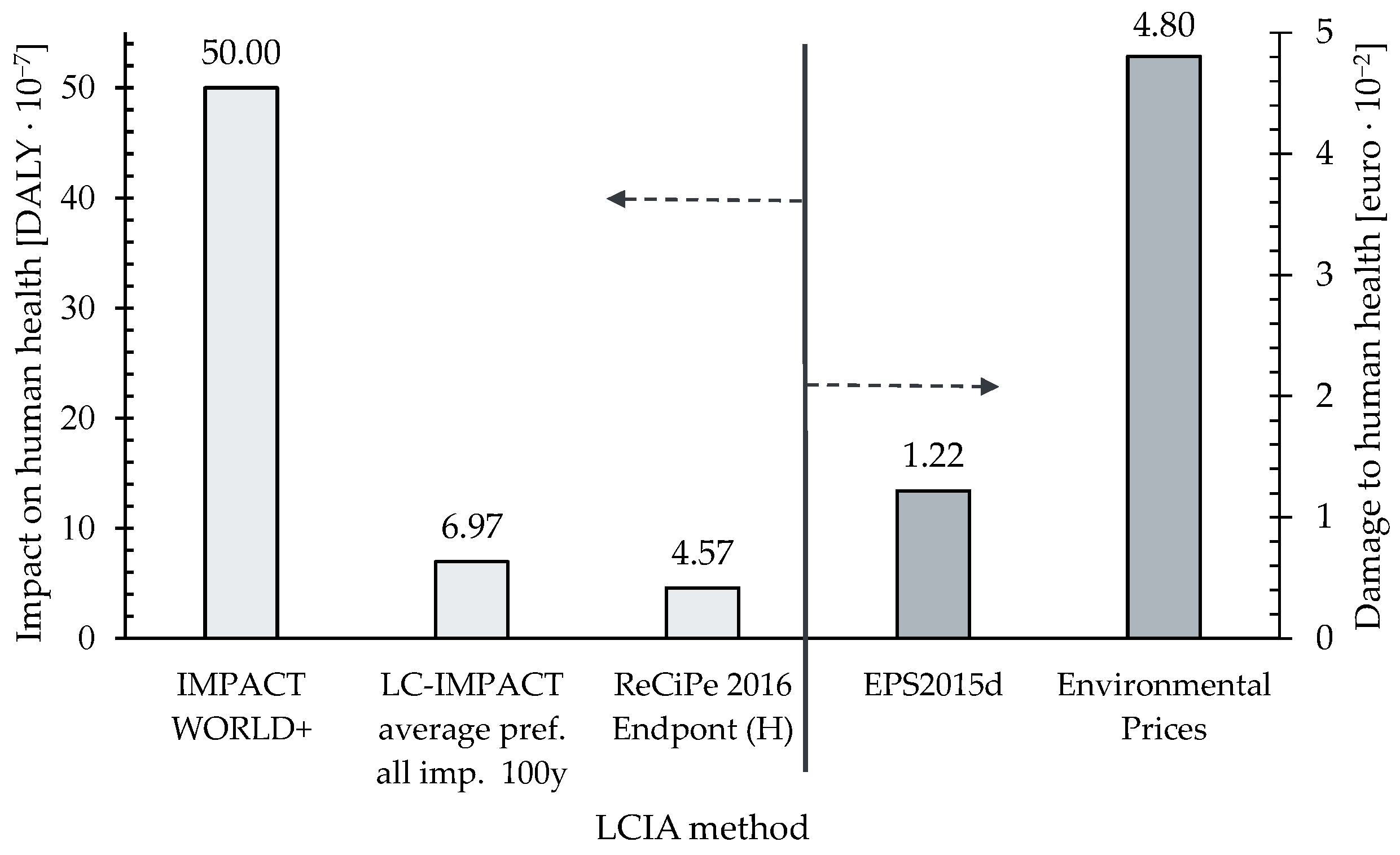
Agriculture and food production can cause a variety of adverse environmental impacts. Life Cycle Assessment (LCA) is the only standardised method so far that provides a comprehensive assessment of the environmental burden of products. LCA results can be expressed as environmental impacts (midpoint level) or environmental damage (endpoint level). Communication on environmental impact is mostly carried out as a part of the Carbon Footprint (CF) or Environmental Product Declaration (EPD), while reporting on environmental damage is rarely used. Due to the growing interest of consumers in ‘healthy’ food, it is important that food producers address the environmental damage. Therefore, an overview of existing Life Cycle Impact Assessment (LCIA) methods that provide insight into endpoint indicators describing damage to human health has been performed and presented in this paper. The application of the selected LCIA methods is demonstrated for the case of food products, highlighting the fact that the results obtained by different LCIA methods are not directly comparable due to a variety of methodological limitations, such as the existence of different environmental indicators and their structure. Finally, the usage of the LCA method for designing food products is presented, with the aim of enabling consumers to choose diets with lower environment and human health impacts.
Keywords: sustainable food consumption; eco-conscious choices; life cycle assessment; environmental impact; human health sustainable food consumption; eco-conscious choices; life cycle assessment; environmental impact; human health