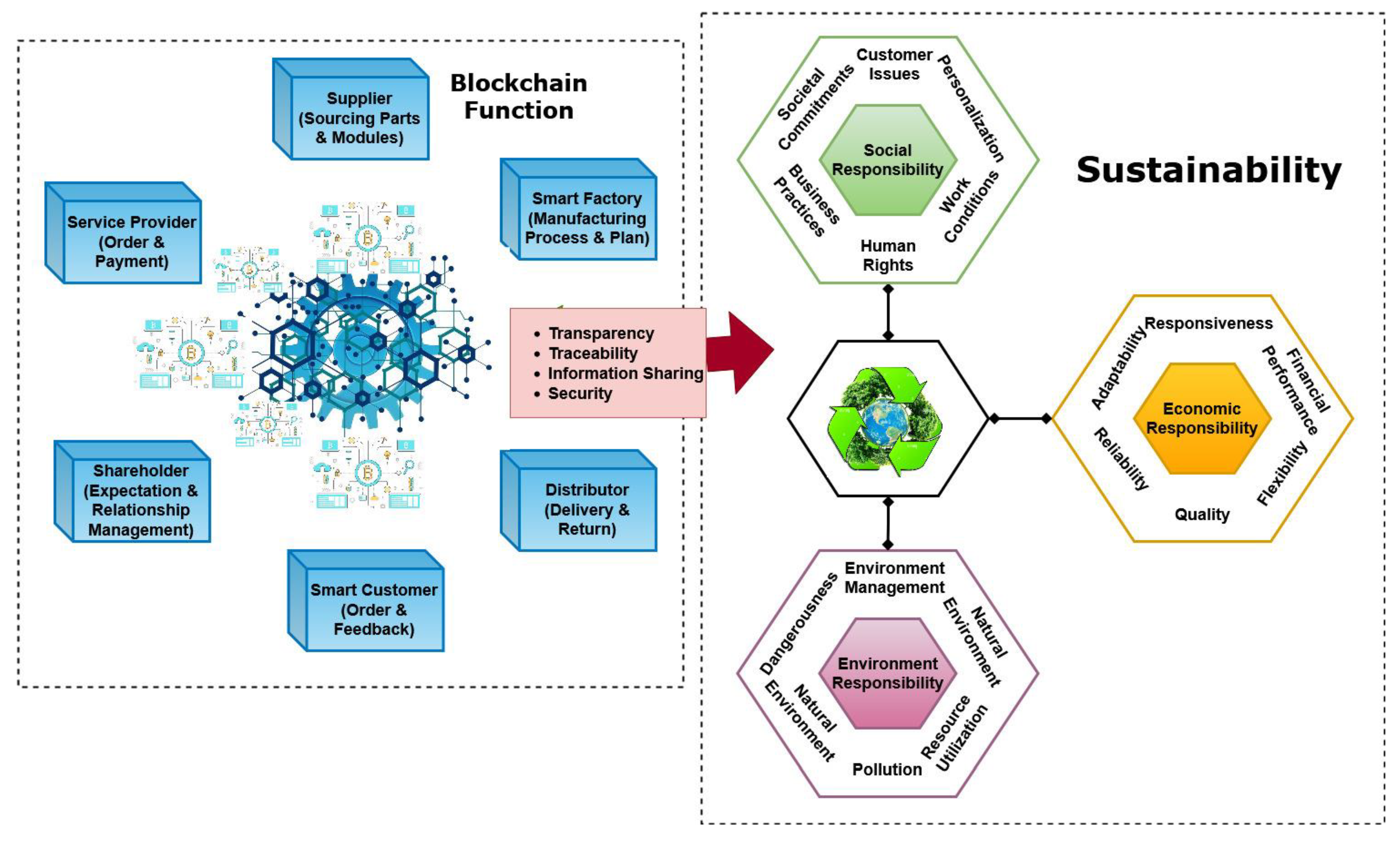
From Hype to Reality: Unveiling the Promises, Challenges and Opportunities of Blockchain in Supply Chain Systems


 ,
,  , , and
Abstract
1. Introduction
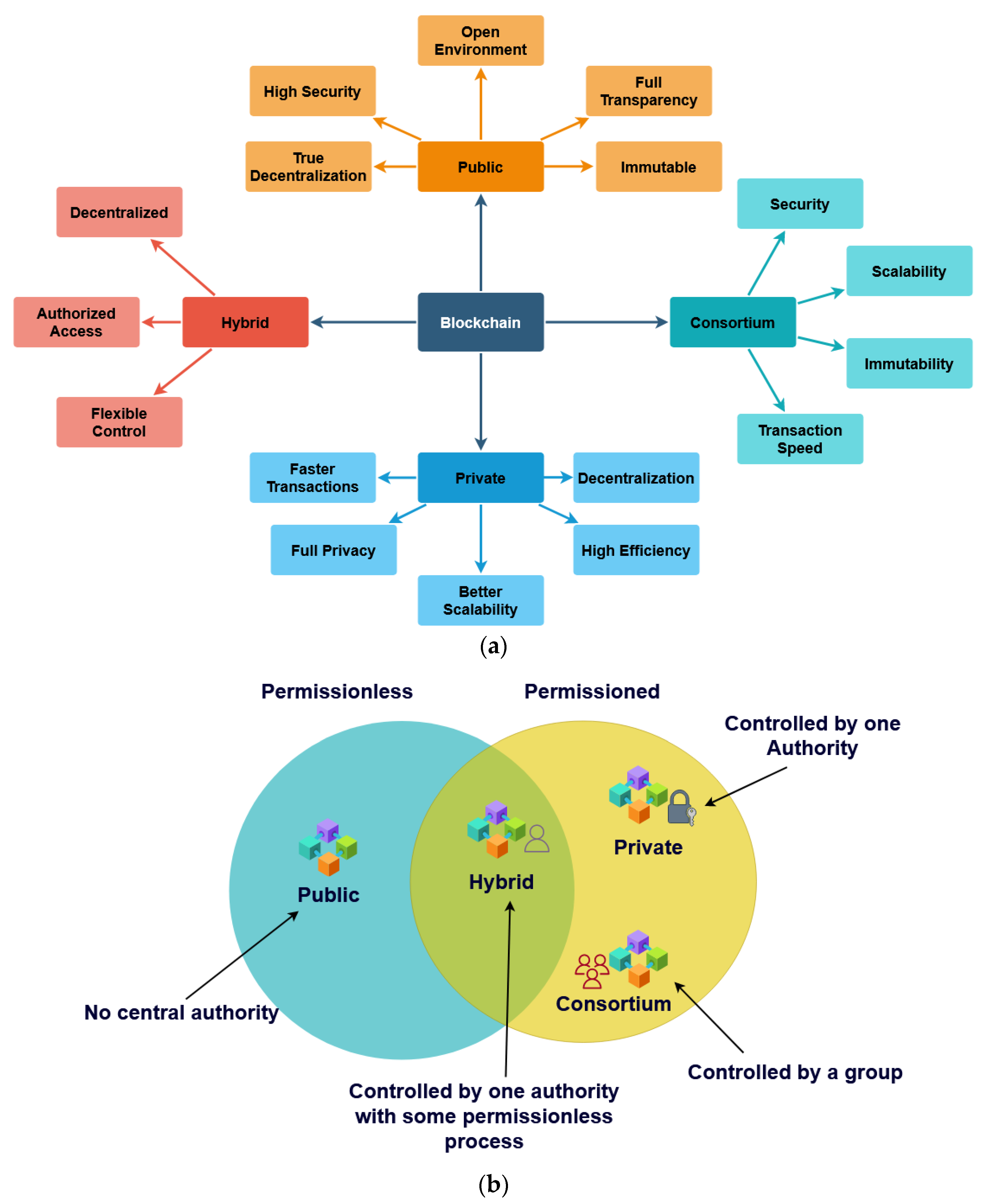
1.1. Types of Blockchain
- Establishing trust: A private network has fewer users than a private network.
- Reduced security: Since there are a smaller number of nodes or participants in a private blockchain network, hence it is more susceptible to a security breach.
- The limitation of private block chains is their need on a central Identity and Access Management (IAM) solution. This system offers complete managerial and tracking capabilities.
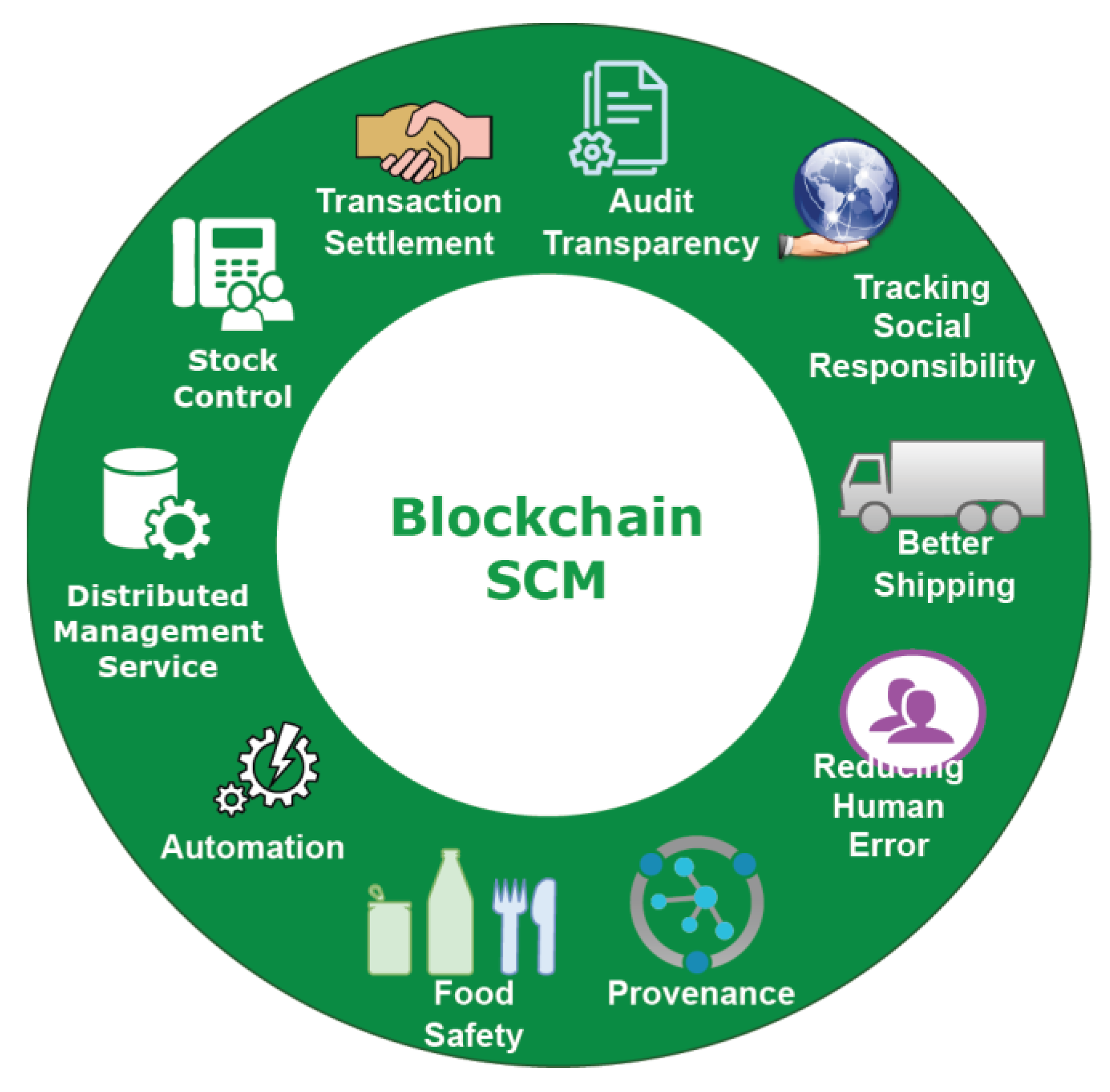
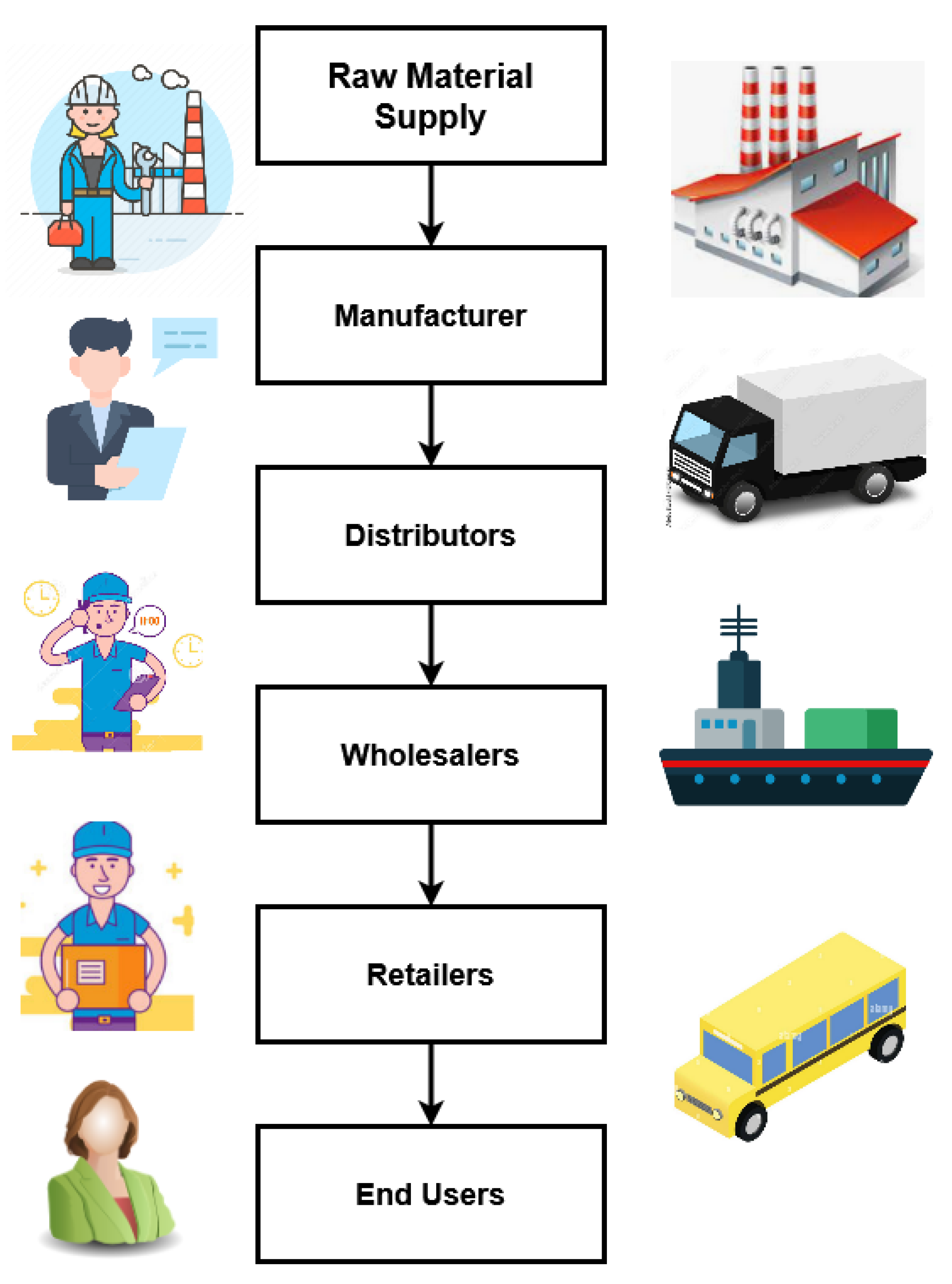
1.2. Supply Chain Management (SCM)
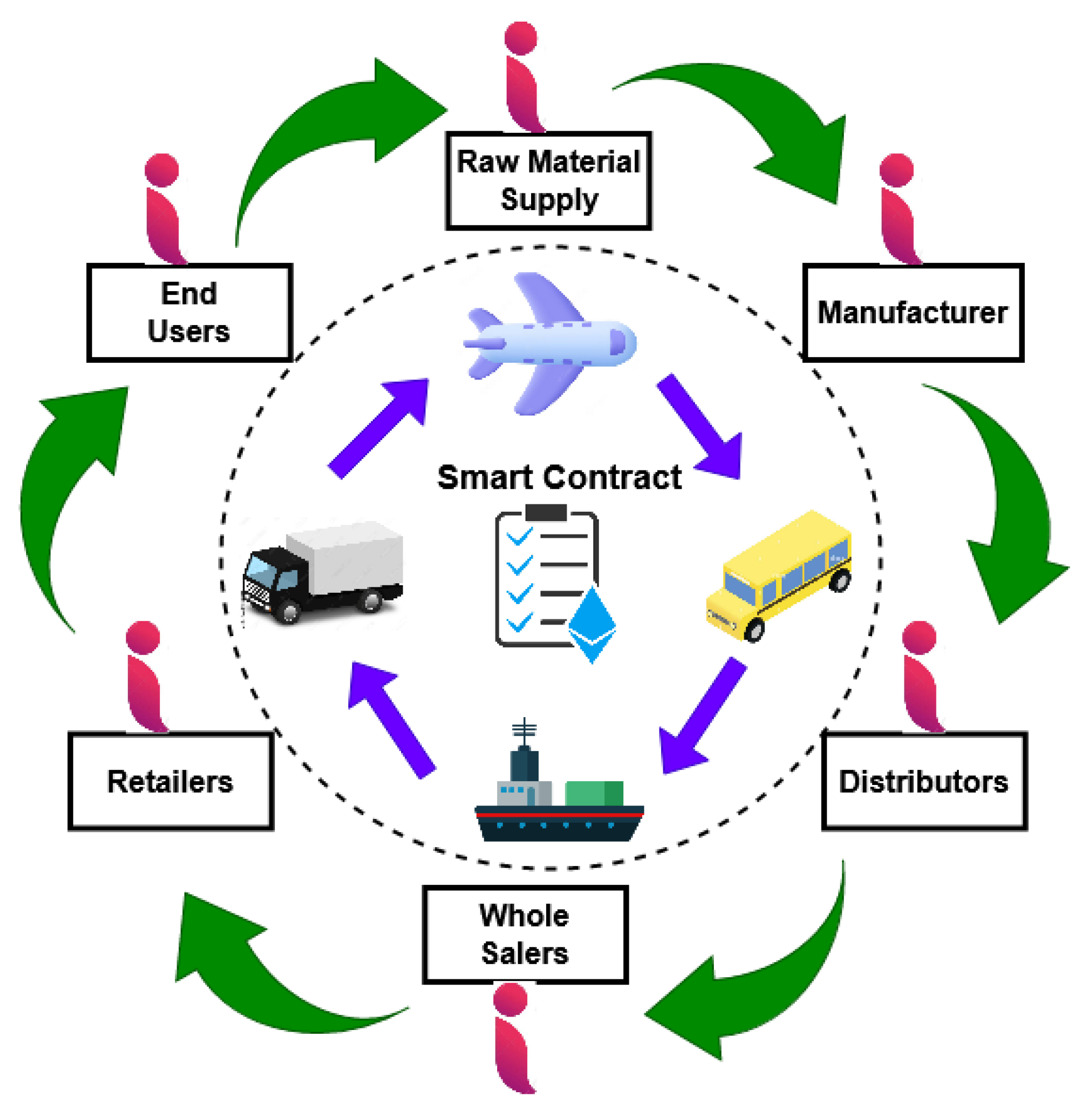
- The technical implementation facets of SCM systems powered by Blockchain are reviewed in this study using a methodical approach.
- We mainly focused on developing blockchain-enabled SCM systems to ensure the security of industrial applications.
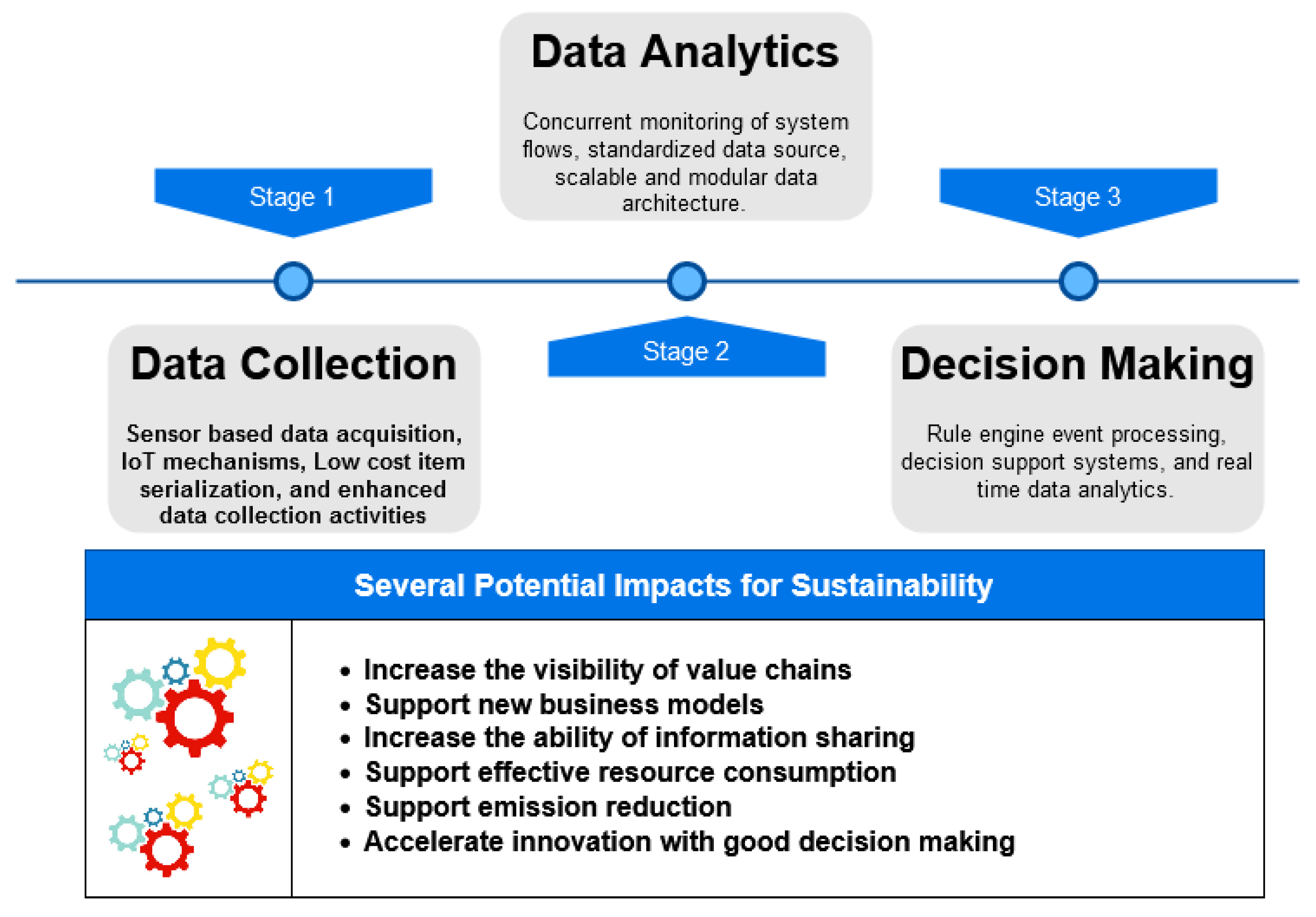
- The significant impacts of using blockchain technology in the SCM have been analyzed in this study with its distinct properties.
- The performance of the recent blockchain methodologies used in the existing works is validated and compared using several security parameters.
2. Knowledge and Related Works
3. Blockchain Technology
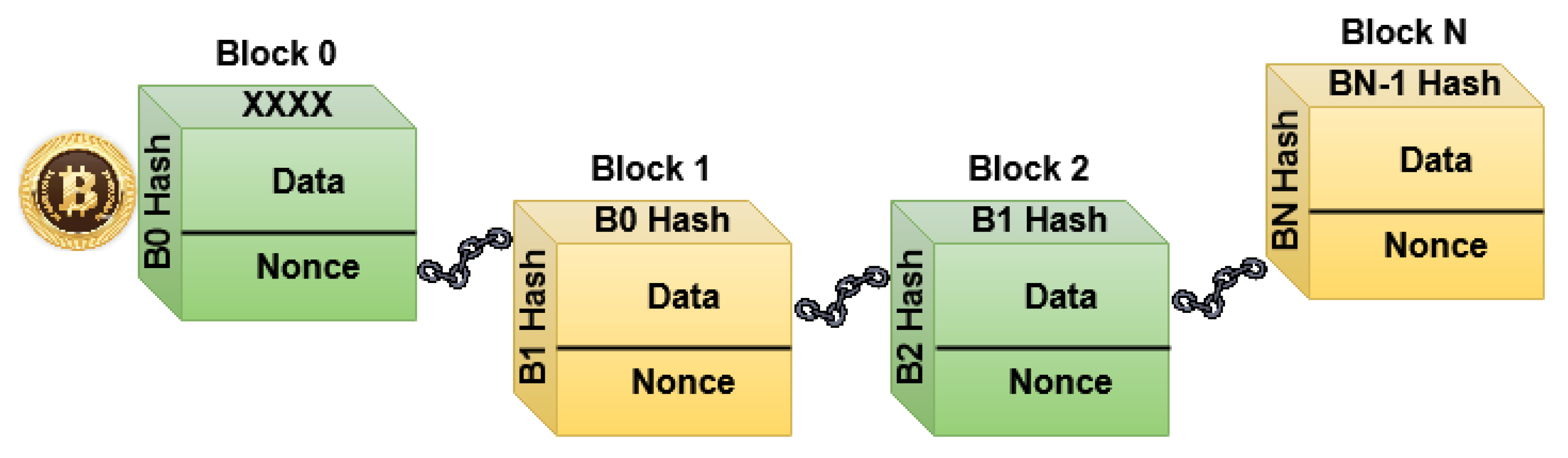
- The hash value of the previous block,
- Transaction data,
- Nonce message, and
- The hash value of the present block.
3.1. Applications of Blockchain in SCM
3.1.1. Fiscal Performance
3.1.2. Quality
3.1.3. Ecological Performance and Management
3.1.4. Resource Utilization
3.2. Privacy Preservation
3.3. Challenges of Using Blockchain
- Blockchain applications face significant challenges with regard to hardware and energy use. The public key crypto engine and a load dispatcher were coupled to build the blockchain hardware accelerator. The overall transaction speed and output accuracy raise as a result of the load being split among numerous components.
- Lack of scalability—On that system, many blockchains struggle to accommodate a large number of users. The biggest blockchain platforms saw moderate rates of exchange and increased exchange costs due to a significant increase in clients. Despite the fact that this reality caused extensive research into how to make both these systems and blockchains more equitable, the debate surrounding the suggestions has significantly shifted. The resolution is probably going to take a while.
- Challenges that still need to be solved include the adaptability of information from blockchain, data security during download, and confidentiality. Peer-to-peer technology have a lot of difficulties executing energy transactions and maintaining information confidentiality. The deployment of blockchain technology was hampered by high resource requirements and transaction costs in energy consumption. A probable answer is the creation of nimble blockchain algorithms enabling instantaneous consensus.
4. Supply Chain Management (SCM) Using Blockchain
5. Results and Discussion
6. Challenges and Recommendations
7. Conclusions
Author Contributions
Funding
Data Availability Statement
Acknowledgments
Conflicts of Interest
References
- Cai, C.; Hao, X.; Wang, K.; Dong, X. The Impact of Perceived Benefits on Blockchain Adoption in Supply Chain Management. Sustainability 2023, 15, 6634. [Google Scholar] [CrossRef]
- Fernandes, L.; Rosado da Cruz, A.M.; Cruz, E.F.; Lopes, S.I. A Review on Adopting Blockchain and IoT Technologies for Fostering the Circular Economy in the Electrical and Electronic Equipment Value Chain. Sustainability 2023, 15, 4574. [Google Scholar] [CrossRef]
- Khor, J.H.; Sidorov, M.; Zulqarnain, S.A.B. Scalable Lightweight Protocol for Interoperable Public Blockchain-Based Supply Chain Ownership Management. Sensors 2023, 23, 3433. [Google Scholar] [CrossRef]
- Wong, S.; Yeung, J.K.-W.; Lau, Y.-Y.; Kawasaki, T. A Case Study of How Maersk Adopts Cloud-Based Blockchain Integrated with Machine Learning for Sustainable Practices. Sustainability 2023, 15, 7305. [Google Scholar] [CrossRef]
- Kashem, M.A.; Shamsuddoha, M.; Nasir, T.; Chowdhury, A.A. Supply Chain Disruption versus Optimization: A Review on Artificial Intelligence and Blockchain. Knowledge 2023, 3, 80–96. [Google Scholar] [CrossRef]
- Fiore, M.; Capodici, A.; Rucci, P.; Bianconi, A.; Longo, G.; Ricci, M.; Sanmarchi, F.; Golinelli, D. Blockchain for the Healthcare Supply Chain: A Systematic Literature Review. Appl. Sci. 2023, 13, 686. [Google Scholar] [CrossRef]
- Song, J.; Yan, X. Impact of Government Subsidies, Competition, and Blockchain on Green Supply Chain Decisions. Sustainability 2023, 15, 3633. [Google Scholar] [CrossRef]
- Dietrich, F.; Louw, L.; Palm, D. Blockchain-Based Traceability Architecture for Mapping Object-Related Supply Chain Events. Sensors 2023, 23, 1410. [Google Scholar] [CrossRef]
- Li, T.; Xu, X.; Liu, W.; Shi, C. Pricing Decision of Three-Level Agricultural Supply Chain Based on Blockchain Traceability and Altruistic Preference. Sustainability 2023, 15, 3304. [Google Scholar] [CrossRef]
- Rocha, G.d.S.R.; Mühl, D.D.; Chingamba, H.A.; de Oliveira, L.; Talamini, E. Blockchain, Quo Vadis? Recent Changes in Perspectives on the Application of Technology in Agribusiness. Future Internet 2023, 15, 38. [Google Scholar] [CrossRef]
- Wei, J.; Yi, X.; Yang, X.; Liu, Y. Blockchain-Based Design of a Government Incentive Mechanism for Manufacturing Supply Chain Data Governance. Sustainability 2023, 15, 6968. [Google Scholar] [CrossRef]
- Bialas, C.; Bechtsis, D.; Aivazidou, E.; Achillas, C.; Aidonis, D. A Holistic View on the Adoption and Cost-Effectiveness of Technology-Driven Supply Chain Management Practices in Healthcare. Sustainability 2023, 15, 5541. [Google Scholar] [CrossRef]
- Viswanadham, Y.V.R.S.; Jayavel, K. A Framework for Data Privacy Preserving in Supply Chain Management Using Hybrid Meta-Heuristic Algorithm with Ethereum Blockchain Technology. Electronics 2023, 12, 1404. [Google Scholar] [CrossRef]
- Iranmanesh, M.; Maroufkhani, P.; Asadi, S.; Ghobakhloo, M.; Dwivedi, Y.K.; Tseng, M.-L. Effects of supply chain transparency, alignment, adaptability, and agility on blockchain adoption in supply chain among SMEs. Comput. Ind. Eng. 2023, 176, 108931. [Google Scholar] [CrossRef]
- Raja Santhi, A.; Muthuswamy, P. Influence of blockchain technology in manufacturing supply chain and logistics. Logistics 2022, 6, 15. [Google Scholar] [CrossRef]
- Xu, X.; He, Y. Blockchain application in modern logistics information sharing: A review and case study analysis. Prod. Plan. Control. 2022, 1–15. [Google Scholar] [CrossRef]
- Nanda, S.K.; Panda, S.K.; Dash, M. Medical supply chain integrated with blockchain and IoT to track the logistics of medical products. Multimed. Tools Appl. 2023, 1–23. [Google Scholar] [CrossRef]
- Tiwari, S.; Sharma, P.; Choi, T.-M.; Lim, A. Blockchain and third-party logistics for global supply chain operations: Stakeholders’ perspectives and decision roadmap. Transp. Res. Part E Logist. Transp. Rev. 2023, 170, 103012. [Google Scholar] [CrossRef]
- Karuppiah, K.; Sankaranarayanan, B.; Ali, S.M. A decision-aid model for evaluating challenges to blockchain adoption in supply chains. Int. J. Logist. Res. Appl. 2023, 26, 257–278. [Google Scholar] [CrossRef]
- Zhang, T.; Dong, P.; Chen, X.; Gong, Y. The impacts of blockchain adoption on a dual-channel supply chain with risk-averse members. Omega 2023, 114, 102747. [Google Scholar] [CrossRef]
- Zhang, Q.; Jiang, X.; Zheng, Y. Blockchain adoption and gray markets in a global supply chain. Omega 2023, 115, 102785. [Google Scholar] [CrossRef]
- Gong, B.; Zhang, H.; Gao, Y.; Liu, Z. Blockchain adoption and channel selection strategies in a competitive remanufacturing supply chain. Comput. Ind. Eng. 2023, 175, 108829. [Google Scholar] [CrossRef]
- Kafeel, H.; Kumar, V.; Duong, L. Blockchain in Supply Chain Management: A synthesis of barriers and enablers for managers. Int. J. Math. Eng. Manag. Sci. 2023, 8, 15. [Google Scholar] [CrossRef]
- Liu, W.; Liu, X.; Shi, X.; Hou, J.; Shi, V.; Dong, J. Collaborative adoption of blockchain technology: A supply chain contract perspective. Front. Eng. Manag. 2023, 10, 121–142. [Google Scholar] [CrossRef]
- da Silva, J.O.D.; dos Santos, D.R. Study of Blockchain Application in the Logistics Industry. Theor. Econ. Lett. 2022, 12, 321–342. [Google Scholar] [CrossRef]
- Selvarajan, S.; Srivastava, G.; Khadidos, A.O.; Khadidos, A.O.; Baza, M.; Alshehri, A.; Lin, J.C.-W. An artificial intelligence lightweight blockchain security model for security and privacy in IIoT systems. J. Cloud Comput. 2023, 12, 38. [Google Scholar] [CrossRef]
- Alhalabi, W.; Al-Rasheed, A.; Manoharan, H.; Alabdulkareem, E.; Alduailij, M.; Alduailij, M.; Selvarajan, S. Distinctive Measurement Scheme for Security and Privacy in Internet of Things Applications Using Machine Learning Algorithms. Electronics 2023, 12, 747. [Google Scholar] [CrossRef]
- Samadhiya, A.; Kumar, A.; Agrawal, R.; Kazancoglu, Y.; Agrawal, R. Reinventing Reverse Logistics through Blockchain Technology: A Comprehensive Review and Future Research Propositions. In Supply Chain Forum: An International Journal; Taylor & Francis: Oxfordshire, UK, 2023; pp. 81–102. [Google Scholar]
- Saini, P.; Iqbal, U.; Ahmed, M.; Kaur, D. Blockchain for Agri-Food Supply Chain and Logistics Management. In Blockchain Technologies and Applications for Digital Governance; IGI Global: Hershey, PA, USA, 2022; pp. 127–150. [Google Scholar]
- Fu, J.; Cao, B.; Wang, X.; Zeng, P.; Liang, W.; Liu, Y. BFS: A blockchain-based financing scheme for logistics company in supply chain finance. Connect. Sci. 2022, 34, 1929–1955. [Google Scholar] [CrossRef]
- Cole, R.; Stevenson, M.; Aitken, J. Blockchain technology: Implications for operations and supply chain management. Supply Chain. Manag. Int. J. 2019, 24, 469–483. [Google Scholar] [CrossRef]
- Benčić, F.M.; Skočir, P.; Žarko, I.P. DL-Tags: DLT and smart tags for decentralized, privacy-preserving, and verifiable supply chain management. IEEE Access 2019, 7, 46198–46209. [Google Scholar] [CrossRef]
- Jabbar, S.; Lloyd, H.; Hammoudeh, M.; Adebisi, B.; Raza, U. Blockchain-enabled supply chain: Analysis, challenges, and future directions. Multimed. Syst. 2021, 27, 787–806. [Google Scholar] [CrossRef]
- Wan, P.K.; Huang, L.; Holtskog, H. Blockchain-enabled information sharing within a supply chain: A systematic literature review. IEEE Access 2020, 8, 49645–49656. [Google Scholar] [CrossRef]
- AlShamsi, M.; Al-Emran, M.; Shaalan, K. A systematic review on blockchain adoption. Appl. Sci. 2022, 12, 4245. [Google Scholar] [CrossRef]
- Ahmad, R.W.; Salah, K.; Jayaraman, R.; Yaqoob, I.; Omar, M. Blockchain in oil and gas industry: Applications, challenges, and future trends. Technol. Soc. 2022, 68, 101941. [Google Scholar] [CrossRef]
- Samad, T.A.; Sharma, R.; Ganguly, K.K.; Wamba, S.F.; Jain, G. Enablers to the adoption of blockchain technology in logistics supply chains: Evidence from an emerging economy. Ann. Oper. Res. 2022, 327, 251–291. [Google Scholar] [CrossRef]
- Liu, X.; Wang, Y.; Wang, J.; Xu, W. Supply chain financial logistics supervision system based on blockchain technology. J. Ambient. Intell. Humaniz. Comput. 2022, 14, 11059–11069. [Google Scholar] [CrossRef]
- Hu, H.; Xu, J.; Liu, M.; Lim, M.K. Vaccine supply chain management: An intelligent system utilizing blockchain, IoT and machine learning. J. Bus. Res. 2023, 156, 113480. [Google Scholar] [CrossRef] [PubMed]
- Mukherjee, S.; Baral, M.M.; Lavanya, B.L.; Nagariya, R.; Singh Patel, B.; Chittipaka, V. Intentions to adopt the blockchain: Investigation of the retail supply chain. Manag. Decis. 2023, 61, 1320–1351. [Google Scholar] [CrossRef]
- Kumar, S.; Barua, M.K. Exploring the hyperledger blockchain technology disruption and barriers of blockchain adoption in petroleum supply chain. Resour. Policy 2023, 81, 103366. [Google Scholar] [CrossRef]
- Sreerakhi, V.; Balagopal, N.; Mohan, A. Transforming supply chain network and logistics using blockchain-a survey. Int. J. Bus. Inf. Syst. 2022, 39, 193–218. [Google Scholar] [CrossRef]
- Sunny, J.; Pillai, V.M.; Nath, H.V.; Shah, K.; Ghoradkar, P.P.; Philip, M.J.; Shirswar, M. Blockchain-enabled beer game: A software tool for familiarizing the application of blockchain in supply chain management. Ind. Manag. Data Syst. 2022, 122, 1025–1055. [Google Scholar] [CrossRef]
- Chang, A.; El-Rayes, N.; Shi, J. Blockchain technology for supply chain management: A comprehensive review. FinTech 2022, 1, 191–205. [Google Scholar] [CrossRef]
- Selvarajan, S.; Mouratidis, H. A quantum trust and consultative transaction-based blockchain cybersecurity model for healthcare systems. Sci. Rep. 2023, 13, 7107. [Google Scholar] [CrossRef]
- Fernandez-Vazquez, S.; Rosillo, R.; de la Fuente, D.; Puente, J. Blockchain in sustainable supply chain management: An application of the analytical hierarchical process (AHP) methodology. Bus. Process Manag. J. 2022, 28, 1277–1300. [Google Scholar] [CrossRef]
- Zhu, Q.; Bai, C.; Sarkis, J. Blockchain technology and supply chains: The paradox of the atheoretical research discourse. Transp. Res. Part E Logist. Transp. Rev. 2022, 164, 102824. [Google Scholar] [CrossRef]
- Liu, J.; Yeoh, G.; Gao, L.; Gao, S.; Ngwenyama, O. Designing a Secure Blockchain-Based Supply Chain Management Framework. J. Comput. Inf. Syst. 2023, 63, 592–607. [Google Scholar] [CrossRef]
- Gürpinar, T.; Große, N.; Schwarzer, M.; Burov, E.; Stammes, R.; Ioannidis, P.A.; Krämer, L.; Ahlbäumer, R.; Henke, M. Blockchain Technology in Supply Chain Management—A Discussion of Current and Future Research Topics; Springer International Publishing: Cham, Switzerland, 2021; pp. 482–503. [Google Scholar]
- Bag, S.; Rahman, M.S.; Gupta, S.; Wood, L.C. Understanding and Predicting the Determinants of Blockchain Technology Adoption and SMEs’ Performance. Int. J. Logist. Manag. 2022; ahead-of-print. [Google Scholar] [CrossRef]
- Goodarzian, F.; Abraham, A.; Ghasemi, P. Chapter 14—Key Success Factors for Blockchain Implementation in Supply Chain Management. In Blockchain in a Volatile-Uncertain-Complex-Ambiguous World; Mathiyazhagan, K., Sreedharan, V.R., Mathivathanan, D., Sunder, M.V., Eds.; Elsevier: Amsterdam, The Netherlands, 2023; pp. 219–231. [Google Scholar] [CrossRef]
- Xu, X.; Tatge, L.; Xu, X.; Liu, Y. Blockchain applications in the supply chain management in German automotive industry. Prod. Plan. Control. 2022, 1–15. [Google Scholar] [CrossRef]
- Ramkumar, G.; Kasat, K.; Khader, R.A.; Muhammed, P.K.N.; Raghu, T.; Chhabra, S. Quality enhanced framework through integration of blockchain with supply chain management. Meas. Sens. 2022, 24, 100462. [Google Scholar] [CrossRef]
- Hong, L.; Hales, D.N. Blockchain performance in supply chain management: Application in blockchain integration companies. Ind. Manag. Data Syst. 2021, 121, 1969–1996. [Google Scholar] [CrossRef]
- Park, A.; Li, H. The Effect of Blockchain Technology on Supply Chain Sustainability Performances. Sustainability 2021, 13, 1726. [Google Scholar] [CrossRef]
- Benstead, A.V.; Mwesiumo, D.; Moradlou, H.; Boffelli, A. Entering the world behind the clothes that we wear: Practical applications of blockchain technology. Prod. Plan. Control. 2022, 1–18. [Google Scholar] [CrossRef]
- Rehman Khan, S.A.; Yu, Z.; Sarwat, S.; Godil, D.I.; Amin, S.; Shujaat, S. The role of block chain technology in circular economy practices to improve organisational performance. Int. J. Logist. Res. Appl. 2022, 25, 605–622. [Google Scholar] [CrossRef]
- Malik, S.; Dedeoglu, V.; Kanhere, S.S.; Jurdak, R. Privchain: Provenance and privacy preservation in blockchain enabled supply chains. In Proceedings of the 2022 IEEE International Conference on Blockchain (Blockchain), Espoo, Finland, 22–25 August 2022; pp. 157–166. [Google Scholar]
- Chanson, M.; Bogner, A.; Bilgeri, D.; Fleisch, E.; Wortmann, F. Blockchain for the IoT: Privacy-preserving protection of sensor data. J. Assoc. Inf. Syst. 2019, 20, 1274–1309. [Google Scholar] [CrossRef]
- Tran, Q.N.; Turnbull, B.P.; Wu, H.-T.; De Silva, A.; Kormusheva, K.; Hu, J. A survey on privacy-preserving blockchain systems (ppbs) and a novel ppbs-based framework for smart agriculture. IEEE Open J. Comput. Soc. 2021, 2, 72–84. [Google Scholar] [CrossRef]
- Peng, L.; Feng, W.; Yan, Z.; Li, Y.; Zhou, X.; Shimizu, S. Privacy preservation in permissionless blockchain: A survey. Digit. Commun. Netw. 2021, 7, 295–307. [Google Scholar] [CrossRef]
- Sharma, P.; Namasudra, S.; Chilamkurti, N.; Kim, B.-G.; Crespo, R.G. Blockchain-Based Privacy Preservation for IoT-Enabled Healthcare System. ACM Trans. Sen. Netw. 2023, 19, 56. [Google Scholar] [CrossRef]
- Pournader, M.; Shi, Y.; Seuring, S.; Koh, S.C.L. Blockchain applications in supply chains, transport and logistics: A systematic review of the literature. Int. J. Prod. Res. 2020, 58, 2063–2081. [Google Scholar] [CrossRef]
- Banupriya, S.; Kottursamy, K.; Bashir, A.K. Privacy-preserving hierarchical deterministic key generation based on a lattice of rings in public blockchain. Peer Peer Netw. Appl. 2021, 14, 2813–2825. [Google Scholar] [CrossRef]
- Malik, S.; Dedeoglu, V.; Kanhere, S.S.; Jurdak, R.; Paik, H.Y. Traceable, trustworthy and privacy preserving agri-food supply chains. In Proceedings of the 2021 Third IEEE International Conference on Trust, Privacy and Security in Intelligent Systems and Applications (TPS-ISA), Virtual, 13–15 December 2021; pp. 313–320. [Google Scholar]
- Rizwan, A.; Karras, D.A.; Kumar, J.; Sánchez-Chero, M.; Mogollón Taboada, M.M.; Altamirano, G.C. An Internet of Things (IoT) Based Block Chain Technology to Enhance the Quality of Supply Chain Management (SCM). Math. Probl. Eng. 2022, 2022, 9679050. [Google Scholar] [CrossRef]
- Aslam, J.; Saleem, A.; Khan, N.T.; Kim, Y.B. Factors influencing blockchain adoption in supply chain management practices: A study based on the oil industry. J. Innov. Knowl. 2021, 6, 124–134. [Google Scholar] [CrossRef]
- Dujak, D.; Sajter, D. Blockchain Applications in Supply Chain. In SMART Supply Network; Kawa, A., Maryniak, A., Eds.; Springer International Publishing: Cham, Switzerland, 2019; pp. 21–46. [Google Scholar] [CrossRef]
- Hasan, A.S.M.T.; Sabah, S.; Haque, R.U.; Daria, A.; Rasool, A.; Jiang, Q. Towards Convergence of IoT and Blockchain for Secure Supply Chain Transaction. Symmetry 2022, 14, 64. [Google Scholar] [CrossRef]
- Kaur, A.; Singh, G.; Kukreja, V.; Sharma, S.; Singh, S.; Yoon, B. Adaptation of IoT with Blockchain in Food Supply Chain Management: An Analysis-Based Review in Development, Benefits and Potential Applications. Sensors 2022, 22, 8174. [Google Scholar] [CrossRef] [PubMed]
- Sudha, V.; Kalaiselvi, R.; Shanmughasundaram, P. Blockchain based solution to improve the Supply Chain Management in Indian agriculture. In Proceedings of the 2021 International Conference on Artificial Intelligence and Smart Systems (ICAIS), Coimbatore, India, 25–27 March 2021; pp. 1289–1292. [Google Scholar]
- Gökalp, E.; Gökalp, M.O.; Çoban, S. Blockchain-based supply chain management: Understanding the determinants of adoption in the context of organizations. Inf. Syst. Manag. 2022, 39, 100–121. [Google Scholar] [CrossRef]
- Huang, L.; Zhen, L.; Wang, J.; Zhang, X. Blockchain implementation for circular supply chain management: Evaluating critical success factors. Ind. Mark. Manag. 2022, 102, 451–464. [Google Scholar] [CrossRef]
- Bayramova, A.; Edwards, D.J.; Roberts, C. The role of blockchain technology in augmenting supply chain resilience to cybercrime. Buildings 2021, 11, 283. [Google Scholar] [CrossRef]
- Bag, S.; Viktorovich, D.A.; Sahu, A.K.; Sahu, A.K. Barriers to adoption of blockchain technology in green supply chain management. J. Glob. Oper. Strateg. Sourc. 2020, 14, 104–133. [Google Scholar] [CrossRef]
- ElMessiry, M.; ElMessiry, A. Blockchain framework for textile supply chain management: Improving transparency, traceability, and quality. In Proceedings of the International Conference on Blockchain, Seattle, WA, USA, 25–30 June 2018; pp. 213–227. [Google Scholar]
- Lin, S.-Y.; Zhang, L.; Li, J.; Ji, L.-l.; Sun, Y. A survey of application research based on blockchain smart contract. Wirel. Netw. 2022, 28, 635–690. [Google Scholar] [CrossRef]
- Li, J.; Kassem, M. Applications of distributed ledger technology (DLT) and Blockchain-enabled smart contracts in construction. Autom. Constr. 2021, 132, 103955. [Google Scholar] [CrossRef]
- Wu, H.; Cao, J.; Yang, Y.; Tung, C.L.; Jiang, S.; Tang, B.; Liu, Y.; Wang, X.; Deng, Y. Data Management in Supply Chain Using Blockchain: Challenges and a Case Study. In Proceedings of the 2019 28th International Conference on Computer Communication and Networks (ICCCN), Valencia, Spain, 29 July–1 August 2019; pp. 1–8. [Google Scholar]
- Wong, S.; Yeung, J.-K.-W.; Lau, Y.-Y.; So, J. Technical Sustainability of Cloud-Based Blockchain Integrated with Machine Learning for Supply Chain Management. Sustainability 2021, 13, 8270. [Google Scholar] [CrossRef]
- Leng, J.; Ruan, G.; Jiang, P.; Xu, K.; Liu, Q.; Zhou, X.; Liu, C. Blockchain-empowered sustainable manufacturing and product lifecycle management in industry 4.0: A survey. Renew. Sustain. Energy Rev. 2020, 132, 110112. [Google Scholar] [CrossRef]
- Ghimire, T.; Joshi, A.; Sen, S.; Kapruan, C.; Chadha, U.; Selvaraj, S.K. Blockchain in additive manufacturing processes: Recent trends & its future possibilities. Mater. Today Proc. 2022, 50, 2170–2180. [Google Scholar] [CrossRef]
- Queiroz, M.M.; Fosso Wamba, S.; De Bourmont, M.; Telles, R. Blockchain adoption in operations and supply chain management: Empirical evidence from an emerging economy. Int. J. Prod. Res. 2021, 59, 6087–6103. [Google Scholar] [CrossRef]
- Stroumpoulis, A.; Kopanaki, E.; Karaganis, G. Examining the Relationship between Information Systems, Sustainable SCM, and Competitive Advantage. Sustainability 2021, 13, 11715. [Google Scholar] [CrossRef]
- Weking, J.; Mandalenakis, M.; Hein, A.; Hermes, S.; Böhm, M.; Krcmar, H. The impact of blockchain technology on business models—A taxonomy and archetypal patterns. Electron. Mark. 2020, 30, 285–305. [Google Scholar] [CrossRef]
- Seidenfad, K.; Hoiss, T.; Lechner, U. A Blockchain to Bridge Business Information Systems and Industrial Automation Environments in Supply Chains; Springer International Publishing: Cham, Switzerland, 2021; pp. 22–40. [Google Scholar]
- Petratos, P.N.; Faccia, A. Fake news, misinformation, disinformation and supply chain risks and disruptions: Risk management and resilience using blockchain. Ann. Oper. Res. 2023, 327, 735–762. [Google Scholar] [CrossRef] [PubMed]
- Deiva Ganesh, A.; Kalpana, P. Future of artificial intelligence and its influence on supply chain risk management—A systematic review. Comput. Ind. Eng. 2022, 169, 108206. [Google Scholar] [CrossRef]
- Liu, Z.-Y.; Guo, P.-T. Supply Chain Decision Model Based on Blockchain: A Case Study of Fresh Food E-Commerce Supply Chain Performance Improvement. Discret. Dyn. Nat. Soc. 2021, 2021, 5795547. [Google Scholar] [CrossRef]
- Prajapati, D.; Jauhar, S.K.; Gunasekaran, A.; Kamble, S.S.; Pratap, S. Blockchain and IoT embedded sustainable virtual closed-loop supply chain in E-commerce towards the circular economy. Comput. Ind. Eng. 2022, 172, 108530. [Google Scholar] [CrossRef]
- Elghaish, F.; Abrishami, S.; Hosseini, M.R. Integrated project delivery with blockchain: An automated financial system. Autom. Constr. 2020, 114, 103182. [Google Scholar] [CrossRef]
- Elghaish, F.; Hosseini, M.R.; Matarneh, S.; Talebi, S.; Wu, S.; Martek, I.; Poshdar, M.; Ghodrati, N. Blockchain and the ‘Internet of Things’ for the construction industry: Research trends and opportunities. Autom. Constr. 2021, 132, 103942. [Google Scholar] [CrossRef]
- Oh, J.; Choi, Y.; In, J. A conceptual framework for designing blockchain technology enabled supply chains. Int. J. Logist. Res. Appl. 2022, 1–19. [Google Scholar] [CrossRef]
- Toapanta, S.M.T.; Gallegos, L.E.M.; Villalta, M.G.G.; Saltos, N.S.M. A Hyperledger Technology Approach to Mitigate the Risks of the Database in Foreign Trade Management. In Proceedings of the 2020 3rd International Conference on Information and Computer Technologies (ICICT), San Jose, CA, USA, 9–12 March 2020; pp. 313–319. [Google Scholar]
- Wang, S.; Ding, W.; Li, J.; Yuan, Y.; Ouyang, L.; Wang, F.Y. Decentralized Autonomous Organizations: Concept, Model, and Applications. IEEE Trans. Comput. Soc. Syst. 2019, 6, 870–878. [Google Scholar] [CrossRef]
- Härer, F.; Fill, H.G. Decentralized Attestation of Conceptual Models Using the Ethereum Blockchain. In Proceedings of the 2019 IEEE 21th Conference on Business Informatics (CBI), Moscow, Russia, 15–17 July 2019; pp. 104–113. [Google Scholar]
- Wamba, S.F.; Queiroz, M.M. Blockchain in the Operations and Supply Chain Management: Benefits, Challenges and Future Research Opportunities; Elsevier: Amsterdam, The Netherlands, 2020; Volume 52, p. 102064. [Google Scholar]
- Vo, K.T.; Nguyen-Thi, A.-T.; Nguyen-Hoang, T.-A. Building sustainable food supply chain management system based on hyperledger fabric blockchain. In Proceedings of the 2021 15th International Conference on Advanced Computing and Applications (ACOMP), Virtual, 24–26 November 2021; pp. 9–16. [Google Scholar]
- Liang, W.; Ji, N. Privacy challenges of IoT-based blockchain: A systematic review. Clust. Comput. 2022, 25, 2203–2221. [Google Scholar] [CrossRef]
- Bernabe, J.B.; Canovas, J.L.; Hernandez-Ramos, J.L.; Moreno, R.T.; Skarmeta, A. Privacy-Preserving Solutions for Blockchain: Review and Challenges. IEEE Access 2019, 7, 164908–164940. [Google Scholar] [CrossRef]
- Zhu, J.; Cao, J.; Saxena, D.; Jiang, S.; Ferradi, H. Blockchain-empowered Federated Learning: Challenges, Solutions, and Future Directions. ACM Comput. Surv. 2023, 55, 240. [Google Scholar] [CrossRef]
- Zhao, Q.; Chen, S.; Liu, Z.; Baker, T.; Zhang, Y. Blockchain-based privacy-preserving remote data integrity checking scheme for IoT information systems. Inf. Process. Manag. 2020, 57, 102355. [Google Scholar] [CrossRef]
- Shen, M.; Zhang, J.; Zhu, L.; Xu, K.; Tang, X. Secure SVM Training Over Vertically-Partitioned Datasets Using Consortium Blockchain for Vehicular Social Networks. IEEE Trans. Veh. Technol. 2020, 69, 5773–5783. [Google Scholar] [CrossRef]
- Thwin, T.T.; Vasupongayya, S. Blockchain-Based Access Control Model to Preserve Privacy for Personal Health Record Systems. Secur. Commun. Netw. 2019, 2019, 8315614. [Google Scholar] [CrossRef]
- Zhang, Y.; Wang, J.; Luo, J. Heuristic-Based Address Clustering in Bitcoin. IEEE Access 2020, 8, 210582–210591. [Google Scholar] [CrossRef]
- He, Z.; Turner, P. Blockchain Applications in Forestry: A Systematic Literature Review. Appl. Sci. 2022, 12, 3723. [Google Scholar] [CrossRef]
- Ouaddah, A. Chapter Eight—A Blockchain based access Control Framework for the Security and Privacy of IoT with Strong Anonymity Unlinkability and Intractability Guarantees. In Advances in Computers; Kim, S., Deka, G.C., Zhang, P., Eds.; Elsevier: Amsterdam, The Netherlands, 2019; Volume 115, pp. 211–258. [Google Scholar]
- Mozumder, M.A.I.; Sheeraz, M.M.; Athar, A.; Aich, S.; Kim, H.C. Overview: Technology Roadmap of the Future Trend of Metaverse based on IoT, Blockchain, AI Technique, and Medical Domain Metaverse Activity. In Proceedings of the 2022 24th International Conference on Advanced Communication Technology (ICACT), Pyeongchang, Republic of Korea, 13–16 February 2022; pp. 256–261. [Google Scholar]
- Zhao, Y.; Zhao, J.; Jiang, L.; Tan, R.; Niyato, D.; Li, Z.; Lyu, L.; Liu, Y. Privacy-Preserving Blockchain-Based Federated Learning for IoT Devices. IEEE Internet Things J. 2021, 8, 1817–1829. [Google Scholar] [CrossRef]
- Juyal, S.; Sharma, S.; Harbola, A.; Shukla, A.S. Privacy and Security of IoT based Skin Monitoring System using Blockchain Approach. In Proceedings of the 2020 IEEE International Conference on Electronics, Computing and Communication Technologies (CONECCT), Bangalore, India, 2–4 July 2020; pp. 1–5. [Google Scholar]
- Kechagias, E.P.; Gayialis, S.P.; Papadopoulos, G.A.; Papoutsis, G. An Ethereum-Based Distributed Application for Enhancing Food Supply Chain Traceability. Foods 2023, 12, 1220. [Google Scholar] [CrossRef] [PubMed]
- Alqarni, M.A.; Alkatheiri, M.S.; Chauhdary, S.H.; Saleem, S. Use of Blockchain-Based Smart Contracts in Logistics and Supply Chains. Electronics 2023, 12, 1340. [Google Scholar] [CrossRef]
Disclaimer/Publisher’s Note: The statements, opinions, and data contained in all publications are solely those of the individual author(s) and contributor(s) and not of MDPI and/or the editor(s). MDPI and/or the editor(s) disclaim responsibility for any injury to people or property resulting from any ideas, methods, instructions or products referred to in the content. |


| References | State of the Art Models | Purpose and Observations |
|---|---|---|
| [36] | Blockchain in food supply chain | The suggested framework is innovative and is anticipated to help food chain managers determine whether Blockchain is appropriate for their business and/or a larger supplier network. |
| [39] | Vaccine supply chain management | It combines IoT, machine learning and blockchain with SCM, where the security among customers is maintained with the transparency of blockchain. |
| [40] | Blockchain is integrated with SCM for retail sector | From the manufacturer to the final consumer, the substance may be tracked via blockchain technology. As a result, it can guarantee the product’s veracity, openness, and trustworthiness throughout the retail supply chain (SC). |
| [19] | Decision aid model for the adoption of blockchain with SCM | It discloses the relationship between cause and effect group issues in the adoption of blockchain and offers structural support to the executives. |
| [41] | Hyperledger blockchain is incorporated with petroleum supply chain | The suggested framework is innovative and is anticipated to help food chain managers determine whether Blockchain is appropriate for their business and/or a larger supplier network. |
| Properties | Sub-Domain | Major Contributions |
|---|---|---|
| Consistency [72] |
|
|
| Neutrality [73] |
|
|
| Resilience [74] |
|
|
| Fiscal performance [75] |
|
|
| Quality [76] |
|
|
| Refs. | Supply Chain Area | Technology Used | Framework Model | Contribution |
|---|---|---|---|---|
| [77,78] | Business application | IoT-integrated blockchain smart contracts | Conceptual framework | It enables effective resource and service sharing. It automated the workflow models of the time-consuming tasks. |
| [79] | SCM | Blockchain-based data storage | Conceptual framework | It helps to reduce the transaction cost and improves the process of executive commitments. |
| [80] | SCM | Blockchain-integrated IoT data storage | Conceptual framework | It assured the properties of data validity and traceability. |
| [81,82] | Manufacturing sectors | Blockchain model | Conceptual framework | It helps to improve the supply chain operations in the manufacturing industries. |
| [83,84] | SCM | Information management | Empirical model | Better adaptability and traceability in the supply chain. |
| [85,86] | Logistics-based business modeling | IoT-integrated Hyperledger technology | Use case model | It helps to improve the efficacy of inbound logistics with better traceability. |
| [87,88] | Supply chain risk management | Artificial Intelligence (AI) based blockchain technology | Conceptual framework | It supports enhancing the resilience of the supply chain system. |
| [89,90] | Supply chain in e-commerce industries | Distributed blockchain technology | Empirical model | It safeguards highly sensitive information by avoiding intermediaries. |
| [91,92] | Financial sector | Blockchain-integrated IoT framework | Conceptual framework | It helps to facilitate market establishment with ensured traceability. |
| [93,94] | Supply chain provenance | Hyperledger technology | Conceptual model | Data validity and accuracy. |
| [95,96] | Business application | Decentralized data storage and security | Conceptual model | It helps to improve the decision-making capability in the supply chain. |
| Blockchain Techniques | Privacy | Security | Consensus | Speed | Scalability | Transaction Cost | Incentive | Smart Contracts |
|---|---|---|---|---|---|---|---|---|
| Bitcoin [97] | No | No | Computationally Intensive PoW | 7 transactions per sec | No | High | Required cryptocurrency | No |
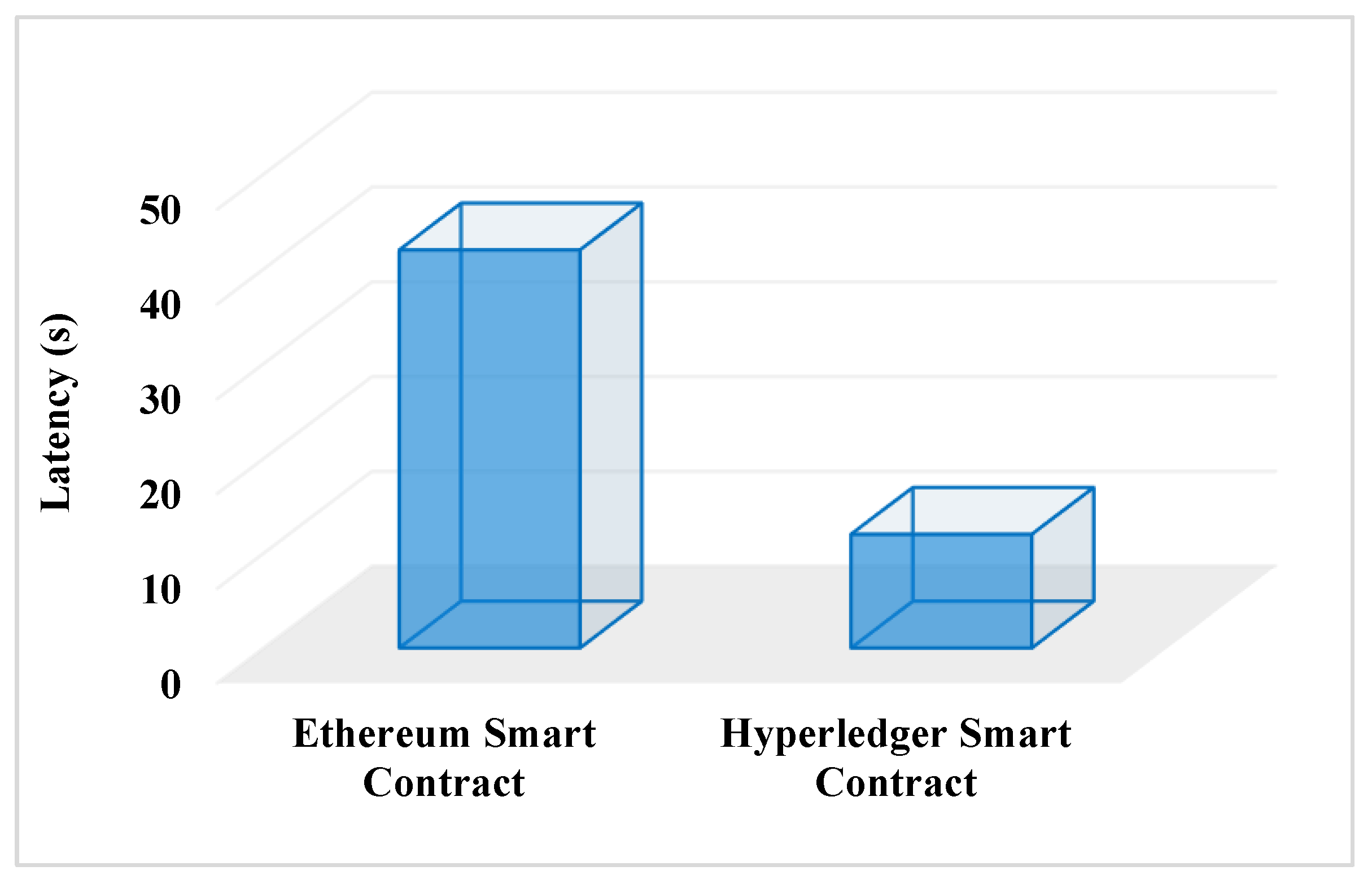
| Ethereum [13] | Yes | Yes | PoW and PoS | 15 transactions per sec | No | High | Required cryptocurrency | Solidity |
| Hyperledger [98] | Yes | Yes | Multiple approaches | 3000 transactions per sec | Yes | Low | It does not require cryptocurrency | Yes |
| Techniques | Security | Privacy | Anonymity | Dynamics | Exactness | Energy Utilization | Overhead | Integrity |
|---|---|---|---|---|---|---|---|---|
| PPBC | 🗸 | 🗸 | X | X | X | X | 🗸 | X |
| FLBC | 🗸 | X | X | X | X | X | X | X |
| RDI-BC | 🗸 | 🗸 | X | 🗸 | 🗸 | X | X | X |
| SVM-BC | 🗸 | 🗸 | X | X | X | X | X | X |
| ACM-BC | 🗸 | 🗸 | X | X | X | X | X | 🗸 |
| Clustering BC | 🗸 | 🗸 | X | X | 🗸 | X | X | X |
| FFD-BC | 🗸 | 🗸 | X | X | X | X | X | X |
| AAC-BC | 🗸 | 🗸 | 🗸 | X | X | X | X | X |
| IoT-BC | X | 🗸 | X | X | X | X | X | X |
| MIoT-BC | 🗸 | 🗸 | X | X | X | X | X | X |
| PMIoT-BC | 🗸 | 🗸 | X | X | 🗸 | 🗸 | X | X |
| SM-IoT-BC | 🗸 | 🗸 | X | X | X | 🗸 | X | X |
| Techniques | Con | Avail | Eff | Acc | Cost | Scal | Run Time | Rel |
|---|---|---|---|---|---|---|---|---|
| PPBC | X | X | X | X | 🗸 | X | X | X |
| FLBC | X | X | 🗸 | 🗸 | X | 🗸 | 🗸 | X |
| RDI-BC | X | X | X | X | X | X | X | X |
| SVM-BC | X | X | 🗸 | 🗸 | X | X | X | X |
| ACM-BC | X | 🗸 | 🗸 | 🗸 | X | X | X | X |
| Clustering BC | X | 🗸 | 🗸 | 🗸 | X | X | X | X |
| FFD-BC | 🗸 | X | X | 🗸 | X | X | X | X |
| AAC-BC | X | X | X | X | X | X | X | X |
| IoT-BC | X | X | 🗸 | X | X | X | X | 🗸 |
| MIoT-BC | X | 🗸 | 🗸 | X | X | X | X | X |
| PMIoT-BC | X | X | 🗸 | 🗸 | X | X | X | X |
| SM-IoT-BC | 🗸 | X | X | X | X | 🗸 | X | X |
Disclaimer/Publisher’s Note: The statements, opinions and data contained in all publications are solely those of the individual author(s) and contributor(s) and not of MDPI and/or the editor(s). MDPI and/or the editor(s) disclaim responsibility for any injury to people or property resulting from any ideas, methods, instructions or products referred to in the content. |
© 2023 by the authors. Licensee MDPI, Basel, Switzerland. This article is an open access article distributed under the terms and conditions of the Creative Commons Attribution (CC BY) license (https://creativecommons.org/licenses/by/4.0/).
Share and Cite
Uddin, M.; Selvarajan, S.; Obaidat, M.; Arfeen, S.U.; Khadidos, A.O.; Khadidos, A.O.; Abdelhaq, M. From Hype to Reality: Unveiling the Promises, Challenges and Opportunities of Blockchain in Supply Chain Systems. Sustainability 2023, 15, 12193. https://doi.org/10.3390/su151612193
Uddin M, Selvarajan S, Obaidat M, Arfeen SU, Khadidos AO, Khadidos AO, Abdelhaq M. From Hype to Reality: Unveiling the Promises, Challenges and Opportunities of Blockchain in Supply Chain Systems. Sustainability. 2023; 15(16):12193. https://doi.org/10.3390/su151612193
Chicago/Turabian StyleUddin, Muen, Shitharth Selvarajan, Muath Obaidat, Shams Ul Arfeen, Alaa O. Khadidos, Adil O. Khadidos, and Maha Abdelhaq. 2023. "From Hype to Reality: Unveiling the Promises, Challenges and Opportunities of Blockchain in Supply Chain Systems" Sustainability 15, no. 16: 12193. https://doi.org/10.3390/su151612193
APA StyleUddin, M., Selvarajan, S., Obaidat, M., Arfeen, S. U., Khadidos, A. O., Khadidos, A. O., & Abdelhaq, M. (2023). From Hype to Reality: Unveiling the Promises, Challenges and Opportunities of Blockchain in Supply Chain Systems. Sustainability, 15(16), 12193. https://doi.org/10.3390/su151612193