Article

The Concept of Integration between State and Provincial Sea Boundaries in Indonesia
by
Eka Djunarsjah
1,2,*,
Andika Permadi Putra
1,2,
Difa Kusumadewi
2,
Kevin Yudistira
1 and
Miga Magenika Julian
1,2
1
Geodesy and Geomatic Engineering, Bandung Institute of Technology, Bandung 40132, West Java, Indonesia
2
Hydrography Research Group, Bandung Institute of Technology, Bandung 40132, West Java, Indonesia
*
Author to whom correspondence should be addressed.
Sustainability 2022, 14(3), 1659; https://doi.org/10.3390/su14031659
Submission received: 31 October 2021 / Revised: 23 January 2022 / Accepted: 27 January 2022 / Published: 31 January 2022
(This article belongs to the Special Issue Frontiers of Maritime Spatial Planning and Management)

Abstract

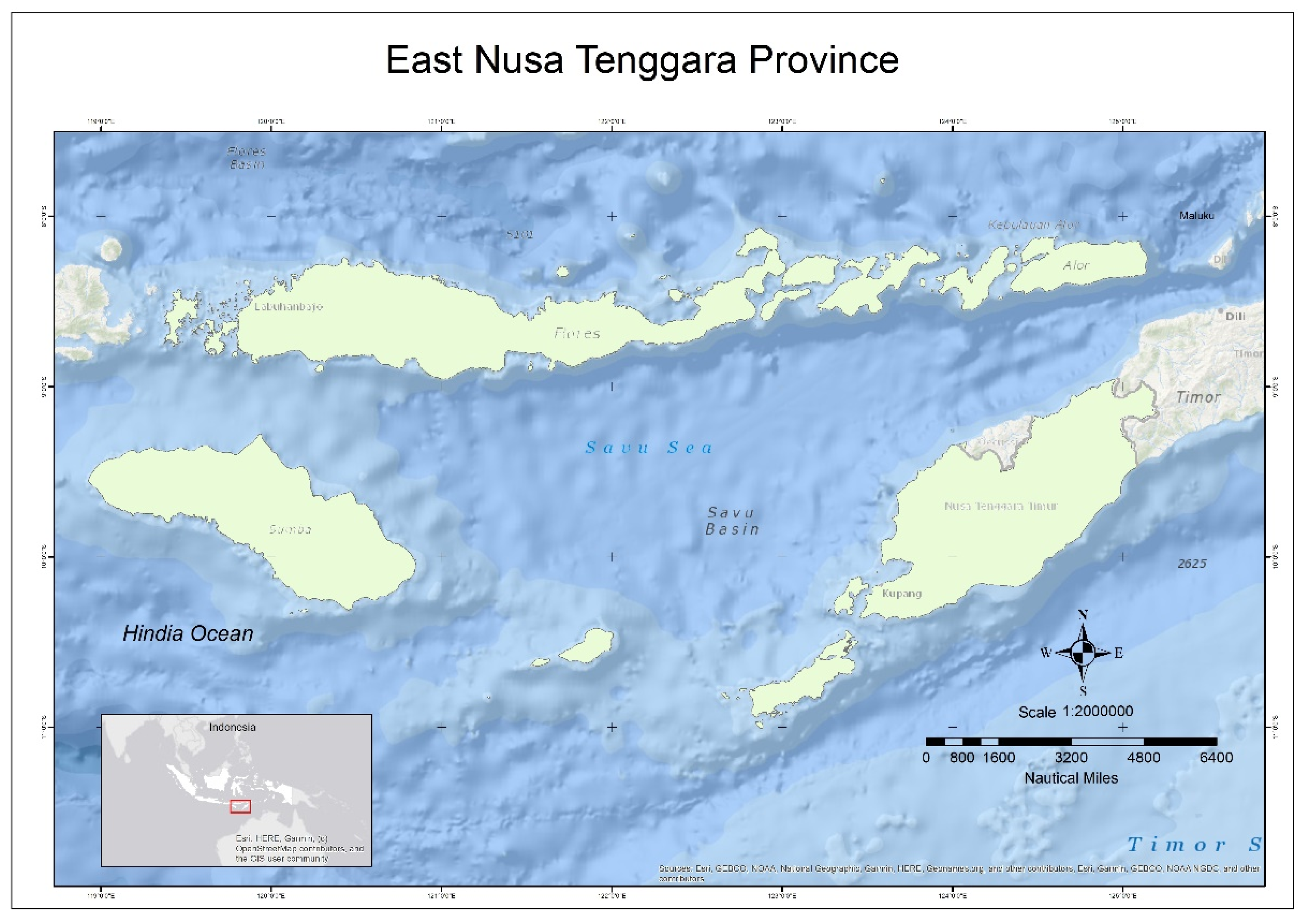
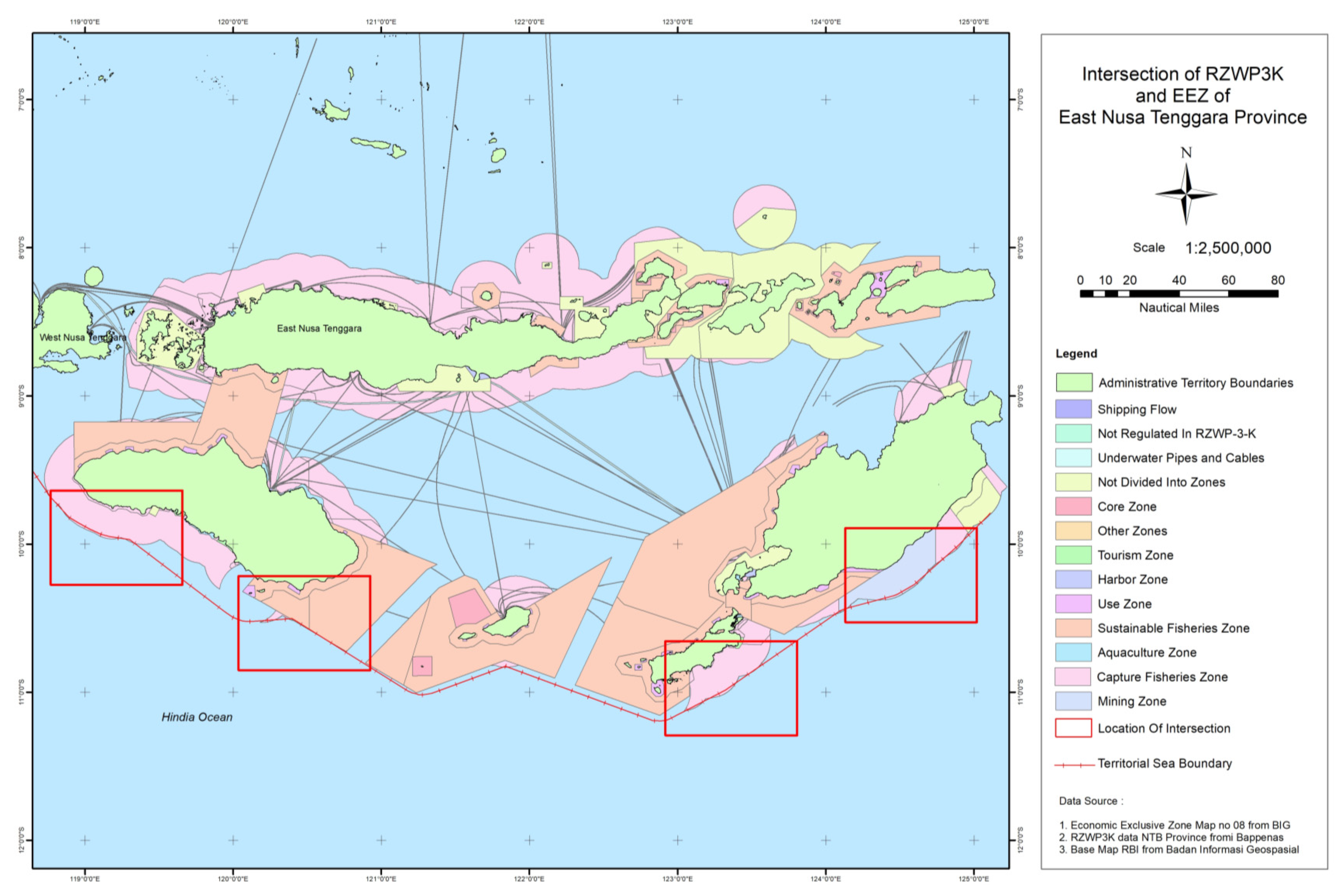
The clarity of marine spatial status requires a coherency between the state (territorial) sea boundary and the provincial sea boundary because both have the same sea width of 12 nautical miles. However, the two sea boundaries use different references; the state sea boundary refers to the low-water line, whereas the provincial sea boundary refers to the high-water line, so that the outer limits of the two sea boundaries differ. From the applicable provisions, the provincial sea management area may not exceed the territorial sea area. The method used to detect the overlap between the state sea and the provincial sea is the overlay method. By taking the study area of the waters of the province of East Nusa Tenggara, a difference is produced between the position of the outermost boundary of the territorial sea of the state of Indonesia and the sea area of East Nusa Tenggara province. The results of this study show differences in the boundaries of the state and provincial seas. To prevent potential issues, in the process of implementing Marine Spatial Planning (MSP) and/or Integrated Coastal Zone Management (ICZM), there must be a clarity and a uniform reference between the state and provincial sea boundaries; otherwise, it will create an overlap of authorities, between the state (central) and the provincial level. This incoherency shows that this practice has not fulfilled one of the requirements in implementing ICZM, which requires the integration of all aspects, including political boundaries.
Keywords: boundary; state; province; MSP; ICZM boundary; state; province; MSP; ICZM