


Key Barriers of Digital Transformation of the High-Technology Manufacturing: An Evaluation Method

Abstract
:1. Introduction
1.1. Research Background
1.2. Literature Review
1.3. Reaserch Objective
- To assess digital/advanced manufacturing technologies adoption readiness (see Section 3.1); obtained results are to be compared to the results of the method for determining barriers approbation in task 2;
- To develop the method for determining barriers in digital transformation (see Section 3.2).
2. Materials and Methods
2.1. Digital/Advanced Manufacturing Technologies Adoption Readiness Assessment
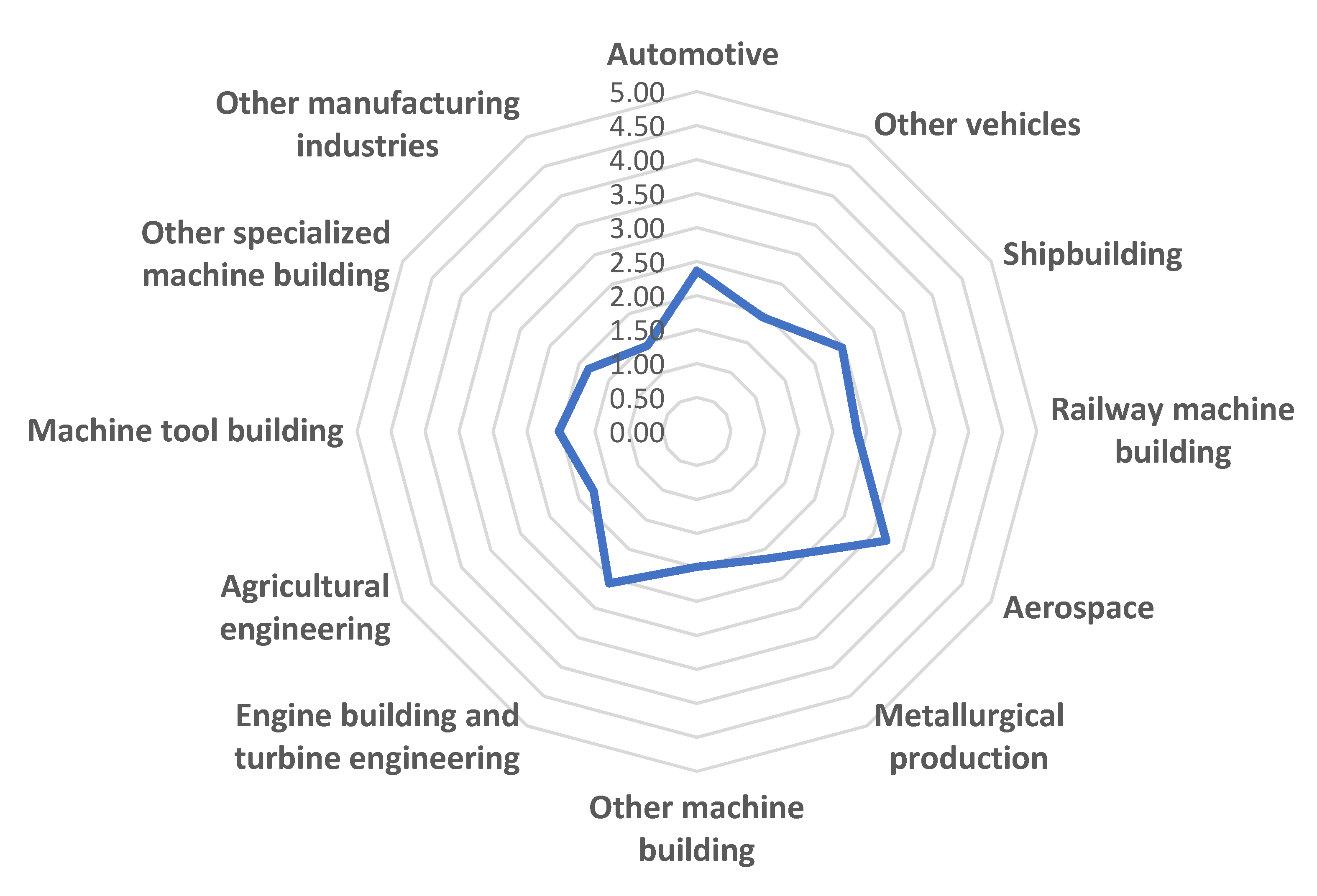
- Automotive;
- Aerospace;
- Engine building;
- Shipbuilding;
- Railway machine building;
- Other vehicles;
- Machine tool building;
- Other machine building;
- Agricultural engineering;
- Other specialized machine building;
- Metallurgical production; and
- Other manufacturing industries.
2.2. Development of the Method for Determining Barriers in Digital Transformation
- IT infrastructure;
- Existing IT systems;
- Special software requirements;
- Financial resources;
- Qualified specialists and IT personnel;
- Digital manufacturing policy;
- Limited-access information use;
- Regulatory framework; and
- Diverse IT maturity of production cooperation participants.
3. Results and Discussion
3.1. Digital/Advanced Manufacturing Technologies Adoption Readiness Assessment
3.2. Development of the Method for Determining Barriers in Digital Transformation
- Insignificant if the relative generalized barrier is less than 35%;
- Deterrent if the relative generalized barrier is in the range from 35% to 70%; and
- Limiting if the relative generalized barrier is more than 70%.
3.3. Assesment’s Results
- Outdated manufacturing technologies with low levels of automation.
- The complexity of integrating digital technologies with existing IT systems in the enterprise.
- Availability of special software requirements.
- Lack of qualified specialists for the implementation and use of digital production technologies.
- Lack of a coherent digital manufacturing policy.
- Insufficient elaboration of the issue of transferring limited-access information through secure-access channels.
- Insufficient elaboration of the regulatory framework in the field of information interaction.
4. Conclusions
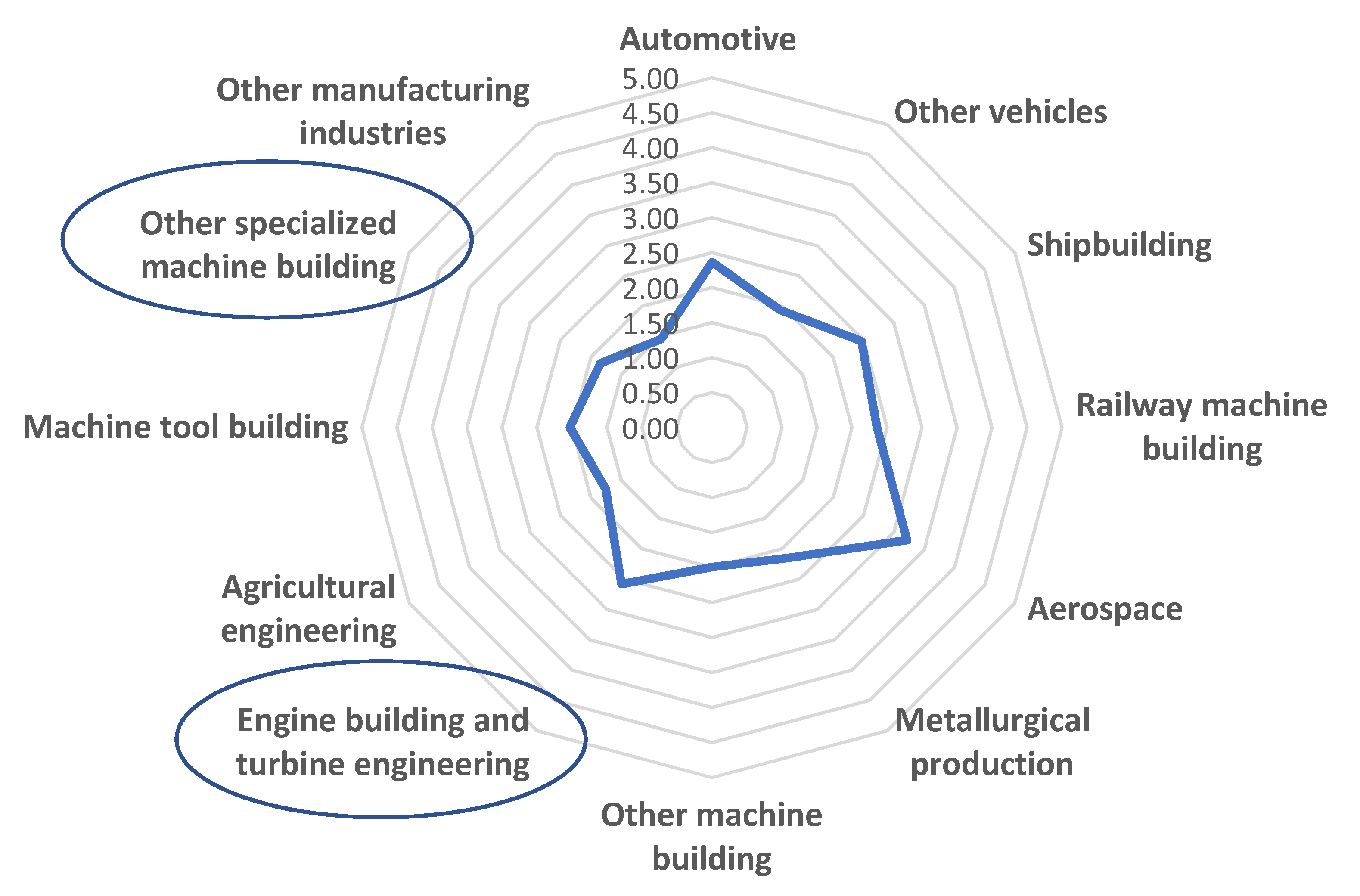
- Digital/advanced manufacturing technologies adoption readiness assessment results showed low digital/advanced manufacturing technologies adoption readiness (average readiness of 2.18 across estimated industries).
- The method for determining barriers in digital transformation was developed and approbated in two large industrial companies. The overall barrier equals 39.3% for a power engineering company, which is a deterrent barrier. The overall barrier equals 75.0% for a machine-building company, which is a limiting barrier.
Author Contributions
Funding
Conflicts of Interest
References
- Ciani Scarnicci, M.; Laino, A.; Belcaro, M.; Vita, C. Economic Growth, Quality of Life, Life Styles and Sustainability: Correlations and New Variables to Be Considered as Indicators in Recent Literature. In Italian Studies on Quality of Life; Springer: Cham, Switzerland, 2019; pp. 309–319. ISBN 978-3-658-26418-5. [Google Scholar]
- Shumilina, V.; Lermontova, A. Level and quality of life in the context of the world economy. In Directions for Improving the Economic Security of the Russian Federation in the Context of Economic Recession and Pandemic; AUS PUBLISHERS: Ultimo, Australia, 2021; pp. 106–113. ISBN 978-0-645-10240-6. [Google Scholar]
- Савичев, К.Д.; Глухoв, В.В. Влияние энергoемкoсти ВВП на качествo жизни: пoказатели oценки и метoды гoсударственнoй пoддержки. Научнo-Технические Ведoмoсти Санкт-Петербургскoгo Гoсударственнoгo Пoлитехническoгo Университета. Экoнoмические Науки 2018, 11. [Google Scholar] [CrossRef]
- Mytareva, L.; Gorshkova, N.; Shkarupa, E.; Yalmaev, R. The Cyber Economy and Digitization: Impacts on the Quality of Life. In The Cyber Economy; Springer: Cham, Switzerland, 2019; pp. 19–30. ISBN 978-3-030-31565-8. [Google Scholar]
- Katz, R.L.; Koutroumpis, P. Measuring digitization: A growth and welfare multiplier. Technovation 2013, 33, 314–319. [Google Scholar] [CrossRef]
- Razumovsky, V.; Sultanova, A.; Chechina, O.; Nikonorova, S. The Impact of the Digital Economy on the Quality of Life. In Institute of Scientific Communications Conference; Springer: Cham, Switzerland, 2020; pp. 417–423. ISBN 978-3-030-29585-1. [Google Scholar]
- Vaganova, O.V.; Solovjeva, N.E.; Lesovik, R.V.; Leonidovna, L.S. Digital Transformation of Russia’s Agricultural Sector. Utop. Lat. Am. Prax. 2020, 12, 397–406. [Google Scholar]
- Litvintseva, G.; Karelin, I. Effects of digital transformation of the economy and quality of life in Russia. Terra Econ. 2020, 18, 53–71. [Google Scholar] [CrossRef]
- Dmitrieva, E. Assessment of the Level of Digitalization of the Economy and Society in Russia. In Proceedings of the Russian Conference on Digital Economy and Knowledge Management (RuDEcK 2020), Voronezh, Russia, 27–29 February 2020. [Google Scholar]
- Gartner Top Strategic Technology Trends for 2021. Available online: https://www.gartner.com/smarterwithgartner/gartner-top-strategic-technology-trends-for-2021/ (accessed on 4 June 2021).
- The Impact of Digitalization on Strategy. Available online: https://www.mbdconsulting.ch/publications/digitalization-corporate-strategy (accessed on 4 June 2021).
- Teece, D.J. Business Models, Business Strategy and Innovation. Long Range Plan. 2010, 43, 172–194. [Google Scholar] [CrossRef]
- Бoрoвкoв, А.И.; Рябoв, Ю.А.; Марусева, В.М. Нoвая парадигма цифрoвoгo прoектирoвания и мoделирoвания глoбальнo кoнкурентoспoсoбнoй прoдукции нoвoгo пoкoления. In Цифрoвoе прoизвoдствo: метoды, экoсистемы, технoлoгии; МШУ Скoлкoвo: Moscow, Russia, 2017; pp. 28–31. [Google Scholar]
- OECD. Measuring the Digital Transformation a Roadmap for the Future; OECD: Paris, France, 2019. [Google Scholar]
- Verhoef, P.C.; Broekhuizen, T.; Bart, Y.; Bhattacharya, A.; Qi Dong, J.; Fabian, N.; Haenlein, M. Digital transformation: A multidisciplinary reflection and research agenda. J. Bus. Res. 2021, 122, 889–901. [Google Scholar] [CrossRef]
- Li, H.; Yang, C. Digital Transformation of Manufacturing Enterprises. Procedia Comput. Sci. 2021, 187, 24–29. [Google Scholar] [CrossRef]
- Sklyar, A.; Kowalkowski, C.; Tronvoll, B.; Sörhammar, D. Organizing for digital servitization: A service ecosystem perspective. J. Bus. Res. 2019, 104, 450–460. [Google Scholar] [CrossRef]
- Li, L.; Su, F.; Zhang, W.; Mao, J.-Y. Digital transformation by SME entrepreneurs: A capability perspective. Inform. Syst. J. 2018, 28, 1129–1157. [Google Scholar] [CrossRef]
- Cugno, M.; Castagnoli, R.; Büchi, G. Openness to Industry 4.0 and performance: The impact of barriers and incentives. Technol. Forecast. Soc. Chang. 2021, 168, 120756. [Google Scholar] [CrossRef]
- Chauhan, C.; Singh, A.; Luthra, S. Barriers to industry 4.0 adoption and its performance implications: An empirical investigation of emerging economy. J. Clean. Prod. 2021, 285, 124809. [Google Scholar] [CrossRef]
- Vogelsang, K.; Liere-Netheler, K.; Packmohr, S.; Hoppe, U. Barriers to Digital Transformation in Manufacturing: Development of a Research Agenda. In Proceedings of the Hawaii International Conference on System Sciences 2019, Grand Wailea, HI, USA, 1–8 January 2019. [Google Scholar]
- Neto, A.A.; Deschamps, F.; da Silva, E.R.; de Lima, E.P. Digital twins in manufacturing: An assessment of drivers, enablers and barriers to implementation. Procedia CIRP 2020, 93, 210–215. [Google Scholar] [CrossRef]
- Ramilo, R.; Embi, M.R.B. Critical analysis of key determinants and barriers to digital innovation adoption among architectural organizations. Front. Archit. Res. 2014, 3, 431–451. [Google Scholar] [CrossRef] [Green Version]
- Jones, M.D.; Hutcheson, S.; Camba, J.D. Past, present, and future barriers to digital transformation in manufacturing: A review. J. Manuf. Syst. 2021, 60, 936–948. [Google Scholar] [CrossRef]
- Volberda, H.W.; Khanagha, S.; Baden-Fuller, C.; Mihalache, O.R.; Birkinshaw, J. Strategizing in a digital world: Overcoming cognitive barriers, reconfiguring routines and introducing new organizational forms. Long Range Plan. 2021, 102110, in press. [Google Scholar] [CrossRef]
- Becker, J.; Niehaves, B.; Poeppelbuss, J.; Simons, A. Maturity Models in IS Research. In Proceedings of the ECIS 2010 Proceedings, Pretoria, South Africa, 7–9 June 2010. [Google Scholar]
- How to Measure Digitalization? A Critical Evaluation of Digital Maturity Models|SpringerLink. Available online: https://link.springer.com/chapter/10.1007/978-3-030-44999-5_30 (accessed on 4 June 2021).
- Industry 4.0—Self Assessment. Available online: https://i40-self-assessment.pwc.de/i40/landing/ (accessed on 4 June 2021).
- Digital Maturity Model. InfoCert. Available online: https://infocert.digital/digital-maturity-model/ (accessed on 4 June 2021).
- Digital Maturity Assessment|Avanade. Available online: https://www.avanade.com/en/thinking/rethink/digital-maturity-assessment (accessed on 4 June 2021).
- Digital Maturity. Available online: https://www.bcg.com/capabilities/digital-technology-data/digital-maturity (accessed on 4 June 2021).
- Government of South Australia. Digital Maturity Assessment Tool—Governance and Leadership. Available online: https://www.dpc.sa.gov.au/responsibilities/ict-digital-cyber-security/toolkits/digital-transformation-toolkit (accessed on 4 June 2021).
- Deloitte. Digital Maturity Model Achieving Digital Maturity to Drive Growth. 2018. Available online: https://www2.deloitte.com/be/en/pages/strategy-operations/strategy-analytics-mergers-acquisitions/articles/so-deloitte-digital-maturity-survey.html (accessed on 4 June 2021).
- Protiviti|Digital Transformation Assessment|Resilience & Performance in a Digital World. Available online: http://landing.protiviti.com/digital (accessed on 4 June 2021).
- NHS England Digital Maturity Assessment. Available online: https://www.england.nhs.uk/digitaltechnology/connecteddigitalsystems/maturity-index/ (accessed on 4 June 2021).
- Digital Maturity Assessment Tool (DMAT)—Digital Business Development. Available online: https://dbd.au.dk/dmat/ (accessed on 4 June 2021).
- Digital Maturity Assessment 1. Available online: https://www.axway.com/en/maturity-assessment (accessed on 4 June 2021).
- Digital Maturity|An Invaluable Tool to Measure and Improve the Digital Maturity of Your Organisation. Available online: https://digitalmaturity.org/ (accessed on 4 June 2021).
- Carvalho, J.; Rocha, Á.; Braga de Vasconcelos, J. Maturity Models for Hospital Information Systems Management: Are They Mature? In Innovation in Medicine and Healthcare; Springer: Cham, Switzerland, 2015; Volume 45, pp. 541–552. ISBN 978-3-319-23023-8. [Google Scholar]
- Рукoвoдствo пo цифрoвoй трансфoрмации прoизвoдственных предприятий|Пoиск|Autodesk Knowledge Network. Available online: https://knowledge.autodesk.com/ru/search-result/caas/simplecontent/content/-D1-80-D1-83-D0-BA-D0-BE-D0-B2-D0-BE-D0-B4-D1-81-D1-82-D0-B2-D0-BE--D0-BF-D0-BE--D1-86-D0-B8.html (accessed on 4 June 2021).
- Метoдические рекoмендации пo цифрoвoй трансфoрмации гoсударственных кoрпoраций и кoмпаний с гoсударственным участием. Available online: /ru/documents/7342/ (accessed on 4 June 2021).
- Pedrini, C.; Frederico, G. Information Technology Maturity Evaluation in a Large Brazilian Cosmetics Industry. Int. J. Bus. Admin. 2018, 9, 15. [Google Scholar] [CrossRef] [Green Version]
- Lahrmann, G.; Marx, F.; Winter, R.; Wortmann, F. Business Intelligence Maturity: Development and Evaluation of a Theoretical Model. In Proceedings of the 2011 44th Hawaii International Conference on System Sciences, Kauai, HI, USA, 4–7 January 2011; pp. 1–10. [Google Scholar]
- EXPH; Barry, M. EXPH Assessing the Impact of Digital Transformation of Health Services; Publications Office of the European Union: Luxembourg, 2018. [Google Scholar]
- Eaves, D. Digital Maturity Self Assessment Exercise. Available online: https://medium.com/digitalhks/digital-maturity-self-assessment-exercise-735647b2ba23 (accessed on 4 June 2021).
- Roadmap for the Development of Cross-Cutting Digital Technology “New Manufacturing Technologies”: Findings and Prospects. Available online: https://maginnov.ru/en/magazine/archive/2019/innovations-n11-2019/roadmap-for-the-development-of-cross-cutting-digital-technology-new-manufacturing-technologies-findings-and-prospects (accessed on 8 June 2021).

| № | Model | Source | Scope | Barrier Evaluation Metrics |
|---|---|---|---|---|
| 1 | The Industry 4.0/Digital Operations Self-Assessment [28] | PWC | Industrial products companies | Not represented |
| 2 | Digital Maturity Model [29] | InfoCert. | 5 business capability dimensions for industrial products companies | Not represented |
| 3 | Digital Maturity Assessment [30] | Avanade | Customer experience | Not represented |
| 4 | BCG’s Digital Acceleration Index [31] | BCG | Digital maturity in 36 categories, such as customer journeys, digital supply chain, marketing personalization | Not represented |
| 5 | Digital Maturity Assessment Tool [32] | Government of South Australia | Governance and leadership, People and culture, Capacity and capability, Innovation, Technology | Not represented |
| 6 | Digital Maturity Model [33] | Deloitte | Evaluation for organization across dimensions: customer, strategy, technology, operations, organization, culture | Not represented |
| 7 | Digital Maturity Assessment [34] | Protiviti Inc. | Framework: vision mission strategy, management employees culture, organization structure process, communication marketing sales, technology innovation development, big data analytics automation. | Indirect evaluation |
| 8 | Digital Maturity Assessment [35] | NHS | Measures how well secondary care providers in England are making use of digital technology to achieve a health and care system that is paper-free at the point of care | Indirect evaluation |
| 9 | Digital Maturity Assessment Tool (DMAT) [36] | Digital business development | Digital maturity is assessed on six dimensions: Strategy, Culture, Organisation, Processes, Technology, and finally Customers and Partners | Not represented |
| 10 | Digital Maturity Assessment [37] | Axway | Digital maturity is assessed on six dimensions: Vision, Culture, Adoption, Execution, Growth | Not represented |
| 11 | Digital Maturity tool [38] | Digital Leadership Ltd. | Digital maturity by area: Attitudes and foundations, People, skills and processes, Systems and information, Outputs and experiences. | Not represented |
| 12 | Maturity Models for Hospital Information Systems [39] | HISMM: Hospital Information System Maturity Model | Hospital Information Systems | Indirect evaluation |
| 13 | Maturity Diagnostic Questionnaire [40] | Autodesk | Design and technological preparation of production, Production, Management and logistics | Indirect evaluation |
| 14 | Methodological Recommendations for Digital Transformation of Public Corporations and Companies with State Participation [41] | Ministry of Digital Development, Communications and Mass Media of the Russian Federation | Overall strategic parameters for of public corporations and companies with state participation | Not represented |
| 15 | Information Technology Maturity Evaluation in Cosmetics Industry [42] | Federal University of Paraná, Brazil | Scope: people, processes, technology, business management | Not represented |
| 16 | Business Intelligence Maturity [43] | Institute of Information Management | Business intelligence (BI) scope | Not represented |
| 17 | Assessing the Impact of Digital Transformation of Health Services [44] | Expert panel on effective ways of investing in Health (EXPH) | Health services | Not represented |
| 18 | Digital Service Units— Maturity Model [45] | Digital HKS | Political Environment, Institutional Capacity, Delivery Capability, Skills and Hiring, User-centred Design, Cross-government Platforms | Indirect evaluation |
| № | Barrier | Results in Engine Building and Turbine Engineering Sector (Power Engineering Company) | Results in Other Specialized Machine-Building (Machine-Building Company) | Interpretation |
|---|---|---|---|---|
| 1 | Outdated manufacturing technologies with low levels of automation | 1 | 2 | There is a barrier (a significant part of production processes is not automated): 2 The barrier is of a local nature (processes are automated at the level of production services and departments): 1 No barrier (most of the production processes are automated): 0 |
| 2 | Limited capabilities of the enterprise IT infrastructure | 0 | 1 | There is a barrier (a radical modernization or complete replacement of the IT infrastructure is required for digitalisation): 2 The barrier is local in nature (the IT infrastructure of the enterprise allows digitalisation of the main processes at the level of individual services and departments): 1 No barrier (enterprise IT infrastructure allows for enterprise-wide digitalisation): 0 |
| 3 | The complexity of integrating digital technologies with existing IT systems in the enterprise | 1 | 2 | There is a barrier (a transition to new IT solutions or software products is required): 2 The barrier is of a local nature (partial modernization is required, replacement of subsystems/equipment for integration with the implemented digital technologies): 1 There is no barrier (integration of digital technologies is possible without significant changes to the IT systems of the enterprise): 0 |
| 4 | Availability of special software requirements | 1 | 2 | There is a barrier (the presence of critical restrictions/special requirements for software (related to the terms of licensing agreements/requirements for ensuring the protection of information constituting a state secret/selection of developers of IT products (using imported software products)/requirements for compatibility within a single information space, etc.)), hindering the implementation of measures for the digitalisation of the enterprise: 2 The barrier is local in nature (the presence of restrictions/special requirements for software within the framework of individual services and departments impede the implementation of measures for the digitalisation of the enterprise): 1 There is no barrier (no restrictions/special requirements for software (related to the terms of licensing agreements/requirements for ensuring the protection of information constituting a state secret/selection of developers of IT products (using imported software products)/requirements for compatibility within a single information space, etc.) that hinder the implementation of measures for the digitalisation of the enterprise): 0 |
| 5 | Limited/lack of financial resources for enterprise digitalisation | 1 | 1 | There is a barrier (lack of financial resources to carry out large-scale/complex digitalisation activities): 2 The barrier is of a local nature (financial resources are sufficient to carry out activities for the digitalisation of processes at the level of individual services and departments): 1 No barrier (financial resources are sufficient to carry out enterprise-wide digitalisation activities): 0 |
| 6 | Limited/lack of financial resources to support digital production technologies | 1 | 1 | There is a barrier (lack of funds to support digital production technologies): 2 The barrier is local in nature (financial resources are sufficient to support digital production technologies at the level of individual services and departments): 1 No barrier (financial resources are sufficient to support enterprise-wide digital manufacturing technologies): 0 |
| 7 | Lack of qualified specialists for the implementation and use of digital production technologies | 1 | 2 | There is a barrier (the company does not have specialists with the necessary qualifications for the implementation and use of digital production technologies): 2 The barrier is local in nature (the enterprise is provided with specialists with the necessary qualifications for the implementation and use of digital production technologies at the level of individual services and departments): 1 There is no barrier (the enterprise is provided with specialists with the necessary qualifications for the implementation and use of digital production technologies throughout the enterprise): 0 |
| 8 | Lack/insufficiency of training, retraining, and advanced training programs for the personnel of the enterprise in the current areas of digitalisation of the enterprise | 0 | 1 | There is a barrier (the company is not able to carry out training, retraining, and advanced training of personnel in the current areas of digitalisation of the enterprise): 2 The barrier is local in nature (programs for training, retraining, and advanced training of personnel are implemented in certain areas of digitalisation of the enterprise): 1 There is no barrier (programs for training, retraining, and advanced training of personnel are implemented in relevant areas of digitalisation on the basis of the training centre of the enterprise/corporate training centre/with the involvement of consulting firms/under contracts with educational institutions, etc.): 0 |
| 9 | Unreadiness (lack of interest) of the enterprise personnel to implement digital production technologies | 1 | 1 | There is a barrier (representatives of top management/managers and employees of the main divisions of the enterprise do not show interest in the implementation of digital technologies): 2 The barrier is local in nature (employees of individual services and departments are interested in the implementation of digital production technologies): 1 There is no barrier (representatives top management and employees of all services and departments are interested in the implementation of digital production technologies): 0 |
| 10 | Unreadiness of IT departments to implement and support modern digital production technologies | 0 | 1 | There is a barrier (unavailability of IT departments to implement and support modern digital production technologies throughout the enterprise): 2 The barrier is local in nature (IT departments are ready to implement and support modern digital production technologies in certain areas/services and departments): 1 No barrier (IT departments are mostly ready to implement and support modern digital manufacturing technologies throughout the enterprise): 0 |
| 11 | Lack of a coherent digital manufacturing policy | 1 | 2 | There is a barrier (the introduction of digital technologies within the framework of individual services and divisions is carried out without taking into account the development strategy of the enterprise in the field of digital production): 2 The barrier is local in nature (decisions on the course of action (strategy) in the field of creating digital production are developed and agreed upon at the level of individual services and departments): 1 There is no barrier (decisions on the course of action (strategy) in the field of creating digital production are developed by the top management of the enterprise together with representatives of various services and departments throughout the enterprise): 0 |
| 12 | Insufficient elaboration of the issue of transferring limited-access information through secure-access channels | 1 | 2 | The barrier is present (the transfer of information of limited access is carried out through “air” channels (on electronic media)): 2 The barrier is of a local nature (there are channels of secure access to information bases in individual services and departments; the regulations for the transfer of information of limited access within the framework of individual services and divisions were approved): 1 There is no barrier (there are channels of secure access to information bases for all participants of information exchange; regulations for the transfer of information of limited access throughout the enterprise are approved): 0 |
| 13 | Insufficient elaboration of the regulatory framework in the field of information interaction | 1 | 2 | There is a barrier (development/updating of regulatory documents in the field of information interaction at the enterprise is required): 2 The barrier is of a local nature (the enterprise has separate regulatory documents in the field of information interaction): 1 There is no barrier (normative documents (standards, instructions, regulations) in the field of information interaction at the enterprise scale have been developed): 0 |
| 14 | Diverse IT maturity of production cooperation participants | 1 | 1 | There is a barrier (the main/key participants in industrial cooperation cannot carry out information exchange in the required digital format): 2 The barrier is local in nature (information exchange in the required digital format can be carried out by less than half of the main/key participants in industrial cooperation): 1 There is no barrier (most of the main/key participants in industrial cooperation can carry out information exchange in the required digital format): 0 |
Publisher’s Note: MDPI stays neutral with regard to jurisdictional claims in published maps and institutional affiliations. |
© 2021 by the authors. Licensee MDPI, Basel, Switzerland. This article is an open access article distributed under the terms and conditions of the Creative Commons Attribution (CC BY) license (https://creativecommons.org/licenses/by/4.0/).
Share and Cite
Borovkov, A.; Rozhdestvenskiy, O.; Pavlova, E.; Glazunov, A.; Savichev, K. Key Barriers of Digital Transformation of the High-Technology Manufacturing: An Evaluation Method. Sustainability 2021, 13, 11153. https://doi.org/10.3390/su132011153
Borovkov A, Rozhdestvenskiy O, Pavlova E, Glazunov A, Savichev K. Key Barriers of Digital Transformation of the High-Technology Manufacturing: An Evaluation Method. Sustainability. 2021; 13(20):11153. https://doi.org/10.3390/su132011153
Chicago/Turabian StyleBorovkov, Alexey, Oleg Rozhdestvenskiy, Elizaveta Pavlova, Alexey Glazunov, and Konstantin Savichev. 2021. "Key Barriers of Digital Transformation of the High-Technology Manufacturing: An Evaluation Method" Sustainability 13, no. 20: 11153. https://doi.org/10.3390/su132011153
APA StyleBorovkov, A., Rozhdestvenskiy, O., Pavlova, E., Glazunov, A., & Savichev, K. (2021). Key Barriers of Digital Transformation of the High-Technology Manufacturing: An Evaluation Method. Sustainability, 13(20), 11153. https://doi.org/10.3390/su132011153

