Electric Load Influence on Performances of a Composite Plant for Hydrogen Production from RES and its Conversion in Electricity


 , ,
, ,
Abstract
1. Introduction
2. Methodology
3. The Case-Study Plant
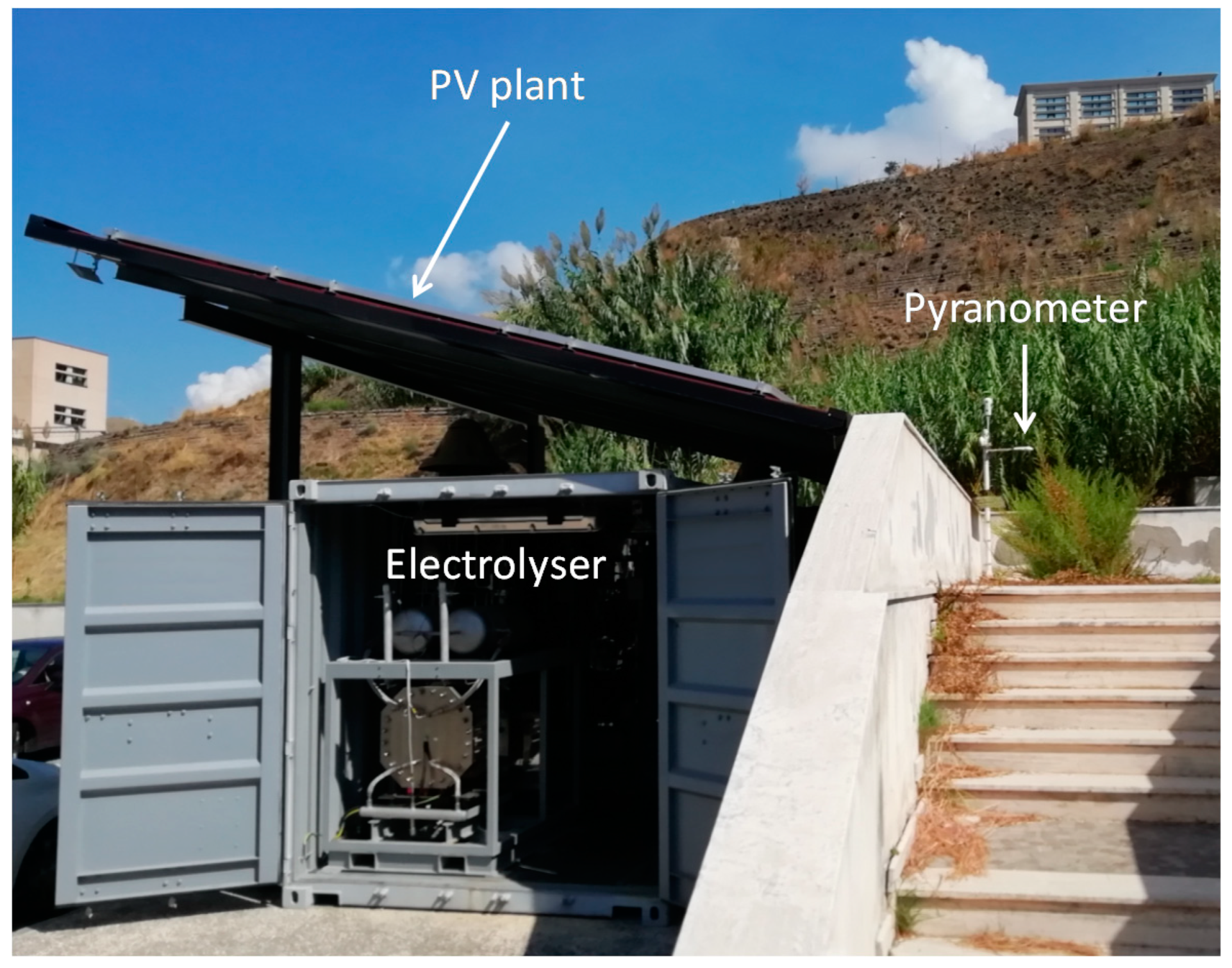
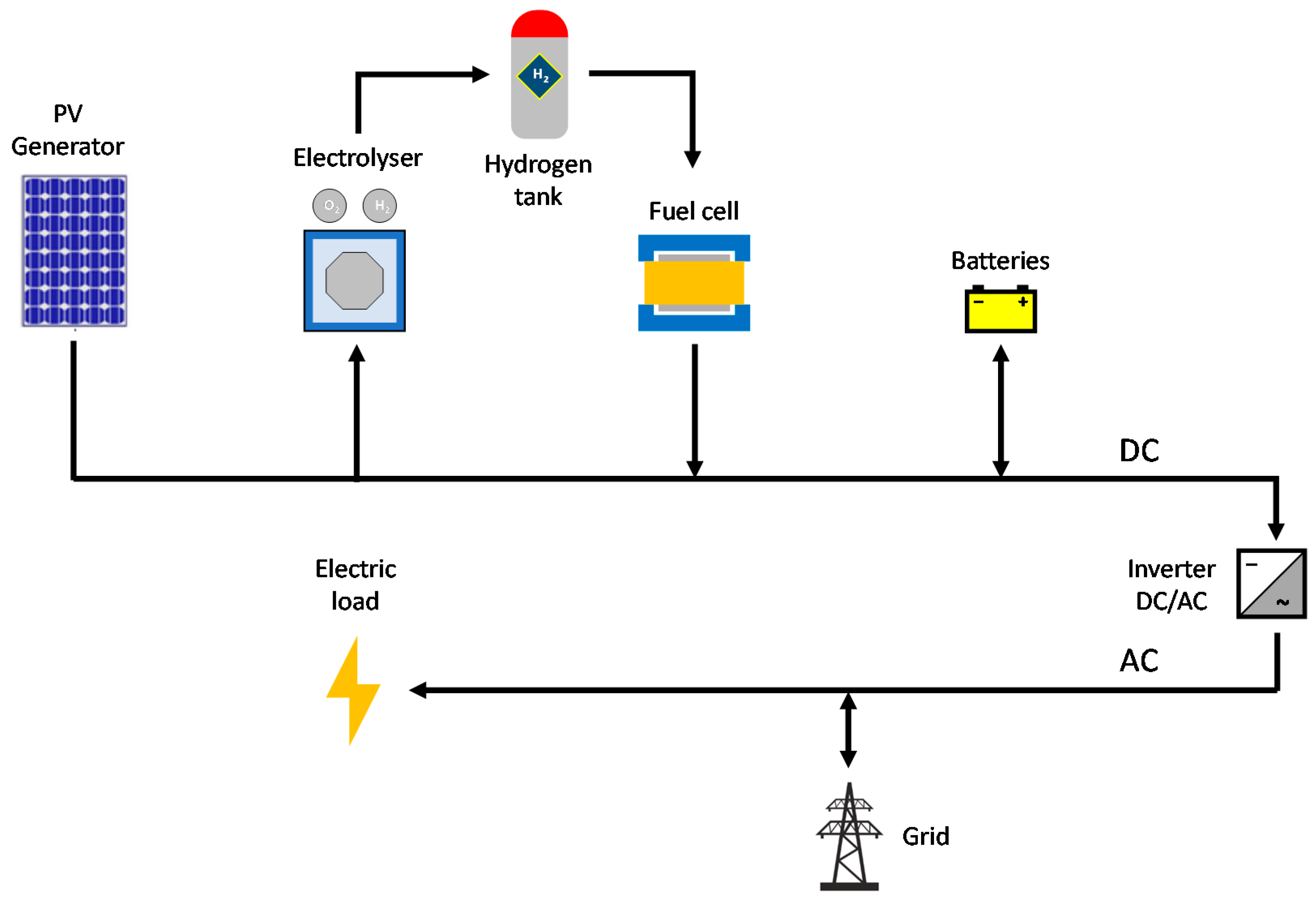
3.1. The Mediterranean University’s Plant
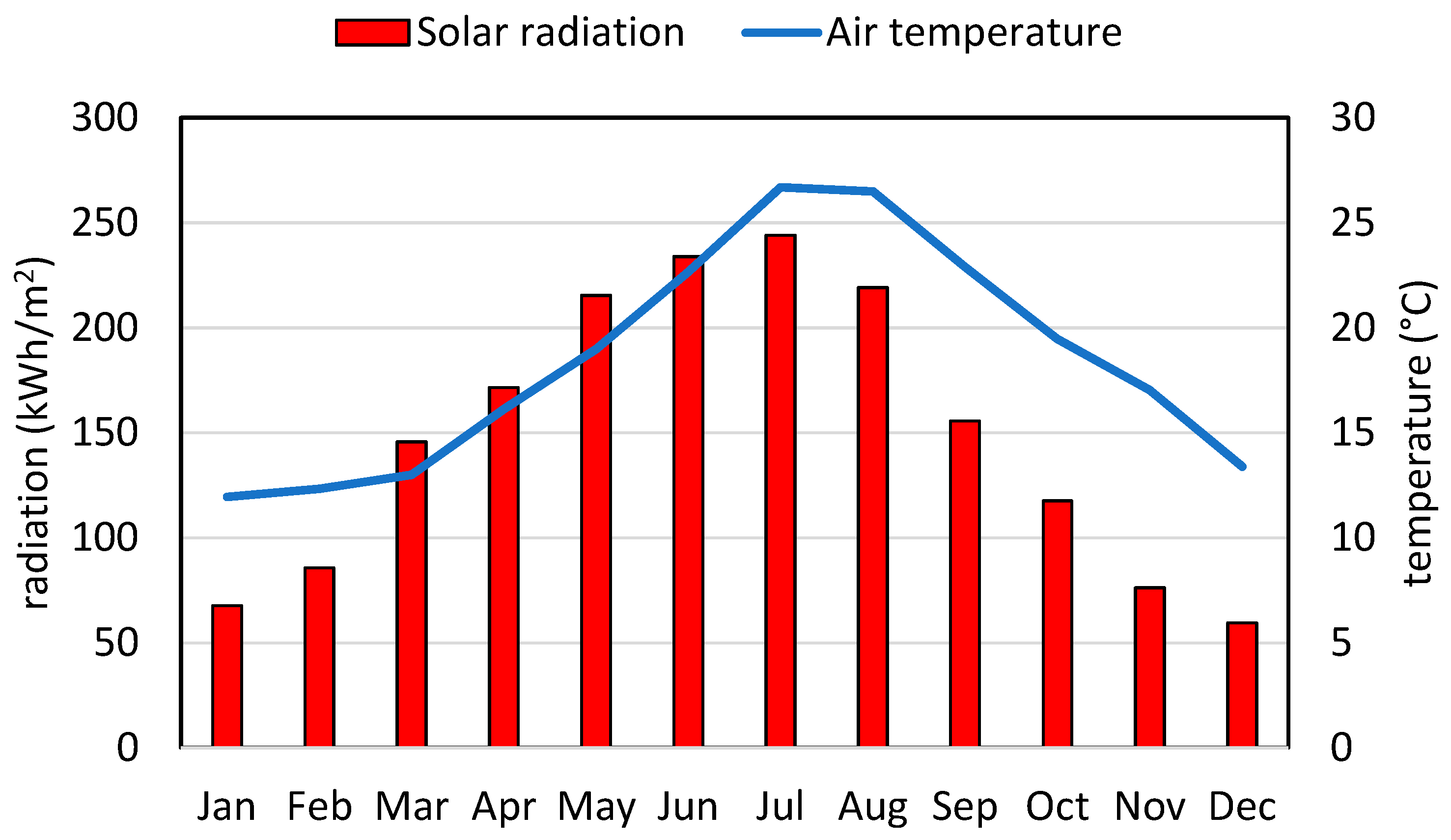
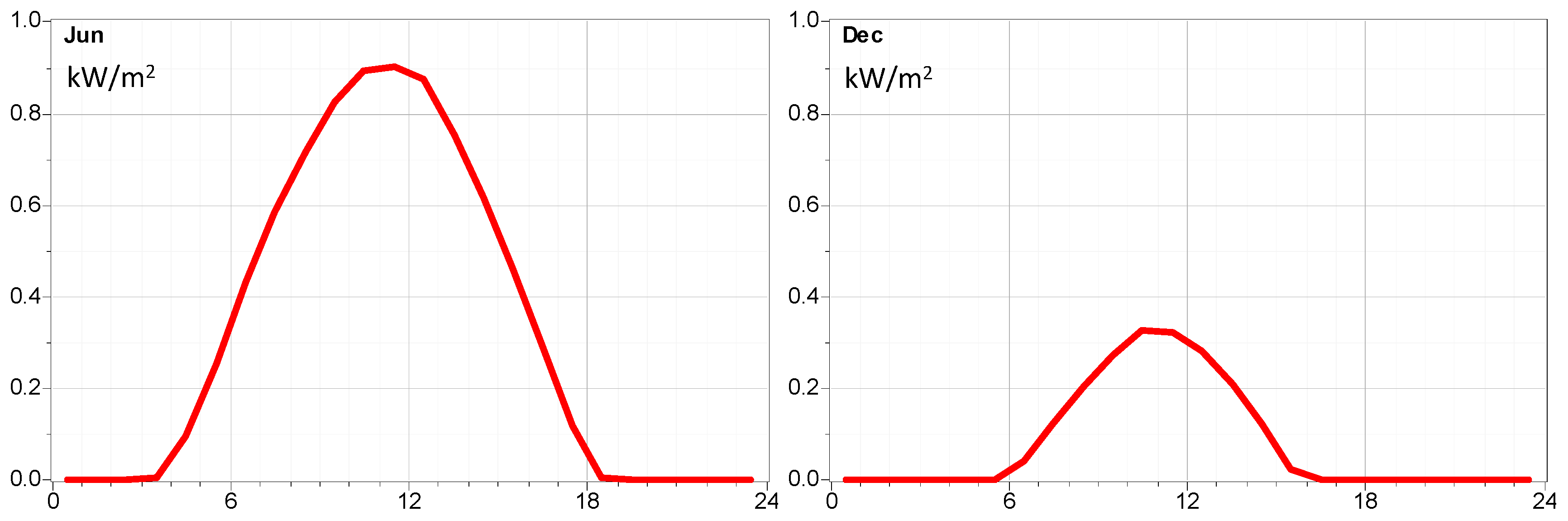
3.2. Site Weather Features
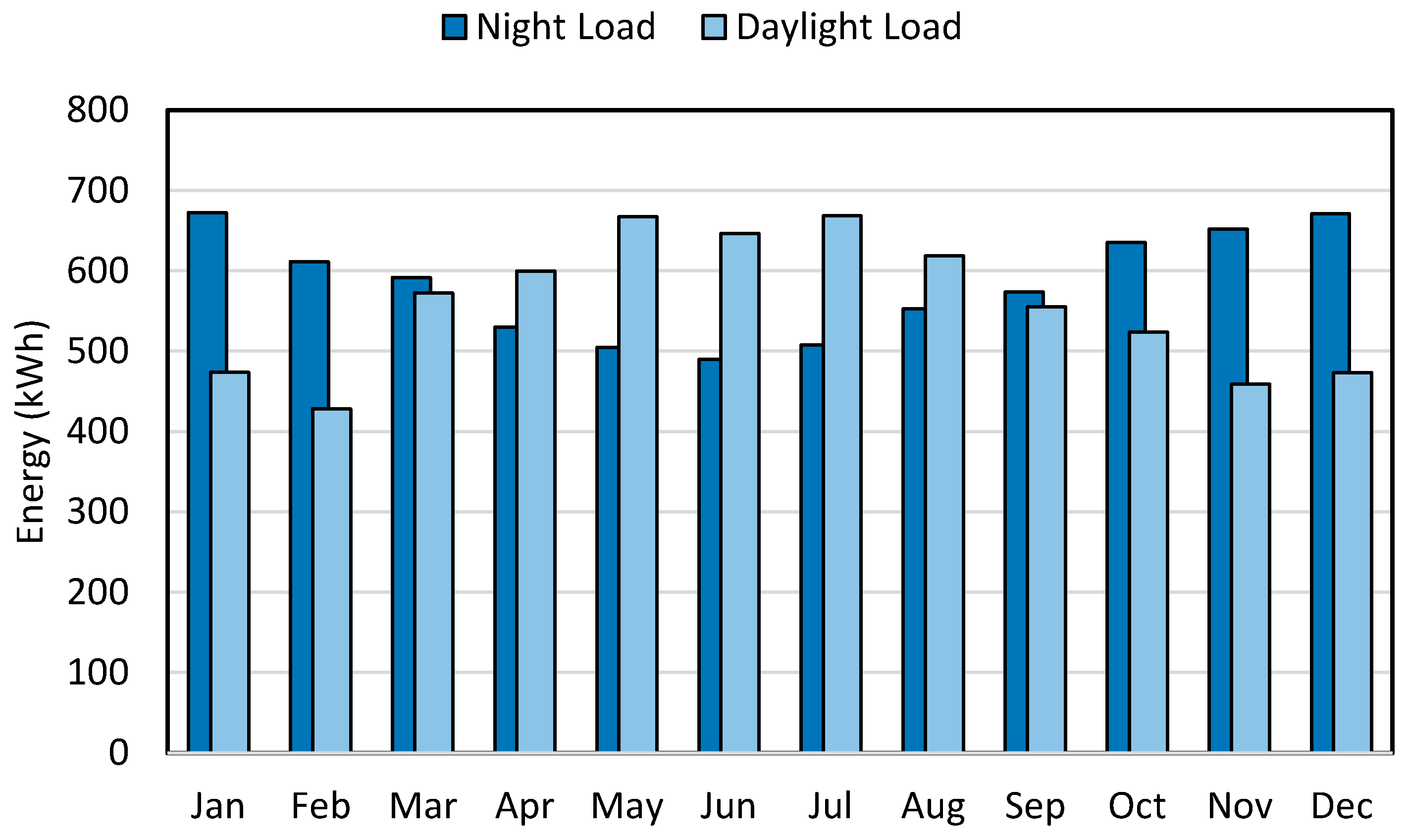
3.3. Load Configurations
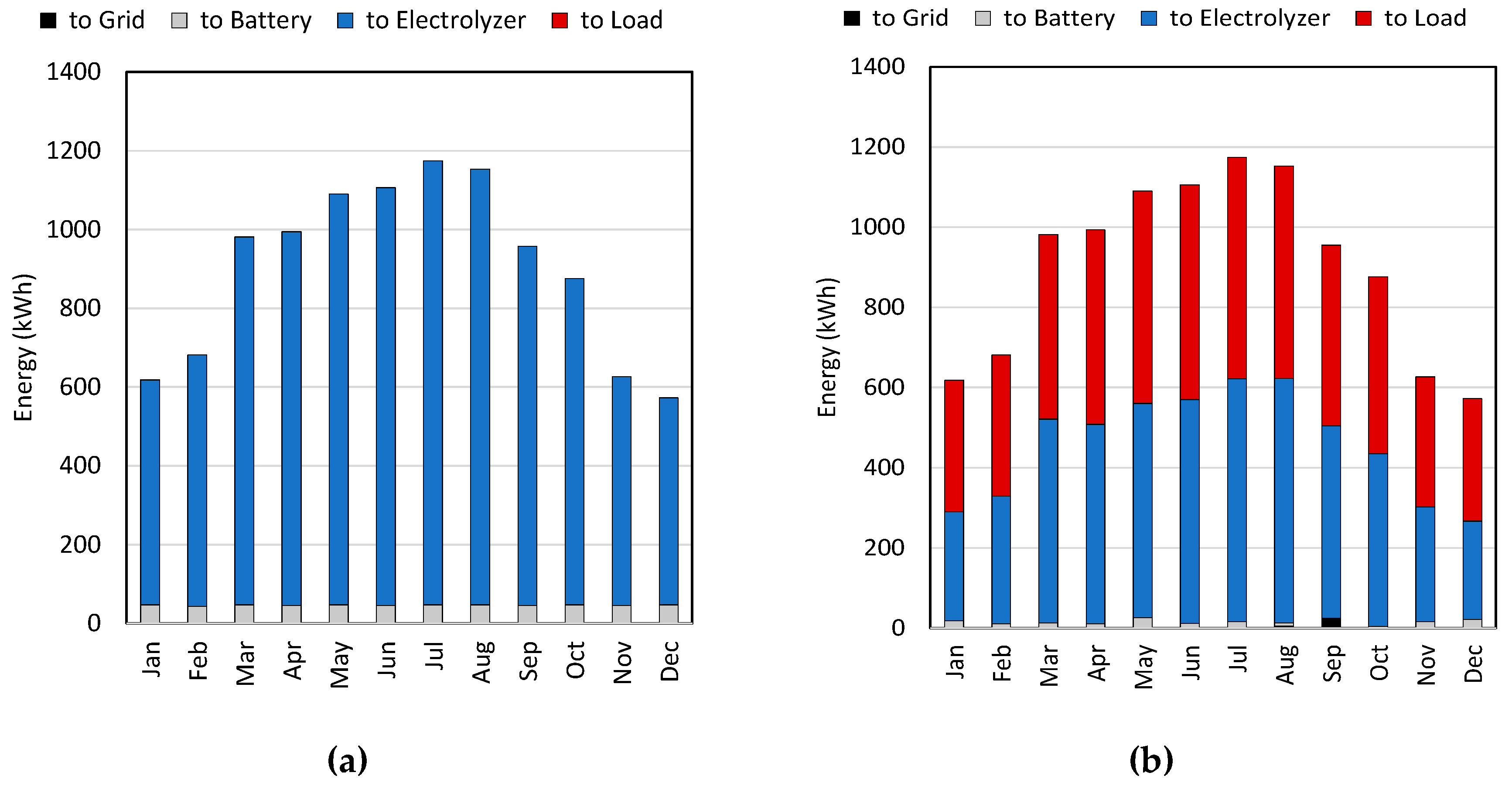
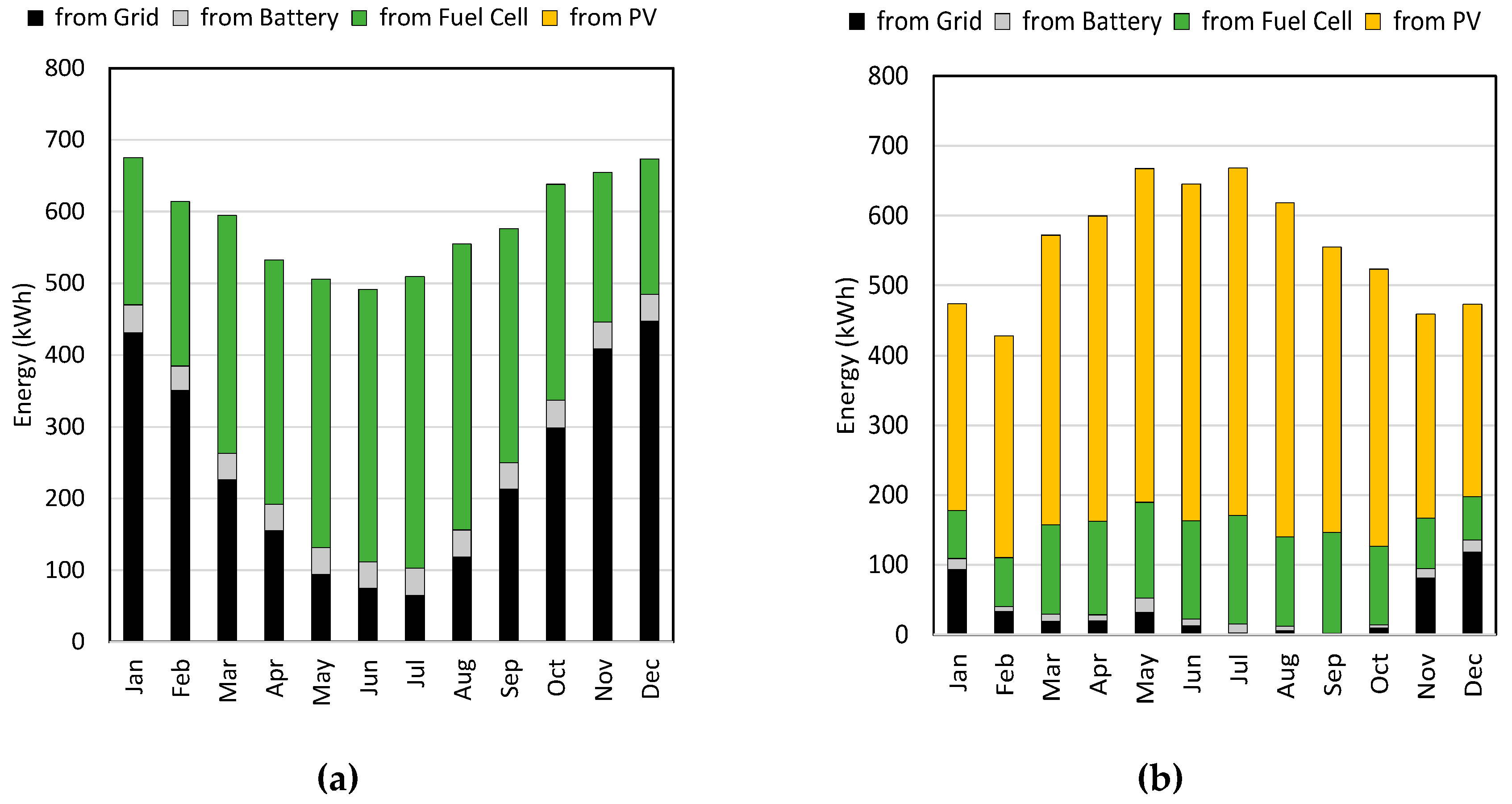
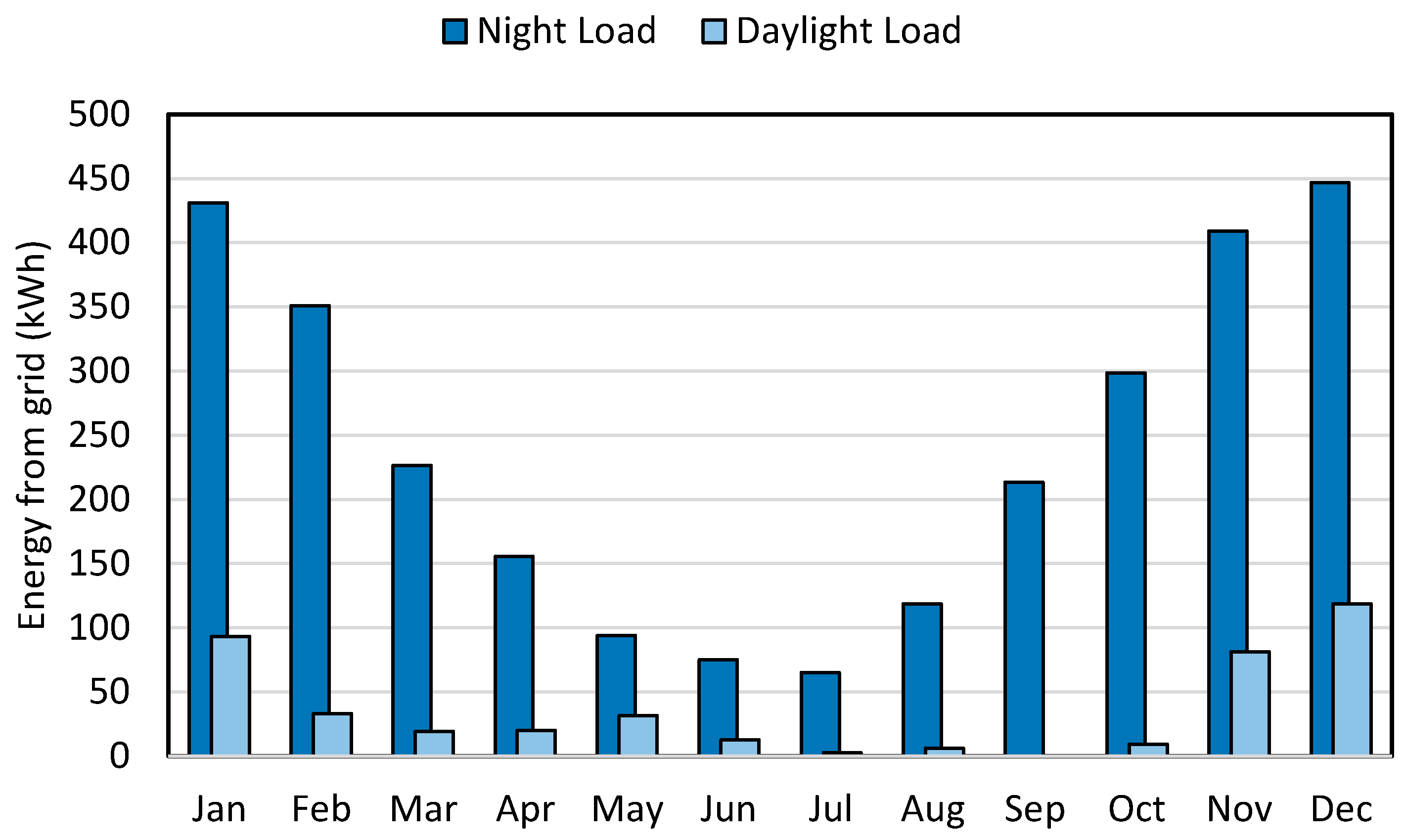
4. Simulation Results
5. Discussion
- is the annual PV array production (kWh/yr);
- is the annual electric energy produced by the Fuel Cell (kWh/yr);
- is the annual electric energy purchased from the grid (kWh/yr).
6. Conclusions
- Firstly, in the current configuration, the share of renewable energy resulted greater than 80% in all the examined cases (it reaches 93% in case of daylight load configuration). This is an encouraging outcome in view of achieving a self-sufficient arrangement.
- Load configuration played a pivotal role in the system operation mode: the mere variation of the load activation period caused substantial difference in the modality with which the load demand is satisfied by the different energy sources constituting the system.
- The current configuration of the system seems to be suited to feed loads which persist prevalently during daytime, whereas to feed loads prevalently confined to nighttime, the production of hydrogen should be improved.
- There is space to improve the hydrogen production, since the hydrogen tank capacity is rarely saturated. Saturation only occurs in summer in the case of daylight load configuration. In order to fulfill the task, enlarging the PV array surface appears to be the best course of action, also considering its simpler technical feasibility.
- In this direction, the design of future development of the system structure should be oriented. However, it is worth noting that every definitive conclusion in this regard is to be supported by future experimental data, whose acquisition is the upcoming step of the current research activity.
Author Contributions
Funding
Conflicts of Interest
References
- Gössling, S. 7-Rights, Authority, and the Police. In The Psychology of the Car; Gössling, S., Ed.; Elsevier: Amsterdam, The Netherlands, 2017; pp. 139–169. ISBN 978-0-12-811008-9. [Google Scholar]
- Hvelplund, F. Renewable energy and the need for local energy markets. Energy 2006, 31, 2293–2302. [Google Scholar] [CrossRef] [Scilit]
- Lund, H. The implementation of renewable energy systems. Lessons learned from the Danish case. Energy 2010, 35, 4003–4009. [Google Scholar] [CrossRef] [Scilit]
- Foley, A.; Olabi, A.G. Renewable energy technology developments, trends and policy implications that can underpin the drive for global climate change. Renew. Sustain. Energy Rev. 2017, 68, 1112–1114. [Google Scholar] [CrossRef] [Scilit]
- Narayanan, A.; Mets, K.; Strobbe, M.; Develder, C. Feasibility of 100% renewable energy-based electricity production for cities with storage and flexibility. Renew. Energy 2019, 134, 698–709. [Google Scholar] [CrossRef] [Scilit]
- da Silva, C.G. Renewable energies: Choosing the best options. Energy 2010, 35, 3179–3193. [Google Scholar] [CrossRef] [Scilit]
- European Parliament and the Council of the European Union. The promotion of the use of energy from renewable sources. Off. J. Eur. Union 2018, 61, 82–209. [Google Scholar]
- Malara, A.; Marino, C.; Nucara, A.; Pietrafesa, M.; Scopelliti, F.; Streva, G. Energetic and economic analysis of shading effects on PV panels energy production. Int. J. Heat Technol. 2016, 34, 465–472. [Google Scholar] [CrossRef] [Scilit]
- Gelazanskas, L.; Gamage, K.A.A. Demand side management in smart grid: A review and proposals for future direction. Sustain. Cities Soc. 2014, 11, 22–30. [Google Scholar] [CrossRef] [Scilit]
- Siano, P. Demand response and smart grids—A survey. Renew. Sustain. Energy Rev. 2014, 30, 461–478. [Google Scholar] [CrossRef] [Scilit]
- Gattuso, D.; Greco, A.; Marino, C.; Nucara, A.; Pietrafesa, M.; Scopelliti, F. Sustainable mobility: Environmental and economic analysis of a cable railway, powered by photovoltaic system. Int. J. Heat Technol. 2016, 34, 7–14. [Google Scholar] [CrossRef] [Scilit]
- Briggs, I.; Murtagh, M.; Kee, R.; McCulloug, G.; Douglas, R. Sustainable non-automotive vehicles: The simulation challenges. Renew. Sustain. Energy Rev. 2017, 68, 840–851. [Google Scholar] [CrossRef] [Scilit]
- Sinigaglia, T.; Lewiski, F.; Martins, M.E.S.; Siluk, J.C.M. Production, storage, fuel stations of hydrogen and its utilization in automotive applications—A review. Int. J. Hydrogen Energy 2017, 42, 24597–24611. [Google Scholar] [CrossRef] [Scilit]
- International Energy Agency. Transition to Sustainable Buildings; International Energy Agency: Paris, France, 2013. [Google Scholar]
- Energy Roadmap 2050; European Commission Communication from the Commission to the European Parliament, the Council, the European Economic and Social Committee and the Committee of the Regions: Brussels, Belgium, 2011.
- Marszal, A.J.; Heiselberg, P.; Bourrelle, J.S.; Musall, E.; Voss, K.; Sartori, I.; Napolitano, A. Zero Energy Building—A review of definitions and calculation methodologies. Energy Build. 2011, 43, 971–979. [Google Scholar] [CrossRef] [Scilit]
- Sartori, I.; Napolitano, A.; Voss, K. Net zero energy buildings: A consistent definition framework. Energy Build. 2012, 48, 220–232. [Google Scholar] [CrossRef] [Scilit]
- Kolokotsa, D.; Rovas, D.; Kosmatopoulos, E.; Kalaitzakis, K. A roadmap towards intelligent net zero- and positive-energy buildings. Sol. Energy 2011, 85, 3067–3084. [Google Scholar] [CrossRef] [Scilit]
- Marino, C.; Nucara, A.; Panzera, M.F.; Pietrafesa, M. Towards the nearly zero and the plus energy building: Primary energy balances and economic evaluations. Therm. Sci. Eng. Prog. 2019, 13, 100400. [Google Scholar] [CrossRef] [Scilit]
- Mathiesen, B.V.; Duić, N.; Stadler, I.; Rizzo, G.; Guzović, Z. The interaction between intermittent renewable energy and the electricity, heating and transport sectors. Energy 2012, 48, 2–4. [Google Scholar] [CrossRef] [Scilit]
- Krajačić, G.; Lončar, D.; Duić, N.; Zeljko, M.; Arántegui, R.L.; Loisel, R.; Raguzin, I. Analysis of financial mechanisms in support to new pumped hydropower storage projects in Croatia. Appl. Energy 2013, 101, 161–171. [Google Scholar] [CrossRef] [Scilit]
- Foley, A.; Lobera, I.D. Impacts of compressed air energy storage plant on an electricity market with a large renewable energy portfolio. Energy 2013, 57, 85–94. [Google Scholar] [CrossRef] [Scilit]
- López-Sabirón, A.M.; Royo, P.; Ferreira, V.J.; Aranda-Usón, A.; Ferreira, G. Carbon footprint of a thermal energy storage system using phase change materials for industrial energy recovery to reduce the fossil fuel consumption. Appl. Energy 2014, 135, 616–624. [Google Scholar] [CrossRef] [Scilit]
- Carbone, R. PV plants with distributed MPPT founded on batteries. Sol. Energy 2015, 122, 910–923. [Google Scholar] [CrossRef] [Scilit]
- Ogawa, T.; Takeuchi, M.; Kajikawa, Y. Analysis of trends and emerging technologies in water electrolysis research based on a computational method: A comparison with fuel cell research. Sustainability 2018, 10, 478. [Google Scholar] [CrossRef] [Scilit]
- Wulf, C.; Kaltschmitt, M. Hydrogen supply chains for mobility-Environmental and economic assessment. Sustainability 2018, 10, 1699. [Google Scholar] [CrossRef] [Scilit]
- Saeedmanesh, A.; Mac Kinnon, M.A.; Brouwer, J. Hydrogen is essential for sustainability. Curr. Opin. Electrochem. 2018, 12, 166–181. [Google Scholar] [CrossRef] [Scilit]
- Gómez-Camacho, C.E.; Ruggeri, B. Energy Sustainability Analysis (ESA) of Energy-Producing Processes: A Case Study on Distributed H2 Production. Sustainability 2019, 11, 4911. [Google Scholar] [CrossRef] [Scilit]
- Carroquino, J.; Bernal-Agustín, J.L.; Dufo-López, R. Standalone Renewable Energy and Hydrogen in an Agricultural Context: A Demonstrative Case. Sustainability 2019, 11, 951. [Google Scholar] [CrossRef] [Scilit]
- Raj, A.S.; Ghosh, P.C. Standalone PV-diesel system vs. PV-H2 system: An economic analysis. Energy 2012, 42, 270–280. [Google Scholar] [CrossRef] [Scilit]
- Kang, L.; Jiang, Y.; Liu, Y. Impacts of synthesis schemes on economy and flexibility of hydrogen networks. Chem. Eng. Sci. 2019, 207, 1159–1174. [Google Scholar] [CrossRef] [Scilit]
- Baghaee, H.R.; Mirsalim, M.; Gharehpetian, G.B.; Talebi, H.A. Reliability/cost-based multi-objective Pareto optimal design of stand-alone wind/PV/FC generation microgrid system. Energy 2016, 115, 1022–1041. [Google Scholar] [CrossRef] [Scilit]
- Baghaee, H.R.; Mirsalim, M.; Gharehpetian, G.B.; Talebi, H.A. A Decentralized Power Management and Sliding Mode Control Strategy for Hybrid AC/DC Microgrids including Renewable Energy Resources. IEEE Trans. Ind. Inform. 2017, 1. [Google Scholar] [CrossRef] [Scilit]
- Marino, C.; Nucara, A.; Pietrafesa, M. Electrolytic hydrogen production from renewable source, storage and reconversion in fuel cells: The system of the “Mediterranea” University of Reggio Calabria. Energy Procedia 2015, 78, 818–823. [Google Scholar] [CrossRef] [Scilit]
- Marino, C.; Nucara, A.; Panzera, M.F.; Pietrafesa, M.; Varano, V. Energetic and economic analysis of a stand alone photovoltaic system with hydrogen storage. Renew. Energy 2019, 142, 316–329. [Google Scholar] [CrossRef] [Scilit]
- HOMER. The Hybrid Optimization Model for Electric Renewables; Homer Energy, LLC: Boulder, CO, USA, 2015. [Google Scholar]
- Kottek, M.; Grieser, J.; Beck, C.; Rudolf, B.; Rubel, F. World map of the Köppen-Geiger climate classification updated. Meteorol. Zeitschrift 2006, 15, 259–263. [Google Scholar] [CrossRef] [Scilit]

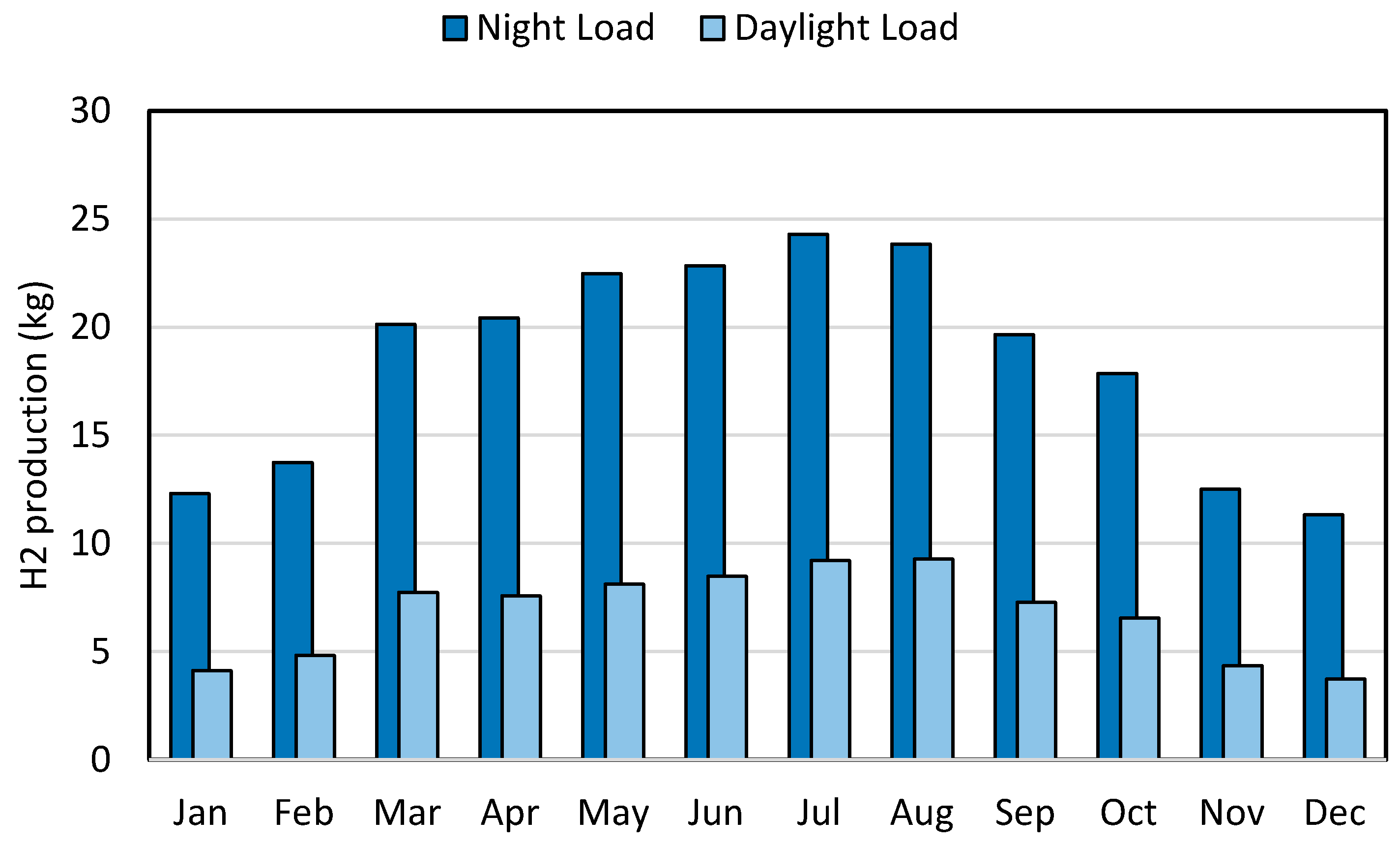
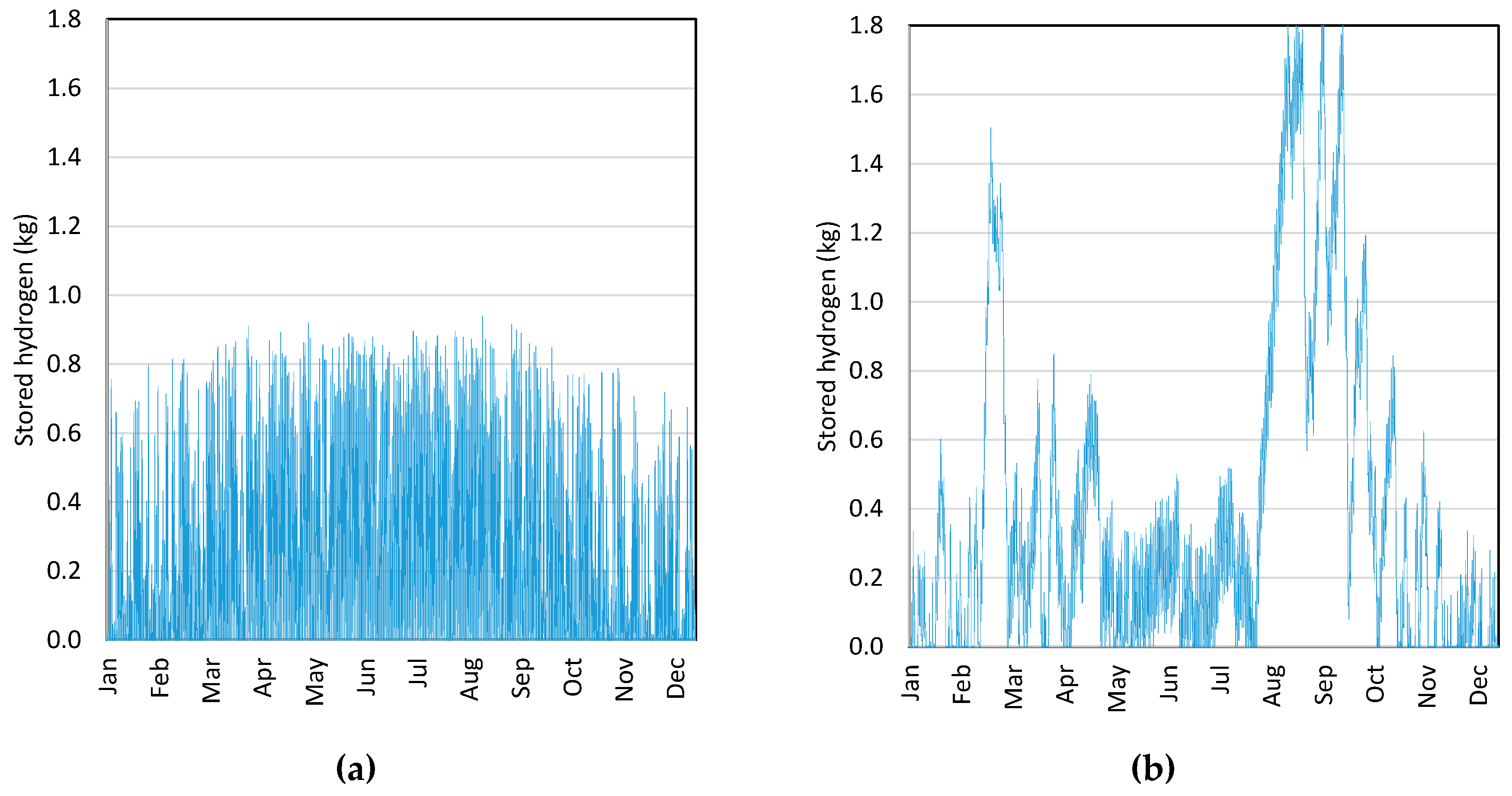
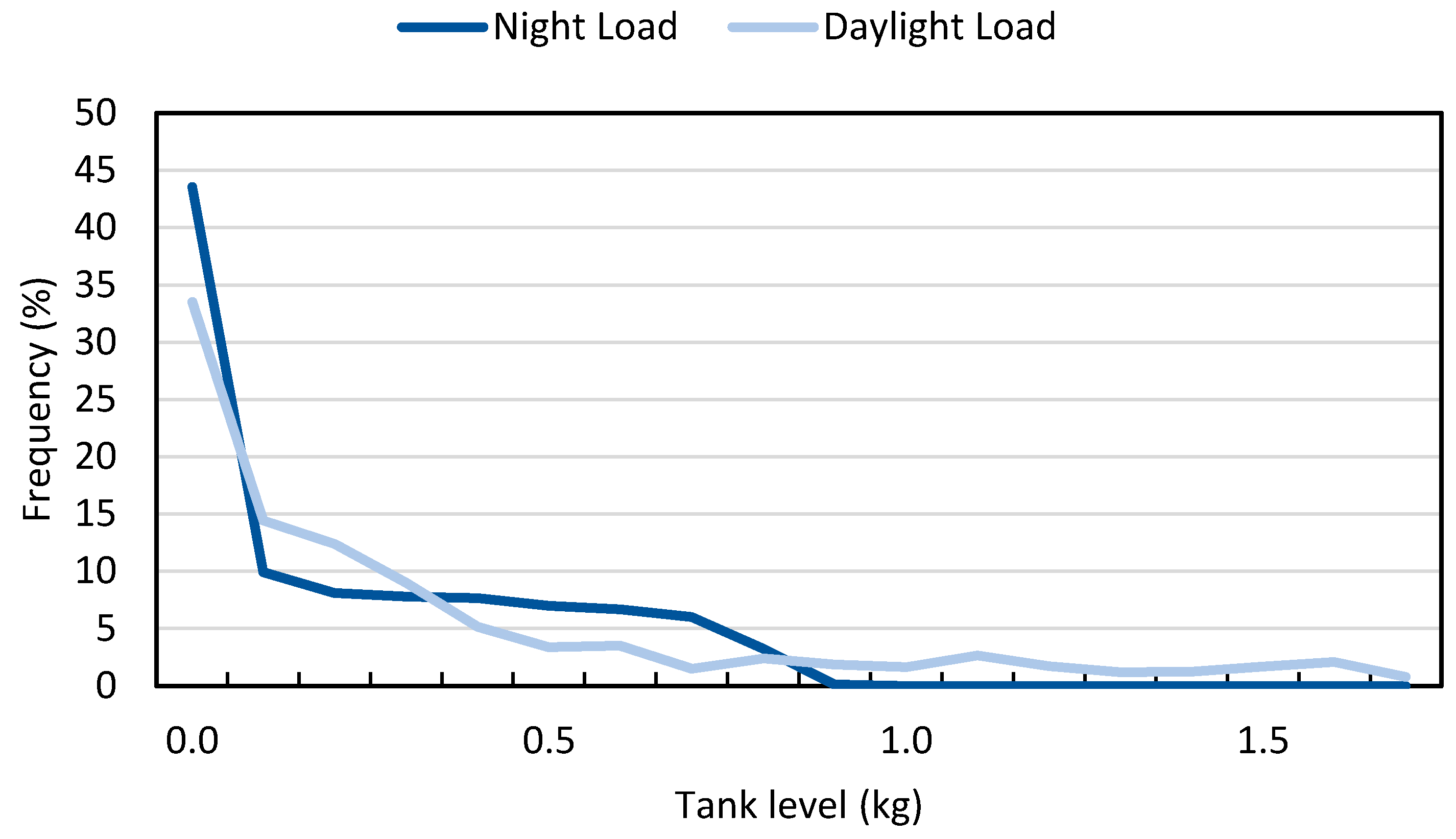
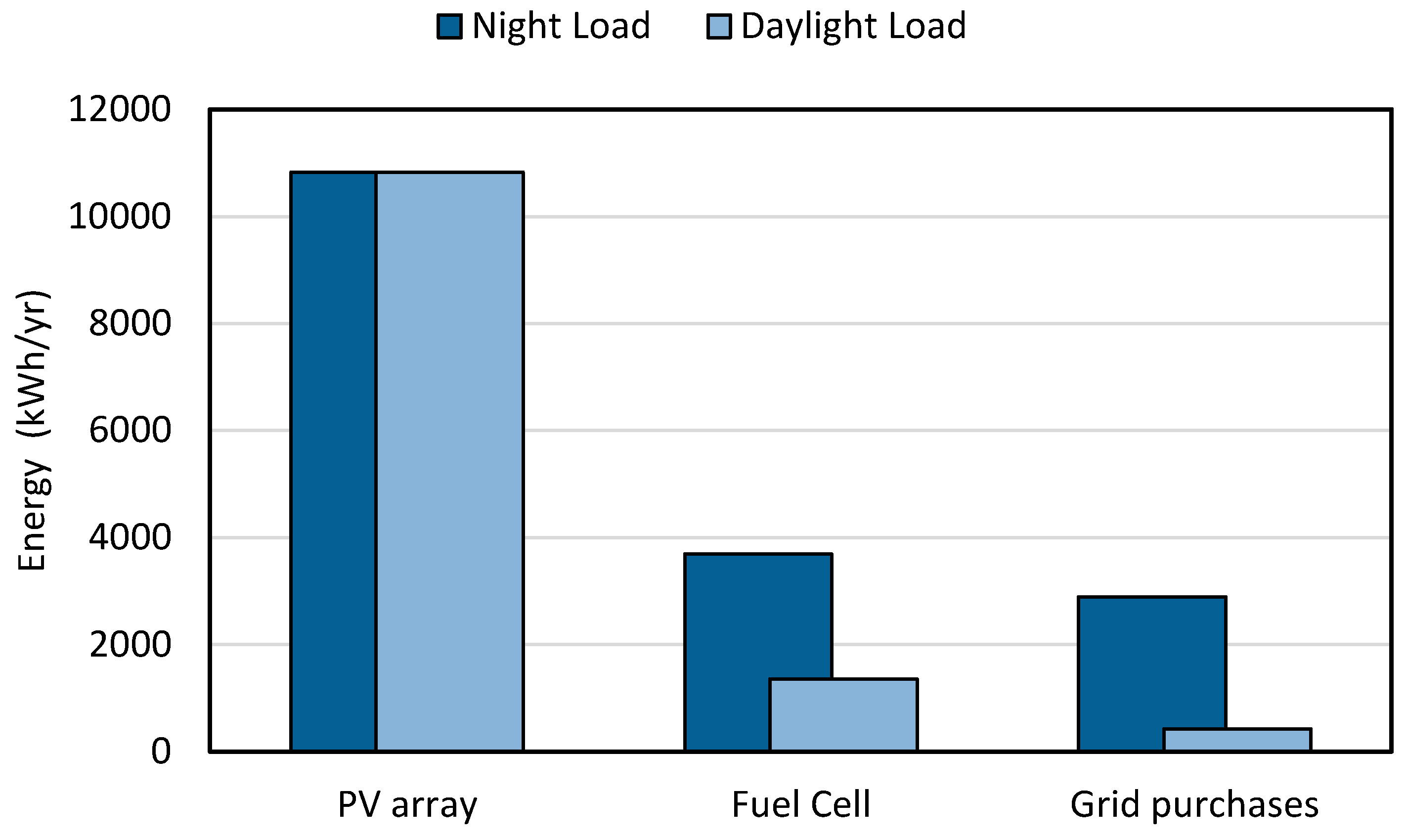

| Type of Panel | Monocrystalline Silicon |
|---|---|
| Maximum power | 360 Wp |
| Efficiency (η) | 22.1% |
| Temperature coefficient (β) | −0.29%/°C |
| Nominal Operating Cell Temperature (NOCT) | 41.5°C |
| Nominal Capacity | 24 Ah |
|---|---|
| Nominal Voltage | 12 V |
| Round-trip efficiency | 80% |
| Min. state of charge | 40% |
| Max. charge rate | 1A/Ah |
| Stack Capacity | 2 Nm3/h | Amount of Demineralized Water | 1.9 l/h |
|---|---|---|---|
| Control interval | 25–100% | Fixed residue | max 2 mg/L |
| Electric power | 2–10 kW | Chloride content | Absent |
| Conversion efficiency | 60% | Maximum conductivity (25 °C) | 5 μS/cm |
| Operating pressure | 20 bar | Purity of hydrogen exiting stack | 99.80% |
| Operating temperature | 80 °C | Purity of stored hydrogen | 99.99% |
| Nominal Power | 6000 VA | Max Power of Charge/Discharge | 6000 W |
|---|---|---|---|
| DC input | 720 VDC 11 A | Efficiency | 97.6% |
| AC output | 400 VAC 50 Hz 9 A |
| Delivered Power | 1’676 W | Storing Temperature | −30–40 °C |
|---|---|---|---|
| Output voltage | 47 ÷ 57 Vdc | Environment temperature | −45–70 °C |
| Maximum H2 consumption | 1.37 Nm3/h | Cabinet temperature | 0−60 °C |
| Efficiency | 40% | H2 pressure | 0.43 bar |
| Delivered power | 1’676 W | Storing temperature | −30–40 °C |
| Input current for auxiliaries | 220/50 VAC/Hz | H2 purity | 99.95% |
| Pmax | 30 bar |
|---|---|
| Volume | 0.75 m3 |
| Capacity at p = 20 bar | 1.8 kg |
| Spectral Range | 300–2800 nm (50% points) |
|---|---|
| Sensitivity | 10 to 20 µV/ (W/m2) |
| Response time | <18 s (95% response) |
| Non-linearity | <1% (from 0 to 1000 W/m2 irradiance) |
| Tilt error | <1% |
| Field of view: | 180° |
| Directional error: | <20 W/m2 (angles up to 80° with 1000 W/m2 beam radiation) |
| Irradiance: | 0 to 2000 W/m2 |
| Uncertainty in daily total | <5% (95% confidence level) |
| Measured Parameter | Measurement Range | Accuracy |
|---|---|---|
| Air temperature | −52 … +60 °C | ±0.3 °C |
| Relative Humidity (RH) | 0–100% | ±3% RH |
| Rain intensity | 0 … 200 mm/h | ±0.1 mm/h |
© 2019 by the authors. Licensee MDPI, Basel, Switzerland. This article is an open access article distributed under the terms and conditions of the Creative Commons Attribution (CC BY) license (http://creativecommons.org/licenses/by/4.0/).
Share and Cite
Carbone, R.; Marino, C.; Nucara, A.; Panzera, M.F.; Pietrafesa, M. Electric Load Influence on Performances of a Composite Plant for Hydrogen Production from RES and its Conversion in Electricity. Sustainability 2019, 11, 6362. https://doi.org/10.3390/su11226362
Carbone R, Marino C, Nucara A, Panzera MF, Pietrafesa M. Electric Load Influence on Performances of a Composite Plant for Hydrogen Production from RES and its Conversion in Electricity. Sustainability. 2019; 11(22):6362. https://doi.org/10.3390/su11226362
Chicago/Turabian StyleCarbone, Rosario, Concettina Marino, Antonino Nucara, Maria Francesca Panzera, and Matilde Pietrafesa. 2019. "Electric Load Influence on Performances of a Composite Plant for Hydrogen Production from RES and its Conversion in Electricity" Sustainability 11, no. 22: 6362. https://doi.org/10.3390/su11226362
APA StyleCarbone, R., Marino, C., Nucara, A., Panzera, M. F., & Pietrafesa, M. (2019). Electric Load Influence on Performances of a Composite Plant for Hydrogen Production from RES and its Conversion in Electricity. Sustainability, 11(22), 6362. https://doi.org/10.3390/su11226362