

A Framework for the Integration of Nature-Based Solutions into Environmental Risk Management Strategies



Abstract
1. Introduction
2. Materials and Method
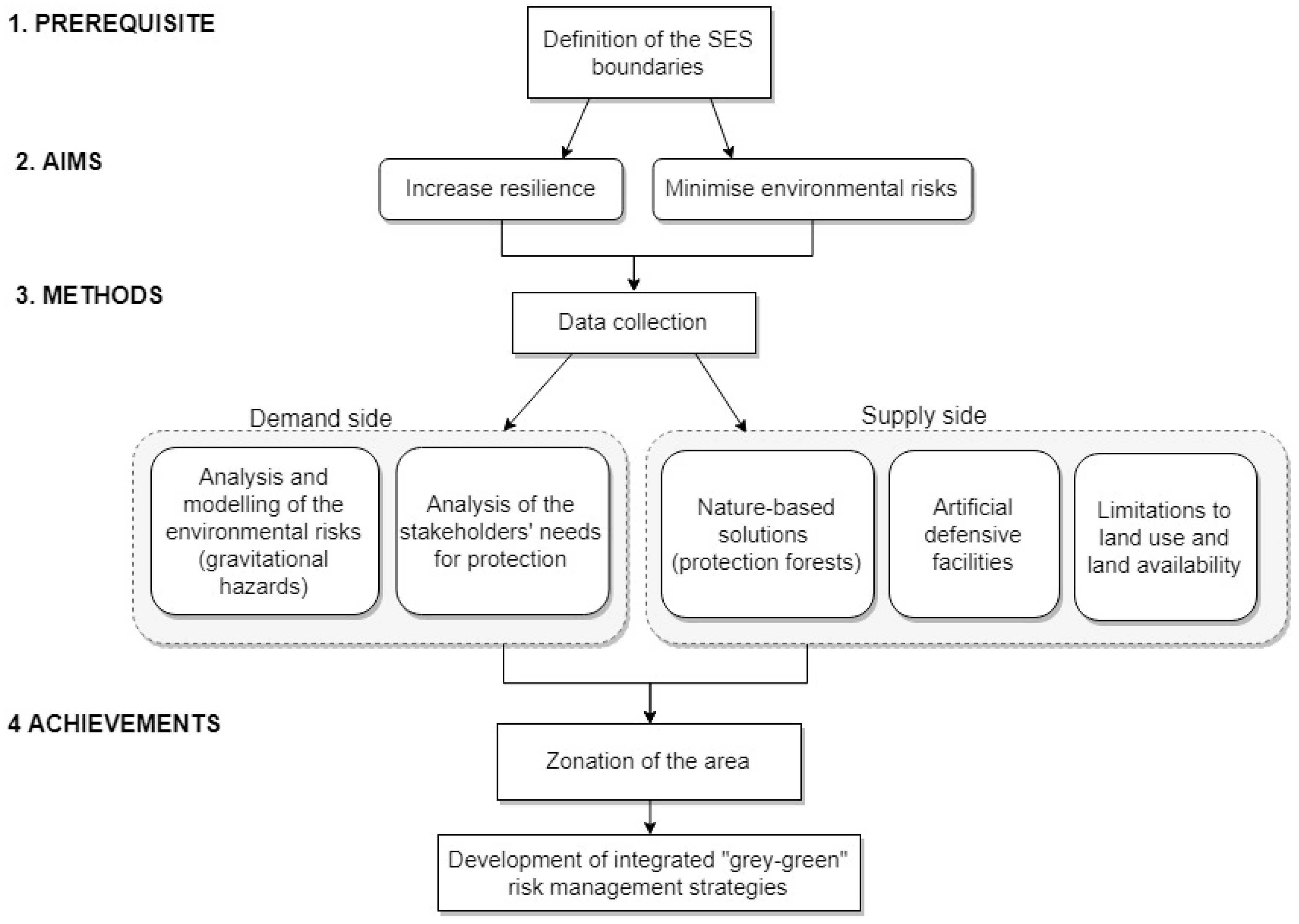
2.1. Structure of the Framework
2.2. Risk Management through the Lens of Resilience and SES
2.3. The Demand Side: Risks and Stakeholder Needs
2.4. The Supply Side: Limitations to Land Use, Artificial Facilities, and Protection Forests
2.5. Zonation of the Area
2.6. Development of Integrated “Grey-Green” Risk Management Strategies
3. Discussion and Conclusions
Author Contributions
Funding
Conflicts of Interest
References
- ALP; CONV. Demographic Changes in the Alps; Alpine Signals; Permanent Secretariat of the Alpine Convention: Innsbruck, Austria, 2015. [Google Scholar]
- EEA. Mapping the Impacts of Natural Hazards and Technological Accidents in Europe: An Overview of the Last Decade; Publications Office of the European Union: Luxembourg, 2010. [Google Scholar]
- Bianchi, E.; Accastello, C.; Trappmann, D.; Blanc, S.; Brun, F. The Economic Evaluation of Forest Protection Service Against Rockfall: A Review of Experiences and Approaches. Ecol. Econ. 2018, 154, 409–418. [Google Scholar] [CrossRef] [Scilit]
- Badoux, A.; Andres, N.; Techel, F.; Hegg, C. Natural hazard fatalities in Switzerland from 1946 to 2015. Nat. Hazards Earth Syst. Sci. 2016, 16, 2747–2768. [Google Scholar] [CrossRef] [Scilit]
- Pfurtscheller, C.; Thieken, A.H. The price of safety: costs for mitigating and coping with Alpine hazards. Nat. Hazards Earth Syst. Sci. 2013, 13, 2619–2637. [Google Scholar] [CrossRef] [Scilit]
- UNISDR. Sendai Framework for Disaster Risk Reduction 2015–2030; International Strategy for Disaster Reduction; United Nations: Geneva, Switzerland, 2015. [Google Scholar]
- Zimmermann, M.; Keiler, M. International Frameworks for Disaster Risk Reduction: Useful Guidance for Sustainable Mountain Development? Mt. Res. Dev. 2015, 35, 195–203. [Google Scholar] [CrossRef] [Scilit]
- Fratesi, U.; Perucca, G. Territorial capital and the resilience of European regions. Ann. Reg. Sci. 2018, 60, 241–264. [Google Scholar] [CrossRef] [Scilit]
- Miura, S.; Amacher, M.; Hofer, T.; San-Miguel-Ayanz, J.; Ernawati; Thackway, R. Protective functions and ecosystem services of global forests in the past quarter-century. For. Ecol. Manag. 2015, 352, 35–46. [Google Scholar] [CrossRef] [Scilit]
- Hollling, C. Engineering Resilience Versus Ecological Resilience. In Engineering Within Ecological Constraints; National Academies Press: Washington DC, USA, 1996; ISBN 978-0-309-59647-3. [Google Scholar]
- Hahn, T.; Schultz, L.; Folke, C.; Olsson, P. Social Networks as sources of Resilience in Social-Ecological Systems. In Complexity Theory for a Sustainable Future; Columbia University Press: New York, NY, USA, 2008; ISBN 978-0-231-50886-5. [Google Scholar]
- Liu, J.; Dietz, T.; Carpenter, S.R.; Alberti, M.; Folke, C.; Moran, E.; Pell, A.N.; Deadman, P.; Kratz, T.; Lubchenco, J.; et al. Complexity of coupled human and natural systems. Science 2007, 317, 1513–1516. [Google Scholar] [CrossRef] [Scilit]
- Walker, B.; Hollin, C.S.; Carpenter, S.R.; Kinzig, A. Resilience, adaptability and transformability in social-ecological systems. Ecol. Soc. 2004, 9, 5. [Google Scholar] [CrossRef] [Scilit]
- Martin-Lopez, B.; Palomo, I.; Garcia-Llorente, M.; Iniesta-Arandia, I.; Castro, A.J.; Garcia Del Amo, D.; Gomez-Baggethun, E.; Montes, C. Delineating boundaries of social-ecological systems for landscape planning: A comprehensive spatial approach. Land Use Policy 2017, 66, 90–104. [Google Scholar] [CrossRef] [Scilit]
- Berger, F.; Rey, F. Mountain protection forests against natural hazards and risks: New French developments by integrating forests in risk zoning. Nat. Hazards 2004, 33, 395–404. [Google Scholar] [CrossRef] [Scilit]
- Holub, M.; Huebl, J. Local protection against mountain hazards—State of the art and future needs. Nat. Hazards Earth Syst. Sci. 2008, 8, 81–99. [Google Scholar] [CrossRef] [Scilit]
- Rimböck, A.; Höhne, R.; Rudolf-Miklau, F.; Pichler, A.; Suda, J.; Mazzorana, B.; Papež, J. Persistence of Alpine Natural Hazard Protection. Meeting Multiple Demands by Applying Systems Engine Ering and Life Cycle Management Principles in Natural Hazard Protection Systems in the Perimeter of the Alpine Convention; PLANALP Brochure; Platform on Natural Hazards of the Alpine Convention: Vienna, Austria, 2014. [Google Scholar]
- O’Farrell, P.J.; Anderson, P.M.L. Sustainable multifunctional landscapes: a review to implementation. Curr. Opin. Environ. Sustain. 2010, 2, 59–65. [Google Scholar] [CrossRef] [Scilit]
- Moos, C.; Bebi, P.; Schwarz, M.; Stoffel, M.; Sudmeier-Rieux, K.; Dorren, L. Ecosystem-based disaster risk reduction in mountains. Earth-Sci. Rev. 2018, 177, 497–513. [Google Scholar] [CrossRef] [Scilit]
- Brang, P.; Schönenberger, W.; Frehner, M.; Schwitter, R.; Wasser, B. Management of protection forests in the European Alps: An overview. For. Snow Landsc. Res. 2006, 80, 23–44. [Google Scholar]
- Kriebel, D.; Tickner, J.; Epstein, P.; Lemons, J.; Levins, R.; Loechler, E.L.; Quinn, M.; Rudel, R.; Schettler, T.; Stoto, M. The precautionary principle in environmental science. Environ. Health Perspect. 2001, 109, 871–876. [Google Scholar] [CrossRef] [PubMed]
- Kohler, M.; Stotten, R.; Steinbacher, M.; Leitinger, G.; Tasser, E.; Schirpke, U.; Tappeiner, U.; Schermer, M. Participative Spatial Scenario Analysis for Alpine Ecosystems. Environ. Manag. 2017, 60, 679–692. [Google Scholar] [CrossRef] [Scilit] [PubMed]
- Cumming, G.S.; Morrison, T.H.; Hughes, T.P. New Directions for Understanding the Spatial Resilience of Social-Ecological Systems. Ecosystems 2017, 20, 649–664. [Google Scholar] [CrossRef] [Scilit]
- Brunner, S.H.; Gret-Regamey, A. Policy strategies to foster the resilience of mountain social-ecological systems under uncertain global change. Environ. Sci. Policy 2016, 66, 129–139. [Google Scholar] [CrossRef] [Scilit]
- Hamann, M.; Biggs, R.; Reyers, B. Mapping social-ecological systems: Identifying “green-loop” and “red-loop” dynamics based on characteristic bundles of ecosystem service use. Glob. Environ. Change-Human Policy Dimens. 2015, 34, 218–226. [Google Scholar] [CrossRef] [Scilit]
- Alessa, L.; Kliskey, A.; Brown, G. Social-ecological hotspots mapping: A spatial approach for identifying coupled social-ecological space. Landsc. Urban Plan. 2008, 85, 27–39. [Google Scholar] [CrossRef] [Scilit]
- Herrero-Jauregui, C.; Arnaiz-Schmitz, C.; Fernanda Reyes, M.; Telesnicki, M.; Agramonte, I.; Easdale, M.H.; Fe Schmitz, M.; Aguiar, M.; Gomez-Sal, A.; Montes, C. What do We Talk about When We Talk about Social-Ecological Systems? A Literature Review. Sustainability 2018, 10, 2950. [Google Scholar] [CrossRef] [Scilit]
- Rist, L.; Moen, J. Sustainability in forest management and a new role for resilience thinking. For. Ecol. Manag. 2013, 310, 416–427. [Google Scholar] [CrossRef] [Scilit]
- Fischer, A.P. Forest landscapes as social-ecological systems and implications for management. Landsc. Urban Plan. 2018, 177, 138–147. [Google Scholar] [CrossRef] [Scilit]
- Irauschek, F.; Rammer, W.; Lexer, M.J. Evaluating multifunctionality and adaptive capacity of mountain forest management alternatives under climate change in the Eastern Alps. Eur. J. For. Res. 2017, 136, 1051–1069. [Google Scholar] [CrossRef] [Scilit]
- Carpenter, S.; Walker, B.; Anderies, J.M.; Abel, N. From metaphor to measurement: Resilience of what to what? Ecosystems 2001, 4, 765–781. [Google Scholar] [CrossRef] [Scilit]
- Adini, B.; Cohen, O.; Eide, A.W.; Nilsson, S.; Aharonson-Daniel, L.; Herrera, I.A. Striving to be resilient: What concepts, approaches and practices should be incorporated in resilience management guidelines? Technol. Forecast. Soc. Chang. 2017, 121, 39–49. [Google Scholar] [CrossRef] [Scilit]
- Schippers, P.; van der Heide, C.M.; Koelewijn, H.P.; Schouten, M.A.H.; Smulders, R.M.J.M.; Cobben, M.M.P.; Sterk, M.; Vos, C.C.; Verboom, J. Landscape diversity enhances the resilience of populations, ecosystems and local economy in rural areas. Landsc. Ecol. 2015, 30, 193–202. [Google Scholar] [CrossRef] [Scilit]
- Maes, J.; Teller, A.; Erhard, M.; Grizzetti, B.; Barredo, J.I.; Paracchini, M.L.; Condè, S.; Somma, F.; Orgiazzi, A.; Jones, A.; et al. Mapping and Assessment of Ecosystems and Their Services. An Analytical Framework for Mapping and Assessment of Ecosystem Condition in EU; MAES Project; European Union: Luxembourg, 2018. [Google Scholar]
- Albert, C.; Galler, C.; Hermes, J.; Neuendorf, F.; von Haaren, C.; Lovett, A. Applying ecosystem services indicators in landscape planning and management: The ES-in-Planning framework. Ecol. Indic. 2016, 61, 100–113. [Google Scholar] [CrossRef] [Scilit]
- Brunner, S.H.; Huber, R.; Gret-Regamey, A. A backcasting approach for matching regional ecosystem services supply and demand. Environ. Modell. Softw. 2016, 75, 439–458. [Google Scholar] [CrossRef] [Scilit]
- Gret-Regamey, A.; Brunner, S.H.; Kienast, F. Mountain Ecosystem Services: Who Cares? Mt. Res. Dev. 2012, 32, S23–S34. [Google Scholar] [CrossRef] [Scilit]
- Dorren, L.K.A.; Berger, F.; Putters, U.S. Real-size experiments and 3-D simulation of rockfall on forested and non-forested slopes. Nat. Hazards Earth Syst. Sci. 2006, 6, 145–153. [Google Scholar] [CrossRef] [Scilit]
- Corona, C.; Lopez-Saez, J.; Favillier, A.; Mainieri, R.; Eckert, N.; Trappmann, D.; Stoffel, M.; Bourrier, F.; Berger, F. Modeling rockfall frequency and bounce height from three-dimensional simulation process models and growth disturbances in submontane broadleaved trees. Geomorphology 2017, 281, 66–77. [Google Scholar] [CrossRef] [Scilit]
- Monnet, J.-M.; Bourrier, F.; Dupire, S.; Berger, F. Suitability of airborne laser scanning for the assessment of forest protection effect against rockfall. Landslides 2017, 14, 299–310. [Google Scholar] [CrossRef] [Scilit]
- Fidej, G.; Mikos, M.; Rugani, T.; Jez, J.; Kumelj, S.; Diaci, J. Assessment of the protective function of forests against debris flows in a gorge of the Slovenian Alps. iForest 2015, 8, 73–81. [Google Scholar] [CrossRef] [Scilit]
- Gret-Regamey, A.; Straub, D. Spatially explicit avalanche risk assessment linking Bayesian networks to a GIS. Nat. Hazards Earth Syst. Sci. 2006, 6, 911–926. [Google Scholar] [CrossRef] [Scilit]
- Christen, M.; Kowalski, J.; Bartelt, P. RAMMS: Numerical simulation of dense snow avalanches in three-dimensional terrain. Cold Reg. Sci. Tech. 2010, 63, 1–14. [Google Scholar] [CrossRef] [Scilit]
- Villamagna, A.M.; Angermeier, P.L.; Bennett, E.M. Capacity, pressure, demand, and flow: A conceptual framework for analyzing ecosystem service provision and delivery. Ecol. Complex. 2013, 15, 114–121. [Google Scholar] [CrossRef] [Scilit]
- Wolff, S.; Schulp, C.J.E.; Verburg, P.H. Mapping ecosystem services demand: A review of current research and future perspectives. Ecol. Indic. 2015, 55, 159–171. [Google Scholar] [CrossRef] [Scilit]
- Boyd, J.; Banzhaf, S. What are ecosystem services? The need for standardized environmental accounting units. Ecol. Econ. 2007, 63, 616–626. [Google Scholar] [CrossRef] [Scilit]
- Reed, M.S.; Graves, A.; Dandy, N.; Posthumus, H.; Hubacek, K.; Morris, J.; Prell, C.; Quinn, C.H.; Stringer, L.C. Who’s in and why? A typology of stakeholder analysis methods for natural resource management. J. Environ. Manag. 2009, 90, 1933–1949. [Google Scholar] [CrossRef] [Scilit]
- Etienne, M.; Du Toit, D.R.; Pollard, S. ARDI: A Co-construction Method for Participatory Modeling in Natural Resources Management. Ecol. Soc. 2011, 16, 44. [Google Scholar] [CrossRef] [Scilit]
- Zabala, A.; Pascual, U.; Garcia-Barrios, L. Payments for Pioneers? Revisiting the Role of External Rewards for Sustainable Innovation under Heterogeneous Motivations. Ecol. Econ. 2017, 135, 234–245. [Google Scholar] [CrossRef] [Scilit]
- Elsawah, S.; Guillaume, J.H.A.; Filatova, T.; Rook, J.; Jakeman, A.J. A methodology for eliciting, representing, and analysing stakeholder knowledge for decision making on complex socio-ecological systems: From cognitive maps to agent-based models. J. Environ. Manag. 2015, 151, 500–516. [Google Scholar] [CrossRef] [Scilit] [PubMed]
- Meyer, V.; Becker, N.; Markantonis, V.; Schwarze, R.; van den Bergh, J.C.J.M.; Bouwer, L.M.; Bubeck, P.; Ciavola, P.; Genovese, E.; Green, C.; et al. Review article: Assessing the costs of natural hazards - state of the art and knowledge gaps. Nat. Hazards Earth Syst. Sci. 2013, 13, 1351–1373. [Google Scholar] [CrossRef] [Scilit]
- Cullotta, S.; Maetzke, F. Forest management planning at different geographic levels in Italy: hierarchy, current tools and ongoing development. Int. For. Rev. 2009, 11, 475–489. [Google Scholar] [CrossRef] [Scilit]
- EOTA. ETAG 207—Guideline for European Technical Approval of Falling Rock Protection Kits; European Organization for Technical Approval: Brussels, Belgium, 2012. [Google Scholar]
- Giacchetti, G.; Grimod, A. Effect of Large Impacts Against Rockfall Barriers. Landslide Sci. A Safer Geoenvironment 2014, 3, 83–89. [Google Scholar]
- Schirpke, U.; Leitinger, G.; Tasser, E.; Schermer, M.; Steinbacher, M.; Tappeiner, U. Multiple ecosystem services of a changing Alpine landscape: past, present and future. Int. J. Biodivers. Sci. Ecosyst. Serv. Manag. 2013, 9, 123–135. [Google Scholar] [CrossRef] [Scilit]
- Berger, F.; Dorren, L.; Kleemayr, K.; Maier, B.; Planinsek, S.; Bigot, C.; Bourrier, F.; Jancke, O.; Toe, D.; Cerbu, G. Eco-Engineering and Protection Forests Against Rockfalls and Snow Avalanches; Cerbu, G.A., Hanewinkel, M., Gerosa, G., Jandl, R., Eds.; Intech Europe: Rijeka, Croatia, 2013; ISBN 978-953-51-1194-8. [Google Scholar]
- Bigot, C.; Dorren, L.K.A.; Berger, F. Quantifying the protective function of a forest against rockfall for past, present and future scenarios using two modelling approaches. Nat. Hazards 2009, 49, 99–111. [Google Scholar] [CrossRef] [Scilit]
- Fuhr, M.; Bourrier, F.; Cordonnier, T. Protection against rockfall along a maturity gradient in mountain forests. For. Ecol. Manag. 2015, 354, 224–231. [Google Scholar] [CrossRef] [Scilit]
- Jancke, O.; Berger, F.; Dorren, L.K.A. Mechanical resistance of coppice stems derived from full-scale impact tests. Earth Surf. Process. Landf. 2013, 38, 994–1003. [Google Scholar] [CrossRef] [Scilit]
- Motta, R.; Haudemand, J.C. Protective forests and silvicultural stability - An example of planning in the Aosta Valley. Mt. Res. Dev. 2000, 20, 180–187. [Google Scholar] [CrossRef] [Scilit]
- Helfenstein, J.; Kienast, F. Ecosystem service state and trends at the regional to national level: A rapid assessment. Ecol. Indic. 2014, 36, 11–18. [Google Scholar] [CrossRef] [Scilit]
- Kajdiz, P.; Diaci, J.; Rebernik, J. Modelling Facilitates Silvicultural Decision-Making for Improving the Mitigating Effect of Beech (Fagus Sylvatica L.) Dominated Alpine Forest against Rockfall. Forests 2015, 6, 2178–2198. [Google Scholar] [CrossRef] [Scilit]
- Rammer, W.; Brauner, M.; Ruprecht, H.; Lexer, M.J. Evaluating the effects of forest management on rockfall protection and timber production at slope scale. Scand. J. Forest Res. 2015, 30, 719–731. [Google Scholar] [CrossRef] [Scilit]
- Wehrli, A.; Dorren, L.K.A.; Berger, F.; Zingg, A.; Schönenberger, W.; Brang, P. Modelling long-term effects of forest dynamics on the protective effect against rockfall. For. Snow Landsc. Res 2006, 80, 57–76. [Google Scholar]
- Golladay, S.W.; Martin, K.L.; Vose, J.M.; Wear, D.N.; Covich, A.P.; Hobbs, R.J.; Klepzig, K.D.; Likens, G.E.; Naiman, R.J.; Shearer, A.W. Achievable future conditions as a framework for guiding forest conservation and management. For. Ecol. Manag. 2016, 360, 80–96. [Google Scholar] [CrossRef] [Scilit]
- Cordonnier, T.; Courbaud, B.; Berger, F.; Franc, A. Permanence of resilience and protection efficiency in mountain Norway spruce forest stands: A simulation study. For. Ecol. Manag. 2008, 256, 347–354. [Google Scholar] [CrossRef] [Scilit]
- Blanc, S.; Accastello, C.; Bianchi, E.; Lingua, F.; Vacchiano, G.; Mosso, A.; Brun, F. An integrated approach to assess carbon credit from improved forest management. J. Sustain. For. 2019, 38, 31–45. [Google Scholar] [CrossRef] [Scilit]
- Accastello, C.; Blanc, S.; Mosso, A.; Brun, F. Assessing the timber value: A case study in the Italian Alps. For. Policy Econ. 2018, 93, 36–44. [Google Scholar] [CrossRef] [Scilit]
- Schouten, M.A.H.; van der Heide, C.M.; Heijman, W.J.M.; Opdam, P.F.M. A resilience-based policy evaluation framework: Application to European rural development policies. Ecol. Econ. 2012, 81, 165–175. [Google Scholar] [CrossRef] [Scilit]
- Steiner, A.; Atterton, J. Exploring the contribution of rural enterprises to local resilience. J. Rural Stud. 2015, 40, 30–45. [Google Scholar] [CrossRef] [Scilit]
- Maes, J.; Jacobs, S. Nature-Based Solutions for Europe’s Sustainable Development. Conserv. Lett. 2017, 10, 121–124. [Google Scholar] [CrossRef] [Scilit]
- Diaz, S.; Demissew, S.; Carabias, J.; Joly, C.; Lonsdale, M.; Ash, N.; Larigauderie, A.; Adhikari, J.R.; Arico, S.; Baldi, A.; et al. The IPBES Conceptual Framework - connecting nature and people. Curr. Opin. Environ. Sustain. 2015, 14, 1–16. [Google Scholar] [CrossRef] [Scilit]
- Jax, K.; Furman, E.; Saarikoski, H.; Barton, D.N.; Delbaere, B.; Dick, J.; Duke, G.; Görg, C.; Gómez-Baggethun, E.; Harrison, P.A.; et al. Handling a messy world: Lessons learned when trying to make the ecosystem services concept operational. Ecosyst. Serv. 2018, 29, 415–427. [Google Scholar] [CrossRef] [Scilit]
- Potschin-Young, M.; Haines-Young, R.; Görg, C.; Heink, U.; Jax, K.; Schleyer, C. Understanding the role of conceptual frameworks: Reading the ecosystem service cascade. Ecosyst. Serv. 2018, 29, 428–440. [Google Scholar] [CrossRef] [Scilit]
- Bouwer, L.M.; Papyrakis, E.; Poussin, J.; Pfurtscheller, C.; Thieken, A.H. The Costing of Measures for Natural Hazard Mitigation in Europe. Nat. Hazards Rev. 2014, 15, 04014010. [Google Scholar] [CrossRef] [Scilit]
- Bebi, P.; Seidl, R.; Motta, R.; Fuhr, M.; Firm, D.; Krumm, F.; Conedera, M.; Ginzler, C.; Wohlgemuth, T.; Kulakowski, D. Changes of forest cover and disturbance regimes in the mountain forests of the Alps. For. Ecol. Manag. 2017, 388, 43–56. [Google Scholar] [CrossRef] [Scilit] [PubMed]

| Protection Demand | |||
|---|---|---|---|
| Low | High | ||
| Protection Supply | Low | Increase resilience | Risk Hotspot |
| High | Risk Coldspot | Increase Resilience | |
© 2019 by the authors. Licensee MDPI, Basel, Switzerland. This article is an open access article distributed under the terms and conditions of the Creative Commons Attribution (CC BY) license (http://creativecommons.org/licenses/by/4.0/).
Share and Cite
Accastello, C.; Blanc, S.; Brun, F. A Framework for the Integration of Nature-Based Solutions into Environmental Risk Management Strategies. Sustainability 2019, 11, 489. https://doi.org/10.3390/su11020489
Accastello C, Blanc S, Brun F. A Framework for the Integration of Nature-Based Solutions into Environmental Risk Management Strategies. Sustainability. 2019; 11(2):489. https://doi.org/10.3390/su11020489
Chicago/Turabian StyleAccastello, Cristian, Simone Blanc, and Filippo Brun. 2019. "A Framework for the Integration of Nature-Based Solutions into Environmental Risk Management Strategies" Sustainability 11, no. 2: 489. https://doi.org/10.3390/su11020489
APA StyleAccastello, C., Blanc, S., & Brun, F. (2019). A Framework for the Integration of Nature-Based Solutions into Environmental Risk Management Strategies. Sustainability, 11(2), 489. https://doi.org/10.3390/su11020489

