

The Evaluation of Green Investments in Urban Areas: A Proposal of an eco-social-green Model of the City



Abstract
1. Introduction
2. The New Role of City Government towards a Model Resilient to Climate Change
- Time scale: Adaptation measures are effective immediately; mitigation measures are effective in the long term.
- Spatial scale: Adaptation is typically local, while mitigation has global effects.
- -
- “Low-regret” or “no-regret” measures produce benefits even in the absence of climate change and with which the costs of adaptation are relatively low compared to the benefits of the action.
- -
- “Win–win (–win)” measures achieve the desired result in terms of reducing climate risks or exploiting potential opportunities as well as bring other social, environmental or economic benefits.
- -
- Reversible and flexible options allow future changes.
- -
- Adding “safety margins” to new investments ensure that these responses are resistant to a range of future climate impacts.
- -
- “Soft” adaptation strategies could include building adaptation capacity to ensure that an organization is better able to cope with a range of climate impacts (e.g., through more effective proactive planning).
- -
- Reduction of decision time horizons.
- -
- Delaying action, i.e., long-term active adaptation strategy.
- -
- Actions based on an ecosystem or “green” approach.
- -
- Infrastructural and technological or “gray” actions in urban settlements include interventions aimed at preventing the increase of hydraulic and geomorphological risks; increasing the infrastructural facilities for cycling and pedestrian mobility; and encouraging the experimentation of new settlement models able to cope with climate changes (e.g., eco-neighborhoods, climate-houses, and climate upgrading).
- -
- to promote and encourage the diffusion of green roofs and the increase of public and private green areas also for the purpose of calming the extreme summer heat phenomena.
- -
- to implement, also for demonstrative purposes and to raise awareness among citizens, experimental interventions of climatic adaptation of public spaces in particularly vulnerable areas, such as increase the green facilities, the permeability of the soils, the social spaces, and the hydraulic performances.
- -
- to increase the endowment of urban green, adopting the logic of green and blue infrastructures, and safeguarding biodiversity in urban areas.
- -
- to support the spread of urban gardens, intended, as well as for educational purposes, also as targeted forms of redevelopment of underused green areas and as a contribution to the food autonomy of urban settlements.
3. Green Infrastructures and Urban Green as Tools for Climate Adaptation of Cities and for the Enhancement of Ecosystem Services
- (1)
- environmental-regulator
- (2)
- hydrogeological protection
- (3)
- social, recreational and therapeutic
- (4)
- cultural and educational
- (5)
- aesthetic-architectural
- -
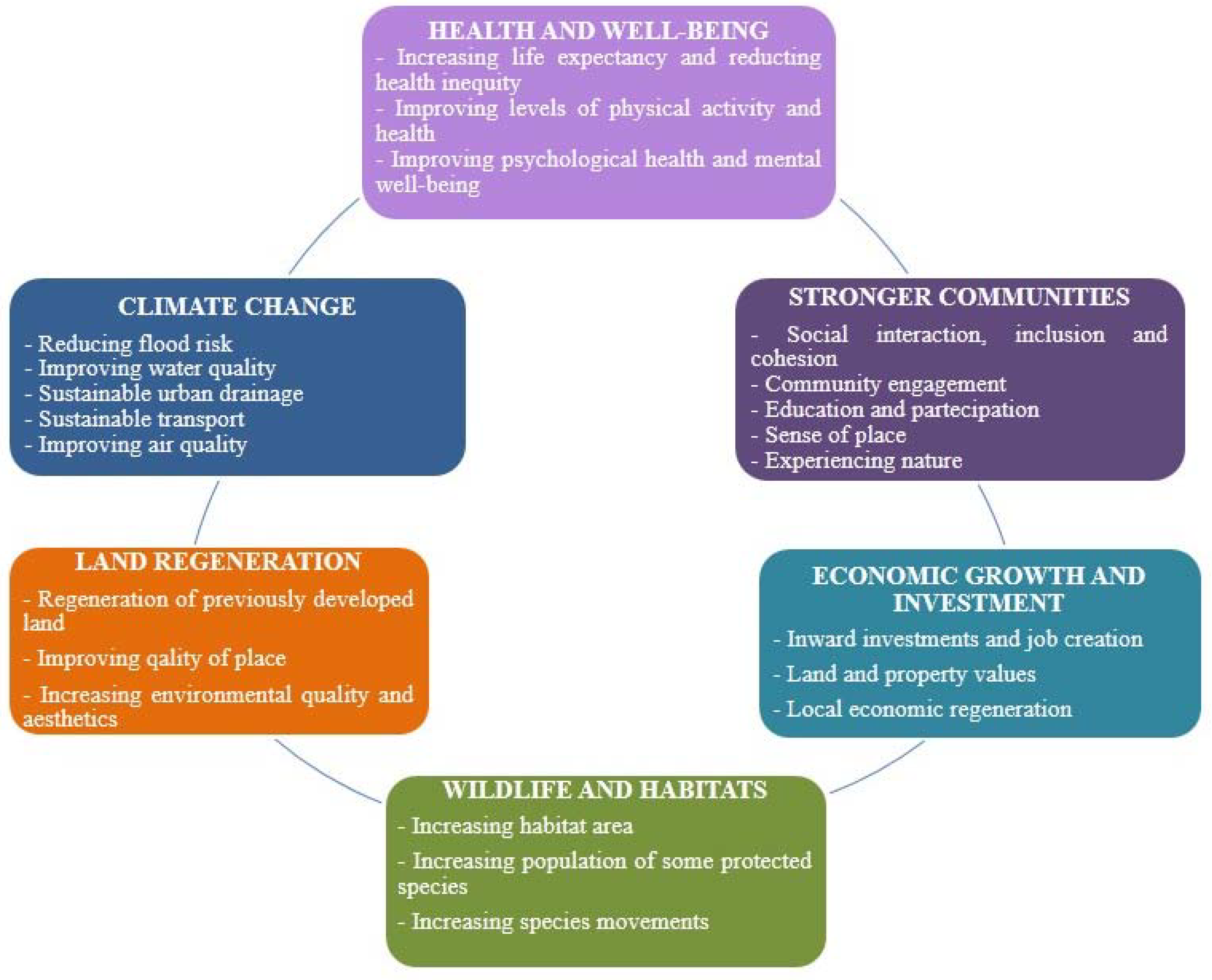
- it provides products (food, fiber, and biomass).
- -
- it generates new services (employment and investment, tourism and recreation, health and well-being education, social services, educational services, and therapeutic function).
- -
- it regulates ecological services (climate, water, land management, and disaster prevention).
- -
- it maintains biodiversity.
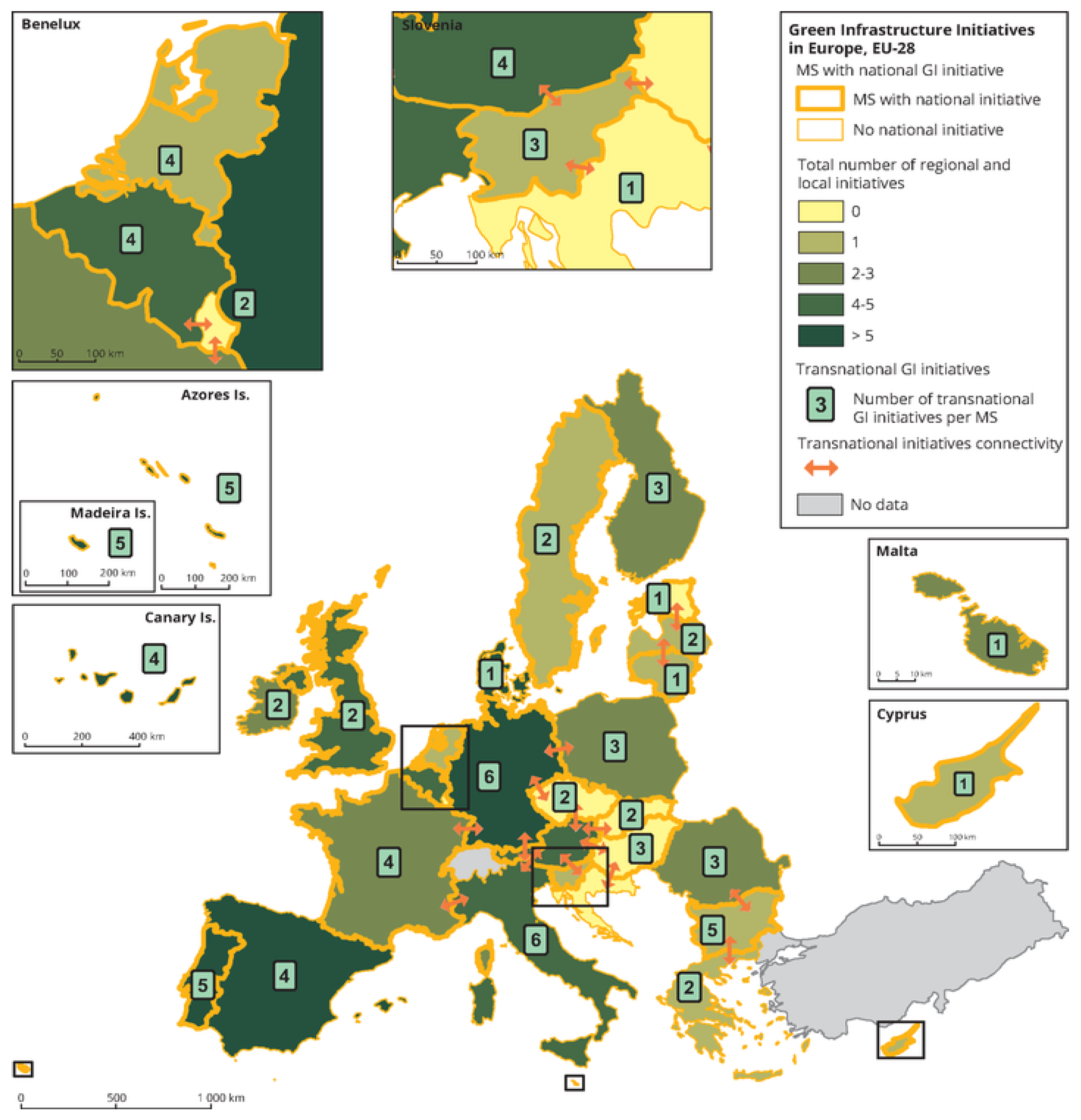
4. Green Infrastructures in the World and Situation in Italy
- -
- Ecosystem services: Positive effects on the local climate, on air quality, on noise levels, on soil stability are evident, and biodiversity conservation.
- -
- Socio-economic aspects: Meet the needs for recreation, social relations, cultural and health growth of its inhabitants.
- -
- Proactive citizens engagement: It is necessary to create and sustain citizen engagement and ownership; collaborative approaches in adaptation actions and green infrastructures projects can be more useful [51].
- -
- Equity approach: It is important to consider residents of diverse housing types and also socio-economically disadvantaged groups; the municipal adaptation and GI planning should support and engage disadvantaged people [52].
- -
- -
- Systematic adaptation mainstreaming: Citizen–municipality interactions require changes in municipal organization and in departmental coordination [35].
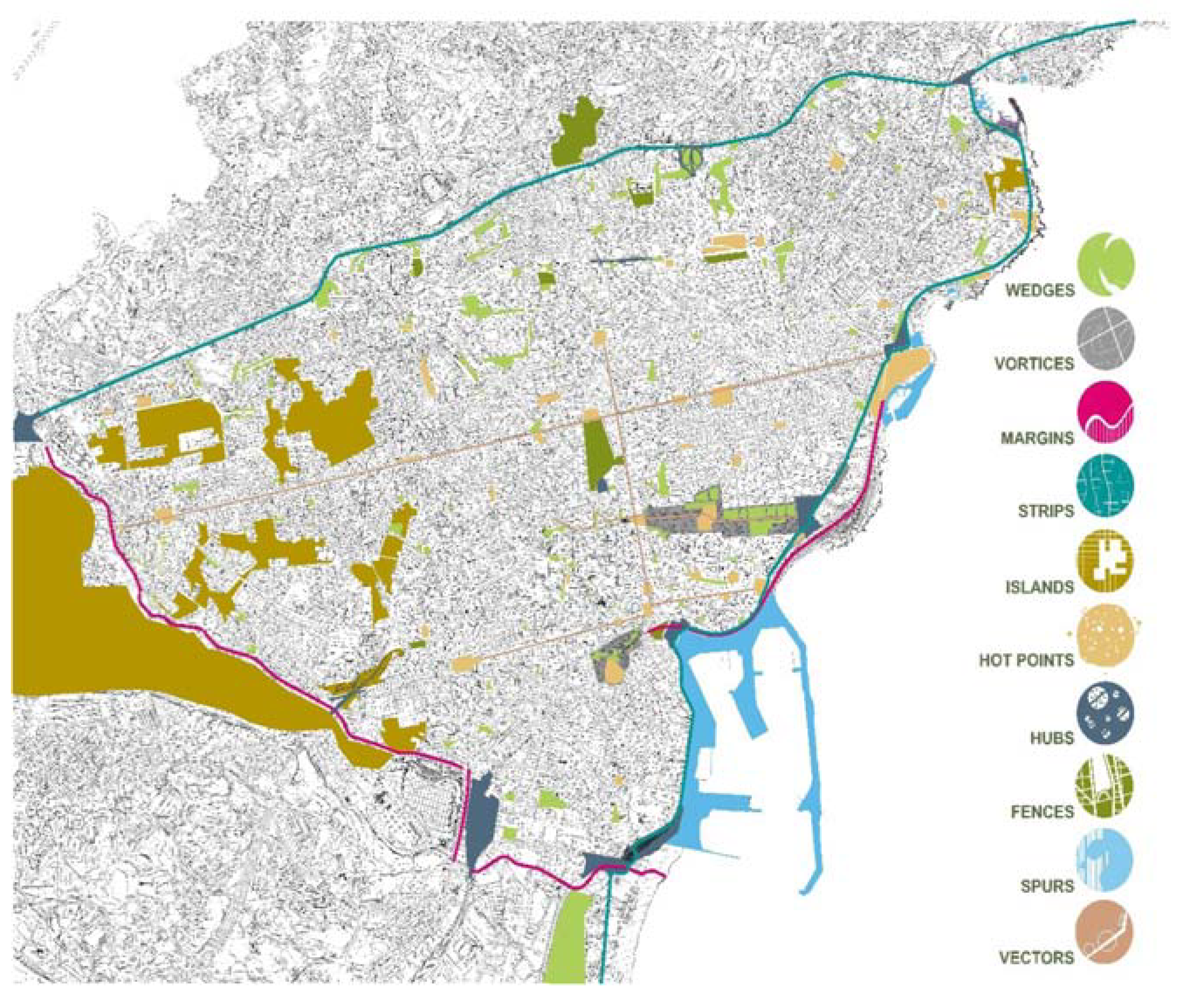
5. The Evaluation of Investments in GI According to an Eco-Social-Green Model: The Case Study of Catania
| The “urban green system” of the city of Catania (*) | ||
| Green typology m2 | ||
| • | Urban Parks (>8000 square meters) | 513,577 |
| • | Green Equipment. (<8000 square meters) | 431,270 |
| • | Urban Design Areas | 715,500 |
| • | Urban Forestation | |
| • | School gardens | 350,000 |
| • | Botanical Gardens and Vivai | 20,000 |
| • | Zoological Gardens | |
| • | Cemetery | 50,000 |
| • | Urban Gardens (mainly managed by families) | 2500 |
| • | Sports areas/Outdoor play | 100,000 |
| • | Bosch areas (>5000 sqm) | 972,769 |
| • | Uncultivated Green | 1,688,044 |
| Total Urban Green | 4,843,660 | |
- improving and preserving the local landscape and environmental restoration;
- favor urban climate control and reduction of albedo and heat islands;
- increase the naturalness and biodiversity of the urban territory; and
- stimulate the aggregative, social and therapeutic functions of green areas (e.g., urban gardens, neighborhood parks, healing gardens, spaces for cultural events and shows) (Regulation of the public and private Green of the city of Catania, 2017).
6. Methodology
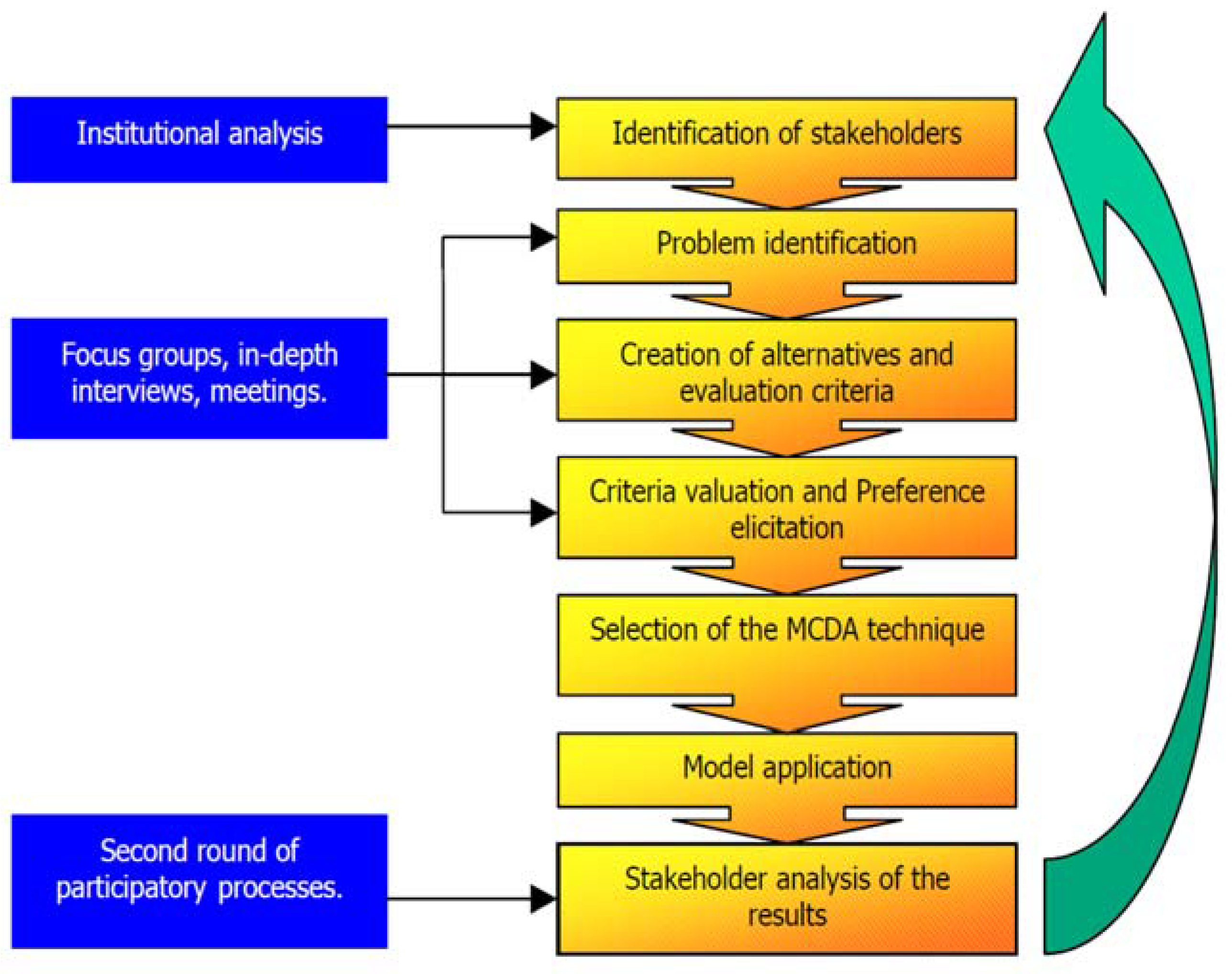
- the individualization of the citizens and of the stakeholders involved (100 questionnaires);
- the definition of the alternative scenarios (definition of the three hypotheses of scenario: social, green and city);
- the definition of the context of evaluation, namely the decisional criteria (urban green spaces of Catania for shared project);
- the evaluation of the impact of alternative scenarios relative to the criteria in question); and
- the final creation of the impact matrix.
- -
- the number of sessions and the time dedicated to each of them (eight, as an expression of the individual categories considered, association of citizens, groups of pensioners, cultural associations, playrooms, trade unions, public institutions, scientific groups, and tertiary sector’s companies, with a length of 4–8 h);
- -
- the creation of an interview guide to conduct the discussion (scientific and dissemination materials, research papers, photos, maps, the relative problems of urban green areas and on the social and climatic effects derived from them);
- -
- the selection of participants (stratified selection for homogeneous groups: age, gender, and income).
- -
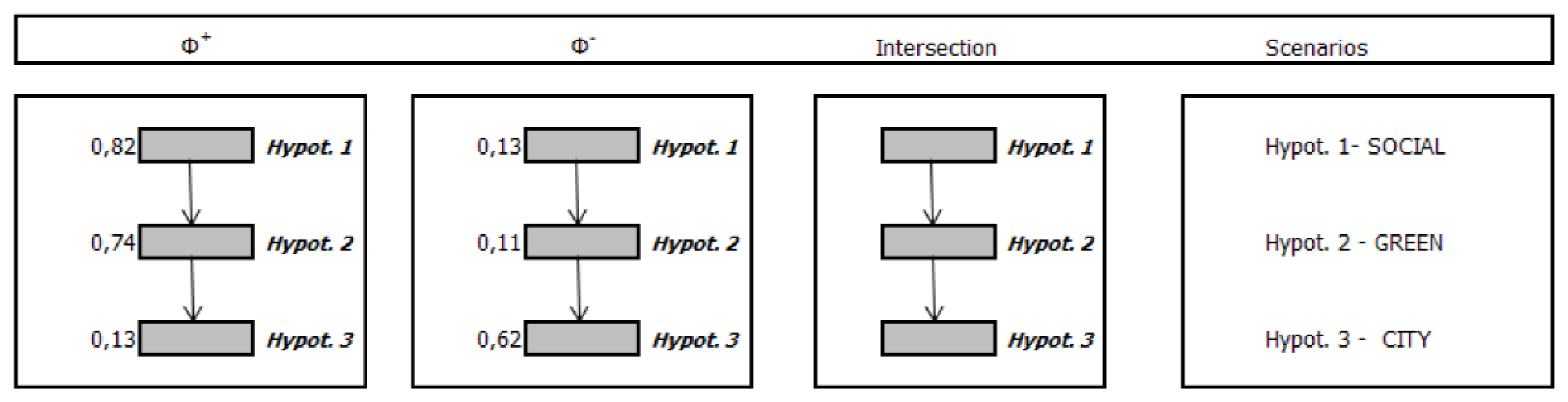
- Hypothesis 1—SOCIAL: creation of green areas with a social function (equipped parks, urban gardens, etc.).
- -
- Hypothesis 2—GREEN: creation of urban green areas with non-usable landscape function.
- -
- Hypothesis 3—CITY: conservative recovery, cleaning and maintenance of the current green.
- -
- a multi-criteria analysis, which, based on the impact matrix, leads to the definition of the priorities of alternative scenarios with regard to certain decision-making criteria;
- -
- an analysis of equity, which, based on the equity matrix, analyzes possible “alliances” or “conflicts” among different interests in relation to the scenarios in question.
- -
- comparison of each single pair of alternatives for all the evaluation criteria considered;
- -
- calculation of a credibility index for each of the aforementioned comparisons, that measures the credibility of one preference relation, e.g. “alternative scenario ‘a’ is better/worse, etc. than alternative scenario ‘b’” (preference relationships are used);
- -
- aggregation of the credibility indices produced during the previous stage leading to a preference intensity index μ* (a, b) of an alternative “a” with respect to another “b” for all the evaluation criteria, associated the concept of entropy H* (a, b), as an indication of the variation in the credibility indices;
- -
- classification of alternative scenarios on the basis of previous information.
7. Results and Discussion
8. Conclusions
Author Contributions
Funding
Conflicts of Interest
References
- United Nations. Revision of the World Urbanization Prospects; United Nations: New York, NY, USA, 2018. [Google Scholar]
- Jim, C.Y. Planning strategies to overcome constraints on greenspace provision in urban Hong Kong Town. Plan. Rev. 2002, 73, 127–152. [Google Scholar]
- Radovanović, M.; Lior, N. Sustainable economic–environmental planning in Southeast Europe—Beyond-GDP and climate change emphases. Sustain. Dev. 2017, 25, 580–594. [Google Scholar] [CrossRef] [Scilit]
- Scuderi, A.; Sturiale, L.; Bellia, C.; Foti, V.T.; Timpanaro, G. The redefinition of the role of agricultural areas in the city of Catania. Rivista di Studi sulla Sostenibilità 2016, 2016, 237–247. [Google Scholar] [CrossRef] [Scilit]
- Scuderi, A.; Sturiale, L.; Bellia, C.; Foti, V.T. Timpanaro, G. The redefinition of the role of agricultural areas in the city in relation to social, environmental, and alimentary functions: The case of Catania. Rivista di Studi sulla Sostenibilità 2017, 2, 1–10. [Google Scholar]
- Monclús, J. From Park Systems and Green Belts to Green Infrastructures. In Urban Visions; Díez Medina, C., Monclús, J., Eds.; Springer: Cham, Switzerland, 2018. [Google Scholar]
- Hestmark, G. Temptations of the tree. Nature 2000, 408, 911. [Google Scholar] [CrossRef] [Scilit] [PubMed]
- Anguluri, R.; Narayanan, P. Role of green space in urban planning: Outlook towards smart cities. Urban For. Urban Green. 2017, 25, 58–65. [Google Scholar] [CrossRef] [Scilit]
- Jim, C.Y. Green spaces preservation and allocation for sustainable greening of compact cities. Cities 2004, 21, 311–320. [Google Scholar] [CrossRef] [Scilit]
- Gill, S.E.; Handley, J.F.; Ennos, A.R.; Pauleit, S. Adapting cities for climate change: The role of the green infrastructure. Built Environ. 2007, 33, 115–133. [Google Scholar] [CrossRef] [Scilit]
- Tzoulas, K.; Korpela, K.; Venn, S.; Yli-Pelkonen, V.; Kazmierczak, A.; Niemelä, J.; James, P. Promoting ecosystem and human health in urban areas using green infrastructure: A literature review. Landsc. Urban Plan. 2007, 81, 167–178. [Google Scholar] [CrossRef] [Scilit]
- Wolch, J.R.; Byrne, J.; Newell, J.P. Urban green space, public health, andenvironmental justice: The challenge of making cities ‘just green enough’. Landsc. Urban Plan. 2014, 125, 234–244. [Google Scholar] [CrossRef] [Scilit]
- Foster, J.; Lowe, A.; Winkelman, S. The Value of Green Infrastructures for Urban Climate Adaptation; Center for Clean Air Policy: Washington, DC, USA, 2011. [Google Scholar]
- Brink, E.; Aalders, T.; Ádám, D.; Feller, R.; Henselek, Y.; Hoffmann, A.; Ibe, K.; Matthey-Doret, A.; Meyer, M.; Negrut, N.L.; et al. Cascades of green: A review of ecosystembased adaptation in urban areas. Glob. Environ. Chang. 2016, 36, 111–123. [Google Scholar] [CrossRef] [Scilit]
- Broto, V.C.; Bulkeley, H. A survey of urban climate change experiments in 100 cities. Glob. Environ. Chang. 2013, 23, 92–102. [Google Scholar] [CrossRef] [Scilit] [PubMed]
- Bulkeley, H. Cities and the governing of climate change. Annu. Rev. Environ. Resour. 2010, 35, 229–253. [Google Scholar] [CrossRef] [Scilit]
- Hunt, A.; Watkiss, P. Climate change impacts and adaptation in cities: A review of the literature. Clim. Chang. 2011, 104, 13–49. [Google Scholar] [CrossRef] [Scilit]
- Munda, G. Multicriteria Evaluation in a Fuzzy Environment—Theory and Applications. In Ecological Economics; Physica-Verlag: Heidelberg, Germany, 1995. [Google Scholar]
- IPCC. Fifth Assessment Report. Climate Change 2014. Mitigation of Climate Change; IPCC: Geneva, Switzerland, 2014. [Google Scholar]
- Voskamp, I.M.; Van de Ven, F.H.M. Planning support system for climate adaptation: Composing effective sets of blue-green measures to reduce urban vulnerability to extreme weather events. Build. Environ. 2015, 83, 159–167. [Google Scholar] [CrossRef] [Scilit]
- Wamsler, C. From risk governance to city-citizen collaboration: Capitalizing on individual adaptation to climate change. Environ. Policy Gov. 2016, 26, 184–204. [Google Scholar] [CrossRef] [Scilit]
- Satterthwaite, D. Environmental Governance: A Comparative Analysis of Nine City Case Studies. J. Int. Dev. 2001, 13, 1009–1014. [Google Scholar] [CrossRef] [Scilit]
- Schicklinski, J. Civil society actors as drivers of socio-ecological transition? In Green Spaces in European Cities as Laboratories of Social Innovation; WWWforEurope Working Papers Series No. 102; WWWforEurope: Vienna, Austria, 2015. [Google Scholar]
- MINAMB. Le Infrastrutture Verdi e i Servizi Ecosistemici in Italia come Strumento per le Politiche Ambientali e la Green Economy: Potenzialità, Criticità e Proposte; Ministero dell’Ambiente: Roma, Italy, 2013.
- Mees, H.L.P.; Driessen, P.P.J.; Runhaar, H.A.C. Exploring the scope of public and private responsibilities for climate adaptation. J. Environ. Policy Plan. 2012, 14, 305–333. [Google Scholar] [CrossRef] [Scilit]
- Tompkins, E.L.; Eakin, H. Managing private and public adaptation to climate change. Glob. Environ. Chang. 2012, 22, 3–11. [Google Scholar] [CrossRef] [Scilit]
- Forsyth, T. Panacea or paradox? Cross-sector partnerships, climate change, and development. Wiley Interdiscip. Rev. Clim. Chang. 2010, 1, 683–696. [Google Scholar] [CrossRef] [Scilit]
- Glasbergen, P. (Ed.) Co-Operative Environmental Governance, Environment & Policy; Springer: Dordrecht, The Netherlands, 1998. [Google Scholar]
- Lemos, M.C.; Agrawal, A. Environmental governance. Annu. Rev. Environ. Resour. 2006, 31, 297–325. [Google Scholar] [CrossRef] [Scilit]
- Bason, C. Leading Public Sector Innovation: Co-Creating for a Better Society; Policy Press: Bristol, UK, 2010. [Google Scholar]
- Armitage, D.R.; Plummer, R.; Berkes, F.; Arthur, R.I.; Charles, A.T.; Davidson-Hunt, I.J.; Diduck, A.P.; Doubleday, N.C.; Johnson, D.S.; Marschke, M.; et al. Adaptive co-management for social–ecological complexity. Front. Ecol. Environ. 2009, 7, 95–102. [Google Scholar] [CrossRef] [Scilit]
- Adger, W.N.; Quinn, T.; Lorenzoni, I.; Murphy, C.; Sweeney, J. Changing social contracts in climate-change adaptation. Nat. Clim. Chang. 2013, 3, 330–333. [Google Scholar] [CrossRef] [Scilit]
- Bridges, A. The role of institutions in sustainable urban governance. Nat. Resour. Forum 2016, 40, 169–179. [Google Scholar] [CrossRef] [Scilit]
- Baird, J.; Plummer, R.; Haug, C.; Huitema, D. Learning effects of interactive decision-making processes for climate change adaptation. Glob. Environ. Chang. 2014, 27, 51–63. [Google Scholar] [CrossRef] [Scilit]
- Brink, E.; Wamsler, C. Collaborative Governance for Climate Change Adaptation: Mapping citizen–municipality interactions. Environ. Policy Gov. 2018, 28, 82–97. [Google Scholar] [CrossRef] [Scilit]
- Butt, N.; Shanahan, D.F.; Shumway, N.; Bekessy, S.A.; Fuller, R.A.; Watson, J.E.; Maggini, R.; Hole, D.G. Opportunities for biodiversity conservation as cities adapt to climate change. Geo Geogr. Environ. 2018, 5, e00052. [Google Scholar] [CrossRef] [Scilit]
- Miccoli, S.; Finucci, F.; Murro, R. Social evaluation approaches in landscape projects. Sustainability 2014, 6, 7906–7920. [Google Scholar] [CrossRef] [Scilit]
- Lo, A.Y.; Jim, C.Y. Willingness of residents to pay and motives for conservation of urban green spaces in the compact city of Hong Kong. Urban For. Urban Green. 2010, 9, 113–120. [Google Scholar] [CrossRef] [Scilit]
- European Commission. Technical Information on Green Infrastructures (GI)—Enhancing Europe’s Natural Capital; Communication from the Commission to the European Parliament; European Commission: Brussels, Belgium, 2013. [Google Scholar]
- Naumann, S.; McKenna, D.; Kaphengst, T. Design, Implementation and Cost Elements of Green Infrastructure Projects; Final Report; European Commission: Brussels, Belgium, 2011. [Google Scholar]
- Costanza, R. (Ed.) Ecological Economics: The Science and Management of Sustainability; Columbia University Press: New York, NY, USA, 1991. [Google Scholar]
- Peters, K.; Elands, B.; Buijs, A. Social interactions in urban parks: Stimulating social cohesion? Urban For. Uran Green. 2010, 9, 93–100. [Google Scholar] [CrossRef] [Scilit]
- Worpole, K.; Knex, K. The Social Value of Public Spaces; Joseph Rowntree Foundation: York, UK, 2007. [Google Scholar]
- Fainstein, S.S. Cities and Diversity. Urban Aff. Rev. 2005, 41, 3–19. [Google Scholar] [CrossRef] [Scilit]
- Maloutas, T.; Pantelidou, M. Debats and developments: The glass menagerie of urban governance and social cohesion concepts and stake/concepts as stakes. Int. J. Urban Reg. Res. 2004, 28, 449–465. [Google Scholar] [CrossRef] [Scilit]
- COM. Comunicazione della Commissione al Parlamento Europeo, al Consiglio, al Comitato Economico e Sociale Europeo e al Comitato delle Regioni. Infrastrutture Verdi—Rafforzare il Capitale Naturale in Europa; 249 Final; COM: Brussels, Belgium, 2013. [Google Scholar]
- Gryseels, M. Relevance of the Concept of Ecosystem Services in the Practice of Brussels Environment (BE). Ecosyst. Serv. 2013, 359–361. [Google Scholar] [CrossRef] [Scilit]
- Niemelä, J.; Saarela, S.-R.; Tarja Söderman, T.; Kopperoinen, L.; Yli-Pelkonen, V.; Väre, S.; Kotze, D.J. Using the ecosystem services approach for betterplanning and conservation of urban green spaces: A Finland case study. Biodivers. Conserv. 2010, 19, 3225–3243. [Google Scholar] [CrossRef] [Scilit]
- Caspersen, O.H.; Olafsson, A.S. Recreational mapping and planning for enlargement of the green structure in greater Copenhagen. Urban For. Urban Green. 2010, 9, 101–112. [Google Scholar] [CrossRef] [Scilit]
- Haaland, C.; Konijnendijkvan den Bosch, C. Challenges and strategies for urban green-space planning in cities undergoing densification: A review. Urban For. Urban Green. 2015, 14, 760–771. [Google Scholar] [CrossRef] [Scilit]
- Hoff, J.; Gausset, Q. Community Governance and Citizen-Driven Initiatives in Climate Change Mitigation; Routledge: London, UK, 2015. [Google Scholar]
- Cutter, S.L.; Boruff, B.J.; Shirley, W.L. Social vulnerability to environmental hazards. Soc. Sci. Q. 2003, 84, 242–261. [Google Scholar] [CrossRef] [Scilit]
- Jones, H.P.; Hole, D.G.; Zavaleta, E.S. Harnessing nature to help people adapt to climate change. Nat. Clim. Chang. 2012, 2, 504–509. [Google Scholar] [CrossRef] [Scilit]
- Wamsler, C.; Luederitz, C.; Ebba, Brink. Local levers for change: mainstreaming ecosystem-based adaptation into municipal planning to foster sustainability transitions. Global Environ. Chang. 2004, 29, 189–201. [Google Scholar] [CrossRef] [Scilit]
- Krasny, M.E.; Russ, A.; Tidball, K.G.; Elmqvist, T. Civic ecology practices: Participatory approaches to generating and measuring ecosystem services in cities. Ecosyst. Serv. 2014, 7, 177–186. [Google Scholar] [CrossRef] [Scilit]
- Foti, V.T.; Scuderi, A.; Stella, G.; Sturiale, L.; Timpanaro, G.; Trovato, M.R. The integration of agriculture in the politics of social regeneration of degraded urban areas. In Integrated Evaluation for the Management of Contemporary Cities. Results of SIEV, Green Energy and Technology; Mondini, G., Fattinnanzi, E., Oppio, A., Bottero, M., Stanghellini, S., Eds.; Springer: Cham, Switzerland, 2016; pp. 99–111. [Google Scholar]
- Sturiale, L.; Calabro’, F.; Della Spina, L. Cultural Planning: A Model of Governance of the Landscape and Cultural Resources in Development Strategies in Rural Contexts. In Utopias and Dystopias in Landscape and Cultural Mosaic—Visions Values Vulnerability; Rezekne Higher Education Institution: Rēzekne, Latvia, 2013; Volume V, pp. 177–188. ISSN 1691-5887. [Google Scholar]
- Sturiale, L.; Trovato, M.R. A Model for Generating Social Values and Decisions to Support the Planning of a SCI; LaborEst: Milan, Italy, 2015; Volume 10, ISSN 1691-5887. [Google Scholar]
- Ahiablame, L.; Engel, B.; Chaubey, I. Representation and evaluation of low impact development practices with L-THIA-LID: An example for planning. Environ. Pollut. 2012, 1, 1. [Google Scholar] [CrossRef] [Scilit]
- Soderberg, H.; Karman, E. MIKA: Methodologies for Integration of Knowledge Areas—The Case of SustainableUrban Water Management; Department of Built Environment & Sustainable Development, Chalmers Architecture, Chalmers University of Technology: Goeteborg, Sweden, 2003. [Google Scholar]
- Panell, D.J.; Glenn, N.A. A framework for the economic evaluation and selection of sustainability indicators in agriculture. Ecol. Econ. 2000, 33, 135–149. [Google Scholar] [CrossRef] [Scilit]
- Siciliano, G. Social multicriteria evaluation of farming practices in the presence of soil degradation. A case study in Southern Tuscany, Italy. Environ. Dev. Sustain. 2009, 11, 1107–1133. [Google Scholar] [CrossRef] [Scilit]
- Vargas Isaza, O.L. La evaluación multicriterio social y su aporte a la conservación de los bosques social multicriteria. Revista Facultad Nacional de Agronomía Medellín 2005, 58, 2665–2683. [Google Scholar]
- De Marchi, B.; Funtowicz, S.O.; Lo Cascio, S.; Munda, G. Combining participative and institutional approacheswith multicriteria evaluation. An empirical study for water issues in Troina, Sicily. Ecol. Econ. 2000, 34, 267–282. [Google Scholar] [CrossRef] [Scilit]
- Greco, S.; Matarazzo, B.; Slowinski, R. Dominance based Rough Set Approach to decision under uncertainty and time preference. Ann. Oper. Res. 2010, 176, 41–75. [Google Scholar] [CrossRef] [Scilit]
- Munaretto, S.; Siciliano, G.; Turvani, M. Integrating adaptive governance and participatory multicriteria methods: A framework for climate adaptation governance. Ecol. Soc. 2014, 19, 74. [Google Scholar] [CrossRef] [Scilit]
- Scuderi, A.; Sturiale, L. Multi-criteria evaluation model to face phytosanitary emergencies: The case of citrus fruits farming in Italy. Agric. Econ 2016, 62, 205–214. [Google Scholar] [CrossRef] [Scilit]
- Notaro, S.; De Salvo, M. Estimating the economic benefits of the landscape function of ornamental trees in a sub-Mediterranean area. Urban For. Urban Green. 2010, 9, 71–81. [Google Scholar] [CrossRef] [Scilit]
- Treiman, T.; Gartner, J. Are residents willing to pay for their community forests? Results of a contingent valuation survey in Missouri, USA. Urban Stud. 2006, 43, 1537–1547. [Google Scholar] [CrossRef] [Scilit]
- Morancho, A.B. A hedonic valuation of urban green areas. Landsc. Urban Plan. 2003, 66, 35–41. [Google Scholar] [CrossRef] [Scilit]
- Mitchell, R.C.; Carson, R.T. Using Surveys to Value Public Goods: The Contingent Valuation Method; Resources for the Future: Washington, DC, USA, 1989. [Google Scholar]
- Luttik, J. The value of trees, water and open space as reflected by house prices in The Netherlands. Landsc. Urban Plan. 2000, 48, 161–167. [Google Scholar] [CrossRef] [Scilit]
- Freeman, A.M. The Measurement of Environmental and Resource Values: Theory and Methods, 2nd ed.; Resources for the Future: Washington, DC, USA, 2003. [Google Scholar]
- Dwyer, J.F.; McPherson, E.G.; Schroeder, H.W.; Rowntree, R.A. Assessing the benefits and costs of the urban forest. J. Arboricult. 1992, 18, 227–234. [Google Scholar]
- Munda, G. Social Multicriteria Evaluation for a Sustainable Economy; Springer: Berlin, Germany, 2008. [Google Scholar]
- Munda, G. A NAIADE based Approach for Sustainability Benchmarking. Int. J. Environ. Technol. Manag. 2006, 6, 65–78. [Google Scholar] [CrossRef] [Scilit]
- Shmelev, E.S.; Rodriguez-Labajos, B. Dynamic multidimensional assessment of sustainability at the macro level: The case of Austria. Ecol. Econ. 2009, 68, 2560–2573. [Google Scholar] [CrossRef] [Scilit]
- Torrieri, F.; Concilio, G.; Nijkamp, P. Decision support tools for urban contingency policy. A scenario approach to risk management of the Vesuvio area in Naples—Italy. J. Conting. Crisis Manag. 2002, 10, 95–112. [Google Scholar] [CrossRef] [Scilit]
- Tiwari, A.P. Choice and Preference of Water Supply Institutions—An Exploratory Study of Stakeholders’ Preferences of Water Sector Reform in Metro City of Delhi, India. 2007. Available online: http://agua.isf.es/semana%E2%80%A6/Doc7_APTiwari_2pag_xcra_a_dobre%20cara.pdf (accessed on 24 November 2017).
- Bekessy, S.A.; White, M.; Gordon, A.; Moilanen, A.; Mccarthy, M.A.; Wintle, B.A. Transparent planning for biodiversity and development in the urban fringe. Landsc. Urban Plan. 2012, 108, 140–149. [Google Scholar] [CrossRef] [Scilit]
- Voogd, H. Multiple Criteria Evaluation for Urban and Regional Planning; Lion: London, UK, 1983. [Google Scholar]
- Forest Research. Benefits of Green Infrastructures; Report by Forest Research; Forest Research: Farnham, UK, 2010. [Google Scholar]
- Langemeyerab, J.; Gómez-Baggethuncf, E.; Haasede, D.; Scheuerd, S.; Elmqvistb, T. Bridging the gap between ecosystem service assessments and land-use planning through Multi-Criteria Decision Analysis (MCDA). Environ. Sci. Policy 2016, 62, 45–56. [Google Scholar] [CrossRef] [Scilit]
- Srdjevic, Z.; Lakicevic, M.; Srdjevic, B. Approach of decision making based on the analytic hierarchy process for urban landscape management. Environ. Manag. 2013, 51, 777–785. [Google Scholar] [CrossRef] [Scilit] [PubMed]
- Grêt-Regamey, A.; Celio, E.; Klein, T.M.; Wissen Hayek, U. Understanding ESs trade-offs with interactive procedural modeling for sustainable urban planning. Landsc. Urban Plan. 2013, 109, 107–111. [Google Scholar] [CrossRef] [Scilit]
- Sanon, S.; Hein, T.; Douven, W.; Winkler, P. Quantifying. ES trade-offs: The case of an urban floodplain in Vienna, Austria. J. Environ. Manag. 2012, 111, 159–172. [Google Scholar] [CrossRef] [Scilit] [PubMed]

| N. | Scenario | Description |
|---|---|---|
| A | SOCIAL | creation of green areas with a social function (equipped parks, urban gardens, etc.) |
| B | GREEN | creation of urban green areas with non-usable landscape function |
| C | CITY | conservative recovery, cleaning and maintenance of the current green |
| Goals | Evaluation criteria |
|---|---|
| Environmental | air quality and human settlement |
| Social | usability, multi-functionality, agricultural production, and employment commitment |
| Climate | reduction of temperatures, creation of accessible shade areas, and thermal excursion |
| Economic | cost of realization, value of the properties, and productive exploitation |
| Landscape | quality of the landscape, exaltation of the seasons, and biodiversity |
| Health safety | pollution, pathogenic presence, and use of pesticides and fertilizers |
| Criteria of evaluation | Scenario Social | Scenario Green | Scenario City |
|---|---|---|---|
| Environmental | |||
| Air quality | Good | Very good | Poor |
| Smell emanation | Good | Excellent | Good |
| Anthropization | Poor | Very good | Very good |
| Waste of water | Poor | Good | Excellent |
| Social | |||
| Usability | Excellent | Medium | Poor |
| Multifunctional | Excellent | Very good | Good |
| Agricultural production | Very good | Poor | Poor |
| Occupational commitment | Very good | Good | Poor |
| Climate | |||
| Temperature reduction | Good | Excellent | Very good |
| Creation of shaded areas | Good | Very good | Good |
| Temperature range | Good | Very good | Poor |
| Humidity | Very good | Good | Poor |
| Economic | |||
| Cost of realization | Good | Poor | Very good |
| Value of real estate | Very good | Excellent | Good |
| Productive exploitation | Very good | Good | Poor |
| Landscape | |||
| Landscape quality | Good | Excellent | Good |
| Exaltation of the seasons | Excellent | Very good | Poor |
| Biodiversity | Excellent | Very good | Poor |
| Health and Safety | |||
| Pollution | Good | Very good | Good |
| Presence of pathogens | Poor | Good | Very good |
| Use of pesticides and fertilizers | Poor | Good | Very good |
| Typologies of Stakeholders | Scenario Social | Scenario Green | Scenario City |
|---|---|---|---|
| A1. Associations of citizens | Very good | Excellent | Poor |
| A2. Groups of pensioners | Excellent | Poor | Poor |
| A3. Cultural associations | Very good | Good | Good |
| A4. Playroom | Excellent | Very good | Good |
| A5. Trade unions | Very good | Excellent | Good |
| A6. Public Institutions | Good | Very good | Poor |
| A7. Scientific groups | Very good | Excellent | Poor |
| A8. Tertiary sector’s companies | Excellent | Excellent | Good |
| Typologies of Stakeholders | Scenario Social | Scenario Green | Scenario City | |
|---|---|---|---|---|
| A1 | Associations of citizens | 0.89 | 0.83 | 0.21 |
| A2 | Groups of pensioners | 0.83 | 0.59 | 0.12 |
| A3 | Cultural associations | 0.85 | 0.65 | 0.38 |
| A4 | Playrooms | 0.74 | 0.38 | 0.11 |
| A5 | Trade unions | 0.64 | 0.82 | 0.23 |
| A6 | Public Institutions | 0.36 | 0.29 | 0.28 |
| A7 | Scientific groups | 0.57 | 0.92 | 0.12 |
| A8 | Tertiary sector’s companies | 0,.86 | 0.85 | 0.54 |
© 2018 by the authors. Licensee MDPI, Basel, Switzerland. This article is an open access article distributed under the terms and conditions of the Creative Commons Attribution (CC BY) license (http://creativecommons.org/licenses/by/4.0/).
Share and Cite
Sturiale, L.; Scuderi, A. The Evaluation of Green Investments in Urban Areas: A Proposal of an eco-social-green Model of the City. Sustainability 2018, 10, 4541. https://doi.org/10.3390/su10124541
Sturiale L, Scuderi A. The Evaluation of Green Investments in Urban Areas: A Proposal of an eco-social-green Model of the City. Sustainability. 2018; 10(12):4541. https://doi.org/10.3390/su10124541
Chicago/Turabian StyleSturiale, Luisa, and Alessandro Scuderi. 2018. "The Evaluation of Green Investments in Urban Areas: A Proposal of an eco-social-green Model of the City" Sustainability 10, no. 12: 4541. https://doi.org/10.3390/su10124541
APA StyleSturiale, L., & Scuderi, A. (2018). The Evaluation of Green Investments in Urban Areas: A Proposal of an eco-social-green Model of the City. Sustainability, 10(12), 4541. https://doi.org/10.3390/su10124541

