

Abstract
Peach and apricot trees usually set more fruit than they can adequately support. Crop load adjustment through fruit thinning is a routine practice adopted by fruit growers to obtain a marketable product. However, hand thinning is an expensive, labor-intense operation. The interest in the mechanization of thinning has increased in the last decades. A new machine, consisting of a tractor-mounted rotor equipped with elastic rods radially inserted on a central axis, has been recently developed to thin both flowers and green fruits in stone fruit crops. In order to test its effectiveness and optimize the operative conditions, trials were carried out in 2016 in two apricot and two peach commercial orchards located in the northeast Italy. Tests were carried out on narrow-canopied orchards, during blooming time, and on green fruit, assessing the flower and fruit removal percentage and the labor saving as compared with the standard fruit hand-thinning practice. In apricot, the machine removed 20.8% of flowers and 43.6% of fruit, allowing 48% time saving in the follow-up fruit manual thinning as compared with the control (hand-thinning only). In peach, mechanical thinning at blooming time removed 63% of flowers, allowing 42.4% time saving in the follow-up fruit manual thinning as compared with the control, whereas mechanical thinning of fruit at the beginning of pit hardening stage removed less than 10%. The development of a mechanical thinning practice, complemented by a manual finishing, could represent a valuable near-term solution to reduce thinning labor time.
1. Introduction
Peach and apricot trees usually set more fruit than they can adequately support until fruit maturation [1]. Crop load adjustment through thinning is hence a necessary practice to minimize competition for assimilates among fruits and to produce a crop of marketable size and quality. Most peach and apricot growers worldwide manually remove excess fruit around 40–60 days after full bloom (DAFB) [2,3,4,5,6,7]. However, hand thinning is an expensive, labor-intense practice, and the skilled workforce needed to perform this operation at best is increasingly difficult to find [8]. Depending on planting density, the training system, and the crop load, fruit hand thinning can require, indeed, 60 ÷ 350 h ha−1 [7,9,10,11] and account for up to 30% of total production costs [9,11,12].
Training systems widespread in the Italian apricot and peach industries, such as Palmetta and Fusetto (Central Leader), are designed for high planting densities (750–1250 trees ha−1) and early and high yields. Their narrow canopies form tall hedgerows suited to perform orchard operations (e.g., pruning, thinning, harvesting) mechanically or with mechanically-assisted devices. In these training systems, the thinning requirement is in the range of 110 ÷ 300 h ha−1 [10]. Moreover, the self-propelled platforms used to facilitate orchard operations in the hedgerow systems are mainly driven by endothermic engines and, despite the limited driving forces required (ranging from 20 to 30 kW engine power), their use generates point pollution phenomena, which, given the large surfaces involved, are not negligible.
So far, the numerous trials to cost-effectively reduce the crop load by spraying chemicals with caustic effect proved to be inconsistent on stone fruits, with the thinning effect varying from excessive to minimal according to factors such as air temperature, humidity, stage of flower/fruit development, or training system, among others [13,14,15,16,17,18,19]. Regardless of the efficacy, a standard thinning practice based on the use of chemical thinners might have a relevant impact from a toxicity point of view. According to Milà i Canals and Polo (2003) [20], in a life cycle assessment (LCA) of the fate of chemical thinners should be included in the pesticide emissions.
Mechanical thinning could represent an economically and/or environmentally sustainable alternative to manual and chemical thinning in fruit trees. Several studies demonstrated that mechanical thinning is a viable method for initial crop load reduction, provided that follow-up hand thinning to reach optimal crop load and distribution of fruit in the canopy is contemplated [21,22,23]. Mechanical thinning can reduce the manual thinning requirement from 40% to 100% [8,11,14]. Over the years, a number of thinning devices, with constructively and functionally different operative systems, have been tested on peach and, to a lesser extent, on apricot [24], including hand-held devices [25], trunk shakers [12], spiked drum canopy shakers [2,8,22], frequency electrodynamic limb shakers [9,26]. String thinner devices such as the German-designed Darwin® or similar machines operating with a rotating rope curtain [8,11,23,27,28] have been quite successfully tested on peach orchards trained to narrow canopy systems, for example, Central leader or perpendicular V, reducing the manual thinning requirement [8,23]. Their use, however, must be restricted to the blooming period or slightly later, in order to minimize the damages of the ropes to the young leaves or fruits. On the other hand, in the growing areas where frost occurrence after blooming is not so infrequent, mechanical thinning at the blooming period might result in low final yields in the cases following frost events.
A new thinning machine has been developed by a French manufacturer, consisting of a rotor equipped with rods radially inserted on a vertical axis and suitable for thinning flowers as well as green fruits. Preliminary tests carried out in Spain with the same machine on one apricot and two peach cultivars trained to the vase system showed a large range (19–73%) of hand labor saving according to the thinning strategy applied, and minimal harm to the branches or fruits at the operative conditions adopted [7]. The present study was carried out in Italy to test this new thinner machine on apricot and peach hedgerow training systems, aiming to set up operative conditions that cause minimal harm to leaves, branches, and fruit; to assess time and costs saving; and to improve environmental sustainability of mechanical thinning practice as compared with conventional hand thinning.
2. Material and Methods
2.1. Thinning Machine
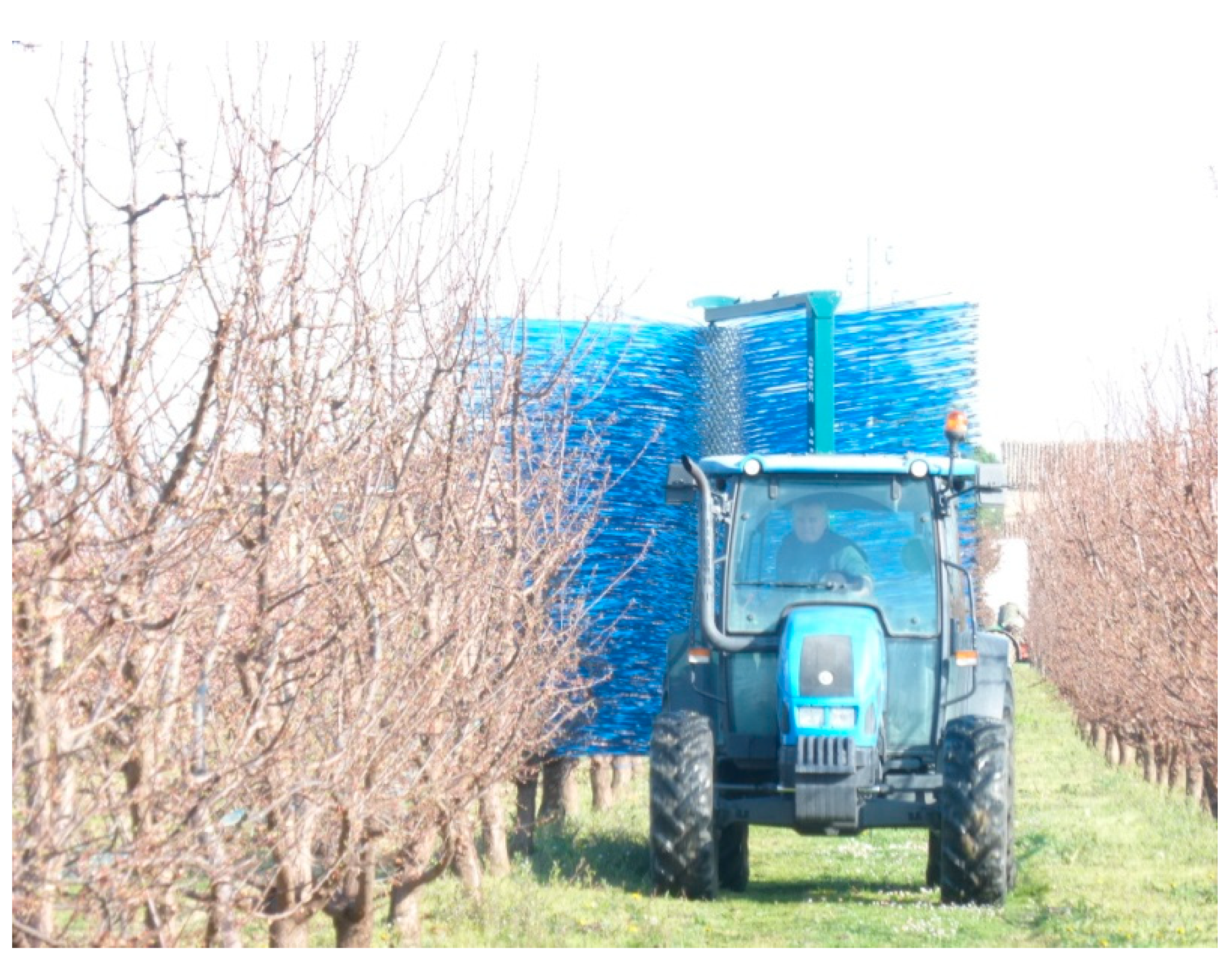
The machine mounted at the rear three-point linkage of a tractor Landini, model Advantage 95 GT, is composed of a vertical rotor on which 2808 flexible working tools (rods) are radially inserted with a nut spring system (Figure 1). The rods are made of flexible glass fiber with soft plastic end caps. Two hydraulic connections with 10 L/min flow and at least 190 bar pressure are required to set the machine. The main rotor is free to rotate and the speed of rotation is defined by the rods’ contact with the tree canopy. The thinning effect is mainly caused by rods input/output to the canopy for direct contact with flowers and fruits. The machine can be adopted to be both semi-mounted and mounted, to perform the thinning operation adequately, the total mass of the tractor with or without front ballast must guarantee the stability of a 3 m rear overhang. For road transport, the machine is mounted on an auxiliary transport frame, where the rotor width is reduced hydraulically from 3.05 to 2.1 m. The main data of the thinner machine are shown in Table 1.
Figure 1.
Thinner machine.
Table 1.
Main data of thinner machine.
Performance
The machine performance was calculated by measuring the working time according to the American Society of Agriculture and Engineering (ASAE) standard methods [29,30]. Other references include the “Commission Internationale pour organisation scientifique du travail en agriculture” (CIOSTA) and the Italian Society of Agricultural Engineering (AIIA) 3A R1 [31]. As the machine operated in orchard conditions, where trees were aligned in rows, the effective field capacity was determined and expressed as area capacity (Ca), as follows:
where
Ca = area capacity (ha h−1)
S = field speed (km h−1)
W = implement working width (m)
Ef = field efficiency (decimal)
For each trial, the machine and thinning performance were calculated.
2.2. Orchard Description
Tests were carried out on narrow-canopied orchards, more easily accessible, and hence best suited to the penetration of thinning elements such as strings or rods [2,11,22] during blooming time and on green fruit. The trials were carried out in March–May 2016 on two apricot and two peach commercial orchards, located in the provinces of Forlì-Cesena and Ravenna, northeast Italy. The main features of the orchards are summarized in Table 2.
Table 2.
Apricot and peach orchards involved in the tests.
2.3. Methodology
In each trial, three-tree plots per treatment repeated three times were randomly chosen. On the central tree of each plot, all the bearing shoots in the canopy were tagged and their shoot length was measured. The number of flowers or fruits on each shoot was counted before and after the thinning operation. According to their length, shoots were grouped into the following length classes: <15 cm; ≥15–25 cm; ≥25–35 cm; and ≥35 cm. The flower/fruit density (number of flowers/fruits per unit length of shoot) before and after the thinning, as well as the flower/fruit removal percentages, were calculated for each shoot. For each length class, the frequency in the canopy was calculated, so average values of flower density and flower removal were calculated using the weighted average.
Before each thinning experiment, preliminary tests were carried out on additional rows of the orchard in order to establish the tractor speeds to apply in the thinning trials, and exclude those resulting in insufficient thinning (<5% of flowers/fruit removed) and those causing over thinning (>80% of flowers/fruit removed) and/or damaged branches. Based on the results of the pre-tests, the tractor speeds in the thinning trials were set at 1.67 m s−1 (apricot flowers and peach flowers and fruits) and 1.11 m s−1 (apricot fruits).
Mechanical thinning of each row was completed in two passes, one per hedgerow side, letting the rotor rods penetrate only half of the canopy thickness, in order to avoid over-thinning the inner canopy. During the intervention, the rotor axis was vertical and parallel to the hedgerows.
In order to ascertain if the machine selectively removed either small or big fruits, 50 fruits per plot were sampled immediately before and after (collecting them from the ground) the thinning intervention, and their weight and size across the suture were measured.
Follow-up hand thinning to commercial level was performed to adjust fruit spacing and eliminate malformed/damaged fruits on the same dates of the control treatments (i.e., the standard practice consisting of only-manual thinning) by the same workers. In either follow-up and standard thinning, laborers were facilitated by self-propelled platforms.
The total crop of the central tree of three plots per treatment randomly chosen in each trial was harvested as a once-over harvest when more than 50% of the fruit was mature. The pack-out percentage (first quality fruit) was calculated, the size of the marketable fruits was measured, and the average size was calculated.
The time (h ha−1) and the cost (€ ha−1) of the thinning mechanical intervention (including the time required for the follow-up thinning) versus the control was calculated in each experiment. The total cost of the manual thinning was calculated based on a labor rate of 9.05 € h−1 [32] and included the cost of the fuel and the oil for running the self-propelled platform (1.59 € h−1) [33]; the cost of the mechanical thinning intervention was calculated taking into account the working capacity (h ha−1) of the thinning device, the cost of subcontracting the operator and the tractor carrying the thinning tool (85 € h−1) [34], and the cost of the labor for the follow up thinning.
Finally, the CO2 emission of the mechanical intervention versus the control was estimated and compared, taking into account that both the manual and the follow-up thinning were performed with the assistance of self-propelled platforms, and that the amount of CO2 produced by the combustion of 1 L of diesel is 2.68 kg of CO2 [35]. Mechanical thinning also took into consideration the working capacity (h ha−1) of the thinning device (Table 3).
Table 3.
Time (h ha−1) required to perform the mechanical thinning, and the hand thinning follow-up, as compared with the only manual thinning.
All recorded data were analyzed using analysis of variance procedures (free software PAST version 2.12, Øyvind Hammer Natural History Museum, University of Oslo). Flower and fruit density before and after thinning, as well as flower and fruit removal percentage, were the variables; shoot length classes were the factors analyzed. Before the analysis of variance, flower and fruit removal data expressed as percentages were transformed into arcsine-square-root values. Mean separations were performed using the post-hoc Tukey’s HSD test at p ≤ 0.05.
3. Results and Discussions
3.1. Machine Performance
The tractor speeds adopted after the preliminary tests are shown in Table 3. The study of machine performance allowed us to obtain the main working parameters in the field in different working times and in different orchards. The data show that the technical solutions that were studied and used to improve the available mechanical thinning solution [11] positively affected the work performance (Table 4).
Table 4.
Working times and performance of the machine.
The effective field capacity in peach fruits is higher (over 2 ha h−1) than in apricot fruits. The test showed an important difference between flower and fruit thinning with almost double performance of the machine for peaches than for apricots (0.96 ha h−1). In the test, peach flowers fell down more easily than the those of apricots, able to withstand almost twice as much in terms of working speed.
3.2. Thinning Efficiency
3.2.1. Apricot Flowers
The thinning test was performed when the orchard was at the stage of full blooming, which, according to Biologische Bundesanstalt, Bundessortenamt, and CHemical industry scale, is BBCH65 stage [4]. The flower density of trees at the date of thinning was 0.45 flowers cm−1, the highest in the shortest shoots (≤15 cm length class), the most represented type of bearing shoots in the canopy, and the lowest in the longest shoots (>25 cm), the least represented (Table 5). No damages to the branches were caused by the machine. The thinner device removed, on average, 20.8% of flowers, a drop in percentage slightly higher than that obtained in Spain on the apricot cv. Oscar, using the same machine at the same flowering stage [7].
Table 5.
Apricot flowers: shoot length classes and their frequency in the canopy, flower density, and flower drop percentage.
The follow-up hand thinning and only-manual thinning (control) were performed 56 days after full blooming (DAFB). The mechanical intervention reduced the time required for follow-up hand thinning 51% (22.2 h ha−1) as compared with the control (45.4 h ha−1) (Table 3), with a saving of 209.54 € ha−1 (Table 6).
Table 6.
Total costs (€ ha−1) of the thinning interventions and amount of saving (€ ha−1) obtained with the mechanical vs. only manual thinning in the four trials.
In the mechanically thinned plots, the harvest was performed 122 DAFB, total yield was 20.4 t ha−1 (95% of which was marketable), and fruit size averaged 51 mm. In the control, ripening of fruit was slightly behind, and the harvest was performed 101 DAFB; yield was 26.5 t ha−1 (92% of which was marketable), significantly higher than in the mechanically thinned plots; and fruits were smaller (average size 48 mm). The two-day anticipation in the harvest and the larger fruit size in the mechanically thinned plots as compared with the control plots presumably depend on the combined effect of the earlier crop load reduction and the lighter crop load.
3.2.2. Apricot Fruits
The thinning was performed 43 DAFB, when fruits weighed 5.9 g on average, and were 20.5 mm large at the suture point. Fruit density before thinning was on average 0.48 fruit cm−1, and was higher in the shortest and most represented class of bearing shoots and lower in the longest shoots (Table 6). The thinning machine removed 43.6% of initial fruit load. This fruit drop percentage is in line with the 40.6% obtained in the tests carried out with the same machine in Spain on the apricot cv. Oscar [7], although fruit thinning was performed at a more advanced growth stage (30–35 mm average fruit size) than in our trial. No damage to branches, and only the detachment of some leaves was noticed.
Fruit removal was rather uniform (Table 7) and unselective across the shoot length classes, the average size and weight of fruits dropped, but the results were statistically not different (on average, 5.8 g and 19.7 mm) from fruits sampled just before thinning. In the week following the treatments, an additional 10–12% fruit drop was recorded in the mechanically thinned plots, so that the final fruit drop was an approximately 55% reduction. This ‘delayed’ fruit drop phenomenon requires further investigation. Indeed, if confirmed on a wider range of apricot cultivars and commercial orchards, a delayed drop of fruit would not allow immediate estimate of the thinning intensity and consequent adjustment of the operative parameters, exposing the grower to the risks of excessive crop load reduction and a poor final yield ha−1.
Table 7.
Apricot fruits: shoot length classes and their frequency in the canopy, fruit density, and fruit drop percentage.
The manual thinning of finishing (Table 3) was performed 55 DAFB. In comparison with the control treatment, requiring 72.0 h ha−1 of manual labor, mechanical fruit thinning significantly reduced the follow-up thinning by up to 37.3 h ha−1 (48.2% time saving), with a saving of 246.48 € ha−1 (Table 6).
Fruit ripening in the mechanically thinned and control plots was contemporaneous, and harvest was performed 108 DAFB. Total yield of the mechanically thinned plots (27.7 t ha−1, 84% of which was marketable) did not differ significantly from the yield of control treatment 28.1 t ha−1 (90% of which was marketable). The average fruit size was significantly larger in the former (49 mm vs. 47 mm), and this is presumably the consequence of the earlier crop load reduction through the mechanical intervention. No fruit damages attributable to the machine (e.g., rubbing) were observed.
3.2.3. Peach Flowers
The mechanical thinning was performed 8 DAFB, when the orchard was at the flower fading stage (BBCH67 stage, [4]). Flower density at this date averaged 0.40 flowers cm−1, the highest in the shoots ≤15 cm, the least represented in the canopy, and the lowest in the shoots ≥25 cm, representing more than 65% of the total bearing shoots in the canopy (Table 8). The distribution of shoots of the various length classes was uneven in the canopy, the frequency of shoots ≥25 cm being twice as concentrated in the upper part of the canopy (40.8%) than in the bottom part (22.0%). This condition usually occurs in hedgerow systems with orchard aging, where the vigorous shoots tend to prevail in the higher and more lighted part of the canopy. Flower removal percentage was not significantly affected by the shoot length, and averaged 63% (Table 6). This value is in the range of flower removal (14 ÷ 70%) obtained using a string thinner tool in the window 0 to 15 DAFB on 12 peach and nectarine orchards trained to perpendicular Y or Central Leader [11]. Conversely, the flower drop in this study was three-fold higher than that obtained in Spain using the same machine on flowers of the nectarine cv. Tifanycov, and 10-fold higher than that obtained on the flat peach cv. UFO-4® [7]. The different cultivars, training system (palmette vs. vase), and tractor speed set in the two experiments have certainly played a role, although it is hard to explain such differences. No damages to the branches were recorded.
Table 8.
Peach flowers: shoot length classes and their frequency, flower density, and flower drop percentage.
The follow-up thinning (Table 3), performed 55 DAFB, was particularly necessary in the upper part of the canopy, requiring 87 h ha−1 overall, with a 42.8% labor saving as compared with the control trees (152 h ha−1), with a saving of 667.20 € ha−1 (Table 6). The mechanically thinned plots produced 28.8 t ha−1 (96% of which was marketable) and fruit size averaged 75 mm. Fruit ripening in the mechanically thinned and control plots was contemporaneous, and harvest was performed 111 DAFB. Yield was significantly higher than in the mechanically thinned plots (30.5 t ha−1, 94% of which was marketable), and fruits were smaller (average size 72 mm). The three-day anticipation in the harvest and the larger fruit size in the mechanically thinned plots as compared with the control plots is presumably attributable to the earlier crop load reduction in the former.
3.2.4. Peach Fruits
The mechanical thinning was performed 55 DAFB, when average fruit weight was 11.5 g and size at the suture was 27.5 mm. Average fruit density in the orchard before thinning was 0.21 fruit cm−1, the highest in the <15-cm long shoots, the least frequent in the canopy, and the lowest in ≥15-cm long shoots, the most frequent (Table 9). In the ≥25-cm long shoots, representing 73% of the total shoots in the canopy and the type of bearing shoots in peach where the best fruit quality is achieved [36,37], fruit removal was only 5.3%. In the trials carried out in Spain with the same machine at 3.5 km h−1 speed, very similar fruit drop percentages were obtained on the cv. UFO-4®, while three-fold higher drop percentages were obtained on the cv. TifanyCOV [7]. The thinning device caused no damages to the branches, and only some leaf detachment was noticed.
Table 9.
Peach fruits: shoot length classes and their frequency, fruit density, and fruit drop percentage.
To shed more light on the reasons for this poor result, the outcomes of thinning tests performed with the same device by local associations of growers in other peach orchards on fruits at various (40–60 DAFB) fruit growth stage were investigated. Based on the collected information (data not shown), it appears that the more advanced the fruit stage at mechanical thinning time, the lower the removal percentage. Moreover, the cultivar also seems to play a role in the effectiveness of the thinning device, confirming the results of the study carried out in Spain [7]. To achieve the wanted fruit load reduction, it will thus be very important to set up, case by case, the best timing and cultivar combination.
Fruit removal was unselective, the average size of fruits detached (12.3 g of weight and 28.5 mm of diameter at the suture), and were not statistically different from those sampled before thinning.
The follow-up thinning of the mechanically thinned plots was performed 57 DAFB (Table 3), requiring 120 h ha−1, with no time saving as compared with the control trees (125.0 h ha−1) and no cost saving (1311 and 1348.12 € ha−1, respectively (Table 6)).
Harvest in the mechanically thinned and control plots was performed in the same date, 113 DAFB. Total yield of the mechanically thinned plots (33.4 t ha−1, 84% of which was marketable) did not differ significantly from the yield of control treatment 35.1 t ha−1, 85% of which was marketable). The average fruit size was significantly larger in the former (71 mm vs. 85 mm), presumably as the consequence of the earlier crop load reduction through the mechanical intervention.
No fruit damages attributable to the machine (e.g., rubbing) were observed.
3.3. CO2 Emission of the Mechanical versus Manual Thinning
The amount of CO2 produced by the mechanical versus only-manual thinning (control) was compared, taking into account that manual thinning in the hedgerows systems is performed with the assistance of self-propelled fruit carriages. Based on the CO2 produced in each of the experiments (Table 10), under the conditions, the mechanical thinning allowed a reduction of CO2 emission ranging from 9.94 to 249.58 kg CO2 ha−1.
Table 10.
Total amount of CO2 (kg ha−1) produced by the only-manual and mechanical thinning operations in the four trials and emission reduction allowed by the mechanical thinning.
4. Conclusions
Crop load adjustment through thinning is a necessary practice in stone fruit. However, the high cost and amount of labor required to perform this operation, the increasing difficulty in finding specialized labor, and the low profitability of farmers in recent years are making the traditional manual intervention less sustainable. Hedgerows systems like those tested in our trials and spread in the modern Italian stone fruit industry are demanding in terms of thinning labor; moreover, to perform the manual thinning of such tall canopies, workers need the support of self-propelled mechanized platforms, the use of which generates air pollution.
Agriculture has improved rapidly in the adoption of new technologies, including the development of thinning devices based on various operative systems. The implementation of a mechanical thinning practice, complemented by a manual finishing, could represent a valuable near-term solution to the above-mentioned problems.
The preliminary tests carried out in this study confirmed that the new thinner developed in France can be used on stone fruit both at blooming and at the green fruit stage, with minimal harm to the branches or the fruits even when thinning is performed at a more advanced fruit growth stage. Either in apricot and peach, the machine did not seem to selectively remove either large or small fruit, similar to what was found in other studies of mechanical fruit thinning [2,38,39]. However, as found in other tests with the same machine (7), the results varied largely, being affected by the species, the cultivar, the flowers and/or fruit loads, and the shoot length. In light of the above considerations, it would be desirable, especially in the early years of introduction of this machine in the standard thinning practice, to collect the local main crop parameters (e.g., fruit variety, training system, load flowers/fruits, final production, etc.) together with the specific machine settings (e.g., working speed, rotor inclination) adopted in the various tests carried out to create a local specific historicity useful to users to quickly identify the optimal working conditions.
The mechanical thinning treatments in our experiments allowed a reduction of 9.94–249.58 kg CO2 emissions due to the (4–51.1%) reduced time in the field of operators and machines.
Further research is needed to set up operational parameters and to adjust dormant pruning techniques in order to better adapt stone fruit orchards to thinning automation, as also found for peach orchards [11]. Moreover, given the poor results obtained on peach when thinning at the green fruit stage, future studies will focus the timing of intervention. The trial is continuing on flowers and fruits of other species and varieties of stone fruits, but these initial positive results lay good foundations for a future appreciation of the system.
Author Contributions
Conceptualization, A.A. and G.C.; Methodology, A.A., G.C., M.C. and S.S.; Software, G.C., D.G. and G.B.; Validation, A.A., G.C., D.G. and G.B.; Formal Analysis, G.C. and D.G.; Investigation, A.A., G.C., D.G. and G.B.; Resources, A.A., G.C., D.G. and G.B.; Data Curation, A.A., G.C., D.G., M.C. and S.S.; Writing—Original Draft Preparation, A.A., G.C., D.G., M.C., and S.S.; Writing—Review & Editing, A.A., G.C., D.G., M.C., S.S. and G.B.; Visualization, G.C., D.G. and G.B.; Supervision, G.C.; Project Administration, A.A.; Funding Acquisition, A.A.
Funding
This research was funded by National project AGROENER (Energia dall’agricoltura: Innovazioni sostenibili per la bioeconomia) grant number [D.M. del Mipaaf 26329 del 01/04/2016].
Conflicts of Interest
The authors declare no conflicts of interest.
References
- Marini, R.P.; Reighard, G.L. Crop load management. In The Peach: Botany, Production and Uses; Layne, D.R., Bassi, D., Eds.; CAB International: Wallingford, UK, 2008; pp. 289–302. [Google Scholar]
- Glenn, D.M.; Peterson, D.L.; Giovannini, D.; Faust, M. Mechanical Thinning of Peaches is Effective Postbloom. Hortscience 1994, 29, 850–853. [Google Scholar]
- Costa, G.; Vizzotto, G. Fruit thinning of peach trees. Plant Growth Regul. 2000, 31, 113–119. [Google Scholar] [CrossRef]
- Meier, U.; Graf, H.; Hess, M.; Kennel, W.; Klose, R.; Mappes, D.; Seipp, D.; Stauss, R.; Streif, J.; Boom van den, T. Phenological growth stages and identification keys of pome fruit. In Growth Stages of Mono-and Dicotyledonous Plants; Blackwell Wissenschafts-Verlag: Berlin, Germany, 1994; pp. 52–54. [Google Scholar]
- Webster, A.D.; Spencer, J.E. Fruit thinning plums and apricots. Plant Growth Regul. 2000, 31, 101–112. [Google Scholar] [CrossRef]
- Son, L. Effects of hand and chemical thinning on fruit size and quality of ‘Priana’ and ‘Beliana’ apricot (Prunus armeniaca) cultivars. N. Z. J. Crop Hortic. Sci. 2004, 32, 331–335. [Google Scholar] [CrossRef]
- IRTA. Estudio de la eficiencia del cepillo Eclairvale 2500® en el aclareo de frutales de hueso. Solicitado por: VIVERSA. Informe número: V2999-4435 Codigo Orgánico: 1200, Fecha: 29/ Noviembre / 2015 (Rev. 4. R-75-00-02), pp. 1–55. Available online: http://www.lacannevale.fr/rapport-IRTA.pdf (accessed on 18 October 2017).
- Schupp, J.R.; Baugher TAuxt Miller, S.S.; Harsh, R.M.; Lesser, K.M. Mechanical Thinning of Peach and Apple Trees Reduces Labor Input and Increases Fruit Size. HorTechnology 2008, 18, 660–670. [Google Scholar]
- Glozer, K.; Hasey, J. Mechanical thinning in cling peach. HortScience 2006, 41, 995. [Google Scholar]
- Neri, D.; Giovannini, D.; Massai, R.; Di Vaio, C.; Sansavini, S.; Del Vecchio, G.; Guarino, F.; Mennone, C.; Abeti, D.; Colombo, R. Efficienza produttiva e gestionale degli impianti di pesco: Confronto fra aree geografiche. Italus Hortus 2010, 17, 50–66. [Google Scholar]
- Asteggiano, L.; Giordani, G.; Bevilacqua, A.; Vittone, G.; Pellegrino, S.; Costa, G. Bloom mechanical thinning improves fruit quality and reduces production costs in peach. Acta Hortic. 2015, 1084, 389–394. [Google Scholar] [CrossRef]
- Berlage, A.G.; Langmo, R.D. Machine vs. Hand thinning of peaches. Trans. ASAE 1982, 25, 538–543. [Google Scholar] [CrossRef]
- Ambrožič Turk, B.; Fajt, N.; Stopar, M. Tergitol as a possible thinning agent for peach cv. Redhaven. Hort. Sci. 2014, 41, 2–49. [Google Scholar] [CrossRef]
- Baugher, T.A.; Shupp, J.; Miller, S.; Hars, M.; Lesser, K.; Reichard, K.; Sollenberger, E.; Armand, M.; Kammerer, L.; Reid, M.; et al. 2010. Chemical and Mechanical Thinning of Peaches. Available online: http://www.newenglandvfc.org/pdf_proceedings/ChemMechThinningPeaches.pdf (accessed on 18 October 2017).
- Byers, R.E. Effects of bloom-thinning chemicals on peach fruit set. J. Tree Fruit Prod. 1999, 2, 59–78. [Google Scholar] [CrossRef]
- Coneva, E.; Cline, J.A. Gibberellic Acid Inhibits Flowering and Reduces Hand Thinning of Redhaven Peach. HortScience 2006, 41, 1596–1601. [Google Scholar]
- Fallahi, E.B.; Fallahi, J.R.; McFerson, J.R.; Byers, R.E.; Ebel, R.C.; Boozer, J.P.; Wilkins, P.S. Tergitol-TMN-6 surfactant is effective bloom thinner for stone fruits. HortScience 2006, 41, 1243–1248. [Google Scholar]
- Klein, J.D.; Cohen, S. Thinning nectarines and peaches at flowering with organosilicone surfactants. HorScience 2000, 35, 385–519. [Google Scholar]
- Osborne, J.L.; Robinson, T.L.; Parra-Quezada, R. Chemical blossom thinning agents reduce crop load of ‘Rising Star’ peach in New York. Acta Hortic. 2005, 727, 423–428. [Google Scholar] [CrossRef]
- Milà i Canals, L.; Clemente Polo, G. Life cycle assessment of fruit production. In Environmentally Friendly Food Processing; Woodhead Publishing Limited: Cambridge, UK, 2003; pp. 29–53. [Google Scholar]
- Myers, S.C.; Savelle, A.T.; Tustin, D.S. Partial flower thinning increases shoot growth, fruit size, and subsequent flower formation of peach. HortScience 2002, 37, 647–650. [Google Scholar]
- Miller, S.S.; Schupp, J.R.; Baugher, T.A.; Wolford, S.D. Performance of Mechanical Thinners for Bloom or Green Fruit Thinning in Peaches. HortScience 2011, 46, 43–51. [Google Scholar]
- Schupp, J.R.; Baugher, T.A. Peach Blossom String thinner performance improved with selective pruning. HortScience 2011, 46, 1486–1492. [Google Scholar]
- Costa, G.; Vizzotto, G. Flower and fruit thinning of peaches and other Prunus. Hort. Rev. 2010, 73, 351–387. [Google Scholar]
- Martin-Gorritz, B.; Torregrosa, A.; Brunton, J.G. Feasibility of peach bloom thinning with hand-held mechanical devices. Sci. Hort. 2011, 129, 91–97. [Google Scholar] [CrossRef]
- Diezma, B.; Rosa, U.A. Monitoring of fruit removal for mechanical thinning of peaches. Frutic 2005, 5, 12–16. [Google Scholar]
- Baugher, T.A.; Elliott, K.C.; Leach, D.W.; Horton, B.D.; Miller, S.S. Improved Methods of Mechanically Thinning Peaches at Full Bloom. J. Am. Soc. Hort. Sci. 1991, 116, 766–769. [Google Scholar]
- Asteggiano, L.; Vittone, G. Diradamento del pesco—L’esperienza italiana. In Proceedings of the VI Simpósio Internacional de Fruticultura Temperada em Região Sub-Tropical. Avaré/ São Paulo, Brasil, 11–13 September 2014. In Agricultural Machinery Management; Standard ASAE EP 496.3; American Society of Agricoltural and Biological Engineers: St. Joseph, MI, USA, February 2007. [Google Scholar]
- ASAE. Agricultural Machinery Management; Standard ASAE EP 496.3; American Society of Agricoltural Engineers: St. Joseph, MI, USA, February 2007. [Google Scholar]
- ASAE. Agricultural Machinery Management; Standard ASAE EP 497.7; American Society of Agricoltural Engineers: St. Joseph, MI, USA, March 2011. [Google Scholar]
- Bodria, L.; Pellizzi, G.; Piccarolo, P. Meccanica Agraria; Il Sole 24 Ore Edagricole: Bologna, Italy, 2006; Volume II. [Google Scholar]
- Confagricoltura di Forlì-Cesena e Rimini, Tabelle Salariali in Vigore dal 01/05/2015 Applicazione del CCNL 22/10/2014. Available online: http://www.confagricolturatreviso.it/lavoro/rinnovo-del-ccnl-operai-agricoli-e-florovivaisti (accessed on 25 September 2018).
- Camera di Commercio Agricoltura, Industria e Artigianato Provincia Forlì Cesena, Nota Informativa sui Prezzi dei Carburanti, 15/09/2018. Available online: http://www.fc.camcom.it/download/prezzi/listino-prodotti-petroliferi-del-15-09-2018.pdf?DWN=16066 (accessed on 26 September 2018).
- APIMAI, Associazione Provinciale Imprese di Meccanizzazione Agricola e Industriale, Tariffario 2018 per le Provincia di Forlì-Cesena e Rimini, 2018. Available online: http://www.caiagromec.it/sites/unima.it/files/tariffari/apima_libretto_2018_8.pdf (accessed on 28 September 2018).
- U.S. Environmental Protection Agency. Emission Facts: Average Carbon Dioxide Emissions Resulting from Gasoline and Diesel Fuel. Available online: http://www.epa.gov/otaq/climate/420f05001.htm#calculating (accessed on 1 October 2018).
- Corelli-Grappadelli, L.; Coston, D.C. Thinning pattern and light environment in peach tree canopies influence fruit quality. HortScience 1991, 26, 1464–1466. [Google Scholar]
- Marini, R.P.; Sowers, D.L. Peach Fruit Weight Is Influenced by Crop Density and Fruiting Shoot Length but not Position on the Shoot. J. Am. Soc. Hort. Sci. 1994, 119, 180–184. [Google Scholar]
- Bukovac, M.J.; Gaston, H.P.; Hedden, S.L.; Levin, J.H. Fruit thinning of peaches with machines. Q. Bull. 1963, 45, 518–532. [Google Scholar]
- Hancock, B.G.; Powell, A.A.; Worthington, J.W. Mechanical thinning of peaches. Peach-World Cultivars Market. 1988, 667–672. [Google Scholar]
© 2018 by the authors. Licensee MDPI, Basel, Switzerland. This article is an open access article distributed under the terms and conditions of the Creative Commons Attribution (CC BY) license (http://creativecommons.org/licenses/by/4.0/).



