Article

Multi-Stack Efficiency Optimization Strategies for Fuel Cell Systems

School of Automation, Central South University, Changsha 410083, China
*
Author to whom correspondence should be addressed.
World Electr. Veh. J. 2026, 17(6), 281; https://doi.org/10.3390/wevj17060281
Submission received: 16 April 2026 / Revised: 20 May 2026 / Accepted: 22 May 2026 / Published: 26 May 2026
(This article belongs to the Section Storage Systems)

Abstract

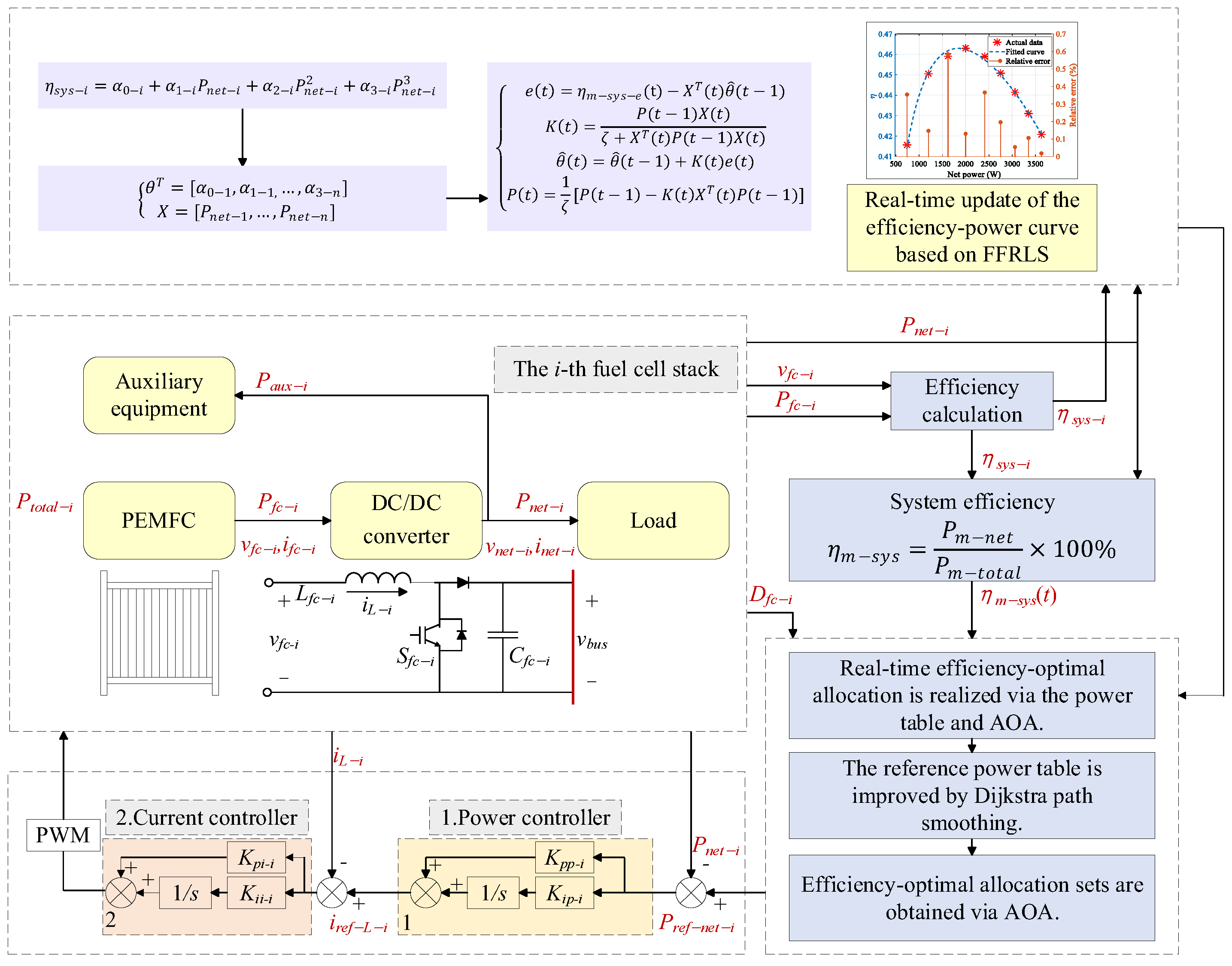
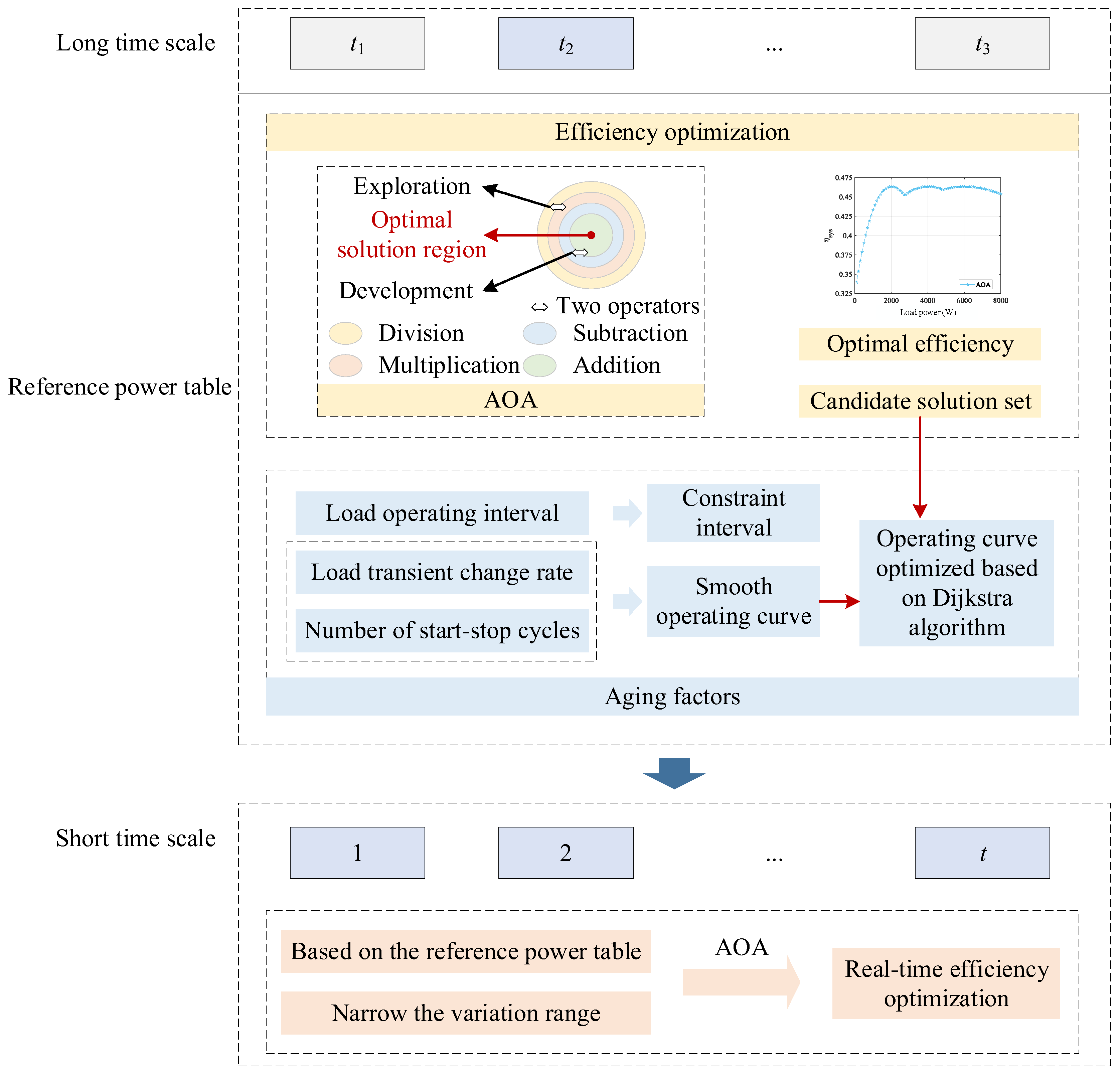
With the in-depth advancement of the “dual carbon” strategy, Proton Exchange Membrane Fuel Cells (PEMFCs), as efficient and clean energy conversion devices, show great potential in the fields of transportation power and stationary power generation. For multi-stack fuel cell systems, a hierarchical optimization strategy based on Pareto decoupling and real-time correction is presented to achieve system efficiency improvement and balanced management of stack aging. Firstly, the Forgetting Factor Recursive Least Square (FFRLS) method is adopted to online identify the parameters of the system’s net output power-efficiency curve. Furthermore, in the steady-state layer, the Arithmetic Optimization Algorithm (AOA) is used to construct an efficiency-optimal candidate solution set. The Dijkstra algorithm is combined to search for the optimal power gradient path, generating a reference power table. In the dynamic layer, with the reference power table as the basis, the AOA algorithm is used to take efficiency optimization as the goal. Load fluctuations are suppressed in real time through strong constraints, realizing the balance between dynamic efficiency and operational stability. This method ensures the stable operation of the system and significantly improves the overall economy and adaptability of power allocation. Simulation results show that this strategy can effectively improve the overall operating efficiency of the system, slow down the stack aging rate, and ensure the stable operation of the system.
Keywords: PEMFCs; modeling; efficiency; power allocation PEMFCs; modeling; efficiency; power allocation