Article

Robust Modulated Model Predictive Control for PMSM Using Active and Virtual Twelve-Vector Scheme with MRAS-Based Parameter Mismatch Compensation


by
Mahmoud Aly Khamis
1,2,*,
Mohamed Abdelrahem
3,4,*,
Jose Rodriguez
5 and
Abdelsalam A. Ahmed
2
1
Institute of Industrial and Control Engineering, Universitat Politècnica de Catalunya, 08028 Barcelona, Spain
2
Department of Electrical Power and Machines Engineering, Faculty of Engineering, Tanta University, Tanta 31733, Egypt
3
Electrical Engineering Department, Faculty of Engineering, Assiut University, Assiut 71515, Egypt
4
Chair of High-Power Converter Systems, Technical University of Munich, 80333 Munich, Germany
5
Director Center for Energy Transition, Universidad San Sebastián, Santiago 4081339, Chile
*
Authors to whom correspondence should be addressed.
World Electr. Veh. J. 2026, 17(2), 77; https://doi.org/10.3390/wevj17020077
Submission received: 7 December 2025 / Revised: 30 January 2026 / Accepted: 30 January 2026 / Published: 5 February 2026
(This article belongs to the Special Issue New Trends in Electrical Drives for EV Applications)

Abstract

Modulated twelve-voltage-vector model predictive current control (MPCC), which applies two or three voltage vectors per control period, exhibits superior steady-state performance compared to modulated six-active-voltage-vector MPCC and conventional MPCC. However, implementing modulated twelve-voltage-vector MPCC requires accurate knowledge of the permanent magnet synchronous motor drive’s inductance and permanent magnet (PM) flux linkage parameters for selecting suboptimal and optimal voltage vectors, as well as computing the duty cycles of optimal vectors. Consequently, its control performance is more sensitive to model parameter inaccuracies. To mitigate parameter sensitivity, a robust modulated twelve-voltage-vector MPCC algorithm based on a model reference adaptive system (MRAS) is proposed. The MRAS-based observer estimates the inductance and PM flux linkage parameters in real time, enhancing model accuracy. The observer is designed with a stability analysis framework, where the proportional and integral gains of the MRAS are theoretically derived to ensure precise parameter estimation. The effectiveness of the proposed algorithm is validated through simulation results, demonstrating satisfactory control performance even under parameter mismatches. Specifically, the torque ripple is reduced from 1.1 A to 0.6 A, corresponding to a reduction of 45.5%. Similarly, the stator flux ripple decreases from 1.75 A to 1 A (42.9% reduction), while the total harmonic distortion (THD) is reduced from 8.39% to 5.48%, representing a 34.7% improvement.

1. Introduction

Permanent magnet synchronous machines (PMSMs) are widely used as traction machines in electric vehicles (EVs) due to their desirable characteristics, such as high efficiency, high power density, and excellent control performance [1,2,3,4,5]. Various control schemes are required to cater to a wide range of applications, as they need to adapt to different operating conditions in PMSM drives. The PMSM drive, on the other hand, is a typical nonlinear control system in which the linear control approach, such as the PI controller, has difficulty providing good control performance and faces difficulties with parameter mismatch. Field-oriented control (FOC) based on PI linear controllers has several limitations when it comes to achieving fast and smooth speed performance across a wide operating range [6].
Advanced control technologies, including sliding mode control [7], fuzzy control [8], and model predictive control (MPC), have been extensively studied and implemented in PMSM drives. These control techniques offer alternative approaches to enhance the performance and efficiency of PMSM drives. Among these control methods, MPC receives much focus because of its simplicity and excellent dynamic behavior. Model predictive control based on the finite control set (FCS-MPC) method [9,10,11,12,13,14,15] was classified into model predictive direct speed control (MPDSC), model predictive torque control (MPTC), and model predictive current control (MPCC).
The FCS-MPCC method predicts the current components of the motor during the next sample interval and selects an optimum voltage vector according to the minimization of cost functions [16]. In conventional MPCC (C-MPCC), only a voltage vector is applied during each sampling interval T s . Consequently, there is no assurance that torque ripples, stator flux ripple, and the THD in the stator phase current will be minimized [6].
To enhance the performance of surface-mounted permanent magnet synchronous motor (SPMSM) drives under the MPCC method, a modified approach called the modulated six-active-voltage-vector MPCC based on the duty-cycle method has been proposed, aiming to minimize torque ripples, stator flux ripple, and THD in the stator phase current during steady-state operation [17,18,19]. In the modulated MPCC (M-MPCC) with six active voltage vectors, based on duty-cycle calculation, an active voltage vector is firstly applied in the calculated duty time, and a zero voltage vector is then applied during the remaining time of the sample period.
Both C-MPCC and M-MPCC with six active voltage vectors involve motor parameters in the prediction model, such as stator resistance, inductance, and PM flux linkage. In the presence of parameter mismatch—caused by operating condition variations or measurement errors—an inaccurate voltage vector may be selected, leading to deteriorated control performance [20,21]. Consequently, the performance of C-MPCC strongly depends on parameter accuracy. Although M-MPCC with six active voltage vectors provides improved dynamic performance, it requires the computation of both the optimal voltage vector and the duty cycle, which rely on motor parameters. As a result, M-MPCC with six active voltage vectors is more sensitive to parameter inaccuracies than C-MPCC.
Despite the extensive research on minimizing the parameter sensitivity of the FCS-MPC method, most existing approaches either eliminate parameter dependence through incremental or observer-based models, or focus on parameter estimation in C-MPCC schemes. However, these methods are generally difficult to integrate with duty-cycle-based M-MPCC, where accurate knowledge of motor parameters—particularly stator inductance and permanent magnet flux linkage—is essential for voltage vector selection and duty-cycle calculation. As a result, the robustness of M-MPCC schemes against parameter mismatches remains insufficiently addressed in the literature. To fill this gap, this paper proposes a robust M-MPCC strategy that integrates a model reference adaptive system (MRAS) for real-time estimation of motor parameters. The proposed approach preserves the low torque ripple and reduced current distortion characteristics of M-MPCC while significantly improving robustness against parameter mismatches, thereby extending the practical applicability of duty-cycle-based predictive current control for PMSM drives.
The structure of this paper is as follows: Section 2 reviews the latest relevant research efforts, highlighting the research gap and the main contributions. Section 3 presents the mathematical model of the surface-mounted permanent magnet synchronous motor. In Section 4, the modulated twelve-voltage-vector MPCC algorithm is introduced. Section 5 analyzes the impact of parameter sensitivity on conventional MPCC and modulated twelve-voltage-vector MPCC methods. Section 6 details the proposed robust modulated twelve-voltage-vector MPCC, incorporating the stability analysis of the MRAS. Section 7 evaluates and compares the dynamic performance of the drive system under both modulated twelve-voltage-vector MPCC and its robust counterpart, considering parameter mismatches. Section 8 provides a discussion comparing the achieved results of the proposed method with those reported in the literature, highlighting the benefits of the proposed approach. Finally, Section 9 provides the conclusion.

2. Related Works and Research Gap

2.1. Related Works

Several strategies have been proposed in [7,22,23,24,25,26,27,28,29,30] to minimize parameter sensitivity of the FCS-MPC method.
In [7], a robust predictive control approach on an incremental prediction model was proposed. This method mitigates performance degradation caused by permanent magnet (PM) flux linkage mismatch and compensates for prediction errors arising from inductance uncertainty through a disturbance observer. By eliminating the dependence of the predictive model on the PM flux linkage, the incremental model-based technique is well suited for C-MPCC. However, it cannot be extended to M-MPCC, since duty-cycle computation requires accurate knowledge of both stator inductance and PM flux linkage. Consequently, the incremental model-based MPC approach is not compatible with M-MPCC.
In [22], an MPCC approach based on an incremental prediction model was proposed. In this method, the influence of the PM flux linkage on the prediction model is eliminated, while an extended state observer (ESO) is employed to improve robustness against inductance mismatch. However, this approach is not suitable for M-MPCC because the ESO estimates lumped disturbances rather than explicit motor parameters. When the PM flux linkage or stator inductance is mismatched, the resulting model error manifests as a disturbance in the current dynamics. Although the ESO can estimate and compensate for this disturbance, it does not provide the explicit parameter information required for duty cycle computation. Consequently, ESO-based MPC is incompatible with the duty-cycle-based M-MPCC framework.
In [23,24,25], observer-based predictive control approaches are investigated. Although these methods can compensate for performance degradation caused by parameter mismatches, they do not provide direct estimates of the actual parameter values. Since the discrepancy between nominal and actual parameters constitutes the parameter error, duty-cycle errors arising from parameter uncertainties cannot be explicitly compensated in duty-cycle-based M-MPCC.
In [26,27,28], a model-free predictive current control strategy was presented, which can predict current without requiring prior knowledge of SPMSM parameters. Consequently, it is difficult to apply this approach to duty-cycle-based M-MPCC.
In [31], Bian and Chien proposed an adaptive fractional-order sliding mode controller with a fractional-order disturbance observer, enhancing robustness against disturbances and parameter variations while reducing chattering; however, explicit parameter estimation was not provided. Similarly, Qu et al. [32] introduced a model-free adaptive fast integral terminal sliding mode control with prescribed performance error constraints and an extended state observer, achieving finite-time convergence and tight tracking performance under varying operating conditions, while inherently accommodating parameter mismatches but without explicitly estimating the system parameters. Ullah et al. [33,34] developed robust and smooth super-twisting sliding mode control strategies for PMSM speed regulation, employing sliding-mode and high-order super-twisting observers to estimate and reject lumped disturbances, including the effects of parameter mismatches, thereby improving tracking performance and reducing chattering; nevertheless, these approaches do not explicitly identify or estimate individual motor parameters. In [35], Liu et al. designed a fuzzy self-tuning fractional-order PD controller with a torque observer, enabling online adaptation for improved disturbance rejection and dynamic response and partially compensating for parameter variations such as inductance and resistance, yet without direct parameter identification. Collectively, these works demonstrate the effectiveness of combining fractional-order, adaptive, and observer-based strategies for PMSM control, while highlighting that direct parameter estimation remains unaddressed.

2.2. Research Gap

The robustness of the system against machine parameter mismatch is improved in [29] by estimating the back electromotive force (EMF) based on the previous values of voltages and currents. The back-EMF estimation can compensate for the error caused by the PM flux linkage mismatch only. However, the presented simulation results show that the effect of this method on duty-cycle-based control schemes is not sufficiently accurate due to the lack of precise inductance estimation.
In [30], a robust two-vector MPCC technique is introduced to mitigate the parameter sensitivity of the conventional two-vector MPCC method. This approach incorporates an inductance and flux linkage extraction methodology that enables accurate determination of both the inductance and PM flux linkage values. The effective approach to enhance the parameter robustness of MPCC is to estimate the actual model parameters in real time. A summary of the aforementioned studies is provided in Table 1.
Online identification methods are commonly employed to determine the actual values of model parameters when parameter mismatches exist in the predictive model. Examples include artificial neural networks (ANNs) [36], the extended Kalman filter (EKF) [37], and the model reference adaptive system (MRAS) [38].
Although online parameter estimation techniques such as EKF and ANNs are commonly employed, they generally entail substantially higher computational demands than MRAS. Specifically, EKF requires repeated system linearization and matrix computations at each sampling instant, along with careful tuning of process and measurement noise covariance matrices to achieve stable and accurate parameter convergence [39]. Similarly, ANNs involve real-time forward and backward propagation and online weight updates, and their convergence is highly sensitive to network architecture, learning rate, and signal excitation. In contrast, the MRAS observer used in the proposed method is based primarily on simple arithmetic operations and PI controllers, offering robust, stable, and guaranteed parameter convergence under appropriate adaptation gain and reference model design. This low computational overhead makes MRAS particularly well-suited for real-time implementation in predictive control frameworks, while still providing reliable and accurate parameter compensation.
It should be noted, however, that MRAS is specifically designed to handle motor parameter uncertainties, such as variations in stator inductance and PM flux linkage. Unmodeled uncertainties in the current loop, including inverter dead-time effects or sensor calibration errors, are outside the scope of MRAS. In such cases, dedicated compensation techniques or robust control methods, such as those proposed in [40], are required to address these nonidealities. By clarifying this distinction, the advantages and intended application scope of the MRAS-based approach are clearly positioned relative to alternative robust control strategies.

2.3. Main Contributions

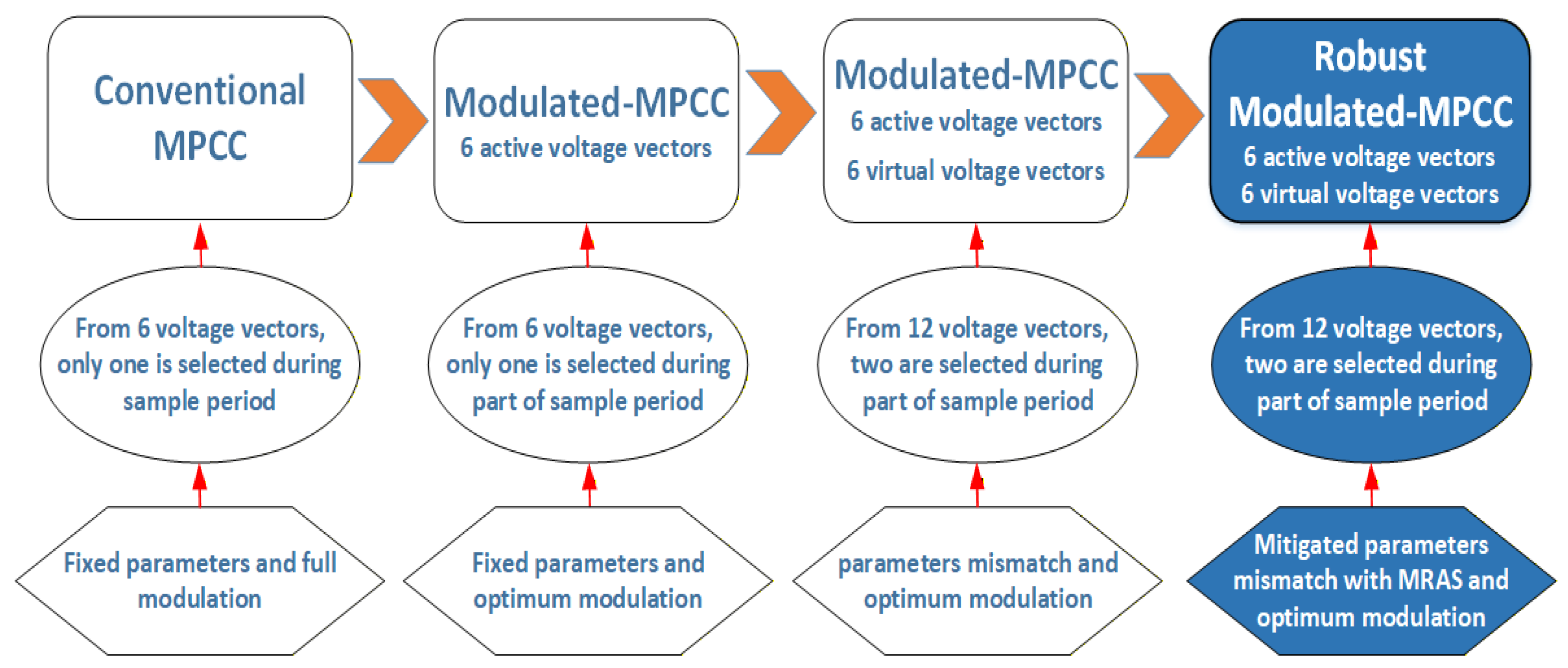
In this paper, a modulated twelve-voltage-vector MPCC method is employed to reduce torque ripple, stator flux ripple, and THD in the stator phase current. To address parameter mismatches that may occur during operation or measurement, a novel robust modulated model predictive current control approach is proposed, incorporating adaptive modulation and compensation for parameter mismatches using an MRAS observer. The primary contributions of this work are summarized as follows and illustrated in Figure 1.
  • Development of an adaptive modulated MPC: A modulated MPC strategy with adaptive modulation is developed to minimize torque and current ripples in PMSM drives.
  • Incorporation of parameter mismatch compensation: The modulated MPC is enhanced by integrating a robust compensation mechanism for parameter mismatches while maintaining low torque and current ripple levels.
  • Design of an MRAS-based parameter estimation technique: A robust MRAS observer is designed to perform real-time estimation of motor parameters, improving predictive accuracy under varying conditions.
  • Performance validation and comparison: The dynamic performance of PMSM drives under the proposed adaptive and robust modulated MPC schemes is evaluated and compared.

3. Mathematical Model of the SPMSM Drives

An SPMSM is considered in this paper so that the inductance in the d-axis L d and the inductance in the q-axis L q are equal: L s = L d = L q . The SPMSM’s state-space representation in the rotor reference frame is described by the following:
d d t [ i d s i q s ] = R s L s ω r ω r R s L s [ i d s i q s ] + 1 L s 0 0 1 L s [ v d s v q s ] + 0 λ P M ω r L s ,
where the state vector is i d q s = [ i d s i q s ] , the input voltage vector is v d q s = [ v d s v q s ] , ω r is the electrical rotor speed, R s is the stator resistance, λ P M is the permanent magnet flux linkage, and L s is the stator inductance.
To predict the motor currents at the next sampling instant k + 1 , the measured position, speed, and current at the current sampling instant k are used to model the motor in discrete form. This is achieved using the forward Euler discretization, as expressed in (2) and (3):
d x d t x ( k + 1 ) x ( k ) T s
x ( k + 1 ) = A x ( k ) + B u ( k )
where x ( k + 1 ) denotes the predicted state vector (e.g., i d q s ( k + 1 ) ) at the next sampling instant, and x ( k ) and u ( k ) represent the measured states and control inputs at the current instant k. By applying this discretization in (2) and (3) to the continuous-time state-space model (1), the discrete-time motor model at the sampling period T s can be expressed as follows:
i d s ( k + 1 ) = A i d s ( k ) + B i q s ( k ) + T s L s v d s ( k ) , i q s ( k + 1 ) = A i q s ( k ) B i d s ( k ) + T s L s v q s ( k ) C ,
where the discrete-time coefficients are defined as follows:
A = 1 R s T s L s , B = ω r ( k ) T s , C = λ P M L s ω r ( k ) T s .
When dead-time is considered, its influence can be compensated by modifying the predictive model in (4), where the applied d q -voltage components are scaled by the factor ( T s t d ) / T s , with t d denoting the inverter dead-time duration.
For each possible actuation of the six switching states, the voltage components in the d-q frame, v d q s ( k ) , in terms of the phase voltages v a b c ( k ) , are determined as follows:
v d s ( k ) v q s ( k ) = cos θ cos ( θ 120 ) cos ( θ + 120 ) sin θ sin ( θ 120 ) sin ( θ + 120 ) v a n ( k ) v b n ( k ) v c n ( k ) ,
The phase voltages v a b c ( k ) are related to the switching function S a b c = [ S a S b S c ] and the DC-link voltage V D C as follows:
v a n ( k ) v b n ( k ) v c n ( k ) = V D C 3 2 1 1 1 2 1 1 1 2 S a S b S c .

4. Modulated Twelve Voltage Vectors MPCC

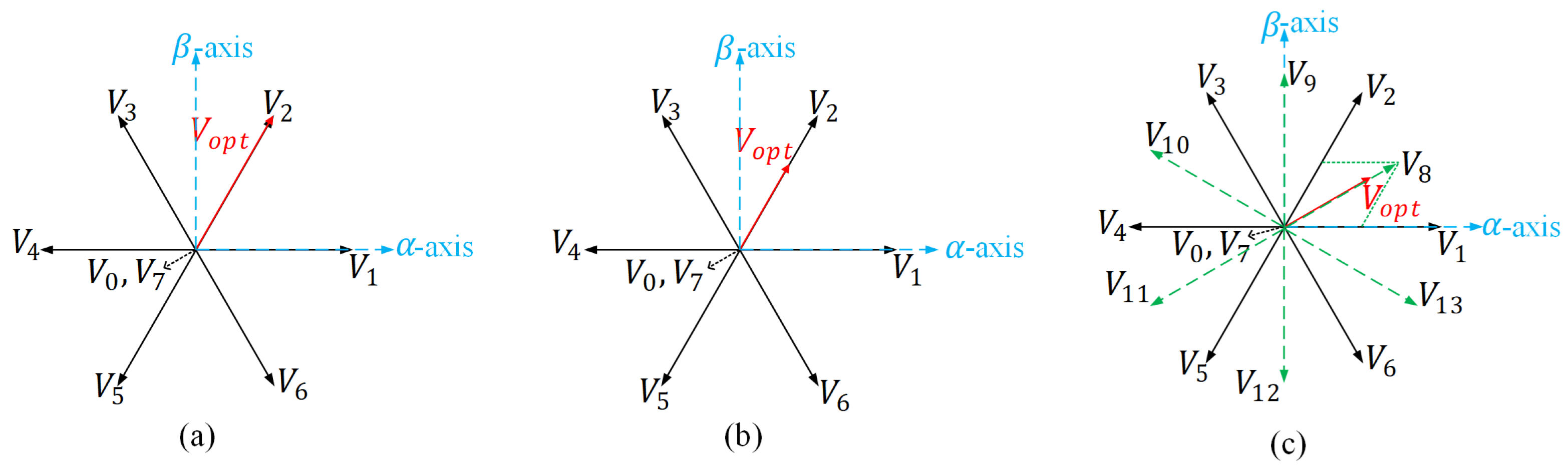
As stated in previous research [19], the conventional modulated voltage vector MPCC (in M-MPCC-6) algorithm incorporates six active voltage vectors. In the modulated twelve-voltage-vector MPCC (in M-MPCC-12) algorithm, as shown in Figure 2, the number of voltage vectors is expanded by introducing six virtual voltage vectors without increasing computational overhead. Figure 2a and Figure 2b illustrate C-MPCC and M-MPCC-6, respectively.
In C-MPCC, the vector v 2 is selected as the optimal voltage vector v opt and applied throughout the entire sampling period T s . In M-MPCC-12, v 2 is also selected as the optimal vector but is applied only for a duration of μ T s . To further enhance SPMSM performance by reducing torque ripple, stator flux ripple, and THD in the stator phase current, six additional virtual voltage vectors are introduced alongside the original six active voltage vectors, as shown in Figure 2c.
In this approach, a virtual voltage vector is generated by combining two neighboring active voltage vectors, referred to as the optimum and suboptimum selected vectors. For instance, if v 1 and v 2 are the optimum and suboptimum selected vectors, respectively, the resulting virtual vector v 8 is applied for μ T s , as illustrated in Figure 2c.
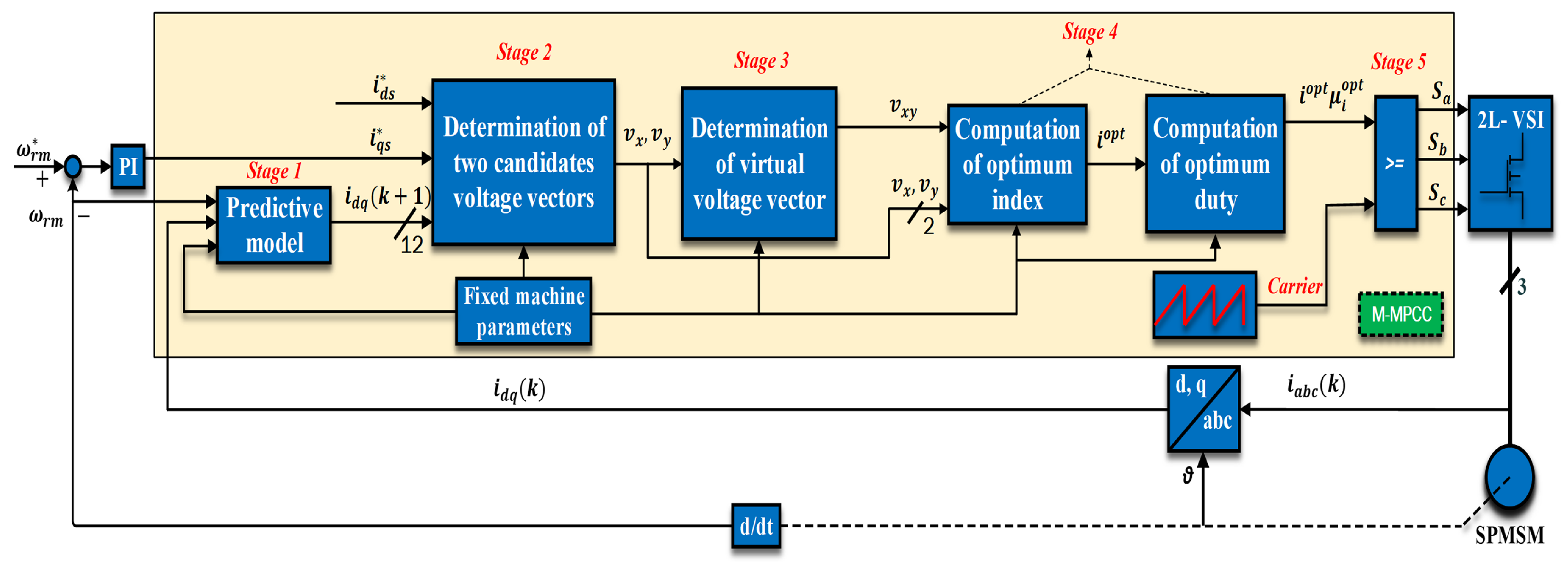
The control diagram of the modulated twelve-voltage-vector MPCC algorithm is shown in Figure 3. A PI-based speed controller is used to track the reference speed and generate i q s * , while the M-MPCC-12 is responsible for tracking i d q s * . A detailed description of the PI speed controller’s design with MPCC can be found in [6]. The control process is divided into five phases as follows.

4.1. Current Prediction

Using the measured currents at k, the predicted current components at ( k + 1 ) for each candidate voltage vector can be described by the following:
i d s ( k + 1 ) = A i d s ( k ) + B i q s ( k ) + T s L s v d s ( k ) , i q s ( k + 1 ) = A i q s ( k ) B i d s ( k ) + T s L s v q s ( k ) C .
According to the concept of M-MPCC, the voltage vector v d q s ( k ) consists of the active voltage vectors in d q frame ( v d s i ( k ) , v q s i ( k ) ) , the zero voltage vector ( v d s o ( k ) , v q s o ( k ) ) , and their respective durations μ T s and ( 1 μ ) T s :
v d s ( k ) = μ i ( k ) v d s i ( k ) + ( 1 μ i ( k ) ) v d s o ( k ) , v q s ( k ) = μ i ( k ) v q s i ( k ) + ( 1 μ i ( k ) ) v q s o ( k ) .

4.2. Selection of Two Optimum Voltage Vectors

The six fundamental active voltage vectors v d q s ( k ) initially generate six predicted current components i d q s ( k + 1 ) , as described in (7). The cost function is then evaluated for each predicted current, and among these, two adjacent voltage vectors ( v x , v y ) correspond to the optimal and suboptimal values:
g i = λ i d i d s * i d s ( k + 1 ) 2 + λ i q i q s * i q s ( k + 1 ) 2 ,
where λ i d and λ i q are the weighting factors for the d-axis and q-axis current components, respectively, and both are set to 1.

4.3. Calculation of Virtual Voltage Vector

The virtual voltage vector is considered as the third optimum candidate. It is generated from its two adjacent active vectors v x and v y :
v x y ( k ) T s = 1 2 v x ( k ) T s + v y ( k ) T s .
The six virtual voltage vectors are symmetrically distributed, each with a 50% duty ratio of the two adjacent active voltage vectors. This approach reduces torque ripple, stator flux ripple, and THD compared to modulated MPCC with six active vectors.
Although the M-MPCC-12 requires evaluating a larger control set than the M-MPCC-6 scheme, the associated computational burden increases linearly and does not introduce additional algorithmic complexity. The virtual voltage vectors are generated through simple linear combinations and evaluated using the same prediction and cost-function structure. Consequently, the proposed method maintains feasible real-time performance on modern embedded controllers while achieving improved control accuracy and robustness.

4.4. Computation of Optimum Index and Duty Cycle

The optimal non-zero voltage vector among the three candidates is selected based on minimizing the cost function in (9). The duty cycle for the selected voltage vector is obtained as follows:
μ i opt ( k ) = α d λ i d v d s i opt ( k ) + α q λ i q v q s i opt ( k ) T s L s λ i d v d s i opt ( k ) 2 + T s L s λ i q v q s i opt ( k ) 2 ,
where
α d = i d s * A i d s ( k ) B i q s ( k ) , α q = i q s * A i q s ( k ) + B i d s ( k ) + C .

4.5. Generation of Inverter Pulses

For the inverter switches, the optimum control signals are
S a b c ( k ) = i opt μ i opt ( k ) ,
where the selected active voltage i opt is applied during the period μ i opt T s , and the zero voltage vector is applied for the remainder of the control period ( 1 μ i opt ) T s .

5. Effect of Parameter Accuracy on Modulated Twelve-Voltage-Vector MPCC

The accuracy of the parameters in the prediction model plays a crucial role in determining the performance of the SPMSM when using the C-MPCC approach, as highlighted in [21]. In the M-MPCC-12 method, model parameters are incorporated into both the selection of two or three optimal voltage vectors and the duty cycle calculation. As a result, the accuracy of these parameters has a greater impact on the performance of the SPMSM compared to the C-MPCC method. This section analyzes the effect of parameter accuracy on the M-MPCC-12, including current prediction and duty cycle calculation.

5.1. Effect of Parameter Mismatch on Current Prediction

If the parameters used in the prediction model are inaccurate, the predicted currents in (7) at time instant ( k + 1 ) are adjusted according to
i d s f ( k + 1 ) = D i d s ( k ) + B i q s ( k ) + T s L s o v d s ( k ) , i q s f ( k + 1 ) = D i q s ( k ) B i d s ( k ) + T s L s o v q s ( k ) Q ,
where
D = 1 T s R s o L s o , Q = T s ω r λ P M o L s o ,
are the coefficients of the inaccurate current prediction. The accurate prediction model is given in (7), where L s , λ P M , and R s represent the accurate parameters, and i d q s ( k + 1 ) corresponds to the accurately predicted currents.
The prediction errors between the inaccurately predicted currents in (13) and the actual predicted currents in (7) can be expressed as
Δ i d s = i d s ( k + 1 ) i d s f ( k + 1 ) = F i d s ( k ) G v d s ( k ) , Δ i q s = i q s ( k + 1 ) i q s f ( k + 1 ) = F i q s ( k ) G v q s ( k ) + H ,
where
F = T s R s o Δ L s T s Δ R s L s o L s o L s , G = T s Δ L s L s o L s , H = T s ω ( Δ L s λ P M o L s o Δ λ P M ) L s o L s , Δ L s = L s L s o , Δ R s = R s R s o , Δ λ P M = λ P M λ P M o .
The effect of parameter mismatch on current prediction can be summarized as follows:
  • No Prediction Errors with Accurate Parameters: When all parameters (stator resistance, PM flux linkage, and inductance) are accurate, no prediction errors occur.
  • Effect of Stator Resistance Mismatch: In the presence of a stator resistance mismatch, the current prediction errors Δ i d q s are minimally affected. This is because only the coefficient F, which depends on T s R s L s , is associated with the stator resistance parameter in the predictive model described in (14). Since the control period T s is very small, the contribution of this term, T s R s L s 1 , is negligible, making the effect of stator resistance errors on the predictive current insignificant.
  • Effect of PM Flux Linkage Mismatch: When there is a mismatch in the permanent magnet flux, λ P M , the q-axis current error, Δ i q s , is significantly affected, whereas the d-axis current error, Δ i d s , remains largely unaffected, as indicated in (14). This occurs because the only coefficient that depends on λ P M is H, which appears exclusively in the equation for Δ i q s and does not appear in the equation for Δ i d s , as shown in (14). Consequently, under the assumptions of the predictive model, the d-axis current prediction is not directly influenced by mismatches in the PM flux.
  • Effect of Inductance Mismatch: In the presence of an inductance mismatch, Δ i d q s is affected, leading to current prediction errors. This is because the coefficient G, which appears in both equations Δ i d q s , depends on the inductance. Therefore, any mismatch in inductance contributes to the current prediction error Δ i d q s , as shown in (14).

5.2. Effect of Parameter Mismatch on Duty Cycle

When the parameters are inaccurate, the inaccurate optimum duty cycle μ i f opt is given by
μ i f opt ( k ) = α d f λ i d v d s i opt ( k ) + α q f λ i q v q s i opt ( k ) T s L s λ i d ( v d s i opt ( k ) ) 2 + T s L s λ i q ( v q s i opt ( k ) ) 2 ,
where
α d f = i d s * D i d s ( k ) B i q s ( k ) , α q f = i q s * D i q s ( k ) + B i d s ( k ) + Q .
The effect of parameter mismatches on the duty cycle is summarized as follows:
  • Effect of Stator Resistance Mismatch: The duty cycle remains largely unaffected because μ i f opt depends weakly on R s and T s R s / L s 1 .
  • Effect of Flux Linkage Mismatch: A mismatch in λ P M causes a slight variation in the duty cycle, but the effect is minor.
  • Effect of Inductance Mismatch: A mismatch in L s causes a significant change in the duty cycle, indicating strong dependence on accurate inductance.
Based on Equations (7) and (8), the duty cycle is an integral part of the current prediction model. Inaccuracies in μ i opt directly impact the predicted current and the application of active and zero voltage vectors. Consequently, the THD of the phase current may increase. Therefore, the performance of the M-MPCC-12 algorithm is primarily influenced by accurate determination of L s and λ P M to ensure effective predictive control.

6. Proposed Robust Modulated Twelve-Voltage-Vector MPCC

6.1. Description of the Novel Idea (Integration of Proposed M-MPCC-12 with MRAS)

In the proposed M-MPCC-12 scheme, both the machine inductance and PM flux linkage parameters are required for selecting two or three voltage vectors and determining their respective duty cycles. Consequently, accurate parameter knowledge is critical for achieving optimal performance.
Based on these considerations, several methods reported in the literature are not suitable for the proposed M-MPCC-12 algorithm. For instance, the ESO [22] and the SMO [31,32,33,34] are primarily designed to reject disturbances caused by parameter mismatches and do not perform online parameter estimation. While these methods function effectively with C-MPCC, they cannot provide the necessary parameter updates for M-MPCC-12. Similarly, back-EMF estimation methods [29] can estimate the PM flux linkage but do not account for variations in machine inductance, rendering them insufficient for the proposed scheme. Incremental model-based approaches [7], which eliminate the dependence of the predictive model on PM flux linkage, can mitigate performance degradation caused by PM flux mismatch and compensate for prediction errors arising from inductance uncertainty via a disturbance observer. Although suitable for C-MPCC, these approaches cannot be extended to M-MPCC, as duty-cycle computation requires accurate knowledge of both stator inductance and PM flux linkage. Consequently, incremental model-based MPC is not compatible with M-MPCC-12.
To enhance the control performance of the SPMSM under the proposed M-MPCC-12 in the presence of parameter mismatches, a robust scheme based on online parameter estimation is developed. Specifically, an MRAS observer is employed to track the machine parameters in real time, minimizing the mismatch between actual and model parameters. This accurate estimation improves the predictive control performance and increases the overall system’s robustness.
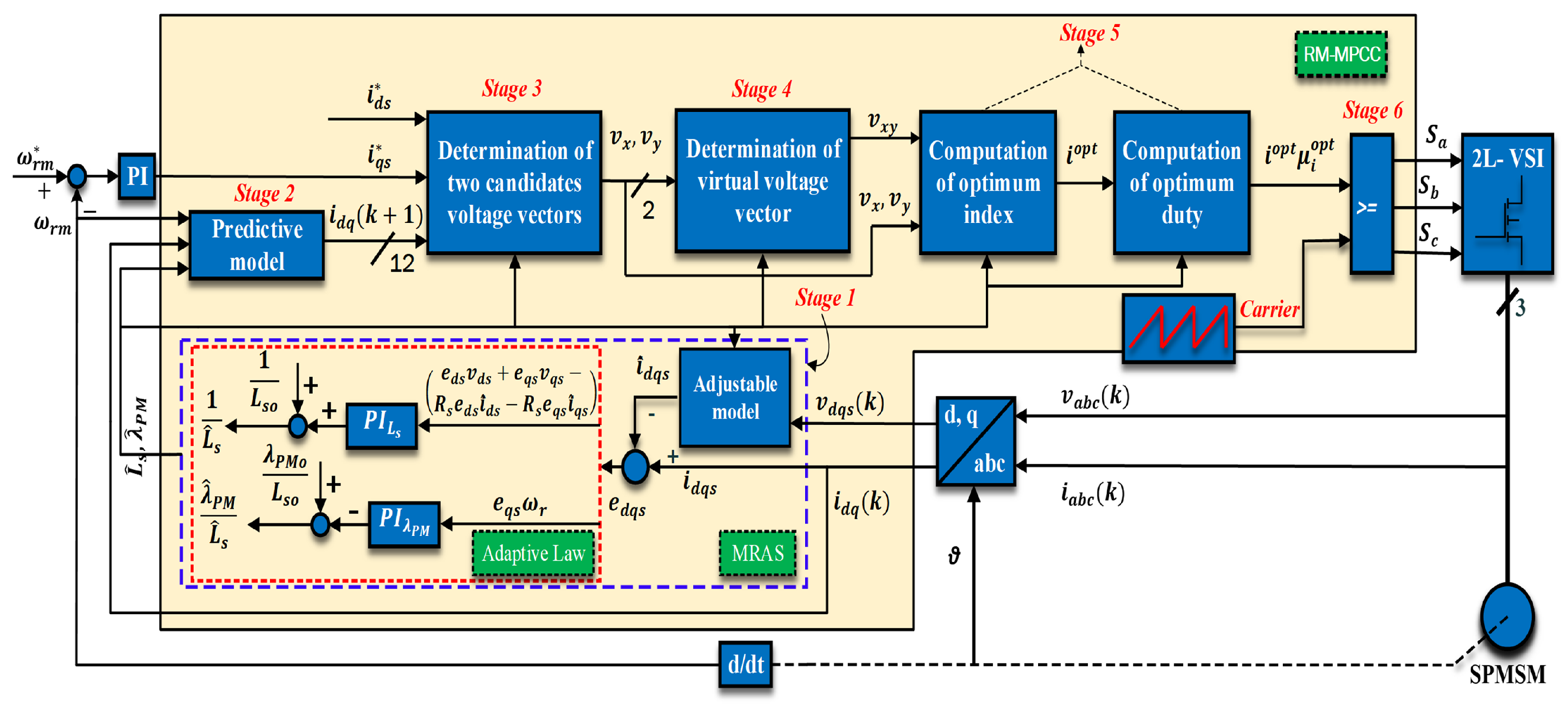
The control diagram of the proposed method, as shown in Figure 4, consists of six key stages.
  • Calculation of Updated Parameters Using MRAS:
    The MRAS observer is used to estimate and update the machine parameters (inductance and PM flux linkage) in real time.
  • Current Prediction and Duty Cycle Calculation:
    For each of the six possible switching states, the predictive model calculates the current and determines the corresponding duty cycles using the updated parameters.
  • Selection of Optimum and Suboptimum Voltage Vectors:
    The two voltage vectors that yield the optimum and suboptimum values of g i are selected. These include an active voltage vector and a virtual voltage vector.
  • Calculation of the Virtual Voltage Vector and Current Prediction:
    The virtual voltage vector is computed, and the predicted currents are obtained using both the active and virtual voltage vectors.
  • Calculation of i opt and μ i opt Based on Updated Parameters:
    The optimal index i opt and the optimal duty cycle μ i opt are determined using the updated parameters from the MRAS observer.
  • Generation of Inverter Pulses:
    The final switching signals are generated and sent to the inverter to apply the selected voltage vectors effectively.
This structured approach ensures improved control performance by continuously adapting to parameter variations, reducing predictive errors, and enhancing the robustness of the M-MPCC-12.
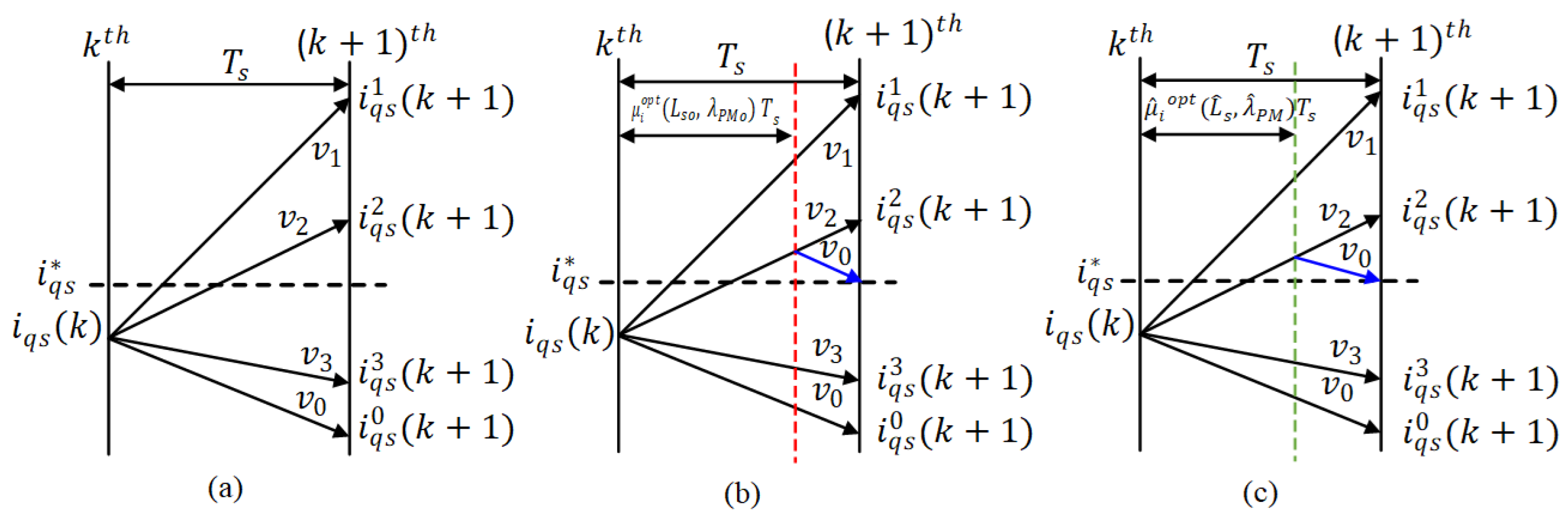
Figure 5 illustrates the concept of voltage vector selection in different MPCC strategies. The details of each sub-figure are described as follows:
  • Figure 5a represents C-MPCC:
    • No modulation is applied.
    • Only one active voltage vector is used during the sampling period T s .
    • The control accuracy is limited by parameter mismatches.
  • Figure 5b represents M-MPCC-12 with inaccurate parameters:
    • Modulation is introduced, and the duty cycle μ i opt is calculated.
    • However, due to parameter mismatches, the computed duty cycle μ i opt is not optimal.
    • This results in errors in current prediction and degraded control performance.
  • Figure 5c represents robust M-MPCC-12 with updated parameters:
    • The MRAS updates the inductance and PM flux linkage parameters in real time.
    • The duty cycle μ i opt is recalculated using the corrected parameters.
    • This improves current prediction accuracy and enhances the control performance.

6.2. Design of MRAS Observer

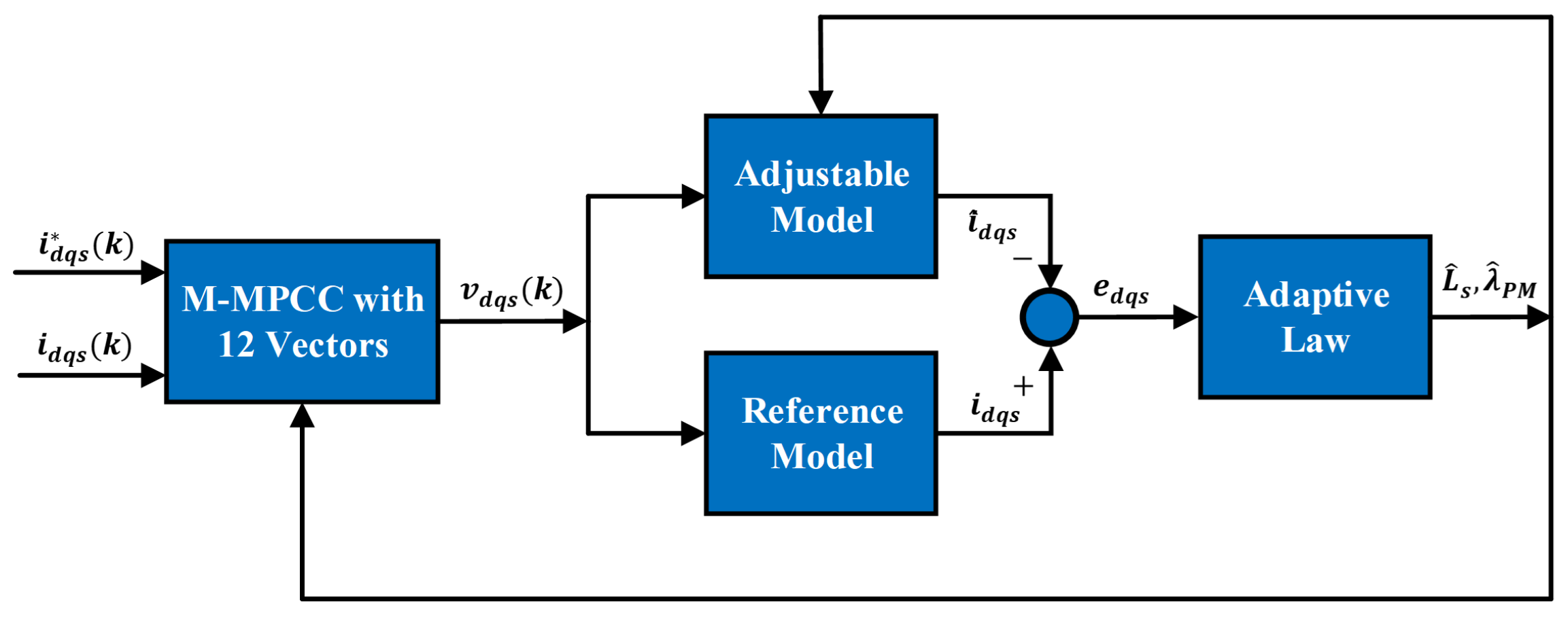
The block diagram of the MRAS observer is shown in detail in Figure 4 (highlighted in the blue section) and is also presented in a simplified form in Figure 6. The MRAS structure adopted in this study follows the approach presented in [41] and consists of three main components:
  • Reference Model—Utilizes a motor model with known and accurate parameters.
  • Adjustable Model—Employs a model that contains unknown parameters to be identified.
  • Adaptive Law—Continuously updates the unknown parameters based on the error between the reference and adjustable models.
The working principle of the MRAS observer can be described as follows:
  • The reference model serves as a benchmark, as it depends on accurately identified parameters.
  • The adjustable model contains uncertain parameters that must be estimated.
  • The adaptive law utilizes the error between the two models to correct the parameters in the adjustable model.
  • As the estimation process continues, the adjustable model output converges to that of the reference model, ensuring that the estimated parameters closely approximate the true motor parameters.
The MRAS observer is specifically designed to estimate critical SPMSM parameters, including the PM flux linkage and stator inductance. The reference model is based on the accurate SPMSM mathematical model, expressed in both matrix and state-space forms as given in Equations (16) and (17):
d d t [ i d s i q s ] = R s L s ω r ω r R s L s [ i d s i q s ] + 1 L s 0 0 1 L s [ v d s v q s ] + 0 ω r λ P M L s ,
x ˙ = K x + M u + N .
Similarly, the adjustable model includes the estimated parameters L ^ s and λ ^ P M , as expressed in Equations (18) and (19):
d d t [ i ^ d s i ^ q s ] = R s L ^ s ω r ω r R s L ^ s [ i ^ d s i ^ q s ] + 1 L ^ s 0 0 1 L ^ s [ v d s v q s ] + 0 ω r λ ^ P M L ^ s ,
x ^ ˙ = K ^ x ^ + M ^ u + N ^ .
The adaptive law in the MRAS framework is designed to estimate the inductance and PM flux linkage by minimizing the error between the reference and adjustable models, as described in Equations (17) and (19) [42]. The main aspects of the adaptive law design are summarized as follows:
  • Error-Based Adjustment: The difference between the outputs of the reference model and the adjustable model is used as the feedback signal to adjust the unknown parameters.
  • Parameter Convergence: The adaptive mechanism ensures that the estimated parameters, namely the inductance and PM flux linkage, gradually converge to their actual values over time.
  • Mathematical Formulation: The state error equation between the reference and adjustable models can be obtained by subtracting Equation (17) from Equation (19), leading to the following dynamic error model:
e ˙ = x ˙ x ^ ˙ = K e I w
where
e = x x ^ , w = ( Δ K x ^ + Δ M u + Δ N ) , Δ K = K K ^ , Δ M = M M ^ , Δ N = N N ^ , I is the identity matrix ,
and w represents a nonlinear, time-varying vector, while Δ K , Δ M , and Δ N denote the parameter variation matrices responsible for estimation errors.
The MRAS observer, highlighted in the blue section of Figure 4 and also presented in a simplified form in Figure 6, can be modeled as a nonlinear, time-varying feedback system composed of two interconnected subsystems:
  • A feedforward linear time-invariant (LTI) subsystem that generates the state error e as its output.
  • A feedback nonlinear time-varying subsystem that receives e as input and produces w as output.

6.3. Stability Analysis and Implementation of the Adaptive Law

The design of the adaptive law is primarily based on Popov’s theorem. According to the Popov stability criterion, the system remains stable if the following two conditions are satisfied:
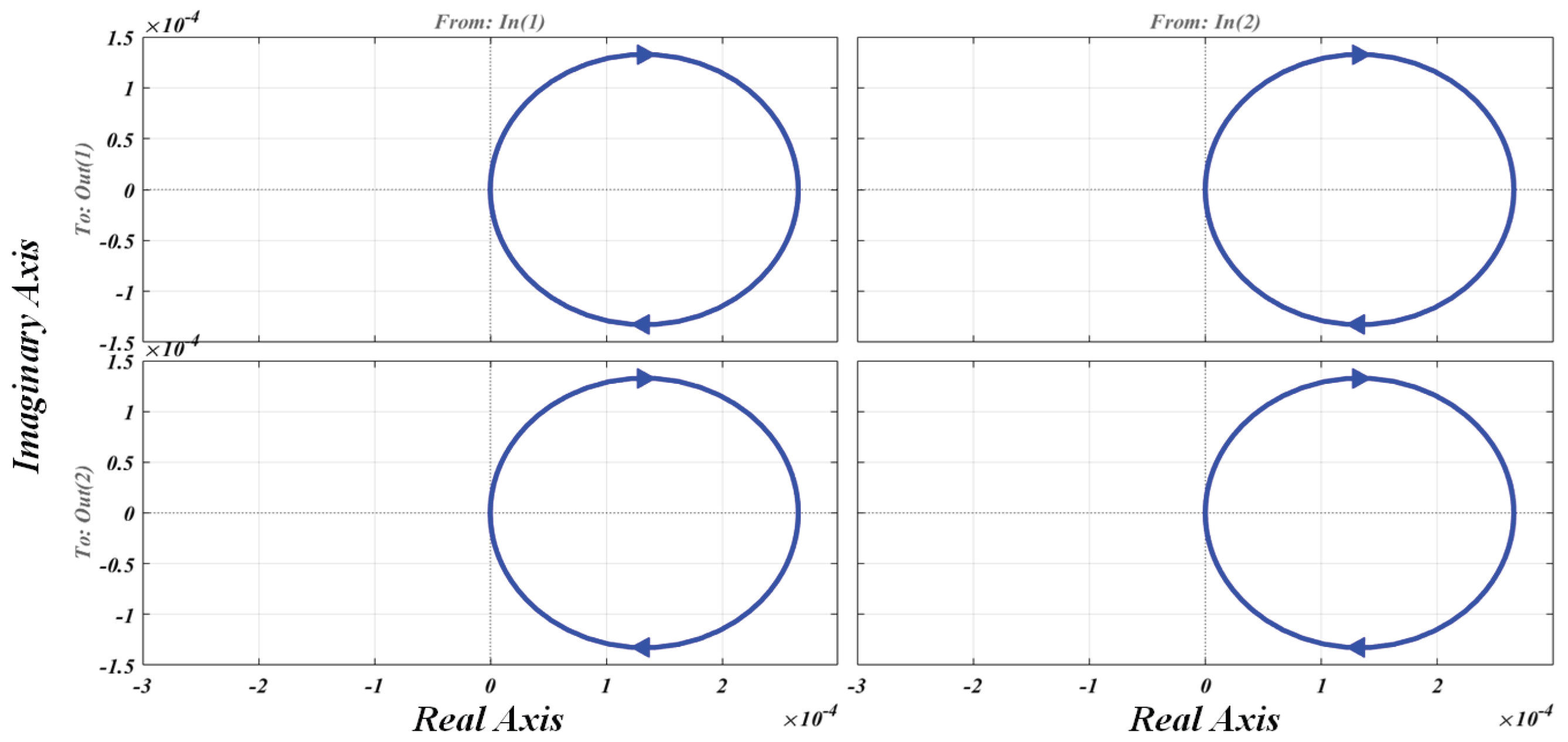
  • Condition 1: The transfer function of the feedforward linear time-invariant subsystem (Equation (21)) must be strictly positive real (SPR), meaning that all poles lie in the left half-plane. Consequently, the Nyquist plot of the transfer function does not encircle the right half-plane, as illustrated in Figure 7.
    G ( s ) = Y ( s ) w ( s ) = D ( s I A ) 1 I = D ( s I K ) 1 I
  • Condition 2: The feedback nonlinear time-varying subsystem must satisfy Popov’s inequality (Equation (22)):
    η ( 0 , t 0 ) = 0 t 0 Y T w d t = 0 t 0 e T w d t ω 0 2 2 ,
    where ω 0 2 is a bounded positive constant independent of time t for all t 0 . The adaptive law is formulated to ensure compliance with this condition by estimating appropriate values for the adjustable model parameters.
By substituting w into Equation (22), the following expression is obtained:
η ( 0 , t 0 ) = 0 t 0 e T Δ K i ^ + Δ M u + Δ N d t ω 0 2 2 .
The overall η ( 0 , t 0 ) term can be decomposed into two distinct components as follows:
η ( 0 , t 0 ) = η 1 ( 0 , t 0 ) + η 2 ( 0 , t 0 ) ,
where η 1 represents the inductance-related component, and η 2 corresponds to the permanent-magnet flux component. This decomposition enables an independent stability analysis of the influence of each parameter.
The first component, η 1 , is expressed as follows:
η 1 ( 0 , t 0 ) = 0 t 0 e T Δ K i ^ + Δ M u d t ω 1 2 2 .
Expanding Equation (25), we obtain the following:
η 1 ( 0 , t 0 ) = 0 t 0 1 L ^ s 1 L s e d s v d s + e q s v q s R s ( e d s i ^ d s + e q s i ^ q s ) d t ω 1 2 2 .
Similarly, the second component η 2 , which represents the PM flux linkage term, is given by the following:
η 2 ( 0 , t 0 ) = 0 t 0 e T Δ N d t ω 2 2 2 .
Substituting Δ N yields the following:
η 2 ( 0 , t 0 ) = 0 t 0 λ ^ P M L ^ s λ P M L s ( e q s ω r ) d t ω 2 2 2 .
Equations (26) and (28) confirm that both η 1 and η 2 are bounded below by finite constants, thereby satisfying Popov’s inequality. As a result, the adaptive law designed for the MRAS observer guarantees global asymptotic stability and ensures parameter convergence.
According to adaptive control theory [43], the state error e converges to zero if the parameters of the adjustable model are accurately identified using the designed adaptive law, which satisfies Popov’s stability criterion. To ensure this condition, the adaptive law is implemented using two PI controllers, as defined in Equations (29) and (30). These controllers are specifically designed to estimate the stator inductance, thereby validating Equation (26), and the permanent-magnet flux linkage, which confirms Equation (28). This formulation ensures accurate parameter estimation, leading to improved system performance and stability.
1 L ^ s 1 L s 0 = K P L s f 1 ( t ) + K I L s 0 t f 1 ( τ ) d τ
λ ^ P M L ^ s λ P M 0 L s 0 = K P λ P M f 2 ( t ) + K I λ P M 0 t f 2 ( τ ) d τ
where
K P L s , K I L s , K P λ P M , K I λ P M are the PI controller gains , L s 0 , λ P M 0 are the initial values of L s and λ P M , f 1 ( t ) is the inductance estimation error between L s and L ^ s , f 2 ( t ) is the PM flux linkage estimation error between λ P M and λ ^ P M .
The use of PI controllers allows the system to dynamically correct estimation errors and guarantee convergence of L ^ s and λ ^ P M to their actual values. This adaptive adjustment enhances both the robustness and steady-state accuracy of the proposed MRAS-based parameter estimation approach.

6.4. Determination of MRAS PI Controller Gains

The PI controller gains of the MRAS were determined using a systematic trial-and-error tuning procedure guided by Popov’s stability criterion. Due to the nonlinear nature of the MRAS dynamics, the gains were selected within the stability region defined by the SPR condition. The proportional gains were gradually increased to achieve an acceptable convergence rate without introducing oscillations, while the integral gains were tuned to eliminate steady-state estimation errors. Although higher gains improve the parameter’s convergence speed, they can adversely affect robustness, whereas lower gains enhance stability at the expense of slower adaptation. The final gain values represent a compromise that ensures rapid and reliable convergence of the permanent magnet flux linkage and stator inductance while maintaining stable operation under abrupt parameter variations. The selected PI controller gains are summarized in Table 2.

6.5. Estimation of Machine Inductance L ^ s

In Appendix A, Equations (A5) and (A6) satisfy Popov’s inequality, ensuring the stability of the adaptive system. As a result, the machine inductance can be estimated using Equation (31), which is derived from Equation (29). Furthermore, based on the relations in Appendix A and Equation (26), the estimated inductance is formally expressed as follows:
L ^ s = 1 1 L s 0 + K P L s + K I L s s e d s v d s + e q s v q s R s e d s i ^ d s R s e q s i ^ q s .
Although the estimated stator inductance depends on the stator resistance within the error term, the PI controller compensates for this effect, rendering the influence of stator resistance mismatch or variations negligible.

6.6. Estimation of PM Flux Linkage λ ^ P M

In Appendix B, Equations (A11) and (A12) satisfy Popov’s inequality, ensuring system stability. Consequently, the PM flux linkage can be estimated using Equation (32), derived from Equation (30). Based on Appendix B and Equation (28), the estimated PM flux linkage is expressed as follows:
λ ^ P M L ^ s = λ P M 0 L s 0 K P λ P M + K I λ P M s e q s ω r .
From Equations (31) and (32), it is evident that the estimated machine inductance and PM flux linkage depend primarily on the PI controller gains. Therefore, proper tuning of the PI gains is critical for achieving a desirable dynamic response.

6.7. Modification of Current Prediction and Duty Cycle

When the parameters used in the predictive model are inaccurate, as expressed in (15), the adaptive law of the MRAS observer is activated to estimate the correct machine parameters of the reference model. These estimated parameters are then fed back to update the predictive model of the proposed RM-MPCC-12 scheme. This update corresponds to Stage 1 of the algorithm, as shown in Figure 4. Subsequently, the predictive model located in Stage 2 is mathematically updated using the equations in (33).
Once the predictive model parameters are corrected, the selection of the two candidate voltage vectors (Stage 3) is refined, since the optimization of the cost function in (9) directly depends on the accuracy of the current predictions to identify the optimum and suboptimum vectors. Thereafter, the determination of the optimal virtual voltage vector is updated according to (10), which corresponds to Stage 4. Based on the corrected virtual vector, the optimal duty cycle is recomputed using (34) (Stage 5). Finally, the inverter switching signals are updated accordingly (Stage 6), as described by (35).
The updated current prediction model incorporating the MRAS-estimated parameters is given by
i ^ d s ( k + 1 ) = D ^ i d s ( k ) + B i q s ( k ) + T s L ^ s v d s ( k ) , i ^ q s ( k + 1 ) = D ^ i q s ( k ) B i d s ( k ) + T s L ^ s v q s ( k ) Q ^ ,
and the corrected optimal duty cycle is computed as
μ ^ i opt = α ^ d λ i v d s , i opt ( k ) + α ^ q λ i v q s , i opt ( k ) T s L s λ i v d s , i opt ( k ) 2 + λ i v q s , i opt ( k ) 2 .
The corresponding inverter switching signals are then generated using the updated duty cycle and optimal voltage vector as
S ^ a b c ( k ) = i ^ opt μ ^ i opt ( k ) ,
where
α ^ d = i d s * D ^ i d s ( k ) B i q s ( k ) , α ^ q = i q s * D ^ i q s ( k ) + B i d s ( k ) + Q ^ , D ^ = 1 T s R s L ^ s , Q ^ = T s ω r λ ^ P M L ^ s .
By continuously updating the current prediction and duty-cycle computation using the MRAS-estimated parameters, the proposed RM-MPCC effectively compensates for parameter mismatches. Consequently, the torque ripple and stator current ripple are significantly reduced, and the THD of the stator phase currents is substantially improved.
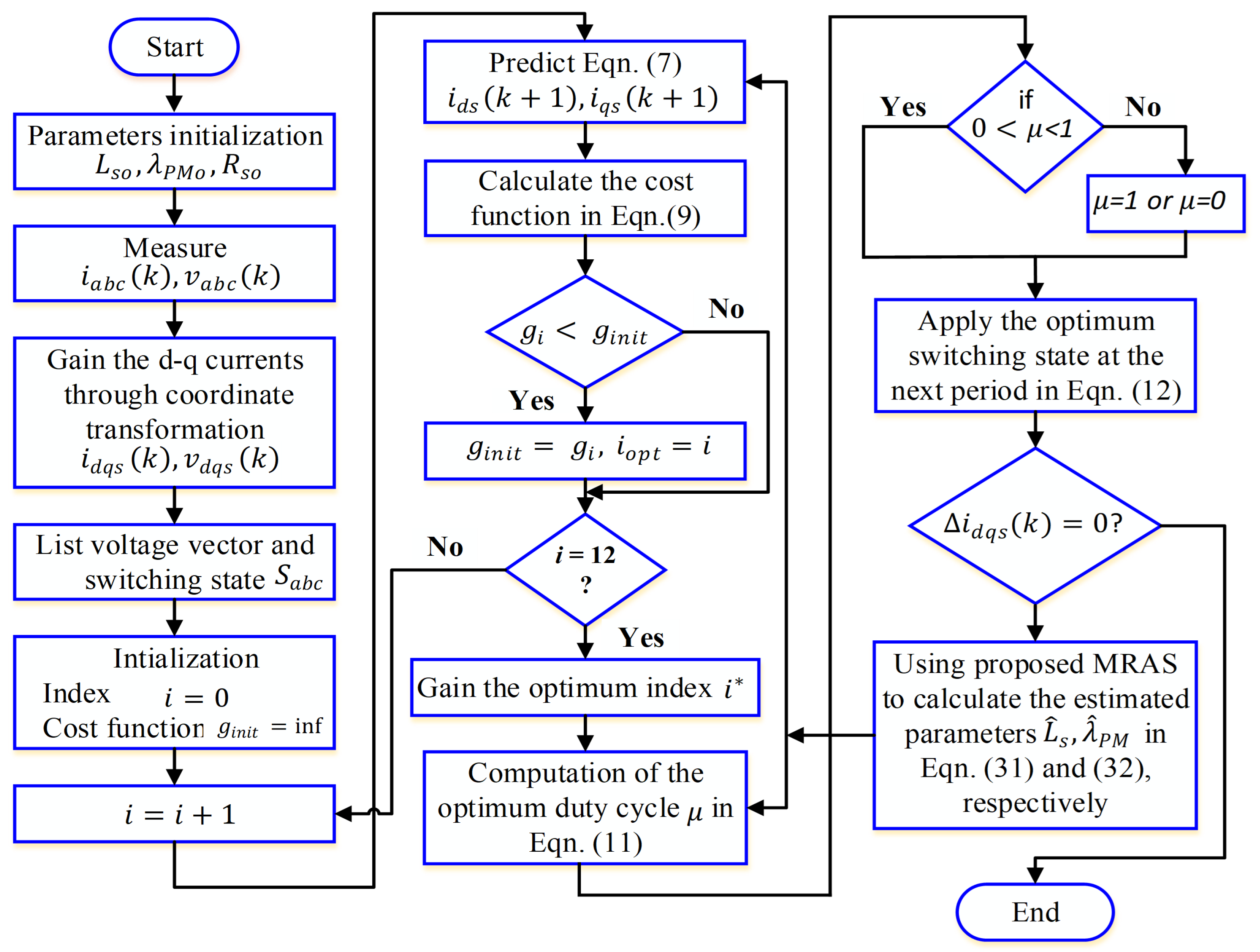
The overall implementation procedure of the proposed RM-MPCC algorithm is summarized in Figure 8, which consists of three main stages: (1) computation of the optimal voltage vector index and duty cycle, (2) parameter estimation and update using the MRAS observer when d–q current tracking errors are detected, and (3) recalculation of the corrected optimal voltage vector and duty cycle.

6.8. Computational Complexity and Real-Time Feasibility

The proposed RM-12-MPCC method introduces a higher computational complexity compared to the conventional twelve-voltage-vector MPCC due to the inclusion of virtual voltage vectors and the MRAS-based online parameter estimation. This increased complexity mainly stems from the expanded cost-function evaluation and adaptive parameter update process. Nevertheless, the MRAS observer relies on simple arithmetic operations and PI controllers, contributing only a limited computational overhead. In addition, the virtual voltage vectors are synthesized through linear combinations of basic active vectors, without introducing additional modulation or switching complexity. As a result, the computational burden increases moderately and scales approximately linearly with the number of candidate voltage vectors. Considering the processing capabilities of modern embedded controllers, the proposed approach remains suitable for real-time implementation while offering improved robustness against parameter variations.

7. Simulations and Performance Assessment

To verify the effectiveness of the proposed control strategy, the SPMSM drive system is simulated in the MATLAB/Simulink 2022b environment. First, the modulated twelve-voltage-vector model predictive current control (M-MPCC-12) scheme is implemented to evaluate its capability in reducing torque ripple, stator flux ripple, and THD in phase current. Its performance is compared with MPC-based control methods reported in the literature, including MPDSC, C-MPCC, and M-MPCC-6, under nominal parameter conditions.
Subsequently, the M-MPCC-12 algorithm is examined under parameter mismatch conditions to assess its performance. Under the same operating conditions, the proposed robust modulated twelve-voltage-vector MPCC (RM-MPCC-12) scheme is then simulated to enable a fair and direct performance comparison. In addition, the influence of under-tuned and over-tuned PI gains on the parameter estimation process is investigated, focusing on their impact on convergence time, estimation overshoot, and current quality.
Finally, the proposed RM-MPCC-12 strategy is evaluated under varying speed and load conditions and compared with the M-MPCC-12 scheme in the presence of parameter mismatches. This comprehensive evaluation demonstrates the effectiveness, robustness, and practical applicability of the proposed method.
The sampling period of the predictive control algorithm is set to T s = 50 μ s , corresponding to a switching frequency of 20 kHz. The DC-link voltage of the inverter is fixed at 360 V. Ideal current and voltage measurements are assumed in the simulations, and no additional filtering is applied to the measured signals. This setup allows the intrinsic performance and robustness of the proposed control strategies to be evaluated without the influence of measurement noise or filtering effects. The specifications of the SPMSM used in the simulations are provided in Table 3.

7.1. Comparative Performance Analysis of SPMSM Using Modulated Twelve-Voltage-Vector and MPC-Based Methods

To further evaluate the effectiveness of the proposed control strategy, a comparative performance analysis is conducted against three established predictive control schemes, namely C-MPCC, the MPDSC method [6], and the M-MPCC-6 approach [17]. All control methods are evaluated under identical operating conditions, where the SPMSM operates at a rated speed of 2000 r/min with a load torque of 3.82 Nm, within the same simulation environment to ensure a fair and consistent comparison.
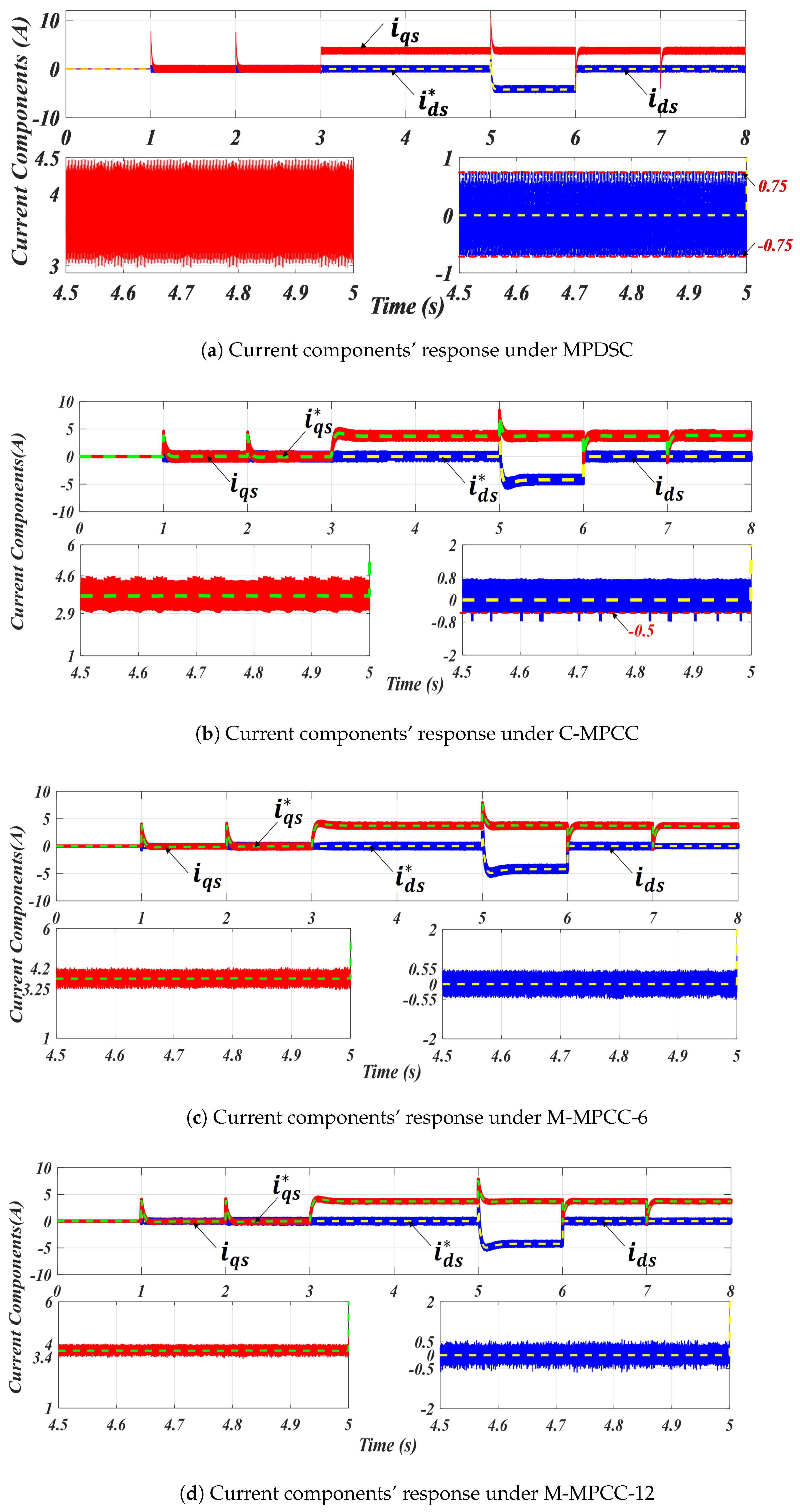
The performance assessment focuses on key steady-state metrics, including torque ripple, stator-flux ripple, and the THD of the phase currents. The results clearly demonstrate that the proposed modulated twelve-voltage-vector MPCC (M-MPCC-12) method achieves significantly lower torque ripple amplitudes and reduced current harmonic distortion compared with the benchmark methods, thereby confirming its superior steady-state performance. The simulated d- and q-axis current responses for the considered control strategies are presented in Figure 9.
For the MPDSC scheme, the torque ripple reaches 1.5 A, the stator-flux ripple reaches 1.5 A, and the phase current THD reaches 11.52%. In the case of C-MPCC, an improved performance compared with MPDSC is observed, where the torque ripple remains at 1.5 A, the stator-flux ripple is reduced to 1.25 A, and the phase current THD decreases to 10.58%. The M-MPCC-6 approach further enhances the steady-state performance, achieving a torque ripple of 0.95 A, a stator-flux ripple of 1.1 A, and a phase current THD of 7.65%.
Finally, the proposed M-MPCC-12 scheme outperforms all the compared methods, yielding the lowest torque ripple of 0.6 A, a stator-flux ripple of 1.0 A, and a phase current THD of 5.29%.
Furthermore, a quantitative comparison of the reported methods in the literature and the proposed M-MPCC-12 approach is summarized in Table 4, where differences in torque ripple, stator-flux ripple, and phase current THD are highlighted under identical operating conditions.

7.2. Performance of SPMSM Under Modulated Twelve-Voltage-Vector with Parameter Mismatch

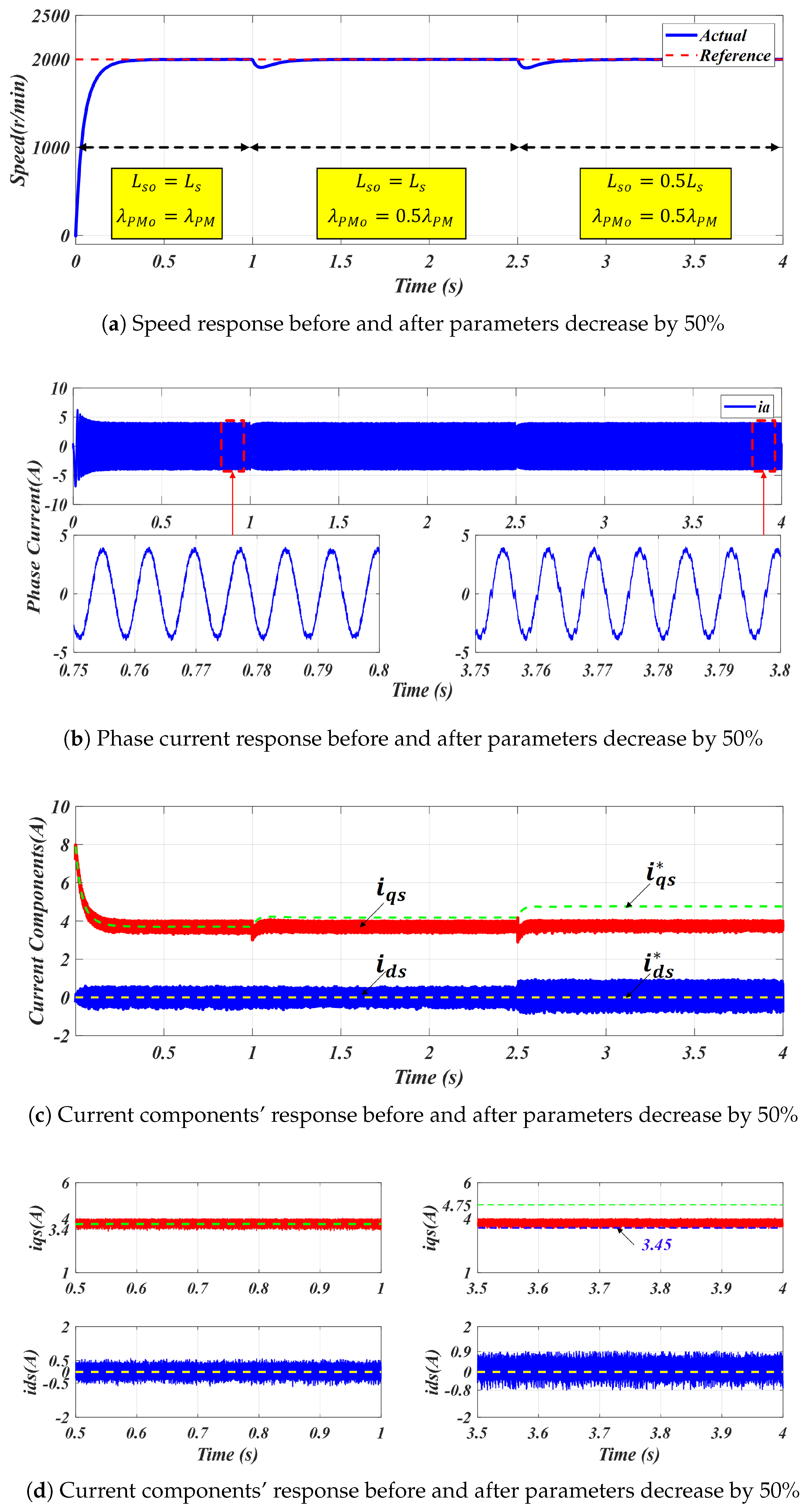
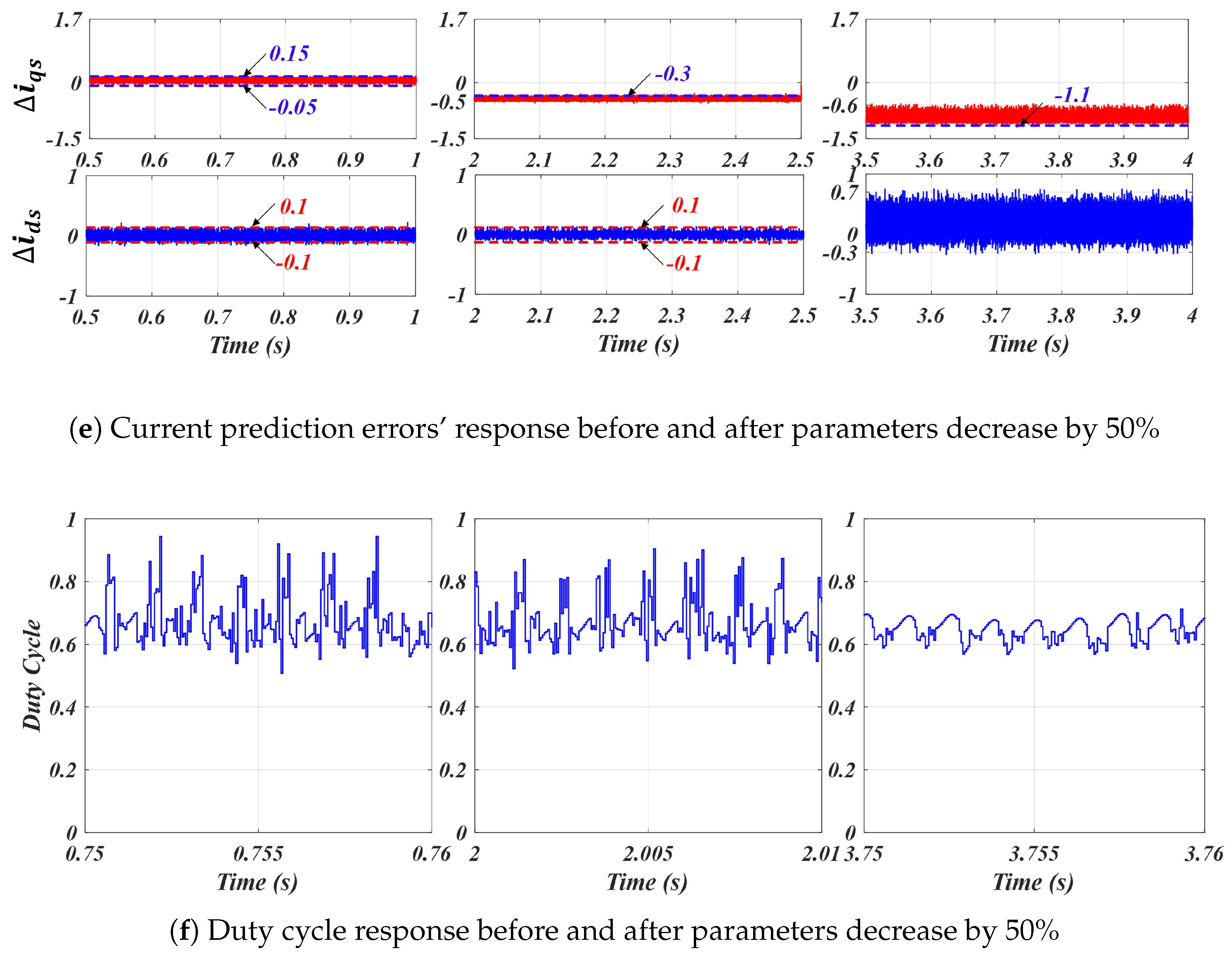
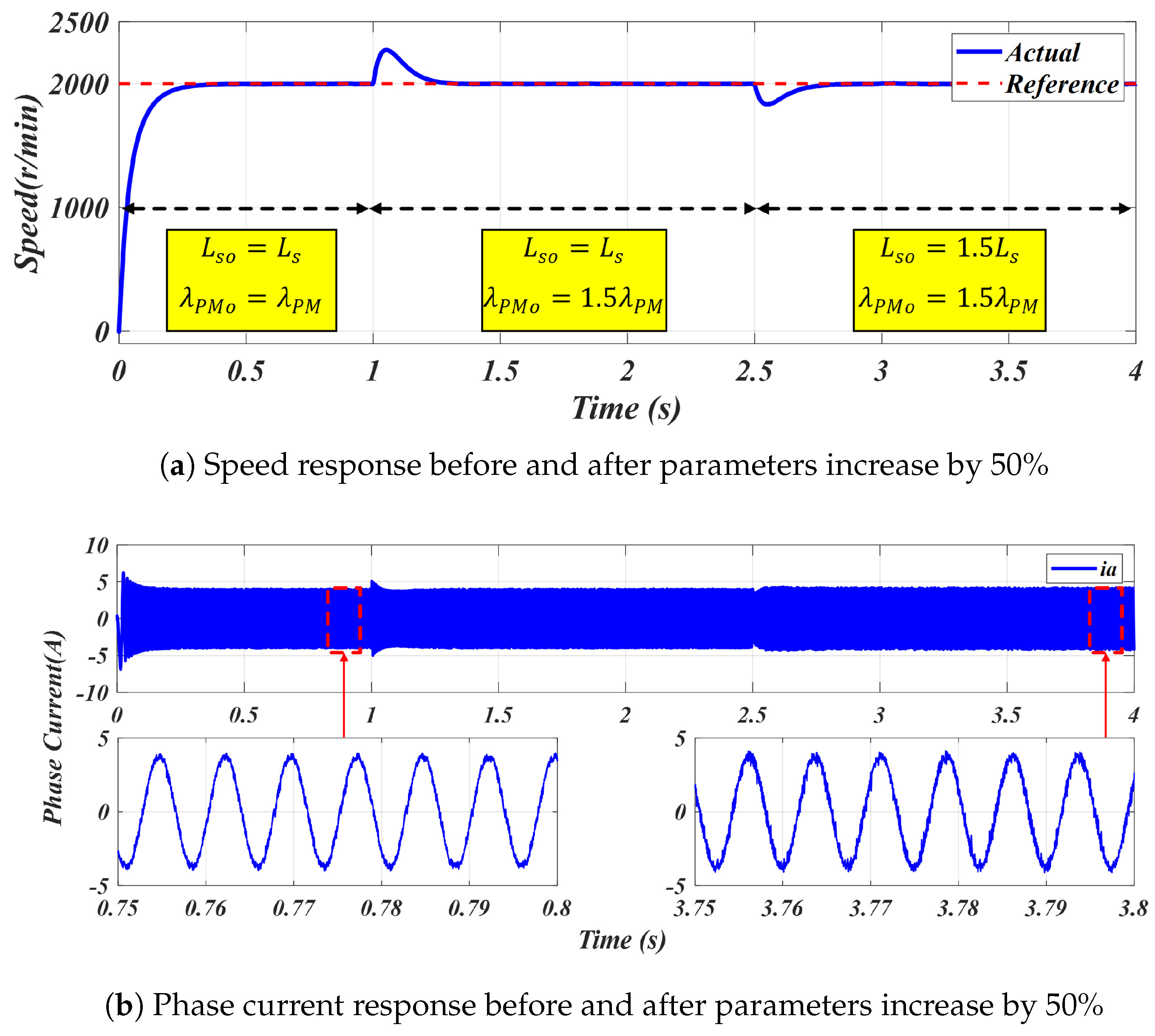
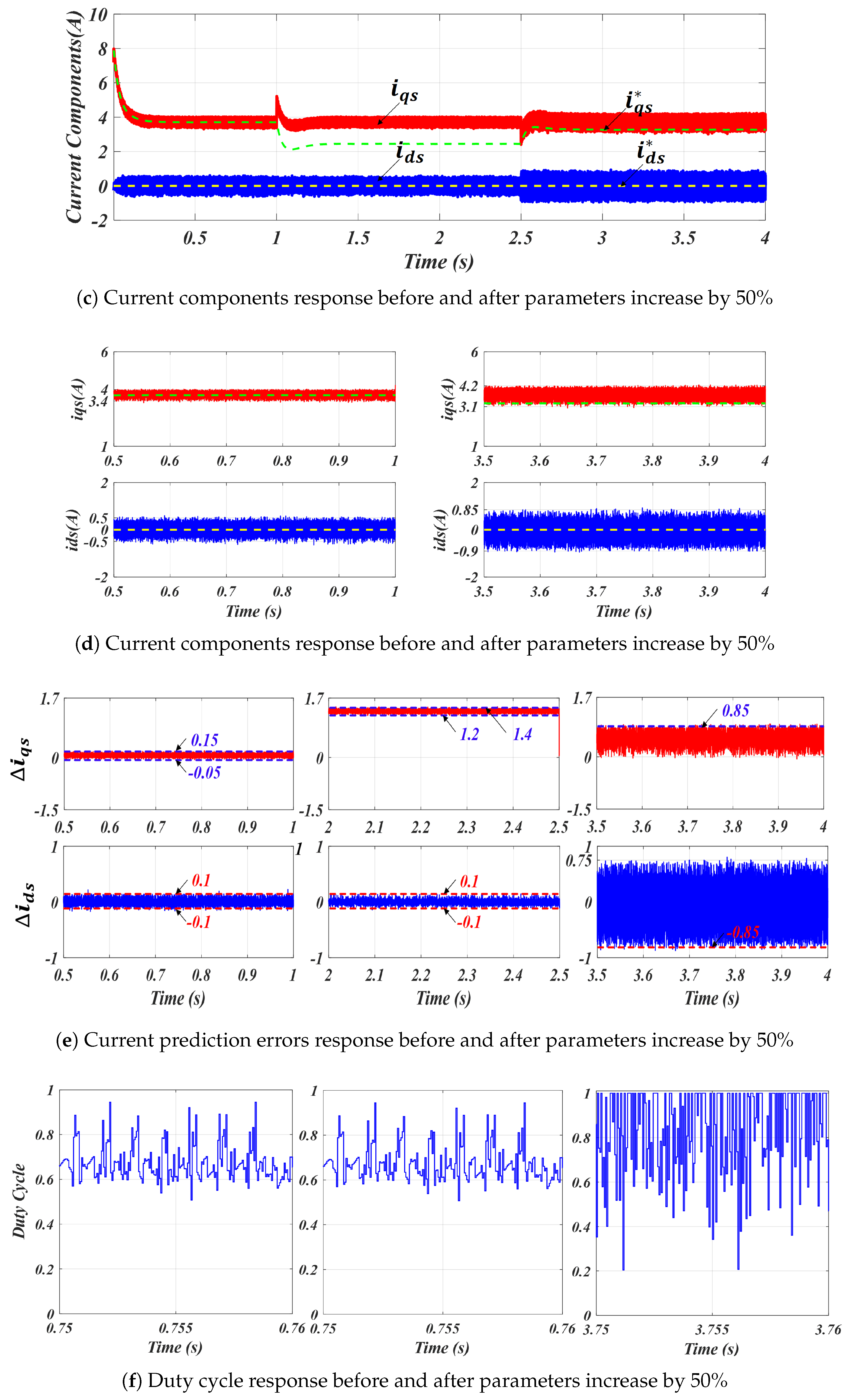
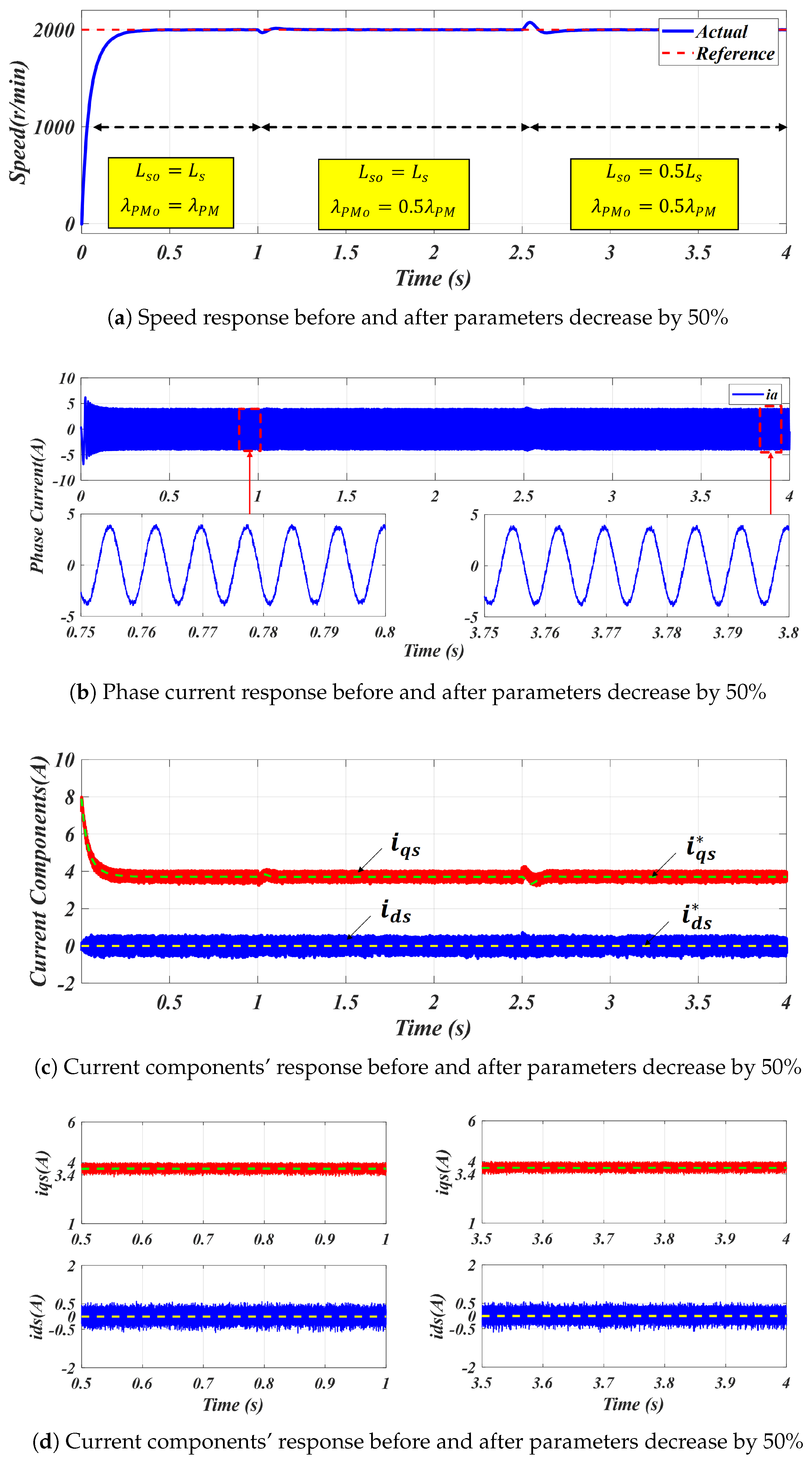
Figure 10 and Figure 11 present the simulation results of the modulated twelve-voltage-vector MPCC with active and virtual voltage vectors under different parameter mismatches. The motor operates at a rated speed of 2000 r/min with a load torque of 3.82 Nm. During the simulation, the PM flux linkage undergoes an abrupt change at t = 1 s , followed by an abrupt change in the inductance parameters at t = 2.5 s ; both changes persist until the end of the simulation.
The effect of parameter mismatch on the dynamic speed-tracking performance is illustrated in Figure 10a and Figure 11a. In Figure 10a, a slight undershoot is observed when the parameters are decreased, whereas Figure 11a shows a slight overshoot followed by an undershoot when the parameters are increased. Despite these transient deviations, the rotor speed continues to track its reference accurately.
The stator phase current waveforms under parameter mismatch are presented in Figure 10b and Figure 11b. Before t = 1 s , no mismatch is applied, while at t = 2.5 s mismatches in both the PM flux linkage and machine inductance are introduced. As a result, the phase current distortion increases, leading to a higher THD.
When a PM flux linkage mismatch is present in the model, a tracking error between the reference and actual q-axis current, i q s * and i q s , is observed, as shown in Figure 10c,d and Figure 11c,d. However, the PM flux linkage mismatch has no noticeable effect on the d-axis current i d s , as illustrated in Figure 10c and Figure 11c.
In contrast, a machine inductance mismatch increases the current ripples in both i d s and i q s , as shown in Figure 10c,d and Figure 11c,d. Specifically, when the inductance is decreased by 50%, the ripple magnitude in i q s is smaller than that observed when the inductance is increased by 50%, as evidenced by comparing Figure 10c,d and Figure 11c,d.
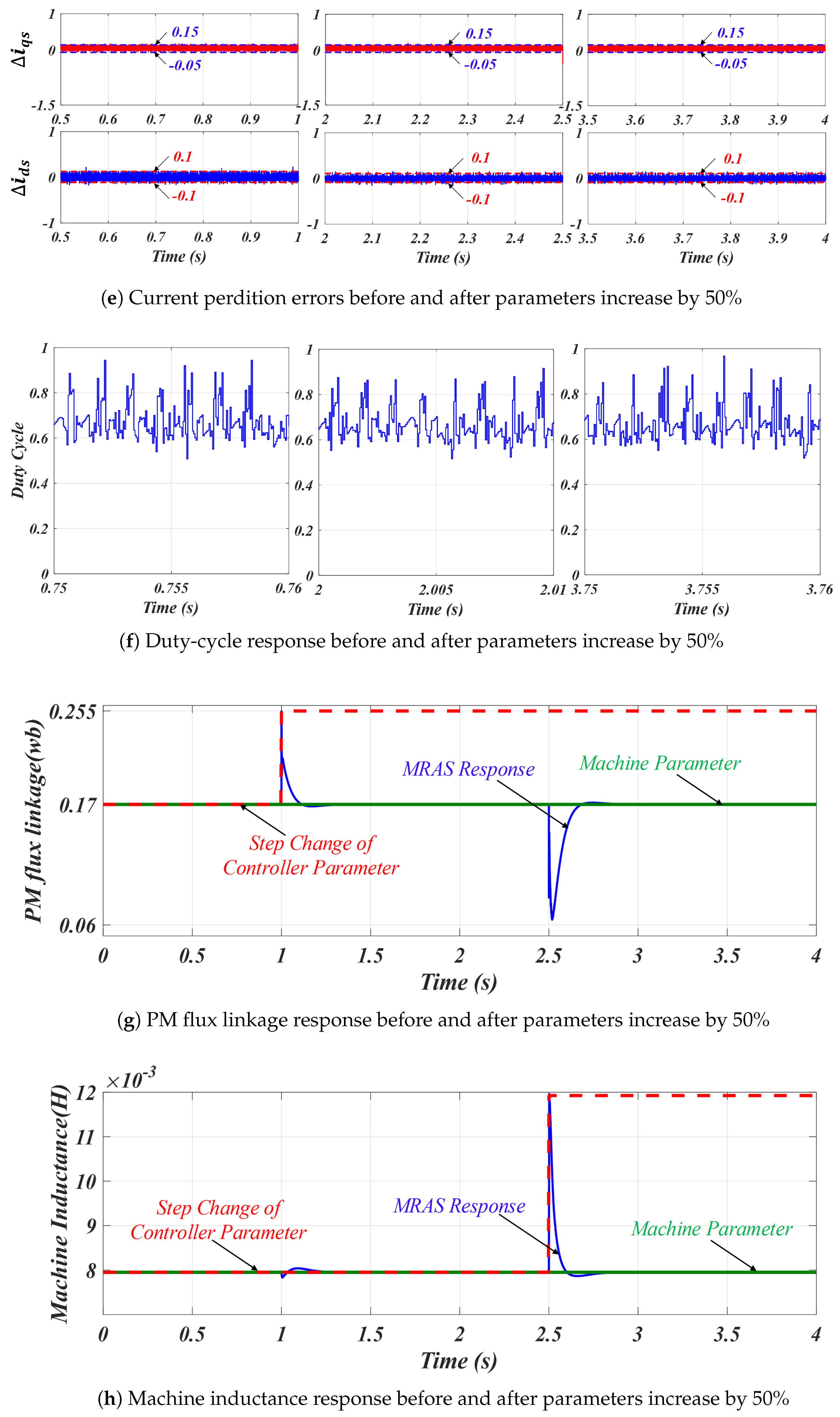
The effect of parameter mismatch on the current prediction error Δ i d q s is depicted in Figure 10e and Figure 11e. The results indicate that Δ i q s is affected by the PM flux linkage mismatch, whereas Δ i d s remains largely unaffected. Conversely, both components of Δ i d q s are sensitive to machine inductance mismatch, which confirms the theoretical analysis presented in Section 5.1.
The influence of parameter mismatch on the optimal duty-cycle range is shown in Figure 10f and Figure 11f. The duty-cycle variation is minimally affected by the PM flux linkage mismatch but is significantly influenced by the machine inductance mismatch, validating the analysis provided in Section 5.2.
When the parameters are decreased by 50%, the stator current THD rises from 5.29% to 7.65%, the tracking error between i q s and i q s * increases from 0 A to 1.05 A, the ripple in i q s decreases from 0.6 A to 0.55 A, and the ripple in i d s increases from 1.0 A to 1.7 A, as shown in Figure 10b–d.
Similarly, when the parameters are increased by 50%, the THD increases from 5.29% to 8.39%, the tracking error increases from 0 A to 0.55 A, the ripple in i q s rises from 0.6 A to 1.1 A, and the ripple in i d s increases from 1.0 A to 1.75 A, as illustrated in Figure 11b–d. These results demonstrate that parameter mismatch degrades the overall performance of the SPMSM drive system.

7.3. Performance Assessment of SPMSM Under Robust Modulated Twelve-Voltage-Vector MPCC

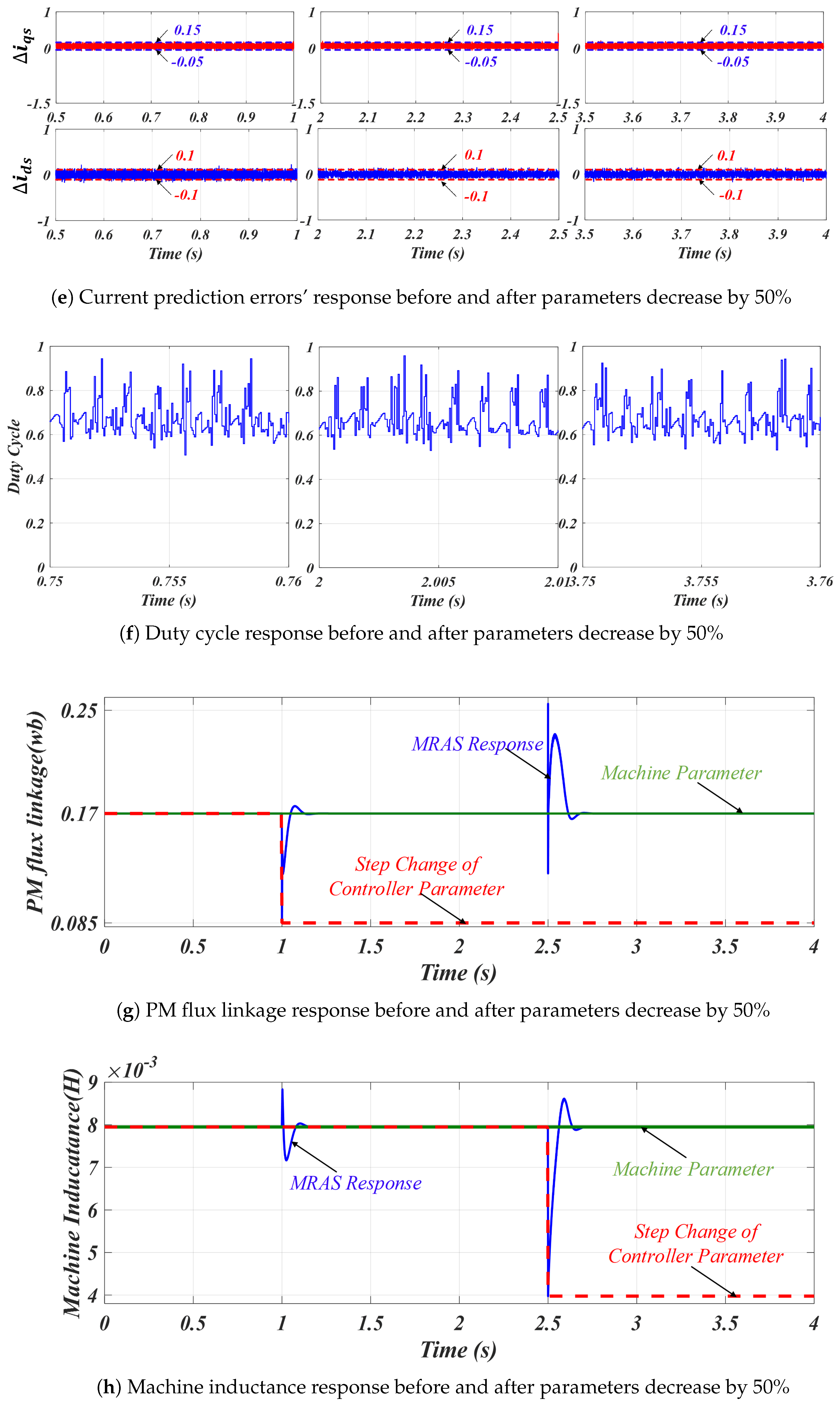
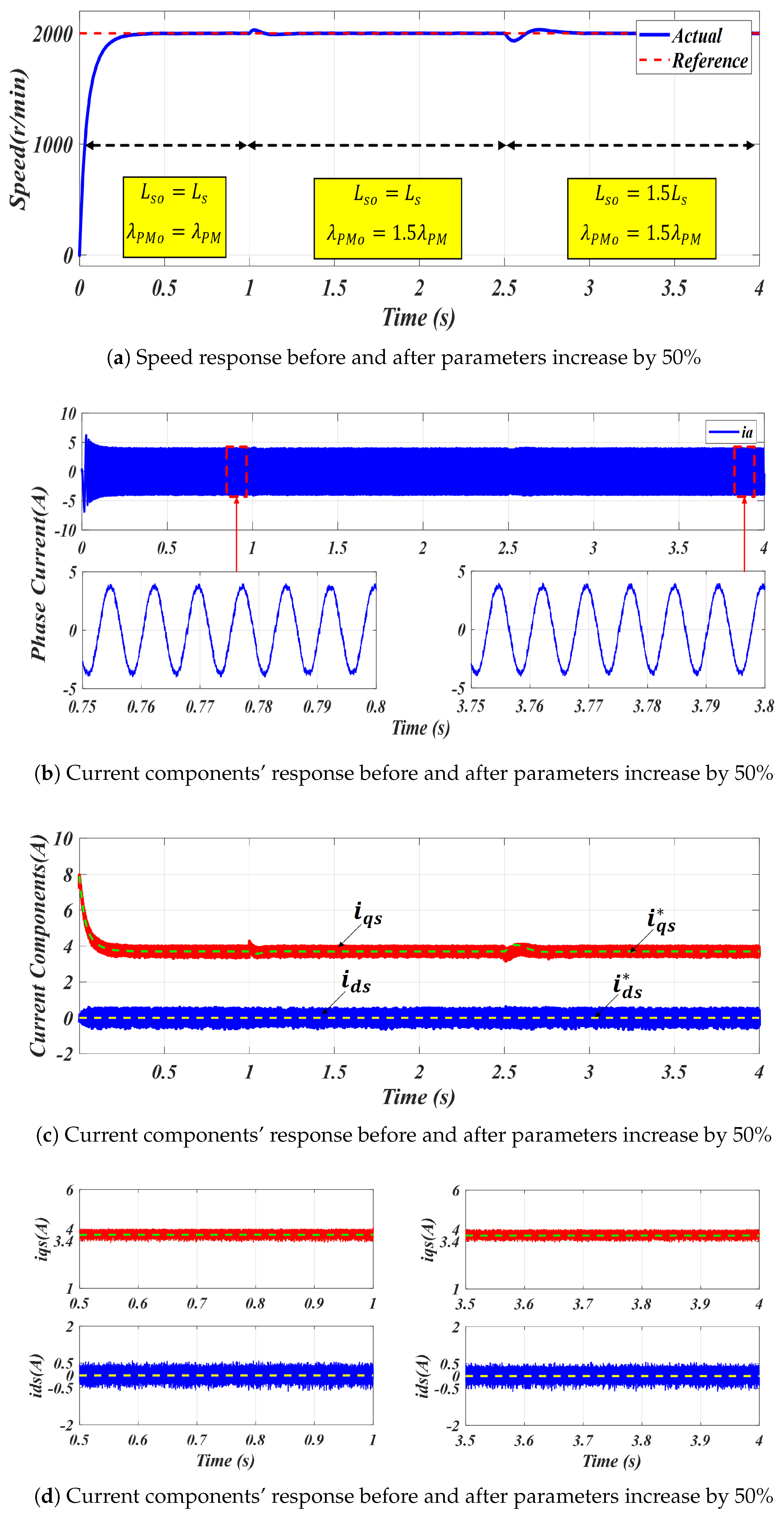
Figure 12 and Figure 13 illustrate the simulation results of the proposed robust control method under abrupt decreases and increases in the PM flux linkage and machine inductance parameters. The motor operates at a rated speed of 2000 r/min with a load torque of 3.82 Nm. During the simulation, the PM flux linkage is abruptly changed at t = 1 s , followed by an abrupt change in the inductance parameters at t = 2.5 s .
It can be observed that, under the proposed control method, the initially measured PM flux linkage and inductance parameters ( λ PM 0 , L s 0 ) used in the predictive model converge to their preset machine values at t = 1 s and t = 2.5 s , respectively. This convergence is achieved through the contribution of the MRAS and the improved tuning of the PI gains, as described in Section 6.4, and is illustrated in Figure 12g,h and Figure 13g,h.
As shown in Figure 12b and Figure 13b, the stator phase currents remain nearly distortion-free after the parameter mismatches, resulting in a significant reduction in THD under the proposed robust control strategy. This represents a marked improvement compared with the distorted phase currents observed in Figure 10b and Figure 11b, thereby demonstrating the effectiveness of the proposed robust algorithm.
Furthermore, no tracking error between the reference and actual q-axis currents, i q s * and i q s , is observed under PM flux linkage mismatch, as shown in Figure 12c and Figure 13c. This contrasts with the tracking errors observed in Figure 10c and Figure 11c. In addition, the current ripples in both i q s and i d s are significantly reduced compared with the results presented in Figure 10c,d and Figure 11c,d.
The current prediction error Δ i d q s is also rapidly reduced under the proposed robust method, as theoretically demonstrated in Section 6.7 and as illustrated in Figure 12e and Figure 13e, compared with the larger prediction errors shown in Figure 10e and Figure 11e. Moreover, the duty-cycle behavior is significantly improved, as the duty-cycle variation is restored to the optimal range of 0.5 to 0.8, as shown in Figure 12f and Figure 13f, in contrast to the degraded performance observed in Figure 10f and Figure 11f.
When the parameters are decreased by 50%, the proposed MRAS-based robust control reduces the stator current THD from 7.65% to 5.37% and eliminates the tracking error between i q s and i q s * , reducing it from 1.05 A to 0 A. In addition, the ripple in i q s decreases from 0.6 A to 0.55 A, and the ripple in i d s decreases from 1.7 A to 1.0 A, as illustrated by comparing Figure 10b–d with Figure 12b–d.
Similarly, when the parameters are increased by 50%, the stator current THD decreases from 8.39% to 5.48%, and the tracking error is eliminated, reducing from 0.55 A to 0 A. The ripple in i q s decreases from 1.1 A to 0.6 A, and the ripple in i d s decreases from 1.75 A to 1.0 A, as illustrated by comparing Figure 11b–d with Figure 13b–d.
These results demonstrate that the proposed robust control strategy effectively compensates for parameter mismatches and improves the overall system’s performance, taking into account the optimized tuning of the PI gains.
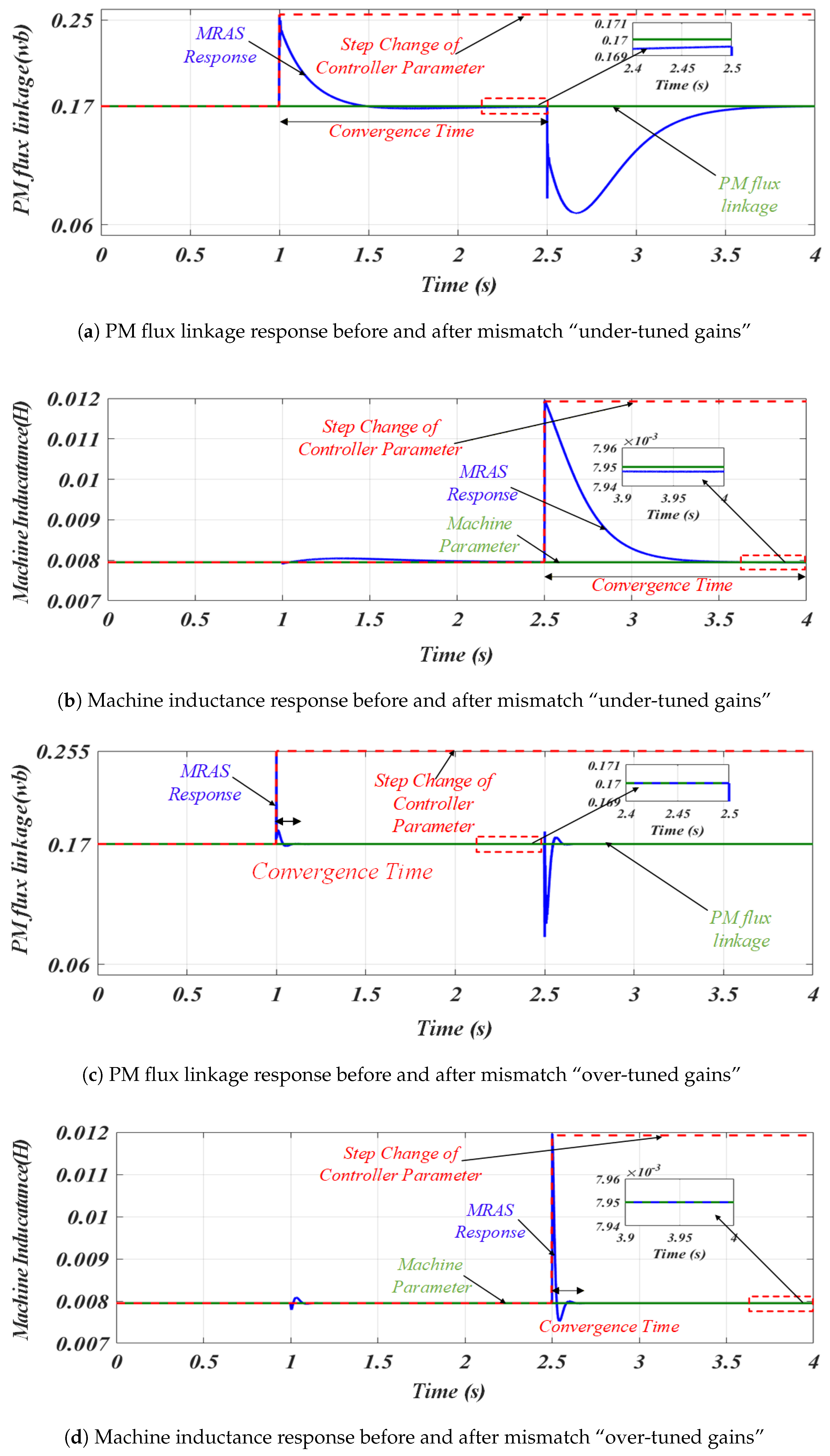
To investigate the effects of under- and over-tuned PI gains on the convergence time, estimation overshoot, and current quality, two case studies are considered. In the under-tuned scenario, the PI gains are set to one-sixth of the nominal (optimal) values, whereas in the over-tuned scenario, the gains are increased by a factor of six. This parametric variation allows a clear assessment of the trade-offs between convergence speed, overshoot, and transient current quality, thereby justifying the selection of the proposed optimal gains.
A comparative study is conducted to evaluate the influence of gain tuning on the MRAS performance under a 50% increase in machine parameters. In the under-tuned case, the reduced PI gains slow down the adaptation process, resulting in a longer convergence time while reducing the overshoot, as illustrated in Figure 14. Conversely, in the over-tuned case, the adaptation dynamics become faster, yielding a shorter convergence time; however, this improvement is achieved at the expense of increased overshoot and oscillatory behavior in the estimated parameters, as shown in Figure 14.
The impact of gain tuning on the phase current quality is analyzed. It is observed that the THD of the phase current is not affected during steady-state operation, since the system settles during the convergence period and the estimated parameters reach nominal values.

7.4. FFT Analysis of Two Control Methods

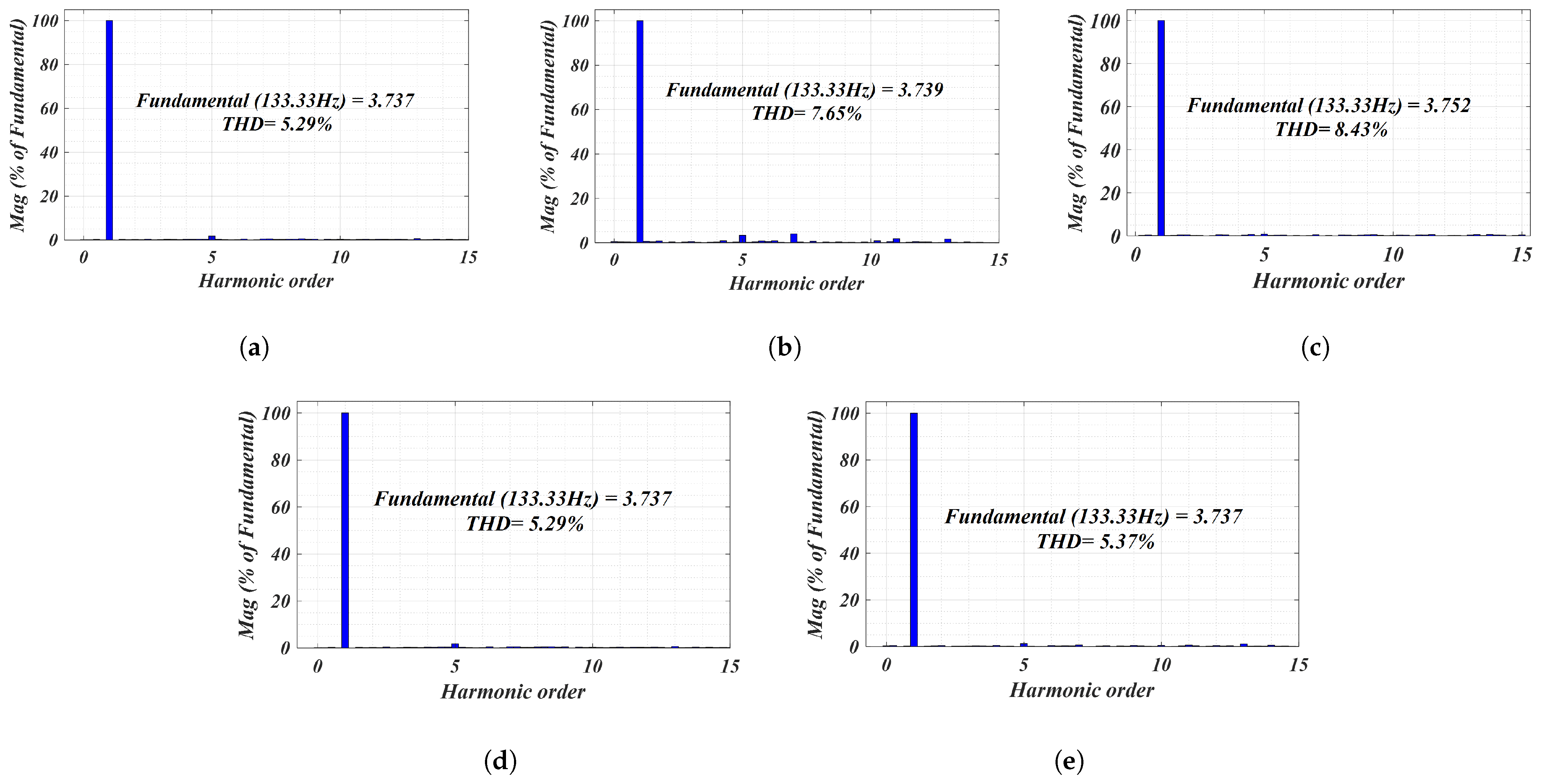
Figure 15 illustrates the THD of the stator phase current at the rated speed and a load torque of 14 Nm for three different control methods.
  • Before Parameter Mismatch: Under nominal conditions, the conventional M-MPCC-12 operates with a duty cycle varying between 0.5 and 0.8, ensuring near-optimal performance. As a result, the stator phase current remains nearly distortion-free, and the corresponding THD is limited to 5.29%, as shown in Figure 15a.
  • After Parameter Mismatch: When parameter mismatches are introduced, the duty cycle adjustment in the conventional M-MPCC-12 becomes suboptimal due to parameter inaccuracies. Consequently, the stator phase current exhibits noticeable distortion, and the THD increases to 7.65% and 8.43% for a 50% decrease and a 50% increase in parameters, respectively, as illustrated in Figure 15b and Figure 15c.
  • RM-MPCC-12 with MRAS: With the MRAS observer accurately estimating the actual machine parameters, the duty cycle variation is restored to the optimal range of 0.5 to 0.8. As a result, the stator phase current becomes nearly ripple-free, and the THD achieved by the RM-MPCC-12 is significantly lower than that of the conventional M-MPCC-12. As shown in Figure 15d and Figure 15e, the THD is reduced to 5.29% and 5.37% under parameter decreases and increases, respectively, demonstrating improved current waveform quality and reduced harmonic distortion.
Finally, all performance metrics discussed in the simulation results are summarized quantitatively in Table 5.

7.5. Performance Assessment of SPMSM Under Robust Modulated Twelve-Voltage-Vector MPCC Under Varying Speeds and Load Conditions Considering Parameter Mismatch

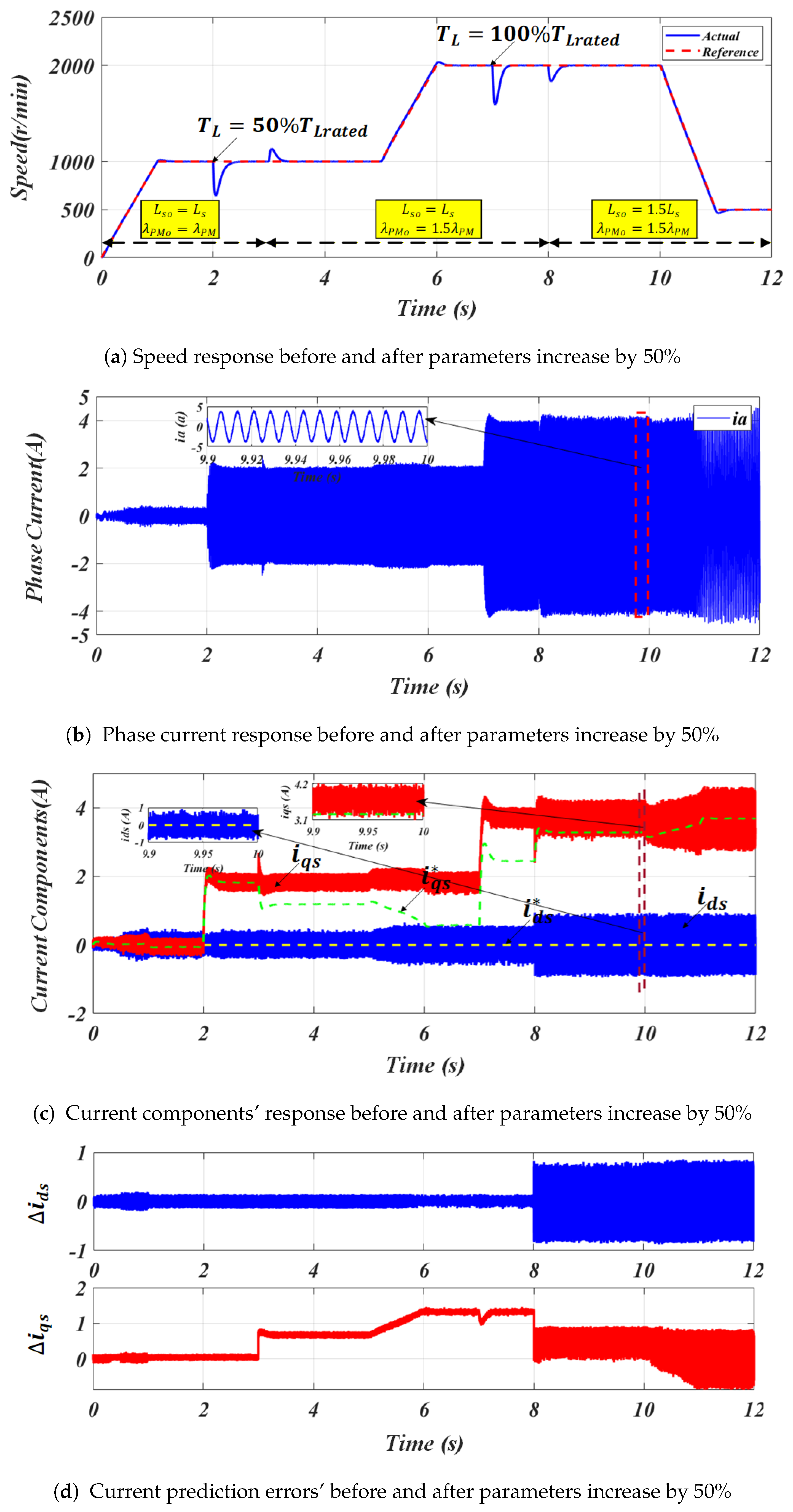
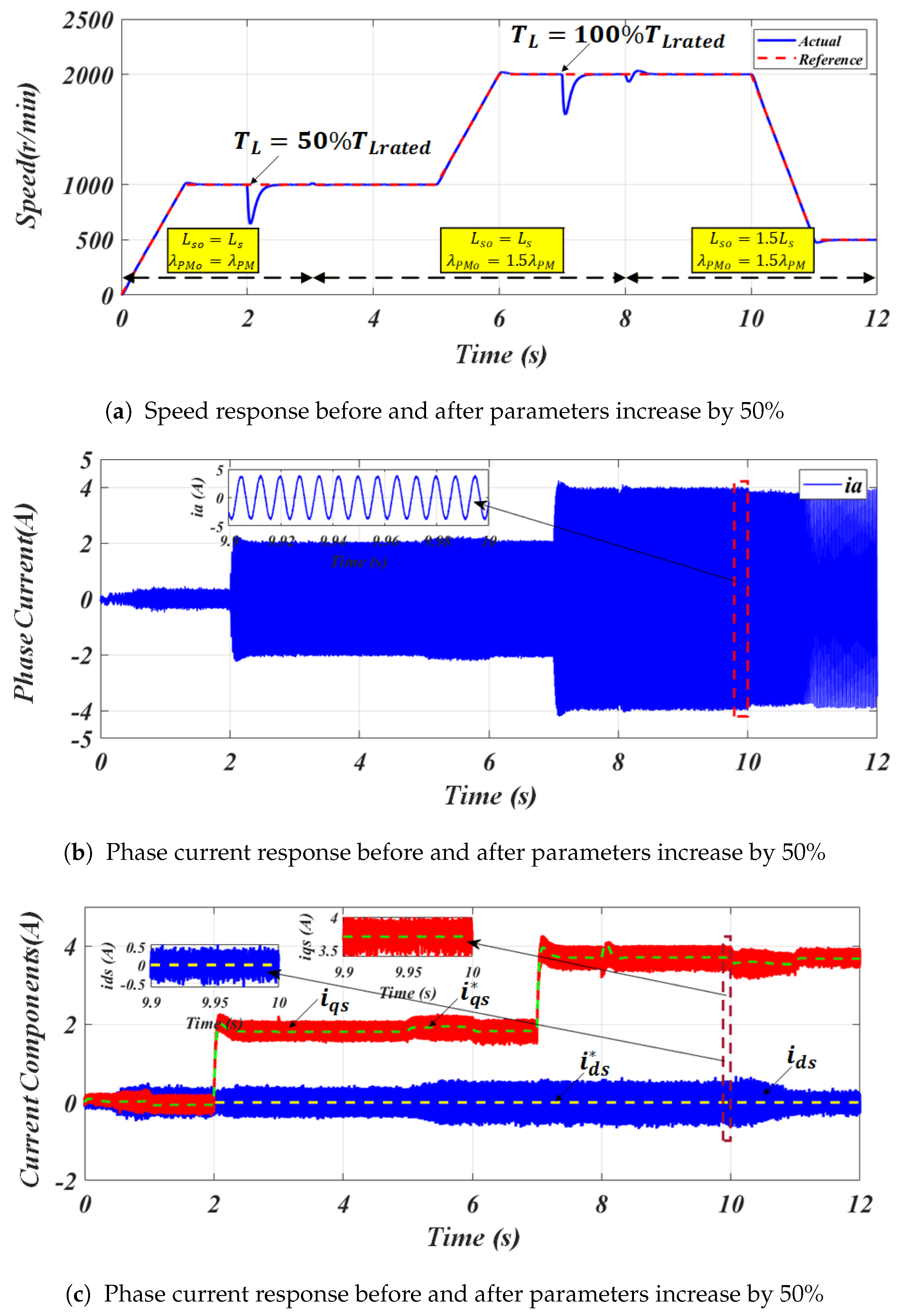
The adaptability and robustness of the proposed RM-MPCC-12 scheme under varying speed and load conditions are evaluated through simulation studies. The results of the conventional M-MPCC-12, shown in Figure 16, are compared with those of the RM-MPCC-12 scheme illustrated in Figure 17. The evaluation covers a wide range of operating conditions, including speed transients, load disturbances, and parameter mismatches.
To assess the dynamic performance, the reference speed is varied over a broad operating range. Specifically, the speed increases from 0 r/min to 1000 r/min during the interval from t = 0 s to t = 1 s and remains constant until t = 5 s. It then ramps up to 2000 r/min between t = 5 s and t = 6 s and is held at this value until t = 10 s. Subsequently, the speed decreases to 500 r/min between t = 10 s and t = 11 s and remains constant until t = 12 s.
Load disturbance tests are conducted by applying a half-rated load torque at t = 2 s, followed by a full-rated load torque at t = 7 s. Furthermore, to evaluate parameter robustness, a 50% increase in the permanent-magnet flux linkage is introduced at t = 3 s, while a 50% increase in the stator inductance is applied at t = 8 s.
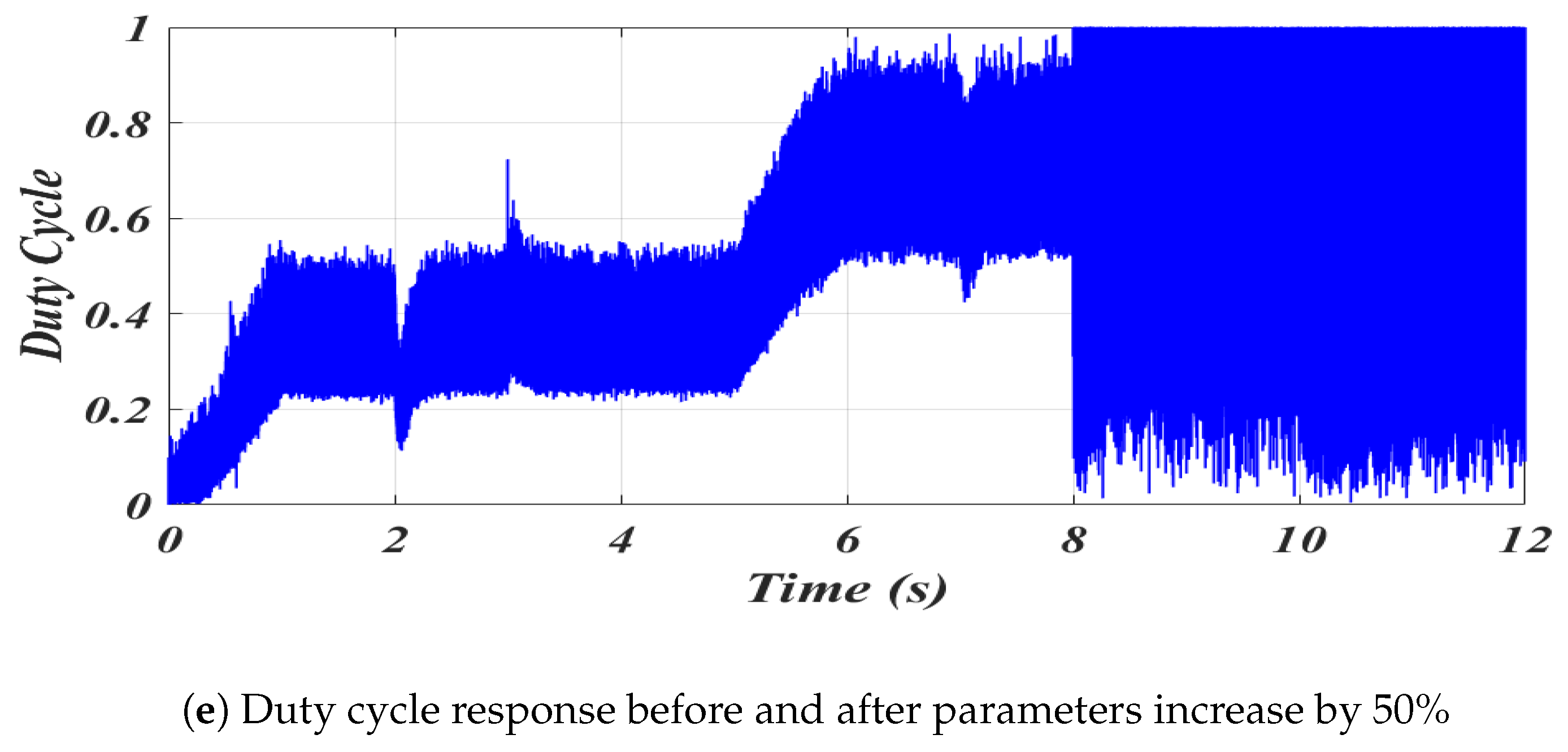
The performance of the conventional M-MPCC-12 scheme, depicted in Figure 16, reveals notable degradation under parameter mismatches. As shown in Figure 16a, the speed response exhibits slight overshoot and undershoot, although the reference trajectory is generally tracked. The phase current quality deteriorates after the parameter variations, as evidenced in the zoomed region of Figure 16b, where the THD increases from 5.29% to 8.39%. In addition, the q-axis current ripple increases from 0.6 A to 1.1 A, while the d-axis current ripple rises from 1 A to 1.75 A, as illustrated in Figure 16c. These effects result from the combined influence of flux-linkage and inductance mismatches. Moreover, the current prediction error Δ i d q s increases, and the duty cycle becomes suboptimal, indicating degraded steady-state performance, as shown in Figure 16d,e.
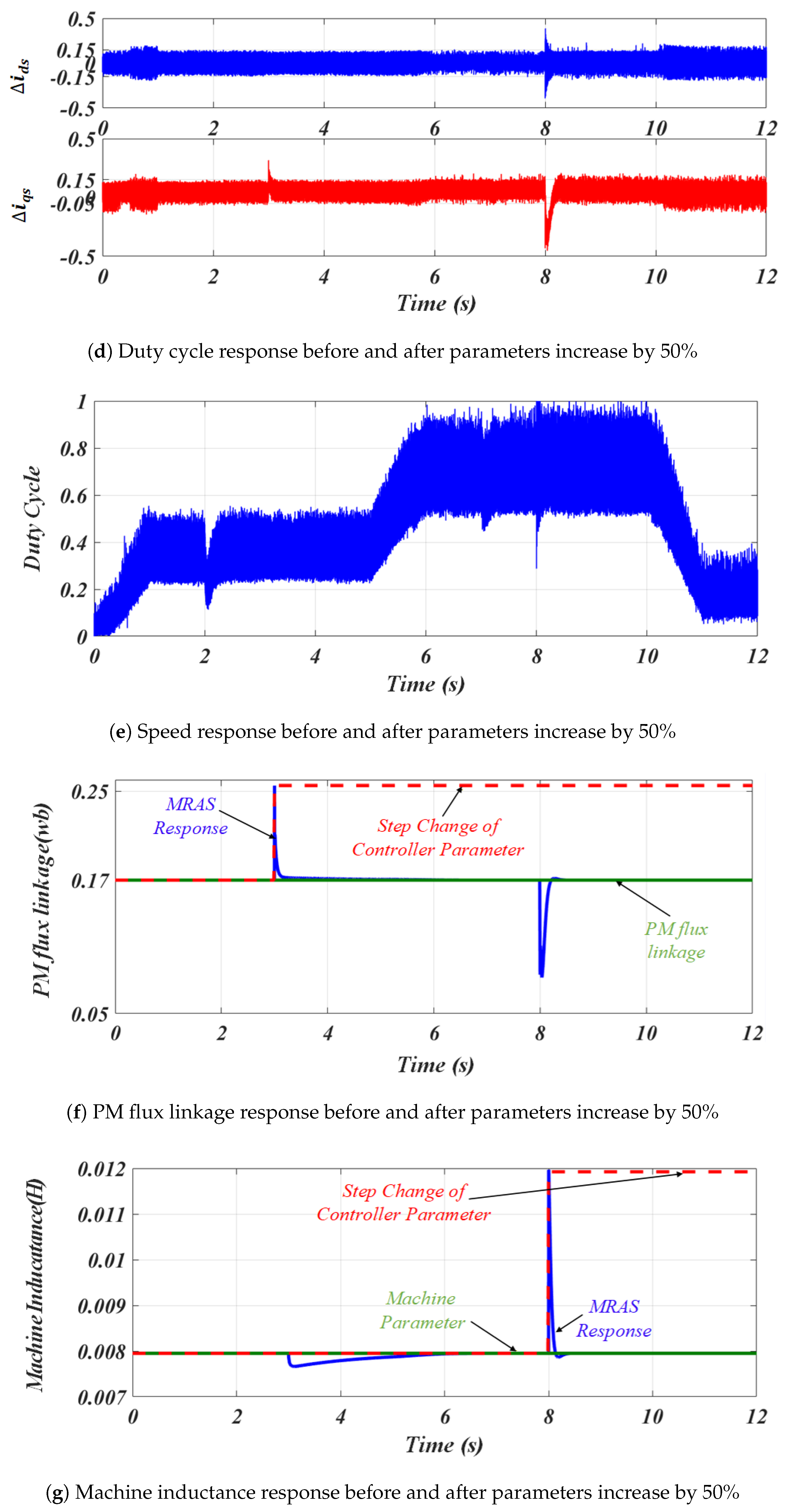
In contrast, the performance of the proposed RM-MPCC-12 scheme is presented in Figure 17. The parameter estimation results demonstrate accurate convergence of the estimated permanent-magnet flux linkage and stator inductance to their true values at t = 3 s and t = 7 s, respectively, as shown in Figure 17f and Figure 17g. Consequently, the phase currents remain nearly distortion-free, as observed in the zoomed region of Figure 17b, with a significantly reduced THD. Furthermore, accurate tracking of the d- and q-axis currents and their references is achieved without steady-state errors, as illustrated in Figure 17c.
In addition, both torque and stator-flux ripples are substantially reduced, and the current prediction error Δ i d q s rapidly converges to zero, as shown in Figure 17d. The duty cycle behavior is also noticeably improved, reflecting enhanced modulation efficiency and superior steady-state performance, as depicted in Figure 17e.
Overall, the proposed RM-MPCC-12 scheme exhibits robust and stable performance under wide speed variations, load disturbances, and significant parameter mismatches. Compared with the conventional M-MPCC-12 approach, the proposed method achieves superior current quality, reduced ripple, improved duty-cycle optimization, and enhanced robustness, thereby confirming its adaptability and suitability for practical applications.

7.6. Limitations and Constraints of the Practical Implementation of the Control Algorithms

The practical implementation of control algorithms introduces real-world constraints that must be carefully addressed. Digital controllers are subject to sampling delays, which can be mitigated using techniques such as two-step-ahead prediction. Inverter nonidealities, including dead-time effects and switching delays, may degrade performance but can be compensated within the prediction model. Additional factors, such as measurement noise, magnetic saturation, and other environmental effects, further challenge implementation. Accounting for these considerations is essential when transitioning from simulation to hardware and often requires extra tuning or compensation strategies. While this work primarily addresses practical implementation issues, it also analyzes other real-world factors, such as parameter variations, through theory and simulation. The implementation and evaluation of the proposed modulated multi-vector MPC with a robust observer demonstrate its effectiveness in overcoming these practical challenges.

8. Discussion

First, under nominal conditions without parameter mismatch, the proposed M-MPCC-12 scheme outperforms all the compared methods reported in the literature, including MPDSC, C-MPCC, and M-MPCC-6. It achieves the lowest torque ripple of 0.6 A, a stator-flux ripple of 1.0 A, and a phase current THD of 5.29%. Furthermore, a quantitative comparison between the existing methods and the proposed M-MPCC-12 approach is presented in Table 6, where the differences in torque ripple, stator-flux ripple, and phase current THD are systematically highlighted under identical operating conditions.
Second, the effect of parameter mismatch is investigated by decreasing and increasing the system parameters by 50%, which results in a noticeable degradation of the control performance in terms of torque ripple, stator-flux ripple, and phase current THD. The corresponding quantitative results are summarized in Table 6.
Finally, the proposed robust M-MPCC-12 scheme, integrated with an MRAS-based parameter estimation mechanism, effectively enhances the predictive model, which is highly dependent on the machine parameters. In particular, the improved parameter estimation significantly benefits the duty-cycle computation and virtual voltage vector selection, which constitute the core components of the proposed control strategy.
The qualitative results summarized in Table 6 demonstrate the performance of the proposed M-MPCC-12 under nominal conditions, in the presence of parameter mismatch, and after parameter estimation. These results clearly confirm the robustness and effectiveness of the proposed method.

9. Conclusions and Extended Issues

A robust modulated twelve-voltage-vector model predictive current control method is proposed to overcome the limitations of the conventional approach. First, the impact of parameter mismatches is analyzed to highlight the sensitivity of the control technique to an accurate motor model. Then, based on the error between measured and predicted currents, an MRAS observer is designed to estimate the accurate motor parameters in real time.
The estimated stator inductance and PM flux linkage parameters are incorporated into the prediction model to improve current prediction accuracy. The key novelty of this approach lies in evaluating the effects of parameter mismatches on the modulation index, thereby enhancing the performance of the SPMSM while mitigating the effects of sudden parameter variations.
Simulation results validate the effectiveness of the proposed algorithm, demonstrating rapid convergence of the estimated parameters to their true values and accurate tracking of parameter variations. Under a 50% increase in parameter mismatch, the conventional modulated twelve-voltage-vector MPCC exhibits significant performance degradation. Specifically, the torque ripple increases from 0.6 A to 1.1 A, corresponding to an 83.3% increase. Likewise, the stator flux ripple rises from 1 A to 1.75 A (a 75% increase), while the THD increases from 5.29% to 8.39%, representing a 58.6% increase. In contrast, the proposed RM-12-MPCC maintains robust performance despite a 50% increase in parameter mismatch. The torque ripple is reduced from 1.1 A to 0.6 A, achieving a 45.5% reduction. Similarly, the stator flux ripple decreases from 1.75 A to 1 A (a 42.9% reduction), and the THD is reduced from 8.39% to 5.48%, corresponding to a 34.7% improvement.

Author Contributions

Conceptualization, M.A.K.; methodology, M.A.K., M.A. and A.A.A.; software, M.A.K.; validation, M.A.K., M.A. and A.A.A.; formal analysis, M.A.K. and M.A.; investigation, M.A.K. and J.R.; data curation, M.A.K.; writing—original draft preparation, M.A.K., M.A., J.R. and A.A.A.; writing—review and editing, M.A.K., M.A., J.R. and A.A.A.; visualization, M.A.K. and A.A.A.; supervision, J.R. and A.A.A. All authors have read and agreed to the published version of the manuscript.

Funding

This research received no external funding.

Data Availability Statement

The original contributions presented in this study are included in this article. Further inquiries can be directed to the corresponding authors.

Acknowledgments

J. Rodriguez acknowledges the support of ANID through project CIA250006.

Conflicts of Interest

The authors declare no conflicts of interest.

Abbreviations

The following abbreviations are used in this manuscript:
PMSMsPermanent magnet synchronous machines;
FOCField oriented control;
MPCModel predictive control;
FCS-MPCFinite control set model predictive control;
MPDSCModel predictive direct speed control;
MPTCModel predictive torque control;
MPCCModel predictive current control;
C-MPCCConventional model predictive current control;
THDTotal harmonic distortion;
SPMSMSurface-mounted permanent magnet synchronous motor;
M-MPCCModulated model predictive current control;
MRASModel reference adaptive system;
PMPermanent magnet;
ESOExtended state observer;
EMFBack electromotive force;
ANNsArtificial neural networks;
EKFExtended Kalman filter;
M-MPCC-6Modulated six-voltage-vector model predictive current control;
M-MPCC-12Modulated twelve-voltage-vector model predictive current control;
LTILinear time-invariant;
SPRStrictly positive real;
RM-MPCC-12Robust modulated twelve-voltage-vector model predictive current control.

Parameters and Constants

The following parameters and constants are used in this manuscript:
V D C DC link voltage (V);
T s Sample time ( μ s );
t d Dead time ( μ s );
λ i d Weighting factor for the d-axis current component (dimensionless);
λ i q Weighting factor for the q-axis current component (dimensionless);
R s Stator resistance ( Ω );
L s Stator inductance (mH);
λ P M Permanent magnet flux linkage (mWb);
L s 0 Initial machine inductance (mH);
λ P M 0 Initial permanent magnet flux linkage (mWb);
K P L s Proportional gain for L s (dimensionless);
K I L s Integral gain for L s (dimensionless);
K P λ P M Proportional gain for λ P M (dimensionless);
K I λ P M Integral gain for λ P M (dimensionless).

Variables and Functions

The following variables and functions are used in this manuscript:
ω r Electrical rotor speed (rad/s);
i d q s dq-axis current components (A);
i d q s ( k + 1 ) Predicted dq-axis current components (A);
v d q s dq-axis voltage components (V);
v a b c Phase voltages (V);
S a b c Switching function (unitless);
g i Cost function (unitless);
μ i opt ( k ) Optimal duty cycle (unitless);
v x y ( k ) Virtual voltage vector (V);
i d q s f ( k + 1 ) Inaccurate predicted dq-axis current components (A);
Δ i d q s dq-axis current prediction error (A);
μ i f opt ( k ) Inaccurate optimal duty cycle (unitless);
L ^ s Estimated machine inductance (mH);
λ ^ P M Estimated permanent magnet flux linkage (mWb).

Appendix A

Substituting (29) into (26) yields (A1). The relationship in (26) can be decomposed into two components, as expressed in (A2) and (A3).
η 1 ( 0 , t 0 ) = 0 t 0 ( ( e d s v d s + e q s v q s R s i ^ d s e d s R s i ^ q s e q s ) · ( K P L s f 1 ( t ) + K I L s 0 t f 1 ( t ) d t ) ) d t γ 1 2
η 11 ( 0 , t 0 ) = 0 t 0 ( e d s v d s + e q s v q s R s i ^ d s e d s R s i ^ q s e q s ) · ( K P L s f 1 ( t ) ) d t γ 11 2
η 12 ( 0 , t 0 ) = 0 t 0 ( e d s v d s + e q s v q s R s i ^ d s e d s R s i ^ q s e q s ) · ( K I L s 0 t f 1 ( t ) d t ) d t γ 12 2
When f 1 ( t ) is considered, Equations (A2) and (A3) can be expressed as (A5) and (A6):
f 1 ( t ) = e d s v d s + e q s v q s R s i ^ d s e d s R s i ^ q s e q s
η 11 ( 0 , t 0 ) = K P L s 0 t 0 f 1 2 ( t ) d t γ 11 2
η 12 ( 0 , t 0 ) = K I L s 0 t 0 F 1 ( t ) F 1 ( t ) d t γ 12 2 = 1 2 K I L s F 1 2 ( t 0 ) γ 12 2
where
F 1 ( t ) = 0 t f 1 ( t ) d t , γ 11 , γ 12 are limited positive constants .

Appendix B

Substituting (30) into (28) yields (A7). The relationship in (28) can be decomposed into two components, as expressed in (A8) and (A9).
η 2 ( 0 , t 0 ) = 0 t 0 e q s ω r · ( K P λ P M f 2 ( t ) + K I λ P M 0 t f 2 ( t ) d t ) d t γ 2 2
η 21 ( 0 , t 0 ) = 0 t 0 e q s ω r · ( K P λ P M f 2 ( t ) ) d t γ 21 2
η 22 ( 0 , t 0 ) = 0 t 0 e q s ω r · ( K I λ P M 0 t f 2 ( t ) d t ) d t γ 22 2
When f 2 ( t ) is considered, Equations (A8) and (A9) can be described as follows:
f 2 ( t ) = e q s ω r
η 21 ( 0 , t 0 ) = K P λ P M 0 t 0 f 2 2 ( t ) d t γ 21 2
η 22 ( 0 , t 0 ) = K I λ P M 0 t 0 F 2 ( t ) F 2 ( t ) d t γ 22 2 = 1 2 K I λ P M F 2 2 ( t 0 ) γ 22 2
where
F 2 ( t ) = 0 t f 2 ( t ) d t , γ 21 , γ 22 are limited positive constants .

References

  1. Zhang, X.; Zhang, W. Model Predictive Full-Torque Control for the Open-Winding PMSM System Driven by Dual Inverter with a Common DC Bus. IEEE J. Emerg. Sel. Top. Power Electron. 2021, 9, 1541–1554. [Google Scholar] [CrossRef]
  2. Zhang, X.; Xu, C. Second-Time Fault-Tolerant Topology and Control Strategy for the Open-Winding PMSM System Based on Shared Bridge Arm. IEEE Trans. Power Electron. 2020, 35, 12181–12193. [Google Scholar] [CrossRef]
  3. Zhang, X.; Cheng, Y.; Zhao, Z.; Yan, K. Optimized Model Predictive Control with Dead-Time Voltage Vector for PMSM Drives. IEEE Trans. Power Electron. 2021, 36, 3149–3158. [Google Scholar] [CrossRef]
  4. Khamis, M.A.; Del Corral, V.R.; Dòpria-Cerezo, A. Impact of Discontinuous PWM Techniques on NVH Performance in IPMSMs. In Proceedings of the IECON 2025—51st Annual Conference of the IEEE Industrial Electronics Society, Madrid, Spain, 14–17 October 2025; IEEE: Piscataway, NJ, USA, 2025; pp. 1–6. [Google Scholar] [CrossRef]
  5. Khamis, M.A.; Del Corral, V.R.; Dòria-Cerezo, A. Effect of Various PWM Aspects on NVH Performance for PMSMs: Analysis & Improvement. In Proceedings of the 2025 IEEE Conference on Power Electronics and Renewable Energy (CPERE), Aswan, Egypt, 28–30 September 2025; IEEE: Piscataway, NJ, USA, 2025; pp. 1–7. [Google Scholar] [CrossRef]
  6. Khames, M.A.; Ahmed, A.A.; Omara, A.M.; Rashad, E.E.M. Dynamic Behavior Assessment of Permanent Magnet Synchronous Motors under Finite Set Model Predictive Controllers and Field-Oriented Control. In Proceedings of the 22nd International Middle East Power Systems Conference (MEPCON), Assiut, Egypt, 14–16 December 2021; pp. 455–462. [Google Scholar] [CrossRef]
  7. Zhang, X.; Zhang, L.; Zhang, Y. Model Predictive Current Control for PMSM Drives with Parameter Robustness Improvement. IEEE Trans. Power Electron. 2019, 34, 1645–1657. [Google Scholar] [CrossRef]
  8. Zhao, X.; Wang, X.; Ma, L.; Zong, G. Fuzzy Approximation Based Asymptotic Tracking Control for a Class of Uncertain Switched Nonlinear Systems. IEEE Trans. Fuzzy Syst. 2020, 28, 632–644. [Google Scholar] [CrossRef]
  9. Mora, A.; Orellana, A.; Juliet, J.; Cardenas, R. Model Predictive Torque Control for Torque Ripple Compensation in Variable-Speed PMSMs. IEEE Trans. Ind. Electron. 2016, 63, 4584–4592. [Google Scholar] [CrossRef]
  10. Luo, Y.; Liu, C. A Simplified Model Predictive Control for a Dual Three-Phase PMSM with Reduced Harmonic Currents. IEEE Trans. Ind. Electron. 2018, 65, 9079–9089. [Google Scholar] [CrossRef]
  11. Zhu, Y.; Yin, J.; Xu, G. A Comparative Study of MPCC and MPTC in PMSM Drive System. In Proceedings of the IEEE 2nd International Conference on Circuits, Systems and Simulation (ICCSS), Beijing, China, 27–29 May 2018; IEEE: Piscataway, NJ, USA, 2018; pp. 36–40. [Google Scholar] [CrossRef]
  12. Chai, S.; Wang, L.; Rogers, E. Model Predictive Control of a Permanent Magnet Synchronous Motor with Experimental Validation. Control Eng. Pract. 2013, 21, 1584–1593. [Google Scholar] [CrossRef]
  13. Fuentes, E.; Kalise, D.; Rodriguez, J.; Kennel, R.M. Cascade-Free Predictive Speed Control for Electrical Drives. IEEE Trans. Ind. Electron. 2014, 61, 2176–2184. [Google Scholar] [CrossRef]
  14. Morel, F.; Lin-Shi, X.; Rétif, J.M.; Allard, B.; Buttay, C. A Comparative Study of Predictive Current Control Schemes for a Permanent-Magnet Synchronous Machine Drive. IEEE Trans. Ind. Electron. 2009, 56, 2715–2728. [Google Scholar] [CrossRef]
  15. Yahia, T.; Ahmed, A.A.; Ahmed, M.M.; El Zawawi, A.; Elbarbary, Z.M.S.; Arafath, M.S.; Ali, M.M. Enhanced Model Predictive Speed Control of PMSMs Based on Duty Ratio Optimization with Integrated Load Torque Disturbance Compensation. Machines 2025, 13, 891. [Google Scholar] [CrossRef]
  16. Wang, W.; Zhang, J.; Cheng, M. Common Model Predictive Control for Permanent-Magnet Synchronous Machine Drives Considering Single-Phase Open-Circuit Fault. IEEE Trans. Power Electron. 2017, 32, 5862–5872. [Google Scholar] [CrossRef]
  17. Zhang, X.; Hou, B. Double Vectors Model Predictive Torque Control Without Weighting Factor Based on Voltage Tracking Error. IEEE Trans. Power Electron. 2018, 33, 2368–2380. [Google Scholar] [CrossRef]
  18. Xu, Y.; Zhang, B.; Zhou, Q. A Model Predictive Current Control Method of PMSM Based on the Simultaneous Optimization of Voltage Vector and Duty Cycle. In Proceedings of the IEEE 8th International Power Electronics and Motion Control Conference (IPEMC-ECCE Asia), Hefei, China, 22–26 May 2016; IEEE: Piscataway, NJ, USA, 2016; pp. 881–884. [Google Scholar] [CrossRef]
  19. Ahmed, A.A.; Koh, B.K.; Kim, J.-S.; Lee, Y.I. Finite control set-model predictive speed control for induction motors with optimal duration. IFAC-PapersOnLine 2017, 50, 7801–7806. [Google Scholar] [CrossRef]
  20. Zhang, X.; Cheng, Y.; Zhang, L. Disturbance-Deadbeat Inductance Observer-Based Current Predictive Control for Surface-Mounted Permanent Magnet Synchronous Motor Drives. IET Power Electron. 2020, 13, 1172–1180. [Google Scholar] [CrossRef]
  21. Young, H.A.; Perez, M.A.; Rodriguez, J. Analysis of Finite-Control-Set Model Predictive Current Control with Model Parameter Mismatch in a Three-Phase Inverter. IEEE Trans. Ind. Electron. 2016, 63, 3100–3107. [Google Scholar] [CrossRef]
  22. Yang, M.; Lang, X.; Long, J.; Xu, D. Flux Immunity Robust Predictive Current Control with Incremental Model and Extended State Observer for PMSM Drive. IEEE Trans. Power Electron. 2017, 32, 9267–9279. [Google Scholar] [CrossRef]
  23. Xia, C.; Wang, M.; Song, Z.; Liu, T. Robust Model Predictive Current Control of Three-Phase Voltage Source PWM Rectifier with Online Disturbance Observation. IEEE Trans. Ind. Inform. 2012, 8, 459–471. [Google Scholar] [CrossRef]
  24. Jia, C.; Wang, X.; Liang, Y.; Zhou, K. Robust Current Controller for IPMSM Drives Based on Explicit Model Predictive Control with Online Disturbance Observer. IEEE Access 2019, 7, 45898–45910. [Google Scholar] [CrossRef]
  25. Zhang, X.; Hou, B.; Mei, Y. Deadbeat Predictive Current Control of Permanent-Magnet Synchronous Motors with Stator Current and Disturbance Observer. IEEE Trans. Power Electron. 2017, 32, 3818–3834. [Google Scholar] [CrossRef]
  26. Lin, C.K.; Yu, J.T.; Lai, Y.S.; Yu, H.C. Improved Model-Free Predictive Current Control for Synchronous Reluctance Motor Drives. IEEE Trans. Ind. Electron. 2016, 63, 3942–3953. [Google Scholar] [CrossRef]
  27. Lin, C.-K.; Liu, T.-H.; Yu, J.-t.; Fu, L.-C.; Hsiao, C.-F. Model-Free Predictive Current Control for Interior Permanent-Magnet Synchronous Motor Drives Based on Current Difference Detection Technique. IEEE Trans. Ind. Electron. 2014, 61, 667–681. [Google Scholar] [CrossRef]
  28. Li, X.; Wang, Y.; Guo, X.; Cui, X.; Zhang, S.; Li, Y. An Improved Model-Free Current Predictive Control Method for SPMSM Drives. IEEE Access 2021, 9, 134672–134681. [Google Scholar] [CrossRef]
  29. Zhang, Y.; Gao, S.; Xu, W. An Improved Model Predictive Current Control of Permanent Magnet Synchronous Motor Drives. In Proceedings of the IEEE Applied Power Electronics Conference and Exposition (APEC), Long Beach, CA, USA, 20–24 March 2016; IEEE: Piscataway, NJ, USA, 2016; pp. 2868–2874. [Google Scholar] [CrossRef]
  30. Zhang, X.; Zhao, Z.; Cheng, Y.; Wang, Y. Robust Model Predictive Current Control Based on Inductance and Flux Linkage Extraction Algorithm. IEEE Trans. Veh. Technol. 2020, 69, 14893–14902. [Google Scholar] [CrossRef]
  31. Bian, F.; Chien, Y.-R. PMSM Speed Control Based on Improved Adaptive Fractional-Order Sliding Mode Control. Symmetry 2025, 17, 736. [Google Scholar] [CrossRef]
  32. Qu, X.; Zhang, S.; Peng, C. Model-Free Adaptive Fast Integral Terminal Sliding Mode Control for Permanent Magnet Synchronous Motor with Position Error Constraint. World Electr. Veh. J. 2025, 16, 341. [Google Scholar] [CrossRef]
  33. Ullah, A.; Pan, J.; Ullah, S.; Zhang, Z. Robust Speed Control of Permanent Magnet Synchronous Motor Drive System Using Sliding-Mode Disturbance Observer Based Variable Gain Fractional Order Super Twisting Sliding Mode Control. Fractal Fract. 2024, 8, 368. [Google Scholar] [CrossRef]
  34. Ullah, A.; Ullah, S.; Zhang, Z.; Pan, J. Smooth Super Twisting Sliding Mode Control Design with High Order Super Twisting Observer for Speed Tracking Control of Permanent Magnet Synchronous Motor Drive System. ISA Trans. 2025, 162, 227–242. [Google Scholar] [CrossRef]
  35. Liu, D.; Han, J.; Chen, G.; Cheng, Y.; Liang, X.; Song, C. Fuzzy self-tuning fractional order PD permanent magnet synchronous motor speed control based on torque compensation. Sci. Rep. 2025, 15, 2141. [Google Scholar] [CrossRef]
  36. Liu, K.; Zhang, Q.; Chen, J.; Zhu, Z.Q.; Zhang, J. Online Multiparameter Estimation of Nonsalient-Pole PM Synchronous Machines with Temperature Variation Tracking. IEEE Trans. Ind. Electron. 2011, 58, 1776–1788. [Google Scholar] [CrossRef]
  37. Shi, Y.; Sun, K.; Huang, L.; Li, Y. Online Identification of Permanent Magnet Flux Based on Extended Kalman Filter for IPMSM Drive with Position Sensorless Control. IEEE Trans. Ind. Electron. 2012, 59, 4169–4178. [Google Scholar] [CrossRef]
  38. Gatto, G.; Marongiu, I.; Serpi, A. Discrete-Time Parameter Identification of a Surface-Mounted Permanent Magnet Synchronous Machine. IEEE Trans. Ind. Electron. 2013, 60, 4869–4880. [Google Scholar] [CrossRef]
  39. Ahmed, A.A.; Koh, B.K.; Lee, Y.I. A Comparison of Finite Control Set and Continuous Control Set Model Predictive Control Schemes for Speed Control of Induction Motors. IEEE Trans. Ind. Inform. 2017, 14, 1334–1346. [Google Scholar] [CrossRef]
  40. Dai, B.; Wang, Z.; Zhao, J.; Li, S. Critical Current-Constrained Continuous Nonsingular Terminal Sliding Mode Control for PMSM Based on Control Barrier Function. IEEE Trans. Power Electron. 2025, 40, 15093–15103. [Google Scholar] [CrossRef]
  41. Vaez-Zadeh, S. Control of Permanent Magnet Synchronous Motors; Oxford University Press: Oxford, UK, 2018. [Google Scholar] [CrossRef]
  42. Liu, K.; Zhang, Q.; Zhu, Z.Q.; Zhang, J.; Shen, A.W.; Stewart, P. Comparison of Two Novel MRAS Based Strategies for Identifying Parameters in Permanent Magnet Synchronous Motors. Int. J. Autom. Comput. 2010, 7, 516–524. [Google Scholar] [CrossRef]
  43. ASM International Handbook Committee. ASM Handbook, Volume 16: Machining; ASM International: Materials Park, OH, USA, 1989. [Google Scholar] [CrossRef]
Figure 1. Progress of MPC, including the proposed method.
Wevj 17 00077 g001
Figure 2. Voltage vectors for MPCC approaches: (a) conventional C-MPCC, (b) modulated six-active-voltage-vector M-MPCC-6, and (c) modulated twelve-voltage-vector M-MPCC-12.
Wevj 17 00077 g002
Figure 3. SPMSM drives using modulated twelve-voltage-vector M-MPCC-12.
Wevj 17 00077 g003
Figure 4. SPMSM drives with robust modulated twelve-voltage-vector M-MPCC-12.
Wevj 17 00077 g004
Figure 5. Vector selection of (a) C-MPCC, (b) M-MPCC-12, and (c) robust M-MPCC-12.
Wevj 17 00077 g005
Figure 6. Block diagram of MRAS algorithm.
Wevj 17 00077 g006
Figure 7. Nyquist plot for the LTI part of MRAS.
Wevj 17 00077 g007
Figure 8. Implementation flow chart of the proposed RM-MPCC algorithm.
Wevj 17 00077 g008
Figure 9. Comparative performance analysis of SPMSM using M-MPCC-12 and other MPC-based methods.
Wevj 17 00077 g009
Figure 10. Response of the SPMSM using M-MPCC-12 when the permanent magnet flux linkage decreases by 50% at 0.6 s and the inductance decreases by 50% at 1.2 s.
Wevj 17 00077 g010aWevj 17 00077 g010b
Figure 11. Response of the SPMSM using M-MPCC-12 when the permanent magnet flux linkage increases by 50% at 0.6 s and the inductance increases by 50% at 1.2 s.
Wevj 17 00077 g011aWevj 17 00077 g011b
Figure 12. Response of the SPMSM using RM-MPCC-12 when the permanent magnet flux linkage decreases by 50% at 0.6 s and the inductance decreases by 50% at 1.2 s.
Wevj 17 00077 g012aWevj 17 00077 g012b
Figure 13. Response of the SPMSM using RM-MPCC-12 when the permanent magnet flux linkage increases by 50% at 0.6 s and the inductance increases by 50% at 1.2 s.
Wevj 17 00077 g013aWevj 17 00077 g013b
Figure 14. Permanent magnet flux linkage and inductance responses for under-tuned and over-tuned gains, with 50% PM change at 1 s and 50% inductance change at 2.5 s.
Wevj 17 00077 g014
Figure 15. THD of the stator phase current for the conventional M-MPCC-12 and the proposed RM-MPCC-12 under nominal conditions and ± 50 % parameter mismatches. (a) Nominal parameters (M-MPCC-12). (b) Parameters decreased by 50% (M-MPCC-12). (c) Parameters increased by 50% (M-MPCC-12). (d) Parameters decreased by 50% (RM-MPCC-12). (e) Parameters increased by 50% (RM-MPCC-12).
Wevj 17 00077 g015
Figure 16. Response of the SPMSM using M-MPCC-12 considering parameter mismatch.
Wevj 17 00077 g016aWevj 17 00077 g016b
Figure 17. Response of the SPMSM using RM-MPCC-12 under varying speed and load conditions considering parameter mismatch.
Wevj 17 00077 g017aWevj 17 00077 g017b
Table 1. Summary of MPCC techniques and algorithms for reducing parameter sensitivity.
Ref.MethodKey ContributionResearch Gap
[7,22]Incremental model with inductance disturbance compensationCompensates error due to inductance mismatch while eliminating PM flux linkage from the prediction model.Difficult to integrate with duty-cycle-based modulation schemes.
[23,24,25]Disturbance observer-based predictive controlCompensates total prediction errors caused by parameter mismatches without explicit parameter estimation.Limited applicability in duty-cycle-based MPCC implementations.
[26,27,28]Model-free predictive current controlCompensates overall parameter mismatch effects without requiring parameter estimation.Not directly compatible with duty-cycle-based MPCC.
[29]Back-EMF estimation approachCompensates PM flux linkage mismatch via back-EMF estimation, improving robustness to flux variations.Applied with duty-cycle-based control but lacks accurate inductance estimation, reducing precision.
[30]Inductance and PM flux linkage extraction algorithmSimultaneous estimation of inductance and PM flux linkage parameters for improved robustness.Successfully implemented in duty-cycle-based MPCC systems.
Table 2. Selected PI controller gains for MRAS.
K P L s K I L s K P λ PM K I λ PM
0.000120.0030.5
Table 3. Parameters and specifications of SPMSM.
SpecificationUnitValue
Rated powerkW1.2
Rated torqueNm5.73
Maximum torqueNm17.19
Rated L-L voltageV(rms)220
Rated line currentA5.6
Maximum line currentA16.8
Rated speedr/min2000
Pole pairs-4
Inertia of rotorkg·m20.00088
Stator resistance Ω 0.75
InductancemH7.95
PM flux linkagemWb0.17
Table 4. Performance comparison of MPC-based control methods.
Control MethodRipple in i qs (A)Ripple in i ds (A)THD in i a (%)
MPDSC1.501.5011.52
C-MPCC1.501.2510.58
M-MPCC-60.951.107.65
M-MPCC-120.601.005.29
Table 5. Performance comparison under parameter mismatch without and with MRAS.
ConditionWithout MismatchParameters Decreased by 50%Parameters Increased by 50%
Performance metricsTracking error i q s : none
Ripple i q s : 0.6 A
Ripple i d s : 1.0 A
THD: 5.29%
Tracking error i q s : 0 to 1.05 A
Ripple i q s : 0.55 A
Ripple i d s : 1.7 A
THD: 7.65%
Tracking error i q s : 0 to 0.55 A
Ripple i q s : 1.1 A
Ripple i d s : 1.75 A
THD: 8.39%
With MRASTracking error i q s : none
Ripple i q s : 0.6 A
Ripple i d s : 1.0 A
THD: 5.48%
MRAS compensates parameter mismatch, yielding
performance comparable to the nominal case
Table 6. Performance comparison of MPC-based control methods under nominal and parameter mismatch conditions.
Control Method/ConditionRipple i qs (A)Ripple i ds (A)THD i a (%)Remarks
Nominal Parameters
MPDSC1.501.5011.52-
C-MPCC1.501.2510.58-
M-MPCC-60.951.107.65-
M-MPCC-120.601.005.29Best performance
Parameter mismatch (50% decrease)
M-MPCC-12 (Without MRAS)0.551.707.65Performance degradation
M-MPCC-12 (With MRAS)0.601.005.48MRAS compensates mismatch
Parameter mismatch (50% increase)
M-MPCC-12 (Without MRAS)1.101.758.39Performance degradation
M-MPCC-12 (With MRAS)0.601.005.48MRAS compensates mismatch
Disclaimer/Publisher’s Note: The statements, opinions and data contained in all publications are solely those of the individual author(s) and contributor(s) and not of MDPI and/or the editor(s). MDPI and/or the editor(s) disclaim responsibility for any injury to people or property resulting from any ideas, methods, instructions or products referred to in the content.