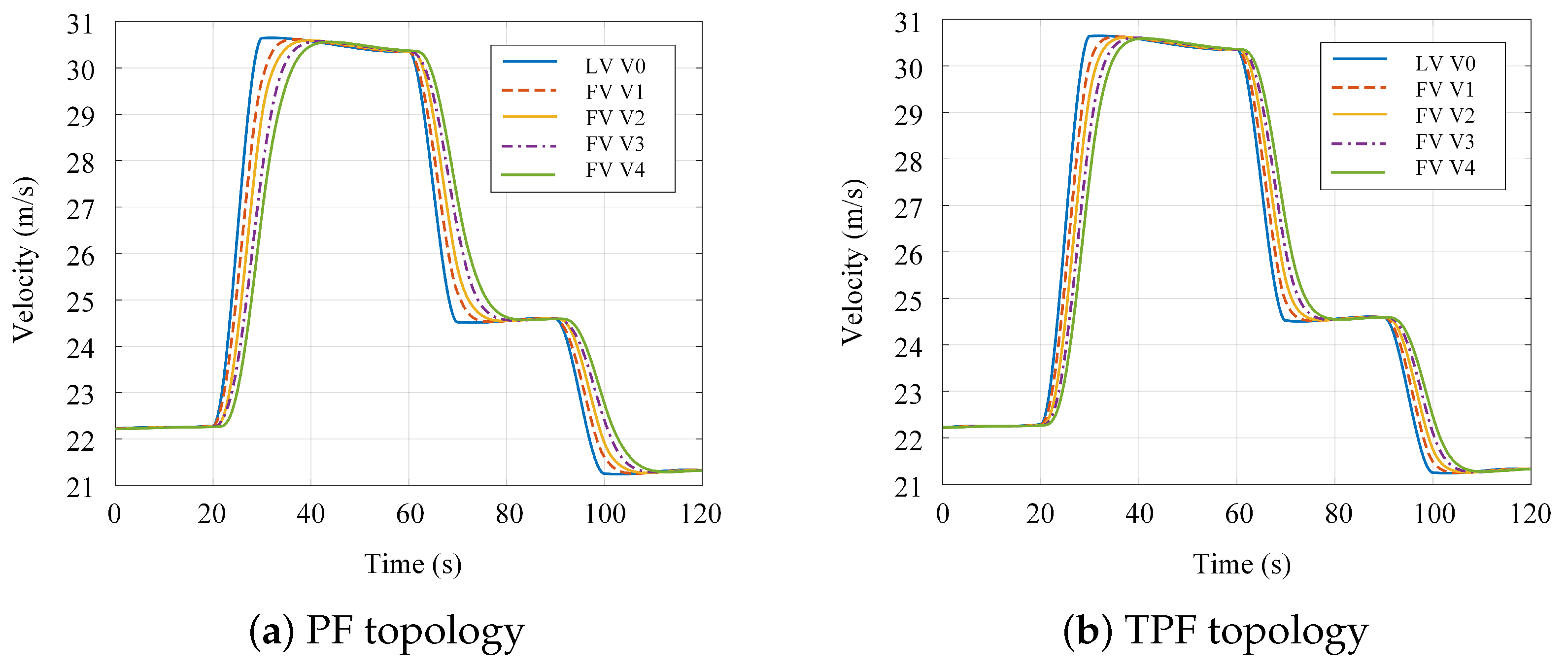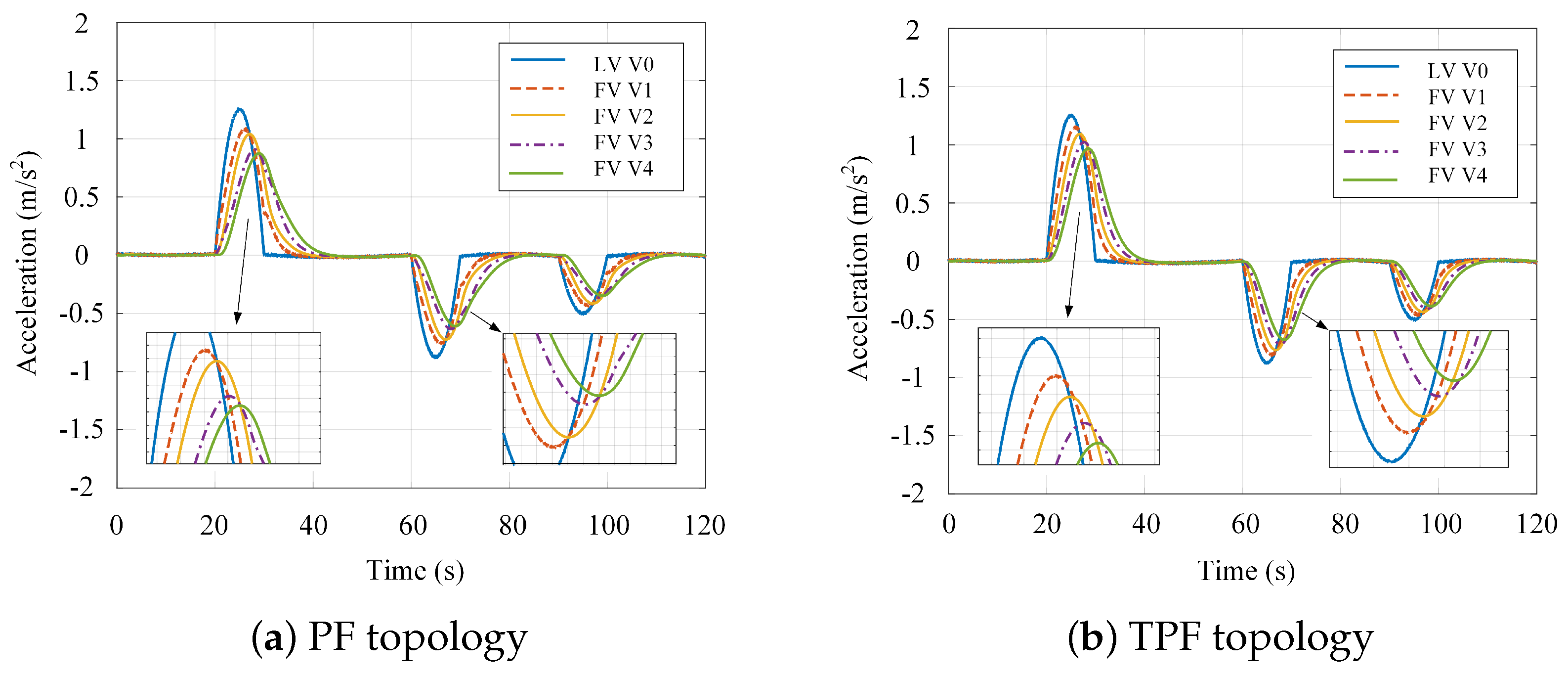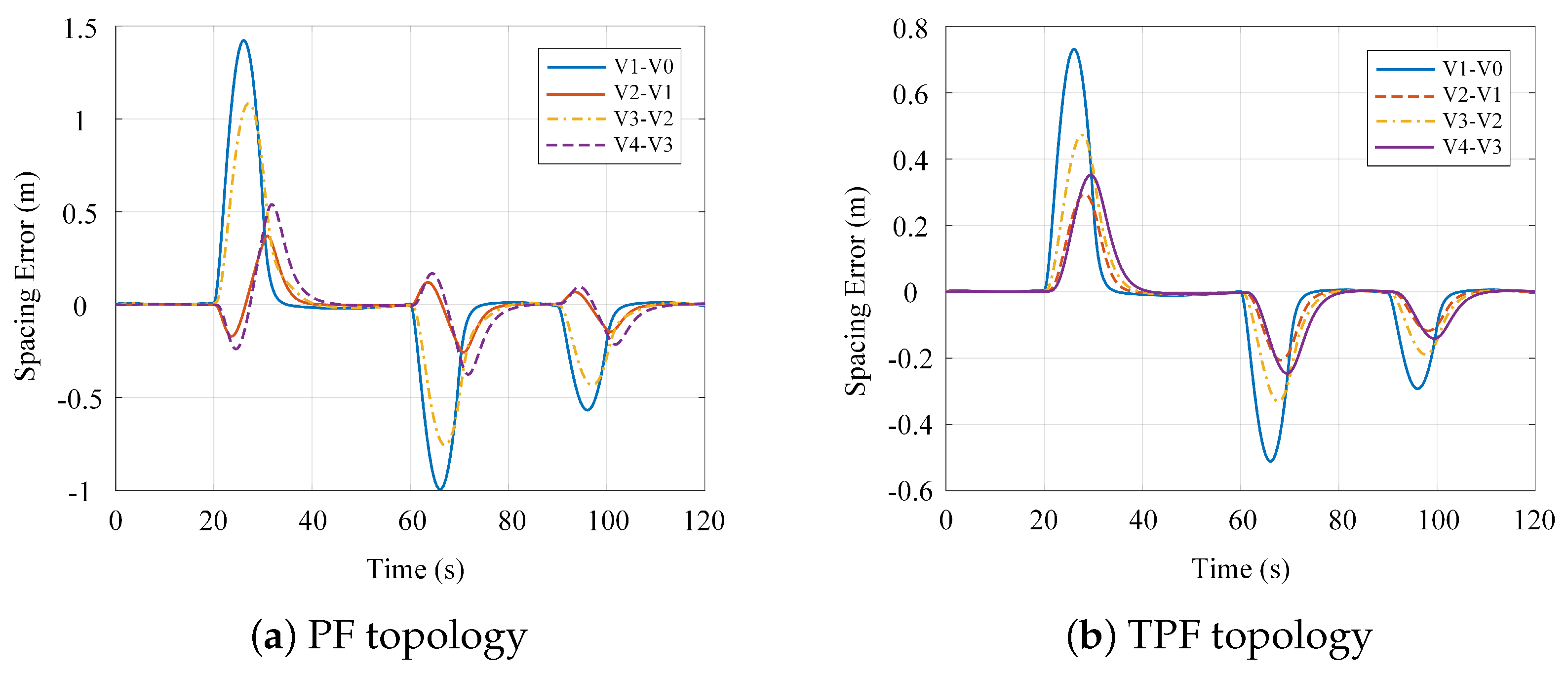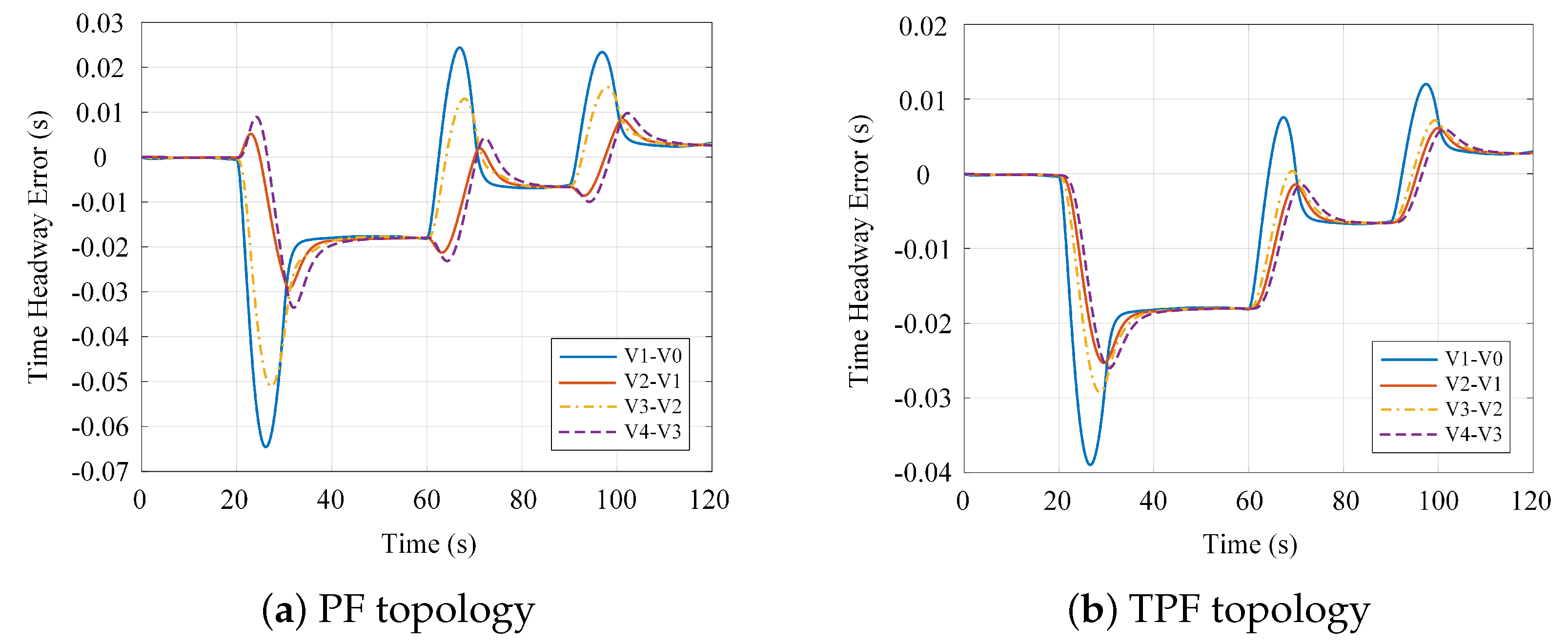

Safety-Oriented Cooperative Control for Connected and Autonomous Vehicle Platoons Using Differential Game Theory and Risk Potential Field


Abstract
1. Introduction
2. Literature Review
2.1. PID-Based Cooperative Adaptive Cruise Control
2.2. Optimal Control and Model Predictive Control Approaches
2.3. Reinforcement Learning-Based Strategies
2.4. Research Gaps and Contributions
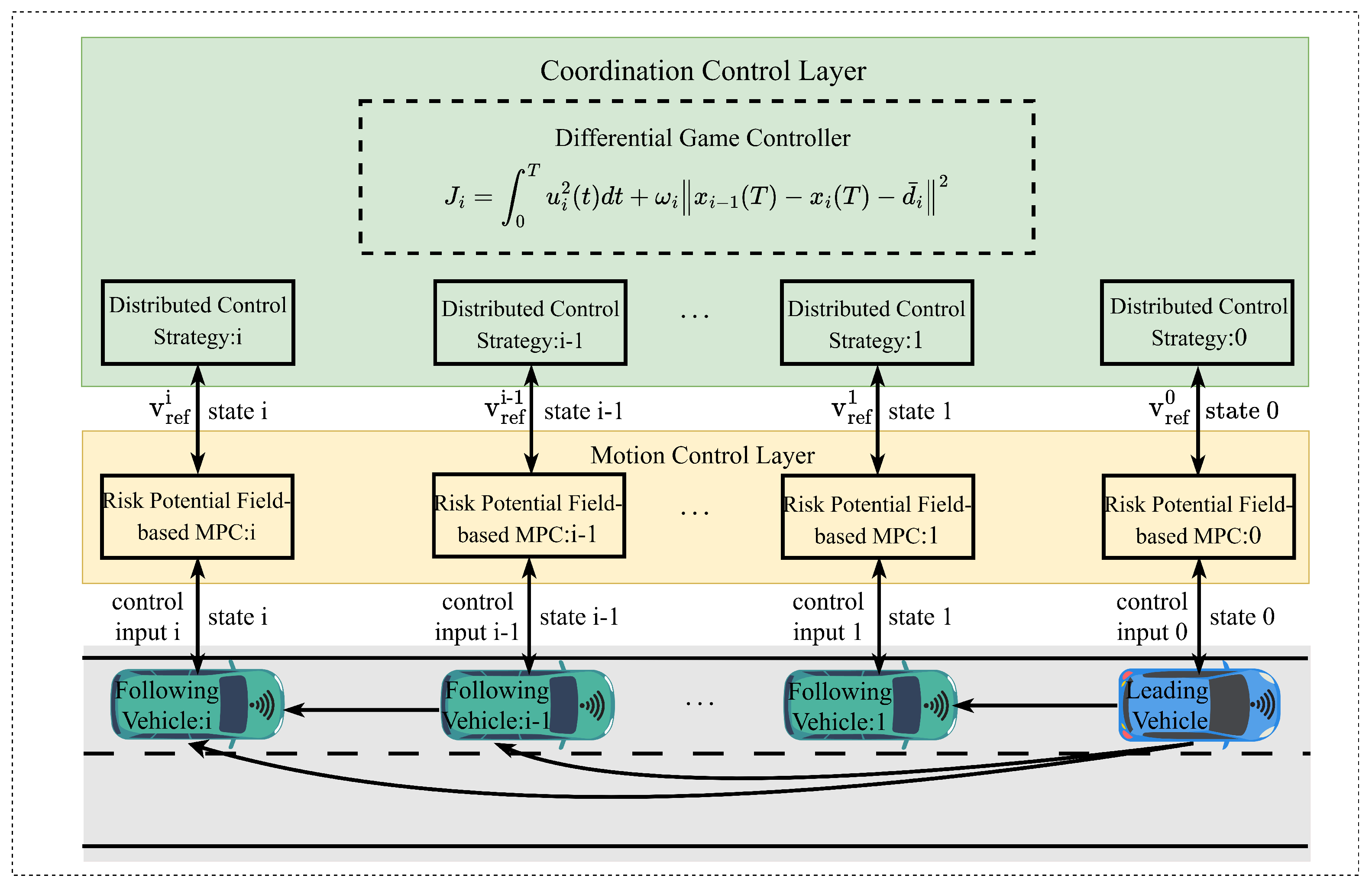
3. Hierarchical Cooperative Control Framework
4. Differential Game-Based Longitudinal Controller
4.1. CAV Communication Topology
4.2. Longitudinal Vehicle Dynamics Modeling for CAV Platoons
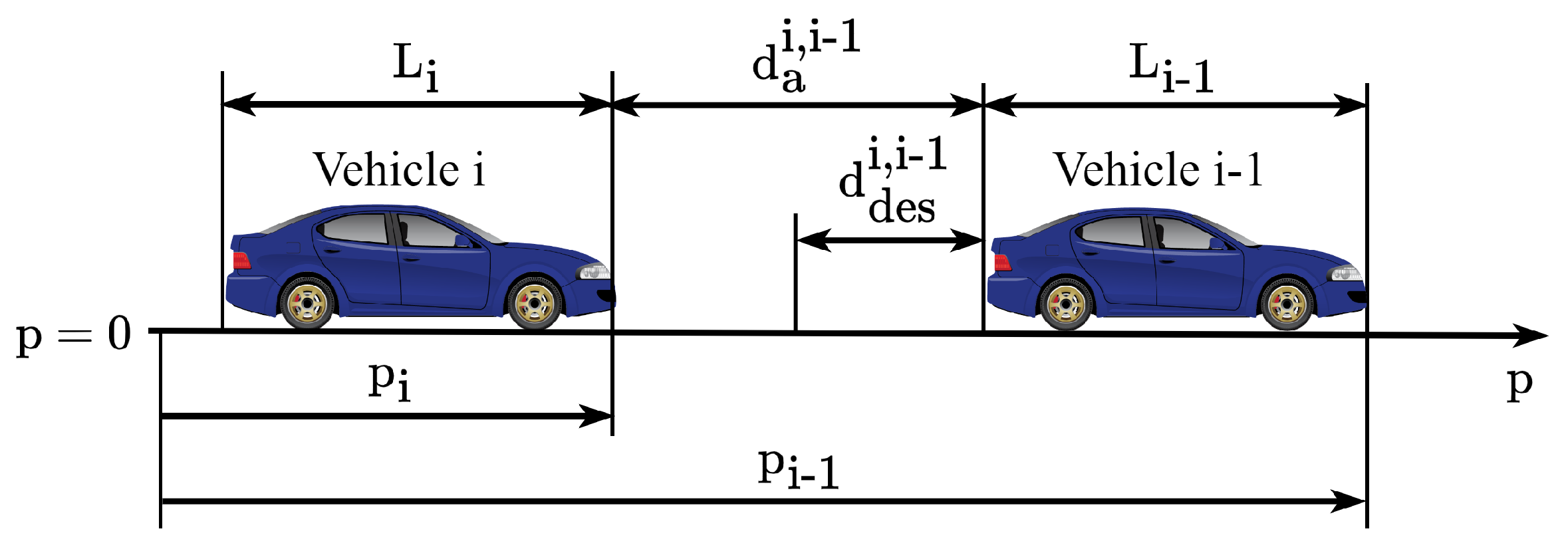
4.3. Inter-Vehicle Spacing Policy for CAV Platoons
4.4. Differential Game-Based Longitudinal Control Strategy for CAV Platoons
4.4.1. Open-Loop Nash Equilibrium of the Differential Game
4.4.2. Estimated Open-Loop Nash Equilibrium of the Differential Game
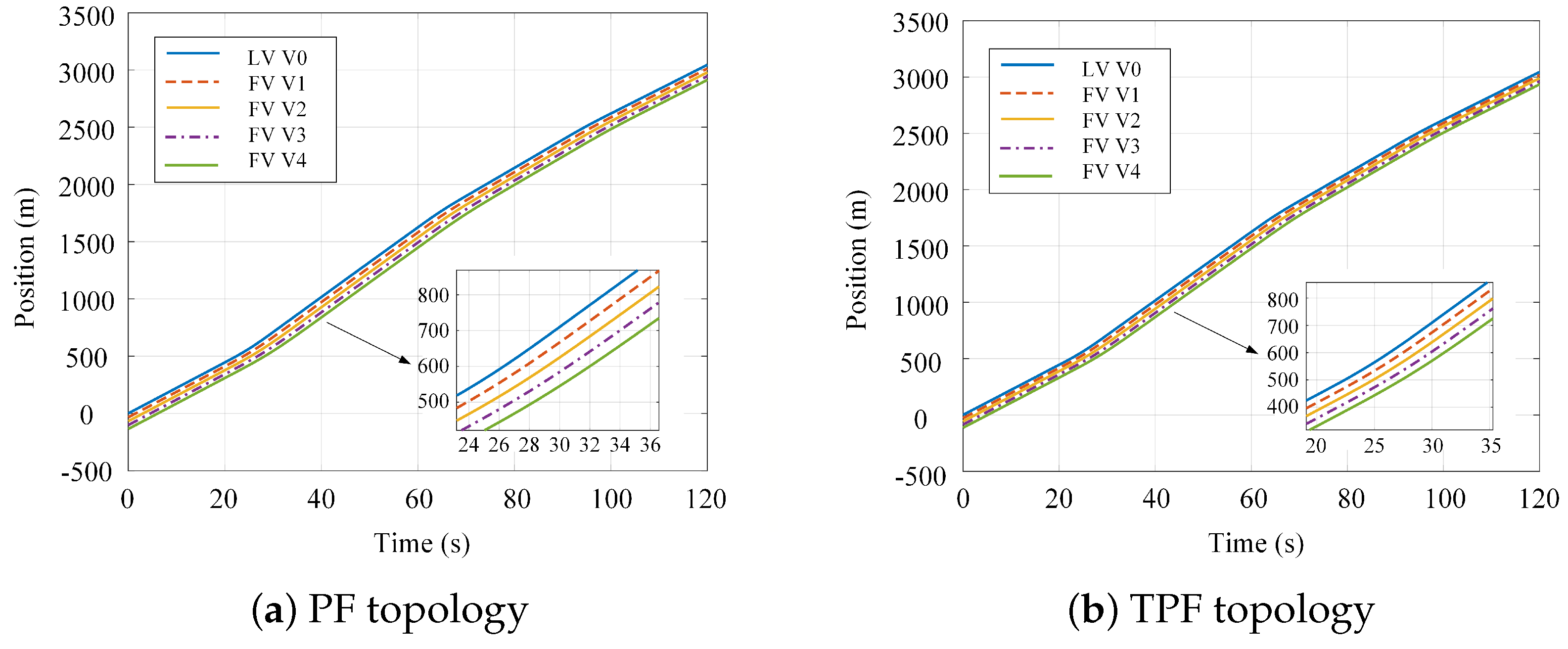
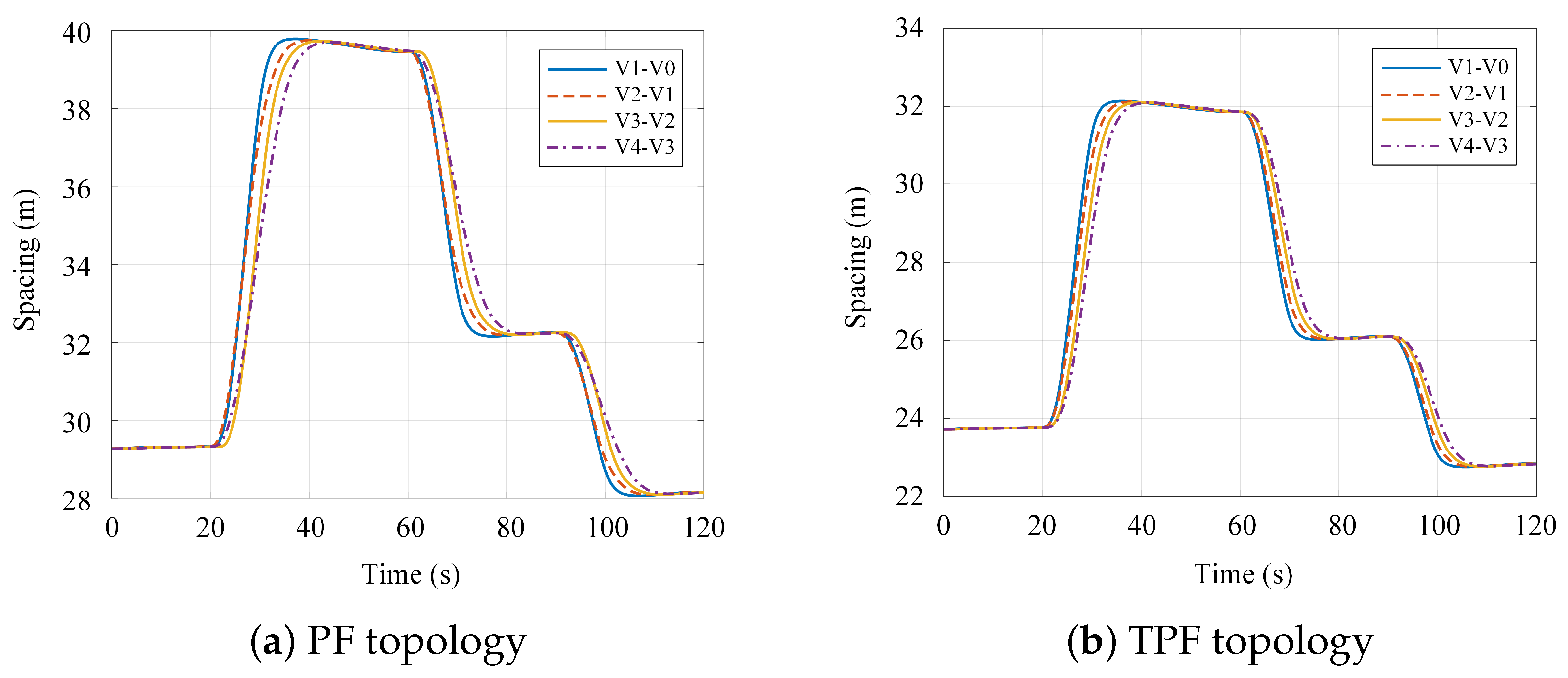
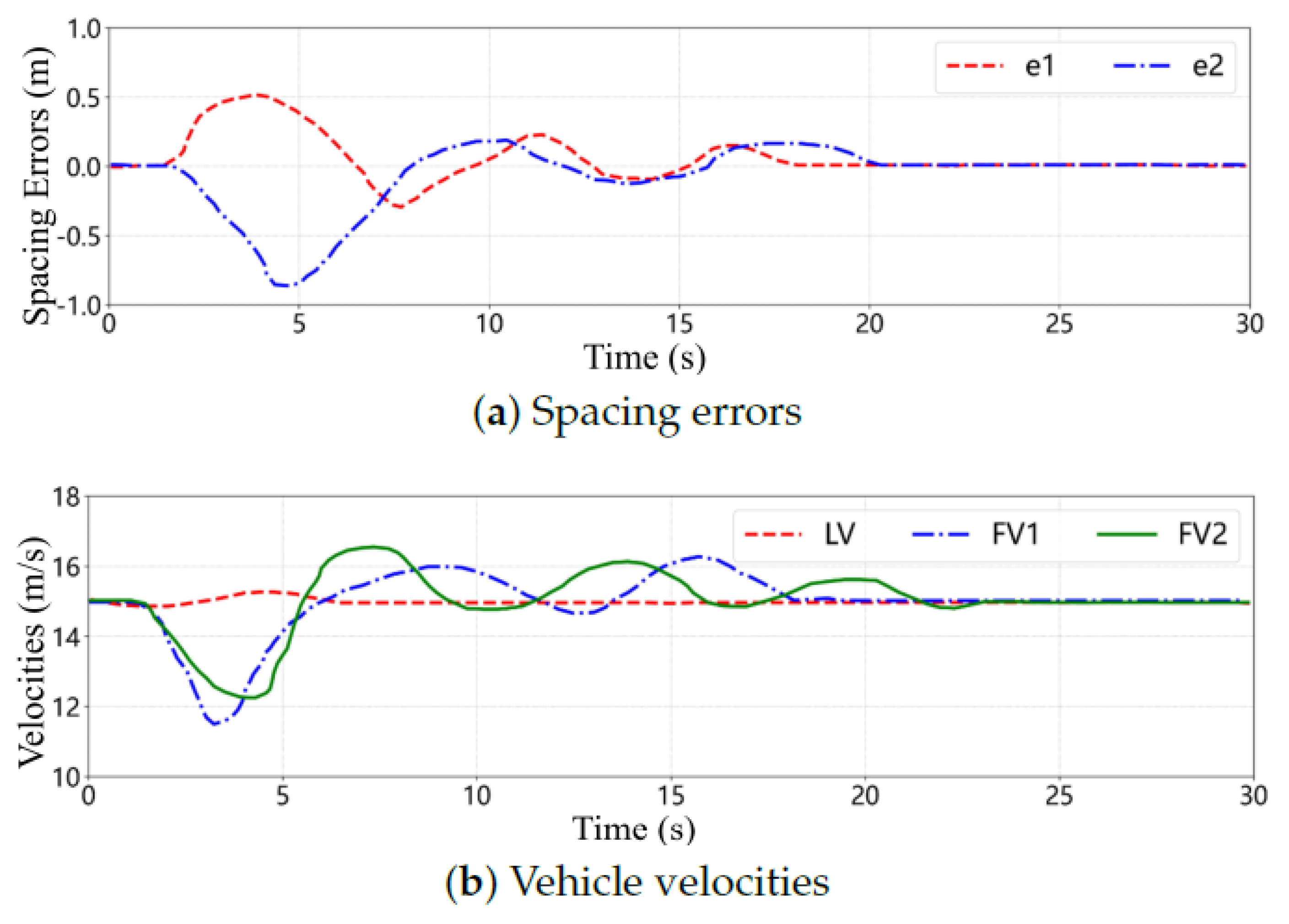
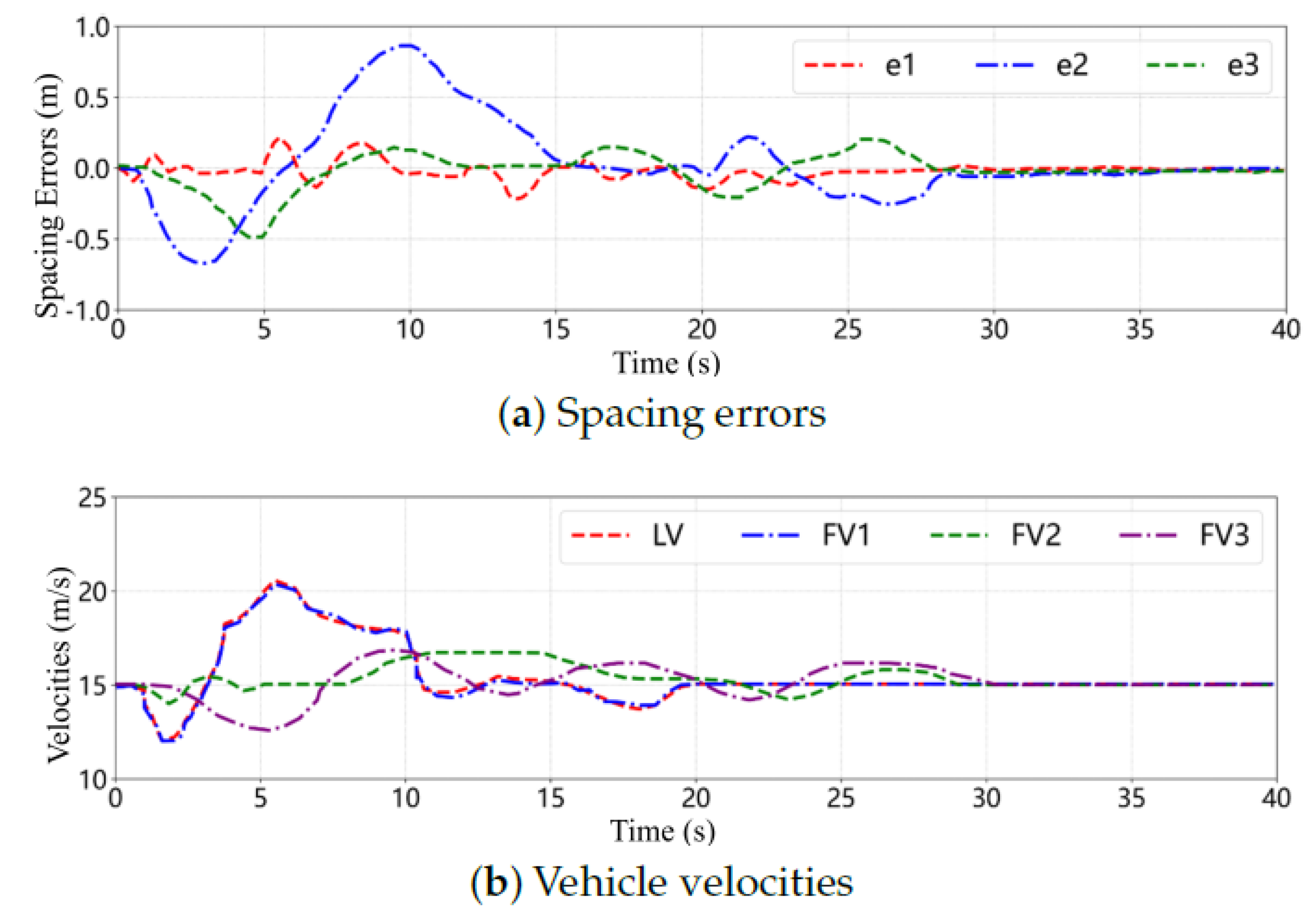
4.4.3. Simulation Validation of the Differential Game-Based Control Strategy
5. Risk Potential Field-Based MPC Lateral Controller
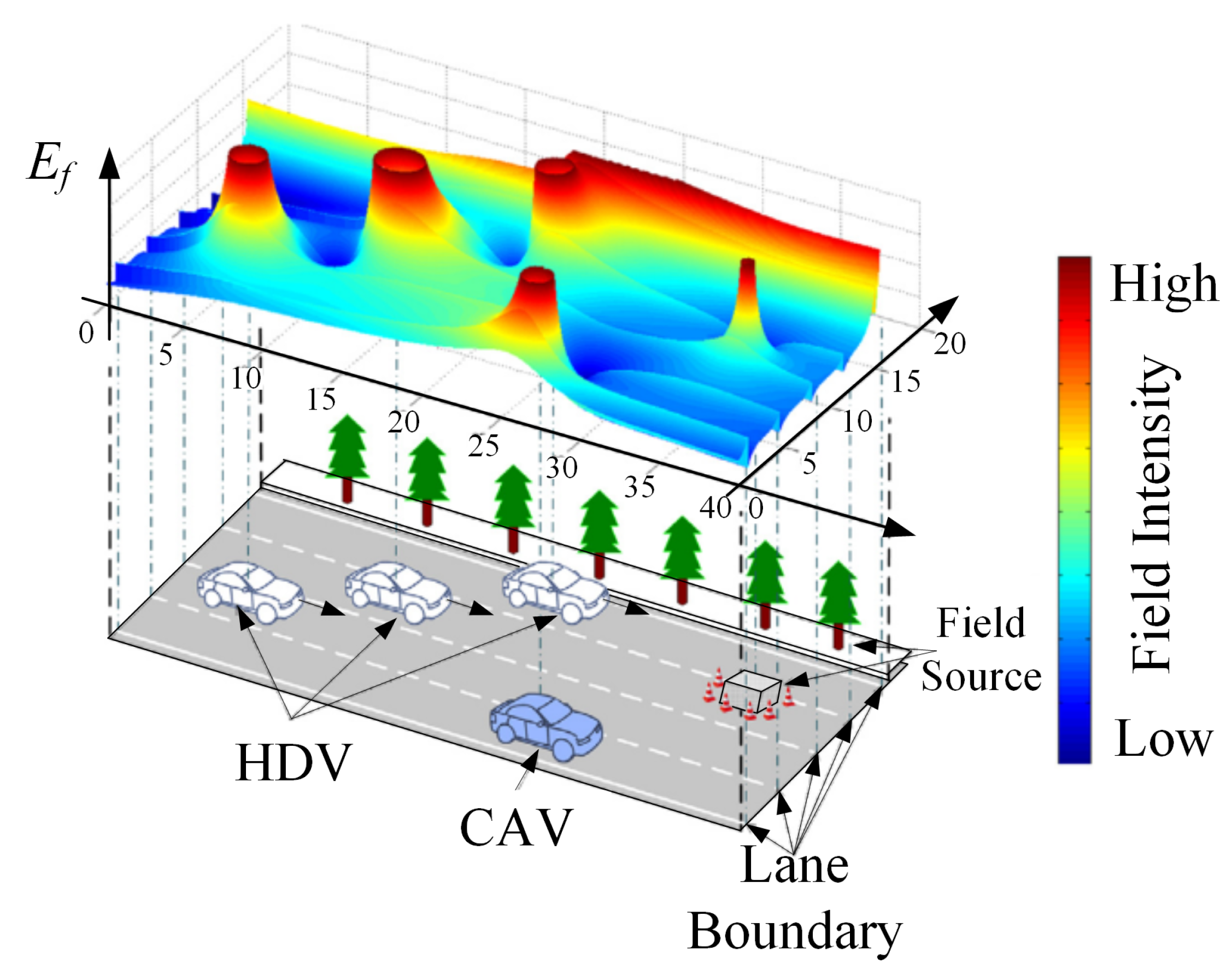
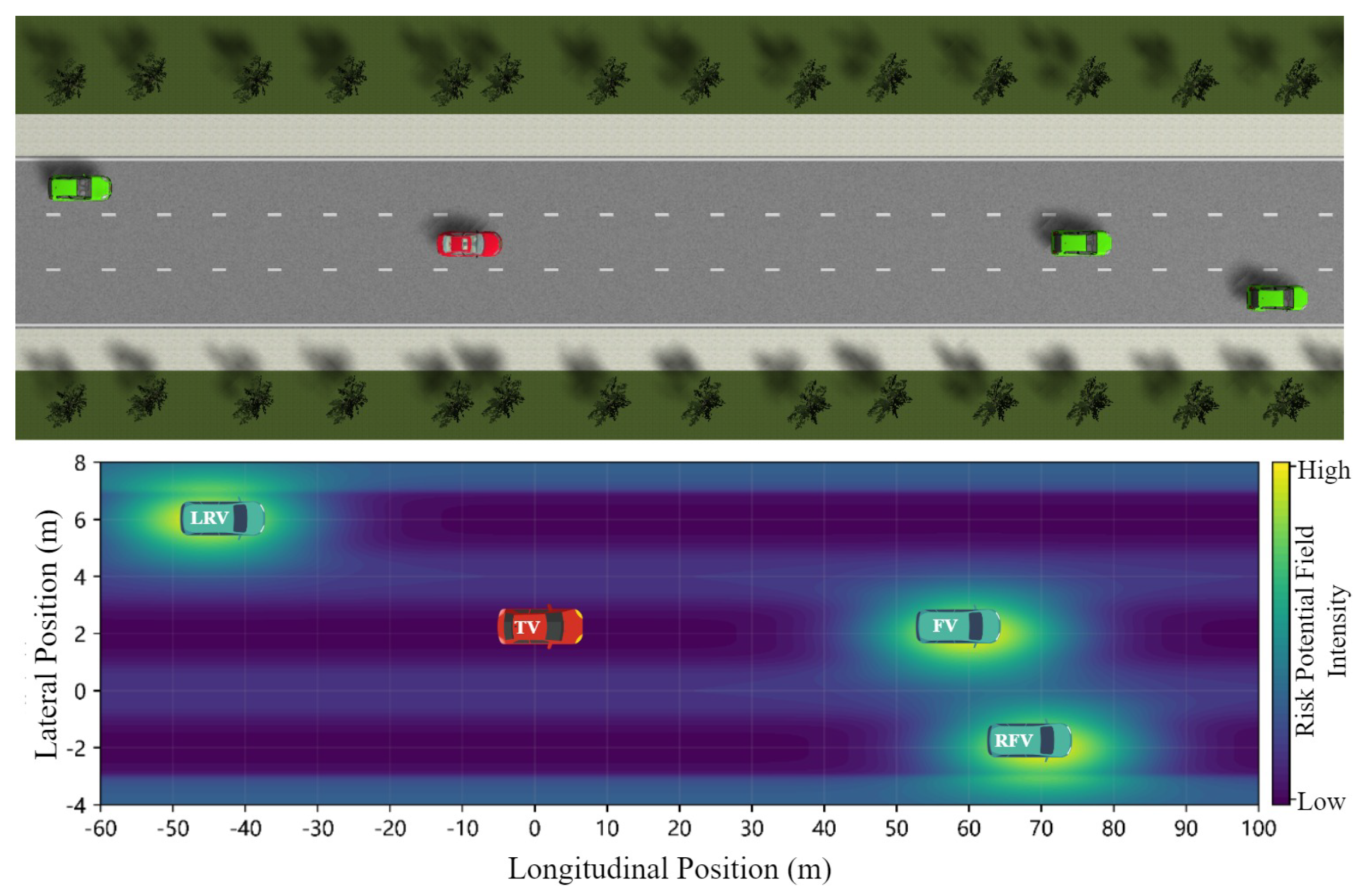
5.1. Risk Potential Field Modeling
5.2. Risk Potential Field-Based MPC Lateral Control Strategy for CAV Platoons
6. Co-Simulation Platform and Experimental Validation
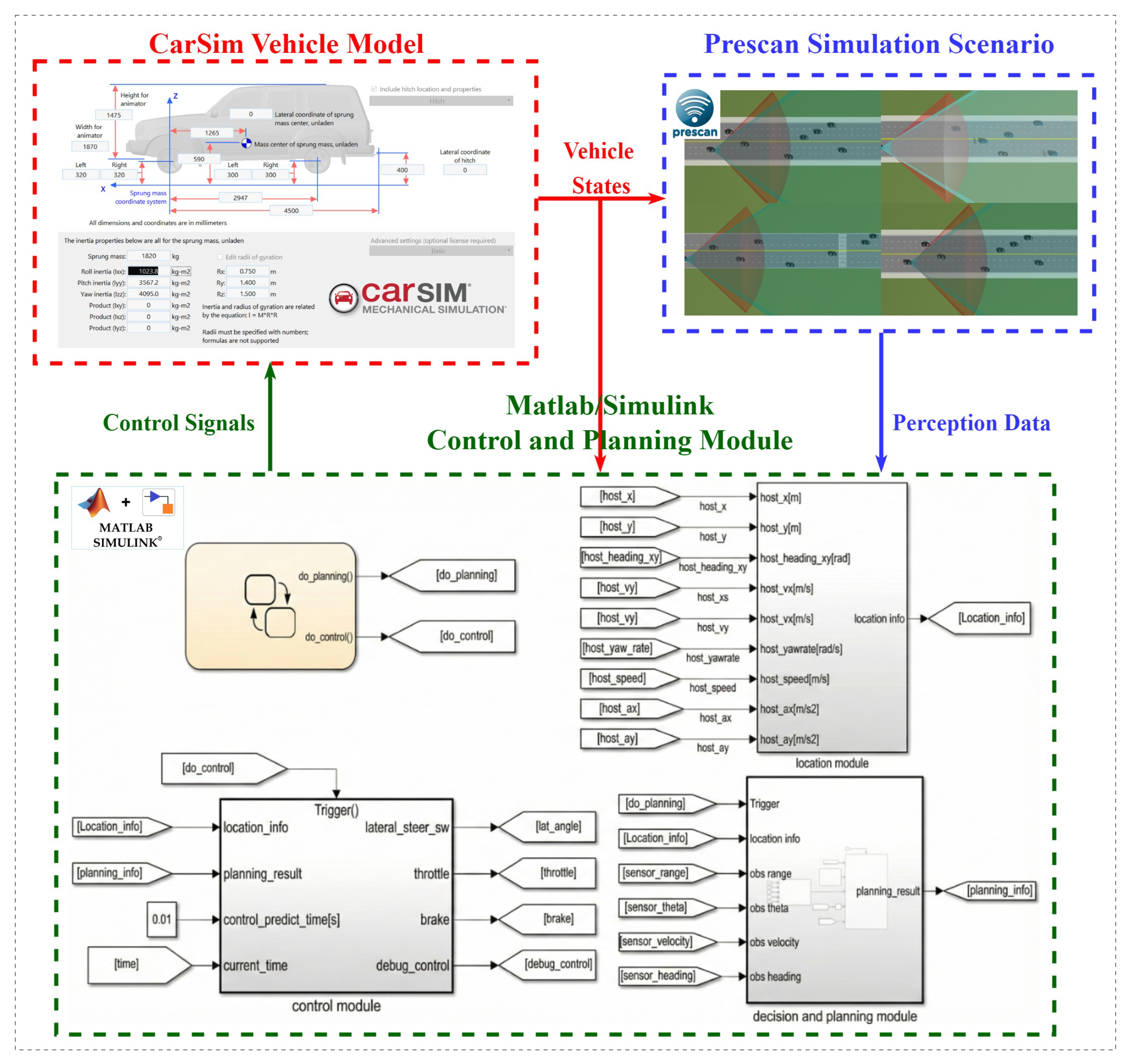
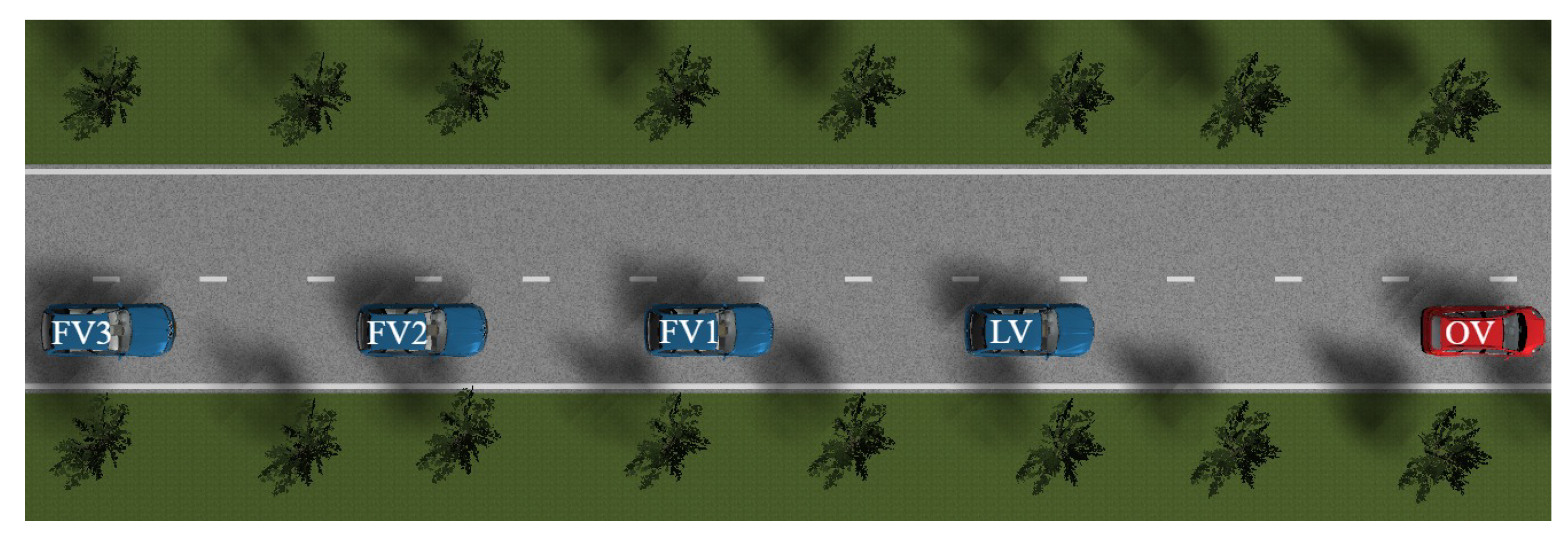
6.1. Co-Simulation Platform Architecture
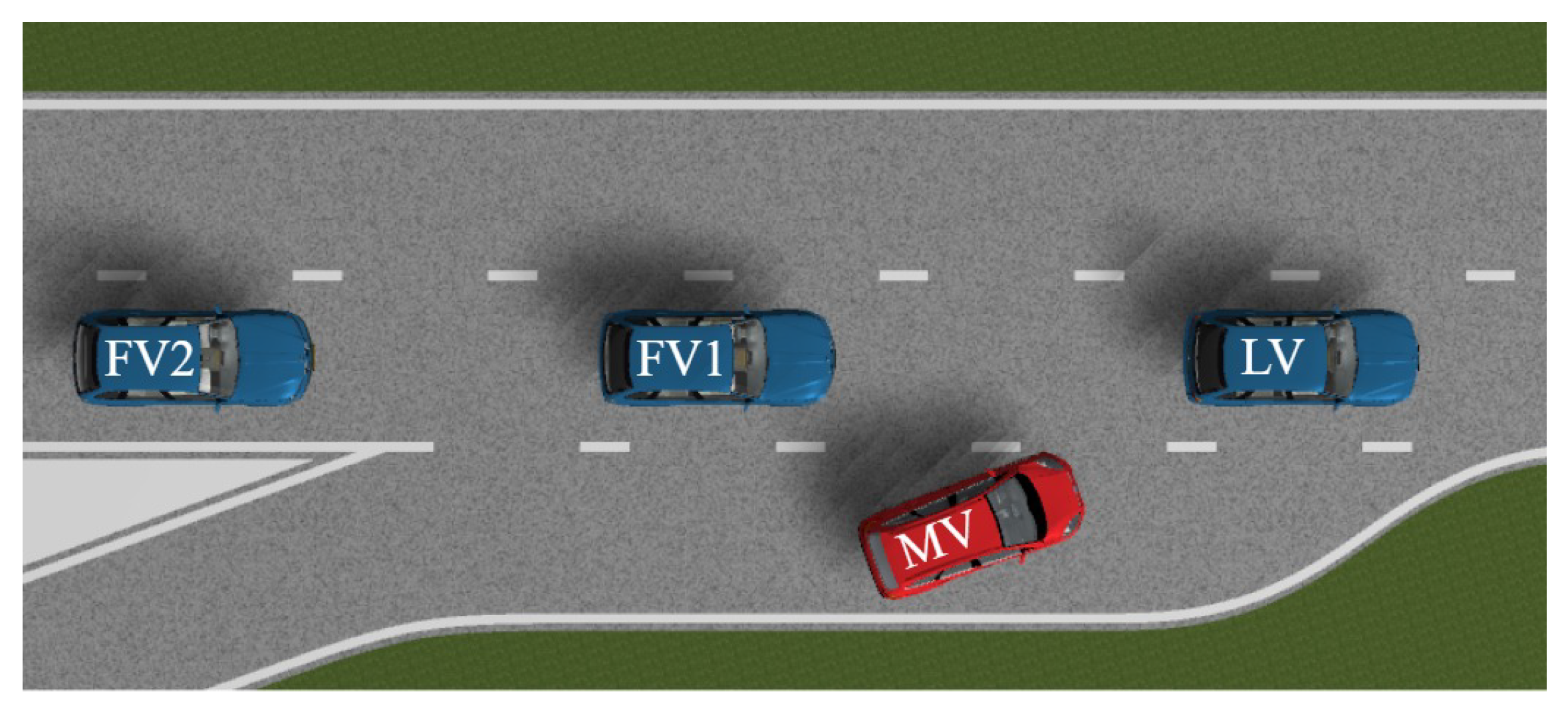
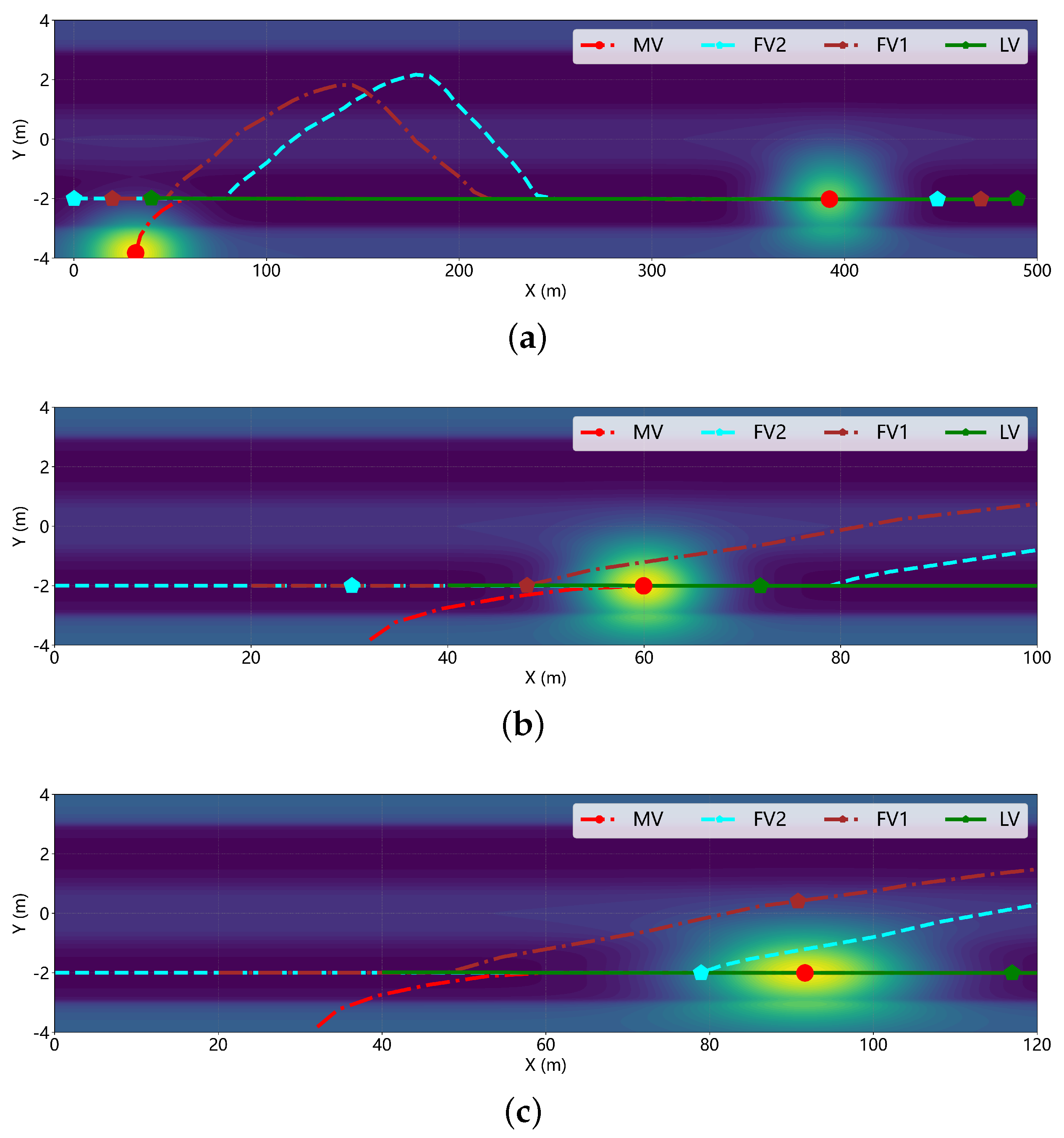
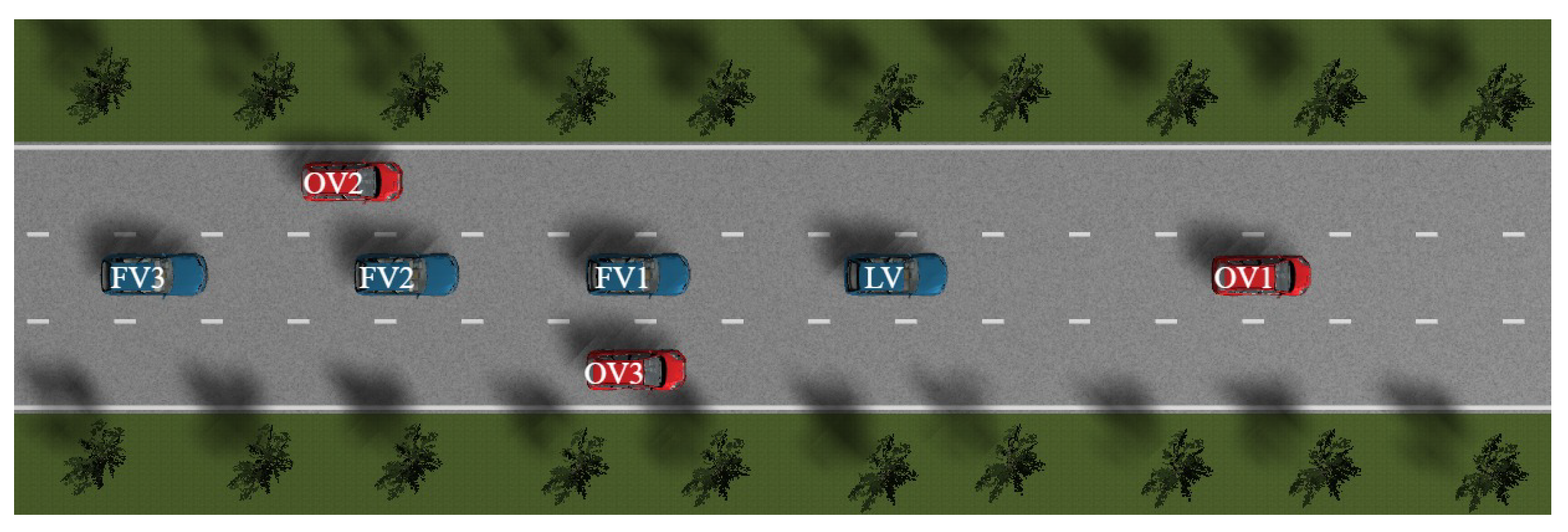
6.2. Ramp Merging Scenario
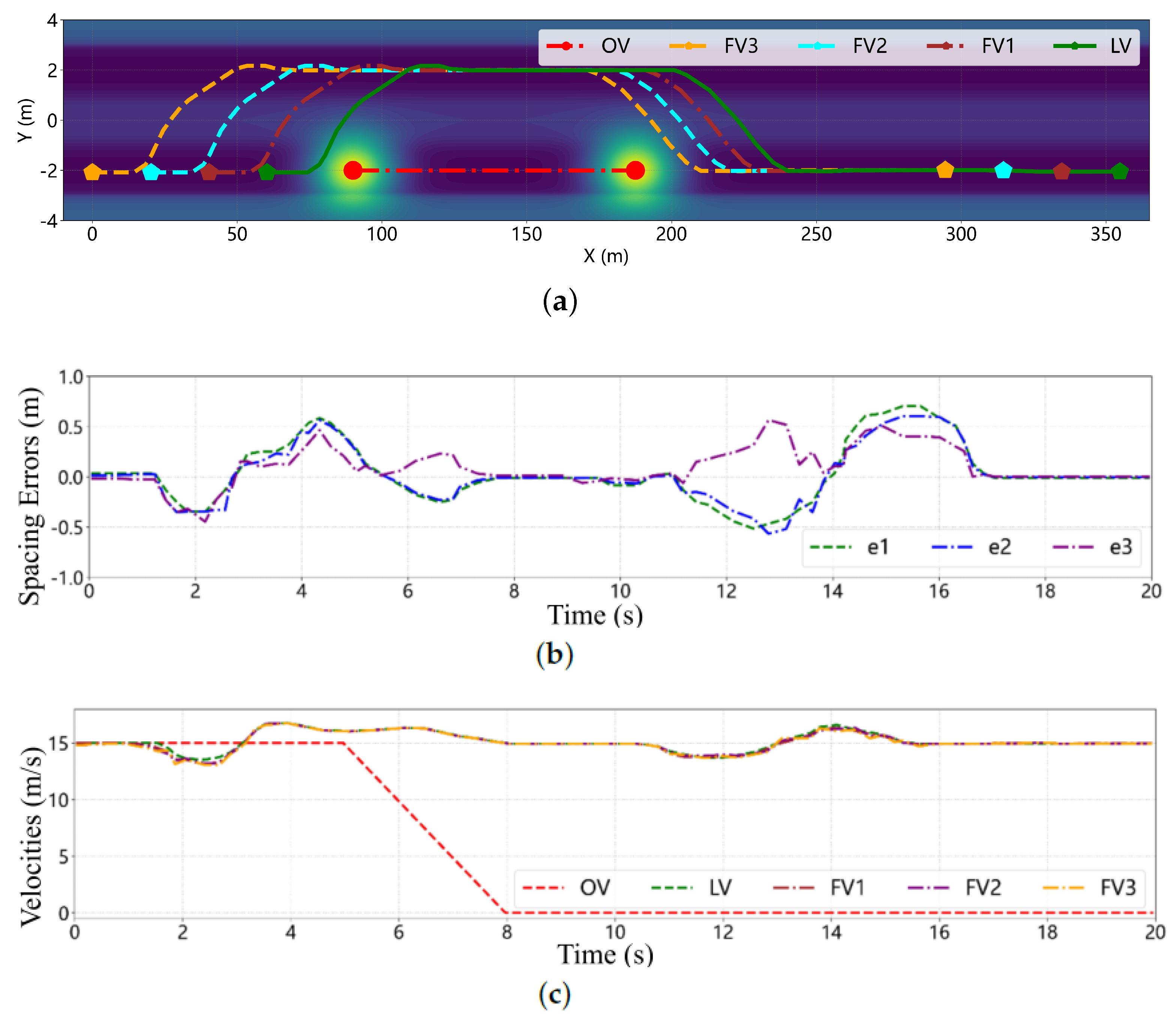
6.3. Emergency Braking Scenario of an Obstacle Vehicle
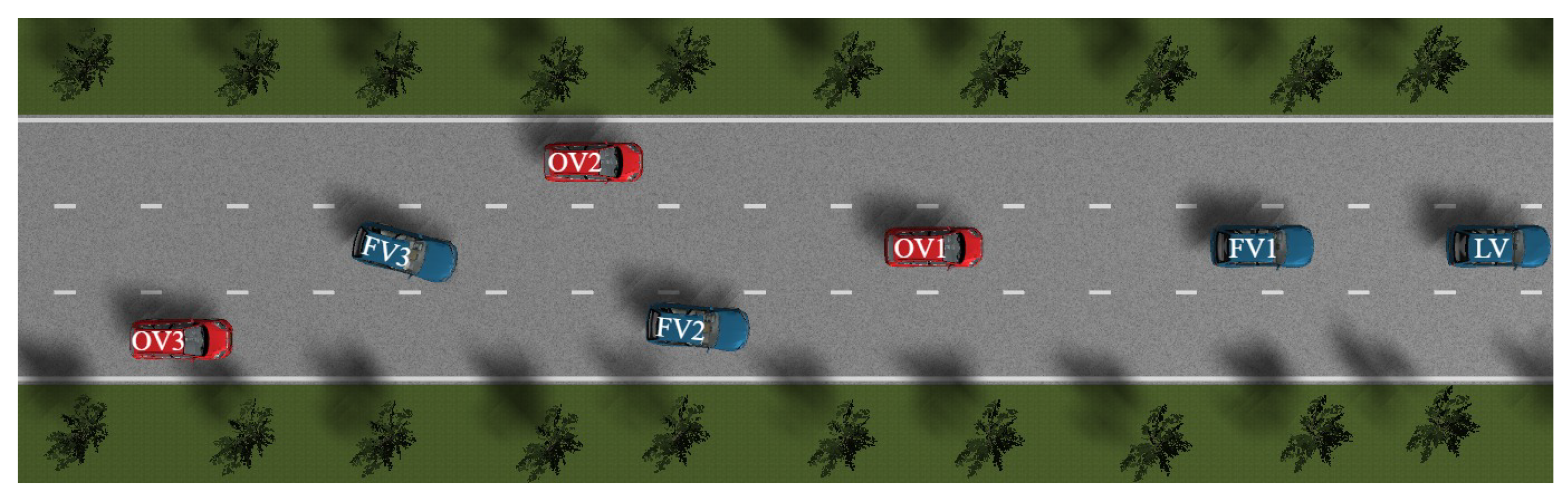
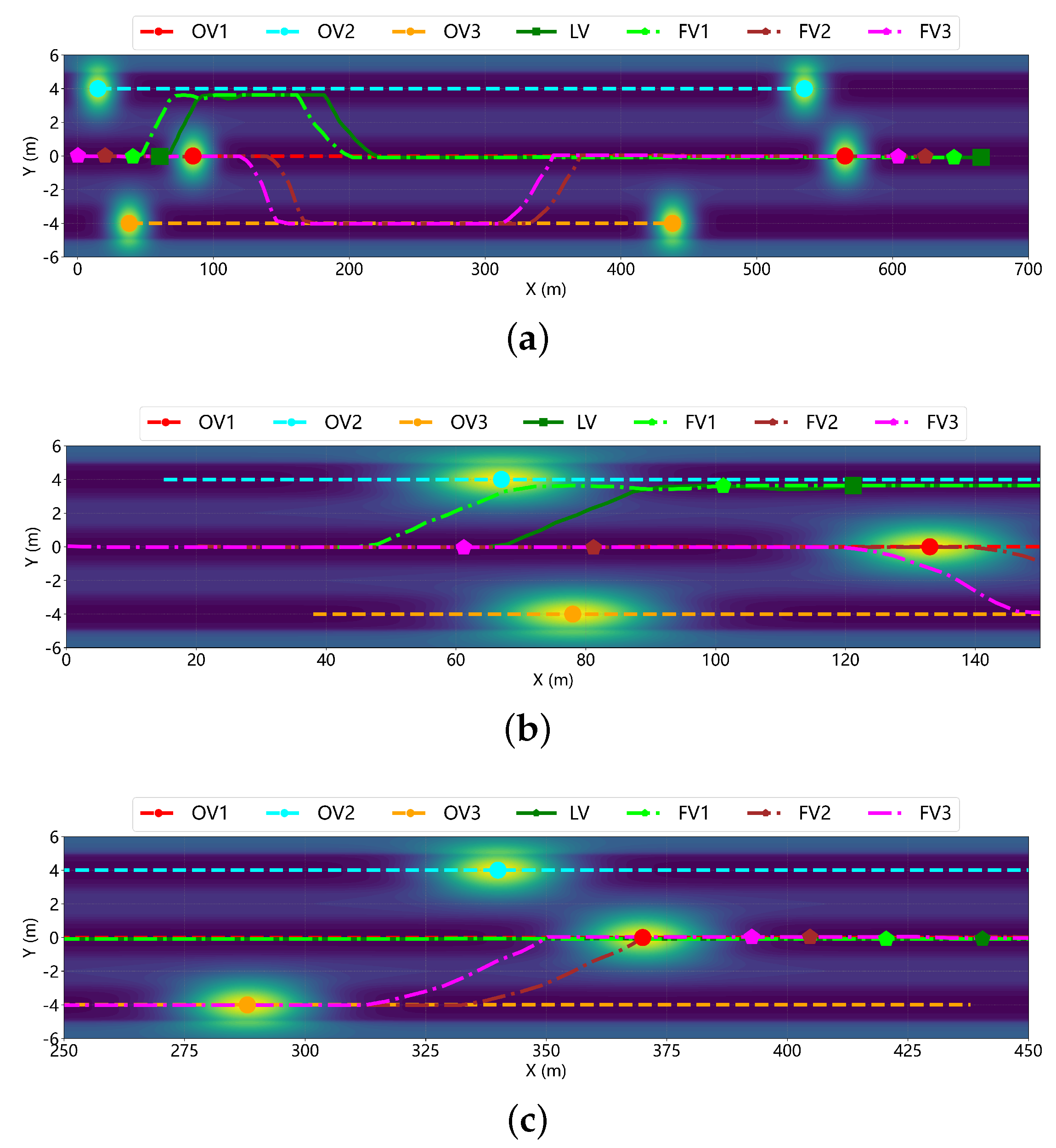
6.4. Multi-Lane Cooperative Obstacle Avoidance Scenario
7. Conclusions
Funding
Institutional Review Board Statement
Informed Consent Statement
Data Availability Statement
Conflicts of Interest
Appendix A. Proof of Theorem 1
Appendix B. Proof of Theorem 2
References
- Wang, K.; Shen, C.; Li, X.; Lu, J. Uncertainty quantification for safe and reliable autonomous vehicles: A review of methods and applications. IEEE Trans. Intell. Transp. Syst. 2025, 26, 2880–2896. [Google Scholar] [CrossRef] [Scilit]
- Garikapati, D.; Shetiya, S.S. Autonomous vehicles: Evolution of artificial intelligence and the current industry landscape. Big Data Cogn. Comput. 2024, 8, 42. [Google Scholar] [CrossRef] [Scilit]
- Pan, Y.; Wu, Y.; Xu, L.; Xia, C.; Olson, D.L. The impacts of connected autonomous vehicles on mixed traffic flow: A comprehensive review. Phys. A Stat. Mech. Its Appl. 2024, 635, 129454. [Google Scholar] [CrossRef] [Scilit]
- Chen, N.; Liu, X. Research on World Models for Connected Automated Driving: Advances, Challenges, and Outlook. Appl. Sci. 2025, 15, 8986. [Google Scholar] [CrossRef] [Scilit]
- Garg, M.; Bouroche, M. Longitudinal Car-Following Control of Connected Autonomous Vehicles in Realistic Scenarios: A Survey. IEEE Trans. Intell. Transp. Syst. 2025, 26, 18404–18433. [Google Scholar] [CrossRef] [Scilit]
- Li, H.; Meng, W.; Han, Z.; Zhang, Z.; Yang, Y. Vehicle platoon in road traffic: A Survey of Modeling, Communication, Controlling and Perspectives. Phys. A Stat. Mech. Its Appl. 2025, 674, 130757. [Google Scholar] [CrossRef] [Scilit]
- Song, L.; Li, J.; Wei, Z.; Yang, K.; Hashemi, E.; Wang, H. Longitudinal and lateral control methods from single vehicle to autonomous platoon. Green Energy Intell. Transp. 2023, 2, 100066. [Google Scholar] [CrossRef] [Scilit]
- Wang, H.; Peng, L.M.; Wei, Z.; Yang, K.; Jiang, L.; Hashemi, E.; Bai, X.X. A holistic robust motion control framework for autonomous platooning. IEEE Trans. Veh. Technol. 2023, 72, 15213–15226. [Google Scholar] [CrossRef] [Scilit]
- Hua, M.; Qi, X.; Chen, D.; Jiang, K.; Liu, Z.E.; Sun, H.; Zhou, Q.; Xu, H. Multi-agent reinforcement learning for connected and automated vehicles control: Recent advancements and future prospects. IEEE Trans. Autom. Sci. Eng. 2025, 22, 16266–16286. [Google Scholar] [CrossRef] [Scilit]
- Rebelo, M.; Rafael, S.; Bandeira, J.M. Vehicle platooning: A detailed literature review on environmental impacts and future research directions. Future Transp. 2024, 4, 591–607. [Google Scholar] [CrossRef] [Scilit]
- Braiteh, F.E.; Bassi, F.; Khatoun, R. Platooning in connected vehicles: A review of current solutions, standardization activities, cybersecurity, and research opportunities. IEEE Trans. Intell. Veh. 2024, 10, 3134–3155. [Google Scholar] [CrossRef] [Scilit]
- Wang, C.; Gong, S.; Zhou, A.; Li, T.; Peeta, S. Cooperative adaptive cruise control for connected autonomous vehicles by factoring communication-related constraints. Transp. Res. Part C Emerg. Technol. 2020, 113, 124–145. [Google Scholar] [CrossRef] [Scilit]
- Wang, S.T.; Zhuang, Y.L.; Zhu, W.X. Traffic flow bifurcation control of autonomous vehicles through a hybrid control strategy combining multi-step prediction and memory mechanism with PID. Commun. Nonlinear Sci. Numer. Simul. 2024, 137, 108136. [Google Scholar] [CrossRef] [Scilit]
- Mo, H.; Meng, Y.; Wang, F.Y.; Wu, D. Interval type-2 fuzzy hierarchical adaptive cruise following-control for intelligent vehicles. IEEE/CAA J. Autom. Sin. 2022, 9, 1658–1672. [Google Scholar] [CrossRef] [Scilit]
- Turri, V.; Besselink, B.; Johansson, K.H. Cooperative look-ahead control for fuel-efficient and safe heavy-duty vehicle platooning. IEEE Trans. Control Syst. Technol. 2016, 25, 12–28. [Google Scholar] [CrossRef] [Scilit]
- Wang, J.; Jiang, Z.; Pant, Y.V. Improving safety in mixed traffic: A learning-based model predictive control for autonomous and human-driven vehicle platooning. Knowl.-Based Syst. 2024, 293, 111673. [Google Scholar] [CrossRef] [Scilit]
- Qian, L.; Chen, J.; Zhao, F.; Chen, X.; Xuan, L. Research on Fast Stochastic Model Predictive Control-Based Eco-Driving Strategy for Connected Mixed Platoons. Automot. Eng. 2024, 46, 1587–1599. [Google Scholar]
- Yang, F.; Wang, H.; Pi, D.; Sun, X.; Wang, X. Research on collaborative adaptive cruise control based on MPC and improved spacing policy. Proc. Inst. Mech. Eng. Part D J. Automob. Eng. 2025, 239, 2603–2615. [Google Scholar] [CrossRef] [Scilit]
- Li, Y.; Zhou, F.; Huang, L.; Yu, S.; Shi, S. Longitudinal Control of Connected Vehicle Platoon based on Deep Reinforcement Learning. Control Decis. 2024, 39, 1879–1887. [Google Scholar]
- Min, H.; Yang, Y.; Wang, W.; Fang, Y.; Song, X. Deep deterministic policy gradient based cooperative platoon longitudinal control strategy. J. Chang. Univ. (Nat. Sci. Ed.) 2021, 41, 11. [Google Scholar]
- Chen, J.; Wu, X.; Lv, Z.; Xu, Z.; Wang, W. Collaborative control of vehicle platoon based on deep reinforcement learning. IEEE Trans. Veh. Technol. 2024, 73, 14399–14414. [Google Scholar] [CrossRef] [Scilit]
- Song, D.; Zhu, B.; Zhao, J.; Han, J.; Chen, Z. Personalized car-following control based on a hybrid of reinforcement learning and supervised learning. IEEE Trans. Intell. Transp. Syst. 2023, 24, 6014–6029. [Google Scholar] [CrossRef] [Scilit]
- Yue, X.; Shi, H.; Zhou, Y.; Li, Z. Hybrid car following control for CAVs: Integrating linear feedback and deep reinforcement learning to stabilize mixed traffic. Transp. Res. Part C Emerg. Technol. 2024, 167, 104773. [Google Scholar] [CrossRef] [Scilit]
- Shi, H.; Zhou, Y.; Wu, K.; Wang, X.; Lin, Y.; Ran, B. Connected automated vehicle cooperative control with a deep reinforcement learning approach in a mixed traffic environment. Transp. Res. Part C Emerg. Technol. 2021, 133, 103421. [Google Scholar] [CrossRef] [Scilit]
- Dafhalla, A.K.Y.; Elobaid, M.E.; Tayfour Ahmed, A.E.; Filali, A.; SidAhmed, N.M.O.; Attia, T.A.; Mohajir, B.A.I.; Altamimi, J.S.; Adam, T. Computer-Aided Efficient Routing and Reliable Protocol Optimization for Autonomous Vehicle Communication Networks. Computers 2025, 14, 13. [Google Scholar] [CrossRef] [Scilit]
- Tariq, U.; Ahanger, T.A. Enhancing Intelligent Transport Systems Through Decentralized Security Frameworks in Vehicle-to-Everything Networks. World Electr. Veh. J. 2025, 16, 24. [Google Scholar] [CrossRef] [Scilit]
- Ruan, T.; Chen, Y.; Li, X.; Wang, J.; Liu, Y.; Wang, H. Stability analysis and controller design of the Cooperative Adaptive Cruise Control platoon considering a rate-free time-varying communication delay and uncertainties. Transp. Res. Part C Emerg. Technol. 2025, 170, 104913. [Google Scholar] [CrossRef] [Scilit]
- Zakerimanesh, A.; Qiu, T.Z.; Tavakoli, M. Stability and intervehicle distance analysis of vehicular platoons: Highlighting the impact of bidirectional communication topologies. IEEE Trans. Control Syst. Technol. 2024, 32, 1124–1139. [Google Scholar] [CrossRef] [Scilit]
- Neto, A.A.; Mozelli, L.A. Robust longitudinal control for vehicular platoons using deep reinforcement learning. IEEE Trans. Intell. Transp. Syst. 2024, 25, 14401–14410. [Google Scholar] [CrossRef] [Scilit]
- Coppola, A.; Lui, D.G.; Petrillo, A.; Santini, S. Cooperative driving of heterogeneous uncertain nonlinear connected and autonomous vehicles via distributed switching robust PID-like control. Inf. Sci. 2023, 625, 277–298. [Google Scholar] [CrossRef] [Scilit]
- Wang, C.; Zhao, Y.; Li, L.; Qu, X.; Ran, B. Enhancing Vehicle Platoons in Connected and Automated Environments With an Improved Spectral Clustering-Based Pinning Control Strategy. IEEE Trans. Veh. Technol. 2025, 74, 8591–8607. [Google Scholar] [CrossRef] [Scilit]
- Wang, Y.; Xu, Z.; Wu, Y.; Jiang, C.; Zheng, Y.; Jiang, Y.; Yao, Z. A Bidirectional Distance Balancing Strategy for Connected Automated Vehicles Platoon in Mixed Traffic Flow. IEEE Internet Things J. 2025, 12, 36525–36535. [Google Scholar] [CrossRef] [Scilit]
- Guo, Y.; Sun, Q.; Pan, Q. Robust Tracking Control of Underactuated UAVs Based on Zero-Sum Differential Games. Drones 2025, 9, 477. [Google Scholar] [CrossRef] [Scilit]
- Wang, Z.; Wu, Z.; Hu, S.; Yuan, F.; Yang, J. Game-Aware MPC-DDP for Mixed Traffic: Safe, Efficient, and Comfortable Interactive Driving. World Electr. Veh. J. 2025, 16, 544. [Google Scholar] [CrossRef] [Scilit]
- Zhu, Y.; Li, Y.; Li, Z.; Li, Z.; Guo, G. Game-Theoretic Decision-Making for Autonomous Vehicles at Unsignalized Intersections under Communication Interferences: A Novel Risk-Adaptive Approach. IEEE Trans. Veh. Technol. 2025, 1–10. [Google Scholar] [CrossRef] [Scilit]
- Chen, M.; Li, B.; Zhang, S.; Zhang, H.; Zhuang, W.; Yin, G.; Chen, B. A Game-Theoretical Framework for Safe Decision Making and Control of Mixed Autonomy Vehicles. IEEE Trans. Intell. Transp. Syst. 2025, 27, 1338–1351. [Google Scholar] [CrossRef] [Scilit]
- Wang, T.; Xu, T.; Zhang, Y.; Chen, S.; Chen, J.; Ye, X. A Distributed Game-Based Traffic Control Model for Unsignalized Intersections in a Connected Vehicle Environment. Transp. Res. Rec. 2025. [Google Scholar] [CrossRef] [Scilit]
- Jond, H.B.; Platoš, J. Differential game-based optimal control of autonomous vehicle convoy. IEEE Trans. Intell. Transp. Syst. 2022, 24, 2903–2919. [Google Scholar] [CrossRef] [Scilit]
- Dong, H.; Shi, J.; Zhuang, W.; Li, Z.; Song, Z. Analyzing the impact of mixed vehicle platoon formations on vehicle energy and traffic efficiencies. Appl. Energy 2025, 377, 124448. [Google Scholar] [CrossRef] [Scilit]
- Ma, Y.; Zhu, J.; Lv, Z.; Zhang, Y. Multi-vehicle dynamic interaction in autonomous driving: Integrating game theory and the potential field method. Transp. B Transp. Dyn. 2025, 13, 2425969. [Google Scholar] [CrossRef] [Scilit]
- Jia, Y.; Qu, D.; Song, H.; Wang, T.; Zhao, Z. Car-following characteristics and model of connected autonomous vehicles based on safe potential field. Phys. A Stat. Mech. Its Appl. 2022, 586, 126502. [Google Scholar] [CrossRef] [Scilit]
- Wang, T.; Qu, D.; Wang, K.; Wei, C.; Li, A. Risk-Aware Lane Change and Trajectory Planning for Connected Autonomous Vehicles Based on a Potential Field Model. World Electr. Veh. J. 2024, 15, 489. [Google Scholar] [CrossRef] [Scilit]
- Chen, Y.; Qu, D.; Wang, T.; Cui, S.; Shao, D. Quantification Method of Driving Risks for Networked Autonomous Vehicles Based on Molecular Potential Fields. Appl. Sci. 2025, 15, 1306. [Google Scholar] [CrossRef] [Scilit]
- Wang, J.; Wu, J.; Zheng, X.; Ni, D.; Li, K. Driving safety field theory modeling and its application in pre-collision warning system. Transp. Res. Part C Emerg. Technol. 2016, 72, 306–324. [Google Scholar] [CrossRef] [Scilit]
- Zhang, Z.; Zhang, L.; Wang, C.; Wang, M.; Cao, D.; Wang, Z. Integrated decision making and motion control for autonomous emergency avoidance based on driving primitives transition. IEEE Trans. Veh. Technol. 2022, 72, 4207–4221. [Google Scholar] [CrossRef] [Scilit]
- Liang, J.; Li, Y.; Yin, G.; Xu, L.; Lu, Y.; Feng, J.; Shen, T.; Cai, G. A MAS-based hierarchical architecture for the cooperation control of connected and automated vehicles. IEEE Trans. Veh. Technol. 2022, 72, 1559–1573. [Google Scholar] [CrossRef] [Scilit]
- Cui, L.; Chakraborty, S.; Ozbay, K.; Jiang, Z.P. Data-Driven Combined Longitudinal and Lateral Control for the Car Following Problem. IEEE Trans. Control Syst. Technol. 2025, 33, 991–1005. [Google Scholar] [CrossRef] [Scilit]
- Bhatt, N.P.; Khajepour, A.; Hashemi, E. MPC-PF: Socially and spatially aware object trajectory prediction for autonomous driving systems using potential fields. IEEE Trans. Intell. Transp. Syst. 2023, 24, 5351–5361. [Google Scholar] [CrossRef] [Scilit]
- Rasekhipour, Y.; Fadakar, I.; Khajepour, A. Autonomous driving motion planning with obstacles prioritization using lexicographic optimization. Control Eng. Pract. 2018, 77, 235–246. [Google Scholar] [CrossRef] [Scilit]
- Seiler, P.; Pant, A.; Hedrick, K. Disturbance propagation in vehicle strings. IEEE Trans. Autom. Control 2004, 49, 1835–1842. [Google Scholar] [CrossRef] [Scilit]
- Yildiz, A.; Jond, H.B. Vehicle swarm platooning as differential game. In Proceedings of the 2021 20th International Conference on Advanced Robotics (ICAR), Ljubljana, Slovenia, 6–10 December 2021; IEEE: Piscataway, NJ, USA, 2021; pp. 885–890. [Google Scholar]





| Vehicle Type | PF Topology | TPF Topology |
|---|---|---|
| Leader v0 | ||
| Follower v1 | ||
| Follower v2 | ||
| Follower v3 | ||
| Follower v4 |
| Parameter Name | Symbol | Value |
|---|---|---|
| Vehicle Dynamics Parameters | ||
| Vehicle mass (kg) | m | 1500 |
| Yaw moment of inertia (kg·m2) | 2500 | |
| Distance from CG to front axle (m) | 1.2 | |
| Distance from CG to rear axle (m) | 1.6 | |
| Front tire cornering stiffness (N/rad) | −128,000 | |
| Rear tire cornering stiffness (N/rad) | −85,000 | |
| Vehicle length (m) | L | 4.5 |
| Powertrain time constant (s) | 0.65 | |
| Spacing Policy Parameters | ||
| Standstill spacing (m) | r | 5.0 |
| Time headway (s) | h | 1.2 |
| Risk Potential Field Parameters | ||
| Potential well depth | 1.0 | |
| Potential field steepness coefficient | 0.5 | |
| Minimum standstill spacing (m) | 2.0 | |
| CAV response time delay (s) | 0.1 | |
| Safety distance adjustment coefficient | 0.8 | |
| Maximum comfortable deceleration (m/s2) | 4.0 | |
| Lane line intensity gain | 50 | |
| Road boundary intensity gain | 200 | |
| Lane line attenuation coefficient | 0.8 | |
| Boundary attenuation coefficient | 0.5 | |
| Longitudinal correction coefficient | l | 2.0 |
| Lateral correction coefficient | w | 1.5 |
| Longitudinal velocity weighting factor | 0.1 | |
| Attenuation exponent | k | 2.0 |
| MPC Controller Parameters | ||
| Prediction horizon | 6 | |
| Control horizon | 3 | |
| Discretization time step (s) | T | 0.1 |
| State tracking weight | Q | diag(10, 1) |
| Control increment weight | R | 0.1 |
| Risk potential field weight | P | 5.0 |
| Slack variable weight | ||
| Constraint Parameters | ||
| Maximum longitudinal velocity (m/s) | 30 | |
| Minimum longitudinal velocity (m/s) | 0 | |
| Maximum steering angle (rad) | 0.5 | |
| Maximum steering rate (rad/s) | 0.3 | |
| Road adhesion coefficient | 0.85 | |
| Simulation Scenario Parameters | ||
| Desired cruising velocity (m/s) | 15 | |
| Initial inter-vehicle spacing (m) | 20 | |
| Lane width (m) | – | 3.75 |
Disclaimer/Publisher’s Note: The statements, opinions and data contained in all publications are solely those of the individual author(s) and contributor(s) and not of MDPI and/or the editor(s). MDPI and/or the editor(s) disclaim responsibility for any injury to people or property resulting from any ideas, methods, instructions or products referred to in the content. |
© 2026 by the author. Published by MDPI on behalf of the World Electric Vehicle Association. Licensee MDPI, Basel, Switzerland. This article is an open access article distributed under the terms and conditions of the Creative Commons Attribution (CC BY) license.
Share and Cite
Wang, T. Safety-Oriented Cooperative Control for Connected and Autonomous Vehicle Platoons Using Differential Game Theory and Risk Potential Field. World Electr. Veh. J. 2026, 17, 67. https://doi.org/10.3390/wevj17020067
Wang T. Safety-Oriented Cooperative Control for Connected and Autonomous Vehicle Platoons Using Differential Game Theory and Risk Potential Field. World Electric Vehicle Journal. 2026; 17(2):67. https://doi.org/10.3390/wevj17020067
Chicago/Turabian StyleWang, Tao. 2026. "Safety-Oriented Cooperative Control for Connected and Autonomous Vehicle Platoons Using Differential Game Theory and Risk Potential Field" World Electric Vehicle Journal 17, no. 2: 67. https://doi.org/10.3390/wevj17020067
APA StyleWang, T. (2026). Safety-Oriented Cooperative Control for Connected and Autonomous Vehicle Platoons Using Differential Game Theory and Risk Potential Field. World Electric Vehicle Journal, 17(2), 67. https://doi.org/10.3390/wevj17020067