From the Eye of the Storm to Epidemiological Footprints After the Floods: Viral, Vector-Borne, and One Health Risks Post-Hurricane Melissa in Jamaica


Abstract
1. Introduction
2. Methods and Analytical Approach
3. Results
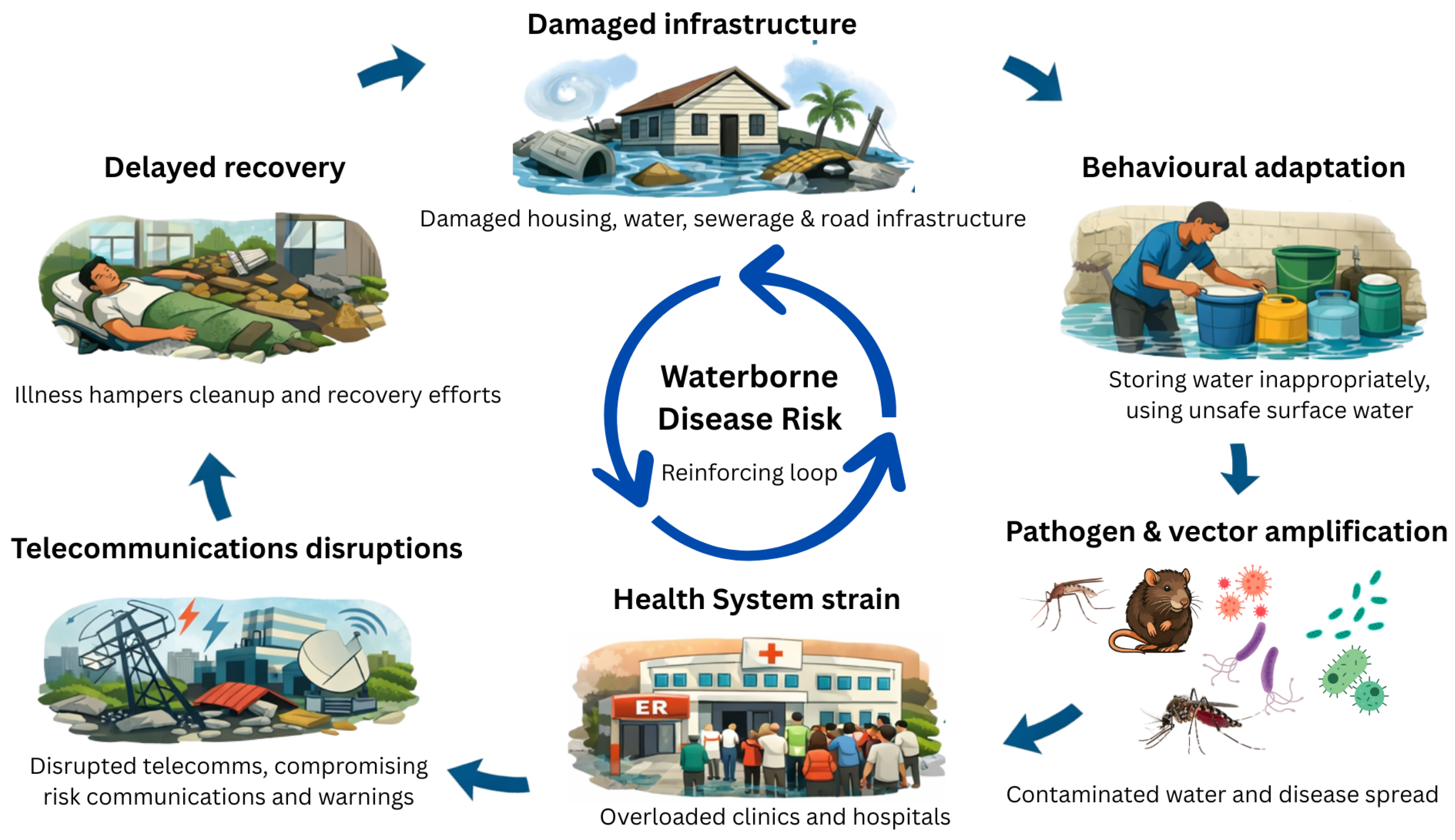
3.1. Water, Sanitation, Hygiene, and Gastrointestinal Disease Risks

| Biothreats | Human | Animal | Plant |
|---|---|---|---|
| Viral (vertebrate) | H5N1 avian influenza or ‘bird flu’ [45] | H5N1 avian influenza or ‘bird flu’ [45,46] | |
| Swine influenza (H1N1, H3N2) [47] | Newcastle disease virus (NDV) or paramyxovirus [46] | ||
| Porcine reproductive and respiratory virus (PRRSV) [47] | |||
| Swine influenza [47] | |||
| Aujeszky’s disease [48] | |||
| Parvovirus | |||
| Viral (waterborne) | Enterovirus, norovirus, and rotavirus [49] | ||
| Viral (rodent-borne) | Hantavirus [9] | Hantavirus [9] | |
| Arenavirus [9] | |||
| Viral (vaccine preventable) | Measles [50] | ||
| Influenza [51] | |||
| COVID-19 [52] | |||
| Viral (Vector-borne) | Dengue virus [53] | African swine fever [54] | Cucurbit yellow stunting disorder virus (CYSDV) [55] |
| Mayaro virus [56] and Zika virus [57] | Bluetongue virus [58] | Cacao yellow vein-banding badnavirus [55] | |
| Yellow fever virus [59] | Classic swine fever [48] | Tomato yellow leaf curl begomovirus [55] | |
| Chikungunya virus [60] | West Nile virus [61] | Sweet potato feathery mottle potyvirus [55] | |
| Oropouche virus and Melao virus [11] | Cacao mild mosaic badnavirus [55] | ||
| West Nile virus [62] | Cucurbit yellow stunting disorder virus (CYSDV) [55] | ||
| Citrus tristeza virus (CTV) [55] | |||
| Sweet potato chlorotic stunt closterovirus [55] | |||
| Papaya ringspot potyvirus [55] | |||
| Bacterial (vector-borne) | Leptospira spp. [32] | Ehrlichia ruminantium (heartwater) [63] | Citrus huanglongbing (HLB) [64] |
| Mycobacterium tuberculosis (TB) [65] | Enteric bacteria (Salmonella, Shigella, E. coli, Campylobacter, etc.) | ||
| Enteric bacteria (Salmonella, Shigella, E. coli, Campylobacter, etc.) | |||
| Clostridium perfringens [44] | |||
| Bacterial (water-borne) | Vibrio cholerae (cholera) [66] | ||
| Bacterial (wound) | Vibrio vulnificus [67] | ||
| Clostridium tetanae [68] | |||
| Streptococcus pyogenes [69] | |||
| Bacterial (vaccine preventable) | Corynebacterium diphtheriae (diphtheria) [70] | ||
| Fungal | Aspergillus niger, Penicillium spp., Trichoderma, and Paecilomyces [71] | Fusarium wilt Tropical Race 4 (TR4) [72] | |
| Histoplasma [73] | |||
| Candida auris [74] | |||
| Parasite | Malaria [75] | ||
| Angiostrongylus cantonensis (eosinophilic meningitis) [76] |
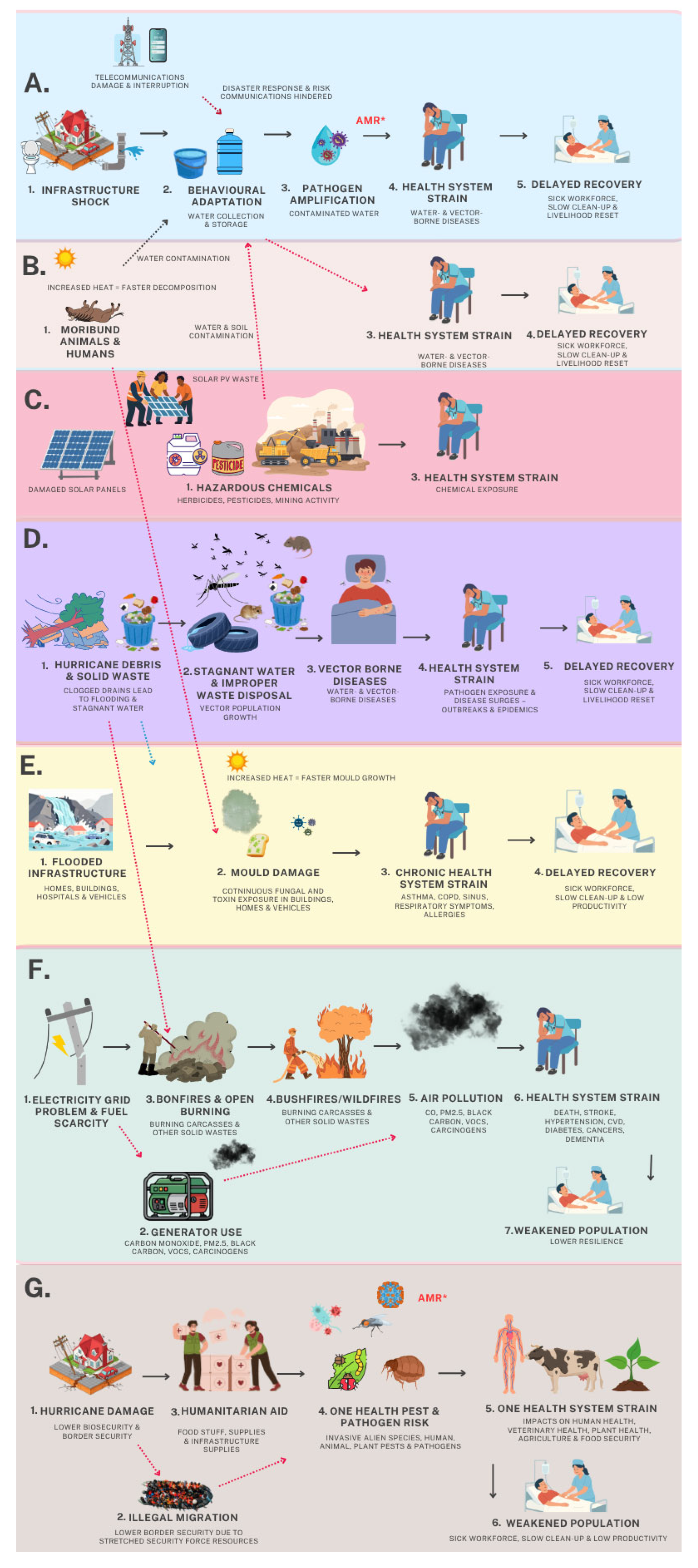
3.2. Vectors and Vector-Borne Diseases
3.3. Vector Control
3.4. Rodent-Borne Pathogens: Hantaviruses, Leptospires, and Arenaviruses
3.5. Agriculture, Antimicrobial Resistance, and Zoonoses
3.6. Environmental Toxic Chemical Exposure Risks
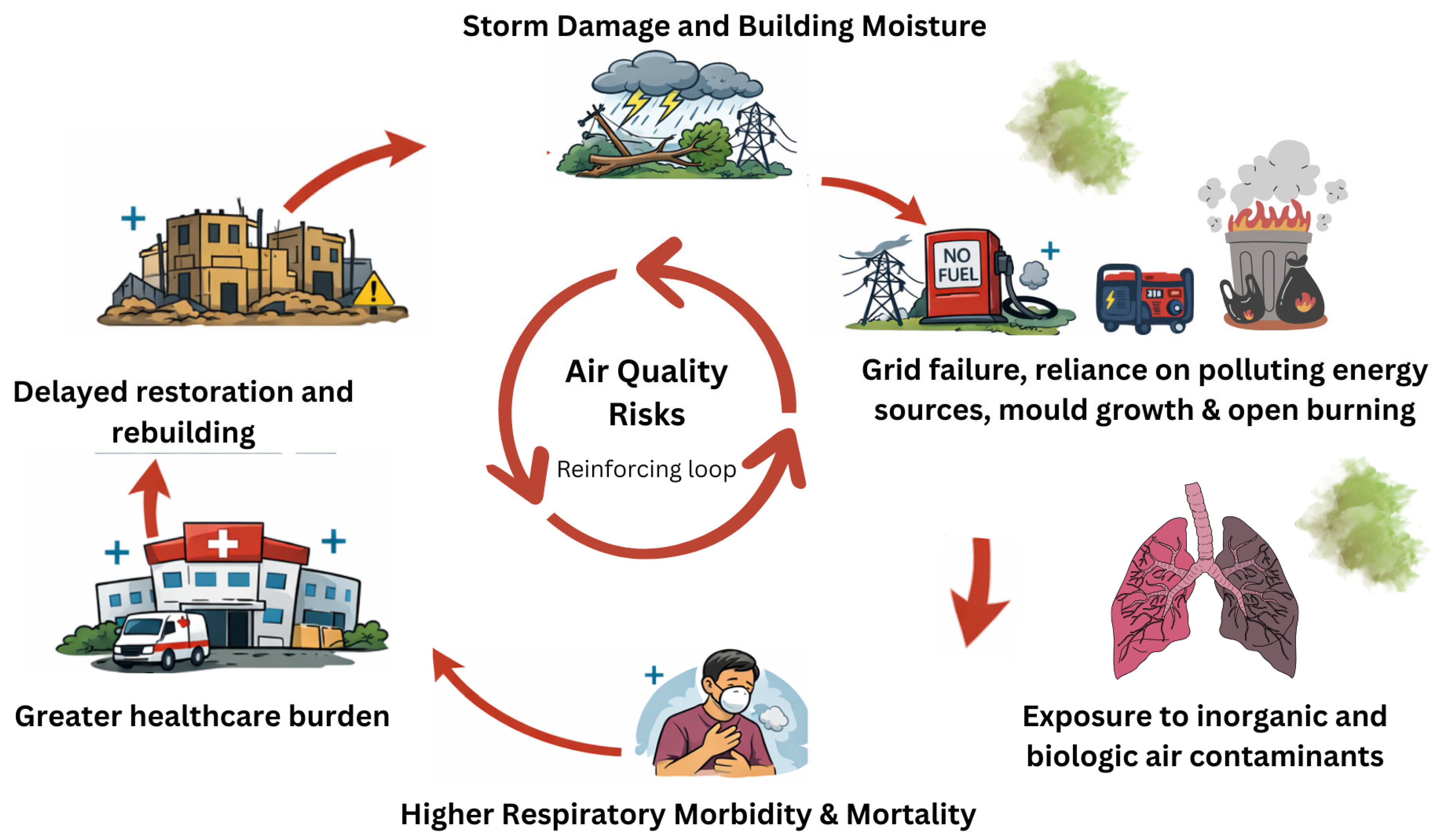
3.7. Invisible Hazards: Mould, Indoor Air Pollution and Open Burning
3.8. Temporary Porosity of Borders, Receipt of Foreign Aid Supplies and Irregular Migration
4. Comparative Lessons from Other Hurricane and Flood Settings
5. Conclusion: From Disaster to Design
6. Recommendations
Author Contributions
Funding
Institutional Review Board Statement
Informed Consent Statement
Data Availability Statement
Conflicts of Interest
Appendix A
- HUMAN HEALTH—WEEK-BY-WEEK PHASED TIMELINE
- A. Phase overview
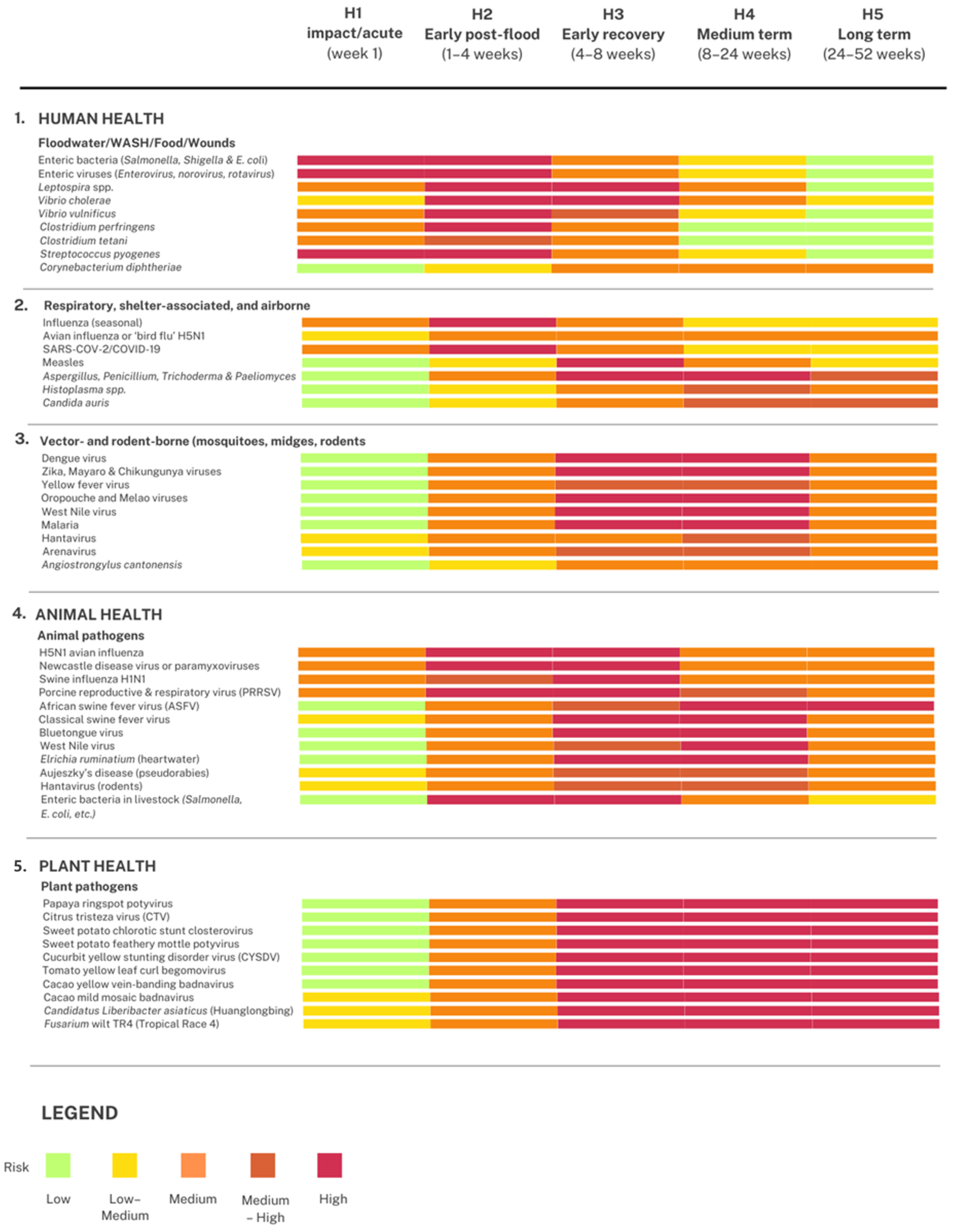
Phase Weeks Post-Landfall Key Environmental Drivers Main Human Risk Clusters (Examples) 1. Impact & acute flooding Week 1 Floodwaters, trauma, shelter crowding, and power loss Flood/WASH-borne and wound infections; acute respiratory clustering 2. Early post-flood Weeks 1–4 Standing water, debris, waste piles, and crowding in shelters Peak diarrhoeal + leptospirosis; early vector and rodent population amplification; intense mould growth; respiratory spread in shelters 3. Early recovery Weeks 4–8 Partial drainage, ongoing displacement, rubbish piles, and temporary housing Vector-borne outbreaks; rodent-related risks; expanding mould burden; healthcare-associated fungal/AMR risks 4. Medium term Weeks 8–24 Rebuilding, informal settlements, compromised housing, and disrupted chronic care Sustained arboviral cycles; TB treatment interruption; vaccine-preventable outbreaks; chronic mould and air-quality problems 5. Long term Weeks 24–52 Persisting structural vulnerabilities and recurring climate extremes Entrenched respiratory and NCD impacts; TB; AMR; chronic One Health vulnerabilities - B. Human pathogens mapped to phases
- Floodwater/WASH/food- and wound-borne
Pathogen/Group Week 1 1–4 Weeks 4–8 Weeks 8–24 Weeks 24–52 Weeks Notes (Drivers) Enteric bacteria (Salmonella, Shigella, E. coli, Campylobacter, Clostridium difficile) H H M L–M L Pit latrine overflow; sewage contamination of water; unsafe food preparation; disrupted refrigeration; compromised handwashing and hygiene Enteric viruses—enterovirus, norovirus, and rotavirus [17] H H M L–M L Highly infectious; spread in shelters, schools, and crowded homes; water and person-to-person Leptospira spp. [33] M H H M L–M (rainy periods) Rodent urine in floodwaters; highest when people wade/work in water during clean-up (1–6 weeks) Vibrio cholerae [37] L–M (context dependent) H (if introduced) H M L–M Saline/brackish floodwater + WASH breakdown; explosive outbreaks if seeded Vibrio vulnificus [38] M M–H M L–M L Brackish/coastal flooding; wound and seafood exposure Clostridium perfringens [14] M H M L L Inadequately cooked/stored food; bulk feeding; power loss Clostridium tetani [39] M M–H (in under-immunised) M L L Wounds from debris, metal, and soil; risk shaped by tetanus coverage Streptococcus pyogenes [40] H H M L–M L Skin/soft tissue infections in wounds; additional pharyngitis in crowded shelters Corynebacterium diphtheriae [41] L L–M M H (with immunity gaps) M Outbreak risk in low-coverage pockets; person-to-person in shelters and schools Angiostrongylus cantonensis [47] L L–M M M M Related to rat–gastropod cycles and food hygiene; may emerge when foraging/crop patterns change - Respiratory, shelter-associated, and airborne
Pathogen/Group Week 1 1–4 Weeks 4–8 Weeks 8–24 Weeks 24–52 Weeks Notes Influenza (seasonal) M H (crowded shelters) M L–M (seasonal) L–M Indoor crowding; poor ventilation H5N1 “bird flu” [15] L–M M M M M Risk if infected birds present; exposure during carcass disposal, live birds, and markets COVID-19 M H M L–M L–M Aerosol transmission in shelters, camps, and clinics; may surge with mixing Measles [19] L L–M M H (if immunity gaps) M Highly transmissible; appears weeks–months later if coverage poor Mycobacterium tuberculosis [36] L–M L–M M H H Treatment interruptions, overcrowding, and under-nutrition; medium–long term Aspergillus, Penicillium, Trichoderma, and Paecilomyces [42] L M H H M–H Mould proliferation in damp buildings; immunosuppressed at greatest risk Histoplasma [44] L L–M M M–H M Disturbed bat/bird droppings during demolition/clean-up Candida auris [45] L L–M M M–H M–H Healthcare associated; emerges with ICU crowding, broad-spectrum antibiotics, and poor IPC - Vector- and rodent-borne (mosquitoes, midges, rodents)
| Pathogen | Week 1 | 1–4 Weeks | 4–8 Weeks | 8–24 Weeks | 24–52 Weeks | Notes |
| Dengue virus [21] | L | M | H | H | M | Aedes breeding surge in containers, debris, and blocked drains |
| Zika virus [24], Mayaro virus [23], and Chikungunya virus [28] | L | M | H | H | M | Similar to Aedes/daytime-biting dynamics; transplacental risks for Zika |
| Yellow fever virus [26] | L | M | M–H (if present) | M–H | M | Depends on local ecology/immunisation; sylvatic and urban cycles |
| Oropouche & Melao viruses [29] | L | M | H | H | M | Culicoides midges/mosquitoes; thrive in damp organic-rich habitats |
| West Nile virus [30] | L | M | H | H | M | Culex mosquitoes; bird–mosquito cycles; wetlands and standing water |
| Malaria [46] | L | M | H (if vectors present) | H | M | Anopheles breeding in new water bodies; depends on local endemicity/importation |
| Hantavirus [18] | L–M | M | M–H | M–H | M | Rodent displacement, causes nesting in new structures; aerosolised excreta |
| Arenavirus [18] | L–M | M | M | M–H | M | Rodent hosts; more structural medium-term risk |
| Angiostrongylus cantonensis [47] | L | L–M | M | M | M | Related to rat–gastropod cycles and food hygiene; may emerge when foraging/crop patterns change |
- C. Animal pathogens
- Phases (animals)
Phase Weeks Drivers A1. Impact & acute 1 Trauma, carcasses, stress, mixing, and disruption of biosecurity A2. Early post-flood 1–4 Carcass disposal, contaminated feed/water, vector habitat, and pig and poultry crowding A3. Early recovery 4–8 Restocking, informal movements, and rebuilding; stable vector amplification A4. Medium term 8–24 Changed landscapes, new stocking densities, and ongoing vector/rodent pressures A5. Long term 24–52 Entrenched endemicity; trade and movement patterns - Animal Pathogens
Pathogen/Group Week 1 1–4 Weeks 4–8 Weeks 8–24 Weeks 24–52 Weeks Notes H5N1 avian influenza [15,16] M H H M M Stress, mixing, and wild bird contact; carcass disposal and wet markets Newcastle disease virus (NDV)/paramyxovirus [16] M H H M M Similar drivers as H5N1; lapses in vaccination/biosecurity Swine influenza [28] M M–H H M M Pig crowding, mixing, and transport; aerosols in barns Porcine reproductive and respiratory syndrome virus (PRRSV) [28] M H H M–H M Highly biosecurity sensitive; stress and stocking changes African swine fever [23] L M M–H (if introduced) H H Introduced via pigs/pork; persists in environment and products Classical swine fever [26] L–M M H H M Similar to ASF but vaccine preventable where programmes exist Bluetongue virus [21] L M H H M Culicoides vectors; wetlands and damp soil; affects ruminants Ehrlichia ruminantium (heartwater) [34] L M M–H H M Tick-borne; altered grazing and wildlife–livestock interface West Nile virus [30] L M H H M Equids and birds; vector dynamics as in humans Aujeszky’s disease (pseudorabies) [26] L–M M M–H M–H M Swine stress, movements, and inter-farm contacts Hantavirus (rodent) [19] L–M M M–H M–H M Rodent population shifts; flood-related rodent displacement Enteric bacteria in livestock (Salmonella, E. coli, etc.) M H H M L–M Contaminated feed/water, stress, manure handling, and slaughter disruptions
- D. PLANT HEALTH TIMELINE
- Mechanical damage and loss of canopy.
- Vector dynamics (aphids, whiteflies, leafhoppers, mealybugs).
- Replanting and planting material quality.
- Soil pathogen spread and altered waterlogging.
- Plant pathogens
| Pathogen/Group | 0–2 Weeks | 2–8 Weeks | 8–24 Weeks | 24–52 Weeks | Notes |
| Papaya ringspot potyvirus [17] | L | M | H | H | Aphid-transmitted; new papaya plantings and flush growth vulnerable |
| Citrus tristeza virus (CTV) [17] | L | M | H | H | Aphid-vectored; damaged citrus groves stressed and re-grafted |
| Sweet potato chlorotic stunt closterovirus [17] | L | M | H | H | Whitefly-borne; spread in replanted vines |
| Sweet potato feathery mottle potyvirus [17] | L | M | H | H | Seed/vegetative material and vector contribution |
| Cucurbit yellow stunting disorder virus (CYSDV) [17] | L | M | H | H | Whitefly-transmitted; cucurbit replanting after storm |
| Tomato yellow leaf curl begomovirus [17] | L | M | H | H | Whiteflies in tomato production; major threat after re-establishment |
| Cacao yellow vein-banding badnavirus [17] | L–M | M | H | H | Chronic; storm damage may change vector/host interface |
| Cacao mild mosaic badnavirus [17] | L–M | M | H | H | As above; long-term canopy recovery phase |
| Candidatus Liberibacter asiaticus (Huanglongbing/citrus greening) [35] | L–M | M | H | H | Psyllid-vectored; long-term chronic; storm may accelerate spread via movement of planting material and grafting |
| Fusarium wilt TR4 (Tropical Race 4) [43] | L–M | M | H | H | Soil-borne; spread via floodwaters, contaminated tools and planting material; becomes apparent over months–years |
| Footnote: H = high relative concern or operational priority; M = moderate relative concern or operational priority; L = low relative concern or operational priority; L–M = low to moderate relative concern; M–H = moderate to high relative concern. Ratings are qualitative and phase-specific. They reflect expected post-hurricane conditions, pathogen ecology, exposure pathways, incubation periods, vector/rodent dynamics, shelter crowding, WASH disruption, and health system vulnerability. They are not measured as Jamaica-specific incidence rates or statistical risk estimates. | |||||
References
- Kelman, I. Islandness within climate change narratives of small island developing states (SIDS). Isl. Stud. J. 2018, 13, 149–166. [Google Scholar] [CrossRef]
- Loukas, A.; Garrote, L.; Vasiliades, L. Hydrological and hydro-meteorological extremes and related risk and uncertainty. Water 2021, 13, 377. [Google Scholar] [CrossRef]
- Taylor, M.A.; Clarke, L.A.; Centella, A.; Bezanilla, A.; Stephenson, T.S.; Jones, J.J.; Campbell, J.D.; Vichot, A.; Charlery, J. Future Caribbean climates in a world of rising temperatures: The 1.5 vs 2.0 dilemma. J. Clim. 2018, 31, 2907–2926. [Google Scholar] [CrossRef]
- Center, N.H. Hurricane Melissa Tropical Cyclone Public Advisory [Update 1700 UTC] Internet. 2025. Available online: https://www.nhc.noaa.gov/archive/2025/al13/al132025.update.10281700.shtml (accessed on 5 February 2026).
- World Bank; IDB. Estimate Hurricane Melissa Damage to Jamaica Totals All-Time-High of US$8.8 Billion; World Bank Group: Washington, DC, USA, 2025. [Google Scholar]
- Cashman, A.; Nurse, L.; John, C. Climate change in the Caribbean: The water management implications. J. Environ. Dev. 2010, 19, 42–67. [Google Scholar] [CrossRef]
- Ordoñez-Betancourth, J.E.; Sanchez-Tinjacá, Y.V.V.; Abrahams, S.I.V.; Duque, S.C.; González, C.; Sarmiento, J.H.; Niño-Machado, N.; Pinilla-Roncancio, M.; González-Uribe, C. Information systems for enhancing multisectoral and multilevel preparedness and response to climate-sensitive infectious diseases in Latin America and the Caribbean: A scoping review. BMJ Public Health 2025, 3, e002428. [Google Scholar] [CrossRef]
- Douglas, K.O.; Gittens-St Hilaire, M. First clinical reports of acute hantavirus and dengue infections among pregnant women in the Caribbean. Infect. Dis. 2024, 56, 564–574. [Google Scholar] [CrossRef]
- Douglas, K.O.; Cayol, C.; Forbes, K.M.; Samuels, T.A.; Vapalahti, O.; Sironen, T.; Hilaire, M.G.-S. Serological evidence of multiple zoonotic viral infections among wild rodents in Barbados. Pathogens 2021, 10, 663. [Google Scholar] [CrossRef]
- Douglas, K.O.; Payne, K.; Sabino-Santos, G.; Chami, P.; Lorde, T. The Impact of Climate on Human Dengue Infections in the Caribbean. Pathogens 2024, 13, 756. [Google Scholar] [CrossRef] [PubMed]
- Douglas, K.O. The silent invaders: Oropouche and Melao viruses, causes of increased public health risks for the Americas. Infect. Dis. 2024, 56, 1009–1014. [Google Scholar] [CrossRef]
- Caballero, N.; González-Teshima, L.Y.; Arias-Amaya, J.S.; Castaño-Duque, S.; González-Uribe, C.; González, C.; Sarmiento, J.H.; Niño-Machado, N.; Pinilla-Roncancio, M. The economics of climate-sensitive infectious diseases affecting human health in Latin America and the Caribbean: A scoping review. BMJ Glob. Health 2025, 10, e018302. [Google Scholar] [CrossRef] [PubMed]
- Erickson, T.B.; Brooks, J.; Nilles, E.J.; Pham, P.N.; Vinck, P. Environmental health effects attributed to toxic and infectious agents following hurricanes, cyclones, flash floods and major hydrometeorological events. J. Toxicol. Environ. Health Part B 2019, 22, 157–171. [Google Scholar] [CrossRef]
- Diaz, J.H.; Brisolara, K.F.; Harrington, D.J.; Hu, C.-Y.; Katner, A.L. The environmental health impact of Hurricane Katrina on New Orleans. Am. J. Public Health 2020, 110, 1480–1484. [Google Scholar] [CrossRef]
- Filipe, J.F.; Herrera, V.; Curone, G.; Vigo, D.; Riva, F. Floods, hurricanes, and other catastrophes: A challenge for the immune system of livestock and other animals. Front. Vet. Sci. 2020, 7, 16. [Google Scholar] [CrossRef] [PubMed]
- Ticehurst, J.L.; Kruger, H. Systems thinking for general surveillance programs–using leverage points to guide program management. Front. Ecol. Evol. 2023, 11, 1106750. [Google Scholar] [CrossRef]
- Arndt, E.; Schneider, K.; Bland, L.; Robinson, A.; Gibert, A.; Camac, J.; Kompas, T. A conceptual framework for measuring and improving the resilience of biosecurity systems. J. Appl. Ecol. 2024, 61, 1749–1760. [Google Scholar] [CrossRef]
- Douglas, K.O. Reimagining Biosecurity: The ‘One Life’ Framework for Pandemic Response in the Caribbean. Glob. Secur. Health Sci. Policy 2025, 10, 2452622. [Google Scholar] [CrossRef]
- Bishop, R.F.; Kirkwood, C. Enteric viruses. Ref. Modul. Biomed. Sci. 2014. [Google Scholar] [CrossRef]
- Haramoto, E.; Kitajima, M.; Hata, A.; Torrey, J.R.; Masago, Y.; Sano, D.; Katayama, H. A review on recent progress in the detection methods and prevalence of human enteric viruses in water. Water Res. 2018, 135, 168–186. [Google Scholar] [CrossRef]
- Quist, A.J.; Fliss, M.D.; Wade, T.J.; Delamater, P.L.; Richardson, D.B.; Engel, L.S. Hurricane flooding and acute gastrointestinal illness in North Carolina. Sci. Total Environ. 2022, 809, 151108. [Google Scholar] [CrossRef]
- Gaither, J.B.; Page, R.; Prather, C.; Paavola, F.; Garrett, A.L. Impact of a hurricane shelter viral gastroenteritis outbreak on a responding medical team. Prehospital Disaster Med. 2015, 30, 355–358. [Google Scholar] [CrossRef]
- Yee, E.L.; Palacio, H.; Atmar, R.L.; Shah, U.; Kilborn, C.; Faul, M.; Gavagan, T.E.; Feigin, R.D.; Versalovic, J.; Neill, F.H.; et al. Widespread outbreak of norovirus gastroenteritis among evacuees of Hurricane Katrina residing in a large “megashelter” in Houston, Texas: Lessons learned for prevention. Clin. Infect. Dis. 2007, 44, 1032–1039. [Google Scholar] [CrossRef]
- Bett, E.C.; Ngetich, W. Rotavirus in pigs: Review on structure, epidemiology, risk factors and zoonotic potential. J. Anim. Sci. Vet. Med. 2025, 10, 270–277. [Google Scholar] [CrossRef]
- Ferrari, E.; Salogni, C.; Martella, V.; Alborali, G.L.; Scaburri, A.; Boniotti, M.B. Assessing the epidemiology of rotavirus a, B, C and H in diarrheic pigs of different ages in northern Italy. Pathogens 2022, 11, 467. [Google Scholar] [CrossRef]
- Gomez, D.E.; Weese, J.S. Viral enteritis in calves. Can. Vet. J. 2017, 58, 1267. [Google Scholar]
- Quist, A.J.; Fliss, M.D.; Richardson, D.B.; Delamater, P.L.; Engel, L.S. Hurricanes, industrial animal operations, and acute gastrointestinal illness in North Carolina, USA. Environ. Res. Health 2025, 3, 015005. [Google Scholar] [CrossRef]
- Dechet, A.M.; Parsons, M.; Rambaran, M.; Mohamed-Rambaran, P.; Florendo-Cumbermack, A.; Persaud, S.; Baboolal, S.; Ari, M.D.; Shadomy, S.V.; Zaki, S.R.; et al. Leptospirosis outbreak following severe flooding: A rapid assessment and mass prophylaxis campaign; Guyana, January–February 2005. PLoS ONE 2012, 7, e39672. [Google Scholar] [CrossRef]
- Vega-Corredor, M.C.; Opadeyi, J. Hydrology and public health: Linking human leptospirosis and local hydrological dynamics in Trinidad, West Indies. Earth Perspect. 2014, 1, 3. [Google Scholar] [CrossRef]
- Chery, G.; Francis, L.; Hunte, S.-A.; Leon, P. Epidemiology of human leptospirosis in Saint Lucia, 2010–2017. Rev. Panam. Salud Pública 2020, 44, e160. [Google Scholar] [CrossRef]
- Jones, F.K. Leptospirosis outbreak in aftermath of Hurricane Fiona—Puerto Rico, 2022. MMWR Morb. Mortal. Wkly. Rep. 2024, 73, 763–768. [Google Scholar] [CrossRef] [PubMed]
- Batchelor, T.W.; Stephenson, T.S.; Brown, P.D.; Amarakoon, D.; Taylor, M.A. Influence of climate variability on human leptospirosis cases in Jamaica. Clim. Res. 2012, 55, 79–90. [Google Scholar] [CrossRef]
- Marinova-Petkova, A.; Guendel, I.; Strysko, J.P.; Ekpo, L.L.; Galloway, R.; Yoder, J.; Kahler, A.; Artus, A.; Hoffmaster, A.R.; Bower, W.A.; et al. (Eds.) First reported human cases of leptospirosis in the United States Virgin Islands in the aftermath of Hurricanes Irma and Maria, September–November 2017. In Open Forum Infectious Diseases; Oxford University Press US: New York, NY, USA, 2019. [Google Scholar]
- Williams, R. Health Ministry Urges Citizens to Observe Safe Water Consumption Practices: Jamaica Information Service. 2025. Available online: https://jis.gov.jm/health-ministry-urges-citizens-to-observe-safe-water-consumption-practices/ (accessed on 14 November 2025).
- Vedachalam, S.; Spotte-Smith, K.T.; Riha, S.J. A meta-analysis of public compliance to boil water advisories. Water Res. 2016, 94, 136–145. [Google Scholar] [CrossRef]
- Ram, P.K.; Blanton, E.; Klinghoffer, D.; Platek, M.; Piper, J.; Straif-Bourgeois, S.; Bonner, M.R.; Mintz, E.D. Household water disinfection in hurricane-affected communities of Louisiana: Implications for disaster preparedness for the general public. Am. J. Public Health 2007, 97, S130–S135. [Google Scholar] [CrossRef]
- O’Shay, S.; Day, A.M.; Islam, K.; McElmurry, S.P.; Seeger, M.W. Boil water advisories as risk communication: Consistency between CDC guidelines and local news media articles. Health Commun. 2022, 37, 152–162. [Google Scholar] [CrossRef]
- Robles, F. In a Jamaican Town, Melissa Leaves Floods ‘Infested’ by Dead Livestock; New York Times: New York, NY, USA, 2025. [Google Scholar]
- James, V. WRA Monitoring Rise in Groundwater: Jamaica Information Service. 2025. Available online: https://jis.gov.jm/wra-monitoring-rise-in-groundwater/ (accessed on 14 November 2025).
- Organization, PAH. PAHO Regional Situation Report 3-Hurricane Melissa; Pan American Health Organisation: Washington, DC, USA, 2025; Available online: https://www.paho.org/en/documents/paho-regional-situation-report-3-hurricane-melissa (accessed on 14 November 2025).
- Wellness, M.H. Residents Urged to Avoid Direct Contact with Rising Floodwaters in Content; Jamaica Observer: Kingston, Jamaica, 2025. [Google Scholar]
- Douglas, K.O.; Payne, K.; Sabino-Santos, G., Jr.; Agard, J. Influence of climatic factors on human hantavirus infections in Latin America and the Caribbean: A systematic review. Pathogens 2021, 11, 15. [Google Scholar] [CrossRef]
- PAHO. Jamaica: Hurricane Melissa—PAHO Situation Report #22–29 November-5 December 2025; Pan American Health Organisation (PAHO): Washington, DC, USA, 2025. [Google Scholar]
- Casteel, M.J.; Sobsey, M.D.; Mueller, J.P. Fecal contamination of agricultural soils before and after hurricane-associated flooding in North Carolina. J. Environ. Sci. Health Part A 2006, 41, 173–184. [Google Scholar] [CrossRef]
- Romero, E.N.; Perera, C.L.; Castaño, R.; Rodríguez, A.; Martinez, H.; Machado, L.; Paneque, M.; Carrillo, D.; Bkanco, M.; Mesa, A.; et al. Isolation of highly pathogenic H5N1 avian influenza virus in birds diagnosed wirh avian influenza in Cuba. Veterinaria 2025, 61, 76. [Google Scholar]
- Douglas, K.O.; Lavoie, M.C.; Mia Kim, L.; Afonso, C.L.; Suarez, D.L. Isolation and genetic characterization of avian influenza viruses and a Newcastle disease virus from wild birds in Barbados: 2003–2004. Avian Dis. 2007, 51, 781–787. [Google Scholar] [CrossRef] [PubMed]
- Jacques-Simon, R.; Millien, M.; Flanagan, K.; Shaw, J.; Morales, P.; Pinto, J.; Pyburn, D.; Gonzalez, W.; Ventura, A.; Lefrancois, T.; et al. A field and laboratory investigation of viral diseases of swine in the Republic of Haiti. J. Swine Health Prod. 2013, 21, 130–138. [Google Scholar] [CrossRef]
- Gainor, K.; Ghosh, S. A comprehensive review of viruses in terrestrial animals from the Caribbean islands of Greater and Lesser Antilles. Transbound. Emerg. Dis. 2022, 69, e1299–e1325. [Google Scholar] [CrossRef] [PubMed]
- Shukla, M.A.; Woc-Colburn, L.; Weatherhead, J.E. Infectious diseases in the aftermath of hurricanes in the United States. Curr. Trop. Med. Rep. 2018, 5, 217–223. [Google Scholar] [CrossRef]
- WHO. Measles–Region of the Americas: World Health Organisation (WHO); WHO: Geneva, Switzerland, 2025. Available online: https://www.who.int/emergencies/disease-outbreak-news/item/2025-DON565 (accessed on 28 April 2025).
- Liu, L.; Haynie, A.; Jin, S.; Zangeneh, A.; Bakota, E.; Hornstein, B.D.; Beckham, D.; Reed, B.C.; Kiger, J.; McClendon, M.; et al. Influenza A (H3) outbreak at a Hurricane Harvey megashelter in Harris County, Texas: Successes and challenges in disease identification and control measure implementation. Disaster Med. Public Health Prep. 2019, 13, 97–101. [Google Scholar] [CrossRef]
- Shultz, J.M.; Trapido, E.J.; Kossin, J.P.; Fugate, C.; Nogueira, L.; Apro, A.; Patel, M.; Torres, V.J.; Ettman, C.K.; Espinel, Z.; et al. Hurricane Ida’s impact on Louisiana and Mississippi during the COVID-19 Delta surge: Complex and compounding threats to population health. Lancet Reg. Health–Am. 2022, 12, 100286. [Google Scholar] [CrossRef]
- Lue, A.M.; Richards-Dawson, M.-A.E.H.; Gordon-Strachan, G.M.; Kodilinye, S.M.; Dunkley-Thompson, J.A.T.; James-Powell, T.D.; Pryce, C.A.; Mears, C.D.; Anzinger, J.J.; Webster-Kerr, K.; et al. Severity and outcomes of Dengue in hospitalized Jamaican children in 2018–2019 during an epidemic surge in the Americas. Front. Med. 2022, 9, 889998. [Google Scholar] [CrossRef] [PubMed]
- Schambow, R.A.; Hussain, S.; Antognoli, M.C.; Kreindel, S.; Reyes, R.; Perez, A.M. Epidemiological assessment of African swine fever spread in the Dominican Republic. Pathogens 2023, 12, 1414. [Google Scholar] [CrossRef]
- Tennant, P.; Rampersad, S.; Alleyne, A.; Johnson, L.; Tai, D.; Amarakoon, I.; Roye, M.; Pitter, P.; Chang, P.-G.; Morgan, L.M. Viral threats to fruit and vegetable crops in the caribbean. Viruses 2024, 16, 603. [Google Scholar] [CrossRef] [PubMed]
- Blohm, G.; Elbadry, M.A.; Mavian, C.; Stephenson, C.; Loeb, J.; White, S.; Telisma, T.; Chavannes, S.; De Rochar, V.M.B.; Salemi, M.; et al. Mayaro as a Caribbean traveler: Evidence for multiple introductions and transmission of the virus into Haiti. Int. J. Infect. Dis. 2019, 87, 151–153. [Google Scholar] [CrossRef]
- Melbourne-Chambers, R.; Palmer, P.; Brown, Y.; James-Powell, T.; Tapper, J.; Mowatt, L.; Webster-Kerr, K.; de Siqueira, I.C.; Christie, C.D.C.; Thorne, C. Clinical findings and neurodevelopmental outcome in Jamaican children with suspected congenital Zika syndrome. Paediatr. Int. Child Health 2025, 45, 18–25. [Google Scholar] [CrossRef]
- Greiner, E.C.; Alexander, F.C.M.; Roach, J.; John, V.S.S.; King, T.H.; Taylor, W.P.; Gibbs, E.P.J. Bluetongue epidemiology in the Caribbean region: Serological and entomological evidence from a pilot study in Barbados. Med. Vet. Entomol. 1990, 4, 289–295. [Google Scholar] [CrossRef]
- Auguste, A.J.; Lemey, P.; Pybus, O.G.; Suchard, M.A.; Salas, R.A.; Adesiyun, A.A.; Barrett, A.D.; Tesh, R.B.; Weaver, S.C.; Carrington, C.V.F. Yellow fever virus maintenance in Trinidad and its dispersal throughout the Americas. J. Virol. 2010, 84, 9967–9977. [Google Scholar] [CrossRef]
- Pham, P.N.; Williams, L.T.; Obot, U.; Padilla, L.; Aung, M.; Akinyemiju, T.F.; Carson, A.P.; Jolly, P. Epidemiology of Chikungunya fever outbreak in Western Jamaica during july–december 2014. Res. Rep. Trop. Med. 2017, 8, 7–16. [Google Scholar] [CrossRef]
- Dupuis, A.P.; Marra, P.P.; Kramer, L.D. Serologic evidence of west nile virus transmission, Jamaica, West Indies. Emerg. Infect. Dis. 2003, 9, 860. [Google Scholar] [CrossRef] [PubMed]
- WHO. Disease Outbreak News; West Nile Virus in Barbados; World Health Organisation (WHO): Geneva, Switzerland, 2024. Available online: https://www.who.int/emergencies/disease-outbreak-news/item/2024-DON538 (accessed on 6 October 2024).
- Vachiéry, N.; Jeffery, H.; Pegram, R.; Aprelon, R.; Pinarello, V.; Kandassamy, R.L.Y.; Raliniaina, M.; Molia, S.; Savage, H.; Alexander, R.; et al. Amblyomma variegatum ticks and heartwater on three Caribbean Islands: Tick infection and Ehrlichia ruminantium genetic diversity in bovine herds. Ann. N. Y. Acad. Sci. 2008, 1149, 191–195. [Google Scholar] [CrossRef]
- Clarke, S.-K.V.; Brown, S.E. Identification and distribution of Haplotypes of Diaphorina citri (Hemiptera: Liviidae) in Jamaica and the Caribbean. J. Econ. Entomol. 2018, 111, 2401–2408. [Google Scholar] [CrossRef]
- Geoghagen, M.; Farr, J.; Hambleton, I.; Pierre, R.; Christie, C. Tuberculosis and HIV co-infections in Jamaican children. West Indian Med. J. 2004, 53, 339–345. [Google Scholar] [PubMed]
- Juin, S.; Michel, E.; Matias, W.R.; Thermidor, E.; Franke, M.F.; Evans, M.V.; Denis, H.; Guillaume, Y.; Bouilly, R.; Mathurin, W.; et al. Water Insecurity, Sociopolitical Instability, and Resurgence of Cholera in Haiti, 2022: An Outbreak Investigation. Am. J. Trop. Med. Hyg. 2025, 113, 689. [Google Scholar] [CrossRef]
- Young, M.C.; Zuberi, E.; Seim, L.; Hedges, M.S.; James, C. A Perfect Storm: Vibrio Necrotizing Fasciitis During Hurricane Season in Florida. Ann. Intern. Med. Clin. Cases. 2024, 3, e231204. [Google Scholar] [CrossRef]
- Varney, J.; Watkins, B.; Shah, J.; Varney, J. A Call for Tetanus Vaccination Awareness Pre-Natural Disasters in Sint Maarten. Caribb. Med. J. 2021, 83. Available online: https://www.caribbeanmedicaljournal.org/2021/12/31/a-call-for-tetanus-vaccination-awareness-pre-natural-disasters-in-sint-maarten/ (accessed on 6 October 2024).
- Long, S.W.; Kachroo, P.; Musser, J.M.; Olsen, R.J. Whole-Genome Sequencing of a Human Clinical Isolate of emm28 Streptococcus pyogenes Causing Necrotizing Fasciitis Acquired Contemporaneously with Hurricane Harvey. Genome Announc. 2017, 5, e01269-17. [Google Scholar] [CrossRef] [PubMed]
- Ikejezie, J.; Langley, T.; Lewis, S.; Bisanzio, D.; Phalkey, R. The epidemiology of diphtheria in Haiti, December 2014–June 2021: A spatial modeling analysis. PLoS ONE 2022, 17, e0273398. [Google Scholar] [CrossRef]
- Rao, C.Y.; Riggs, M.A.; Chew, G.L.; Muilenberg, M.L.; Thorne, P.S.; Van Sickle, D.; Dunn, K.H.; Brown, C. Characterization of airborne molds, endotoxins, and glucans in homes in New Orleans after Hurricanes Katrina and Rita. Appl. Environ. Microbiol. 2007, 73, 1630–1634. [Google Scholar] [CrossRef] [PubMed]
- Herrera, R.M.; Hernández, Y.; Magdama, F.; Mostert, D.; Bothma, S.; Salgado, E.M.P.; Terán, D.; González, E.; Angulo, R.; Angel, L.; et al. First report of Fusarium wilt of Cavendish bananas caused by Fusarium oxysporum f. sp. cubense Tropical Race 4 in Venezuela. Plant Dis. 2023, 107, 3297. [Google Scholar] [CrossRef]
- Gugnani, H.; Denning, D. Estimated burden of serious fungal infections in Jamaica by literature review and modelling. West Indian Med. J. 2016, 64, 245. [Google Scholar]
- Mcknight, N.; Bruce-Mowatt, M.A.; Meyler-Charvis, M.R.; Rodriguez, C.-A.T.; Reynolds-Campbell, G.; Nicholson, A. First Isolation of C. auris in a Patient A Polymicrob. Wound Infect. Jamaica. Int. J. Infect. Dis. 2025, 152, 107597. [Google Scholar] [CrossRef]
- Grillet, M.E.; Moreno, J.E.; Hernández-Villena, J.V.; Vincenti-González, M.F.; Noya, O.; Tami, A.; Paniz-Mondolfi, A.; Llewellyn, M.; Lowe, R.; Escalante, A.A.; et al. Malaria in Southern Venezuela: The hottest hotspot in Latin America. PLoS Neglected Trop. Dis. 2021, 15, e0008211. [Google Scholar] [CrossRef] [PubMed]
- Lindo, J.F.; Escoffery, C.T.; Reid, B.; Codrington, G.; Cunningham-Myrie, C.; Eberhard, M.L. Fatal autochthonous eosinophilic meningitis in a Jamaican child caused by Angiostrongylus cantonensis. Am. J. Trop. Med. Hyg. 2004, 70, 425–428. [Google Scholar] [CrossRef]
- Roque, A.; Wutich, A.; Brewis, A.; Beresford, M.; Lloréns, H.; García-Quijano, C.; Jepson, W. Water sharing as disaster response: Coping with water insecurity after hurricane María. Hum. Organ. 2023, 82, 248–260. [Google Scholar] [CrossRef]
- Peters, E.J. (Ed.) Impact of hurricane Ivan on Grenada water supply. In Proceedings of the Institution of Civil Engineers-Water Management; Thomas Telford Ltd.: London, UK, 2010. [Google Scholar]
- Warren, M.; Crespo-Medina, M.; Toro, G.R.; Rodriguez, R.A.; Hernandez, M.; Rosario-Ortiz, F.L.; Korak, J.A. Water Quality in Puerto Rico after Hurricane Maria: Challenges Associated with Water Quality Assessments and Implications for Resilience. ACS EST Water 2023, 3, 354–365. [Google Scholar] [CrossRef]
- Rundblad, G.; Knapton, O.; Hunter, P.R. The causes and circumstances of drinking water incidents impact consumer behaviour: Comparison of a routine versus a natural disaster incident. Int. J. Environ. Res. Public Health 2014, 11, 11915–11930. [Google Scholar] [CrossRef] [PubMed]
- Bowser, G.C.; Cutter, S.L. Stay or go? Examining decision making and behavior in hurricane evacuations. Environ. Sci. Policy Sustain. Dev. 2015, 57, 28–41. [Google Scholar] [CrossRef]
- Mensah, E.R.; Wrenn, D.H.; Jaenicke, E.C. Do Households Adapt? Repeated Hurricane Exposure and the Purchasing of Bottled Water. J. Agric. Appl. Econ. 2026, 58, 142–158. [Google Scholar] [CrossRef]
- Bageri, A.; Ee, C.M.; Lusmita, M.; Syahidan, D.; Darimi, A. Design and Development of a Smart Portable Water Purification System. Int. J. Auton. Robot. Intell. Syst. (IJARIS) 2025, 1, 1–12. [Google Scholar] [CrossRef]
- Bhattacharya, S.; Sarkar, P. Design and evaluation of a hybrid solar-powered water purification and energy system for rural and semi-urban households. Energy Sustain. Dev. 2026, 91, 101917. [Google Scholar] [CrossRef]
- Abbasi, E. Climate change and vector-borne disease transmission: The role of insect behavioral and physiological adaptations. Integr. Org. Biol. 2025, 7, obaf011. [Google Scholar] [CrossRef] [PubMed]
- Blum, A.J.; Majid, M.F.; Hotez, P.J. Pakistan: A nation held back by NTDs. PLoS Neglected Trop. Dis. 2018, 12, e0006751. [Google Scholar] [CrossRef] [PubMed]
- WHO. WHO Launches Global Strategic Plan to Fight Rising Dengue and Other Aedes-Borne Arboviral Diseases; WHO: Geneva, Switzerland, 2024.
- Gage, K.L.; Burkot, T.R.; Eisen, R.J.; Hayes, E.B. Climate and vectorborne diseases. Am. J. Prev. Med. 2008, 35, 436–450. [Google Scholar] [CrossRef]
- Moise, I.K.; Huang, Q.; Mutebi, J.-P.; Petrie, W.D. Effects of Hurricane Irma on mosquito abundance and species composition in a metropolitan Gulf coastal city, 2016–2018. Sci. Rep. 2024, 14, 21886. [Google Scholar] [CrossRef]
- ACAPS. Anticipated impact of Hurricane Melissa—Jamaica; Thematic Report; ACAPS: Geneva, Switzerland, 2025. [Google Scholar]
- Lucas, K.J.; Watkins, A.; Phillips, N.; Appazato, D.J.; Linn, P. The impact of Hurricane Irma on population density of the black salt-marsh mosquito, Aedes taeniorhynchus, in Collier County, Florida. J. Am. Mosq. Control Assoc. 2019, 35, 71–74. [Google Scholar] [CrossRef]
- PAHO. Jamaica: Hurricane Melissa—PAHO Situation Report #23–6-12 December 2025; Pan American Health Organisation (PAHO): Washington, DC, USA, 2025. [Google Scholar]
- PAHO. Jamaica: Hurricane Melissa—PAHO Situation Report #25–20 December–22 January 2026; Pan American Health Organisation (PAHO): Washington, DC, USA, 2026. [Google Scholar]
- WHO, Diseases. UUWBWSPfRaTiT. In Global Vector Control Response 2017–2030; WHO: Geneva, Switzerland, 2017. Available online: https://www.who.int/publications/i/item/9789241512978 (accessed on 20 November 2025).
- Desa, U. Revision of World Urbanization Prospects; UN Department of Economic and Social Affairs: New York, NY, USA, 2018; p. 16. [Google Scholar]
- Wilke, A.B.; Vasquez, C.; Mauriello, P.J.; Beier, J.C. Ornamental bromeliads of Miami-Dade County, Florida are important breeding sites for Aedes aegypti (Diptera: Culicidae). Parasites Vectors 2018, 11, 283. [Google Scholar] [CrossRef] [PubMed]
- Douglas, K.O.; Samuels, T.A.; Gittens-St Hilaire, M. Serum LPS associated with Hantavirus and dengue disease severity in Barbados. Viruses 2019, 11, 838. [Google Scholar] [CrossRef]
- Noble, S.A.; Ali, R.L.; Wilson-Clarke, C.F.; Khouri, N.K.; Norris, D.E.; Sandiford, S.L. Detection of invasive Aedes vittatus mosquitoes in Jamaica: Molecular identification and surveillance implications. Parasites Vectors 2025, 18, 469. [Google Scholar] [CrossRef]
- Sudeep, A.; Shil, P. Aedes vittatus (Bigot) mosquito: An emerging threat to public health. J. Vector Borne Dis. 2017, 54, 295–300. [Google Scholar] [CrossRef]
- Ryan, S.J.; Lippi, C.A.; Carlson, C.J.; Stewart-Ibarra, A.M.; Borbor-Cordova, M.J.; Romero, M.; Cox, S.-A.; Mahon, R.; Trotman, A.; Rollock, L.; et al. Zika virus outbreak, Barbados, 2015–2016. Am. J. Trop. Med. Hyg. 2018, 98, 1857–1859. [Google Scholar] [CrossRef]
- Millman, A.J.; Esposito, D.H.; Biggs, H.M.; Decenteceo, M.; Klevos, A.; Hunsperger, E.; Munoz-Jordan, J.; Kosoy, O.I.; McPherson, H.; Sullivan, C.; et al. Chikungunya and Dengue Virus Infections Among United States Community Service Volunteers Returning from the Dominican Republic, 2014. Am. J. Trop. Med. Hyg. 2016, 94, 1336–1341. [Google Scholar] [CrossRef]
- Banho, C.A.; Parra, M.C.P.; Nascimento, O.B.; Magnani, G.P.; Ferreira, M.V.M.; Lemos, A.P.; Lourenço, K.L.; Marques, B.d.C.; Brancini, M.L.; Sacchetto, L.; et al. Vector surveillance during a major Chikungunya outbreak in northwestern São Paulo state, Brazil. npj Viruses 2025, 3, 78. [Google Scholar] [CrossRef]
- Ramirez, M.N.M.M.; Rodriguez, L.A.; Pavlicich, S.V.; Wuyk, A.; Ortiz, C.; Arevalos, F.M.; Morilla, L. High Prevalence of Septic Shock in Hospitalized Infants With Chikungunya During the 2023 Epidemic in Paraguay. Pediatr. Infect. Dis. J. 2025, 44, 920–924. [Google Scholar] [CrossRef] [PubMed]
- PAHO. Epidemiological Alert Chikungunya and Oropouche in the Americas Region—28 August 2025. 2025. Available online: https://www.paho.org/en/documents/epidemiological-alert-chikungunya-and-oropouche-americas-region-28-august-2025 (accessed on 28 August 2025).
- Oliveira, M.E.d.S.P.d.; Krokovsky, L.; Couto, M.J.B.; Guedes, D.R.D.; Diniz, G.T.N.; Ayres, C.F.J.; Paiva, M.H.S. Evaluation of the Impact of Coinfection and Superinfection on Chikungunya and Mayaro Viruses’ Replication in Aedes aegypti. Microorganisms 2025, 13, 2165. [Google Scholar] [CrossRef]
- Gonzalez-Escobar, G.; Churaman, C.; Rampersad, C.; Singh, R.; Nathaniel, S. Mayaro virus detection in patients from rural and urban areas in Trinidad and Tobago during the Chikungunya and Zika virus outbreaks. Pathog. Glob. Health 2021, 115, 188–195. [Google Scholar] [CrossRef]
- Lindo, J.; Brown, P.D.; Vickers, I.; Brown, M.; Jackson, S.T.; Lewis-Fuller, E. Leptospirosis and malaria as causes of febrile illness during a dengue epidemic in Jamaica. Pathog. Glob. Health 2013, 107, 329–334. [Google Scholar] [CrossRef]
- Webster-Kerr, K.; Figueroa, J.P.; Weir, P.L.; Lewis-Bell, K.; Baker, E.; Horner-Bryce, J.; Lewis-Fuller, E.; DuCasse, M.B.; Carter, K.H.; Campbell-Forrester, S. Success in controlling a major outbreak of malaria because of Plasmodium falciparum in Jamaica. Trop. Med. Int. Health 2011, 16, 298–306. [Google Scholar] [CrossRef]
- Lindo, J.F.; Bryce, J.H.; Ducasse, M.B.; Howitt, C.; Barrett, D.M.; Morales, J.L.; Ord, R.; Burke, M.; Chiodini, P.L.; Sutherland, C.J. Plasmodium malariae in Haitian refugees, Jamaica. Emerg. Infect. Dis. 2007, 13, 931. [Google Scholar] [CrossRef]
- Clark, J. 42 Haitian Migrants Detained after Illegal Landing in Portland; Caribbean National Weekly.Com.: Davie, FL, USA, 2025; Available online: https://www.caribbeannationalweekly.com/news/42-haitian-migrants-detained-after-illegal-landing-in-portland-jamaica/ (accessed on 15 May 2025).
- Isard, S.A.; Gage, S.H.; Comtois, P.; Russo, J.M. Principles of the atmospheric pathway for invasive species applied to soybean rust. Bioscience 2005, 55, 851–861. [Google Scholar] [CrossRef]
- Richardson, C.H.; Nemeth, D.J. Hurricane-borne African locusts (Schistocerca gregaria) on the Windward Islands. GeoJournal 1991, 23, 349–357. [Google Scholar] [CrossRef]
- Darnis, M.; Schoeny, A.; Sauvion, N. More than wings: Long-distance dissemination of insects in the atmosphere. In Biological Highways in The Sky; Editions Quae: Versailles, France, 2025; Available online: https://hal.inrae.fr/hal-05343064 (accessed on 20 February 2026).
- Blair, M.; Bassett, M.; Abouzid, A.; Hiebert, E.; Polston, J.; McMillan, R., Jr.; Graves, W.; Lamberts, M. Occurrence of bean golden mosaic virus in Florida. Plant Dis. 1995, 75, 529–533. [Google Scholar] [CrossRef]
- Government DoACI. Spiral Whitefly Intervention–District Spraying Schedule Update: Department of Agriculture Cayman Islands Government. 2026. Available online: https://doa.gov.ky/spiral-whitefly-intervention-district-spraying-schedule/ (accessed on 22 April 2026).
- Jaffal, A.; Fite, J.; Baldet, T.; Delaunay, P.; Jourdain, F.; Mora-Castillo, R.; Olive, M.-M.; Roiz, D. Current evidences of the efficacy of mosquito mass-trapping interventions to reduce Aedes aegypti and Aedes albopictus populations and Aedes-borne virus transmission. PLoS Neglected Trop. Dis. 2023, 17, e0011153. [Google Scholar] [CrossRef]
- Hernandez, J.R.; Pietrantonio, P.V. Pyrethroid resistance in Aedes aegypti: Genetic mechanisms worldwide, and recommendations for effective vector control. Parasites Vectors 2025, 18, 409. [Google Scholar] [CrossRef]
- Ebrahimi, R.; Nejadghaderi, S.A.; Khalili, M.; Haghdoost, A.; Aghaei-Afshar, A.; Sharifi, H. Managing and controlling diseases transmitted by Aedes mosquitoes: A review on best practices. Trop. Med. Health 2026, 54, 12. [Google Scholar] [CrossRef]
- Francis, S.; Campbell, T.; McKenzie, S.; Wright, D.; Crawford, J.; Hamilton, T.; Huntley-Jones, S.; Spence, S.; Belemvire, A.; Alavi, K.; et al. Screening of insecticide resistance in Aedes aegypti populations collected from parishes in Eastern Jamaica. PLoS Neglected Trop. Dis. 2020, 14, e0008490. [Google Scholar] [CrossRef]
- Marcombe, S.; Darriet, F.; Tolosa, M.; Agnew, P.; Duchon, S.; Etienne, M.; Tcha, M.M.Y.; Chandre, F.; Corbel, V.; Yébakima, A. Pyrethroid resistance reduces the efficacy of space sprays for dengue control on the island of Martinique (Caribbean). PLoS Neglected Trop. Dis. 2011, 5, e1202. [Google Scholar] [CrossRef]
- Jahir, A.; Kahamba, N.F.; Knols, T.O.; Jackson, G.; Patty, N.F.A.; Shivdasani, S.; Okumu, F.O.; Knols, B.G.J. Mass trapping and larval source management for mosquito elimination on small Maldivian islands. Insects 2022, 13, 805. [Google Scholar] [CrossRef]
- Rapley, L.P.; Johnson, P.H.; Williams, C.R.; Silcock, R.M.; Larkman, M.; Long, S.A.; Russell, R.C.; Ritchie, S.A. A lethal ovitrap-based mass trapping scheme for dengue control in Australia: II. Impact on populations of the mosquito Aedes aegypti. Med. Vet. Entomol. 2009, 23, 303–316. [Google Scholar] [CrossRef]
- Knols, B.G.; Posada, A.; Sison, M.J.; Knols, J.M.; Patty, N.F.; Jahir, A. Rapid elimination of Aedes aegypti and Culex quinquefasciatus mosquitoes from Puerco Island, Palawan, Philippines with odor-baited traps. Insects 2023, 14, 730. [Google Scholar] [CrossRef]
- Gleaner, J. Vector control workers stoned in St Elizabeth. Jamaica Gleaner, 20 November 2025. Available online: https://jamaica-gleaner.com/article/news/20251121/vector-control-workers-stoned-st-elizabeth (accessed on 20 November 2025).
- Yedjou, C.G.; Moore, P.D. Environmental exposure and health effects associated with malathion toxicity. In Toxicity and Hazard of Agrochemicals; InTech: London, UK, 2015; p. 71. [Google Scholar]
- WHO. Protecting the Health and Safety of Workers in Emergency Vector Control of Aedes Mosquitoes: Interim Guidance for Vector Control and Health Workers; World Health Organization: Geneva, Switzerland, 2016.
- Meerburg, B.G.; Singleton, G.R.; Kijlstra, A. Rodent-borne diseases and their risks for public health. Crit. Rev. Microbiol. 2009, 35, 221–270. [Google Scholar] [CrossRef]
- Davis, S.; Calvet, E.; Leirs, H. Fluctuating rodent populations and risk to humans from rodent-borne zoonoses. Vector-Borne Zoonotic Dis. 2005, 5, 305–314. [Google Scholar] [CrossRef]
- Shiels, A.B.; Lombard, C.D.; Shiels, L.; Hillis-Starr, Z. Invasive rat establishment and changes in small mammal populations on Caribbean Islands following two hurricanes. Glob. Ecol. Conserv. 2020, 22, e00986. [Google Scholar] [CrossRef]
- Evans-Gilbert, T.; Lindo, J.F.; Henry, S.; Brown, P.; Christie, C.D. Severe eosinophilic meningitis owing to Angiostrongylus cantonensis in young Jamaican children: Case report and literature review. Paediatr. Int. Child Health 2014, 34, 148–152. [Google Scholar] [CrossRef]
- (UNDP), U.N.D.P. Over 4.8 Million Tonnes of Debris Left by Hurricane Melissa Across Western Jamaica, According to UNDP Analysis: UNDP. 2025. Available online: https://caribbean.un.org/en/304810-over-48-million-tonnes-debris-left-hurricane-melissa-across-western-jamaica-according-undp (accessed on 14 November 2025).
- Pimenta, M.; Alexa, M.; Mabandza, D.B.; Dulaurent, S.; Huynh, B.-T.; Gaschet, M.; Opatowski, L.; Breurec, S.; Ploy, M.-C.; Dagot, C. Wastewater-based AMR surveillance associated with tourism on a Caribbean island (Guadeloupe). J. Glob. Antimicrob. Resist. 2025, 43, 27–34. [Google Scholar] [CrossRef]
- Craddock, H.A.; Kearney, A.; Fitzpatrick, F.; Finn, C.; Pryce, M.T.; Fitzgerald-Hughes, D. The challenge of reducing antimicrobial resistance (AMR) across the one health landscape: Diverse perspectives on AMR risks and their mitigation in sinks, drains, and wastewater. Sci. Total Environ. 2025, 992, 179935. [Google Scholar] [CrossRef]
- Shultz, J.M.; Kossin, J.P.; Shepherd, J.M.; Ransdell, J.M.; Walshe, R.; Kelman, I.; Galea, S. Risks, health consequences, and response challenges for small-island-based populations: Observations from the 2017 Atlantic hurricane season. Disaster Med. Public Health Prep. 2019, 13, 5–17. [Google Scholar] [CrossRef]
- Gozzer, E.; Becerra-Chauca, N.; Abba-Aji, M.; Wirtz, V.J.; Cordoba, G.; Canchihuamán, F.; Nagassar, R.P.; Yañez-Diaz, S.; Brou, P.S.; Delgado-Flores, C.J.; et al. Antimicrobial resistance interventions in Latin America and the Caribbean: A scoping review of reported interventions between 2018–2024. Antimicrob. Resist. Infect. Control 2025, 14, 137. [Google Scholar]
- Etherton, B.A.; Choudhury, R.A.; Briseño, R.I.A.; Mouafo-Tchinda, R.A.; Sulá, A.I.P.; Choudhury, M.; Adhikari, A.; Lei, S.L.; Kraisitudomsook, N.; Buritica, J.R.; et al. Disaster plant pathology: Smart solutions for threats to global plant health from natural and human-driven disasters. Phytopathol® 2024, 114, 855–868. [Google Scholar] [CrossRef]
- Irey, M.; Gottwald, T.R.; Graham, J.H.; Riley, T.D.; Carlton, G. Post-hurricane analysis of citrus canker spread and progress towards the development of a predictive model to estimate disease spread due to catastrophic weather events. Plant Health Prog. 2006, 7, 16. [Google Scholar] [CrossRef]
- Mohan, P. Impact of hurricanes on agriculture: Evidence from the Caribbean. Nat. Hazards Rev. 2017, 18, 04016012. [Google Scholar] [CrossRef]
- Mandigo, A.C.; DiScenza, D.J.; Keimowitz, A.R.; Fitzgerald, N. Chemical contamination of soils in the New York City area following Hurricane Sandy. Environ. Geochem. Health 2016, 38, 1115–1124. [Google Scholar]
- Han, I.; Whitworth, K.W.; Christensen, B.; Afshar, M.; Han, H.A.; Rammah, A.; Oluwadairo, T.; Symanski, E. Heavy metal pollution of soils and risk assessment in Houston, Texas following Hurricane Harvey. Environ. Pollut. 2022, 296, 118717. [Google Scholar] [CrossRef]
- Li, Z.; Wang, W.; Ji, Y.; Li, W.; Han, Y.; Xu, J.; Sheng, Y.; Shi, Z.; Zhu, L. A super typhoon disturbs organic contamination in agricultural soils. Environ. Sci. Technol. Lett. 2021, 8, 237–243. [Google Scholar] [CrossRef]
- Foulds, S.A.; Brewer, P.A.; Macklin, M.G.; Haresign, W.; Betson, R.E.; Rassner, S.M.E. Flood-related contamination in catchments affected by historical metal mining: An unexpected and emerging hazard of climate change. Sci. Total Environ. 2014, 476, 165–180. [Google Scholar] [CrossRef]
- Richards, D.; Yabar, H. Jamaica’s Renewable Energy Transition: Pathways and Challenges to Achieving 50% Renewable Electricity by 2030. Int. J. Environ. Sci. Nat. Resour. 2024, 34, 556385. [Google Scholar] [CrossRef]
- Observer, J. Hurricane Melissa impacts renewable energy players. Jamaica Observer, 18 Novermber 2025. Available online: https://www.jamaicaobserver.com/2025/11/18/hurricane-melissa-impacts-renewable-energy-players/ (accessed on 18 November 2025).
- Krantz, D. Solving problems like Maria: A case study and review of collaborative hurricane-resilient solar energy and autogestión in Puerto Rico. J. Sustain Res. 2021, 3, e210004. [Google Scholar]
- Sharma, H.B.; Vanapalli, K.R.; Barnwal, V.K.; Dubey, B.; Bhattacharya, J. Evaluation of heavy metal leaching under simulated disposal conditions and formulation of strategies for handling solar panel waste. Sci. Total Environ. 2021, 780, 146645. [Google Scholar]
- Heydenrych, G. New Perspectives on the Fight against Chemical Weapons. Chem. Int. 2025, 47, 45–47. [Google Scholar] [CrossRef]
- Cleofas, M.E.A.; Abnasan, S.J.B.; Garbo, M.C.B.; Paragas, E.C.A.; Sevilla, P.D.O.; Tobias-Altura, M.C. Prevalence of fungal growth in flood-prone public elementary schools in district 3, Malabon, Philippines. Southeast Asian J. Trop. Med. Public Health 2020, 51, 80–97. [Google Scholar]
- Li, D.-W.; Yang, C.S. Fungal contamination as a major contributor to sick building syndrome. Adv. Appl. Microbiol. 2004, 55, 31–112. [Google Scholar] [PubMed]
- Wurster, S.; Paraskevopoulos, T.; Toda, M.; Jiang, Y.; Tarrand, J.J.; Williams, S.; Chiller, T.M.; Jackson, B.R.; Kontoyiannis, D.P. Invasive mould infections in patients from floodwater-damaged areas after hurricane Harvey—A closer look at an immunocompromised cancer patient population. J. Infect. 2022, 84, 701–709. [Google Scholar] [CrossRef]
- Bolaños-Rosero, B.; Hernández-González, X.; Cavallín-Calanche, H.; Godoy-Vitorino, F.; Vesper, S. Impact of Hurricane Maria on mold levels in the homes of Piñones, Puerto Rico. Air Qual. Atmos. Health 2023, 16, 661–668. [Google Scholar] [CrossRef]
- Schnall, A.H.; Roth, J.J.; Ekpo, L.L.; Guendel, I.; Davis, M.; Ellis, E.M. Disaster-related surveillance among US Virgin Islands (USVI) shelters during the Hurricanes Irma and Maria response. Disaster Med. Public Health Prep. 2019, 13, 38–43. [Google Scholar] [CrossRef]
- Edwards, E. Warnings Rise for U.S. as Severe Flu Strain Causes Outbreaks in Canada, U.K.: NBC News. 2025. Available online: https://www.nbcnews.com/health/health-news/evere-flu-strain-h3n2-us-response-outbreaks-canada-uk-rcna243431 (accessed on 12 November 2025).
- Subramanian, R.; Ellis, A.; Torres-Delgado, E.; Tanzer, R.; Malings, C.; Rivera, F.; Morales, M.; Baumgardner, D.; Presto, A.; Mayol-Bracero, O.L. Air quality in puerto rico in the aftermath of hurricane maria: A case study on the use of lower cost air quality monitors. ACS Earth Space Chem. 2018, 2, 1179–1186. [Google Scholar] [CrossRef]
- News, R.J. At Least Seven People Dead Due to Carbon Monoxide Poisoning from Generator Use: Radio Jamaica News. 2025. Available online: https://www.instagram.com/reels/DRTiQp-iApu/ (accessed on 20 November 2025).
- tvjnews. More Disaster in Eastern Westmoreland as Large Bush Fire Rages in Cave Community. Available online: https://www.instagram.com/reels/DRR6_ywkUog/ (accessed on 20 February 2026).
- Kaya, D.; Santiago, C.; Pernas, E.; Truong, S.; Martinez, G.; Méndez, L.B.; Delgado, Y. Air Pollutants in Puerto Rico: Key Pollutants and Carcinogenic Properties. Int. J. Environ. Res. Public Health 2025, 22, 1549. [Google Scholar] [CrossRef] [PubMed]
- Roper, W.E. Waste management policy revisions: Lessons learned from the Katrina disaster. Int. J. Environ. Technol. Manag. 2008, 8, 275–309. [Google Scholar] [CrossRef]
- Miller, C.A.; Lemieux, P.M. Emissions from the burning of vegetative debris in air curtain destructors. J. Air Waste Manag. Assoc. 2007, 57, 959–967. [Google Scholar] [CrossRef]
- Johnravindar, D.; Blessy, S.; Selvam, A.; Wong, J.W.; Selvakumar, R. Transforming food waste into bioenergy: Progress and prospects. Transform. Solid Waste Energy 2026, 1, 63–90. [Google Scholar]
- Azevedo, A.; Lapa, N.; Moldão, M.; Gominho, J.; Duarte, E. Fruit and vegetable wastes as co-substrates in anaerobic co-digestion: Effect of storage temperature on physicochemical properties and biogas production. Energy Nexus 2025, 17, 100354. [Google Scholar] [CrossRef]
- Observer, J. 21 of 40 Haitian refugees captured after boat arrives in Portland. Jamaica Observer, 22 September 2025. Available online: https://www.jamaicaobserver.com/2025/09/22/21-40-haitian-refugees-captured-boat-arrives-portland/ (accessed on 20 November 2025).
- Office of the Prime Minister. Special Press Briefing: Hurricane Melissa Recovery. Internet, 4 December 2025. Available online: https://opm.gov.jm/special-press-briefing-hurricane-melissa-recovery/ (accessed on 20 November 2025).
- Cortes, C.P.; Rodríguez, M.F.; Sued, O.; Ville, R. Infectious Diseases and Migration in Latin America. In Handbook of Health and Migration in Latin America and the Caribbean; Springer: Berlin/Heidelberg, Germany, 2025; pp. 79–104. [Google Scholar]
- van Vliet, N.; Puran, A.; David, O.; Nasi, R. From the forest to the coast: The wild meat trade chain on the Coast of Guyana. Ethnobiol. Conserv. 2022, 11. [Google Scholar] [CrossRef]
- Laurent, M.; Bournez, L.; Delgado, A.; Mondésir, M.; Shaw, J.; Lefrancois, T.; Pradel, J.; Trotman, M. (Eds.) Fighting cocks industry in the Caribbean: Awarness and role of the veterinary services. In Proceedings of the 13th International Symposium on Veterinary Epidemiology and Economics, Maastricht, The Netherlands, 20–24 August 2012. [Google Scholar]


| Human Health | Phase | Weeks Post-Landfall | Key Environmental Factors | Main Human Risk Clusters |
|---|---|---|---|---|
| Impact & acute flooding | Week 1 | Floodwater, trauma, shelter crowding, power loss | Flood/WASH-borne and wound infections, acute respiratory clustering | |
| Early post-flood | Weeks 1–4 | Standing water, debris, waste piles, crowding in shelters | Peak diarrhoeal and leptospirosis diseases, early vector population surges, mould growth, respiratory disease spread in shelters | |
| Early recovery | Weeks 4–8 | Partial drainage, ongoing displacement, mounting garbage piles, temporary/makeshift housing | Vector-borne and rodent-borne disease outbreaks, expanded mould burden, healthcare-related fungal and AMR risks | |
| Medium term | Weeks 8–24 | Rebuilding, informal settlements, compromised housing, disrupted chronic disease healthcare | Sustained arboviral cycles, TB treatment interruption, vaccination schedule interruptions, vaccine-preventable disease outbreaks, chronic mould and air-quality problems | |
| Long term | Weeks 24–52 | Persisting structural vulnerabilities, recurring hydrometeorological events | Entrenched respiratory and NCD impacts, TB, AMR, chronic One Health vulnerabilities | |
| Animal Health | Phase | Weeks post-landfall | State | Driver |
| Impact & acute flooding | Week 1 | Damage | Trauma, carcasses, stress, mixing, disruption of farm biosecurity | |
| Early post-flood | Weeks 1–4 | Burial, disposal, treatment | Carcass disposal, contaminated feed/water, expanded vector habitat, pig and poultry crowding | |
| Early recovery | Weeks 4–8 | Restocking | Restocking, informal movements, rebuilding, stable vector/rodent proliferation | |
| Medium term | Weeks 8–24 | Animal flock establishment | Changed landscapes, new stocking densities, persistent vector/rodent pressures | |
| Long term | Weeks 24–5 | Chronic build-up | Entrenched endemicity, trade and movement patterns | |
| Plant Health | Phase | Weeks post-landfall | Driver | |
| Impact & acute flooding | Week 1 | Damage | Mechanical damage by wind, water, and debris, loss of canopy and fruits | |
| Early post-flood | Weeks 1–4 | Regrowth/replanting | Insect vector dynamics (aphids, whiteflies, leafhoppers, mealybugs), introduction risk through humanitarian aid | |
| Early recovery | Weeks 4–8 | Regrowth/replanting | Replanting and planting material quality (e.g., imports) | |
| Medium term | Weeks 8–24 | Crop establishment | Soil pathogen spread and soil chemical contamination due to waterlogging | |
| Long term | Weeks 24–52 | Chronic build-up | Chronic soil contamination by heavy metals |
| Subsystem | Gaps | Opportunities | |
|---|---|---|---|
| Political | Disaster governance architecture has limited formal integration of One Health and biosecurity considerations (e.g., emergency operations centres, cabinet briefings). Post-disaster political communications emphasise infrastructure damage and relief, while subclinical and medium-term infectious risks (e.g., leptospirosis, VBD waves 4–8 weeks later, chronic mould exposure) receive limited high-level framing. Weak institutionalised mechanisms for cross-ministerial decision-making on high-risk aid consignments (agriculture, health, trade, environment, security). | Mandate national emergency operations explicitly include One Health infectious disease risk briefs (floodwaters, vectors, rodents, indoor air/mould, hazardous chemical exposure) at cabinet and parliamentary updates. Use Hurricane Melissa as a catalyst to formalise inter-ministerial infectious disease task forces (health–agriculture–environment–infrastructure-local government) for floods and storms, with pre-agreed triggers for specific interventions (e.g., mass mosquito source reduction, rodent control, mould assessments in schools). | |
| Economic | Economic loss estimates focus on physical assets and agricultural output, rarely quantifying health system costs and productivity losses from flood-borne infections (e.g., leptospirosis, diarrhoeal disease), dengue/arboviral surges, rodent-borne infections and mould-related respiratory morbidity. No routine valuation of long-term costs of inadequate mould remediation (in homes, schools, workplaces, vehicles) or of recurrent dengue and leptospirosis outbreaks exacerbated by underinvestment in drainage and vector control. | Integrate health-impact and productivity modelling (including DALYs and economic costs) of floodwater-borne, vector-borne and mould-related diseases into post-Hurricane Melissa reconstruction and climate-finance proposals. Justify and secure investment in drainage, solid-waste management, urban design and housing standards as cost-effective infectious disease prevention measures, not merely engineering projects. Include preventive health and One Health infrastructure (vector control management, rodent control, mould remediation capacity) as line items in macroeconomic recovery plans and negotiations with IFIs. | |
| Climate and health financing architecture that targets cascading One Health challenges intrinsically linked to hurricanes and other hydrometeorological events (e.g., national parametric insurance products). | |||
| Social | Public risk communication is often inconsistent, delayed or overly technical messaging on floodwater infectious risks (e.g., leptospirosis, faecal contamination), rodent exposure, and mould in homes and shelters. Cultural practices (e.g., children playing in flood waters, informal waste dumping, water storage in open containers) persist without behaviourally informed interventions, amplifying exposure to pathogens. Crowded shelters and informal post-storm living arrangements increase respiratory disease risk, but community understanding of ventilation, masking, and cough etiquette is variable. | Co-design targeted, plain-language messages on leptospirosis, diarrhoeal disease, arboviruses, rodent exposures, and mould risks and make risk messaging understandable, tangible, and actionable. Mobilise local and regional celebrities, community and faith-based organisations to lead neighbourhood clean-up and mosquito source reduction campaigns, combined with advice on rodent control and safe post-flood behaviour. Prepare and record messaging ahead of disaster events ready to be deployed as soon as communications are reactivated (proactive vs. reactive). Develop community messaging and toolkits for post-flood home/vehicle checks (stagnant water, rodent signs, visible mould, ventilation), enabling people to act as first-line risk detectors. | |
| Technological | Limited deployment of environmental sensing and decision-support tools (e.g., real-time rainfall–flood modelling and vector borne disease EWS) in routine disaster operations. Lack of digitised hazardous chemical management system to enable georeferencing and tracking of hazardous chemicals and modelling of exposure risks. Lack of wastewater surveillance to quantify pathogen risks and forecast infectious outbreaks and epidemics. | Develop and implement integrated climate–hydrology–health-mobility early warning models to forecast clusters of infectious disease cases based on rainfall, flooding, and vector indices. Develop digitised hazardous chemical management system to enable georeferencing and tracking of hazardous chemicals and model exposure risks. Issue standard technical guidelines for mould risk assessment (moisture mapping, sampling strategies, HVAC inspection), wastewater surveillance and low-cost mould remediation methods appropriate for tropical, resource-limited contexts. | |
| Health | Human | Lack of clinical awareness of the spectrum of biothreats in a nuanced hurricane-modified environment. Mould-related respiratory disease and exacerbation of asthma, COPD, and allergenic conditions are often under-recognised and under-coded in surveillance systems post-event. | Embedding biosecurity and health security threats in specific disaster and emergency response environments for professional training (medicine, veterinary, public). Implement standardised, syndromic respiratory and allergy surveillance, explicitly attributing possible mould-related exacerbations to inform remediation priorities. |
| Animal | Coordination between human health and veterinary/public health services for vector/rodent surveillance and control remains fragmented. | Create joint human–animal–vector surveillance teams to monitor wastewater, rodents, livestock, companion animals and vectors in high-risk areas, feeding into health alerts and interventions. | |
| Plant | Lack of rapid diagnostic testing for plant pathogens and plant pests on emergency/disaster aid supply consignments. | Expand plant-health surveillance and risk assessment for introduced or redistributed plant pests and pathogens, which indirectly affect human nutrition, pesticide use and livelihoods. | |
| Environment | Post-Hurricane Melissa environmental assessments with limited structured sampling of floodwaters, soils and sediments for pathogenic microorganisms, chemical pollution, rodent activity markers, and mould reservoirs. Lack of mould remediation guidelines and open burning guidelines under emergency and disaster situations. | Incorporate microbiological and rodent-ecology components into post-flood environmental surveys, including testing of standing water and high-contact sediments. Prioritise investment in “healthy infrastructure”: climate-resilient drainage, covered drains, regular gully maintenance, and integrated waste systems that reduce mosquito breeding and rodent refuges. Innovate temporary housing solutions for displaced persons due to disasters and emergencies with adequate WASH and biosecurity integrity. | |
| Ethics | Vulnerable groups (children, older adults, persons with chronic lung disease) are often least able to move out of mould-infested or vector- and rodent-prone housing and exposed to fogging. Households in remote rural communities, informal settlements, hillside or floodplain locations, and small offshore or coastal communities can experience delayed or reduced access to search-and-rescue, medical care, clean water, and reconstruction support relative to more visible urban areas. Low-income groups, renters, informal workers, and persons without secure land tenure are more likely to occupy structurally weak, flood- and mould-prone housing, and to reside in mosquito- and rodent-dense environments, yet they have the least capacity to relocate, remediate, or retrofit their dwellings. Decisions that tolerate long-term mould contamination, recurrent flooding, or chronic vector infestation for the sake of rapid short-term recovery effectively shift risk and cost onto children and future generations, especially in already disadvantaged communities. | Develop transparent, publicly discussed criteria for prioritising shelters, communities and facilities for early WASH restoration, vector/rodent control, and mould remediation, with specific weighting for populations at heightened vulnerability. Incorporate explicit equity and human-rights benchmarks into national disaster plans (e.g., minimum time-to-rescue and time-to-aid targets for remote and high-risk communities). Establish mechanisms for community feedback, grievance and independent review of disaster decisions that appear to produce or perpetuate inequities in rescue, aid, or environmental remediation, and use these findings to refine ethical guidelines before subsequent events. Embed the principle that recovery investments should reduce, not entrench, structural vulnerability, for example, by prioritising resilient housing, drainage, and indoor environmental quality in low-income communities. | |
| Legal | Disaster and public health laws may not include explicit triggers or thresholds for mandatory vector-control, rodent-control, or mould-remediation actions in public facilities post-flood. Absence of enforceable indoor environmental health standards (e.g., moisture and mould criteria) limits the legal leverage to insist on remediation in rental properties, workplaces or public buildings. Limited explicit legal provisions for rapid environmental disease-risk assessments (including microbial, vector and mould assessments) as a standard component of post-disaster obligations. | Amend relevant public health and housing legislation to define minimum standards and enforcement mechanisms for post-flood mould and vector control in public and rental properties. Include vector, rodent, chemical, and mould risk-management clauses in building codes and environmental regulations, especially for critical infrastructure (schools, hospitals, shelters). Codify requirements for integrated post-disaster environmental and infectious disease assessments, with mandated reporting and accountability, ensuring that floodwater pathogens, vectors, rodents, chemical levels, and mould all fall within the legal remit. | |
Disclaimer/Publisher’s Note: The statements, opinions and data contained in all publications are solely those of the individual author(s) and contributor(s) and not of MDPI and/or the editor(s). MDPI and/or the editor(s) disclaim responsibility for any injury to people or property resulting from any ideas, methods, instructions or products referred to in the content. |
© 2026 by the authors. Licensee MDPI, Basel, Switzerland. This article is an open access article distributed under the terms and conditions of the Creative Commons Attribution (CC BY) license.
Share and Cite
Douglas, K.O.; Ranglin-Edwards, G. From the Eye of the Storm to Epidemiological Footprints After the Floods: Viral, Vector-Borne, and One Health Risks Post-Hurricane Melissa in Jamaica. Viruses 2026, 18, 605. https://doi.org/10.3390/v18060605
Douglas KO, Ranglin-Edwards G. From the Eye of the Storm to Epidemiological Footprints After the Floods: Viral, Vector-Borne, and One Health Risks Post-Hurricane Melissa in Jamaica. Viruses. 2026; 18(6):605. https://doi.org/10.3390/v18060605
Chicago/Turabian StyleDouglas, Kirk O., and Gail Ranglin-Edwards. 2026. "From the Eye of the Storm to Epidemiological Footprints After the Floods: Viral, Vector-Borne, and One Health Risks Post-Hurricane Melissa in Jamaica" Viruses 18, no. 6: 605. https://doi.org/10.3390/v18060605
APA StyleDouglas, K. O., & Ranglin-Edwards, G. (2026). From the Eye of the Storm to Epidemiological Footprints After the Floods: Viral, Vector-Borne, and One Health Risks Post-Hurricane Melissa in Jamaica. Viruses, 18(6), 605. https://doi.org/10.3390/v18060605