Hidden in Plain Sight: Alphavirus Persistence and Its Potential for Driving Chronic Pathogenesis
 ,
,
Abstract
1. Introduction
2. Alphavirus Persistence: Insights from Human and Animal Models
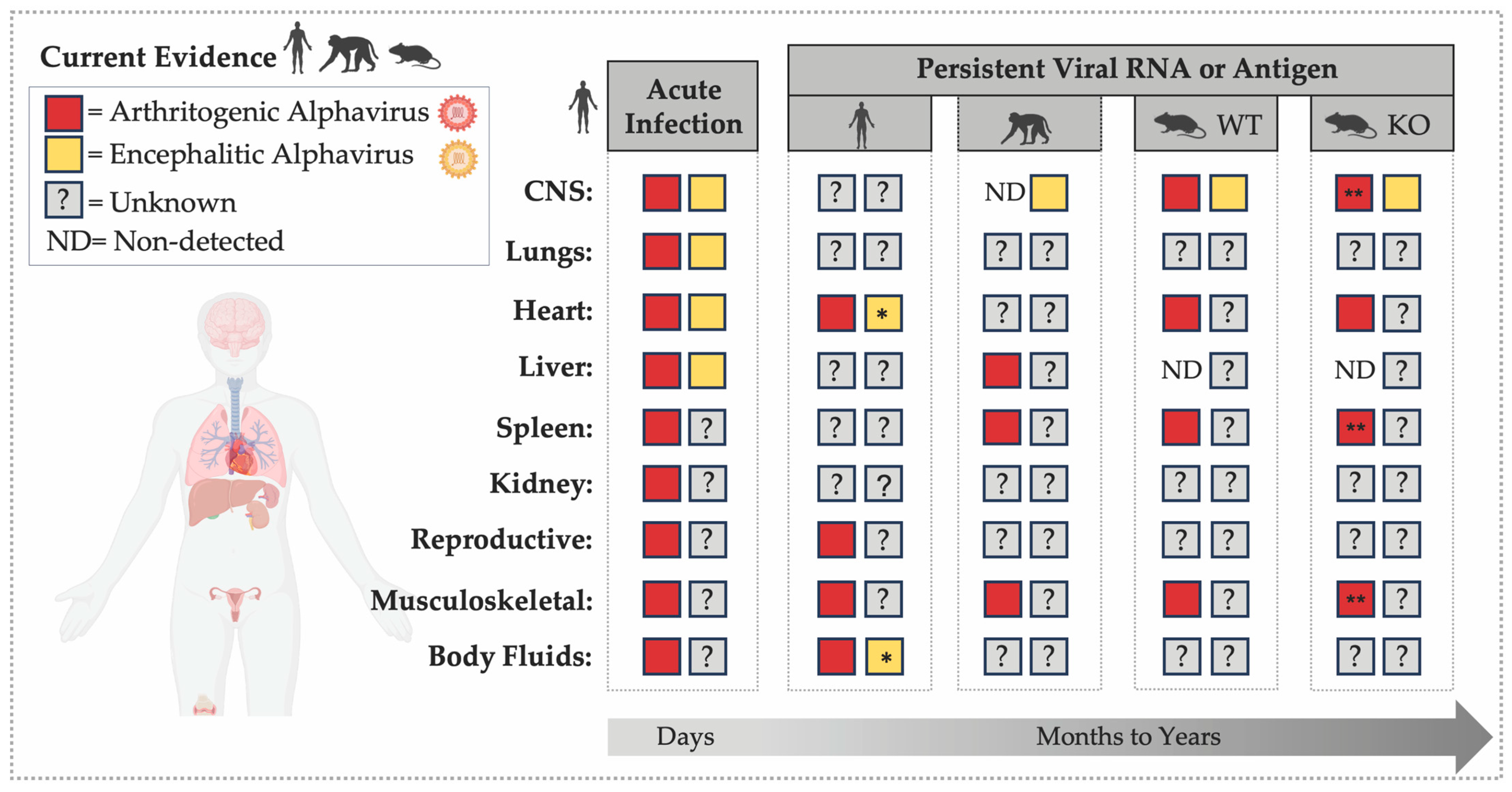
2.1. Arthritogenic Alphaviruses: Evidence of Viral Persistence in Humans and Non-Human Primates

2.2. Encephalitic Alphaviruses: Evidence of Viral Persistence in Humans and NHP Models
2.3. From Correlation to Causation: Mouse Models as Key Tools to Study Alphavirus Persistence
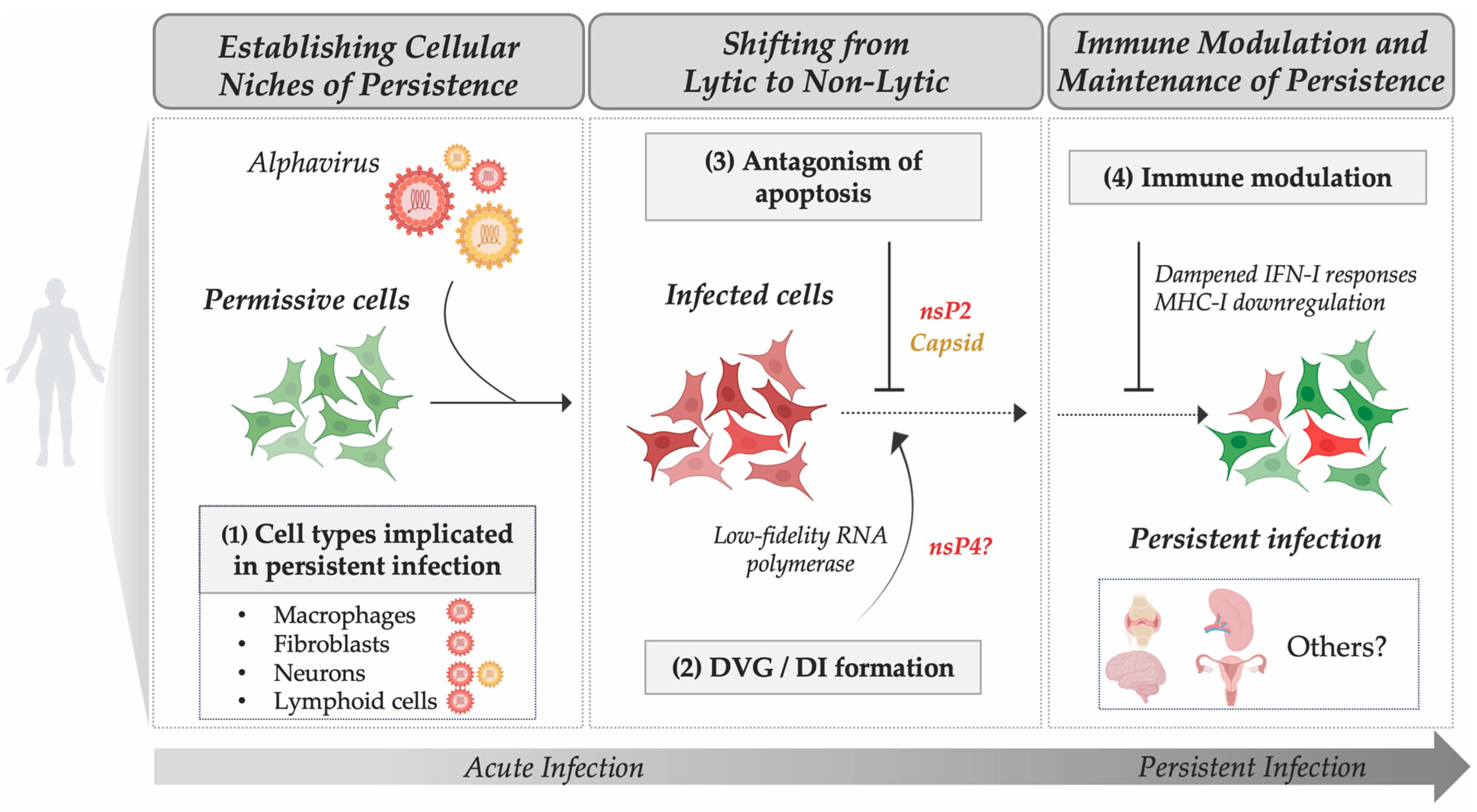
3. The Establishment of Persistent Infections: Finding the Right Place to Hide
3.1. Viral Entry: Receptor-Dependent and Receptor-Independent Entry
3.2. Cell Types Implicated in Alphavirus Persistence
3.2.1. Tissue-Resident and Monocyte-Derived Macrophages
3.2.2. Neurons and Non-Neuronal CNS Cells
3.2.3. Fibroblasts and Muscle Satellite Cells
3.2.4. Splenic Lymphoid Cells
4. Virus–Host Interactions in Alphavirus Persistence: Shifting from Lytic to Non-Lytic Infection
4.1. Limitation of Replication Output and Cytopathicity Through DVGs and DIs
4.2. Antagonism of Apoptosis
4.3. Host Factors
5. Establishing Persistence Within the Host: The Role of Immune Modulation
5.1. IFN-I and Innate Control of Alphavirus Infection
5.2. Adaptive Immunity in Alphavirus Persistence
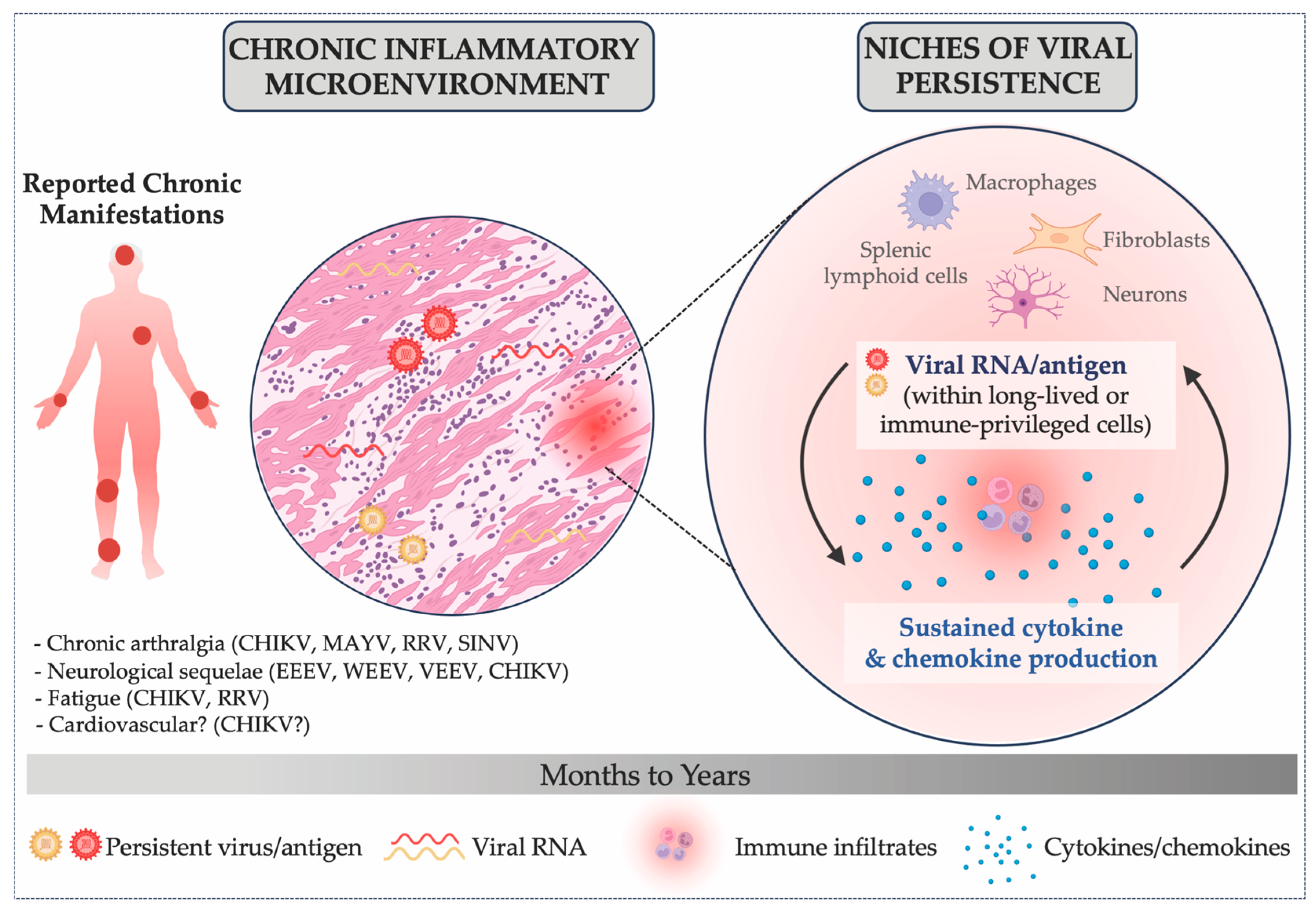
5.3. Persistence as a Potential Driver of Chronic Pathogenesis
6. The Need for Advanced Human Models to Study Alphavirus Persistence
7. Conclusions and Gaps in Knowledge
Author Contributions
Funding
Data Availability Statement
Acknowledgments
Conflicts of Interest
Abbreviations
| 3D | Three-dimensional |
| ApoER2 | Low density lipoprotein receptor-related protein 8 |
| BAX | BCL-2-like protein 4 |
| BCL-2 | B-cell lymphoma 2 |
| BHK-21 | Baby hamster kidney fibroblast cells |
| CD137 | TNF receptor superfamily member 9 |
| CD4+ T cells | T helper lymphocytes |
| CD8+ T cells | Cytotoxic T lymphocytes |
| CHIKV | Chikungunya virus |
| CNS | Central nervous system |
| DIs | Defective interfering particles |
| dLNs | Draining lymph nodes |
| DPI | Days post-infection |
| DVGs | Defective viral genomes |
| E1-3 | Envelope glycoproteins 1-3 |
| EEEV | Eastern equine encephalitis virus |
| eIF3k | Eukaryotic translation initiation factor 3 subunit K |
| FDCs | Follicular dendritic cells |
| GC | Germinal center |
| HIV-1 | Human immunodeficiency virus |
| IFN-I | Type I interferon |
| IFN-III | Type III interferon |
| IFNα | Interferon alpha |
| IFNAR1 | Interferon alpha/beta receptor |
| iNOS | Inducible nitric oxide synthase |
| iPSCs | Induced pluripotent stem cells |
| IRF5 | Interferon regulatory factor 5 |
| ISG | Interferon-stimulated gene |
| JAK | Janus kinase |
| kb | Kilobase |
| LDLRAD3 | Low density lipoprotein receptor class A domain-containing protein 3 |
| Mavs−/− | Deficient in mitochondrial antiviral signaling protein |
| MAVS | Mitochondrial antiviral signaling protein |
| MAYV | Mayaro virus |
| MDA5 | Melanoma differentiation-associated protein 5 |
| MDMs | Monocyte-derived macrophages |
| MEFs | Mouse embryonic fibroblasts |
| MHC-I | Major histocompatibility complex class I |
| MHC-II | Major histocompatibility complex class II |
| MXRA8 | Matrix remodeling associated 8 |
| MyD88 | Myeloid differentiation primary response 88 |
| NHP | Non-human primate |
| NK | Natural killer |
| NOX2 | NADPH oxidase 2 |
| NSP1-4 | Nonstructural proteins 1-4 |
| ONNV | O’nyong-nyong virus |
| ORFs | Open reading frames |
| PCDH10 | Protocadherin-10 |
| PFU | Plaque-forming units |
| PRRs | Pattern-recognition receptors |
| Rag1−/− | Deficient in recombination activating gene 1 |
| RIG-I | Retinoic acid-induced gene-I |
| RNase L | Ribonuclease L |
| RRV | Ross River virus |
| SFV | Semliki Forest virus |
| SINV | Sindbis virus |
| SPCS3 | Signal peptidase complex subunit 3 |
| +ssRNA | Positive-sense, single-stranded RNA |
| STAT | Signal transducers and activators of transcription |
| TGF-β | Transforming growth factor beta |
| TIM-1 | T-cell immunoglobulin mucin domain-1 |
| TLR3 | Toll-like receptor 3 |
| TLR7 | Toll-like receptor 7 |
| TNF | Tumor necrosis factor |
| TRIF | TIR-domain-containing adapter-inducing interferon beta |
| μMT | B-cell-deficient mice |
| VEEV | Venezuelan equine encephalitis virus |
| VLDL3 | Very low-density lipoprotein receptor |
| WEEV | Western equine encephalitis virus |
Glossary
| Definition | |
| Abortive infection | An incomplete viral life cycle in which infection is initiated that may support limited viral replication but ultimately fails to produce infectious progeny due to the absence or incompatibility of essential viral or host factors |
| Acute infection | The initial stage of infection, characterized by active viral replication, high viremia, and the onset of clinical symptoms |
| Autophagy | A highly conserved eukaryotic degradation pathway that recycles cytoplasmic components through lysosomal processing, maintaining cellular homeostasis and supporting survival under stress conditions |
| Cellular niches | Specialized cellular or tissue environments that enable viruses to evade clearance and maintain persistence or low-level replication |
| Helper virus | A virus that provides necessary functions (such as proteins or replication machinery) to complement a defective virus, enabling its genome replication and assembly into infectious particles |
| Host factors | Cellular proteins that may interfere with viral replication or assembly, forming part of the intrinsic antiviral defense, including interferon-stimulated genes (ISGs) |
| Immune-privileged | A state in which specific tissues or anatomical sites exhibit reduced immune surveillance or inflammatory responses, allowing these sites to tolerate the introduction of foreign antigens without eliciting an inflammatory immune response |
| Long-term manifestations | Clinical symptoms that are maintained weeks to years after the initial infection with a given virus |
| Low-fidelity variants of the RNA polymerase nsP4 | An enzyme that synthesizes RNA with a higher error rate, making it more likely to incorporate incorrect nucleotides during viral replication (which may lead to increased genetic diversity in RNA viruses) |
| Lytic to non-lytic infection | The shift from virus-induced death (lytic infection) to infection without cytopathic effects (non-lytic infection) |
| Novel alternative human models | Models to replace or decrease animal use during experiments, including organ-on-a-chip systems, computational modeling, or in vitro cell cultures, such as the use of human induced pluripotent stem cells (iPSCs) |
| Opsonized antigens | Viral particles or antigens coated with host antibodies or complement proteins, facilitating recognition and uptake by phagocytic cells via Fc or complement receptors |
| Persistent viral material | The continued presence of viral RNA or proteins in host tissues after apparent clinical recovery, even when infectious particles are no longer produced |
| Post-acute sequelae | The long-term health effects or complications that persist after the acute phase of infection has resolved (e.g., chronic arthralgia) |
| Productive infection | A complete viral life cycle that results in the generation of infectious viral progeny |
| Replication output | Viral particles produced as a result of the process of viral replication within a host cell |
| Vectorial capacity | The overall ability of a mosquito population to transmit a pathogen to vertebrate hosts, influenced by the biting rate, vector competence, lifespan, and extrinsic incubation period |
| Viral debris | Non-replicative viral remnants of an infection, including residual viral RNA and proteins that linger after resolution of the initial infection |
| Viral persistence | In the context of alphavirus infection, we define viral persistence as any detectable viral RNA or antigen within the vertebrate host after the resolution of viremia and acute disease signs, regardless of whether active replication occurs |
| Viremia | The presence of infectious virus in the bloodstream |
References
- Chen, R.; Mukhopadhyay, S.; Merits, A.; Bolling, B.; Nasar, F.; Coffey, L.L.; Powers, A.; Weaver, S.C. Ictv Report Consortium, null ICTV Virus Taxonomy Profile: Togaviridae. J. Gen. Virol. 2018, 99, 761–762. [Google Scholar] [CrossRef]
- Kafai, N.M.; Diamond, M.S.; Fox, J.M. Distinct Cellular Tropism and Immune Responses to Alphavirus Infection. Annu. Rev. Immunol. 2022, 40, 615–649. [Google Scholar] [CrossRef]
- de Souza, W.M.; Ribeiro, G.S.; de Lima, S.T.S.; de Jesus, R.; Moreira, F.R.R.; Whittaker, C.; Sallum, M.A.M.; Carrington, C.V.F.; Sabino, E.C.; Kitron, U.; et al. Chikungunya: A Decade of Burden in the Americas. Lancet Reg. Health Am. 2024, 30, 100673. [Google Scholar] [CrossRef]
- Ribeiro Dos Santos, G.; Jawed, F.; Mukandavire, C.; Deol, A.; Scarponi, D.; Mboera, L.E.G.; Seruyange, E.; Poirier, M.J.P.; Bosomprah, S.; Udeze, A.O.; et al. Global Burden of Chikungunya Virus Infections and the Potential Benefit of Vaccination Campaigns. Nat. Med. 2025, 31, 2342–2349. [Google Scholar] [CrossRef]
- Lorenz, C.; de Azevedo, T.S.; Chiaravalloti-Neto, F. Effects of Climate Change on the Occurrence and Distribution of Western Equine Encephalitis Virus in South America. Public Health 2025, 239, 1–8. [Google Scholar] [CrossRef] [PubMed]
- Rocklöv, J.; Dubrow, R. Climate Change: An Enduring Challenge for Vector-Borne Disease Prevention and Control. Nat. Immunol. 2020, 21, 479–483. [Google Scholar] [CrossRef]
- De Souza, W.M.; Weaver, S.C. Effects of Climate Change and Human Activities on Vector-Borne Diseases. Nat. Rev. Microbiol. 2024, 22, 476–491. [Google Scholar] [CrossRef]
- Tsetsarkin, K.A.; Vanlandingham, D.L.; McGee, C.E.; Higgs, S. A Single Mutation in Chikungunya Virus Affects Vector Specificity and Epidemic Potential. PLoS Pathog. 2007, 3, e201. [Google Scholar] [CrossRef]
- Zeller, H.; Van Bortel, W.; Sudre, B. Chikungunya: Its History in Africa and Asia and Its Spread to New Regions in 2013–2014. J. Infect. Dis. 2016, 214, S436–S440. [Google Scholar] [CrossRef] [PubMed]
- Zhang, Y.; Zhang, Y.; Fang, Z.; Ni, S. China’s Chikungunya Virus Outbreak Is a Wake up Call. Nature 2025, 645, 41. [Google Scholar] [CrossRef] [PubMed]
- European Centre for Disease Prevention and Control. Chikungunya Virus Disease Worldwide Overview. 2025. Available online: https://www.ecdc.europa.eu/en/chikungunya-monthly (accessed on 31 October 2025).
- Available online: https://www.health.ny.gov/press/releases/2025/2025-10-14_chikungunya (accessed on 31 October 2025).
- Forato, J.; Meira, C.A.; Claro, I.M.; Amorim, M.R.; de Souza, G.F.; Muraro, S.P.; Toledo-Teixeira, D.A.; Dias, M.F.; Meneses, C.A.R.; Angerami, R.N.; et al. Molecular Epidemiology of Mayaro Virus among Febrile Patients, Roraima State, Brazil, 2018–2021. Emerg. Infect. Dis. 2024, 30, 1013–1016. [Google Scholar] [CrossRef]
- Esposito, D.L.A.; Fonseca, B.A.L.D. Will Mayaro Virus Be Responsible for the next Outbreak of an Arthropod-Borne Virus in Brazil? Braz. J. Infect. Dis. 2017, 21, 540–544. [Google Scholar] [CrossRef]
- Hassing, R.-J.; Leparc-Goffart, I.; Blank, S.N.; Thevarayan, S.; Tolou, H.; van Doornum, G.; van Genderen, P.J. Imported Mayaro Virus Infection in the Netherlands. J. Infect. 2010, 61, 343–345. [Google Scholar] [CrossRef] [PubMed]
- Brustolin, M.; Bartholomeeusen, K.; Rezende, T.; Ariën, K.K.; Müller, R. Mayaro Virus, a Potential Threat for Europe: Vector Competence of Autochthonous Vector Species. Parasit. Vectors 2024, 17, 200. [Google Scholar] [CrossRef] [PubMed]
- Friedrich-Jänicke, B.; Emmerich, P.; Tappe, D.; Günther, S.; Cadar, D.; Schmidt-Chanasit, J. Genome Analysis of Mayaro Virus Imported to Germany from French Guiana. Emerg. Infect. Dis. 2014, 20, 1255–1257. [Google Scholar] [CrossRef]
- Llagonne-Barets, M.; Icard, V.; Leparc-Goffart, I.; Prat, C.; Perpoint, T.; André, P.; Ramière, C. A Case of Mayaro Virus Infection Imported from French Guiana. J. Clin. Virol. Off. Publ. Pan Am. Soc. Clin. Virol. 2016, 77, 66–68. [Google Scholar] [CrossRef]
- Dieme, C.; Ciota, A.T.; Kramer, L.D. Transmission Potential of Mayaro Virus by Aedes Albopictus, and Anopheles Quadrimaculatus from the USA. Parasit. Vectors 2020, 13, 613. [Google Scholar] [CrossRef] [PubMed]
- Fernández, D.; Yun, R.; Zhou, J.; Parise, P.L.; Mosso-González, C.; Villasante-Tezanos, A.; Weaver, S.C.; Pando-Robles, V.; Aguilar, P.V. Differential Susceptibility of Aedes Aegypti and Aedes Albopictus Mosquitoes to Infection by Mayaro Virus Strains. Am. J. Trop. Med. Hyg. 2023, 109, 115–122. [Google Scholar] [CrossRef]
- Long, K.C.; Ziegler, S.A.; Thangamani, S.; Hausser, N.L.; Kochel, T.J.; Higgs, S.; Tesh, R.B. Experimental Transmission of Mayaro Virus by Aedes Aegypti. Am. J. Trop. Med. Hyg. 2011, 85, 750–757. [Google Scholar] [CrossRef]
- Brustolin, M.; Pujhari, S.; Henderson, C.A.; Rasgon, J.L. Anopheles Mosquitoes May Drive Invasion and Transmission of Mayaro Virus across Geographically Diverse Regions. PLoS Negl. Trop. Dis. 2018, 12, e0006895. [Google Scholar] [CrossRef]
- Hill, V.; Koch, R.T.; Bialosuknia, S.M.; Ngo, K.; Zink, S.D.; Koetzner, C.A.; Maffei, J.G.; Dupuis, A.P.; Backenson, P.B.; Oliver, J.; et al. Dynamics of Eastern Equine Encephalitis Virus during the 2019 Outbreak in the Northeast United States. Curr. Biol. CB 2023, 33, 2515–2527.e6. [Google Scholar] [CrossRef]
- Centers for Disease Control (CDC). Western Equine Encephalitis—United States and Canada, 1987. MMWR Morb. Mortal. Wkly. Rep. 1987, 36, 655–659. [Google Scholar]
- Vissani, M.A.; Alamos, F.; Tordoya, M.S.; Minatel, L.; Schammas, J.M.; Dus Santos, M.J.; Trono, K.; Barrandeguy, M.E.; Balasuriya, U.B.R.; Carossino, M. Outbreak of Western Equine Encephalitis Virus Infection Associated with Neurological Disease in Horses Following a Nearly 40-Year Intermission Period in Argentina. Viruses 2024, 16, 1594. [Google Scholar] [CrossRef]
- Available online: https://www.cdc.gov/eastern-equine-encephalitis/data-maps/historic-data.html (accessed on 31 October 2025).
- Bartholomeeusen, K.; Daniel, M.; LaBeaud, D.A.; Gasque, P.; Peeling, R.W.; Stephenson, K.E.; Ng, L.F.P.; Ariën, K.K. Chikungunya Fever. Nat. Rev. Dis. Primer 2023, 9, 17. [Google Scholar] [CrossRef] [PubMed]
- Dorléans, F.; Hoen, B.; Najioullah, F.; Herrmann-Storck, C.; Schepers, K.M.; Abel, S.; Lamaury, I.; Fagour, L.; Césaire, R.; Guyomard, S.; et al. Outbreak of Chikungunya in the French Caribbean Islands of Martinique and Guadeloupe: Findings from a Hospital-Based Surveillance System (2013–2015). Am. J. Trop. Med. Hyg. 2018, 98, 1819–1825. [Google Scholar] [CrossRef]
- Traverse, E.M.; Hopkins, H.K.; Vaidhyanathan, V.; Barr, K.L. Cardiomyopathy and Death Following Chikungunya Infection: An Increasingly Common Outcome. Trop. Med. Infect. Dis. 2021, 6, 108. [Google Scholar] [CrossRef]
- De Souza, W.M.; De Lima, S.T.S.; Simões Mello, L.M.; Candido, D.S.; Buss, L.; Whittaker, C.; Claro, I.M.; Chandradeva, N.; Granja, F.; De Jesus, R.; et al. Spatiotemporal Dynamics and Recurrence of Chikungunya Virus in Brazil: An Epidemiological Study. Lancet Microbe 2023, 4, e319–e329. [Google Scholar] [CrossRef] [PubMed]
- Brito, C.; Falcão, M.B.; Albuquerque, M.d.F.P.M.d.; Cerqueira-Silva, T.; Teixeira, M.G.; Franca, R.F.d.O. Chikungunya: From Hypothesis to Evidence of Increased Severe Disease and Fatalities. Viruses 2025, 17, 62. [Google Scholar] [CrossRef] [PubMed]
- Cerqueira-Silva, T.; Cardim, L.L.; Paixão, E.; Rossi, M.; Santos, A.C.; Portela F de Souza, A.; Santos, G.; Barreto, M.L.; Brickley, E.B.; Pescarini, J.M. Hospitalisation, Mortality and Years of Life Lost among Chikungunya and Dengue Cases in Brazil: A Nationwide Cohort Study, 2015–2024. Lancet Reg. Health Am. 2025, 49, 101177. [Google Scholar] [CrossRef]
- Torales, M.; Beeson, A.; Grau, L.; Galeano, M.; Ojeda, A.; Martinez, B.; León, N.; Cabello, A.; Rojas, F.; de Egea, V.; et al. Notes from the Field: Chikungunya Outbreak—Paraguay, 2022–2023. MMWR Morb. Mortal. Wkly. Rep. 2023, 72, 636–638. [Google Scholar] [CrossRef]
- Zacks, M.A.; Paessler, S. Encephalitic Alphaviruses. Vet. Microbiol. 2010, 140, 281–286. [Google Scholar] [CrossRef]
- Ronca, S.E.; Dineley, K.T.; Paessler, S. Neurological Sequelae Resulting from Encephalitic Alphavirus Infection. Front. Microbiol. 2016, 7, 959. [Google Scholar] [CrossRef]
- Suhrbier, A. Rheumatic Manifestations of Chikungunya: Emerging Concepts and Interventions. Nat. Rev. Rheumatol. 2019, 15, 597–611. [Google Scholar] [CrossRef]
- Schilte, C.; Staikovsky, F.; Couderc, T.; Madec, Y.; Carpentier, F.; Kassab, S.; Albert, M.L.; Lecuit, M.; Michault, A. Chikungunya Virus-Associated Long-Term Arthralgia: A 36-Month Prospective Longitudinal Study. PLoS Negl. Trop. Dis. 2013, 7, e2137. [Google Scholar] [CrossRef]
- Silva, M.M.O.; Kikuti, M.; Anjos, R.O.; Portilho, M.M.; Santos, V.C.; Gonçalves, T.S.F.; Tauro, L.B.; Moreira, P.S.S.; Jacob-Nascimento, L.C.; Santana, P.M.; et al. Risk of Chronic Arthralgia and Impact of Pain on Daily Activities in a Cohort of Patients with Chikungunya Virus Infection from Brazil. Int. J. Infect. Dis. 2021, 105, 608–616. [Google Scholar] [CrossRef]
- Tritsch, S.R.; Encinales, L.; Pacheco, N.; Cadena, A.; Cure, C.; McMahon, E.; Watson, H.; Porras Ramirez, A.; Mendoza, A.R.; Li, G.; et al. Chronic Joint Pain 3 Years after Chikungunya Virus Infection Largely Characterized by Relapsing-Remitting Symptoms. J. Rheumatol. 2020, 47, 1267–1274. [Google Scholar] [CrossRef] [PubMed]
- Guillot, X.; Ribera, A.; Gasque, P. Chikungunya-Induced Arthritis in Reunion Island: A Long-Term Observational Follow-Up Study Showing Frequently Persistent Joint Symptoms, Some Cases of Persistent Chikungunya Immunoglobulin M Positivity, and No Anticyclic Citrullinated Peptide Seroconversion After 13 Years. J. Infect. Dis. 2020, 222, 1740–1744. [Google Scholar] [CrossRef] [PubMed]
- Santiago, F.W.; Halsey, E.S.; Siles, C.; Vilcarromero, S.; Guevara, C.; Silvas, J.A.; Ramal, C.; Ampuero, J.S.; Aguilar, P.V. Long-Term Arthralgia after Mayaro Virus Infection Correlates with Sustained Pro-Inflammatory Cytokine Response. PLoS Negl. Trop. Dis. 2015, 9, e0004104. [Google Scholar] [CrossRef] [PubMed]
- Slegers, C.A.D.; Keuter, M.; Günther, S.; Schmidt-Chanasit, J.; van der Ven, A.J.; de Mast, Q. Persisting Arthralgia Due to Mayaro Virus Infection in a Traveler from Brazil: Is There a Risk for Attendants to the 2014 FIFA World Cup? J. Clin. Virol. Off. Publ. Pan Am. Soc. Clin. Virol. 2014, 60, 317–319. [Google Scholar] [CrossRef]
- Taylor, S.F.; Patel, P.R.; Herold, T.J.S. Recurrent Arthralgias in a Patient with Previous Mayaro Fever Infection. South. Med. J. 2005, 98, 484–485. [Google Scholar] [CrossRef]
- Harley, D.; Sleigh, A.; Ritchie, S. Ross River Virus Transmission, Infection, and Disease: A Cross-Disciplinary Review. Clin. Microbiol. Rev. 2001, 14, 909–932. [Google Scholar] [CrossRef]
- Harley, D.; Bossingham, D.; Purdie, D.M.; Pandeya, N.; Sleigh, A.C. Ross River Virus Disease in Tropical Queensland: Evolution of Rheumatic Manifestations in an Inception Cohort Followed for Six Months. Med. J. Aust. 2002, 177, 352–355. [Google Scholar] [CrossRef]
- Condon, R.J.; Rouse, I.L. Acute Symptoms and Sequelae of Ross River Virus Infection in South-Western Australia: A Follow-up Study. Clin. Diagn. Virol. 1995, 3, 273–284. [Google Scholar] [CrossRef]
- Gylfe, Å.; Ribers, Å.; Forsman, O.; Bucht, G.; Alenius, G.-M.; Wållberg-Jonsson, S.; Ahlm, C.; Evander, M. Mosquitoborne Sindbis Virus Infection and Long-Term Illness. Emerg. Infect. Dis. 2018, 24, 1141–1142. [Google Scholar] [CrossRef]
- Niklasson, B.; Espmark, A. Ockelbo Disease: Arthralgia 3–4 Years after Infection with a Sindbis Virus Related Agent. Lancet Lond. Engl. 1986, 1, 1039–1040. [Google Scholar] [CrossRef] [PubMed]
- Elsinga, J.; Gerstenbluth, I.; Van Der Ploeg, S.; Halabi, Y.; Lourents, N.T.; Burgerhof, J.G.; Van Der Veen, H.T.; Bailey, A.; Grobusch, M.P.; Tami, A. Long-Term Chikungunya Sequelae in Curaçao: Burden, Determinants, and a Novel Classification Tool. J. Infect. Dis. 2017, 216, 573–581. [Google Scholar] [CrossRef]
- Van Aalst, M.; Nelen, C.M.; Goorhuis, A.; Stijnis, C.; Grobusch, M.P. Long-Term Sequelae of Chikungunya Virus Disease: A Systematic Review. Travel Med. Infect. Dis. 2017, 15, 8–22. [Google Scholar] [CrossRef]
- Hickie, I.; Davenport, T.; Wakefield, D.; Vollmer-Conna, U.; Cameron, B.; Vernon, S.D.; Reeves, W.C.; Lloyd, A. Post-Infective and Chronic Fatigue Syndromes Precipitated by Viral and Non-Viral Pathogens: Prospective Cohort Study. BMJ 2006, 333, 575. [Google Scholar] [CrossRef] [PubMed]
- Noran, H.H.; Baker, A.B. Western Equine Encephalitis: The Pathogenesis of the Pathological Lesions. J. Neuropathol. Exp. Neurol. 1945, 4, 269–276. [Google Scholar] [CrossRef]
- Noran, H.H. Chronic Equine Encephalitis. Am. J. Pathol. 1944, 20, 259–267. [Google Scholar]
- Bowen, G.S.; Fashinell, T.R.; Dean, P.B.; Gregg, M.B. Clinical Aspects of Human Venezuelan Equine Encephalitis in Texas. Bull. Pan Am. Health Organ. 1976, 10, 46–57. [Google Scholar]
- Patwardhan, A.; Nalini, A.; Baishya, P.P.; Kulanthaivelu, K.; Krishnareddy, H.; Dutta, D.; Chawla, T.; Chowdary, R.M.; Yadav, R.; Vengalil, S. Case Report: Post-Chikungunya-Associated Myeloneuropathy. Am. J. Trop. Med. Hyg. 2021, 105, 942–945. [Google Scholar] [CrossRef]
- Gérardin, P.; Couderc, T.; Bintner, M.; Tournebize, P.; Renouil, M.; Lémant, J.; Boisson, V.; Borgherini, G.; Staikowsky, F.; Schramm, F.; et al. Chikungunya Virus-Associated Encephalitis: A Cohort Study on La Réunion Island, 2005–2009. Neurology 2016, 86, 94–102. [Google Scholar] [CrossRef]
- Pokeerbux, M.R.; Mavingui, P.; Gérardin, P.; Agrinier, N.; Gokalsing, E.; Meilhac, O.; Cournot, M. A Holistic Approach to Cardiometabolic and Infectious Health in the General Population of Reunion Island: The REUNION Study. J. Epidemiol. Glob. Health 2024, 14, 839–846. [Google Scholar] [CrossRef] [PubMed]
- Obeyesekere, I.; Hermon, Y. Arbovirus Heart Disease: Myocarditis and Cardiomyopathy Following Dengue and Chikungunya Fever—A Follow-up Study. Am. Heart J. 1973, 85, 186–194. [Google Scholar] [CrossRef] [PubMed]
- Patel, D.M.; Patel, M.V.; Sharma, K.H.; Patel, G.R.; Patel, M.B.; Shah, V.V. Post Chikungunya Chronic Arthritis: Systemic Inflammatory Status Triggering Acute Coronary Syndrome. Curr. Rheumatol. Rev. 2019, 15, 229–233. [Google Scholar] [CrossRef] [PubMed]
- Cerqueira-Silva, T.; Pescarini, J.M.; Cardim, L.L.; Leyrat, C.; Whitaker, H.; Antunes de Brito, C.A.; Brickley, E.B.; Barral-Netto, M.; Barreto, M.L.; Teixeira, M.G.; et al. Risk of Death Following Chikungunya Virus Disease in the 100 Million Brazilian Cohort, 2015–18: A Matched Cohort Study and Self-Controlled Case Series. Lancet Infect. Dis. 2024, 24, 504–513. [Google Scholar] [CrossRef]
- McCarthy, M.K.; Morrison, T.E. Persistent RNA Virus Infections: Do PAMPS Drive Chronic Disease? Curr. Opin. Virol. 2017, 23, 8–15. [Google Scholar] [CrossRef] [PubMed]
- Miller, C.M.; Moen, J.K.; Iwasaki, A. The Lingering Shadow of Epidemics: Post-Acute Sequelae across History. Trends Immunol. 2025, S1471-4906(25)00267-4. [Google Scholar] [CrossRef]
- Soden, M.; Vasudevan, H.; Roberts, B.; Coelen, R.; Hamlin, G.; Vasudevan, S.; La Brooy, J. Detection of Viral Ribonucleic Acid and Histologic Analysis of Inflamed Synovium in Ross River Virus Infection. Arthritis Rheum. 2000, 43, 365–369. [Google Scholar] [CrossRef]
- Hoarau, J.-J.; Jaffar Bandjee, M.-C.; Krejbich Trotot, P.; Das, T.; Li-Pat-Yuen, G.; Dassa, B.; Denizot, M.; Guichard, E.; Ribera, A.; Henni, T.; et al. Persistent Chronic Inflammation and Infection by Chikungunya Arthritogenic Alphavirus in Spite of a Robust Host Immune Response. J. Immunol. 2010, 184, 5914–5927. [Google Scholar] [CrossRef]
- Levine, B.; Hardwick, J.M.; Griffin, D.E. Persistence of Alphaviruses in Vertebrate Hosts. Trends Microbiol. 1994, 2, 25–28. [Google Scholar] [CrossRef]
- Griffin, D.E. Why Does Viral RNA Sometimes Persist after Recovery from Acute Infections? PLoS Biol. 2022, 20, e3001687. [Google Scholar] [CrossRef]
- Dokubo, E.K.; Wendland, A.; Mate, S.E.; Ladner, J.T.; Hamblion, E.L.; Raftery, P.; Blackley, D.J.; Laney, A.S.; Mahmoud, N.; Wayne-Davies, G.; et al. Persistence of Ebola Virus after the End of Widespread Transmission in Liberia: An Outbreak Report. Lancet Infect. Dis. 2018, 18, 1015–1024. [Google Scholar] [CrossRef] [PubMed]
- Mukadi-Bamuleka, D.; Edidi-Atani, F.; Morales-Betoulle, M.E.; Legand, A.; Nkuba-Ndaye, A.; Bulabula-Penge, J.; Mbala-Kingebeni, P.; Crozier, I.; Mambu-Mbika, F.; Whitmer, S.; et al. Fatal Meningoencephalitis Associated with Ebola Virus Persistence in Two Survivors of Ebola Virus Disease in the Democratic Republic of the Congo: A Case Report Study. Lancet Microbe 2024, 5, 100905. [Google Scholar] [CrossRef]
- Jacobs, M.; Rodger, A.; Bell, D.J.; Bhagani, S.; Cropley, I.; Filipe, A.; Gifford, R.J.; Hopkins, S.; Hughes, J.; Jabeen, F.; et al. Late Ebola Virus Relapse Causing Meningoencephalitis: A Case Report. Lancet Lond. Engl. 2016, 388, 498–503. [Google Scholar] [CrossRef]
- Griffin, D.E. Measles Virus Persistence and Its Consequences. Curr. Opin. Virol. 2020, 41, 46–51. [Google Scholar] [CrossRef]
- Wendorf, K.A.; Winter, K.; Zipprich, J.; Schechter, R.; Hacker, J.K.; Preas, C.; Cherry, J.D.; Glaser, C.; Harriman, K. Subacute Sclerosing Panencephalitis: The Devastating Measles Complication That Might Be More Common Than Previously Estimated. Clin. Infect. Dis. Off. Publ. Infect. Dis. Soc. Am. 2017, 65, 226–232. [Google Scholar] [CrossRef]
- Mead, P.S.; Duggal, N.K.; Hook, S.A.; Delorey, M.; Fischer, M.; Olzenak McGuire, D.; Becksted, H.; Max, R.J.; Anishchenko, M.; Schwartz, A.M.; et al. Zika Virus Shedding in Semen of Symptomatic Infected Men. N. Engl. J. Med. 2018, 378, 1377–1385. [Google Scholar] [CrossRef]
- Castro, Í.A.; Yang, Y.; Gnazzo, V.; Kim, D.-H.; Van Dyken, S.J.; López, C.B. Murine Parainfluenza Virus Persists in Lung Innate Immune Cells Sustaining Chronic Lung Pathology. Nat. Microbiol. 2024, 9, 2803–2816. [Google Scholar] [CrossRef]
- Stein, S.R.; Ramelli, S.C.; Grazioli, A.; Chung, J.-Y.; Singh, M.; Yinda, C.K.; Winkler, C.W.; Sun, J.; Dickey, J.M.; Ylaya, K.; et al. SARS-CoV-2 Infection and Persistence in the Human Body and Brain at Autopsy. Nature 2022, 612, 758–763. [Google Scholar] [CrossRef]
- Choutka, J.; Jansari, V.; Hornig, M.; Iwasaki, A. Unexplained Post-Acute Infection Syndromes. Nat. Med. 2022, 28, 911–923. [Google Scholar] [CrossRef]
- Chen, B.; Julg, B.; Mohandas, S.; Bradfute, S.B. RECOVER Mechanistic Pathways Task Force. Viral Persistence, Reactivation, and Mechanisms of Long COVID. eLife 2023, 12, e86015. [Google Scholar] [CrossRef]
- Machkovech, H.M.; Hahn, A.M.; Garonzik Wang, J.; Grubaugh, N.D.; Halfmann, P.J.; Johnson, M.C.; Lemieux, J.E.; O’Connor, D.H.; Piantadosi, A.; Wei, W.; et al. Persistent SARS-CoV-2 Infection: Significance and Implications. Lancet Infect. Dis. 2024, 24, e453–e462. [Google Scholar] [CrossRef]
- Deen, G.F.; Broutet, N.; Xu, W.; Knust, B.; Sesay, F.R.; McDonald, S.L.R.; Ervin, E.; Marrinan, J.E.; Gaillard, P.; Habib, N.; et al. Ebola RNA Persistence in Semen of Ebola Virus Disease Survivors—Final Report. N. Engl. J. Med. 2017, 377, 1428–1437. [Google Scholar] [CrossRef]
- Ventoso, I.; Berlanga, J.J.; Toribio, R.; Díaz-López, I. Translational Control of Alphavirus-Host Interactions: Implications in Viral Evolution, Tropism and Antiviral Response. Viruses 2024, 16, 205. [Google Scholar] [CrossRef]
- Leung, J.Y.-S.; Ng, M.M.-L.; Chu, J.J.H. Replication of Alphaviruses: A Review on the Entry Process of Alphaviruses into Cells. Adv. Virol. 2011, 2011, 249640. [Google Scholar] [CrossRef]
- Ozden, S.; Huerre, M.; Riviere, J.-P.; Coffey, L.L.; Afonso, P.V.; Mouly, V.; de Monredon, J.; Roger, J.-C.; El Amrani, M.; Yvin, J.-L.; et al. Human Muscle Satellite Cells as Targets of Chikungunya Virus Infection. PLoS ONE 2007, 2, e527. [Google Scholar] [CrossRef]
- de Brito, M.S.A.G.; de Marchi, M.S.; Perin, M.Y.; Côsso, I.d.S.; Bumlai, R.U.M.; Júnior, W.V.d.S.; Prado, A.Y.M.; da Cruz, T.C.D.; Avila, E.T.P.; Damazo, A.S.; et al. Inflammation, Fibrosis and E1 Glycoprotein Persistence in Joint Tissue of Patients with Post-Chikungunya Chronic Articular Disease. Rev. Soc. Bras. Med. Trop. 2023, 56, e02782023. [Google Scholar] [CrossRef]
- Chang, A.Y.; Martins, K.A.O.; Encinales, L.; Reid, S.P.; Acuña, M.; Encinales, C.; Matranga, C.B.; Pacheco, N.; Cure, C.; Shukla, B.; et al. Chikungunya Arthritis Mechanisms in the Americas: A Cross-Sectional Analysis of Chikungunya Arthritis Patients Twenty-Two Months After Infection Demonstrating No Detectable Viral Persistence in Synovial Fluid. Arthritis Rheumatol. 2018, 70, 585–593. [Google Scholar] [CrossRef]
- Bouquillard, E.; Fianu, A.; Bangil, M.; Charlette, N.; Ribéra, A.; Michault, A.; Favier, F.; Simon, F.; Flipo, R.-M. Rheumatic Manifestations Associated with Chikungunya Virus Infection: A Study of 307 Patients with 32-Month Follow-up (RHUMATOCHIK Study). Jt. Bone Spine 2018, 85, 207–210. [Google Scholar] [CrossRef]
- Bandeira, A.C.; Campos, G.S.; Rocha, V.F.D.; Souza, B.S.d.F.; Soares, M.B.P.; Oliveira, A.A.; de Abreu, Y.C.; Menezes, G.S.; Sardi, S.I. Prolonged Shedding of Chikungunya Virus in Semen and Urine: A New Perspective for Diagnosis and Implications for Transmission. IDCases 2016, 6, 100–103. [Google Scholar] [CrossRef]
- Martins, E.B.; Silva, M.F.B.; Tassinari, W.S.; de Bruycker-Nogueira, F.; Moraes, I.C.V.; Rodrigues, C.D.S.; Santos, C.C.; Sampaio, S.A.; Pina-Costa, A.; Fabri, A.A.; et al. Detection of Chikungunya Virus in Bodily Fluids: The INOVACHIK Cohort Study. PLoS Negl. Trop. Dis. 2022, 16, e0010242. [Google Scholar] [CrossRef]
- Pérez-Pérez, J.E.; Guzmán-Martínez, O.; Torres-Flores, J.M.; Sampieri, C.L.; Pérez-Carreón, J.I.; López-Balderas, N.; Barragán, M.Á.; Mendoza-Cervantes, G.; García-García, F.; Campos, A.; et al. Persistent Cervical Infection with the Chikungunya Virus. Rev. Soc. Bras. Med. Trop. 2025, 58, e008122025. [Google Scholar] [CrossRef]
- Carter, I.W.; Smythe, L.D.; Fraser, J.R.; Stallman, N.D.; Cloonan, M.J. Detection of Ross River Virus Immunoglobulin M Antibodies by Enzyme-Linked Immunosorbent Assay Using Antibody Class Capture and Comparison with Other Methods. Pathology 1985, 17, 503–508. [Google Scholar] [CrossRef]
- Niklasson, B.; Espmark, A.; Lundström, J. Occurrence of Arthralgia and Specific IgM Antibodies Three to Four Years after Ockelbo Disease. J. Infect. Dis. 1988, 157, 832–835. [Google Scholar] [CrossRef]
- Bohannon, C.; Powers, R.; Satyabhama, L.; Cui, A.; Tipton, C.; Michaeli, M.; Skountzou, I.; Mittler, R.S.; Kleinstein, S.H.; Mehr, R.; et al. Long-Lived Antigen-Induced IgM Plasma Cells Demonstrate Somatic Mutations and Contribute to Long-Term Protection. Nat. Commun. 2016, 7, 11826. [Google Scholar] [CrossRef]
- Labadie, K.; Larcher, T.; Joubert, C.; Mannioui, A.; Delache, B.; Brochard, P.; Guigand, L.; Dubreil, L.; Lebon, P.; Verrier, B.; et al. Chikungunya Disease in Nonhuman Primates Involves Long-Term Viral Persistence in Macrophages. J. Clin. Investig. 2010, 120, 894–906. [Google Scholar] [CrossRef]
- Messaoudi, I.; Vomaske, J.; Totonchy, T.; Kreklywich, C.N.; Haberthur, K.; Springgay, L.; Brien, J.D.; Diamond, M.S.; Defilippis, V.R.; Streblow, D.N. Chikungunya Virus Infection Results in Higher and Persistent Viral Replication in Aged Rhesus Macaques Due to Defects in Anti-Viral Immunity. PLoS Negl. Trop. Dis. 2013, 7, e2343. [Google Scholar] [CrossRef]
- Ma, H.; Albe, J.R.; Gilliland, T.; McMillen, C.M.; Gardner, C.L.; Boyles, D.A.; Cottle, E.L.; Dunn, M.D.; Lundy, J.D.; Salama, N.; et al. Long-Term Persistence of Viral RNA and Inflammation in the CNS of Macaques Exposed to Aerosolized Venezuelan Equine Encephalitis Virus. PLoS Pathog. 2022, 18, e1009946. [Google Scholar] [CrossRef]
- Albe, J.R.; Ma, H.; Gilliland, T.H.; McMillen, C.M.; Gardner, C.L.; Boyles, D.A.; Cottle, E.L.; Dunn, M.D.; Lundy, J.D.; O’Malley, K.J.; et al. Physiological and Immunological Changes in the Brain Associated with Lethal Eastern Equine Encephalitis Virus in Macaques. PLoS Pathog. 2021, 17, e1009308. [Google Scholar] [CrossRef]
- Sharp, T.M.; Keating, M.K.; Shieh, W.-J.; Bhatnagar, J.; Bollweg, B.C.; Levine, R.; Blau, D.M.; Torres, J.V.; Rivera, A.; Perez-Padilla, J.; et al. Clinical Characteristics, Histopathology, and Tissue Immunolocalization of Chikungunya Virus Antigen in Fatal Cases. Clin. Infect. Dis. Off. Publ. Infect. Dis. Soc. Am. 2021, 73, e345–e354. [Google Scholar] [CrossRef]
- Smith, D.R.; Schmaljohn, C.S.; Badger, C.; Ostrowski, K.; Zeng, X.; Grimes, S.D.; Rayner, J.O. Comparative Pathology Study of Venezuelan, Eastern, and Western Equine Encephalitis Viruses in Non-Human Primates. Antiviral Res. 2020, 182, 104875. [Google Scholar] [CrossRef] [PubMed]
- Hommel, D.; Heraud, J.M.; Hulin, A.; Talarmin, A. Association of Tonate Virus (Subtype IIIB of the Venezuelan Equine Encephalitis Complex) with Encephalitis in a Human. Clin. Infect. Dis. 2000, 30, 188–190. [Google Scholar] [CrossRef]
- Fragkoudis, R.; Dixon-Ballany, C.M.; Zagrajek, A.K.; Kedzierski, L.; Fazakerley, J.K. Following Acute Encephalitis, Semliki Forest Virus Is Undetectable in the Brain by Infectivity Assays but Functional Virus RNA Capable of Generating Infectious Virus Persists for Life. Viruses 2018, 10, 273. [Google Scholar] [CrossRef]
- Levine, B.; Griffin, D.E. Persistence of Viral RNA in Mouse Brains after Recovery from Acute Alphavirus Encephalitis. J. Virol. 1992, 66, 6429–6435. [Google Scholar] [CrossRef]
- de Souza, W.M.; Fumagalli, M.J.; de Lima, S.T.S.; Parise, P.L.; Carvalho, D.C.M.; Hernandez, C.; de Jesus, R.; Delafiori, J.; Candido, D.S.; Carregari, V.C.; et al. Pathophysiology of Chikungunya Virus Infection Associated with Fatal Outcomes. Cell Host Microbe 2024, 32, 606–622.e8. [Google Scholar] [CrossRef]
- Taylor, K.; Kolokoltsova, O.; Ronca, S.E.; Estes, M.; Paessler, S. Live, Attenuated Venezuelan Equine Encephalitis Virus Vaccine (TC83) Causes Persistent Brain Infection in Mice with Non-Functional αβ T-Cells. Front. Microbiol. 2017, 8, 81. [Google Scholar] [CrossRef]
- Pouch, S.M.; Katugaha, S.B.; Shieh, W.-J.; Annambhotla, P.; Walker, W.L.; Basavaraju, S.V.; Jones, J.; Huynh, T.; Reagan-Steiner, S.; Bhatnagar, J.; et al. Transmission of Eastern Equine Encephalitis Virus from an Organ Donor to 3 Transplant Recipients. Clin. Infect. Dis. Off. Publ. Infect. Dis. Soc. Am. 2019, 69, 450–458. [Google Scholar] [CrossRef]
- Noval, M.G.; Spector, S.N.; Bartnicki, E.; Izzo, F.; Narula, N.; Yeung, S.T.; Damani-Yokota, P.; Dewan, M.Z.; Mezzano, V.; Rodriguez-Rodriguez, B.A.; et al. MAVS Signaling Is Required for Preventing Persistent Chikungunya Heart Infection and Chronic Vascular Tissue Inflammation. Nat. Commun. 2023, 14, 4668. [Google Scholar] [CrossRef] [PubMed]
- Hawman, D.W.; Stoermer, K.A.; Montgomery, S.A.; Pal, P.; Oko, L.; Diamond, M.S.; Morrison, T.E. Chronic Joint Disease Caused by Persistent Chikungunya Virus Infection Is Controlled by the Adaptive Immune Response. J. Virol. 2013, 87, 13878–13888. [Google Scholar] [CrossRef] [PubMed]
- Figueiredo, C.M.; Neris, R.L.d.S.; Gavino-Leopoldino, D.; da Silva, M.O.L.; Almeida, J.S.; Dos-Santos, J.S.; Figueiredo, C.P.; Bellio, M.; Bozza, M.T.; Assunção-Miranda, I. Mayaro Virus Replication Restriction and Induction of Muscular Inflammation in Mice Are Dependent on Age, Type-I Interferon Response, and Adaptive Immunity. Front. Microbiol. 2019, 10, 2246. [Google Scholar] [CrossRef]
- Weber, W.C.; Streblow, Z.J.; Andoh, T.F.; Denton, M.; Raué, H.-P.; Amanna, I.J.; Slifka, D.K.; Kreklywich, C.N.; Arduino, I.; Sulgey, G.; et al. Development of a Virulent O’nyong’nyong Challenge Model to Determine Heterologous Protection Mediated by a Hydrogen Peroxide-Inactivated Chikungunya Virus Vaccine. PLoS Negl. Trop. Dis. 2025, 19, e0012938. [Google Scholar] [CrossRef]
- Hong, J.P.; McCarthy, M.K.; Davenport, B.J.; Morrison, T.E.; Diamond, M.S. Clearance of Chikungunya Virus Infection in Lymphoid Tissues Is Promoted by Treatment with an Agonistic Anti-CD137 Antibody. J. Virol. 2019, 93, e01231-19. [Google Scholar] [CrossRef]
- Morrison, T.E.; Oko, L.; Montgomery, S.A.; Whitmore, A.C.; Lotstein, A.R.; Gunn, B.M.; Elmore, S.A.; Heise, M.T. A Mouse Model of Chikungunya Virus-Induced Musculoskeletal Inflammatory Disease: Evidence of Arthritis, Tenosynovitis, Myositis, and Persistence. Am. J. Pathol. 2011, 178, 32–40. [Google Scholar] [CrossRef] [PubMed]
- Zarrella, K.M.; Sheridan, R.M.; Ware, B.C.; Davenport, B.J.; da Silva, M.O.L.; Vyshenska, D.; Martin, A.U.; May, N.A.; Weiskopf, D.; Hesselberth, J.R.; et al. Chikungunya Virus Persists in Joint-Associated Macrophages and Promotes Chronic Disease. Res. Sq. 2025, rs.3.rs-6917990. [Google Scholar] [CrossRef]
- Young, A.R.; Locke, M.C.; Cook, L.E.; Hiller, B.E.; Zhang, R.; Hedberg, M.L.; Monte, K.J.; Veis, D.J.; Diamond, M.S.; Lenschow, D.J. Dermal and Muscle Fibroblasts and Skeletal Myofibers Survive Chikungunya Virus Infection and Harbor Persistent RNA. PLoS Pathog. 2019, 15, e1007993. [Google Scholar] [CrossRef]
- Locke, M.C.; Fox, L.E.; Dunlap, B.F.; Young, A.R.; Monte, K.; Lenschow, D.J. Interferon Alpha, but Not Interferon Beta, Acts Early to Control Chronic Chikungunya Virus Pathogenesis. J. Virol. 2022, 96, e0114321. [Google Scholar] [CrossRef]
- Uhrlaub, J.L.; Pulko, V.; DeFilippis, V.R.; Broeckel, R.; Streblow, D.N.; Coleman, G.D.; Park, B.S.; Lindo, J.F.; Vickers, I.; Anzinger, J.J.; et al. Dysregulated TGF-β Production Underlies the Age-Related Vulnerability to Chikungunya Virus. PLoS Pathog. 2016, 12, e1005891. [Google Scholar] [CrossRef]
- Belarbi, E.; Legros, V.; Basset, J.; Desprès, P.; Roques, P.; Choumet, V. Bioluminescent Ross River Virus Allows Live Monitoring of Acute and Long-Term Alphaviral Infection by In Vivo Imaging. Viruses 2019, 11, 584. [Google Scholar] [CrossRef]
- Abdelnabi, R.; Jochmans, D.; Verbeken, E.; Neyts, J.; Delang, L. Antiviral Treatment Efficiently Inhibits Chikungunya Virus Infection in the Joints of Mice during the Acute but Not during the Chronic Phase of the Infection. Antiviral Res. 2018, 149, 113–117. [Google Scholar] [CrossRef]
- Poo, Y.S.; Rudd, P.A.; Gardner, J.; Wilson, J.A.C.; Larcher, T.; Colle, M.-A.; Le, T.T.; Nakaya, H.I.; Warrilow, D.; Allcock, R.; et al. Multiple Immune Factors Are Involved in Controlling Acute and Chronic Chikungunya Virus Infection. PLoS Negl. Trop. Dis. 2014, 8, e3354. [Google Scholar] [CrossRef]
- Wilson, J.A.C.; Prow, N.A.; Schroder, W.A.; Ellis, J.J.; Cumming, H.E.; Gearing, L.J.; Poo, Y.S.; Taylor, A.; Hertzog, P.J.; Di Giallonardo, F.; et al. RNA-Seq Analysis of Chikungunya Virus Infection and Identification of Granzyme A as a Major Promoter of Arthritic Inflammation. PLoS Pathog. 2017, 13, e1006155. [Google Scholar] [CrossRef] [PubMed]
- Zhang, R.; Kim, A.S.; Fox, J.M.; Nair, S.; Basore, K.; Klimstra, W.B.; Rimkunas, R.; Fong, R.H.; Lin, H.; Poddar, S.; et al. Mxra8 Is a Receptor for Multiple Arthritogenic Alphaviruses. Nature 2018, 557, 570–574. [Google Scholar] [CrossRef] [PubMed]
- Clark, L.E.; Clark, S.A.; Lin, C.; Liu, J.; Coscia, A.; Nabel, K.G.; Yang, P.; Neel, D.V.; Lee, H.; Brusic, V.; et al. VLDLR and ApoER2 Are Receptors for Multiple Alphaviruses. Nature 2022, 602, 475–480. [Google Scholar] [CrossRef]
- Poudyal, S.; Bandyopadhyay, A.; Kuhn, R.J. Insights into the Landscape of Alphavirus Receptor and Antibody Interactions. Viruses 2025, 17, 1019. [Google Scholar] [CrossRef]
- Tabula Sapiens Consortium; Jones, R.C.; Karkanias, J.; Krasnow, M.A.; Pisco, A.O.; Quake, S.R.; Salzman, J.; Yosef, N.; Bulthaup, B.; Brown, P.; et al. The Tabula Sapiens: A Multiple-Organ, Single-Cell Transcriptomic Atlas of Humans. Science 2022, 376, eabl4896. [Google Scholar] [CrossRef]
- Ma, H.; Kim, A.S.; Kafai, N.M.; Earnest, J.T.; Shah, A.P.; Case, J.B.; Basore, K.; Gilliland, T.C.; Sun, C.; Nelson, C.A.; et al. LDLRAD3 Is a Receptor for Venezuelan Equine Encephalitis Virus. Nature 2020, 588, 308–314. [Google Scholar] [CrossRef] [PubMed]
- Li, W.; Plante, J.A.; Lin, C.; Basu, H.; Plung, J.S.; Fan, X.; Boeckers, J.M.; Oros, J.; Buck, T.K.; Anekal, P.V.; et al. Shifts in Receptors during Submergence of an Encephalitic Arbovirus. Nature 2024, 632, 614–621. [Google Scholar] [CrossRef]
- Yin, P.; Davenport, B.J.; Wan, J.J.; Kim, A.S.; Diamond, M.S.; Ware, B.C.; Tong, K.; Couderc, T.; Lecuit, M.; Lai, J.R.; et al. Chikungunya Virus Cell-to-Cell Transmission Is Mediated by Intercellular Extensions in Vitro and in Vivo. Nat. Microbiol. 2023, 8, 1653–1667. [Google Scholar] [CrossRef]
- Le, B.C.T.; Burassakarn, A.; Tongchai, P.; Ekalaksananan, T.; Aromseree, S.; Phanthanawiboon, S.; Polsan, Y.; Alexander, N.; Overgaard, H.J.; Pientong, C. Characterization and Involvement of Exosomes Originating from Chikungunya Virus-Infected Epithelial Cells in the Transmission of Infectious Viral Elements. Int. J. Mol. Sci. 2022, 23, 12117. [Google Scholar] [CrossRef]
- Winkler, E.S.; Shrihari, S.; Hykes, B.L.; Handley, S.A.; Andhey, P.S.; Huang, Y.-J.S.; Swain, A.; Droit, L.; Chebrolu, K.K.; Mack, M.; et al. The Intestinal Microbiome Restricts Alphavirus Infection and Dissemination through a Bile Acid-Type I IFN Signaling Axis. Cell 2020, 182, 901–918.e18. [Google Scholar] [CrossRef]
- Bernier, E.D.; Bartnicki, E.; Khanna, K.M. Macrophages: Sentinels, Warriors, and Healers. Hum. Mol. Genet. 2025, 34, R110–R120. [Google Scholar] [CrossRef]
- Ginhoux, F.; Guilliams, M. Tissue-Resident Macrophage Ontogeny and Homeostasis. Immunity 2016, 44, 439–449. [Google Scholar] [CrossRef] [PubMed]
- Suhrbier, A.; La Linn, M. Clinical and Pathologic Aspects of Arthritis Due to Ross River Virus and Other Alphaviruses. Curr. Opin. Rheumatol. 2004, 16, 374–379. [Google Scholar] [CrossRef] [PubMed]
- Keck, F.; Kortchak, S.; Bakovic, A.; Roberts, B.; Agrawal, N.; Narayanan, A. Direct and Indirect Pro-Inflammatory Cytokine Response Resulting from TC-83 Infection of Glial Cells. Virulence 2018, 9, 1403–1421. [Google Scholar] [CrossRef] [PubMed]
- Gardner, C.L.; Burke, C.W.; Tesfay, M.Z.; Glass, P.J.; Klimstra, W.B.; Ryman, K.D. Eastern and Venezuelan Equine Encephalitis Viruses Differ in Their Ability to Infect Dendritic Cells and Macrophages: Impact of Altered Cell Tropism on Pathogenesis. J. Virol. 2008, 82, 10634–10646. [Google Scholar] [CrossRef]
- Jalloh, S.; Olejnik, J.; Berrigan, J.; Nisa, A.; Suder, E.L.; Akiyama, H.; Lei, M.; Ramaswamy, S.; Tyagi, S.; Bushkin, Y.; et al. CD169-Mediated Restrictive SARS-CoV-2 Infection of Macrophages Induces pro-Inflammatory Responses. PLoS Pathog. 2022, 18, e1010479. [Google Scholar] [CrossRef]
- Cline, T.D.; Beck, D.; Bianchini, E. Influenza Virus Replication in Macrophages: Balancing Protection and Pathogenesis. J. Gen. Virol. 2017, 98, 2401–2412. [Google Scholar] [CrossRef]
- Eberhardt, N.; Noval, M.G.; Kaur, R.; Amadori, L.; Gildea, M.; Sajja, S.; Das, D.; Cilhoroz, B.; Stewart, O.; Fernandez, D.M.; et al. SARS-CoV-2 Infection Triggers pro-Atherogenic Inflammatory Responses in Human Coronary Vessels. Nat. Cardiovasc. Res. 2023, 2, 899–916. [Google Scholar] [CrossRef]
- Yao, Z.; Ramachandran, S.; Huang, S.; Kim, E.; Jami-Alahmadi, Y.; Kaushal, P.; Bouhaddou, M.; Wohlschlegel, J.A.; Li, M.M. Interaction of Chikungunya Virus Glycoproteins with Macrophage Factors Controls Virion Production. EMBO J. 2024, 43, 4625–4655. [Google Scholar] [CrossRef] [PubMed]
- Way, S.J.R.; Lidbury, B.A.; Banyer, J.L. Persistent Ross River Virus Infection of Murine Macrophages: An in Vitro Model for the Study of Viral Relapse and Immune Modulation during Long-Term Infection. Virology 2002, 301, 281–292. [Google Scholar] [CrossRef]
- Sourisseau, M.; Schilte, C.; Casartelli, N.; Trouillet, C.; Guivel-Benhassine, F.; Rudnicka, D.; Sol-Foulon, N.; Le Roux, K.; Prevost, M.-C.; Fsihi, H.; et al. Characterization of Reemerging Chikungunya Virus. PLoS Pathog. 2007, 3, e89. [Google Scholar] [CrossRef]
- Sun, E.D.; Nagvekar, R.; Pogson, A.N.; Brunet, A. Brain Aging and Rejuvenation at Single-Cell Resolution. Neuron 2025, 113, 82–108. [Google Scholar] [CrossRef]
- Gazerani, P. The Neuroplastic Brain: Current Breakthroughs and Emerging Frontiers. Brain Res. 2025, 1858, 149643. [Google Scholar] [CrossRef]
- Vernon, P.S.; Griffin, D.E. Characterization of an in Vitro Model of Alphavirus Infection of Immature and Mature Neurons. J. Virol. 2005, 79, 3438–3447. [Google Scholar] [CrossRef]
- Das, T.; Hoarau, J.J.; Bandjee, M.C.J.; Maquart, M.; Gasque, P. Multifaceted Innate Immune Responses Engaged by Astrocytes, Microglia and Resident Dendritic Cells against Chikungunya Neuroinfection. J. Gen. Virol. 2015, 96, 294–310. [Google Scholar] [CrossRef] [PubMed]
- Khalili-Shirazi, A.; Gregson, N.; Webb, H.E. Immunocytochemical Evidence for Semliki Forest Virus Antigen Persistence in Mouse Brain. J. Neurol. Sci. 1988, 85, 17–26. [Google Scholar] [CrossRef] [PubMed]
- Alvarez, P.A.; Tang, A.; Winters, D.M.; Kaushal, P.; Medina, A.; Nieto, M.V.; Kaczor-Urbanowicz, K.E.; St Amant, F.; Reyes, B.R.; Kaake, R.M.; et al. Old World Alphaviruses Use Distinct Mechanisms to Infect Brain Microvascular Endothelial Cells for Neuroinvasion. Cell Rep. 2025, 44, 116305. [Google Scholar] [CrossRef]
- Salminen, A.; Kaarniranta, K.; Kauppinen, A. Tissue Fibroblasts Are Versatile Immune Regulators: An Evaluation of Their Impact on the Aging Process. Ageing Res. Rev. 2024, 97, 102296. [Google Scholar] [CrossRef]
- Ware, B.C.; Parks, M.G.; da Silva, M.O.L.; Morrison, T.E. Chikungunya Virus Infection Disrupts MHC-I Antigen Presentation via Nonstructural Protein 2. PLoS Pathog. 2024, 20, e1011794. [Google Scholar] [CrossRef] [PubMed]
- Lewis, S.M.; Williams, A.; Eisenbarth, S.C. Structure and Function of the Immune System in the Spleen. Sci. Immunol. 2019, 4, eaau6085. [Google Scholar] [CrossRef]
- Akhrymuk, I.; Frolov, I.; Frolova, E.I. Sindbis Virus Infection Causes Cell Death by nsP2-Induced Transcriptional Shutoff or by nsP3-Dependent Translational Shutoff. J. Virol. 2018, 92, e01388-18. [Google Scholar] [CrossRef]
- Garmashova, N.; Gorchakov, R.; Volkova, E.; Paessler, S.; Frolova, E.; Frolov, I. The Old World and New World Alphaviruses Use Different Virus-Specific Proteins for Induction of Transcriptional Shutoff. J. Virol. 2007, 81, 2472–2484. [Google Scholar] [CrossRef]
- Petrakova, O.; Volkova, E.; Gorchakov, R.; Paessler, S.; Kinney, R.M.; Frolov, I. Noncytopathic Replication of Venezuelan Equine Encephalitis Virus and Eastern Equine Encephalitis Virus Replicons in Mammalian Cells. J. Virol. 2005, 79, 7597–7608. [Google Scholar] [CrossRef]
- Atasheva, S.; Krendelchtchikova, V.; Liopo, A.; Frolova, E.; Frolov, I. Interplay of Acute and Persistent Infections Caused by Venezuelan Equine Encephalitis Virus Encoding Mutated Capsid Protein. J. Virol. 2010, 84, 10004–10015. [Google Scholar] [CrossRef]
- Remenyi, R.; Gao, Y.; Hughes, R.E.; Curd, A.; Zothner, C.; Peckham, M.; Merits, A.; Harris, M. Persistent Replication of a Chikungunya Virus Replicon in Human Cells Is Associated with Presence of Stable Cytoplasmic Granules Containing Nonstructural Protein 3. J. Virol. 2018, 92, e00477-18. [Google Scholar] [CrossRef] [PubMed]
- Frolov, I.; Agapov, E.; Hoffman, T.A.; Prágai, B.M.; Lippa, M.; Schlesinger, S.; Rice, C.M. Selection of RNA Replicons Capable of Persistent Noncytopathic Replication in Mammalian Cells. J. Virol. 1999, 73, 3854–3865. [Google Scholar] [CrossRef]
- Dryga, S.A.; Dryga, O.A.; Schlesinger, S. Identification of Mutations in a Sindbis Virus Variant Able to Establish Persistent Infection in BHK Cells: The Importance of a Mutation in the nsP2 Gene. Virology 1997, 228, 74–83. [Google Scholar] [CrossRef] [PubMed]
- Manzoni, T.B.; López, C.B. Defective (Interfering) Viral Genomes Re-Explored: Impact on Antiviral Immunity and Virus Persistence. Future Virol. 2018, 13, 493–503. [Google Scholar] [CrossRef]
- Schlesinger, S.; Weiss, B.; Dohner, D. Defective Particles in Alphavirus Infections. Med. Biol. 1975, 53, 372–379. [Google Scholar]
- Weiss, B.; Rosenthal, R.; Schlesinger, S. Establishment and Maintenance of Persistent Infection by Sindbis Virus in BHK Cells. J. Virol. 1980, 33, 463–474. [Google Scholar] [CrossRef]
- Monroe, S.S.; Ou, J.H.; Rice, C.M.; Schlesinger, S.; Strauss, E.G.; Strauss, J.H. Sequence Analysis of cDNA’s Derived from the RNA of Sindbis Virions and of Defective Interfering Particles. J. Virol. 1982, 41, 153–162. [Google Scholar] [CrossRef] [PubMed]
- Atkinson, T.; Barrett, A.D.; Mackenzie, A.; Dimmock, N.J. Persistence of Virulent Semliki Forest Virus in Mouse Brain Following Co-Inoculation with Defective Interfering Particles. J. Gen. Virol. 1986, 67, 1189–1194. [Google Scholar] [CrossRef]
- Rezelj, V.V.; Carrau, L.; Merwaiss, F.; Levi, L.I.; Erazo, D.; Tran, Q.D.; Henrion-Lacritick, A.; Gausson, V.; Suzuki, Y.; Shengjuler, D.; et al. Defective Viral Genomes as Therapeutic Interfering Particles against Flavivirus Infection in Mammalian and Mosquito Hosts. Nat. Commun. 2021, 12, 2290. [Google Scholar] [CrossRef]
- Poirier, E.Z.; Mounce, B.C.; Rozen-Gagnon, K.; Hooikaas, P.J.; Stapleford, K.A.; Moratorio, G.; Vignuzzi, M. Low-Fidelity Polymerases of Alphaviruses Recombine at Higher Rates to Overproduce Defective Interfering Particles. J. Virol. 2015, 90, 2446–2454. [Google Scholar] [CrossRef]
- Xu, J.; Sun, Y.; Li, Y.; Ruthel, G.; Weiss, S.R.; Raj, A.; Beiting, D.; López, C.B. Replication Defective Viral Genomes Exploit a Cellular Pro-Survival Mechanism to Establish Paramyxovirus Persistence. Nat. Commun. 2017, 8, 799. [Google Scholar] [CrossRef] [PubMed]
- Griffin, D.E.; Hardwick, J.M. Regulators of Apoptosis on the Road to Persistent Alphavirus Infection. Annu. Rev. Microbiol. 1997, 51, 565–592. [Google Scholar] [CrossRef]
- Singh, R.; Letai, A.; Sarosiek, K. Regulation of Apoptosis in Health and Disease: The Balancing Act of BCL-2 Family Proteins. Nat. Rev. Mol. Cell Biol. 2019, 20, 175–193. [Google Scholar] [CrossRef] [PubMed]
- Levine, B.; Huang, Q.; Isaacs, J.T.; Reed, J.C.; Griffin, D.E.; Hardwick, J.M. Conversion of Lytic to Persistent Alphavirus Infection by the Bcl-2 Cellular Oncogene. Nature 1993, 361, 739–742. [Google Scholar] [CrossRef]
- Solà-Riera, C.; García, M.; Ljunggren, H.-G.; Klingström, J. Hantavirus Inhibits Apoptosis by Preventing Mitochondrial Membrane Potential Loss through Up-Regulation of the pro-Survival Factor BCL-2. PLoS Pathog. 2020, 16, e1008297. [Google Scholar] [CrossRef] [PubMed]
- Krejbich-Trotot, P.; Belarbi, E.; Ralambondrainy, M.; El-Kalamouni, C.; Viranaicken, W.; Roques, P.; Desprès, P.; Gadea, G. The Growth of Arthralgic Ross River Virus Is Restricted in Human Monocytic Cells. Virus Res. 2016, 225, 64–68. [Google Scholar] [CrossRef]
- Joubert, P.-E.; Werneke, S.W.; de la Calle, C.; Guivel-Benhassine, F.; Giodini, A.; Peduto, L.; Levine, B.; Schwartz, O.; Lenschow, D.J.; Albert, M.L. Chikungunya Virus-Induced Autophagy Delays Caspase-Dependent Cell Death. J. Exp. Med. 2012, 209, 1029–1047. [Google Scholar] [CrossRef]
- Joubert, P.-E.; Werneke, S.; de la Calle, C.; Guivel-Benhassine, F.; Giodini, A.; Peduto, L.; Levine, B.; Schwartz, O.; Lenschow, D.; Albert, M.L. Chikungunya-Induced Cell Death Is Limited by ER and Oxidative Stress-Induced Autophagy. Autophagy 2012, 8, 1261–1263. [Google Scholar] [CrossRef] [PubMed]
- Krejbich-Trotot, P.; Denizot, M.; Hoarau, J.-J.; Jaffar-Bandjee, M.-C.; Das, T.; Gasque, P. Chikungunya Virus Mobilizes the Apoptotic Machinery to Invade Host Cell Defenses. FASEB J. Off. Publ. Fed. Am. Soc. Exp. Biol. 2011, 25, 314–325. [Google Scholar] [CrossRef]
- Carpentier, K.S.; Morrison, T.E. Innate Immune Control of Alphavirus Infection. Curr. Opin. Virol. 2018, 28, 53–60. [Google Scholar] [CrossRef]
- Zhou, A.; Paranjape, J.; Brown, T.L.; Nie, H.; Naik, S.; Dong, B.; Chang, A.; Trapp, B.; Fairchild, R.; Colmenares, C.; et al. Interferon Action and Apoptosis Are Defective in Mice Devoid of 2′,5′-Oligoadenylate-Dependent RNase L. EMBO J. 1997, 16, 6355–6363. [Google Scholar] [CrossRef]
- Burke, J.M.; Moon, S.L.; Matheny, T.; Parker, R. RNase L Reprograms Translation by Widespread mRNA Turnover Escaped by Antiviral mRNAs. Mol. Cell 2019, 75, 1203–1217.e5. [Google Scholar] [CrossRef]
- Sawicki, D.L.; Silverman, R.H.; Williams, B.R.; Sawicki, S.G. Alphavirus Minus-Strand Synthesis and Persistence in Mouse Embryo Fibroblasts Derived from Mice Lacking RNase L and Protein Kinase R. J. Virol. 2003, 77, 1801–1811. [Google Scholar] [CrossRef][Green Version]
- Fox, J.M.; Diamond, M.S. Immune-Mediated Protection and Pathogenesis of Chikungunya Virus. J. Immunol. 2016, 197, 4210–4218. [Google Scholar] [CrossRef] [PubMed]
- Schilte, C.; Couderc, T.; Chretien, F.; Sourisseau, M.; Gangneux, N.; Guivel-Benhassine, F.; Kraxner, A.; Tschopp, J.; Higgs, S.; Michault, A.; et al. Type I IFN Controls Chikungunya Virus via Its Action on Nonhematopoietic Cells. J. Exp. Med. 2010, 207, 429–442. [Google Scholar] [CrossRef]
- Grieder, F.B.; Vogel, S.N. Role of Interferon and Interferon Regulatory Factors in Early Protection against Venezuelan Equine Encephalitis Virus Infection. Virology 1999, 257, 106–118. [Google Scholar] [CrossRef]
- Rudd, P.A.; Wilson, J.; Gardner, J.; Larcher, T.; Babarit, C.; Le, T.T.; Anraku, I.; Kumagai, Y.; Loo, Y.-M.; Gale, M.; et al. Interferon Response Factors 3 and 7 Protect against Chikungunya Virus Hemorrhagic Fever and Shock. J. Virol. 2012, 86, 9888–9898. [Google Scholar] [CrossRef]
- Noval, M.G.; Rodriguez-Rodriguez, B.A.; Rangel, M.V.; Stapleford, K.A. Evolution-Driven Attenuation of Alphaviruses Highlights Key Glycoprotein Determinants Regulating Viral Infectivity and Dissemination. Cell Rep. 2019, 28, 460–471.e5. [Google Scholar] [CrossRef]
- Boehmer, D.; Zanoni, I. Interferons in Health and Disease. Cell 2025, 188, 4480–4504. [Google Scholar] [CrossRef]
- Bastard, P.; Gervais, A.; Le Voyer, T.; Rosain, J.; Philippot, Q.; Manry, J.; Michailidis, E.; Hoffmann, H.-H.; Eto, S.; Garcia-Prat, M.; et al. Autoantibodies Neutralizing Type I IFNs Are Present in ~4% of Uninfected Individuals over 70 Years Old and Account for ~20% of COVID-19 Deaths. Sci. Immunol. 2021, 6, eabl4340. [Google Scholar] [CrossRef] [PubMed]
- Gervais, A.; Bastard, P.; Bizien, L.; Delifer, C.; Tiberghien, P.; Rodrigo, C.; Trespidi, F.; Angelini, M.; Rossini, G.; Lazzarotto, T.; et al. Auto-Abs Neutralizing Type I IFNs in Patients with Severe Powassan, Usutu, or Ross River Virus Disease. J. Exp. Med. 2024, 221, e20240942. [Google Scholar] [CrossRef]
- Chan, Y.-H.; Ng, L.F.P. Age Has a Role in Driving Host Immunopathological Response to Alphavirus Infection. Immunology 2017, 152, 545–555. [Google Scholar] [CrossRef] [PubMed]
- Lidbury, B.A.; Rulli, N.E.; Musso, C.M.; Cossetto, S.B.; Zaid, A.; Suhrbier, A.; Rothenfluh, H.S.; Rolph, M.S.; Mahalingam, S. Identification and Characterization of a Ross River Virus Variant That Grows Persistently in Macrophages, Shows Altered Disease Kinetics in a Mouse Model, and Exhibits Resistance to Type I Interferon. J. Virol. 2011, 85, 5651–5663. [Google Scholar] [CrossRef] [PubMed]
- Hawman, D.W.; Fox, J.M.; Ashbrook, A.W.; May, N.A.; Schroeder, K.M.S.; Torres, R.M.; Crowe, J.E.; Dermody, T.S.; Diamond, M.S.; Morrison, T.E. Pathogenic Chikungunya Virus Evades B Cell Responses to Establish Persistence. Cell Rep. 2016, 16, 1326–1338. [Google Scholar] [CrossRef]
- Griffin, D.E. Immune Responses to RNA-Virus Infections of the CNS. Nat. Rev. Immunol. 2003, 3, 493–502. [Google Scholar] [CrossRef]
- McCarthy, M.K.; Davenport, B.J.; Reynoso, G.V.; Lucas, E.D.; May, N.A.; Elmore, S.A.; Tamburini, B.A.; Hickman, H.D.; Morrison, T.E. Chikungunya Virus Impairs Draining Lymph Node Function by Inhibiting HEV-Mediated Lymphocyte Recruitment. JCI Insight 2018, 3, e121100. [Google Scholar] [CrossRef] [PubMed]
- McCarthy, M.K.; Reynoso, G.V.; Winkler, E.S.; Mack, M.; Diamond, M.S.; Hickman, H.D.; Morrison, T.E. MyD88-Dependent Influx of Monocytes and Neutrophils Impairs Lymph Node B Cell Responses to Chikungunya Virus Infection via Irf5, Nos2 and Nox2. PLoS Pathog. 2020, 16, e1008292. [Google Scholar] [CrossRef] [PubMed]
- Múnera, J.O.; Kechele, D.O.; Bouffi, C.; Qu, N.; Jing, R.; Maity, P.; Enriquez, J.R.; Han, L.; Campbell, I.; Mahe, M.M.; et al. Development of Functional Resident Macrophages in Human Pluripotent Stem Cell-Derived Colonic Organoids and Human Fetal Colon. Cell Stem Cell 2023, 30, 1434–1451.e9. [Google Scholar] [CrossRef]
- Rockel, A.; Brunnbauer, T.; Wagner, N.; Gerull, B.; Ergün, S.; Wörsdörfer, P. Tissue Resident Macrophages Innately Develop in a Human iPSC-Derived Cardiac Organoid Model. bioRxiv 2025. [Google Scholar] [CrossRef]
- Cartron, M.; Ciesielski, V.; Houzet, L.; Perera, K.D.; Abiven, H.; Lista Brotos, M.J.; Plotton, I.; Mathieu, R.; Branchereau, J.; Martin-Lefevre, L.; et al. Chikungunya Virus Replicates in the Human Testis Ex Vivo and Impacts Peritubular Myoid Cells Functional Markers. Emerg. Microbes Infect. 2025, 14, 2587984. [Google Scholar] [CrossRef]
- Ringquist, R.; Bhatia, E.; Chatterjee, P.; Maniar, D.; Fang, Z.; Franz, P.; Kramer, L.; Ghoshal, D.; Sonthi, N.; Downey, E.; et al. An Immune-Competent Lung-on-a-Chip for Modelling the Human Severe Influenza Infection Response. Nat. Biomed. Eng. 2025. [Google Scholar] [CrossRef]
- Kim, J.; Koo, B.-K.; Knoblich, J.A. Human Organoids: Model Systems for Human Biology and Medicine. Nat. Rev. Mol. Cell Biol. 2020, 21, 571–584. [Google Scholar] [CrossRef]
- Liu, X.; Zhou, Z.; Zhang, Y.; Zhong, H.; Cai, X.; Guan, R. Recent Progress on the Organoids: Techniques, Advantages and Applications. Biomed. Pharmacother. 2025, 185, 117942. [Google Scholar] [CrossRef]
- Papamichail, L.; Koch, L.S.; Veerman, D.; Broersen, K.; van der Meer, A.D. Organoids-on-a-Chip: Microfluidic Technology Enables Culture of Organoids with Enhanced Tissue Function and Potential for Disease Modeling. Front. Bioeng. Biotechnol. 2025, 13, 1515340. [Google Scholar] [CrossRef]
- Gumbs, S.B.H.; Berdenis van Berlekom, A.; Kübler, R.; Schipper, P.J.; Gharu, L.; Boks, M.P.; Ormel, P.R.; Wensing, A.M.J.; de Witte, L.D.; Nijhuis, M. Characterization of HIV-1 Infection in Microglia-Containing Human Cerebral Organoids. Viruses 2022, 14, 829. [Google Scholar] [CrossRef]
- Vogiatzis, S.; Gori Savellini, G.; Terrosi, C.; Trevisan, M.; Anichini, G.; Rizzo, L.; Alessandri, G.; Dal Molin, E.; Lucca, C.; Barzon, L.; et al. Phenotypic Characterization of Two Neuroinvasive Toscana Virus Strains Clinically Associated with Self-Limited and Persistent Infections in Human Neural Cells and Brain Organoids. Front. Cell. Infect. Microbiol. 2025, 15, 1658107. [Google Scholar] [CrossRef] [PubMed]
- Martins, E.B.; de Bruycker-Nogueira, F.; Rodrigues, C.D.S.; Santos, C.C.; Sampaio, S.A.; Fabri, A.A.; Guerra-Campos, V.; Mares-Guia, M.A.M.; Faria, N.R.C.; Santos, A.S.; et al. Chikungunya Virus Shedding in Semen: A Case Series. Viruses 2022, 14, 1879. [Google Scholar] [CrossRef] [PubMed]
- Blitvich, B.J.; Magalhaes, T.; Laredo-Tiscareño, S.V.; Foy, B.D. Sexual Transmission of Arboviruses: A Systematic Review. Viruses 2020, 12, 933. [Google Scholar] [CrossRef] [PubMed]
- McGuire, P.J. Mitochondrial Dysfunction and the Aging Immune System. Biology 2019, 8, 26. [Google Scholar] [CrossRef]
- Soto-Garita, C.; Carrera, J.-P.; López-Vergès, S.; Corrales-Aguilar, E. Advances in Clinical Diagnosis and Management of Chikungunya Virus Infection. Curr. Treat. Options Infect. Dis. 2018, 10, 397–409. [Google Scholar] [CrossRef]


Disclaimer/Publisher’s Note: The statements, opinions and data contained in all publications are solely those of the individual author(s) and contributor(s) and not of MDPI and/or the editor(s). MDPI and/or the editor(s) disclaim responsibility for any injury to people or property resulting from any ideas, methods, instructions or products referred to in the content. |
© 2025 by the authors. Licensee MDPI, Basel, Switzerland. This article is an open access article distributed under the terms and conditions of the Creative Commons Attribution (CC BY) license.
Share and Cite
Villanueva Guzman, M.d.M.; Yao, Z.; Li, M.M.H.; Noval, M.G. Hidden in Plain Sight: Alphavirus Persistence and Its Potential for Driving Chronic Pathogenesis. Viruses 2026, 18, 30. https://doi.org/10.3390/v18010030
Villanueva Guzman MdM, Yao Z, Li MMH, Noval MG. Hidden in Plain Sight: Alphavirus Persistence and Its Potential for Driving Chronic Pathogenesis. Viruses. 2026; 18(1):30. https://doi.org/10.3390/v18010030
Chicago/Turabian StyleVillanueva Guzman, Maria del Mar, Zhenlan Yao, Melody M. H. Li, and Maria Gabriela Noval. 2026. "Hidden in Plain Sight: Alphavirus Persistence and Its Potential for Driving Chronic Pathogenesis" Viruses 18, no. 1: 30. https://doi.org/10.3390/v18010030
APA StyleVillanueva Guzman, M. d. M., Yao, Z., Li, M. M. H., & Noval, M. G. (2026). Hidden in Plain Sight: Alphavirus Persistence and Its Potential for Driving Chronic Pathogenesis. Viruses, 18(1), 30. https://doi.org/10.3390/v18010030