




Enhanced Thermal Mass of Mycelium-Based Biocomposites for Timber Constructions: A Comparative Study


Abstract
1. Introduction
2. Materials and Methods
2.1. Materials
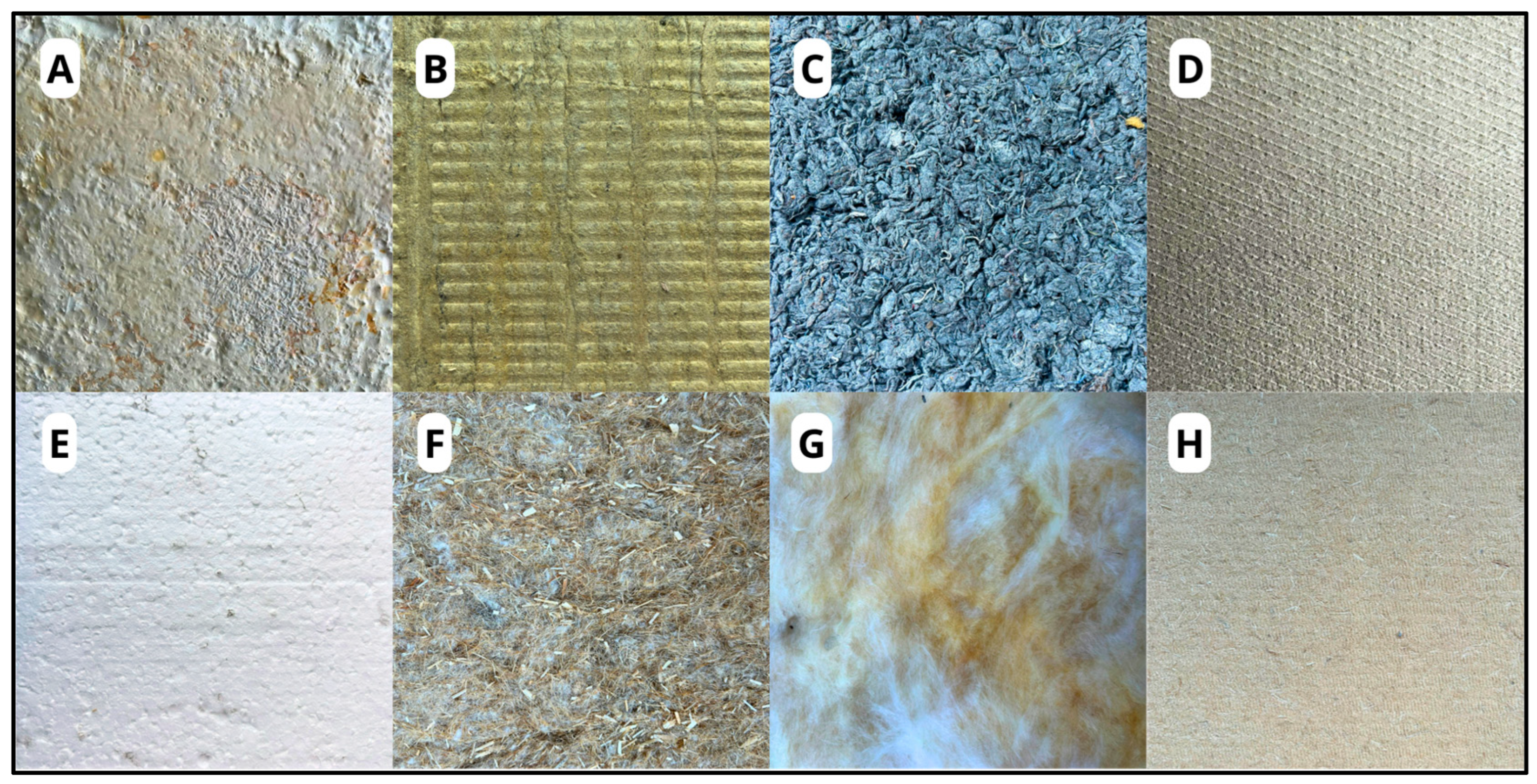
- Mycelium-Based Biocomposite (MBB): A mycelium-based thermal insulation from industrial waste wood (Kronospan, Jihlava, Czech Republic) bonded by Ganoderma sessile (Boston edison, Terrestrial fungi, Portland, OR, USA) in 3 biological replications.
- Recycled cotton fibers insulation panel (RC): origin EN-TEX (Enroll CZ, Nová Ves, Czech Republic), obtained from study [11].
- HempWool insulation board (HW): HempWool low density batt (Hempitecture Inc., Jerome, AZ, USA).
- Wood Fiberboard (FB): standard commercial grade, STEICO therm dry (STEICO SE, Feldkirchen, Germany).
- Mineral Wool (MW): standard commercial grade, Isover Topsil (Saint-Gobain, La Défense, France).
- Glass Wool (GW): standard commercial grade, Isover Domo Plus (Saint-Gobain, La Défense, France).
- Expanded Polystyrene Grey (EPS-G): standard commercial grade, Isover EPS GP 29 (Saint-Gobain, La Défense, France).
- Expanded Polystyrene (EPS): standard commercial grade, Isover EPS 70 F (Saint-Gobain, La Défense, France).
2.2. Production
2.3. Measurement
2.4. Calculation
2.5. Wall Composition
2.6. Statistical Analysis
2.7. Use of Artificial Intelligence Tools
3. Results
3.1. MBB Production
3.2. Thermo-Physical Characteristics
4. Discussion
5. Conclusions
- (1)
- MBB exhibits a thermal conductivity of λ = 0.0641 ± 0.0024 W·m−1·K−1, which is the highest among the tested insulation materials, consistent with its elevated bulk density (149.0 ± 9.4 kg·m−3) and within the literature range for mycelium-based composites [12]. Its thermal resistance performance is therefore best interpreted alongside its thermal inertia properties rather than against conventional low-density insulants alone.
- (2)
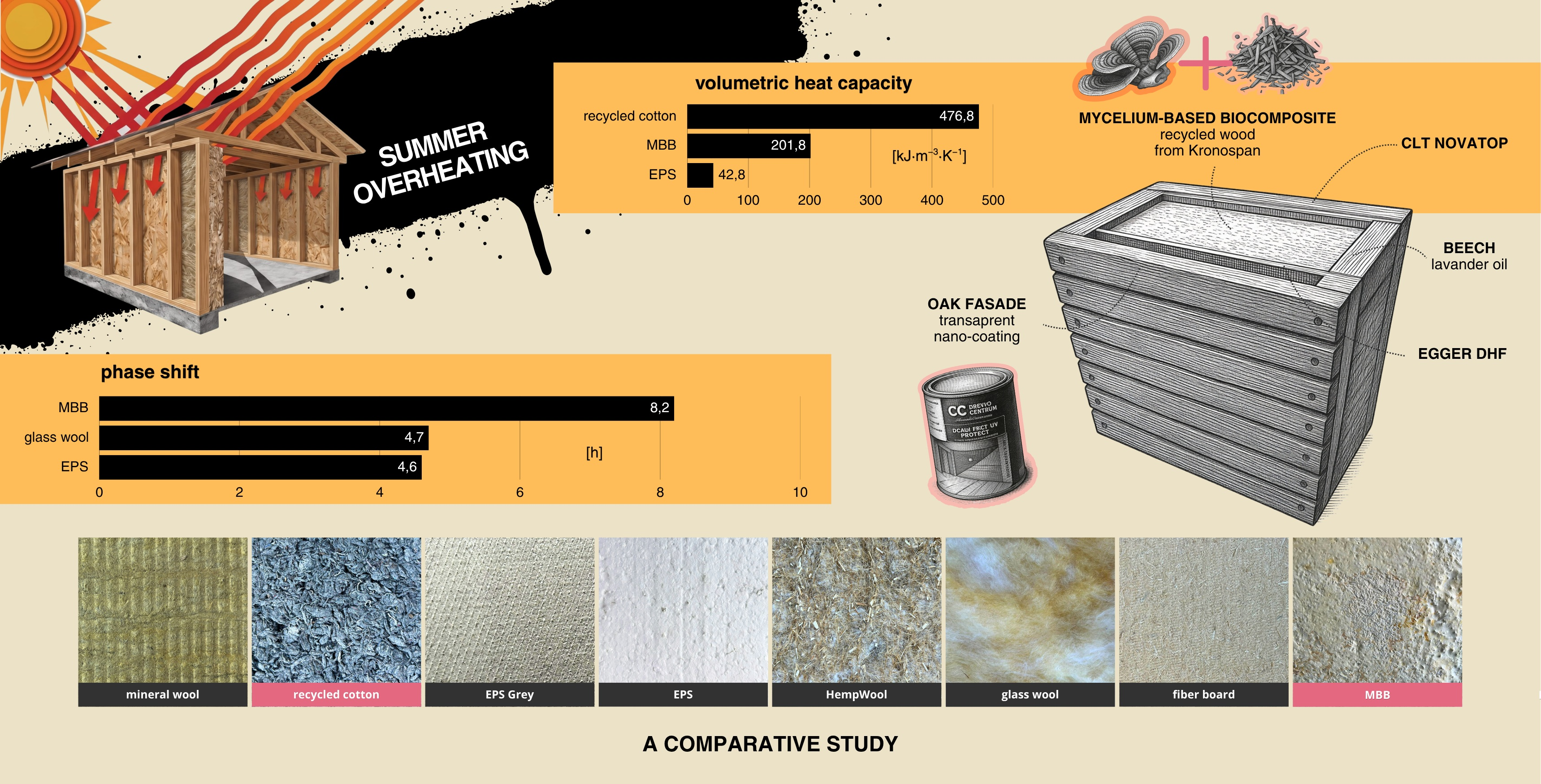
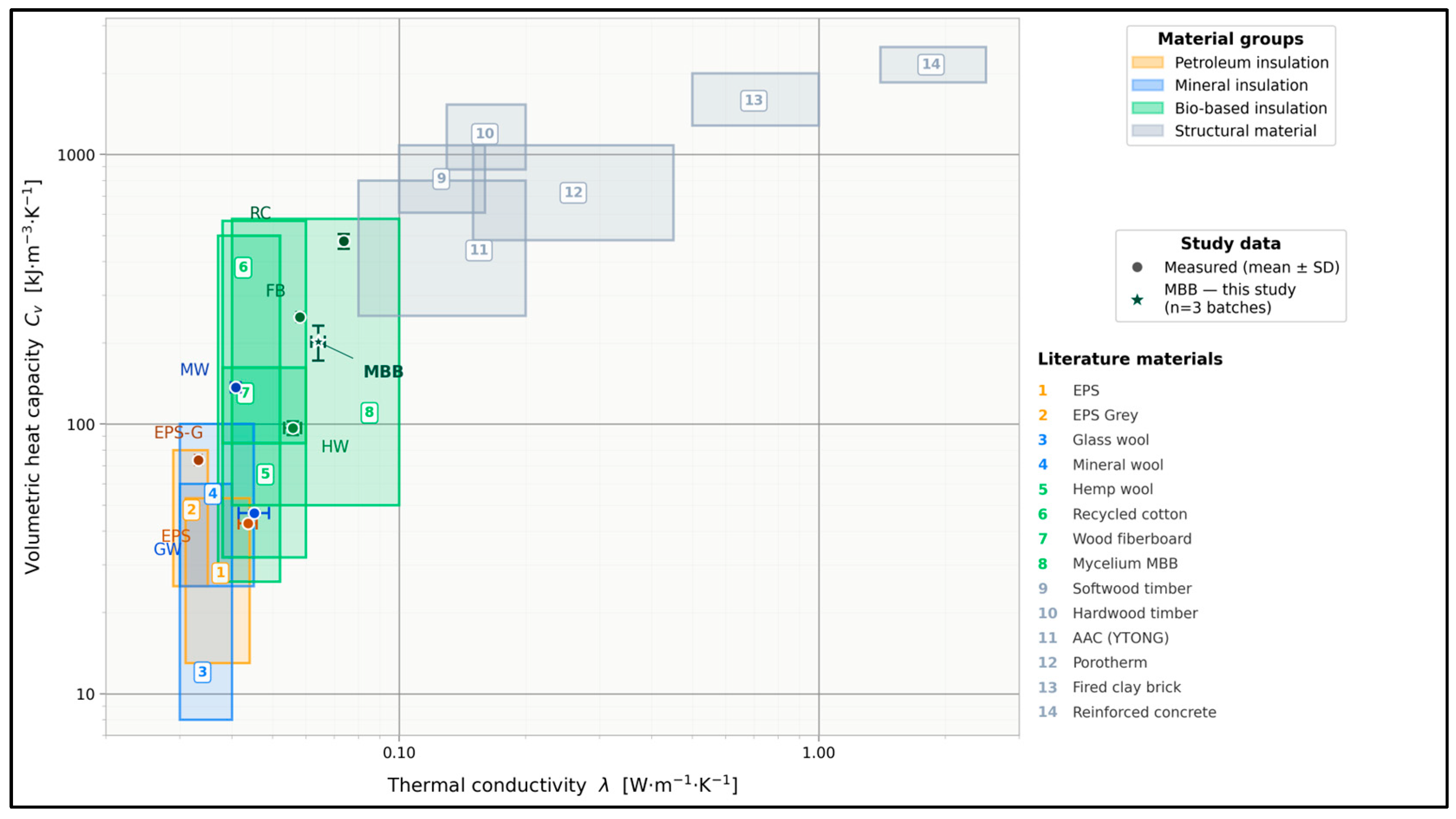
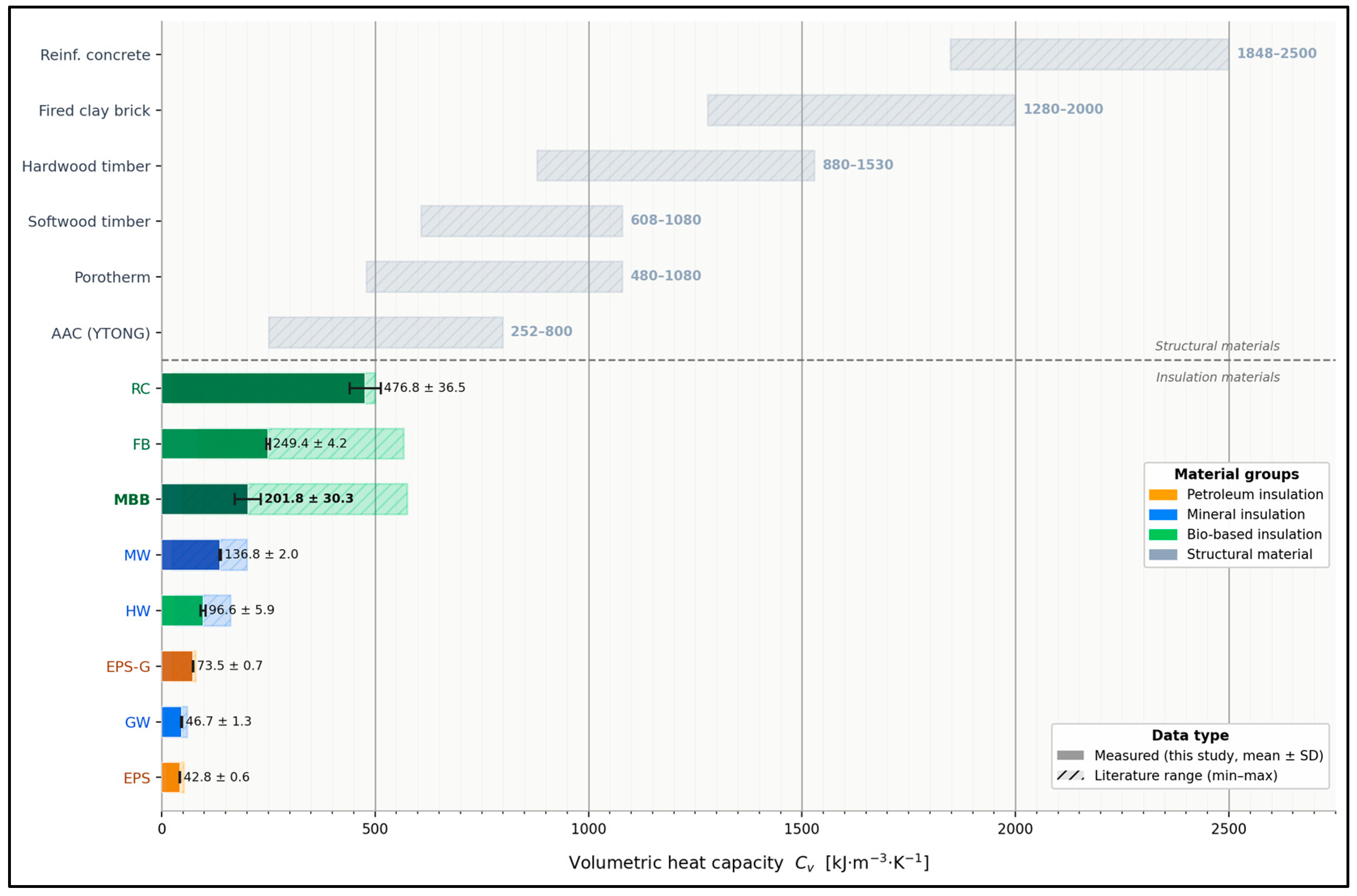
- The volumetric heat capacity of MBB (Cv = 201.8 ± 30.3 kJ·m−3·K−1) is 4.7 times higher than EPS, positioning MBB in the Ashby diagram between conventional insulation and structural bio-based material zones. While materials with similar thermo-physical behavior already exist in the form of dense bio-based insulations, the true novelty of MBB lies in its sustainable fabrication, achieving this dual-function position purely through natural mycelial growth on recycled industrial waste.
- (3)
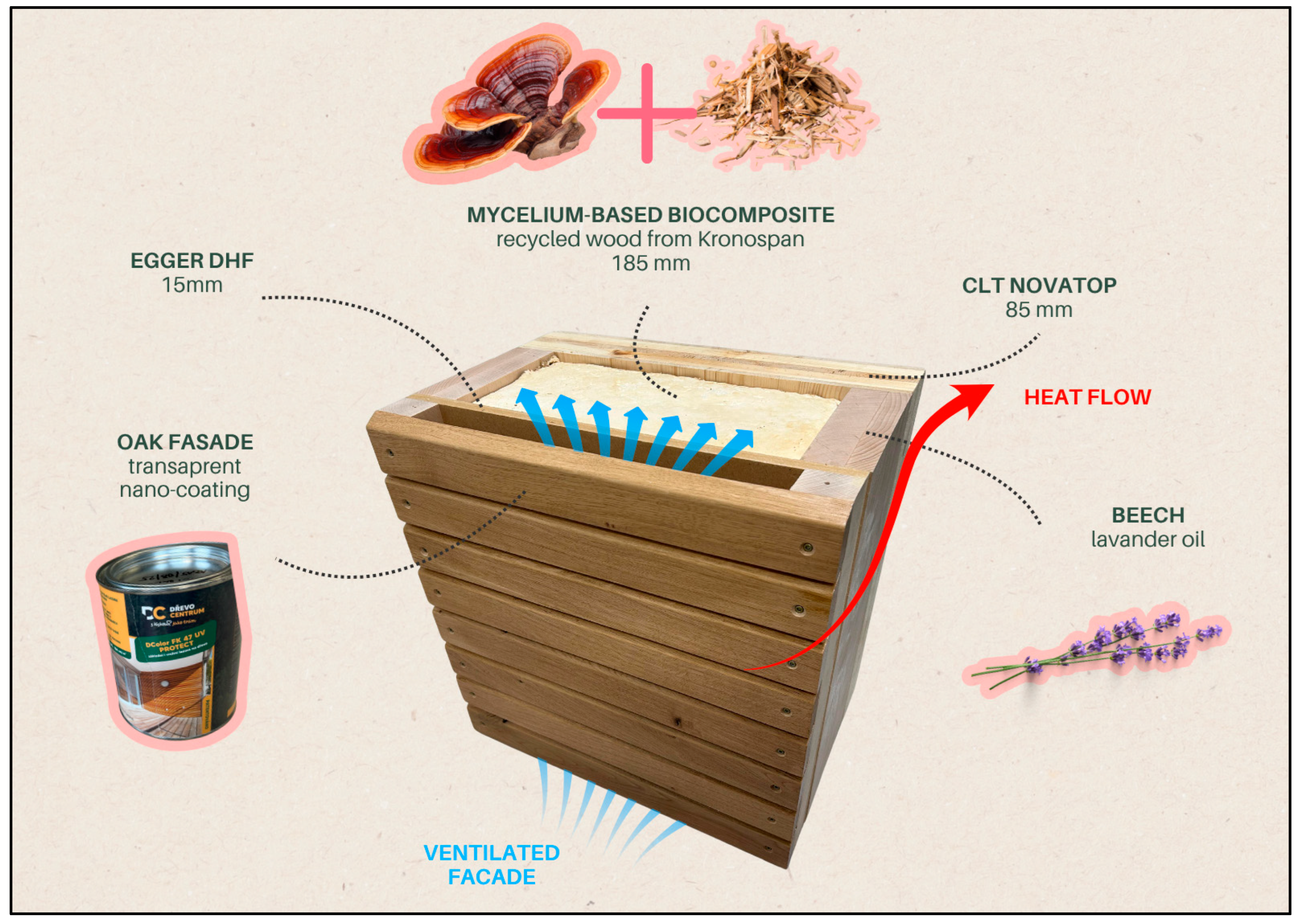
- At the design thickness of 185 mm, MBB achieves a thermal phase shift of 8.2 h, compared to 4.6 h for EPS. The additional 3.6 h delay in peak heat wave transmission supports passive thermal buffering and reduced peak cooling loads in summer overheating scenarios [36]. It should be noted that these phase shift values are derived from the simplified analytical approximation (Equation (2)) and serve as comparative indicators of relative material performance; they are not equivalent to dynamic wall performance assessments, which would require the transfer-matrix method of EN ISO 13786:2018 [25] applied to complete assemblies under dynamic climatic boundary conditions.
- (4)
- In a softwood timber frame wall assembly with 200 mm structural and 200 mm insulation layer thicknesses, the timber + MBB system achieves an areal heat capacity of κtotal = 156–262 kJ·m−2·K−1, representing a 1.8-fold improvement over the AAC (YTONG) + EPS baseline (59–169 kJ·m−2·K−1) and its upper range almost reaches that of fired clay brick + EPS.
Author Contributions
Funding
Data Availability Statement
Acknowledgments
Conflicts of Interest
Abbreviations
| AAC | Autoclaved aerated concrete |
| BES | Building energy simulation |
| CLT | Cross-laminated timber |
| Cv | Volumetric heat capacity [kJ·m−3·K−1] |
| c | Specific heat capacity [J·kg−1·K−1] |
| EPS | Expanded Polystyrene |
| EPS-G | Expanded Polystyrene Grey (graphite) |
| FB | Wood fiberboard |
| GW | Glass wool |
| HW | Hemp wool |
| ISOMET | Transient impulse heat-transfer analyser (Applied Precision Ltd.) |
| MBB | Mycelium-based biocomposite |
| MW | Mineral wool |
| RC | Recycled cotton insulation board |
| VHC | Volumetric heat capacity (alternative notation, see Cv) |
| YTONG | Brand name of autoclaved aerated concrete (Xella International) |
| α | Thermal diffusivity [m2·s−1] |
| λ | Thermal conductivity [W·m−1·K−1] |
| Φ | Thermal phase shift [radians] |
| τ | Thermal phase shift [hours] |
| ρ | Bulk density [kg·m−3] |
References
- Hanewinkel, M.; Cullmann, D.A.; Schelhaas, M.-J.; Nabuurs, G.-J.; Zimmermann, N.E. Climate Change May Cause Severe Loss in the Economic Value of European Forest Land. Nat. Clim. Change 2013, 3, 203–207. [Google Scholar] [CrossRef]
- Seidl, R.; Thom, D.; Kautz, M.; Martin-Benito, D.; Peltoniemi, M.; Vacchiano, G.; Wild, J.; Ascoli, D.; Petr, M.; Honkaniemi, J.; et al. Forest Disturbances under Climate Change. Nat. Clim. Change 2017, 7, 395–402. [Google Scholar] [CrossRef] [PubMed]
- Leuschner, C. Drought Response of European Beech (Fagus sylvatica L.)—A Review. Perspect. Plant Ecol. Evol. Syst. 2020, 47, 125576. [Google Scholar] [CrossRef]
- Schuldt, B.; Buras, A.; Arend, M.; Vitasse, Y.; Beierkuhnlein, C.; Damm, A.; Gharun, M.; Grams, T.E.E.; Hauck, M.; Hajek, P.; et al. A First Assessment of the Impact of the Extreme 2018 Summer Drought on Central European Forests. Basic Appl. Ecol. 2020, 45, 86–103. [Google Scholar] [CrossRef]
- Ehrhart, T.; Steiger, R.; Lehmann, M.; Frangi, A. European Beech (Fagus sylvatica L.) Glued Laminated Timber: Lamination Strength Grading, Production and Mechanical Properties. Eur. J. Wood Wood Prod. 2020, 78, 971–984. [Google Scholar] [CrossRef]
- Arriaga, F.; Wang, X.; Íñiguez-González, G.; Llana, D.F.; Esteban, M.; Niemz, P. Mechanical Properties of Wood: A Review. Forests 2023, 14, 1202. [Google Scholar] [CrossRef]
- De Araujo, V.; Aguiar, F.; Jardim, P.; Mascarenhas, F.; Marini, L.; Aquino, V.; Santos, H.; Panzera, T.; Lahr, F.; Christoforo, A.L. Is Cross-Laminated Timber (CLT) a Wood Panel, a Building, or a Construction System? A Systematic Review on Its Functions, Characteristics, Performances, and Applications. Forests 2023, 14, 264. [Google Scholar] [CrossRef]
- Plos, M.; Fortuna, B.; Šuligoj, T.; Turk, G. From Visual Grading and Dynamic Modulus of European Beech (Fagus sylvatica) Logs to Tensile Strength of Boards. Forests 2022, 13, 77. [Google Scholar] [CrossRef]
- Verbeke, S.; Audenaert, A. Thermal Inertia in Buildings: A Review of Impacts across Climate and Building Use. Renew. Sustain. Energy Rev. 2018, 82, 2300–2318. [Google Scholar] [CrossRef]
- Al-Homoud, M.S. Performance Characteristics and Practical Applications of Common Building Thermal Insulation Materials. Build. Environ. 2005, 40, 353–366. [Google Scholar] [CrossRef]
- Zachara, T.; Šedivka, P.; Borůvka, V.; Kubista, K.; Holeček, T.; Lexa, M.; Sahula, L.; Sikora, A. Cold-Pressed Insulation Boards from Recycled Cotton Fibers Using a Water-Borne PVAc–Starch Binder: Processing, Structure and Properties. Materials 2026, 19, 1097. [Google Scholar] [CrossRef] [PubMed]
- Jones, M.; Mautner, A.; Luenco, S.; Bismarck, A.; John, S. Engineered Mycelium Composite Construction Materials from Fungal Biorefineries: A Critical Review. Mater. Des. 2020, 187, 108397. [Google Scholar] [CrossRef]
- Mialeshka, V.; Kowaluk, G.; Pásztory, Z. Sustainable Insulation Panels Made of Tree Bark Fibers: Thermal and Fire Performance. Forests 2026, 17, 26. [Google Scholar] [CrossRef]
- Appels, F.V.W.; Camere, S.; Montalti, M.; Karana, E.; Jansen, K.M.B.; Dijksterhuis, J.; Krijgsheld, P.; Wösten, H.A.B. Fabrication Factors Influencing Mechanical, Moisture- and Water-Related Properties of Mycelium-Based Composites. Mater. Des. 2019, 161, 64–71. [Google Scholar] [CrossRef]
- Elsacker, E.; Vandelook, S.; Van Wylick, A.; Ruytinx, J.; De Laet, L.; Peeters, E. A comprehensive framework for the production of mycelium-based lignocellulosic composites. Sci. Total Environ. 2020, 725, 138431. [Google Scholar] [CrossRef] [PubMed]
- Haneef, M.; Ceseracciu, L.; Canale, C.; Bayer, I.S.; Heredia-Guerrero, J.A.; Athanassiou, A. Advanced materials from fungal mycelium: Fabrication and tuning of physical properties. Sci. Rep. 2017, 7, 41292. [Google Scholar] [CrossRef] [PubMed]
- Girometta, C.; Picco, A.M.; Baiguera, R.M.; Dondi, D.; Babbini, S.; Cartabia, M.; Pellegrini, M.; Savino, E. Physico-Mechanical and Thermodynamic Properties of Mycelium-Based Biocomposites: A Review. Sustainability 2019, 11, 281. [Google Scholar] [CrossRef]
- Elsacker, E.; Vandelook, S.; Brancart, J.; Peeters, E.; De Laet, L. Mechanical, Physical and Chemical Characterisation of Mycelium-Based Composites with Different Types of Lignocellulosic Substrates. PLoS ONE 2019, 14, e0213954. [Google Scholar] [CrossRef] [PubMed]
- Irbe, I.; Kirpluks, M.; Kampuss, M.; Andze, L.; Milbreta, U.; Filipova, I. Assessing the Conformity of Mycelium Biocomposites for Ecological Insulation Solutions. Materials 2024, 17, 6111. [Google Scholar] [CrossRef] [PubMed]
- Schiavoni, S.; D’Alessandro, F.; Bianchi, F.; Asdrubali, F. Insulation Materials for the Building Sector: A Review and Comparative Analysis. Renew. Sustain. Energy Rev. 2016, 62, 988–1011. [Google Scholar] [CrossRef]
- Giuffrida, G.; Caponetto, R.; Nocera, F. Hygrothermal Properties of Raw Earth Materials: A Literature Review. Sustainability 2019, 11, 5342. [Google Scholar] [CrossRef]
- Petržela, B.; Jozífek, M.; Richter, J.; Pavelek, M.; Hýsek, Š. Valorisation of Industrial Waste Wood in Mycelium-Based Biocomposites for Thermal Insulation: A Hygrothermal and Microstructural Analysis. Ind. Crops Prod. 2026, 246, 123411. [Google Scholar] [CrossRef]
- Hýsek, Š.; Petržela, B.; Jozífek, M.; Němec, M. Mycelium-Based Biocomposites as Key Enabling Technology in Industry 5.0: Application of Laser Cutting, 3D Scan, X-Ray CT Scan and AI-Based Prediction in Heat Insulation Industrial Production. Wood Mater. Sci. Eng. 2026, 1–9. [Google Scholar] [CrossRef]
- ASTM D5334-22; Standard Test Method for Determination of Thermal Conductivity of Soil and Rock by Thermal Needle Probe Procedure. ASTM International: West Conshohocken, PA, USA, 2022.
- ISO 13786:2017; Thermal Performance of Building Components—Dynamic Thermal Characteristics—Calculation Methods. International Organization for Standardization: Geneva, Switzerland, 2017.
- Carslaw, H.S.; Jaeger, J.C. Conduction of Heat in Solids, 2nd ed.; Oxford University Press: Oxford, UK, 1959. [Google Scholar]
- Dvořák, O.; Kvietková, M.S.; Šimůnková, K. The Influence of the Initial Treatment of Oak Wood on Increasing the Durability of Exterior Transparent Coating Systems. Polymers 2023, 15, 3251. [Google Scholar] [CrossRef] [PubMed]
- Pánek, M.; Dvořák, O.; Štěrbová, I.; Šimůnková, K.; Zeidler, A.; Šedivka, P. Oak Wood-Based Material with Extended Colour Stability for Exterior Wooden Structures. CZ Patent No. 309 200 B6, 11 May 2022. [Google Scholar]
- Stazi, F.; Ulpiani, G.; Pergolini, M.; Di Perna, C. The Role of Areal Heat Capacity and Decrement Factor in Case of Hyper Insulated Buildings: An Experimental Study. Energy Build. 2018, 176, 310–324. [Google Scholar] [CrossRef]
- Glass, S.V.; Zelinka, S.L. Moisture Relations and Physical Properties of Wood. In Wood Handbook: Wood as an Engineering Material; Gen. Tech. Rep. FPL-GTR-190; U.S. Department of Agriculture, Forest Service, Forest Products Laboratory: Madison, WI, USA, 2010; Chapter 4. [Google Scholar]
- Kim, K.-H.; Jeon, S.-E.; Kim, J.-K.; Yang, S. An Experimental Study on Thermal Conductivity of Concrete. Cem. Concr. Res. 2003, 33, 363–371. [Google Scholar] [CrossRef]
- Narayanan, N.; Ramamurthy, K. Structure and Properties of Aerated Concrete: A Review. Cem. Concr. Compos. 2000, 22, 321–329. [Google Scholar] [CrossRef]
- EN ISO 10456:2007; Building Materials and Products—Hygrothermal Properties—Tabulated Design Values and Procedures for Determining Declared and Design Thermal Values. International Organization for Standardization: Geneva, Switzerland, 2007.
- Wildman, J.; Shea, A.; Walker, P.; Henk, D. Extrinsic and Intrinsic Determinants of Thermal Conductivity in Mycelium Composites. Build. Serv. Eng. Res. Technol. 2025, 46, 317–338. [Google Scholar] [CrossRef]
- Bonga, K.B.; Bertolacci, L.; Contardi, M.; Paul, U.C.; Zafar, M.S.; Mancini, G.; Marini, L.; Ceseracciu, L.; Fragouli, D.; Athanassiou, A. Mycelium Agrowaste-Bound Biocomposites as Thermal and Acoustic Insulation Materials in Building Construction. Macromol. Mater. Eng. 2024, 309, 2300449. [Google Scholar] [CrossRef]
- Kučzyński, T.; Staszczuk, A.; Ziembicki, P.; Paluszak, A. The Effect of the Thermal Mass of the Building Envelope on Summer Overheating of Dwellings in a Temperate Climate. Energies 2021, 14, 4117. [Google Scholar] [CrossRef]
- Ghazi Wakili, K.; Rädle, W.; Rohner, T. Measuring the Specific Heat Capacity of Thermal Insulation Materials Used in Buildings by Means of a Guarded Hot Plate Apparatus. Int. J. Thermophys. 2023, 44, 15. [Google Scholar] [CrossRef]
- ISO 12572:2016; Hygrothermal Performance of Building Materials and Products—Determination of Water Vapour Transmission Properties—Cup Method. International Organization for Standardization: Geneva, Switzerland, 2016.


| Sieve Size [mm] | 8 | 3.15 | 2 | 1.6 | 0.8 | 0.5 | 0.25 | 0 |
| Particles Share [%] | 0.01 | 2.54 | 26.78 | 17.78 | 48.40 | 4.41 | 0.31 | 0.25 |
| Replication | a [mm] | SH(a) [%] | b [mm] | SH(b) [%] | t [mm] | SH(t) [%] | m [kg] | ρ [kg·m−3] |
|---|---|---|---|---|---|---|---|---|
| 1 | 487.0 ± 0.4 | 2.6 ± 0.1 | 487.0 ± 0.7 | 2.6 ± 0.1 | 184.0 ± 0.7 | 8.0 ± 0.4 | 6.23 | 142.8 ± 0.6 |
| 2 | 488.0 ± 0.8 | 2.4 ± 0.2 | 488.0 ± 1.6 | 2.4 ± 0.3 | 185.0 ± 1.6 | 7.5 ± 0.8 | 7.04 | 159.8 ± 1.5 |
| 3 | 486.0 ± 1.6 | 2.8 ± 0.3 | 484.0 ± 1.3 | 3.2 ± 0.3 | 186.0 ± 1.0 | 7.0 ± 0.5 | 6.31 | 144.3 ± 1.0 |
| Abbrev. | ρ [kg·m−3] | λ [W·m−1·K−1] | Cv [kJ·m−3·K−1] | c [J·kg−1·K−1] | τ [h] | R185 [m2·K·W−1] |
|---|---|---|---|---|---|---|
| EPS | 13.1 ± 0.4 | 0.0436 ± 0.0022 | 42.8 ± 0.6 (a) | 3262 ± 116 | 4.6 ± 0.2 | 4.2 ±0.2 |
| EPS-G | 32.0 ± 1.1 | 0.0332 ± 0.0007 | 73.5 ± 0.7 (b) | 2300 ± 87 | 6.9 ± 0.2 | 5.6 ± 0.1 |
| GW | 17.2 ± 0.9 | 0.0452 ± 0.0040 | 46.7 ± 1.3 (a) | 2719 ± 172 | 4.7 ± 0.4 | 4.1 ± 0.4 |
| HW | 38.0 ± 2.3 | 0.0558 ± 0.0027 | 96.6 ± 5.9 (b) | 2548 ± 202 | 6.1 ± 0.5 | 3.3 ± 0.2 |
| MW | 62.8 ± 3.1 | 0.0408 ± 0.0012 | 136.8 ± 2.0 (c) | 2178 ± 32 | 8.4 ± 0.3 | 4.5 ± 0.1 |
| FB | 56.8 ± 4.0 | 0.0580 ± 0.0011 | 249.4 ± 4.2 (e) | 4409 ± 272 | 9.6 ± 0.2 | 3.2 ± 0.1 |
| MBB | 149.0 ± 7.7 | 0.0641 ± 0.0024 | 201.8 ± 30.3 (d) | 1351 ± 158 | 8.2 ± 1.3 | 2.9 ± 0.1 |
| RC | 300.0 ± 0.0 | 0.0738 ± 0.0003 | 476.8 ± 36.5 (f) | 1589 ± 122 | 11.7 ± 0.9 | 2.5 ± 0.0 |
| Wall System | Cv Structural (lit.) [kJ·m−3·K−1] | Cv Insulation [kJ·m−3·K−1] | κtotal [kJ·m−2·K−1] |
|---|---|---|---|
| Reinf. concrete + EPS | 1848–2500 | 42.8 ± 0.6 | 378–509 |
| Fired clay brick + EPS | 1280–2000 | 42.8 ± 0.6 | 264–409 |
| Softwood timber + RC | 608–1080 | 476.8 ± 36.5 | 211–319 |
| Softwood timber + MBB | 608–1080 | 201.8 ± 30.3 | 156–262 |
| Softwood timber + FB | 608–1080 | 249.4 ± 4.2 | 171–267 |
| Softwood timber + MW | 608–1080 | 136.8 ± 2.0 | 149–244 |
| Softwood timber + HW | 608–1080 | 96.6 ± 5.9 | 140–236 |
| Softwood timber + GW | 608–1080 | 46.7 ± 1.3 | 131–226 |
| AAC (YTONG) + EPS | 252–800 | 42.8 ± 0.6 | 59–169 |
Disclaimer/Publisher’s Note: The statements, opinions and data contained in all publications are solely those of the individual author(s) and contributor(s) and not of MDPI and/or the editor(s). MDPI and/or the editor(s) disclaim responsibility for any injury to people or property resulting from any ideas, methods, instructions or products referred to in the content. |
© 2026 by the authors. Licensee MDPI, Basel, Switzerland. This article is an open access article distributed under the terms and conditions of the Creative Commons Attribution (CC BY) license.
Share and Cite
Petržela, B.; Zachara, T.; Jozífek, M.; Pavelek, M.; Hýsek, Š. Enhanced Thermal Mass of Mycelium-Based Biocomposites for Timber Constructions: A Comparative Study. Forests 2026, 17, 763. https://doi.org/10.3390/f17070763
Petržela B, Zachara T, Jozífek M, Pavelek M, Hýsek Š. Enhanced Thermal Mass of Mycelium-Based Biocomposites for Timber Constructions: A Comparative Study. Forests. 2026; 17(7):763. https://doi.org/10.3390/f17070763
Chicago/Turabian StylePetržela, Benjamín, Tadeáš Zachara, Miroslav Jozífek, Miloš Pavelek, and Štěpán Hýsek. 2026. "Enhanced Thermal Mass of Mycelium-Based Biocomposites for Timber Constructions: A Comparative Study" Forests 17, no. 7: 763. https://doi.org/10.3390/f17070763
APA StylePetržela, B., Zachara, T., Jozífek, M., Pavelek, M., & Hýsek, Š. (2026). Enhanced Thermal Mass of Mycelium-Based Biocomposites for Timber Constructions: A Comparative Study. Forests, 17(7), 763. https://doi.org/10.3390/f17070763