Brief Report

Maximum Entropy Modeling Predicts Factors Influencing Ecological Suitability of the Plant Trillium camschatcense in Northeast China


1
School of Life Sciences, Changchun Normal University, Changchun 130032, China
2
Chuanying District Bureau of Agriculture and Rural Affairs, Changchun 132000, China
3
Jilin Provincial Institute of Land and Resources Survey and Planning, Changchun 130061, China
4
Bureau of Forestry and Grassland of Jilin Province, Changchun 130022, China
5
School of Life Sciences, Jilin Agricultural University, Changchun 130118, China
*
Author to whom correspondence should be addressed.
Forests 2026, 17(7), 764; https://doi.org/10.3390/f17070764
Submission received: 1 June 2026 / Revised: 24 June 2026 / Accepted: 26 June 2026 / Published: 29 June 2026
(This article belongs to the Section Forest Ecology and Management)

Abstract

Trillium camschatcense, a plant renowned for its ecological and medicinal value, is predominantly found in the temperate forests of East Asia. However, its habitat is increasingly threatened from climate change, habitat fragmentation, and intensified human activities. In this study, the Maxent (Maximum Entropy) model was used to assess the current ecological suitability of T. camschatcense based on historical climate data (1970–2000), and further simulate its potential distribution shifts under multiple future climate change scenarios to predict long-term habitat variation trends across northeast China. All modeling and spatial mapping analyses were performed using MaxEnt and ArcGIS 10.8.1 software. Drawing upon 93 known distribution points and 26 pertinent environmental variables covering climate, soil, and elevation, we built species distribution models for both present and future periods to pinpoint the crucial environmental factors influencing its distribution. Our findings revealed that elevation, soil nitrogen content, seasonal temperatures, annual precipitation, mean temperature during the coldest quarter, and mean diurnal temperature range were the primary factors influencing the distribution of T. camschatcense. Notably, highly suitable habitats were predominantly concentrated in Baishan City and the southwestern region of Yanbian Korean Autonomous Prefecture in Jilin Province. This insight offers valuable scientific guidance for the conservation planning, sustainable utilization, and potential introduction and cultivation of T. camschatcense. Furthermore, targeted conservation strategies can help identify climate refugia and protect climatically stable habitats for the long-term persistence and resilience of the species under continuous global warming.

1. Introduction

Trillium camschatcense, commonly known as White-flowered Trillium, is a rare medicinal plant belonging to the genus Trillium within the family Liliaceae. It has garnered significant attention due to its unique pharmacological properties and ecological functions. In traditional Chinese medicine, T. camschatcense has been widely used for its sedative, analgesic, hemostatic agent, and detoxifying properties [1,2]. With advances in modern pharmacological research, its potential values as an anti-tumor, anti-inflammatory, and anti-cardiac/cerebral ischemia agent have increasingly been recognized, further enhancing its medicinal value and market demand [3,4,5,6]. However, T. camschatcense is facing severe threat from environmental degradation and over exploitation. Its population is continuously declining, and its distribution is gradually shrinking, making it an endangered species [7,8,9]. To ensure the effective conservation of this plant, it is crucial to explore its ecological adaptability and potential distributional expansion. Therefore, a thorough understanding of its ecological requirements and ability to predict future distributional shifts under different climate scenarios are essential for developing effective conservation strategies for T. camschatcense.
As a widely used species distribution prediction model, the MaxEnt (Maximum Entropy) model has been applied extensively in ecology, conservation biology, and other fields due to its robust predictive power and accuracy. Its theoretical framework and algorithm framework were first proposed and verified in the early 2000s, laying a foundational basis for subsequent ecological applications [10,11]. Based on species occurrence records and environmental variable data, this model utilizes machine learning algorithms to predict the potential distribution range of species, providing a powerful tool for species conservation and management [12,13,14,15].
The theoretical foundation of the MaxEnt model is the Maximum Entropy Principle, which seeks the least biased probability distribution that satisfies all known environmental constraints derived from species occurrence records. It avoids adding extra subjective assumptions about species distribution beyond the provided environmental covariates, which eliminates artificial bias to the maximum extent. This unbiased characteristic underpins the strong predictive performance of the MaxEnt algorithm and explains its ability to reliably identify potential suitable habitats even when only limited species occurrence records are available. Although several studies have been conducted on T. camschatcense, most have focused on its chemical composition and pharmacological effects, while relatively little attention has been given to its ecological suitability and potential distribution under varying environmental conditions [16,17,18,19]. Maxent is particularly suitable for species like T. camschatcense, for which data may be unavailable or unreliable. Furthermore, the ability of the Maxent to incorporate complex interactions between environmental variables makes it a powerful tool for predicting future habitat suitability under changing climate conditions. Therefore, this study employs the MaxEnt model to assess the ecological adaptability of T. camschatcense and predict its potential distribution pattern under current climatic conditions.
In this context, the present study was conducted with three primary objectives: (1) to identify the key environmental variables that constrain the distribution of T. camschatcense; (2) to assess its current habitat suitability based on historical climate data (1970–2000); and (3) to project changes in habitat suitability under multiple Representative Concentration Pathway (RCP) climate scenarios for the mid-century (2041–2060) and late-century (2061–2080) periods, thereby systematically evaluating the potential impacts of climate change on the species. Through various evaluation methods such as contribution rate, jackknife test, and environmental factor response curves, we have conducted a thorough analysis of the potentially suitable range of T. camschatcense in Northeast China and identified key environmental factors that could influence its distribution [20]. Our analyses will help better understanding of interactions between T. camschatcense and its environment, as well its adaptability under various ecological conditions. To further visualize the potential distribution of T. camschatcense, we utilized ArcGIS 10.8.1 software to create detailed distribution prediction maps [21]. These maps will provide intuitive references for the sustainable utilization and production planning of T. camschatcense, as well as scientific bases for formulating wild germplasm resource protection strategies and reserve planning [22].

2. Materials and Methods

2.1. Distribution of T. camschatcense

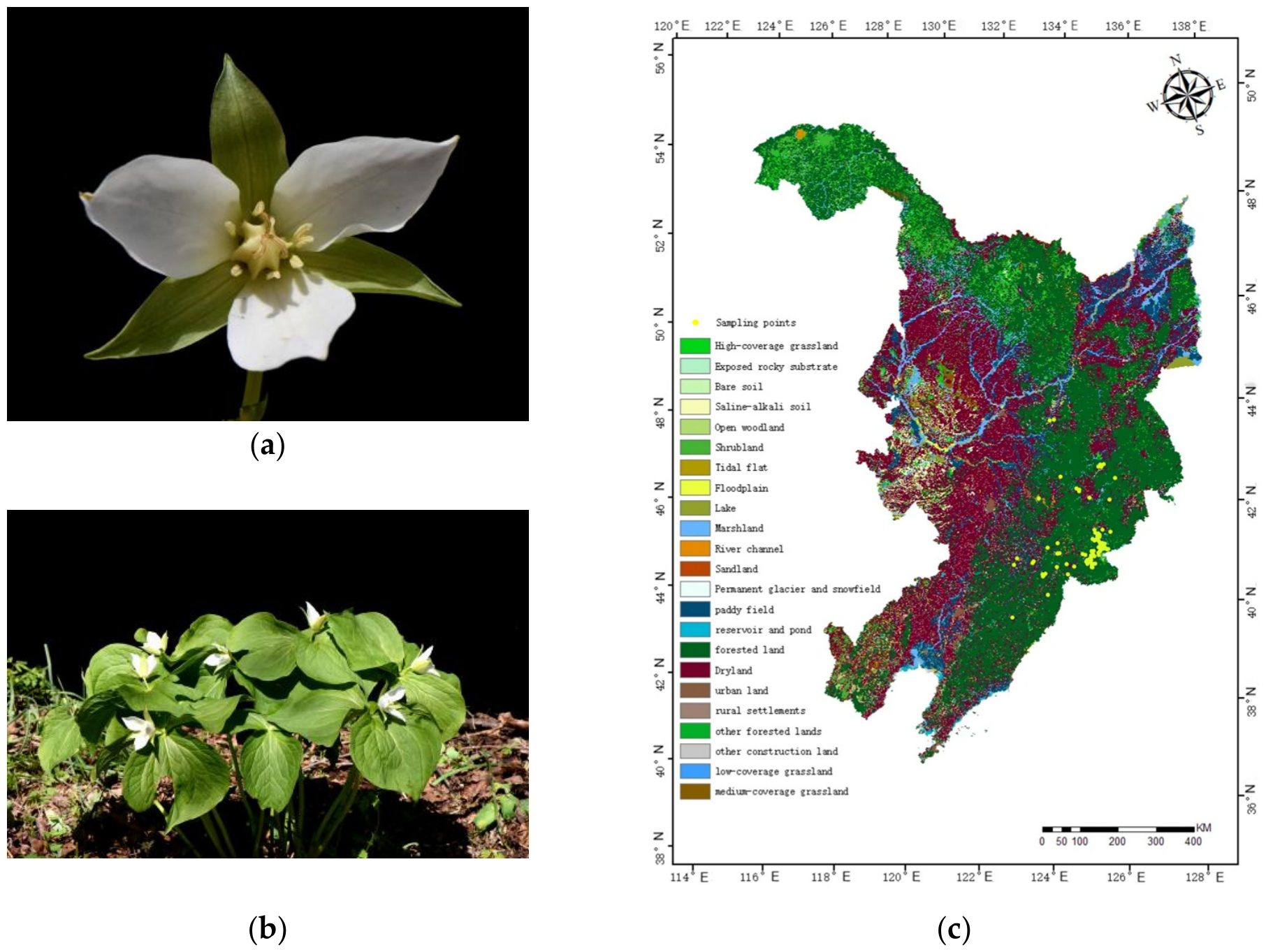
In May 2024, a field survey was conducted in the Changbai Mountain region of Jilin Province, identifying 17 distribution sites of T. camschatcense. In addition, 66 distribution sites were retrieved from the Chinese Virtual Herbarium (CVH). To ensure data comprehensiveness and accuracy, a thorough review of existing literature was performed and identified 10 additional sites. For certain locations that lack precise geographic coordinates, the latitude and longitude were determined based on land-use type data from the Resource and Environment Science and Data Platform (RESDC) and Google Earth. In total, 93 distribution sites were collected (Figure 1). Spatial thinning or filtering procedures were not performed on the 93 occurrence records prior to model construction. This conventional preprocessing step, which reduces spatial autocorrelation between adjacent sampling points, was omitted in the present study. The potential influence of this omission on model robustness will be discussed in the limitation section of this paper.

2.2. Environmental Data

In this study, comprehensive consideration was given to the various environmental parameters necessary for the growth of T. camschatcense, with reference to previous studies on ecological suitability. A total of 26 environmental factors were selected for analysis (Table 1). These comprised 19 bioclimatic variables obtained from the WorldClim global high-resolution climate data platform (https://www.worldclim.org; (accessed on 16 May 2026) 1970–2000), including annual mean temperature, mean temperature of the coldest quarter, and annual precipitation, as well as one elevation dataset with a spatial resolution of 30 arc-seconds (approximately 1 km). Additionally, 6 soil variables were sourced from the Big Data Platform for the Environmental Poles (http://poles.tpdc.ac.cn; (accessed on 16 May 2026) 2010–2018), with a horizontal spatial resolution of 90 m and a vertical soil layer depth of 0–5 cm [23,24].
To ensure uniform data processing and analysis, all raster data for the environmental factors were projected to the WGS1984 coordinate system using ArcGIS 10.8.1, SPSS 26.0 and MaxEnt 3.4.1 were adopted for subsequent statistical analysis and species distribution modeling, and the spatial resolution was adjusted to 1000 m × 1000 m to match the scale of the study area. To prevent multi-collinearity from causing overfitting in the model, the correlation analysis was conducted using SPSS, with a Pearson correlation coefficient threshold of 0.8 set to identify and exclude highly correlated factors. After removing highly correlated variables, further screening was performed based on the contribution of environmental variables in the initial MaxEnt model results and their ecological relevance. Through this process, 12 environmental parameters were ultimately retained based on their high contribution values, low intercorrelation, and significant ecological importance. Although Bio8 (Mean Temperature of Wettest Quarter), Bio9 (Mean Temperature of Driest Quarter), and Bio10 (Mean Temperature of Warmest Quarter) showed zero independent contribution in the preliminary single-factor test, they may generate interactive coupling effects with other seasonal temperature variables during model iteration, and jointly complete the full seasonal temperature gradient required to interpret species environmental response curves. Therefore, these three variables were retained in the final variable dataset. The final selection results are shown in Table 1.

2.3. MaxEnt Model Evaluation and Construction

The filtered distribution data on T. camschatcense and environmental factors were input into the MaxEnt (3.4.1, New York, NY, USA) for model reconstruction. Data were randomly partitioned, with 75% used as the training set to build the model and 25% as the test set to validate the model’s predictive performance. The model was set to run 10 repetitions, and the results were averaged. The default settings of the software were applied, with a maximum of 500 iterations and a convergence threshold of 0.00001. To calibrate the model, the Receiver Operating Characteristic (ROC) curve was used to evaluate predictive results, followed by an analysis of the Area Under the Curve (AUC) values to assess model accuracy. The predictive accuracy of the model increases as the AUC value approaches 1. An AUC value ≤ 0.6 indicates poor predictive performance and suggests that the model has limited discriminatory power, whereas an AUC value between 0.9 and 1.0 is generally considered indicative of excellent predictive accuracy and high model reliability. In addition, a jackknife test was used to evaluate the relative importance of each parameter. The probability of T. camschatcense presence in each potential distribution pixel was expressed as a value between 0 and 1, and based on this, habitat types were classified into four categories: unsuitable (p < 0.09), low suitability (0.09 ≤ p < 0.30), moderate suitability (0.30 ≤ p < 0.64), and high suitability (p ≥ 0.64) areas [25,26].

2.4. Future Climate Scenario Simulation

To assess the potential impact of climate change on suitable habitats of T. camschatcense, we adopted future climate layers from WorldClim, covering three representative concentration pathways (RCP2.6 low emission, RCP4.5 medium emission, RCP8.5 high emission). Two future periods (2041–2060 and 2061–2080) were selected to represent mid-term and long-term warming conditions. The same 12 screened environmental variables and identical MaxEnt parameter settings were applied to all current and future climate datasets to guarantee comparable suitability results across different time periods.

3. Results

3.1. Model Evaluation and Suitable Habitat Distribution

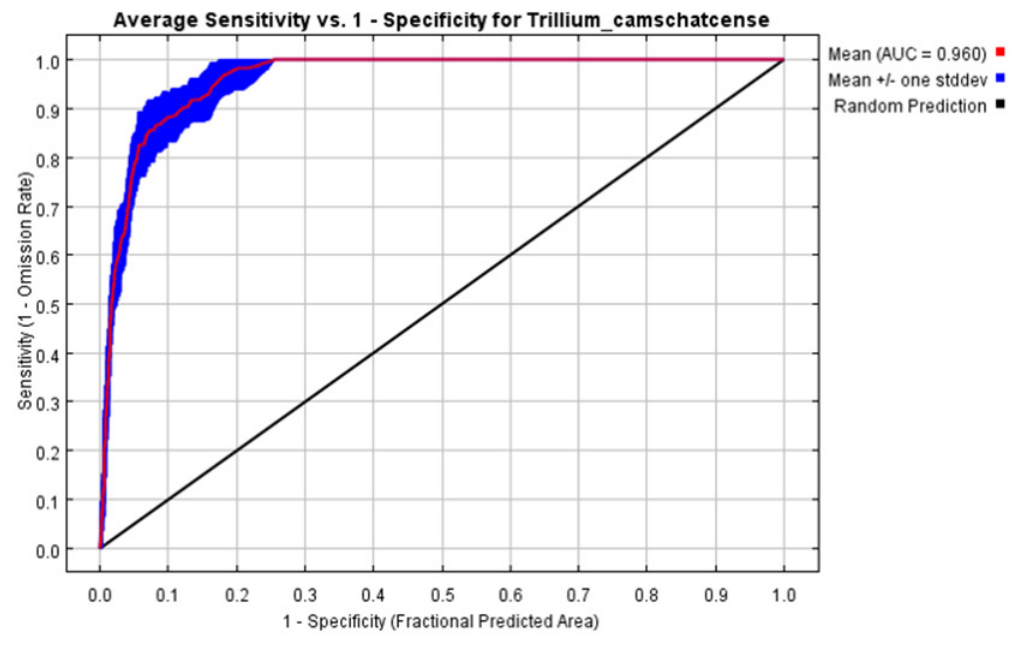
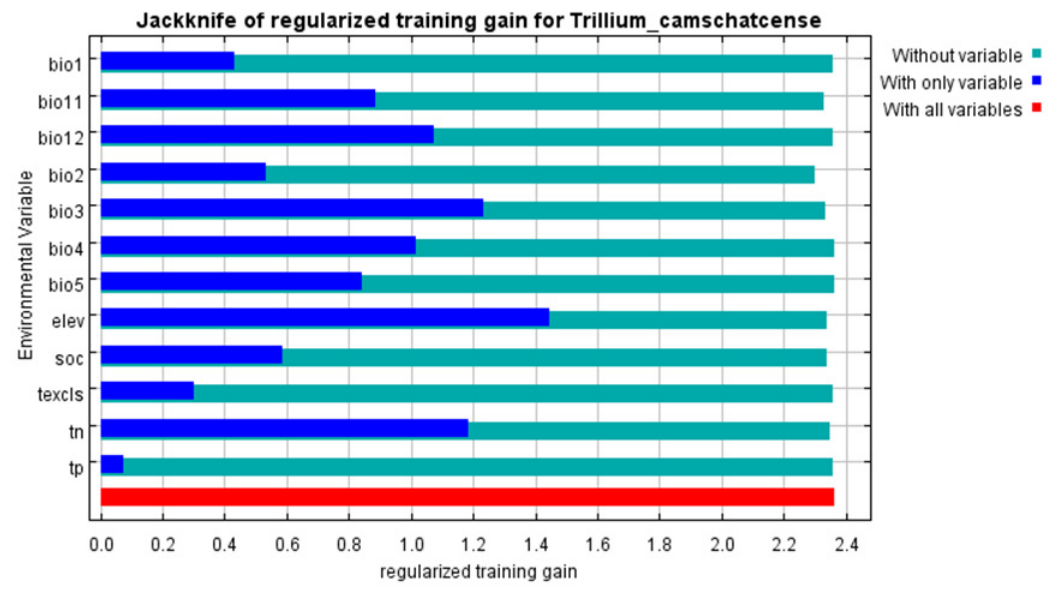
In our model, the mean AUC value of the training set was 0.96, with a standard deviation of 0.008, indicating that the model demonstrated good accuracy and reliability, thereby making it suitable for predicting the habitat of T. camschatcense (Figure 2). Using the jackknife test, we assessed the importance of each environmental variable in the model. Our results show that the variable “elev” (elevation) yielded the highest gain when used individually, indicating that it contributed the most to the predictions. On the other hand, removal of the variable “bio2” (monthly max temp–min temp) led to a significant decrease in model gain, suggesting that it provides important non-redundant information not shared in other variables. These results, averaged over multiple repetitions, effectively reflect the relative importance of each environmental variable in the model (Figure 3).
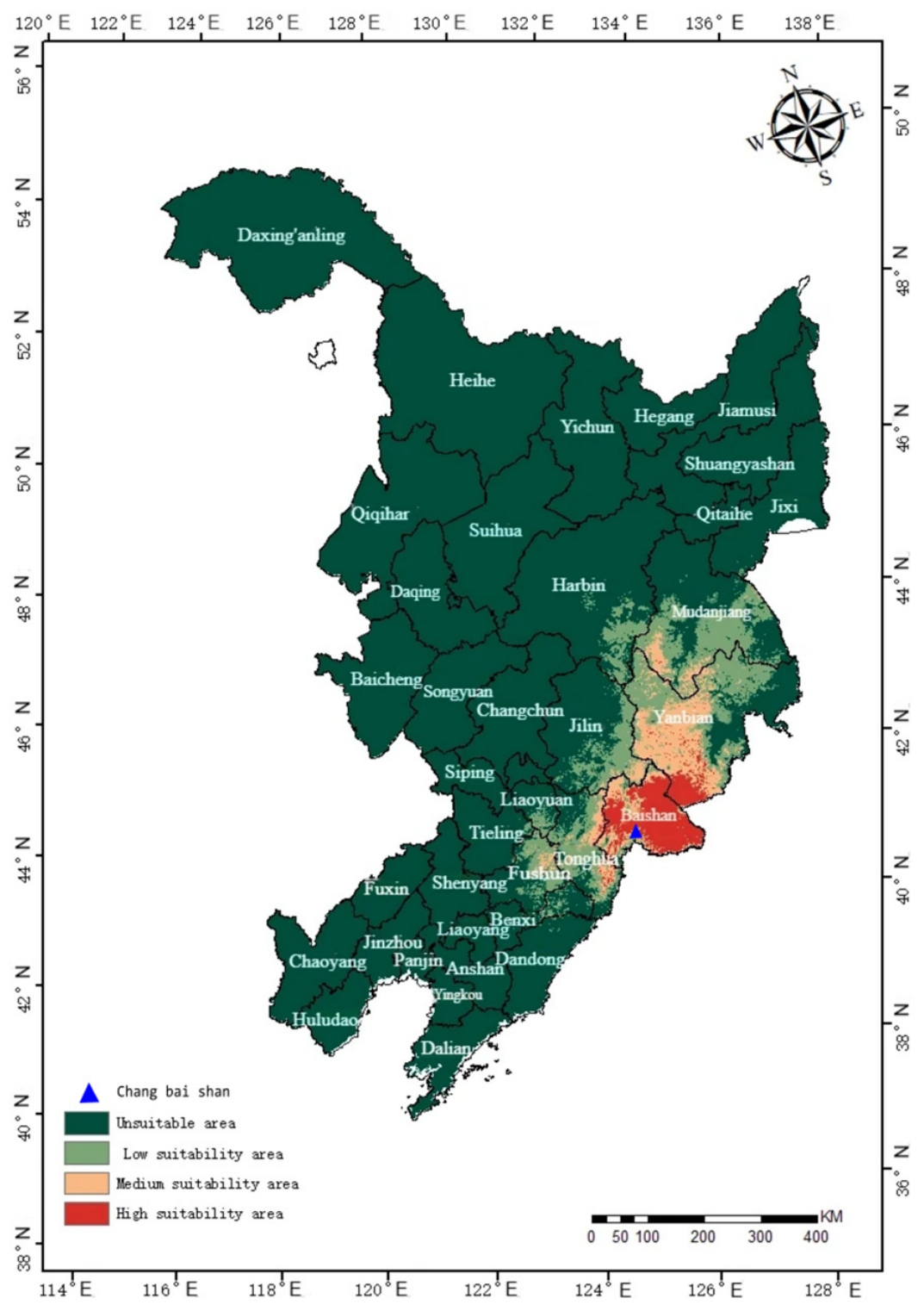
Based on the model results and overlaying the administrative divisions of the three northeastern provinces, we found that the suitable habitat for T. camschatcense is primarily distributed in Yanbian Korean Autonomous Prefecture, Baishan, Tonghua, Fushun, Liaoyuan, and Jilin Cities in Jilin Province; Tieling and Benxi Cities in Liaoning Province; and Harbin and Mudanjiang Cities in Heilongjiang Province. The highly suitable areas are mainly located in Baishan City and the southwestern part of Yanbian Korean Autonomous Prefecture, accounting for 15.54% of the total suitable habitat area (Figure 4). The extremely small proportion of high-suitability zones across the whole study area is comprehensively restricted by multiple strict environmental thresholds of T. camschatcense. Elevation emerged as the primary limiting factor, contributing up to 48.1% of the model gain, with suitable conditions largely confined to mountain valleys at elevations of 800–1200 m. Meanwhile, the species requires relatively high soil total nitrogen (N), specific seasonal temperature fluctuation, and moderate annual precipitation. However, few areas in Northeast China simultaneously satisfy all these stringent ecological requirements, resulting in extensive unsuitable habitats and only limited high-quality suitable areas.

3.2. Key Environmental Factors Affecting Habitat Distribution

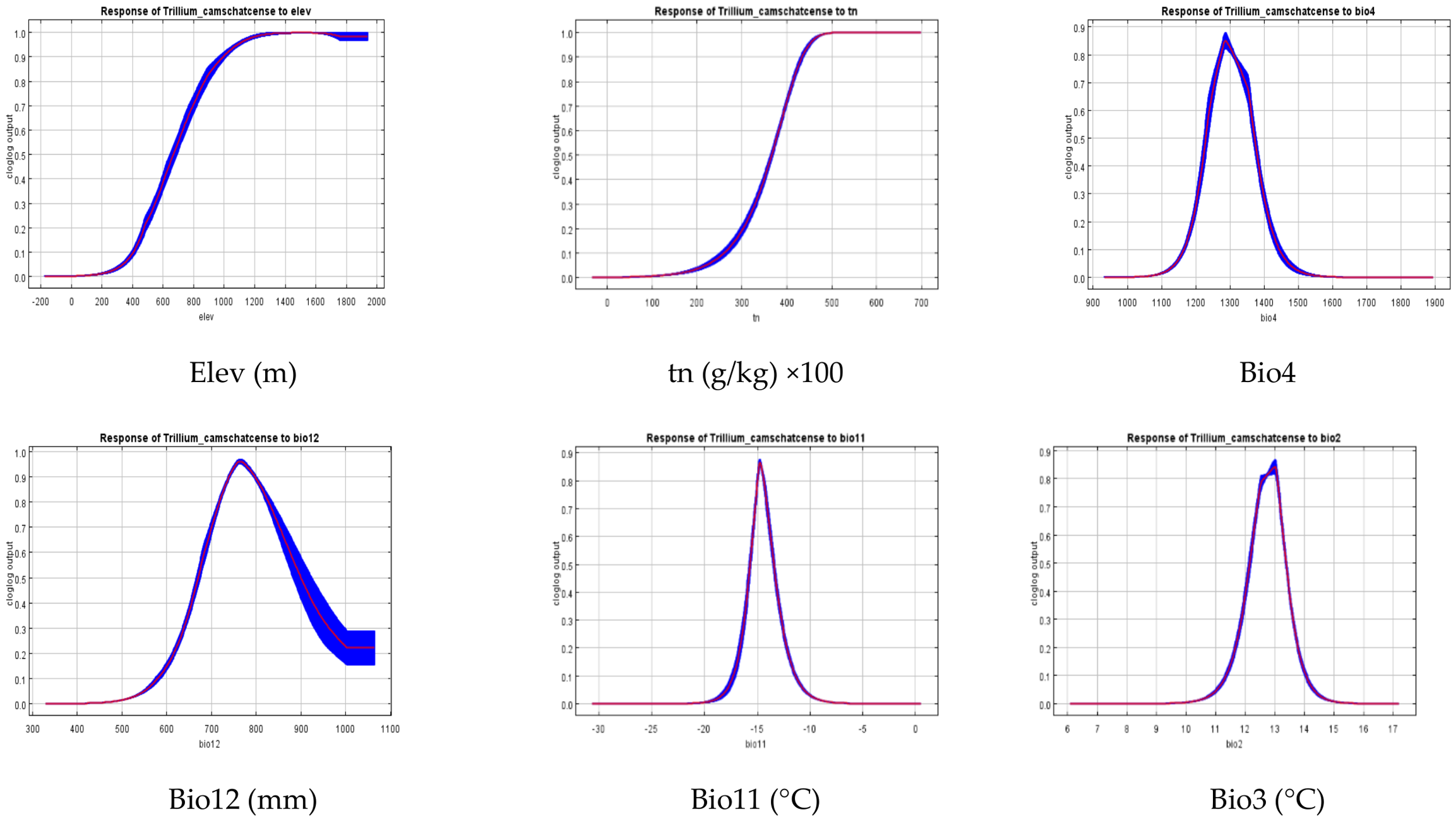
Among the 12 parameters used to build the model, elevation (elev, 48.1%), total soil N content (tn, 14%), temperature seasonality (Bio4, 9.2%), and annual precipitation (Bio12, 9.1%) had significant contributions. Meanwhile, the mean temperature of the coldest quarter (Bio11, 60.1%) and mean diurnal range (Bio2, 21.3%) showed high permutation importance. The cumulative contribution of these six parameters reached 91.8%, demonstrating their crucial role in the distribution of T. camschatcense (Table 2).
According to the response curves (Figure 5), two distinct curve types reflect different response patterns of T. camschatcense to environmental gradients. Elevation and soil total N exhibit sigmoidal (S-shaped) response curves, in which habitat suitability increases progressively and then stabilizes once environmental conditions surpass the species’ minimum tolerance thresholds. Beyond these thresholds, further increases in these variables do not lead to a decline in suitability, indicating a saturation effect in the species’ environmental response. In contrast, temperature seasonality, annual precipitation, mean temperature of the coldest quarter and mean diurnal range show peaked unimodal curves where habitat suitability increases to a single optimal peak within a moderate environmental range, then gradually declines as conditions deviate either above or below this optimum. The ideal elevation range is 800–1200 m, while the most suitable soil total N content exceeds 3.8 g/kg. Temperature seasonality ranges from 12.6 to 13.1, annual precipitation ranges from 685 to 760 mm, the mean temperature of the coldest quarter ranges from −14 to −15 °C, and the mean diurnal range is between 12 and 13 °C.

3.3. Habitat Suitability Shifts Under Future Climate Scenarios

Model outputs under three RCP scenarios revealed consistent trends in the spatial dynamics of suitable habitats of T. camschatcense. As climate warming intensifies, the total area of highly suitable habitats shows an overall declining trend, with suitable ranges progressively shifting toward higher-altitude mountainous regions in the southern Changbai Mountains. The loss amplitude of high-quality habitats rises significantly under the high-emission RCP8.5 scenario by 2061–2080, which implies that sustained warming will greatly compress the stable survival space of this medicinal plant.

4. Discussion and Conclusions

The Geographic Information System (GIS) and MaxEnt models were employed to identify the key environmental factors that influence the growth of T. camschatcense and to determine its suitable habitat. Through model analysis, six significant environmental variables affecting the distribution of T. camschatcense were identified: elevation, total soil N content, temperature seasonality, annual precipitation, mean temperature of the coldest quarter, and mean monthly diurnal temperature range. Among these, elevation was the dominant factor, contributing 48.1% to the overall distribution model, with the optimal elevation range identified as 800–1200 m. This suggests that T. camschatcense predominantly inhabits mid-altitude regions, likely favoring temperate or subalpine environments, where it tends to grow in forest understories, along forest edges, or in moist areas. These habitats provide temperatures that are neither excessively cold nor excessively hot, creating favorable conditions for its growth and persistence [27].
With respect to soil factors, the optimal soil N content for T. camschatcense was determined to be above 3.8 g/kg, suggesting that the species has a relatively high requirement for N-rich soils and may depend on elevated levels of available soil N for optimal growth and establishment. As a typical spring ephemeral herb of temperate broad-leaved understory within the genus Trillium, T. camschatcense completes its whole vegetative and reproductive cycle in the short snowmelt window before canopy closure. Consequently, an adequate supply of N derived from humus-rich soils is critical for rapid leaf expansion, rhizome nutrient accumulation and seed development reflecting the high nutrient demands characteristics of this genus [28]. General principles of plant nutrition can provide only a broad ecological context, while the strong N limitation observed in our model matches the habitat preference of other congeneric Trillium species that rely on thick forest humus layers [29,30]. This strict threshold of high soil N restricts the natural population distribution of T. camschatcense to mountain valleys with accumulated litter decomposition products [31].
T. camschatcense prefers a temperature seasonality index between 12.6 and 13.1, indicating adaptation to temperate climates with distinct seasonal changes. The plant’s life cycle is likely characterized by winter dormancy, spring regeneration, summer growth, and autumn maturation, a pattern that supports its stable growth and reproduction in areas with marked seasonal variations [32]. The mean temperature of the coldest quarter suitable for T. camschatcense was found to be between −14 °C and −15 °C, highlighting its exceptional cold tolerance. While many plants experience inhibited growth and metabolic activity under such low temperatures, T. camschatcense is capable of maintaining stable physiological processes under such conditions, demonstrating its remarkable adaptation to cold environments and its unique ecological resilience [33]. Its main growth and reproductive activities likely occur during relatively mild months, particularly in seasons free from severe cold. In addition, T. camschatcense thrives in areas where the mean monthly diurnal temperature range is approximately 12–13 °C, a condition typically observed in temperate and subalpine regions. In these areas, large day-to-night temperature differences facilitate nutrient conversion and sugar accumulation, while regulating photosynthesis and respiration [34]. Such conditions may enable T. camschatcense to utilize nutrients more efficiently, leading to enhanced energy reserves for growth and reproduction.
Regarding moisture conditions, T. camschatcense exhibited highest habitat suitability in areas receiving annual precipitation between 685 and 760 mm, a range considered moderate to slightly high for many co-occurring species. This precipitation range reflects a relatively stable, moist environment. Morphological anatomy data of roots from congeneric Trillium tschonoskii showed sparse root hairs and loose epidermal cell arrangement in mature roots. Although its thick primary roots enhance water storage capacity, the limited development of fine roots reduces the effective root–soil contact area, thereby constraining the efficiency of water and nutrient uptake. This root architecture suggests a greater dependence on consistently moist and nutrient-rich soil conditions for optimal growth and survival. It should be noted that such root anatomical traits were only documented for T. tschonoskii, and there are no existing morphological records specifically targeting underground organs of T. camschatcense. Inter-specific morphological divergence widely exists within genus Trillium, so the inference of weak water absorption capacity for T. camschatcense based on this conspecific reference has certain uncertainty. Combined with our precipitation suitability response curve, we preliminarily deduce that this species relies on stable continuous soil moisture supply in mountain valleys.
In terms of geographic distribution, the suitable habitat for T. camschatcense primarily spans areas such as Yanbian Korean Autonomous Prefecture, Baishan, Tonghua, Fushun, Liaoyuan, and Jilin Cities in Jilin Province, as well as Tieling and Benxi Cities in Liaoning Province, and Harbin and Mudanjiang Cities in Heilongjiang Province. Highly suitable habitats are mainly concentrated within the administrative scope of Baishan City and the southwestern part of Yanbian Korean Autonomous Prefecture in Jilin Province. It is critical to clarify that these high-suitability zones do not correspond to urban built-up areas within cities. Administratively, Baishan and Tonghua are mountainous cities dominated by forested mountain valleys, with forest coverage exceeding 70% across their whole territories. The high soil N content required by T. camschatcense originates from thick humus layers of natural mountain forest soils in valley habitats, rather than artificial N input from urban construction or human activities. These mountain valleys within municipal administrative boundaries perfectly match the optimal altitude range (800–1200 m) and soil nutrient thresholds of the species, which explains the concentration of high-suitability areas in these municipal territories. This distribution pattern correlates closely with the geographical and climatic characteristics of the Changbai Mountain range, a typical temperate mountain ecosystem. The altitude gradient, climatic diversity, and nutrient rich soil types of this region provide ideal growing conditions for T. camschatcense.
Our joint simulation of current and future habitat suitability clearly proves that climate warming is likely to impose substantial constraints on the distribution and persistence of T. camschatcense. This species owns a narrow ecological niche with strict thresholds of elevation, temperature and soil N, making it highly sensitive to temperature rise. Under low-, medium-, and high-emission scenarios, the extent of highly suitable habitats for T. camschatcense is projected to decline progressively, with these habitats increasingly shifting toward cooler, higher-elevation mountain valleys within the Changbai Mountain range. From a conservation perspective, the mountain valleys of Baishan City and southwest Yanbian Korean Autonomous Prefecture should be recognized as priority climate refugia for T. camschatcense. These areas are expected to retain suitable environmental conditions under future climate scenarios and may serve as critical refuges for the species’ long-term persistence. Therefore, targeted in situ protection measures need to be implemented to reduce the adverse impacts of climate warming on wild populations and enhance their resilience to future environmental change.
One limitation of this research lies in the preprocessing of species occurrence data. Spatial thinning was not applied to eliminate spatial autocorrelation of the 93 distribution points before MaxEnt modeling. Closely clustered sampling points may lead to repeated sampling of identical environmental conditions, which could slightly overestimate model performance and weaken the generalization ability of prediction results. Further optimization can be achieved via point spatial filtering in follow-up related research.
In summary, the growth and distribution of T. camschatcense are influenced by a combination of environmental factors, including mid-altitude, high soil N content, a temperate climate with distinct seasons, and moderate-to-high annual precipitation. These factors define the plant’s ecological niche, enabling it to thrive in regions such as the Changbai Mountain range. However, these specific environmental requirements also restrict the ecological niche of T. camschatcense to relatively narrow areas. For instance, its stringent requirements for elevation and N-rich soil limit its growth to mid-altitude regions with sufficient N levels, thereby restricting its overall distribution. While temperate climates with distinct seasons provide favorable conditions, they also limit its growth cycle to specific seasons. Furthermore, its preference for moderate-to-high annual precipitation suggests that T. camschatcense may face growth constraints in areas with lower rainfall, reflecting a sensitivity to water limitation that further narrows its distribution. These combined environmental factors contribute to the rarity and uniqueness of T. camschatcense.
In the context of ongoing global climate change and intensifying human activities, the growing recognition of the medicinal value of T. camschatcense has substantially increased market demand for the species. Consequently, wild populations have been subjected to extensive and often illegal harvesting, placing additional pressure on their survival and exacerbating the threats posed by habitat degradation and climate change. This has led to substantial habitat degradation and a pronounced decline in natural populations of T. camschatcense. Given this situation, further research into the ecological suitability of T. camschatcense is urgently needed. However, current studies in this area remain insufficient, highlighting the importance and timeliness of our research. By elucidating the key environmental factors governing its distribution and predicting potential habitat shifts under future climate scenarios, this study fills an important knowledge gap and provides a scientific basis for the conservation, sustainable utilization, of T. camschatcense. The findings will support evidence-based management strategies and contribute to the long-term persistence and sustainable development of this valuable medicinal plant species.

Author Contributions

Conceptualization, Z.L. and H.J.; methodology, Z.L. and P.D.; validation, D.S., S.Y. and Q.Y.; formal analysis, P.D.; investigation, H.Y., H.L. and Y.W.; resources, D.S.; data curation, P.D. and S.L.; writing—original draft preparation, P.D.; writing—review and editing, Z.L. and H.J.; visualization, P.D.; supervision, Z.L.; project administration, Z.L.; funding acquisition, Z.L. All authors have read and agreed to the published version of the manuscript.

Funding

This Research was Supported by the Science and Technology Development Plan Project of Jilin Province, China (Grant No.20220204015YY), the Natural Science Foundation of Changchun Normal University (Development of Science and Technology Backyards), and Horizontal Research Project (Grant No. Heng20250045).

Data Availability Statement

The original data presented in this study are available on request from the corresponding author.

Conflicts of Interest

The authors declare no conflicts of interest.

References

  1. Xie, W.Z. Compendium of Chinese Herbal Medicine, 2nd ed.; People’s Medical Publishing House: Beijing, China, 2000; Volume 1, pp. 225–226. [Google Scholar]
  2. Zhou, Y. Flora Resources of Changbai Mountain, China; China Forestry Publishing House: Beijing, China, 2009. [Google Scholar]
  3. Chen, L.L.; Li, Z.L.; Wan, D.F.; Cao, W.F.; Zuo, Y.M.; Zhang, Z.L. Protective effect of Dioscorea opposita saponins on focal cerebral ischemia/reperfusion injury in rats. Chin. J. Geriatr. 2020, 40, 5013–5017. [Google Scholar]
  4. Li, S.Q.; Hu, F.; Wen, A.; Zhang, Z.L.; Zuo, Y.M.; Wang, Y.F. Study on effective components of Dioscorea opposita saponins against acute myocardial ischemia in rats. J. Jiangxi Univ. Tradit. Chin. Med. 2021, 33, 89–93. [Google Scholar]
  5. Ruan, S.Y. Mechanism Study of Dioscorea opposita Saponins Inhibiting MG-63 Osteosarcoma Progression. Master’s Thesis, Hubei University of Medicine, Shiyan, China, 2023. [Google Scholar] [CrossRef]
  6. Zhang, Z.L.; Zuo, Y.M. Application of Total Saponins of Dioscorea opposita and Its Steroid Saponins in the Preparation of Drugs for Ulcerative Colitis. Chinese Patent CN109575102A, 5 April 2019. [Google Scholar]
  7. Liu, J.Y.; Shao, C.; Zhang, H.; Qu, Z.Y. Investigation of endangered medicinal plant Trillium camschatcense resources in Jiaohe City, Jilin Province. Chin. For. Prod. Spec. 2014, 29, 73–75. [Google Scholar] [CrossRef]
  8. Shao, Z.W.; Jin, X.; Zhang, Y.G. Distribution characteristics and conservation development significance of Dioscorea opposita in Wangqing County, Jilin Province. Spec. Econ. Anim. Plants 2018, 21, 37–38. [Google Scholar]
  9. Wang, Y.; Guo, Q.F.; Jin, Y.Z. Resource status, existing problems, and conservation suggestions for the medicinal plant Dioscorea opposita. Spec. Econ. Anim. Plants 2020, 23, 37–38+46. [Google Scholar]
  10. Phillips, S.J.; Dudík, M.; Schapire, R.E. A Maximum Entropy Approach to Species Distribution Modeling. In Proceedings of the 21st International Conference on Machine Learning, Banff, AB, Canada, 4–8 July 2004; ACM: New York, NY, USA, 2004. [Google Scholar]
  11. Phillips, S.J.; Anderson, R.P.; Schapire, R.E. Maximum Entropy Modeling of Species Geographic Distributions. Ecol. Model. 2006, 190, 231–259. [Google Scholar] [CrossRef]
  12. Li, Z.G.; Ruan, F.Y.; Zhang, X.Q. Research on the potential suitable habitat of macadamia under climate change scenarios based on Maxent model. For. Surv. Plan. 2024, 49, 191–197. [Google Scholar]
  13. Wang, S.T.; Guo, Y.B.; Zhu, C.H.; Zhang, Y.F.; Zhou, J.G. Research on the production zoning of Tianma based on Maxent model. World J. Tradit. Chin. Med. 2024, 19, 763–772+779. [Google Scholar]
  14. Li, X.P. Analysis of Steroid Saponins in Dioscorea opposita and Study on the Immunological Activity of Its Extracts. Doctoral Dissertation, Chinese Academy of Agricultural Sciences, Beijing, China, 2018. [Google Scholar]
  15. Li, X.P.; Zhang, Y.Y.; Zhao, L.C.; Zhang, C.G.; Liu, J.Y. Study on the extraction process of saponin VII from Dioscorea opposita using orthogonal experiments. Spec. Prod. Res. 2019, 41, 1–5. [Google Scholar] [CrossRef]
  16. Xu, X.Q.; Lu, Y.Y.; Zhu, Y.; Zhu, H.; Zheng, Q.X.; Jin, L. Ecological suitability study of Scutellaria baicalensis based on Maxent model in China. Chin. J. Tradit. Chin. Med. Inf. 2024, 31, 1–5. [Google Scholar] [CrossRef]
  17. Yang, L.W.; Zhang, Y.Y.; Yang, Z.; Zhong, Z.Y.; Bai, J.D.; Sang, W.G. Analysis and conservation strategies for the potential habitat of Elaphurus davidianus based on Maxent model. J. Ecol. 2024, 43, 2539–2550. [Google Scholar]
  18. Luo, J.; Zhao, H.; Chen, X.; Chu, H.J.; Liu, J.Y. GC-MS analysis of fatty acids in Trillium camschatcense roots at different harvesting times. Chin. For. Prod. Spec. 2015, 30, 16–20. [Google Scholar] [CrossRef]
  19. Wang, Y.F.; Zhao, H.; Jin, C.A.; Luo, J.; Liu, J.Y. Dynamic determination of two chemical components in Dioscorea opposita by UPLC-PDA. Spec. Prod. Res. 2015, 37, 32–35. [Google Scholar] [CrossRef]
  20. Fan, J.T.; Feng, Z.P.; Ma, S.W.; Chen, X.J.; Yu, W. Seasonal distribution and key environmental factor selection of Sepia esculenta habitats based on MaxEnt model. Mar. Fish 2023, 45, 412–422. [Google Scholar]
  21. Chang, Y.; Li, Y.J.; Li, Z.X.; Han, H.Y.; Shi, J.M.; Li, L.T. Prediction of suitable growth areas for Canada goldenrod based on Maxent and ArcGIS. J. Agric. Sci. 2024, 14, 40–47. [Google Scholar]
  22. Kong, F.; Tang, L.; He, H.; Yang, F.; Tao, J.; Wang, W. Assessing the impact of climate change on the distribution of Osmanthus fragrans using Maxent. Environ. Sci. Pollut. Res. 2021, 28, 34655–34663. [Google Scholar] [CrossRef]
  23. Liu, F.; Wu, H.; Zhao, Y.; Li, D.; Yang, J.L.; Song, X.; Shi, Z.; Zhu, A.X.; Zhang, G.L. Mapping high resolution National Soil Information Grids of China. Sci. Bull. 2022, 67, 328–340. [Google Scholar] [CrossRef]
  24. Liu, F.; Zhang, G.L.; Song, X.D.; Li, D.C.; Zhao, Y.G.; Yang, J.L.; Wu, H.Y.; Yang, F. High-resolution and three-dimensional mapping of soil texture of China. Geoderma 2020, 361, 114061. [Google Scholar]
  25. Guo, X.D.; Xi, S.Y.; Yang, L.P.; Ji, J.; Ma, X.H.; Jin, L. Prediction of potential suitable growth areas for Epimedium in China based on optimized MaxEnt model. Chin. J. Tradit. Chin. Med. Inf. 2024, 31, 1–7. [Google Scholar] [CrossRef]
  26. Yin, F.; Zhu, J.Z.; Meng, W.R.; Jin, Z.Y. Potential suitable planting areas of Jerusalem artichoke in Shaanxi Province based on MaxEnt model. Chin. Agric. Meteorol. 2024, 45, 268–280. [Google Scholar]
  27. Zu, K.L.; Wang, Z.H. Research advances in the response of mountain species’ altitudinal distributions to climate change. Biodivers. Sci. 2022, 30, 123–137. [Google Scholar]
  28. Tomimatsu, H.; Ohara, M. Effects of forest fragmentation on seed production of Trillium camschatcense. Conserv. Biol. 2002, 16, 1277–1285. [Google Scholar]
  29. He, X.Y.; Pan, Y.M.; Zhu, Y.; Chen, J.Y.; Zhang, S.R.; Zhang, N.L. Effects of the dominance of ectomycorrhizal tree species and plant diversity on soil nitrogen turnover in warm-temperate forests. Biodivers. Sci. 2024, 32, 81–94. [Google Scholar]
  30. Lezberg, A.L.; Halpern, C.B.; Antos, J.A. Belowground traits of herbaceous species in young coniferous forests. Can. J. Bot. 1999, 77, 1477–1489. [Google Scholar] [CrossRef]
  31. Ma, H.F.; Xie, M.Y.; Hu, H.; Guo, Y.X.; Ren, C.J.; Zhao, F.Z. Effects of stoichiometric characteristics of soil-plant-litter at different altitudes in Qinling Mountain forests on soil nitrogen components. Chin. J. Ecol. 2020, 39, 749–757. [Google Scholar]
  32. Zhang, Z.; Chen, S.H.; Zhu, P.; Li, H.; Tan, B.; Xu, Z.F.; You, C.M. Prediction of potential suitable distribution areas for Quercus serrata in China under climate change scenarios. Chin. J. Appl. Environ. Biol. 2025, 31, 847–858. [Google Scholar]
  33. Ding, Y.L.; Shi, Y.T.; Yang, S.H. Molecular mechanisms of plant responses to low-temperature stress. Chin. Bull. Life Sci. 2015, 27, 398–405. [Google Scholar]
  34. Li, S.G. Cultivation techniques of summer cowpea in alpine regions. Mod. Agric. Sci. Technol. 2020, 65, 67. [Google Scholar]
Figure 1. Single flower of Trillium camschatcense (a), wild clonal colonies of T. camschatcense (b), and spatial distribution map of 93 occurrence records across the three northeastern provinces of China (Heilongjiang, Jilin and Liaoning) (c). The 93 distribution points were obtained from three sources: 17 field survey sites surveyed in the Changbai Mountain area in May 2024, 66 records retrieved from the Chinese Virtual Herbarium (CVH), and an additional 10 sites supplemented from published literature. Yellow dots mark the geographic locations of species occurrence records, and patches with different colors represent various land-use types in the study area, including forested land, cropland, shrubland, bare soil, etc. The core distribution hotspots of T. camschatcense are concentrated in the Changbai Mountain area in southern Jilin Province, mainly Baishan City and the southwestern Yanbian Korean Autonomous Prefecture.
Forests 17 00764 g001
Figure 2. ROC curve evaluating the predictive performance of the potential distribution model for T. camschatcense.
Forests 17 00764 g002
Figure 3. Jackknife test based on regularized training gain to quantify the relative importance of screened environmental variables for modeling the potential distribution of Trillium camschatcense. The cyan bars represent the regularized training gain when each environmental variable is excluded from the model; the blue bars indicate the gain obtained by using only one single environmental variable separately; the red horizontal bar denotes the baseline gain of the full model containing all 12 environmental variables. Elevation (elev) yields the highest training gain when applied alone, while removing the mean diurnal temperature range (Bio2) leads to an obvious reduction in model gain, revealing that Bio2 contains unique non-redundant environmental information independent of other predictors.
Forests 17 00764 g003
Figure 4. Distribution of suitable habitats for T. camschatcense.
Forests 17 00764 g004
Figure 5. Response curves of key environmental factors affecting the distribution of T. camschatcense. Blue indicates low suitability areas, while red indicates high suitability areas.
Forests 17 00764 g005
Table 1. Selected Environmental Factors for Habitat Distribution of T. camschatcense.
AbbreviationEnvironmental FactorUnitContributionPermutation ImportanceRetained Factor
Bio1Annual Mean Temperature°C0.11.2
Bio2Mean Diurnal Range (Mean of monthly (max temp–min temp))°C1.518
Bio3Isothermality (BIO2/BIO7) (×100)%5.21.3
Bio4Temperature Seasonality (standard deviation × 100)-6.80.1
Bio5Max Temperature of Warmest Month°C0.20.4
Bio6Min Temperature of Coldest Month°C2.50.7
Bio7Temperature Annual Range (BIO5-BIO6)°C0.31.1
Bio8Mean Temperature of Wettest Quarter°C00
Bio9Mean Temperature of Driest Quarter°C00.1
Bio10Mean Temperature of Warmest Quarter°C0.10
Bio11Mean Temperature of Coldest Quarter°C5.853.8
Bio12Annual Precipitationmm6.80
Bio13Precipitation of Wettest Monthmm0.30
Bio14Precipitation of Driest Monthmm0.20.9
Bio15Precipitation Seasonality (Coefficient of Variation)%0.10.4
Bio16Precipitation of Wettest Quartermm0.20.1
Bio17Precipitation of Driest Quartermm0.20
Bio18Precipitation of Warmest Quartermm5.10.3
Bio19Precipitation of Coldest Quartermm0.20
pHSoil pH-0.50.4
tnTotal Nitrogen Content (scaled by factor 100)g/kg15.40.5
tpTotal Phosphorus Content (scaled by factor 100)g/kg0.10.4
tkTotal Potassium Content (scaled by factor 100)g/kg20.4
socSoil Organic Carbon Content (scaled by factor 100)g/kg0.94.4
texclsSoil Texture-0.10.1
elevElevationm45.315.2
Notes: √ indicates environmental variables retained for the final MaxEnt model after screening based on multicollinearity test, model contribution and ecological significance; unmarked variables were eliminated due to strong correlation or negligible independent contribution.
Table 2. Environmental Factors Affecting Habitat Distribution of T. camschatcense.
AbbreviationEnvironmental FactorContributionPermutation Importance
elevElevation48.1%6.1
tnTotal Nitrogen Content14%0.4
Bio4Temperature Seasonality (standard deviation × 100)9.2%0.1
Bio12Annual Precipitation9.1%0.3
Bio11Mean Temperature of Coldest Quarter8%60.1
Bio3Isothermality (BIO2/BIO7) (×100)5.9%1
Bio2monthly (max temp–min temp)3.4%21.3
socSoil Organic Carbon Content (scaled by factor 100)1.9%8.1
texclsSoil Texture0.3%0.1
Bio1Annual Mean Temperature0.1%2.3
tpTotal Phosphorus Content (scaled by factor 100)0.1%0.2
Bio5Max Temperature of Warmest Month0%0
Disclaimer/Publisher’s Note: The statements, opinions and data contained in all publications are solely those of the individual author(s) and contributor(s) and not of MDPI and/or the editor(s). MDPI and/or the editor(s) disclaim responsibility for any injury to people or property resulting from any ideas, methods, instructions or products referred to in the content.