Review

Urban Forests as Socio-Ecological Systems and Their Role in Ecosystem Services Provision and Climate Change Adaptation: A Review


by
Luis Alejandro Acosta-Martínez
1,2,
Solhanlle Bonilla-Duarte
1,3,4,* and
Ulises J. Jauregui-Haza
1,4
1
Área de Ciencias Básicas y Ambientales, Instituto Tecnológico de Santo Domingo (INTEC), Avenida de Los Próceres 49, Los Jardines del Norte, Distrito Nacional, Santo Domingo 10602, Dominican Republic
2
Departamento de Ciencias Ambientales, Universidad ISA (UNISA), Avenida Presidente Antonio Guzmán Fernández Km. 5, Santiago de los Caballeros 51011, Dominican Republic
3
Ministerio de Medio Ambiente y Recursos Naturales, Avenida Cayetano Germosén, Ensachez El Pedregal, Distrito Nacional, Santo Domingo 11107, Dominican Republic
4
Cátedra UNESCO de Cambio Climático, Resiliencia y Sistemas Complejos, Instituto Tecnológico de Santo Domingo (INTEC), Avenida de Los Próceres 49, Los Jardines del Norte, Distrito Nacional, Santo Domingo 10602, Dominican Republic
*
Author to whom correspondence should be addressed.
Forests 2026, 17(5), 584; https://doi.org/10.3390/f17050584
Submission received: 3 March 2026 / Revised: 15 April 2026 / Accepted: 29 April 2026 / Published: 11 May 2026
(This article belongs to the Section Urban Forestry)

Abstract

The accelerated growth of cities has intensified interest in the ecosystem services provided by urban forests, increasingly conceptualized as socio-ecological systems (SESs). This study presents a structured narrative review combined with bibliometric analysis of research published between 2010 and 2025 to examine how urban forests are addressed in relation to ecosystem service provision and climate change adaptation. The literature search and screening process followed procedures informed by the PRISMA framework to enhance transparency in the identification and selection of relevant studies. The results reveal a marked increase in scientific production during the last decade, with approximately 70% of publications concentrated in five countries: the United States, China, Italy, Canada, and Brazil. Although research methodologies are diverse, a strong bias toward quantitative ecological models—particularly tools such as i-Tree—persists, often prioritizing carbon sequestration while overlooking social dimensions of urban forest governance. A key finding is the disconnect between objectively modeled ecosystem services and the benefits perceived by citizens, which may influence the long-term sustainability and acceptance of urban green infrastructure. In addition, emerging research highlights the importance of considering ecosystem disservices, such as allergenic pollen, infrastructure conflicts, or maintenance costs, within urban forest planning. Finally, the review identifies a significant research gap in Latin America and the Caribbean, where rapid urbanization requires context-specific socio-ecological approaches. Advancing urban forest management therefore requires transdisciplinary frameworks that integrate ecological processes, social perception, governance, and climate adaptation to support more resilient and equitable cities.

1. Introduction

Over the past 50 years, natural ecosystems have undergone more extensive and rapid modification than in any other period of history because of human activities, primarily to meet the growing demand for food, water, fiber and fuel, and the impact of climate change [1]. It is estimated that 50% of the global population resides in cities [2], and in developing countries, this figure is even higher, reaching 70% [3]. Although urban areas cover approximately 2% of the Earth’s surface, they generate more than 70% of Greenhouse Gas (GHG) emissions [4], making them highly vulnerable to the adverse effects of climate change [5,6].
Cities depend on biodiversity, as they provide essential goods and ecosystem services for economic, social, environmental, and cultural sustainability [7]. Urban and peri-urban forests are critical components of urban ecosystems and significantly contribute to the well-being of city dwellers [8]. These forests provide numerous goods and services (ecosystem services), such as carbon sequestration [9], air quality improvement [10], and the reduction of urban flooding through rainwater infiltration. Furthermore, they serve as habitats for various species of flora and fauna [11], enhance the visual aesthetics of cities [12], and provide settings that reconnect people with nature [13].
Cities represent large urban centers with a high demand for ecosystem services but low local provision [14]. Consequently, urban forests—understood as a network of natural or semi-natural green areas—play a pivotal role in providing ecosystem services [14,15,16] and mitigating the negative effects of climate change [17]. In this regard, greater attention must be given to the ecology of urban centers through interdisciplinary and multidisciplinary perspectives that approach the city as a socio-ecological system [18,19].
Urban forests are generally defined as the collective population of trees within a city [20]. However, this definition often overlooks socio-ecological nuances [21], and definitions may vary according to different planning or management methods [22]. A more systematic definition characterizes them as the complete set of tree-dominated systems in cities, comprising all forests, groups of trees, and individual trees located in urban and peri-urban areas [23], including their associated infrastructure and ecological and social connections [21].
The socio-ecological system framework is based on an ecological perspective—composed of green infrastructure elements, networks, and the provision of ecosystem services—as well as a social perspective centered on the demand for and access to the ecosystem services provided by urban green infrastructure [15,24]. Cities are significant scenarios for the co-production of socio-ecological systems, enabling new forms of habitability [25] and fostering an understanding of new synergies, interdependencies, and exchanges between cities and ecosystems [26].
Land-use policies play a fundamental role in reconciling social and ecological dimensions in the provision of local ecosystem services [27]. However, in many countries, territorial planning rarely integrates the management of urban green areas. This lack of integration exerts strong pressure on urban and peri-urban forests, which, in most cases, are converted into areas for urban expansion [28].
Current research focuses primarily on biophysical benefits, with fewer studies quantifying social and economic benefits in an integrated manner [29,30]. Concurrently, an increasing number of review and integrative studies have examined urban forests as complex socio-ecological systems (SES) that are pivotal to urban resilience and public health [19,24]. For example, Johnson [31] introduced a conceptual model of the urban forest patch as a complex SES, incorporating cross-scale interactions with direct implications for decision-making to improve management outcomes. Similarly, Vogt [24] presented a comprehensive framework for studying the complexities of urban forest systems—synthesized from numerous existing frameworks in the field—which can be utilized to generate context-specific insights into urban forest management and dynamics. Guoyu Wang et al. [32] developed and applied socio-ecological network analysis to assess peri-urban forest management in the Guanzhong Plain urban agglomeration. Furthermore, Johnson et al. [33] concluded that understanding the structure and function of urban landscapes necessitates the integration of social and ecological research. However, deciphering the socio-ecological context is often a challenging task, as it is not always clearly defined in the literature; thus, it is critical to identify where and how specific urban conditions determine the effectiveness of management practices [24]. This study presents a review of the literature published over the last fifteen years, examining how urban forests are addressed as socio-ecological systems in the context of ecosystem service provision and climate change adaptation.

2. Materials and Methods

Literature Search and Review Approach

This study is a structured narrative review complemented by a bibliometric analysis, rather than a systematic review. The PRISMA framework was used as a guiding tool to enhance transparency in the identification and screening of the literature, but it was not applied as a strict protocol. Therefore, this study does not include a formal risk-of-bias assessment or aim for exhaustive reproducibility. The review analyzes scientific articles published between 2010 and 2025 using the Scopus database. Scopus was selected because it is one of the most comprehensive multidisciplinary databases, offering extensive coverage of international peer-reviewed journals, high overlap with other major indexes, and a significant proportion of unique titles across scientific disciplines [29,34].
To ensure transparency and reproducibility, the identification and selection process followed a structured procedure informed by the PRISMA 2020 guidelines (Preferred Reporting Items for Systematic Reviews and Meta-Analyses) [35]. While the PRISMA framework guided the screening process, this study is characterized as a structured literature review combined with bibliometric analysis rather than a full systematic review. The search strategy employed the following keywords: “Urban forests”, “socio-ecological systems”, “ecosystem services”, and “climate change adaptation”. These terms were combined using Boolean operators to optimize the search: (“Urban forests” AND “socio-ecological system”) OR (“Urban forests” AND “climate change adaptation”) OR (“Urban forests” AND “ecosystem services”).
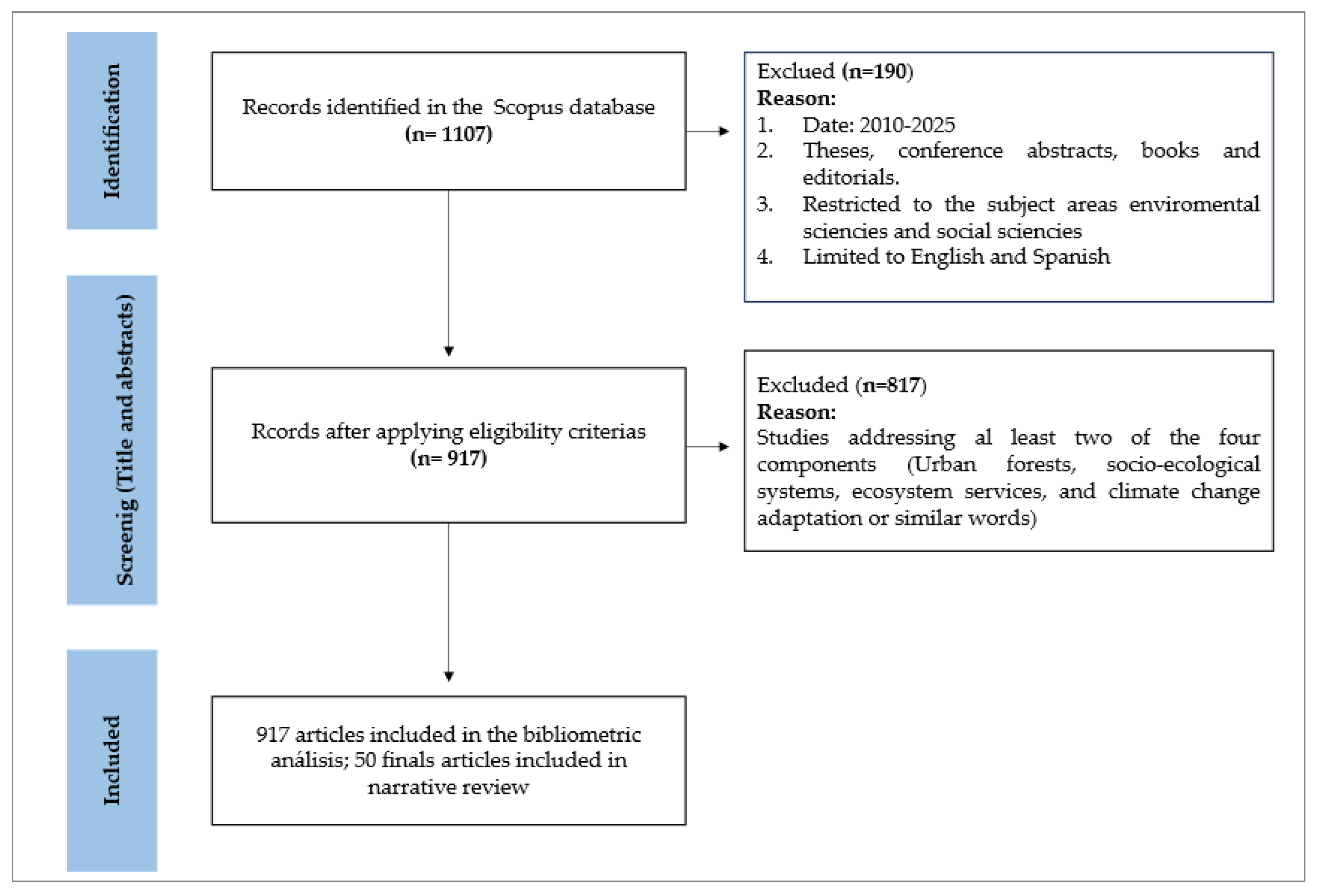
The initial search was performed on 20 November 2025, with a final update on 15 January 2026. This initial search identified a total of 1107 documents. After applying preliminary eligibility filters, 917 records were selected for bibliometric analysis. Subsequently, the screening of titles and summaries using the defined inclusion and exclusion criteria was carried out, resulting in a final sample of 50 articles for structured narrative review. The complete workflow from initial identification to the final categorized inclusion is visually summarized in the PRISMA flow diagram (Figure 1).
To facilitate efficient management of recovered records, the software Rayyan 2023 (Rayyan Systems Inc., Cambridge, MA, USA) was used. This web-based tool enabled initial loading of records from the Scopus database, automated duplicate detection and removal, and collaborative screening by the review team. The titles and abstracts were independently evaluated for relevance, using predefined inclusion and exclusion criteria, that are presented below. Full-text articles were evaluated in Rayyan for final eligibility, ensuring a systematic and transparent filtering process that minimized bias and improved reproducibility.
Data were documented according to a standardized protocol, where objectives and inclusion criteria were specified in detail.
Eligibility Criteria:
The following eligibility criteria were used for selecting studies to be included in this structured literature review:
  • Language: English and Spanish.
  • Publication Date: 2010–2025.
  • Document Type: articles, conference papers, and reviews.
  • Subject Area: limit to relevant fields (e.g., Environmental Science and Social Sciences).
Inclusion Criteria
  • Studies addressing at least two of the four components (Urban forests, socio-ecological systems, ecosystem services, and climate change adaptation). Synonymous terms were identified a priori and treated as equivalent during screening to avoid exclusions due to terminology variations. Borderline cases were retained for full-text review when relevance was unclear at the title/abstract stage, and final decisions were made based on predefined eligibility criteria.
  • Studies discussing Urban forests as socio-ecological systems.
Exclusion Criteria
  • Studies focusing on only one component without integration.
  • Non-peer-reviewed sources or abstracts without full text.
The research patterns within these studies were quantitatively analyzed using bibliometric indicators. A timeline was established to identify the years of peak research proliferation regarding urban forests. The geographic distribution of the studies was presented from two perspectives: first at a global level and second at the Latin American and Caribbean regional level. Given that keywords serve as the core of research articles, they effectively represent the research objectives, methodologies, and conceptual frameworks [36]. Consequently, a keyword co-occurrence analysis was performed on both titles and abstracts to identify term associations based on their co-occurrence within the text. This analysis aimed to highlight research trends in the field. For this purpose, VOS viewer (version 1.6.20), a freeware software designed for creating and visualizing bibliographic networks and maps, was utilized.

3. Results and Discussion

3.1. Bibliometric Analysis

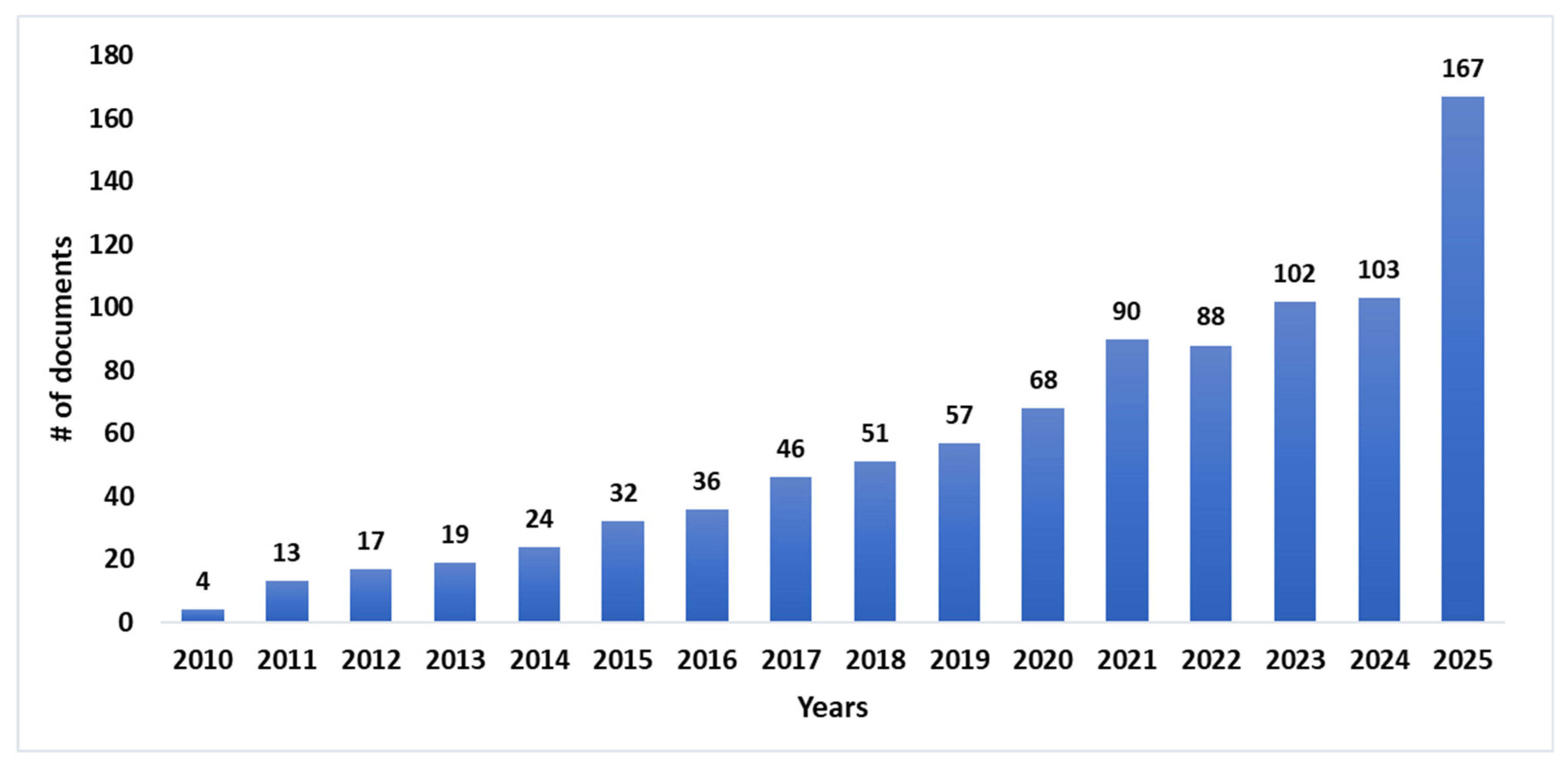
The Scopus database search yielded a total of 917 articles published between 2010 and 2025, with the highest volume of publications occurring within the last five years. Based on the results, an exponential temporal pattern was observed (Figure 2), reflecting a significant growth in the number of publications related to urban forests, such as socio-ecological systems and their role in ecosystem service provision and climate change adaptation. Escobedo et al. [37] point out that the research and promotion of urban forests and the multiple ecosystem services they provide represent a critical area of interest for addressing the environmental challenges faced by urban areas worldwide.
This review of the literature evidences a significant interest in understanding urban forests as socio-ecological systems and their role in ecosystem service provision and climate change adaptation [37,38,39,40]. Approximately 60% of the identified studies were published within the final five years of the analyzed period (2010–2025). This trend demonstrates the scientific community’s increasing focus on the socio-ecological processes of urban forests. The volume and scope of research examining urban forests highlight not only their environmental values but also their aesthetic and experiential roles for city residents, emphasizing their status as indispensable components of urban ecosystems that promote urban livability.
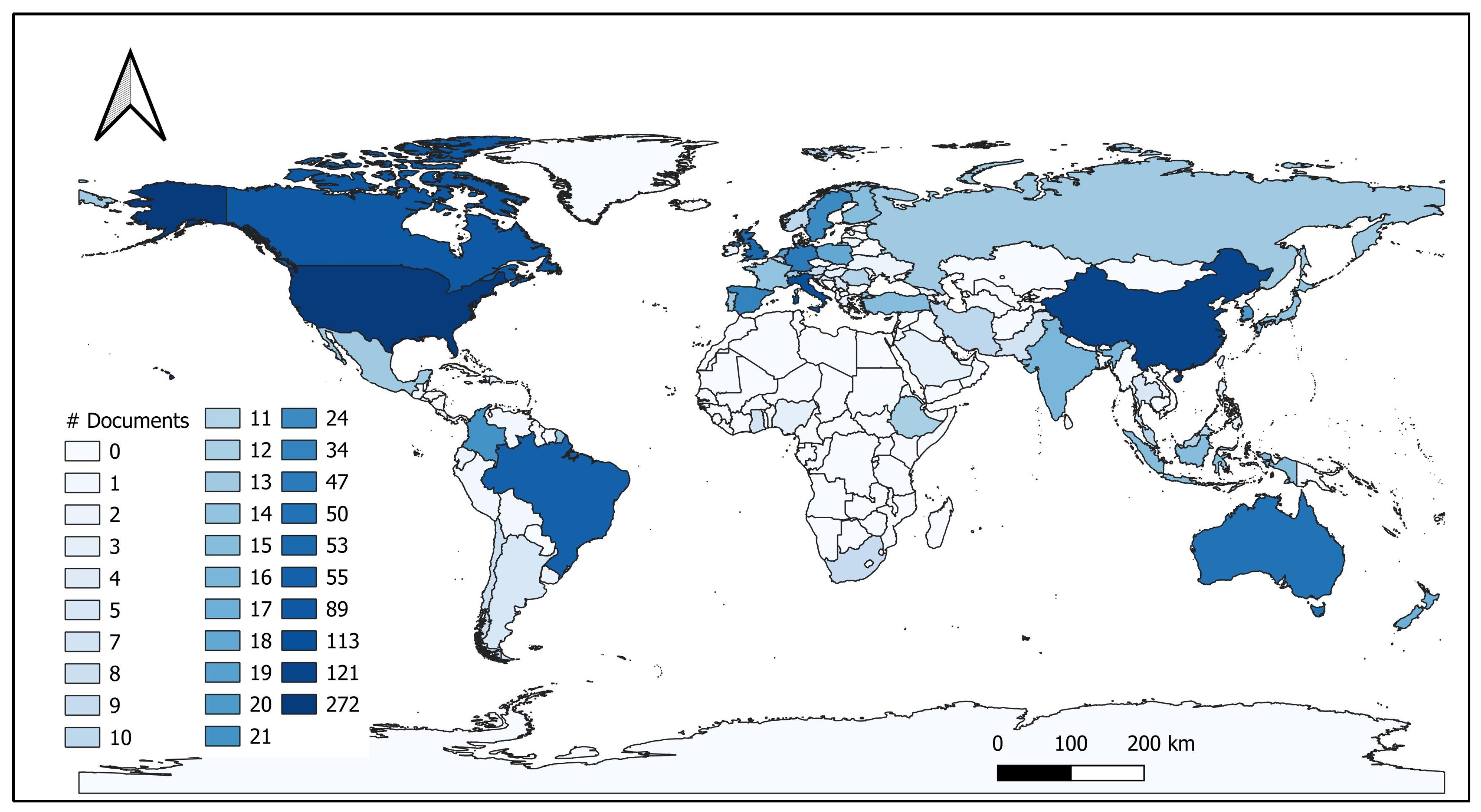
Figure 3 illustrates the geographical distribution of the articles identified during the analyzed period. The highest number of publications by country corresponds to the United States, with a total of 272 articles. This is followed by China with 121 articles, Italy with 113, Canada with 89, Brazil with 55, the United Kingdom with 53, Australia with 50, Germany with 47, and Spain with 34. The results reveal a clear dominance of the United States in scientific production, which may be attributed to two primary factors. First, the concept of urban forestry originated in the United States in early 1894 and spread throughout North America and Europe by 1960, before its introduction in China in 1980 [41,42]. Second, the United States Forest Service developed the i-Tree Tools software (Version 6.1.35, 2025), a peer-reviewed model for researching the benefits provided by urban forests that has been widely utilized on a global scale [43,44].
Five countries (the United States, China, Italy, Canada, and Brazil) account for approximately 70% of the articles published on this topic. This leadership can be attributed to their high levels of economic and scientific development; furthermore, China and Brazil have experienced accelerated growth in recent decades. These nations possess numerous cities, facing diverse associated urban environmental challenges and allocating substantial resources to research on urban forests and the ecosystem services they provide. Consequently, studies conducted in these nations tend to be more comprehensive and systematic, offering significant potential to serve as references and support future research in less-studied regions [45]. Conversely, the low number of publications in developing countries may be associated with limited funding or investment in this field, as these nations often prioritize socioeconomic development [46,47].
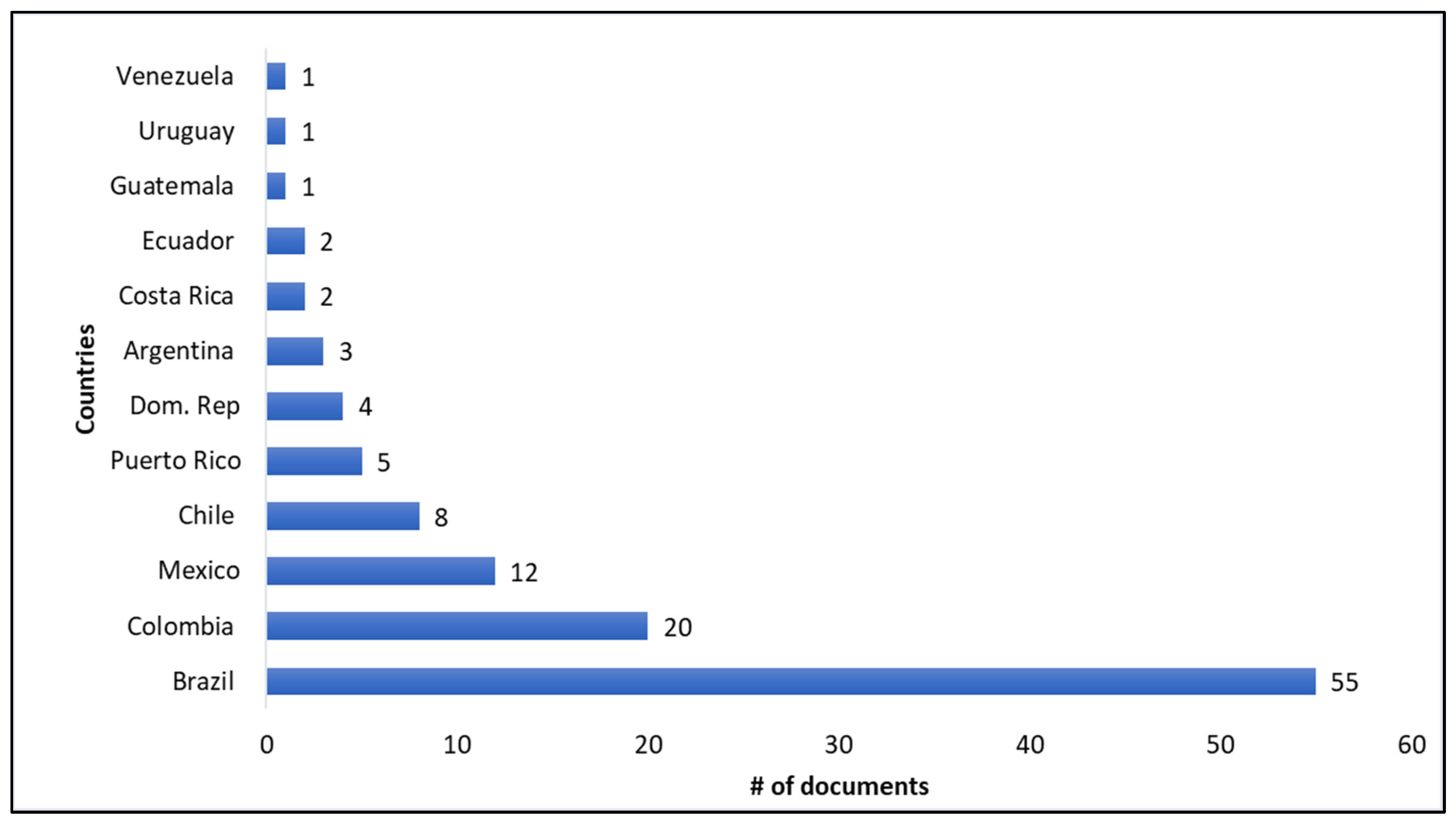
Figure 4 illustrates the distribution of published articles in Latin America and the Caribbean. Brazil accounted for the highest number of publications with 55 articles, followed by Colombia (20), Mexico (12), Chile (8), Puerto Rico (5), the Dominican Republic (4), and Argentina (3). Costa Rica and Ecuador recorded two articles each, while Guatemala, Uruguay, and Venezuela contributed one each. Although urban forest research has expanded significantly in the United States, Canada, China, Europe, and Australia, studies in Latin America and the Caribbean remain limited, despite the region being one of the most urbanized and biodiverse in the world [46].
In the case of Latin America and the Caribbean (LAC), the number of publications remains very low compared to other regions (Figure 4), although Brazil (55 articles) and Colombia (20 articles) stand out with a significant volume of research. This discrepancy may be explained by regional strengths; LAC is a high-biodiversity region where research generally focuses on conservation priorities, including the impacts of urbanization on nature [3,47] and current rates of conservation area loss [48].
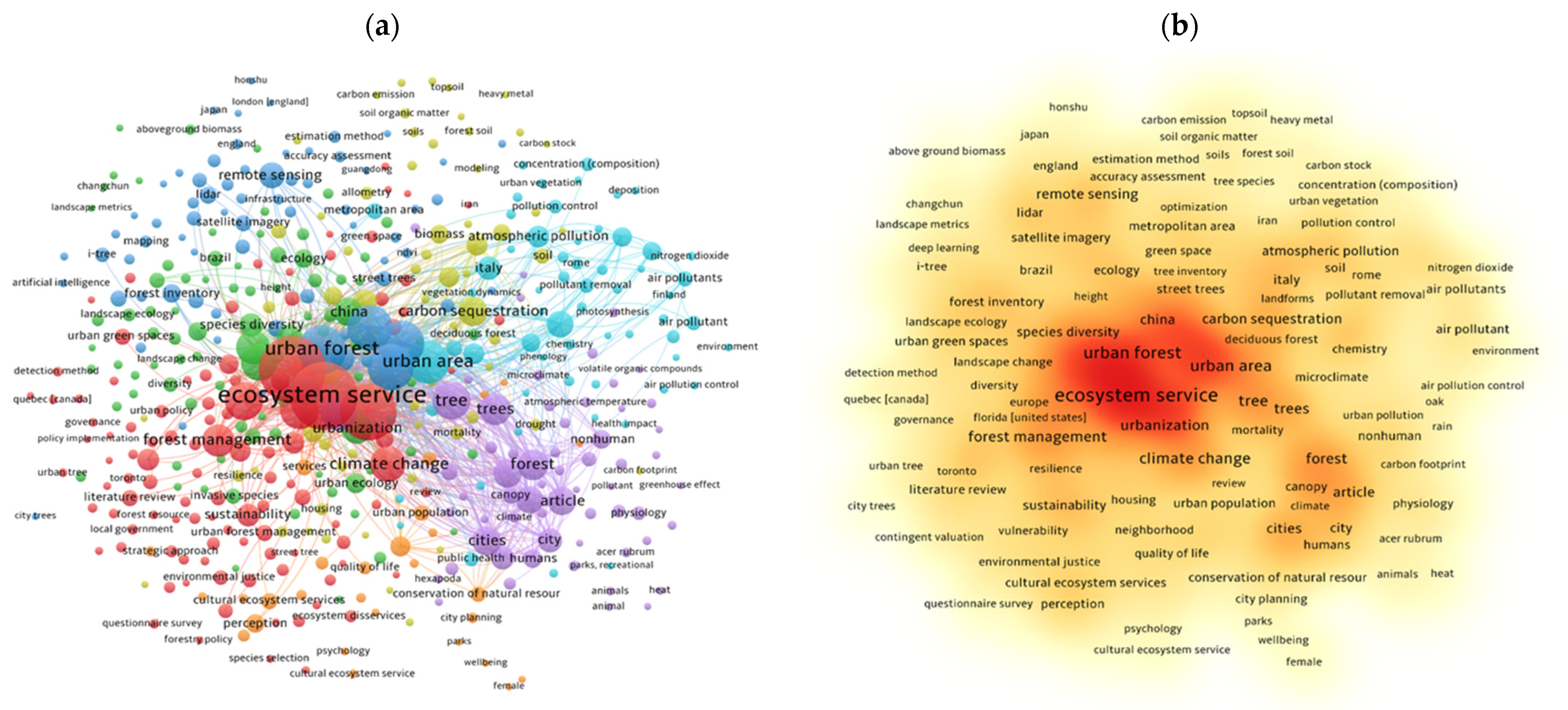
The analysis of author keyword co-occurrence has become an increasingly prevalent method in content analysis for effectively identifying emerging research trends and prominent areas of interest [49]. Prior to analysis, keywords were standardized to merge synonyms, singular/plural forms, and spelling variants in order to reduce redundancy. Generic or non-informative terms were excluded. Only keywords meeting a minimum occurrence threshold (i.e., appearing at least 5 times across the dataset, giving 482 keywords) were included in the analysis, ensuring that the network reflects core themes rather than sporadic terms. The co-occurrence network was constructed using VOSviewer’s (version 1.6.20) association strength normalization method. Clusters were generated using the software’s default clustering algorithm, with the resolution parameter set to its standard value, which balances cluster granularity and interpretability. The same preprocessing and parameter settings were applied consistently to both the network visualization and the keyword density map shown in Figure 5, which illustrates two types of visual representation used in the keyword analysis. The keyword co-occurrence network highlights the connections between the most significant keywords related to the research theme. Conversely, the keyword density map highlights the primary research clusters that are closely aligned with the focus of the present study.
In Figure 5a, all keywords are grouped into seven primary themes, represented by distinct colors. These themes include ecosystem services, urban forestry, urban forests, carbon sequestration, the United States, urban areas, and environmental protection. The size of each node reflects the frequency of the respective keyword within the literature. Furthermore, Figure 5b illustrates keyword density through color intensity, ranging from yellow to red. ‘Ecosystem services’ emerge as the central and articulating keyword within the analyzed scientific literature, serving as a core link across the various research topics.

3.2. Urban Forests as Socio-Ecological Systems

The study of urban forests has evolved from viewing them as purely biological entities to recognizing them as complex systems that integrate social dimensions, thereby establishing the paradigm of urban forests as socio-ecological systems (SES) [19,24,29,30,31]. Despite this conceptual shift, Table 1 reveals that the reviewed literature remains predominantly focused on the ecological perspective, characterized by a significant reliance on quantitative approaches to measure environmental functions. Notably, there is extensive use of the i-Tree model [50,51,52,53], driven by a global interest in standardizing the quantification of urban forest ecosystem services, particularly carbon sequestration and storage. However, this standardization faces critical challenges regarding accuracy, as the application of models like i-Tree requires robust uncertainty frameworks that account for variations across diverse urban contexts to avoid biases in decision-making. Furthermore, the evaluation of the arboreal component must move beyond generalist metrics to identify specific local contributions that validate its real efficiency in service provision within unique urban environments [54,55,56,57,58].
In contrast, the social perspective identified in the literature introduces greater complexity by incorporating human well-being and public preferences. Key findings suggest that access and proximity to urban green spaces are not only indicators of socio-environmental justice but also determinant factors for mental health and social cohesion in urban centers [81,84]. This social complexity is further compounded by the technical uncertainties inherent in standard modeling tools, which can affect the reliability of the benefits communicated to citizens and influence their trust and engagement with green infrastructure [62,75,82,86]. A critical turning point in the current discussion is the distinction between “objective” benefits (measured by models) and “perceived” benefits (experienced by citizens). For instance, ref. [107] found that citizens often do not perceive regulating services (such as cooling) unless the benefit is extreme, prioritizing “aesthetics” and “recreation” even if the forest is objectively inefficient in ecological terms. This dichotomy suggests that the provision of ecosystem services depends not solely on the existence of biomass, but on how individuals interact with and value these spaces, thereby placing human experience at the center of forest management [87,88,89].
This interplay becomes even more evident when analyzing socio-ecological interactions specifically, where the study of ecosystem “disservices” has emerged as a prominent theme. Recent research [103,105] demonstrates that factors such as perceived insecurity, allergies, or accident risks are critical determinants of public acceptance. Ignoring these negative aspects in the planning of nature-based solutions can compromise the long-term viability of green infrastructure projects. Therefore, managing urban forests as SES requires a constant balance: maximizing ecological functions while actively mitigating disservices that affect urban livability [27].
In addition to the benefits provided by urban forests, recent research emphasizes the importance of considering ecosystem disservices, defined as the negative impacts or costs that ecosystems may generate for human well-being [103,104]. In urban contexts, these may include allergenic pollen, infrastructure damage caused by tree roots, increased maintenance costs, or perceived safety concerns in densely vegetated areas [105,106]. Recognizing both ecosystem services and disservices is essential for balanced urban forest planning, as it allows decision-makers to design management strategies that maximize benefits while minimizing potential risks and conflicts with urban infrastructure and public perception [105,106,108].
Finally, the effective integration of these dimensions relies on governance and planning. Despite advances in ecological modeling and the understanding of social demands, this review identifies persistent barriers to integrating transdisciplinary knowledge into land-use policies [90,91]. A lack of coordination between urban expansion plans and forest management often relegates urban forests to a secondary role compared to grey infrastructure. For example, an increased amount of research shows that urban forests and green infrastructure are frequently sidelined when cities expand, largely because planning and forest management are not well coordinated. This tends to favor grey infrastructure and short-term development, leading to forest loss, fragmentation, and weaker ecosystem services [99,102,109].

3.3. The Role of Urban Forest in Ecosystem Services Provision and Climate Change Adaptation

Table 2 provides a summary of the primary findings from the literature selected for this structured literature review, revealing a clear hierarchy among the analyzed ecosystem services. There is a notable predominance of research focused on Carbon Regulation (ES1) as one of the fundamental contributions of urban forests to global climate action. Recent studies [50,51,56,61,63,65,90,92,95,96,100], utilizing quantitative modeling via the i-Tree Eco tool, continue to employ carbon sequestration functions to justify investments in urban green infrastructure. However, it is important to note that from a local adaptation perspective, the emphasis on Carbon Regulation may be overshadowing ecosystem services that are more immediate for local urban resilience, such as hydro-thermal regulation [58,62].
Within the current context of Climate Change Adaptation (CCA), the analysis identifies Hydro-Thermal Regulation (ES2) as one of the most critical urban forest functions for city survival. Studies such as those by [55,58] demonstrate that the capacity of urban trees to mitigate the Urban Heat Island (UHI) effect and manage stormwater runoff is more relevant to immediate public health than long-term carbon storage. Despite its importance, the integration of these functions into practical urban planning remains a challenge, often due to the lack of high-resolution spatial models capable of predicting these benefits within complex microclimates [62].
Among the crucial findings identified is the recognition of Ecosystem Disservices (ES5) as a variable associated with mismanagement and maladaptation. Although research on this topic remains limited, emerging studies by authors such as [103,105] warn that neglecting negative costs such as storm-related infrastructure damage, allergies, or maintenance expenses can lead to the failure of adaptation strategies. For instance, prioritizing fast-growing species to maximize carbon sequestration (ES1) may result in brittle trees that pose significant risks during extreme weather events, thereby undermining broader resilience goals (CCA) [57,64].
Finally, Social Well-being (ES4) often appears decoupled from technical adaptation models. While research on air quality (ES3) and carbon (ES1) is highly quantitative, benefits related to mental health and social cohesion are predominantly addressed through qualitative methods [86,87]. This methodological disconnect suggests the need for a transdisciplinary approach [57,82] that does not merely “aggregate” services, but rather seeks synergies where climate adaptation (e.g., cooling) simultaneously promotes the social use of public spaces, thus avoiding siloed planning.

4. Perspectives and Challenges of Research on Urban Forests as Socio Ecological Systems and Their Role in Ecosystem Service Provision and Climate Change Adaptation

Over the last decade and a half, research on urban forests has grown exponentially and, more importantly, shifted conceptually from viewing trees as isolated ecological assets toward understanding urban forests as socio ecological systems in which biophysical structure, human perception, access, governance, and justice jointly determine benefits. This surge-roughly sixty percent of publications arising in the most recent five-year window-mirrors heightened concern for sustainability and climate resilience, and it anchors a field now intent on connecting pattern-process-function-service chains to lived urban outcomes. At the center of this shift is the recognition that services are coproduced through interactions between canopy configuration, spatial connectivity, and social dynamics, and that assessments must incorporate environmental justice, accessibility, and perception alongside biophysical indicators while explicitly acknowledging potential ecosystem disservices that can erode acceptability and resilience over time.
A second perspective redefining the field is the movement beyond carbon centric accounting toward multi service, adaptation-oriented portfolios. For years, standardized tools such as i Tree organized research and investment narratives around sequestration and storage, but recent reviews argue that services with immediate, local relevance to health and climate risk, especially hydrothermal regulation of heat and runoff, must be elevated alongside air quality improvement and mental health and recreation benefits. This evolution is not a rejection of carbon and pollution removal; rather, it is a call for explicit analysis of tradeoffs and synergies, so that design choices deliver cooling, flood mitigation, and well-being while still accounting for mitigation and air quality co benefits in a single, decision relevant framework.
Decision ready research increasingly couples biophysical models with social data to bring these portfolios into planning and finance cycles. Pairing i Tree Eco/Canopy and remote sensing with participatory GIS and surveys reveals cultural services, neighborhood priorities, and inequities that inventories may miss, translating evidence into local questions about where shade, air filtration, recreation, or risk reduction are most needed.
Regional lenses sharpen these perspectives. In Latin America and the Caribbean, reviews document rapid growth but persistent underrepresentation relative to need, with many studies concentrated in a few countries and biomes despite intense urbanization and biodiversity. City scale analyses, such as Medellín’s shrinking and fragmenting green cover under densification, clarify where targeted tree planting, protection, and connectivity interventions can most effectively reduce heat exposure and enhance resilience, underscoring the importance of context adapted SES approaches that integrate governance and equity from the outset.
Notwithstanding this progress, several enduring challenges constrain the impact of research on policy and practice. A first is the persistent ecological bias and methodological fragmentation that leave social dimensions and lived experience at the margins of otherwise sophisticated modeling efforts; the evidence base is still dominated by quantitative ecological modules while qualitative well-being, perception, and governance studies often run on parallel tracks, weakening the link from supply metrics to actionable, health relevant demand. Reviews on adaptation echo this gap and call for integrated, transdisciplinary workflows that connect pattern–process–function–service to risk and health outcomes, not just to biophysical indicators.
A second challenge lies in geographic inequality in knowledge production. Roughly seventy percent of the literature is produced in five countries: United States, China, Italy, Canada, and Brazil, leaving many fast-urbanizing Global South cities without context specific parameters, uncertainty estimates, or policy ready guidance scaled to tropical, peri urban, and informal settlement mosaics. This imbalance risks transferring models optimized for temperate, high-income contexts into places where climate exposure, infrastructure constraints, and socio environmental vulnerability differ markedly, thereby diluting the effectiveness of interventions.
A third constraint is the incomplete integration of ecosystem disservices and climate risks into planning and species selection. Evidence from Bogotá shows that allergenic pollen burdens can concentrate in vulnerable neighborhoods, complicating simplistic “more trees everywhere” prescriptions and calling for trait-based palettes and site designs that minimize health burdens and storm related failures while maximizing services. The attached review similarly warns that prioritizing fast growth or carbon alone can inadvertently increase breakage, maintenance costs, or infrastructural conflicts under extreme events, undermining long term resilience.
A fourth barrier is governance and policy implementation. Even where robust ES evidence exists, translation into zoning overlays, heat action plans, capital budgets, or maintenance programs is often blocked by institutional fragmentation, short funding cycles, and weak cross department coordination. Practitioner oriented work suggests that multi-level governance architectures linking schools, municipalities, and regional agencies, together with open data practices and co production mechanisms, are prerequisites for mainstreaming SES evidence into everyday planning and for sustaining monitoring beyond project cycles.
Finally, data quality and verification remain critical to credibility and uptake, especially when citizen or rapid assessments are involved. Best practice now points to hierarchical verification pipelines, combining automated filters and range checks with community consensus and expert review for outliers, and routine inter comparison with reference networks to reduce perceived risk among regulators and to meet evidentiary standards in statutory contexts.
Taken together, these insights outline a pragmatic research agenda. First, operationalize transdisciplinary SES frameworks that unify ecology, sociology, governance, equity, and health within decision analytic workflows, multi criteria prioritization, scenario testing, and trade off analysis, so outputs are policy ready at the scales planners use. Second, invest in context specific studies in the Global South, particularly Latin America and the Caribbean, to generate locally valid parameters for tropical and peri urban mosaics, report uncertainties, and align interventions with justice-oriented resilience planning. Third, adopt multi service assessments that elevate cooling and runoff control alongside carbon and pollution removal and translate these into public health indicators such as heat exposure reduction. Fourth, institutionalize co production and equity aware planning, pairing i Tree/remote sensing outputs with participatory GIS and distributional metrics so mapped capacity, flows, and demand link directly to actionable instruments. Fifth, plan for life cycle stewardship under warming climates by advancing climate forward, trait-based species palettes, securing nursery supply chains, and testing establishment and maintenance regimes that ensure survival and service delivery while minimizing disservices. Sixth, embed verification ready monitoring and publish metadata rich, interoperable datasets to accelerate institutional uptake and cross city comparability.
The bottom line is clear: urban forests, framed as socio ecological systems, can deliver multifunctional ecosystem services and tangible adaptation benefits when evidence is co-produced, equity aware, verification ready, and integrated into governance and finance. The current wave of scholarship captures the necessary pivot, reconciling modeled and perceived benefits, rebalancing carbon centric accounting with hydrothermal and social services, and institutionalizing co production, so that science consistently shapes resilient, people centered urban forests.

5. Limitations

This study presents several limitations that should be acknowledged. First, the literature search was conducted exclusively using the Scopus database, which may have resulted in the omission of relevant studies indexed elsewhere. This approach may also have led to the underrepresentation of grey literature, including technical reports and policy documents that are particularly relevant in urban forest governance and planning. Second, the review was restricted to publications in English and Spanish, which may have excluded relevant research published in other languages and potentially contributed to geographic imbalances in the results. Third, although PRISMA framework was used to enhance transparency in the identification and screening process, this study is not a systematic review. Therefore, no formal protocol, risk-of-bias assessment, or exhaustive reproducibility criteria were applied. The findings should thus be interpreted as a structured and interpretative synthesis of research trends, rather than as a meta-analytic or fully reproducible evaluation of the literature.
Finally, the selection of search terms and keyword combinations may not have captured all conceptual variations related to urban forests and socio-ecological systems. Despite these limitations, the review provides a comprehensive overview of current research patterns and identifies critical gaps for future investigation.

6. Conclusions

This structured literature review examined the scope of literature published between 2010 and 2025 concerning urban forests as socio-ecological systems (SES) and their role in ecosystem service provision and climate change adaptation. The results reveal exponential growth in scientific production, with the highest volume of research appearing in the last five years. This increase reflects a burgeoning global concern that positions urban forests as an indispensable green infrastructure strategy for the sustainability of modern cities.
However, the geographical distribution of research remains asymmetrical. Five countries—the United States, China, Italy, Canada, and Brazil—account for 70% of the published articles. While nations with lower research outputs may draw upon the general theoretical frameworks established by these leading countries, reliance on external literature presents significant limitations given the diverse climatic and socioeconomic contexts. In Latin America, production remains limited, with Brazil and Colombia at the forefront. This gap appears to be influenced by restricted funding for research and scientific communication in this topic. Therefore, it is important to promote local research in developing nations, where rapid urban growth and limited resources necessitate context-adapted solutions.
Furthermore, while literature has begun to transition toward viewing urban forests as complex socio-ecological systems, a pronounced bias toward quantitative ecological perspectives persists. The dominance of biophysical models (such as i-Tree) tends to marginalize social and human dimensions. This disconnection between “objective” modeled benefits and those “perceived” by citizens represents a critical challenge. The long-term sustainability and climate resilience of urban forests will depend on bridging this gap through transdisciplinary approaches that integrate public perception into decision-making processes.
Ultimately, urban resilience in the context of climate change is not contingent solely upon the availability of empirical scientific data; rather, it necessitates a fundamental reconfiguration of governance architectures. Current paradigms are often characterized by the prioritization of grey infrastructure and pervasive administrative fragmentation create institutional bottlenecks that effectively marginalize natural capital. Overcoming these impediments requires a strategic transition toward multi-level co-production frameworks in which forest management and urban planning converge. Only through the rigorous alignment of biophysical metrics, social perceptions, and territorial policies can ecosystem services be institutionalized as the central organizing principle for the development of more resilient and human-centric cities.
Finally, the future research agenda must prioritize the economic and social valuation of intangible benefits for human well-being and delve deeper into management models that integrate socio-environmental justice. This is essential to ensure that urban forests serve as drivers of resilience and equity in 21st-century cities.

Author Contributions

Conceptualization: L.A.A.-M., S.B.-D. and U.J.J.-H.; Methodology: L.A.A.-M., S.B.-D. and U.J.J.-H.; Formal analysis: L.A.A.-M., S.B.-D. and U.J.J.-H.; Data preparation: L.A.A.-M.; Writing—original draft preparation: L.A.A.-M.; Writing—review and editing: S.B.-D. and U.J.J.-H.; Supervision; Project administration: S.B.-D.; Funding acquisition: S.B.-D. All authors have read and agreed to the published version of the manuscript.

Funding

This research was funded by the project “Urban and peri-urban forests of the Dominican Republic as socio-ecological systems and their role in ecosystem service provision and climate change adaptation”, Code 2022-2B1-160, financed by the Fondo Nacional de Innovación y Desarrollo Científico y Tecnológico (FONDOCyT), Dominican Republic.

Data Availability Statement

No new data were created or analyzed in this study. Data sharing is not applicable to this article.

Acknowledgments

This work was conducted as part of the doctoral program in Environmental Sciences at INTEC, Dominican Republic. LAAM thanks MESCYT for the financial support of his studies.

Conflicts of Interest

The authors declare no conflicts of interest.

References

  1. Millennium Ecosystem Assessment (MEA). Ecosystems and Human Well-Being: Wetlands and Water Synthesis; World Resources Institute: Washington, DC, USA, 2005; ISBN 1-56973-597-2. Available online: https://www.millenniumassessment.org/documents/document.358.aspx.pdf (accessed on 26 February 2024).
  2. United Nations. World Urbanization Prospects: The 2018 Revision; United Nations: New York, NY, USA, 2019. [Google Scholar]
  3. UN-Habitat. World Cities Report 2016: Urbanization and Development—Emerging Futures; United Nations Human Settlements Programme: Nairobi, Kenya, 2016; ISBN 978-92-1-132708-3. [Google Scholar] [CrossRef]
  4. Zárate, C.A.; Agulló, E.C.; Gil, C.F.; Martínez, J.M.F.P.; Diaz, D.R.; León, P.Á.; Navío, E. Canarias ante la Emergencia Climática: Creando un Clima de Resiliencia; Gobierno de Canarias: Santa Cruz de Tenerife, Spain, 2021.
  5. Hidalgo García, D.; Founda, D.; Rezapouraghdam, H. Urban Forest Microclimates and Their Response to Heat Waves—A Case Study for London. Forests 2025, 16, 790. [Google Scholar] [CrossRef]
  6. Schnell, S.; Altrell, D.; Stahl, G.; Kleinn, C. The Contribution of Trees Outside Forests to National Tree Biomass and Carbon Stocks—A Comparative Study Across Three Continents. Environ. Monit. Assess. 2015, 187, 4197. [Google Scholar] [CrossRef] [PubMed]
  7. Secretariat of the Convention on Biological Diversity. Cities and Biodiversity Outlook: Action and Policy—A Global Assessment of the Links Between Urbanization, Biodiversity and Ecosystem Services; Secretariat of the Convention on Biological Diversity: Montreal, QC, Canada, 2012; ISBN 92-9225-433-4. Available online: https://www.cbd.int/doc/health/cbo-action-policy-en.pdf (accessed on 26 February 2024).
  8. Ordóñez, C.; Duinker, P.N. An Analysis of Urban Forest Management Plans in Canada: Implications for Urban Forest Management. Landsc. Urban Plan. 2013, 116, 36–47. [Google Scholar] [CrossRef]
  9. Nowak, D.J.; Dwyer, J.F. Understanding the Benefits and Costs of Urban Forest Ecosystems. In Urban and Community Forestry in the Northeast; Kuser, J.E., Ed.; Springer: Dordrecht, The Netherlands, 2007; pp. 25–46. [Google Scholar] [CrossRef]
  10. Selmi, W.; Weber, C.; Rivière, E.; Blond, N.; Mehdi, L.; Nowak, D.J. Air Pollution Removal by Trees in Public Green Spaces in Strasbourg City, France. Urban For. Urban Green. 2016, 17, 192–201. [Google Scholar] [CrossRef]
  11. Aronson, M.F.J.; Lepczyk, C.A.; Evans, K.L.; Goddard, M.A.; Lerman, S.B.; MacIvor, J.S.; Nilon, C.H.; Vargo, T. Biodiversity in the City: Key Challenges for Urban Green Space Management. Front. Ecol. Environ. 2017, 15, 189–196. [Google Scholar] [CrossRef]
  12. Mader, A.; Patrickson, S.; Calcaterra, E.; Smit, J. TEEB Manual for Cities: Ecosystem Services in Urban Management; The Economics of Ecosystems and Biodiversity, UN Environment: Geneva, Switzerland, 2011.
  13. Jasmani, Z.; Ravn, H.P.; Konijnendijk, C.C.; van den Bosch, C.C.K. Introducing a Method for Social-Ecological Assessment of Small Urban Parks. Environ. Proc. J. 2016, 1, 123–131. [Google Scholar] [CrossRef]
  14. Van Oijstaeijen, W.; Van Passel, S.; Cools, J. Urban Green Infrastructure: A Review on Valuation Toolkits from an Urban Planning Perspective. J. Environ. Manag. 2020, 267, 110603. [Google Scholar] [CrossRef]
  15. Hansen, R.; Pauleit, S. From Multifunctionality to Multiple Ecosystem Services? A Conceptual Framework for Multifunctionality in Green Infrastructure Planning for Urban Areas. Ambio 2014, 43, 516–529. [Google Scholar] [CrossRef]
  16. Baró, F.; Palomo, I.; Zulian, G.; Vizcaino, P.; Haase, D.; Gómez-Baggethun, E. Mapping Ecosystem Service Capacity, Flow and Demand for Urban Planning and Policy: A Case Study in the Barcelona Metropolitan Region. Land Use Policy 2016, 57, 405–417. [Google Scholar] [CrossRef]
  17. Salbitano, F.; Borelli, S.; Conigliaro, M.; Chen, Y. Guidelines on Urban and Peri-Urban Forestry; FAO Forestry Paper No. 178; Food and Agriculture Organization of the United Nations (FAO): Rome, Italy, 2016; ISBN 9789251094426. [Google Scholar]
  18. Gómez-Baggethun, E.; Gren, Å.; Barton, D.N.; Langemeyer, J.; McPhearson, T.; O’Farrell, P.; Andersson, E.; Hamstead, Z.; Kremer, P. Urban Ecosystem Services. In Urbanization, Biodiversity and Ecosystem Services: Challenges and Opportunities; Elmqvist, T., Fragkias, M., et al., Eds.; Springer: Dordrecht, The Netherlands, 2013; pp. 175–251. [Google Scholar] [CrossRef]
  19. Vogt, J. Urban Forests as Social-Ecological Systems. In Encyclopedia of the World’s Biomes; Goldstein, M.I., DellaSala, D.A., Eds.; Elsevier: Oxford, UK, 2020; Volume 5, pp. 58–70. [Google Scholar]
  20. Rowntree, R.A. Ecology of the urban forest—Introduction to Part I. Urban Ecol. 1984, 8, 1–11. [Google Scholar] [CrossRef]
  21. FAO. Forests and Agriculture: Land Use Challenges and Opportunities; Food and Agriculture Organization of the United Nations: Rome, Italy, 2016; ISBN 9789251094426. [Google Scholar]
  22. Konijnendijk, C.C.; Ricard, R.M.; Kenney, A.; Randrup, T.B. Defining urban forestry—A comparative perspective of North America and Europe. Urban For. Urban Green. 2006, 4, 93–103. [Google Scholar] [CrossRef]
  23. Nowak, D.J. Institutionalizing urban forestry as a “biotechnology” to improve environmental quality. Urban For. Urban Green. 2006, 5, 93–100. [Google Scholar] [CrossRef]
  24. Vogt, J. A Comprehensive Framework for Understanding Urban Forests as Social-Ecological Systems. Arboric. Urban For. 2024, 50, 427–469. [Google Scholar] [CrossRef]
  25. Romero-Muñoz, S.; Sánchez-Chaparro, T.; Muñoz Sanz, V.; Tillie, N. Urban Greening Management Arrangements between Municipalities and Citizens for Effective Climate Adaptation Pathways: Four Case Studies from The Netherlands. Land 2024, 13, 1414. [Google Scholar] [CrossRef]
  26. Haase, D.; Larondelle, N.; Andersson, E.; Artmann, M.; Borgström, S.; Breuste, J.; Gomez-Baggethun, E.; Gren, Å.; Hamstead, Z.; Houck, P.; et al. A quantitative review of urban ecosystem service assessments: Concepts, models, and implementation. Ambio 2014, 43, 413–433. [Google Scholar] [CrossRef]
  27. Dobbs, C.; Escobedo, F.J.; Zipperer, W.C.; de la Maza, C.L. A framework for developing urban forest ecosystem services and goods indicators. Landsc. Urban Plan. 2019, 187, 196–206. [Google Scholar] [CrossRef]
  28. Villanueva, K.; Badland, H.; Hooper, P.; Koohsari, M.J.; Mavoa, S.; Davern, M.; Roberts, R.; Goldfeld, S.; Giles-Corti, B. Developing indicators of public open space to promote health and wellbeing in communities. Appl. Geogr. 2015, 57, 112–122. [Google Scholar] [CrossRef]
  29. Miao, C.; Wang, J.; Wang, D. Research progress on urban forest ecosystem services and multifunctionality. Int. J. Environ. Sci. Technol. 2025, 22, 11557–11566. [Google Scholar] [CrossRef]
  30. Xie, C.; Chen, S.; Liu, D.; Jim, C.Y. Unveiling the complex networks of urban tree diversity research: A global perspective. Ecol. Evol. 2024, 14, e11630. [Google Scholar] [CrossRef]
  31. Johnson, L.R.; Johnson, M.L.; Aronson, M.F.J.; Campbell, L.K.; Falxa-Raymond, N.; Svendsen, L.S.; Sonti, N.F. Conceptualizing social-ecological drivers of change in urban forest patches. Urban Ecosyst. 2021, 24, 633–648. [Google Scholar] [CrossRef]
  32. Wang, G.; Li, J.; Liu, X.; Li, B.; Zhang, Y. Social-ecological network of peri-urban forest in urban expansion: A case study of urban agglomeration in Guanzhong Plain, China. Land Use Policy 2024, 139, 107074. [Google Scholar] [CrossRef]
  33. Johnson, M.L.; Novem Auyeung, D.S.; Sonti, N.F.; Campbell, L.K.; Svendsen, L.S. Social-ecological research in urban natural areas: An emergent process for integration. Urban Ecosyst. 2019, 22, 77–90. [Google Scholar] [CrossRef]
  34. Pranckutė, R. Web of Science (WoS) and Scopus: The Titans of Bibliographic Information in Today’s Academic World. Publications 2021, 9, 12. [Google Scholar] [CrossRef]
  35. Page, M.J.; McKenzie, J.E.; Bossuyt, P.M.; Boutron, I.; Hoffmann, T.C.; Mulrow, C.D.; Shamseer, L.; Tetzlaff, J.M.; Akl, E.A.; Brennan, S.E.; et al. The PRISMA 2020 statement: An updated guideline for reporting systematic reviews. BMJ 2021, 372, n71. [Google Scholar] [CrossRef] [PubMed]
  36. Badiu, D.L.; Nita, A.; Iojă, C.I.; Niţă, M.R. Disentangling the connections: A network analysis of approaches to urban green infrastructure. Urban For. Urban Green. 2019, 41, 211–220. [Google Scholar] [CrossRef]
  37. Escobedo, F.J.; Giannico, V.; Jim, C.Y.; Sanesi, G.; Lafortezza, R. Urban forests, ecosystem services, green infrastructure and nature-based solutions: Nexus or evolving metaphors? Urban For. Urban Green. 2019, 37, 3–12. [Google Scholar] [CrossRef]
  38. Nesshöver, C.; Assmuth, T.; Irvine, K.N.; Rusch, G.M.; Waylen, K.A.; Delbaere, B.; Haase, D.; Jones-Walters, L.; Keune, H.; Kovacs, E. The science, policy and practice of nature-based solutions: An interdisciplinary perspective. Sci. Total Environ. 2017, 579, 1215–1227. [Google Scholar] [CrossRef]
  39. Willis, K.J.; Petrokofsky, G. The natural capital of city trees. Science 2017, 356, 374–376. [Google Scholar] [CrossRef]
  40. Boulton, C.; Dedekorkut-Howes, A.; Byrne, J. Factors shaping urban greenspace provision: A systematic review of the literature. Landsc. Urban Plan. 2018, 178, 82–101. [Google Scholar] [CrossRef]
  41. Zhu, Y.; Wang, C.; Jia, B.; Su, J. GIS-based analysis of the accessibility of urban forests in the central city of Guangzhou, China. Acta Ecol. Sin. 2011, 31, 2290–2300. [Google Scholar]
  42. Sander, H. Estonian (Baltic) Urban Forestry and Urban Greening with an Interview with Professor Cecil C. Konijnendijk of Canada. Balt. For. 2018, 24, 158–163. [Google Scholar]
  43. Zhao, H.; Zhao, D.; Jiang, X.; Zhang, S.; Lin, Z. Assessment of urban forest ecological benefit based on the i-Tree Eco model—A case study of Changchun central city. Forests 2023, 14, 1304. [Google Scholar] [CrossRef]
  44. Sjöman, J.D.; Tuhkanen, E.M.; Mänttäri, M.; Cimburová, Ž.; Stålhammar, S.; Barton, D.N.; Randrup, T.B. Expectations of i-Tree Eco as a tool for urban tree management in Nordic cities. Front. Sustain. Cities 2024, 5, 1325039. [Google Scholar] [CrossRef]
  45. Lin, J.; Kroll, C.N.; Nowak, D.J.; Greenfield, E.J. A review of urban forest modeling: Implications for management and future research. Urban For. Urban Green. 2019, 43, 126366. [Google Scholar] [CrossRef]
  46. Ordoñez-Barona, C.; Devisscher, T.; Dobbs, C.; Aguilar, L.O.; Baptista, M.D.; Navarro, N.M.; de la Maza, C.L.; Martínez-Harms, M.J.; Hernández, J.P.; Settelmyer, S.; et al. Trends in urban forestry research in Latin America & the Caribbean: A systematic literature review and synthesis. Urban For. Urban Green. 2020, 47, 126544. [Google Scholar] [CrossRef]
  47. MacGregor-Fors, I.; Escobar, F.; Rueda-Hernández, R.; Avendaño-Reyes, S.; Baena, M.; Bandala, V.; Chacón Zapata, S.; Guillén-Servent, A.; González-García, F.; Lorea-Hernández, F.; et al. City “Green” Contributions: The Role of Urban Greenspaces as Reservoirs for Biodiversity. Forests 2016, 7, 146. [Google Scholar] [CrossRef]
  48. Rincón-Ruiz, A.; Arias-Arévalo, P.; Núñez Hernández, J.M.; Cotler, H.; Aguado Caso, M.; Meli, P.; Tauro, A.; Ávila Akerberg, V.D.; Avila-Foucat, V.S.; Cardenas, J.P.; et al. Applying integrated valuation of ecosystem services in Latin America: Insights from 21 case studies. Ecosyst. Serv. 2019, 36, 100901. [Google Scholar] [CrossRef]
  49. Rahim, N.H.; Razak, S.A.; Chang, X.; Chng Saun, F.; Khan, M.N.; Hamzah, S.N.; Rohman, F.; Ali, B.; Kaplan, A.; Iqbal, M.; et al. Ecosystem Services by Urban Forest (UF) towards Climate Change Adaptation: A Review. Pol. J. Environ. Stud. 2024, 33, 3503–3513. [Google Scholar] [CrossRef]
  50. Nowak, D.J.; Hoehn, R.E.; Bodine, A.R.; Crane, D.E.; Dwyer, J.F.; Bonnewell, V.; Watson, G. Urban forest structure, ecosystem services and change in Syracuse, NY. Urban Ecosyst. 2016, 19, 1455–1477. [Google Scholar] [CrossRef]
  51. Amini Parsa, V.; Salehi, E.; Yavari, A.R.; van Bodegom, P.M. Evaluating the potential contribution of urban ecosystem service to climate change mitigation. Urban Ecosyst. 2019, 22, 989–1006. [Google Scholar] [CrossRef]
  52. Raum, S.; Hand, K.L.; Hall, C.; Edwards, D.M.; O’Brien, L.; Doick, K.J. Achieving impact from ecosystem assessment and valuation of urban greenspace: The case of i-Tree Eco in Great Britain. Landsc. Urban Plan. 2019, 190, 103590. [Google Scholar] [CrossRef]
  53. Bonilla-Duarte, S.; Gómez-Valenzuela, V.; Vargas-de la Mora, A.L.; García-García, A. Urban forest sustainability in residential areas in the city of Santo Domingo. Forests 2021, 12, 884. [Google Scholar] [CrossRef]
  54. Ernstson, H. The social production of ecosystem services: A framework for studying environmental justice and ecological complexity in urbanized landscapes. Landsc. Urban Plan. 2013, 109, 7–17. [Google Scholar] [CrossRef]
  55. Endreny, T.; Santagata, R.; Perna, A.; De Stefano, C.; Rallo, R.F.; Ulgiati, S. Implementing and managing urban forests: A much needed conservation strategy to increase ecosystem services and urban wellbeing. Ecol. Modell. 2017, 360, 328–335. [Google Scholar] [CrossRef]
  56. Crosby, M.K.; McConnell, T.E. Incorporating Spectral Unmixing to Estimate Carbon Sequestration Changes in an Urban Forest Canopy. Urban Sci. 2025, 9, 454. [Google Scholar] [CrossRef]
  57. Feng, R.; Wang, F.; Wang, K.; Wang, L.; Fan, Z.; Ren, Z. Quantifying the environmental synergistic effect of cooling-air purification-carbon sequestration from urban forest in China. J. Clean. Prod. 2024, 448, 141514. [Google Scholar] [CrossRef]
  58. Feng, R.; Wang, F.; Wang, K.; Wang, L.; Fan, Z.; Ren, Z. Synergistic effects of urban forest on urban heat island-air pollution-carbon stock in mega-urban agglomeration. Urban For. Urban Green. 2025, 103, 128590. [Google Scholar] [CrossRef]
  59. Davivongs, V.; Suttikasem, W.; Chuenchum, P.; Paksunthon, S.; Sirisukpoca, U. Urban forest for green university campus: Identifying area covered in vegetation as forest at Kasetsart University, Bangkok, Thailand. J. Digit. Landsc. Archit. 2024, 9, 432–440. [Google Scholar]
  60. Kotlov, I.; Chernenkova, T.; Belyaeva, N. Urban forests of Moscow: Typological diversity, succession status, and fragmentation assessment. Landsc. Ecol. 2023, 38, 3767–3789. [Google Scholar] [CrossRef]
  61. Steenberg, J.W.N.; Ristow, M.; Duinker, P.N.; Nowak, D.J.; Hoehn, R.E.; Wang, J. A national assessment of urban forest carbon storage and sequestration in Canada. Carbon Balance Manag. 2023, 18, 11. [Google Scholar] [CrossRef]
  62. Wang, L. Mediating Effect of Heat Waves between Ecosystem Services and Heat-Related Mortality of Characteristic Populations: Evidence from Jiangsu Province, China. Int. J. Environ. Res. Public Health 2023, 20, 2750. [Google Scholar] [CrossRef]
  63. Koricho, H.H.; Seboka, A.D.; Fufa, F.; Degefa, A.M.; Beyene, G.H. Study on the ecosystem services of urban forests: Implications for climate change mitigation in the case of Adama City of Oromiya Regional Sate, Ethiopia. Urban Ecosyst. 2022, 25, 575–584. [Google Scholar] [CrossRef]
  64. Moody, R.; Shao, G.; Morzillo, A.T. Modeling the spatial distribution of the current and future ecosystem services of urban tree planting in Chicopee and Fall River, Massachusetts. Urban For. Urban Green. 2021, 66, 127403. [Google Scholar] [CrossRef]
  65. Benegas Negri, L.A.; Rojas, A.; Iraheta, A.; Cardenas, J. Análisis del componente arbóreo y su contribución a los servicios ecosistémicos en la ciudad de Turrialba, Costa Rica. Ecosistemas 2021, 30, 2083. [Google Scholar] [CrossRef]
  66. Lin, J.; Kroll, C.N.; Nowak, D.J. An uncertainty framework for i-Tree eco: A comparative study of 15 cities across the United States. Urban For. Urban Green. 2021, 60, 127062. [Google Scholar] [CrossRef]
  67. Wood, S.L.R.; Dupras, J. Increasing functional diversity of the urban canopy for climate resilience: Potential tradeoffs with ecosystem services? Urban For. Urban Green. 2021, 58, 126972. [Google Scholar] [CrossRef]
  68. Pallozzi, E.; Guidolotti, G.; Ciccioli, P.; Calfapietra, C. Particulate matter concentrations and fluxes within an urban park in Naples. Environ. Pollut. 2020, 266, 115134. [Google Scholar] [CrossRef]
  69. Lin, J.; Kroll, C.N.; Nowak, D.J. Ecosystem service-based sensitivity analyses of i-Tree Eco. Arboric. Urban For. 2020, 46, 287–306. [Google Scholar] [CrossRef]
  70. Trlica, A.; Hutyra, L.R.; Smith, I.A.; Reinmann, A.B. Current and future biomass carbon uptake in Boston’s urban forest. Sci. Total Environ. 2020, 709, 136196. [Google Scholar] [CrossRef]
  71. Lai, P.Y.; Jim, C.Y.; Zhang, H. Heritage trees in Macau: Relationships among biomass structure, age, and ecosystem services. Arboric. Urban For. 2020, 46, 109–134. [Google Scholar] [CrossRef]
  72. Baraldi, R.; Chieco, C.; Neri, L.; Facini, O.; Rapparini, F.; Morrone, L.; Rotondi, A.; Carriero, G. An integrated study on air mitigation potential of urban vegetation: From a multi-trait approach to modeling. Urban For. Urban Green. 2019, 41, 127–138. [Google Scholar] [CrossRef]
  73. Hepcan, Ç.; Hepcan, S. Ecosystem services of the urban forest: A case study of Izmir, Turkey. Landsc. Res. 2018, 43, 1113–1126. [Google Scholar]
  74. Han, Y.; Kang, W.; Song, Y. Mapping and quantifying variations in ecosystem services of urban green spaces: A test case of carbon sequestration at the district scale for Seoul, Korea (1975–2015). Int. Rev. Spat. Plan. Sustain. Dev. 2018, 6, 110–120. [Google Scholar] [CrossRef]
  75. Nowak, D.J.; Hirabayashi, S.; Bodine, A.; Greenfield, E. Air pollution removal by urban forests in Canada and its effect on air quality and human health. Urban For. Urban Green. 2018, 29, 40–48. [Google Scholar] [CrossRef]
  76. Woldegerima, T.; Yeshitela, K.; Lindley, S. Ecosystem services assessment of the urban forests of Addis Ababa, Ethiopia. Urban Ecosyst. 2017, 20, 683–699. [Google Scholar] [CrossRef]
  77. Boukili, V.K.S.; Heisler, G.M.; Nowak, D.J.; Greenfield, E.J.; Lord, A.K.; Wang, J.; Zuo, H. Assessing the performance of urban forest carbon sequestration models using direct measurements of tree growth. Urban For. Urban Green. 2017, 24, 212–221. [Google Scholar] [CrossRef]
  78. Timilsina, N.; Staudhammer, C.L.; Escobedo, F.J.; Lawrence, A. Tree biomass, wood waste yield, and carbon storage changes in an urban forest. Landsc. Urban Plan. 2014, 127, 18–27. [Google Scholar] [CrossRef]
  79. Martin, N.A.; Chappelka, A.H.; Keever, G.J.; Loewenstein, E.F. Evaluation of sampling protocol for i-Tree Eco: A case study in predicting ecosystem services at Auburn University. Arboric. Urban For. 2013, 39, 56–61. [Google Scholar] [CrossRef]
  80. Bonilla-Duarte, S.; Caballero González, C.; Cortés Rodríguez, L.; Javier Jáuregui-Haza, U.; García-García, A. Contribution of Urban Forests to the Ecosystem Service of Air Quality in the City of Santo Domingo, Dominican Republic. Forests 2021, 12, 1249. [Google Scholar] [CrossRef]
  81. Bressane, A.; Silva, M.B.; Goulart, A.P.G.; Medeiros, L.C.d.C. Understanding How Green Space Naturalness Impacts Public Well-Being: Prospects for Designing Healthier Cities. Int. J. Environ. Res. Public Health 2024, 21, 585. [Google Scholar] [CrossRef]
  82. Battisti, L.; Giacco, G.; Moraca, M.; Pettenati, G.; Dansero, E.; Larcher, F. Spatializing Urban Forests as Nature-based Solutions: A methodological proposal. Cities 2024, 144, 104629. [Google Scholar] [CrossRef]
  83. Nunes Candido, H.M.; Endreny, T.A.; Alvim Carvalho, F. With Great Ecosystem Services Comes Great Responsibility: Benefits Provided by Urban Vegetation in Brazilian Cities. Plants 2025, 14, 392. [Google Scholar] [CrossRef]
  84. Valderrama, C.F.; Ceron, A.; Herrera, J.P.; Diaz, L. Análisis de la agroforestería urbana: Una revisión sistemática y análisis bibliométrico. Colomb. For. 2023, 26, 77–91. [Google Scholar] [CrossRef]
  85. Cuce, P.M.; Cuce, E.; Santamouris, M. Towards Sustainable and Climate-Resilient Cities: Mitigating Urban Heat Islands Through Green Infrastructure. Sustainability 2025, 17, 1303. [Google Scholar] [CrossRef]
  86. Perkins, H.A. Gramsci in the Green: Grassroots Governance and the Environmental Justice of the Urban Forest. Environ. Plan. A 2011, 43, 1244–1263. [Google Scholar] [CrossRef]
  87. Depietri, Y.; Orenstein, D.E. Managing fire risk at the wildland-urban interface requires reconciliation of tradeoffs between regulating and cultural ecosystem services. Ecosyst. Serv. 2020, 44, 101108. [Google Scholar] [CrossRef]
  88. Fisher, J.C.; Irvine, K.N.; Bicknell, J.E.; Hayes, W.M.; Fernandes, D.; Mistry, J.; Davies, Z.G. Perceived biodiversity, sound, naturalness and safety enhance the restorative quality and wellbeing benefits of green and blue space in a neotropical city. Sci. Total Environ. 2021, 755, 143095. [Google Scholar] [CrossRef]
  89. Bonilla-Duarte, S.; Mancebo, Y.R.; Vargas-de la Mora, A.L.; García-García, A. Perception of Ecosystem Services and Adaptation to Climate Change: Mirador Sur Park in Santo Domingo. Forests 2022, 13, 587. [Google Scholar] [CrossRef]
  90. Rehman, Z.; Zubair, M.; Dar, B.A.; Habib, M.M.; Abd-ElGawad, A.M.; Yasin, G.; Gilani, M.M.; Malik, J.A.; Rafique, M.T.; Jahanzaib, J. Urban Parks and Native Trees: A Profitable Strategy for Carbon Sequestration and Climate Resilience. Land 2025, 14, 903. [Google Scholar] [CrossRef]
  91. Suhane, S.; Kumar, A.; Sharma, P.; Singh, R. Integrating Urban Forests into Sustainable Urban Planning: Strategies, Challenges and Future Directions. Int. J. Environ. Sci. 2024, 10, 2229–7359. [Google Scholar]
  92. Saud, P.; Chhetri, S.G.; Pelkki, M. Not population density, but city size and per capita income influence the urban forest carbon sequestration: A case of growing cities in Arkansas, USA. Environ. Chall. 2024, 16, 101000. [Google Scholar] [CrossRef]
  93. Tilman, A.R.; Haight, R.G. Public policy for management of forest pests within an ownership mosaic. Ecol. Econ. 2025, 234, 108602. [Google Scholar] [CrossRef]
  94. Kryukov, V.A.; Golubeva, E.I. How Protected Areas Are Transforming Within Megapolis: An Advanced Spatiotemporal Legislative Model. Geogr. Environ. Sustain. 2023, 16, 52–63. [Google Scholar] [CrossRef]
  95. Shen, G.; Song, Z.; Xu, J.; Zou, L.; Huang, L.; Li, Y. Are Ecosystem Services Provided by Street Trees at Parcel Level Worthy of Attention? A Case Study of a Campus in Zhenjiang, China. Int. J. Environ. Res. Public Health 2023, 20, 880. [Google Scholar] [CrossRef]
  96. Asfaw, Z.; Zergaw, Y. Woody Species Diversity and Biomass Carbon Sequestration in Private Residential Green Infrastructure of Dilla Town, Southern Ethiopia. Int. J. For. Res. 2022, 2022, 4017094. [Google Scholar] [CrossRef]
  97. Rockwell, C.A.; Moll-Rocek, J.; Shrestha, P.; Scliar Cabral, O.; Russo, A.; Escobedo, F.J. Species Richness, Stem Density, and Canopy in Food Forests: Contributions to Ecosystem Services in an Urban Environment. Urban Plan. 2022, 7, 139–154. [Google Scholar] [CrossRef]
  98. Berglihn, E.C.; Gómez-Baggethun, E. Ecosystem services from urban forests: The case of Oslomarka, Norway. Ecosyst. Serv. 2021, 51, 101358. [Google Scholar] [CrossRef]
  99. Hartigan, M.; Fitzsimons, J.; Grenfell, M.; Kent, T. Developing a Metropolitan-Wide Urban Forest Strategy for a Large, Expanding and Densifying Capital City: Lessons from Melbourne, Australia. Land 2021, 10, 809. [Google Scholar] [CrossRef]
  100. Paletto, A.; Chino, S.T.; Frizzera, L.; Gagliardi, K.; Gratani, L.; Notarangelo, M.; Pierangeli, D.; Ravenscroft, N.; Scartazza, A. Effects of different thinning systems on the economic value of ecosystem services: A case-study in a black pine peri-urban forest in Central Italy. Ann. For. Res. 2017, 60, 313–326. [Google Scholar] [CrossRef]
  101. Oldfield, E.E.; Felson, A.J.; Wood, S.A.; Hallett, R.A.; Strickland, M.S.; Bradford, M.A. Growing the urban forest: Tree performance in response to biotic and abiotic land management. Restor. Ecol. 2015, 23, 707–718. [Google Scholar] [CrossRef]
  102. Capotorti, G.; Mollo, B.; Zavattero, L.; Anzellotti, I.; Celesti-Grapow, L. Setting priorities for urban forest planning. A comprehensive response to ecological and social needs for the metropolitan area of Rome (Italy). Sustainability 2015, 7, 3958–3976. [Google Scholar] [CrossRef]
  103. Liu, W.-Y.; Liu, C.-R.; Lin, C.-C. Enhancing urban climate resilience: A holistic evaluation of urban forest disservices in the aftermath of typhoons. Urban Clim. 2024, 54, 101857. [Google Scholar] [CrossRef]
  104. Masini, E.; Sgrigna, G.; Baraldi, R.; Pallozzi, E.; Salvatori, E.; Zolla, G.; Calfapietra, C. The ecosystem disservices of trees on sidewalks: A study based on a municipality urban tree inventory in Central Italy. Urban For. Urban Green. 2023, 86, 128007. [Google Scholar] [CrossRef]
  105. Escobedo, F.J.; Clerici, N.; Staudhammer, C.L.; Corzo, G.T.; Frieri, G.I. Neotropical urban forest allergenicity and ecosystem disservices can affect vulnerable neighborhoods in Bogota, Colombia. Sustain. Cities Soc. 2023, 89, 104343. [Google Scholar] [CrossRef]
  106. Escobedo, F.J.; Nowak, D.J.; Knight, M.W.; Maza, C.R.; de la Maza, C.L. Trees and Crime in Bogota, Colombia: Is the link an ecosystem disservice or service? Land Use Policy 2018, 78, 583–592. [Google Scholar] [CrossRef]
  107. Derkzen, M.L.; van Teeffelen, A.J.; Verburg, P.H. Quantifying urban ecosystem services based on high-resolution data of urban green space: An assessment for Rotterdam, the Netherlands. J. Appl. Ecol. 2015, 52, 1020–1032. [Google Scholar] [CrossRef]
  108. Dobbs, C.; Kendal, D.; Nitschke, C.R. Multiple ecosystem services and disservices of the urban forest establishing their connections with landscape structure and sociodemographics. Ecol. Indic. 2014, 43, 44–55. [Google Scholar] [CrossRef]
  109. Cobbinah, P.B.; Asibey, M.O.; Azumah, A.D. Urban forest and the question of planning-sustainability inadequacy. Cities 2023, 140, 104453. [Google Scholar] [CrossRef]
Figure 1. PRISMA-informed flow diagram of literature identification, screening, eligibility, and inclusion.
Forests 17 00584 g001
Figure 2. Annual Publications Trends of the 917 documents included in the bibliometric analysis during the analyzed period (#: number in figure).
Forests 17 00584 g002
Figure 3. Geographical Distribution of Publications by Countries (#: number in figure).
Forests 17 00584 g003
Figure 4. Publication Trends in Latin America and the Caribbean Region during the analyzed period (#: number in figure).
Forests 17 00584 g004
Figure 5. Keyword analysis in the study of urban forests as socio-ecological systems and their role in ecosystem service provision and climate change adaptation. (a) Co-occurrence network; (b) Keyword density visualization.
Forests 17 00584 g005
Table 1. Analysis of Urban Forests as Socio-ecological Systems in all studies included in the literature review.
DimensionKey Research FocusSynthesis of Findings/TrendsReferences
EP: Ecological PerspectiveGreen infrastructure, networks, and environmental functions.Predominance of quantitative models (e.g., i-Tree) to measure air quality and carbon storage. Strong focus on canopy structure and biodiversity.[50,51,55,56,57,58,59,60,61,62,63,64,65,66,67,68,69,70,71,72,73,74,75,76,77,78,79,80]
SP: Social PerspectiveHuman well-being, public preferences, and access.Studies highlight the positive correlation between green area proximity and mental health. Shift toward evaluating “perceived” vs. “objective” benefits.[53,62,75,80,81,82,83,84,85,86,87,88,89]
GP: Governance and PlanningLand-use policies and transdisciplinary knowledge.Identification of barriers in territorial planning; need for integrating urban forest management into urban expansion policies.[64,70,90,91,92,93,94,95,96,97,98,99,100,101,102]
SEI: Socio-ecological InteractionsCo-production of habitability and service/disservice balance.Research emerging on “disservices” (allergens, safety risks) as a critical factor for public acceptance and planning.[103,104,105,106]
Table 2. Synthesis of Ecosystem Services (ES) and their contribution to Climate Change Adaptation (CCA).
CategoryMain Research Findings and IdeasMethodological ApproachReferences
ES1: Carbon RegulationFocuses on carbon sequestration and storage as a key strategy for mitigating greenhouse gas emissions.Primarily quantitative models and simulations (especially i-Tree Eco).[50,51,56,61,63,65,66,76,77,82,85,90,92,95,96,100]
ES2: Hydro-Thermal RegulationMitigation of the Urban Heat Island (UHI) effect and reduction of urban flooding via rainwater infiltration.Spatial analysis using GIS and remote sensing combined with biophysical modeling.[55,58,62]
ES3: Air Quality ImprovementIdentification of forest functions regarding the removal of atmospheric pollutants (PM2.5, NO2).Quantitative environmental assessments and pollution dispersion models.[68,72,75,78]
ES4: Social Well-being & HealthPositive effects on physical and mental health, reconnecting people with nature.Qualitative and Social methods, mainly surveys and interviews with stakeholders.[86,87]
ES5: Ecosystem DisservicesAnalysis of negative impacts such as allergens, infrastructure damage, and management costs.Risk assessment and qualitative reporting of social/economic costs.[103,104,105,106]
CCA: Climate Change AdaptationIntegration of multiple services to enhance urban resilience and sustainability.Transdisciplinary approach; synergy of multiple ES to inform decision-making.[57,64,67,82,98,99]
Disclaimer/Publisher’s Note: The statements, opinions and data contained in all publications are solely those of the individual author(s) and contributor(s) and not of MDPI and/or the editor(s). MDPI and/or the editor(s) disclaim responsibility for any injury to people or property resulting from any ideas, methods, instructions or products referred to in the content.