Abstract
In addition to being influenced by global drivers, forest herb-layer communities are also shaped by various local factors, such as topography, stand characteristics and soil properties. The responses of ground vegetation were studied in the ravine forests of a Natura 2000 site in eastern Slovenia. A high species richness of 218 plant species was observed in the herb layer, including some woody species. On average, 52.8 different plant species were recorded per plot. Species richness was significantly associated with topographic and forest stand factors, rather than soil characteristics. It was positively associated with altitude and the amount of deadwood and negatively associated with tree height. However, the main predictors for the species composition of the ground vegetation were tree layer cover and soil pH. Among the studied ravine forests, Tilia-dominated stands are characterised by the highest species diversity and the lowest herb-layer cover, indicating a composition of less competitive, site-specific species inhabiting sites with high resource heterogeneity and diverse microhabitats. To preserve the high level of biodiversity of heterogeneous ravine forests and to maintain their favourable conservation status, it is crucial to sustain the natural state of forest soils and stands by implementing appropriate management measures. Such measures may include close-to-nature forest management, which is already being implemented in the studied ravine forests.
Keywords:
ravine forests; ground vegetation; herb layer; forest stands; topography; soil; Tilio–Acerion; Slovenia 1. Introduction
The diversity and composition of forest plant communities are shaped by ecological determinants operating across multiple spatial scales, influencing different facets of species organisation [1,2]. These determinants do not act uniformly across vegetation properties; rather, their effects differ between taxonomic and functional levels, and their relative importance varies among individual vegetation parameters [3].
At broad spatial scales, climate is widely recognised as a primary driver of forest plant community diversity [4]. At finer, local scales, however, vegetation patterns are increasingly shaped by interactions between abiotic and biotic factors. Among these, forest stand characteristics, such as tree layer composition and diversity, play an important role [5,6], alongside the physical and chemical properties of the soil [7]. In addition, topographic features, including aspect and slope [8,9], together with associated microclimatic conditions such as air temperature and humidity [10,11], can be decisive in shaping forest vegetation diversity and composition.
Forest ecosystems consist of different layers of vegetation that interact in complex ways. This means that the herb-layer vegetation is influenced by ecological factors acting from above, such as light availability, and from below, such as soil texture, moisture and nutrient availability. The forest understorey, which includes tree regeneration and herbaceous plants, is strongly influenced by local factors, such as the composition and structure of the tree canopy above it. By modifying the availability and spatial heterogeneity of essential resources, such as light, water and soil nutrients, the overstorey tree layer plays the main role in shaping understorey conditions [5,12]. In addition, the characteristics of the litter layer are largely determined by the overstorey tree species [13,14], which also have different allelopathic effects. Through the filtering of resources, the overstorey canopy directly affects herb-layer diversity. Closed-canopy mature stands dominated by late-successional tree species create low-light understorey environments that restrict the establishment of more light-demanding species [15]. More generally, light availability at the forest floor is regulated by canopy characteristics [16]. The effects of these environmental drivers on herb-layer assemblages are often tightly interrelated [12], which obscures the assessment of the individual contribution of each factor to understorey diversity. For example, forest soil properties are jointly influenced by the dominant tree species [17] and macroclimatic conditions [7].
Even small-scale habitats can exhibit high ecological heterogeneity, with environmental conditions varying across multiple gradients. These conditions are influenced by both global factors, such as climate, and local factors, such as topography, forest stands and soil conditions. This results in high vegetation diversity and variation in species composition. Therefore, maintaining diverse local drivers is important for supporting diverse flora and fauna, as well as contributing to ecosystem services and the quality of forest habitats. Habitat quality is often associated with stand density, species diversity and composition, and the presence of old trees and deadwood [18].
Local factors have been shown to have a significant impact on the ground vegetation and total biodiversity of small-scale forest ecosystems, such as ravine forests. These small-scale ravine forests, designated as a European priority forest habitat type within the Tilio–Acerion forests of slopes, screes and ravines (Code 9180*), are extensively distributed across the mountainous regions of temperate Europe [19,20], ranging from Boreal to Northern Europe, through Central Europe, to the Iberian Peninsula, Southeastern Europe and Eastern Europe [21]. This habitat type has been recorded in 21 EU Member States and identified in 2323 designated Natura 2000 sites across Europe [20,21]. It is noteworthy that a significant number of Natura sites containing habitat type 9180* are in Germany (753 sites), France (294), Italy (222), Slovakia (133), Sweden (120), the Czech Republic (108) and Spain (102) [20]. Ecological characteristics, including soil characteristics, as well as forest vegetation and stand characteristics, are central to identifying ravine forests belonging to the syntaxonomical alliance Tilio platyphylli–Acerion pseudoplatani (shortened to Tilio–Acerion) [22].
To illustrate the impact of topography, forest stands and soil conditions on the biodiversity of ground vegetation in ravine forests, a case study was selected from a Natura 2000 site in eastern Slovenia. This site is notable for its high representation of ravine forests and the wide range of ecological conditions found within it, as documented in previous studies [21,23]. Based on these studies, a representative set of close-to-nature-managed ravine forests was selected to assess the main local driving factors of ground vegetation diversity and composition. The study had two main aims: (i) to evaluate the impacts of topographic, stand structure and soil factors on the species richness of the herb layer in the selected ravine forests, and (ii) to assess how these factors shape species composition, combining both spring and summer aspects of vegetation.
2. Materials and Methods
2.1. Study Area
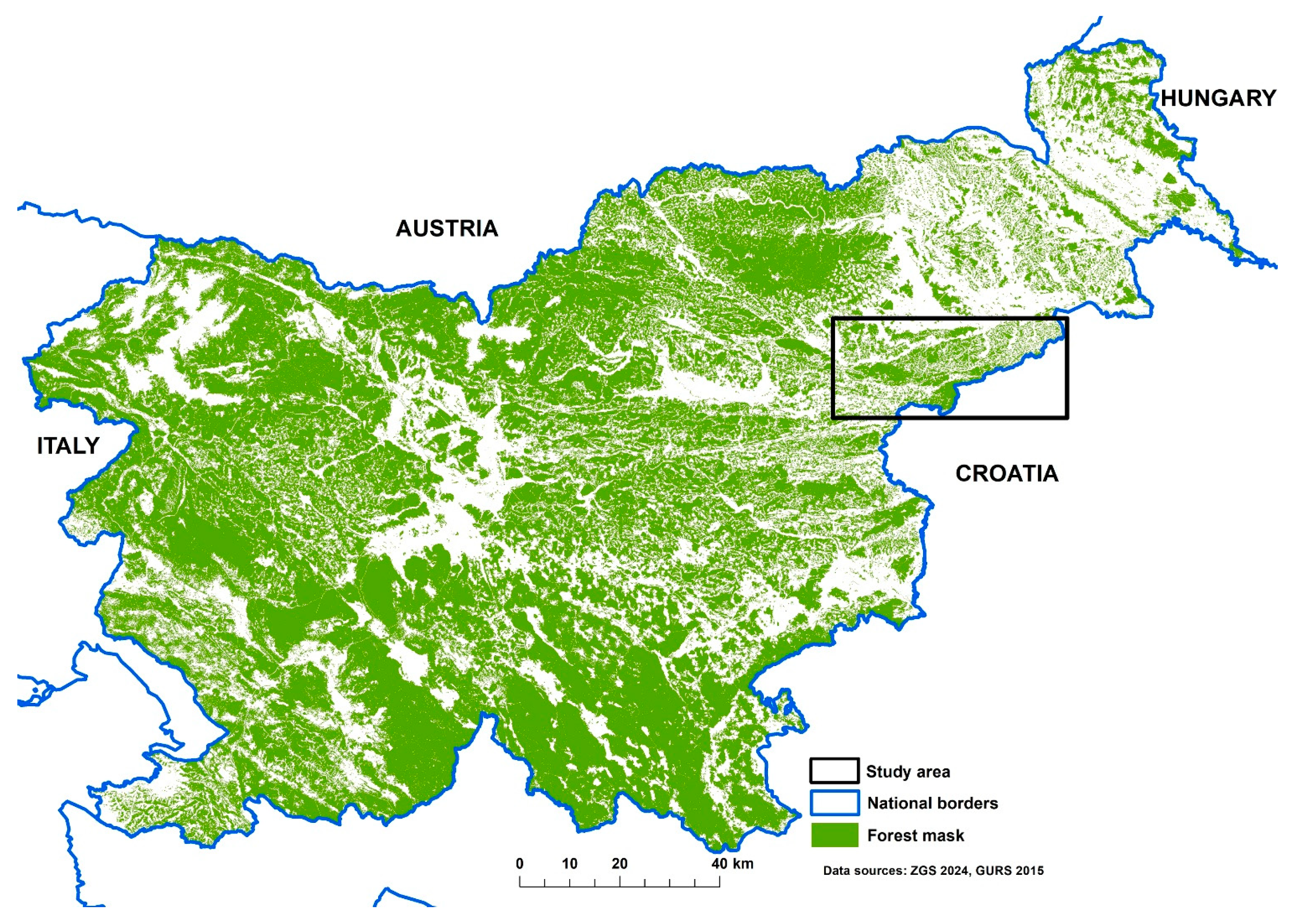
The study area is located in a forested landscape in eastern Slovenia. The site is designated within the Natura 2000 network as Boč-Haloze-Donačka gora (site code SI3000118; herein referred to as the BHD site) (Figure 1). The total area of the BHD site is 10,882 hectares, of which 853 hectares are assigned to the ravine forests of the priority habitat type of Tilio–Acerion forests (9180*). The most prevalent forest habitats are Illyrian beech forests (91K0) and Luzulo–Fagetum beech forests (9110) [21]. The topographical variations within the site range from 240 to 978 m, and the presence of a mosaic of forest vegetation types is indicative of the area’s diverse relief and geological conditions. The predominant topographic features are peaks, ridges, slopes and small plains. Due to the prevalence of carbonate bedrock, the area lacks a developed surface river network, as water quickly percolates into the karst subsurface. This geological and topographical diversity is reflected in the variety of soil types. Brown calcareous soils, rendzinas and rankers occur in alternating patterns depending on the slope and the type of bedrock. Further details about soil conditions and climate can be found in ref. [21]. The soil and climatic heterogeneity in the study area support floristic elements from Central Europe, the Illyrian and steppe regions, as well as the Mediterranean and Alpine regions [24].
Figure 1.
Location of the Boč-Haloze-Donačka gora (Natura 2000 site) study area in the eastern part of Slovenia (Sub-Pannonian region).
2.2. Description of the Studied Ravine Forests
A categorisation based on ecological and tree species composition reveals that there are two distinct groups of ravine forests belonging to the alliance Tilio–Acerion. The first is characterised by wetter and cooler sites, dominated by sycamore maple (Acer pseudoplatanus), classified within the Lunario–Acerenion sub-alliance. The second category is characterised by drier and warmer sites dominated by limes (Tilia platyphyllos Scop. and Tilia cordata Mill.) and thermophilous broadleaves. These sites are classified within the Tilio–Acerenion sub-alliance [19,25].
Although small in size, these ravine forests have been identified in a variety of sites and ecological conditions. Ravine forests are usually found in small patches in stony or rocky gullies, dolines, ravines, torrential fans, gravelly slopes, moist rock formations and sun-exposed ridges. These forests are found at altitudes ranging from the colline to the altimontane vegetation belt [26]. The soils in these forests are primarily colluvial–deluvial, with rare rendzina and brown calcareous soil formations. Dystric brown soils and ranker or eutric brown soils have also been documented. Some stands are found on very steep or rocky terrain [26].
The tree layer consists of noble broadleaf trees, which improve soil quality and provide high-value timber. The most dominant tree species are sycamore (Acer pseudoplatanus L.), Norway maple (Acer platanoides L.), wych elm (Ulmus glabra Huds.), European ash (Fraxinus excelsior L.), large-leaved lime (Tilia platyphyllos) and small-leaved lime (Tilia cordata). In terms of floristic composition, these communities share similarities with beech forests, but they contain a greater abundance of hygrophilous and nitrophilous species. The understorey vegetation usually comprises mesophilous, tall herbs and ferns that require high levels of nutrients, soil moisture and air humidity. Acer pseudoplatanus-dominated forests occur on colder, wetter sites, while Tilia forests, which are slightly more thermophilous, are found on warmer, drier sites [26].
Ravine forests in Slovenia occur across a wide range of site and stand conditions, spanning a broad ecological amplitude and a wide array of forest associations [26]. The studied ravine forests (habitat type 9180*) are diverse, with subtypes also having been identified [23]. These forests have high conservation value and often provide habitat for rare and protected species [26]. However, due to their small size, occurrence in smaller fragments and exposure to various pressures and threats, they are more vulnerable than larger forest types [21,26,27].
2.3. Data Collection
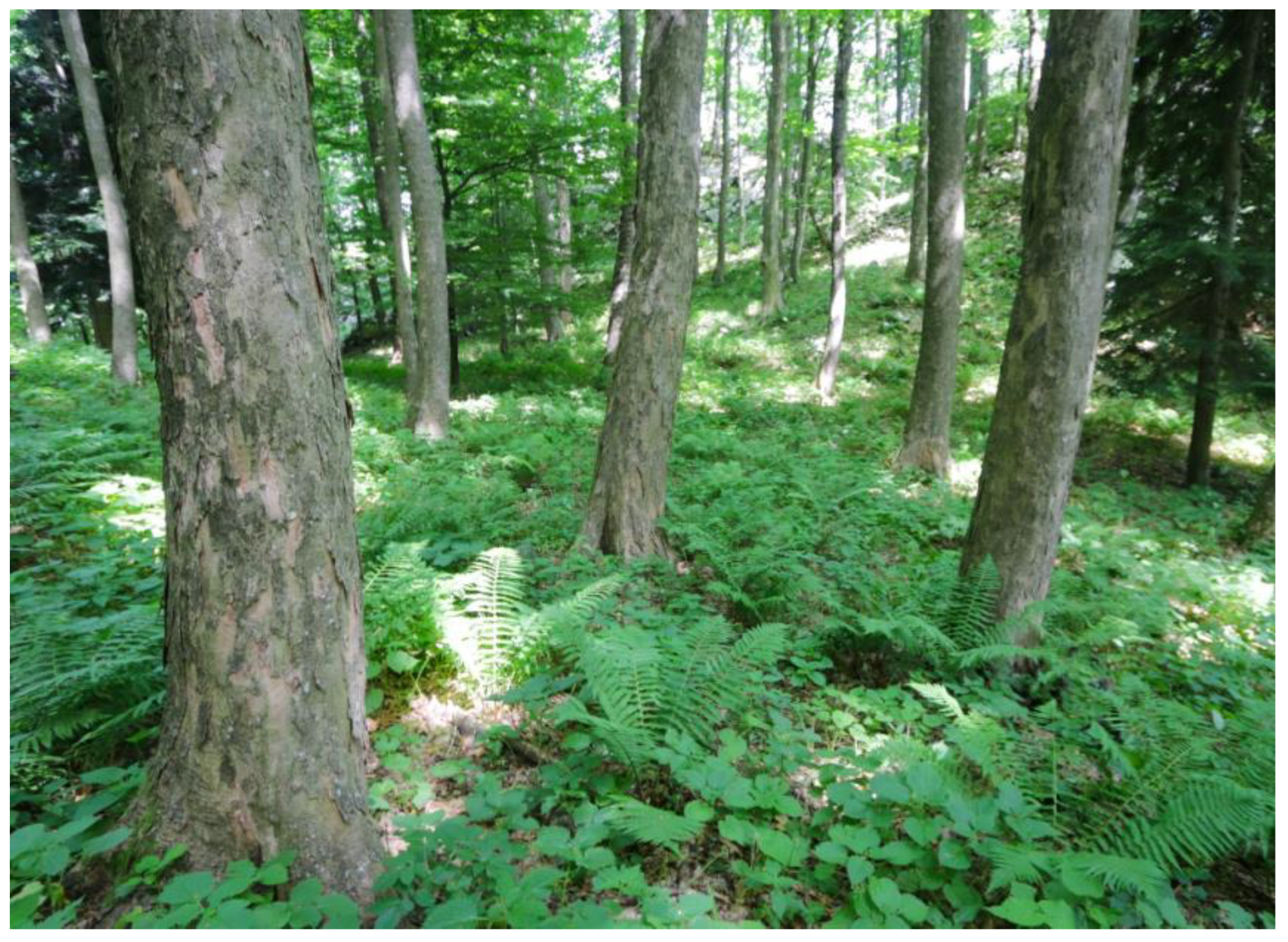
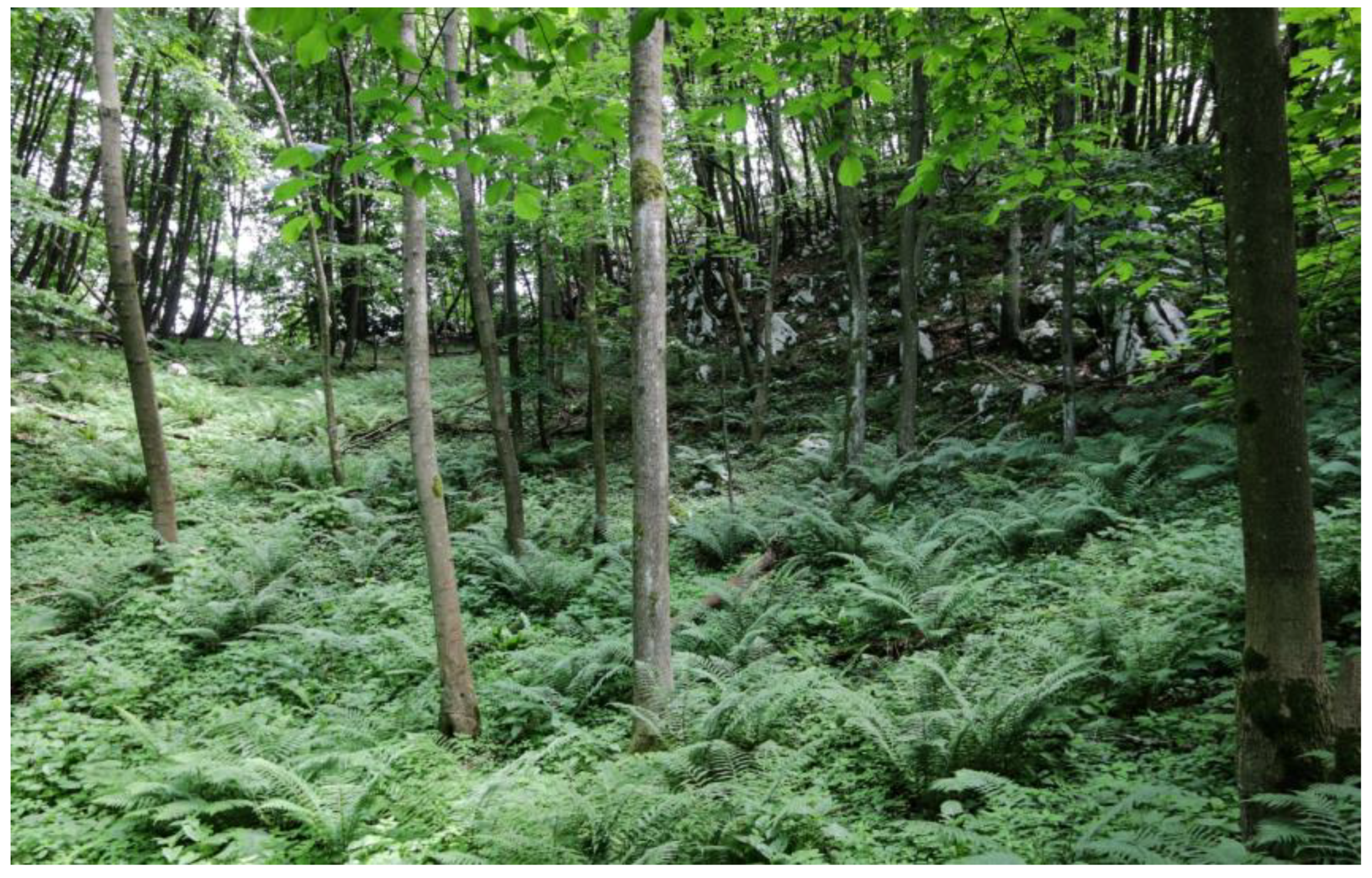
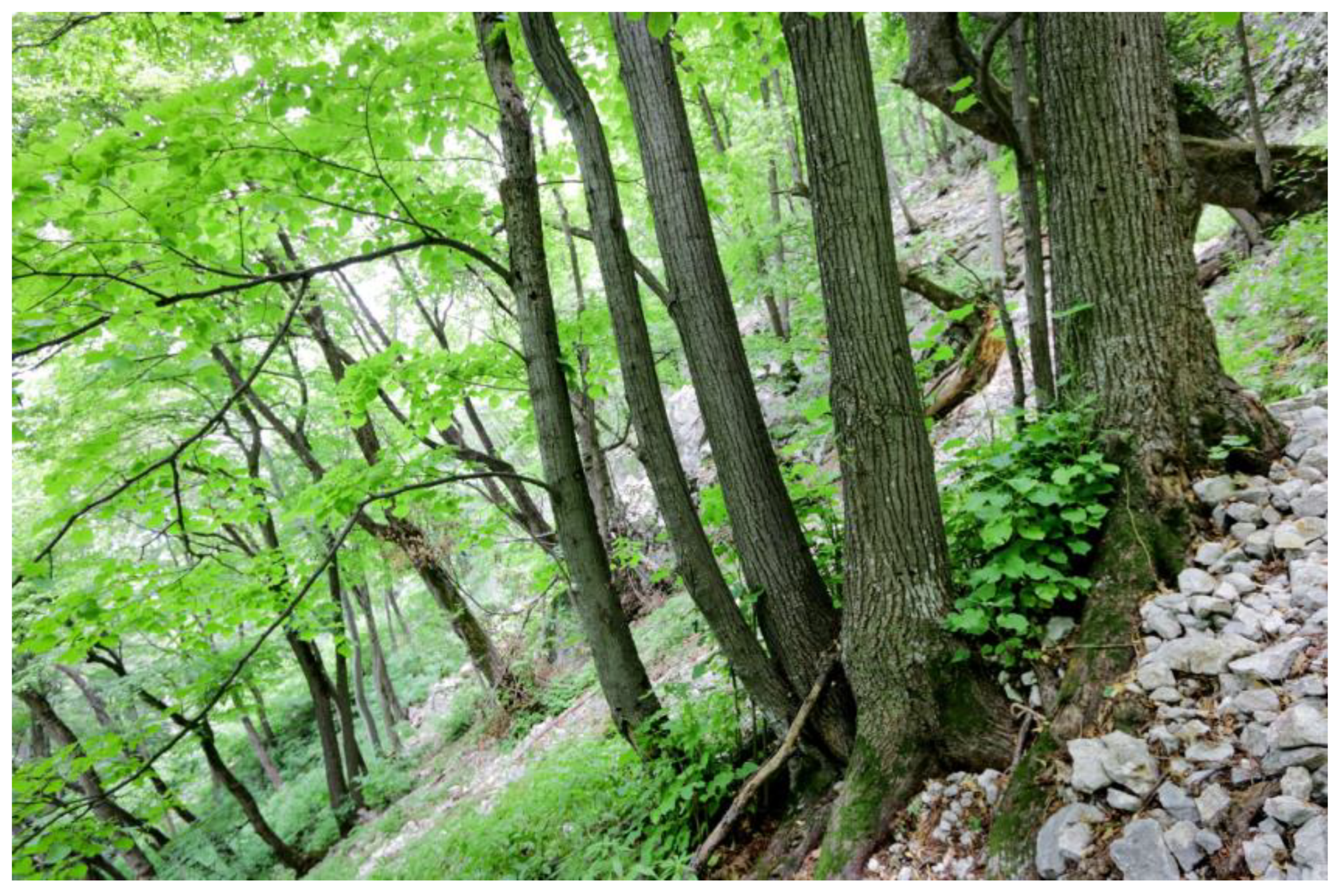
The selection of plots for the present study was undertaken using a multi-phase approach. In the initial phase of the study, a comprehensive mapping and analysis of all ravine forests within the BHD site were conducted [21,23]. In this study, 30 plots were selected from the ravine forests of the BHD site. These were selected based on the findings of previous studies, with the aim of identifying the impacts of local factors on vegetation diversity and composition, such as topography, forest stands and soils [28]. This selection process was designed to ensure that the study area was covered in a representative manner, with the aim of capturing as much ecological and geographical variation as possible within the ravine forests of the BHD site. We selected plots with homogeneous stands, with as few large gaps and other inconsistencies as possible, and with evenly distributed larger pieces of deadwood across the entire plot area. Of all selected plots, 18 plots were dominated by Acer pseudoplatanus, 8 by Fraxinus excelsior and 4 by Tilia species (Figure 2, Figure 3 and Figure 4).
Figure 2.
Plot dominated by Acer pseudoplatanus (Photo: L. Kutnar).
Figure 3.
Plot dominated by Fraxinus excelsior (Photo: L. Kutnar).
Figure 4.
Plot dominated by Tilia species (Photo: L. Kutnar).
All of the study plots were circular with a radius of 25.23 m and an area of 2000 m2. Within these plots, smaller, identical subplots were installed at the same centre point. The area and radius of these subplots varied according to the employed methodology and specific parameters. Vegetation, soil and common site characteristics were evaluated in 400 m2 subplots [29], while forest stand structure and tree characteristics were evaluated in subplots ranging from 200 to 2000 m2 [30,31].
Between 2021 and 2023, field assessments of all parameters were carried out as part of the LIFE Integrated Project for Enhanced Management of Natura 2000 in Slovenia. Different datasets were collected at each study plot to test the effects of soils and forest stands on ground vegetation [29].
2.3.1. Vegetation Survey
The size of the sampling area was 400 m2 in all plots [29]. The outer parts of the study plots (2000 m2) represent a buffer zone for the vegetation plots and also have an important impact on the herb layer of the vegetation plots by modifying light, nutrient supply, moisture, etc. All vascular plant species in the herb layer (all herbaceous species and woody individuals lower than 0.5 m) were recorded twice, in springtime (April 2022) and summer (June–August 2021 and 2022). The herb layer contains herbaceous (forbs, graminoids, ferns) and woody species [29]. The abundance of encountered species in the herb layer was visually estimated using a modified Barkman scale [32]. Species nomenclature followed [33,34,35,36,37,38,39]. During the vegetation survey, the overall cover (%) of each vegetation layer was also estimated: tree layer (woody individuals taller than 5 m), shrub layer (woody individuals from 0.5 to 5 m tall), herb layer (woody individuals up to 0.5 m and herbaceous plants) and moss layer (bryophytes on different substrates, including ground, rock, deadwood and living wood).
2.3.2. Topographic and Stand Variable Measurements
On each plot, the cover (%) of outcropping rock and rock fragments was recorded. Other topographic and site information was also recorded, such as altitude (m above sea level), aspect (azimuth degrees) and slope (vertical degrees). The heat load index (HLI) or potential annual direct incident radiation was calculated using the formula published in [40] based on aspect, slope and latitude (i.e., Equation (1) in ref. [40]).
The location, diameter at breast height (DBH) and height of living trees, as well as the amount of dead biomass on each plot, were measured following the methodology of the Slovenian National Forest Inventory [21,30,31]. Living trees and shrubs with a DBH of at least 10 cm were measured on circular plots of 200 m2, and those with a DBH of at least 30 cm on 600 m2 plots. For each tree, the azimuth and horizontal distance from the plot centre were recorded. The heights of at least five trees in each plot were measured (if more than one tree species was present, more than five tree heights were measured). Deadwood biomass (standing dead trees, lying dead trees, stumps, snags and coarse woody debris) was also measured (see also ref. [21]). Deadwood biomass with a DBH (standing dead trees, lying dead trees) or diameter (stumps, snags and coarse woody debris) of at least 10 cm was recorded on circular plots of 200 m2, and that with a DBH or diameter of at least 30 cm on 2000 m2 plots. The variables calculated from the inventory measurements of living trees and dead biomass are described in more detail in Table 1.
2.3.3. Soil Sampling and Analysis
Plots for soil sampling were the same as those used for the vegetation analysis. We sampled the organic (Ol, Of + Oh) layers and the mineral soil up to a depth of 20 cm at two depth intervals: 0–10 cm and 10–20 cm. On each plot, we systematically took sub-samples at three sampling points, which were evenly located 6 m from the centre of the plot. We combined the sub-samples from each horizon and depth into one composite sample. At each subsampling point in the mineral soil, soil samples were also taken with Kopecky cylinders, with which we measured the bulk density. The following variables were measured and calculated for soil samples: pH (CaCl2), total nitrogen content (g/kg), soil texture, soil organic carbon (g/kg), moisture content (%), cation exchange capacity (cmol/kg), exchangeable calcium (cmol/kg), bulk density (kg/m3), extractable phosphorus (mg/kg), texture, exchangeable cations (Ca2+, Mg2+, K+, Na+, etc.), sum of bases and sum of acids. Soil analyses were carried out in accordance with standard procedures and protocols [41,42,43,44,45,46,47]. Since our complete dataset included several different soil variables, we investigated the correlations between them to identify those containing similar information (see also ref. [3]). The organic and upper mineral soil layers were included in the analyses because topsoil conditions are considered the most important for plant species in the herb layer [14].
Table 1.
Description of explanatory variables used in the analyses.
Table 1.
Description of explanatory variables used in the analyses.
| Variable | Description of Variables | Group of Variables |
|---|---|---|
| Altitude | Height above sea level (in m) | Topographic/site |
| Rockiness | Cover of outcropping rock and rock fragments (in % of plot surface) | Topographic/site |
| HLI | Heat load index (HLI) calculated with Equation (1) published in ref. [40] | Topographic/site |
| T_COVER | Tree layer cover (%) [29] | Forest stand |
| Tree_N | Number of different tree species in the overstorey [31,48] | Forest stand |
| Height | Mean height of overstorey trees (m) [49] | Forest stand |
| DBH | Mean diameter at breast height (cm) of the five largest trees [50] | Forest stand |
| GS | Total growing stock (volume) of all trees (m3/ha) [31] | Forest stand |
| Acer | Total growing stock (volume) of Acer pseudoplatanus and Acer platanoides (m3/ha) [31] | Forest stand |
| Fraxinus | Growing stock (volume) of Fraxinus excelsior (m3/ha) [31] | Forest stand |
| Tilia | Total growing stock (volume) of Tilia cordata and Tilia platyphyllos (m3/ha) [31] | Forest stand |
| Ulmus | Growing stock (volume) of Ulmus glabra (m3/ha) [31] | Forest stand |
| Castanea | Growing stock (volume) of Castanea sativa (m3/ha) [31] | Forest stand |
| Ostrya | Growing stock (volume) of Ostrya carpinifolia (m3/ha) [31] | Forest stand |
| Carpinus | Growing stock (volume) of Carpinus betulus (m3/ha) [31] | Forest stand |
| Tot_N | Total number of living trees per hectare [51] | Forest stand |
| CE | Clark and Evans aggregation index was calculated as follows: , where and where is the Euclidean distance between the i-th tree and its nearest neighbour, is the plot area and is the number of trees on the plot [52] | Forest stand |
| DWD_V | Total volume of deadwood biomass (m3/ha) | Forest stand |
| DLR | Dead-to-living tree growing stock volume ratio [48] | Forest stand |
| pH | Soil reaction (pH) measured in 0.01 M CaCl2 in the 0–10 cm mineral soil layer | Soil |
| C/N | Ratio between carbon (C) and total nitrogen content (N) in the 0–10 cm mineral soil layer | Soil |
| CEC | Cation exchange capacity (cmol(+)/kg) in the 0–10 cm mineral soil layer | Soil |
| BS | Base saturation (%) is calculated as follows: BS = (sum of exchangeable base cations/CEC) × 100 in the 0–10 cm mineral soil layer | Soil |
2.4. Data Analysis
A set of 68 explanatory variables related to topographic features and stand characteristics was measured in the field. Additionally, 40 soil variables were measured in soil samples in the laboratory. Based on collinearity tests between all the measured explanatory variables in the field and laboratory, and on a preliminary screening assessment of the explanatory power of these variables, the initial set of 108 variables was reduced to a subset of 23 predictors (Table 1) [28], which was used for statistical analyses.
Statistical analyses were computed with R software, version 4.3.0 [53]. For the analysis of the vegetation data, spring and summer relevés were merged by choosing the higher cover values of both relevés. Species richness (total number of vascular plant species in the herb layer) was modelled by fitting a series of 23 univariate generalised linear models. We assumed a Poisson error distribution, which is generally recommended for count data, and a logarithmic link function was used in model specifications. Based on all significant predictors derived from univariate analysis, we carried out multivariate regression. To avoid violations of the underlying assumptions, we followed the recommendations of ref. [54]. The values of the predictors were standardised by subtracting the sample mean from the individual values and dividing the results by the sample standard deviation. We used the performance package [55] to examine multicollinearity between the predictors by calculating the variance inflation factor. The minimal adequate model was calculated with forward stepwise selection based on the Akaike information criterion [56], as implemented in the MASS package [57]. The fit of the final model was validated by plotting the residuals and the dispersion was tested using the DHARMa package [58]. Because we detected a slight overdispersion, we finally adopted a negative binomial distribution, which improved our model. The relative importance of each explanatory variable included in the final model was assessed via dominance analysis [59].
To analyse the impact of the environmental variables on herb-layer species composition [28], transformation-based redundancy analysis (RDA) was used as implemented in the vegan package [60]. The suitability of the RDA method was supported by the results of detrended correspondence analysis, which produced a length of the first axis gradient of 3.3 standard units. Prior to analysis, species abundance values were transformed with the Hellinger transformation [61]. This approach has several benefits, such as mitigating the double-zero problem, reducing the influence of dominant species and improving suitability for linear methods like RDA. Using the final subset of 23 environmental predictors, a forward selection procedure was applied to create the most parsimonious set of variables that significantly contributed to the explained variation. For this purpose, the function “forward.sel” from the adespatial package [62] was used based on scaled predictors and a permutation test.
3. Results
3.1. Species Richness
A total of 218 plant species were recorded in the herb layer of the selected ravine forests at the BHD site. These records were based on surveys conducted during the spring and summer periods. On average, 52.8 different plant species were recorded per plot. The highest number of species recorded in the herb layer was 80 and the lowest was 20. Among the three groups of plots dominated by different key tree species, the lowest mean number of species (47.2, range 20–69) was identified in plots where Acer pseudoplatanus was the dominant species in the tree layer (n = 18). This was followed by plots dominated by Fraxinus excelsior (n = 8), with a mean species number of 60.0 (range 43–80 species). The small group of four plots dominated by Tilia species in the tree layer had the highest mean species richness in the herb layer (63.8, range 47–75 species). The most frequently occurring species in the herb layer of the studied plots were Cardamine bulbifera (L.) Crantz (present in all plots), Dryopteris filix-mas (L.) Schott (present in 97% of plots), Galeobdolon flavidum (F. Herm.) Holub (97%), Polystichum setiferum (Forssk.) Woyn. (93%), Arum maculatum L. (87%), Circaea lutetiana L. (87%), Galium odoratum (L.) Scop. (87%), Mercurialis perennis L. (80%), Paris quadrifolia L. (80%) and Salvia glutinosa L. (80%). Young trees and shrubs were also common in this layer, including Acer pseudoplatanus (97%), Ulmus glabra (87%), Fagus sylvatica L. (80%), and Sambucus nigra L. (80%).
A univariate generalised linear regression model was employed to assess the relationship between herb-layer species richness and each of the selected explanatory variables related to topography, stand and soil characteristics (n = 23; see Table 1 and Table 2). This resulted in 13 significant variables (see Table 2). Species richness in the studied ravine forests was highly correlated with eight variables (p < 0.001). The following variables were positively associated with species richness (Table 2): total volume of deadwood biomass (DWD_V; pseudo-R2 = 30.7%), altitude (23.5%), dead-to-living volume ratio (DLR; 18.7%), growing stock of Tilia species (Tilia; 13.7%) and Ostrya carpinifolia Scop. (Ostrya; 10.7%). However, species richness was negatively associated with the following variables (Table 2): tree layer cover (T_COVER; pseudo-R2 = 23.5%), mean overstorey tree height (Height; 19.4%) and growing stock of Acer species (Acer; 15.0%). In the studied ravine forests, species richness was also negatively associated with the mean DBH of the five largest trees (DBH; 9.8%, p < 0.01) and growing stock of Castanea sativa Mill. (Castanea; 4.3%, p < 0.05) and Ulmus glabra (Ulmus; 4.0%, p < 0.05). Species richness was positively associated with the total number of living trees per hectare (Tot_N; 6.5%, p < 0.01) and cation exchange capacity (CEC; 5.7%, p < 0.05).
Table 2.
Relationship between plant species richness in the herb layer and each of the selected explanatory variables related to topographic, stand and soil characteristics (n = 23) derived from univariate regression models. Predictors are ranked according to the pseudo-R2. Significance levels are indicated with asterisks: *** p < 0.001, ** p < 0.01, * p < 0.05, ns—not significant.
However, the multivariate regression model, which considered 23 explanatory variables related to topographic, stand and soil characteristics (Table 1 and Table 2), identified only three significant predictors (Table 3). There was a positive association between species richness and total deadwood biomass volume (DWD_V; relative importance = 34.0%, p < 0.001) and altitude (9.5%, p < 0.05). According to the final multivariate model (Table 3), species richness was negatively associated with the mean height of overstorey trees (Height; 12.5%, p < 0.05). The pseudo R2 of the final model was 52.7% and the AIC value was 228.9.
Table 3.
Results from the final multivariate regression model for species richness. Predictors are ranked according to the relative importance obtained via dominance analysis. Significance levels are indicated with asterisks: *** p < 0.001, * p < 0.05.
3.2. Species Composition
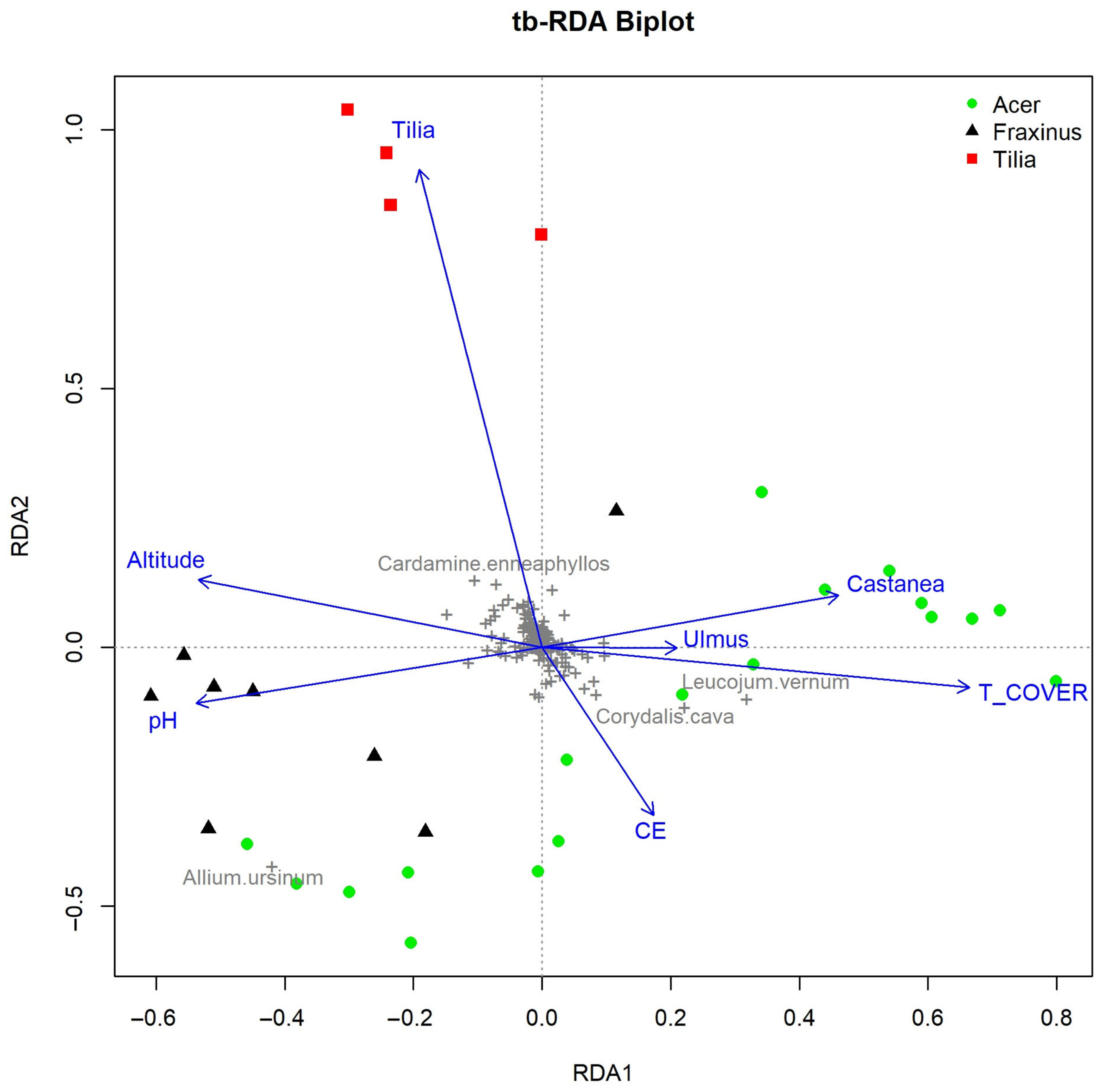
The species composition of the herb layer in the studied ravine forests was significantly correlated with seven of the initial 23 explanatory variables used in the stepwise selection for RDA. The most explanatory and highly significant variables (p < 0.001) were the following (Table 4): growing stock of Tilia species (Tilia; 11.2%), soil reaction (pH; 8.8%) and tree layer cover (T_COVER; 8.5%). Additionally, the growing stock of Castanea sativa (Castanea, 6.7%) and the Clark and Evans aggregation index (CE; 5.0%) also significantly contributed to explaining the species composition of the studied forests (p < 0.01). The following variables contributed slightly less to the compositional variability (p < 0.05): growing stock of Ulmus glabra (Ulmus; 4.5%) and altitude (4.4%). The RDA model, which included seven factors, explained 49.1% of the variability in species composition.
Table 4.
Predictors for species composition. Significance levels are indicated with asterisks: *** p < 0.001, ** p < 0.01, * p < 0.05.
tb-RDA revealed significant gradients in species composition within the studied ravine forests, relating to seven explanatory variables (from the final model) associated with topographic, stand and soil characteristics (Figure 5). Plots dominated by Tilia species (including Tilia cordata and T. platyphyllos) were clearly separated from those dominated by Acer species and Fraxinus excelsior. Tilia plots are at the top of Figure 5, with low values on the first RDA axis and high values on the second. Most plots dominated by Fraxinus have low values on both axes, while plots with Acer species have low values on the second axis (Figure 5). Plots with stands dominated by Acer species have the greatest ecological range and are located along the entire first RDA axis.
Figure 5.
Transformation-based redundancy analysis (tb-RDA) biplot based on the final model including seven variables with a significant contribution to the explained variation in species composition of the herb layer across 30 plots. Outlined are four early spring ephemeral herbs (geophytes) with an exceptional position along the first or second RDA axis compared with other species, which are clustered in the central part of the diagram. Plots are coloured and symbolised according to the dominant tree species in the stand.
The vector of T_COVER is opposite to the vector of altitude, which indicates that tree layer cover was on average higher at lower altitudes. The vector of the Castanea sativa growing stock also indicates a higher proportion of this species in Acer-dominated stands at lower altitudes. These stands, which are admixed with Castanea sativa, grow in more acidic soils (lower pH). However, other Acer stands admixed with different broadleaves are found at higher altitudes and in soils with a higher pH (less acidic) on carbonate bedrock. Among the early spring ephemeral herbs, Corydalis cava (L.) Schweigg. & Körte and Leucojum vernum L. are indicative of Acer forests at lower altitudes. Cardamine enneaphyllos (L.) Crantz is a more characteristic species of forests at higher altitudes, while Allium ursinum L. is more abundant in Fraxinus and Acer plots on the left side of the RDA biplot (at higher altitudes).
The Clark and Evans aggregation index (CE) indicates differences between Tilia stands, where tree individuals are more clustered, and other stands, where trees are distributed more randomly or regularly within the plots.
4. Discussion
4.1. Factors Associated with Species Richness
The plant species richness of the understorey in the ravine forests studied in the BHD Natura 2000 site was very high. The mean species richness per plot was almost 53, which is much higher than the 44 plant species identified in plots of the same size in other forests in Slovenia [3] that are also managed according to close-to-nature principles.
Our study revealed that species richness in the herb layer of ravine forests responded differently to topographic, stand and soil factors. Among these factors, the total volume of deadwood biomass was most strongly positively associated with species richness. Dittrich et al. [63] concluded that modern silviculture has led to a reduction in deadwood, particularly of large diameter, resulting in the loss of an important habitat niche in European forests. By contrast, the ravine forests in our study harbour large amounts of standing and downed deadwood (average of 33.6 m3/ha per plot), which is significantly higher than the mean deadwood volume in Slovenian forests (14.8 m3/ha) [64]. This is also a result of close-to-nature forest management in ravine forests, which maintains higher volumes of deadwood. The presence of deadwood is a key factor supporting high species richness and diverse composition, particularly among bryophytes [65,66,67]. However, deadwood also promotes the colonisation of vascular plants [68,69] and tree seedlings [70,71]. Moreover, lying deadwood also promotes functional diversity in the understorey [72]. Vascular plants colonise deadwood of all decay classes, including freshly fallen logs [69]. The density of colonisers increases with the decomposition rate of the deadwood and is higher when the deadwood is exposed to light. Species that prefer deadwood to soil are typically early successional species, while those that prefer soil are often hygrophytes or typical understorey species [69].
In the ravine forests studied at the BHD site, the most diverse stands dominated by Tilia species had the highest mean amount of deadwood (62.2 m3/ha), with values reaching up to 115.0 m3/ha. These Tilia stands are located in rocky areas (with an average of more than 76% of the surface covered by rocks and stones), which are steep and remote. The high volumes of deadwood are mainly due to the absence or limited management of these forests, which are located in more extreme and less accessible areas [21].
High volumes of deadwood were also observed in Fraxinus excelsior-dominated stands, with an average measurement of 56.0 m3/ha. While deadwood can offer potential ecological benefits in the future, the current high levels are the result of the degradation and high mortality of Fraxinus excelsior stands, which have been affected by the invasive fungal disease ash dieback (Hymenoscyphus fraxineus, Anamorph Chalara fraxinea) [73,74]. The increased mortality of key tree species in the studied ravine forests, particularly Fraxinus excelsior, resulted in the opening of canopy crowns and increased light availability at ground level. It was revealed that species richness decreased significantly with tree-layer cover, which was much lower in Fraxinus stands (59.4%) than in all plots (81.5%). This was reflected in a higher number of plant species in the herb layer and increased herb layer cover. A post-disturbance response in the forest herb layer is characterised by an increase in the diversity of resident species combined with colonisation of early successional species [75]. This is consistent with the findings of ref. [76], who revealed that plant species richness in the understorey of temperate forests increased with light availability.
Overall, deadwood in the studied ravine forests is only partly a primary driver of species richness. It is more likely to be a proxy for less intensive management on the one hand and for disturbances on the other. In the first case, deadwood in the progressive decaying phases directly promotes species richness in Tilia and mature Acer stands, where different microhabitats enable the colonisation of specific vascular plant species and their functional groups [72]. However, in Fraxinus stands with ash dieback, which causes disturbances and creates more open stands, a high level of deadwood does not directly support high species richness. Here, deadwood correlates with species richness not because plants grow on lying logs in the initial decaying phase, but because a high level of deadwood indicates open canopies (i.e., disturbance) or complex habitat structures that promote the coexistence of different species.
However, species richness in the herb layer is negatively associated with tree height. Above-average values were observed for both tree height (27.0 m vs. 25.0 m for all plots) and tree layer cover (91.2% vs. 81.5% for all plots) in stands dominated by Acer pseudoplatanus, well-preserved forests with favourable conservation status [21]. The lower species richness in these Acer-dominated stands with dense canopy cover is also due to the absence of early successional and non-forest species that are closely associated with forest disturbances. It appears that height may act as a proxy for canopy closure in dense Acer stands rather than influencing species richness directly. Conversely, species composition was found to be positively associated with the growing stock of Tilia species, including T. platyphyllos and T. cordata. These are the characteristic tree species of ravine forests on very steep and rocky terrain, with an admixture of Ostrya carpinifolia and other thermophilic broadleaves. This variable was not found to be a direct driving factor of species composition; rather, it indicates well-preserved forests in extreme and less accessible areas. These Tilia-dominated stands are managed at a low intensity in accordance with the close-to-nature approach, which promotes various microhabitats on rocky surfaces and maintains a high amount of deadwood. Furthermore, the contrasting richness values between Acer- and Tilia-dominated stands appear to be a consequence of the distinct ecological niches that these stands occupy rather than a direct effect of the tree species themselves. Tilia stands are confined to higher altitudes and extremely rocky terrain, conditions which suppress the dominance of competitive understorey species (hence the low cover of the herb layer) and allow diverse, specialised flora to coexist.
Altitude was one of the most influential factors for species richness in the studied ravine forests. The species richness of the herb layer also increased with altitude in Central European beech forests [77]. However, an inverse unimodal species richness–altitude pattern was observed, with a minimum at intermediate altitudes. In the altitudinal range of the studied plots between 336 m and 949 m above sea level, most of the ravine-forest stands with an above-average species richness (52.8 species per plot) were located at an altitude above 700 m. These stands at higher elevations are mixed with beech-dominated forests and interact with them, sharing some common species. Furthermore, light-demanding noble broadleaves often occur as pioneer species on primarily beech sites [26]. Different floristic elements from the Alps, Central Europe and other regions contribute to the higher species richness of stands at higher elevations [24]. Additionally, the floristic composition of the studied ravine forests is enriched by the presence of some relict and endemic Illyrian species that survived the Quaternary glaciations in southern European refugia, including some typical forest herbs [22].
4.2. Factors Associated with Species Composition
Tilia stands with the highest species richness had the lowest herb layer cover, which averaged 36.3% compared with the mean of 77.9% across all plots. This is somewhat consistent with the findings of ref. [78], who demonstrated that plant species richness and composition respond significantly differently to local, landscape and biogeographical variables, and that species composition can reveal more about the ecological processes affecting plant communities than species richness alone. However, both species richness and composition revealed significant driving processes in the studied ravine forests.
In the Tilia stands, in addition to the common species of ravine forest, the composition of the herb layer also encompassed some less competitive species (e.g., different stress-tolerators) that have adapted to extreme, steep and rocky sites. This results in the highest level of species richness. In rocky Tilia stands under extreme and exposed site conditions, the ability of mesic and hygrophilous plant species to spread and develop larger cover is restricted.
In contrast to ref. [79], who reported a lack of tree clusters in managed ravine forests, the field data from the present study revealed a high frequency of tree clusters with multiple stems, particularly in Tilia-dominated stands. This was indicated by a higher degree of tree clustering, as evidenced by the low values of the Clark and Evans aggregation index [52] in Tilia stands (0.64 vs. 0.81 for all plots). Unlike previous studies of ravine forests [21], these stand structural indicators effectively explained the differences in vertical structure between Tilia stands, where the trees are more clustered, and Acer and Fraxinus stands, where the trees are more randomly or regularly distributed within the plots.
In the present analysis, the pH of the mineral soil layer was the only one of the 40 soil variables that significantly indicated a gradient in species composition in ravine forests. Despite heterogeneous soil conditions ranging from less to extremely rocky sites, and different soil horizon depths, this suggests relatively comparable soil conditions across all types of stands and sites. Along the pH gradient, which varied between 4.1 and 6.9, species composition responded to this variable. In terms of soil reaction, forests dominated by Acer tree species are heterogeneous, as they grow on different soil types (e.g., colluvial–deluvial soils, rendzinas and brown calcareous soils, eutric to dystric brown soils and rankers), and both extreme pH values were measured in different Acer forests. It was revealed that soil acidity largely accounts for the floristic composition of the herb-layer vegetation, but canopy cover, an important factor in the present study of ravine forests, may greatly modify the effect of soil reaction on species composition [80].
As with species richness, altitude was shown to be an important factor influencing the species composition of the herb layer in the studied ravine forests. The gradient of altitude, together with the vectors of pH, tree layer cover and Castanea growing stock, indicated substantial changes in species composition between Acer forests at lower altitudes and Acer forests at higher altitudes.
These variables, which explained the high gradient in species composition, also indicated heterogeneity in the ravine forests studied in the BHD Natura 2000 site. This shows that small-scale ravine forests, such as the Tilio–Acerion forests of slopes, screes and ravines (9180*), may exhibit a high degree of heterogeneity. Alongside global changes and disturbances [81], local topography, stand and site characteristics should also be considered in forest management aimed at supporting natural processes and structures as much as possible. The most appropriate way to consider the heterogeneous vegetation, ecological and stand conditions in ravine forests is to apply an approach that favours less intensive management, such as close-to-nature forest management.
5. Conclusions
The high level of plant diversity found in the herb layer of ravine forests, which are designated as an EU priority habitat, highlights their important role as biodiversity hotspots within forest ecosystems, emphasising their conservation value within the Natura 2000 network. The results suggest that the structural characteristics of forest stands and topographic heterogeneity are important factors associated with plant diversity, which is an important consideration for conservation efforts. Stands dominated by Tilia species demonstrated that high species richness can be obtained in structurally diverse forests despite relatively low herb-layer cover. This indicates that forest management practices should focus primarily on maintaining the structural complexity of forest stands and the heterogeneity of site conditions. Preserving diverse stand structures and retaining deadwood appear particularly important for sustaining the microhabitats that support forest plant specialists. Therefore, conservation strategies should utilise close-to-nature and similar forest management approaches to maintain the natural disturbance dynamics, structural variability and continuity of forest habitats, ensuring the long-term stability and biodiversity of ravine forest ecosystems.
Author Contributions
Conceptualisation, L.K., J.K., A.M.P. and A.M.; Data curation, J.K., A.M.P., L.K. and A.M.; Formal analysis, J.K., L.K. and A.M.P.; Methodology, L.K., J.K., A.M.P. and A.M.; Resources, L.K.; Visualisation, J.K.; Writing—original draft, L.K., J.K., A.M.P. and A.M.; Writing—review & editing, L.K., J.K., A.M.P. and A.M. All authors have read and agreed to the published version of the manuscript.
Funding
This study was funded by the EU LIFE Integrated Project for Enhanced Management of Natura 2000 in Slovenia (LIFE17 IPE/SI/000011) and by the Slovenian Research and Innovation Agency (ARIS), Research Program P4-0107.
Data Availability Statement
Research data are available at: https://doi.org/10.20315/Data.0016 (accessed on 10 March 2026).
Acknowledgments
We thank Valerija Babij (Slovenia Forest Service) and Erika Kozamernik, Marko Frank, Ana Simčič, David Štefanič, Ajša Alagić, Samo Stopar, Tadej Sluga, Daniel Žlindra, Magda Špenko and Ana Prhavc (Slovenian Forestry Institute) for their extensive help during fieldwork at the study site and for technical support. We are also grateful to the two anonymous reviewers for their valuable comments, which considerably improved the initial version of this paper. We thank Jan P. Nagel for proofreading and language editing.
Conflicts of Interest
The authors declare no conflicts of interest.
References
- Sabatini, F.M.; Jiménez-Alfaro, B.; Burrascano, S.; Blasi, C. Drivers of herb-layer species diversity in two unmanaged temperate forest in northern Spain. Community Ecol. 2014, 15, 147–157. [Google Scholar] [CrossRef]
- Maes, S.L.; Perring, M.P.; Depauw, L.; Bernhardt-Römermann, M.; Blondeel, H.; Brūmelis, G.; Brunet, J.; Decocq, G.; den Ouden, J.; Govaert, S.; et al. Plant functional trait response to environmental drivers across European temperate forest understorey communities. Plant Biol. 2020, 22, 410–424. [Google Scholar] [CrossRef]
- Kermavnar, J.; Kutnar, L.; Marinšek, A. Disentangling the ecological determinants of species and functional trait diversity in herb-layer plant communities in European temperate forests. Forests 2021, 12, 552. [Google Scholar] [CrossRef]
- Vanneste, T.; Valdés, A.; Verheyen, K.; Perring, M.P.; Bernhardt-Römermann, M.; Andrieu, E.; Brunet, J.; Cousins, S.A.O.; Deconchat, M.; De Smedt, P.; et al. Functional trait variation of forest understory plant communities across Europe. Basic Appl. Ecol. 2019, 34, 1–14. [Google Scholar] [CrossRef]
- Barbier, S.; Gosselin, F.; Balandier, P. Influence of tree species on understory vegetation diversity and mechanisms involved—A critical review for temperate and boreal forests. For. Ecol. Manag. 2008, 254, 1–15. [Google Scholar] [CrossRef]
- Petersson, L.; Holmström, E.; Lindbladh, M.; Felton, A. Tree species impact on understory vegetation: Vascular plant communities of Scots pine and Norway spruce managed stands in northern Europe. For. Ecol. Manag. 2019, 448, 330–345. [Google Scholar] [CrossRef]
- Weigel, R.; Gilles, J.; Klisz, M.; Manthey, M.; Kreyling, J. Forest understory vegetation is more related to soil than to climate towards the cold distribution margin of European beech. J. Veg. Sci. 2019, 30, 746–755. [Google Scholar] [CrossRef]
- Catorci, A.; Tardella, F.M.; Cutini, M.; Luchetti, L.; Paura, B.; Vitanzi, A. Reproductive traits variation in the herb layer of a submediterranean deciduous forest landscape. Plant Ecol. 2013, 214, 737–749. [Google Scholar] [CrossRef]
- Tardella, F.M.; Postiglione, N.; Bricca, A.; Cutini, M.; Catorci, A. Altitude and aspect filter the herb layer functional structure of sub-Mediterranean forests. Phytocoenologia 2019, 49, 185–198. [Google Scholar] [CrossRef]
- Leuschner, C.; Lendzion, J. Air humidity, soil moisture and soil chemistry as determinants of the herb layer composition in European beech forests. J. Veg. Sci. 2009, 20, 288–298. [Google Scholar] [CrossRef]
- Macek, M.; Kopecký, M.; Wild, J. Maximum air temperature controlled by landscape topography affects plant species composition in temperate forests. Landsc. Ecol. 2019, 34, 2541–2556. [Google Scholar] [CrossRef]
- Su, X.; Wang, M.; Huang, Z.; Fu, S.; Chen, H.Y.H. Forest understory vegetation: Colonization and the availability and heterogeneity of resources. Forests 2019, 10, 944. [Google Scholar] [CrossRef]
- Vockenhuber, E.A.; Scherber, C.; Lagenbruch, C.; Meißner, M.; Seidel, D.; Tscharntke, T. Tree diversity and environmental context predict herb species richness and cover in Germany’s largest connected deciduous forest. Perspect. Plant Ecol. 2011, 13, 111–119. [Google Scholar] [CrossRef]
- Maes, S.L.; Blondeel, H.; Perring, M.P.; Depauw, L.; Brūmelis, G.; Brunet, J.; Decocq, G.; den Ouden, J.; Härdtle, W.; Hédl, R.; et al. Litter quality, land-use history, and nitrogen deposition effects on topsoil conditions across European temperate deciduous forests. For. Ecol. Manag. 2019, 433, 405–418. [Google Scholar] [CrossRef]
- Tinya, F.; Márialigeti, S.; Király, I.; Németh, B.; Ódor, P. The effect of light conditions on herbs, bryophytes and seedlings of temperate mixed forests in Őrség, Western Hungary. Plant Ecol. 2009, 204, 69–81. [Google Scholar] [CrossRef]
- Depauw, L.; Perring, M.P.; Landuyt, D.; Maes, S.L.; Blondeel, H.; De Lombaerde, E.; Brūmelis, G.; Brunet, J.; Closset-Kopp, D.; Czerepko, J.; et al. Light availability and land-use history drive biodiversity and functional changes in forest herb layer communities. J. Ecol. 2020, 108, 1411–1425. [Google Scholar] [CrossRef]
- Mölder, A.; Streit, M.; Schmidt, W. When beech strikes back: How strict nature conservation reduces herb-layer diversity and productivity in Central European deciduous forests. For. Ecol. Manag. 2014, 319, 51–61. [Google Scholar] [CrossRef]
- Tinya, F.; Kovács, B.; Bidló, A.; Dima, B.; Király, I.; Kutszegi, G.; Lakatos, F.; Mag, Z.; Márialigeti, S.; Nascimbene, J.; et al. Environmental drivers of forest biodiversity in temperate mixed forests—A multi-taxon approach. Sci. Total Environ. 2021, 795, 148720. [Google Scholar] [CrossRef]
- EC. Interpretation Manual of European Union Habitats—EUR28; European Commission, DG Environment: Brussels, Belgium, 2013. [Google Scholar]
- EEA. Tilio–Acerion Forests of Slopes, Screes and Ravines: Habitats Directive Annex I Code 9180; European Environment Agency, Biodiversity, Information System for Europe: Copenhagen, Denmark, 2025. [Google Scholar]
- Kutnar, L.; Kermavnar, J.; Pintar, A.M. Structural and compositional indicators of the conservation status of forest habitats: A case study of ravine forests—EU priority habitat type Tilio–Acerion. Ecol. Indic. 2025, 179, 114079. [Google Scholar] [CrossRef]
- Košir, P.; Čarni, A.; Di Pietro, R. Classification and phytosociological differentiation of broad-leaved ravine forests in southeastern Europe. J. Veg. Sci. 2008, 19, 331–342. [Google Scholar] [CrossRef]
- Kermavnar, J.; Kozamernik, E.; Kutnar, L. Assessing the heterogeneity and conservation status of the Natura 2000 priority forest habitat type Tilio–Acerion (9180*) based on field mapping. Forests 2023, 14, 232. [Google Scholar] [CrossRef]
- Karlo, T.; Senegačnik, A. Analiza in Ocena Stanja Projektnega Območja Boč-Haloze-Donačka Gora (Report of Detailed Analysis of Situation on Nature Conservation Measures for Natura 2000 Sites Boč-Haloze-Donačka Gora); Institute of the Republic of Slovenia for Nature Conservation: Ljubljana, Slovenia, 2020; 55p. [Google Scholar]
- Steinacker, C.; Beierkuhnlein, C.; Jaeschke, A. Assessing the exposure of forest habitat types to projected climate change—Implications for Bavarian protected areas. Ecol. Evol. 2019, 9, 14417–14429. [Google Scholar] [CrossRef]
- Dakskobler, I.; Košir, P.; Kutnar, L. Gozdovi Plemenitih Listavcev v Sloveniji (Broad-Leaved Ravine Forests in Slovenia); Silva Slovenica: Ljubljana, Slovenia; Gozdarski inštitut Slovenije: Ljubljana, Slovenia, 2013; 75p. [Google Scholar]
- Kutnar, L.; Matijašić, D.; Pisek, R. Conservation status and potential threats to Natura 2000 forest habitats in Slovenia. Šumar. List 2011, 5–6, 215–231. [Google Scholar]
- Kutnar, L.; Pintar, A.M.; Marinšek, A.; Kermavnar, J. Dataset on the Topography, Soil, Vegetation and Stand Characteristics of Tilio–Acerion Forests (Boč, Slovenia); Gozdarski inštitut Slovenije: Ljubljana, Slovenia, 2026. [Google Scholar] [CrossRef]
- Canullo, R.; Starlinger, F.; Granke, O.; Fischer, R.; Aamlid, D.; Neville, P. ICP Forests Manual on Methods and Criteria for Harmonized Sampling, Assessment, Monitoring and Analysis of the Effects of Air Pollution on Forests; Part VII.1: Assessment of Ground Vegetation; UNECE ICP Forests Programme Coordinating Centre: Hamburg, Germany, 2016; p. 19. [Google Scholar]
- Skudnik, M.; Grah, A.; Guček, M.; Kovač, M.; Kušar, G.; Pintar, A.M.; Pisek, R.; Poljanec, A.; Žlogar, J. Nacionalna Gozdna Inventura: Interna Navodila za Terensko Delo (2020–2024): (Ver. 02/2022); Gozdarski inštitut Slovenije: Ljubljana, Slovenia, 2022; 76p. [Google Scholar]
- Pintar, A.; Ferreira, A.; Krajnc, L.; Kušar, G.; Skudnik, M. Pestrost in pojavljanje domačih in tujerodnih drevesnih in grmovnih vrst na ploskvah Nacionalne gozdne inventure v Sloveniji. Acta Silv. Lign. 2024, 134, 11–26. [Google Scholar] [CrossRef]
- Barkman, J.J.; Doing, H.S.; Segal, S. Kritische Bemerkungen und Vorschläge zur quantitativen Vegetationsanalyse. Acta Bot. Neerl. 1964, 13, 394–419. [Google Scholar] [CrossRef]
- Tutin, T.G.; Heywood, V.H.; Burges, N.A.; Moore, D.M.; Valentine, D.H.; Walters, S.M.; Webb, D.A. Flora Europaea; Cambridge University Press: Cambridge, UK, 1964; Volume 1. [Google Scholar]
- Tutin, T.G.; Heywood, V.H.; Burges, N.A.; Moore, D.M.; Valentine, D.H.; Walters, S.M.; Webb, D.A. Flora Europaea; Cambridge University Press: Cambridge, UK, 1968; Volume 2. [Google Scholar]
- Tutin, T.G.; Heywood, V.H.; Burges, N.A.; Moore, D.M.; Valentine, D.H.; Walters, S.M.; Webb, D.A. Flora Europaea; Cambridge University Press: Cambridge, UK, 1972; Volume 3. [Google Scholar]
- Tutin, T.G.; Heywood, V.H.; Burges, N.A.; Moore, D.M.; Valentine, D.H.; Walters, S.M.; Webb, D.A. Flora Europaea; Cambridge University Press: Cambridge, UK, 1976; Volume 4. [Google Scholar]
- Tutin, T.G.; Heywood, V.H.; Burges, N.A.; Moore, D.M.; Valentine, D.H.; Walters, S.M.; Webb, D.A. Flora Europaea; Cambridge University Press: Cambridge, UK, 1980; Volume 5. [Google Scholar]
- Tutin, T.G.; Burges, N.A.; Chater, A.O.; Edmondson, J.R.; Heywood, V.H.; Moore, D.M.; Valentine, D.H.; Walters, S.M.; Webb, D.A. Flora Europaea, 2nd ed.; Cambridge University Press: Cambridge, UK, 1993. [Google Scholar]
- Martinčič, A.; Wraber, T.; Jogan, N.; Podobnik, A.; Turk, B.; Vreš, B.; Ravnik, V.; Frajman, B.; Strgulc Krajšek, S.; Trčak, B.; et al. Mala Flora Slovenije: Ključ za Določanje Praprotnic in Semenk; Tehniška založba Slovenije: Ljubljana, Slovenia, 2007; 967p. [Google Scholar]
- McCune, B.; Keon, D. Equations for potential annual direct incident radiation and heat load. J. Veg. Sci. 2002, 13, 603–606. [Google Scholar] [CrossRef]
- ISO 10390; Soil Quality—Determination of pH. ISO: Geneva, Switzerland, 2005.
- ISO 10693; Soil Quality—Determination of Carbonate Content—Volumetric Method. ISO: Geneva, Switzerland, 1995.
- ISO 10694; Soil Quality—Determination of Organic and Total Carbon After Dry Combustion (Elementary Analysis). ISO: Geneva, Switzerland, 1995.
- ISO 11277; Soil Quality—Determination of Particle Size Distribution in Mineral Soil Material—Method by Sieving and Sedimentation. ISO: Geneva, Switzerland, 2009.
- ISO 11464; Soil Quality—Pre-Treatment of Samples for Physico-Chemical Analysis. ISO: Geneva, Switzerland, 2006.
- ISO 11465; Soil Quality—Determination of Dry Matter and Water Content on a Mass Basis—Gravimetric Method. ISO: Geneva, Switzerland, 1993.
- ISO 13878; Soil Quality—Determination of Total Nitrogen Content by Dry Combustion (“Elemental Analysis”). ISO: Geneva, Switzerland, 1998.
- Borghi, C.; Francini, S.; Mcroberts, R.E.; Parisi, F.; Lombardi, F.; Nocentini, S.; Maltoni, A.; Travaglini, D.; Chirici, G. Country-wide assessment of biodiversity, naturalness and old-growth status using national forest inventory data. Eur. J. For. Res. 2024, 143, 271–303. [Google Scholar] [CrossRef]
- Tarmu, T.; Laarmann, D.; Kiviste, A. Mean height or dominant height—What to prefer for modelling the site index of Estonian forests? For. Stud. 2020, 72, 121–138. [Google Scholar] [CrossRef]
- Smyčková, M.; Koutecký, T.; Ujházyová, M.; Ujházy, K.; Verheyen, K.; Volařík, D.; Šebesta, J.; Friedl, M.; Máliš, F.; Hofmeister, J. Herb layer species richness declines with heterogeneity of the forest structure in primary beech-dominated forests while proportion of forest specialists increases. For. Ecol. Manag. 2024, 556, 121728. [Google Scholar] [CrossRef]
- Rybar, J.; Bosela, M.; Marcis, P.; Ujházyová, M.; Polťák, D.; Hederová, L.; Ujházy, K. Effects of tree canopy on herbaceous understorey throughout the developmental cycle of a temperate mountain primary forest. For. Ecol. Manag. 2023, 546, 121353. [Google Scholar] [CrossRef]
- Clark, P.J.; Evans, F.C. Distance to Nearest Neighbor as a Measure of Spatial Relationships in Populations. Ecology 1954, 35, 445–453. [Google Scholar] [CrossRef]
- R Core Team. R: A Language and Environment for Statistical Computing; R Foundation for Statistical Computing: Vienna, Austria, 2023. [Google Scholar]
- Zuur, A.F.; Ieno, E.N.; Elphick, C.S. A protocol for data exploration to avoid common statistical problems. Methods Ecol. Evol. 2010, 1, 3–14. [Google Scholar] [CrossRef]
- Lüdecke, D.; Ben-Shachar, M.S.; Patil, I.; Waggoner, P.; Makowski, D. Performance: An R Package for Assessment, Comparison and Testing of Statistical Models. J. Open Sour Softw. 2021, 6, 3139. [Google Scholar] [CrossRef]
- Johnson, J.B.; Omland, K.S. Model selection in ecology and evolution. Trends Ecol. Evol. 2004, 19, 101–108. [Google Scholar] [CrossRef]
- Venables, W.N.; Ripley, B.D. Modern Applied Statistics with S, 4th ed.; Springer: New York, NY, USA, 2002; ISBN 0-387-95457-0. [Google Scholar]
- Hartig, F. DHARMa: Residual Diagnostics for Hierarchical (Multi-Level/Mixed) Regression Models, R package version 0.4.7; CRAN: Vienna, Austria, 2024.
- Bustos Navarrete, C.; Coutinho Soares, F. Dominanceanalysis: Dominance Analysis, R package version 2.1.1; CRAN: Vienna, Austria, 2025.
- Oksanen, J.; Simpson, G.; Blanchet, F.; Kindt, R.; Legendre, P.; Minchin, P.; O’Hara, R.; Solymos, P.; Stevens, M.; Szoecs, E.; et al. Vegan: Community Ecology Package, R package version 2.6-4; CRAN: Vienna, Austria, 2022.
- Legendre, P.; Gallagher, E.D. Ecologically meaningful transformations for ordination of species data. Oecologia 2001, 129, 271–280. [Google Scholar] [CrossRef]
- Dray, S.; Bauman, D.; Blanchet, G.; Borcard, D.; Clappe, S.; Guénard, G.; Jombart, T.; Larocque, G.; Legendre, P.; Madi, N.; et al. Adespatial: Multivariate Multiscale Spatial Analysis, R package version 0.3-23; CRAN: Vienna, Austria, 2023.
- Dittrich, S.; Jacob, M.; Bade, C.; Leuschner, C.; Hauck, M. The significance of deadwood for total bryophyte, lichen, and vascular plant diversity in an old-growth spruce forest. Plant Ecol. 2014, 215, 1123–1137. [Google Scholar] [CrossRef]
- Kušar, G.; Neumann, M. Patterns of deadwood volume and dynamics in Slovenian forests. Acta Silv. Lign. 2024, 133, 1–12. [Google Scholar] [CrossRef]
- Fojcik, B.; Wierzgoń, M.; Chmura, D. Response of bryophytes to disturbances in managed forests. A case study from a Polish forest. Cryptogam. Bryol. 2019, 40, 105–118. [Google Scholar] [CrossRef]
- Müller, J.; Boch, S.; Prati, D.; Socher, S.A.; Pommer, U.; Hessenmöller, D.; Schall, P.; Schulz, E.D.; Fischer, M. Effects of forest management on bryophyte species richness in Central European forests. For. Ecol. Manag. 2019, 432, 850–859. [Google Scholar] [CrossRef]
- Kutnar, L.; Kermavnar, J.; Sabovljević, M.S. Bryophyte diversity, composition and functional traits in relation to bedrock and tree species composition in close-to-nature managed forests. Eur. J. For. Res. 2023, 142, 865–882. [Google Scholar] [CrossRef]
- Staniaszek-Kik, M.; Żarnowiec, J.; Chmura, D. Colonization patterns of vascular plant species on decaying logs of Fagus sylvatica L in a lower mountain forest belt: A case study of the Sudeten mountains. Appl. Ecol. Env. Res. 2014, 12, 601–613. [Google Scholar] [CrossRef]
- Unar, P.; Daněk, P.; Adam, D.; Paločková, L.; Holík, J. Can deadwood be preferred to soil? Vascular plants on decaying logs in different forest types in Central Europe. Eur. J. For. Res. 2024, 143, 379–391. [Google Scholar] [CrossRef]
- Chećko, E.; Jaroszewicz, B.; Olejniczak, K.; Kwiatkowska-Falińska, A.J. The importance of coarse woody debris for vascular plants in temperate mixed deciduous forests. Can. J. For. Res. 2015, 45, 1154–1163. [Google Scholar] [CrossRef]
- Khanina, L.; Bobrovsky, M. Value of large Quercus robur fallen logs in enhancing the species diversity of vascular plants in an old-growth mesic broad-leaved forest in the Central Russian upland. For. Ecol. Manag. 2021, 491, 119172. [Google Scholar] [CrossRef]
- Chelli, S.; Bricca, A.; Cutini, M.; Campetella, G.; Cervellini, M.; Tsakalos, J.L.; Canullo, R. Large standard trees and deadwood promote functional divergence in the understory of beech coppice forests. For. Ecol. Manag. 2021, 494, 119324. [Google Scholar] [CrossRef]
- Ogris, N.; Hauptman, T.; Jurc, D. Chalara fraxinea causing common ash dieback newly reported in Slovenia. Plant Pathol. 2009, 58, 1173. [Google Scholar] [CrossRef]
- Pautasso, M.; Aas, G.; Queloz, V.; Holdenrieder, O. European ash (Fraxinus excelsior) dieback—A conservation biology challenge. Biol. Conserv. 2013, 158, 37–49. [Google Scholar] [CrossRef]
- Kermavnar, J.; Eler, K.; Marinšek, A.; Kutnar, L. Initial understory vegetation responses following different forest management intensities in Illyrian beech forests. Appl. Veg. Sci. 2019, 22, 48–60. [Google Scholar] [CrossRef]
- Dormann, C.F.; Bagnara, M.; Boch, S.; Hinderling, J.; Janeiro-Otero, A.; Schäfer, D.; Schall, P.; Hartig, F. Plant species richness increases with light availability, but not variability, in temperate forests understorey. BMC Ecol. 2020, 20, 43. [Google Scholar] [CrossRef]
- Hrivnák, R.; Gömöry, D.; Slezák, M.; Ujházy, K.; Hédl, R.; Jarčuška, B.; Ujházyová, M. Species richness pattern along altitudinal gradient in central European beech forests. Folia Geobot. 2014, 49, 425–441. [Google Scholar] [CrossRef]
- Aggemyr, E.; Auffret, A.G.; Jädergård, L.; Cousins, S.A.O. Species richness and composition differ in response to landscape and biogeography. Landsc. Ecol. 2018, 33, 2273–2284. [Google Scholar] [CrossRef]
- Baran, J.; Pielech, R.; Kauzal, P.; Kukla, W.; Bodziarczyk, J. Influence of forest management on stand structure in ravine forests. For. Ecol. Manag. 2020, 463, 118018. [Google Scholar] [CrossRef]
- Tyler, G. Interacting effects of soil acidity and canopy cover on the species composition of field-layer vegetation in oak/hornbeam forests. For. Ecol. Manag. 1989, 28, 101–114. [Google Scholar] [CrossRef]
- Kutnar, L.; Kermavnar, J.; Pintar, A.M. Climate change and disturbances will shape future temperate forests in the transition zone between Central and SE Europe. Ann. For. Res. 2021, 54, 67–86. [Google Scholar] [CrossRef]
Disclaimer/Publisher’s Note: The statements, opinions and data contained in all publications are solely those of the individual author(s) and contributor(s) and not of MDPI and/or the editor(s). MDPI and/or the editor(s) disclaim responsibility for any injury to people or property resulting from any ideas, methods, instructions or products referred to in the content. |
© 2026 by the authors. Licensee MDPI, Basel, Switzerland. This article is an open access article distributed under the terms and conditions of the Creative Commons Attribution (CC BY) license.