3.1. Distributions of Voxel-Based Metrics
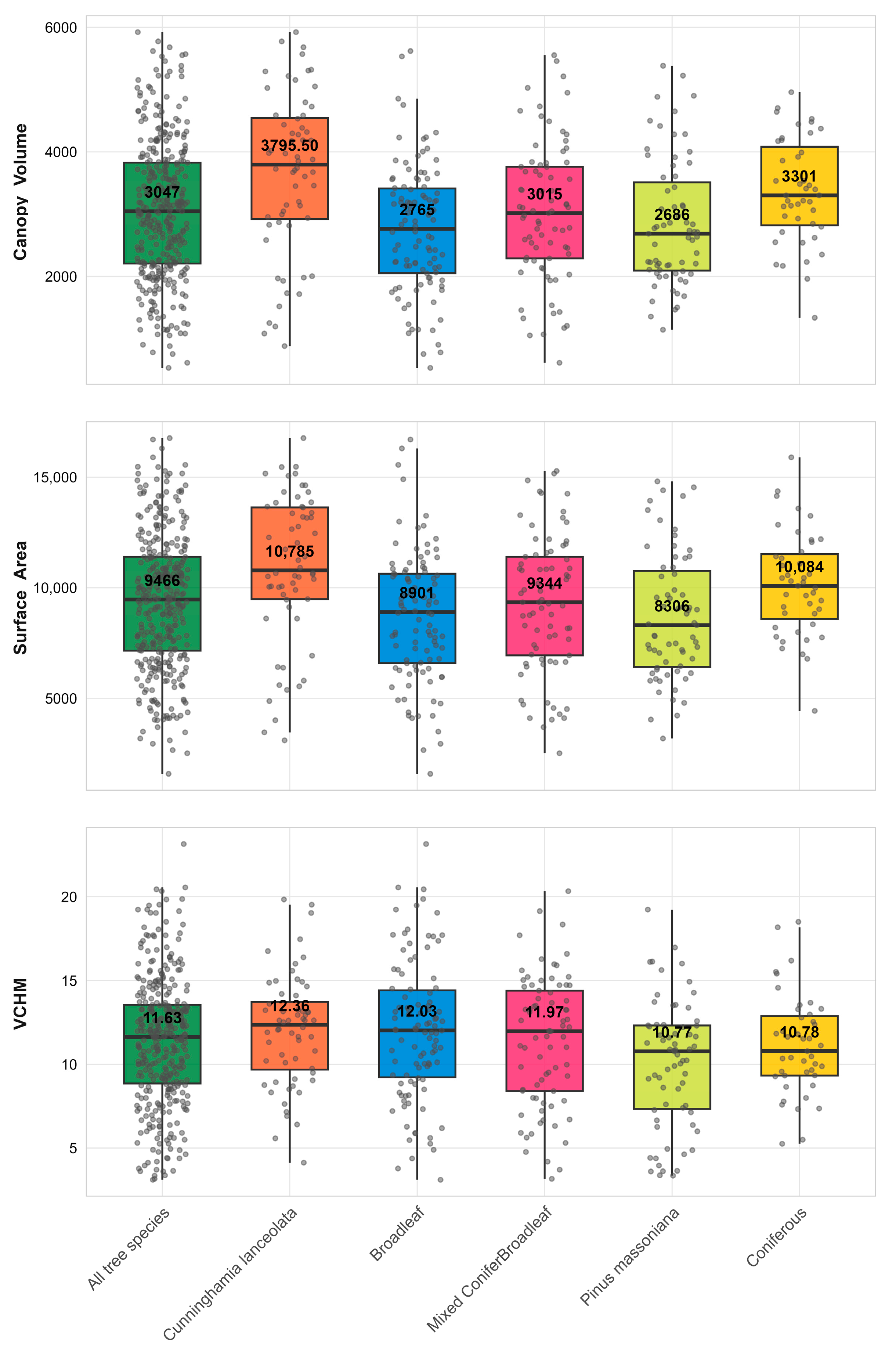
Based on voxelized ALS data, this study extracted three structural parameters: the VCHM, canopy volume, and canopy surface area. Descriptive statistics of these metrics are presented across different forest types (
Figure 2 and
Table 6). Coniferous forests (e.g.,
Cunninghamia lanceolata) exhibited a relatively uniform canopy structure in terms of VCHM, with a median of 11.01 m, an interquartile range of 6.52 m, and a variance of 28.34. Broadleaved forests showed a higher median VCHM (17.07 m), a larger interquartile range (11.53 m), and a variance of 68.24, reflecting greater variability in canopy height. Mixed forests displayed intermediate VCHM metrics (median 14.97 m, interquartile range 10.24 m, variance 55.36), with a wider distribution that may suggest more complex structural characteristics. Notably,
Pinus massoniana forests demonstrated a considerable capacity for spatial occupancy, with a median canopy volume of 1.03 × 10
5 m
3 (variance 1.56 × 10
10 and a median canopy surface area of 8.18 × 10
4 m
2 (variance 4.35 × 10
8). In comparison, coniferous forests (exemplified by Cunninghamia lanceolata) had a larger median canopy volume (1.66 × 10
5 m
3) but a relatively smaller median canopy surface area (1.13 × 10
5 m
2), indicating a distinct spatial configuration strategy.
3.2. Correlation Analysis Between Voxel-Based Metrics and AGB
All voxel-extracted metrics, VCHM, canopy volume, and canopy surface area, showed highly significant positive correlations with AGB across all forest types, demonstrating strong potential as predictors for AGB estimation (
Table 7) and comprehensively reflecting the close relationship between canopy structural characteristics and AGB. For the pooled sample of all tree species, the correlation coefficients for VCHM, canopy surface area, and canopy volume reached 0.672, 0.525, and 0.462, respectively, confirming the general relevance of voxel-based 3D metrics for biomass estimation. Analyzed by forest type, all three metrics maintained significant correlations within each type, with particularly strong associations in coniferous forests. In
Pinus massoniana and
Cunninghamia lanceolata forests, the correlation coefficients for VCHM were as high as 0.836 and 0.822, for canopy surface area 0.701 and 0.657, and for canopy volume 0.598 and 0.615, respectively. In broadleaved and mixed forests, all three metrics also reached significant levels, with VCHM showing the strongest correlation, followed by canopy surface area; canopy volume, although somewhat lower, remained significantly correlated.
3.3. Results of Random Forest Model
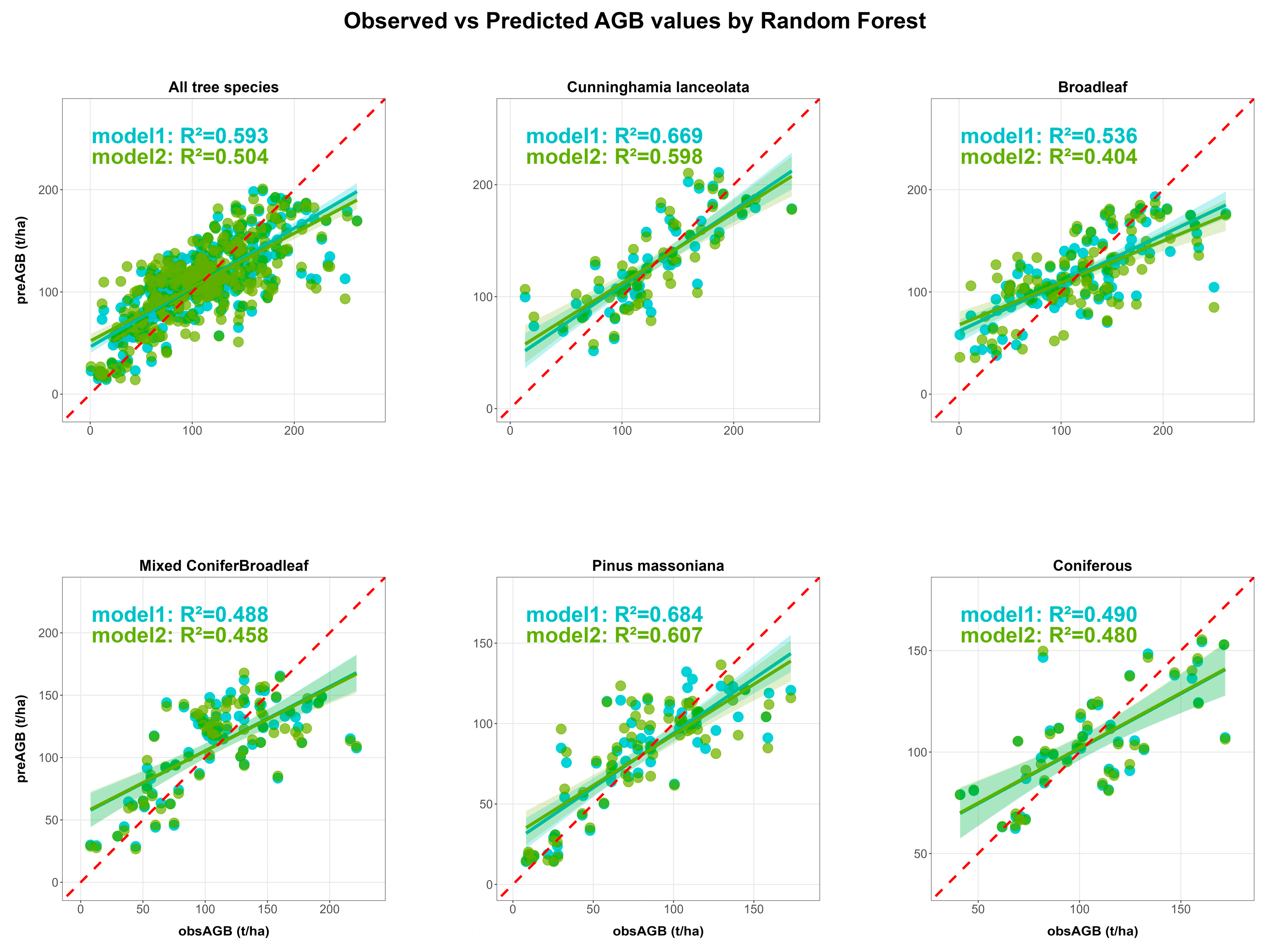
To assess the value of voxel-based 3D canopy metrics for estimating forest AGB, we developed and compared two Random Forest models. Model 1 used only traditional LiDAR metrics, while Model 2 combined these with the novel voxel-based metrics. Their performance, evaluated via 10-fold cross-validation (
Figure 3), showed that Model 2 consistently and significantly outperformed Model 1 across all forest types. For the combined dataset, Model 2 achieved an R
2 of 0.593—an improvement of 0.089 (17.7%) over Model 1’s R
2 of 0.504. This demonstrates that integrating voxel-based 3D structural information effectively enhances AGB estimation accuracy. Analysis by individual forest type further confirmed the universally beneficial effect of voxel metrics. In Chinese fir forests, Model 2 achieved the highest R
2 of 0.689 among all types, which is an improvement of 0.091 (15.2%) over Model 1. For mixed coniferous–broadleaved forests, Model 2 attained an R
2 of 0.536, showing the most substantial relative increase of 0.132 (32.7%) compared to Model 1. This underscores the particularly significant gain provided by voxel metrics for biomass estimation in structurally complex mixed forests. It is noteworthy that, despite variations in sample size and structural characteristics among the different forest types, Model 2 consistently maintained a clear accuracy advantage over Model 1 in all cases.
To evaluate the value of voxel-based 3D canopy metrics for estimating forest AGB, we developed and compared two Random Forest models. Model 1 used only traditional LiDAR metrics, whereas Model 2 combined traditional metrics with the novel voxel-based metrics. Model performance was evaluated via 10-fold cross-validation. The results showed that Model 2 consistently and significantly outperformed Model 1 across all forest types (
Figure 3). The 95% confidence intervals around the regression lines in
Figure 3 visually represent the estimation uncertainty; the generally narrower confidence intervals for Model 2 indicate improved estimation precision. For the combined dataset, Model 2 achieved an R
2 of 0.593, an increase of 0.089 (17.7%) over the R
2 of 0.504 obtained by Model 1. This demonstrates that incorporating voxel-based 3D structural information effectively enhances the accuracy of AGB estimation. Further analysis by forest type confirmed the consistent benefit of voxel metrics. In Chinese fir forests, Model 2 attained the highest R
2 among all forest types (0.689), which represents an improvement of 0.091 (15.2%) over Model 1. For mixed coniferous–broadleaved forests, Model 2 yielded an R
2 of 0.536, corresponding to the largest relative increase of 0.132 (32.7%) compared with Model 1. Accordingly, the confidence intervals for Model 2 in mixed forests were markedly narrower than those for Model 1, underscoring the reduction in estimation uncertainty achieved by voxel metrics in structurally complex stands. It is noteworthy that despite variations in sample size and structural characteristics among forest types, Model 2 consistently maintained a clear advantage over Model 1 in both accuracy and precision, as systematically evidenced by the higher R
2 values and generally tighter confidence bands shown in
Figure 3.
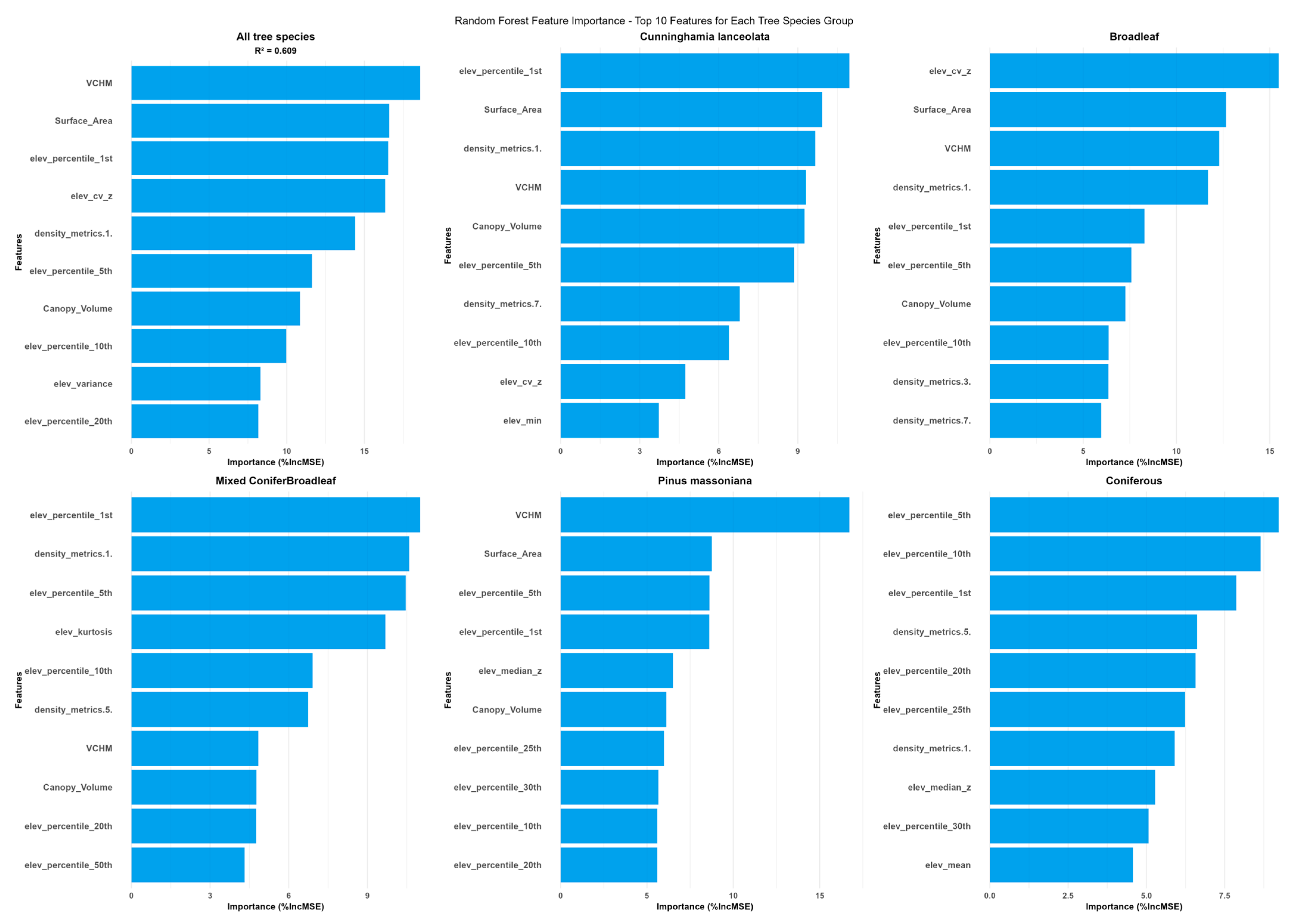
The variable importance analysis results from the Random Forest model (
Figure 4) reveal, from different perspectives, the critical role of the proposed voxel-based 3D canopy structural parameters in improving the estimation accuracy of forest AGB. Specifically, in the comprehensive all-species model, the VCHM exhibited the highest feature importance (%IncMSE = 16%), significantly outperforming other traditional LiDAR metrics. The canopy surface area (14%) and canopy volume (10%) also ranked within the top five, highlighting the dominant role of 3D structural features in comprehensively explaining spatial variations in biomass. In the species-specific group analyses, different forest types demonstrated distinct feature importance patterns aligned with their structural characteristics: In the Cunninghamia lanceolate model, topographic factors (e.g., elev_percentile_1st, 10%) ranked highest, but canopy surface area and canopy volume (both 9%) followed closely, with VCHM (8%) also ranking within the top four, indicating that although topography played a dominant role, 3D structural parameters remained important synergistic predictors. In the
Pinus massoniana model, VCHM (18%) emerged as the most important feature, corroborating the significant influence of vertical canopy structure on biomass in this species, followed by canopy surface area. In broadleaf forests, VCHM (13%) and canopy surface area (12%) ranked just below the topographic coefficient of variation (elev_cv_z, 15%), with their high importance reflecting the close relationship between canopy external morphological complexity and biomass in broadleaf forests. In mixed conifer–broadleaf forests, although the absolute values of VCHM (5%) and canopy volume (4%) were relatively low, they remained key predictors in the feature ranking for this group, demonstrating the persistent explanatory power of 3D parameters in mixed forest structures. Overall, these results indicate that the proposed 3D voxel-based structural parameters generally exhibit high feature importance across different forest types, enabling a more direct and physically meaningful representation of the relationship between canopy structure and AGB. This provides essential structural information for enhancing the accuracy and generalizability of AGB estimation models.
3.4. AGB Estimation Results
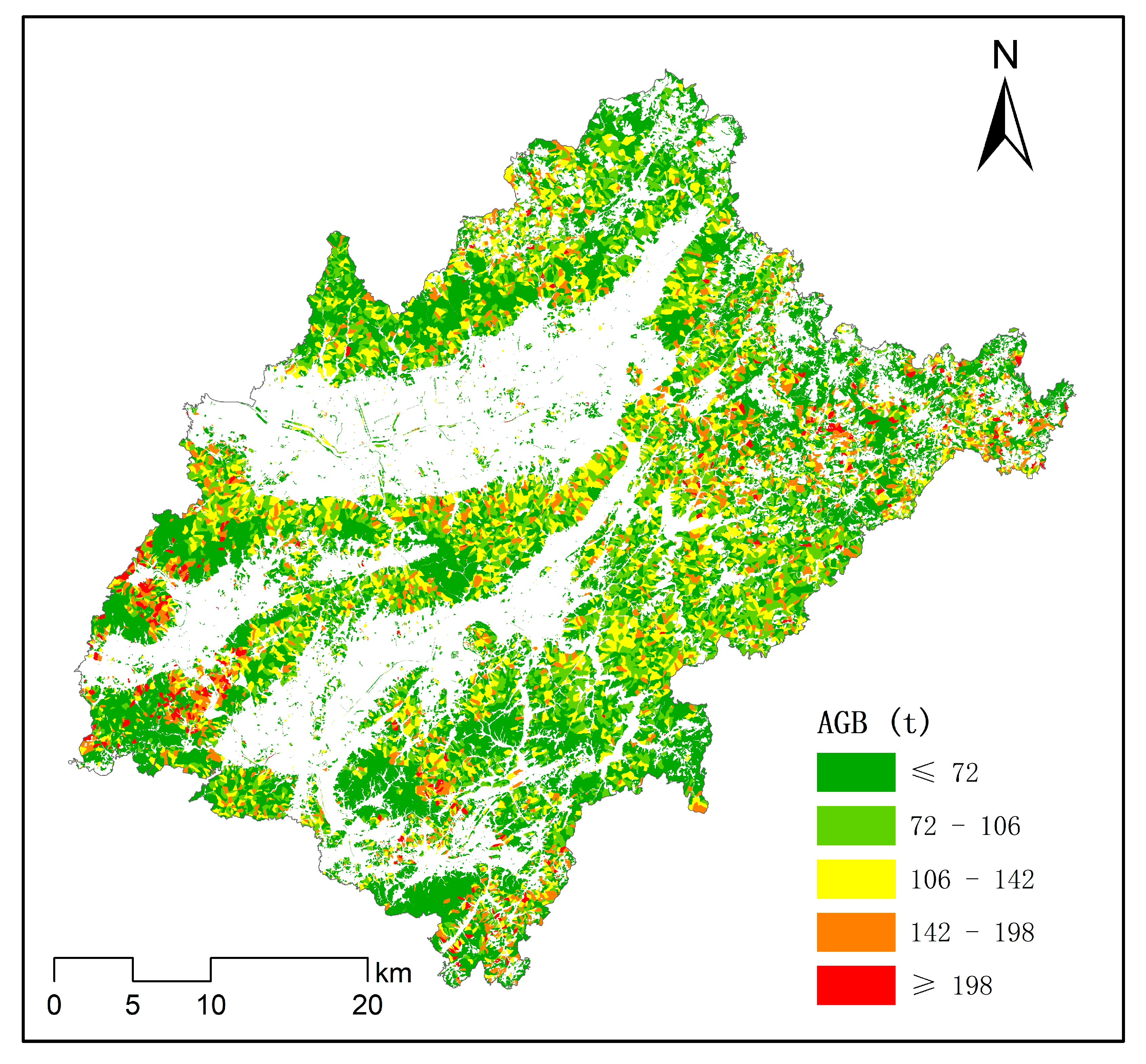
The inversion based on the optimal model revealed that the total AGB of forests in Dongyang City is 8.36 million t (
Table 8). Spatially, areas with high biomass (≥198 t/ha) are predominantly distributed in patchy patterns across the central and northeastern regions, while low-biomass areas (0–72 t/ha) are widely scattered along the western and southern margins. In terms of species composition,
Pinus massoniana forests contributed the most significantly, reaching 4.83 million t and accounting for 57.73% of the total (
Figure 5). This was followed by mixed coniferous–broadleaved forests (2.04 million t, 24.25%) and broadleaved mixed forests (1.18 million t, 14.03%).
Cunninghamia lanceolata forests and coniferous mixed forests had relatively low biomass stocks of 0.1723 million and 0.1384 million t, respectively, together accounting for only 3.71% of the total.