


Abstract
Norway spruce (Picea abies [L.] Karst.) plays a key role in European forestry as well as in the wood-processing industry. Identifying suitable alternative species has become increasingly important. In this study, we compared several spruce species originating from two sites in the Ore Mountains (Krušné hory, 483–883 m a.s.l.), an area severely affected by an extensive air-pollution disaster (high SO2 concentrations) during the 1970s and 1980s. Norway spruce, Serbian spruce (Picea omorika [Panč.] Purk.) and blue spruce (Picea pungens Engelm.) were evaluated in terms of production potential, carbon sequestration relevant to climate-change mitigation, and selected physical wood properties (wood density and shrinkage). The greatest stem volume and corresponding carbon sequestration were recorded for P. omorika (0.191 m3; 75.5 kg), followed by P. abies (0.142 m3; 49.0 kg), while P. pungens showed significantly (p < 0,05) lower values (0.069 m3; 30.6 kg). In terms of wood properties, the highest wood-density values were obtained for P. omorika, together with P. abies, at both sites. P. pungens exhibited lower wood densities. In terms of shrinkage, the species displayed similar values. Overall, our results indicate that P. omorika is comparable to P. abies, and its wood could therefore serve as a suitable substitute for certain applications.
1. Introduction
In recent years, Picea abies in Central Europe has been severely affected by abiotic stressors such as long-term drought, accompanied by declining groundwater levels, as well as strong winds that have contributed to extensive windthrows. These disturbances have been followed by biotic damage, including outbreaks of secondary pests such as the spruce bark beetle (Ips typographus) [1,2,3]. This sequence of events has led to widespread salvage logging operations across affected stands [4,5]. Moreover, lowered groundwater levels also increase spruce susceptibility to pathogens, including Heterobasidion spp. [6].
Progressing global climate change (GCC) is one of the reason which has profoundly affected the forests of Central Europe by increasing the frequency and intensity of extreme climatic events [7,8,9,10,11] and altering tree-growth dynamics [12]. These changes pose a major challenge for all forestry-related sectors, including the timber industry, which relies heavily on coniferous wood production—particularly on P. abies [4,7,13,14]. Drought stress can directly offset productivity gains expected from longer growing seasons by suppressing radial growth and altering carbon allocation patterns [15,16] or indirectly weaken the positive relationship between temperature and growth during the warmest years [17,18]. Prolonged water deficit leads to a strong reduction in shoot, needle, and root growth, as well as a decrease in annual increment. P. abies responds to drought by rapidly closing its stomata, which limits transpiration but also suppresses photosynthesis and biomass production [19,20,21]
Additionally, in this developmental and industrial age, air pollution also significantly affects forest growth [22,23,24]. Especially in the terms of sulphur dioxide (SO2), nitrogen oxides (NOX), ammonia (NH3) or heavy metals. These pollutants have the potential to severely disrupt physiological processes, thereby reducing photosynthesis, inducing leaf necrosis, hindering tree-ring growth, and increasing mortality rates [25,26,27]. In the Czech Republic, the Ore Mountains region underwent significant environmental impact from one of Europe’s most severe pollution events during the 1970s and 1980s. The pollution originated from coal power plants, which emitted exceedingly high levels of SO2. Due to prolonged sulphur dioxide emissions, over 40,000 hectares of primarily Picea abies forests have been adversely affected [28,29]. From the 1990s, various soil recovery methods and silviculture treatments were employed to aid in the restoration and reforestation of damaged environments [28,30]. First the soil recovery to restore soil pH, nutrient content, etc., was employed [28,29], the then the increase in forest resilience by afforestation with diverse tree species [28,29,31], and finally long-term monitoring, adaptive management and research to control new established forests were employed [29,31,32].
Therefore, understanding the effects of forest management interventions that influence ecosystem stability is crucial for mitigating GCC impacts [33,34], as forests play an increasingly important role in biomass production, carbon sequestration, air-quality regulation, and hydrological balance [35,36]. P. abies exhibits exceptionally high sensitivity to both direct and indirect consequences of GCC, as demonstrated by extensive landscape-level disturbances across Europe [37,38,39,40,41]. A similar pattern is observed in the geographically non-native P. pungens, widely planted during the air-pollution crisis of the 20th century, which currently suffers rapid decline caused by Gemmamyces piceae and other pathogens [42,43].
The ecological stability of spruce stands is strongly shaped by silvicultural practices, particularly tending regimes [7,44]. In particular, thinning regimes applied from above have been shown to substantially enhance the structural stability of P. abies stands [45,46,47,48,49]. At the same time, suitable introduced conifers may provide promising adaptive options under intensifying GCC [50,51], as they can contribute to both mitigation and adaptation processes in forest ecosystems [52,53,54,55,56]. One of the promising alternatives to the declining P. abies and P. pungens should be P. omorika, a species tolerant of a wide range of soil and moisture conditions [57,58]. On extremely dry sites, it outperforms most other conifers [59]. Compared with P. abies, P. omorika generally reaches similar heights but smaller diameters, except on acidic and drought-prone sites where it often shows higher productivity [57,58,60,61]. It is also more productive and forms more stable stands than P. pungens [59], yet has been largely overlooked in Central European forestry despite producing high-quality timber [58].
For the timber industry, a stable supply of wood with high density, strength, elasticity, and minimal defect rates is essential, as these characteristics determine both the technical quality and economic value of assortments [62,63]. Economically, P. abies is one of the most important timber species in Europe. Spruce wood is widely used for the production of sawn timber, structural elements, roof trusses, windows, doors, and flooring [64,65]. It is particularly valued as a construction material due to its good bending strength and elasticity [66]. P. abies is also a primary raw material for the production of particleboard (PB) and medium-density fibreboard (MDF), which are commonly used in furniture manufacturing and interior design [67]. These panels are characterised by favourable mechanical properties and low formaldehyde emissions. Owing to its high fibre content, spruce wood is also used in pulp and paper production. Additionally, wood residues and bark have practical applications as biomass for energy purposes and as a source of bioactive chemical compounds [68] A specialised use of spruce wood is in the manufacture of musical instruments, where resonance wood is prized for its high density and narrow annual rings [64].
In recent years, however, climate-induced disturbances have severely disrupted P. abies stands, leading to sharp increases in salvage logging, substantial variability in wood density, and a reduced share of high-quality timber available for processing [69]. Consequently, intensive efforts are being directed toward identifying suitable replacements for P. abies that can ensure more stable wood production under changing climatic conditions. Several introduced tree species show considerable potential in this regard, as their wood often maintains higher density or superior mechanical properties even under climatic stress [43,70].
P. omorika thus represents a viable alternative to both the widely used P. abies and P. pungens, especially in the mountain regions of Central Europe affected historically by air pollution [31,57]. Introduced species with higher adaptive capacity may be essential for developing resilient forest-management strategies under GCC [71,72]. The aim of this study was therefore to evaluate and compare (i) the quantitative production characteristics and (ii) the wood-quality attributes of three spruce species—P. abies, P. omorika, and P. pungens—with the goal of identifying suitable adaptive measures in response to the decline of both native P. abies and non-native P. pungens.
2. Materials and Methods
2.1. Study Site
The research was carried out at two sites in the western part of Czechia. Historically, the Ore Mountains (Krušné hory) were severely impacted in the 1970s and 1980s by an extensive air-pollution calamity, when extremely high concentrations of SO2 caused large-scale dieback of P. abies, leading to the widespread use of non-suitable P. pungens as a potential replacement species. The combined effect of these disturbances led to pronounced soil acidification, structural degradation, and increased weed encroachment, substantially reducing the regenerative potential of forest ecosystems in the region [31]. The first is located in the mountainous part of the Ore Mountains, within the Fláje game reserve near the Czech–German border. The second site lies at a mid-elevation position on the opposite side of the Ore Mountains, near the town of Sokolov, in the Antonín–Sokolov Forest Arboretum, a coal post-mining landscape. Both forest areas are managed by the state enterprise Lesy České republiky under comparable silvicultural practices. At each site, three forest stands of different spruce species were selected in close proximity, all of comparable age, management history, and site conditions (Table 1).
Table 1.
Overview of basic site and stand parameters of spruce stands differentiated by spruce species and localities in 2024.
The first study area is situated at an elevation of 813–883 m within the Fláje Game Reserve, located near the Fláje Reservoir in the Ore Mountains. According to the Köppen–Geiger climate classification, the area belongs to the warm-summer humid continental climate type (Dfb) [73]. The mean annual precipitation is approximately 980 mm, and the mean annual temperature reaches 5.5 °C, based on measurements from the Český Jiřetín–Fláje meteorological station (740 m a.s.l.). From a forest typology perspective, the study area corresponds to the Fageto-Piceetum acidophilum unit [74].
The second region has a temperate oceanic climate (Cfb) according to Köppen–Geiger climate classification [73], with long-term means of 7.3 °C and approximately 610 mm of annual precipitation measured at the Sokolov station (402 m a.s.l.). Elevation within the arboretum reaches 444 m a.s.l. and the soils, still in early pedogenetic development, reflect the young age of the substrate [75]. Successional trends point toward Querceto-Fagetum acidophilum communities, while periodically waterlogged microsites support vegetation typical of Fraxineto-Alnetum alluviale habitats. Coal extraction shaped this landscape between 1881 and 1965, resulting in 22.5 million t of coal and 10.8 million m3 of overburden being removed [76]. Following the cessation of mining, the Antonín-Sokolov spoil heap underwent forest reclamation between 1969 and 1974, including topsoil application and the establishment of a diverse collection of 220 woody species across 165 ha, with selected areas left to natural succession. Since establishment, the stands have been managed only lightly, with interventions restricted to understory control and sanitary [75,77].
2.2. Data Collection—Dendrometric Parameters
For the determination of dendrometric parameters, 40 living trees of each evaluated spruce species were randomly selected within every stand at each study site (totally 240 trees). Random selection was performed using a random number generator (RGN function). For all sampled trees, diameter at breast height (DBH) was measured in two perpendicular directions, together with total tree height, height to the base of the live crown, and crown projection diameter, again assessed in two perpendicular directions. The height of the live crown was defined as the point marking the beginning of the continuous crown, represented by at least two living branches attached to the main stem [78]. DBH was measured using a Mantax Blue calliper (Haglöf, Långsele, Sweden) with an accuracy of 1 mm. Tree height and the height to the live crown were measured with a Vertex laser altimeter (Haglöf, Långsele, Sweden) with an accuracy of 0.1 m.
2.3. Tree Sampling and Specimen Preparation
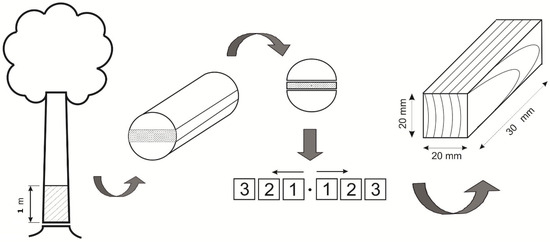
To assess the physical properties of wood from the evaluated stands, we applied a systematic sampling and following testing protocol. From both localities three sample trees from each spruce species were cut on long-term research plots, and 2 m long sections from a basal part of the stem were collected to prepare test samples (specimens were obtained from a stem height of 0.2 to 2.2 m above the ground). The trees represented the stands in terms of mean height and mean diameter. The trees had to be straight, not curved, to avoid the occurrence of compression wood. They were also free of defects as decay, or any other irregularities affecting wood properties. The trees were felled, and a 1 m section was extracted from the base of the trunk. This basal log was chosen to provide sufficient amount of testing samples because of small diameters of the trees. The second reason for such design was our effort to minimise the number of defects, especially ingrown branches. From each log, a central board (north to south orientation) was sawn using a bandsaw. The board was cut roughly through the pith so that the radial direction of the wood (from pith to bark) was preserved.
From these boards, rectangular test specimens were prepared, with dimensions of 20 mm × 20 mm × 30 mm (radial × tangential × along fibres). Specimens were cut sequentially along the radial axis, i.e., starting from near the pith, then outward in the direction of the cambium (bark). The aim of the sampling strategy was to capture the radial variation in wood properties (especially density gradients). Such an approach is consistent with practices in wood science for evaluating horizontal fluctuation and development in the course of time. See also Figure 1 for details on tree sampling and the samples position.
Figure 1.
Description of the tree sampling and testing samples position.
2.4. Properties Evaluation—Wood Density
Wood density was determined as basic density, i.e., oven-dry mass per green volume (fully saturated wood with the moisture content over fibre saturation point), which is a standard procedure and eliminates variability due to moisture content. Each specimen was dried in a laboratory kiln at 103 ± 2 °C until constant mass (i.e., until further drying resulted in less than a minimal mass change). This ensures that all free and bound water is removed and the wood reaches its dry equilibrium. For each oven-dry specimen, mass (m) was measured gravimetrically. The dimensions (length, width, thickness) were measured using a calliper to compute volume (V). Specimens were soaked in water until the samples MC was above fibre saturation point (no additional swelling occurred). The samples were considered saturated when the volume was stabilised (two consecutive measurements showed no further increase). This protocol is in line with standardised procedures such as those described in the international standard for wood density measurement ISO 13061-2:2014 [79]. In total, 550 samples (330 from Locality 1, 220 from Locality 2) were tested for density. Density (ρ) was then calculated using the formula:
where ρ is the basic density (kg·m−3), m is oven-dry mass (kg), and V is green volume (m3).
2.5. Properties Evaluation—Dimensional Changes (Shrinkage)
To characterise how this wood responds to moisture content changes (i.e., when water is removed), shrinkage was measured. This is a key aspect of dimensional stability, which significantly affects wood performance in service (e.g., risk of warping or cracking). For shrinkage tests, specimens were first brought to a moisture content above the fibre saturation point to determine their maximum size. Then they were dried to oven-dry conditions to determine the minimum size. Sizes (in the tangential and the radial direction) were measured using a calliper, in a similar way as in the case of density measurement, to evaluate changes in specified directions. This procedure is consistent with standardised procedures, described in the international standard for shrinkage measuring ISO 13061-13:2024 [80]. The same test samples were used as for the density assessment (in total, 550 samples for all localities). The shrinkage (β) for both anatomical directions was calculated as:
where lmax is the dimension of the saturated specimen and lmin is the dimension of oven-dried specimen (0% moisture content) for specified direction (tangential or radial).
2.6. Properties Evaluation—Production Parameters
The structural characteristics and productivity parameters of the overstorey were quantified using the software SIBYLA Triquetra 10 alpha [81]. Tree volumes were derived from species-specific volumetric functions documented by [82]. Above-ground biomass—including stem wood, branches, and foliage—was estimated based on established allometric models published by [82,83,84,85]. Below-ground biomass was calculated using the root system model developed by [86]. Carbon stocks in individual trees were then determined following the procedure of [87], which converts dry-mass components to carbon content using element concentrations expressed per 10 mg kg−1 of dry matter.
2.7. Statistical Analysis
Statistical analyses were conducted in the STATISTICA environment (version 13.4.0.14; TIBCO Software, Virginia Beach, VA, USA). Comparisons of dendrometric variables and wood-quality traits among the spruce species followed a structured analytical framework. Prior to inferential testing, data distributions were examined using the Shapiro–Wilk test for normality and Bartlett’s test for homogeneity of variances. When both assumptions were satisfied, species differences were assessed using a one-way analysis of variance (ANOVA), followed by Tukey’s HSD test for post hoc comparisons. In cases where at least one of the parametric assumptions was violated, the non-parametric Kruskal–Wallis test was applied as an alternative approach to compare the evaluated traits. Group means that differ significantly are denoted by different letters (α = 0.05).
3. Results
3.1. Production Potential
At both sites, statistically significant differences (p < 0.01) were detected among all studied parameters. At Site 1, the largest DBH was recorded in P. abies (18.9 cm), while P. pungens exhibited a significantly (p < 0.05) smaller DBH (15.6 cm; Table 2). The tallest trees were observed in P. omorika (16.9 m), whereas the shortest trees were significantly lower (p < 0.05) in P. pungens (7.4 m). In terms of stand stability, the slenderness coefficient ranged from 47.7 in P. pungens to 98.5 in P. omorika. Stem volume was highest in P. omorika (0.183 m3) and lowest again in P. pungens (0.052 m3). Biomass and carbon content followed the trend of stem volume, with P. omorika exhibiting the highest values (136.5 kg biomass, 72.5 kg C).
Table 2.
Production and structural parameters (mean ± standard deviation) of trees on the permanent research plots differentiated by spruce species; the significantly (p < 0.05) highest values are in bold.
At Site 2, the DBH was significantly largest (p < 0.05) in P. omorika (20.2 cm). The smallest diameter and height were recorded in P. pungens (14.7 cm and 10.8 m). A significantly (p < 0.05) higher HDR was recorded in P. abies (101.2), while no significant difference was found between P. omorika (74.2) and P. pungens (75.5). Stem volume, biomass, and carbon content were again significantly highest (p < 0.05) in P. omorika (0.198 m3, 147.7 kg biomass, 78.4 kg C) and lowest in P. pungens (0.085 m3, 72.8 kg biomass, 38.0 kg C). Overall, P. omorika exhibited the highest morphometric and biometric values at both localities, whereas P. pungens showed the lowest parameters. P. abies fell between these extremes and demonstrated variability between localities.
3.2. Wood Density
Our results confirm that there are differences in wood properties between individual spruce species, which should be taken into account in the industry. These differences were also confirmed at two different locations in terms of growing conditions and silvicultural measures applied to the stand.
The highest density at Location 1 was achieved by P. omorika (378 kg.m−3), followed by P. abies (375 kg.m−3). The difference between these species is not statistically significant. The lowest value was achieved by P. pungens with 353 kg.m−3. This species, on the other hand, differs statistically from the other two species. The density value is relatively little variable for all tested species, with P. abies achieving the highest coefficient of variation (9.3%). At second site, the highest density value was obtained for P. abies (409 kg.m−3), closely followed by P. omorika with 408 kg.m−3, and the values do not differ from a view of statistical analysis. The lowest value was obtained for P. pungens. The variability of the property for this site was a bit higher, with the highest value of 11.6% for P. pungens. For more details, see Table 3.
Table 3.
Wood density (in kg.m−3) for individual spruce species according to locality (the significantly, p < 0.05, highest values are in bold).
3.3. Tangential Shrinkage
At Locality 1, P. abies achieved the highest average tangential shrinkage value of 7.1%, closely followed by P. omorika with 7.0%. P. pungens showed the lowest average value of 5.8%. As in the case of density, the values for P. omorika and P. abies are practically identical (the difference is not statistically significant). The highest maximum measured at this site was recorded for P. pungens (10.5%), while the lowest minimum was 1.8% for the same species. P. abies had a minimum value of 3.9% and a maximum value of 9.8%, while P. omorika had a minimum of 3.2% and a maximum of 9.3%. Variability of the property is generally higher in contrast to density. The variability was similar for all species, with coefficients of variation of 19.4%–19.5%.
For Locality 2, P. abies again had the highest average value of 8.9%, followed by P. omorika with 8.0%, while P. pungens had the lowest average value of 6.6%. It should be emphasised here that wood with the lowest possible shrinkage value is desirable for industrial use. P. omorika achieved a statistically significant lower value, with comparable wood density to P. abies at the same time. The highest maximum value at this site was recorded for P. abies (11.8%), while the lowest minimum was 3.2% for P. pungens. For P. omorika, the minimum and maximum values were 5.1% and 10.8%. The coefficients of variation at this site ranged from 16.1% to 18.9%. Detailed data are given in Table 4.
Table 4.
Tangential shrinkage (in %) for individual spruce species according to locality (the significantly, p < 0.05, highest values are in bold).
3.4. Radial Shrinkage
At Locality 1, similar results (from a view of spruce species comparison) were achieved for radial shrinkage as for tangential shrinkage. P. omorika achieved slightly lower values than P. abies, but the values are statistically identical, and the wood species are therefore comparable in terms of this characteristic. The highest average values for radial shrinkage were achieved by P. abies (4.3%), followed by P. omorika (4.1%). P. pungens showed the lowest average value of 3.3% (a statistically significant difference from the other two spruce species). The highest maximum value at this site was recorded for P. pungens (7.0%), while the lowest minimum was 1.9% for the same species. For P. abies, the minimum and maximum values were 2.3% and 6.8%, and for P. omorika, 2.5% and 6.8%. The coefficients of variation ranged from 17.8% to 22.0%.
At Locality 2, P. abies again achieved the highest average value of 6.6%, followed by P. omorika with 5.6%, while P. pungens had the lowest average shrinkage of 5.1%. In this case, P. omorika does not differ statistically significantly from P. pungens, and as mentioned above, lower values are considered beneficial for applications. The highest maximum value was 8.5% for P. abies, and the lowest minimum was 2.3% for P. pungens. For P. omorika, the minimum and maximum values ranged between 3.7% and 8.1%. The coefficients of variation ranged from 16.7% to 23.5%. Detailed values are given in Table 5.
Table 5.
Radial shrinkage (in %) for individual spruce species according to locality (significantly, p < 0.05, highest values are in bold).
3.5. Radial Distribution of Wood Properties
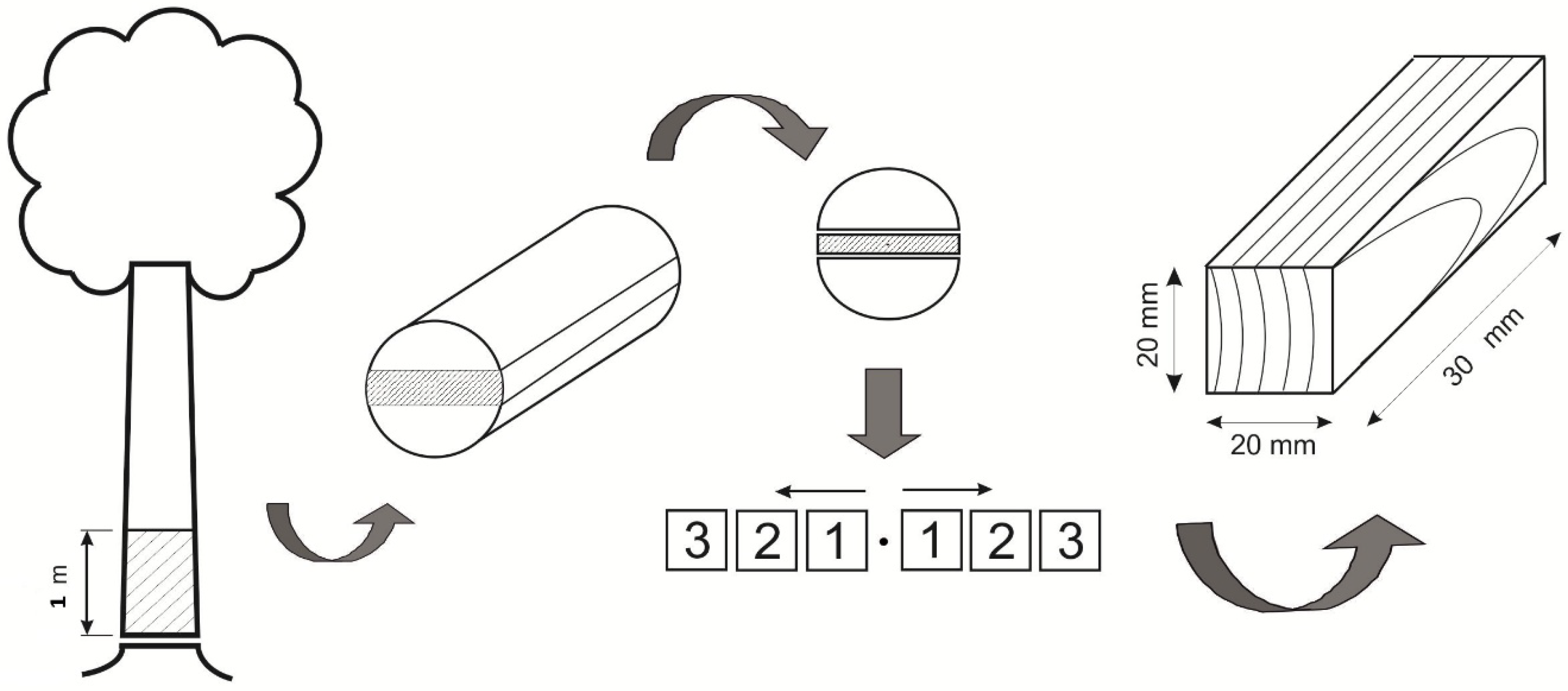
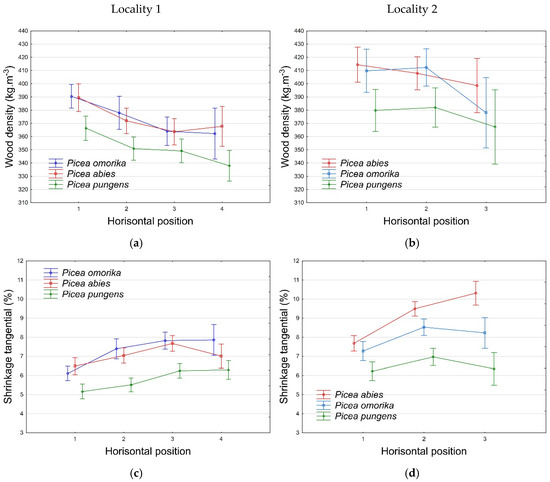
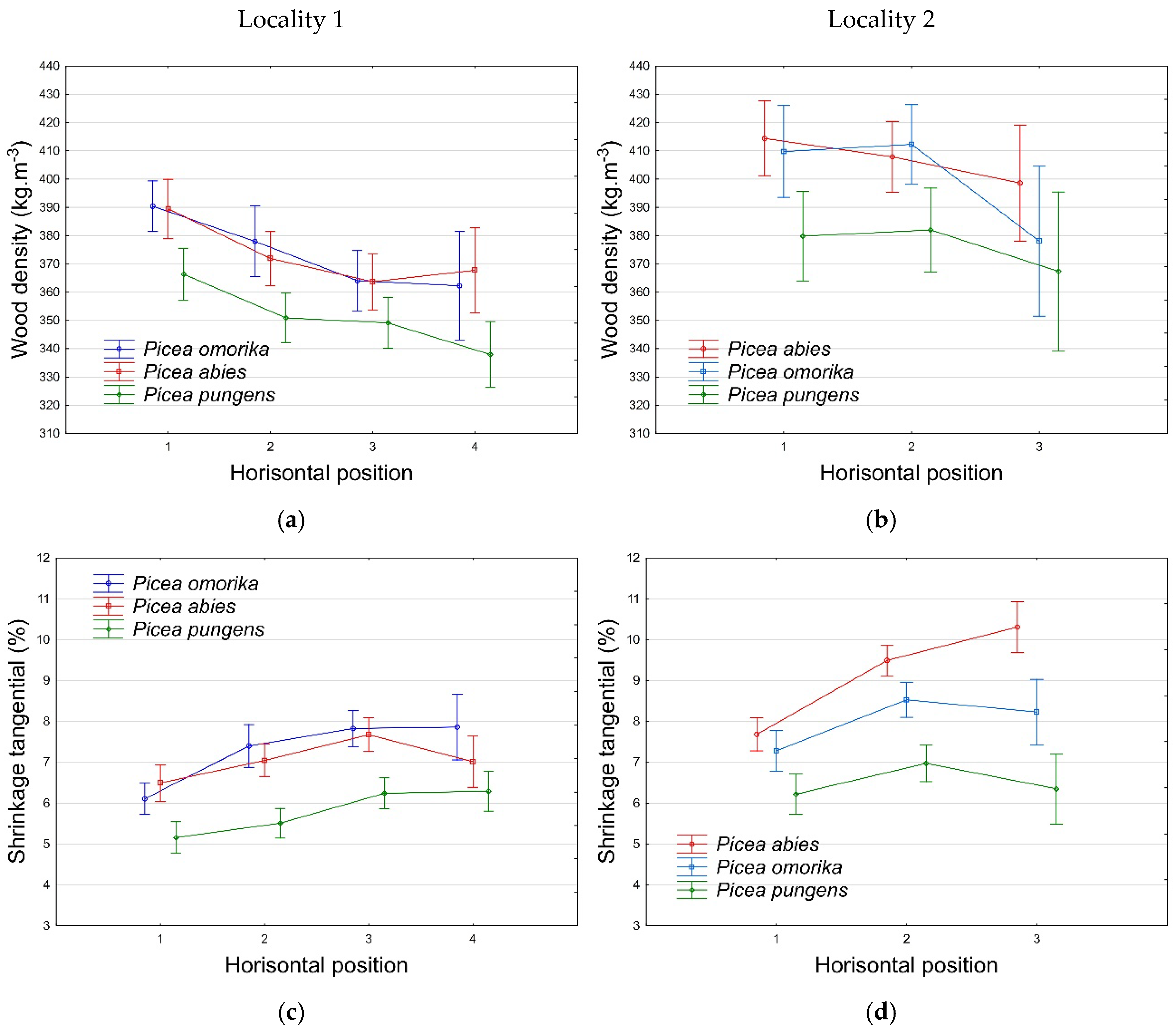
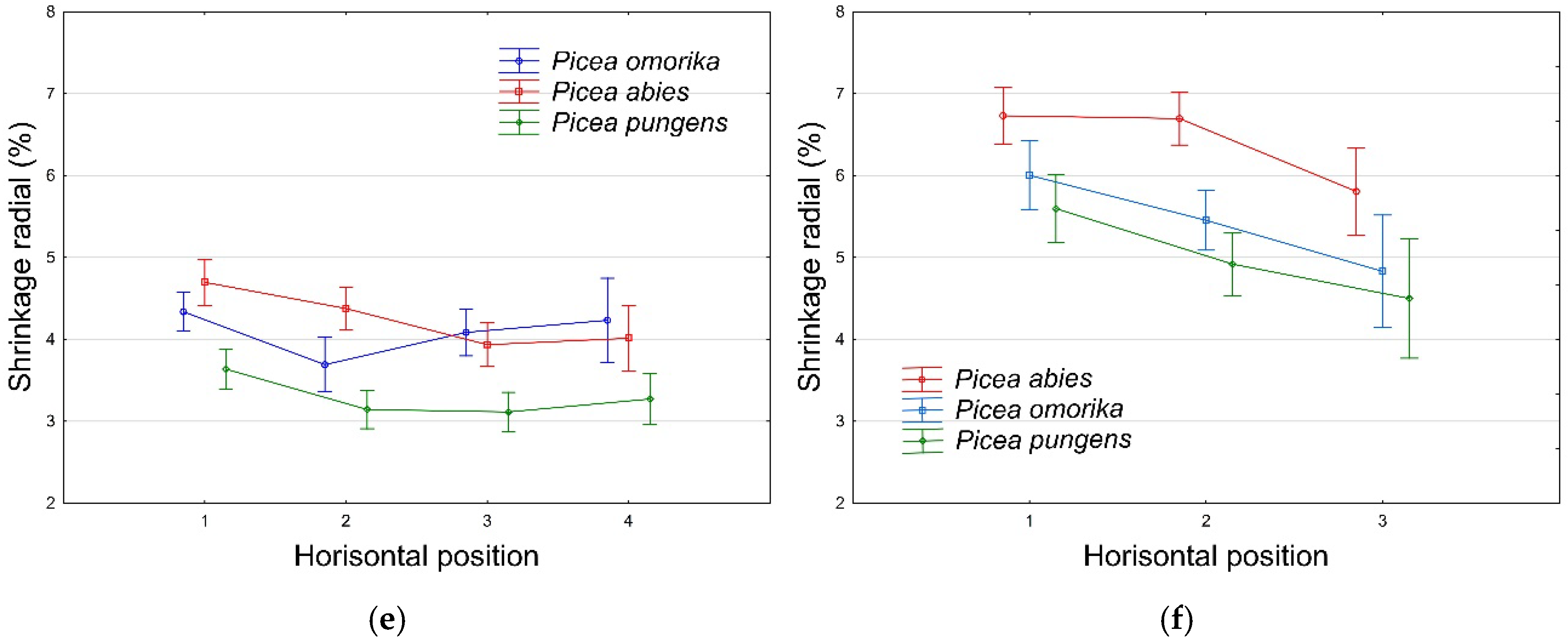
As the tested trees were young from a view of final harvest, we also focused our research on the evaluated properties’ variability within a trunk (i.e., changes in wood properties in direction from the stem centre outwards and their development over the course of time). Figure 2a,b show the distribution of wood density for three spruce species depending on location in three relative positions, where position 1 indicates samples close to the pith and position 3 indicates samples close to the bark. The species order remained consistent in all positions. Between positions 1–3, there was a slight decrease in density from the pith to the bark in all three species. However, this trend is not statistically significant. At Locality 2, there is greater variability, but the trend remains the same. Regardless of position, the lower quality of P. pungens wood in terms of density is evident, as is the comparability of P. omorika and P. abies. Figure 2c,d show tangential shrinkage at individual positions in the trunk. The graph shows a slight increase in shrinkage towards the peripheral part of trunk. As in the case of density, the trend is not clear and statistically significant in most cases (except for P. abies at Locality 2). Figure 2e,f show the radial course of shrinkage in the trunk. No trend is apparent for Locality 1, while Locality 2 shows a slight downward trend. The graph for Locality 2 clearly shows that P. omorika is more similar to P. pungens in terms of shrinkage, which should be considered a positive factor.
Figure 2.
Within-stem variability of the tested wood properties according to localities; (a,b) wood density; (c,d) tangential shrinkage; (e,f) radial shrinkage (x-axis: Figures denote a relative position of the to the pith, i.e., 1 indicates a position near the pith, 3 is a position close to the bark. The intervals represent standard deviations).
The evaluation of wood density and tangential and radial shrinkage in three relative positions from the pith to the bark (1–3) showed that all monitored properties exhibited only limited differences within the trunk in most cases, and their values remained relatively constant within individual species. The wood density at both sites showed a slight or insignificant increase from the pith to the bark for all species, with the positions often overlapping and impossible to distinguish. Similarly, tangential and radial shrinkage did not show a clear horizontal trend. Overall, the results show that there are no significant changes in the physical properties monitored within the trunk, and the material is therefore fairly homogeneous.
4. Discussion
This research provides a multi-faceted comparison of two non-native tree species, as alternatives to P. abies, planted at two reclamation sites located in the Ore Mountains within the Czech Republic. Conducted analyses provide unique data about silviculture and wood quality, production and carbon sequestration, which might be implemented in sustainable forest management in Central Europe, especially on post-mining, degraded sites.
From the perspective of mechanical stability (e.g., resistance to windthrow), as indicated by the slenderness coefficient [88], values for the studied spruce species ranged from 47.7 in Picea pungens at Site 1 to 101.2 in P. abies at Site 2. The HDR should be evaluated in conjunction with other factors, including stand structure and density, as well as site conditions such as soil parameters, exposure, slope, elevation and stand age [89]. The low HDR and the associated reduced tree height of P. pungens at Site 1 are likely a consequence of stronger air-pollution load at this locality, to which this non-native species is less well adapted, resulting in impaired growth performance and a recent progressive decline driven primarily by fungal pathogens [90]. When interpreting the results—not only in terms of the HDR, but also regarding growth parameters and wood quality—it must be considered that the study sites differ substantially in site conditions, with the high-altitude Site 1 characterised by very acidic soils (pH 3.1) and low Ca and K contents, whereas Site 2, located on a former spoil heap, exhibits markedly higher soil pH (6.1), approximately fourfold higher P content, and an elevation lower by 425 m.
In terms of production potential, the consistently superior stem volume and carbon allocation of P. omorika at both study sites (0.191 m3; 75.5 kg) indicate its strong adaptive potential under the environmental conditions of the Ore Mountains, which is in line with previous findings highlighting its tolerance to pollution stress and harsh site conditions (e.g., [57]). In contrast, the markedly lower morphometric and biometric values observed in P. pungens (0.069 m3; 30.6 kg) suggest limited suitability for production-oriented forestry in Central Europe, despite its known resistance to industrial emissions [31,91]. The intermediate position of P. abies, coupled with its pronounced site-dependent variability, reflects its well-documented sensitivity to environmental stressors, particularly air pollution and drought (e.g., [22]). These results also underline the importance of species-specific growth dynamics when considering substitutions for declining P. abies stands under climate change scenarios [40]. Overall, the performance of P. omorika supports its potential role as a complementary species in future Central European forest management, particularly in areas recovering from historical pollution impacts.
Given that wood density significantly impacts other wood properties, including mechanical strength [92], its evaluation is essential, especially when dealing with non-native tree species, to facilitate informed decisions regarding future utilisation and processing methodologies [43,93,94]. The results of the study showed that P. omorika reached wood density values very similar to those of P. abies at both sites, whereas P. pungens exhibited consistently lower and more variable density. This finding agrees with the conclusions of broader comparative studies indicating that P. omorika is the only tested replacement species achieving density and strength levels comparable to P. abies [95]. The average density values observed in our material were slightly lower than those reported for older or slower-growing stands, where the density of P. omorika frequently exceeds 500 kg·m−3 [96,97]. Published values for P. abies density vary widely across Europe—from about 330 kg·m−3 to 520 kg·m−3 and are often considerably lower than those obtained in controlled case studies. Wood density is influenced by numerous factors, including age, location, site index, provenance, and stand history; such occurrences are not unusual [98,99].
The close similarity in density between P. omorika and P. abies in our material confirms that, at least under the tested site conditions, P. omorika can provide wood of comparable quality for industrial uses. This agrees with the conclusions of Zeidler et al. [94] who identified P. omorika as the only non-native spruce reaching the density and strength level of P. abies among several candidate replacement species in the Czech Republic, and with other reports describing P. omorika as a potential alternative to P. abies and P. pungens in practical forestry and timber production [95,100].
On the other hand, the consistently lower density of P. pungens in our study is consistent with earlier work from non-forest sites, where P. pungens was characterised by relatively low density, modest shrinkage and juvenile-wood structure with wide rings and low latewood proportion [95]. Such properties limit the suitability of P. pungens for high-grade structural applications when compared with both P. abies and P. omorika [94,96]. The strong link between density and key mechanical properties such as MOR and MOE reported for P. abies, P. mariana and other spruce species [93,96,100] suggests that the observed density similarity between P. omorika and P. abies may extend to other strength-related parameters as well.
The observed tangential and radial shrinkage values showed that P. omorika again closely followed P. abies, while P. pungens reached slightly lower shrinkage in both anatomical directions. Previous studies on conifers have indicated that shrinkage is strongly species-specific but often correlated with density, with P. abies forming relatively moderate shrinkage compared to other softwoods [101]. Our findings fit this general pattern: P. omorika, which attained density values very similar to P. abies, also exhibited comparable tangential and radial shrinkage, whereas P. pungens, with its lower density, showed slightly lower shrinkage. This suggests that, from the perspective of dimensional stability during drying and use, wood of P. omorika should behave similarly to P. abies, which is critical for substitution in applications where fit tolerances and the risk of warping are important [94].
The radial changes on the cross-section of the mature spruces increase from pith to bark direction, with typically decrease from the pith outward for the first several rings, due to high occurrence of juvenile wood [102,103]. In our study within-stem (radial) variability in wood properties was generally low due to young age of tested trees. Studies on P. abies have shown that radial gradients in density and shrinkage can be pronounced in young, fast-grown material, especially near the pith, but tend to level off with increasing age as mature wood becomes dominant [96,104,105]. Similarly to previous research on P. abies and other conifers, radial patterns in density and mechanical properties were either weak or statistically insignificant, which is common in relatively young stands where juvenile wood still dominates the basal section of the stem [106].
In general, physical and mechanical properties of wood are strongly influenced by site and growth effects. The influence of site effects on properties of spruce wood has been confirmed in many studies [107,108,109]. In our study site effects on wood density and shrinkage were visible but not dominant. For all species, density values at the second locality tended to be moderately higher and slightly more variable than those at the first site, while the basic species ranking remained unchanged. Similar modest site-related differences have been reported for P. abies across Central Europe, where environmental conditions, growth rate and plantation history can modify mean density but rarely change the relative position of species or provenances [105].
Obtained results and observations are encouraging in terms of substitution, as it indicates that P. omorika may retain wood properties similar to P. abies over various site conditions, within the environmental parameters of our two locations [1,3]. From a broader silvicultural perspective, the potential of P. omorika as a partial replacement for P. abies depends not only on wood properties but also on growth performance and resilience under changing climate. Recent reviews emphasise the high drought tolerance, stable growth and relatively good resistance of P. omorika to some climatic extremes, while also highlighting risks related to its narrow natural range, sensitivity to certain pathogens and browsing damage [57,106,107]. At the same time, numerous studies have documented the increasing vulnerability of P. abies monocultures in Central Europe to drought, windthrow and biotic agents, which motivates the search for alternative conifers with acceptable wood quality [108,109]. Large-scale dieback of P. abies across Central Europe due to drought, bark beetle outbreaks and increasing climatic extremes highlights the necessity to identify resilient species with acceptable wood quality for future forest management [110,111]. Our results contribute to this debate by confirming that, at least in terms of basic density and shrinkage behaviour, P. omorika matches P. abies and clearly outperforms P. pungens, which supports its consideration as a technically suitable substitute in some industrial chains.
Nevertheless, several limitations of our study must be acknowledged. The dataset is restricted to two localities and relatively young stands, and only basal segments of the stem were analysed; other parts of the bole and older trees may show different property distributions. The main limitation of this study is the restricted stand-level replication, as only a single stand per species was evaluated at each site, which may limit the broader applicability of the results. Nevertheless, several key parameters showed statistically significant differences, highlighting consistent species-level trends in growth and structural characteristics. Furthermore, we focused on basic density and shrinkage, while other important technological properties such as dynamic modulus of elasticity, bending strength, microfibril angle or checking and distortion behaviour during industrial drying were not assessed. It should also be noted that the biomass and carbon sequestration models applied in this study were derived for native Norway spruce, but similar approaches are commonly used for other non-native tree species in growth simulators such as SIBYLA [79], providing reliable estimates despite minor uncertainties related to species-specific traits. Several authors have noted that data on introduced spruces in Europe are scarce, making direct comparison with native P. abies challenging and emphasising the need for additional long-term trials under Central European conditions [57,94].
Previous work on P. omorika indicates that its mechanical properties can be favourable and, in some cases, exceed those of local reference material, ref. [112] but these aspects should be confirmed under Central European site conditions and for a wider range of stand structures. Future research should therefore combine detailed silvicultural trials with a more comprehensive wood quality assessment and should explicitly address the performance of P. omorika in mixed and converted stands rather than only in pure blocks.
Overall, our findings show that P. omorika combines silvicultural potential in Central European conditions with wood density and shrinkage properties that are comparable to those of P. abies and superior to those of P. pungens. When interpreted together with previous regional and international studies [57,94,96,106,107,112], these results support the view that P. omorika can serve as a realistic partial substitute for P. abies in selected industrial applications, provided that its ecological requirements, risks and stand management needs are taken into account in long-term forest planning.
5. Conclusions
Picea omorika, known as Serbian spruce, is a spruce species growing in areas exposed to higher temperatures and droughts, and could be more resistant to climate change and replace so P. abies to some extent. Our study confirmed that P. omorika generally exhibited the greatest tree height, stem volume, biomass, and carbon sequestration among the studied spruce species in relation to mitigation of GCC. P. abies showed intermediate performance, and P. pungens the lowest. It is also comparable in terms of wood quality. Irrespective of locality, P. omorika obtained the highest values for wood density, similar to those for P. abies. The same conclusions work for shrinkage, no matter if it is in the radial or tangential direction. The shrinkage for P. omorika is similar or even lower to that of P. abies for both sites. In contrast, all P. pungens properties are lower, especially in terms of the density, and it fell behind other tested species. Knowing these wood properties, it could serve as the P. abies substitute for some industrial areas and subsequent applications. However, the study was limited by the number of sites and sample trees, which may affect the generalizability of the results. Further research is recommended to assess long-term growth performance and wood quality of P. omorika across diverse environmental conditions.
Author Contributions
Conceptualization, A.Z., S.V. and V.T.; methodology, A.Z. and Z.V.; software, A.Z. and Z.V.; validation, K.T., and J.G.; formal analysis, A.Z., V.T. and Z.V.; investigation, V.B. and J.C.; resources, V.T.; data curation, V.B.; writing—original draft preparation, P.B., Z.V., V.T., K.T. and U.S.; writing—review and editing, K.T., V.B., J.C. and A.T.; visualisation, A.Z.; supervision, A.Z.; project administration, V.T.; funding acquisition, V.T. All authors have read and agreed to the published version of the manuscript.
Funding
This study was supported by the Czech University of Life Sciences Prague, Faculty of Forestry and Wood Sciences (IGA 3149 Václav Trojan).
Data Availability Statement
The data presented in this study are available on request from the first author.
Conflicts of Interest
The authors declare no conflicts of interest.
References
- Merlin, M.; Hylen, G.; Vergarechea, M.; Bright, R.M.; Eisner, S.; Solberg, S. Climate-Growth Relationships for Norway Spruce and Scots Pine Remained Relatively Stable in Norway over the Past 60 Years despite Significant Warming Trends. For. Ecol. Manag. 2024, 569, 122180. [Google Scholar] [CrossRef] [Scilit]
- Diffenbaugh, N.S.; Field, C.B. Changes in Ecologically Critical Terrestrial Climate Conditions. Science 2013, 341, 486–492. [Google Scholar] [CrossRef] [Scilit] [PubMed]
- Hlásny, T.; Zimová, S.; Merganičová, K.; Štěpánek, P.; Modlinger, R.; Turčáni, M. Devastating Outbreak of Bark Beetles in the Czech Republic: Drivers, Impacts, and Management Implications. For. Ecol. Manag. 2021, 490, 119075. [Google Scholar] [CrossRef] [Scilit]
- Šimůnek, V.; Vacek, Z.; Vacek, S.; Švanda, M.; Hájek, V.; D’Andrea, G. Norway Spruce Forest Management in the Czech Republic Is Linked to the Solar Cycle under Conditions of Climate Change—From Tree Rings to Salvage Harvesting. J. Space Weather Space Clim. 2024, 14, 37. [Google Scholar] [CrossRef] [Scilit]
- Dobor, L.; Hlásny, T.; Rammer, W.; Zimová, S.; Barka, I.; Seidl, R. Is Salvage Logging Effectively Dampening Bark Beetle Outbreaks and Preserving Forest Carbon Stocks? J. Appl. Ecol. 2020, 57, 67–76. [Google Scholar] [CrossRef] [Scilit]
- Terhonen, E.; Langer, G.J.; Bußkamp, J.; Rßscuţoi, D.R.; Blumenstein, K. Low Water Availability Increases Necrosis in Picea abies after Artificial Inoculation with Fungal Root Rot Pathogens Heterobasidion parviporum and Heterobasidion annosum. Forests 2019, 10, 55. [Google Scholar] [CrossRef] [Scilit]
- Černý, J. Výchovný Zásah v Mladých Smrkových Porostech Jako Nástroj Mitigace Globální Klimatické Změny? Rep. For. Res. Zprávy Lesn. Výzkumu 2023, 68, 149–158. [Google Scholar] [CrossRef] [Scilit]
- Bosela, M.; Tumajer, J.; Cienciala, E.; Dobor, L.; Kulla, L.; Marčiš, P.; Popa, I.; Sedmák, R.; Sedmáková, D.; Sitko, R.; et al. Climate Warming Induced Synchronous Growth Decline in Norway Spruce Populations across Biogeographical Gradients since 2000. Sci. Total Environ. 2021, 752, 141794. [Google Scholar] [CrossRef] [Scilit]
- Hlásny, T.; Mátyás, C.; Seidl, R.; Kulla, L.; Merganiová, K.; Trombik, J.; Dobor, L.; Barcza, Z.; Konôpka, B. Climate Change Increases the Drought Risk in Central European Forests: What Are the Options for Adaptation? Cent. Eur. For. J. 2014, 60, 5–18. [Google Scholar] [CrossRef] [Scilit]
- Seidl, R.; Thom, D.; Kautz, M.; Martin-Benito, D.; Peltoniemi, M.; Vacchiano, G.; Wild, J.; Ascoli, D.; Petr, M.; Honkaniemi, J.; et al. Forest Disturbances under Climate Change. Nat. Clim. Change 2017, 7, 395–402. [Google Scholar] [CrossRef] [Scilit]
- Rahmstorf, S.; Coumou, D. Increase of Extreme Events in a Warming World. Proc. Natl. Acad. Sci. USA 2011, 108, 17905–17909. [Google Scholar] [CrossRef] [Scilit] [PubMed]
- Martinez del Castillo, E.; Torbenson, M.C.A.; Reinig, F.; Tejedor, E.; de Luis, M.; Esper, J. Contrasting Future Growth of Norway Spruce and Scots Pine Forests Under Warming Climate. Glob. Change Biol. 2024, 30, e17580. [Google Scholar] [CrossRef] [Scilit] [PubMed]
- Li, C.; Barclay, H.; Roitberg, B.; Lalonde, R. Forest Productivity Enhancement and Compensatory Growth: A Review and Synthesis. Front. Plant Sci. 2020, 11, 575211. [Google Scholar] [CrossRef] [Scilit] [PubMed]
- Andreassen, K.; Solberg, S.; Tveito, O.E.; Lystad, S.L. Regional Differences in Climatic Responses of Norway Spruce (Picea abies L. Karst) Growth in Norway. For. Ecol. Manag. 2006, 222, 211–221. [Google Scholar] [CrossRef] [Scilit]
- Sánchez-Pinillos, M.; D’Orangeville, L.; Boulanger, Y.; Comeau, P.; Wang, J.; Taylor, A.R.; Kneeshaw, D. Sequential Droughts: A Silent Trigger of Boreal Forest Mortality. Glob. Change Biol. 2022, 28, 542–556. [Google Scholar] [CrossRef] [Scilit]
- Ruiz-Pérez, G.; Vico, G. Effects of Temperature and Water Availability on Northern European Boreal Forests. Front. For. Glob. Change 2020, 3, 34. [Google Scholar]
- Hanewinkel, M.; Cullmann, D.A.; Schelhaas, M.-J.; Nabuurs, G.-J.; Zimmermann, N.E. Climate Change May Cause Severe Loss in the Economic Value of European Forest Land. Nat. Clim. Change 2013, 3, 203–207. [Google Scholar] [CrossRef] [Scilit]
- Shestakova, T.A.; Gutiérrez, E.; Valeriano, C.; Lapshina, E.; Voltas, J. Recent Loss of Sensitivity to Summer Temperature Constrains Tree Growth Synchrony among Boreal Eurasian Forests. Agric. For. Meteorol. 2019, 268, 318–330. [Google Scholar] [CrossRef] [Scilit]
- Zavadilová, I.; Szatniewska, J.; Petrík, P.; Mauer, O.; Pokorný, R.; Stojanović, M. Sap Flow and Growth Response of Norway Spruce under Long-Term Partial Rainfall Exclusion at Low Altitude. Front. Plant Sci. 2023, 14, 1089706. [Google Scholar] [CrossRef] [Scilit]
- Hesse, B.D.; Hikino, K.; Gebhardt, T.; Buchhart, C.; Dervishi, V.; Goisser, M.; Pretzsch, H.; Häberle, K.-H.; Grams, T.E.E. Acclimation of Mature Spruce and Beech to Five Years of Repeated Summer Drought—The Role of Stomatal Conductance and Leaf Area Adjustment for Water Use. Sci. Total Environ. 2024, 951, 175805. [Google Scholar] [CrossRef] [Scilit]
- Ditmarová, Ľ.; Kurjak, D.; Palmroth, S.; Kmeť, J.; Střelcová, K. Physiological Responses of Norway Spruce (Picea abies) Seedlings to Drought Stress. Tree Physiol. 2010, 30, 205–213. [Google Scholar] [CrossRef] [Scilit] [PubMed]
- Mikulenka, P.; Prokůpková, A.; Vacek, Z.; Vacek, S.; Bulušek, D.; Simon, J.; Šimůnek, V.; Hájek, V. Effect of Climate and Air Pollution on Radial Growth of Mixed Forests: Abies alba Mill. vs. Picea abies (L.) Karst. Cent. Eur. For. J. 2020, 66, 23–36. [Google Scholar] [CrossRef] [Scilit]
- Shetti, R.; Boonen, K.; Smiljanić, M.; Tejnecký, V.; Drábek, O.; Lehejček, J. Do Trees Respond to Pollution? A Network Study of the Impact of Pollution on Spruce Growth from Europe. Environ. Pollut. 2024, 350, 124012. [Google Scholar] [CrossRef] [Scilit] [PubMed]
- Rydval, M.; Wilson, R. The Impact of Industrial SO2 Pollution on North Bohemia Conifers. Water Air Soil Pollut. 2012, 223, 5727–5744. [Google Scholar] [CrossRef] [Scilit]
- Takahashi, M.; Feng, Z.; Mikhailova, T.A.; Kalugina, O.V.; Shergina, O.V.; Afanasieva, L.V.; Heng, R.K.J.; Majid, N.M.A.; Sase, H. Air Pollution Monitoring and Tree and Forest Decline in East Asia: A Review. Sci. Total Environ. 2020, 742, 140288. [Google Scholar] [CrossRef] [Scilit]
- Mathias, J.M.; Thomas, R.B. Disentangling the Effects of Acidic Air Pollution, Atmospheric CO2, and Climate Change on Recent Growth of Red Spruce Trees in the Central Appalachian Mountains. Glob. Change Biol. 2018, 24, 3938–3953. [Google Scholar] [CrossRef] [Scilit]
- Sidor, C.G.; Cuciurean, C.I.; Popa, I.; Ștefan, L.; Vlad, R.; Badea, O. Broad-Leaved Tree Growth Modulated by Industrial Air Pollution in the Northern Romania (Baia Mare Region). Forests 2022, 13, 807. [Google Scholar] [CrossRef] [Scilit]
- Šrámek, V.; Slodičák, M.; Lomský, B.; Balcar, V.; Kulhavý, J.; Hadaš, P.; Pulkráb, K.; Šišák, L.; Pěnička, L.; Sloup, M. The Ore Mountains: Will Successive Recovery of Forests from Lethal Disease Be Successful. Mt. Res. Dev. 2008, 28, 216–221. [Google Scholar] [CrossRef] [Scilit]
- Kupková, L.; Potůčková, M.; Lhotáková, Z.; Albrechtová, J. Forest Cover and Disturbance Changes, and Their Driving Forces: A Case Study in the Ore Mountains, Czechia, Heavily Affected by Anthropogenic Acidic Pollution in the Second Half of the 20th Century. Environ. Res. Lett. 2018, 13, 095008. [Google Scholar] [CrossRef] [Scilit]
- Novotný, R.; Fadrhonsová, V.; Šrámek, V. Long-Term Monitored Norway Spruce Plots in the Ore Mountains—30 Years of Changes in Forest Health, Soil Chemistry and Tree Nutrition after Air Pollution Calamity. Plants 2024, 13, 2379. [Google Scholar] [CrossRef] [Scilit]
- Hammerova, V.; Vacek, S.; Vacek, Z.; Černy, J.; Cukor, J.; Gallo, J.; Kubenka, M. Forest Ecosystem Restoration in the Ore Mountains: A Review of Silvicultural Measures Addressing Environmental Degradation. J. For. Sci. 2025, 71, 323–335. [Google Scholar] [CrossRef] [Scilit]
- Grunewald, K.; Bastian, O. Ecosystem Assessment and Management as Key Tools for Sustainable Landscape Development: A Case Study of the Ore Mountains Region in Central Europe. Ecol. Model. 2015, 295, 151–162. [Google Scholar] [CrossRef] [Scilit]
- Naudts, K.; Chen, Y.; McGrath, M.J.; Ryder, J.; Valade, A.; Otto, J.; Luyssaert, S. Europe’s Forest Management Did Not Mitigate Climate Warming. Science 2016, 351, 597–600. [Google Scholar] [CrossRef] [Scilit] [PubMed]
- Keenan, R.J. Climate Change Impacts and Adaptation in Forest Management: A Review. Ann. For. Sci. 2015, 72, 145–167. [Google Scholar] [CrossRef] [Scilit]
- Bottero, A.; Forrester, D.I.; Cailleret, M.; Kohnle, U.; Gessler, A.; Michel, D.; Bose, A.K.; Bauhus, J.; Bugmann, H.; Cuntz, M.; et al. Growth Resistance and Resilience of Mixed Silver Fir and Norway Spruce Forests in Central Europe: Contrasting Responses to Mild and Severe Droughts. Glob. Change Biol. 2021, 27, 4403–4419. [Google Scholar] [CrossRef] [Scilit]
- Bellassen, V.; Luyssaert, S. Carbon Sequestration: Managing Forests in Uncertain Times. Nature 2014, 506, 153–155. [Google Scholar] [CrossRef] [Scilit]
- Šimůnek, V.; Vacek, Z.; Vacek, S.; Švanda, M.; Podrázský, V.; Cukor, J.; Gallo, J.; Zahradník, P. Bark Beetle-Induced Salvage Logging Cycle Is Caused by Weather Patterns Linked to the NAO and Solar Cycle in Central Europe. For. Ecosyst. 2025, 13, 100328. [Google Scholar] [CrossRef] [Scilit]
- Thurm, E.A.; Hernandez, L.; Baltensweiler, A.; Ayan, S.; Rasztovits, E.; Bielak, K.; Zlatanov, T.M.; Hladnik, D.; Balic, B.; Freudenschuss, A.; et al. Alternative Tree Species under Climate Warming in Managed European Forests. For. Ecol. Manag. 2018, 430, 485–497. [Google Scholar] [CrossRef] [Scilit]
- Buras, A.; Menzel, A. Projecting Tree Species Composition Changes of European Forests for 2061–2090 Under RCP 4.5 and RCP 8.5 Scenarios. Front. Plant Sci. 2019, 9, 1986. [Google Scholar] [CrossRef] [Scilit]
- Wilmking, M.; van der Maaten-Theunissen, M.; van der Maaten, E.; Scharnweber, T.; Buras, A.; Biermann, C.; Gurskaya, M.; Hallinger, M.; Lange, J.; Shetti, R.; et al. Global Assessment of Relationships between Climate and Tree Growth. Glob. Change Biol. 2020, 26, 3212–3220. [Google Scholar] [CrossRef] [Scilit]
- Knoke, T.; Gosling, E.; Thom, D.; Chreptun, C.; Rammig, A.; Seidl, R. Economic Losses from Natural Disturbances in Norway Spruce Forests—A Quantification Using Monte-Carlo Simulations. Ecol. Econ. 2021, 185, 107046. [Google Scholar] [CrossRef] [Scilit]
- Černý, K.; Pešková, V.; Soukup, F.; Havrdová, L.; Strnadová, V.; Zahradník, D.; Hrabětová, M. Gemmamyces Bud Blight of Picea Pungens: A Sudden Disease Outbreak in Central Europe. Plant Pathol. 2016, 65, 1267–1278. [Google Scholar] [CrossRef] [Scilit]
- Zeidler, A.; Borůvka, V.; Tomczak, K.; Vacek, Z.; Cukor, J.; Vacek, S.; Tomczak, A. The Potential of Non-Native Pines for Timber Production—A Case Study from Afforested Post-Mining Sites. Forests 2024, 15, 1388. [Google Scholar] [CrossRef] [Scilit]
- Ashton, M.S.; Kelty, M.J. The Practice of Silviculture: Applied Forest Ecology; John Wiley & Sons: Hoboken, NJ, USA, 2018; ISBN 1119270952. [Google Scholar]
- Dušek, D.; Novák, J.; Slodičák, M. Reakce Mladých Smrkových Porostů Na Výchovné Zásahy v Oblastech Chronického Chřadnutí Smrku. Zprávy Lesn. Výzkumu 2014, 59, 104–108. [Google Scholar]
- Ara, M.; Maria Felton, A.; Holmström, E.; Petersson, L.; Berglund, M.; Johansson, U.; Nilsson, U. Pre-Commercial Thinning in Norway Spruce-Birch Mixed Stands Can Provide Abundant Forage for Ungulates without Losing Volume Production. For. Ecol. Manag. 2022, 520, 120364. [Google Scholar] [CrossRef] [Scilit]
- Dušek, D.; Novák, J.; Černý, J. The Mechanical Stability of Pure Norway Spruce Stands along an Altitudinal Gradient in the Czech Republic. Forests 2023, 14, 1558. [Google Scholar] [CrossRef] [Scilit]
- Štefančík, I. Vývoj Kvantitatívnej Produkcie Smrekového Porastu s Rozdielnym Východiskovým Počtom Sadeníc a Spôsobom Výchovy. Zprávy Lesn. Výzkumu 2013, 58, 37–49. [Google Scholar]
- Slodičák, M.; Novak, J. Silvicultural Measures to Increase the Mechanical Stability of Pure Secondary Norway Spruce Stands before Conversion. For. Ecol. Manag. 2006, 224, 252–257. [Google Scholar] [CrossRef] [Scilit]
- Pötzelsberger, E.; Spiecker, H.; Neophytou, C.; Mohren, F.; Gazda, A.; Hasenauer, H. Growing Non-Native Trees in European Forests Brings Benefits and Opportunities but Also Has Its Risks and Limits. Curr. For. Rep. 2020, 6, 339–353. [Google Scholar] [CrossRef] [Scilit]
- Frischbier, N.; Nikolova, P.S.; Brang, P.; Klumpp, R.; Aas, G.; Binder, F. Climate Change Adaptation with Non-Native Tree Species in Central European Forests: Early Tree Survival in a Multi-Site Field Trial. Eur. J. For. Res. 2019, 138, 1015–1032. [Google Scholar] [CrossRef] [Scilit]
- Gossner, M.M.; Wende, B.; Levick, S.; Schall, P.; Floren, A.; Linsenmair, K.E.; Steffan-Dewenter, I.; Schulze, E.-D.; Weisser, W.W. Deadwood Enrichment in European Forests—Which Tree Species Should Be Used to Promote Saproxylic Beetle Diversity? Biol. Conserv. 2016, 201, 92–102. [Google Scholar] [CrossRef] [Scilit]
- Mondek, J.; Baláš, M. Douglas-Fir (Pseudotsuga menziesii (Mirb.) Franco) and Its Role in the Czech Forests. J. For. Sci. 2019, 65, 41–50. [Google Scholar] [CrossRef] [Scilit]
- Remeš, J.; Pulkrab, K.; Bílek, L.; Podrázský, V. Economic and Production Effect of Tree Species Change as a Result of Adaptation to Climate Change. Forests 2020, 11, 431. [Google Scholar] [CrossRef] [Scilit]
- Ayan, S.; Sarsekova, D.; Kenesaryuly, G.; Yilmaz, E.; Gulseven, O.; Sahin, I. Accumulation of Heavy Metal Pollution Caused by Traffic in Forest Trees in the Park of Kerey and Janibek Khans of the City of Nur-Sultan, Kazakhstan. J. For. Sci. 2021, 67, 357–366. [Google Scholar] [CrossRef] [Scilit]
- Vacek, S.; Vacek, Z.; Cukor, J.; Podrazsky, V.; Gallo, J. Pinus Contorta Douglas Ex Loudon and Climate Change: A Literature Review of Opportunities, Challenges, and Risks in European Forests. J. For. Sci. 2022, 68, 329–343. [Google Scholar] [CrossRef] [Scilit]
- Vacek, Z.; Vacek, S. Challenges and Risks of Serbian Spruce (Picea omorika [Pančić] Purk.) in the Time of Climate Change—A Literature Review. Cent. Eur. For. J. 2023, 69, 152–166. [Google Scholar] [CrossRef] [Scilit]
- Král, D. Assessing the Growth of Picea omorika [Pan.] Purkyn in the Masaryk Forest Training Forest Enterprise at Ktiny. J. For. Sci. 2002, 48, 388–398. [Google Scholar] [CrossRef] [Scilit]
- Ivetić, V.; Aleksić, J.M. Serbian Spruce and Climate Change: Possible Outcomes and Conservation Strategy. In Forests of Southeast Europe Under a Changing Climate: Conservation of Genetic Resources; Šijačić-Nikolić, M., Milovanović, J., Nonić, M., Eds.; Springer International Publishing: Cham, Switzerland, 2019; pp. 353–371. ISBN 978-3-319-95267-3. [Google Scholar]
- Pokorný, J. Smrk Omorika. Lesn. Práce 1981, 60, 183–184. [Google Scholar]
- Filer, D.; Farjon, A. An Atlas of the World’s Conifers: An Analysis of Their Distribution, Biogeography, Diversity and Conservation Status; Brill: Leiden, The Netherlands, 2013; ISBN 978-90-04-21180-3. [Google Scholar]
- Tomczak, K.; Cukor, J.; Mania, P.; Vacek, Z.; Tomczak, A. European Beech Potential for Agricultural Land Afforestation: An Anatomical and Wood Quality Perspective. Eur. J. Wood Wood Prod. 2025, 83, 178. [Google Scholar] [CrossRef] [Scilit]
- Höwler, K.; Seidel, D.; Krenn, T.; Berthold, D.; Ehbrecht, M.; Müller, J.; Kietz, B. Evaluation of Softwood Timber Quality—A Case Study on Two Silvicultural Systems in Central Germany. Forests 2022, 13, 1910. [Google Scholar] [CrossRef] [Scilit]
- Stanciu, M.D.; Dinulică, F.; Cîrstea, I.C. Physical and Mechanical Characterization of Resonance Spruce (Picea abies L). IOP Conf. Ser. Mater. Sci. Eng. 2020, 916, 012112. [Google Scholar] [CrossRef] [Scilit]
- Szymański, S. Silviculture of Norway Spruce. In Biology and Ecology of Norway Spruce; Tjoelker, M.G., Boratyński, A., Bugała, W., Eds.; Springer: Dordrecht, The Netherlands, 2007; pp. 295–307. ISBN 978-1-4020-4841-8. [Google Scholar]
- Šilinskas, B.; Varnagirytė-Kabašinskienė, I.; Aleinikovas, M.; Beniušienė, L.; Aleinikovienė, J.; Škėma, M. Scots Pine and Norway Spruce Wood Properties at Sites with Different Stand Densities. Forests 2020, 11, 587. [Google Scholar] [CrossRef] [Scilit]
- Salem, M.Z.M.; Zeidler, A.; Böhm, M.; Srba, J. Norway Spruce (Picea abies [L.] Karst.) as a Bioresource: Evaluation of Solid Wood, Particleboard, and MDF Technological Properties and Formaldehyde Emission. Bioresources 2013, 8, 1199–1221. [Google Scholar] [CrossRef] [Scilit]
- Neiva, D.M.; Araújo, S.; Gominho, J.; Carneiro, A.d.C.; Pereira, H. An Integrated Characterization of Picea Abies Industrial Bark Regarding Chemical Composition, Thermal Properties and Polar Extracts Activity. PLoS ONE 2018, 13, e0208270. [Google Scholar] [CrossRef] [Scilit] [PubMed]
- Torresan, C.; Hilmers, T.; Avdagić, A.; Di Giuseppe, E.; Klopčič, M.; Lévesque, M.; Motte, F.; Uhl, E.; Zlatanov, T.; Pretzsch, H. Changes in Tree-Ring Wood Density of European Beech (Fagus sylvatica L.), Silver Fir (Abies alba Mill.), and Norway Spruce (Picea abies (L.) H. Karst.) in European Mountain Forests between 1901 and 2016. Ann. For. Sci. 2024, 81, 49. [Google Scholar] [CrossRef] [Scilit]
- Huber, C.; Langmaier, M.; Stadlmann, A.; Hochbichler, E.; Grabner, M.; Teischinger, A.; Konnerth, J.; Grabner, M.; Müller, U.; Pramreiter, M. Potential Alternatives for Norway Spruce Wood: A Selection Based on Defect-Free Wood Properties. Ann. For. Sci. 2023, 80, 41. [Google Scholar] [CrossRef] [Scilit]
- Bolte, A.; Ammer, C.; Löf, M.; Nabuurs, G.-J.; Schall, P.; Spathelf, P. Adaptive Forest Management: A Prerequisite for Sustainable Forestry in the Face of Climate Change. In Sustainable Forest Management in a Changing World: A European Perspective; Spathelf, P., Ed.; Springer: Dordrecht, The Netherlands, 2009; pp. 115–139. ISBN 978-90-481-3301-7. [Google Scholar]
- Dimitrova, A.; Csilléry, K.; Klisz, M.; Lévesque, M.; Heinrichs, S.; Cailleret, M.; Andivia, E.; Madsen, P.; Böhenius, H.; Cvjetkovic, B. Risks, Benefits, and Knowledge Gaps of Non-Native Tree Species in Europe. Front. Ecol. Evol. 2022, 10, 908464. [Google Scholar] [CrossRef] [Scilit]
- Peel, M.C.; Finlayson, B.L.; McMahon, T.A. Updated World Map of the Köppen-Geiger Climate Classification. Hydrol. Earth Syst. Sci. 2007, 11, 1633–1644. [Google Scholar] [CrossRef] [Scilit]
- Ulbrichova, I.; Podrazsky, V.V.; Slodicak, M. Soil Forming Role of Birch in the Ore Mts. J. For. Sci. 2005, 51, 54–58. [Google Scholar] [CrossRef] [Scilit]
- Dimitrovský, K.; Modrá, B.; Prokopová, D. Produkční a Mimoprodukční Význam Antropogenních Substrátů Na Výsypkách Sokolovské Uhelné Pánve. Zprav. Hnědé Uhlí 2010, 4, 8–16. [Google Scholar]
- Vacek, Z.; Prokůpková, A.; Vacek, S.; Bulušek, D.; Šimůnek, V.; Hájek, V.; Králíček, I. Mixed vs. Monospecific Mountain Forests in Response to Climate Change: Structural and Growth Perspectives of Norway Spruce and European Beech. For. Ecol. Manag. 2021, 488, 119019. [Google Scholar] [CrossRef] [Scilit]
- Dimitrovský, K.; Kupka, I.; Popperl, I. Les Jako Důležitý Fenomén Obnovy Průmyslové Krajiny. In Obnova Lesního Prostředí při Zalesňování Nelesních a Degradovaných Půd; ČZU v Praze: Kostelec nad Černými lesy, Czech Republic, 2007; pp. 20–27. [Google Scholar]
- Sharma, R.P.; Vacek, Z.; Vacek, S. Modelling Tree Crown-to-Bole Diameter Ratio for Norway Spruce and European Beech. Silva Fenn. 2017, 51, 5. [Google Scholar] [CrossRef] [Scilit]
- ISO 13061-2:2014; Physical and Mechanical Properties of Wood—Test Methods for Small Clear Wood Specimens—Part 2: Determination of Density for Physical and Mechanical Tests. International Organization for Standardization: Geneva, Switzerland, 2014.
- ISO 13061-13:2024; Physical and Mechanical Properties of Wood—Test Methods for Small Clear Wood Specimens—Part 13: Determination of Radial and Tangential Shrinkage. International Organization for Standardization: Geneva, Switzerland, 2024.
- Fabrika, M.; Ďurský, J. Algorithms and Software Solution of Thinning Models for SIBYLA Growth Simulator. J. For. Sci. 2005, 51, 431–445. [Google Scholar] [CrossRef] [Scilit]
- Petraš, R.; Pajtík, J. Sustava cesko-slovenskych objemovych tabuliek drevin. Lesn. Cas. 1991, 37, 49–56. [Google Scholar]
- Petras, R. Listova Biomasa Porastov Smreka, Borovice a Buka. Lesn. Cas. 1985, 31, 323–333. [Google Scholar]
- Ledermann, T.; Neumann, M. Ergebnisse Vorläufiger Untersuchungen Zur Erstellung von Biomassefunktionen Aus Daten Alter Dauerversuchsflächen. In Proceedings of the Beiträge zur Jahrestagung, Freising, Germany, 9–11 May 2005; Deutscher Verband Forstlicher Forschungsanstalten, Sektion Ertragskunde: Freising, Germany, 2005. [Google Scholar]
- Seifert, T.; Schuck, J.; Block, J.; Pretzsch, H. Simulation von Biomasse-und Nährstoffgehalt von Waldbäumen. Dtsch. Verband Forstl. Forschungsanstalten. Sekt. Ertragskd 2006, 29, 208–223. [Google Scholar]
- Drexhage, M.; Colin, F. Estimating Root System Biomass from Breast-height Diameters. For. Int. J. For. Res. 2001, 74, 491–497. [Google Scholar] [CrossRef] [Scilit]
- Bublinec, E. Koncentrácia, Akumulácia a Kolobeh Prvkov v Bukovom a Smrekovom Ekosystéme; Veda: Brooklyn, NY, USA, 1994; ISBN 8022401277. [Google Scholar]
- Wang, Y.; Titus, S.J.; LeMay, V.M. Relationships between Tree Slenderness Coefficients and Tree or Stand Characteristics for Major Species in Boreal Mixedwood Forests. Can. J. For. Res. 1998, 28, 1171–1183. [Google Scholar] [CrossRef]
- Skrzyszewski, J.; Pach, M. The Use of the Slenderness Coefficient in Diagnosing Wind Damage Risks. Acta Silvestria 2020, LVII, 7–24. [Google Scholar] [CrossRef] [Scilit]
- Šefl, J.; Mottlovei, V.; Schoálkovei, I. Bud Blight (Gemmamyces piceae) in the Eastern Part of the Krušné Hory Mountains. J. For. Sci. 2020, 66, 309–317. [Google Scholar] [CrossRef] [Scilit]
- Moravčík, P. Development of New Forest Stands after a Large Scale Forest Decline in the Krušné Hory Mountains. Ecol. Eng. 1994, 3, 57–69. [Google Scholar] [CrossRef] [Scilit]
- Tomczak, K.; Mania, P.; Cukor, J.; Vacek, Z.; Komorowicz, M.; Tomczak, A. Wood Quality of Pendulate Oak on Post-Agricultural Land: A Case Study Based on Physico-Mechanical and Anatomical Properties. Forests 2024, 15, 1394. [Google Scholar] [CrossRef] [Scilit]
- Dinwoodie, J.M. Timber: Its Nature and Behaviour, 2nd ed.; CRC Press: New York, NY, USA, 2000; ISBN 0429204264. [Google Scholar]
- Zeidler, A.; Borůvka, V.; Brabec, P.; Tomczak, K.; Bedřich, J.; Vacek, Z.; Cukor, J.; Vacek, S. The Possibility of Using Non-Native Spruces for Norway Spruce Wood Replacement—A Case Study from the Czech Republic. Forests 2024, 15, 255. [Google Scholar] [CrossRef] [Scilit]
- Savill, P.; Wilson, S.; Mason, B.; Jinks, R.; Stokes, V.; Christian, T. Alternative Spruces to Sitka and Norway. Part 1-Serbian Spruce (Picea Omorika). Q. J. For. 2017, 111, 32–39. [Google Scholar]
- Gryc, V.; Vavrčík, H.; Kotalík, O. Selected Properties of Blue Spruce Wood from Non-Forest Land. Acta Univ. Agric. Silvic. Mendel. Brun. 2009, 57, 37–44. [Google Scholar]
- Madsen, B. Structural Behavior of Timber; Timber Engineering Ltd.: North Vancouver, BC, USA, 1992; ISBN 9780969616207. [Google Scholar]
- Cukor, J.; Zeidler, A.; Vacek, Z.; Vacek, S.; Šimůnek, V.; Gallo, J. Comparison of Growth and Wood Quality of Norway Spruce and European Larch: Effect of Previous Land Use. Eur. J. For. Res. 2020, 139, 459–472. [Google Scholar] [CrossRef] [Scilit]
- Szaban, J.; Kowalkowski, W.; Karaszewski, Z.; Jakubowski, M. Effect of Tree Provenance on Basic Wood Density of Norway Spruce (Picea abies [L.] Karst.) Grown on an Experimental Plot at Siemianice Forest Experimental Station. Drew. Pr. Nauk. Doniesienia Komun. 2014, 57, 135–143. [Google Scholar]
- Shmulsky, R.; Jones, P.D. Forest Products and Wood Science: An Introduction; John Wiley & Sons: Hoboken, NJ, USA, 2019. [Google Scholar]
- Rosner, S.; Karlsson, B.; Konnerth, J.; Hansmann, C. Shrinkage Processes in Standard-Size Norway Spruce Wood Specimens with Different Vulnerability to Cavitation. Tree Physiol. 2009, 29, 1419–1431. [Google Scholar] [CrossRef] [Scilit]
- Zawadzka, K.; Kozakiewicz, P. The Radial Variation of the Selected Physical and Mechanical Properties of Norway Spruce (Picea abies (L.) H. Karst) Wood from the Provenance Area in Głuchów. Ann. Wars. Univ. Life Sci. SGGW For. Wood Technol. 2019, 105, 133–143. [Google Scholar] [CrossRef] [Scilit]
- Jyske, T.; Mäkinen, H.; Saranpää, P. Wood Density within Norway Spruce Stems. Silva Fenn. 2008, 42, 439–455. [Google Scholar] [CrossRef] [Scilit]
- Saranpää, P. Basic Density, Longitudinal Shrinkage and Tracheid Length of Juvenile Wood of Picea abies (L.) Karst. Scand. J. For. Res. 1994, 9, 68–74. [Google Scholar] [CrossRef] [Scilit]
- Horáček, P.; Fajstavr, M.; Stojanović, M. The Variability of Wood Density and Compression Strength of Norway Spruce (Picea abies/L./Karst.) within the Stem. Beskydy 2018, 10, 17–26. [Google Scholar] [CrossRef] [Scilit]
- Ballian, D.; Ravazzi, C.; Caudullo, G. Picea Omorika in Europe: Distribution, Habitat, Usage and Threats. In European Atlas of Forest Tree Species; Publications Office of the European Union: Luxembourg, 2016; Volume 157. [Google Scholar]
- Hering, S.; Irrgang, S. Conversion of Substitute Tree Species Stands and Pure Spruce Stands in the Ore Mountains in Saxony. J. For. Sci. 2005, 51, 519–525. [Google Scholar] [CrossRef] [Scilit]
- Klimo, E.; Hager, H.; Kulhavý, J. Spruce Monocultures in Central Europe: Problems and Prospects; European Forest Institute: Joensuu, Finland, 2000; Volume 33. [Google Scholar]
- Perkovic, I.; Pernar, N.; Roje, V.; Baksic, D.; Banekovic, M. Impacts of Norway Spruce (Picea abies L., H. Karst.) Stands on Soil in Continental Croatia. IForest 2019, 12, 511–517. [Google Scholar] [CrossRef] [Scilit]
- Netherer, S.; Lehmanski, L.; Bachlehner, A.; Rosner, S.; Savi, T.; Schmidt, A.; Huang, J.; Paiva, M.R.; Mateus, E.; Hartmann, H.; et al. Drought Increases Norway Spruce Susceptibility to the Eurasian Spruce Bark Beetle and Its Associated Fungi. New Phytol. 2024, 242, 1000–1017. [Google Scholar] [CrossRef] [Scilit]
- Kędziora, W.; Szyc, K.; Silva, J.S.; Wójcik, R. Drought and Suboptimal Habitats Shape Norway Spruce Vulnerability to Bark Beetle Outbreaks in Białowieża Forest, Poland. Land 2025, 14, 2014. [Google Scholar] [CrossRef] [Scilit]
- Petrović, D.; Dukić, V.; Popović, Z.; Todorović, N. MOR and MOE of Serbian Spruce (Picea omorika Pančić/Purkyně) Wood from Natural Stands. Drv. Ind. 2021, 72, 193–200. [Google Scholar] [CrossRef] [Scilit]

Disclaimer/Publisher’s Note: The statements, opinions and data contained in all publications are solely those of the individual author(s) and contributor(s) and not of MDPI and/or the editor(s). MDPI and/or the editor(s) disclaim responsibility for any injury to people or property resulting from any ideas, methods, instructions or products referred to in the content. |
© 2026 by the authors. Licensee MDPI, Basel, Switzerland. This article is an open access article distributed under the terms and conditions of the Creative Commons Attribution (CC BY) license.