Article

Microbial Co-Occurrence Network Robustness, Not Diversity, Is a Key Predictor of Soil Organic Carbon in High-Altitude Mountain Forests


1
State Key Laboratory of Herbage Improvement and Grassland AgroEcosystems, College of Ecology, Lanzhou University, Lanzhou 730030, China
2
Ecological Research Institute of the Qilian Mountains, Hexi University, Zhangye 734000, China
3
College of Agriculture and Ecological Engineering, Hexi University, Zhangye 734000, China
4
Management Bureau of Qilian Mountains Nature Reserve in Gansu, Zhangye 734000, China
*
Author to whom correspondence should be addressed.
Forests 2025, 16(12), 1876; https://doi.org/10.3390/f16121876
Submission received: 17 November 2025 / Revised: 13 December 2025 / Accepted: 16 December 2025 / Published: 18 December 2025

Abstract

Altitude-driven environmental changes influence the persistence of soil organic carbon (SOC) via microbial metabolic pathways. However, the degree to which the network robustness of microbial communities directly predicts the persistence of organic carbon in alpine mountain forests remains unclear. This study focused on the Qilian Sabina przewalskii forest, situated along an altitude gradient of 2900–3400 m in the Qilian Mountains, systematically exploring the organization of soil microbial communities, the co-occurrence networks’ robustness, and their predictive capacity for organic carbon storage. The results indicate that altitude, as a critical driving factor, not only alters the physicochemical properties, microbial composition, and diversity of the soil but also significantly impacts its complexity and network robustness. The complexity and robustness of the microbial network are highest in the mid-altitude region (3100–3200 m), which is conducive to the development of robust microbial networks. Both bacterial α diversity and network robustness exhibit positive correlations with SOC, whereas fungal diversity shows a negative correlation with SOC. Furthermore, statistical modeling revealed that indices of microbial co-occurrence network robustness were stronger predictors of SOC storage than classical alpha-diversity indices. The structural equation model reveals that microbial biomass nitrogen (MBN) serves as a key mediating factor linking microbial diversity and SOC. Soil characteristics emerge as the primary direct driving factor, whereas the robustness of microbial networks exerts a significant yet minor direct and mediating influence. This study underscores that the robustness of microbial networks, rather than their diversity, is a critical predictor of soil organic carbon in high-altitude mountain forests. It offers a novel theoretical framework for understanding the mechanisms of the carbon cycle in mountain forest ecosystems in the context of climate warming.

1. Introduction

Soil organic carbon (SOC) represents the largest terrestrial carbon pool, three and four times larger than atmospheric and vegetation carbon stocks, respectively [1]. Therefore, even minor fluctuations in soil carbon pools can lead to considerable alterations in atmospheric CO2 concentrations and ecosystem carbon cycles [2], while exacerbating or mitigating climate change [3]. However, the size of the organic carbon reservoir is heavily influenced by microbial activity [4], as the turnover of the huge soil carbon pool is almost exclusively microbial related. Microorganisms are reputed to be the largest decomposers on earth and important regulators of soil nutrient cycling [5]. Recent research indicates that microbial organic carbon can contribute as much as 50%–80% to the soil carbon reservoir, and its residual carbon storage is 40 times that of the biomass of living microbes [4], accounting for 40%–59% of terrestrial carbon pools [6], which largely determines SOC storage [7]. Microorganisms decompose litter by secreting extracellular enzymes on the one hand [8], and form microbial residue carbon through anabolism on the other hand [9], which will affect how much litter and microbial residues contribute to the organic carbon pool and consequently influence organic carbon retention [10]. Hence, understanding the characteristics of microbial communities and their relative contributions to the soil organic carbon pool, as well as the trends of these contributions, is vital for elucidating the mechanisms that stabilize soil organic carbon and for comprehending the dynamic changes in soil carbon reservoirs in response to climate change.
In recent years, there has been significant interest in understanding how soil microbial communities’ structure and diversity respond to environmental gradients [11]. Altitudinal gradients in mountain ecosystems integrate shifts in climate, vegetation, and soil properties [12], directly impacting microbial metabolism and reproduction [13]. Therefore, investigating the characteristics of soil microbial community structure along various altitudinal gradients is crucial to comprehend the responses of soil and ecosystems to environmental shifts, particularly organic carbon pools to climate warming. Existing research on the correlation between soil microorganisms and altitude primarily focuses on ecosystems with extensive altitudinal ranges or diverse vegetation types, such as desert grasslands, mountain shrubs, and various forest ecosystems [14]. Moreover, the effects of altitude on soil microbial characteristics include MBC [15], community structure [16], and diversity [17] and other aspects. However, the relationship between soil microorganisms and SOC storage in mountain ecosystems remains elusive, and the mechanism of microbial community-mediated microbial C production and its contribution to SOC retention and regulation is still poorly understood. Further research is needed to clarify their relationship and response mechanism to altitude.
Qilian Mountain is a key ecological functional area and biodiversity protection priority area in China, as well as a natural water tower and ecological barrier in Northwest China, playing an indispensable role in maintaining ecological balance in China [18]. Due to the impacts of global climate change, both the air and surface temperatures in the Qilian Mountains have risen at rates of 0.36 °C per decade and 0.072 °C per decade, respectively [19]. Therefore, the microbial network robustness and carbon cycle of the ecosystem living in this environment will also change significantly. However, the soil microbial network robustness is greatly influenced by their diversity and the intricate interactions between different microorganisms [20]. Previous network-based approaches revealed complex interrelationships between microbial communities [21,22], and communities based on topological properties [23] and robustness [24] assessed the stability of microbial communities. It was also found that the complexity of microbial networks is associated with the carbon cycle [22], and that the composition and activities of prevalent microbial communities disproportionately impact carbon cycle processes [25]; microbial diversity plays a critical role in stabilizing soil carbon stocks and facilitating decomposition within alpine ecosystems [26,27]. In addition, microbial biomass C (MBC), as a sensitive biological indicator of environmental change [28], can be regulated by microbial diversity [29]. Although microbial biomass C (MBC) represents only a small fraction of total soil organic carbon [30], it is nevertheless crucial for carbon sequestration [31], Recent studies even call for the inclusion of microbial measurements in estimates of carbon stock [32]. Despite this knowledge, little is known about how soil microbial community structure and network robustness respond to elevation changes within the Qilian Mountains. Additionally, the impact of these changes on organic carbon storage in alpine ecosystems remains unclear, which complicates our assessment of elevation differences in the microbial enhancement of forest carbon sequestration.
Previous studies on forest soil organic carbon in alpine mountains have concentrated on estimating carbon stocks and the content and dynamics of various soil carbon pools [33,34,35]. We also found that elevation changes significantly impacted both the storage of carbon and nitrogen as well as the microbial diversity in typical forests of the Qilian Mountains [36,37]. However, as the essential components of the soil carbon pool, the relative contribution of microorganisms to soil organic carbon accumulation and the mechanism of regulation and maintenance have not been thoroughly studied. Therefore, we took the Sabina przewalskii forest at altitude of 2900–3400 m in Qilian Mountains as the research object to further explore how soil microbial community, network structures, and organic carbon storage respond to altitude gradient, so as to fill the gap in research concerning the influence of microbial community structure and network robustness on organic carbon storage. The following hypotheses were tested: (1) altitude gradient changed the network robustness of soil microbial community; (2) variations in microbial communities are associated with alterations in soil organic carbon storage; (3) in alpine coniferous forests, soil microbial community network robustness correlates with carbon sequestration and sink enhancement. The results will deepen our understanding of microbial carbon sequestration in the context of climate warming, and provide a scientific foundation for carbon cycles and the future ecological restoration of alpine ecosystems.

2. Materials and Methods

2.1. Study Area

The study site is Tianlaochi watershed (99°53′~99°58′ E, 38°23′~38°27′ N) in Sunan Yugu Autonomous County, Zhangye City, Gansu Province, China, with an elevation of 2660~4419 m. The area has an alpine and semi-arid mountain forest grassland climate, with am annual average temperature of 0.7 °C, annual average precipitation of about 433 mm, and 84.2% of rainfall concentrated in June to September, with rainfall obviously increasing from low altitude to high sea level [38]. The evaporation is about 1051.7 mm, the relative humidity is about 60%, and the frost-free period is 90~140 days. In order to safeguard national ecological security and improve regional ecological environment, the Chinese government implemented the Natural Forest Protection Project in 1998. The vegetation cover in Qilian Mountains increased significantly, forming a vegetation distribution pattern with obvious vertical zonality along the elevation gradient. From low altitude to high altitude, the environments comprise arbor forest, grassland, shrub, subalpine grassland, and alpine meadow, in turn. Among them, Picea crassifolia and Sabina przewalskii forest are the main arbor forests. Picea crassifolia is distributed on the shady slope at elevations of 2700~3300 m, and Sabina przewalskii is distributed on the sunny slope at elevations of 2900~3400 m, accounting for 26.45% and 10.08% of the whole watershed, respectively [39]. The soils are mainly mountain gray-brown and shrub meadow soil, with a thin layer of mainly silty sand.

2.2. Sample Plot Setup and Soil Sample Collection

From June to July 2024, through comprehensive investigation, we established 18 sampling plots of the Sabina przewalskii forests along specific altitudinal gradients with neat forest form, basically consistent forest age and site conditions, and less human disturbance in the Tianlaochi watershed of Qilian Mountains. An elevation of 2900–3400 m was divided into six distance gradients at regular intervals, we selected three 25 m × 25 m sample plots from each elevation gradient, and the latitude and longitude of each plot were recorded utilizing a handheld GPS (Table 1). Within each plot, three soil-sampling points were established along the diagonal, and a soil profile was excavated at the sampling point. Soil samples were collected independently from five depth intervals: 0–10 cm, 10–20 cm, 20–30 cm, 30–40 cm, and 40–60 cm, using a shovel. At the same time, soil at the sampling site was sampled using a 5 cm diameter ring cutter, which was used to determine the soil bulk density. After eliminating visible materials such as litter and roots, the soil samples were passed through a 2 mm sieve, mixed thoroughly, and transported to the laboratory in a vehicle-mounted refrigerator at −4 °C. A portion of each sample was designated for high-throughput sequencing and preserved at −80 °C in an ultra-low-temperature refrigerator, while the remaining portion was air-dried at room temperature prior to further analysis to determine the physical and chemical properties.

2.3. Soil Physical and Chemical Properties Determination

The physicochemical characteristics of the soil were assessed following the guidelines outlined in ‘Soil physical and chemical analysis & description of soil profiles’ [40] and the National Standards of the People’s Republic of China GB/T33027-2016 [41], including soil bulk density, porosity, water retention capacity, organic carbon (SOC), total nitrogen (TN), total phosphorus (TP), total potassium (TK), microbial biomass carbon (MBC) and microbial biomass nitrogen (MBN). Bulk density and porosity were determined using the ring knife method, and water retention capacity was evaluated by ring knife immersion approach. TN content was determined using the concentrated sulfuric acid–perchloric acid digestion–Kjeldahl nitrogen determination method. TP content was measured using the sodium hydroxide fusion–molybdenum antimony anti-colorimetric method. TK content was assessed through the nitric acid, perchloric acid digestion–hydrofluoric acid decomposition–flame photometric method. SOC was measured by the potassium dichromate oxidation–external heating method. MBC content was determined by the chloroform fumigation potassium sulfate extraction TOC method with factors of KEC = 0.45. MBN content was determined by chloroform fumigation potassium chloride extraction using the Kjeldahl nitrogen method with factors of KFN = 0.54 [30].

2.4. Soil Microbial Community Characteristics Analysis

Soil DNA was extracted, PCR amplified, and sequenced using Illumina technology, performed by Sangon Biotech (Shanghai) Co., Ltd. (Shanghai, China). For the extraction of total community genomic DNA, we utilized the E.Z.N.A™ Mag-Bind Soil DNA Kit (Omega Bio-tek, Norcross, GA, USA) in accordance with the manufacturer’s protocol. We assessed the concentration of the extracted DNA with a Qubit 4.0 (Thermo Fisher Scientific, Waltham, MA, USA) to confirm the adequate yield of high-quality genomic DNA.

2.4.1. Bacterial 16S rRNA Gene Amplification

The V3–V4 hypervariable region of the bacterial 16S rRNA gene was amplified using the 2×Hieff® Robust PCR Master Mix (Yeasen Biotechnology, Shanghai, China) following Langille et al. [42]. The universal primers used were forward primer (CCTACGGGNGGCWGCAG) and reverse primer (GACTACHVGGGTATCTAATCC), both PAGE-purified [43]. The PCR reaction mixture consisted of: 2 μL microbial DNA (10 ng/μL), 1 μL each of forward and reverse primers (10 μM), and 2×Hieff® Robust PCR Master Mix, in a total volume of 30 μL. Amplification was carried out in a thermal cycler (Applied Biosystems 9700, Foster City, CA, USA) under the following conditions: initial denaturation at 95 °C for 3 min; 5 cycles of denaturation at 95 °C for 30 s, annealing at 45 °C for 30 s, and extension at 72 °C for 30 s; followed by 20 cycles of denaturation at 95 °C for 30 s, annealing at 55 °C for 30 s, and extension at 72 °C for 30 s; with a final extension at 72 °C for 5 min.

2.4.2. Fungal ITS Region Amplification

The fungal internal transcribed spacer (ITS) region was amplified using the same 2×Hieff® Robust PCR Master Mix. The ITS1F forward primer (CTTGGTCATTTAGAGGAAGTAA) and ITS2 reverse primer (GCTGCGTTCTTCATCGATGC) were used. The PCR setup was identical to that for bacteria: 2 μL DNA (10 ng/μL), 1 μL of each primer (10 μM), and master mix to 30 μL. The thermal cycling program consisted of 95 °C for 3 min; 35 cycles of 95 °C for 30 s, 55 °C for 30 s, and 72 °C for 30 s; with a final extension at 72 °C for 5 min.

2.4.3. Post-Amplification Analysis

PCR products from both bacterial and fungal amplifications were verified by electrophoresis on 2% (w/v) agarose gels in TBE buffer, stained with ethidium bromide, and visualized under UV light. Qualified amplicons were then pooled and purified for subsequent Illumina library preparation and sequencing.

2.4.4. Library Preparation, Sequencing, and Bioinformatic Processing

Hieff NGSTM DNA Selection Beads (Yeasen Biotechnology, Shanghai, China) were used to purify the amplicon products, removing free primers and primer dimers. The purified amplicons were ligated with universal Illumina adapters and indices. Prior to sequencing, the DNA concentration of each library was quantified using a Qubit® 4.0 Green double-stranded DNA assay, and quality was assessed with a Bioanalyzer 2100 (Agilent Technologies, Santa Clara, CA, USA). Paired-end sequencing (2 × 300 bp) was performed on an Illumina MiSeq platform (Illumina, San Diego, CA, USA). After sequencing, paired-end reads were merged based on their overlap using PEAR software (version 0.9.8). The resulting sequences were processed into fasta and quality files. Effective tags were clustered into operational taxonomic units (OTUs) at a 97% similarity threshold using Usearch software (v. 11.0.667). Chimeric sequences and singleton OTUs (containing only one read) were removed. The most abundant sequence within each cluster was selected as the representative OTU sequence. Taxonomic classification was performed by comparing bacterial OTU representative sequences against the RDP Database, and fungal OTU representative sequences against the UNITE fungal ITS Database.

2.5. Co-Occurrence Network Construction and Analyses

Network analysis was conducted to evaluate the complexity and network robustness of soil microbial communities at each elevation gradient. To determine the pairwise relationships between operational taxonomic units (OTUs) and to build networks for both bacterial and fungal communities, Spearman’s rank correlation alongside adjustment for false discovery rate was utilized. Co-occurrence network was constructed by Gephi software (v.0.10.1). A correlation coefficient exceeding 0.8 or falling below −0.8, accompanied by a p value under 0.05, was deemed statistically significant. Then, we obtain the positive edge, negative edge, connectance, topological coefficient, degree centralization, average clustering coefficient, and relative modularity of network connection.
Following the methodology described by Liu et al. [44], robustness was evaluated by removing either 50% of the nodes at random or five targeted module centers and employing both weighted and unweighted methods. Ultimately, variables related to network robustness were obtained, comprising robustness assessed through weighted random removal, unweighted random removal, weighted directional removal, and unweighted directional removal.

2.6. Model Construction

2.6.1. Construction of the Linear Model

We conducted a systematic analysis of the effects of soil microbial α-diversity (Shannon’s index), community dissimilarity (Bray–Curtis distance), and topological attributes of the microbial co-occurrence network specifically, the number of edges, the number of positive edges, average degree, degree centralization, and average clustering coefficient, as well as the network robustness on soil organic carbon (SOC) content. This was achieved by constructing general linear regression models. The overall significance of each model was evaluated using an F-test, while the explanatory power of each factor was determined through t-tests and the corresponding regression coefficients, along with the coefficient of determination (R2). All analyses were performed using the R platform (v4.5.2) with the lm() function.

2.6.2. Construction of the Structural Equation Model (SEM)

We constructed covariance-based structural equation models (SEM) using the “lavaan” package in R (v. 4.5.2) to assess the direct and indirect effects of microbial diversity, microbial network robustness, soil properties, litter properties, microbial biomass carbon (MBC), and microbial biomass nitrogen (MBN) on SOC. Microbial diversity, microbial network robustness, soil properties, and litter properties were modeled as latent variables, and each latent variable was defined by its own set of underlying measurement indicators. The non-independence of samples is addressed by designating sample points as clustering variables with robust estimators. The overall goodness of fit of each SEM was evaluated using the Fitting Index (CFI), Tucker–Lewis index (TLI), approximate root mean square error (RMSEA), and standardized root mean square residual (SRMR). When the CFI/TLI value exceeds 0.90 and the RMSEA and SRMR values are lower than 0.08, the model is considered to have an acceptable fit. We report the standardization coefficients of all paths in the model. The explanatory power of the model is manifested as the coefficient of determination (R2) at the level of latent variables.

2.7. Statistical Analysis

All statistical analyses were performed using R (version 4.5.2), with data visualization conducted using the “ggplot2” package and Origin (2024). To represent key theoretical constructs that were measured by multiple correlated variables (e.g., soil properties), we created composite indices using Principal Component Analysis (PCA). For each construct, a separate PCA was performed on its constituent variables, which were first standardized to ensure comparability. The scores of the first principal component (PC1), which captures the largest proportion of variance among the variables, were extracted and used as a single, integrated metric for that construct in all subsequent structural equation modeling (SEM). Additionally, Mantel tests were performed using the full set of environmental variables to assess overall correlations with microbial community composition.

3. Results

3.1. Soil Physical and Chemical Properties in Sabina przewalskii Forests at Different Altitudes

The soil physicochemical properties of TK, SOC, MBC, MBN, SP, BD, MWC, CWC, and FC all showed extremely significant differences (p < 0.01) among different levels of elevation (Table 2). The contents of soil SOC, BD, and TN increased initially and then decreased with the increase in elevation. BD and TN reached their peaks at 3000 m, SOC reached its peak at 3200 m, and reached the minimum values at 3400 m and 2900 m, respectively. With the increase in altitude, soil MBC, MBN, TK, and TP decreased significantly, while soil SP, MWC, CWC, and FC decreased first and then increased. Soil SP, MWC, CWC, and FC were the lowest at an altitude of 3000 m and the highest at 3300 m (Table 2).

3.2. Changes in the Microbial Community Diversity and Composition in Response to Altitudinal Gradients

In general, elevation had a significant impact on the abundance, alpha diversity, and community composition of both bacteria and fungi. The composition of soil bacterial and fungal were 25,195 and 2199 OTUs, respectively. The total amount of OTUs in the surface soil was generally higher than that in the subsoil, and was particularly pronounced in the mid-altitude area than in the high and low-altitude areas. The abundance and Shannon diversity indices for bacteria and fungi initially increased with rising altitude before tapering off. At an elevation of 2900 m, both bacterial abundance and Shannon diversity were elevated in comparison to other altitudes. The abundance of fungi was the highest at an altitude of 3000 m, and the Shannon diversity was 6.85 and 3.73, respectively. At an altitude of 3300 m, the abundances of bacteria and fungi and Shannon diversity were the lowest, with the diversity being only 6.09 and 2.56, respectively. The Shannon diversity of soil microorganisms gradually decreased as soil depth increased. The average Shannon diversity of bacteria in the topsoil layer (0–10 cm) was 6.78, and only 6.29 in the 40–60 cm soil layer. Notable variations in microbial community composition between sample plots at differing altitudes were identified through nonmetric multidimensional scaling analysis and the ANOSIM test, which indicated distinct clustering of bacterial and fungal communities related to altitude shifts. The main bacterial and fungal phyla in forest soil at different altitudes are shown in the figure. According to the phylogenetic tree of bacteria and fungi at the genus level, Pseudomonadota Acidobacteriota, Gemmatimonadota, Basidiomycota, Ascomycota, and Mortierellomycota were abundant in the soil of Sabina przewalskii forests.

3.3. The Response of Soil Microbial Network Robustness to Altitude Vhanges

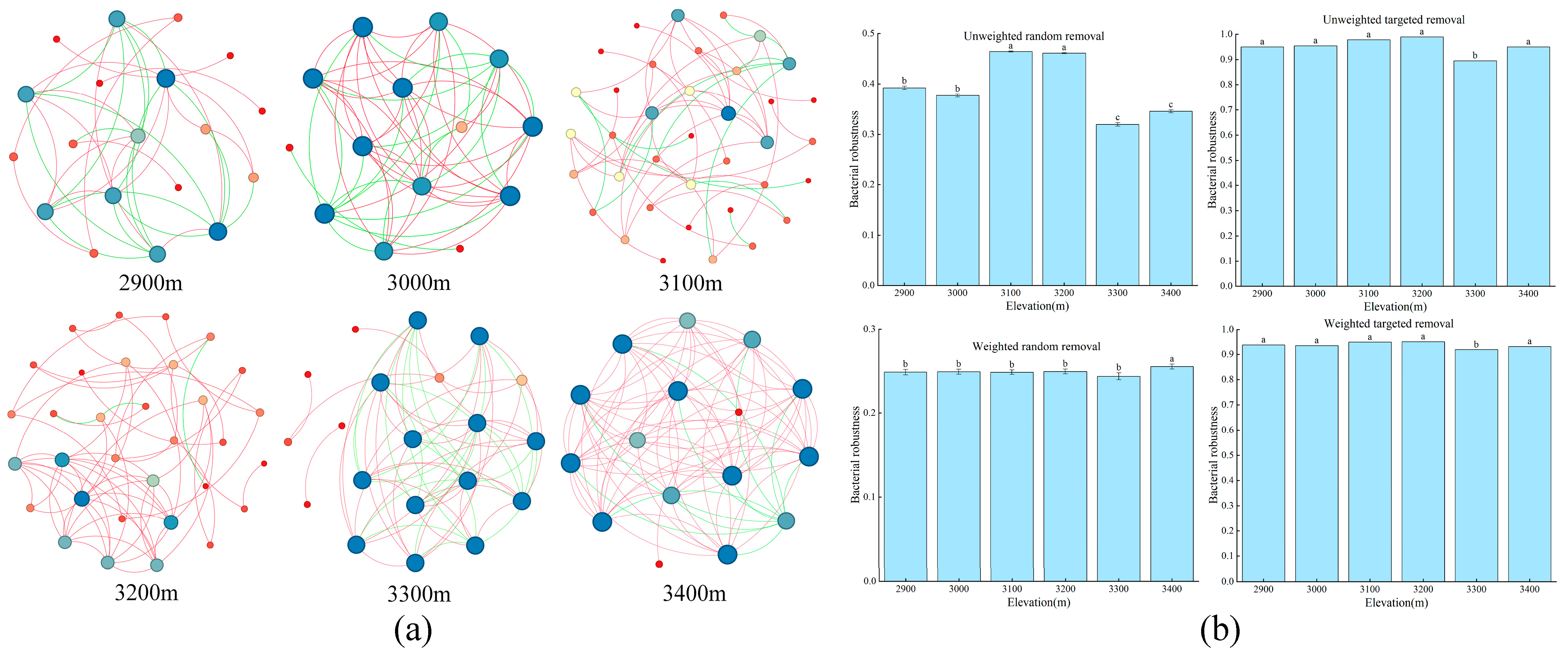
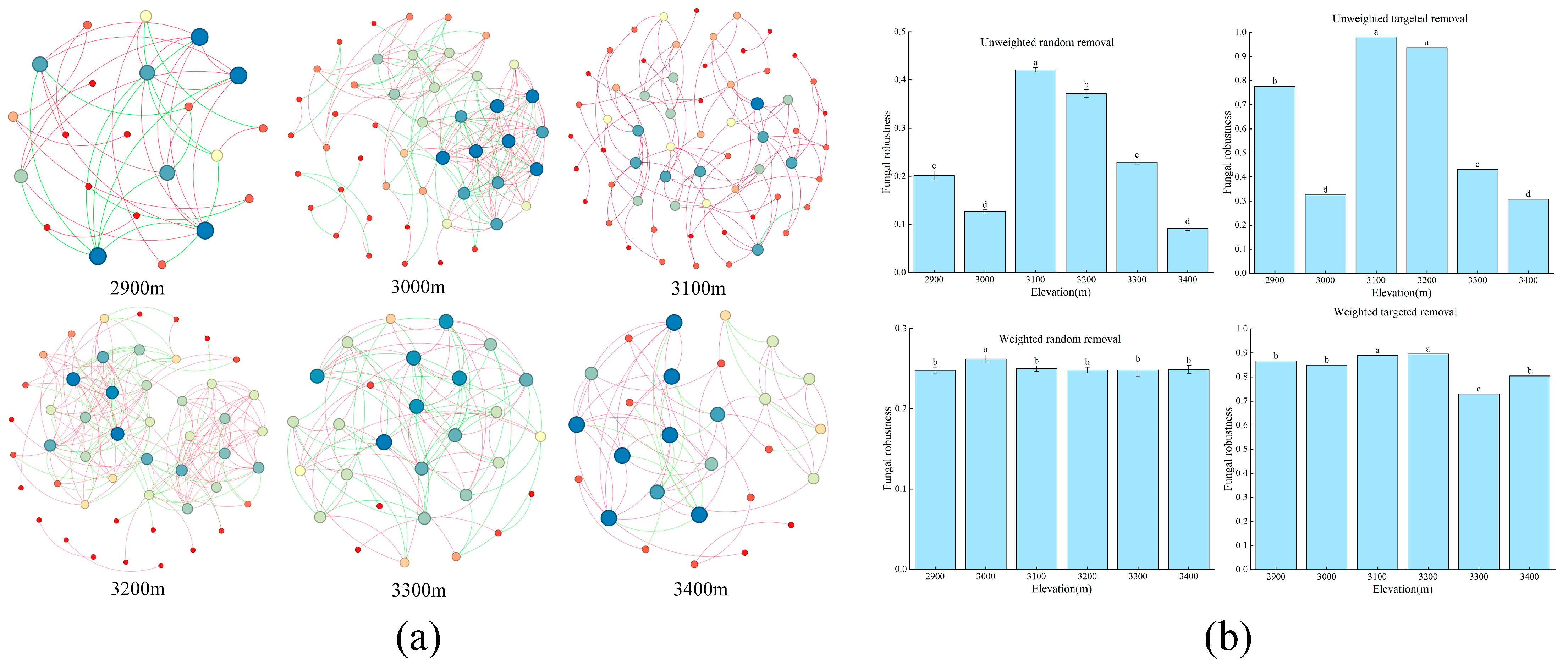
The complexity and robustness of microbial communities were assessed by constructing co-occurrence networks for bacterial (Figure 1a) and fungal (Figure 2a) populations. The findings indicate that the soil microbial network robustness in mid-altitude forest stands (3100–3200 m) is relatively high (Figure 1b and Figure 2b). Notably, mid-altitude plots exhibited significant enhancements in the network robustness of both fungal and bacterial community networks compared to low and high-altitude forest stands. The robustness of bacterial communities in forest land at an altitude of 3200 m was evaluated using four assessment methods: weighted random removal, weighted targeted removal, unweighted random removal, and unweighted targeted removal. The results revealed increases of 6.88%–14.14%, 3.56%–9.45%, 0.02%–0.57%, and 1.34%–3.31%, respectively, when compared to other altitudes. Similarly, the robustness of the fungal community, assessed through the same four methods, showed increases of 19.16%–32.92%, 20.52%–67.38%, 0.10%–0.24%, and 2.26%–15.92%, respectively. However, the average degree of network connectivity in low-altitude forest land surpassed that of medium- and high-altitude forest stands. Specifically, the average degree of soil bacterial and fungal networks reached up to 3.02 times and 2.82 times that of medium- and high-altitude forests, respectively. Furthermore, it was observed that the network robustness of bacterial communities at most sampling points generally exceeded that of fungal communities.
The changes in the complexity indicators of bacterial and fungal networks also confirmed these results. For example, in low-altitude (3000 m) forest stands, the number of edges in the bacterial network increased by 26.73%–208.99% compared with other altitude forest stands, the number of positively correlated edges increased by 42.96%–144.30%, and the topological coefficient increased by 4.79%–52.27%. Meanwhile, the increase in altitude leads to a decrease in the average clustering coefficient of most plots. The maximum reduction in the average clustering coefficient of the bacterial community and the fungal community reached 28.40% and 66.01, respectively.
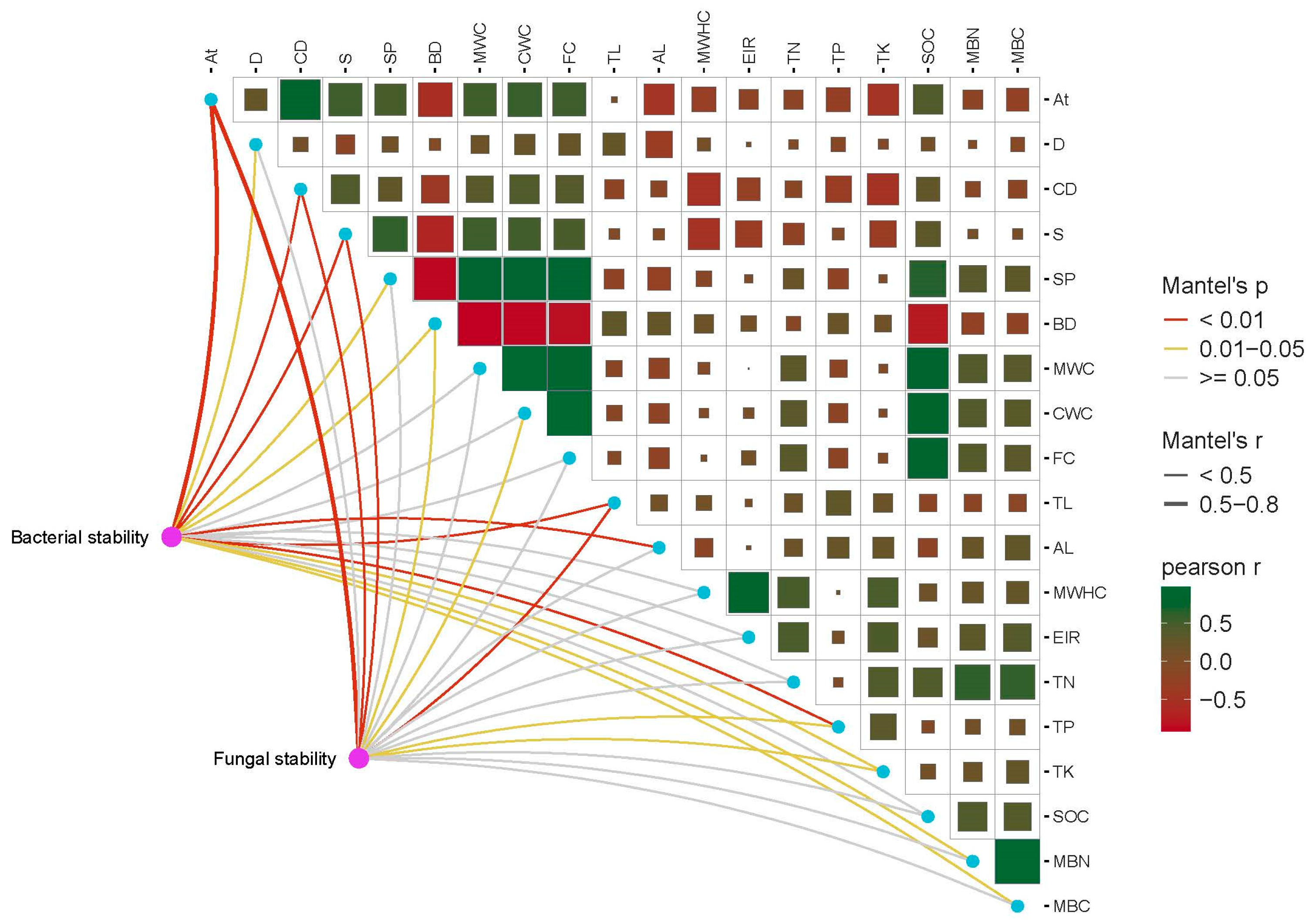
The Mantel test was employed to elucidate the factors driving variations in bacterial and fungal community network robustness (Figure 3). Altitude, canopy density, slope, and litter thickness emerged as the primary determinants of microbial community network robustness. Additionally, soil microbiomass carbon, nitrogen and total potassium content, and soil porosity and capillary water-holding capacity are identified as important factors affecting the network robustness of bacterial communities. Moreover, soil bulk density, capillary water-holding capacity, total phosphorus, and total potassium content significantly affected fungal community network robustness.

3.4. Relationship Between Soil Microbial Communities and SOC

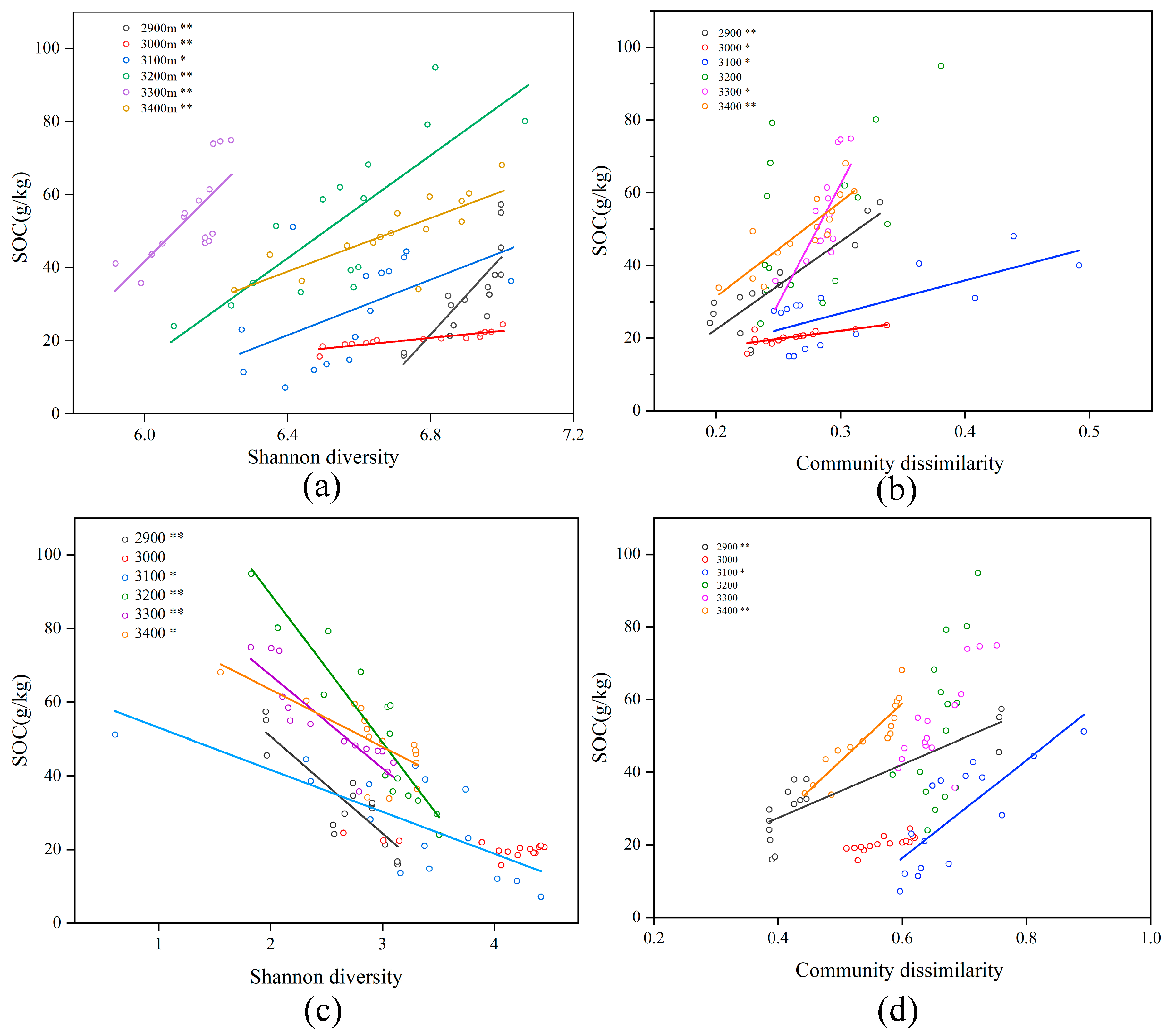
The relationship between soil microbial diversity and soil organic carbon (SOC) content was examined using a general linear regression model (Figure 4). The Shannon diversity index for soil bacteria exhibited a significant positive correlation with SOC across all altitude bands (Figure 4a; p < 0.05 at each altitude). Conversely, the correlation between fungal Shannon diversity and SOC displayed an opposing trend, revealing a significant negative association in all altitude bands except at 3000 m (Figure 4c; p < 0.05). Furthermore, a significant positive correlation exists between SOC content and the dissimilarity of soil bacterial and fungal communities, as measured by Bray–Curtis distance (Figure 4b,d). Elevated SOC levels correspond to greater structural differences among microbial communities. These findings suggest that both bacterial diversity and community dissimilarity are positively correlated with SOC accumulation, a relationship that is consistent across various altitude environments. However, the association between fungal diversity and SOC demonstrates significant altitude dependence.
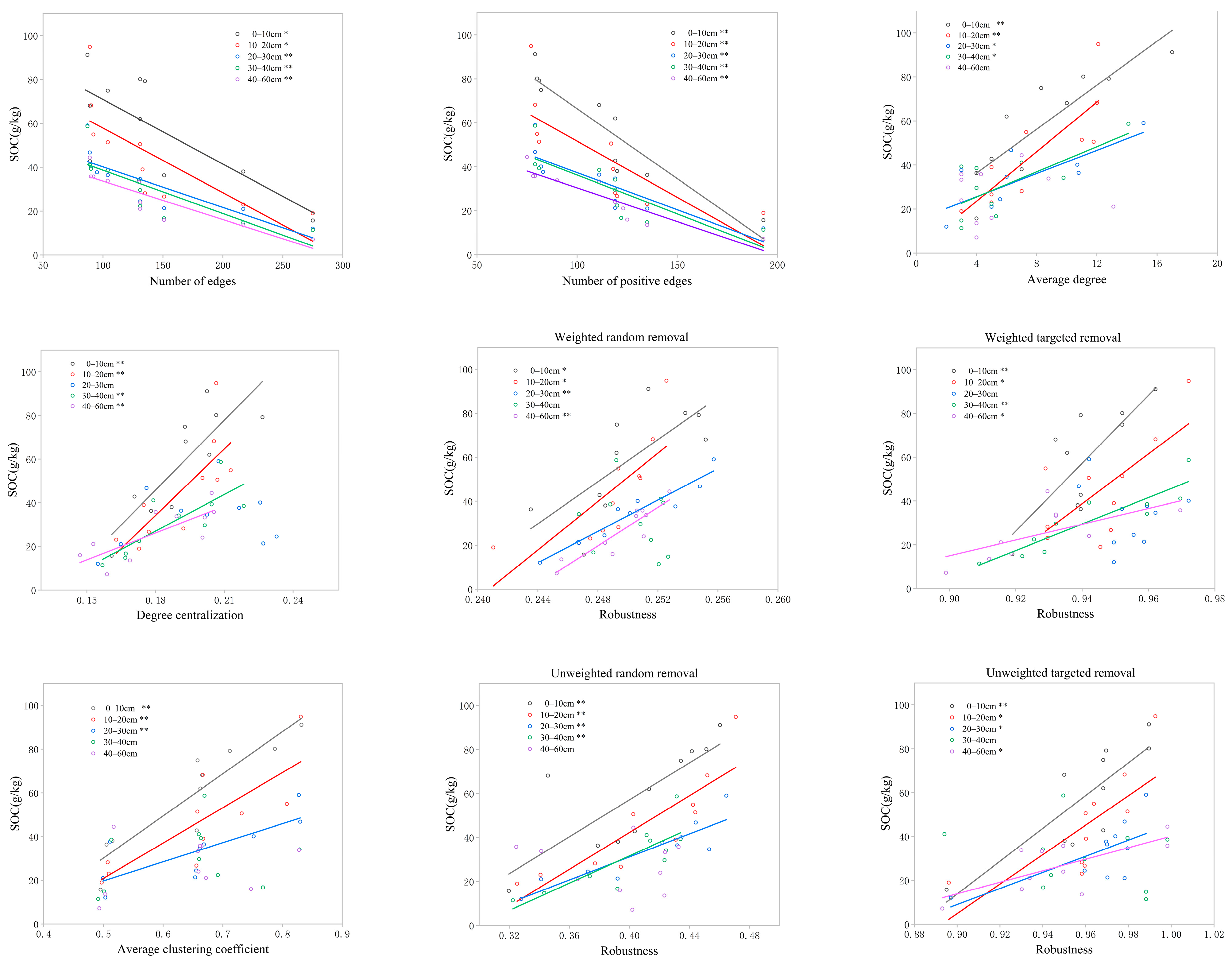
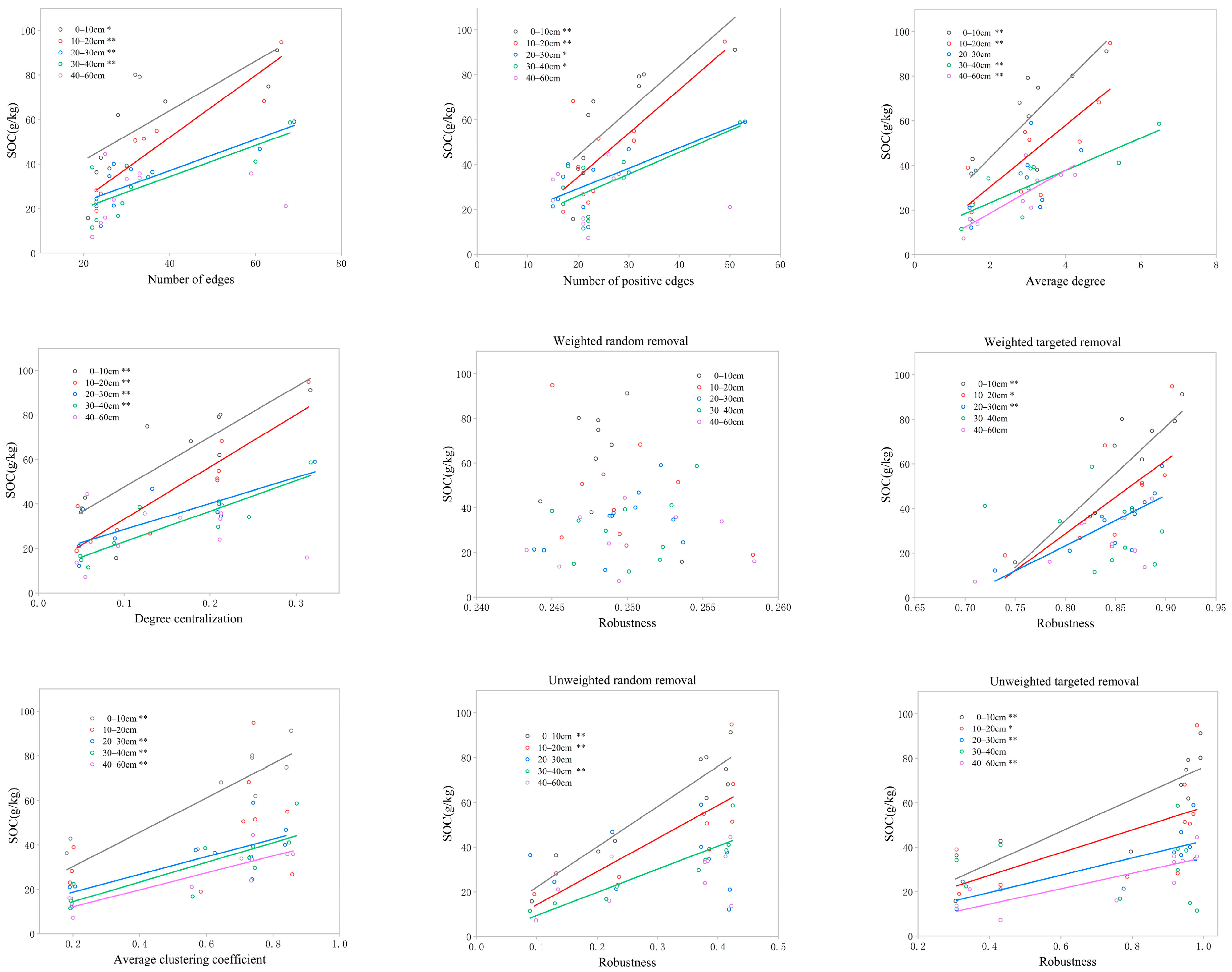
Furthermore, the relationship between the topological properties of microbial networks and soil organic carbon (SOC) exhibits a notable vertical differentiation pattern. In the upper and middle soil layers, specifically from 0 to 40 cm, network robustness of bacterial and fungal communities assessed through random and targeted removal simulations along with degree centralization, average clustering coefficient, and average connectivity, demonstrated significant positive correlations with SOC content (Figure 5 and Figure 6). This finding suggests that greater carbon storage correlates with a more stable, centralized, and locally interactive microbial network structure. Conversely, in deeper soil layers, particularly at depths of 40–60 cm, these positive correlations generally weaken or vanish. Additionally, the total number of edges and the number of positive edges, which reflect the scale of network connections, exhibit negative correlations with SOC throughout the entire profile, with this trend being more pronounced in deeper soil (Figure 5). This indicates that in surface soil with elevated SOC levels, microbial networks tend to exhibit higher connection centrality, local clustering, and overall stability, albeit with a more streamlined total number of connections. However, at greater depths, the association between this “efficient and stable” network structure and SOC diminishes.

3.5. Pathways of Soil Microbial Influence on Organic Carbon Storage

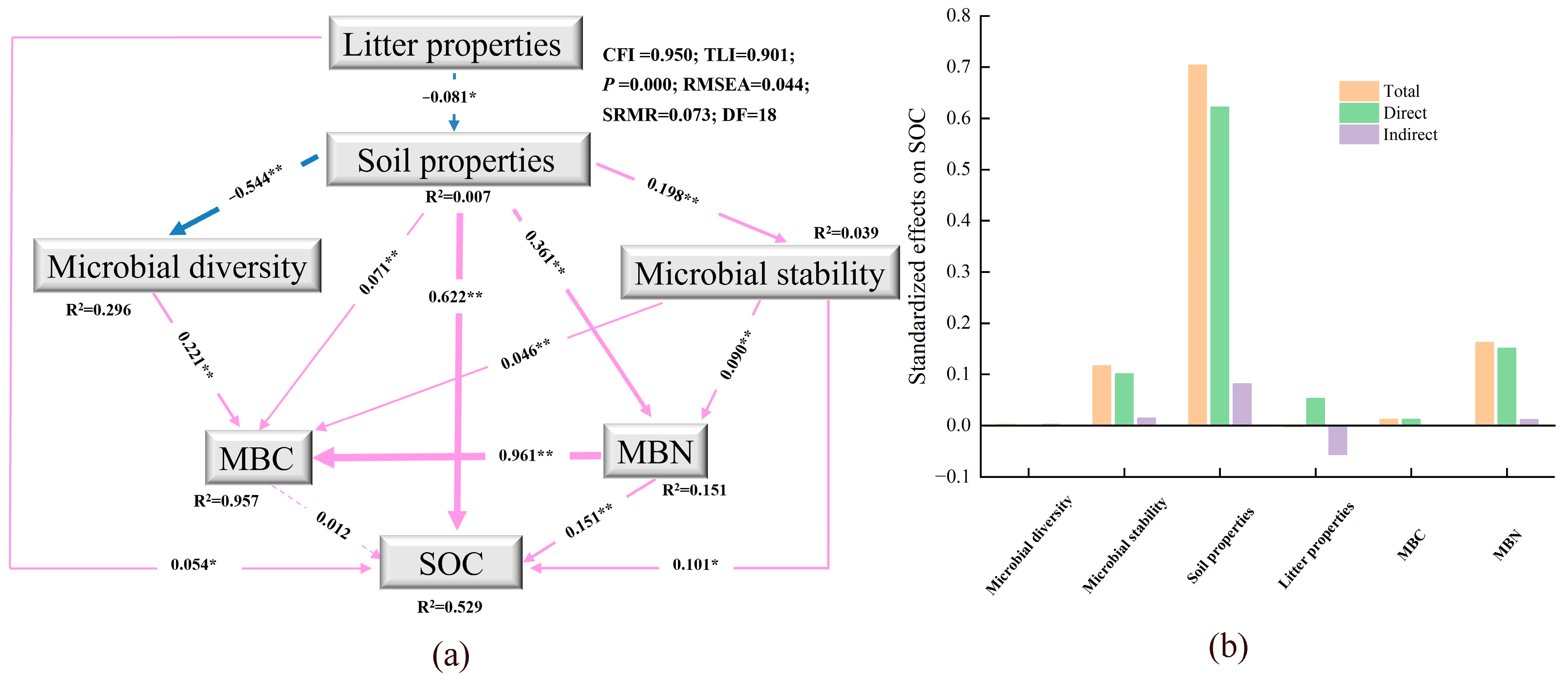
SEM was constructed to further test our hypothesis that changes in the microbial community of dark coniferous forests in the alpine mountains would affect SOC storage (Figure 7). SEM was used to illustrate the pathways by which soil microbial diversity and network robustness affect soil organic carbon storage, combined with microbial biomass carbon and nitrogen, soil properties, and litter properties (p = 0.000; Figure 7a). The CFI and TLI of the SEM are 0.950 and 0.901, respectively. Soil microbial models based on microbial diversity and network robustness can explain 52.9% of the variation in soil organic carbon storage. The direct positive effect of soil characteristics on soil organic carbon (SOC) was the strongest, with a coefficient of 0.622 (p < 0.001). Microbial network robustness significantly impacts SOC directly (0.101, p < 0.001) and also exerts an indirect influence through microbial biomass nitrogen (Figure 7b). In contrast, microbial diversity does not directly affect SOC but has a weak indirect effect mediated by its positive influence on microbial biomass carbon (MBC). Microbial biomass, including both MBC and MBN, serves a crucial mediating role in linking environmental factors to organic carbon. Furthermore, the indirect negative effect of litter properties on SOC is relatively minor, primarily mediated by their negative impact on soil properties. Structural equation modeling (SEM) demonstrates a good fit, suggesting that microorganisms, including bacteria and fungi, collectively enhance soil carbon accumulation through distinct yet complementary pathways. Abiotic factors, particularly soil properties, are the main influencing factors of SOC accumulation, while microbial network robustness plays a significant regulatory and facilitative role.

4. Discussion

4.1. Altitude Gradient Affects the Soil Microbial Communities Network Robustness

Elevation gradients alter the complexity of bacterial and fungal networks in soils, resulting in increased the network robustness of soil microbial communities. This is consistent with our first hypothesis and the observations made in grassland [45] and mountain ecosystems [46]. Similarly, Ren et al. (2018) found through an altitude gradient experiment covering three climate zones that the altitude gradient significantly affected the richness and diversity of the microbial community [47]. Soil bacterial alpha diversity was significantly higher at medium altitudes, and the influence of altitudinal gradients on bacterial beta diversity was greater than that on fungal beta diversity. The research results of Kong et al. (2022) indicated that the altitude gradient caused changes in the natural connectivity of the surface soil bacterial community in forest land [48]. Our study also demonstrated that the altitude gradient altered the network robustness of soil microbial community. The increased network complexity (e.g., average degree, clustering coefficient) and robustness under mid-altitude conditions indicate a more stable and interconnected microbial system. This enhancement of network robustness can be explained by the framework of the moderate disturbance hypothesis and the microbial life history strategy [49]. The environmental conditions at low altitudes are relatively “comfortable”, making it a paradise for a few fast-growing and highly competitive microorganisms (R-strategists). The community structure is simple and the competition among species is fierce. The environmental stress at high altitudes is extremely strong (low temperature and nutrient deficiency), and only a few stress-resistant K-strategists or oligotrophic microorganisms can survive. The environmental conditions limit the activity and diversity of microorganisms, and it is very difficult to establish complex interaction networks. Only the medium altitude provides an “optimal stress zone”, allowing for the coexistence and functional complementarity of microorganisms with different life history strategies (r-, K-, pressure-tolerant), forming a relatively complex network with high system robustness and less susceptibility to environmental fluctuations, thereby promoting ecosystem resilience.
Mantel’s test indicated that the network robustness of bacterial and fungal communities within the Sabina przewalskii forest ecosystem is influenced by a hierarchy of environmental filters, with elevation serving as the primary factor affecting microbial community network robustness. While our study did not directly quantify microtopography, the literature suggests that at fine scales, factors such as slope and aspect can modulate microclimate and litter input [44,50], thereby potentially introducing additional hierarchical filtering on microbial community assembly beyond the broad altitudinal gradient. At finer scales, the network robustness of bacterial communities is predominantly determined by the availability of microbiomass carbon and nitrogen (e.g., MBC, MBN) as well as soil pore structure, which facilitate a fast-growing, commensal lifestyle [51]. In contrast, the network robustness of fungal communities is more closely associated with soil physical structure (e.g., bulk weight) and the availability of key macronutrients such as phosphorus and potassium. This relationship reflects their potassium selection strategy and their role in organic matter decomposition and co-nutrient acquisition [52,53]. This dichotomy underscores the distinct ecological niches occupied by bacteria and fungi, with bacteria being more responsive to resource fluxes and habitat porosity, while fungi exhibit greater sensitivity to physical habitat destruction and mineral nutrient availability [54].

4.2. Soil Microbial Community Network Robustness Correlates with Carbon Sequestration and Sink Enhancement in an Alpine Dark Coniferous Forests

Recent studies indicate that the network robustness of microbial communities is intricately linked to ecosystem functional processes, including the carbon cycle [24,55]. Our research further substantiates that in alpine dark coniferous forests, soil microbial community network robustness correlates with carbon sequestration and sink enhancement, and there is a significant depth dependence. A notable positive correlation between network complexity, robustness, and soil organic carbon (SOC) is consistently observed in surface soil (0–40 cm) (Figure 5 and Figure 6). However, in deeper soil (40–60 cm), this correlation diminishes significantly. This disparity primarily arises from the environmental differentiation across various soil layers. The elevated carbon mass and oxygen availability in surface soil foster a more complex and active microbial network, whose interactions directly influence the dynamic turnover of SOC. In contrast, deep soil is limited by carbon and energy constraints, as well as anoxic conditions, which diminish microbial activity and network complexity, thereby decoupling network attributes from the stable SOC reservoir. Consequently, the positive influence of microbial network robustness on carbon storage is most pronounced in surface soil. This finding aligns with the emerging consensus that microbial life history strategies and interaction networks govern carbon turnover in terrestrial ecosystems [56,57]. A more complex and diverse structure of soil microbial communities contributes to greater network robustness within the soil ecosystem, thereby enhancing its ecological functions [58].
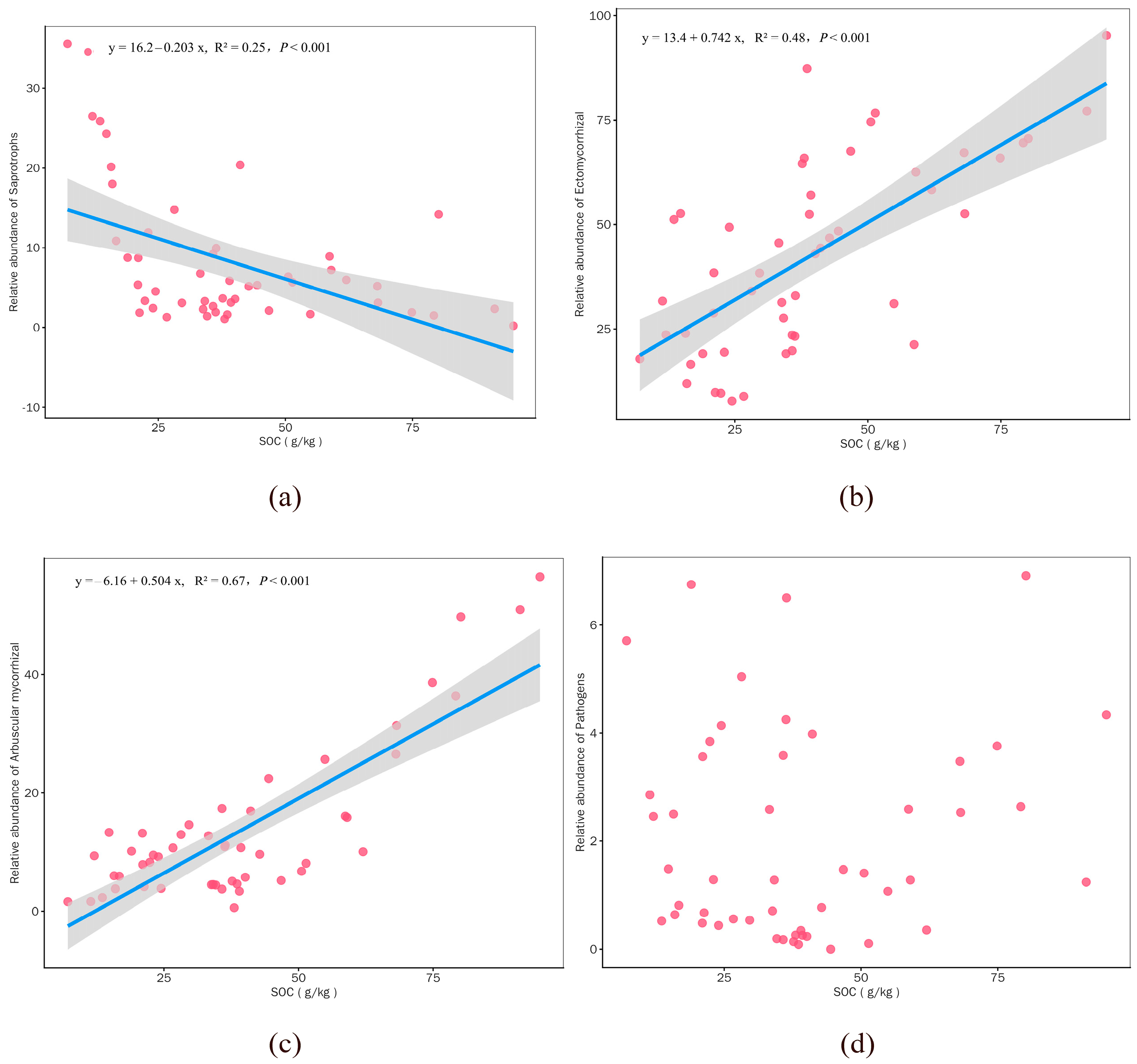
Soil microbial communities can regulate the carbon balance of ecosystems [59] and are a key driving factor for forest carbon sequestration [60]. It is due to their physiological characteristics and differences in network robustness that our analyses show that the robustness of bacterial co-occurrence networks exhibited a stronger correlation with SOC compared to fungal network robustness. This aligns with the finding from general linear regression models that the Shannon diversity of bacterial was significantly positively correlated with SOC, whereas fungal diversity showed a slight negative relationship. This indicates that bacteria may play a more crucial role in stabilizing the formation of carbon pools, mainly due to their faster metabolic rates and broader versatility in mediating humification and the formation of mineral-related organic matter [4]. In contrast, the negative correlation between fungal Shannon diversity and soil organic carbon (SOC) arises from the fundamental transformation in the functional composition of soil fungal communities along the carbon gradient. Specifically, there is a significant fluctuation in the relationship between decomposer functional groups and symbiotic functional groups. In soils with lower SOC content, the relative abundance of saprotrophs fungi is markedly higher (Figure 8a; R2 = 0.25, p < 0.001), and their vigorous decomposition activity may result in rapid mineralization and loss of organic carbon [61]; conversely, in soils with higher SOC content, symbiotic mycorrhizal fungi predominate (ectomycorrhizal fungi: Figure 8b, R2 = 0.48; arbuscular mycorrhizal fungi: Figure 8c, R2 = 0.67; p < 0.001). This group of fungi enhances carbon input into the soil through symbiosis with plants and aids in the stabilization and retention of carbon via mechanisms such as mycelial networks, secretions, and bacterial residues. Consequently, higher fungal alpha diversity often reflects a community state characterized by diverse saprophytic bacteria and active carbon turnover. This also indicates that in alpine mountain forest ecosystems, microbial communities evolve towards higher cooperation and network resilience to overcome environmental pressure, which is conducive to carbon retention [62]. In addition, the microbial community structure in the soil at mid-altitude is more stable than that at low and high altitudes, and it has better potential for soil organic carbon storage. Meanwhile, the soil environment (BD, TN and water-holding characteristics) of mid-altitude forest stands is better than that of low-altitude and high-altitude plots at most sampling points. Therefore, the mid-altitude area (3100–3200 m) will be the key region for the ecological environment restoration and carbon sink function improvement of the Sabina przewalskii forest.
SEM results further elucidate the mechanistic pathways through which microbial network robustness influences soil organic carbon (SOC). Although soil properties have the greatest direct influence, microbial biomass (MBC, MBN) is a key mediator linking microbial diversity and network robustness to organic carbon accumulation [63]. This underscores the significance of microbial carbon and nitrogen use efficiency in regulating carbon sequestration [64]. An increase in microbial mass may enhance the formation of microbial necro mass and the secretion of microbial byproducts, thus favoring the establishment of stable carbon pools in the soil [65,66]. The weak direct effect of microbial diversity, in contrast to the strong positive effect of microbial network robustness, highlights an essential paradigm: the structure and resilience of microbial interactions serve as better predictors of ecosystem function than abundance alone [67]. This finding is particularly relevant in coniferous forests, where microbial networks play a critical role in the decomposition of complex apoplastic material, with their carbon sequestration capacity optimized when integrated within stable and interconnected communities. Moreover, microbial biomass nitrogen (MBN) represents a significant factor influencing the soil organic carbon (SOC) storage process. The relatively weak direct effect of MBC on SOC in our model may be explained by the dual role of active microbial biomass. According to the ‘microbial carbon pump’ concept, while microbial residues contributes to stable SOC, a large, active microbial biomass can also stimulate respiration fluxes in the short term [8,68]. Thus, the net effect on SOC accumulation may represent a balance between these opposing processes—a hypothesis that warrants testing in future studies incorporating direct CO2 flux measurements.
In conclusion, our research findings demonstrate that organic carbon storage in alpine dark coniferous forests is influenced by the synergistic interaction between abiotic soil conditions and the soil microbial network robustness. Furthermore, as climate warming and human disturbances escalate, preserving the integrity of soil microbial systems becomes essential for the long-term carbon storage of these delicate ecosystems [69]. Consequently, forest management aimed at enhancing terrestrial carbon sinks and policies addressing climate change should consider the microbial network robustness as a key indicator of the carbon storage potential within ecosystems [70]. Future investigations will further explore the role of microbial communities in carbon storage across different soil layers—topsoil, subsoil, and deep soil—in forest ecosystems, given that both microbial communities [48] and organic carbon storage [71] exhibit significant variation with soil layer depth.

4.3. Limitations and Future Perspectives

This study offers valuable insights by connecting soil organic carbon to the robustness of microbial symbiotic networks, which may serve as a potential indicator of community stability. However, it is inherently correlational and depends on spatiotemporal substitution. The network metrics we derived reflect spatial correlations rather than directly measured temporal stability. Consequently, future research should emphasize long-term time sequencing to quantify stability indicators and incorporate controlled experiments that manipulate carbon pools and microbial communities. This comprehensive approach is essential for moving beyond mere correlations, establishing causal relationships, and elucidating the underlying mechanisms of carbon regulation stability, ultimately enhancing predictions of soil health and carbon-climate feedback.

5. Conclusions

In this study, we elucidated the regulatory mechanism by which microbial community network robustness influences soil organic carbon (SOC) persistence in the Sabina przewalskii forest across an altitude gradient. Altitude serves as a critical driving factor that not only modifies the physical and chemical properties of soil but also alters its microbial composition and diversity, thereby significantly affecting its complexity and network robustness. At intermediate altitudes, microbial communities exhibit maximum network robustness and complexity, concomitantly with high levels of organic C in the soil. Microbial biomass nitrogen (MBN) acts as a crucial mediating variable in the microbial regulation of SOC, emphasizing the importance of microbial nitrogen utilization efficiency in the carbon fixation process. Soil properties represent the most potent direct driving force for SOC storage, while the microbial network robustness serves as a more informative predictor of ecosystem functions than the diversity of individual species. Thus, this study offers a microbial perspective on carbon management in high-altitude mountain forest ecosystems.
Future research should prioritize the evaluation of microbial network robustness as a critical indicator of ecosystem carbon storage potential. The subsequent implementation of controlled experiments on microbial communities and carbon pools, with an emphasis on long-term time-series studies of microbial stability, will elucidate the mechanisms underlying carbon regulation stability across spatial and temporal scales. This approach will also improve predictions regarding soil health and carbon-climate feedbacks.

Author Contributions

Conceptualization, Y.F. and C.Z.; methodology, T.W. and Y.F.; software, C.L.; validation, J.L. and L.W.; formal analysis, Y.F. and C.Z.; investigation, T.W., Y.F., L.W. and C.L.; resources, J.L.; data curation, Y.F., C.L. and T.W.; writing—original draft preparation, Y.F. and C.L.; writing—review and editing, Y.F. and J.L.; visualization, Y.F. and C.Z.; supervision, C.Z.; project administration, C.Z.; funding acquisition, C.Z. and Y.F. All authors have read and agreed to the published version of the manuscript.

Funding

This work was funded by the Science and Technology Major Project of Gansu Province, China (23ZDKA0006), Natural Science Foundation Project of Gansu Province (24JRRG009), the young doctor support project of colleges and universities in Gansu Province (2025QB-091), and Zhangye Science and Technology Planning Project of Gansu Province (ZY2025KY04). We are especially grateful to everyone who helped with this project.

Data Availability Statement

The original contributions presented in this study are included in the article. Further inquiries can be directed to the corresponding authors.

Conflicts of Interest

The authors declare no conflicts of interest.

References

  1. Wang, M.; Guo, X.; Zhang, S.; Xiao, L.; Mishra, U.; Yang, Y.; Zhu, B.; Wang, G.; Mao, X.; Qian, T.; et al. Global Soil Profiles Indicate Depth-Dependent Soil Carbon Losses under a Warmer Climate. Nat. Commun. 2022, 13, 5514. [Google Scholar] [CrossRef] [PubMed]
  2. Tian, P.; Zhao, X.; Liu, S.; Wang, Q.; Zhang, W.; Guo, P.; Razavi, B.S.; Liang, C.; Wang, Q. Differential Responses of Fungal and Bacterial Necromass Accumulation in Soil to Nitrogen Deposition in Relation to Deposition Rate. Sci. Total Environ. 2022, 847, 157645. [Google Scholar] [CrossRef]
  3. Voosen, P. ‘Hot’ Climate Models Exaggerate Earth Impacts. Science 2022, 376, 685. [Google Scholar] [CrossRef]
  4. Liang, C.; Schimel, J.P.; Jastrow, J.D. The Importance of Anabolism in Microbial Control over Soil Carbon Storage. Nat. Microbiol. 2017, 2, 17105. [Google Scholar] [CrossRef]
  5. Li, D.; Han, B.; Li, X.; Ma, J.; Zhang, J.; Jia, Z. Microbial interaction network determines the age of soil organic carbon. Acta Microbiol. Sin. 2025, 25, 1–18. [Google Scholar] [CrossRef]
  6. Chen, X.; Hu, Y.; Xia, Y.; Zheng, S.; Ma, C.; Rui, Y.; He, H.; Huang, D.; Zhang, Z.; Ge, T.; et al. Contrasting Pathways of Carbon Sequestration in Paddy and Upland Soils. Glob. Change Biol. 2021, 27, 2478–2490. [Google Scholar] [CrossRef] [PubMed]
  7. He, M.; Fang, K.; Chen, L.; Feng, X.; Qin, S.; Kou, D.; He, H.; Liang, C.; Yang, Y. Depth-dependent Drivers of Soil Microbial Necromass Carbon across Tibetan Alpine Grasslands. Glob. Change Biol. 2022, 28, 936–949. [Google Scholar] [CrossRef]
  8. Liang, C.; Zhu, X. The Soil Microbial Carbon Pump as a New Concept for Terrestrial Carbon Sequestration. Sci. China Earth Sci. 2021, 64, 545–558. [Google Scholar] [CrossRef]
  9. Xiao, K.; Zhao, Y.; Liang, C.; Zhao, M.; Moore, O.W.; Otero-Fariña, A.; Zhu, Y.; Johnson, K.; Peacock, C.L. Introducing the Soil Mineral Carbon Pump. Nat. Rev. Earth Environ. 2023, 4, 135–136. [Google Scholar] [CrossRef]
  10. Zhang, Q.; Li, X.; Liu, J.; Liu, J.; Han, L.; Wang, X.; Liu, H.; Xu, M.; Yang, G.; Ren, C.; et al. The Contribution of Microbial Necromass Carbon to Soil Organic Carbon in Soil Aggregates. Appl. Soil Ecol. 2023, 190, 104985. [Google Scholar] [CrossRef]
  11. Liu, P.; Ding, S.; Liu, N.; Mo, Y.; Liang, Y.; Ma, J. Soil Microbial Community in Relation to Soil Organic Carbon and Labile Soil Organic Carbon Fractions under Detritus Treatments in a Subtropical Karst Region during the Rainy and Dry Seasons. Forests 2023, 14, 2291. [Google Scholar] [CrossRef]
  12. Zhang, Y.; Yuan, C.; Hu, D.; Zhang, Y.; Hou, L.; Li, J.; Han, S.; Dou, Y.; Cao, J. Elevation Shapes Soil Microbial Diversity and Carbon Cycling in Platycladus orientalis Plantations. Forests 2024, 15, 979. [Google Scholar] [CrossRef]
  13. Li, Y.; Feng, X.; Zhao, F.; Guo, S.; Wang, J.; Ren, C. Structure characteristics of soil microbial community in Quercus aliena var. acuteserrata forests at different altitudes in Qinling mountains. Sci. Silvae Sin. 2021, 57, 22–31. [Google Scholar] [CrossRef]
  14. Cui, Y.X.; Fang, L.C.; Guo, X.B.; Wang, X.; Wang, Y.Q.; Li, P.F.; Zhang, Y.; Zhang, X. Responses of Soil Microbial Communities to Nutrient Limitation in the Desert-Grassland Ecological Transition Zone. Sci. Total Environ. 2018, 642, 45–55. [Google Scholar] [CrossRef]
  15. Wang, S.Y.; Wang, Y.J.; Qiu, K.Y.; Li, X.C.; Qiu, A.Z.; Zhu, Y.C.; Zhang, S.; Si, H.Y.; Zhang, Y.Q.; Feng, J.L.; et al. Variation regularity of stoichiometric characteristics of soil microbial biomass C, N, and P along the altitudinal gradient and their influencing factors in Helan Mountains. Pratacultural Sci. 2024, 41, 1558–1570. [Google Scholar] [CrossRef]
  16. Sun, Y.M.; Chen, X.L.; Cai, J.W.; Li, Y.Z.; Zhou, Y.H.; Zhang, H.X.; Zheng, K. Altitudinal Effects on Soil Microbial Diversity and Composition in Moso Bamboo Forests of Wuyi Mountain. Plants 2024, 13, 2471. [Google Scholar] [CrossRef]
  17. Fu, F.; Li, J.; Li, S.; Chen, W.; Ding, H.; Xiao, S.; Li, Y. Elevational Distribution Patterns and Drivers of Soil Microbial Diversity in the Sygera Mountains, Southeastern Tibet, China. Catena 2023, 221, 106738. [Google Scholar] [CrossRef]
  18. Zeng, L.X.; Lei, L.; Wang, X.R.; Zhu, J.H.; Xiao, W.F.; Liu, X.D.; Jing, W.M. Effect of altitudinal variation on carbon density in arbor layer and soil layer of Picea crassifolia forest in Qilian Mountains. Acta Ecol. Sin. 2018, 38, 7168–7177. [Google Scholar] [CrossRef]
  19. Li, X.Y.; Cao, G.C.; Chen, Z.Y.; Yuan, J.; Sun, Z.T.; Tang, J.T. Spatial-temporal characteristics and influencing factors of land surface temperature on the southern slope of Qilian Mountains from 2001 to 2022. J. Desert Res. 2024, 44, 84–94. [Google Scholar]
  20. Bardgett, R.D.; Caruso, T. Soil Microbial Community Responses to Climate Extremes: Resistance, Resilience and Transitions to Alternative States. Philos. Trans. R. Soc. B-Biol. Sci. 2020, 375, 20190112. [Google Scholar] [CrossRef]
  21. De Vries, F.T.; Griffiths, R.I.; Bailey, M.; Craig, H.; Girlanda, M.; Gweon, H.S.; Hallin, S.; Kaisermann, A.; Keith, A.M.; Kretzschmar, M.; et al. Soil Bacterial Networks Are Less Stable under Drought than Fungal Networks. Nat. Commun. 2018, 9, 3033. [Google Scholar] [CrossRef] [PubMed]
  22. Morriën, E.; Hannula, S.E.; Snoek, L.B.; Helmsing, N.R.; Zweers, H.; De Hollander, M.; Soto, R.L.; Bouffaud, M.-L.; Buée, M.; Dimmers, W.; et al. Soil Networks Become More Connected and Take up More Carbon as Nature Restoration Progresses. Nat. Commun. 2017, 8, 14349. [Google Scholar] [CrossRef]
  23. Wu, M.; Chen, S.; Chen, J.; Xue, K.; Chen, S.-L.; Wang, X.-M.; Chen, T.; Kang, S.; Rui, J.; Thies, J.E.; et al. Reduced Microbial Stability in the Active Layer Is Associated with Carbon Loss under Alpine Permafrost Degradation. Proc. Natl. Acad. Sci. USA 2021, 118, e2025321118. [Google Scholar] [CrossRef]
  24. Yuan, M.M.; Guo, X.; Wu, L.; Zhang, Y.; Xiao, N.; Ning, D.; Shi, Z.; Zhou, X.; Wu, L.; Yang, Y.; et al. Climate Warming Enhances Microbial Network Complexity and Stability. Nat. Clim. Change 2021, 11, 343–348. [Google Scholar] [CrossRef]
  25. Stone, B.W.; Li, J.; Koch, B.J.; Blazewicz, S.J.; Dijkstra, P.; Hayer, M.; Hofmockel, K.S.; Liu, X.-J.A.; Mau, R.L.; Morrissey, E.M.; et al. Nutrients Cause Consolidation of Soil Carbon Flux to Small Proportion of Bacterial Community. Nat. Commun. 2021, 12, 3381. [Google Scholar] [CrossRef]
  26. Liu, R.; Yao, Y.; Li, Q.; Cai, Z.; Wei, D.; Wang, X.; Zhang, S. Rhizosphere Soil Microbes Benefit Carbon and Nitrogen Sinks under Long-Term Afforestation on the Tibetan Plateau. Catena 2023, 220, 106705. [Google Scholar] [CrossRef]
  27. Xu, M.; Li, X.; Kuyper, T.W.; Xu, M.; Li, X.; Zhang, J. High Microbial Diversity Stabilizes the Responses of Soil Organic Carbon Decomposition to Warming in the Subsoil on the Tibetan Plateau. Glob. Change Biol. 2021, 27, 2061–2075. [Google Scholar] [CrossRef]
  28. Ma, J.; Kang, F.; Cheng, X.; Han, H. Moderate Thinning Increases Soil Organic Carbon in Larix principis-rupprechtii (Pinaceae) Plantations. Geoderma 2018, 329, 118–128. [Google Scholar] [CrossRef]
  29. Hao, W.; Xia, B.; Xu, M. Erosion-Deposition Positively Reconstruct the Bacterial Community and Negatively Weaken the Fungal Community. Catena 2022, 217, 106471. [Google Scholar] [CrossRef]
  30. Vance, E.D.; Brookes, P.C.; Jenkinson, D.S. Microbial Biomass Measurements in Forest Soils: The Use of the Chloroform Fumigation-Incubation Method in Strongly Acid Soils. Soil Biol. Biochem. 1987, 19, 697–702. [Google Scholar] [CrossRef]
  31. Li, C.H.; Fultz, L.M.; Moore-Kucera, J.; Acosta-Martínez, V.; Horita, J.; Strauss, R.; Zak, J.; Calderón, F.; Weindorf, D. Soil Carbon Sequestration Potential in Semi-Arid Grasslands in the Conservation Reserve Program. Geoderma 2017, 294, 80–90. [Google Scholar] [CrossRef]
  32. Chen, H.; Ju, P.; Zhu, Q.; Xu, X.; Wu, N.; Gao, Y.; Feng, X.; Tian, J.; Niu, S.; Zhang, Y.; et al. Carbon and Nitrogen Cycling on the Qinghai–Tibetan Plateau. Nat. Rev. Earth Environ. 2022, 3, 701–716. [Google Scholar] [CrossRef]
  33. Ghani, M.I.; Wang, J.; Li, P.; Pathan, S.I.; Sial, T.A.; Datta, R.; Mokhtar, A.; Ali, E.F.; Rinklebe, J.; Shaheen, S.M.; et al. Variations of Soil Organic Carbon Fractions in Response to Conservative Vegetation Successions on the Loess Plateau of China. Int. Soil Water Conserv. Res. 2023, 11, 561–571. [Google Scholar] [CrossRef]
  34. Yuan, Z.; Song, X.; Feng, Z.; Wang, J.; Wang, R.; Agathokleous, E.; Fang, C.; Sardans, J.; Penuelas, J. Soil Organic Carbon and Nitrogen Sequestration Following Grazing Exclusion on the Loess Plateau, China. Catena 2023, 232, 107412. [Google Scholar] [CrossRef]
  35. Zeng, X.; Feng, J.; Yu, D.; Wen, S.; Zhang, Q.; Huang, Q.; Delgado-Baquerizo, M.; Liu, Y. Local Temperature Increases Reduce Soil Microbial Residues and Carbon Stocks. Glob. Change Biol. 2022, 28, 6433–6445. [Google Scholar] [CrossRef]
  36. Bai, L.L.; Wang, W.Y.; Chen, Z.; Chen, X.Y.; Xiong, Y. The Variations in Soil Microbial Communities and Their Mechanisms along an Elevation Gradient in the Qilian Mountains, China. Sustainability 2025, 17, 1797. [Google Scholar] [CrossRef]
  37. Feng, Y.M.; Lv, C.Y.; Wang, L.; Zhao, W.J.; Ma, X.E.; Du, J.L.; He, J.L. Carbon and nitrogen storage and allocation patterns of Picea crassifolia forest with different stand density. Arid Land Geogr. 2023, 46, 1133–1144. [Google Scholar]
  38. Huang, J.Y.; Zhao, C.Y.; Wei, Y.; Zang, F.; Chang, Y.P.; Hao, H.; An, J.L.; Zhang, M.J.; Zhang, H.P. Characteristics of soil water-heat at a subalpine meadow during the freezing and thawing periods in Tianlaochi catchment of the Qilian Mountains. J. Glaciol. Geocryol. 2023, 45, 1591–1601. [Google Scholar] [CrossRef]
  39. Gao, C.C.; Zhao, C.Y.; Wang, C.; Wang, Q.T.; Wang, F.Y. Soil physicochemical Properties and Infiltration Characteristies Under Different Vegetation Types in Tianlaochi Watershed in the Upstream of Heihe River. J. Soil Water Conserv. 2016, 30, 117–121, 126. [Google Scholar] [CrossRef]
  40. Liu, G.S.; Jiang, N.H.; Zhang, L.D.; Liu, Z.L. Soil Physical and Chemical Analysis & Description of Soil Profiles; China Standards Press: Beijing, China, 1996. [Google Scholar]
  41. GB/T33027-2016; Methodology for Field Long-Term Observation of Forest Ecosystem. National Forestry and Grassland Administration China Standards Press: Beijing, China, 2016.
  42. Langille, M.G.I.; Zaneveld, J.; Caporaso, J.G.; McDonald, D.; Knights, D.; Reyes, J.A.; Clemente, J.C.; Burkepile, D.E.; Thurber, V.; Knight, R.; et al. Predictive Functional Profiling of Microbial Communities Using 16S rRNA Marker Gene Sequences. Nat. Biotechnol. 2013, 31, 814–821. [Google Scholar] [CrossRef]
  43. Mori, H.; Maruyama, F.; Kato, H.; Toyoda, A.; Dozono, A.; Ohtsubo, Y.; Nagata, Y.; Fujiyama, A.; Tsuda, M.; Kurokawa, K. Design and Experimental Application of a Novel Non-Degenerate Universal Primer Set That Amplifies Prokaryotic 16S rRNA Genes with a Low Possibility to Amplify Eukaryotic rRNA Genes. DNA Res. 2014, 21, 217–227. [Google Scholar] [CrossRef]
  44. Liu, R.; Yao, Y.; Chu, Q.; Wei, D.; Wang, X.; Zhang, S. Enhanced Soil Microbial Stability Is Associated with Soil Organic Carbon Storage under High-Altitude Forestation. J. Environ. Manag. 2024, 370, 122462. [Google Scholar] [CrossRef]
  45. Luo, Z.M.; Liu, J.X.; Zhou, Y.Y.; Du, J.Q.; Wu, Q.; Chai, B.F. Communitv structures and diversity patems of the soil prlist communities along an alitudina gradient in a subalpine grassland. Acta Ecol. Sin. 2021, 41, 2783–2793. [Google Scholar] [CrossRef]
  46. Yang, Y.; Qiu, K.; Xie, Y.; Li, X.; Zhang, S.; Liu, W.; Huang, Y.; Cui, L.; Wang, S.; Bao, P. Geographical, Climatic, and Soil Factors Control the Altitudinal Pattern of Rhizosphere Microbial Diversity and Its Driving Effect on Root Zone Soil Multifunctionality in Mountain Ecosystems. Sci. Total Environ. 2023, 904, 166932. [Google Scholar] [CrossRef]
  47. Ren, C.; Zhang, W.; Zhong, Z.; Han, X.; Yang, G.; Feng, Y.; Ren, G. Differential Responses of Soil Microbial Biomass, Diversity, and Compositions to Altitudinal Gradients Depend on Plant and Soil Characteristics. Sci. Total Environ. 2018, 610–611, 750–758. [Google Scholar] [CrossRef] [PubMed]
  48. Kong, W.; Wei, X.; Wu, Y.; Shao, M.; Zhang, Q.; Sadowsky, M.J.; Ishii, S.; Reich, P.B.; Wei, G.; Jiao, S.; et al. Afforestation Can Lower Microbial Diversity and Functionality in Deep Soil Layers in a Semiarid Region. Glob. Change Biol. 2022, 28, 6086–6101. [Google Scholar] [CrossRef]
  49. Zhang, H.; Fang, Y.; Zhang, B.; Luo, Y.; Yi, X.; Wu, J.; Chen, Y.; Sarker, T.C.; Cai, Y.; Chang, S.X. Land-Use-Driven Change in Soil Labile Carbon Affects Microbial Community Composition and Function. Geoderma 2022, 426, 116056. [Google Scholar] [CrossRef]
  50. Ortiz, C.; Fernández-Alonso, M.J.; Kitzler, B.; Díaz-Pinés, E.; Saiz, G.; Rubio, A.; Benito, M. Variations in Soil Aggregation, Microbial Community Structure and Soil Organic Matter Cycling Associated to Long-Term Afforestation and Woody Encroachment in a Mediterranean Alpine Ecotone. Geoderma 2022, 405, 115450. [Google Scholar] [CrossRef]
  51. Xia, Q.; Zheng, N.; Heitman, J.L.; Shi, W. Soil Pore Size Distribution Shaped Not Only Compositions but Also Networks of the Soil Microbial Community. Appl. Soil Ecol. 2022, 170, 104273. [Google Scholar] [CrossRef]
  52. Xiao, D.; He, X.; Zhang, W.; Hu, P.; Sun, M.; Wang, K. Microbiological Mechanism Underlying Vegetation Restoration across Climatic Gradients in a Karst Ecosystem. Land Degrad. Dev. 2022, 33, 3245–3259. [Google Scholar] [CrossRef]
  53. Zi, H.; Hu, Y.; Hu, L.; Wang, C. Distinct Responses of Soil Bacterial Communities to N and P Fertilization in a Tibetan Alpine Meadow of China. Land Degrad. Dev. 2023, 34, 4236–4251. [Google Scholar] [CrossRef]
  54. Chen, Y.; Neilson, J.W.; Kushwaha, P.; Maier, R.M.; Barberán, A. Life-History Strategies of Soil Microbial Communities in an Arid Ecosystem. ISME J. 2021, 15, 649–657. [Google Scholar] [CrossRef] [PubMed]
  55. Liu, G.; Sun, J.; Xie, P.; Guo, C.; Zhu, K.; Tian, K. Climate Warming Enhances Microbial Network Complexity by Increasing Bacterial Diversity and Fungal Interaction Strength in Litter Decomposition. Sci. Total Environ. 2024, 908, 168444. [Google Scholar] [CrossRef]
  56. Deng, Q.; Cheng, X.; Hui, D.; Zhang, Q.; Li, M.; Zhang, Q. Soil Microbial Community and Its Interaction with Soil Carbon and Nitrogen Dynamics Following Afforestation in Central China. Sci. Total Environ. 2016, 541, 230–237. [Google Scholar] [CrossRef]
  57. Wagg, C.; Schlaeppi, K.; Banerjee, S.; Kuramae, E.E.; Van Der Heijden, M.G.A. Fungal-Bacterial Diversity and Microbiome Complexity Predict Ecosystem Functioning. Nat. Commun. 2019, 10, 4841. [Google Scholar] [CrossRef]
  58. Hu, L.; Li, Q.; Yan, J.; Liu, C.; Zhong, J. Vegetation Restoration Facilitates Belowground Microbial Network Complexity and Recalcitrant Soil Organic Carbon Storage in Southwest China Karst Region. Sci. Total Environ. 2022, 820, 153137. [Google Scholar] [CrossRef]
  59. Zhang, J.; Huang, H.; Liu, H.; Wu, H.; Zhang, Z.; Wang, G.; Xue, S.; Liu, G. Effects of Soil Microbiological Properties on the Fractional Distribution and Stability of Soil Organic Carbon under Different N Addition Treatments. Forests 2023, 14, 1540. [Google Scholar] [CrossRef]
  60. Wang, X.; Zhou, L.; Fu, Y.; Jiang, Z.; Jia, S.; Song, B.; Liu, D.; Zhou, X. Drought-Induced Changes in Rare Microbial Community Promoted Contribution of Microbial Necromass C to SOC in a Subtropical Forest. Soil Biol. Biochem. 2024, 189, 109252. [Google Scholar] [CrossRef]
  61. Argiroff, W.A.; Zak, D.R.; Pellitier, P.T.; Upchurch, R.A.; Belke, J.P. Decay by Ectomycorrhizal Fungi Couples Soil Organic Matter to Nitrogen Availability. Ecol. Lett. 2022, 25, 391–404. [Google Scholar] [CrossRef] [PubMed]
  62. Tao, F.; Huang, Y.; Hungate, B.A.; Manzoni, S.; Frey, S.D.; Schmidt, M.W.I.; Reichstein, M.; Carvalhais, N.; Ciais, P.; Jiang, L.; et al. Microbial Carbon Use Efficiency Promotes Global Soil Carbon Storage. Nature 2023, 618, 981–985. [Google Scholar] [CrossRef]
  63. Kallenbach, C.M.; Frey, S.D.; Grandy, A.S. Author Correction: Direct Evidence for Microbial-Derived Soil Organic Matter Formation and Its Ecophysiological Controls. Nat. Commun. 2018, 9, 3929. [Google Scholar] [CrossRef]
  64. Sun, X.; Sun, H.; Zhang, Q.; Zhu, B.; Dai, H.; Zeng, Q.; Chen, J.; Chen, W.; Chen, Y. Soil Particulate Organic Carbon Regulates Microbial Carbon Use Efficiency in Subtropical Forests under Nitrogen Addition in Different Seasons. Appl. Soil Ecol. 2024, 203, 105680. [Google Scholar] [CrossRef]
  65. Prommer, J.; Walker, T.W.N.; Wanek, W.; Braun, J.; Zezula, D.; Hu, Y.; Hofhansl, F.; Richter, A. Increased Microbial Growth, Biomass, and Turnover Drive Soil Organic Carbon Accumulation at Higher Plant Diversity. Glob. Change Biol. 2020, 26, 669–681. [Google Scholar] [CrossRef]
  66. Zheng, F.; Wu, X.; Zhang, M.; Liu, X.; Song, X.; Lu, J.; Wang, B.; Jan Van Groenigen, K.; Li, S. Linking Soil Microbial Community Traits and Organic Carbon Accumulation Rate under Long-Term Conservation Tillage Practices. Soil Tillage Res. 2022, 220, 105360. [Google Scholar] [CrossRef]
  67. Hernandez, D.J.; David, A.S.; Menges, E.S.; Searcy, C.A.; Afkhami, M.E. Environmental Stress Destabilizes Microbial Networks. ISME J. 2021, 15, 1722–1734. [Google Scholar] [CrossRef] [PubMed]
  68. Liang, C.; Amelung, W.; Lehmann, J.; Kästner, M. Quantitative Assessment of Microbial Necromass Contribution to Soil Organic Matter. Glob. Change Biol. 2019, 25, 3578–3590. [Google Scholar] [CrossRef] [PubMed]
  69. Pei, L.; Ye, S.; Xie, L.; Zhou, P.; He, L.; Yang, S.; Ding, X.; Yuan, H.; Dai, T.; Laws, E.A. Differential Effects of Warming on the Complexity and Stability of the Microbial Network in Phragmites Australis and Spartina Alterniflora Wetlands in Yancheng, Jiangsu Province, China. Front. Microbiol. 2024, 15, 1347821. [Google Scholar] [CrossRef] [PubMed]
  70. Liang, Y.; Leifheit, E.F.; Lehmann, A.; Rillig, M.C. Soil Organic Carbon Stabilization Is Influenced by Microbial Diversity and Temperature. Sci. Rep. 2025, 15, 13990. [Google Scholar] [CrossRef]
  71. Zhang, Z.T.; Wang, K.; Li, G.L.; Xie, X.M.; Chang, X.F.; Zheng, J. Beyond Shrub Dieback: Understory Plant Diversity, Soil Water and Soil Carbon Storage Were Improved in a Semi-Arid Region. For. Ecol. Manag. 2023, 545, 121267. [Google Scholar] [CrossRef]
Figure 1. Soil bacterial community network robustness. (a) Co-occurrence network representing soil bacterial communities. All edges in the network exhibited significant Spearman correlations among operational taxonomic units (OTUs) (|r| > 0.8, p < 0.05). The red lines denote positive correlations, while the green lines indicate negative correlations. (b) Robustness is defined as the percentage of taxonomic groups that remain when 50% of the groups are randomly eliminated from each network using weighted and unweighted methods, or when 5 module hubs are eliminated from each network using the same methods. Each error bar represents the standard error of the mean value of each column after 100 simulation repetitions. There are significant differences between different letters indicating different altitudes. The same below.
Forests 16 01876 g001
Figure 2. Soil fungal community network robustness. (a) Co-occurrence networks of soil fungal community. All edges in the network exhibited significant Spearman correlations among operational taxonomic units (OTUs) (|r| > 0.8, p < 0.05). The red lines denote positive correlations, while the green lines indicate negative correlations. (b) Robustness of soil fungal community at different altitude gradients.
Forests 16 01876 g002
Figure 3. Environmental factors influencing the soil microbial communities network robustness using the Mantel test. The line width corresponds to Mantel’s r statistic, and the line color indicates the statistical significance based on 99 permutations. It also shows pairwise comparisons of environmental factors, with color gradients representing Spearman’s correlation coefficients. At: altitude; D: stand density; CD: depression degree; S: slope; SP: soil porosity; BD: soil bulk density; MWC: maximum water-holding capacity; CWC: capillary water-holding capacity; FC: field capacity; TL: thickness of litters; AL: accumulation of litters; MWHC: maximum water-holding capacity of litters; EIR: effective retention rate of litters; TN: total nitrogen in soil; TP: total phosphorus in soil; TK: total potassium in soil; SOC: soil organic carbon; MBC: soil microbial biomass carbon; MBN: soil microbial biomass nitrogen.
Forests 16 01876 g003
Figure 4. Relationship of soil microbial alpha diversity and community dissimilarity with soil organic carbon. Different colors represent different altitude gradients. The asterisk indicates that the regression relationship between alpha diversity and SOC within that elevation reached a significant level (**, p < 0.01; *, p < 0.05).
Forests 16 01876 g004
Figure 5. Relationships between the network complexity and robustness of soil bacterial community with SOC storage. Different colors represent different soil layers. Asterisks indicate that the regression relationship within this soil layer has reached a significant level (**, p < 0.01; *, p < 0.05).
Forests 16 01876 g005
Figure 6. Relationships between the network complexity and robustness of soil fungal community with SOC storage. Different colors represent different soil layers. Asterisks indicate that the regression relationship within this soil layer has reached a significant level (**, p < 0.01; *, p < 0.05).
Forests 16 01876 g006
Figure 7. The structural equation model of the effect of microbial communities, MBN, MBC, soil properties, and litter properties on SOC storage. (a) Single-headed arrows indicate the hypothesized direction of causation. Paths are shown in light purple if positive or in light blue if negative. Solid lines indicate significant paths. Line width is proportional to the absolute value of the path coefficient. The Comparative Fit Index (CFI), Tucker–Lewis Index (TLI), p values, Degree of Freedom (Df), Root Mean Square Error of Approximation (RMSEA), and Standardized Root Mean Square Residual (SRMR) of the SEM are shown in the upper right of the conceptual diagrams. The R2 of each component model is shown next to the response variable. The asterisks indicate statistical significance (**, p < 0.01; *, p < 0.05). (b) Bar graphs show the standardized effects of SEM on SOC storage.
Forests 16 01876 g007
Figure 8. Relationships between soil organic carbon (SOC) and the relative abundance of major fungal functional groups. (a) Saprotrophic fungi; (b) ectomycorrhizal fungi; (c) arbuscular mycorrhizal fungi; (d) pathogenic fungi. Red points represent the observed values from individual soil samples. Solid lines represent significant linear regressions (p < 0.05), with shaded areas indicating 95% confidence intervals.
Forests 16 01876 g008
Table 1. Basic status of Sabina przewalskii forest at different elevations.
Altitude
(m)
Stand Density/
(Trees·hm−2)
Number of
Samples
Mean DBH/cmMean Tree Height/mAspectSlope/(°)Canopy Density
2900736 ± 86316.85 ± 1.876.64 ± 0.74S30.0~36.00.38 ± 0.06
30001024 ± 223316.15 ± 1.027.23 ± 1.81S18.0~20.00.53 ± 0.05
31001113 ± 331318.69 ± 0.856.60 ± 2.53S25.0~31.00.56 ± 0.08
32001152 ± 187323.95 ± 0.836.96 ± 1.80S29.0~36.00.56 ± 0.08
3300960 ± 133323.02 ± 1.886.46 ± 2.05S37.0~40.00.69 ± 0.07
34001080 ± 238323.71 ± 1.376.69 ± 1.65S36.0~43.00.69 ± 0.05
Table 2. Soil physical and chemical properties at different elevations.
Elevation
(m)
290030003100320033003400Fp
SP0.57 ± 0.06 c0.40 ± 0.04 d0.56 ± 0.08 c0.63 ± 0.08 b0.66 ± 0.06 a0.62 ± 0.06 b147.1270.000 **
BD (g/cm3)1.11 ± 0.17 b1.63 ± 0.14 a0.99 ± 0.24 c0.81 ± 0.20 d0.74 ± 0.12 e0.79 ± 0.17 de258.7320.000 **
MWC0.53 ± 0.13 d0.25 ± 0.04 e0.62 ± 0.24 c0.84 ± 0.26 b0.91 ± 0.18 a0.85 ± 0.29 ab113.0730.000 **
CWC0.39 ± 0.08 d0.22 ± 0.04 e0.50 ± 0.21 c0.71 ± 0.22 b0.79 ± 0.12 a0.71 ± 0.26 b120.3140.000 **
FC0.36 ± 0.07 c0.20 ± 0.04 d0.46 ± 0.21 b0.66 ± 0.20 a0.72 ± 0.13 a0.66 ± 0.24 a119.7070.000 **
TN (g/kg)2.92 ± 0.27 ab3.66 ± 0.23 a2.62 ± 0.52 ab2.85 ± 0.41 ab2.77 ± 0.21 ab2.40 ± 0.21 b1.6990.173
TP (g/kg)0.67 ± 0.08 a0.65 ± 0.02 ab0.58 ± 0.05 b0.64 ± 0.02 ab0.57 ± 0.07 b0.60 ± 0.07 ab2.3600.071
TK (g/kg)1.66 ± 0.13 a1.68 ± 0.02 a1.47 ± 0.11 b1.67 ± 0.03 a1.49 ± 0.01 b1.30 ± 0.01 c23.8390.000 **
SOC (g/kg)24.78 ± 1.30 d19.71 ± 0.54 d33.37 ± 1.94 c54.29 ± 1.83 a52.38 ± 2.16 ab46.93 ± 2.12 ab47.3350.000 **
MBC (mg/kg)712.97 ± 43.42 a340.09 ± 19.81 b408.15 ± 27.01 b375.05 ± 18.79 b419.55 ± 35.90 b411.66 ± 40.48 b15.9980.000 **
MBN (mg/kg)114.31 ± 7.94 a51.24 ± 3.01 c65.55 ± 4.70 bc56.97 ± 3.12 bc69.10 ± 6.55 bc70.85 ± 6.30 b15.1700.000 **
Note: The data is presented as mean ± standard deviation (n = 15). Distinct lowercase letters signify significant differences across elevations (p < 0.05). SP: total porosity; BD: bulk density; MWC: maximum water-holding capacity; CWC: capillary capacity; FC: field capacity; TN: total nitrogen; TP: total phosphorus; TK: total potassium; SOC: soil organic carbon; MBC: microbial biomass carbon; MBN: microbial biomass nitrogen. * p < 0.05; ** p < 0.01.
Disclaimer/Publisher’s Note: The statements, opinions and data contained in all publications are solely those of the individual author(s) and contributor(s) and not of MDPI and/or the editor(s). MDPI and/or the editor(s) disclaim responsibility for any injury to people or property resulting from any ideas, methods, instructions or products referred to in the content.