Article

Professional Degree Graduate Education in Forestry: Comparative Insights Across Developing and Developed Countries


1
College of Life Sciences, Nanjing Forestry University, Nanjing 210037, China
2
College of Forestry, Nanjing Forestry University, Nanjing 210037, China
*
Author to whom correspondence should be addressed.
Forests 2025, 16(12), 1875; https://doi.org/10.3390/f16121875
Submission received: 16 October 2025 / Revised: 12 December 2025 / Accepted: 12 December 2025 / Published: 18 December 2025
(This article belongs to the Section Forest Economics, Policy, and Social Science)

Abstract

Forests play a central role in biodiversity conservation, climate mitigation, and sustainable development, requiring highly skilled professionals trained through effective graduate education. Grounded in Comparative Education Theory, this study conducts a comparative analysis of ten flagship forestry graduate programs across developed and developing countries, examining how institutional characteristics influence curriculum design, professional preparation, and student outcomes. Using a structured document review of program handbooks, curriculum guides, faculty profiles, and sectoral reports from 2015 to 2025, the study analyzes six dimensions of program design: curriculum structure, faculty and research capacity, industry engagement, infrastructure resources, funding models, and international partnerships. Findings reveal substantial variation across institutions. Programs in developed countries often benefit from stronger research environments, diversified funding, and well-established collaborations with industry and government agencies. Several developing-country programs face constraints related to funding, infrastructure, and technological capacity, yet demonstrate strengths in traditional ecological knowledge and community-based training. Across cases, graduate employment outcomes are shaped by sectoral dynamics, program specialization, and opportunities for experiential learning. The study highlights institutional and not national patterns and emphasizes that broader generalizations require larger, more representative datasets. Insights may inform program enhancement, capacity development, and future research on global forestry education.

1. Introduction

1.1. Background: Forests, Global Challenges, and the Role of Graduate Forestry Education

Forests underpin planetary biodiversity, climate regulation, and bio-economy value chains. Their stewardship requires a highly skilled workforce capable of integrating ecological science, technological innovation, governance competencies, and community engagement. Forestry professionals therefore play a critical role in managing and safeguarding these ecosystems, ensuring that forests are sustainably maintained to achieve long-term socio-ecological objectives. Providing these professionals with comprehensive and contextually relevant training is essential for effective forest management, particularly in an era characterized by accelerating global pressures.
Over recent decades, forestry education has undergone significant transformation. The increasing complexity of environmental challenges—ranging from climate change and biodiversity loss to socio-ecological conflict and resource scarcity—demands that forestry graduates possess multidisciplinary competencies. Modern forestry education must therefore extend beyond traditional silviculture and resource management to include climate mitigation, ecological restoration, socio-ecological systems thinking, and community-based forest governance. This global shift has prompted widespread efforts to modernize forestry curricula to better prepare graduates for the diverse environmental and societal challenges they will encounter. These developments highlight the need for integrative educational strategies that incorporate scientific, political, economic, and social dimensions, framed within a spatially informed understanding of forest landscapes [1,2].

1.2. Gaps Between Developed and Developing Countries

Despite these global advancements, substantial disparities persist between forestry education systems in developed and developing countries. Many developing countries face limited access to modern infrastructure and technologies, constraining the incorporation of advanced tools such as remote sensing, geographic information systems (GIS), and forest modelling into their curricula. In contrast, institutions in high-income countries benefit from well-established research networks, extensive partnerships with forestry sectors, and greater funding stability. These conditions enable them to regularly update program content in response to emerging challenges such as climate change, biodiversity decline, and the integration of Indigenous and local ecological knowledge [1].
Developing countries continue to face significant structural constraints in updating their curricula and integrating modern techniques necessary for competitiveness and innovation, while also being significantly affected by issues related to brain drain [1,3]. In addition to the issues of accessing modern tools and insufficient funding, there is often a lack of qualified faculty [3,4]. However, developing countries provide a unique advantage since they possess their own fundamental traditional ecological knowledge and community-oriented practices essential for sustainable forestry management. Incorporating this Indigenous knowledge into modern forestry education may yield creative strategies to manage forests sustainably [5]. These persistent gaps underscore the growing need for educational reform worldwide, albeit in ways that acknowledge and respond to local and regional conditions.

1.3. Aim and Research Questions

Although regional disparities in forestry education have been widely acknowledged, there remains a notable lack of comparative studies that apply explicit educational frameworks to examine how different systems prepare forestry professionals. Existing research often focuses on single countries or specific regional contexts, with limited attention to cross-national institutional variation or to how such variation shapes graduate preparedness and professional outcomes [6,7]. To address this gap, this study offers a structured comparative analysis of graduate-level forestry education in ten countries: Brazil, Indonesia, Nigeria, China, India, Canada, Sweden, the United States, the United Kingdom, and Germany.
The analysis examines how programs differ in their curricular orientations, institutional characteristics, and resource environments, while also identifying cross-cutting challenges that shape the preparation of forestry professionals. By doing so, the study provides insights into how graduate forestry education can more effectively contribute to global sustainability goals and equip graduates to respond to the diverse ecological and socio-economic challenges facing forest landscapes worldwide [8].
Guided by this comparative purpose and conceptual framing, the study addresses the following research questions:
(1)
How do flagship graduate forestry programs in developed and developing countries differ across key institutional dimensions, including curriculum structure, faculty and research capacity, enrolment characteristics, industry alignment, employment outcomes, and funding models?
(2)
What contextual and institutional factors explain the similarities and differences observed across the ten selected international cases?
(3)
What implications do these comparative findings have for strengthening forestry graduate education in diverse regional and economic settings?
These research questions provide a coherent analytical arc for the study and frame the comparative methodology developed in the subsequent sections.

1.4. Theoretical Framework

This study is grounded in Comparative Education Theory, which conceptualizes education systems as institutionally embedded within broader socio-economic, political, and environmental contexts. Modern comparative education no longer focuses solely on national system description, but instead emphasizes cross-institutional, multi-dimensional analysis of educational structures, resources, and outcomes within an increasingly globalized policy environment [9,10].
Recent scholarship emphasizes that higher education institutions operate simultaneously under global convergence pressures, such as international accreditation standards, sustainability discourses, and labor-market alignment, while remaining shaped by national governance regimes, funding structures, and developmental contexts [10,11]. This global–local interaction is particularly salient for forestry education, which is directly linked to climate governance, land-use policy, ecosystem management, and bio-economy development.
Within comparative education, institutional-level analysis has become a dominant methodological orientation for examining how professional programs translate policy objectives into educational practice [11,12]. This perspective supports the examination of how curriculum design, faculty capacity, industry engagement, infrastructure, financial models, and international partnerships jointly shape professional graduate training across contexts.
Accordingly, this study operationalizes Comparative Education Theory through a six-dimensional analytical framework that captures core institutional components of professional forestry education. These dimensions do not represent abstract theoretical categories, but rather empirically observable institutional domains widely used in comparative higher-education research to analyze program quality, sector relevance, and graduate employability [9,10]. The six analytical dimensions applied in this study correspond to core strands of higher-education theory addressing curriculum design, professional pedagogy, institutional capacity, labour-market linkage, public financing, and internationalization [13,14,15,16].
By anchoring the analysis in Comparative Education Theory, this study moves beyond descriptive comparison. Instead, it explains how structural, financial, and professional-institutional arrangements drive observable differences in forestry graduate education across development contexts.

2. Global Status and Trends in Forestry Education

Building on this theoretical framing, this section reviews global status and recent trends in forestry education, highlighting international initiatives and national reform efforts that constitute the broader context in which the ten case-study programs operate.
In recent years, there has been considerable momentum towards international initiatives on forestry education improvement. International organizations, national governments, and educational institutions are cooperating to tackle the issues of curriculum modernization, improve accessibility, and ensure global relevancy. One initiative, launched by the Food and Agriculture Organization of the United Nations (FAO) in 2020, called the Global Forest Education Initiative (GFEI), is a multinational measure that has been focused on curriculum reform and includes sustainability, climate action and indigenous knowledge as part of forestry education reform. Ultimately, this initiative is expected to contribute to strengthening viable, inclusive forestry education systems around the world, particularly in developing countries, where traditionally, resources have been limited. The GFEI is about interdisciplinary learning and context-based education, which can allow for forestry programs to prepare professionals to deal with global challenges such as deforestation, climate change, and biodiversity loss [1,17].
A significant trend has been the growing accessibility of Massive Open Online Courses (MOOCs) aimed toward forestry professionals. CIFOR (Center for International Forestry Research) and several other organizations have worked with international organizations to produce online educational platforms that educate professionals on sustainable forest management, carbon markets, and forest preservation. MOOCs offer a low-cost and flexible form of education, particularly for forestry professionals in developing countries, where other forms of formal education may not be accessible [5,8].
Alongside those worldwide initiatives, many reform initiatives in forestry education were undertaken nationally. For example, Brazil implemented a new curriculum emphasizing ecosystem services and climate change adaptation, aiming to better prepare graduates to address some of the pressing environmental challenges in the Amazon. In China, bioenergy and renewable energy have been integrated into forestry programs at universities like Beijing Forestry University (BFU) as an example of the country’s commitment to its carbon neutrality goals [18]. To tackle the intersectionality of environmental issues in India, policy analysis, forest management, and biodiversity conservation are increasingly being incorporated into the curricula of forestry education institutions, including the Indian Institute of Forest Management (IIFM) [1,19].
In addition to single-institution offerings, Europe hosts long-standing collaborative degrees and networks that shape curricula and mobility, including the MSc European Forestry (Erasmus Mundus/EMJM), Euroforester (SLU), and the SILVA Network and Erasmus Forestry Network, which coordinate quality, portability, and joint modules across universities. These initiatives exemplify regional harmonisation and could inform developed-developing cooperation models [20,21,22,23,24].
Despite these significant advancements, many challenges persist. Some of the matters that hinder advancement, particularly in developing countries, include the digital divide, accessibility to governmental funding, and brain drain. Although programs such as MOOCs enhance access to education, issues related to internet access and digital literacy persist as significant obstacles in some areas [5]. Moreover, the presence of inadequately qualified educators, along with outdated educational resources in various developing countries, persists in hindering many institutions from fully modernizing their forestry curriculum [3,4]. Although significant progress has been made, numerous challenges remain that require enhanced collaboration among international organizations, national governments, and universities to ensure that forestry education can effectively meet future global demands.

3. Methodology

3.1. Research Design and Scope

Drawing on Comparative Education Theory and the global trends outlined above, this study adopts a qualitative comparative case-study design [25], to examine institutional characteristics of graduate-level forestry education in ten flagship programs across developing and developed countries [17,18]. The focus is on institutions, not countries: the cases were selected as influential graduate programs within their national systems, but they do not claim to represent national forestry education as a whole. The findings, therefore, reflect institutional patterns rather than nationally or globally representative trends.
While Comparative Education Theory provides the overarching logic for cross-national comparison, we further draw on established higher education theories—constructive alignment, signature pedagogies, public-good perspectives, and global higher education analyses—to interpret how specific institutional features shape program quality and professional formation [13,14,15,16]. First, the structure of professional programs is interpreted through Biggs and Tang’s theory of constructive alignment, which emphasizes coherence between learning outcomes, curriculum structures, teaching resources, and assessment practices. This framework underpins our analysis of curriculum structure and specialization and supports the comparison of how institutions align program objectives with pedagogical and assessment strategies [13]. Second, we draw on Shulman’s research on signature pedagogies, which argues that each profession cultivates distinctive modes of instruction, reasoning, and performance. Forestry, as an applied, field-based, and management-oriented profession, relies on experiential learning, field instruction, and decision-making pedagogies. This informs the dimension on industry and policy linkages, especially regarding internships, practicums, and professional accreditation [14]. Third, Marginson’s public-good theory of higher education positions universities as institutions embedded in national and global systems of economic development, knowledge production, and public service. This framework guides our comparative analysis of faculty capacity, research infrastructures, and public funding models, particularly in understanding divergences between high-income and resource-constrained systems [16]. Fourth, we adopt Altbach’s global higher education perspectives, which state that institutional stratification, internalization, and uneven resource distribution shape program quality and graduate opportunities worldwide. This supports our focus on partnerships and mobility, international networks, and institutional responses to global sustainability agendas [15].
Together, these four theoretical perspectives justify the selection of the six-dimensional analytical framework used in the comparative framework, encompassing curriculum structure, faculty and research capacity, industry and policy linkages, infrastructure and learning resources, financial models, and international partnerships. These dimensions reflect core components of professional graduate education identified across higher education and provide a coherent structure for the comparative analysis presented in later sections.
Graduate-level programs were selected as the analytical focus because, consistent with Biggs & Tang and Shulman, professional competencies and advanced specialization are predominantly cultivated at the master’s level rather than in undergraduate curricula [13,14,26,27]. They typically show greater differentiation in specialization, research intensity, and external linkages than undergraduate programs, which tend to be broader and more standardized. The intention is to illuminate how institutional design at the graduate level may contribute to the capacity of forestry education systems to respond to contemporary ecological and socio-economic challenges.
To clarify the analytical scope of the comparison, we established several conceptual definitions and inclusion criteria prior to program selection. A professional graduate degree in forestry is defined here as a course- or practice-oriented master’s program (such as MF or MSc Forestry) that emphasizes applied competencies, professional preparation, and management-oriented training rather than exclusively research-thesis pathways. Following Shulman, programs meeting this definition typically include signature pedagogies such as field training, industry placements, or management simulations [14].
A program was included in the sample if it contained a recognizable forestry core comprising at least four of the following domains: (i) silviculture or forest ecology; (ii) forest measurements and inventory; (iii) forest policy and governance; (iv) forest economics; (v) forest operations or engineering; and (vi) GIS and remote sensing. Programs also required explicit learning outcomes related to forest ecosystems or forest-based value chains.
We use sustainable forest management (SFM) in the widely adopted sense articulated by international bodies, maintaining biodiversity, productivity, regeneration capacity, vitality, and multiple ecological, economic, and social functions of forests, while acknowledging the term’s evolving interpretations in recent scholarship.
These conceptual boundaries guided program identification, data selection, and the comparative analytical procedures described in the subsequent sections. Building on these conceptual definitions, the next step involved selecting countries and institutions that met these inclusion criteria and represented diverse geographical, economic, and forestry-sector contexts.

3.2. Literature Search, Case Selection, and Data Sources

A structured literature search was conducted between January and March 2025 using Scopus, Web of Science, Google Scholar, and institutional repositories. Search terms combined phrases such as “forestry higher education”, “forest science curriculum”, “graduate forestry programs”, “forestry pedagogy”, “forestry education reform”, and “comparative forestry education”. The study applied a recency rule that prioritized sources published between 2015 and 2025 in order to capture contemporary developments in forestry education and higher education policy.
Older sources were included only when they served a clearly defined historical function. In this study, historical context refers to publications that (i) document the origins and long-term evolution of forestry education in a given country or institution, (ii) provide foundational conceptual or theoretical frameworks still widely cited in higher education or professional curriculum research, or (iii) describe landmark reforms or structural changes that continue to shape current institutional arrangements. Such pre-2015 references are explicitly used to contextualize the development of programs, not to describe current conditions.
Country and institutional selection followed a purposeful sampling approach designed to capture variation across forest-rich regions and economic contexts, while remaining analytically manageable. Countries were included if they (i) host at least one nationally recognized graduate program in forestry or forest-related sciences, (ii) have publicly accessible institutional documentation in English or another language readable by the authors, and (iii) represent different regions (Asia, Africa, Europe, the Americas) and development categories. Within each country, flagship programs were identified using a set of institutional indicators. A program was considered a flagship when it met a majority of the following criteria:
  • recognized national or regional prominence in forestry education;
  • a long-standing institutional history in forestry or forest-related disciplines;
  • strong research output in forestry, environmental science, or related fields;
  • comprehensive graduate offerings (e.g., MSc, professional master’s, or doctoral programs);
  • evidence of international engagement through partnerships, joint programs, or mobility schemes.
Each of the ten selected institutions met at least four of these five indicators. A summary matrix documenting how each institution met the flagship criteria is provided in Table A1 of Appendix A, together with a short justification for its inclusion.
To aid interpretation of cross-country variation, information on languages of instruction was also collected from institutional websites and program documents. For each program, the primary language of instruction and the presence of English-taught components (where applicable) were recorded. In several cases, national languages (e.g., Mandarin, Portuguese, German, Swedish) are used alongside English-taught tracks or courses, particularly at the master’s level. Language of instruction was not used as a selection criterion, but it provides a relevant contextual background for comparing program accessibility and internationalization.
Empirical data for the case studies were compiled from publicly available institutional sources: curriculum guides, program handbooks, course descriptions, faculty profiles, departmental reports, strategic plans, and, where accessible, budget summaries and annual reports. These documents were supplemented by international and national reports on forestry education and higher education more broadly, including publications from FAO, IUFRO, UNESCO, and other relevant bodies.
Because financial information is not reported in a standardized way across institutions, all percentages and funding ranges presented in the analysis (e.g., estimated proportions of government, tuition, or donor funding) are treated as approximations. They are derived from the triangulation of multiple documents (annual reports, financial statements, and institutional summaries), and are intended to serve as indicative ranges rather than precise measures.

3.3. Analytical Framework, Data Analysis

The comparative analysis is structured around six theoretical dimensions derived from established work on higher education systems, professional program evaluation, and labour-market alignment [13,14,15,16,26]:
(1)
curriculum structure and specialization;
(2)
faculty profiles and research capacity;
(3)
industry and policy linkages;
(4)
infrastructure and learning resources;
(5)
financial models and resource allocation;
(6)
partnerships and mobility opportunities.
Curriculum structure and specialization are grounded in Biggs and Tang’s theory of constructive alignment, while faculty profiles and research capacity reflect Shulman’s and Marginson’s emphasis on professional knowledge formation and higher education as a public good. Industry and policy linkages are informed by Shulman’s concept of signature pedagogies and Altbach’s work on external engagement and labor-market stratification. Infrastructure and learning resources, as well as financial models and resource allocation, follow Marginson’s and Altbach’s analyses of unequal capacity and public/private funding regimes in global higher education. Finally, partnerships and mobility opportunities are interpreted through Altbach’s internationalization framework and comparative education perspectives on cross-border academic integration [13,14,15,16].
These dimensions are treated as analytical domains rather than evaluative scores: they capture different aspects of institutional functioning that the literature identifies as central to the quality and relevance of professional graduate education. For each institution, information from the document was divided thematically according to these dimensions. The resulting profiles formed the basis for cross-case comparison, focusing on patterns, asymmetries, and recurrent challenges rather than on ranking institutions.
Given the nature of the data, the analysis does not employ statistical inference. Instead, it seeks to identify plausible relationships between institutional features (e.g., funding structures, faculty capacity, curriculum design) and the opportunities or constraints they create for students and staff. Where appropriate, the comparative findings are interpreted in light of existing scholarship on higher education capacity, graduate employability, and forestry sector needs. Study limitations and implications for future research are discussed in Section 6.
An overview of case study countries, their regions, income groups, Human Development Index (HDI) scores, and selected institutions is provided in Table 1, and their geographic distribution is shown in Figure 1.

4. Results: Institutional Case Descriptions

Following the review of global initiatives and trends in Section 2 (“Global Status and Trends in Forestry Education”) and the outline of the comparative research design in Section 3 (“Methodology”), this section presents descriptive case profiles of the ten institutions. Together, these institutional narratives form the empirical foundation for the cross-case comparative analysis that follows.

4.1. Forestry Education in Developing Countries

Forestry education in many developing countries encounters substantial challenges that significantly impact the quality and accessibility of graduate programs [30]. One of the main prominent issues is insufficient financing to maintain updated curricula, adequately equip facilities, and provide access to the latest research tools [30,31]. With a lack of funding, numerous institutions are unable to sufficiently provide students with the vital resources necessary for developing skills that enable adaptation to evolving forest management models annually. This will pose a difficulty in cultivating qualified experts in sectors experiencing heightened demand in developing countries, including sustainable forest management, biodiversity protection, and climate change mitigation [32]. Alongside financial concerns, brain drain will exacerbate the issues various developing countries encounter concerning their forestry education institutions. Numerous skilled graduates, encountering restricted career options domestically, are frequently compelled to seek work in developed countries or pursue higher-paying occupations unrelated to forestry. The adverse consequences of this systemic talent migration result in a diminished local workforce in several developing countries, which creates a hole in forestry-related professions in their home country. Each skilled employee who departs diminishes the workforce available to preserve biodiversity, promote environmental sustainability, and engage in the long-term research and innovation pertinent to forestry education. Ultimately, there will be a decreasing number of trained experts available to tackle the genuine environmental challenges that the developing country must confront within its context [31,33].
Despite these limitations, graduate forestry education in developing countries possesses unique advantages that can effectively solve global environmental issues [33]. A notable strength is the incorporation of traditional ecological knowledge and community-based practices [34]. In regions where Indigenous peoples have a significant connection to forests, programs have integrated traditional forest management practices, local classification systems, and comprehensive perspectives on the role of forests in cultural identities and lifestyles [35]. These methods enable graduates to evaluate the dynamic social, cultural, and ecological factors associated with forest utilization and enhance potential connections with local stakeholders [33]. Using this traditional knowledge, forestry education institutions in developing countries have cultivated a distinctive comprehension of the diverse application of forest landscapes, achieving a thorough equilibrium between the biological integrity of forests and the welfare and aspirations of local communities [35].
International collaborations have demonstrated advantages in enhancing educational quality. Through partnerships with global institutions, developing countries have gained access to advanced expertise, innovative practices, and modern resources that would otherwise be unavailable due to financial limitations [36]. These collaborative connections offer a unique mode of collaboration and research experience that enhances university infrastructure and student quality, while also expanding opportunities for students to tackle enduring complex environmental and socio-economic challenges, both locally and globally [37]. By establishing global partnerships, developing countries can enhance educational standards and produce graduates capable of achieving significant advancements in sustainable forest management, addressing future global challenges in their region and internationally.
In summary, graduate forestry education in many developing countries consistently encounters structural challenges, including financial shortages and brain drain, but it is also supported by distinctive local strengths and enhanced by growing international development efforts. By integrating local wisdom and international expertise, developing countries can establish comprehensive local forestry education programs that equip students to tackle global systemic challenges in sustainable forest management [33,35].

4.1.1. Developing Countries Case Study Analysis

The forestry education systems in developing countries exhibit significant variability, with some institutions leading the way in innovative curricula and others struggling to keep pace with the rapidly growing industry.
Brazil: University of São Paulo
Brazil has a long tradition in forestry education, with multiple institutions across the country. Nonetheless, its schools face challenges related to fluctuating enrollment, and degree programs frequently misalign with academic training and industry demands [38]. The University of São Paulo (USP) is a premier university in Brazil, providing a program in Forest Engineering that combines a strong technical foundation in silviculture and forest management with contemporary topics such as carbon markets and GIS technologies [38]. The most important part of USP’s forestry curriculum is the mandatory one-semester field training conducted at university-owned research stations, providing students with direct experience in watershed management, forest operations, and environmental education [38]. Despite existing gaps in specific skills, there is a substantial market demand for qualified graduates. A study of graduates from the USP Forestry Engineering Program between 2008 and 2022 indicated that 97% of alumni from this era are employed in the forestry sector, predominantly within private enterprises, consultancies, or academia [39]. Employer surveys observed gaps in communication, teamwork and digital skills among some graduates, particularly in writing and verbal communication, leadership, and problem-solving, as well as insufficient familiarity with emerging fields such as carbon trading and integrated landscape management [40]. To address these gaps, the university sought to enhance collaboration with the business sector by implementing initiatives such as forestry practice groups (GPFLOR), internships, and employability connections to facilitate job prospects. Furthermore, organizations affiliated with IPEF (Institute of Forest Research and Studies) employ an average of one forest engineer for every 4000 hectares of cultivated forests, underscoring the employment opportunities within this field [40]. The findings emphasize the necessity for university education to align with market demands, incorporating essential technical and behavioral competencies for graduates.
In recent years, USP has introduced optional courses in wildlife management and climate change to tackle these concerns and has collaborated with sector leaders such as the Forest Research and Technology Institute (IPEF) to ensure research aligns with the sector’s requirements [38]. Recommendations for improvement would include expanding soft skills training, fostering deeper collaboration with industry leaders to expand internship opportunities, and updating course content to incorporate subjects such as data science, analytics, and sustainability topics, thereby equipping graduates to meet the demands of the forestry sector [38].
Indonesia: Bogor Agricultural University
Forestry education in Indonesia is crucial for addressing significant environmental issues, such as deforestation, biodiversity decline, and unsustainable resource management. Institutions like Bogor Agricultural University (IPB) are pioneering the integration of multidisciplinary methodologies into education, community involvement, and sustainable development concepts within their forestry curricula [41]. The IPB program emphasizes social literacy, focusing on equipping students with skills to resolve conflicts, stakeholder mapping, and engage with communities to advance sustainable forest management [41]. The conflict resolution training equips students to address conflicts between communities and forest managers, such as those arising from unlawful logging activities. The stakeholder mapping and analysis modules enable them to identify and collaborate with various stakeholders, including government agencies and Indigenous community members [41].
IBP prioritizes community-based forest management, which aligns with Indonesian national policy through the Social Forestry Program. Students participate in a field project to create collaborative models for a management framework that considers ecological conservation and local livelihoods, while addressing issues related to illegal logging and land encroachment by both the local community and forest managers [41]. IPB offers educational programs that are conducive to young cohorts, utilizing digital resources and interactive approaches to involve younger generations in learning about sustainable living practices [41].
Persistent challenges for IPB encompass insufficient public understanding of environmental sustainability and inadequate compliance with policy [42]. IPB research suggests it is important for the development of law enforcement and is consistently developing adaptive curricula to effectively manage the complexities encountered in the real world [41]. IPB’s relevant objectives aim to produce graduates equipped to facilitate Indonesia’s transition to sustainable forest governance by combining academic rigor and practice engagement. IPB should keep demonstrating its value by integrating community-based forest management into its curriculum.
Nigeria: University of Ibadan
The evolution of forestry education in Nigeria has been significant since its establishment. The University of Ibadan (UI) is distinguished by being the first institution to establish a forestry department, which was founded in 1963 [43]. The curriculum initially focused on conventional fields such as silviculture and forest management. Subsequently, the focus has transitioned to environmental conservation methods, agroforestry, and socioeconomic behaviors to address sustainability challenges [33,43]. The field experiences low enrollment, as forestry is considered less prestigious than medicine or engineering [43,44]. University programs have faced criticism for prioritizing theoretical knowledge over practical, skills-oriented training, leading to a shortage of graduates’ employment in a sector experiencing a decline in public sector positions [45]. The discrepancy between forestry education and labor market demands constitutes a significant issue. Many graduates from UI and other institutions, including the Federal University of Technology, Akure (FUTA), pursue careers in non-forestry sectors such as banking, teaching, or entrepreneurship, primarily due to insufficient formal employment opportunities [44]. A 2016 FUTA study indicated that 84% of forestry graduates were employed in fields unrelated to their degree, whereas only 16% obtained positions within the forestry sector [44]. The trend is intensified by Nigeria’s elevated unemployment rate and the prevalence of informal, low-skilled forestry employment [46,47]. Initiatives to modernize forestry education, including incorporating ecotourism, environmental management, and entrepreneurial training courses, seek to align with global trends and broaden career opportunities [48]. Systemic challenges remain, including inadequate funding, obsolete teaching materials, and weak connections with industry [43,44].
Postgraduate education at UI has shown notable stability, emphasizing research on sustainable forest management and climate change mitigation [43]. Nonetheless, insufficient infrastructure and funding constrain its potential. To promote forestry education, it is recommended to update curricula to emphasize practice-based learning, strengthen collaborations with industries, and incorporate ICT to facilitate distance learning capabilities [45]. A campaign is necessary to enhance public awareness and garner political support for green jobs, thereby aligning education with the requirements of sustainable forest management [44,49].
China: Beijing Forestry University
Since the mid-twentieth century, forestry education in China has developed into an integrated system that combines higher education, vocational training, and adult learning in response to the growing complexities of sustainability challenges both nationally and worldwide. Prominent forestry institutions in China, such as Beijing Forestry University (BFU), Nanjing Forestry University (NFU), Northwest A&F University (NWAFU), and the Chinese Academy of Forestry, are acknowledged as essential educational establishments offering comprehensive curricula for undergraduate, graduate, and doctoral programs focused on sustainable forestry and forest management. These institutions offer diverse specialized programs such as forest economics, silviculture, dendrology, environmental engineering, forest protection, and soil conservation [18,35]. BFU is an institution recognized for allocating resources to forest management, research, and policy within the realm of forestry education. BFU operates within a three-tiered research framework (local–provincial–national implementation partnerships) to support strategic initiatives such as the Natural Forest Protection Program and the Shelterbelt Development Program, which function at local, provincial, and national levels [18]. Recent research, however, revealed a significant deficiency in current forestry education, particularly with forest bioenergy, despite established institutional strengths. A study conducted by [50] among NWAFU students revealed a deficiency in knowledge and focus on forest bioenergy within the curriculum despite generally positive student attitudes toward renewable energy. The findings hold significance for BFU, considering the similar academic profiles of the two institutions and their connections to the State Forestry Administration and the Ministry of Education [50]. Historically, the curricula of NWAFU and BFU lacked a comprehensive approach to bioenergy education until recent years. The existing gap poses a significant challenge for China in pursuing national energy objectives, mainly aiming to generate 15% of transportation energy from biofuels by 2020 [50,51]. Enhancing interdisciplinary training, practical applications, and public awareness in forestry education is essential to prepare students for future policymakers, researchers, and industry leaders with the necessary skills to advance China’s renewable energy agenda [50].
The Chinese government has prioritized the incorporation of renewable energy education into university curricula, as stipulated in the national strategies of the 2005 Renewable Energy Law [50]. BFU, recognized as one of China’s three premier forestry universities, is pivotal in this initiative and is actively enhancing its academic programs and research facilities. Beijing Forestry University (BFU) offers over 30 undergraduate programs and employs a selective admissions process that incorporates entrance test results and provincial quotas, including national assessments, thereby fostering educational excellence while ensuring equitable access in a country with a significant forestry industry [52]. Graduate placement into professional work is facilitated through national and provincial initiatives, with over 30% of placements conducted directly by the Ministry of Forestry, while the remainder is administered by institutions [52]. The BFU provides teacher education and continuing education programs tailored for senior managers in the forestry sector [52].
BFU’s ability to tackle national and transnational forestry concerns has been enhanced through international cooperation. The BFU has provided regional exchanges and capacity building of sustainable forest management through Global Affairs Canada (GAC), the Asia-Pacific Network for Sustainable Forest Management and Rehabilitation (APFNet), and the International Union of Forest Research Organizations (IUFRO) [35,53]. The APFNet Fellowship Program (ASP) facilitates training early- and mid-career professionals from the Asia-Pacific region at BFU, NFU, and NWAFU. BFU acknowledges the importance of incorporating biotechnology, digital forestry, and climate change mitigation into their curriculum, in response to global trends and critiques that their programs are overly conventional and not aligned with contemporary sustainability requirements, particularly when compared with more progressive international programs.
Significant advancements have been made in forestry education development; however, challenges persist, including excessive research funding directed towards ineffective priorities, disparate levels of global competitiveness, and a shortage of highly skilled professionals in remote and underserved regions [18]. Addressing inadequately targeted areas necessitates targeted initiatives. For instance, China’s ‘363 Plan’ seeks to cultivate specialized talent, enhance vocational education for forestry professionals, and foster innovation in technology development through new platforms like digital forestry and ecological security. The BFU must persist in upgrading its curriculum and enhancing institutional ability to align with international standards for forestry education, while also meeting local environmental and industrial requirements. Consequently, emphasizing the enhancement of experiential learning, integrating policies, and advancing multi-sector collaboration will be crucial in enabling graduates to effectively contribute to China’s long-term environmental and energy goals.
India: Indian Institute of Forest Management
The Indian forestry graduate education system has improved significantly. The Indian Institute of Forest Management (IIFM) in Bhopal has played a key role in advancing forest management education and research. Founded in 1982, IIFM addresses gaps in forestry management education that traditional institutions like the Forest Research Institute (FRI) have not covered [19,54]. The institute provides specialized postgraduate programs concentrating on forest policy, economics, biodiversity conservation, and sustainable resource management, in accordance with India’s National Forest Policy (1988) and the recommendations of the National Commission on Agriculture (1976) [19].
The IIFM curriculum is characterized as interdisciplinary, integrating social sciences, economics, and environmental governance with conventional education focused on forestry management [19]. This illustrates broader national trends, as forestry education has shifted from a focus on technical silviculture to encompass community-based forest management, climate change adaptation, and non-timber forest products (NTFPs) [54]. Challenges remain, such as funding limitations, compounded by insufficient coordination between agriculture and industry, as well as the persistent necessity to reassess curricula to address new global forestry issues [19].
IIFM collaborates with institutions like the Forest Research Institute (FRI) (deemed university) and state agricultural universities offering M.Sc. and Ph.D. programs in forestry, aiming to cultivate professionals equipped to address the complexities of forestry in India, including degradation, biodiversity loss, and sustainable livelihoods [54]. Further recommendations for enhancing the quality of graduate education encompass augmenting funding for educational research, establishing networks of research aimed at addressing local challenges, and integrating technology with indigenous traditional knowledge into the curriculum to better prepare students for their professional endeavors [19].
In conclusion, while forestry education in developing countries faces distinct problems, each country’s approach, whether through international collaborations or fieldwork opportunities, demonstrates the potential for significant growth in addressing global issues.

4.2. Forestry Education in Developed Countries

Forestry education in various developed countries is supported by advantageous institutional conditions, substantial funding, improved facilities and support systems, and robust international networks within the research community [55]. These programs have modern laboratories, advanced field equipment, and an abundance of digital resources, enabling the training of students in modern forest management practices, ecological monitoring, and data analysis [33,55].
Modifying curricula to address current global challenges is increasingly essential. Educational training programs explicitly acknowledge climate change, biodiversity, and sustainable forest management, enhancing awareness of ecosystem services and environmental mitigation strategies [55]. The curricula evolution represents interdisciplinary involvement in ecological sciences, socio-economic matters, and political participation in forest sector governance [56,57].
Forestry education institutions in most of the developed countries are distinguished by their research capabilities. Substantial funding and international collaborations enable the management of critical issues, including deforestation, habitat fragmentation, and biodiversity loss [4]. Global partnerships enhance knowledge exchange, promote the dissemination of best practices, and provide access to diverse expertise, thereby offering students an international and comparative perspective on forestry issues [55,58].
This technoscientific orientation has notable limitations. Numerous studies indicate a disparity between the methodologies preferred in developed countries and the conditions encountered in developing countries [30,59]. Educational content and research agendas may overlook developing regions’ environmental, social, and cultural specificities, thereby diminishing the transferability of proposed solutions. The focus on advanced technologies may marginalize traditional knowledge, community management practices, and resource-adapted methods [43,59,60].
Knowledge transfer should not be a unidirectional process. Promoting bilateral exchanges is crucial, as it acknowledges the significance of local knowledge, especially in agroforestry and sustainable community management [59]. Creating an inclusive and contextual pedagogy that incorporates innovations from developed countries and indigenous knowledge from developing countries is crucial in addressing current global challenges [30].
In conclusion, although forestry education in developed nations offers significant benefits related to innovation, research, and internationalization, its overall efficacy hinges on integrating diverse perspectives and incorporating alternative knowledge and practices.

4.2.1. Developed Countries Case Study Analysis

Forestry education in many developed countries, such as Canada, Sweden, the United States, the United Kingdom, and Germany, has often been more robust and better-resourced than in developing countries.
Canada: University of British Columbia
The University of British Columbia (UBC) was one of the institutions that led the evolution of graduate education in forestry in Canada. This initiative aimed to address the requirements of sustainable forest management through interdisciplinary research and innovation. In 1950, UBC awarded the first forestry doctorate in Canada, establishing itself as a leader in advanced forestry scholarship. Over the subsequent 50 years, Canadian universities conferred around 500 PhD degrees in forestry [61,62].
The Faculty of Forestry at UBC offers comprehensive master’s and doctoral programs, including the Master of International Forestry (MIF), which is a rigorous course-based degree focused on experiential learning and global forest governance and management, as well as other professional tracks such as urban forestry and wood building (UBC, n.d.-b). UBC addresses issues while implementing practical initiatives, exemplified by the Centre for Advanced Wood Processing (CAWP), which links research with industry [61,63]. UBC has demonstrated its commitment to Indigenous forestry projects with the establishment of the First Nations Forestry Coordinator post in 1994 and the formation of an Advisory Council in 1995 that incorporated traditional knowledge into the current curriculum [64]. UBC has also introduced the Bachelor of Indigenous Land Stewardship (BILS) (undergraduate), signaling a wider institutional shift towards Indigenous-led stewardship and community partnership [65]. UBC addresses sectoral challenges through problem-based learning, applied research units, and professional master’s programs, alongside new Indigenous-led stewardship curricula [65,66].
Sweden: Swedish University of Agricultural Sciences
Forestry education in Sweden has a historical foundation going back to 1828 with the establishment of the Royal Forestry Institute, which created a framework for formal forestry education [67]. The Swedish University of Agricultural Sciences (SLU) is a prestigious university for forestry teaching and research, providing undergraduate, graduate, and doctoral degrees in forestry [68]. The Faculty of Forestry at SLU oversees forestry education, which prioritizes a balanced integration of theoretical instruction and practical field experience to address the evolving needs of the Swedish forestry sector, a significant contributor to national exports and employment [68]. The Jägmästare degree is SLU’s primary professional program, spanning 4.5 to 5 years and encompassing a comprehensive integration of biological, technical, economic, and social dimensions of forestry [67,69]. The curriculum covers field trips, leadership training, public speaking, and collaborative group work, fostering a comprehensive educational experience. Admission is highly selective, with only 60 students accepted annually from 600 to 800 applicants. The average age of applicants is around 23, highlighting the program’s attraction to mature and dedicated candidates [67]. SLU provides a three-year Bachelor’s degree in Forest Engineering (Skogsmästare), focusing on operational efficiency, environmental responsibility, and leadership skills [68]. This program comprises two years of foundational courses at the National School of Forest Engineering in Skinnskatteberg, followed by a year of specialization at SLU’s primary campuses. Both programs have experienced a rise in female participation; in 2004, women constituted 30% of Jägmästare students and 18% of Forest Engineering students [68].
SLU provides comprehensive postgraduate programs, conferring around 37 doctorates annually in forest science [68]. The research activities correspond with national priorities including sustainable forest management, climate change adaptation, and biodiversity conservation. Academic critics highlight the necessity for enhanced integration of social and humanistic perspectives within forestry curricula to effectively tackle the complexities of multifunctional forest management and augment forestry education’s attractiveness [68].
SLU’s forestry programs are progressively designed to embody multidisciplinary principles, preparing students to navigate disputes and accommodate many stakeholder interests in forest governance [70]. The program incorporates current issues, including biodiversity loss, climate change, and the sociopolitical aspects of forest policy, specifically the Swedish Forest Act and voluntary certification schemes like FSC and PEFC [71,72]. The foundational concept of education is “freedom under responsibility”, with a notable aspect of Swedish forest policy being the integration of production, policy, and environmental obligations [71]. Students are expected to conduct critical analyses of legal frameworks and policy instruments while cultivating abilities in stakeholder engagement and conflict resolution or mitigation [70,73]. Practical learning and applied research are essential elements of the SLU educational structure. Students are empowered to theoretically address real-world issues, including the identification of key forest habitats (KFH) and facilitating dialogues between conservationists and private landowners [74]. This trainee learning environment is further enhanced by a strong focus on evidence-based decision-making and communication, essential skills for contemporary forestry professionals [75]. SLU possesses several connections within the industrial sector, facilitating employment opportunities for forestry education graduates in forestry corporations, public agencies, or research organizations [67,68].
In summary, SLU forestry education integrates robust scientific principles, practical training, and experience, together with multidisciplinary methodologies. SLU forestry education equips students to address global environmental challenges within the framework of conventional forestry training. The necessity to integrate socio-ecological concerns into conventional forestry education and to address global sustainable development goals has escalated due to the impacts of climate change on biodiversity and environmental degradation [76]. SLU’s dedication to educational excellence and policy-relevant training serves as a vital foundation for graduating students prepared to advance sustainable forest management in Sweden and internationally.
United States: Yale University
Forestry education in the United States has developed to address the many ecological, social, and management challenges encountered in the field. Yale University’s School of the Environment (YSE), previously known as the School of Forestry and Environmental Studies, demonstrates this evolution through its interdisciplinary approach. The program integrates ecological research, policy analysis, and practical management [77]. The curriculum ultimately seeks to provide professionals with both the technical skills necessary for forestry and the competence to address related socioeconomic and environmental challenges [78]. This dual approach addresses the contemporary requirements of forestry graduates to engage with society, manage policy dialogues, resolve stakeholder conflicts, and promote sustainable development from a broad contextual viewpoint, while also preserving their fundamental skills in forest science and management. YSE integrates significant major trends when assessing alterations in forestry education in the United States. Yale’s professional master’s degrees include the MF (Master of Forestry) and MEM (Master of Environmental Management). The MF features a structured skills core (e.g., silviculture, forest finance, geospatial analysis) with a capstone, while the MEM provides management/policy specializations [79,80]. These exemplify professional orientation with explicit forestry competencies. Kelly and Brown have emphasized that contemporary forestry programs should integrate traditional technical training to adequately educate students for the problems posed by climate change, wildfires, and the expansion of collaborative professions [81]. Yale’s methodology addresses these requirements through comprehensive coursework, immersive experiences, and research opportunities, including a diverse array of career opportunities for students in both public and private sectors [82]. Coufal emphasizes that professionalism equips students with not only technical competencies but also the ethical foundation and leadership abilities essential for career advancement [83].
Consulting employers underscores the significance of this comprehensive educational framework. Sample et al. (2015) demonstrate a heightened preference among forestry employers for graduates possessing robust communication skills, systems thinking, and traits indicative of interdisciplinary collaboration consistent with Yale’s educational framework [76]. The program’s capacity to educate graduates has been significant, given that the prevailing reluctance towards forestry education nationally has led to a decline in traditional forestry programs [82]. YSE persistently integrates sophisticated research with practical application and fosters robust professional networks to cultivate leaders addressing the intricate challenges encountered in forest ecosystems and the profession at large.
United Kingdom: Bangor University
Forestry education in the United Kingdom has encountered significant challenges, particularly with declining enrolments in forestry courses, which raises concerns regarding the future of the forestry sector and the recruitment of qualified professionals. In an effort to address these challenges, universities are implementing strategic interventions to enhance the visibility and appeal of their forestry programs [84]. Among these institutions, Bangor University stands out for its robust MSc Forestry program, which is designed to equip students with the essential skills and knowledge needed to navigate the complexities of the forestry sector.
Bangor University’s MSc Forestry program is characterized by its comprehensive and professional course-based structure. It encompasses a variety of modules that cover essential topics in forestry, including silviculture, which focuses on the cultivation and management of forests; forest management, emphasizing sustainable practices; forest measurement, which involves techniques for assessing forest resources; policy analysis related to legislative frameworks governing forestry; and Geographic Information Systems (GIS), which utilizes technology to analyze spatial data pertinent to forestry. This diverse curriculum ensures that students receive a well-rounded education that prepares them for the multifaceted challenges of the industry [85].
One of the distinguishing features of Bangor University’s forestry program is its strong emphasis on field-based learning. This hands-on approach allows students to apply theoretical knowledge in real-world settings, fostering a deeper understanding of forestry practices and the challenges that professionals face in the field. Furthermore, the program benefits from industry collaboration, particularly with the UK Forestry Commission and other stakeholders, providing students with insights into current trends, challenges, and opportunities within the forestry sector. Such collaborations also create networking opportunities, which are crucial for students as they transition into the workforce [85].
The multidisciplinary nature of the MSc Forestry program at Bangor University further enhances its appeal. By integrating elements from environmental science, economics, and policy, the program prepares graduates for a wide range of roles within the forestry sector, from forest management to conservation and policy-making. This comprehensive approach is particularly important in attracting students to the field, especially in light of declining enrolments in forestry education.
In response to the challenges facing forestry education, Bangor University has also implemented strategic interventions aimed at engaging younger audiences. Through outreach programs and innovative educational materials, the university actively seeks to spark interest in forestry as a viable career path, ensuring a future pipeline of qualified professionals. This proactive engagement is essential for securing the longevity and vitality of the forestry sector in the UK [85].
In conclusion, Bangor University’s MSc Forestry program emerges as a leading choice for students aspiring to pursue a career in forestry. Its focus on practical learning, industry collaboration, and a multidisciplinary approach effectively addresses the challenges facing forestry education in the UK. By enhancing the visibility and appeal of forestry programs, Bangor University plays a vital role in securing the future of the forestry sector and ensuring that graduates are well-equipped to meet its diverse challenges [86].
The forestry education landscape in the UK demonstrates both continuity and change. The future of the sector depends on modernizing curricula, improving collaboration, and rejuvenating the perception of forestry as a dynamic and impactful career path [55,87]. With the increasing global demand for sustainable forest management, UK institutions must adapt to prepare professionals equipped to tackle the environmental and societal challenges of the 21st century.
Germany: Technical University of Munich
In Germany, forestry education is systematically structured across universities and technical institutes. Notable faculties are located at universities in Göttingen, Freiburg, Munich (Technical University of Munich, TUM), and Dresden, in addition to five technical colleges focused on forestry and related disciplines [88]. These institutions prioritize interdisciplinary and project-based learning to tackle the complex challenges of sustainable forest management, incorporating ecological, economic, and social dimensions into their curricula. The Technical University of Munich (TUM), situated in Freising near Munich, is a prestigious institution with comprehensive programs in conventional forestry education with expertise in contemporary research, and practical applications [88]. TUM provides problem-based learning experiences, like “Analysis of a Harvest Event”, where students must analyze the economic, ecological, and logistical factors involved in forest management to facilitate student-centered, interactive learning [89]. This method illustrates the broader need for forestry education programs to evolve and meet evolving community needs [90].
The TUM program notably collaborates with the Weihenstephan Forest and Wood Competence Center, which links technical colleges, research institutions, and industry to foster innovation in forestry and wood sciences [88]. This initiative reflects Germany’s transition to localized centers fostering knowledge in resource sustainability, transdisciplinary and applied research, climate change adaptation, and biodiversity [88]. The TUM program possesses beneficial affiliations with regional forest research centers, which guarantee that education is seen as scientifically grounded and practice-relevant [88]. The M.Sc. Forest and Wood Science at TUM (Weihenstephan) is a course-based master’s that covers forest ecosystems, management and wood value chains; the degree qualifies graduates for admission to the Bavarian forestry preparatory service [91].
According to TUM, forestry education in Germany is at the forefront of worldwide issues and technological advancements. The methodologies employed for research may encompass experimental (controlled studies) and/or observational investigations, offering a solid basis to support sustainable forestry practices [88].
The forestry program at the Technical University of Munich exemplifies a comprehensive approach to forestry education by integrating quality training and education with practical experience, diverse perspectives, and collaboration with research institutions and industry [88]. Such programs are crucial for cultivating a new generation of forestry professionals who can address the complex challenges facing forests and forest-dependent communities worldwide [90]. To remain viable, forestry education needs to evolve to remain responsive to declining student enrollment and interest in the field [30].
Overall, while forestry education systems in developed countries share common strengths in research, interdisciplinary education, and industry collaboration, each country tailors its approach to meet local and global needs, offering unique contributions to sustainable forest management.

5. Cross-Case Comparative Analysis

Guided by the six analytical dimensions derived from Comparative Education Theory and higher education research, this section synthesizes cross-cutting patterns across the ten institutional cases. Rather than ranking programs, the analysis foregrounds structural asymmetries between developed and developing country contexts, while also identifying areas of convergence that may serve as a basis for mutual learning and policy transfer.

5.1. Curriculum Focus and Degree Structures

Graduate programs in forestry in developed and developing countries exhibit significant devotion to sustainability, conservation, and resource management (Table 2). Graduate forestry education across the ten selected cases shows diverse curricular emphases and degree structures (Table 2). In Brazil, USP’s Programa de Pós-Graduação em Recursos Florestais (PPGRF) remains strongly research-oriented, with MSc and PhD tracks that prioritize silviculture, forest management, forest products, and conservation policy. Indonesia’s IPB University combines coursework with thesis requirements and integrates applied elements such as internships in tropical silviculture, biodiversity, and REDD+ projects. Nigeria’s University of Ibadan offers a conventional two-year MSc Forestry, with core training in forest management and economics, though it remains more academically oriented than professionally structured.
China’s Beijing Forestry University exemplifies the growing role of professional master’s programs, focusing on applied forestry skills, GIS, engineering, and natural forest monitoring in line with the Natural Forest Protection Programme (NFPP). India’s IIFM, in contrast, offers an explicitly professional orientation through the MBA in Forestry Management, combining coursework with mandatory internships and consulting projects in climate change, governance, and policy.
Among developed countries, UBC’s Master of International Forestry (MIF) and Yale’s Master of Forestry (MF) illustrate professional degree models, both incorporating capstones, internships, and applied coursework. The UK’s Bangor University continues to provide taught MScs in forestry, accredited by the Institute of Chartered Foresters (ICF), which balance academic content with employer-linked dissertations. In Europe, SLU’s MSc in Forest Ecology and Sustainable Management and TUM’s MSc in Forest and Wood Science follow research-intensive structures, integrating coursework with substantial thesis components, while also enabling professional accreditation pathways. Collectively, these programs highlight the variation between professional, applied curricula in North America and Asia, and research-driven programs in Europe and Latin America.

5.2. Graduate Enrollment Trends

Patterns of graduate enrolment in forestry and related programs show considerable variability across institutions, with differences in the way universities publish data (Table 3). Where program-level headcounts are unavailable, we report the closest official statistic (faculty totals, annual completions, or university-wide master’s intake), clearly labelled to ensure transparency. It is important to note that enrolment data remain fragmented: some institutions report annual applicant numbers or completions (e.g., USP, BFU) rather than consistent year-on-year enrolment figures. This limits strict comparability but still highlights broad trends in demand and capacity.
In Canada, the University of British Columbia maintains a robust graduate cohort: in 2023–2024, the MSc in Forestry enrolled 107 students, alongside 15 in the MSc Forestry, representing roughly one-third of the faculty’s graduate student body of over 300 [91]. At Yale School of the Environment, the professional Master of Forestry (MF) program admitted 13 students as part of the 2024–2025 incoming class of 147 across its master’s degrees [92].
The United Kingdom’s Bangor University demonstrates long-standing postgraduate training capacity, having graduated 835 full-time MSc students in Environmental Forestry over the past four decades [85]. More recent cohorts average around 20–25 students per year, though precise annual intake is not consistently published. In Sweden, SLU registered 337 new master’s students in 2023 across its second-cycle programs [93]. While forestry is a major component, separate enrolment for the MSc in Forest Ecology and Sustainable Management is not disaggregated.
Germany’s Technical University of Munich does not publish program-specific enrolment data for the MSc in Forest and Wood Science. Similarly, Beijing Forestry University (BFU) does not release master’s headcounts by specialty in English; instead, university-wide figures indicate over 9000 master’s applicants in 2024 [94]. For India, enrolment is more clearly reported: 201 students were enrolled in IIFM’s MBA in Forestry Management for the 2023–2024 academic year [95]. In Nigeria, the University of Ibadan’s Faculty of Renewable Natural Resources reported 671 students in 2022–2023, though the figure aggregates undergraduate and postgraduate levels [96]. Finally, at Brazil’s USP (ESALQ), the PPGRF program awarded 16 graduate degrees in 2025 (7 MSc, 9 PhD), indicating throughput but not current enrolment [97].
Overall, enrolment data remain fragmented and inconsistent across contexts: North American programs publish clear annual headcounts, European universities report broader faculty or degree-cycle totals, while several institutions in developing countries provide only faculty-level statistics or graduation outputs. This heterogeneity complicates direct cross-national comparisons but highlights the need for more systematic enrolment reporting in forestry graduate education.

5.3. Faculty Profiles and Research Specializations

Faculty expertise and institutional research priorities play a key role in shaping the quality and orientation of Forestry graduate education. Furthermore, Forestry faculties in developing and developed countries exhibit notable disparities in faculty size, research focus, and project scope. These variations illustrate how universities adjust their expertise to meet their regions’ environmental and economic challenges (Table 4).
USP’s PPGRF benefits from over 30 faculty members organized into six research lines, covering silviculture, ecology, products, economics, and conservation. Similarly, IPB University and BFU maintain large forestry faculties (>25 and >60, respectively), allowing diverse coverage of tropical forestry, governance, GIS, and restoration ecology. In contrast, Nigeria’s University of Ibadan has limited publicly available data on faculty size, but program descriptions emphasize social forestry, forest economics, and wildlife management.
Professional schools also demonstrate substantial expertise: IIFM’s ~25 faculty members are concentrated in forestry management, policy, and sustainability, while UBC and Yale both employ large, interdisciplinary faculties (80+ and ~45, respectively), spanning forest genetics, ecology, economics, and governance. European programs are equally well resourced: Bangor (~20 faculty), SLU (~40+), and TUM (~35+) offer deep specialization across silviculture, forest ecology, wood science, forest technology, and policy.
This distribution reflects a structural divide: institutions in high-income countries typically house larger, more specialized faculties with integrated research facilities, while those in lower- and middle-income contexts operate with fewer staff and narrower research portfolios. This uneven faculty distribution shapes the capacity for curriculum innovation and international collaboration.
The primary differences between the two groups are found in their research priorities and the availability of funding. Developing countries focus on urgent environmental and socio-economic issues, implementing applied forestry solutions that have direct impacts on local communities. Developed countries prioritize long-term sustainability, climate adaptation, and technological advancements that influence global forestry practices. The differences underscore the essential contributions of both groups in tackling forestry challenges at local and global levels.

5.4. Industry Alignment

In this study, “industry alignment” refers to structured forms of employer or professional engagement, including internships, capstone projects, accreditation, advisory boards, and published placement outcomes. These indicators provide verifiable signals of how closely programs connect graduate training with sectoral labour-market needs. We assess “industry alignment” across the case studies via five observable dimensions: required internships or practica; capstone or client-project courses; professional accreditation; advertised work-placement opportunities; and named external partnerships (Table 5). In developed country cases (Canada, USA, UK), all these dimensions are well represented: UBC’s MIF offers a credit internship/project (FRST 526C), capstone work, and strong employer links; Yale MF is SAF-accredited and integrates capstone experiences and experiential learning; Bangor MSc Forestry is ICF-accredited and maintains student placements and external dissertation supervisors. In contrast, European research-oriented programs such as SLU and TUM show weaker evidence of mandatory internship requirements, though partnerships with public forestry agencies and external research units are documented. Among developing-country programs, India’s IIFM explicitly includes summer internships and project work; BFU (China) and ESALQ (Brazil) document external practice bases and enterprise cooperation but do not uniformly require internships; IPB and UI provide field practice and departmental collaborations, but no master’s-level internship requirement was publicly evident in program materials. These findings suggest that while alignment is strongest where professional master’s or applied degree models dominate, many forestry graduate programs within similar institutional contexts still lack consistent, obligatory linkage to practice in curriculum.

5.5. Graduate Employment Outcomes

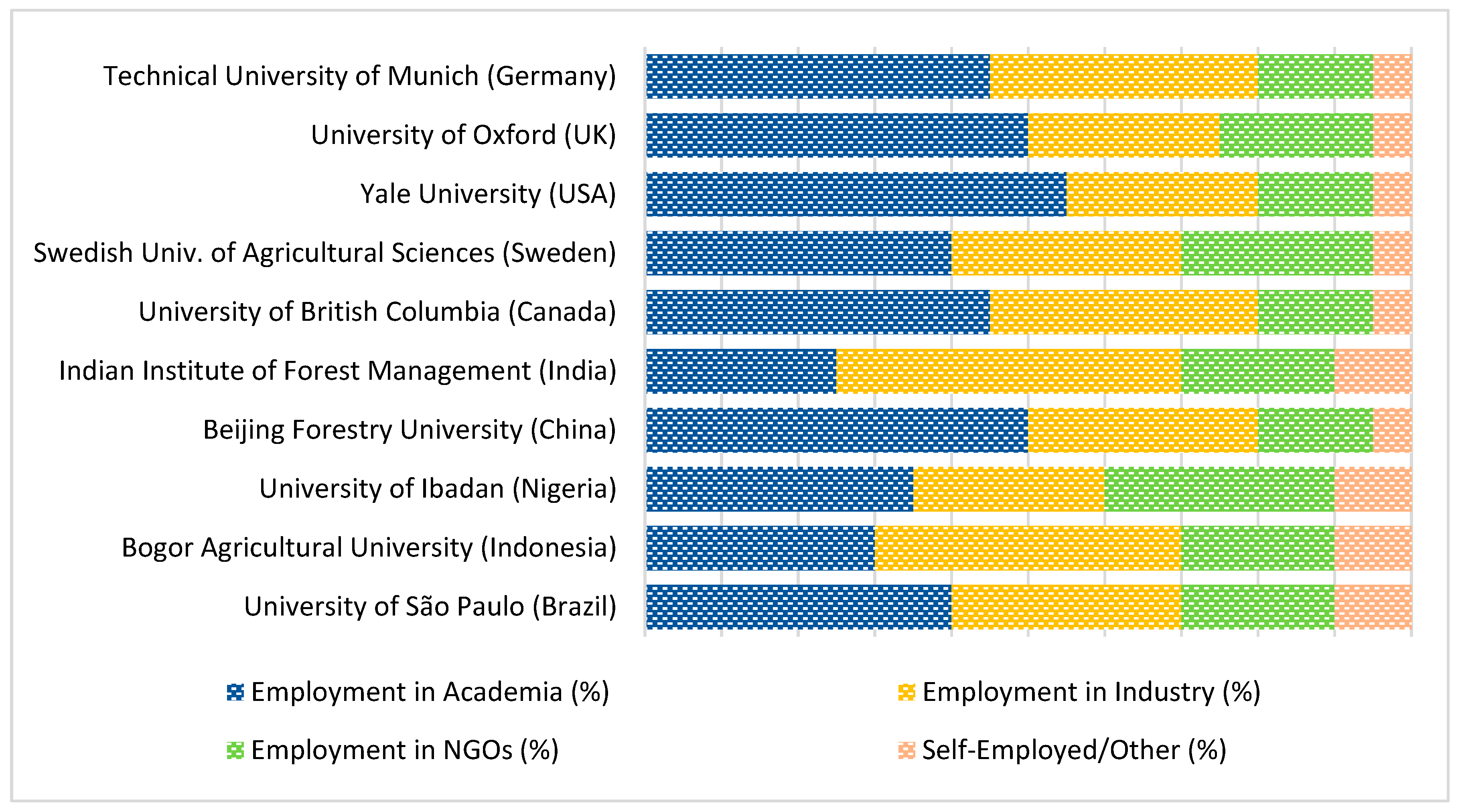
Tracking where forestry graduates work reveals how well education systems align with national forest policy goals and employment needs. Graduates’ employment (Figure 2) outcomes from universities in both developed and developing nations exhibit notable trends. In developed nations such as the USA, UK, Sweden, and Canada, the academic sector employs 45%–55% of graduates, while industry employs 25%–35%. Employment in NGOs constitutes 15%–25%, whereas self-employment is comparatively low at 5%.
In contrast, industry employment is more significant in developing countries such as Brazil, Indonesia, Nigeria, China, and India, ranging from 25% to 45%, with India and Indonesia exhibiting particularly high levels. Academia continues to hold considerable importance, accounting for 25%–50% of employment, with China exhibiting the highest levels of academic employment. In Nigeria, NGO participation stands at 30%, surpassing that of other nations and indicating a significant local demand for development initiatives. Self-employment occurs with a frequency of 5%–10% greater than that observed in developed countries.
The observed patterns indicate that developed economies emphasize academia and formal industry positions, whereas developing nations demonstrate increased diversification, characterized by heightened involvement of industry and NGOs, influenced by differing economic and labor market conditions.

5.6. Financial Models for Forestry Education

Funding mechanisms differ significantly between institutions in the developed and developing nations, with consequences for enrollment, staffing, and research output. Financial models play a crucial role in shaping the accessibility, quality, and sustainability of forestry graduate programs. Financial support patterns for forestry graduate programs exhibit pronounced differences between developed and developing countries, highlighting broader disparities in higher education funding models and institutional capacities (Table 6).
On one hand, developed countries exhibit diversified and resilient funding mechanisms. Yale University (USA) and Bangor Univ. (UK) exhibit highly diversified revenue streams, with 30%–45% of funding derived from endowments and investments, highlighting their substantial financial reserves and strong alumni networks. Yale and Bangor university obtain 15%–20% of their funding from philanthropy, indicating robust donor engagement, while 30%–35% is sourced from competitive research grants, highlighting their prominence in forestry research. European universities, including the SLU and TUM, predominantly depend on government grants, which account for 40%–60% of their funding. This reliance is characteristic of Europe’s publicly funded higher education systems. Nonetheless, they also secure 20%–30% of their income from research grants, thereby ensuring continued scientific output. Additionally, partnerships with the private sector account for 10%–15%, supporting research aligned with industry needs and workforce development.
On the other hand, developing countries exhibit a reliance on government support and face significant financial instability. Conversely, universities in developing countries such as Brazil, Nigeria, Indonesia, and India depend significantly on government funding, accounting for 60%–80% of their financial resources. This dependence makes them vulnerable to political and economic fluctuations [33]. Endowments are minimal (0%–5%), indicating underdeveloped fundraising infrastructures. Philanthropy and private sector contributions are also low (5%–10%), suggesting weak linkages between industry and academia. Tuition fees represent merely 5%–20% of total revenue, restricted by affordability issues, while research grants contribute 10%–20%, trailing behind those of developed counterparts, thereby constraining innovation potential [19]. BFU (China) exemplifies a partial exception, receiving 40%–50% government support and 10%–15% private sector participation, reflecting China’s state-driven forestry investments. India’s IIFM derives 15–20% of its revenue from tuition, indicating its specialized emphasis on professional training [19].
To improve the sustainability and global competitiveness of higher education institutions, various areas for enhancement can be identified for both developed and developing nations. Universities in developed countries ought to diversify philanthropic support beyond conventional endowments and research grants by enhancing alumni contributions and corporate sponsorships, and public donations will ensure long-term financial sustainability. Furthermore, enhancing international collaborations could strengthen research leadership and attract funding from international sources. Enhancing private sector engagement in research is crucial for developing countries, as it not only increases research funding but also fosters industry partnerships and improves graduate employment opportunities. Enhancing access to research grant funding, whether through increased government investment or improved collaboration with international funding partners, could significantly strengthen research capacity. Establishing endowment funds through alumni contributions enhances financial sustainability. Raising tuition fees for international students, while maintaining affordability for domestic students, represents a viable strategy for enhancing revenue without compromising access to education.
In summary, the comparative review of forestry graduate programs in both developed and developing countries reveals shared objectives in sustainable forest management. Nonetheless, there are distinctions in curriculum practices, funding models, faculty expertise, and employment outcomes. Developed countries typically receive funding from various sources, engage in international collaborations, prioritize decision-making in their curricula, and face challenges in fulfilling their obligations to provide access to graduate training in sustainable forest management research. Conversely, developing countries often provide a curriculum that is more aligned with community interests and focuses on training individuals locally. These differences indicate a potential for mutual learning and focused reform, which are explored in greater detail in the subsequent thematic synthesis.

6. Limitations

(1)
Institutional Rather than National Representativeness
This study is based on a purposive sample of ten flagship graduate forestry programs and therefore reflects institutional-level patterns rather than nationally or globally representative trends. Although the selected programs are influential within their respective national systems, they cannot capture the full internal diversity of forestry education within each country. Consequently, the findings should not be interpreted as characterizing entire national education systems.
(2)
Reliance on Secondary and Publicly Available Data
The analysis relies primarily on documentary sources, including curricula, institutional reports, program websites, and international organization publications. Such sources may emphasize strategic narratives and promotional perspectives rather than fully reflecting operational realities. The absence of primary data collection (e.g., interviews with faculty, students, alumni, or employers) limits the ability to validate institutional claims regarding graduate outcomes, industry engagement, and pedagogical effectiveness.
(3)
Incomplete Standardization of Financial and Employment Data
Financial structures, funding proportions, and graduate employment outcomes are not reported using standardized metrics across institutions or countries. As a result, all percentage ranges and categorical estimates presented in this study should be interpreted as approximations derived from triangulated documentary evidence rather than precise measurements. This constrains direct quantitative comparability.
(4)
Uneven Regional Representation
The geographical distribution of cases is necessarily uneven, with certain regions (e.g., Asia) represented more heavily than others (e.g., Africa and Latin America). This limits the ability to generalize regional patterns and highlights the need for broader multi-country sampling in future research.
(5)
Absence of Longitudinal Perspective
The study provides a snapshot of forestry graduate education structures during the 2015–2025 period. It does not capture long-term institutional change, policy reform trajectories, or shifting labor-market dynamics over time. Longitudinal designs would be needed to assess educational reform impacts more robustly.

7. Discussion: Interpretation of Findings in Relation to Existing Literature

This Discussion interprets the comparative findings through the lens of Comparative Education Theory. The results reveal both convergence and divergence in forestry graduate education: convergence around sustainability-oriented curricula and internationalisation, and divergence shaped by inequalities in resources, institutional capacity, and professional integration. Together, these dynamics explain how different systems prepare forestry professionals for contemporary forest governance challenges.
This study compared flagship graduate forestry programs across ten countries to examine patterns of curriculum design, faculty capacity, industry engagement, employment outcomes, and financial models. Although the cases are institutional rather than nationally representative, the cross-case synthesis reveals meaningful structural variations that align closely with established theories in higher education and professional learning.
Across all institutions, curricula increasingly reflect a shift where forestry education is expanding beyond traditional silviculture toward interdisciplinary training on climate change, ecological restoration, and socio-ecological systems [6,7]. Programs in Europe and North America (e.g., UBC, Yale, SLU, TUM) incorporate these themes within modular, specialization-focused curricula, while several institutions in developing countries include them more unevenly due to differences in resources and instructional capacity. These patterns align with global calls for competence-based and context-responsive higher education, as emphasized in professional education theory [13,14].
Faculty composition and research capacity emerged as key differentiators. Graduate programs in high-income institutions (e.g., UBC, Yale, Bangor) generally demonstrate stronger faculty-to-student ratios, transparent employment tracking, more extensive research networks, and greater access to accreditation frameworks, supporting Shulman’s argument that professional programs depend on stable expertise communities and robust “signature pedagogies” [14]. In contrast, many developing-country institutions report underemployment, uneven research infrastructures, and diversion of graduates into non-forestry sectors [44]. This asymmetry mirrors FAO’s global findings that access to finance and robust labour markets remain key differentiators in forestry education quality [17].
Industry and policy engagement also varied widely and strongly influenced employment outcomes. Programs with structured internships, capstone requirements [7], or accreditation pathways (e.g., IIFM, Bangor, Yale) demonstrate clearer professional pathways, supporting evidence from comparative higher education that labour-market embeddedness enhances graduate employability [16]. Conversely, where such linkages are optional or not evidenced (e.g., IPB, UI, ESALQ), graduates face more fragmented career trajectories. This suggests that professional engagement mechanisms, rather than curricular content alone, are decisive for graduate employability.
Infrastructure and learning resources also emerged as a key differentiator across the analyzed programs. Institutions in developed countries, such as UBC, Yale, SLU and TUM, regularly report access to advanced digital laboratories, remote sensing platforms, well-equipped field stations, and high-capacity research forests, aligning with the “public good” orientation of strong higher education systems [15]. By contrast, several developing-country programs (e.g., ESALQ, UI, IPB, and Nigerian universities) operate with more limited digital infrastructure, fewer modern GIS or modelling tools, and constrained field-training resources, reflecting disparities discussed in the broader literature on forestry education capacity. These infrastructural gaps shape not only the depth of analytical training students can receive, but also their exposure to modern forest monitoring tools, which increasingly underpin the global forestry labour market.
Resource allocation and funding models also play a decisive role in shaping program strength and socio-economic accessibility. North American programs rely heavily on tuition-based financing but moderate this burden through competitive fellowships, graduate assistantships, and philanthropic endowments. European institutions, particularly SLU and TUM, benefit from substantial public funding, enabling low-cost or tuition-free study while maintaining internationally competitive research environments. Meanwhile, most developing country programs, such as Nigeria, India, Indonesia, and Brazil, depend predominantly on state funding and have more limited access to diversified revenue streams, resulting in uneven investment in infrastructure, research personnel, and student financial support. This reproduces structural inequalities described in global higher education analyses [15]. These constraints mirror broader patterns documented by FAO and regional studies, suggesting that financial centralization restricts program adaptability, internationalization, and long-term sustainability.
Partnerships and mobility, central to the six-dimensions, also varied substantially. Long-standing regional networks such as Erasmus Forestry, Euroforester, and ITTO fellowships provide structured mobility and curriculum harmonization opportunities for European institutions, while similar platforms are less developed in the developing countries. This limits opportunities for faculty exchange, experiential learning, and co-designed curricula that the literature identifies as essential mechanisms for capacity building in professional fields [13,16].
Taken together, these findings suggest that enhancing forestry education within the analyzed institutional contexts necessitates a dual emphasis: (i) reinforcing professional pathways through accreditation, structured internships, and stronger employer engagement; and (ii) ensuring financial accessibility, particularly in contexts where tuition constitutes a high barrier.
These findings must be interpreted in light of several methodological limitations. Because the analysis is based on ten purposively selected flagship institutions, the results are institutional in scope and do not claim national or global representativeness. The reliance on publicly available secondary data introduces potential reporting bias, particularly regarding funding structures, industry linkages, and employment outcomes. Moreover, financial and graduate outcome indicators could only be reconstructed as indicative ranges rather than standardized quantitative measures. Regional coverage is necessarily uneven, and the cross-sectional design limits insight into long-term reform dynamics. These constraints do not invalidate the comparative patterns identified, but they require that all interpretations and policy implications be viewed as context-sensitive and exploratory rather than universally prescriptive.
These limitations point to several directions for future research. Multi-country studies that combine document analysis with stakeholder interviews, surveys, and graduate-tracking data across a larger and more diverse set of institutions would enable stronger claims about national systems and global trends. Longitudinal designs could examine how curriculum reforms, funding changes, or new partnership arrangements affect graduate employability and sectoral outcomes over time. Further work could also investigate how indigenous and community-based knowledge systems are integrated into professional forestry education and how this shapes graduates’ capacity to address context-specific sustainability challenges.

8. Policy Recommendations

The recommendations presented here are grounded in the institutional trends observed in the ten programs included in this study. Their broader applicability beyond the sampled institutions would require additional evidence from more diverse regional and institutional contexts. The comparative analysis of forestry graduate programs in developed and developing countries revealed significant differences in educational objectives, funding sources, and the alignment of graduates with employment opportunities. Based on these findings, we propose recommendations aimed at enhancing the efficiency, equity, and sustainability of forestry graduate education across the cases examined.
It is essential for educational programs in both developed and developing countries to modernize their curricula. Developing countries could advance forestry education by incorporating digital forestry, soft skills, and entrepreneurship into the curriculum. These developments are essential for equipping students to address the contemporary demands of the forestry job sector. For example, ‘How Digital Intelligence Integration Boosts Forestry’ [102] highlights how remote sensing, machine learning, and digital platforms can enhance carbon monitoring, supply chain transparency, and innovation in forestry education. Similarly, [103] examines how digital tools like simulation platforms, gamified learning, and collaborative software can significantly improve entrepreneurial training outcomes in environments with limited infrastructure. Developed countries should prioritize the integration of local ecological knowledge and community-based management into their programs. Local practices can significantly enhance the understanding of forest ecosystems and their sustainable management [104]. With the development of new curricula, it is essential to diversify funding models. Developing countries frequently depend on constrained state budgets; thus, they need to establish partnerships with the private sector and effectively engage with their alumni networks. According to evidence from the World Bank, public–private partnerships serve as effective models for developing countries to utilize diverse funding sources and enhance educational opportunities in forestry [104]. Developed countries should focus on enhancing philanthropic support and fostering public–private funding for research. The UNEP indicates that these funding mechanisms are essential for the preservation of research excellence in forestry and education within developed countries [105].
International collaboration remains an area with significant potential for improvement. Faculty exchanges, joint research initiatives, and dual degree programs can enhance institutional capacity in developing countries. According to UNESCO, faculty exchanges, joint projects, and dual degree programs enhance the capabilities of individual institutions and promote knowledge sharing between institutions in both developed and developing countries [106]. Developed countries possess the opportunity to provide mentorship and enhance the capacity of forestry institutions in developing countries. The UNDP suggests that mentorship programs serve as effective development and learning opportunities that address capacity challenges and promote knowledge transfer for sustainable forest management in developing nations [107].
Finally, aligning forestry education with workforce needs is essential. Developing countries should work closely with the forest-based industries and green employers to build a way that aligns educational content with the labor market’s evolving demands. As the FAO emphasizes, integrating industry needs into curricula will improve graduate employability [108]. In contrast, policymakers in developed countries are encouraged to prioritize incorporating leadership, entrepreneurship, and global policy skills into training, preparing students for leadership roles in forestry. The European Commission outlines the EU’s commitment to enhancing forest conservation and restoration efforts, emphasizing the need for integrated policies and international cooperation [90].
While many of the recommendations emerge directly from the comparative analysis of the ten flagship programs, some proposed global-level measures (e.g., international education funds or graduate observatories) are informed by the broader literature and ongoing policy debates [97,98,99,100,101,102,103,104,105]. These should be interpreted as forward-looking options and topics for further research, rather than prescriptions derived solely from the present institutional sample.
The following Table 7 provides a concise overview of these recommendations, emphasizing how developing and developed countries can improve forestry education through curriculum updates, diversified funding, international collaborations, and workforce alignment. These policy recommendations are intended to facilitate discussion and may provide useful guidance for institutions similar to those included in this study, while broader applicability would require further empirical validation, ensuring that they meet the sustainability goals of the 21st century while addressing the specific challenges faced by both developed and developing countries.

9. Conclusions

Looking ahead, the institutions examined in this study illustrate the growing need for graduate forestry programs to respond to escalating ecological and socio-economic challenges, including climate change, biodiversity loss, and sustainable resource governance. Across the ten flagship programs analyzed, adaptive capacity is most visible where interdisciplinary curricula, experiential learning, and international collaboration are institutionally embedded. Within the studied cases, programs in developed and developing contexts exhibit complementary strengths. Several high-income institutions demonstrate strong research infrastructures, international accreditation pathways, and stable funding environments, while many institutions in developing contexts draw on deep community-based ecological knowledge and applied management traditions. The comparative evidence highlights the value of institution-level mutual learning, rather than uniform global models. By strengthening curriculum integration, enhancing alignment with emerging forest-sector demands, and reinforcing international partnerships, the sampled institutions show how graduate forestry education can better prepare professionals for sustainable forest governance under diverse conditions. Beyond its practical implications, this study also contributes to the applied development of Comparative Education Theory by demonstrating how a six-dimensional institutional framework can be operationalized in a sustainability-oriented professional field closely linked to ecological systems. Given the institutional scope of the sample, further comparative research with expanded geographical coverage is required before broader generalizations can be drawn.

Author Contributions

Conceptualization, T.W. and L.Y.; methodology, T.W. and Y.R.; software, T.W. and Y.R.; validation, T.D. and Y.R.; formal analysis, T.D. and W.H.; investigation, T.W. and Y.R.; resources, T.D. and Y.R.; writing—original draft preparation, T.W. and Y.R.; writing—review and editing, W.H. and T.D.; visualization, T.W.; supervision, L.Y. All authors have read and agreed to the published version of the manuscript.

Funding

This research work was funded by Key Projects of Education Science Planning in Jiangsu Province: Research on the Rotational Cultivation Model for Professional Degree Postgraduates in Forestry Science (Grant Number: B/2023/01/190).

Data Availability Statement

All data used in this study are publicly available from institutional and international sources as detailed in Appendix B: Source Audit Table.

Conflicts of Interest

The authors declare no conflicts of interest.

Appendix A. Flagship Program Selection Matrix

To ensure transparency in the case selection process, Appendix A presents a summary matrix demonstrating how each of the ten selected institutions met the predetermined flagship program criteria. As described in Section 3, a program was considered “flagship” if it met at least four of five indicators: (1) national or regional prominence, (2) long institutional history in forestry or related fields, (3) strong research output, (4) comprehensive graduate offerings, and (5) evidence of international engagement. All ten institutions selected for this study meet at least four of these criteria, and most meet all five. This appendix provides a concise justification for each institution’s inclusion in the comparative analysis.
Table A1. Summary Matrix Demonstrating Flagship Program Selection.
CountryInstitution
Selected
ProminenceHistoryResearch OutputGraduate OfferingsInternational EngagementJustification
Summary
BrazilUniversity of São Paulo (USP)/ESALQOldest and most influential forestry faculty in Brazil; strong research footprint and regional leadership.
IndonesiaBogor Agricultural University (IPB)National reference institution with extensive forestry training and international partnerships.
NigeriaUniversity of Ibadan (UI)-Long-standing forestry program with national prominence; strong academic impact despite limited internationalization.
ChinaBeijing Forestry University (BFU)China’s top forestry-specialized university with strong research and global collaboration networks.
IndiaIndian Institute of Forest Management (IIFM)Nationally recognized for professional forestry management programs with strong policy linkages.
CanadaUniversity of British Columbia (UBC)Leading North American forestry school with high global rankings and extensive graduate offerings.
SwedenSwedish University of Agricultural Sciences (SLU)Europe’s foremost forestry research institution with long-standing tradition and strong internationalization.
United StatesYale School of the Environment (YSE)Historically significant forestry school with global influence and comprehensive graduate programs.
United KingdomBangor UniversityLong-established forestry education centre with strong research and international MSc networks.
GermanyUniversity of FreiburgOne of Europe’s oldest forestry programs with extensive international partnerships and strong research capacity.
Note: ✓ = Meets the criteria.

Appendix B. Source Audit Table

This appendix documents all program sources, access dates, and independent references used in the comparative analysis. It ensures transparency, allows replication, and enforces the 2015–2025 recency rule described in the Section 3.
Table A2. Summary Source Audit Table.
CountryInstitution/
Program
Resources for Programme Page/Handbook Resources for Independent/
External Reports
Notes on Use
CanadaUBC—Master of International Forestry (MIF)[109][110]Used for curriculum, tuition, internship evidence.
USAYale School of the Environment–Master of Forestry (MF)[111][112]Used for capstone, accreditation, graduate outcomes.
UKBangor University—MSc Forestry[113][114]Used for accreditation, placement pathways.
SwedenSLU—MSc Forest Ecology & Sustainable Management[115][110]Used for curriculum, financial model.
GermanyTUM—MSc Forestry & Wood Sciences[116][117]Used for tuition, scholarships, faculty profiles.
IndiaIIFM—MBA Forestry Management[118][119]Used for tuition, employment outcomes, internships.
ChinaBeijing Forestry University—Professional Master Forestry[120][121]Used for curriculum, scholarships, placement.
BrazilUSP/ESALQ–PPGRF[122][123]Used for curriculum, research lines, funding.
IndonesiaIPB University–MSc Forestry[124][125]Used for curriculum, outcomes, field practice.
NigeriaUniversity of Ibadan—MSc Forestry[126][44,48]Used for curriculum and employment outcomes.

References

  1. Rodríguez-Piñeros, S.; Walji, K.; Rekola, M.; Owuor, J.A.; Lehto, A.; Tutu, S.A.; Giessen, L. Innovations in forest education: Insights from the best practices global competition. For. Policy Econ. 2020, 118, 102260. [Google Scholar] [CrossRef]
  2. Arunachalam, A.; Pandey, L. Transforming forestry education for better job prospects. Curr. Sci. 2019, 117, 748–752. [Google Scholar] [CrossRef]
  3. Zoungrana, I.; Mogotsi, K.K.; Temu, A.B.; Rudebjer, P.G. Rebuilding Africa’s Capacity for Agricultural Development: The Role of Tertiary Education; World Agroforestry Centre (ICRAF): Nairobi, Kenya, 2001. [Google Scholar]
  4. Ogunsola, A.J.; Ogunsola, J.O.; Awe, F.; Fatoki, O.A.; Kolade, R.I.; Oke, O.S. Perception of Forestry as a Career Choice among Forestry Students in Nigeria. Tanzan. J. Agric. Sci. 2020, 19, 167–173. [Google Scholar]
  5. Laurillard, D.; Kennedy, E. The Potential of MOOCs for Learning at Scale in the Global South; Centre for Global Higher Education: London, UK, 2017. [Google Scholar]
  6. Kanowski, P.; Yao, D.; Wyatt, S. SDG 4: Quality Education and Forests–‘The Golden Thread’. In Sustainable Development Goals: Their Impacts on Forests and People; Katila, P., Colfer, C.J.P., de Jong, W., Galloway, G., Pacheco, P., Winkel, G., Eds.; Cambridge University Press: Cambridge, UK, 2019; pp. 108–145. [Google Scholar]
  7. Mika, R.; Terry, L.S. Global Assessment of Forest Education–Creation of a Global Forest Education Platform and Launch of a Joint Initiative under the Aegis of the Collaborative Partnership on Forests (FAO-ITTO-IUFRO project GCP /GLO/044/GER); Forestry Working Paper No. 32; Food and Agriculture Organization of the United Nations (FAO): Rome, Italy, 2022. [Google Scholar] [CrossRef]
  8. Chesterman, S.; Wardell, D.A.; Mehmood-Ul-Hassan, M.; Bourne, M. Capacity Needs Assessment of CIFOR, ICRAF and their partners for the implementation of the CGIAR Research Program on Forestry, Trees and Agroforestry (FTA): Phase II, 2017–2021; Center for International Forestry Research (CIFOR): Bogor, Indonesia, 2020. [Google Scholar] [CrossRef]
  9. Bray, M.; Adamson, B.; Mason, M. Comparative Education Research: Approaches and Methods, 2nd ed.; Springer: Cham, Switzerland, 2014. [Google Scholar] [CrossRef]
  10. Zajda, J.; Majhanovich, S. (Eds.) Globalisation, Cultural Identity and Nation-Building: The Changing Paradigms; Globalisation, Comparative Education and Policy Research; Springer: New York, NY, USA, 2021; Volume 23. [Google Scholar]
  11. Wolhuter, C.C. Review of the Review: Constructing the Identity of Comparative Education. Res. Comp. Int. Educ. 2008, 3, 323–344. [Google Scholar] [CrossRef]
  12. Bray, M.; Thomas, R.M. Levels of Comparison in Educational Studies: Different Insights from Different Literatures and the Value of Multilevel Analyses. Harv. Educ. Rev. 1995, 65, 472–491. [Google Scholar] [CrossRef]
  13. Biggs, J.; Tang, C. Teaching for Quality Learning at University: What the Students Does, 4th ed.; The Society for Research into Higher Education: London, UK, 2011. [Google Scholar]
  14. Shulman, L.S. Signature pedagogies in the professions. Daedalus 2005, 134, 52–59. [Google Scholar] [CrossRef]
  15. Altbach, P. Global Perspectives on Higher Education; Johns Hopkins University: Baltimore, MD, USA, 2022. [Google Scholar] [CrossRef]
  16. Marginson, S. Higher Education and Public Good. High. Educ. Q. 2011, 65, 411–433. [Google Scholar] [CrossRef]
  17. FAO. Global Forest Resources Assessment 2020; FAO: Rome, Italy, 2020. [Google Scholar] [CrossRef]
  18. Zhang, S.G. Challenges and strategies of forest research and education in China. Forest Sci. Technol. 2005, 1, 203–210. [Google Scholar] [CrossRef]
  19. Bhat, K.M. Forest education and research in India: Country report. Forest Sci. Technol. 2005, 1, 185–192. [Google Scholar] [CrossRef]
  20. International Tropical Timber Organization. International Tropical Timber Organization Fellowship Programme. Available online: https://www.itto.int/top_stories/2024/07/17/itto_fellowship_programme_now_open_for_2024_applications/ (accessed on 14 March 2025).
  21. Erasmus Forestry Network. Available online: https://erfonet.com/ (accessed on 14 March 2025).
  22. The SILVA Network. Available online: https://ica-silva.eu/ (accessed on 14 March 2025).
  23. University of Eastern Finland. Master of Science in European Forestry. Available online: https://sites.uef.fi/europeanforestry/ (accessed on 14 March 2025).
  24. SLU-Swedish University of Agricultural Sciences. Euroforester MSC with a Major in Forestry Science. Available online: https://www.slu.se/en/study/programmes-courses/masters-programmes/euroforester/ (accessed on 14 March 2025).
  25. Yin, R.K. Case study research: Design and methods. Appl. Soc. Res. Methods Ser. 2013, 18, 54–56. [Google Scholar] [CrossRef]
  26. Teichler, U. Higher Education and the World of Work Conceptual Frameworks, Comparative Perspectives, Empirical Findings; Brill: Leiden, The Netherlands, 2009; Volume 16. [Google Scholar]
  27. Clark, B.R. The entrepreneurial university: Demand and response. Tert. Educ. Manag. 1998, 4, 5–16. [Google Scholar] [CrossRef]
  28. United Nations Development Programme. Breaking the Gridlock: A Snapshot of the 2023/2024 Human Development Report; United Nations Development Programme: New York, NY, USA, 2024. [Google Scholar] [CrossRef]
  29. The World Bank Group. World Bank Country and Lending Groups–Country Classification; The World Bank: Washington, DC, USA, 2020. [Google Scholar]
  30. Ratnasingam, J.; Ioras, F.; Vacalie, C.C.; Wenming, L. The future of professional forestry education: Trends and challenges from the malaysian perspective. Not. Bot. Horti Agrobot. Cluj. Napoca 2013, 41, 12–20. [Google Scholar] [CrossRef]
  31. Aryal, A. How to beat the brain drain and foster home expertise. Nature 2024, 634, 267. [Google Scholar] [CrossRef]
  32. Ndiangui, P. From Brain Drain to Brain Gain: The Battle Against Talent Drain. J. Cult. Values Educ. 2020, 4, 34–48. [Google Scholar] [CrossRef]
  33. Temu, A.; Okali, D.; Bishaw, B. Forestry education, training and professional development in Africa. Int. For. Rev. 2006, 8, 118–125. [Google Scholar] [CrossRef]
  34. Maryawan, I.; Rochsas, A. Pendidikan dan Penelitian Kehutanan di Berbagai Belahan Dunia: Sebuah Tinjauan Literatur. J. Sci. Appl. Technol. 2022, 6, 22–31. [Google Scholar] [CrossRef]
  35. De Jong, W.; Huang, K.; Zhuo, Y.; Kleine, M.; Wang, G.; Liu, W.; Xu, G. A comparison of forestry continuing education academic degree programs. Forests 2021, 12, 824. [Google Scholar] [CrossRef]
  36. Park, M.S.; Sojin, Y.; Yeo-Chang, Y.; Donsavanh, B.; Phetlumphan, B. Needs assessment of forestry education in Laos: The case of Souphanouvong University. J. For. Res. 2019, 24, 201–211. [Google Scholar] [CrossRef]
  37. Buyinza, M.; Vedeld, P. Restore, reform or transform forestry education in Uganda? Makerere J. High. Educ. 2009, 2, 112–120. [Google Scholar] [CrossRef]
  38. Hakamada, R.; Ferraz, S.F.d.B.; Mattos, E.M.; Sulbarán-Rangel, B. Trends in Brazil’s Forestry Education: Overview of the Forest Engineering Programs. Forests 2023, 14, 1644. [Google Scholar] [CrossRef]
  39. Hakamada, R.; Ferraz, S.F.d.B.; Sulbarán-Rangel, B.; Lucena, L.; Hinestroza, H.P. Trends in Brazil’s Forestry Education—Part 3: Employment Patterns of Forest Engineering Graduates from Two Public Universities in the Last 15 Years. Forests 2023, 14, 1911. [Google Scholar] [CrossRef]
  40. Hakamada, R.; Ferraz, S.F.d.B.; Sulbaran-Rangel, B. Trends in Brazil’s Forestry Education—Part 2: Mismatch between Training and Forest Sector Demands. Forests 2023, 14, 1805. [Google Scholar] [CrossRef]
  41. Riyanto, S.; Ismail, M.H.; Bidin, S. A Review of Social Knowledge among Forestry Graduates in Forest Education Curriculum in Indonesia; Atlantis Press: Dordrecht, The Netherlands, 2024; pp. 204–221. [Google Scholar] [CrossRef]
  42. Parker, L. Environmentalism and education for sustainability in Indonesia. Indones. Malay World 2018, 46, 235–240. [Google Scholar] [CrossRef]
  43. Alao, J.S. Repositioning forestry education in Nigeria. Electron. J. Environ. Agric. Food Chem. 2010, 9, 284–292. [Google Scholar]
  44. Adeyanju, S.; Adesuyi, O.; Offiah, C.; Fasalejo, O.; Ogunlade, B. Where are the foresters? The influx of forestry graduates to non-forestry jobs in Nigeria. In Proceedings of the XV World Forestry Congress, Seoul, Republic of Korea, 2–6 May 2022. [Google Scholar]
  45. Akande, A.J. Challenges to Forestry Education: A Perspective from Nigeria; World Agroforestry Centre: Nairobi, Kenya, 2008. [Google Scholar]
  46. Lekah, A.; Mala, W.; Ofosu, S.; Boadu, K.B.; Onotunji, A.B.; Shonowo, D.A.; Babalola, F.D. Global Outlook on Forest Education: A Special Report: Forest Education in Africa; Nigeria Country Report; Online Publication, 2019. [Google Scholar] [CrossRef]
  47. Popoola, L.; Agbeja, B.O. 8 Renewable Natural Resources Education in Nigeria: University of Ibadan Experience. In New Perspectives in Forestry Education; ICRAF: Nairoby, Kenya, 2007. [Google Scholar]
  48. Onatunji, A.B.; Owuor, J.A.; Rodriguez-Piñeros, S.; Babalola, F.D.; Akello, S.; Adeyemi, O. Building a Successful Forestry Career in Africa: Inspirational Stories and Opportunities; International Union of Forest Research Organizations: Vienna, Austria, 2021; 120p. [Google Scholar]
  49. Qu, M.; Ahponen, P.; Tahvanainen, L.; Gritten, D.; Mola-Yudego, B.; Pelkonen, P. Chinese university students’ knowledge and attitudes regarding forest bio-energy. Renew. Sustain. Energy Rev. 2011, 15, 3649–3657. [Google Scholar] [CrossRef]
  50. NDRC-National Development and Reform Commission. Medium and Long Term Development Plan for Renewable Energy; NDRC: Beijing, China, 2007. [Google Scholar]
  51. Murphy, P.J.; Roberts, R.W. Forestry Education in China. For. Chron. 1988, 64, 469–474. [Google Scholar] [CrossRef]
  52. The University of British Columbia; Faculty of Forestry. APFNet, Growing Higher Forestry Education in a Changing World: Analysis of Higher Forestry Education in the Asia-Pacific Region; China Forestry Publishing House: Beijing, China, 2018. [Google Scholar]
  53. Ginwal, H.S.; Rai, K.C. Forestry Research, Education, and Extension in India. In Textbook of Forest Science; Mandal, A.K., Nicodemus, A., Eds.; Springer Nature: Singapore, 2025; pp. 53–64. [Google Scholar] [CrossRef]
  54. Innes, J.L.; Ward, D. Professional Education in Forestry Incorporating Text from the First Edition of Commonwealth Forests on Technical Education in Forestry. 2010. Available online: https://www.cfa-international.org/docs/Commonwealth%20Forests%202010/cfa_layout_web_chapter5.pdf (accessed on 20 March 2025).
  55. Pelkonen, P. Challenges and strategies for forest education and research in Finland. For. Sci. Technol. 2005, 1, 104–114. [Google Scholar] [CrossRef]
  56. Arevalo, J.; Mola-Yudego, B.; Pelkonen, P.; Qu, M. Students’ views on forestry education: A cross-national comparison across three universities in Brazil, China and Finland. For. Policy Econ. 2012, 25, 123–131. [Google Scholar] [CrossRef]
  57. Innes, J.L. Multidisciplinarity, interdisciplinarity and training in forestry and forest research. For. Chron. 2005, 81, 324–329. [Google Scholar] [CrossRef]
  58. Erskine, J.M. Agroforestry: Its development as a sustainable, productive land-use system for low-resource farmers in southern Africa. For. Ecol. Manag. 1991, 45, 281–291. [Google Scholar] [CrossRef]
  59. Chima, U.D.; Sobere, P.G. Secondary School Students’ Perception of Forestry and Wildlife Management in Rivers State, Nigeria. J. Agric. Soc. Res. 2011, 11, 26–35. [Google Scholar]
  60. Nordin, V.J.; Comeau, R. Forest resources education in Canada. For. Chron. 2003, 79, 799–808. [Google Scholar] [CrossRef]
  61. Apsey, M.; Laishley, D.; Nordin, V.; Paille, G. The perpetual forest: Using lessons from the past to sustain Canada’s forests in the future. For. Chron. 2000, 76, 29–53. [Google Scholar] [CrossRef]
  62. Godbout, C. Forestry education in Canada. For. Chron. 1997, 73, 341–347. [Google Scholar] [CrossRef]
  63. Smith, P. Aboriginal peoples and issues in forestry education in Canada: Breaking new ground. For. Chron. 2002, 78, 250–254. [Google Scholar] [CrossRef]
  64. UBC-University of British Columbia; Facutly of Forestry. Bachelor of Indigenous Land Stewardship. Available online: https://forestry.ubc.ca/future-students/undergraduate/indigenous-land-stewardship/ (accessed on 14 March 2025).
  65. UBC-University of British Columbia; Faculty of Forestry. Master of International Forestry (MIF). Retrived 2025. Available online: https://www.grad.ubc.ca/prospective-students/graduate-degree-programs/master-international-forestry (accessed on 14 March 2025).
  66. Bergqvist, G.; Sugg, A.; Downie, B. Forestry education in Sweden. For. Chron. 1989, 65, 414–420. [Google Scholar] [CrossRef]
  67. Hånell, B.; Magnusson, T.; Hallgren, J.E.; Karlsson, A. Swedish forest research and higher education-challenging issues and future strategies of forest research and education in Sweden. For. Sci. Technol. 2005, 1, 98–103. [Google Scholar] [CrossRef]
  68. SLU. The Swedish University of Agricultural Sciences-Forester Program (Jägmästarprogrammet). Available online: https://student.slu.se/studier/kurser-och-program/program-pa-grundniva/jagmastare/ (accessed on 12 March 2025).
  69. Jakobsson, R.; Olofsson, E.; Ambrose-Oji, B. Growing higher forestry education in a changing world. Scand. J. For. Res. 2020, 36, 68–82. [Google Scholar] [CrossRef]
  70. Appelstrand, M. Developments in Swedish forest policy and administration-from a ‘policy of restriction’ toward a ‘policy of cooperation’. Scand. J. For. Res. 2012, 27, 186–199. [Google Scholar] [CrossRef]
  71. Sandström, C.; Lindkvist, A.; Öhman, K.; Nordström, E.M. Governing Competing Demands for Forest Resources in Sweden. Forests 2011, 2, 218–242. [Google Scholar] [CrossRef]
  72. Niemelä, J.; Young, J.; Alard, D.; Askasibar, M.; Henle, K.; Johnson, R.; Kurttila, M.; Larsson, T.-B.; Matouch, S.; Nowicki, P.; et al. Identifying, managing and monitoring conflicts between forest biodiversity conservation and other human interests in Europe. For. Policy Econ. 2005, 7, 877–890. [Google Scholar] [CrossRef]
  73. Götmark, F. Conflicts in conservation: Woodland key habitats, authorities and private forest owners in Sweden. Scand. J. For. Res. 2009, 24, 504–514. [Google Scholar] [CrossRef]
  74. Blennow, K.; Persson, J.; Tomé, M.; Hanewinkel, M. Climate Change: Believing and Seeing Implies Adapting. PLoS ONE 2012, 7, e50182. [Google Scholar] [CrossRef]
  75. Hertog, I.M.; Brogaard, S.; Krause, T. Barriers to expanding continuous cover forestry in Sweden for delivering multiple ecosystem services. Ecosyst. Serv. 2022, 53, 101392. [Google Scholar] [CrossRef]
  76. Sample, V.A.; Bixler, R.P.; McDonough, M.H.; Bullard, S.H.; Snieckus, M.M. The promise and performance of forestry education in the united states: Results of a survey of forestry employers, graduates, and educators. J. For. 2015, 113, 528–537. [Google Scholar] [CrossRef]
  77. De’arman, K.J.; York, R.F. ‘Society-Ready’ and ‘Fire-Ready’ Forestry Education in the United States: Interdisciplinary Discussion in Forestry Course Textbooks. J. For. 2021, 119, 236–250. [Google Scholar] [CrossRef]
  78. Yale. Yale School of the Environment/Master of Forestry—MF. Available online: https://environment.yale.edu/academics/masters/mf/mf-curriculum-courses (accessed on 14 March 2025).
  79. Yale. Yale School of the Environment/Master of Environmental Management—MEM. Available online: https://environment.yale.edu/academics/masters/mem (accessed on 14 March 2025).
  80. Kelly, E.C.; Brown, G. Who are we educating and what should they know? An assessment of forestry education in California. J. For. 2019, 117, 95–103. [Google Scholar] [CrossRef]
  81. O’Hara, K.L.; Redelsheimer, C.L. Divergent trends in accredited forestry programs in the United States: Implications for research and education. J. For. 2012, 110, 201–206. [Google Scholar] [CrossRef]
  82. Coufal, J.E. Forestry: Profession, professional, professionalism. J. For. 2019, 117, 180–181. [Google Scholar] [CrossRef]
  83. Burley, J.; Plenderleith, K.; Howe, R.; Freer-Smith, P. Forest education and research in the United Kingdom. For. Sci. Technol. 2005, 1, 67–76. [Google Scholar] [CrossRef]
  84. Bangor University. Development of Forestry at Bangor University: An international dimension; School of Natural Sciences. Available online: https://www.bangor.ac.uk/sites/default/files/migrated-files/natural-sciences/courses/distancelearning/documents/10-12CFSummer2019Bangor.pdf (accessed on 14 March 2025).
  85. Walmsley, J.; Savill, P.; Burley, J.; Evans, J.; Horsey, R.; Leslie, A.; Falck, J.; Innes, J.; Waterson, J. Forestry in British Higher Education: A tale of decline and regeneration. Q. J. For. 2015, 109, 268–273. [Google Scholar]
  86. Leslie, A.D.; Wilson, E.R.; Starr, C.B. The current state of professional forestry education in the United Kingdom. Int. For. Rev. 2006, 8, 339–349. [Google Scholar] [CrossRef]
  87. Von Gadow, K. Forest research and education in Germany. For. Sci. Technol. 2005, 1, 77–83. [Google Scholar] [CrossRef]
  88. Von Gadow, K. Adapting silvicultural management systems to urban forests. Urban For. Urban Green 2002, 1, 107–113. [Google Scholar] [CrossRef]
  89. Green, C.C. Forestry Education in the United States; Forest Resources Librarian; University of Washington Libraries: Seattle, WA, USA, 2006. [Google Scholar]
  90. TUM. Technical University of Munich-School of Life Sciences/M.Sc. Forest and Wood Science. Available online: https://www.ls.tum.de/en/ls/studies/courses-and-programs/forest-and-wood-science-msc/ (accessed on 12 March 2025).
  91. University of British Columbia. Master of Applied Science in Forestry. Faculty of Forestry Graduate Studies. 2024. Available online: https://www.grad.ubc.ca/prospective-students/graduate-degree-programs/master-of-applied-science-forestry (accessed on 14 March 2025).
  92. Yale School of the Environment. Welcome, YSE Class of 2027. Available online: https://environment.yale.edu/news/article/welcome-yse-class-2027 (accessed on 14 March 2025).
  93. Swedish University of Agricultural Sciences. Annual report 2023. Uppsala: SLU. Available online: https://www.slu.se/globalassets/slu.se/om-slu/organisation/institutioner/stad-och-land/dokument/2023annualreport.pdf (accessed on 14 March 2025).
  94. China Higher Education Student Information (CHSI). Beijing Forestry University Graduate Admissions Statistics. Available online: https://yz.chsi.com.cn/sch/tjzc--method-viewPub,infoId-3412879349,categoryId-670568,schId-367895,mindex-11.dhtml (accessed on 14 March 2025).
  95. Indian Institute of Forest Management. MBA (Forestry Management) Enrolment and Placement Report 2023–2024. Bhopal: IIFM. Available online: https://iifm.ac.in/ (accessed on 14 March 2025).
  96. University of Ibadan. Student Enrolment Statistics, Faculty of Renewable Natural Resources (2022/2023 Session). Postgraduate College/Faculty of Renewable Natural Resources. Available online: https://pgcollege.ui.edu.ng/program.php?department=Forest%20Production%20and%20Products (accessed on 14 March 2025).
  97. University of Sao Paulo (USP); Luiz de Quieroz College of Agriculture (ESALQ). Postgraduate Program in Forest Resources (PPGRF). Available online: https://www.esalq.usp.br/pg/programas/recursos-florestais/principal (accessed on 14 March 2025).
  98. Yale School of the Environment. LinkedIn Alumni Insights–Yale School of the Environment. 2024. Available online: https://www.linkedin.com/school/yaleenvironment/people (accessed on 15 March 2025).
  99. World Bank. Green Jobs and Higher Education Alignment in the Global South. 2021. Available online: https://www.worldbank.org/en/topic/jobs (accessed on 14 March 2025).
  100. Indian Institute of Forest Management. Alumni Placement Report; Indian Institute of Forest Management: Bhopal, India, 2023. [Google Scholar]
  101. Dong, B.; Zhang, M.; Li, S.; Xie, L.; Xie, B.; Chen, L. How Digital Intelligence Integration Boosts Forestry Ecological Productivity: Evidence from China. Forests 2025, 16, 1343. [Google Scholar] [CrossRef]
  102. Ali, S.R.; Zunain, S.; Faraz, M.; Shujaa, T.B. Empowering Entrepreneurship Education with Digital Technologies Tools. Qlantic Qlantic J. Soc. Sci. 2025, 6, 234–251. [Google Scholar] [CrossRef]
  103. Akalibey, S.; Hlaváčková, P.; Schneider, J.; Fialová, J.; Darkwah, S.; Ahenkan, A. Integrating indigenous knowledge and culture in sustainable forest management via global environmental policies. J. For. Sci. 2024, 70, 265–280. [Google Scholar] [CrossRef]
  104. World Bank. World Development Report 2019: The Changing Nature of Work. 2019. Available online: https://doi.org/10.1596/978-1-4648-1328-3 (accessed on 8 May 2025). [CrossRef]
  105. UNEP-FI Annual Overview 07/2019–12/2020. 2019. Available online: https://www.unepfi.org/wordpress/wp-content/uploads/2021/07/2020-Annual-Overview.pdf (accessed on 15 March 2025).
  106. Pedro, F.; Galan, V. International Cooperation to Enhance Synergies. In Proceedings of the World Conference on Higher Education, Barcelona, Spain, 18–20 May 2022. [Google Scholar]
  107. United Nations Development Programme. Good Practices in South-South and Triangular Cooperation for Sustainable Development; UNDP: New York, NY, USA, 2022; Volume 4. [Google Scholar]
  108. Kacprzak, A. Guidelines on the Promotion of Green Jobs in Forestry; FAO: Rome, Italy, 2022. [Google Scholar]
  109. UBC Faculty of Forestry. Master of International Forestry: Programme Requirements & Internship/Project. Available online: https://forestry.ubc.ca/future-students/graduate/profession-al-masters-degrees/master-of-international-forestry/ (accessed on 14 March 2025).
  110. FAO. Regional Assessment Of Forest Education In Europe. 2021. Available online: www.fao.org/publications (accessed on 14 March 2025).
  111. Yale YSE. MF Curriculum and Outcomes. Available online: https://environment.yale.edu/academics/masters/mf (accessed on 14 March 2025).
  112. SAF. Committee on Accreditation Actions. 2024. Available online: https://www.eforester.org/Main/Certification_Education/Accreditation/Committees_on_Accreditation/Main/Accreditation/Committees_on_Accreditation.aspx?hkey=130cf91a-0ed5-44b0-9f8d-e001b2d5a39f (accessed on 16 March 2025).
  113. Bangor University. MSc Forestry: Programme and Accreditation. Available online: https://www.bangor.ac.uk/study/postgraduate/forestry (accessed on 16 March 2025).
  114. ICF. Forestry Sector Skills Plan. Available online: https://charteredforesters.org/wp-content/uploads/2025/04/Forestry-Sector-Skills-Plan-2025.pdf (accessed on 16 March 2025).
  115. SLU Admissions. Programme Description. Available online: https://www.slu.se/en/study/programmes-courses/ (accessed on 16 March 2025).
  116. TUM. Programme Description and Optional Internship. Available online: https://www.ls.tum.de/en/ls/studies/courses-and-programs/forest-and-wood-science-msc/ (accessed on 16 March 2025).
  117. DAAD. Study in Germany–Tuition & Aid. Available online: https://www.daad.de/en/studying-in-germany/ (accessed on 16 March 2025).
  118. IIFM. Placement Brochure 2023–2024. Available online: https://iifm.ac.in (accessed on 16 March 2025).
  119. Shiksha. Programme Fees Overview. Available online: https://www.shiksha.com/studyabroad/scholarships/masters-courses?ct=2 (accessed on 16 March 2025).
  120. BFU. Programme Handbook and MOFCOM Programme Page. Available online: https://www.china-aibo.cn/en/info/1005/1497.htm (accessed on 16 March 2025).
  121. CSC. CSC Detailed Application Guide. 2024. Available online: https://www.jaist.ac.jp/admissions/data/Application%20Guide_JAIST-CSC%202024.pdf (accessed on 16 March 2025).
  122. ESALQ/USP. Postgraduate Program in Forest Resources. Available online: https://www.esalq.usp.br/pg/programas/recursos-florestais/en/academics/courses (accessed on 16 March 2025).
  123. CAPES. CAPES Fellowship. Available online: https://globalpartners.purdue.edu/global-partnerships/brazil/capes.html (accessed on 16 March 2025).
  124. IPB. Faculty of Forestry and Environment Website. Available online: https://manhut.ipb.ac.id (accessed on 16 March 2025).
  125. Shanahan, M.; Saengcharnchai, S.; Atkinson, J.; Ganz, D. Regional Assessment of Forest Education in Asia and the Pacific. Rome, 2021. Available online: http://www.wipo.int/amc/en/mediation/rules (accessed on 14 March 2025).
  126. UI. Faculty of Renewable Natural Resources Page. Available online: https://rnrs.ui.edu.ng (accessed on 16 March 2025).
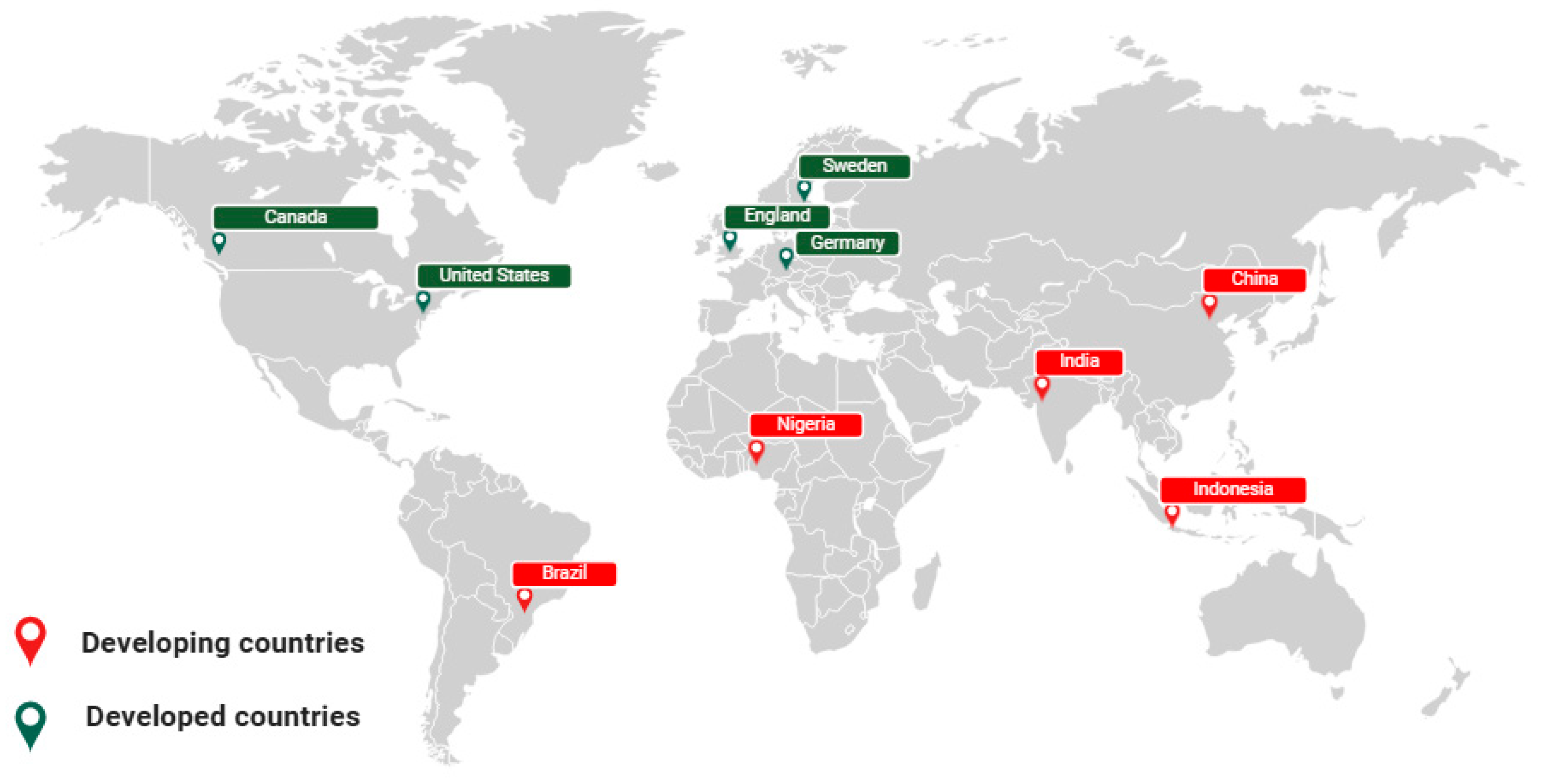
Figure 1. Geographic distribution of case study countries.
Forests 16 01875 g001
Figure 2. Graduate Employment Outcomes between developing and developed countries. Values represent estimated ranges derived from triangulated institutional documents. As the data are approximate and not reported in standardized formats, the bars depict indicative proportions rather than precise measurements. Note: Data availability limited; disaggregation by domestic/international not consistently reported. Estimates are based on a review of publicly available alumni tracer studies, graduate employment surveys, LinkedIn alumni analytics, and institutional outcome reports. Where precise data were unavailable, trends were inferred from program mission statements and sectoral reports [89,90,91,92,93,94,95,96,97,98,99,100,101].
Forests 16 01875 g002
Table 1. Overview of selected case study countries by region, World Bank income classification, Human Development Index (HDI), and representative forestry institution.
CountryRegionIncome GroupHDI (2022)Representative Institution
BrazilLatin AmericaUpper-middle0.754University of São Paulo
IndonesiaSoutheast AsiaLower-middle0.705Bogor Agricultural University
NigeriaAfricaLower-middle0.535University of Ibadan
ChinaEast AsiaUpper-middle0.768Beijing Forestry University
IndiaSouth AsiaLower-middle0.633Indian Institute of Forest Management
CanadaNorth AmericaHigh0.929University of British Columbia
SwedenEuropeHigh0.949Swedish University of Agricultural Sciences
United StatesNorth AmericaHigh0.921Yale University
United KingdomEuropeHigh0.929Bangor University
GermanyEuropeHigh0.942Technical University of Munich
Data sources: UNDP Human Development Report 2023/24 [28]; World Bank Income Groups (2023) [29].
Table 2. Comparative overview of forestry graduate programs across selected institutions.
CountryUniversity/
Program
Degree StructureCurriculum Focus AreasNotes/Source
BrazilUSP–ESALQ, PPGRFMSc (2 yrs, thesis); PhD (4 yrs)Silviculture, forest management, forest products, conservation, policyCAPES-accredited graduate program; research-based
IndonesiaIPB University, Master in ForestryMSc (2 yrs, coursework + thesis)Silviculture, biodiversity, plantation forestry, agroforestry, forest policyInternships common in concessions/REDD+
NigeriaUniversity of Ibadan, MSc ForestryMSc (18 months–2 yrs, coursework + thesis)Forest management, forest economics, social/environmental forestry, productsNigeria’s oldest forestry MSc
ChinaBFU, Master of Forestry Professional master (3 yrs, applied project)Silviculture, engineering, GIS, restoration, NFPP monitoringNational flagship professional degree
IndiaIIFM, MBA-FMMBA (2 yrs, course + internship)Forestry management, climate change, policy, governance, developmentRecognized as professional degree
CanadaUBC, MIFProfessional master (10–12 months, coursework + capstone)International forestry, markets, governance, community forestrySAF-accredited; capstone project
USAYale YSE, MFProfessional master (2 yrs, coursework + capstone)Silviculture, forest management planning, policy, field trainingSAF-accredited; field school
UKBangor, MSc ForestryTaught MSc (1 yr FT, 2 yrs PT)Silviculture, forest ecology, GIS, economics, management planningAccredited by ICF
SwedenSLU, MSc FESMMSc (2 yrs, 120 credits, thesis)Forest ecology, silviculture, conservation, sustainable managementErasmus/SILVA links
GermanyTUM, MSc Forest & Wood SciencesMSc (2 yrs, coursework + thesis)Forest ecology, wood science, silviculture, economics, policyPathway to professional service
Note: Data compiled from institutional websites and program descriptions accessed between January and April 2025. Detailed program sources are provided in Table A2 of Appendix B.
Table 3. Enrollment trends in Graduate forestry programs across developing and developed countries.
CountryInstitution/ProgramMetric (Scope)YearValue
CanadaUBC MSc ForestryEnrolled headcount (program)2023–2024107 (Graduate and Postdoctoral Studies)
CanadaUBC MASc ForestryEnrolled headcount (program)current15 (Graduate and Postdoctoral Studies)
USAYale YSE–MFIncoming class (intake)2024–202513 (of 147 master’s) (Yale School of the Environment)
UKBangor MSc Environmental ForestryCumulative graduates (throughput)1980s–2021835 (FT MSc, 41 yrs) (Bangor University)
SwedenSLU (all master’s)New master’s registered (univ)2023337 (SLU.SE)
SwedenSLU (all 1st/2nd cycle)FTE (target period)2022–202412,677 FTE (SLU.SE)
GermanyTUM M.Sc. Forest & Wood ScienceND (no public headcount)(program info only) (TUM Weihenstephan)
BrazilESALQ/USP PPGRFDegrees awarded (completions)2025 YTDMSc 7; PhD 9 (esalq.usp.br)
IndonesiaIPB–Dept. Forest ManagementGrad students (dept total)current~55 (M + PhD) (IPB University)
NigeriaUniv. of Ibadan–FRNRFaculty headcount (all levels)2022/2023671 (University of Ibadan)
ChinaBFU (university)Master’s exam applicants20249000+ (applicants) (Dxsbb)
IndiaIIFM MBA (FM)Enrolled (MBA FM)2023–2024201 (National CAMPA)
Note: Enrollment data were gathered from institutional reports and Ministry of Education databases. Where only recent or partial data were available, missing trends were inferred from national higher education statistics and multi-year institutional summaries.
Table 4. Faculty profiles and research specializations from 2023 to 2025.
CountryUniversity/
Program
Faculty Size
(Approx)
Research SpecializationsNotes/Source
BrazilUSP–ESALQ, PPGRF~30+ faculty (6 lines of research)Silviculture, forest ecology, forest products, forest economics, conservation policy, biometricsCAPES directory; ESALQ program guide
IndonesiaIPB University~25+ forestry facultySilviculture, tropical forestry, forest economics, biodiversity, governanceFaculty of Forestry & Environment profile
NigeriaUniversity of IbadanND (public data limited)Social forestry, forest economics, ecology, wildlife managementDescribed in faculty profiles; not systematically published
ChinaBeijing Forestry University~60+ in forestry schoolSilviculture, forest engineering, remote sensing/GIS, forest policy, restorationBFU faculty directories
IndiaIIFM~25 facultyForest management, environment policy, sustainability, climate governanceMBA-FM faculty listing
CanadaUBC Faculty of Forestry~80+ professorsForest genetics, silviculture, forest economics, climate/forest policy, urban forestryFaculty of Forestry staff page
USAYale YSE~45 core facultySilviculture, forest ecology, tropical forestry, forest economics, governanceFaculty profiles
UKBangor University~20 staff in forestrySilviculture, ecology, GIS, forest operations, policySchool of Natural Sciences faculty
SwedenSLU~40+ forestry facultyForest ecology, management, conservation, climate impacts, silvicultureSLU department pages
GermanyTUM~35+ forestry professorsForest ecology, wood science, technology, policy, forest geneticsTUM School of Life Sciences directory
Note: Data compiled from faculty directories, departmental profiles, and institutional research project listings from 2023 to 2025. A full source audit is provided in Appendix B.
Table 5. Industry alignment evidence by program.
CountryProgram
(Institution)
Internship/
Practicum (Required)
Capstone/
Client Project
Professional AccreditationWork Placement AdvertisedExplicit Partnerships/Practice
Bases
CanadaUBC—Master of International Forestry (MIF)
USAYale—Master of Forestry (MF)
UKBangor—MSc Forestry
SwedenSLU—MSc Forest Ecology & Sustainable Management
GermanyTUM—MSc Forest & Wood Sciences◑ (optional)
IndiaIIFM–MBA-FM
ChinaBFU—Professional Master of Forestry
BrazilUSP/ESALQ–PPGRF
IndonesiaIPB—Master of Forestry
NigeriaUniv. of Ibadan–MSc Forestry
Note: ✔ = required/documented; ◑ = optional or partially available; — = not documented. Verified sources listed in Appendix B.
Table 6. Financial support patterns for forestry graduate programs in developing and developed countries.
UniversitiesEndowment and InvestmentsTuition and FeesGovernment GrantsPrivate Sector PartnershipsPhilanthropy and DonationsResearch Grants
YU (USA)≈30%–40%≈20%–25%15%–20%≈10%–15%≈15%–20%≈30%–35%
Bangor (UK)≈40%–45%≈15%–20%≈25%–30%≈10%–15%10%–15%30%–35%
SLU (Sweden)Minimal≈5%–10%≈50%–60%≈5%–10%≈5%–10%20%–30%
UBC (Canada)≈10%–15%≈20%–25%≈40%–45%≈10%–15%5%–10%≈20%–25%
TUM (Germany)5%–10%≈5%–10%40%–50%≈10%–15%≈5%–10%≈20%–25%
BFU (China)Minimal or non-existent≈10%–15%≈40%–50%10%–15%≈5%–10%15%–20%
USP (Brazil)Minimal or absent.≈5%–10%≈60%–70%≈5%–10%≈5%–10%15%–20%
UI (Nigeria)Minimal or non-existent≈5%–10%≈70%–80%≈5%–10%≈5%–10%10%–15%
IPB (Indonesia)Minimal or non-existent≈10%–15%≈60%–70%≈5%–10%≈5%–10%≈15%–20%
IIFM (India)Minimal or non-existent≈15%–20%≈60%–70%≈5%–10%≈5%–10%10%–15%
Note: Percentages in this table were estimated using available public data from institutional annual reports, government budget documents, and scholarship programs. In cases where exact figures were not disclosed, funding patterns were inferred from financial aid policies and external sector funding literature (e.g., FAO, World Bank). Full source details in Appendix B.
Table 7. Implementations based on comparative analysis for graduate Forestry education in developed and developing countries.
Policy FocusDeveloping CountriesDeveloped CountriesJoint Global Action
Curriculum ModernizationUpdate curricula to include digital forestry, soft skills, and entrepreneurship.Increase the integration of local ecological knowledge and community-based management.Develop modular, flexible curricula through international co-design platforms.
Funding ModelsDiversify funding beyond state budgets through private sector partnerships and alumni networks.Strengthen philanthropic support and public–private research funding alignment.Launch global forest education funds (via FAO/IUFRO/UNEP) for cross-border training and exchange.
International CollaborationExpand faculty exchange, joint research, and dual-degree programs.Provide mentorship and capacity-building support for institutions in developing countries.Foster developing-developing and developing-developed institutional networks on sustainable forestry training.
Workforce AlignmentBuild strong feedback loops with forest-based industries and green employers.Incorporate leadership, entrepreneurship, and global policy skills into training.Coordinate graduate tracking and job market data via global observatories.
Disclaimer/Publisher’s Note: The statements, opinions and data contained in all publications are solely those of the individual author(s) and contributor(s) and not of MDPI and/or the editor(s). MDPI and/or the editor(s) disclaim responsibility for any injury to people or property resulting from any ideas, methods, instructions or products referred to in the content.