Article

Influence of Urban Greenery on Microclimate Across Temporal and Spatial Scales

1
BioSense Institute, University of Novi Sad, Dr Zorana Djindjića 1, 21000 Novi Sad, Serbia
2
Novi Sad Urban Climate Lab, Faculty of Sciences, University of Novi Sad, Trg Dositeja Obradovića 3, 21000 Novi Sad, Serbia
*
Author to whom correspondence should be addressed.
Forests 2025, 16(11), 1729; https://doi.org/10.3390/f16111729
Submission received: 28 October 2025 / Revised: 12 November 2025 / Accepted: 13 November 2025 / Published: 14 November 2025
(This article belongs to the Special Issue Urban Forests and Greening for Sustainable Cities)

Abstract

This study investigates the influence of urban greenery on microclimate conditions in Novi Sad, a city characterized by a temperate oceanic climate, by integrating high-resolution remote sensing data with in situ measurements from 12 urban climate stations. Sentinel-2 imagery was used to capture vegetation patterns, including tree lines and small green patches, while air temperature data were collected across two climatically contrasting years. Vegetation extent and structural characteristics were quantified using NDVI thresholds (0.6–0.8), capturing variability in vegetation activity and canopy density. Results indicate that high-activity vegetation, particularly dense tree canopies, exerts the strongest cooling effects, significantly influencing air temperatures up to 750 m from measurement sites, whereas total green area alone showed no significant effect. Cooling effects were most pronounced during summer and autumn, with temperature reductions of up to 2 °C in areas dominated by mature trees. Diurnal–nocturnal analyses revealed consistent spatial cooling patterns, while seasonal variability highlighted the role of evergreen and deciduous composition. Findings underscore that urban heat mitigation is driven more by vegetation structure and composition than by green area size, emphasizing the importance of preserving high-canopy trees in urban planning. This multidimensional approach provides actionable insights for optimizing urban greenery to enhance microclimate resilience.

1. Introduction

Urban greenery is increasingly recognized as a key component in mitigating urban heat island effects and enhancing local climatic conditions [1,2]. Vegetation moderates air and surface temperatures through shading and evapotranspiration, while also influencing humidity, wind patterns, and thermal comfort [3]. The magnitude of these effects depends not only on the extent of vegetated areas but also on their structural complexity [4,5,6] and seasonal phenological cycles [7]. Spatial configuration, such as proximity to green spaces, and temporal dynamics, including intra-annual variation in canopy cover, have been shown to shape localized climates at both neighborhood and city scales [8,9,10]. Understanding these multi-scale relationships is essential for designing green infrastructure that maximizes climatic and ecological benefits [11], aligning with Sustainable Development Goals (SDG 11: Sustainable Cities and Communities; SDG 13: Climate Action) by supporting evidence-based urban planning and climate resilience strategies. This study examines Novi Sad, a temperate-climate city, to evaluate urban greenery across spatial and temporal scales, generating empirical insights for environmental governance and policy development.
Quantifying the influence of urban greenery on air temperature remains methodologically challenging. Numerous studies have explored various characteristics of greenery and quantified their role in mitigating the urban heat island (UHI) effect. Land-use analyses have demonstrated significant differences in land surface temperature between forested and non-forested areas [12]. Reported temperature reductions attributed to vegetation range from 1.0 °C [13] and 1.7 °C [14] to 3.94 °C [12]. Spatial analyses have employed diverse approaches: for example, Zhang et al. (2019) [15] investigated the influence of park sky view factor, Cordeiro et al. (2023) [16] analyzed the vertical temperature profiles in relation to greenery, whereas Morakinyo et al. (2018) [17] found that a canopy coverage of approximately 30% can lower temperatures by 0.5–1.0 °C. Toparlar et al. (2018) [18] reported temperature decreases ranging from 3.3 °C to 2.4 °C in urban and rural areas, contingent on distance from parks. Quantitative estimates of temperature change per unit distance also vary considerably, ranging from 0.15 °C/km [19] to 0.8 °C/km [20], 0.4 °C/km [21], and up to 3.89 °C/km [22]. More recently, Ambarwati et al. (2023) [23] classified neighborhoods according to green cover into high-, moderate-, and low-density vegetation classes (>39%, 25%–39%, and <25%, respectively), concluding that the cooling effect is most pronounced in areas with the highest vegetation density.
The size of green spaces alone does not fully explain their cooling potential; structural and compositional attributes are also critical. Tree cover, canopy stratification, and spatial arrangement significantly influence both the magnitude and spatial reach of cooling [24,25]. Structural analyses consistently highlight the dominant role of trees in reducing ambient temperatures. Parks with greater tree density exhibit the strongest daytime cooling, though this effect may weaken or reverse at night [26]. Cooling intensity is further shaped by the proportion of paved surfaces, tree canopy, and shrubs [25]. In high-density urban areas, tree cover provides greater UHI mitigation than shrubs [27], contributing more substantially to temperature reduction [14]. In the absence of detailed urban vegetation inventories, remote sensing (RS) provides a robust tool for evaluating both the extent and quality of green spaces. Vegetation indices, particularly NDVI, are widely employed to assess green space quality, though thresholds vary: NDVI < 0.2 typically denotes barren land (>0.3 indicates vegetation), >0.5 denotes dense or tall vegetation, and >0.8 corresponds to forests [28,29,30]. Despite widespread adoption, no consensus exists regarding NDVI thresholds at which vegetation delivers significant UHI mitigation. For example, Schiano-Phan et al. (2015) [31] examined the spatial network of parks and green areas and confirmed their significant influence on urban temperature regimes. Satellite imagery enables comprehensive assessments of urban morphology, its temporal dynamics [32], and the resulting implications for microclimate [33]. Lestari et al. (2018) [34] reported that higher NDVI values were associated with temperature reductions of approximately 0.12 °C per 30 m, further suggesting that optimal inter-green-space distances should not exceed 260 m.
Previous studies adopt varied spatial scales, resulting in inconsistent estimates of urban greenery cooling extents. Reported influence distances range from 300 m [35] to 2 km [36], with smaller buffers (200–300 m) commonly used in COVID-19-era studies [37,38,39]. Larger extents have also been proposed, including 1.6 km [40] and 1.5 km for combined UHI mitigation and air purification [41], while 500 m remains a frequently applied standard [42,43]. Cooling intensity consistently declines with distance from green spaces [44,45,46,47], and although both cooling magnitude and spatial reach scale with green area size, the relationship is non-linear [24,25,36].
Cooling effects also exhibit strong seasonal variability. Higher reductions are typically observed in summer [24,45], when cooling effects can extend up to 1100 m [45], followed by spring, autumn, and winter [24]. Seasonal differences are further influenced by climate conditions, with stronger cooling reported in dry compared to wet seasons [36]. In colder months, park temperatures may exceed those of surrounding urban areas [24]. Combined effects of vegetation and water bodies on thermal regulation also vary seasonally, with peak influence in autumn and park size most strongly shaping cooling magnitude in spring–autumn [7]. Diurnal variability further modulates cooling performance due to plant physiological cycles. Enhanced cooling under warmer conditions, including nighttime, has been documented [48], although tree-dense parks typically deliver the strongest cooling during daytime, with effects diminishing or reversing at night [26]. Day–night contrasts across land-use types are substantial: parks record the lowest daytime temperatures, whereas nocturnal minima often occur in commercial areas [49]. Diurnal and nocturnal cooling patterns have been explicitly compared [44], including analyses emphasizing nocturnal effects and rural–urban gradients [45]. Peak cooling has been temporally resolved in some cases, with maximum temperature reductions observed mid-day [50].
While previous studies have examined the relationship between green area coverage and air temperature, few have explored the influence of vegetation quality—assessed through NDVI value distributions—across multiple spatial scales. This study seeks to bridge that research gap by evaluating the influence of urban greenery on local climatic conditions, considering both the quantity and quality of vegetated areas, seasonal and diurnal dynamics, and buffer zones of maximal impact. Multi-scale analysis provides insight into the contribution of size and the structure of urban greenery to the change in the air temperature and highlights methodological considerations in applying GIS and remote sensing tools for urban ecological research.

2. Materials and Methods

2.1. Location

Measurements were carried out in Novi Sad (45.24774, 19.85458), the second largest city in Serbia, with a population of 325.000 [51] on the urbanized area of 102 km2, and located at an elevation of 80–86 m above sea level along the banks of the Danube River and the Danube–Tisa–Danube Canal. The city has a Cfb climate according to the Köppen–Geiger climate classification system [52]. The mean monthly air temperature ranges from 0.8 °C in January to 22.8 °C in July, and the mean annual precipitation is 685 mm based on the reference period from 2001 to 2020 [53]. Based on the type of climate and summer temperatures, the urban area of Novi Sad has suffered from increasingly frequent and intense heatwaves in the last two decades [54,55]. The most built-up and urbanized areas in Novi Sad are the downtown and surrounding zones, as well as industrial zones on the northwestern part of the city [56,57].
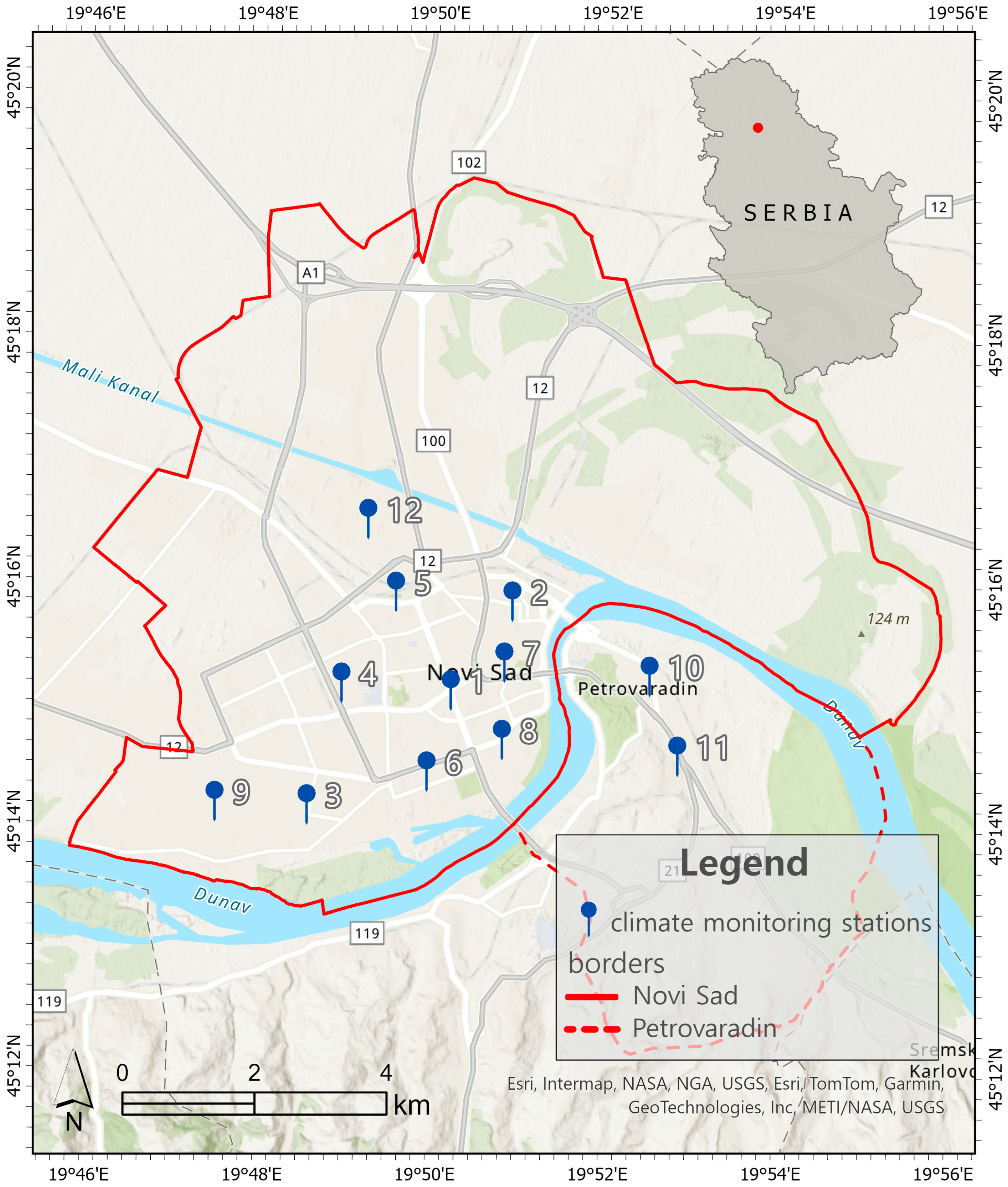
The study encompassed 12 meteorological station locations within the urbanized area of the city (Figure 1). The location for each station was determined based on the local climate zone (LCZ) classification system guidelines [58] and guidance for representative meteorological observations at urban sites [59,60,61]. According to the urbanization pattern of Novi Sad and the local knowledge of researchers, stations are positioned at five different LCZ classes that represent built-up areas (Table 1). Two stations are located in LCZ 2 (compact midrise), characterized by dense 3–9-story buildings, extensive impervious surfaces, and minimal vegetation. LCZ 3 (compact low-rise) comprises dense 1–3-story buildings with similarly low greenery and high surface sealing. Five stations are situated in LCZ 5 (open midrise), typified by midrise buildings with a higher proportion of green and blue spaces and reduced impervious cover compared to LCZ 2. Three stations fall within LCZ 6 (open low-rise), which consists of low-rise buildings surrounded by more gardens and vegetated areas than LCZ 3. Finally, one station is located in LCZ 8 (large low-rise), characterized by 1–3-story industrial or large-footprint buildings with predominantly paved surfaces and little to no tree cover. The geometric and surface cover values, as well as, thermal, radiative and metabolic properties for each LCZ are explained in detailed by Stewart and Oke (2012) [58] but based on physical properties of each LCZ the highest air temperature can be expected in compact midrise/lowrise zones (LCZs 2 and 3) and in large lowrise areas (LCZ8) [62].

2.2. Climate Parameters

The Novi Sad urban climate network (NSUNET) [62] consists of meteorological stations, each distributed in the LCZ throughout the Novi Sad urban area. Each station provides 10 min measurement data resolution of air temperature and relative air humidity (together with system diagnostic data). For the purpose of this paper, and due to the fact that these data do not change rapidly within the measured interval, datasets that capture hourly air temperature data from 12 urban sites over a period of two years, covering 2016 and 2017 (measurement time is in UTC), were used. These years were selected due to their contrasting climatic profiles: 2016 was markedly wetter, with approximately 30% higher precipitation, while 2017 was among the driest years on record and characterized by multiple intense summer heatwaves, providing a robust basis for comparison between hydro-climatically extreme years (Supplementary Material Table S1). The temperature data were cleaned and gap-filled, so there were 24 measures at each site for each day. These datasets are freely available on the Zenodo platform for further use [63]. There are multiple potential uses for these data. They can provide insights when trying to understand intra-urban and inter-urban research, urban climate modeling on local or micro scales, heat-related public health investigations, and urban environment inquiries [64]. Each station was equipped with ChipCap 2 sensors placed in radiation protection screens with dimensions are 200 × 240 mm. A fully calibrated temperature sensor, developed by the General Electric Measurement & Control Company, (Billerica, MA, USA) was used. The accuracy of the air temperature sensor was ±0.3 °C. Each station contained a central processor, an erasable programmable read-only memory (EPROM) chip for data storage, a GPRS/EDGE/3G modem, a power supply, and a backup battery installed inside the console. The sensors and the equipment were installed at least 4 m above the ground (with a deviation of ±0.2 m) on the arms (50 cm long) fixed to selected lampposts [62].

2.3. Greenery Data

The analysis of urban greenery was conducted using two primary indicators: the amount and the quality of vegetation cover. To calculate urban greenery, optical Sentinel-2 satellite data with 10 m spatial resolution were obtained from the Copernicus Data Space Ecosystem. For this purpose, atmospherically corrected Level-2A (L2A) images acquired on cloud-free days were used. Climate data were collected continuously over a two-year period, whereas Sentinel-2 imagery was selected at seasonal midpoints to best represent peak vegetation activity. One representative image per meteorological season was selected to calculate the Normalized Difference Vegetation Index (NDVI). The NDVI was computed using the red and near-infrared spectral bands, following the standard equation:
N D V I = ( N I R   r e d ) ( N I R + r e d )
Based on a review of relevant literature, e.g., [28,29,30], a threshold NDVI value of 0.3 was applied to differentiate between sealed (non-vegetated) and green (vegetated) surfaces. Pixels with NDVI values greater than 0.3 were classified as vegetated, while values below this threshold were categorized as non-vegetated. While a threshold of 0.3 is commonly used to separate vegetated from non-vegetated surfaces, this may underestimate winter vegetation due to deciduous cover or snow. Alternative indices, including EVI and seasonal adjustments, were considered. However, previous work [32] supports the use of NDVI over EVI and NDRE. Although NDRE is more sensitive to subtle variations in vegetation activity, its Sentinel-2 spatial resolution (20 × 20 m) limits its applicability for mapping small green features and tree lines, increases mixed-pixel effects, fails to capture individual tree crowns smaller than ~30 m in diameter, and introduces greater seasonal variability. EVI, while designed to reduce atmospheric and background influences, exhibited higher temporal instability than NDVI, producing inconsistencies across the study period. Similar limitations of EVI have been reported in other studies [65,66,67,68,69].
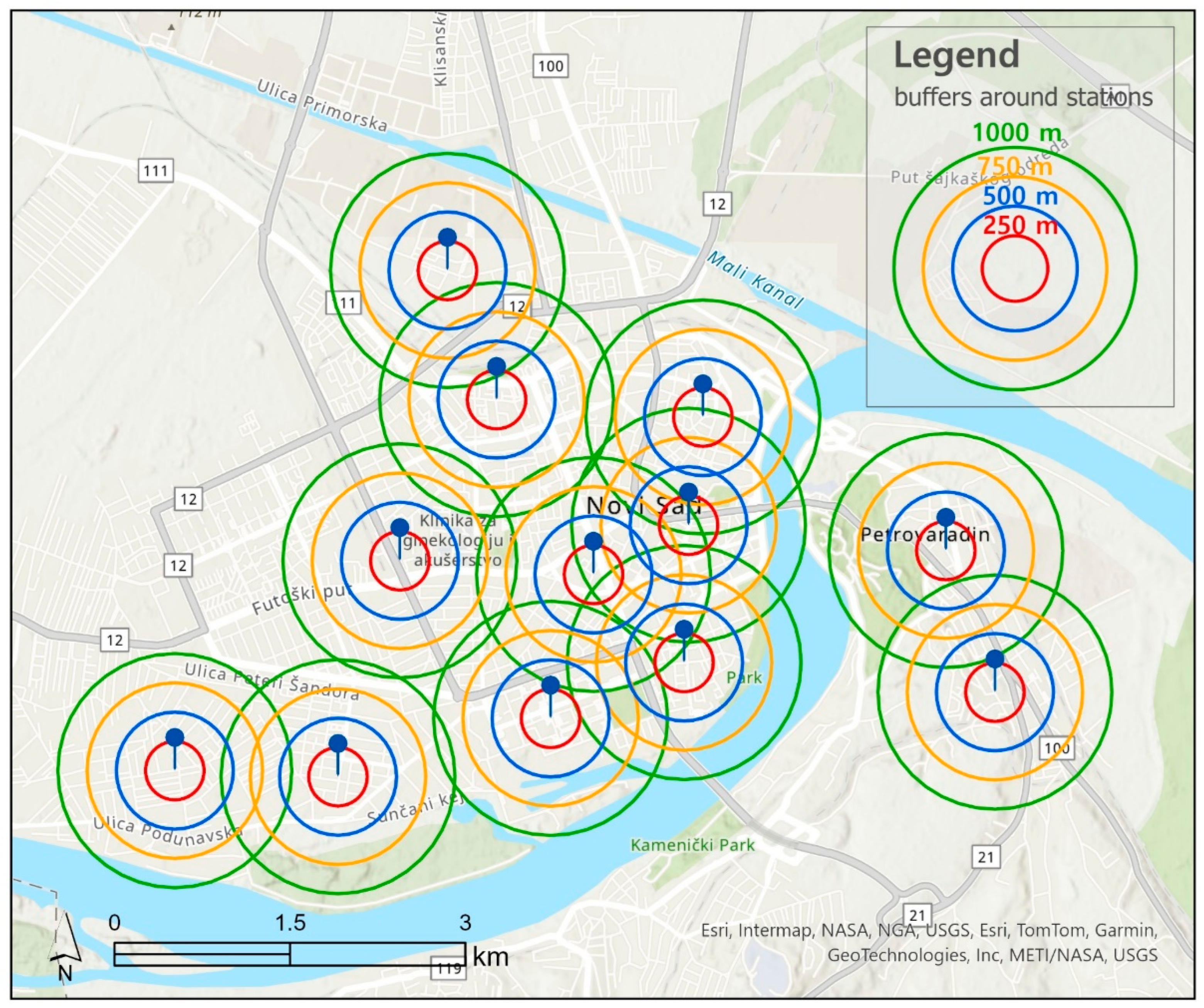
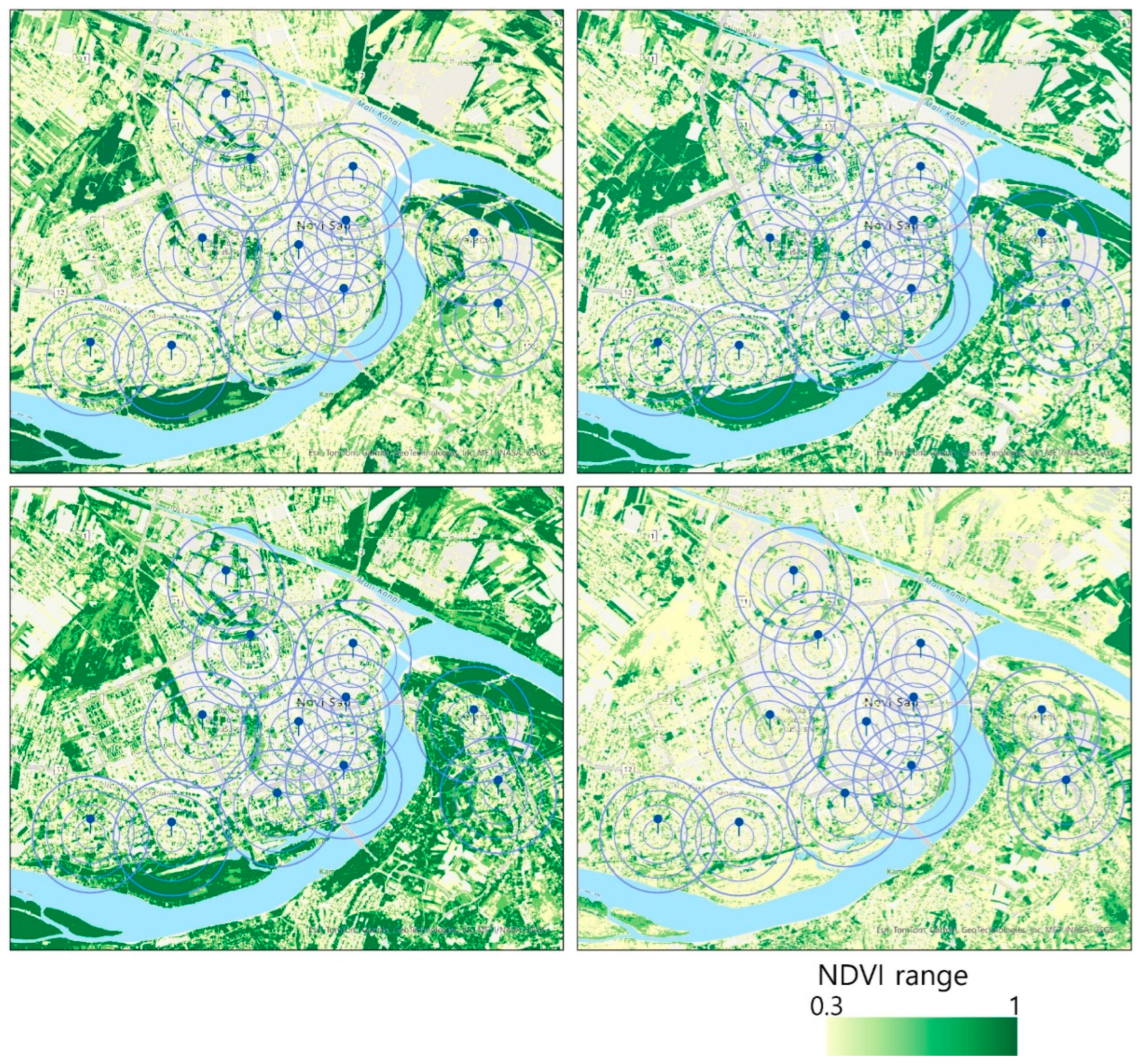
To assess the relationship between vegetation distribution and local climatic conditions, georeferenced climate monitoring stations were used as reference points. Around each station, buffer zones of varying radii (250 m, 500 m, 750 m, and 1000 m) (Figure 2) were delineated to capture greenery within different spatial extents.
Greenery quantity was assessed using two metrics: (i) the absolute area of green space within each buffer (Supplementary Material, Table S2), and (ii) the proportion of green pixels relative to total buffer area.
The proportion of greenery within each buffer was then calculated using the following formula:
g r e e n   a r e a s % = n u m b e r   o f   p i x e l s   o f   N D V I > 0.3   t o t a l   n u m b e r   o f   p i x e l s   i n   m u n i c i p a l i t y × 100
This multi-scalar approach enables the examination of how vegetation cover varies with distance from climate stations and provides a robust basis for linking microclimatic observations (e.g., temperature) with surrounding green infrastructure. By comparing vegetation coverage across the different buffer sizes, it is possible to identify the most relevant spatial scale for analyzing vegetation–climate interactions in urban environments.
Vegetation quality was assessed through analysis of vegetative activity, expressed as the distribution frequency of NDVI values grouped in intervals (bins) of 0.1. Comparisons between buffer zones were performed using both the quantitative and qualitative measures of greenery.

2.4. Data Analysis

Shapiro–Wilk normality tests confirmed normal distributions for both vegetation and climatic variables. Descriptive statistics were examined across spatial units and temporal scales. Intergroup differences were tested using ANOVA, with statistical significance set at p < 0.05. Further analyses included regression modeling based on NDVI, NDVI bin distribution analysis with emphasis on high-activity vegetation (NDVI ≥ 0.6, NDVI ≥ 0.7, and NDVI ≥ 0.8), spatial autocorrelation assessment using Moran’s I, and geographically weighted regression (GWR). Model performance and association strength were evaluated using R2 and Pearson correlation coefficients.

3. Results

3.1. Variation in Temperature Across Seasons

The analysis of temperature variability across the twelve monitored locations revealed statistically significant differences among all seasons in both study years. One plausible explanation for this variability lies in the prevailing synoptic conditions, which influenced both the amount and temporal distribution of precipitation over Novi Sad. According to long-term meteorological measurements from the official meteorological station at Rimski Šančevi (Novi Sad), the mean annual precipitation for the period 1949–2024 is 627.3 mm. In 2016, the total annual precipitation reached 819.9 mm, representing approximately 30% above the long-term average and marking it as the second wettest year in the past fifteen years. In contrast, 2017 was notably dry, with an annual total of 513.1 mm, equivalent to 82% of the multi-decadal mean, making it the third driest year within the same period. Pronounced precipitation disparities were recorded during the warmest months of the year. Specifically, in June, precipitation totaled 143.2 mm in 2016 compared to 65.7 mm in 2017; in July, 68.4 mm in 2016 versus 12.0 mm in 2017; and in August, 45.8 mm in 2016 versus 17.4 mm in 2017. These data indicate that precipitation levels across all three summer months of 2017 were substantially below the long-term average, whereas in 2016, June exceeded the average, July approximated it, and August fell below it.
Detailed monthly and annual precipitation variability for 2016, 2017, and the 1949–2024 average are based on continuous monitoring from the Rimski Šančevi meteorological station.
Across all seasons, notable differences were observed between 2016 and 2017 in the study area. Spatial variability reached up to 1.22 °C in 2016, whereas in 2017 it increased to 2.01 °C. The most pronounced divergence occurred during winter, when 2017 was considerably colder than 2016. In contrast, intra-seasonal variations across both days and locations exhibited broadly similar patterns in the two years. Locations 1, 7, and 8 (Grbavica, Stari grad, and Liman 1–2) consistently recorded the highest temperatures, whereas locations 10 and 11 (Petrovaradin) were the coldest, followed by locations 6 and 9 (Liman 3–4 and Adice) (Table 2). The greatest similarity between the two years was observed during spring. In autumn, however, temperatures were somewhat higher in 2017, while in summer, average temperatures were approximately 2 °C warmer compared to 2016. Seasonal variability was highest during autumn 2016, whereas the summer of the same year exhibited the most stable temperature conditions.

3.2. Diurnal and Nocturnal Variation in Temperature

Daily air temperatures were classified into diurnal and nocturnal periods. The diurnal temperature interval was defined according to seasonal daylight duration as follows: winter—from 07:00 to 16:00 CET, spring—from 07:00 to 20:00 CET, summer—from 06:00 to 21:00 CET, and autumn—from 06:00 to 17:00 CET. The nocturnal interval corresponded to the complementary hours: winter—17:00 to 08:00 CET, spring—21:00 to 06:00 CET, summer—22:00 to 05:00 CET, and autumn—18:00 to 05:00 CET. Due to urban thermal inertia, peak nocturnal cooling may lag behind the sunset. This aspect is further discussed in the Section 4.
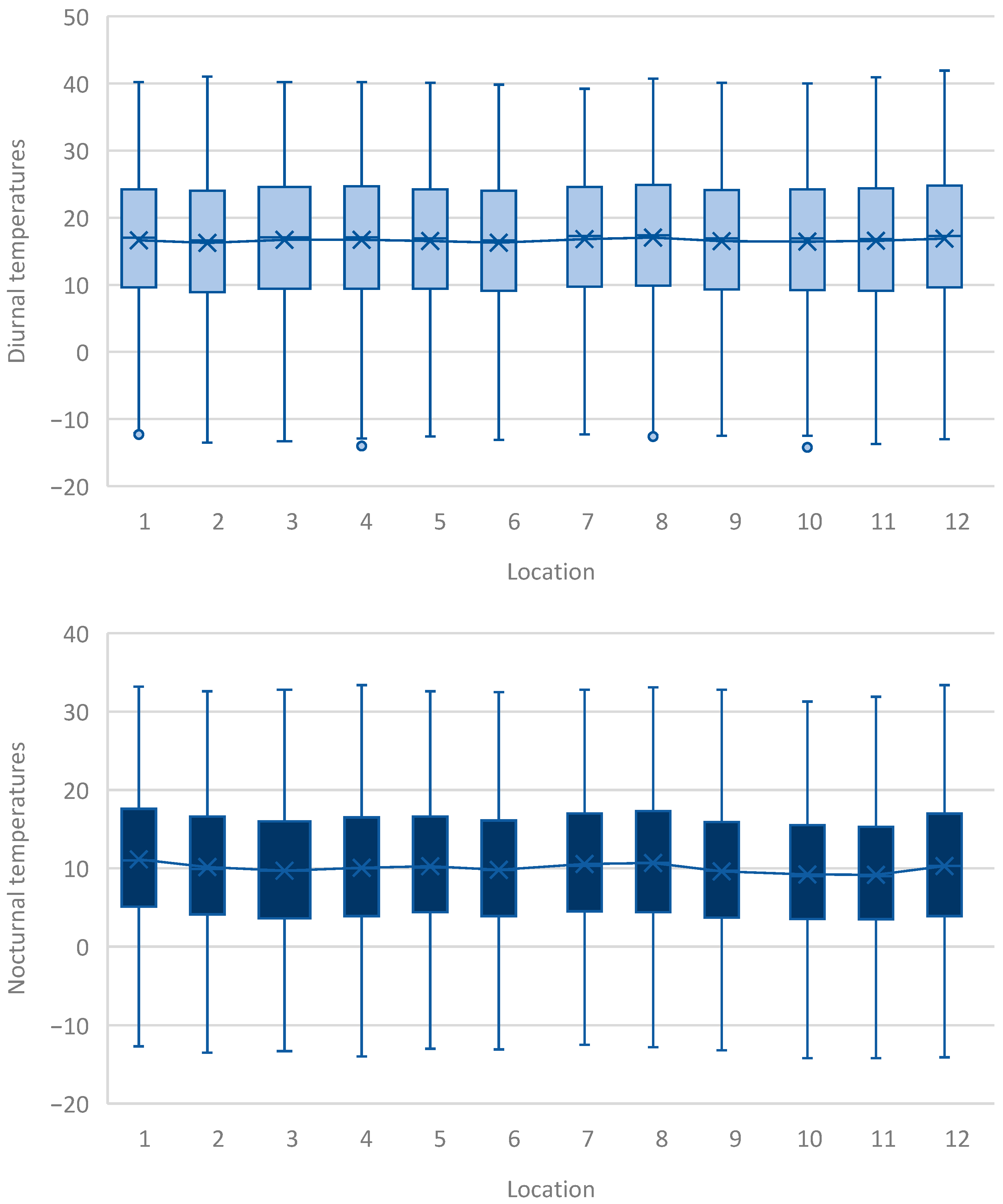
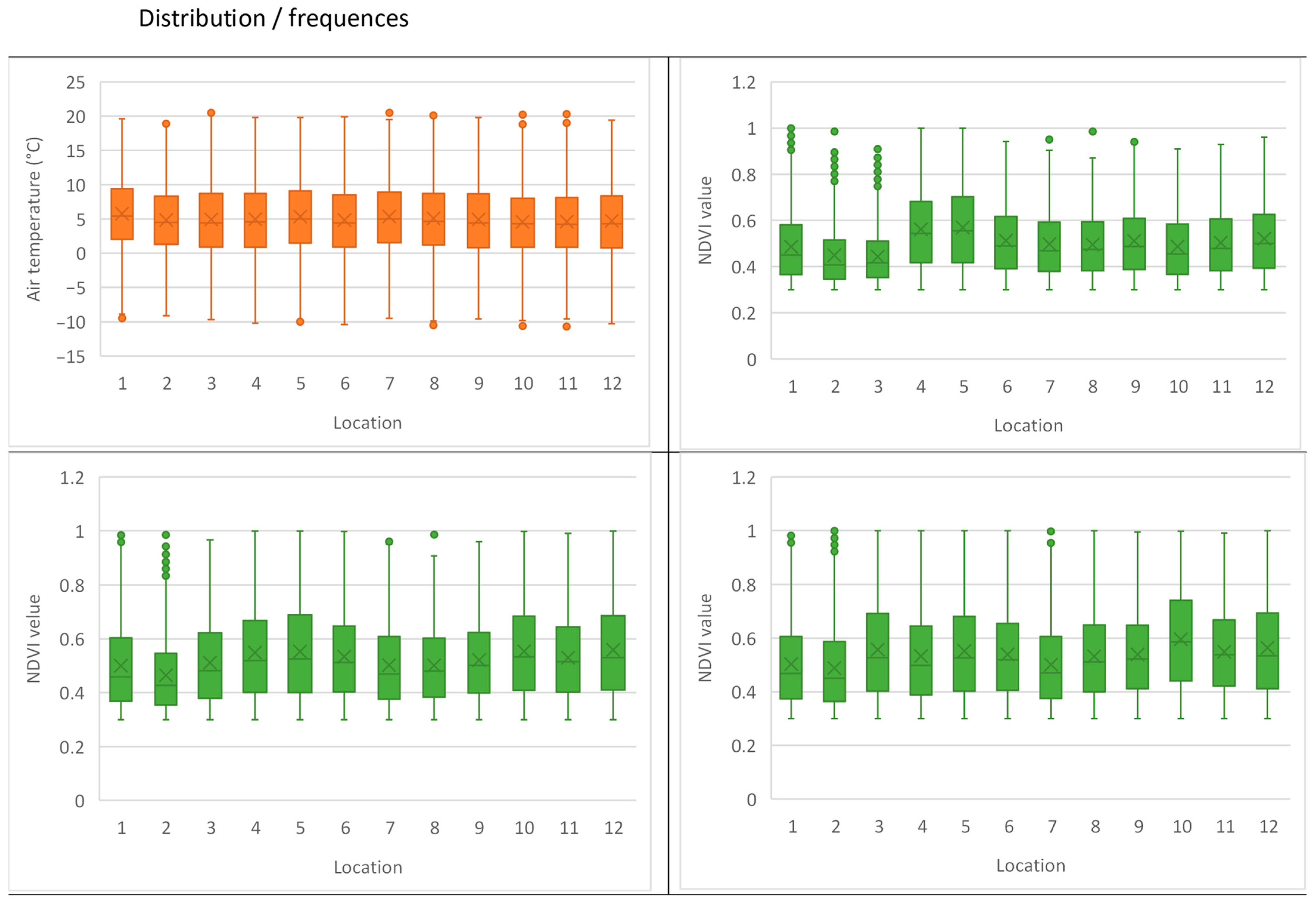
During 2016, no statistically significant differences in diurnal temperatures were observed among the monitoring stations, including the winter of 2017. The first significant variations appeared in spring 2017 and persisted through summer and autumn. In spring 2017, the Podbara (station 2; mean temperature 16.03 °C) and Liman 3–4 (station 6; 16.00 °C) sites were significantly cooler compared to Liman 1–2 (station 8; 17.31 °C) and the Industrial zone (station 12; 17.25 °C), while Liman 1–2 also differed from Adice (station 9; 16.17 °C). In summer, diurnal temperature differences became more pronounced, with several stations exhibiting notably higher values. Sajmište (station 4; 28.14 °C), Liman 1–2 (station 8; 28.43 °C), and Petrovaradin (station 12; 28.11 °C) were the warmest locations, whereas Liman 3–4 (station 6; 27.00 °C) was significantly cooler than stations 4, 8, and 12. During autumn 2017, the magnitude of differences decreased, with significant variations only between cooler sites—Podbara (station 2; 14.59 °C), Banatić (station 5; 14.78 °C), and Liman 3–4 (station 6; 14.71 °C)—and warmer sites—Liman 1–2 (station 8; 16.19 °C) and the Industrial zone (station 12; 16.23 °C). Overall, a consistent spatial pattern was observed (Figure 3, top graph), with Podbara (station 2) exhibiting the lowest diurnal temperatures and Liman 1–2 (station 8), together with the Industrial zone (station 12), exhibiting the highest (Supplementary Material Table S3).
Nocturnal temperatures displayed substantially greater variability across both 2016 and 2017. In winter 2016, Grbavica (station 1; mean temperature 5.20 °C) recorded the highest nocturnal temperatures, followed by Banatić (station 5; 4.58 °C) and Stari Grad (station 7; 4.58 °C), while the lowest were measured at Petrovaradin (stations 10 and 11; 3.62 °C and 3.60 °C, respectively). A similar spatial pattern persisted in spring 2016, when Grbavica (station 1; 12.67 °C) and Stari Grad (station 7; 12.15 °C) were the warmest sites, contrasting with the cooler Adice (station 9; 11.09 °C) and Petrovaradin (stations 10 and 11; 10.79 °C and 10.70 °C). During summer 2016, Grbavica (station 1; 21.31 °C), Podbara (station 2; 20.51 °C), and Stari Grad (station 7; 20.75 °C) exhibited the highest nocturnal temperatures, while Adice (station 9; 19.41 °C) and Petrovaradin (stations 10 and 11; 19.18 °C and 19.02 °C) remained the coolest. In autumn 2016, significant differences were again noted between Grbavica (station 1; 12.52 °C) and Petrovaradin (stations 10 and 11; 10.41 °C and 10.34 °C). In winter 2017, the highest nocturnal temperatures were recorded at Grbavica (station 1; 0.98 °C), Stari Grad (station 7; 0.47 °C), and Liman 1–2 (station 8; 0.52 °C), whereas the lowest occurred at Petrovaradin (station 11; –0.50 °C). During spring 2017, the warmest sites were again Grbavica (station 1; 13.11 °C), Liman 1–2 (station 8; 13.31 °C), and the Industrial zone (station 12; 12.93 °C), while Petrovaradin (stations 10 and 11; 10.99 °C and 10.96 °C) remained the coolest. In summer 2017, almost all locations exhibited statistically significant differences in nocturnal temperature. The highest mean temperatures were again observed at Grbavica (station 1; 23.10 °C), Liman 1–2 (station 8; 23.28 °C), and the Industrial zone (station 12; 22.74 °C), and the lowest at Adice (station 9; 20.93 °C) and Petrovaradin (stations 10 and 11; 20.49 °C and 20.52 °C). In autumn 2017, this spatial pattern persisted, with the highest nocturnal temperatures measured at Grbavica (station 1; 13.17 °C), Liman 1–2 (station 8; 13.55 °C), and the Industrial zone (station 12; 13.23 °C), and the lowest again at Petrovaradin (stations 10 and 11; 10.94 °C and 11.03 °C). The spatial distribution of nocturnal temperatures revealed a consistent pattern throughout the study period. The Grbavica, Liman 1–2, and Industrial zone stations (1, 8, and 12) represented persistent thermal maxima (Figure 3, bottom graph), whereas Petrovaradin (stations 10 and 11) consistently exhibited the lowest temperatures (Supplementary Material Table S4).

3.3. Spatial Variability of Greenery

To detect the spatial variability of greenery, two different data providers were used. For seasonal representation, Sentinel-2 optical images were selected for 24 June (spring), 3 August (summer), 2 October (autumn), and 6 December (winter). As expected, the highest vegetative activity was recorded in spring, whereas the lowest was observed during winter. Meteorological stations were distributed across 11 municipalities, with only two stations (10 and 11) located within the same municipality. Although municipalities differ in total surface area, their internal characteristics—including altitude, land cover, degree of surface sealing, and patterns of human activity—are relatively uniform, thereby justifying the comparison of temperature differences at the municipal level.
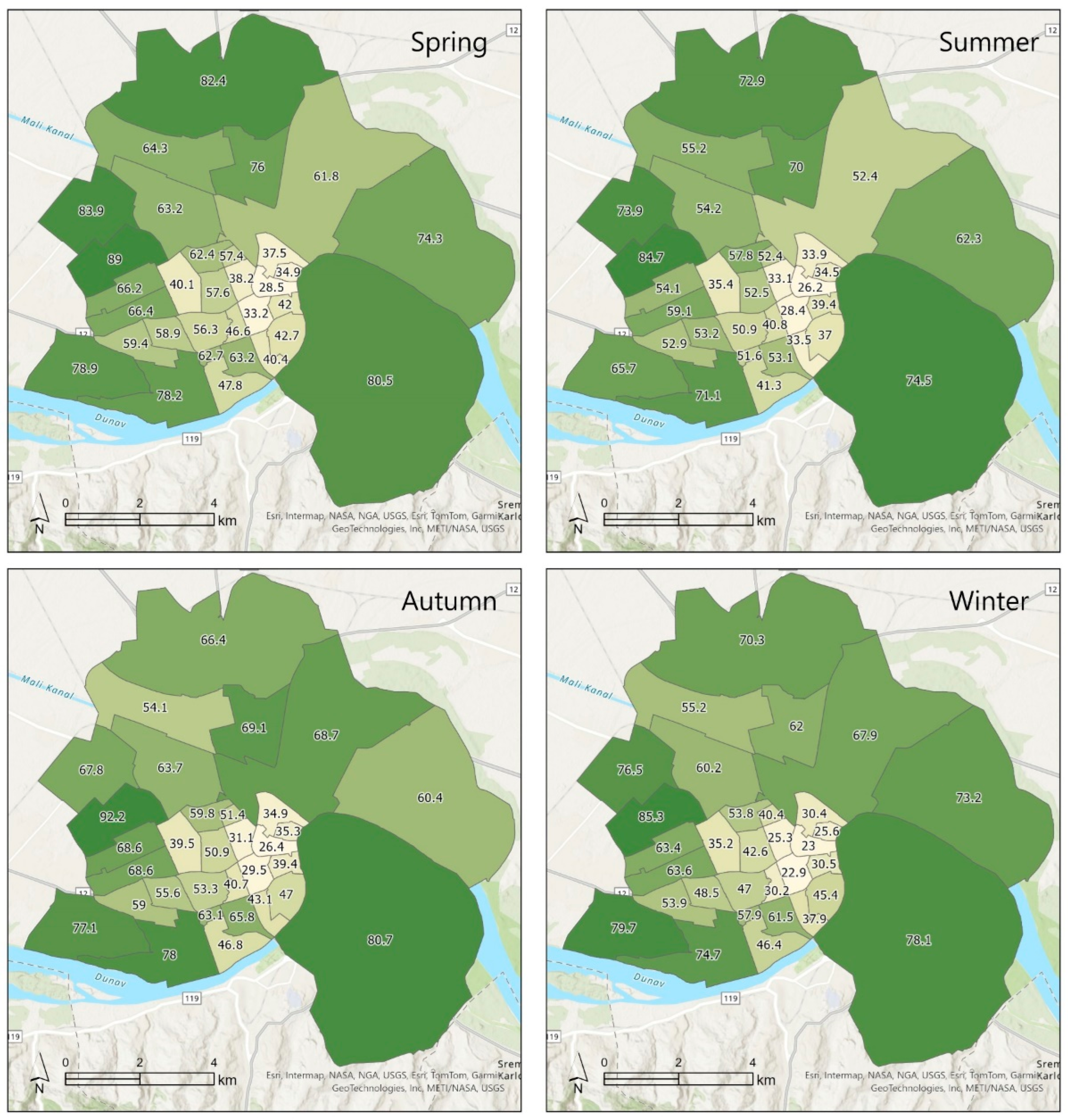
The results indicate that, across seasons, the municipalities with the highest proportion of green coverage were Petrovaradin and Adice (stations 9, 10, and 11), followed by Telep and Liman 3–4 (stations 3 and 6). In contrast, Grbavica, Podbara, and Stari Grad (stations 1, 2, and 7), representing the central and most densely built-up areas, exhibited the lowest green coverage (Figure 4).
The variation in green surface extent was minimal in Podbara (station 2; 5.41%), whereas the greatest variation was observed in Liman 3–4 (station 6; up to 13.06%). On average, seasonal fluctuations in greenery for each municipality ranged from 4.54% to 32.88% being strongest in summer and weakest in winter. The spatial distribution of green areas at the municipal level exhibited distinct seasonal patterns, which varied according to the distance from meteorological stations.

3.4. Buffer Zones

Four different radii were considered for the quantification of the influence of greenery on the local climate: 250 m, 500 m, 750 m, and 1000 m. As shown in Figure 2, there is a major overlap between the 1000 m radius of stations 1, 2, 6, 7, and 8, as well as between 5 and 12 and 10 and 11. Even though a local climate zone (LCZ) typically spans hundreds of meters to a few kilometers (Stewart and Oke, 2012) [58], the 1000 m buffer zone around the meteorological station was used in our research with certain limitations.
The extent of green areas across municipalities varied as a function of buffer zone size (Table 3). The highest variation was observed within the 500 m buffer zone (10.42%), whereas the lowest variation occurred within the 750 m buffer zone (8.4%), indicating greater stability in this spatial context. Among individual sites, Location 6 (Liman 3–4) exhibited the least variability across buffer distances, reflecting a relatively homogeneous environment surrounding the meteorological station. In contrast, the greatest variability was recorded at Location 2 (Podbara).
Similarities in vegetation dynamics were observed within the 500 m and 750 m buffer zones, where the highest levels of vegetative activity occurred during summer and autumn. By contrast, the 250 m and 1000 m buffer zones exhibited a distinct pattern, with lower vegetative activity in summer compared to spring. Comparable trends were also identified among stations 1–7, located in the central urban area, while stations 8–12, situated in the city’s periphery, displayed consistent patterns across buffer zones.
Pearson correlation analysis indicated no significant relationship between air temperature across 12 urban locations and the quantity of greenery, measured either as proportional cover (%) or absolute area (ha) (p > 0.05). The correlations were consistently weak (r ≤ 0.10), with negligible explanatory power (R2 = 0.01). Linear regression further confirmed that green area within 250 m, 500 m, and 750 m buffers did not significantly predict air temperature, regardless of whether greenery was expressed as percent cover or absolute area. Across all buffer zones, model fit remained low (R2 = 0.03, 0.11, and 0.08, respectively), indicating that the overall amount of green space alone did not explain spatial variations in air temperature.

3.5. Relation of Greenery to Climatic Parameters

The ratio of green to sealed surfaces provides a clear indication of the influence of vegetation on temperature, as significant differences (p < 0.01) are evident between most stations. When these seasonal and buffer-zone variations are considered together, they underscore the limitations of the threshold-based approach. Nevertheless, their integration with the distribution of NDVI values, along with the significant temperature differences across buffer zones, offers novel insights into the relationship between greenery and microclimatic variation.
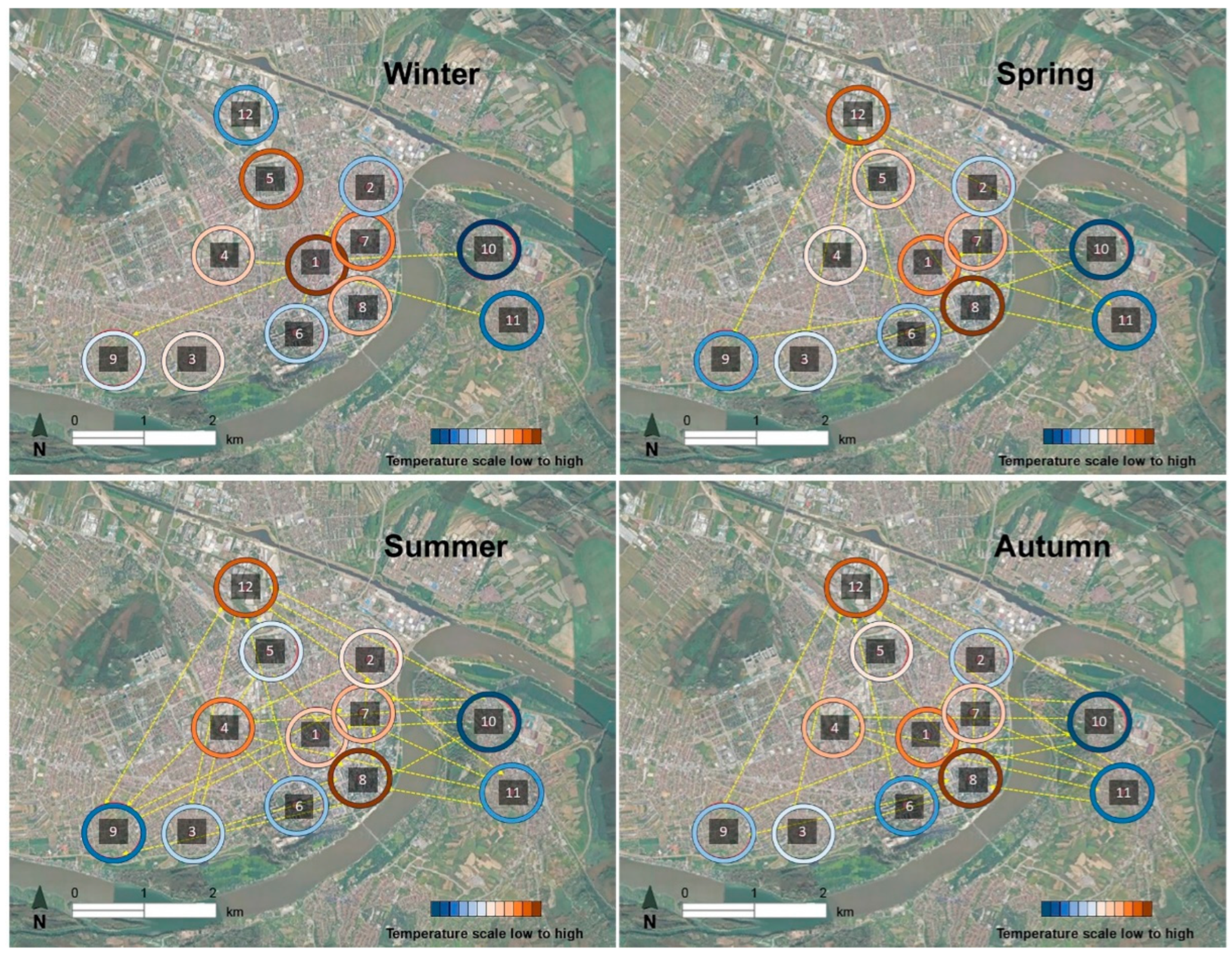
Locations 1, 8, and 7 (Grbavica, Liman 1–2, and Stari Grad) consistently rank among the five warmest sites across all seasons, corresponding to their position within the densest urban fabric. Conversely, locations 6, 9, 10, and 11 (Liman 3–4, Adice, and Petrovaradin) exhibit the lowest temperatures throughout the year. However, statistically significant differences were detected only among some stations. In winter, Location 1 (Grbavica) is notably warmer than peripheral areas, whereas in other seasons, stations situated at the urban periphery (9, 10, 11, and 12) display significantly lower temperatures compared to other sites (Figure 5).
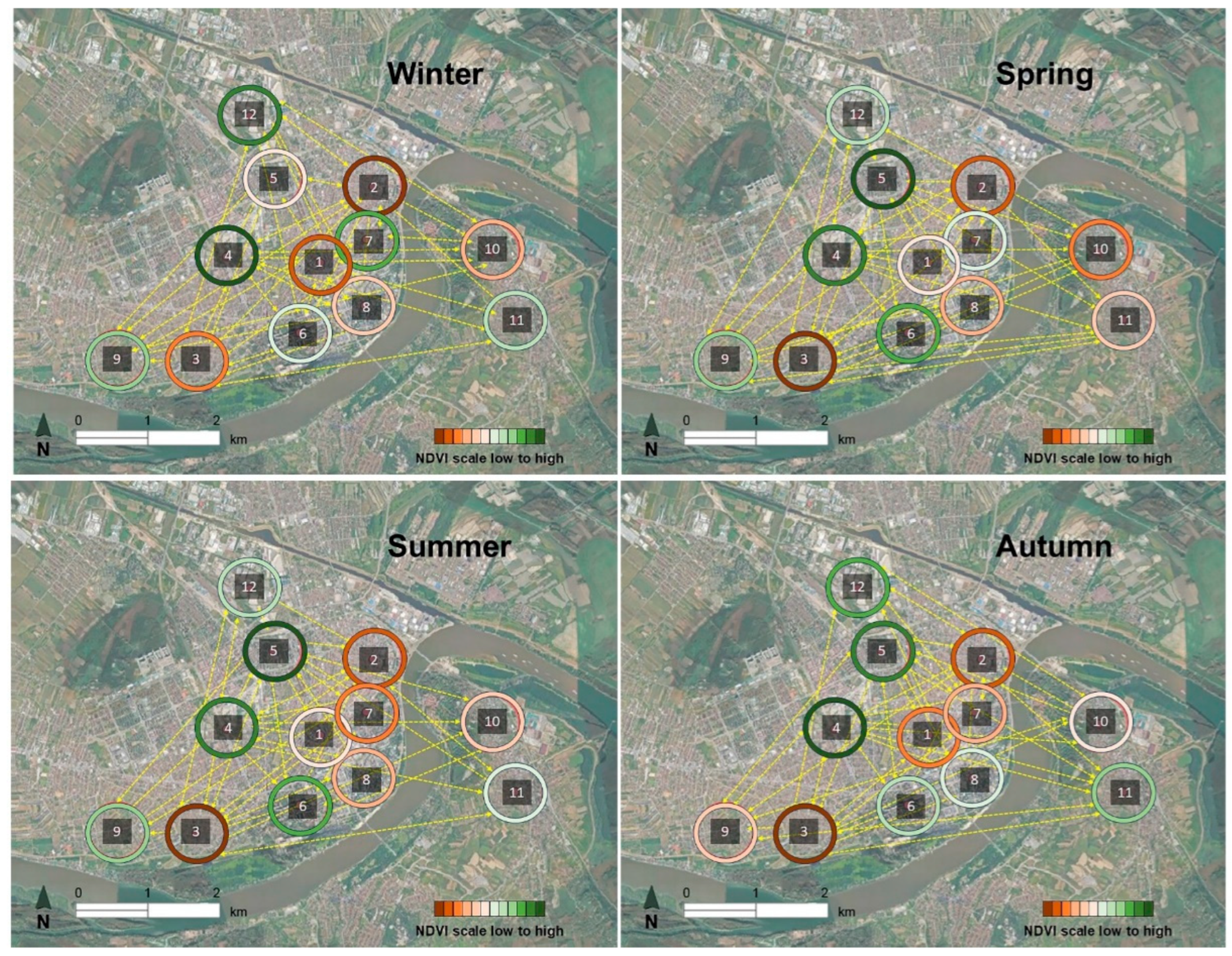
Within the 250 m buffer, Locations 4 and 5 (Sajmište and Banatić) consistently exhibit the highest levels of greenery throughout the year, followed by Location 12 (Industrial Zone). In contrast, the lowest proportions of green cover are observed around Stations 2 and 3 (Podbara and Telep). As illustrated in Figure 6, nearly all differences in vegetative activity among the stations are statistically significant.
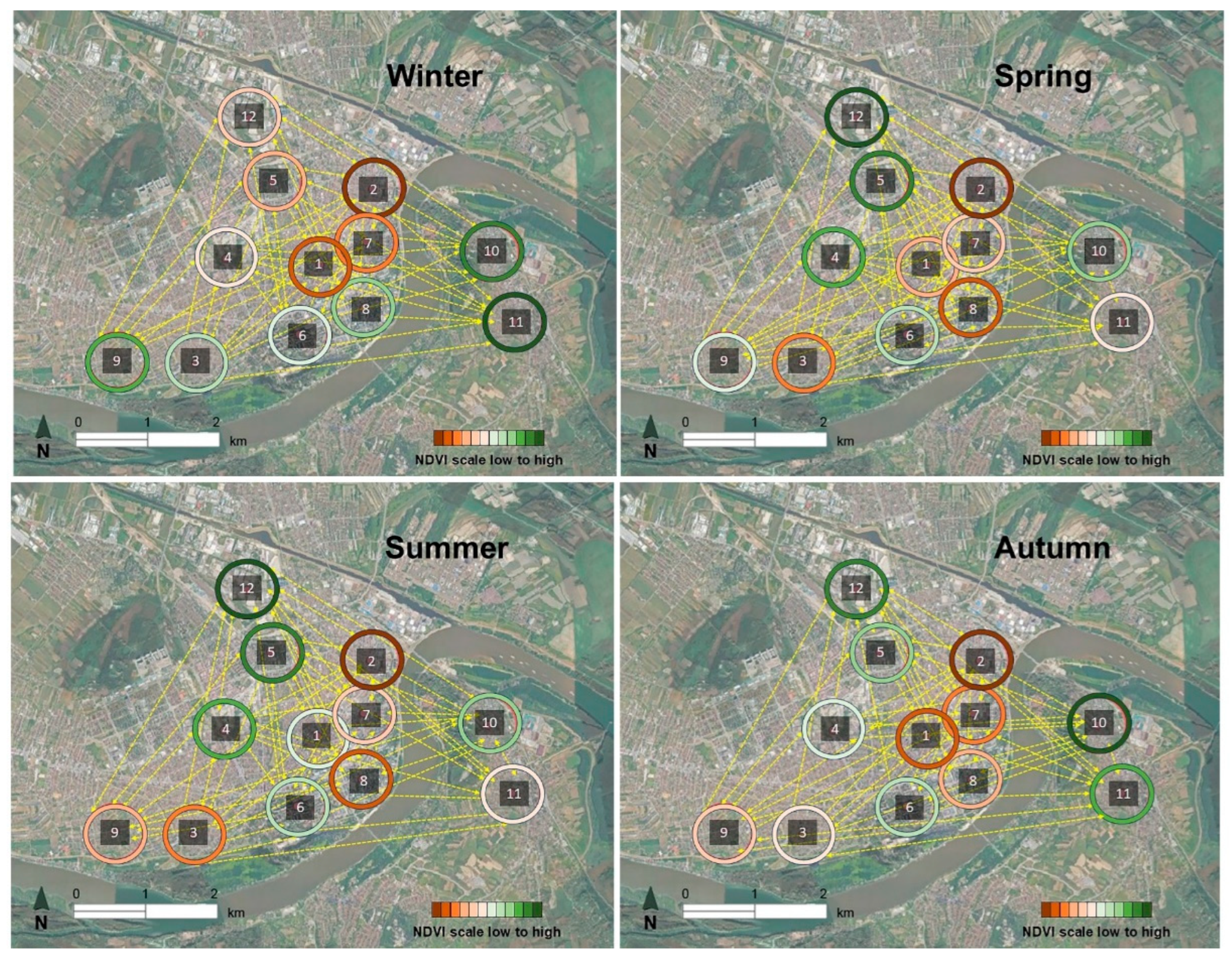
When considering the 500 m buffer, the distribution of greenery exhibited a slightly different pattern. Locations 10 and 11 (Petrovaradin) demonstrated the highest levels of vegetation during autumn and winter, whereas Locations 4, 5, and 12 (Sajmište, Banatić, and Industrial Zone) showed the greatest vegetative activity in spring and summer. In contrast, Locations 2 and 7 (Podbara and Stari Grad) consistently ranked among the least green areas across all seasons (Figure 7).
The 750 m buffer largely mirrored the results observed at 500 m, with Locations 10 and 11 (Petrovaradin) again emerging as the greenest during autumn and winter, and Locations 12 and 5 (Industrial Zone and Banatić) during spring and summer. Conversely, Locations 1, 2, and 7 (Grbavica, Podbara, and Stari Grad) remained the least vegetated, which corresponds with the relatively homogeneous characteristics at the municipality level.
At the 1000 m buffer, substantial overlap among station surroundings warrants cautious interpretation. Nonetheless, statistically significant differences were observed between most stations, with exceptions noted for particular seasonal comparisons. Specifically, in spring 2017, no significant differences were found between stations 1–8, 4–9, 4–11, 5–12, and 9–11. In summer 2017, similarities were identified between stations 1–7, 1–8, 1–9, 1–11, 2–7, 3–4, 4–6, 8–9, 8–11, 9–11, and 10–12. In autumn 2017, nonsignificant differences occurred for stations 1–2, 2–7, 3–11, 3–12, 5–6, 5–8, 5–9, 6–8, 6–9, 8–9, and 11–12. Finally, in winter 2017, similarities were observed for stations 1–2, 3–8, 4–5, 4–7, 5–7, 8–9, and 9–11. Overall, Locations 1, 4, 9, and 11 (Grbavica, Sajmište, Adice, and Petrovaradin) exhibit partially overlapping characteristics, suggesting comparable vegetative patterns.
Moran’s I Given the spatial structure of the dataset, Moran’s I was applied to assess spatial autocorrelation. The results revealed a high, significant degree of spatial dependence for the 1000 m buffer (p < 0.05), indicating a violation of independence assumptions and justifying its exclusion from further statistical analysis (Table 4).
The high Moran’s I value suggests a notable spatial homogeneity in green areas, characterized by either elevated or low vegetative activity. This pattern may reflect environmental constraints limiting vegetation growth, or it may result from the design of green spaces, wherein tall vegetation or lawns dominate, leading to limited variability across the landscape. This interpretation is further supported by the Z-score, which indicates clustering in the spatial distribution (Table 4).

3.6. Vegetative Activity of Greenery

In addition to the total area of green spaces within each municipality and the defined buffer zones, the analysis also considered the quality of vegetation, expressed through vegetative activity. Figure 8 presents vegetative activity on a color scale ranging from light to dark green, where dark green indicates the highest and light green the lowest levels of vegetative activity. The spatial pattern clearly reflects the densely built central zone of the city, corresponding to the locations of Stations 1, 2, 7, and 8 (Grbavica, Podbara, Stari Grad, and Liman 1–2). However, temperature distribution across stations indicates that the mere extent of green areas is not sufficient to explain the observed thermal variability. For instance, Stations 2 and 7 (Podbara and Stari Grad) exhibit comparable proportions of greenery yet significantly differ in air temperature. Figure 8 further shows the spatial intensity of vegetative activity. It is evident that some meteorological stations situated in highly urbanized areas are surrounded by parks with dense, mature tree canopies that maintain high vegetative activity throughout the year.
Within the 250 m buffer, the lowest proportion of green pixels was observed at Stations 1 and 2 (Grbavica and Podbara), a pattern that persists within the 500 m buffer. At larger distances (750 m and 1000 m buffers), the smallest proportion of green pixels was recorded at Stations 2 and 7 (Podbara and Stari Grad). Conversely, the highest share of green pixels was observed at Stations 5 and 9 (Banatić and Adice) within the 250 m buffer, at Stations 9 and 11 (Adice and Petrovaradin) within the 500 m buffer, and at Stations 10 and 11 (Petrovaradin) within the 750 m and 1000 m buffers. A consistent spatial pattern in land-cover characteristics was evident across buffer distances of 250–750 m. Stations 1, 2, 7, and 12 (Grbavica, Podbara, Stari Grad, and the Industrial Zone) exhibited the highest proportions of sealed surfaces, whereas Stations 9, 10, and 11 (Adice and Petrovaradin) were characterized by the lowest levels of impervious cover (Figure 8).
To further examine the quality of green areas, the analysis employed the NDVI across predefined intervals (bins). Vegetative activity serves as an indicator of vegetation quality, where higher NDVI values generally correspond to areas dominated by tall, dense vegetation, while lower values are typically associated with lawns, shrubs, and perennial plant cover [70]. The objective was to assess whether local air temperatures are influenced solely by the extent of greenery or also by its structure and quality, and to determine the relative contribution of these factors.
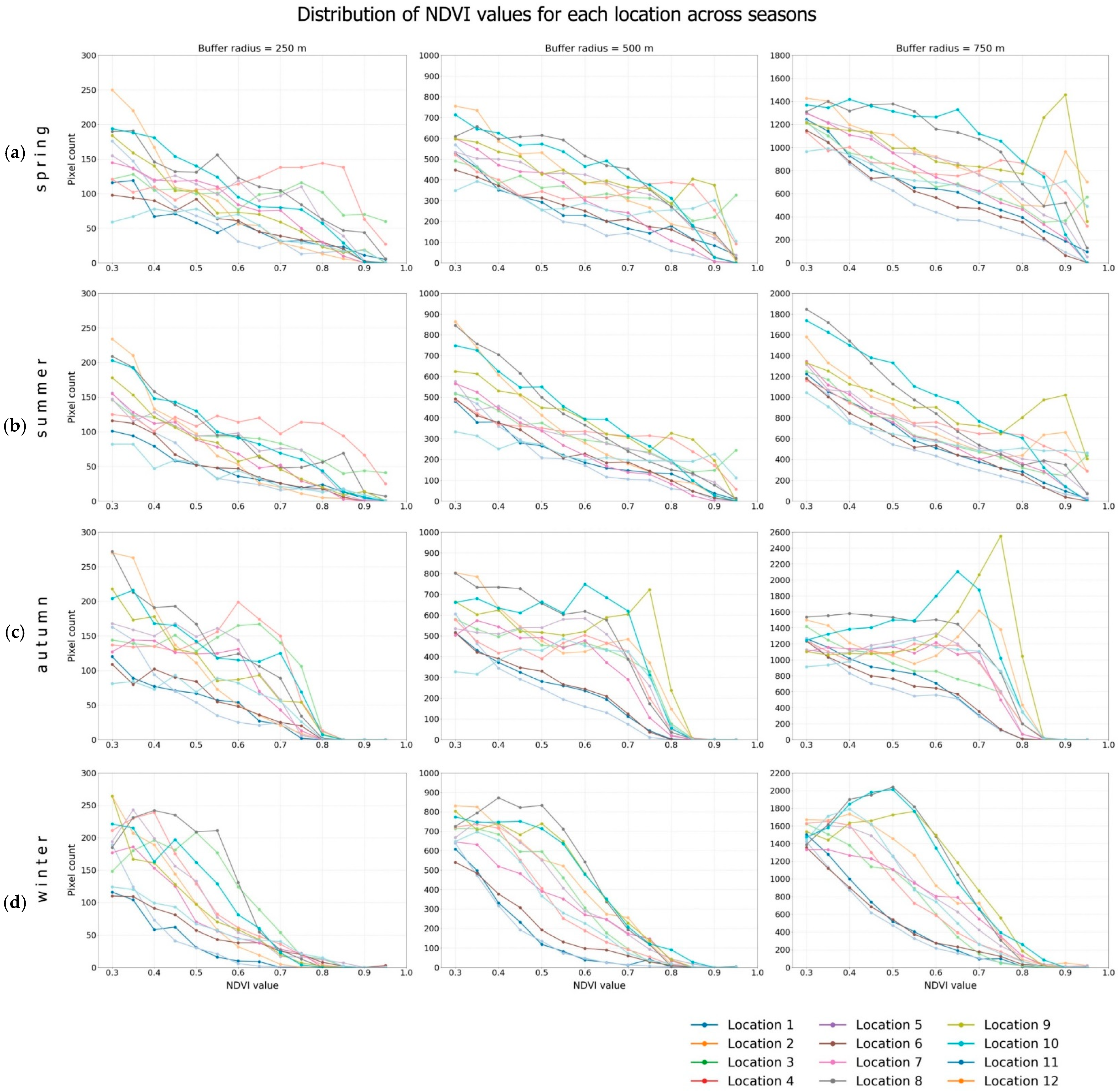
The highest mean NDVI values within the buffer zones did not correspond to areas exhibiting the lowest air temperatures, nor did the buffers with the lowest mean NDVI values align with the locations of the highest air temperatures. In both spring and summer, the highest average NDVI values were recorded at locations 4, 5, and 12 (Sajmište, Banatić, and Industrial zone) within the 250 m and 500 m buffers. However, this pattern shifted in autumn and winter for the 500 m buffer, as well as throughout the year within the 750 m buffer, where the highest average NDVI values were observed at locations 9, 10, 11, and 12 (Adice, Petrovaradin, and Industrial zone). Conversely, the lowest average NDVI values were consistently found at locations 1 and 2 (Grbavica and Podbara), and occasionally at locations 3, 7, and 8 (Telep, Stari grad, and Liman 1–2) (Figure 9). The distribution of NDVI values is presented for all 12 locations across 250–750 m buffer zones. The strongest changes in vegetation activity with increasing buffer extent were observed at locations 3, 10, and 12 (Telep, Petrovaradin, and the Industrial zone), where vegetation presence increased, and at locations 4 and 7 (Sajmište and Stari Grad), where vegetation cover declined as buffer size expanded.
To gain a more detailed understanding of vegetation characteristics, we examined the distribution of NDVI values across bins, with each location represented by the number of pixels within a given NDVI range (Figure 10).
A more detailed analysis of vegetation quality revealed that the highest proportions of pixels with low vegetative activity (NDVI values between 0.3 and 0.5) were consistently observed at locations 1, 2, and 7 (Grbavica, Podbara, and Stari Grad) across all buffer zones (250 m, 500 m, and 750 m). NDVI values within this range accounted for approximately 80%–90% of the total green pixels. In the immediate surroundings of the Industrial Zone (location 12), vegetation is predominantly composed of shrubs and mown lawns (70% of NDVI values under 0.5). However, at greater distances—within the 500 m and 750 m buffers—these areas also include a substantial proportion of tall vegetation (50% NDVI values above 0.8). This pattern is consistent with the general tendency for urban forests to be more prevalent along the peripheries of urban areas than within their central zones [71].
The highest levels of vegetative activity within the 250 m buffer were observed at locations 4 and 5 (Sajmište and Banatić)—41 and 42%, respectively, of the total green pixels. Within the 500 m and 750 m buffers surrounding the meteorological stations, elevated vegetative activity was particularly evident at locations 10, 11, and 12 (38%–56% of high-activity vegetation). For location 10, NDVI values predominantly fell within bins above 0.8, indicating a high presence of urban forest vegetation. An exception was noted during winter within the 750 m buffer, where vegetative activity declined, suggesting that the majority of vegetation in these areas is deciduous.
A correlation matrix was constructed to examine the relationships between air temperature across 12 locations and the tested predictor variables (Table 4). To differentiate the influence of total green area from that of high-activity vegetation, NDVI distribution frequencies were analyzed using three thresholds (NDVI ≥ 0.6, ≥0.7, and ≥0.8), following the relevant literature [28,29,30]. Results indicate that, for the 500 m and 750 m buffers, the absolute size of the green area did not correlate with high-activity vegetation, although a moderate association with NDVI ≥ 0.6 appeared in the 750 m buffer. In contrast, only the 250 m buffer showed a consistent decline in vegetation frequency as NDVI thresholds increased, suggesting that dense, high-canopy vegetation is generally located farther from monitoring stations.
Total green area exhibited no significant correlation with air temperature in any buffer. Conversely, high-activity vegetation showed a stronger association with temperature reduction as the NDVI threshold increased (NDVI ≥ 0.8), with the strongest effect observed in the 750 m buffer. Moderately high vegetation activity (NDVI ≥ 0.7) demonstrated the greatest influence within the 500 m buffer. The lowest threshold (NDVI ≥ 0.6) showed no significant thermal effect in the 750 m buffer and the weakest association within the 250 m buffer compared to the ≥0.7 and ≥0.8 thresholds (Table 5).
Regression analysis indicates that for vegetation with NDVI ≥ 0.6, the 250 m and 500 m buffers demonstrated statistically significant associations with air temperature (p < 0.05), although with low explanatory power (R2 = 0.09 for both). For NDVI ≥ 0.7, significance increased, with the 250 m buffer significant at p < 0.05 and the 500 m and 750 m buffers at p < 0.01, explaining R2 = 0.12, 0.19, and 0.16 of temperature variance, respectively. The strongest relationships were observed for NDVI ≥ 0.8, where all buffers were highly significant (250 m: p < 0.05; 500 m and 750 m: p < 0.01) with increasing explanatory power (R2 = 0.11, 0.20, and 0.22, respectively). Notably, the 750 m buffer exhibited the highest influence on air temperature (Supplementary Table S5). While the NDVI explains a meaningful portion of temperature variability, R2 values indicate that additional factors—including albedo, building density, and sky view factor—also contribute substantially to the observed thermal patterns.
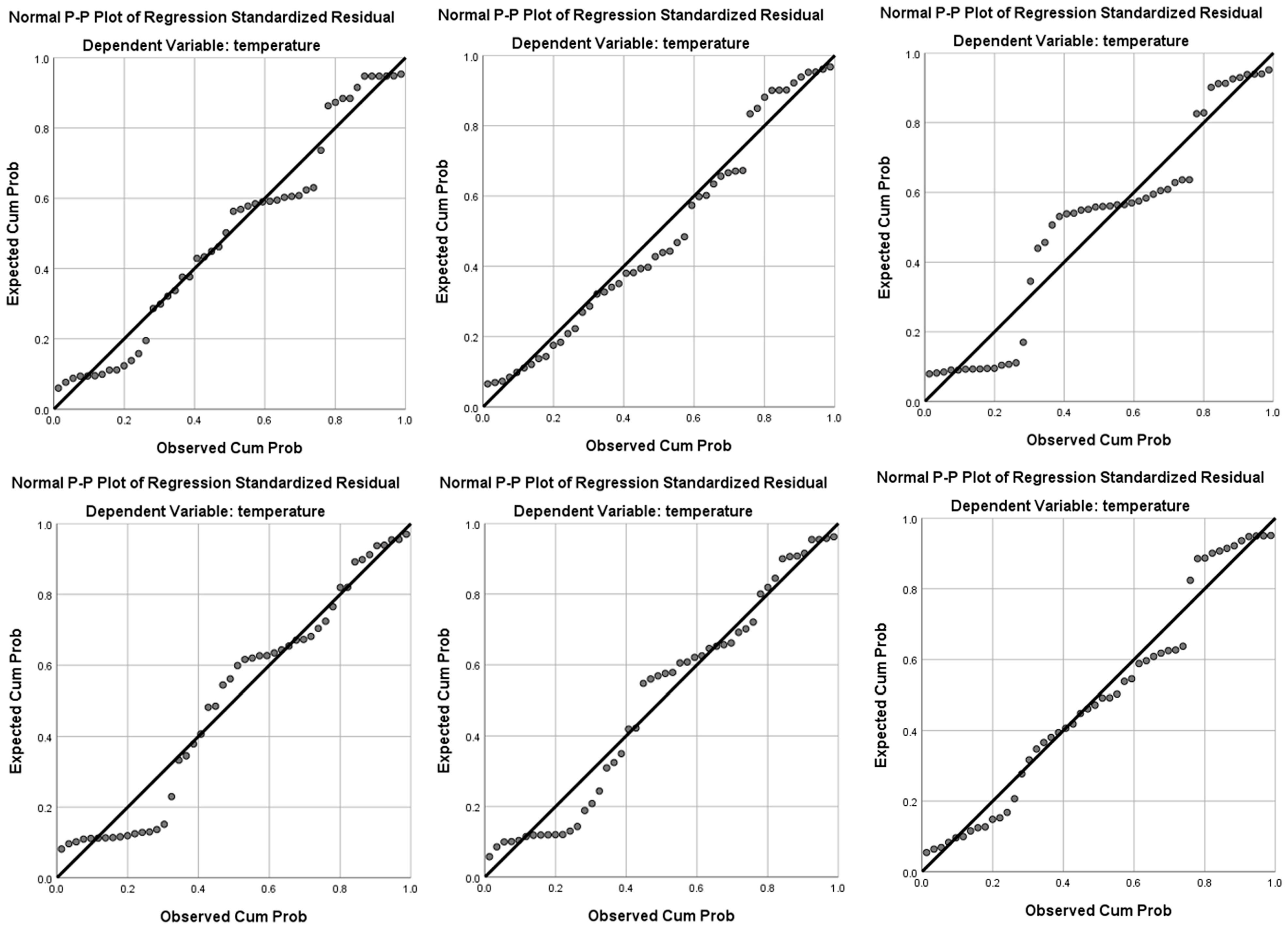
Figure 11 illustrates the regression models plot for the two opposing thresholds—NDVI ≥ 0.6 and NDVI ≥ 0.8 across buffers. The Normal P–P plots of standardized residuals demonstrate that, for all six regression models, the assumption of normality is adequately met. Minor deviations are visible in the lower or upper tails—particularly in the 250 m buffer models—yet the overall distribution remains acceptably linear. The models using a higher vegetative activity threshold (NDVI ≥ 0.8) show slightly improved alignment with the theoretical normal distribution, suggesting a more stable model fit compared with NDVI ≥ 0.6. Collectively, these diagnostics confirm that the residual structure does not violate normality and that regression-based inference is statistically reliable across the examined buffer distances and vegetation thresholds.

4. Discussion

Urban greenery exhibits a highly complex relationship with urban climate dynamics. Nevertheless, it remains the most significant factor in mitigating the effects of urban heat islands. This role is particularly critical in the contemporary context, as the majority of the global population now resides in urban environments. Consequently, the interaction between vegetation and urban microclimate has been the focus of extensive scientific research over recent decades.
This study integrates remote sensing data with in situ measurements obtained from urban climate stations positioned at 12 locations within the urban area of Novi Sad (NSUNET). Data collection was conducted during two climatically contrasting years—one characterized by exceptionally high air temperatures and the other by pronounced precipitation. To ensure spatial consistency between remotely sensed and field-based observations, Sentinel-2 satellite imagery with a spatial resolution of 10 × 10 m was employed, allowing the inclusion of fine-scale green features such as tree lines and small vegetation patches. In the absence of a public inventory of urban greenery, two methodological approaches were considered: land-use classification or vegetation quantification using NDVI. Previous research [10] classified land use into six categories: impervious surfaces, forest vegetation (trees mixed with shrubs and grass), other vegetation (shrubs and grass), water, agricultural land, and barren land. However, this classification proved inadequate for the present study area, as, under Kong et al.’s definitions [10], the categories of forest vegetation and other vegetation overlap, and all green areas within our study area would be subsumed under these two classes. Consequently, we employed the NDVI, as it allows for differentiation based on vegetation activity. This approach is particularly relevant given that areas with higher vegetative activity are expected to exert a stronger cooling effect, regardless of their designated land-use class.
The immediate surroundings of urban climate stations show greater variability in green cover than the 500 m and 750 m buffers. Across 12 locations, green coverage ranged from 36%–78% in spring, declining in winter, particularly in central areas such as Grbavica (21%), Podbara (15%), and Stari Grad (32%). This seasonal decrease reflects a key limitation of NDVI, which underestimates vegetation under snow cover and depends on the availability of cloud-free Sentinel-2 imagery. These limitations were mitigated by selecting cloud-free images captured after the growing season but prior to snowfall. Novi Sad exhibits a relatively balanced spatial distribution of greenery compared to other European cities, which report coverage between 27% and 92% and NDVI values from 0.35 to 0.48 [8]. Following the classification by Ambarwati et al. (2023) [23], approximately one-third of the study area falls into the moderate vegetation class and the remainder into the high class in spring. In winter, mixed pixels and snow-covered low vegetation frequently fall below the 0.3 NDVI threshold, leading to misclassification as built surfaces. Consequently, two municipalities shift to the low-coverage category, two to moderate, and eight remain in the high category. Grbavica and Podbara shift from moderate to low coverage, while Stari Grad and the Industrial Zone remain moderate. The pronounced seasonal variability in Grbavica and Podbara is attributed to dense urban form and fragmented greenery—primarily street trees and small multifunctional parks—resulting in a higher share of mixed pixels and stronger seasonal sensitivity.
Areas with greater green coverage tended to display lower seasonal air temperatures, yet vegetation extent alone did not explain temperature variability. The warmest locations across spring, summer, and autumn—Grbavica, Stari Grad, and Liman 1–2 (Stations 1, 7, 8)—also exhibited the lowest green cover within 250 m and 500 m buffers. Conversely, Liman 3–4, Adice, Petrovaradin, and the Industrial Zone (Stations 6, 9, 10, 12) recorded the lowest temperatures and higher green coverage. However, correlations were not statistically significant. The cooling influence of green areas was most pronounced in summer and autumn, followed by spring, contrasting with findings by Zhang et al. (2023) [7], who identified autumn as the strongest season of effect, followed by spring and summer. While Zhang et al. (2023) [7] included green infrastructure typologies (e.g., water bodies), this study tested absolute green area size as the primary predictor, which demonstrated no explanatory power for air temperature variation (p > 0.05, R2 < 0.01 across all buffers). This indicates that urban planning should move beyond surface ratios of built-up to green areas and incorporate structural attributes of both buildings and vegetation.
A clear spatial gradient was observed, with the highest temperatures concentrated in the dense urban core (Grbavica, Stari Grad, Liman 1–2), while Petrovaradin was consistently the coolest, followed by Liman 3–4 and Adice. Diurnal analysis showed that Podbara registered the lowest daytime temperatures, whereas Liman 1–2 and the Industrial Zone recorded the highest. At night, the dense urban area remained the warmest, and Petrovaradin the coolest. Night-time temperature variability was lower overall, aligning with Crum et al. (2017) [48]. Although green cover varied substantially between sites, its relative diurnal–nocturnal cooling effect was spatially consistent, differing from observations by Jusuf et al. (2007) [49]. Potchter et al. (2006) [26] reported that parks with high tree density induce significant daytime cooling, though this effect may reverse during nighttime. Our results confirm the greater magnitude of daytime cooling; however, no reversal in nighttime temperature trends was observed. The largest diurnal–nocturnal temperature differences occurred at locations with highly uneven green cover across buffers, particularly where 250 m greenness differed strongly from 500 m and 750 m extents. Further analysis of diurnal–nocturnal temperature dynamics should incorporate additional parameters to account for thermal inertia effects [72], which can delay peak nocturnal cooling relative to sunset—a phenomenon particularly pronounced in urban environments. This temporal lag may require adjustments to the operational definition of daytime and nighttime hours.
In the absence of standardized thresholds defining the spatial extent of greenery effects, this study adopted buffers ranging from 250 to 1000 m to capture the variability reported in previous research [37,38,40,41,73,74]. Buffer selection was additionally constrained by the spatial proximity of meteorological stations, which limited the maximum radius to 1 km to avoid full overlap. Moran’s I analysis indicated excessive spatial autocorrelation at 1000 m, leading to its exclusion from statistical testing. Nevertheless, the 1000 m buffer is presented for contextual interpretation, with statistical inferences drawn cautiously given the high spatial homogeneity of the urban landscape.
Although NDVI is widely used for assessing vegetation–temperature relationships, methodological inconsistencies reduce cross-study comparability. Following Martinez and Labib (2023) [28], a threshold of NDVI ≥ 0.3 was applied to distinguish vegetated from non-vegetated surfaces. Spatial variability in greenness was most pronounced at the urban periphery, where larger buffers incorporated more forested land, while central built-up areas showed consistently low green coverage across all buffer sizes. This spatial variation did not correspond to equivalent differences in air temperature, indicating that vegetation extent alone does not sufficiently explain cooling effects. Previous research has similarly emphasized that cooling efficiency is influenced by vegetation structure, cover, and edge complexity, beyond size alone [75]. To further characterize vegetation heterogeneity, NDVI values were classified into intervals reflecting functional canopy differences. Lower NDVI ranges (0.3–0.5) typically correspond to lawns, shrubs, and low perennials, while values > 0.8 represent dense tree canopies. Seasonal NDVI dynamics also capture variations in evergreen versus deciduous composition. Three high-vegetation thresholds were evaluated: ≥0.6, ≥0.7, and ≥0.8. The ≥0.6 threshold was adopted as a conservative lower bound for high-activity vegetation, consistent with studies identifying dense or vigorous vegetation above NDVI > 0.5–0.8. The ≥0.8 threshold was tested as a high-density benchmark but was absent in some buffers, while ≥0.7 was retained to preserve inter-buffer variability.
Analysis of NDVI frequency distributions indicates that central urban zones are characterized not only by limited green cover but also by the dominance of low-activity vegetation. This pattern is consistent across all buffer distances for the three most densely built locations. However, in neighboring Belgrade, Kecman et al. (2025) [76] found that small green spaces significantly influence thermal comfort in cities (analyzed through PET index and UTCI). The Industrial Zone in our study presents a contrasting profile: while its immediate surroundings are largely impervious with sparse low vegetation, urban forests become prominent at 500 m and 750 m buffers. Conversely, Sajmište, Banatić, and Adice are characterized by extensive tree canopy cover, while Petrovaradin and other peripheral zones exhibit the highest proportion of high-activity vegetation. Petrovaradin remains distinct in winter, maintaining elevated NDVI values despite Sentinel-2 imaging at the end of the vegetation season, indicating a strong presence of evergreen species alongside deciduous vegetation influenced by proximity to Fruška Gora Mountain.
The ≥0.6 NDVI threshold did not yield significant correlations to the air temperature beyond the distance of 500 m, whereas NDVI ≥ 0.8 remained significant. Xia et al. (2025) [77] similarly report that cooling effects strengthen markedly when NDVI exceeds 0.6, a threshold that produced the strongest and most significant correlations in our analysis, despite not being present in all buffers. To account for inter-buffer variability, a ≥0.7 threshold was additionally assessed. All three NDVI thresholds (≥0.6, ≥0.7, and ≥0.8) demonstrated stronger correlations and explanatory potential than green area size alone, reinforcing that dense, high-canopy vegetation plays a key role in urban heat mitigation. Consistent with Hidalgo-García et al. (2025) [78], who identify grass-dominated areas as most vulnerable to heat, and forests as more resilient, our results indicate that greater vegetative activity corresponds with stronger cooling effects. This aligns with Richards et al. (2020) [14], who demonstrate that tree canopies provide the strongest cooling benefits, reducing air temperature by −0.6 °C, and up to −0.9 °C when combined with shrubs. The coolest locations during spring, summer, and autumn consistently corresponded to areas with the highest proportion of greenery. The temperature difference between locations with the highest and lowest green coverage was 1.59 °C in spring, 1.80 °C in summer, 2.01 °C in autumn, and 0.99 °C in winter. Within a given season, average temperature variability ranged between approximately 4 and 7 °C, with the greatest fluctuations between and within stations observed in autumn, whereas summer exhibited the most stable thermal conditions. The lowest air temperatures were recorded in areas dominated by mature tree canopy, while the highest occurred in zones with predominantly low vegetation. Cooling influence also declined with distance, as the ≥0.7 threshold showed a notable reduction in correlation strength at 750 m compared to 250–500 m. However, NDVI ≥ 0.8 zones had the cooling effect that stretched the furthest. The analysis of seasonal fluctuation in the role of urban greenery in the mitigation of urban heat island is found in the work of Keikhosravi et al. (2023) [24]. They examined the relationship between distance from urban parks and the intensity of the cooling effect, reporting pronounced seasonal variation, but they found that it extends to a distance of 200 m from the park, while our findings suggest the cooling effect as far as 750 m.
The regression analysis demonstrates the proportion of air temperature variability explained by both the extent and structural characteristics of urban greenery. Green area size alone did not emerge as a statistically significant predictor. In contrast, high-activity vegetation exhibited a measurable influence on UHI intensity, with effects varying by NDVI threshold and spatial scale. Vegetation with NDVI ≥ 0.6 showed a localized effect, significant only within 250–500 m, explaining 11% of temperature variance at 250 m and less at 500 m. NDVI ≥ 0.7 exerted a significant influence up to 750 m, producing the strongest effect at 500 m, where it explained 19% of temperature variability. The strongest and most spatially stable association was observed for NDVI ≥ 0.8, representing tall, dense canopy cover, which maintained high correlation strength across all distances and accounted for approximately 20% of temperature variation. These results indicate that urban cooling is more strongly associated with vegetation structure than with green area extent alone, emphasizing the importance of mature, high-canopy trees rather than simply increasing green space coverage. The remaining proportion of temperature variability (>50%) is attributable to other urban form parameters, including sky-view factor, storey-level morphology, surface albedo, and building density. Collectively, the findings suggest that strategically prioritizing dense, high-activity tree canopy has the potential to reduce UHI intensity by up to 2 °C in Novi Sad.
This research advances the understanding of the interdependence between urban green spaces and urban climate by cross-validating the influence of both the quantity and quality of greenery—including structural composition and the differentiation between evergreen and broadleaved species—with spatial and temporal variations in air temperature. The analysis encompassed seasonal, diurnal, and nocturnal temperature fluctuations across four buffer zones, providing a multidimensional perspective on vegetation–climate interactions. Studies of this nature are essential for contemporary urban planning and ecosystem service assessments, particularly as increasing climate pressures make urban environments progressively more challenging for sustainable living.

Limitations of the Study

This study offers novel insights into the multidimensional relationships between urban greenery and microclimate, while also encountering several methodological limitations: (1) absence of ground-based vegetation structure data; (2) seasonal variability of NDVI threshold validity; (3) temporal constraints in Sentinel-2 image availability; and (4) overlapping buffer zones. The lack of a detailed urban green inventory limited data acquisition to land-use datasets or remote sensing products. Given the insufficient spatial resolution of land-use data for microclimate assessment, analysis relied on NDVI thresholding. To mitigate seasonal bias, imagery was manually selected to represent peak seasonal conditions using cloud-free Sentinel-2 scenes. However, despite a nominal 5-day revisit cycle, this temporal resolution remains insufficient to fully capture short-term phenological dynamics. Additionally, the occurrence of mixed pixels may lead to the omission of small vegetation patches or narrow tree lines, particularly when NDVI values fluctuate near the threshold. All monitoring sites were located within the urban extent of Novi Sad, ensuring relatively uniform background climatic conditions, but simultaneously limiting feasible buffer size due to spatial proximity. Buffers of 1000 m demonstrated substantial spatial overlap, which Moran’s I analysis confirmed to contain excessive spatial autocorrelation, leading to their exclusion from inferential statistical analysis. Future research should aim to address these constraints, particularly through improved vegetation structure datasets, higher temporal resolution imagery, or alternative spatial sampling designs.

5. Conclusions

This study investigated the effects of urban forests and green spaces on local air temperature by integrating high-resolution remote sensing data with in situ meteorological observations. Focusing on two climatically contrasting years, the analysis demonstrated that the extent, structure, and vegetative quality of urban greenery substantially influence urban microclimates. While the area of green cover correlated with air temperature variability, the assessment of vegetative activity through NDVI provided deeper insight into the role of vegetation structure and species composition. Locations with higher proportions of pixels exceeding NDVI > 0.8—indicative of tall, dense tree canopies—consistently exhibited lower diurnal and nocturnal air temperatures, whereas areas dominated by low vegetation (NDVI 0.3–0.5) or impervious surfaces were markedly warmer. High-activity vegetation (NDVI ≥ 0.7–0.8) exerted the strongest cooling effects, influencing air temperatures up to 750 m from measurement sites and accounting for approximately 20% of temperature variability. In contrast, total green area alone was not a significant predictor. Spatial and temporal analyses across buffer zones (250–1000 m) revealed persistent cooling effects of urban greenery, strongest during summer and autumn. Seasonal NDVI fluctuations reflected the influence of vegetation type, particularly the distribution of deciduous and evergreen species, on microclimatic variability. These findings highlight the critical ecosystem services provided by urban forests in mitigating urban heat island intensity and promoting ecological balance. They further emphasize that vegetation quality—specifically canopy density and species composition—must be incorporated into urban climate modeling and the design of green infrastructure. The application of NDVI bin segmentation proved effective for capturing fine-scale vegetation patterns and their thermal impacts. These results highlight the importance of vegetation composition, canopy density, and spatial configuration in mitigating urban heat islands, emphasizing that urban planning should prioritize high-activity vegetation rather than merely increasing green space to enhance climatic resilience. The integrative methodological framework presented here offers a replicable model for assessing the benefits of urban forests to urban climate and supports data-driven strategies for sustainable urban ecosystem design. This study directly contributes to advancing targets related to strengthening scientific, technical, and socio-economic assessments of climate change. Furthermore, it supports climate change adaptation goals by promoting the integration of climate-informed measures into urban planning, while enhancing knowledge and institutional capacity for climate resilience.

Supplementary Materials

The following supporting information can be downloaded at: https://www.mdpi.com/article/10.3390/f16111729/s1.

Author Contributions

Conceptualization, I.S. and S.S.; methodology, I.S. and S.S.; software, I.Š.; validation, I.S., S.S. and M.R.; formal analysis, I.S. and M.R.; investigation, I.S., S.S., J.D., I.Š. and M.R.; resources, S.S.; data curation, I.S., S.S., J.D., I. Š. and M.R.; writing—original draft preparation, I.S.; writing—review and editing, I.S., S.S., J.D., I.Š. and M.R.; visualization, M.R.; funding acquisition, S.S. All authors have read and agreed to the published version of the manuscript.

Funding

The research was funded by the Ministry of Science, Technological Development, and Innovation of the Republic of Serbia (grants No. 451-03-137/2025-03/200125 & 451-03-136/2025-03/200125).

Data Availability Statement

Data are available upon request.

Conflicts of Interest

The authors declare no conflicts of interest.

References

  1. Bowler, D.E.; Buyung-Ali, L.; Knight, T.M.; Pullin, A.S. Urban greening to cool towns and cities: A systematic review of the empirical evidence. Landsc. Urban Plan. 2010, 97, 147–155. [Google Scholar] [CrossRef]
  2. Norton, B.A.; Coutts, A.M.; Livesley, S.J.; Harris, R.J.; Hunter, A.M.; Williams, N.S.G. Planning for cooler cities: A framework to prioritise green infrastructure to mitigate high temperatures. Landsc. Urban Plan. 2015, 134, 127–138. [Google Scholar] [CrossRef]
  3. Shashua-Bar, L.; Pearlmutter, D.; Bitan, A.; Erell, E. The cooling efficiency of urban landscape strategies in a hot dry climate. Landsc. Urban Plan. 2009, 101, 13–22. [Google Scholar] [CrossRef]
  4. Hemiddi, N.A. Measurement of surface and air temperature over sites with different land treatments. In Proceedings of the Passive and Low Energy Conference, Seville, Spain, 24–27 September 1991. [Google Scholar]
  5. Narita, K.; Mikami, T.; Sugawara, H.; Honjo, T.; Kimura, K.; Kuwata, N. Cool island and cold air-seeping phenomena in an urban park, Shinjuku Gyoen, Tokyo. Geogr. Rev. Jpn. 2004, 77, 403–420. [Google Scholar] [CrossRef]
  6. Cao, X.; Onishi, A.; Chen, J.; Imura, H. Quantifying the cool island intensity of urban parks using ASTER and IKONOS data. Landsc. Urban Plan. 2010, 96, 224–231. [Google Scholar] [CrossRef]
  7. Zhang, K.; Yun, G.; Song, P.; Wang, K.; Li, A.; Du, C.; Jia, X.; Feng, Y.; Wu, M.; Qu, K.; et al. Discover the desirable landscape structure of urban parks for mitigating urban heat: A high spatial resolution study using a forest city, Luoyang, China as a lens. Int. J. Environ. Res. Public Health 2023, 20, 3155. [Google Scholar] [CrossRef]
  8. Ali, S.B.; Patnaik, S.; Madguni, O. Microclimate land surface temperature across urban land use/land cover forms. Glob. J. Environ. Sci. Manag. 2017, 3, 231–242. [Google Scholar]
  9. Shao, H.; Kim, G. A comprehensive review of different types of green infrastructure to mitigate urban heat islands: Progress, functions, and benefits. Land 2022, 11, 1792. [Google Scholar] [CrossRef]
  10. Kong, F.H.; Yin, H.W.; James, P.; Hutyra, L.R.; He, H.S. Effects of spatial pattern of greenspace on urban cooling in a large metropolitan area of eastern China. Landsc. Urban Plan. 2014, 128, 35–47. [Google Scholar] [CrossRef]
  11. Simović, I.; Tomićević Dubljević, J.; Tošković, O.; Vujčić Trkulja, M.; Živojinović, I. Underlying Mechanisms of Urban Green Areas’ Influence on Residents’ Health—A Case Study from Belgrade, Serbia. Forests 2023, 14, 765. [Google Scholar] [CrossRef]
  12. Carrillo-Niquete, G.A.; Andrade, J.L.; Valdez-Lazalde, J.R.; Reyes-García, C.; Hernández-Stefanoni, J.L. Characterizing spatial and temporal deforestation and its effects on surface urban heat islands in a tropical city using Landsat time series. Landsc. Urban Plan. 2022, 217, 104280. [Google Scholar] [CrossRef]
  13. Motazedian, A.; Coutts, A.M.; Tapper, N.J. The microclimatic interaction of a small urban park in central Melbourne with its surrounding urban environment during heat events. Urban For. Urban Green. 2020, 52, 126688. [Google Scholar] [CrossRef]
  14. Richards, D.R.; Fung, T.K.; Belcher, R.N.; Edwards, P.J. Differential air temperature cooling performance of urban vegetation types in the tropics. Urban For. Urban Green. 2020, 50, 126651. [Google Scholar] [CrossRef]
  15. Zhang, J.; Gou, Z.; Lu, Y.; Lin, P. The impact of sky view factor on thermal environments in urban parks in a subtropical coastal city of Australia. Urban For. Urban Green. 2019, 44, 126422. [Google Scholar] [CrossRef]
  16. Cordeiro, A.; Ornelas, A.; Lameiras, J.M. The Thermal Regulator Role of Urban Green Spaces: The Case of Coimbra (Portugal). Forests 2023, 14, 2351. [Google Scholar] [CrossRef]
  17. Morakinyo, T.E.; Lau, K.K.L.; Ren, C.; Ng, E. Performance of Hong Kong’s common tree species for outdoor temperature regulation, thermal comfort and energy saving. Build. Environ. 2018, 137, 157–170. [Google Scholar] [CrossRef]
  18. Toparlar, Y.; Blocken, B.; Maiheu, B.; Heijst, G.J.F. Impact of urban microclimate on summertime building cooling demand: A parametric analysis for Antwerp, Belgium. Appl. Energy 2018, 228, 852–872. [Google Scholar] [CrossRef]
  19. Amani-Beni, M.; Zhang, B.; Xie, G.-D.; Shi, Y. Impacts of urban green landscape patterns on land surface temperature: Evidence from the adjacent area of Olympic Forest Park of Beijing, China. Sustainability 2019, 11, 513. [Google Scholar] [CrossRef]
  20. Amani-Beni, M.; Zhang, B.; Xie, G.; Odgaard, A. Impacts of the microclimate of a large urban park on its surrounding built environment in the summertime. Remote Sens. 2021, 13, 4703. [Google Scholar] [CrossRef]
  21. Huang, L.; Zhao, D.; Wang, J.; Zhu, J.; Li, J. Scale impacts of land cover and vegetation corridors on urban thermal behavior in Nanjing, China. Theor. Appl. Climatol. 2008, 94, 241–257. [Google Scholar] [CrossRef]
  22. Pramanik, S.; Punia, M. Assessment of green space cooling effects in dense urban landscape: A case study of Delhi, India. Model. Earth Syst. Environ. 2019, 5, 867–884. [Google Scholar] [CrossRef]
  23. Ambarwati, N.; Faida, L.; Marhaento, H. The effects of green open spaces on microclimate and thermal comfort in three integrated campuses in Yogyakarta, Indonesia. Geoplan. J. Geomat. Plan. 2023, 10, 37–44. [Google Scholar] [CrossRef]
  24. Keikhosravi, G.; Khalidi, S.; Shahmoradi, M. Effects of climates and physical variables of parks on the radius and intensity of cooling of surrounding settlements. Urban Clim. 2023, 51, 101601. [Google Scholar] [CrossRef]
  25. Chang, C.R.; Li, M.H.; Chang, S.D. A preliminary study on the local cool-island intensity of Taipei city parks. Landsc. Urban Plan. 2007, 80, 386–395. [Google Scholar] [CrossRef]
  26. Potchter, O.; Cohen, P.; Bitan, A. Climatic behavior of various urban parks during hot and humid summer in Tel Aviv, Israel. Int. J. Climatol. 2006, 26, 1695–1711. [Google Scholar] [CrossRef]
  27. Giridharan, R.; Lau, S.S.Y.; Ganesan, S.; Givoni, B. Lowering the outdoor temperature in high-rise high-density residential developments of coastal Hong Kong: The vegetation influence. Build. Environ. 2008, 43, 1583–2159. [Google Scholar] [CrossRef]
  28. Martinez, A.; Labib, S.M. Demystifying normalized difference vegetation index (NDVI) for greenness exposure assessments and policy interventions in urban greening. Environ. Res. 2023, 220, 115155. [Google Scholar] [CrossRef]
  29. Drori, R.; Dan, H.; Sprintsin, M.; Sheffer, E. Precipitation-Sensitive Dynamic Threshold: A New and Simple Method to Detect and Monitor Forest and Woody Vegetation Cover in Sub-Humid to Arid Areas. Remote Sens. 2020, 12, 1231. [Google Scholar] [CrossRef]
  30. Mehta, A.; Shukla, S.; Rakholia, S. Vegetation Change Analysis using Normalized Difference Vegetation Index and Land Surface Temperature in Greater Gir Landscape. J. Sci. Res. 2021, 65, 1–6. [Google Scholar] [CrossRef]
  31. Schiano-Phan, R.; Weber, F.; Santamouris, M. The mitigative potential of urban environments and their microclimates. Buildings 2015, 5, 783–801. [Google Scholar] [CrossRef]
  32. Simović, I.; Šikoparija, B.; Panić, M.; Radulović, M.; Lugonja, P. Remote Sensing of Poplar Phenophase and Leaf Miner Attack in Urban Forests. Remote Sens. 2022, 14, 6331. [Google Scholar] [CrossRef]
  33. Chatterjee, R.S.; Singh, N.; Thapa, S.; Sharma, D.; Kumar, D. Retrieval of land surface temperature (LST) from Landsat TM6 and TIRS data by single channel radiative transfer algorithm using satellite and ground-based inputs. Int. J. Appl. Earth Obs. Geoinf. 2017, 58, 264–277. [Google Scholar] [CrossRef]
  34. Lestari, I.; Dewi, I.; Pratama, L.; Bramono, C.; Nurvaridzi, R.; Suryandari, R.; Widyatmanti, W. Utilization of remote sensing and GIS to identify radius of urban cool island for planning open green area in urban area (case study of Yogyakarta). In Proceedings of the 9th IGRSM International Conference and Exhibition on Geospatial & Remote Sensing (IGRSM 2018), Kuala Lumpur, Malaysia, 24–25 April 2018; IOP Conference Series: Earth and Environmental Science. Volume 169. [Google Scholar]
  35. Skoulika, F.; Santamouris, M.; Kolokotsa, D.; Boemi, N. On the thermal characteristics and the mitigation potential of a medium-size urban park in Athens, Greece. Landsc. Urban Plan. 2014, 123, 73–86. [Google Scholar] [CrossRef]
  36. Jauregui, E. Influence of a large urban park on temperature and convective precipitation in a tropical city. Energy Build. 1990, 15, 457–463. [Google Scholar] [CrossRef]
  37. Zhang, Y.; Wu, Q.; Wu, L.; Li, Y. Measuring community green inequity: A fine-scale assessment of Beijing urban area. Land 2021, 10, 1197. [Google Scholar] [CrossRef]
  38. Zhang, J.; Cheng, Y.; Li, H.; Wan, Y.; Zhao, B. Deciphering the changes in residential exposure to green spaces: The case of a rapidly urbanizing metropolitan region. Build. Environ. 2021, 188, 107508. [Google Scholar] [CrossRef]
  39. Yan, D.; Xu, L.; Wang, Q.; Feng, J.; Wu, X. Quantifying Landscape Effects on Urban Park Thermal Environments Using ENVI-Met and 3D Grid Profile Analysis. Forests 2025, 16, 1085. [Google Scholar] [CrossRef]
  40. Wu, L.; Kim, S.K. Exploring the equality of accessing urban green spaces: A comparative study of Chinese cities. Ecol. Indic. 2021, 121, 107080. [Google Scholar] [CrossRef]
  41. Song, Y.; Huang, B.; Cai, J.; Chen, B. Dynamic assessments of population exposure to urban greenspace using multi-source big data. Sci. Total Environ. 2018, 634, 1315–1325. [Google Scholar] [CrossRef]
  42. Sarkar, C.; Webster, C.; Gallacher, J. Residential greenness and prevalence of major depressive disorders: A cross-sectional, observational, associational study of adult UK Biobank participants. Lancet Planet. Health 2018, 2, 162–173. [Google Scholar] [CrossRef]
  43. Mouly, T.A.; Mishra, G.D.; Hystad, P.; Nieuwenhuijsen, M.; Knibbs, L.D. Residential greenspace and anxiety symptoms among Australian women living in major cities: A longitudinal analysis. Environ. Int. 2023, 179, 108110. [Google Scholar] [CrossRef]
  44. Spronken-Smith, R.A.; Oke, T.R. The thermal regime of urban parks in two cities with different summer climates. Int. J. Remote Sens. 1998, 19, 2085–2104. [Google Scholar] [CrossRef]
  45. Upmanis, H.; Eliasson, I.; Lindqvist, S. The influence of green areas on nocturnal temperatures in a high latitude city (Göteborg, Sweden). Int. J. Climatol. 1998, 18, 681–700. [Google Scholar] [CrossRef]
  46. Chen, X.Z.; Su, Y.X.; Li, D.; Huang, G.Q.; Chen, W.Q.; Chen, S.S. Study on the cooling effects of urban parks on surrounding environments using Landsat TM data: A case study in Guangzhou, southern China. Int. J. Remote Sens. 2012, 33, 5889–5914. [Google Scholar] [CrossRef]
  47. Hamada, S.; Ohta, T. Seasonal variations in the cooling effect of urban green areas on surrounding urban areas. Urban For. Urban Green. 2010, 9, 15–24. [Google Scholar] [CrossRef]
  48. Crum, S.M.; Shiflett, S.A.; Jenerette, G.D. The influence of vegetation, mesoclimate and meteorology on urban atmospheric microclimates across a coastal to desert climate gradient. J. Environ. Manag. 2017, 200, 295–303. [Google Scholar] [CrossRef]
  49. Jusuf, S.K.; Wong, N.H.; Hagen, E.; Anggoro, R.; Yan, H. The influence of land use on the urban heat island in Singapore. Habitat Int. 2007, 31, 232–242. [Google Scholar] [CrossRef]
  50. Sodoudi, S.; Zhang, H.; Chi, X.; Müller, F.; Li, H. The influence of spatial configuration of green areas on microclimate and thermal comfort. Urban For. Urban Green. 2018, 34, 85–96. [Google Scholar] [CrossRef]
  51. Statistical Office of the Republic of Serbia. Age and Sex. Data by Settlements. Book 2. 2022 Census of Population, Households and Dwellings. Statistical Office of the Republic of Serbia, Belgrade. 2023. Available online: https://popis2022.stat.gov.rs/sr-latn/5-vestisaopstenja/news-events/20230525-starost-i-pol/ (accessed on 30 October 2025).
  52. Kottek, M.; Grieser, J.; Beck, C.; Rudolf, B.; Rubel, F. World map of the Köppen–Geiger climate classification updated. Meteorol. Z. 2006, 15, 259–263. [Google Scholar] [CrossRef]
  53. Republic Hydrometeorological Service of Serbia. Official Website. Available online: https://www.hidmet.gov.rs/index_eng.php (accessed on 30 October 2025).
  54. Arsenović, D.; Savić, S.; Lužanin, Z.; Radić, I.; Milošević, D.; Arsić, M. Heat-related mortality as an indicator of population vulnerability in a mid-sized Central European city (Novi Sad, Serbia, summer 2015). Geogr. Pannon. 2019, 23, 204–215. [Google Scholar] [CrossRef]
  55. Savić, S.; Arsenović, D.; Lužanin, Z.; Milošević, D.; Dunjić, J.; Šećerov, I.; Kojić, M.; Radić, I.; Harhaji, S.; Arsić, M. Hospital admission tendencies caused by day-to-day temperature changes during summer: A case study for the city of Novi Sad (Serbia). Int. J. Biometeorol. 2023, 67, 695–704. [Google Scholar] [CrossRef]
  56. Geletič, J.; Lehnert, M.; Savić, S.; Milošević, D. Inter-/intra-zonal seasonal variability of the surface urban heat island based on Local Climate Zones in three Central European cities. Build. Environ. 2019, 156, 21–32. [Google Scholar] [CrossRef]
  57. Savić, S.; Krstić, H.; Šećerov, I.; Dunjić, J. Decreasing the energy demand in public buildings using nature-based solutions: Case studies from Novi Sad (Republic of Serbia) and Osijek (Republic of Croatia). Energy Sustain. Soc. 2024, 14, 23. [Google Scholar] [CrossRef]
  58. Stewart, I.D.; Oke, T.R. Local climate zones for urban temperature studies. Bull. Am. Meteorol. Soc. 2012, 93, 1879–1900. [Google Scholar] [CrossRef]
  59. Aguilar, E.; Auer, I.; Brunet, M.; Peterson, T.C.; Wieringa, J. Guidelines on Climate Data and Homogenization; WMO-TD 1186, WCDMP-No. 53; World Meteorological Organization: Geneva, Switzerland, 2003; p. 50. [Google Scholar]
  60. Oke, T.R. Initial Guidance to Obtain Representative Meteorological Observations at Urban Sites; IOM Report 81, WMO/TD No. 1250; World Meteorological Organization: Geneva, Switzerland, 2006; p. 51. [Google Scholar]
  61. Muller, C.L.; Chapman, L.; Grimmond, C.S.B.; Young, D.T.; Cai, X.-M. Toward a standardized metadata protocol for urban meteorological networks. Bull. Am. Meteorol. Soc. 2013, 94, 1161–1185. [Google Scholar] [CrossRef]
  62. Šećerov, I.; Savić, S.; Milošević, D.; Arsenović, D.; Dolinaj, D.; Popov, S. Progressing urban climate research using a high-density monitoring network system. Environ. Monit. Assess. 2019, 191, 89. [Google Scholar] [CrossRef] [PubMed]
  63. Savić, S.; Šećerov, I.; Dunjic, J.; Milošević, D. Hourly Air Temperature Datasets from the City of Novi Sad—NSUNET System. Zenodo 2023. [Google Scholar] [CrossRef]
  64. Savić, S.; Šećerov, I.; Lalić, B.; Nie, D.; Roantree, M. Air temperature and relative humidity datasets from an urban meteorological network in the city area of Novi Sad (Serbia). Data Brief 2023, 49, 109425. [Google Scholar] [CrossRef]
  65. de Moura, Y.M.; Galvão, L.S.; Hilker, T.; Wu, J.; Saleska, S.; do Amaral, C.H.; Nelson, B.W.; Lopes, A.P.; Wiedeman, K.K.; Prohaska, N.; et al. Spectral analysis of amazon canopy phenology during the dry season using a tower hyperspectral camera and modis observations. ISPRS J. Photogramm. Remote Sens. 2017, 131, 52–64. [Google Scholar] [CrossRef]
  66. Moura, Y.M.; Galvão, L.S.; dos Santos, J.R.; Roberts, D.A.; Breunig, F.M. Use of MISR/Terra data to study intra- and inter-annual EVI variations in the dry season of tropical forest. Remote Sens. Environ. 2012, 127, 260–270. [Google Scholar] [CrossRef]
  67. Dong, J.; Xiao, X.; Wagle, P.; Zhang, G.; Zhou, Y.; Jin, C.; Torn, M.S.; Meyers, T.P.; Suyker, A.E.; Wang, J.; et al. Comparison of four EVI-based models for estimating gross primary production of maize and soybean croplands and tallgrass prairie under severe drought. Remote Sens. Environ. 2015, 162, 154–168. [Google Scholar] [CrossRef]
  68. Sims, D.A.; Rahman, A.F.; Vermote, E.F.; Jiang, Z. Seasonal and inter-annual variation in view angle effects on MODIS vegetation indices at three forest sites. Remote Sens. Environ. 2011, 115, 3112–3120. [Google Scholar] [CrossRef]
  69. Huete, A.R.; Didan, K.; Shimabukuro, Y.E.; Ratana, P.; Saleska, S.R.; Hutyra, L.R.; Yang, W.; Nemani, R.R.; Myneni, R. Amazon rainforests green-up with sunlight in dry season. Geophys. Res. Lett. 2006, 33, L06405. [Google Scholar] [CrossRef]
  70. Huang, S.; Tang, L.; Hupy, J.P.; Wang, J.; Shao, G. A commentary review on the use of normalized difference vegetation index (NDVI) in the era of popular remote sensing. J. For. Res. 2021, 32, 1–6. [Google Scholar] [CrossRef]
  71. Nielsen, A.B.; Hedblom, M.; Olafsson, A.S.; Wiström, B. Spatial configurations of urban forest in different landscape and socio-political contexts: Identifying patterns for green infrastructure planning. Urban Ecosyst. 2017, 20, 379–392. [Google Scholar] [CrossRef]
  72. Keravec-Balbot, T.; Rodler, A.; Roupioz, L.; Musy, M.; Gresse, T.; Briottet, X. Identification of urban thermal properties by combining urban microclimate modeling and thermal infrared satellite data. Sustain. Cities Soc. 2025, 118, 105995. [Google Scholar] [CrossRef]
  73. Blachowski, J.; Hajnrych, M. Assessing the Cooling Effect of Four Urban Parks of Different Sizes in a Temperate Continental Climate Zone: Wroclaw (Poland). Forests 2021, 12, 1136. [Google Scholar] [CrossRef]
  74. Carrus, G.; Scopelliti, M.; Lafortezza, R.; Colangelo, G.; Ferrini, F.; Salbitano, F.; Agrimi, M.; Portoghesi, L.; Semenzato, P.; Sanesi, G. Go greener, feel better? The positive effects of biodiversity on well-being in urban and peri-urban green areas. Landsc. Urban Plan. 2015, 134, 221–228. [Google Scholar] [CrossRef]
  75. Yan, Z.; Wu, T.; Xuan, L.; Li, W.; Wang, X.; Dong, L.; Yu, K.; Wang, Y. The Scale-Dependent Differences in Cooling Efficiency of UGS in Different Functional Areas: A Case Study of Xi’an, China. Forests 2024, 15, 1946. [Google Scholar] [CrossRef]
  76. Kecman, S.; Stojanović, N.; Vukmirović, M.; Vasiljević, N.; Bjedov, I.; Vujović, D. The Impact of the Small Urban Green Space on the Urban Thermal Environment: The Belgrade Case Study (Serbia). Forests 2025, 16, 321. [Google Scholar] [CrossRef]
  77. Xia, J.; Yan, Y.; Dou, Z.; Han, D.; Zhang, Y. Exploring the Role of Urban Green Spaces in Regulating Thermal Environments: Comparative Insights from Seoul and Busan, South Korea. Forests 2025, 16, 1515. [Google Scholar] [CrossRef]
  78. Hidalgo-García, D.; Founda, D.; Rezapouraghdam, H.; Jiménez, A.E.; Azinuddin, M. Urban Forest Microclimates and Their Response to Heat Waves—A Case Study for London. Forests 2025, 16, 790. [Google Scholar] [CrossRef]
Figure 1. Study area of Novi Sad city with the spatial distribution of urban climate stations.
Forests 16 01729 g001
Figure 2. Climate stations and surrounding buffers of 250 m, 500 m, 750 m, and 1000 m.
Forests 16 01729 g002
Figure 3. Spatiotemporal dynamics of diurnal and nocturnal air temperature across seasons.
Forests 16 01729 g003
Figure 4. Change in vegetative activity across seasons: spring, summer, autumn, and winter.
Forests 16 01729 g004
Figure 5. Significant differences (marked with yellow arrows) in temperatures (marked in the gradient from dark blue—the lowest to dark orange—the highest) between stations across seasons.
Forests 16 01729 g005
Figure 6. Significant differences (marked with yellow arrows) in vegetative activity around a buffer of 250 m (NDVI marked in the gradient from dark orange—the lowest to dark green—the highest) between stations across seasons.
Forests 16 01729 g006
Figure 7. Significant differences (marked with yellow arrows) in vegetative activity around a buffer of 500 m (NDVI marked in the gradient from dark orange—the lowest to dark green—the highest) between stations across seasons.
Forests 16 01729 g007
Figure 8. Change in vegetative activity across seasons: spring (top left), summer (top right), autumn (bottom left), and winter (bottom right).
Forests 16 01729 g008
Figure 9. Change in air temperatures (top left) and vegetative activity across buffers: 250 m (top right), 500 m (bottom left), and 750 m (bottom right).
Forests 16 01729 g009
Figure 10. Consistency over buffers (250 m, 500 m, and 750 m) in (a) spring, (b) summer, (c) autumn, and (d) winter.
Forests 16 01729 g010
Figure 11. Regression models for temperature in relation to the vegetative activity ≥ 0.6 in buffer 250 m (top left), 500 m (top middle), and 750 m (top right), and vegetative activity ≥ 0.8 in buffer 250 m (bottom left), 500 m (bottom middle), and 750 m (bottom right).
Forests 16 01729 g011
Table 1. Basic spatial information of urban climate stations.
Station IDStation AdressLCZ NumberLCZ NameLatitudeLongitudeStation HeightAltitude
1Grbavica, ulica Danila Kiša 72compact midrise45.24916619.8372223.9579
2Podbara, ulica Zemljane ćuprije 122compact midrise45.26138819.8488884.1278
3Telep, ulica Feješ Klare 52c3compact lowrise45.23333319.8097224.0579
4Sajmište, Bulevar Evrope (Veselina Masleše 6)5open midrise45.2519.8161114.0275
5Banatić, ulica Omladinskog pokreta 45open midrise45.262519.8263884.0078
6Liman 3-4, ulica Balzakova 245open midrise45.23805519.8327774.0881
7Stari grad, ulica Žarka Zrenjanina 25open midrise45.25305519.84754.1680
8Liman 1-2, ulica Narodnog fronta 15open midrise45.242519.8472224.2978
9Adice, ulica Branka Ćopića 976open lowrise45.23361119.7919444.0076
10Petrovaradin, ulica Patrijarha Rajačića 446open lowrise45.25138819.8755554.1076
11Petrovaradin, ulica Mažuranićeva 636open lowrise45.24055519.8811114.0092
12Industrial Zone South, put Partizanskog novosadskog odreda (Metro)8large lowrise45.27236919.8208334.0077
Table 2. Variations in temperatures (°C) across seasons, with the highest values marked in orange and the lowest marked in blue.
Year/
Season
20162017
SpringSummerAutumnWinterSpringSummerAutumnWinter
LocationMean values ± standard deviationMean values ± standard deviation
114.48 ± 6.1223.64 ± 4.5613.59 ± 6.745.76 ± 5.1414.96 ± 5.8925.82 ± 5.4014.13 ± 5.731.56 ± 5.95
214.01 ± 6.3423.27 ± 4.8512.76 ± 6.834.84 ± 5.0914.35 ± 6.1625.39 ± 5.7813.27 ± 5.830.72 ± 5.92
314.00 ± 6.4423.22 ± 5.0912.93 ± 7.074.92 ± 5.4514.38 ± 6.3025.33 ± 6.0313.37 ± 6.140.75 ± 6.18
413.90 ± 6.3623.08 ± 4.8412.86 ± 7.054.97 ± 5.4614.48 ± 6.3426.29 ± 5.7313.91 ± 5.980.64 ± 6.27
514.14 ± 6.3123.24 ± 4.8812.88 ± 6.775.36 ± 5.3314.55 ± 6.1525.34 ± 5.7713.39 ± 5.810.70 ± 6.10
613.79 ± 6.2822.91 ± 4.8312.76 ± 6.884.85 ± 5.3414.21 ± 6.0625.12 ± 5.8113.18 ± 5.910.63 ± 6.06
714.43 ± 6.2323.55 ± 4.5513.36 ± 6.895.34 ± 5.2814.82 ± 5.9725.82 ± 5.4813.91 ± 5.941.26 ± 6.01
814.12 ± 6.3123.32 ± 4.8113.03 ± 6.905.07 ± 5.3015.63 ± 5.9926.71 ± 5.6414.83 ± 5.751.28 ± 6.10
913.76 ± 6.3522.91 ± 5.0412.84 ± 7.014.91 ± 5.4614.18 ± 6.2225.03 ± 6.0113.25 ± 6.040.72 ± 6.22
1013.71 ± 6.3922.77 ± 4.9212.37 ± 6.944.58 ± 5.2914.04 ± 6.2624.91 ± 5.9512.82 ± 6.050.64 ± 6.03
1113.69 ± 6.5522.88 ± 5.3912.41 ± 7.154.60 ± 5.3614.04 ± 6.4325.04 ± 6.3112.99 ± 6.270.57 ± 6.15
1213.87 ± 6.4323.08 ± 5.0112.92 ± 7.134.71 ± 5.3815.45 ± 6.3326.31 ± 5.9614.68 ± 5.970.86 ± 6.33
Note. Locations with significantly different air temperatures are underlined.
Table 3. The percentage of green pixels at the municipality level across seasons, with maximum and minimum marked in green and orange, respectively.
Buffer 250
LocationSpringSummerAutumnWinter
136.0429.9629.9620.76
238.7834.1832.2424.9
356.8549.4458.8451.74
469.2361.4973.2370.92
577.4873.2972.2662.74
664.7154.1264.3558.82
738.0432.9233.2332
854.7445.6253.3545.93
978.0467.1177.0778.6
1054.5949.9261.8351.98
1171.3865.2873.4864
1234.0526.2136.7736.97
Buffer 500
LocationSpringSummerAutumnWinter
136.8342.3935.2725.28
233.9536.423224.53
357.4169.170.9865.9
454.5661.2560.6855.97
555.8461.2356.4549.35
651.2663.4763.6658.96
738.4741.8936.8229.64
841.8751.355.0149.71
967.8377.6877.3776.1
1067.0972.4778.171.06
1168.2675.7480.2172.11
1240.7749.4751.8247.34
Buffer 750
LocationSpringSummerAutumnWinter
142.8748.8443.1534.25
236.0839.5936.7330.54
361.9574.3873.9970.01
450.4457.1355.5750.02
558.1764.7761.5453.42
652.5163.8863.3260.18
739.7343.5440.1532.98
847.9557.0860.8555.98
968.8980.6281.6380.85
1072.6978.385.3879.54
1174.6683.5988.181.6
1248.9559.0962.4258.97
Buffer 1000
LocationSpringSummerAutumnWinter
157.8650.8152.544.25
239.4835.5137.633.57
384.0273.3883.7278.92
464.4657.1362.5555.65
563.8756.2661.4154.58
670.6960.0470.3765.19
743.7338.8540.8134.18
851.7344.2252.8347.56
983.6572.1884.6683.36
1082.576.1389.8585.09
1185.5476.3992.386.52
1258.6949.7260.7257.36
Table 4. Moran’s I for buffer 1000 m across seasons.
SeasonMoran’s IndexExpected IndexVarianceZ-Scorep-Value
spring1.548670−0.0909090.4178642.5363830.011200
summer1.406119−0.0909090.4204192.3088130.020954
autumn1.632777−0.0909090.4178902.6664130.007667
winter1.671196−0.0909090.4219882.7125750.006676
Table 5. Correlation matrix table of the air temperatures and various predictor variables (size and high-activity vegetation) with color scale representing correlation strength: light to dark green for temperature–vegetation correlations and light to dark gray for inter-vegetation characteristics.
TemperatureGreenery Size Buffer 250 mGreenery Size Buffer 500 mGreenery Size Buffer 750 mNDVI ≥ 0.6 Buffer 250 mNDVI ≥ 0.6 Buffer 500 mNDVI ≥ 0.6 Buffer 750 mNDVI ≥ 0.7 Buffer 250 mNDVI ≥ 0.7 Buffer 500 mNDVI ≥ 0.7 Buffer 750 mNDVI ≥ 0.8 Buffer 250 mNDVI ≥ 0.8 Buffer 500 mNDVI ≥ 0.8 Buffer 750 m
temperature1−0.0350.1080.080.301 *0.334 *0.2680.347 *0.435 **0.397 **0.333 *0.444 **0.467 **
greenery size buffer 250 m−0.03510.776 **0.662 **0.722 **0.645 **0.554 **0.568 **0.461 **0.407 **0.389 **0.2210.186
greenery size buffer 500 m0.1080.776 **10.969 **0.378 **0.678 **0.716 **0.2390.465 **0.553 **0.1110.1790.273
greenery size buffer 750 m0.080.662 **0.969 **10.2640.637 **0.736 **0.1340.421 **0.562 **0.0220.1360.269
NDVI ≥0.6 buffer 250 m0.301 *0.722 **0.378 **0.26410.701 **0.476 **0.949 **0.697 **0.476 **0.793 **0.590 **0.402 **
NDVI ≥0.6 buffer 500 m0.334 *0.645 **0.678 **0.637 **0.701 **10.935 **0.634 **0.931 **0.899 **0.488 **0.673 **0.652 **
NDVI ≥0.6 buffer 750 m0.2680.554 **0.716 **0.736 **0.476 **0.935 **10.401 **0.831 **0.939 **0.2690.534 **0.637 **
NDVI ≥0.7 buffer 250 m0.347 *0.568 **0.2390.1340.949 **0.634 **0.401 **10.723 **0.475 **0.930 **0.709 **0.491 **
NDVI ≥0.7 buffer 500 m0.435 **0.461 **0.465 **0.421 **0.697 **0.931 **0.831 **0.723 **10.917 **0.656 **0.876 **0.818 **
NDVI ≥0.7 buffer 750 m0.397 **0.407 **0.553 **0.562 **0.476 **0.899 **0.939 **0.475 **0.917 **10.403 **0.730 **0.832 **
NDVI ≥0.8 buffer 250 m0.333 *0.389 **0.1110.0220.793 **0.488 **00.2690.930 **0.656 **0.403 **10.763 **0.524 **
NDVI ≥0.8 buffer 500 m0.444 **0.2210.1790.1360.590 **0.673 **0.534 **0.709 **0.876 **0.730 **0.763 **10.901 **
NDVI ≥0.8 buffer 750 m0.467 **0.1860.2730.2690.402 **0.652 **0.637 **0.491 **0.818 **0.832 **0.524 **0.901 **1
Note. * Correlation is significant at the 0.05 level (2-tailed). ** Correlation is significant at the 0.01 level (2-tailed).
Disclaimer/Publisher’s Note: The statements, opinions and data contained in all publications are solely those of the individual author(s) and contributor(s) and not of MDPI and/or the editor(s). MDPI and/or the editor(s) disclaim responsibility for any injury to people or property resulting from any ideas, methods, instructions or products referred to in the content.