
Article

Automatic Algorithm Based on Simpson Seventh-Order Integration of Current Minus Short-Circuit Current: Extracting Photovoltaic Device Parameters Within One-Diode Model

by
Victor-Tapio Rangel-Kuoppa
Department of Physics, Lancaster University, Lancaster LA1 4YW, UK
Algorithms 2026, 19(1), 17; https://doi.org/10.3390/a19010017
Submission received: 17 September 2025 / Revised: 28 November 2025 / Accepted: 15 December 2025 / Published: 24 December 2025

Abstract

Simpson’s seventh-order integration has been implemented in an automatically executable program to integrate the current minus the short-circuit current. Then, a regression of this integral to a second-degree polynomial in two variables, namely the voltage and the short-circuit current, is performed, obtaining six regression constants. The series ( R s ) and shunt resistance ( R s h ), the ideality factor (n), and the saturation (Isat) and light current (Ilig) are extracted from these regression constants. The standard errors of these five photovoltaic device parameters are also calculated. R s , R s h , n, Ilig, and Isat can be extracted with less than 1% error when the percentage noise is p n < 0.05%, with just N 26 ( N 101 for Isat), in contrast with a value of N 751 , in the case of the trapezoidal integration method being used. The program calculates the photovoltaic device parameters in less than a second for 1001 data points, four seconds for 10,001 data points, and nineteen seconds for 20,001 data points, which is in striking contrast with the tenths of minutes when using the trapezoidal integration provided by the software Origin, as it has to be performed manually. It is worth mentioning that for the case of p n 0.1%, both trapezoidal and Simpson seventh-order integration practically yield the same accuracy; nevertheless, the program outstands the trapezoidal integration, as it achieves the extraction in nineteen seconds or less. The results reported in this article are valid for the one-diode solar cell model, and might not be valid for other models.

1. Introduction

The climate change our planet is facing has become a global concern, and the situation is so dramatic that it has been referred to as climate catastrophe [1,2,3,4,5,6,7]. At the same time, the power demand forecast is that it will rise to 30 TW by year 2050 [8,9]. Solar energy, harvested through photovoltaic devices, is a suitable solution to tackle both problems, as it is a large source of nature-friendly free energy [8,9,10,11].
The one-diode photovoltaic model is the one most frequently used, due to its simplicity, as it is the model with the smallest number of parameters, namely just five parameters [12]. These five parameters are as follows: the light current (Ilig), the saturation current (Isat), the shunt resistance (Rsh), the series resistance (Rs), and the ideality factor (n). The current–voltage (IV) equation and the electric circuit of the one-diode photovoltaic device model are given and commented in the next section. These five parameters provide important information during research, manufacture and production about the photovoltaic devices. Isat is related to recombination mechanisms, like Shockley–Read–Hall, Auger, or surface recombination [13], whilst Ilig provides information regarding acceptor and donor lifetime and densities [14]. In the case of n = 1, the transport mechanism is minority carrier diffusion; however, in the case of n = 2, the governing transport mechanism is the generation and/or recombination of charge carriers within the depletion region [15]. Rsh is related to the crystal quality, and it is expected to be as large as possible to avoid current loss, whilst Rs is connected to the ohmic contact quality, and it is expected to be as little as possible, as a large value causes a large voltage loss [16,17].
Further details can be found in the literature [13,14,15,16,17].
An examination of the IV equation (see Equation (1)) reveals it cannot be solved for either I or V, complicating the extraction of the five photovoltaic device parameters. Several techniques have been brought forward to obtain them. Some suppositions on one or more of the five photovoltaic device parameters are necessary in some cases [18,19,20,21,22,23,24,25], whilst in other cases, different luminescence and/or maximum power point measurements are needed [18,19,23,26,27,28,29,30,31,32].
Only few methodologies directly process the IV curves independently of any previous assumption or illumination conditions [7,33,34,35]. For example, in [7,34], two methodologies were proposed to extract the five solar cell parameters. These proposals were later incorporated inside two iterative cycles in [34], where the Cheung method, originally suggested to extract Rs and n from a Schottky contact [36], was proved to be appliable to photovoltaic device IV curves [34]. Finally, in 2006, Ortiz–Conde et al. [35] proposed an IV equation for photovoltaic devices, based on the Lambert function. Afterwards, they defined the Co-Content function as C C V , I =   0 V I I s c d V , ( I s c = I ( V = 0 ) , which refers to the short-circuit current [35]. In their pioneering article, they proved that after performing the regression of C C V , I to   C V 0 + C V 1 V + C V 2 V 2 + C I 1 I I s c + C I 2 I I s c 2 + C I 1 V 1 V I I s c , the elements Isat, n, Ilig, Rs, and Rsh can be deduced from C V 0 , C V 1 , C V 2 , C I 1 , C I 2 ,   and C I 1 V 1 [35].
When the Ortiz–Conde et al. [35] method was applied to the ideal, i.e., noiseless IV curves, with a percentage noise p n = 0 % , and a density of measured points per voltage P V = 1000   m e a s u r e d   p o i n t s V (see Section 3 in [7]), outstanding photovoltaic device parameter extraction was achieved [7]. However, when it was implemented in CIGS- and CdTe-based photovoltaic-device-measured IV curves, unrealistic parameter extraction occurred due to the limiting presence of noise (see Section 4 in [34]). This reveals that the correct calculation of C C V , I is a pivotal step in this methodology, as the integration strongly depends on   P V and p n . Further research revealed that the adverse effect of the noise can be reduced in some cases, increasing the value of P V [37]. In those articles [37], C C V , I was calculated by applying the trapezoidal integration technique and escalating P V minimized the adverse effect of the noise, providing a more faultless C C V , I in some cases; hence, the photovoltaic device parameter obtention was more accurate. A large weakness of escalating P V , is that values as big as 50,001 m e a s u r e d   p o i n t s V are necessary, causing computation and time analysis to vastly increase. Alternative solutions to deal with this issue were explored: the application of the Newton–Cotes quadrature formula, the 3/8 rule, and Simpson’s integration methods were explored to reduce the adverse effect of noise [38], while in other reports, the C C V , I was computed by first performing a polynomial fitting of I I s c , and then integrating it [39]. Enhancement was obtained using these suggestions; nevertheless, software like Labview and Origin are needed to implement them, leading to researchers needing to spending money on these software licenses and to dedicate time to implement them. Thus, it would be very convenient for the photovoltaic device research community to be supplied with an executable program that automatically, quickly, and accurately deduced the five photovoltaic parameters and their standard deviations, together with any matrixes and vectors involved in the computation, from the photovoltaic device IV curves.
This short discussion explains the reason of this research: to supply the photovoltaic device research community with an automatically executable program that extracts from the IV curves the five photovoltaic parameters and any other valuable information, based on the Ortiz–Conde et al. method [35], and using the Simpson seventh-order integration method.
It is worth mentioning here that the Ortiz–Conde et al. method was designed for the one-diode solar cell model [35]. This is the model used in second-generation solar cells. However, in third-generation solar cells, like perovskites- and kesterites-based solar cells, a drift–diffusion model is used [40,41,42,43,44,45,46,47]. Further information about this model can be found in the literature [40,41,42,43,44,45,46,47].
The structure of this publication is as follows. Section 2 briefly discusses the one-diode photovoltaic device model and the Ortiz–Conde et al. method [35]. In Section 3, the theory of the polynomial fitting of C C V , I to C V 0 + C V 1 V + C V 2 V 2   + C I 1 I I S C + C I 2 I I S C 2 + C I 1 V 1 V I I S C is discussed. Results are then revealed in Section 4, and finally the conclusions are summarized in Section 5.

2. Overview of the Ortiz–Conde et al. Method

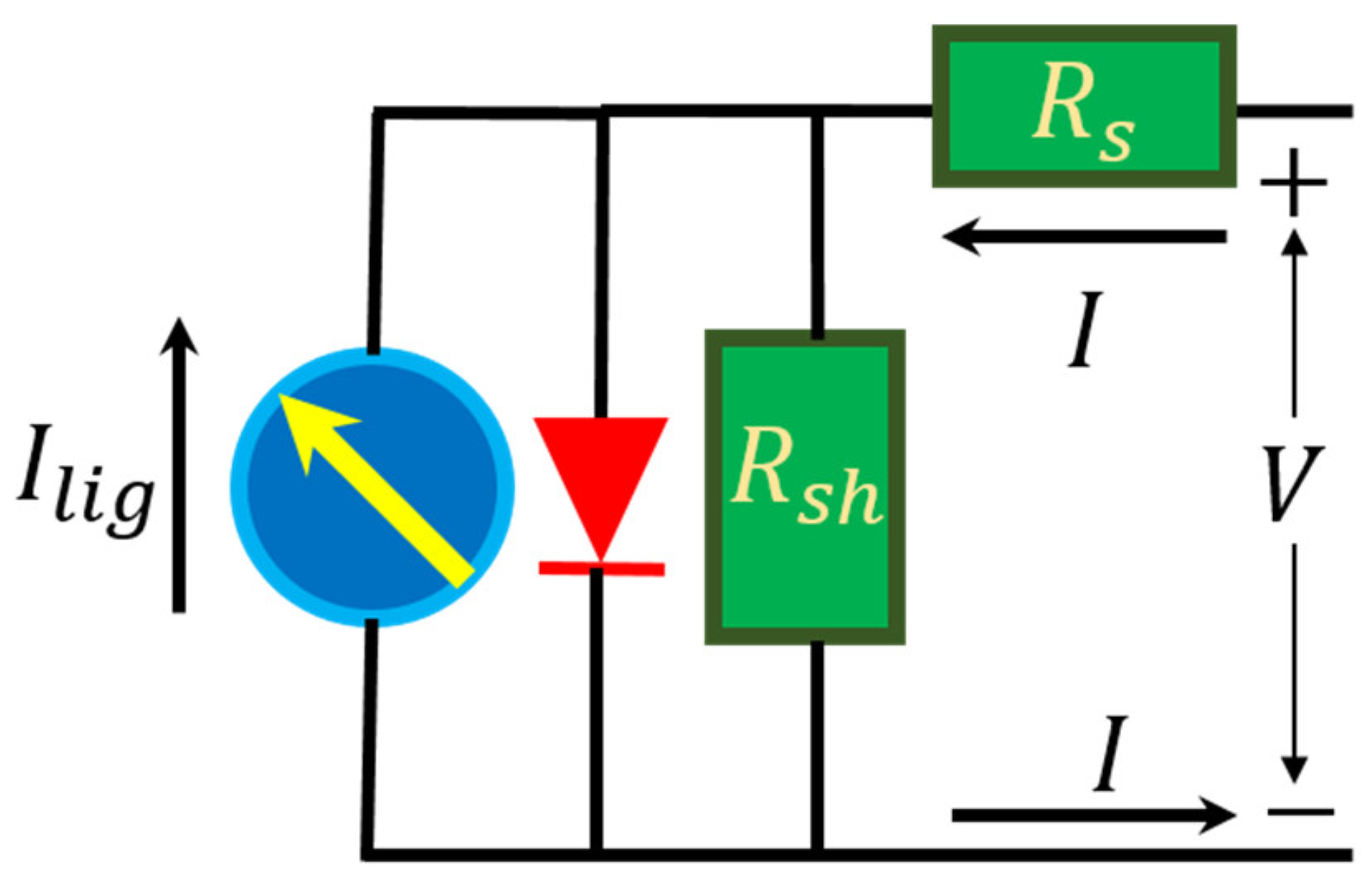
For completeness purposes, first, the one-diode photovoltaic model circuit and the IV equation of the one-diode photovoltaic model are given in Figure 1 and in Equation (1) [7]. An overview of the Ortiz–Conde et al. method [35] is given afterwards.
I = I s a t e x p V I R s n k T 1 + V I R s R s h I l i g
Ortiz–Conde et al. proposed, in 2006, the Co-Content C C V , I function as follows [35]:
C C V , I =   0 V I I s c d V ,  
where I s c = I V = 0 is the short-circuit current.
In their study, they proved that after performing polynomial fitting of Equation (2) to the next second-degree polynomial in two variables, namely V and I I S C ,
C V 0 + C V 1 V + C V 2 V 2 + C I 1 I I S C + C I 2 I I S C 2 + C I 1 V 1 V I I S C ,  
Rs, Rsh, n, and Ilig parameters could be extracted from the regression constants C V 1 , C I 1 , C V 2 , and C I 2 using the following [35]:
R s h = 1 2 C V 2 ,
R s = A 1 4 C V 2 ,
n = C V 1 A 1 + 4 C I 1 C V 2 4 V t h C V 2 ,   a n d
I l i g = 1 + A C V 1 + I s c 2 2 C I 1 C V 2 ,
where V t h = k T is the thermal velocity, whilst T the absolute temperature, k the Boltzmann constant, and A = 1 + 16 C I 2 C V 2 .
Isat is then computed by evaluating the following:
I s a t = B I + I l i g V I R s R s h ,
at the largest possible V (see Section 4 in [7] for explanation).
The function B is given by B = 1 e x p ( ( V I R s ) / n k T ) 1 .
The expressions for the first-order errors of Rs, Rsh, n, and Ilig, i.e., R s , R s h , n , and I l i g , as function of the standard deviations of C V 0 , C V 1 , C V 2 , C I 1 , C I 2 , C V 1 I 1 , i.e., C V 0 , C V 1 , C V 2 , C I 1 , C I 2 , and C V 1 I 1 were deduced in Section 3.2 in [34], and are given by the following:
R s h = C V 2 2 C V 2 2 ,
R s = 1 2 A 1 + 8 C V 2 C I 2 A C V 2 2 C V 2 + 8 C I 2 A ,
n = A 1 4 V t h C V 2 C V 1 + C V 1 A 1 + 8 C V 2 C I 2 4 V t h A C V 2 C V 2 + 1 V t h C I 1 + 2 C V 1 A V t h C I 2 ,
I l i g = 1 + A 2 C V 1 4 C I 2 C V 1 + I s c A + 2 C I 1 C V 2 2 C V 2 C I 1 4 C V 1 + I s c C V 2 A C I 2 ,
while the first error of Isat, i.e., I s a t , was deduced in Section 2 in the following [38]:
I s a t = B 1 + R s R s h R s n k T B + 1 I + I l i g V I R s R s h I + B I l i g + B I 1 R s B + 1 n k T I + I l i g V I R s R s h R s + B V I R s R s h 2 R s h B B + 1 I R s n 2 k T I + I l i g V I R s R s h n ,
where I is the amperemeter precision.
The application of the Ortiz–Conde et al. method [35] is given in the next section.

3. IV Computation and Their Mathematical Analysis

The IV simulated curves used in this article were built using the C program reported in [7]. The photovoltaic device parameters used in this article were n = 2.5 , Rsh = 1 kΩ, Rs = 1 Ω, Ilig = 1 mA, and Isat = 1 µA, in the [0 V, 1 V] voltage range. Rsh, Rs, Isat, and Ilig are powers of 10 to facilitate comparison with the extracted photovoltaic device parameters from the program; at the same time, in general, second-generation laboratory-made photovoltaic devices have this tendency in these parameters: Rsh and Ilig are three orders of magnitude larger than Rs and Isat, respectively [48,49,50,51,52,53,54,55,56,57,58,59,60,61,62,63,64,65,66,67,68,69]. As a first step, the IV curves were simulated noiseless, i.e., p n = 0 % , and then, a second group of IV curves was built, adding p n = 0.001 % , 0.005%, 0.01%, 0.05%, 0.1%, and 0.5% of I m a x = I V = 1 V = 209.61   mA to evaluate the accuracy of the program, extracting the photovoltaic device parameters IV curves. The expression for adding the noise is as follows:
I w i t h   n o i s e = I w i t h o u t   n o i s e + r × p n × I m a x
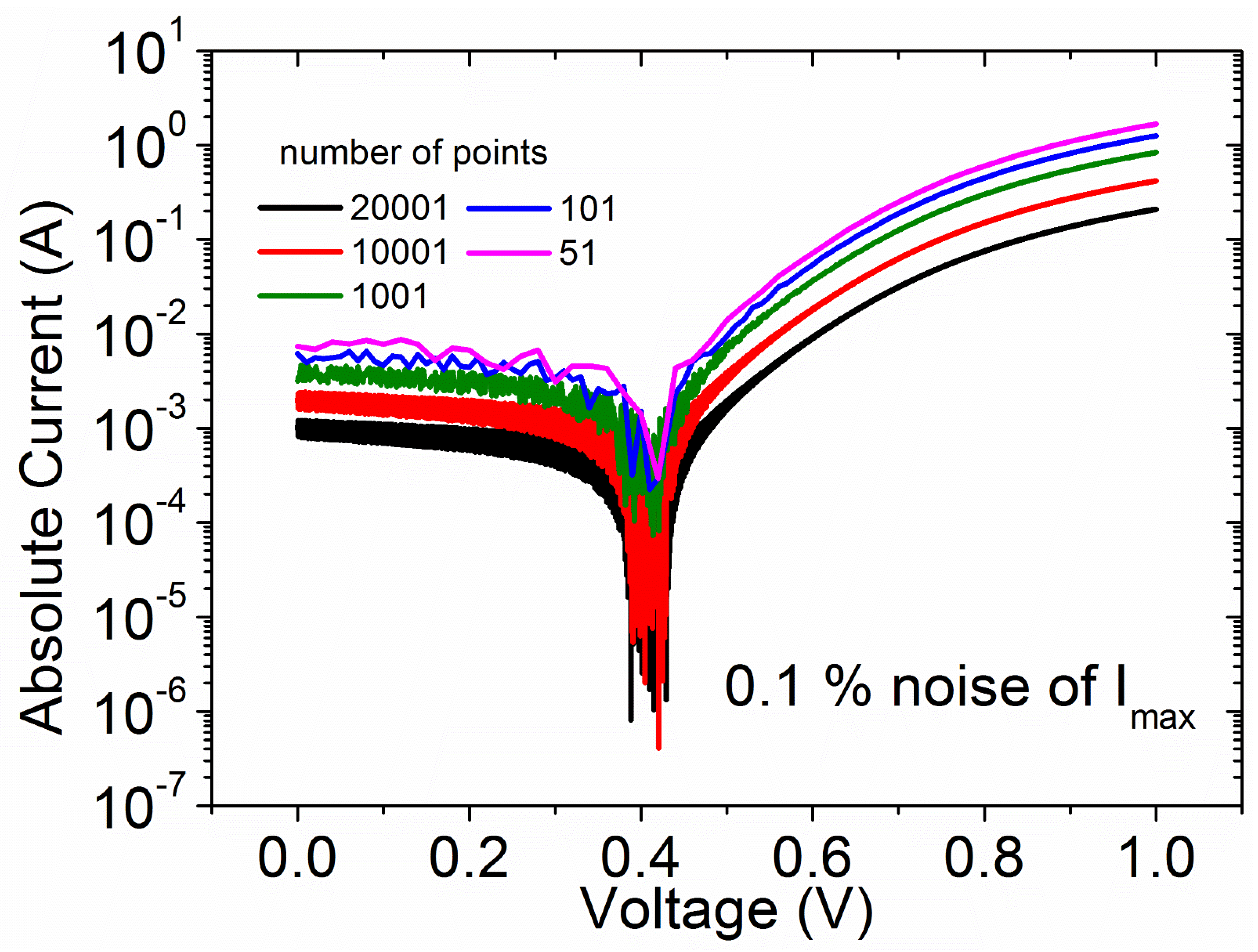
where r is a random number between −1 and 1. An example of some of the IV curves, with a p n = 0.1% of I m a x is shown in Figure 2.
Let us assume that we deal with an IV data set of N data pairs, i.e., { V i ,   I i   w i t h   i = 0 ,   1 ,   ,   N 1 } . In this manuscript, the first data point is indexed as zero, meaning that the last data point is the N − 1 point.
The first IV data point is V 0 = 0   V ,   I 0 = I s c , and then the program calculates I s c as this first I data point, and, at the same time, the program computes the voltage step, i.e., V as V =   V 1   V 0 . This explains why one of the conditions of the IV data text file is that all the voltage points must be equally spaced (see text below for further details), as the program calculates V using this expression, and presumes it to be of constant value through the whole computation. In following step, the program calculates I I s c as   I I s c i = I i I s c .
The program then computes C C V , I . For C C 0 , its value is assigned to zero, as it is the integral form 0 V to 0 V (see Equation (2)):
C C 0 = 0 .
The next value, C C 1 , is calculated using the trapezoidal integration formula [70]:
C C 1 = C C 0 +   I I s c 1   +     I I s c 0   2 V ,
while the Newton–Cotes quadrature formula [70] is used to calculate C C 2 :
C C 2 = C C 0 +   V 3   I I s c 2 + 4   I I s c 1 +   I I s c 0 ,  
It continues, calculating C C 3 using the 3/8 integration rule [70]:
C C 3 = C C 0 +   3 V 8   I I s c 3 + 3   I I s c 2 + 3   I I s c 1 +   I I s c 0 ,  
The Boole’s formula [70] is used to compute C C 4 :
C C 4 = C C 0 +   2 V 45 7   I I s c 4 + 32   I I s c 3 + 12   I I s c 2 + 32   I I s c 1 + 7   I I s c 0 ,  
and for the C C 5 and C C 6 cases, the Simpson fifth- and sixth-order integration methods [70] are used, respectively, as follows:
C C 5 = C C 0 +   5 V 288 19   I I s c 5 + 75   I I s c 4 + 50   I I s c 3 + 50   I I s c 2 + 75   I I s c 1 + 19   I I s c 0 , a n d
C C 6 = C C 0 + V 140 41   I I s c 6 + 216   I I s c 5 + 27   I I s c 4 + 272   I I s c 3 + 27   I I s c 2 + 216   I I s c 1 + 41   I I s c 0 ,
Finally, the subsequent ones are calculated using the Simpson seventh-order integration [70]
C C i = C C 0 + 7 V 17280 751   I I s c i + 3577   I I s c i 1 + 1323   I I s c i 2 + 2989   I I s c i 3 + 2989   I I s c i 4 + 1323   I I s c i 5 + 3577   I I s c i 6 + 751   I I s c i 7 ,
for values i = 7 ,   ,   N 1 .
A numerical example on the implementation of this integration procedure can be found in the Supplementary Material, where the polynomial fitting of C C V , I to C V 0 + C V 1 V + C V 2 V 2 + C I 1 I I s c + C I 2 I I s c 2 + C I 1 V 1 V I I s c , to obtain C V 0 , C V 1 , C V 2 , C I 1 , C I 2 , and C I 1 V 1 , is explained. At the same time, a diagram flow of the program, as the numerical computational steps, can be found in the Supplementary Material, together with a summary of the conditions the IV data text file should have to be properly read by the program.
The program was run in IV data files containing 8, 9, 10, 11, 19, 26, 38, 51, 64, 76, 101, 251, 501, 751, 1,001, 2,501, 5,001, 7,501, 10,001, 12,501, 15,001, 17,501, and 20,001 data points for the no noise case, and p n = 0.001 % , 0.005 % , 0.01 % , 0.05%, and 0.1% of I m a x added noise, provided in the Supplementary Material. The results were compared to those obtained using the trapezoidal integration method in the following section to study the accuracy of the five deduced photovoltaic device parameters.
The computational time the program requires for each of the previous number of data points is worth mentioning here. The program delivers the total computational time in the Results files (see Supplementary Material for further details), and when plotting it as a function of N , a parabolic relation expression, namely c o m p u t a t i o n a l   t i m e = 0.04 + 1.2 × 10 4 × N + 5.4 × 10 8 × N 2 , is obtained, in case the user does not request the vector and matrixes to be saved. This means that the computational time is around four and nineteen seconds, when N = 10001   and N = 20001 data points, respectively. However, in case the user decides to save the vectors and matrices related to the computational steps (see Supplementary Material for further details), the total computational time also shows a parabolic relation as function of N , and in this case, c o m p u t a t i o n a l   t i m e = 3.4 + 6 × 10 3 × N + ( 7.2 × 10 6 ) × N 2 , which means that for the cases N = 10001   and N = 20001 , the total computational time is 664 s = 11 min and 2764 s = 46 min, increasing abruptly compared with the former case. The user should be aware of the large increase in computational time when using the program, in case she/he decides to save the computational matrixes and vectors used by the program. Nevertheless, the duration of four and nineteen seconds, in case the user does not save the vectors and matrixes, is in striking contrast with the tenths of minutes required when implementing the trapezoidal integration method, as it has to be performed manually using software like Origin or Excell.

4. Results and Discussion

A compendium of the implementation of the program CCSimpsOrd7.exe is revealed in Table S1, available in the Supplementary Material, showing the C V 0   ± C V 0 ,   C V 1 ± C V 1 ,   C V 2 ± C V 2 , C I 1 ± C I 1 ,   C I 2 ± C I 2 and C V 1 I 1 ± C V 1 I 1 together with the calculated R s ± R s , R s h ± R s h ,   n ± n ,   I l i g ± I l i g ,   I s a t ± I s a t in the case of noiseless IV curves.
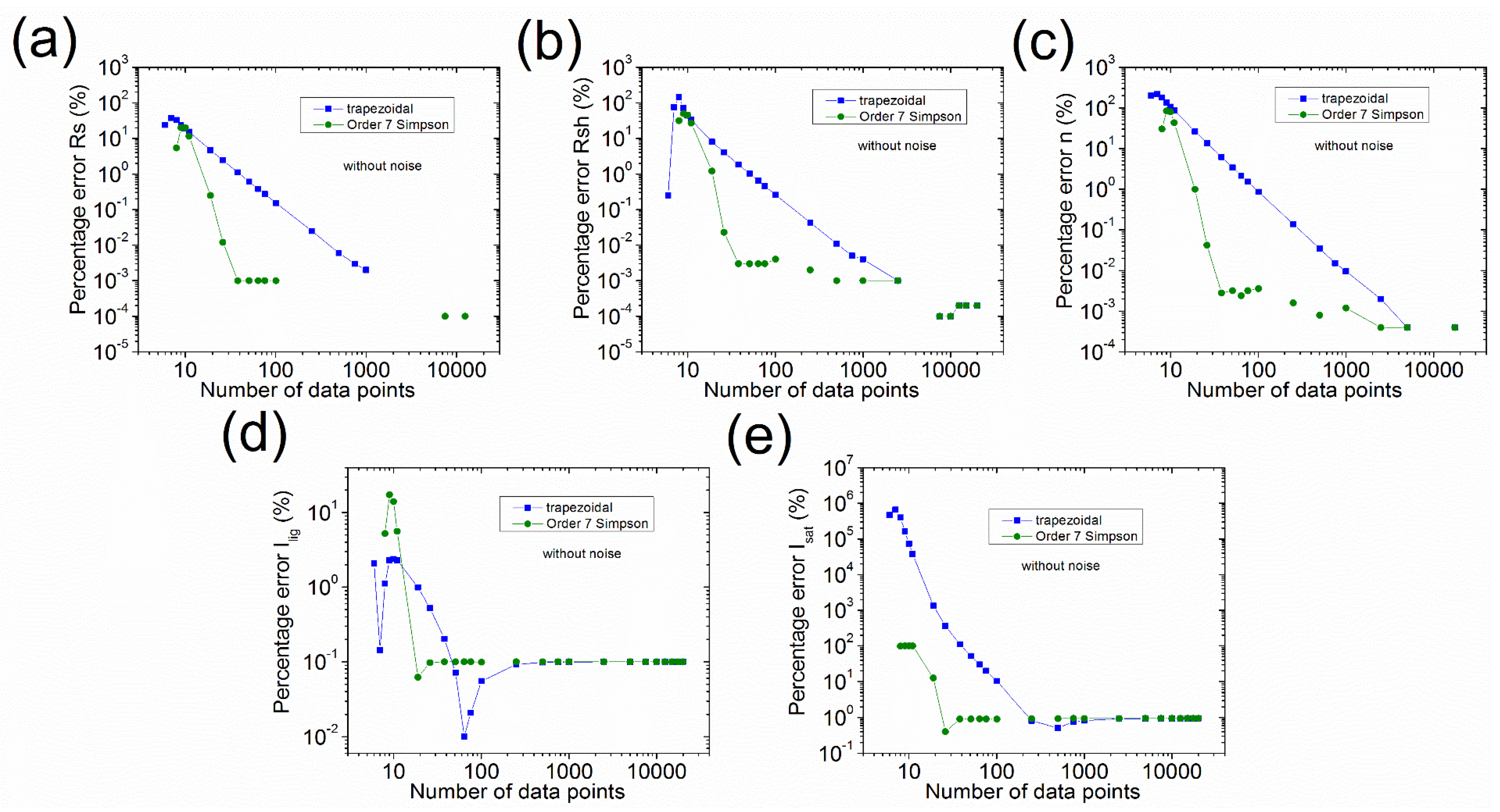
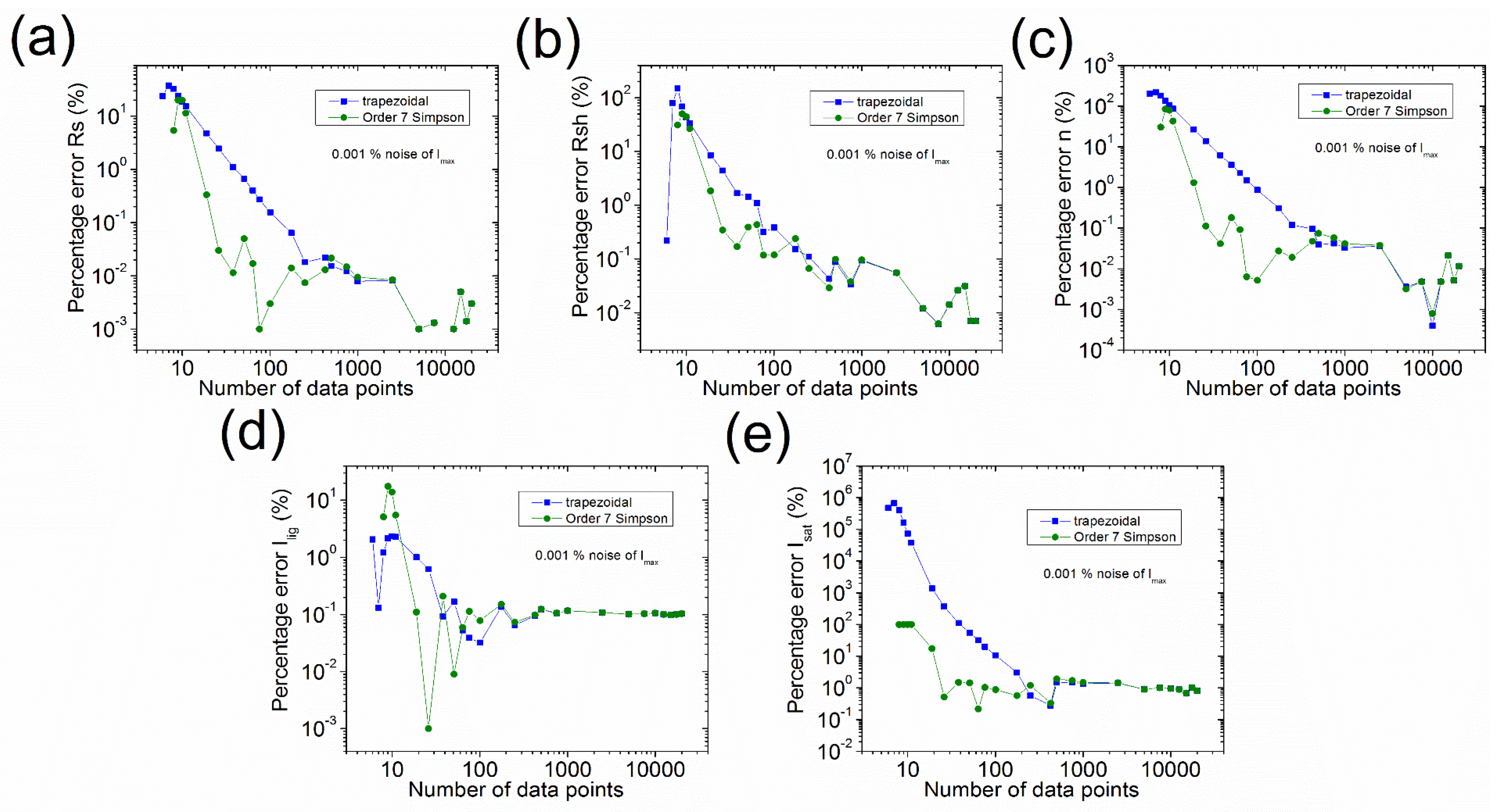
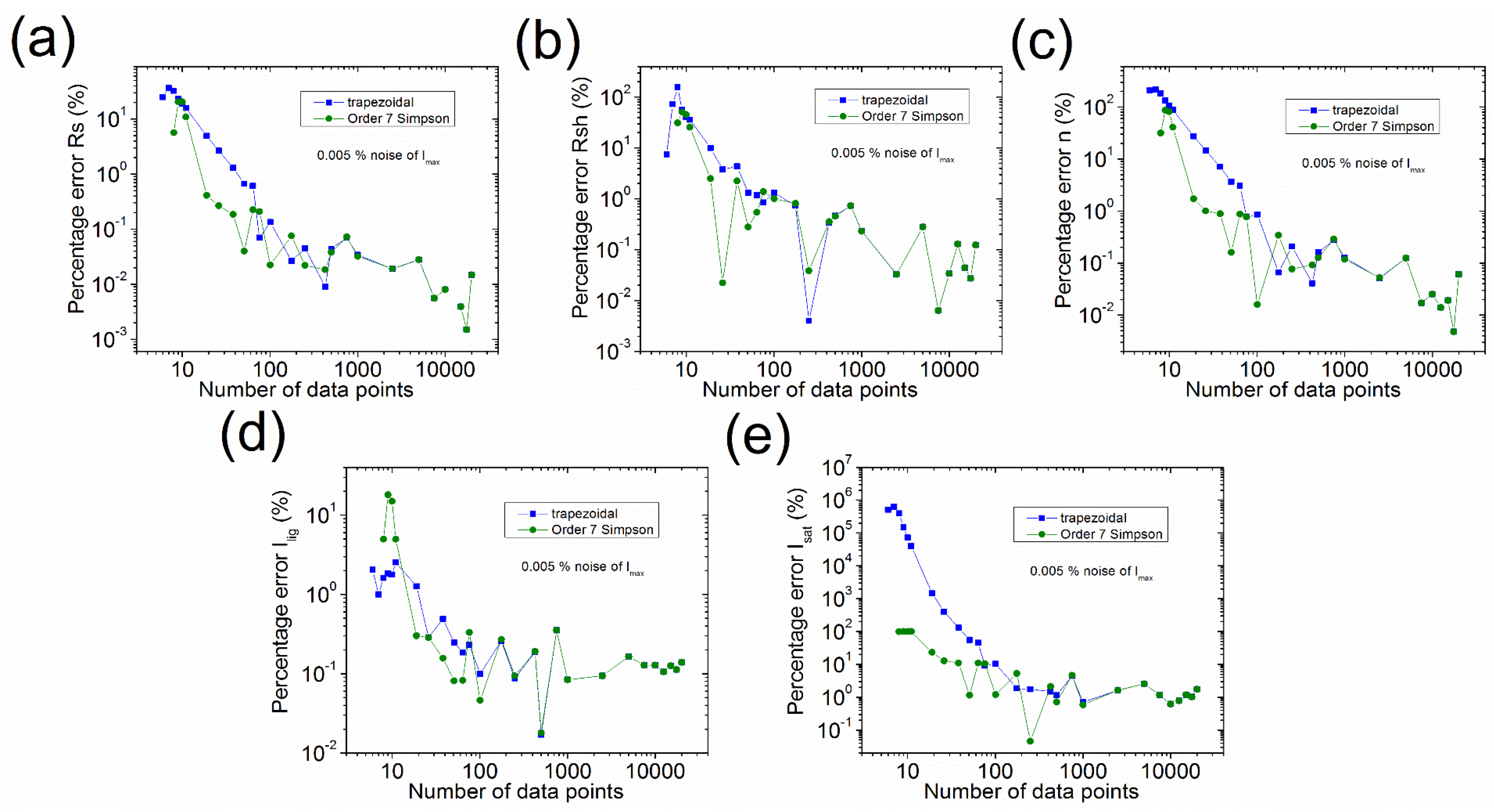
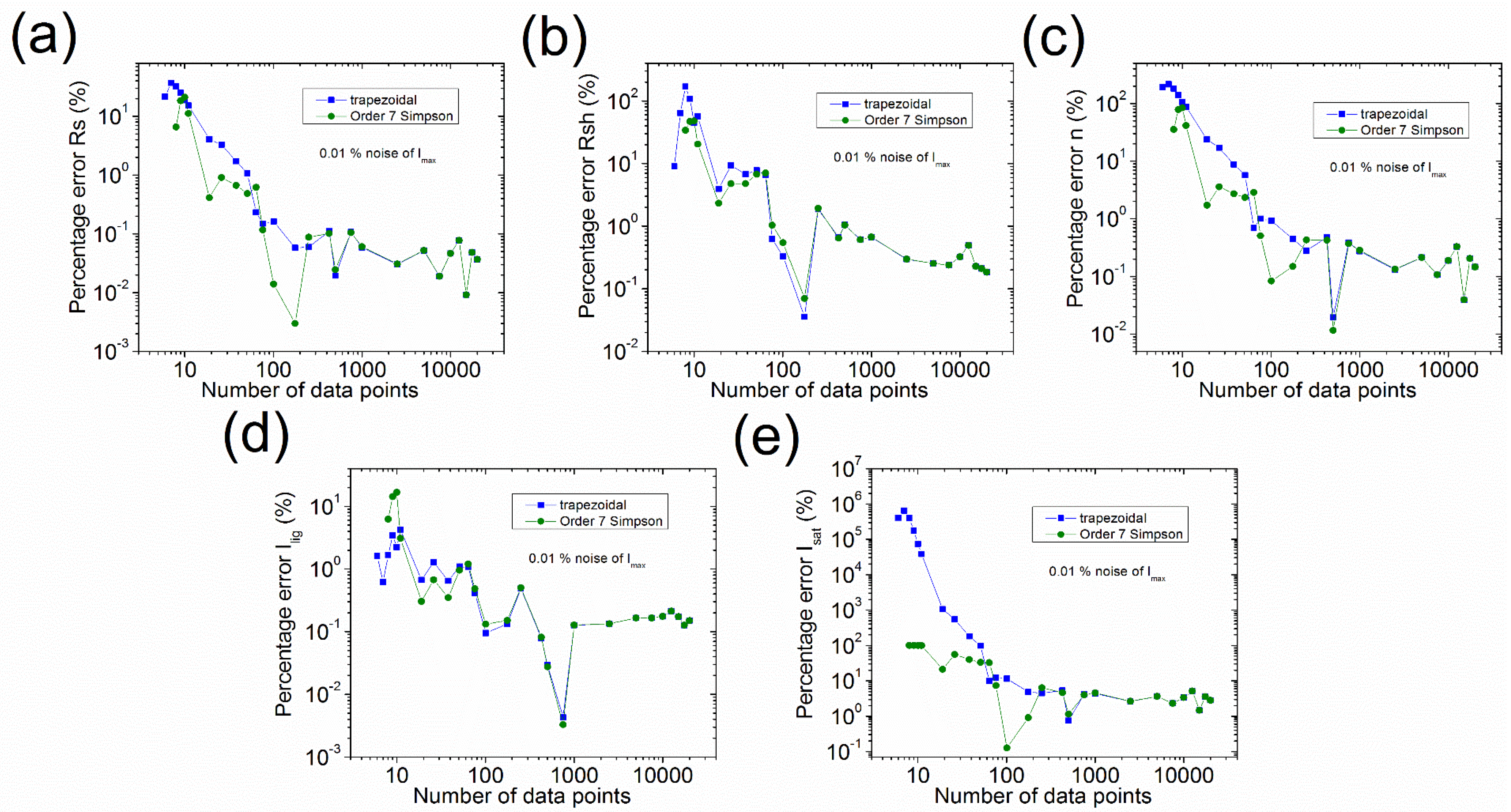
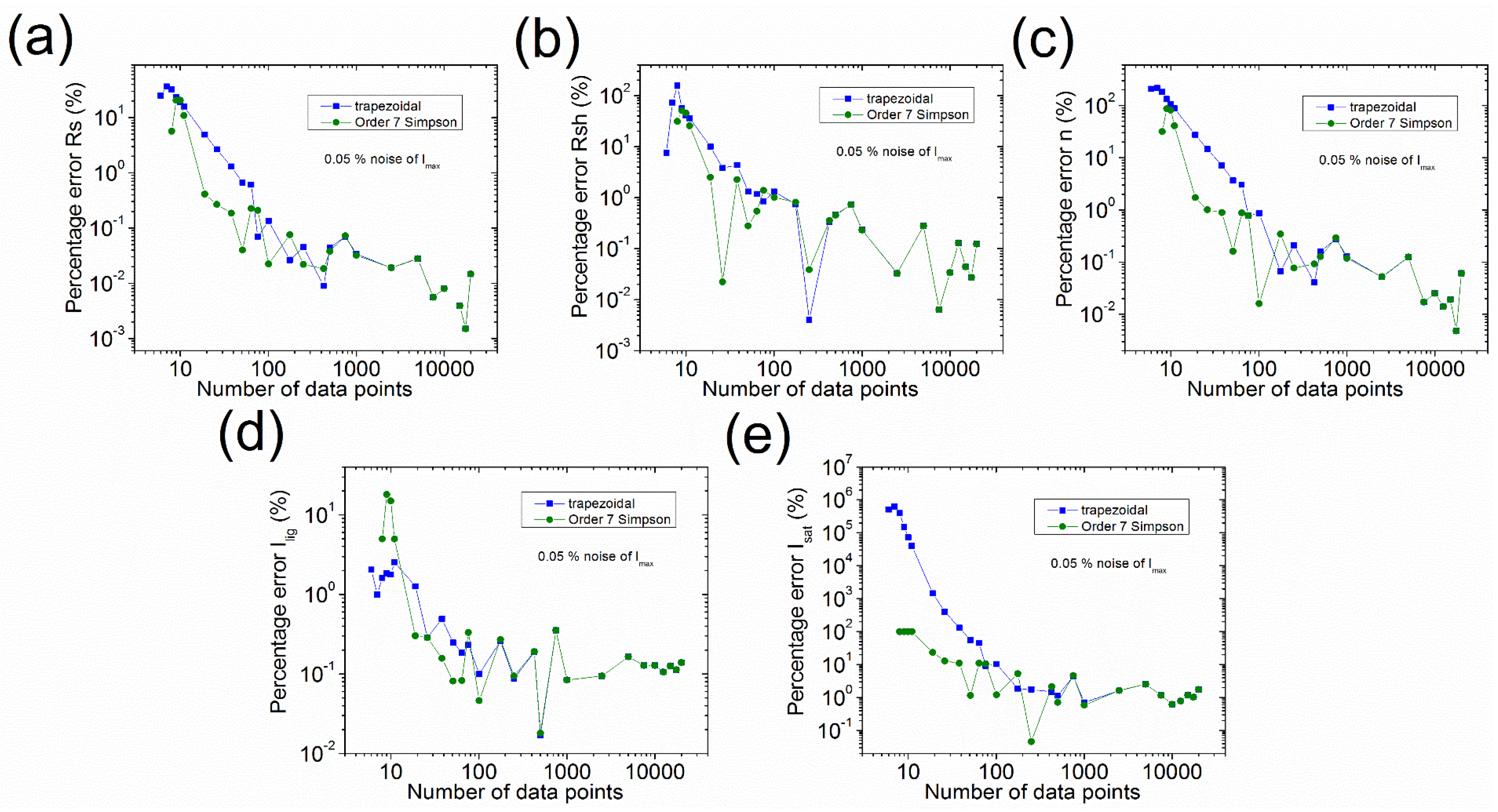
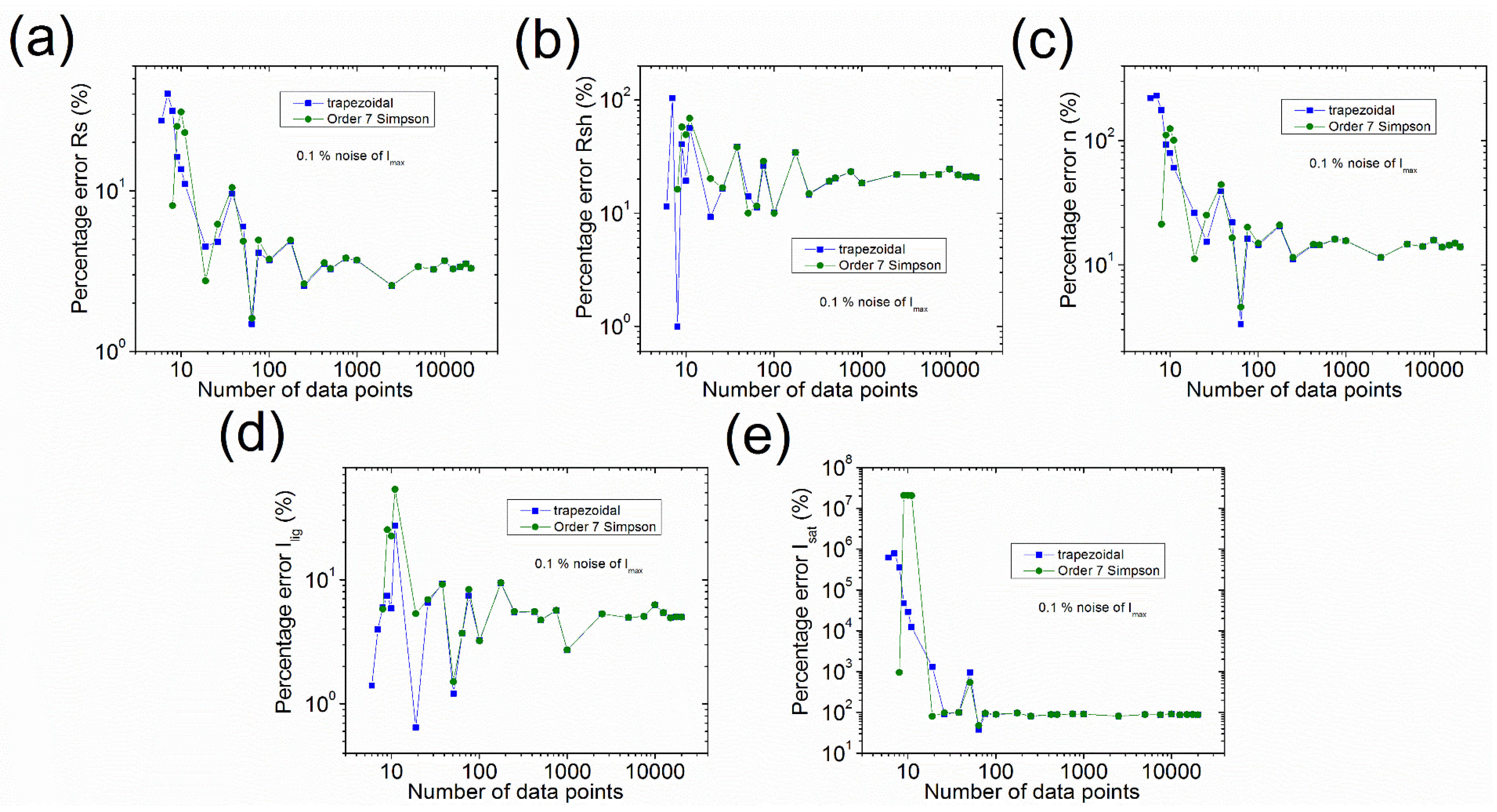
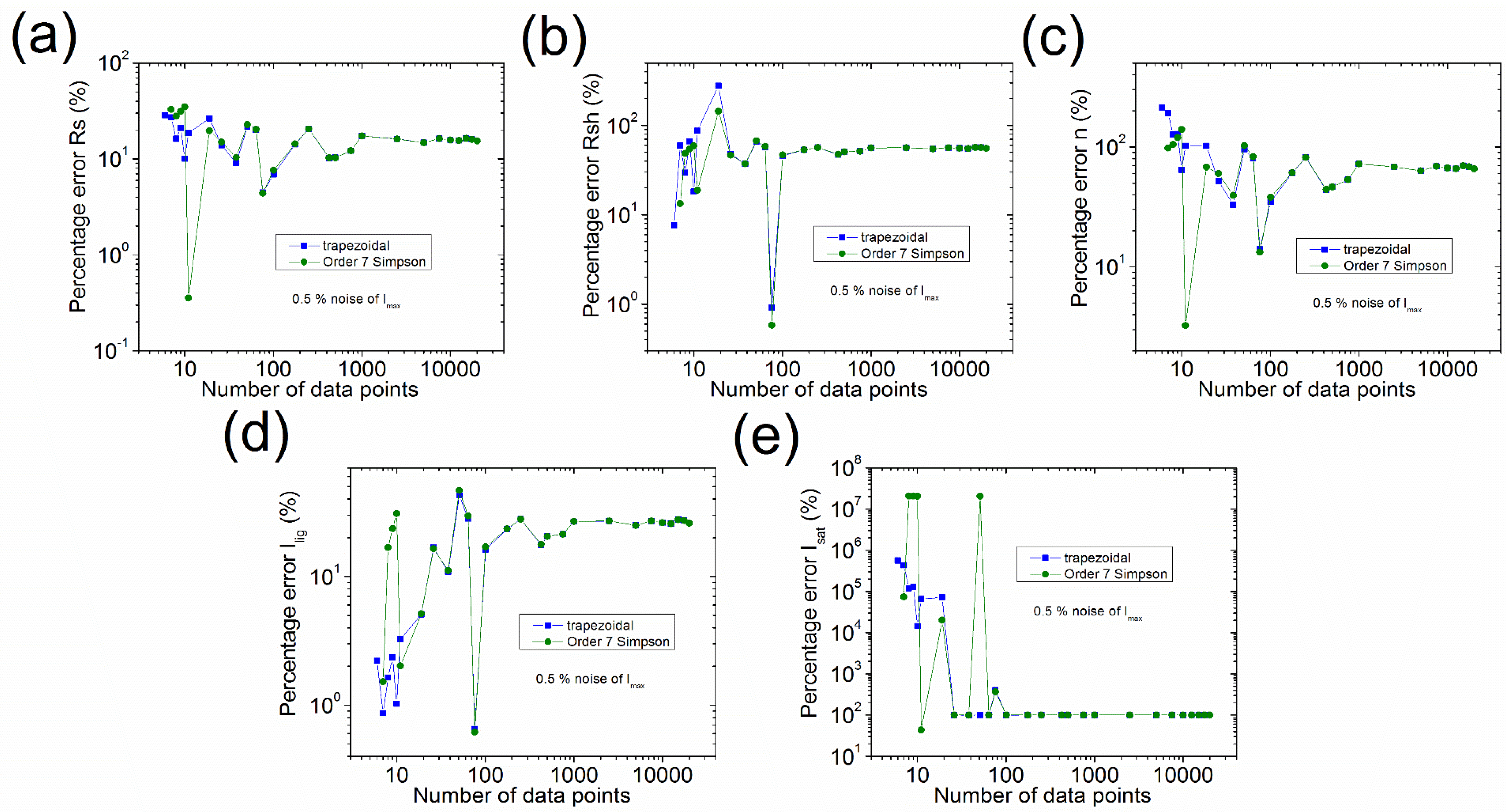
The percentage errors, relative to the original values of n = 2.5 , Rs = 1 Ω, Rsh = 1 kΩ, Isat = 1 µA, and I p h = 1 mA of the results reported in Table S1, are plotted in Figure 3 in green colour. Also, for comparison purposes, the percentage errors using the trapezoidal integration method provided by the software Origin are shown in blue colour. In Figure 4, Figure 5, Figure 6, Figure 7, Figure 8 and Figure 9, the percentage errors for the cases of p n = 0.001 % , 0.005 % , 0.01 % , 0.05%, 0.1%, and 0.5% of I m a x are exposed, respectively.
As seen from Table S1 and Figure 3, reasonable parameter extraction was achieved using the seventh-order Simpson integration method in the case of noise case, obtaining the five solar cell parameters with less than 1% error, and with just N 26 ; in the case where the trapezoidal integration method was used, at least N 251 was needed to extract all the five photovoltaic device parameters. Something similar happens in the case of p n = 0.001%, 0.005%, 0.01%, and 0.05 of I m a x , for R s , R s h , n, and Ilig (see Figure 4, Figure 5, Figure 6 and Figure 7): they can be extracted with 1% error or less, with just N 26 ; however, when it comes to Isat, it is necessary to have at least N 101 . For these p n cases, in case the trapezoidal integration method is used, it is necessary that N 751 to deduce all the five solar cell parameters with less than 1% error. Clearly, for these values of p n , the seventh-order integration method clearly yields more accurate values, with smaller values of N.
For the case of p n = 0.1% and 0.5% of I m a x (see Figure 8 and Figure 9), the seventh-order Simpson integration method does not give any benefit compared to using the trapezoidal integration method, and the percentage errors of R s , R s h , n, Ilig, and Isat converge to 3%, 7%, 20%, 7%, and 100% in the case of p n = 0.1%, and to 12%, 70%, 180%, 30%, and 100% in the case of p n = 0.5%, for values of N 251 . In general, the trapezoidal integration method and the seventh-order Simpson integration yield the same results for N 501 , which suggest that 501 is the optimum number of points.
The reader should notice that results reported in this article are valid for the one-diode photovoltaic device model. They are not necessarily valid for other models.

5. Conclusions

The seventh-order Simpson integration method has been implemented in an executable program to more accurately compute the Co-Content function, and to extract with more precision the five photovoltaic device parameters, together with their standard deviations. It has been tested in ideal (noiseless) IV curves and IV curves with p n = 0.001%, 0.005%, 0.01%, 0.05%, 0.1%, and 0.5% noise of the maximum current. Excellent parameter extraction is obtained for R s , R s h , n, and Ilig, for the cases of p n < 0.05%, with less than 1% error, with just N 26 for R s , R s h , n, and Ilig, and N 101 for Isat, respectively, in contrast with a value of N 751 , in case the trapezoidal integration method is used. For the case of p n = 0.1% and 0.5%, it is not possible to extract the five photovoltaic device parameters with less than 1% error: when p n 0.1%, both trapezoidal and Simpson seventh-order integration practically yield the same accuracy; nevertheless, the program still outstands the trapezoidal integration regarding computational time, as it achieves the extraction in nineteen seconds or less, while the trapezoidal integration method has to be implemented manually in software like Origin, requiring at least tenths of minutes.
In future studies, other integration methods, such as Gauss quadrature, Monte Carlo integration, or higher-order Simpson integration, should be investigated. It is expected that higher-order Simpson integration, such as eighth-order, should yield a more accurate calculation of the Co-Content function and more accurate photovoltaic device parameter extraction.
The reader should be aware that the results reported in this article are valid for the one-diode solar cell model and might not be valid for other models.
It is expected that the program provided in this article will provide the photovoltaic solar energy research community with a useful tool to obtain the five photovoltaic device parameters in a fast and precise way, which will help them to research and obtain more efficient photovoltaics devices.

Supplementary Materials

The following supporting information can be downloaded at https://www.mdpi.com/article/10.3390/a19010017/s1. References [70,71,72] are cited in supplementary file.

Author Contributions

V.-T.R.-K.: conceptualization; data curation; formal analysis; investigation; methodology; resources; software; visualization; writing—original draft preparation; writing—review and editing. All authors have read and agreed to the published version of the manuscript.

Funding

This research was funded by Newton Funds (grant ST/P003052/1).

Data Availability Statement

The data that support the findings of this study are available from the corresponding author upon reasonable request.

Acknowledgments

The scientific advice and support by Daniel Muenstermann, Robert James Young, the Newton Funds (grant ST/P003052/1), and Lancaster University is gratefully acknowledged.

Conflicts of Interest

The author has no conflicts to disclose.

References

  1. McLaughlin, C.M.; Yuning, S.; Viswanathan, V.; Sawers, R.J.H.; Kemanian, A.R.; Lasky, J.R. Maladaptation in cereal crop landraces following a soot-producing climate catastrophe. Nat. Commun. 2025, 16, 4289. [Google Scholar] [CrossRef]
  2. Rosa, P.B.Z.; de Oliveira, G.M.; Pimentel, M.; Schuch, M.; Wolf, J. Climate catastrophe in Rio Grande do Sul, Brazil: Impact of strategic actions in response to flooding. BMC Res. Notes 2025, 18, 56. [Google Scholar] [CrossRef] [PubMed]
  3. Batibeniz, F.; Seneviratne, S.I.; Jha, S.; Ribeiro, A.; Suarez-Gutierrez, L.; Raible, C.C.; Malhotra, A.; Armstrong, B.; Bell, M.L.; Lavigne, E.; et al. Rapid climate action is needed: Comparing heat vs. COVID-19-related mortality. Sci. Rep. 2025, 15, 1002. [Google Scholar] [CrossRef] [PubMed]
  4. Buchanan, M. How to plot the climate catastrophe. Nat. Phys. 2023, 19, 301. [Google Scholar] [CrossRef]
  5. Peñuelas, J.; Nogué, S. Catastrophic climate change and the collapse of human societies. Natl. Sci. Rev. 2023, 10, nwad082. [Google Scholar] [CrossRef]
  6. Kriegler, E. On the verge of dangerous anthropogenic interference with the climate system? Environ. Res. Lett. 2007, 2, 011001. [Google Scholar] [CrossRef]
  7. Kim, S.-H.; Kryjov, V.N.; Ahn, J.-B. The roles of global warming and Arctic Oscillation in the winter 2020 extremes in East Asia. Environ. Res. Lett. 2022, 17, 065010. [Google Scholar] [CrossRef]
  8. Razykov, T.; Ferekides, C.; Morel, D.; Stefanakos, E.; Ullal, H.S.; Upadhyaya, H.M. Solar photovoltaic electricity: Current status and future prospects. Sol. Energy 2011, 85, 1580. [Google Scholar] [CrossRef]
  9. Brugger, H.; Eichhammer, W.; Mikova, N.; Dönitz, E. Energy Efficiency Vision 2050: How will new societal trends influence future energy demand in the European countries? Energy Policy 2021, 152, 112216. [Google Scholar] [CrossRef]
  10. Diesing, A.; Hanto, J.; Löffler, K. Unlocking solar and hydrogen potentials: A comparative analysis of solar tracking systems for South Africa’s energy transition. Renew. Energy 2026, 256, 124066. [Google Scholar] [CrossRef]
  11. Evro, S.; Alamooti, M.; Tomomewo, O.S. Quantifying the global energy transition: A policy-ready framework linking renewable deployment and emissions outcomes. Renew. Sustain. Energy Rev. 2026, 225, 116189. [Google Scholar] [CrossRef]
  12. Rangel-Kuoppa, V.-T.; Albor-Aguilera, M.-D.-L.; Hérnandez-Vásquez, C.; Flores-Márquez, J.-M.; González-Trujillo, M.-Á.; Contreras-Puente, G.-S. Shunt resistance and saturation current determination in CdTe and CIGS solar cells. Part 1: A new theoretical procedure and comparison with other methodologies. Semicond. Sci. Technol. 2018, 33, 45007. [Google Scholar] [CrossRef]
  13. Meyer, L. Extraction of saturation current and ideality factor from measuring Voc and Isc of photovoltaic modules. Int. J. Photoenergy 2017, 2017, 8479487. [Google Scholar] [CrossRef]
  14. Rodríguez-Martínez, X.; Pascual-San-José, E.; Fei, Z.; Heeney, M.; Guimera, R.; Campoy-Quiles, M. Predicting the photocurrent–composition dependence in organic solar cells. Energy Environ. Sci. 2021, 14, 986. [Google Scholar] [CrossRef]
  15. Singh, N.S.; Jain, A.; Kapoor, A. Determination of the solar cell junction ideality factor using special trans function theory (STFT). Sol. Energy Mater. Sol. Cells 2009, 93, 1423. [Google Scholar] [CrossRef]
  16. Müller, T.C.M.; Pieters, B.E.; Rau, U.; Kirchartz, T. Analysis of the series resistance in pin-type thin-film silicon solar cells. J. Appl. Phys. 2013, 113, 134503. [Google Scholar] [CrossRef]
  17. Turek, M. Current and illumination dependent series resistance of solar cells. J. Appl. Phys. 2014, 115, 144503. [Google Scholar] [CrossRef]
  18. Gayen, R.N.; Chakrabarti, T. Effect of series and shunt resistance on the photovoltaic properties of solution-processed zinc oxide nanowire based CZTS solar cell in superstrate configuration. Mater. Sci. Semicond. Process 2019, 100, 1–7. [Google Scholar] [CrossRef]
  19. Celik, A.N.; Acikgoz, N. Modelling and experimental verification of the operating current of mono-crystalline photovoltaic modules using four- and five-parameter models. Appl. Energy 2007, 84, 1–15. [Google Scholar] [CrossRef]
  20. Brano, V.L.; Orioli, A.; Ciulla, G.; Gangi, A.D. An improved five-parameter model for photovoltaic modules. Sol. Energy Mater. Sol. Cells 2010, 94, 1358. [Google Scholar] [CrossRef]
  21. Arcipiani, B. Generalization of the area method for the determination of the parameters of a non-ideal solar cell. Rev. Phys. Appl. 1985, 20, 269. [Google Scholar] [CrossRef]
  22. Zhang, C.; Zhang, J.; Hao, Y.; Lin, Z.; Zhu, C. A simple and efficient solar cell parameter extraction method from a single current-voltage curve. J. Appl. Phys. 2011, 110, 064504. [Google Scholar] [CrossRef]
  23. El-Adawi, M.; Al-Nuaim, I. A method to determine the solar cell series resistance from a single J-V characteristic curve considering its shunt resistance—New approach. Vacuum 2001, 64, 33. [Google Scholar] [CrossRef]
  24. Aberle, A.; Wenham, S.; Green, M.A. New method for accurate measurements of the lumped series resistance of solar cells. In Proceedings of the Twenty Third IEEE Photovoltaic Specialists Conference—1993 (Cat. No.93CH3283-9), Louisville, KY, USA, 10–14 May 1993; pp. 133–139. [Google Scholar]
  25. Araujo, G.I.; Sanchez, E. A new method for experimental determination of the series resistance of a solar cell. IEEE Trans. Electron Devices 1982, 29, 1511. [Google Scholar] [CrossRef]
  26. Lal, M.; Sing, S. A new method of determination of series and shunt resistances of silicon solar cells. Sol. Energy Mater. Sol. Cells 2007, 91, 137. [Google Scholar] [CrossRef]
  27. Cotfas, D.; Cotfas, P.; Kaplanis, S.; Ursutiu, D. Results on series and shunt resistances in a c-Si PV cell. Comparison using existing methods and a new one. J. Optoelectron. Adv. Mater. 2008, 10, 3124. [Google Scholar]
  28. Bowden, S.; Rohatgi, A. Rapid and accurate determination of series resistance and fill factor losses in industrial silicon solar cells. In Proceedings of the 17th European Photovoltaic Solar Energy Conference and Exhibition, Munich, Germany, 22–26 October 2001; p. 22. [Google Scholar]
  29. Khan, F.; Baek, S.-H.; Kim, J.H. Intensity dependency of photovoltaic cell parameters under high illumination conditions: An analysis. Appl. Energy 2014, 133, 356. [Google Scholar] [CrossRef]
  30. Tivanov, M.; Patryn, A.; Drozdov, N.; Fedotov, A.; Mazanik, A. A Determination of solar cell parameters from its current-voltage and spectral characteristics. Sol. Energy Mater. Sol. Cells 2005, 87, 457. [Google Scholar] [CrossRef]
  31. Brano, V.I.; Ciulla, G. An efficient analytical approach for obtaining a five parameters model of photovoltaic modules using only reference data. Appl. Energy 2013, 111, 894. [Google Scholar] [CrossRef]
  32. Chan, D.; Philips, J.; Phang, J. A comparative study of extraction methods for solar cell model parameters. Solid-State Electron. 1986, 29, 329. [Google Scholar] [CrossRef]
  33. Rangel-Kuoppa, V.-T.; Albor-Aguilera, M.-D.-L.; Hérnandez-Vásquez, C.; Flores-Márquez, J.-M.; Jiménez-Olarte, D.; González-Trujillo, M.-Á.; Contreras-Puente, G.-S. Shunt resistance and saturation current determination in CdTe and CIGS solar cells. Part 2: Application to experimental IV measurements and comparison with other methods. Semicond. Sci. Techn. 2018, 33, 45008. [Google Scholar] [CrossRef]
  34. Rangel-Kuoppa, V.-T. Obtention of solar cell parameters, through convergence of iterative cycles: Part 2: Application to experimental current-voltage measurements. Heliyon 2002, 8, e10548. [Google Scholar] [CrossRef]
  35. Ortiz-Conde, A.; Sánchez, F.J.G.; Muci, J. New method to extract the model parameters of solar cells from the explicit analytic solutions of their illuminated I–V characteristics. Sol. Energy Mater. Sol. Cells 2006, 90, 352. [Google Scholar] [CrossRef]
  36. Cheung, S.K.; Cheung, N.W. Extraction of Schottky diode parameters from forward current-voltage characteristics. Appl. Phys. Lett. 1986, 49, 85. [Google Scholar] [CrossRef]
  37. Rangel-Kuoppa, V.-T. Solar cell parameter accuracy improvement, via refinement of the Co-Content function. Part 2: Discussion on the experimental application. Eng. Res. Express 2002, 4, 015020. [Google Scholar] [CrossRef]
  38. Rangel-Kuoppa, V.-T. A more accurate Co-Content function calculation, using alternative integration methods, for Current–Voltage curves measured in the zero volt to open-circuit voltage range. Discov. Energy 2024, 4, 20. [Google Scholar] [CrossRef]
  39. Rangel-Kuoppa, V.-T. Refinement of the Co-Content function, through an integration of a polynomial fit of IIsc Part 1 theoretical analysis and proposal. Discov. Electron. 2024, 1, 37. [Google Scholar] [CrossRef]
  40. van Reenen, S.; Kemerink, M.; Snaith, H.J. Modeling anomalous hysteresis in perovskite solar cells. J. Phys. Chem. Lett. 2015, 6, 3808. [Google Scholar] [CrossRef]
  41. Richardson, G.; O’Kane, S.E.J.; Niemann, R.G.; Peltola, T.A.; Foster, J.M.; Cameron, P.J.; Walker, A.B. Can slow-moving ions explain hysteresis in the current-voltage curves of perovskite solar cells. Energy Environ. Sci. 2016, 9, 1746. [Google Scholar] [CrossRef]
  42. Courtier, N.E.; Cave, J.M.; Walker, A.B.; Richardson, G.; Foster, J.M. IonMonger: A free and fast planar perovskite solar cell simulator with coupled ion vacancy and charge carrier dynamics. J. Comput. Electron. 2019, 18, 1435. [Google Scholar] [CrossRef]
  43. Courtier, N.E.; Cave, J.M.; Walker, A.B.; Richardson, G. How transport layer properties affect perovskite solar cell performance: Insights from a coupled charge transport/ion migration model. Energy Environ. Sci. 2019, 12, 396. [Google Scholar] [CrossRef]
  44. Lin, Z. Relationship between ion vacancy mobility and hysteresis of perovskite solar cells. Chem. Phys. 2022, 554, 111422. [Google Scholar] [CrossRef]
  45. Spampinato, C.; Calogero, G.; Mannino, G.; Valastro, S.; Smecca, E.; Arena, V.; La Magna, P.; Bongiorno, C.; Fazio, E.; Alberti, A. A Sputtered Gig-Lox TiO2 Sponge Integrated with CsPbI3:EuI2 for Semitransparent Perovskite Solar Cells. J. Phys. Chem. C 2025, 129, 16338. [Google Scholar] [CrossRef]
  46. Lin, Z. Effect of ion vacancy migration on open-circuit voltage of perovskite solar cells. Phys. Status Solidi A 2022, 19, 2100472. [Google Scholar] [CrossRef]
  47. Lin, Z. Influence of ion vacancy migration on short-circuit current of perovskite solar cells. Phys. Status Solidi A 2022, 219, 2200262. [Google Scholar] [CrossRef]
  48. Ruscello, M.; Sarkar, T.; Levitsky, A.; Matrone, G.M.; Droseros, N.; Schlisske, S.; Sachs, E.; Reiser, P.; Mankel, E.; Kowalsky, W.; et al. Nanocomposite of nickel oxide nanoparticles and polyethylene oxide as printable hole transport layer for organic solar cells. Sustain. Energy Fuels 2019, 3, 1418. [Google Scholar] [CrossRef]
  49. Sankaran, S.; Glaser, K.; Gartner, S.; Rodlmeier, T.; Sudau, K.; Hernandez-Sosa, G.; Colsmann, A. Fabrication of polymer solar cells from organic nanoparticle dispersions by doctor blading or ink-jet printing. Org. Electron. 2016, 28, 118. [Google Scholar] [CrossRef]
  50. Eckstein, R.; Hernandez-Sosa, G.; Lemmer, U.; Mechau, N. Aerosol jet printed top grids for organic optoelectronic devices. Org. Electron. 2014, 15, 2135. [Google Scholar] [CrossRef]
  51. Andrade-Arvizu, J.; Izquierdo-Roca, V.; Becerril-Romero, I.; Vidal-Fuentes, P.; Fonoll-Rubio, R.; Sánchez, Y.; Placidi, M.; Calvo-Barrio, L.; Vigil-Galán, O.; Saucedo, E. Is It Possible to Develop Complex S-Se Graded Band Gap Profiles in Kesterite-Based Solar Cells? ACS Appl. Mater. Interfaces 2019, 11, 32945. [Google Scholar] [CrossRef] [PubMed]
  52. Andrade-Arvizu, J.; Fonoll-Rubio, R.; Sánchez, Y.; Becerril-Romero, I.; Malerba, C.; Valentini, M.; Calvo-Barrio, L.; Izquierdo-Roca, V.; Placidi, M.; Vigil-Galán, O.; et al. Rear Band gap Grading Strategies on Sn–Ge-Alloyed Kesterite Solar Cells. ACS Appl. Energy Mater. 2020, 3, 10362. [Google Scholar] [CrossRef]
  53. Fonoll-Rubio, R.; Andrade-Arvizu, J.; Blanco-Portals, J.; Becerril-Romero, I.; Guc, M.; Saucedo, E.; Peiró, F.; Calvo-Barrio, L.; Ritzer, M.; Schnohr, C.S.; et al. Insights into interface and bulk defects in a high efficiency kesterite-based device. Energy Environ. Sci. 2021, 14, 507. [Google Scholar] [CrossRef]
  54. Aguilera, M.L.A.; Marquez, J.M.F.; Trujillo, M.A.G.; Vásquez, C.H.; Puente, G.C.; García, C.M.; Morales, G.R. Improving the optical and crystalline properties on CdS thin films growth on small and large area by using CBD technique. Rev. Mex. Fis. 2016, 62, 129. [Google Scholar]
  55. Marquez, J.M.F.; Aguilera, M.L.A.; Matsumoto-Kuwabara, Y.; Trujillo, M.A.G.; Vásquez, C.H.; Mendoza-Perez, R.; Puente, G.S.C.; Tufiño-Velazquez, M. Improving CdS/CdTe thin film solar cell efficiency by optimizing the physical properties of CdS with the application of thermal and chemical treatments. Thin Solid Films 2015, 582, 124. [Google Scholar] [CrossRef]
  56. Vásquez, C.H.; Aguilera, M.L.A.; Trujillo, M.A.G.; Marquez, J.M.F.; Gutiérrez, U.G.; Hernández, J.R.A.; Olarte, D.J. Study of CdTe recrystallization by hydrated-CdCl2 thermal treatment. Rev. Mex. Fis. 2017, 63, 466. [Google Scholar]
  57. Vásquez, C.H.; Aguilera, M.L.A.; Trujillo, M.A.G.; Márquez, J.M.F.; Olarte, D.J.; Hernández, S.G.; Orea, A.C. Enhancement of CdS/CdTe solar cells by the interbuilding of a nanostructured Te-rich layer. Mater. Res. Express 2017, 4, 086403. [Google Scholar] [CrossRef]
  58. Sastré-Hernández, J.; Calixto, M.E.; Tufiño-Velázques, M.; Contreras-Puente, G.; Morales-Acevedo, A.; Casados-Cruz, G.; Hernández-Pérez, M.A.; Albor-Aguilera, M.L.; Mendoza-Pérez, R. Cu (In, Ga) Se2 thin films processed by co-evaporation and their application into solar cells. Rev. Mex. Fis. 2011, 57, 441. [Google Scholar]
  59. Ortega-Cardenas, J.A.; Albor-Aguilera, M.L.; Hernandez-Vasquez, C.; Flores-Marquez, J.; Rueda-Morales, G.; Rangel-Kuoppa, V.-T.; González-Trujillo, M.Á.; Yee-Madeira, H. Impact of different thermal treatments on ZnS physical properties and their performance in CdTe solar cells. Mater. Res. Express 2019, 6, 086461. [Google Scholar] [CrossRef]
  60. Galarza-Gutierrez, U.; Albor-Aguilera, M.L.; Gonzalez-Trujillo, M.A.; Hernandez-Vasquez, C.; Ortega-Cardenas, J.; Flores-Marquez, J.M.; Cruz-Gandarilla, F.; Ramírez-Rosales, D.; Mendoza-Pérez, R.; Rueda-Morales, G. Incorporation of an efficient β-In2S3 thin film as window material into CdTe photovoltaic devices. Mater. Res. Express 2019, 6, 125510. [Google Scholar] [CrossRef]
  61. Gutierrez, U.G.; Aguilera, M.L.A.; Vasquez, C.H.; Márquez, J.M.F.; Trujillo, M.A.G.; Olarte, D.J.; Hernández, J.R.A.; Millán, A.R. Structural and Optoelectronic Properties of β-In2S3 Thin Films to be Applied on Cadmium Reduced Solar Cells. Phys. Status Solidi A 2017, 215, 1700428. [Google Scholar] [CrossRef]
  62. Aguilera, M.L.A.; Márquez, J.M.F.; Trujillo, M.A.G.; Kuwahara, Y.M.; Morales, G.R.; Galán, O.V. Influence of CdS Thin Films Growth Related with the Substrate Properties and Conditions Used on CBD Technique. Energy Procedia 2014, 44, 111. [Google Scholar] [CrossRef]
  63. Mendoza-Perez, R.; Sastre-Hernandez, J.; Hernandez-Perez, M.A.; Aguilar-Hernandez, J.; Del Oso, J.A.; Santana-Rodríguez, G.; Lizardi, J.J. Pressure effects in RF and DC sputtered Sb2Te3 thin films and its applications into solar cells. Mater. Sci. Semicond. Process. 2020, 112, 104876. [Google Scholar] [CrossRef]
  64. Gutierrez, K.Z.-B.; Zayas-Bazán, P.G.; de Moure-Flores, F.; Jiménez-Olarte, D.; Sastré-Hernández, J.; Hernández-Gutiérrez, C.A.; Aguilar-Hernández, J.R.; Mejía-García, C.; Morales-Acevedo, A.; Contreras-Puente, G. Development of a CdCl2 thermal treatment process for improving CdS/CdTe ultrathin solar cells. J. Mater. Sci. Mater. Electron. 2019, 30, 16932. [Google Scholar] [CrossRef]
  65. Gutierrez, K.Z.-B.; Zayas-Bazán, P.G.; de Melo, O.; de Moure-Flores, F.; Andraca-Adame, J.A.; Moreno-Ruiz, L.A.; Martínez-Gutiérrez, H.; Gallardo, S.; Sastré-Hernández, J.; Contreras-Puente, G. CdS/CdTe heterostructures for applications in ultra-thin solar cells. Materials 2018, 11, 1788. [Google Scholar] [CrossRef] [PubMed]
  66. Mendoza-Pérez, R.; Hernández, J.A.; Contreras-Puente, G.; Sastre-Hernández, J. Estudio comparativo de la degradación de celdas solares de CdTe con CdS procesado por CBD y CSVT. Rev. Mex. Física 2012, 58, 397. [Google Scholar]
  67. Zayas-Bazán, P.G.; Contreras-Puente, G.; Santana-Rodríguez, G.; Hernández, E.; Calzadilla, O.; Gutiérrez, K.Z.-B.; Sastre-Hernández, J.; de Melo, O. CdTe Deposition by Isothermal Sublimation at Short Distances in CdS/CdTe Solar Cells. Rev. Cub. Física 2011, 28, 39. [Google Scholar]
  68. Alvarez-Vázquez, J.I.; Sastré-Hernández, J.; Ortega-Cervantez, G.; Mendoza-Pérez, R.; Núñez-Membrillo, J.A.; Santana-Hernández, S.; Maldonado-Altamirano, P.; Aguilar-Hernández, J. Investigation of ZnO:Al/carbon nanotubes bilayers effects on the photovoltaic performance of hybrid solar cells. J. Mater. Sci. Mater. Electron. 2025, 36, 51. [Google Scholar] [CrossRef]
  69. Torres-Bautista, L.A.; Sastré-Hernández, J.; Mendoza-Pérez, R.; Del Oso, J.A.; Aguilar-Hernández, J. Investigation of the effects of thermal annealing to PEDOT:PSS on the photovoltaic response of hybrid solar cells. J. Mater. Sci. Mater. Electron. 2024, 35, 2020. [Google Scholar] [CrossRef]
  70. Abramowitz, M.; Stegun, I.A. Handbook of Mathematical Functions with Formulas, Graphs, and Mathematical Tables, 9th ed.; Dover Publications: New York, NY, USA, 1972. [Google Scholar]
  71. Basilevsky, A. Applied Matrix Algebra in Statistical Sciences, 1st. ed.; Dover: New York, NY, USA, 2005. [Google Scholar]
  72. Freedman, D.A. Statistical Models: Theory and Practice, 2nd. ed.; Cambridge University Press: Cambridge, UK, 2009. [Google Scholar]
Figure 1. One-diode photovoltaic device model electric circuit.
Algorithms 19 00017 g001
Figure 2. Logarithm plot of the absolute current for curves with 51 points (purple curve), 101 points (blue curve), 1001 points (green curve), 10,001 points (red curve), and 20,001 points (black curve), with a percentage noise of p n = 0.1% of I m a x .
Algorithms 19 00017 g002
Figure 3. Graph (in green) of the results reported in Table S1 (no noise case) for percentage errors of (a) R s , (b) R s h , (c) n, (d) Ilig, and (e) Isat, relative to the original of n = 2.5 , Rs = 1 Ω, Rsh = 1 kΩ, Isat = 1 µA, and I l i g = 1 mA parameters. Plotted in blue colour are the results obtained using the trapezoidal integration provided by the software Origin.
Algorithms 19 00017 g003
Figure 4. Graph (in green) of the results reported for the p n = 0.001 % of I m a x case for percentage errors of (a) R s , (b) R s h , (c) n, (d) Ilig, and (e) Isat, relative to the original of n = 2.5 , Rs = 1 Ω, Rsh = 1 kΩ, Isat = 1 µA, and I l i g = 1 mA parameters obtained using the program CCSimpsOrd7.exe reported in this article. Plotted in blue colour are the results obtained using the trapezoidal integration provided by the software Origin.
Algorithms 19 00017 g004
Figure 5. Graph (in blue) of the results reported for the p n = 0.005% of I m a x case for percentage errors of (a) R s , (b) R s h , (c) n, (d) Ilig, and (e) Isat, relative to the original of n = 2.5 , Rs = 1 Ω, Rsh = 1 kΩ, Isat = 1 µA, and I l i g = 1 mA parameters obtained using the program CCSimpsOrd7.exe reported in this article. Plotted in black colour are the results obtained using the trapezoidal integration provided by the software Origin.
Algorithms 19 00017 g005
Figure 6. Graph (in green) of the results reported for the p n = 0.01% of I m a x case for percentage errors of (a) R s , (b) R s h , (c) n, (d) Ilig, and (e) Isat, relative to the original of n = 2.5 , Rs = 1 Ω, Rsh = 1 kΩ, Isat = 1 µA, and I l i g = 1 mA parameters obtained using the program CCSimpsOrd7.exe reported in this article. Plotted in blue colour are the results obtained using the trapezoidal integration provided by the software Origin.
Algorithms 19 00017 g006
Figure 7. Graph (in green) of the results reported for the p n = 0.05% of I m a x case for percentage errors of (a) R s , (b) R s h , (c) n, (d) Ilig, and (e) Isat, relative to the original of n = 2.5 , Rs = 1 Ω, Rsh = 1 kΩ, Isat = 1 µA, and I l i g = 1 mA parameters obtained using the program CCSimpsOrd7.exe reported in this article. Plotted in blue colour are the results obtained using the trapezoidal integration provided by the software Origin.
Algorithms 19 00017 g007
Figure 8. Graph (in green) of the results reported for the p n = 0.1% of I m a x case for percentage errors of (a) R s , (b) R s h , (c) n, (d) Ilig, and (e) Isat, relative to the original of n = 2.5 , Rs = 1 Ω, Rsh = 1 kΩ, Isat = 1 µA, and I l i g = 1 mA parameters obtained using the program CCSimpsOrd7.exe reported in this article. Plotted in blue colour are the results obtained using the trapezoidal integration provided by the software Origin.
Algorithms 19 00017 g008
Figure 9. Graph (in green) of the results reported for the p n = 0.5% of I m a x case for percentage errors of (a) R s , (b) R s h , (c) n, (d) Ilig, and (e) Isat, relative to the original of n = 2.5 , Rs = 1 Ω, Rsh = 1 kΩ, Isat = 1 µA, and I l i g = 1 mA parameters obtained using the program CCSimpsOrd7.exe reported in this article. Plotted in blue colour are the results obtained using the trapezoidal integration provided by the software Origin.
Algorithms 19 00017 g009
Disclaimer/Publisher’s Note: The statements, opinions and data contained in all publications are solely those of the individual author(s) and contributor(s) and not of MDPI and/or the editor(s). MDPI and/or the editor(s) disclaim responsibility for any injury to people or property resulting from any ideas, methods, instructions or products referred to in the content.