Article

Recognition Dilemma for Similarity Measure Based on the Radius of Gyration

1
School of Mathematics and Physics Teaching Center, Weifang University of Science and Technology, Weifang 262700, China
2
Department of Multimedia Game Development and Application, Hungkuang University, Taichung 433304, Taiwan
*
Author to whom correspondence should be addressed.
Algorithms 2026, 19(1), 16; https://doi.org/10.3390/a19010016
Submission received: 11 November 2025 / Revised: 15 December 2025 / Accepted: 20 December 2025 / Published: 23 December 2025

Abstract

We use an analytical algorithm to show that the similarity measure based on the radius of gyration, still suffers from unresolved pattern recognition dilemmas. We improve the results of the radius of gyration with the y axis to prove that it is independent of the height of the trapezoidal fuzzy number, which is the key factor to constructing our counterexample. We also show that a previously developed counterexample contained questionable results. Our findings demonstrate that relying on only a few similarity measures is not sufficient to fully resolve pattern recognition dilemmas. Hence, we suggest that researchers who refer to those papers that constructed iterative algorithms with several similarity measures and repeatedly applied those measures to look for a complete solution algorithm.

1. Introduction

We use an analytical algorithm to show that the similarity measure proposed by Deng et al. [1] related to the radius of gyration still suffered from unsolvable pattern recognition dilemmas. The effective computation of similarity between a pattern and a sample remains an open issue. Numerous algorithms based on probability theory, possibility theory, and fuzzy set theory have been proposed to address this problem. All of these algorithms have desirable features but also suffer from various drawbacks. Fuzzy set theory, initiated by Zadeh [2], is capable of dealing with imprecision and imperfect information in real-world applications. After five decades of development, fuzzy set theory provides intuitive and computationally feasible methods to handle uncertain and ambiguous phenomena in real-world data. Deng et al. [1] presented a paper discussing the similarity measures of Chen [3], Lee [4], and Chen and Chen [5], and claimed that those measures could not solve certain pattern recognition dilemmas. In a pattern recognition setting, given multiple prototype patterns P 1 , , P m and a sample B , under a similarity measure, S i m , if only one pattern, denoted as P t , yields the maximum similarity value,
t = i : S i m P i , B = m a x j = 1 , , m S i m P j , B ,
then the sample, B , should be classified as belonging to that pattern, P t . However, there are cases where at least two samples achieve the maximum similarity value,
S i m P α , B = S i m P β , B = m a x j = 1 , , m S i m P j , B ,
with α β 1 , , m . Chu et al. [6] defined such a scenario (Equation (2)) as a recognition dilemma. Deng et al. [1] provided examples demonstrating that the similarity measures of Lee [4] and Chen and Chen [5] also suffer from the same recognition dilemma. Hence, Deng et al. [1] proposed a new similarity measure based on the radius of gyration (originally introduced by Hibbeler [7]) and provided several examples illustrating that their measure can solve pattern recognition dilemmas that Chen [3], Lee [4], and Chen and Chen [5] failed to resolve. Since its publication, Deng et al. [1] has been cited by 51 papers, which can be grouped into four categories:
(a)
To develop new similarity measures: Huang and Cheng [8], Guha and Chakraborty [9], Adabitabar Firozja et al. [10], Allahviranloo et al. [11], Rezaee [12], Chou [13], Li and Liu [14], Chou [15], Chutia [16], Farhadinia and Xu [17], Liu et al. [18], Jiang et al. [19], and Sen et al. [20].
(b)
To construct new models: D’Urso and Giordani [21], Isern et al. [22], Chen [23], Su et al. [24], Yang and Shen [25], Deng et al. [26], Mukherjee and Basu [27], Farhadinia and Ban [28], Anand [29], Chou [30], Dutta [31], Mohamad and Ibrahim [32], Chutia and Gogoi [33], Deli [34], Duc et al. [35], Dutta [36], Wu et al. [37], and Wu et al. [38].
(c)
To derive application-oriented algorithms: Morillas et al. [39], Deng et al. [40,41], Guha and Chakraborty [42], Kaur and Kumar [43,44], Wang et al. [45], Matawale et al. [46], Mishra et al. [47], Ahmadizar and Hosseinabadi Farahani [48], Zhang and Xu [49], Das et al. [50], Chutia and Gogoi [51], Dutta [52], Dhivya and Sridevi [53], Rafiq et al. [54], and Kang et al. [55].
(d)
To discuss the similarity measure of Deng et al. [1]: Chen [56], and Deng et al. [57].
Except for Chen [56] and Deng et al. [57], few papers have critically examined Deng et al.’s [1] measure for potential issues. In Section 4, we provide a detailed discussion of the algorithm regarding the counterexample for the recognition dilemma of Deng et al. [57].
In this paper, we construct a pattern recognition scenario with two patterns and one sample that results in an unsolved recognition dilemma for Deng et al.’s [1] measure, thereby showing that Deng et al. [1] fails to meet the criteria by which they criticized Chen [3], Lee [4], and Chen and Chen [5].
Many previous studies have shown that applying existing similarity measures can lead to recognition dilemmas; such outcomes have often motivated the development of new similarity measures.
For example, Julian et al. [58] corrected an issue in Mitchell [59]; Chu et al. [6] provided justification for Liu [60]; Hung et al. [61] revised an algorithm by Liang and Shi [62]; Lin and Julian [63] modified the approach of Yusoff et al. [64]; and Tung and Hopscotch [65] improved the method of Szmidt and Kacprzyk [66]. Following this trend, we examine the similarity measure proposed by Deng et al. [1], which is based on the radius of gyration.
The similarity measure of Deng et al. [1] is very complex, and until now no research has pointed out that it still suffers from recognition dilemmas. The purpose of this paper is to present an analytical approach demonstrating that the similarity measure proposed by Deng et al. [1] can still lead to a recognition dilemma. As discussed above, only two papers—Chen [56] and Deng et al. [57]—are closely related to Deng et al. [1]. Other researchers have focused on developing new similarity measures, constructing new algorithms, and applying their proposed algorithms to real applications. Thus, most subsequent papers mention Deng et al. [1] only in their introductions as one among many past similarity measures.
Here, we first consider the research of Chen [56]. We were unable to obtain Chen [56] to fully understand its content regarding Deng et al. [1]. However, we found two papers by Farhadinia and Ban [28] and Marin et al. [67] that comment on Chen [56]. First, we quote the comments of Farhadinia and Ban [28]: “Taking into consideration the confidence level of fuzzy numbers, Chen and Chen [5] proposed a similarity measure between two generalized trapezoidal fuzzy numbers (GTFNs) based on the geometric distance together with the center of gravity distance. To overcome the shortcomings of Chen and Chen’s [5] similarity measure, Deng et al. [1] presented a similarity measure based on the radius of gyration. Chen [56] proposed a similarity measure for GTFNs using the geometric-mean average operator to overcome the drawbacks of the similarity measure of Deng et al. [1]. Wei and Chen [68] proposed an algorithm for measuring the degree of similarity between GTFNs based on the arithmetic-mean average operator and the perimeter of GTFNs to overcome the shortcomings of Chen and Chen’s similarity measure [5].”
The above quotation reveals the following three assertions:
(a)
Deng et al. [1] revised Chen and Chen [5],
(b)
Chen [56] improved Deng et al. [1],
(c)
Wei and Chen [68] amended Chen and Chen [5].
Since Wei and Chen [68] applied an arithmetic-mean operator (different from the radius of gyration considered by Deng et al. [1]), their research lies outside the scope of this paper, and we will not examine whether Wei and Chen [68] successfully amended Chen and Chen [5]. Unfortunately, we could not obtain Chen [56] to fully understand the challenges it raised regarding Deng et al. [1], as mentioned by Farhadinia and Ban [28]. However, based on the commentary by Marin et al. [67], we infer that Chen [56] did not provide a fully rigorous treatment of that similarity measure.
According to Marin et al. [67], for two trapezoidal fuzzy numbers, P = p 1 , p 2 , p 3 , p 4 , and Q = q 1 , q 2 , q 3 , q 4 , Chen [56] defined the following measure:
S i m P , Q = i = 1 4 2 p i q i 1 4 1 .
We must point out that the similarity measure proposed by Chen [56] is questionable for the following reasons.
To ensure his measure stayed within the suitable range [0, 1],
0 S i m ( P , Q ) 1 ,
Chen [56] needed to satisfy the following condition:
1 i = 1 4 2 p i q i 1 / 4 2 .
We can rewrite Equation (5) as
1 i = 1 4 2 p i q i 16 .
To preserve the non-negativity of the product of four terms, it is required that
0 2 p i q i ,
holds for i = 1 , 2 , , 4 , with the given parameters, and one can then impose the next restriction,
p i q i 2 ,
for i = 1 , 2 , , 4 , for the corresponding values.
Consequently, the similarity measure proposed by Chen [56] can only handle trapezoidal fuzzy numbers that are very close to each other, in order to ensure that Equation (8) holds. On the other hand, if p i q i = 2 , for i = 1 , 2 , , 4 , then S i m P , Q = 1 , which is invalid for a similarity measure. From the above discussion, we conclude that Chen’s [56] approach is not rigorous. Thus, even without accessing Chen [56] directly, we can ensure that our analytical algorithm is distinct from theirs.
Deng et al. [57] provided a counterexample to Deng et al. [1], claiming that Deng et al.’s [1] measure has a pattern recognition dilemma. Published five years after Chen [56], Deng et al. [57] clarified that Chen [56] did not present a counterexample against Deng et al. [1]. In Section 4, we will show that the counterexample proposed by Deng et al. [57] is merely a near tie, resulting from a rounding approximation. Therefore, our study is the first to develop a valid counterexample to Deng et al. [1].
Deng et al. [1] criticized the similarity measures of Chen and Chen [5] for their inability to differentiate patterns for a given sample. Deng et al. [1] proposed a new similarity measure, claiming that it would not create a pattern recognition dilemma. In this paper, we refute that claim by presenting a pattern recognition dilemma that cannot be solved using Deng et al.’s [1] similarity measure. Our approach is analytical, allowing us to prove our claim without relying on numerical estimation. Our findings provide a theoretical framework for the future development of similarity-measure algorithms for generalized fuzzy numbers. Intuitively, if the universe of discourse X = x 1 , , x n , patterns P 1 , , P m , and a sample B , to compare S i m P j , B for j = 1 , , m is from a subset of 0 , 1 2 n into 0 , 1 . Consequently, it is known that a continuous function, S i m P j , B , need not be one-to-one. It is trivial to observe that when m = 2 , there are two patterns, say P s and P t , satisfying S i m P s , B = S i m P t , B . This might explain why, in the past two decades, almost all existing similarity measures have been challenged by recognition dilemmas. Recall that the similarity measure proposed by Deng et al. [1] contains a term, B S A , S B , which is defined as Equation (46) of this study, which is not a continuous function. Hence, arguments about continuous functions cannot be directly applied to Deng et al.’s [1] similarity measure (based on the radius of gyration).
Therefore, whether Deng et al.’s [1] similarity measure can truly avoid the pattern recognition dilemma remains an open question. The motivation of this study is to address this gap by constructing a counterexample showing that the similarity measure, S D , cannot overcome recognition dilemmas. The similarity measure proposed by Deng et al. [1] is very complicated, and until now no paper has provided a well-designed counterexample to demonstrate that it cannot avoid the recognition dilemma.
Thus, the main goal of this study is to construct an example with one sample, A , and two different patterns B and C under the condition
S i m A , B = S i m A , C ,
such that the sample cannot be decisively assigned to either pattern.
Developing an analytically verified pattern recognition dilemma is a challenging problem. In our study, most recognition dilemmas encountered are related to the arithmetic mean of two points, and in those examples there are two patterns. In contrast, Chu et al. [6] dealt with three patterns and adopted a fractional expression to construct their recognition dilemma. Chu et al.’s [6] use of a fractional expression motivates us to perform our computations not with decimal approximations, but in exact fractional form.
Contribution of this study:
(I)
This manuscript revisits the well-cited similarity measure for generalized fuzzy numbers proposed by Deng et al. [1], which was intended to overcome earlier pattern recognition issues and avoid recognition dilemmas.
(II)
We carefully examined Deng et al.’s [1] algorithm both theoretically and through examples, identifying and correcting several mathematical inconsistencies (including a flawed membership function definition and an incorrect special-case formula).
(III)
We analytically constructed a new counterexample in which Deng et al.’s similarity measure leads to a pattern recognition dilemma.
(IV)
We re-evaluated a counterexample claimed by Deng et al. [57], showing that their reported tie was an artifact of rounding and that with higher precision no true tie occurs.
(V)
This manuscript demonstrates that relying on Deng et al.’s single similarity measure is insufficient to avoid recognition dilemmas. It advocates for more robust approaches, such as iterative algorithms that use multiple similarity measures, to fully resolve pattern recognition dilemmas.

2. Background: Review of Deng et al. [1] and Our Revisions

Deng et al. [1] used the moment of inertia to define the radius of gyration. For an area A located in the x y plane, the moment of inertia of area A with respect to x axis is defined as
I x = y 2 d A ,
and the radius of gyration of area A with respect to the x axis is defined as
r x = I x / A .
Similarly, the moment of inertia of area A with respect to y axis is defined as
I y = x 2 d A ,
and the radius of gyration of area A with respect to the y axis is defined as
r y = I y / A .
For a generalized trapezoidal fuzzy number, A = a , b , c , d ; w , where 0 w 1 and 0 a b c d 1 , Deng et al. [1] defined its membership function as
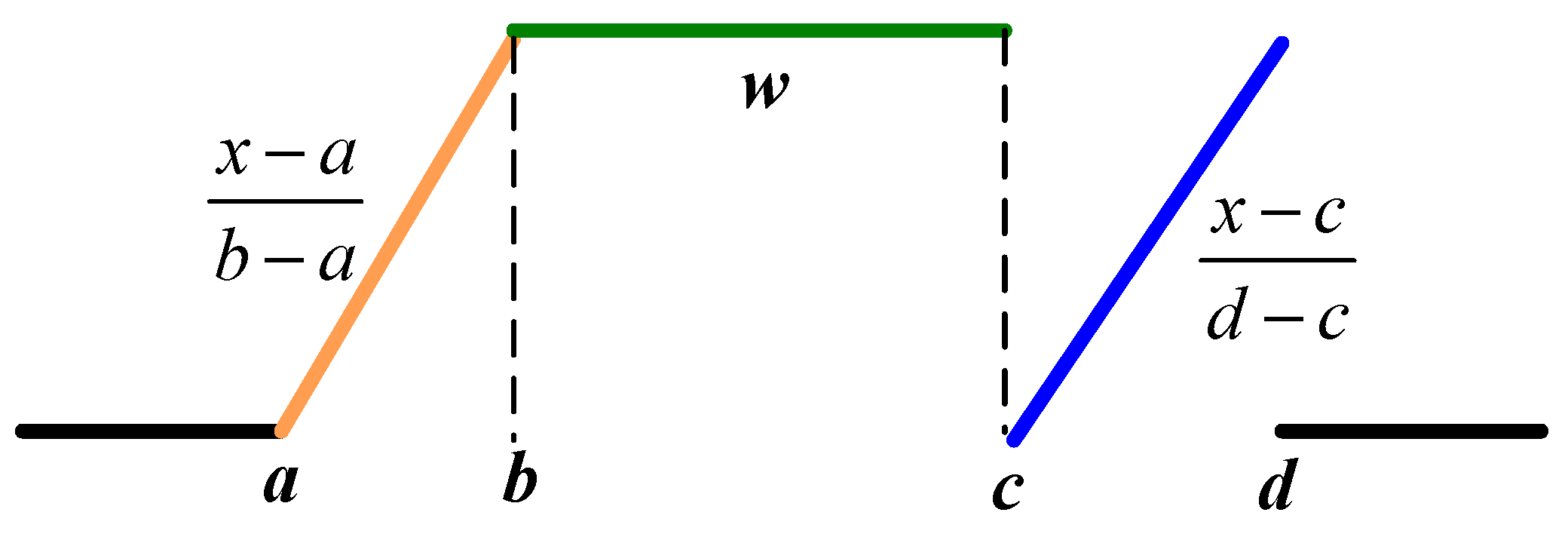
μ A x =             0 ,                               x < a x a / b a , a x b                             w ,                           b x c x c / d c , c x d                   0 ,                           d < x .
Please refer to Figure 1 below. The first (increasing) phase is marked in orange, the second (stable) phase in green, and the third phase in blue.
However, the definition of a generalized trapezoidal fuzzy number given by Deng et al. [1] (Equation (14)) yields some questionable results.
For example, with the condition of c x d , based on Equation (14), we compute the left-hand and the right-hand limits at c , as follows:
lim x c μ A x = lim x c w = w ,
and
lim x c + μ A x = lim x c + x c d c = 0 .
Based on the third row of Equation (14), we derive that
μ A c = w .
and according to the fourth row of Equation (14), we obtain that
μ A c = 0 .
Based on Equations (15)–(18), the trapezoidal fuzzy member is not well-defined and not continuous at x = c . Similarly, we evaluate the left-hand and the right-hand limits at d , as follows:
lim x d μ A x = lim x d x c d c = 1 ,
and
l i m x d + μ A x = 0 .
Referring to the fourth row of Equation (14), we find that
μ A d = 1 .
According to Equations (19)–(21), the trapezoidal fuzzy member is not continuous at x = d . Therefore, based on Equations (15)–(21), we propose the following revised definition of the membership function:
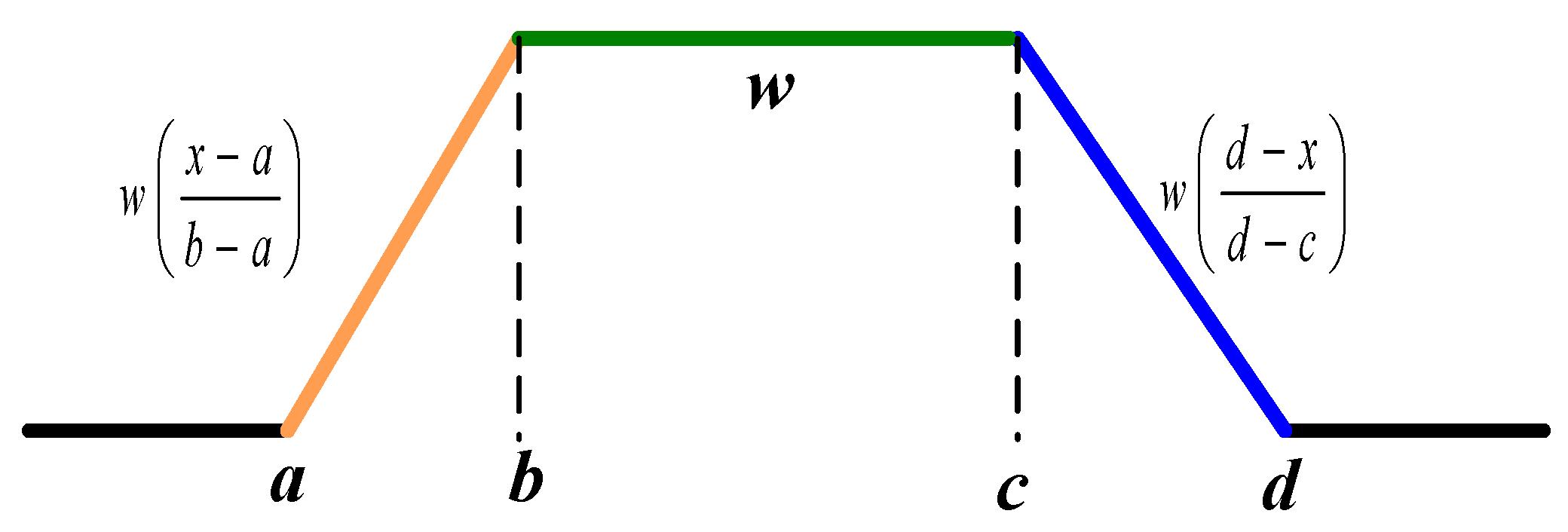
μ A x =                       0 ,                                   x < a w x a / b a , a x b                                   w ,                               b x c w d x / d c , c x d                         0 ,                                 d < x ,
where a , b is the increasing period; b , c is the stable period, under the restriction of 0 a < b c < d 1 , with height w , satisfying 0 < w 1 ; c , d is the decreasing period for a generalized trapezoidal fuzzy number. For the late discussion of radius of gyration, we need a condition, a + b < c + d , which is satisfied with our assumed restriction, 0 a < b c < d 1 .
We refer to the following Figure 2 for our revised membership function. The first (increasing) phase is marked in orange, the second (stable) phase in green, and the third (decreasing) phase in blue.
In Deng et al. [1], for a generalized trapezoidal fuzzy number, they derived the radius of gyration r x , r y with
r x = 2 I x 1 + I x 2 + I x 3 w d + c b a ,
and
r y =   2 I y 1 + I y 2 + I y 3 w d + c b a ,
where Deng et al. [1] introduced the following abbreviations to simplify these expressions:
I x 1 = b a 12 w 3 ,
I x 2 = c b 3 w 3 ,
I x 3 = d c 12 w 3 ,
I y 1 = b a 3 w 4 + b a a 2 w 2 + 2 b a 2 a w 3 ,
I y 2 = c b 3 w 3 + c b b 2 w + c b 2 b w ,
and
I y 3 = d c 3 w 12 + d c c 2 w 2 + d c 2 c w 3 .
We note that the derivations of Equations (23) and (24) were obtained under the restriction of
a + b < c + d ,
because the denominator must be positive.
However, Deng et al. [1] did not substitute their intermediate terms, I x j and I y j for j = 1 , 2 , 3 , into the final formula to obtain a simplified expression for the radius of gyration. We provide the following improvement.
First, we compute the area of trapezoidal region in Figure 2.
A = 1 2 b a w + c b w + 1 2 d c w , = w 2 b a + 2 c b + d c w ,     = w 2 c + d b a .
Based on the definition of Equation (10), we compute that
I x = y 2 d A , = a b 0 w x a / b a y 2 d y d x + b c 0 w y 2 d y d x + c d 0 w d x / d c y 2 d y d x ,       = a b y 3 3 0 w x a b a d x + b c y 3 3 0 w d x + c d y 3 3 0 w d x d c d x , = a b w 3 3 b a 3 x a 3 d x + b c w 3 3 d x + c d w 3 3 d c 3 d x 3 d x , = w 3 3 b a 3 x a 4 4 a b + w 3 3 x b c + w 3 3 d c 3 d x 4 4 c d , = w 3 b a 12 + w 3 c b 3 + w 3 d c 12 .
Using Equation (11) and the results of Equations (32) and (33), we derive the radius of gyration with the x axis:
r x = I x / A ,   = w 3 b a 12 + w 3 c b 3 + w 3 d c 12 / w 2 c + d b a ,   = w 2 6 b a + 4 c b + d c c + d b a ,   = w 6 1 + 2 c b d + c b a ,
Similarly, using Equation (12), we find that
I y = x 2 d A , = a b 0 w x a / b a x 2 d y d x + b c 0 w x 2 d y d x + c d 0 w d x / d c x 2 d y d x , = a b x 2 y 0 w x a b a d x + b c x 2 y 0 w d x + c d x 2 y 0 w d x d c d x , = a b x 2 w x a b a d x + b c x 2 w d x + c d x 2 w d x d c d x , = w b a x 4 4 a x 3 3 a b + w 3 x 3 b c + w d c d x 3 3 x 4 4 c d , = w b a b 4 a 4 4 a b 3 a 3 3 + w c 3 b 3 3 + w d c d d 3 c 3 3 d 4 c 4 4 = w 12 3 b 2 + a 2 b + a 4 a b 2 + b a + a 2 + w c 3 b 3 3 , + w 12 4 d d 2 + c 2 3 d 2 + c 2 d + c , = w 12 3 b 3 b 2 a b a 2 a 3 + w 12 4 c 3 4 b 3 + w 12 d 3 + d 2 c + d c 2 3 c 3 , = w 12 d 3 + d 2 c + d c 2 + c 3 b 3 + b 2 a + b a 2 + a 3 , = w 12 d 2 + c 2 d + c b 2 + a 2 b + a .
According to Equation (13) and the findings of Equations (32) and (35), we derive the radius of gyration with the y axis as
r y = d 2 + c 2 d + c b 2 + a 2 b + a 6 d + c b a .
Notably, in Equation (36), the value of r y , radius of gyration about the y axis is independent of the height, w .
This observation is the cornerstone of our example in Section 3, as it implies that we can adjust the heights of patterns without affecting r y , thereby enabling a tie.
On the other hand, Deng et al. [1] also provided formulas for a generalized trapezoidal fuzzy number under the special condition a = b = c = d . Specifically, they provide the moment of inertia of area A with respect to x and y ,
I x = y 2 d A = 0 ε y 2 ε d y = ε w 3 3 ,
and
I y = x 2 d A = 0 ε a 2 w d x = a 2 w ε .
However, the derivation of Equation (37) included a questionable upper integration bound, and the result of Equation (38) was incorrect. Therefore, based on the original definition of the moment of inertia of area A concerning the x axis and y axis, we provide revised derivations yielding
I x = y 2 d A = 0 w a a + ε y 2 d x d y = 0 w y 2 ε d y = ε w 3 / 3 .
Consequently, we revised the upper bound of the integration from “ ε ” to “ w ”, and
I y = x 2 d A = a a + ε 0 w x 2 d y d x = a a + ε x 2 w d x = a 2 w ε + a w ε 2 + w ε 3 / 3 ,
by comparing Equations (38) with our Equation(40); we find that the original Equation (38) requires correction.
Fortunately, under the condition A = w ε , taking the limit as ε 0 + yields the following for the radius of gyration with the x axis:
r x = lim ε 0 + I x / A ,   = lim ε 0 + ε w 3 / 3 / w ε ,   = w / 3 .
and for the radius of gyration with the y axis,
r y = lim ε 0 + I y / A , = lim ε 0 + a 2 w ε + a w ε 2 + w ε 3 / 3 / w ε , = lim ε 0 + a 2 + a ε + ε 2 / 3 , = a .
Thus, the final results of Deng et al. [1],
r x = w / 3 ,
and
r y = a ,
were still obtained.

3. Results: A Recognition Dilemma Proposed by Us

It is well known that the pattern recognition dilemma exists for every single similarity measure. For example, Mitchell [59], Liang and Shi [62], and Hung and Yang [69] have pointed out that Li and Cheng [70] cannot overcome the recognition dilemma. Julian et al. [58] showed that Mitchell’s measure [59] also failed to pass the test. Yen et al. [71] not only revealed that Hung and Yang [69] cannot handle the recognition dilemma but also developed an algorithm containing a series of similarity measures proportional to the cardinal number of a finite universe of discourse. Following this trend, Chu et al. [6], and Chou [30] constructed algorithms with a series of similarity measures to solve the pattern recognition dilemma under the restriction of a finite set. To the best of our knowledge, no paper has claimed to solve the pattern recognition dilemma in the continuous case. For a finite (discrete) universe of discourse, the computation between a sample and a pattern involves only addition and multiplication. For a continuous universe of discourse, the computation between a sample and a pattern uses integration. It is more difficult to construct two equal similarity values using integration than using addition and multiplication. The similarity measure proposed by Deng [1] is based on radius of gyration and involves integration. This is likely the reason that, up to now, no research paper has challenged Deng [1] with a recognition-dilemma example. It is a trivial fact that counterexamples exist to demonstrate that Deng [1] cannot handle the recognition dilemma. However, actually creating such a counterexample to prove this failure is challenging.
We denote the sample as A and the two prototype patterns as B and C. We present a recognition dilemma involving one sample, A = a 1 , a 2 , a 3 , a 4 ; w A , and two patterns, B = b 1 , b 2 , b 3 , b 4 ; w B and C = c 1 , c 2 , c 3 , c 4 ; w C , expressed as generalized trapezoidal fuzzy numbers.
Deng et al. [1] proposed the similarity measure based on the radius of gyration,
S D A , B = 1 1 4 i = 1 4 a i b i 1 r y A r y B B S A , S B min r x A , r x B max r x A , r x B ,
where B S A , S B is defined as follows:
B S A , S B = 1 ,   S A + S B > 0 0 ,   S A + S B = 0 ,
with S A = a 4 a 1 and S B = b 4 b 1 .
Our goal is to construct an unsolved pattern recognition dilemma for Deng et al.’s [1] similarity measure by achieving the condition S D A , B = S D A , C . From the simplified expression of Equation (36), we observe that the radius of gyration with respect to y , r y is independent of the height w , which guided the design of our example.
We construct one sample, A = a 1 , a 2 , a 3 , a 4 ; w A , and two patterns, B = b 1 , b 2 , b 3 , b 4 ; w B and C = c 1 , c 2 , c 3 , c 4 ; w C , such that a j , for j = 1 , 2 , 3 , 4 , b k , for k = 1 , 2 , 3 , 4 , and c i , for i = 1 , 2 , 3 , 4 , are given numbers, with w A = 1 , and then there are only two heights: w B , and w C are treated as variables.
We assume that w B and w C satisfy the following two restrictions, which are, respectively,
w B < 1 + 2 a 3 a 2 a 4 + a 3 a 2 a 1 / 1 + 2 b 3 b 2 b 4 + b 3 b 2 b 1 ,
and
w C < 1 + 2 a 3 a 2 a 4 + a 3 a 2 a 1 / 1 + 2 c 3 c 2 c 4 + c 3 c 2 c 1 .
According to Equation (47), with w A = 1 , we derive that
r x B = w B 6 1 + 2 b 3 b 2 b 4 + b 3 b 2 b 1 , < w A 6 1 + 2 a 3 a 2 a 4 + a 3 a 2 a 1 = r x A ,
and then we obtain that
min r x A , r x B max r x A , r x B = r x B r x A = w B 1 + 2 b 3 b 2 b 4 + b 3 b 2 b 1 / 1 + 2 a 3 a 2 a 4 + a 3 a 2 a 1 .
By the same argument, owing Equation (48), with w A = 1 , we find that
r x C = w C 6 1 + 2 c 3 c 2 c 4 + c 3 c 2 c 1 , < w A 6 1 + 2 a 3 a 2 a 4 + a 3 a 2 a 1 = r x A ,
and then we obtain that
min r x A , r x C max r x A , r x C = r x C r x A = w C 1 + 2 c 3 c 2 c 4 + c 3 c 2 c 1 / 1 + 2 a 3 a 2 a 4 + a 3 a 2 a 1 .
Under the restriction of 0 a 1 < a 2 a 3 < a 4 1 , we imply that S A = a 4 a 1 > 0 . Similarly, we derive that S B > 0 . Moreover, it shows S C > 0 to yield that
B S A , S B = 1 ,
and
B S A , S C = 1 .
We recall Equation (36); without knowing w B , we can derive r y B . We recall Equation (36); independent of the value of w A = 1 , we can derive r y A . Knowing the values of a j , for j = 1 , 2 , 3 , 4 , b k , for k = 1 , 2 , 3 , 4 , we obtain 1 1 4 i = 1 4 a i b i .
To simplify the expression, applying Equations (50) and (53), we assume the computed value as a constant, denoted as K A , B ; that is,
K A , B = 1 1 4 i = 1 4 a i b i 1 r y A r y B ,
and then we obtain that
S D A , B = K A , B w B 1 + 2 b 3 b 2 b 4 + b 3 b 2 b 1 / 1 + 2 a 3 a 2 a 4 + a 3 a 2 a 1 .
Similarly, we assume that
K A , C = 1 1 4 i = 1 4 a i c i 1 r y A r y C ,
and then we find that
S D A , C = K A , C w C 1 + 2 c 3 c 2 c 4 + c 3 c 2 c 1 / 1 + 2 a 3 a 2 a 4 + a 3 a 2 a 1 .
Our goal is to construct a counterexample to produce a pattern recognition dilemma, as characterized by
S D A , B = S D A , C .
We plug Equations (56) and (58) into Equation (59) to yield
K A , B w B 1 + 2 b 3 b 2 b 4 + b 3 b 2 b 1 / 1 + 2 a 3 a 2 a 4 + a 3 a 2 a 1 ,                               = K A , C w C 1 + 2 c 3 c 2 c 4 + c 3 c 2 c 1 / 1 + 2 a 3 a 2 a 4 + a 3 a 2 a 1 .
We can further simplify Equation (60) as follows:
K A , B w B 1 + 2 b 3 b 2 b 4 + b 3 b 2 b 1 = K A , C w C 1 + 2 c 3 c 2 c 4 + c 3 c 2 c 1 .
There are many possible choices of w B and w C that satisfy three conditions: Equation (47) for w B , Equation (48) for w C , and satisfying Equation (61).
Our strategy is to choose two fuzzy numbers because their radius of gyration about the y-axis is independent of the height, such that we can render the two similarity measures equal by appropriately scaling their heights.
We will assume that
A = 0.3 , 0.4 , 0.5 , 0.6 ; w A = 1 ,
B = 0.2 , 0.3 , 0.4 , 0.5 ; w B ,
and
C = 0.4 , 0.5 , 0.6 , 0.7 ; w C ,
where the values of w B and w C will be assigned during our derivations.
Based on Equation (36), we know that the values of r y C , r y A , and r y B are independent of the values of w A , w B , and w C , and then we obtain that
r y C = 736 / 2400 ,
r y A = 617 / 2400 ,
and
r y B = 304 / 2400 .
Based on Equation (34), and b 4 b 3 = b 3 b 2 = b 2 b 1 = 0.1 , and c 4 c 3 = c 3 c 2 = c 2 c 1 = 0.1 , we derive that
r x A = w A / 2 ,
r x B = w B / 2 ,
and
r x C = w C / 2 .
Under our construction of Equations (62)–(64), we can simplify Equations (47) and (48) as follows:
w B < 1 ,
and
w C < 1 .
Under the restrictions of Equations (71) and (72), and we assume that w A = 1 , we know that
min r x A , r x B max r x A , r x B = r x B r x A = w B ,
and
min r x A , r x C max r x A , r x C = r x C r x A = w C .
Thus far, we have derived that
S D A , B = 0.9 1 r y A + r y B w B = 0.9 1 617 2400 + 304 2400 w B ,
and
S D A , C = 0.9 1 r y C + r y A w C , = 0.9 1 736 2400 + 617 2400 w C .
Based on our findings of Equations (75) and (76), we know that solving that Equation S D A , B = S D A , C yields the following assignment:
1 r y A + r y B w B = 1 r y C + r y A w C .
Therefore, to satisfy Equation (77), we assign specific values to w B and w C as follows:
w B = 1 r y C + r y A , = 1 736 / 2400 + 617 / 2400 ,
and
w C = 1 r y A + r y B , = 1 617 / 2400 + 304 / 2400 .
We check our assumption of Equations (78) and (79) for w B and w C that satisfy the restrictions of Equations (71) and (72) as w B < 1 , and w C < 1 .
Consequently, we construct an example with two patterns, B and C, and one sample, A, with
A = 0.3 , 0.4 , 0.5 , 0.6 ; w A = 1 ,
B = 0.2 , 0.3 , 0.4 , 0.5 ; w B = 1 736 2400 + 617 2400 ,
and
C = 0.4 , 0.5 , 0.6 , 0.7 ; w C = 1 617 2400 + 304 2400 ,
such that based on Equation (75), we derive that
S D A , B = 0.9 1 r y A + r y B w B = 0.9 1 617 2400 + 304 2400 w B , = 0.9 w C w B .
According to Equation (76), we obtain
S D A , C = 0.9 1 r y C + r y A w C , = 0.9 1 736 2400 + 617 2400 w C , = 0.9 w B w C .
We observe the findings of Equations (83) and (84), which imply that
S D A , B = 0.9 w C w B , = 0.9 w B w C = S D A , C ,
and then the desired recognition dilemma is achieved.
Through our approach, we not only constructed one counterexample, but a family (infinite) of counterexamples. We assume that
A = 0.3 , 0.4 , 0.5 , 0.6 ; w A = 1 ,
B ε = 0.2 , 0.3 , 0.4 , 0.5 ; w B ε = 1 736 / 2400 + 617 / 2400 ε ,
and
C ε = 0.4 , 0.5 , 0.6 , 0.7 ; w C ε = 1 617 / 2400 + 304 / 2400 ε ,
with 0 < ε 1 , and then we derive that
S D A , B = 0.9 w C w B ε 2 , = 0.9 w B w C ε 2 = S D A , C ,
with
w B = 1 r y C + r y A ,
and
w C = 1 r y A + r y B .
Thus, we have developed a family of counterexamples to demonstrate that the similarity measure proposed by Deng et al. [1] suffers from an unsolved problem with the pattern recognition dilemma.

4. Review of Deng et al. [57]

Deng et al. [57] claimed to have constructed a pattern recognition dilemma that the similarity measure proposed by Deng et al. [1] could not resolve. This implies that Deng et al. [57] asserted they had created a counterexample showing that a recognition dilemma occurs for Deng et al.’s [1] similarity measure.
We first present their example and then point out why their assertion is not valid.
Deng et al. [57] described two patterns, A and C , with one sample B B where the trapezoidal fuzzy numbers of A , B B , and C C are denoted as follows:
A = 0.183 , 0.183 , 0.417 , 0.417 , 0.2 ,
B = 0.3 , 0.3 , 0.5 , 0.5 , 0.4 ,
and
C = 0.45 , 0.45 , 0.55 , 0.55 , 0.8 .
Deng et al. [57] claimed that based on the similarity measure of Deng et al. [1] then
S A , B = 0.4065 ,
and
S B , C = 0.4065 .
Hence, Deng et al. [57] concluded that they had constructed a counterexample illustrating that Deng et al.’s [1] similarity measure cannot determine the pattern of the given sample.
However, we found the following values:
r x A = 0.2 3 ,
r y A = 0.417 3 0.183 3 3 0.417 0.183 ,
r x B = 0.4 3 ,
r y B = 0.5 3 0.3 3 3 0.5 0.3 ,
r x C = 0.8 3 ,
and
r y C = 0.55 3 0.45 3 3 0.55 0.45 .
We calculate the similarity measure of Equations (95) and (96) to the eighth decimal place to imply that
A , B = 0.40651460 .
and
S B , C = 0.40649065 .
Deng et al. [57] derived that S A , B = 0.4065 of Equation (95) and S B , C = 0.4065 of Equation (96) were rounded to the fourth decimal place to obtain
S A , B 0.4065 S B , C .
However, using our more detailed expressions of Equations (103) and (104), we find the result
S A , B 0.40651460 > S B , C 0.40649065 .
We found that rounding the results to four decimal places, as done in Deng et al. [57], led to a false conclusion of a tie. Thus, at higher precision we find S A , B > S B , C , indicating the sample B should be classified as belonging to pattern A. The supposed “dilemma” in Deng et al. [57] disappears when exact computation is used.
Based on the above findings, we emphasize the importance of using sufficient precision or exact symbolic computation when analyzing similarity measures to avoid spurious ties caused by numerical rounding.

5. Tangible Solutions for Pattern Recognition Dilemmas

Yen et al. [71], Chu et al. [6], and Chou [30] developed several iterative algorithms that repeatedly apply similarity measures to solve pattern recognition dilemmas. The number of steps in these algorithms is proportional to the cardinality of the universe of discourse. If the universe of discourse is finite, Yen et al. [71], Chu et al. [6], and Chou [30] proved their respective iterative algorithms can avoid a pattern recognition dilemma. In these algorithms, if a tie occurs, additional similarity measures or steps are applied iteratively until the tie is broken. The number of iterations needed is proportional to the cardinality of the universe of discourse, and the cited papers have proven that their algorithms converge to a unique classification for a finite universe of discourse. Therefore, we conclude that those earlier algorithms, which use only a fixed finite number of similarity measures to resolve recognition dilemmas, should be revised so that the number of steps grows with the cardinality of the universe of discourse. Under such an approach, recognition dilemmas will not occur.

6. Conclusions

In this paper, we first revised some questionable results from Deng et al. [1]. Next, we constructed a counterexample to show that Deng et al.’s [1] similarity measure can encounter a recognition dilemma. We examined the counterexample of an “equal similarity value” proposed by Deng et al. [57], extending the number of decimal places used, and found that the values are not actually equal. This shows that proving an identity purely through numerical methods is not reliable, because increasing the precision can reveal inequalities. Our findings suggest that any fixed single-step similarity measure may be insufficient, and that more dynamic or repeated applications of similarity measures (as seen in recent iterative algorithms) are needed to fully resolve pattern recognition dilemmas.
We present several possible directions for future research, including (a) examining numerical near-tie scenarios, (b) considering appropriate numerical tolerances, (c) constructing rounding-based examples, (d) testing on non-toy datasets, (e) analyzing worst-case computational complexity, (f) conducting small numerical experiments, (g) integrating contemporary data-driven approaches, (h) comparing multiple models, (i) evaluating prediction performance across various metrics, (j) developing multi-end ensemble models, (k) creating web applications for real-time contamination assessment, (l) exploring very high-dimensional feature spaces, and (m) handling complex uncertainties in large-scale datasets. Other potential directions include (n) devising practical diagnostic or mitigation strategies, (o) investigating structurally complex engineering problems, (p) comparing performance across different configurations, (q) combining experimental results with finite element analysis, (r) evaluating competing mechanical models or parameter sets, (s) examining misclassifications caused by unresolved dilemmas, (t) addressing scalability issues, (u) assessing computational costs, (v) conducting quantitative trade-off analyses, (w) evaluating the computational overhead of repeated radius-of-gyration calculations, (x) demonstrating approaches in real-world applications, (y) performing additional computational experiments, (z) exploring ethical or regulatory considerations, (a1) understanding regulatory scrutiny, (b1) focusing on safety-critical use cases, (c1) mitigating risks of systematic bias, (d1) preventing unsafe misclassifications, (e1) tackling modern large-scale pattern recognition challenges, (f1) validating methods on real applications, (g1) handling high-dimensional environmental modeling, and (h1) pursuing advanced structural analysis.

Author Contributions

Conceptualization, S.W. and G.K.Y.; methodology, S.W.; software, X.Z.; validation, S.W. and X.Z.; formal analysis, S.W.; investigation, S.W. and X.Z.; resources, G.K.Y.; data curation, X.Z.; writing—original draft preparation, S.W.; writing—review and editing, G.K.Y.; visualization, X.Z. and G.K.Y.; supervision, S.W.; project administration, S.W.; funding acquisition, S.W. All authors have read and agreed to the published version of the manuscript.

Funding

This research received no external funding.

Data Availability Statement

We used the same numerical example in Deng et al. [57].

Conflicts of Interest

The authors declare no conflicts of interest.

References

  1. Deng, Y.; Shi, W.; Du, F.; Liu, Q. A new similarity measure of generalized fuzzy numbers and its application to pattern recognition. Pattern Recognit. Lett. 2004, 25, 875–883. [Google Scholar] [CrossRef]
  2. Zadeh, L.A. Fuzzy sets. Inform. Control 1965, 8, 338–353. [Google Scholar] [CrossRef]
  3. Chen, S.M. New methods for subjective mental workload assessment and fuzzy risk analysis. Cybern. Syst. Int. J. 1996, 27, 449–472. [Google Scholar] [CrossRef]
  4. Lee, H.S. Optimal consensus of fuzzy opinions under group decision making environment. Fuzzy Sets Syst. 2002, 132, 303–315. [Google Scholar] [CrossRef]
  5. Chen, S.J.; Chen, S.M. Fuzzy risk analysis based on similarity measures of generalized fuzzy numbers. IEEE Trans. Fuzzy Syst. 2003, 11, 45–56. [Google Scholar] [CrossRef]
  6. Chu, C.H.; Hung, K.C.; Julian, P. A complete pattern recognition approach under Atanassov’s intuitionistic fuzzy sets. Knowl.-Based Syst. 2014, 66, 36–45. [Google Scholar] [CrossRef]
  7. Hibbeler, R.C. Mechanics of Materials; Prentice-Hall: Englewood Cliffs, NJ, USA, 2000. [Google Scholar]
  8. Huang, C.J.; Cheng, M.Y. Similarity measurement of rule-based knowledge using conditional probability. J. Inf. Sci. Eng. 2008, 24, 769–784. [Google Scholar]
  9. Guha, D.; Chakraborty, D. A new approach to fuzzy distance measure and similarity measure between two generalized fuzzy numbers. Appl. Soft Comput. J. 2010, 10, 90–99. [Google Scholar] [CrossRef]
  10. Adabitabar Firozja, M.; Fath-Tabar, G.H.; Eslampia, Z. The similarity measure of generalized fuzzy numbers based on interval distance. Appl. Math. Lett. 2012, 25, 1528–1534. [Google Scholar] [CrossRef]
  11. Allahviranloo, T.; Abbasbandy, S.; Hajighasemi, S. A new similarity measure for generalized fuzzy numbers. Neural Comput. Appl. 2012, 21, 289–294. [Google Scholar] [CrossRef]
  12. Rezaee, B. Rule base simplification by using a similarity measure of fuzzy sets. J. Intell. Fuzzy Syst. 2012, 23, 193–201. [Google Scholar] [CrossRef]
  13. Chou, C.C. A new similarity measure of fuzzy numbers. J. Intell. Fuzzy Syst. 2014, 26, 287–294. [Google Scholar] [CrossRef]
  14. Li, X.; Liu, Y. Distance and similarity measures between uncertain variables. J. Intell. Fuzzy Syst. 2015, 28, 2073–2081. [Google Scholar] [CrossRef]
  15. Chou, C.C. A generalized similarity measure for fuzzy numbers. J. Intell. Fuzzy Syst. 2016, 30, 1147–1155. [Google Scholar] [CrossRef]
  16. Chutia, R. Fuzzy risk analysis using similarity measure of interval-valued fuzzy numbers and its application in poultry farming. Appl. Intell. 2018, 48, 3928–3949. [Google Scholar] [CrossRef]
  17. Farhadinia, B.; Xu, Z. Hesitant fuzzy information measures derived from T-norms and S-norms. Iran. J. Fuzzy Syst. 2018, 15, 157–175. [Google Scholar]
  18. Liu, P.; Ali, Z.; Mahmood, T. The distance measures and cross-entropy based on complex fuzzy sets and their application in decision making. J. Intell. Fuzzy Syst. 2020, 39, 3351–3374. [Google Scholar] [CrossRef]
  19. Jiang, W.; Yong, Q.; Liu, N.; Luo, Y. RAPOT: An Adaptive Multifactor Risk Assessment Framework on Public Opinion for Trial Management. Wirel. Commun. Mob. Comput. 2021, 2021, 5514003. [Google Scholar] [CrossRef]
  20. Sen, S.; Patra, K.; Mondal, S.K. A new approach to similarity measure for generalized trapezoidal fuzzy numbers and its application to fuzzy risk analysis. Granul. Comput. 2021, 6, 705–718. [Google Scholar] [CrossRef]
  21. D’Urso, P.; Giordani, P. A weighted fuzzy c-means clustering model for fuzzy data. Comput. Stat. Data Anal. 2006, 50, 1496–1523. [Google Scholar] [CrossRef]
  22. Isern, D.; Marin, L.; Valls, A.; Moreno, A. The unbalanced linguistic ordered weighted averaging operator. In Proceedings of the IEEE International Conference on Fuzzy Systems, Barcelona, Spain, 18–23 July 2010. [Google Scholar]
  23. Chen, S. Fuzzy information retrieval based on a new similarity measure of generalized fuzzy numbers. Intell. Autom. Soft Comput. 2011, 17, 465–476. [Google Scholar] [CrossRef]
  24. Su, X.; Jiang, W.; Xu, J.; Xu, P.; Deng, Y. A new fuzzy risk analysis method based on generalized fuzzy numbers. J. Softw. 2011, 6, 1755–1762. [Google Scholar] [CrossRef]
  25. Yang, L.; Shen, Q. Adaptive fuzzy interpolation. IEEE Trans. Fuzzy Syst. 2011, 19, 1107–1126. [Google Scholar] [CrossRef]
  26. Deng, Y.; Chen, Y.; Zhang, Y.; Mahadevan, S. Fuzzy Dijkstra algorithm for shortest path problem under uncertain environment. Appl. Soft Comput. J. 2012, 12, 1231–1237. [Google Scholar] [CrossRef]
  27. Mukherjee, S.; Basu, K. Solution of a class of intuitionistic fuzzy assignment problem by using similarity measures. Knowl.-Based Syst. 2012, 27, 170–179. [Google Scholar] [CrossRef]
  28. Farhadinia, B.; Ban, A.I. Developing new similarity measures of generalized intuitionistic fuzzy numbers and generalized interval-valued fuzzy numbers from similarity measures of generalized fuzzy numbers. Math. Comput. Model. 2013, 57, 812–825. [Google Scholar] [CrossRef]
  29. Anand, A.K. Approach to calculate the degree of similarity between generalized trapezoidal fuzzy numbers. Int. J. Appl. Inf. Syst. 2016, 11, 32–36. [Google Scholar] [CrossRef]
  30. Chou, W.S. New algorithm of similarity measures for pattern-recognition problems. J. Test. Eval. 2016, 44, 1473–1484. [Google Scholar] [CrossRef]
  31. Dutta, P. Comparison of arithmetic operations of generalized fuzzy numbers: Case study in risk assessment. Cybern. Syst. 2016, 47, 290–320. [Google Scholar] [CrossRef]
  32. Mohamad, D.; Ibrahim, S.Z. Decision making procedure based on Jaccard similarity measure with Z-numbers. Pertanika J. Sci. Technol. 2017, 25, 561–574. [Google Scholar]
  33. Chutia, R.; Gogoi, M.K. Fuzzy risk analysis in poultry farming using a new similarity measure on generalized fuzzy numbers. Comput. Ind. Eng. 2018, 115, 543–555. [Google Scholar] [CrossRef]
  34. Deli, I. A TOPSIS method by using generalized trapezoidal hesitant fuzzy numbers and application to a robot selection problem. J. Intell. Fuzzy Syst. 2020, 38, 779–793. [Google Scholar] [CrossRef]
  35. Duc, D.A.; Hang, D.T.; Tam, P.M.; Hue, T.T.; Loi, T.V.; Lien, L.T.; Dat, L.Q. Lecturers’ research capacity assessment using an extension of generalized fuzzy multi-criteria decision-making approach. Int. J. Fuzzy Syst. 2020, 22, 2652–2663. [Google Scholar] [CrossRef]
  36. Dutta, P. An advanced dice similarity measure of generalized fuzzy numbers and its application in multicriteria decision making. Arab. J. Basic Appl. Sci. 2020, 27, 75–92. [Google Scholar] [CrossRef]
  37. Wu, A.; Li, H.; Wang, F. An improved similarity measure of generalized trapezoidal fuzzy numbers and its application in multi-attribute group decision making. Iran. J. Fuzzy Syst. 2020, 17, 165–181. [Google Scholar]
  38. Wu, M.Q.; Chen, T.Y.; Fan, J.P. Similarity measures of T-spherical fuzzy sets based on the cosine function and their applications in pattern recognition. IEEE Access 2020, 8, 98181–98192. [Google Scholar] [CrossRef]
  39. Morillas, S.; Gregori, V.; Peris-Fajarnés, G.; Latorre, P. A new vector median filter based on fuzzy metrics. In Proceedings of the Image Analysis and Recognition, Second International Conference, ICIAR 2005, Toronto, ON, Canada, 28–30 September 2005; pp. 81–90. [Google Scholar]
  40. Deng, Y.; Jiang, W.; Sadiq, R. Modeling contaminant intrusion in water distribution networks: A new similarity-based DST method. Expert Syst. Appl. 2011, 38, 571–578. [Google Scholar] [CrossRef]
  41. Deng, Y.; Sadiq, R.; Jiang, W.; Tesfamariam, S. Risk analysis in a linguistic environment: A fuzzy evidential reasoning-based approach. Expert Syst. Appl. 2011, 38, 15438–15446. [Google Scholar] [CrossRef]
  42. Guha, D.; Chakraborty, D. Fuzzy multi attribute group decision making method to achieve consensus under the consideration of degrees of confidence of experts’ opinions. Comput. Ind. Eng. 2011, 60, 493–504. [Google Scholar] [CrossRef]
  43. Kaur, A.; Kumar, A. A new method for solving fuzzy transportation problems using ranking function. Appl. Math. Model. 2011, 35, 5652–5661. [Google Scholar] [CrossRef]
  44. Kaur, A.; Kumar, A. A new approach for solving fuzzy transportation problems using generalized trapezoidal fuzzy numbers. Appl. Soft Comput. J. 2012, 12, 1201–1213. [Google Scholar]
  45. Wang, Q.; Zhang, Z.; Zhang, Y.; Deng, Y. Fuzzy shortest path problem based on biological method. J. Inf. Comput. Sci. 2012, 9, 1365–1371. [Google Scholar]
  46. Matawale, C.R.; Datta, S.; Mahapatra, S.S. Agility appraisement and identification of agile barriers in a supply chain. Int. J. Serv. Oper. Manag. 2013, 16, 478–505. [Google Scholar] [CrossRef]
  47. Mishra, S.; Samantra, C.; Datta, S.; Mahapatra, S.S. Supplier evaluation in agile supply chain in fuzzy paradigm. Int. J. Serv. Oper. Manag. 2013, 16, 1–41. [Google Scholar] [CrossRef]
  48. Ahmadizar, F.; Hosseinabadi Farahani, M. Clustering fuzzy objects using ant colony optimization. Int. J. Ind. Eng. Comput. 2014, 5, 115–126. [Google Scholar] [CrossRef]
  49. Zhang, X.; Xu, Z. Novel distance and similarity measures on hesitant fuzzy sets with applications to clustering analysis. J. Intell. Fuzzy Syst. 2015, 28, 2279–2296. [Google Scholar] [CrossRef]
  50. Das, S.; Guha, D.; Dutta, B. Medical diagnosis with the aid of using fuzzy logic and intuitionistic fuzzy logic. Appl. Intell. 2016, 45, 850–867. [Google Scholar] [CrossRef]
  51. Chutia, R.; Gogoi, M.K. Fuzzy risk analysis in poultry farming based on a novel similarity measure of fuzzy numbers. Appl. Soft Comput. 2018, 66, 60–76. [Google Scholar] [CrossRef]
  52. Dutta, P. Human health risk assessment under uncertain environment and its SWOT analysis. Open Public Health J. 2018, 11, 72–92. [Google Scholar] [CrossRef]
  53. Dhivya, J.; Sridevi, B. Intuitionistic fuzzy similarity measure for generalized fuzzy numbers and its application in fingerprint matching. IETE J. Res. 2019, 65, 523–534. [Google Scholar]
  54. Rafiq, M.; Ashraf, S.; Abdullah, S.; Mahmood, T.; Muhammad, S. The cosine similarity measures of spherical fuzzy sets and their applications in decision making. J. Intell. Fuzzy Syst. 2019, 36, 6059–6073. [Google Scholar] [CrossRef]
  55. Kang, B.; Zhang, P.; Gao, Z.; Chhipi-Shrestha, G.; Hewage, K.; Sadiq, R. Environmental assessment under uncertainty using Dempster–Shafer theory and Z-numbers. J. Ambient Intell. Humaniz. Comput. 2020, 11, 21. [Google Scholar] [CrossRef]
  56. Chen, S.J. A new similarity measure of generalized fuzzy numbers based on geometric-mean averaging operator. In Proceedings of the 2006 IEEE International Conference on Fuzzy Systems, Vancouver, BC, Canada, 16–21 July 2006; pp. 1879–1886. [Google Scholar]
  57. Deng, Y.; Sun, D.; Jiang, W.; Xu, X. An improved radius of gyration similarity measure between generalized fuzzy numbers and its application to multisource data fusion. J. Comput. 2011, 6, 1732–1739. [Google Scholar] [CrossRef]
  58. Julian, P.; Hung, K.C.; Lin, S. On the Mitchell similarity measure and its application to pattern recognition. Pattern Recognit. Lett. 2012, 33, 1219–1223. [Google Scholar] [CrossRef]
  59. Mitchell, H.B. On the Dengfend–Chuntian similarity measure and its application to pattern recognition. Pattern Recognit. Lett. 2003, 24, 3101–3104. [Google Scholar] [CrossRef]
  60. Liu, H.W. New similarity measures between intuitionistic fuzzy sets and between elements. Math. Comput. Model. 2005, 42, 61–70. [Google Scholar] [CrossRef]
  61. Hung, K.C.; Lin, J.; Chu, P. An extended algorithm of similarity measures and its application to radar target recognition based on intuitionistic fuzzy sets. J. Test. Eval. 2015, 43, 1–10. [Google Scholar] [CrossRef]
  62. Liang, Z.; Shi, P. Similarity measures on intuitionistic fuzzy sets. Pattern Recognit. Lett. 2003, 24, 2687–2693. [Google Scholar] [CrossRef]
  63. Lin, S.; Julian, P. An extended similarity measure for intuitionistic fuzzy sets revisit. J. Discret. Math. Sci. Cryptogr. 2015, 18, 139–145. [Google Scholar] [CrossRef]
  64. Yusoff, B.; Taib, I.; Abdullah, L.; Wahab, A.F. A new similarity measure on intuitionistic fuzzy sets. Int. J. Comput. Math. Sci. 2011, 5, 70–74. [Google Scholar]
  65. Tung, C.; Hopscotch, C. Discussion on similarity measure of its complement. J. Discret. Math. Sci. Cryptogr. 2015, 18, 417–432. [Google Scholar] [CrossRef]
  66. Szmidt, E.; Kacprzyk, J. A new concept of a similarity measure for intuitionistic fuzzy sets and its use in group decision making. In Proceedings of the Modeling Decisions for Artificial Intelligence, Tsukuba Japan, 25–27 July 2005. [Google Scholar]
  67. Marin, L.; Moreno, A.; Isern, D. Automatic preference learning on numeric and multi- valued categorical attributes. Knowl.-Based Syst. 2014, 56, 201–215. [Google Scholar] [CrossRef]
  68. Wei, S.H.; Chen, S.M. A new approach for fuzzy risk analysis based on similarity. Expert Syst. Appl. 2009, 36, 589–598. [Google Scholar] [CrossRef]
  69. Hung, W.L.; Yang, M.S. Similarity measures of intuitionistic fuzzy sets based on Hausdorff distance. Pattern Recogn. Lett. 2004, 25, 1603–1611. [Google Scholar] [CrossRef]
  70. Li, D.F.; Cheng, C.T. New similarity measures of intuitionistic fuzzy sets and applications to pattern recognitions. Pattern Recogn. Lett. 2002, 23, 221–225. [Google Scholar]
  71. Yen, P.C.P.; Fan, K.C.; Chao, H.C.J. A new method for similarity measures for pattern recognition. Appl. Math. Model. 2013, 37, 5335–5342. [Google Scholar] [CrossRef]
Figure 1. Graph of the trapezoidal fuzzy member proposed by Deng et al. [1].
Algorithms 19 00016 g001
Figure 2. Graph of our revised trapezoidal fuzzy member.
Algorithms 19 00016 g002
Disclaimer/Publisher’s Note: The statements, opinions and data contained in all publications are solely those of the individual author(s) and contributor(s) and not of MDPI and/or the editor(s). MDPI and/or the editor(s) disclaim responsibility for any injury to people or property resulting from any ideas, methods, instructions or products referred to in the content.