
Review

Algorithms Facilitating the Observation of Urban Residential Vacancy Rates: Technologies, Challenges and Breakthroughs


1
School of Geography and Planning, Nanning Normal University, Nanning 530001, China
2
Key Laboratory of Environment Change and Resources Use in Beibu Gulf, Ministry of Education, Nanning Normal University, Nanning 530001, China
3
College of Engineering, City University of Hong Kong, Hong Kong 999077, China
4
School of Geographical Sciences, Southwest University, Chongqing 400715, China
5
Department of Architecture and Built Environment, University of Nottingham, Ningbo 315154, China
*
Authors to whom correspondence should be addressed.
These authors contributed equally to this work.
Algorithms 2025, 18(3), 174; https://doi.org/10.3390/a18030174
Submission received: 30 January 2025 / Revised: 11 March 2025 / Accepted: 12 March 2025 / Published: 20 March 2025
(This article belongs to the Special Issue Algorithms for Smart Cities (2nd Edition))

Abstract

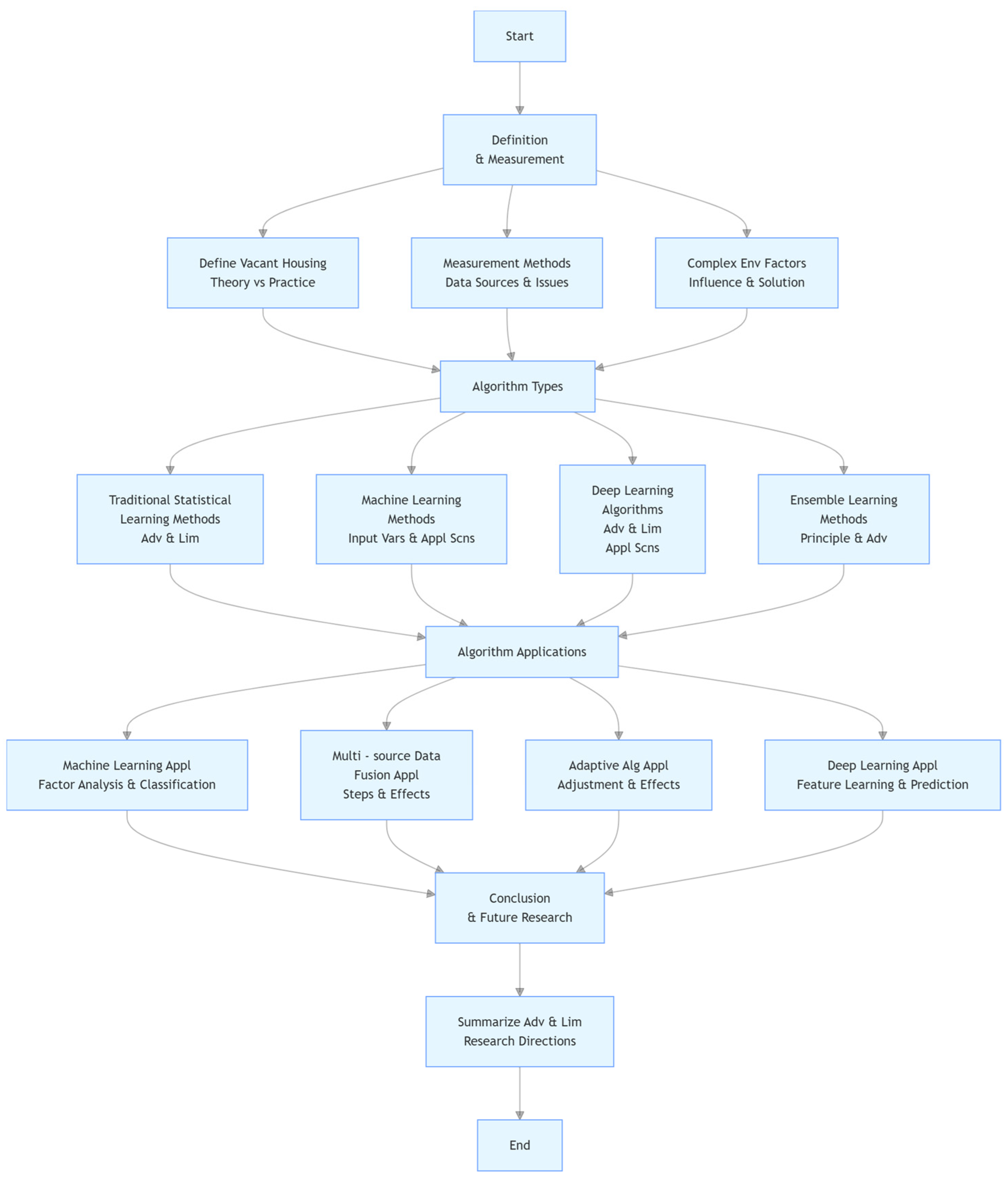
In view of the challenges brought by a complex environment, diverse data sources and urban development needs, our study comprehensively reviews the application of algorithms in urban residential vacancy rate observation. First, we explore the definition and measurement of urban residential vacancy rate, pointing out the difficulties in accurately defining vacant houses and obtaining reliable data. Then, we introduce various algorithms such as traditional statistical learning, machine learning, deep learning and ensemble learning, and analyze their applications in vacancy rate observation. The traditional statistical learning algorithm builds a prediction model based on historical data mining and analysis, which has certain advantages in dealing with linear problems and regular data. However, facing the high nonlinear relationships and complexity of the data in the urban residential vacancy rate observation, its prediction accuracy is difficult to meet the actual needs. With their powerful nonlinear modeling ability, machine learning algorithms have significant advantages in capturing the nonlinear relationships of data. However, they require high data quality and are prone to overfitting phenomenon. Deep learning algorithms can automatically learn feature representation, perform well in processing large amounts of high-dimensional and complex data, and can effectively deal with the challenges brought by various data sources, but the training process is complex and the computational cost is high. The ensemble learning algorithm combines multiple prediction models to improve the prediction accuracy and stability. By comparing these algorithms, we can clarify the advantages and adaptability of different algorithms in different scenarios. Facing the complex environment, the data in the observation of urban residential vacancy rate are affected by many factors. The unbalanced urban development leads to significant differences in residential vacancy rates in different areas. Spatiotemporal heterogeneity means that vacancy rates vary in different geographical locations and over time. The complexity of data affected by various factors means that the vacancy rate is jointly affected by macroeconomic factors, policy regulatory factors, market supply and demand factors and individual resident factors. These factors are intertwined, increasing the complexity of data and the difficulty of analysis. In view of the diversity of data sources, we discuss multi-source data fusion technology, which aims to integrate different data sources to improve the accuracy of vacancy rate observation. The diversity of data sources, including geographic information system (GIS) (Geographic Information System) data, remote sensing images, statistics data, social media data and urban grid management data, requires integration in format, scale, precision and spatiotemporal resolution through data preprocessing, standardization and normalization. The multi-source data fusion algorithm should not only have the ability of intelligent feature extraction and related analysis, but also deal with the uncertainty and redundancy of data to adapt to the dynamic needs of urban development. We also elaborate on the optimization methods of algorithms for different data sources. Through this study, we find that algorithms play a vital role in improving the accuracy of vacancy rate observation and enhancing the understanding of urban housing conditions. Algorithms can handle complex spatial data, integrate diverse data sources, and explore the social and economic factors behind vacancy rates. In the future, we will continue to deepen the application of algorithms in data processing, model building and decision support, and strive to provide smarter and more accurate solutions for urban housing management and sustainable development.
Keywords: urban residential vacancy rate; algorithm application; data source diversity; complex environment; urban development needs urban residential vacancy rate; algorithm application; data source diversity; complex environment; urban development needs