
Article

Numerical Simulation of Micro-Bubbles Dispersion by Surface Waves
1
Institute of Applied Physics of the Russian Academy of Sciences, 603950 Nizhny Novgorod, Russia
2
Department of Engineering Science and Ocean Engineering, Taiwan National University, Taipei 106, Taiwan
*
Author to whom correspondence should be addressed.
Algorithms 2022, 15(4), 110; https://doi.org/10.3390/a15040110
Submission received: 25 February 2022 / Revised: 20 March 2022 / Accepted: 22 March 2022 / Published: 24 March 2022

Abstract

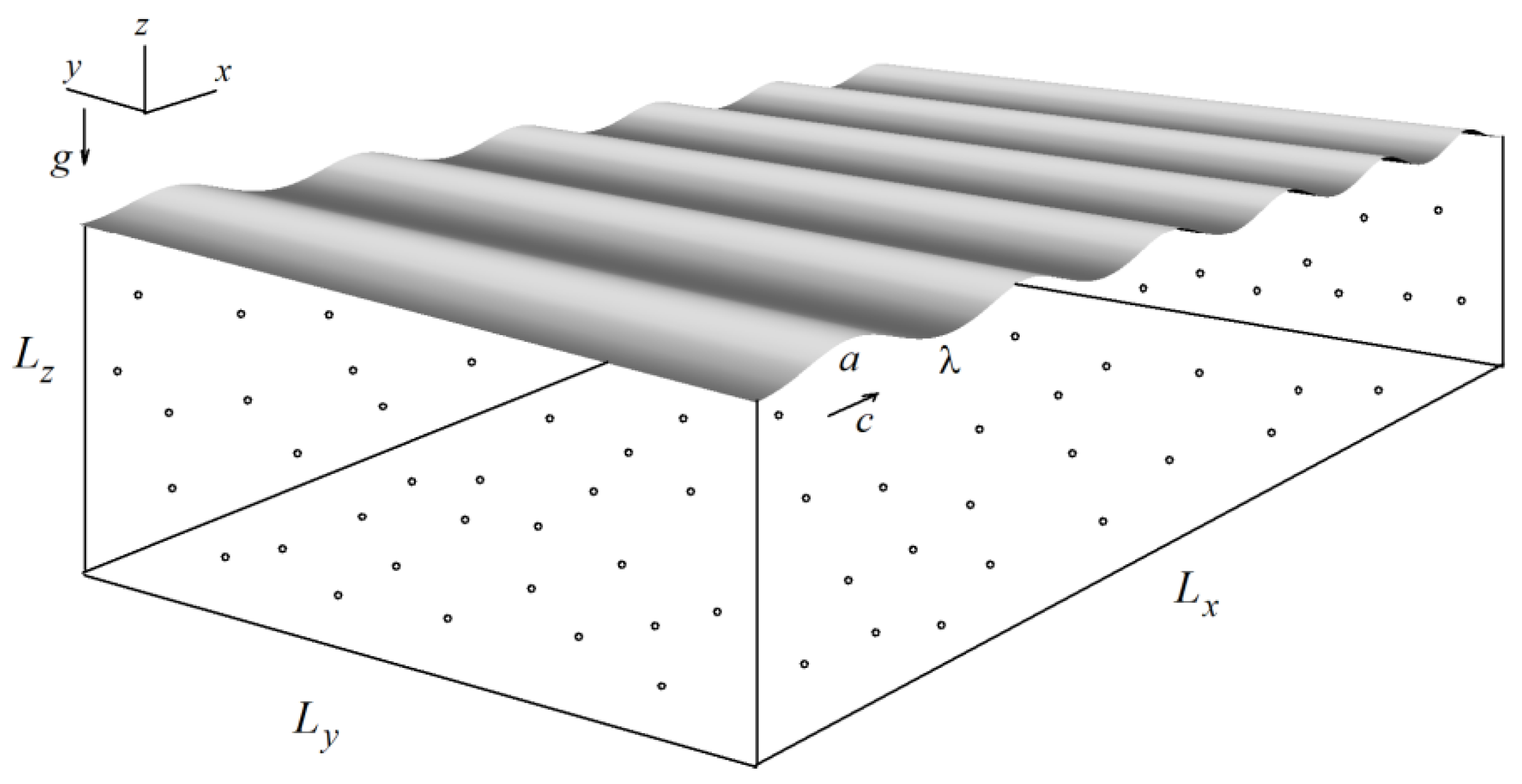
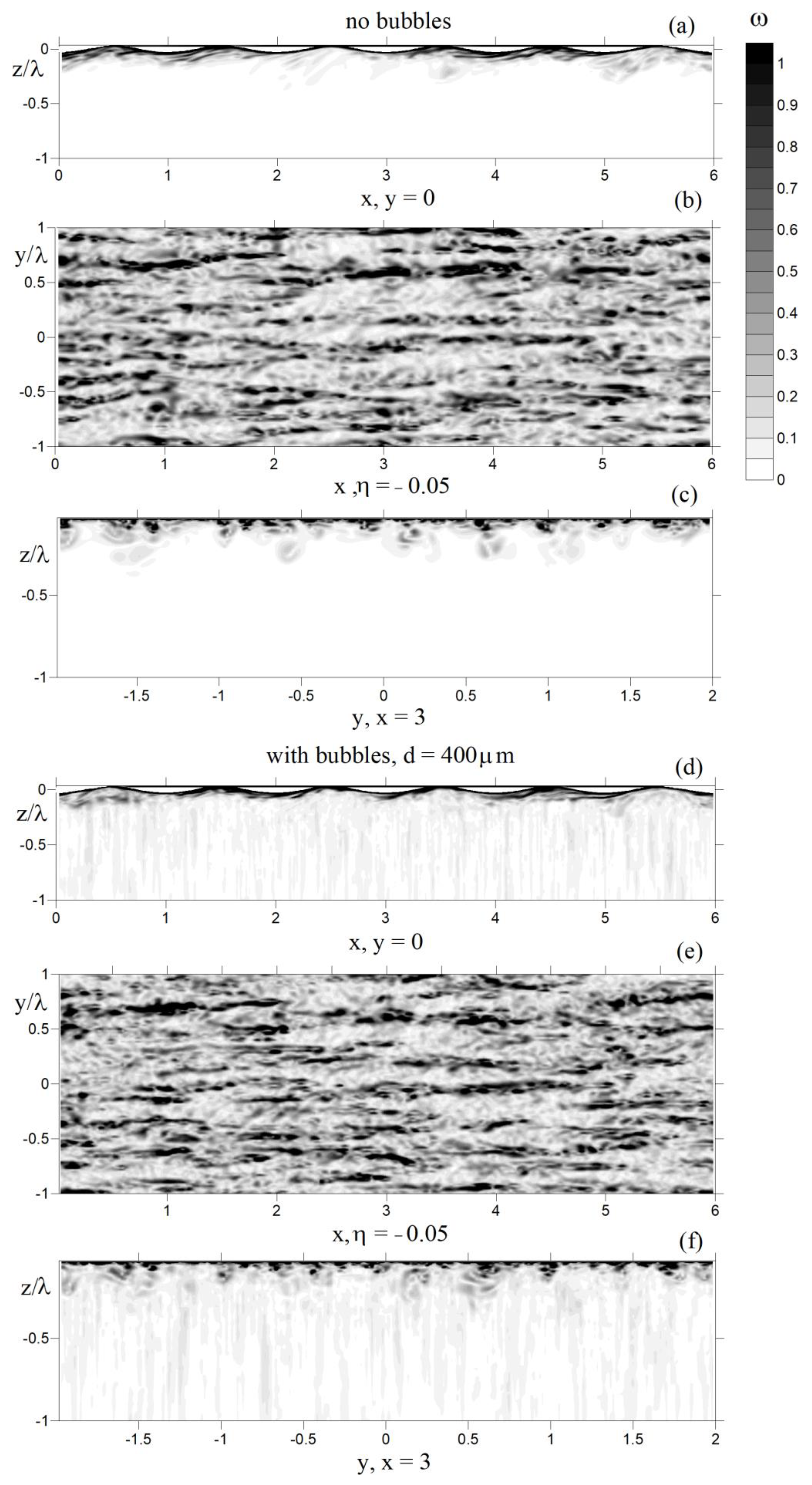
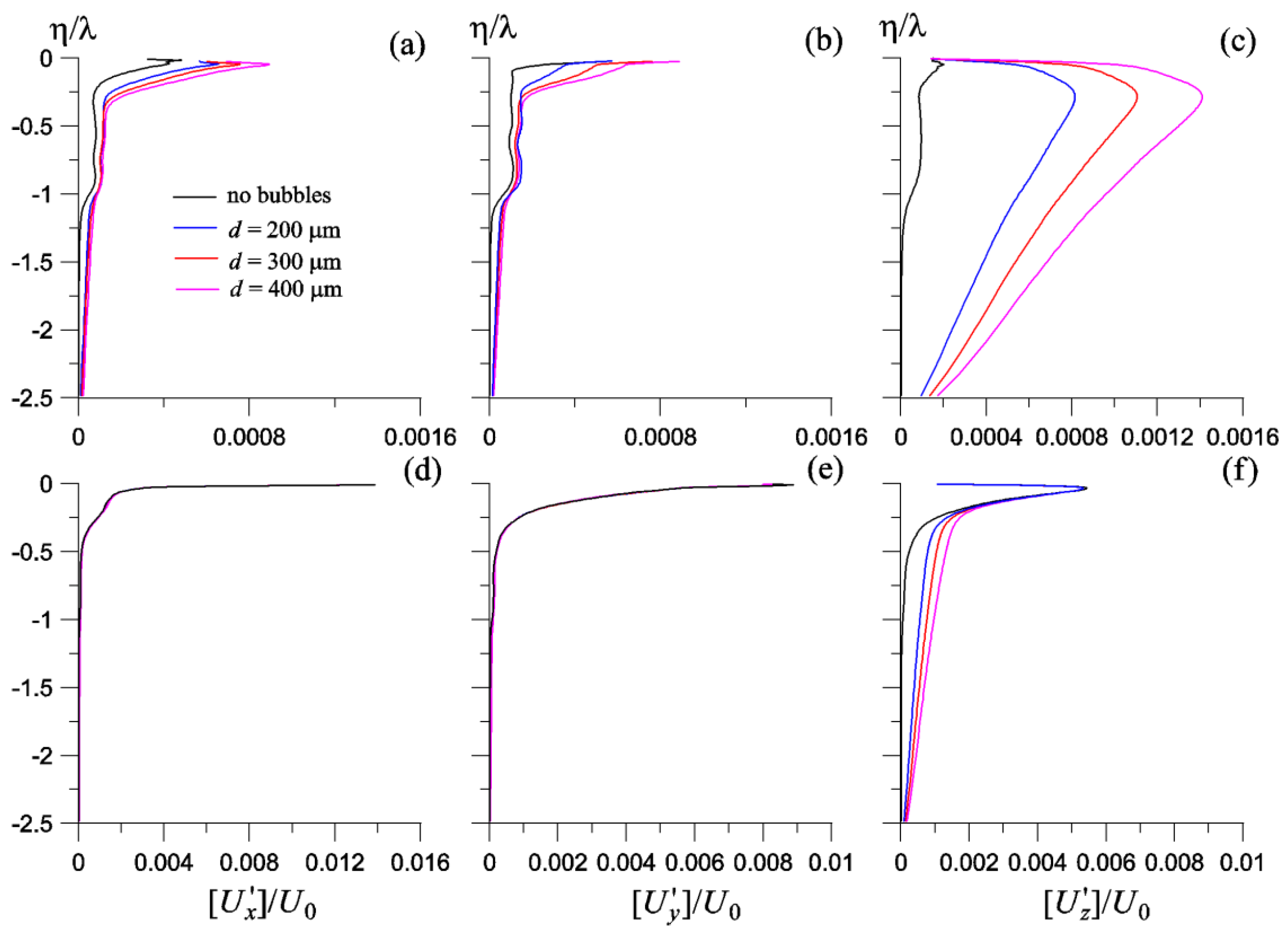
This paper presents an algorithm for numerical modeling of bubble dispersion occurring in the near-surface layer of the upper ocean under the action of non-breaking two-dimensional (2D) surface waves. The algorithm is based on a Eulerian-Lagrangian approach where full, 3D Navier-Stokes equations for the carrier flow induced by a waved water surface are solved in a Eulerian frame, and the trajectories of individual bubbles are simultaneously tracked in a Lagrangian frame, taking into account the impact of the bubbles on the carrier flow. The bubbles diameters are considered in the range from 200 to 400 microns (thus, micro-bubbles), and the effects related to the bubbles deformation and dissolution in water are neglected. The algorithm allows evaluation of the instantaneous as well as statistically stationary, phase-averaged profiles of the carrier-flow turbulence, bubble concentration (void fraction) and void-fraction fluxes for different flow regimes, both with and without wind-induced surface drift. The simulations results show that bubbles are capable of enhancing the carrier-flow turbulence, as compared to the bubble-free flow, and that the vertical water velocity fluctuations are mostly augmented, and increasingly so by larger bubbles. The results also show that the bubbles dynamics are governed by buoyancy, the surrounding fluid acceleration force and the drag force whereas the impact of the lift force remains negligible.
Keywords: numerical simulation; surface water waves; bubble dispersion; turbulence modification numerical simulation; surface water waves; bubble dispersion; turbulence modification