Article

Enhanced Photoelectrochemical Performance of BiVO4 Photoanodes Through Few-Layer MoS2 Composite Formation for Efficient Water Oxidation


by
Deepak Rajaram Patil
1,2,
Santosh S. Patil
3,
Rajneesh Kumar Mishra
4,*,
Sagar M. Mane
5,* and
Seung Yoon Ryu
1,2,*
1
Department of Physics, Dongguk University, Seoul 04620, Republic of Korea
2
Photoenegy Harvesting and Conversion Technology (PHCT), Dongguk University, Seoul 04620, Republic of Korea
3
Department of Research and Development, Dr. Vishwanath Karad MIT World Peace University (MIT-WPU), Kothrud, Pune 411038, India
4
Department of Physics, Yeungnam University, Gyeongsan 38541, Republic of Korea
5
Department of Fiber System Engineering, Yeungnam University, Gyeongsan 38541, Republic of Korea
*
Authors to whom correspondence should be addressed.
Materials 2025, 18(24), 5639; https://doi.org/10.3390/ma18245639
Submission received: 6 November 2025 / Revised: 9 December 2025 / Accepted: 10 December 2025 / Published: 15 December 2025

Abstract

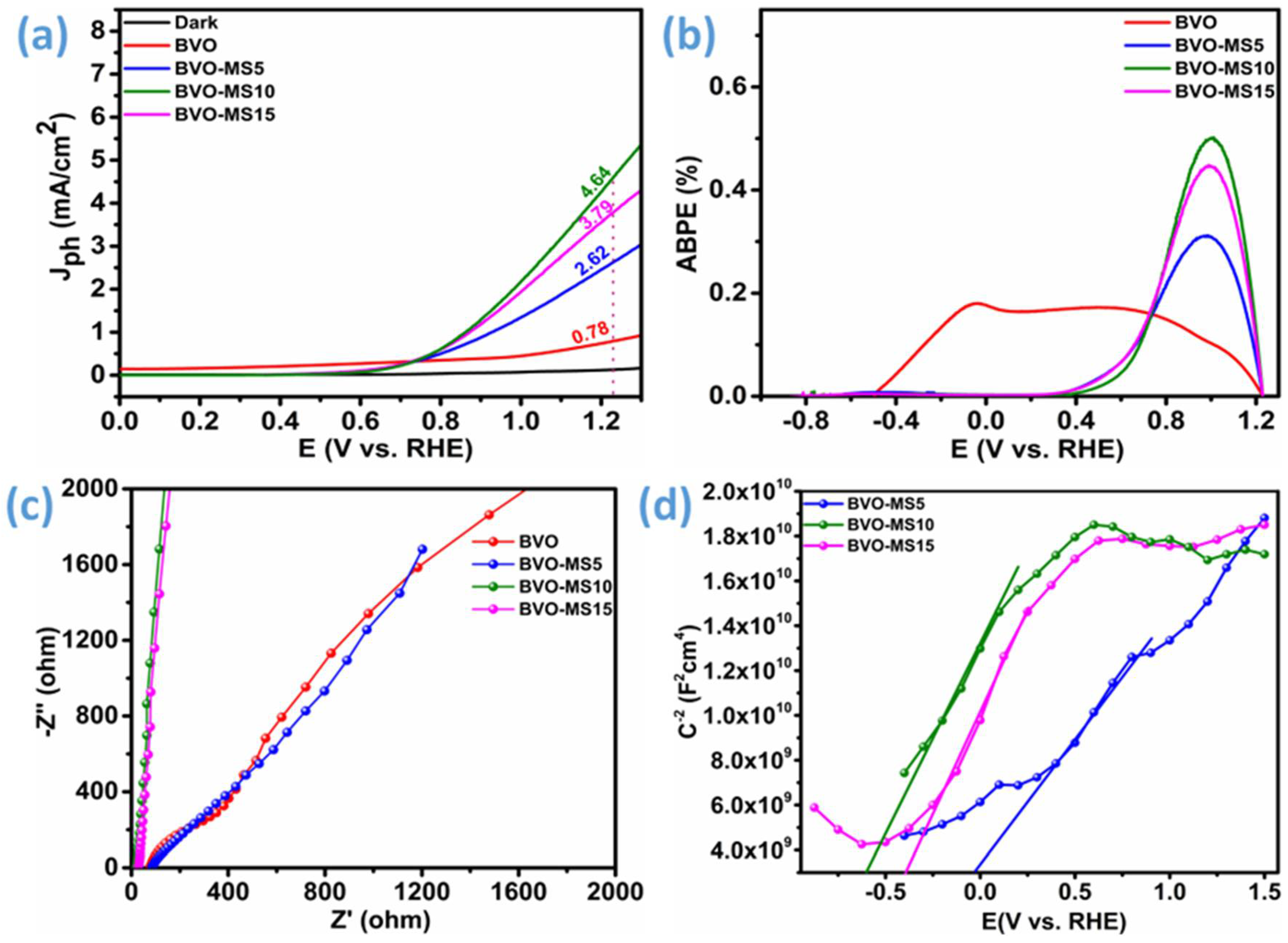
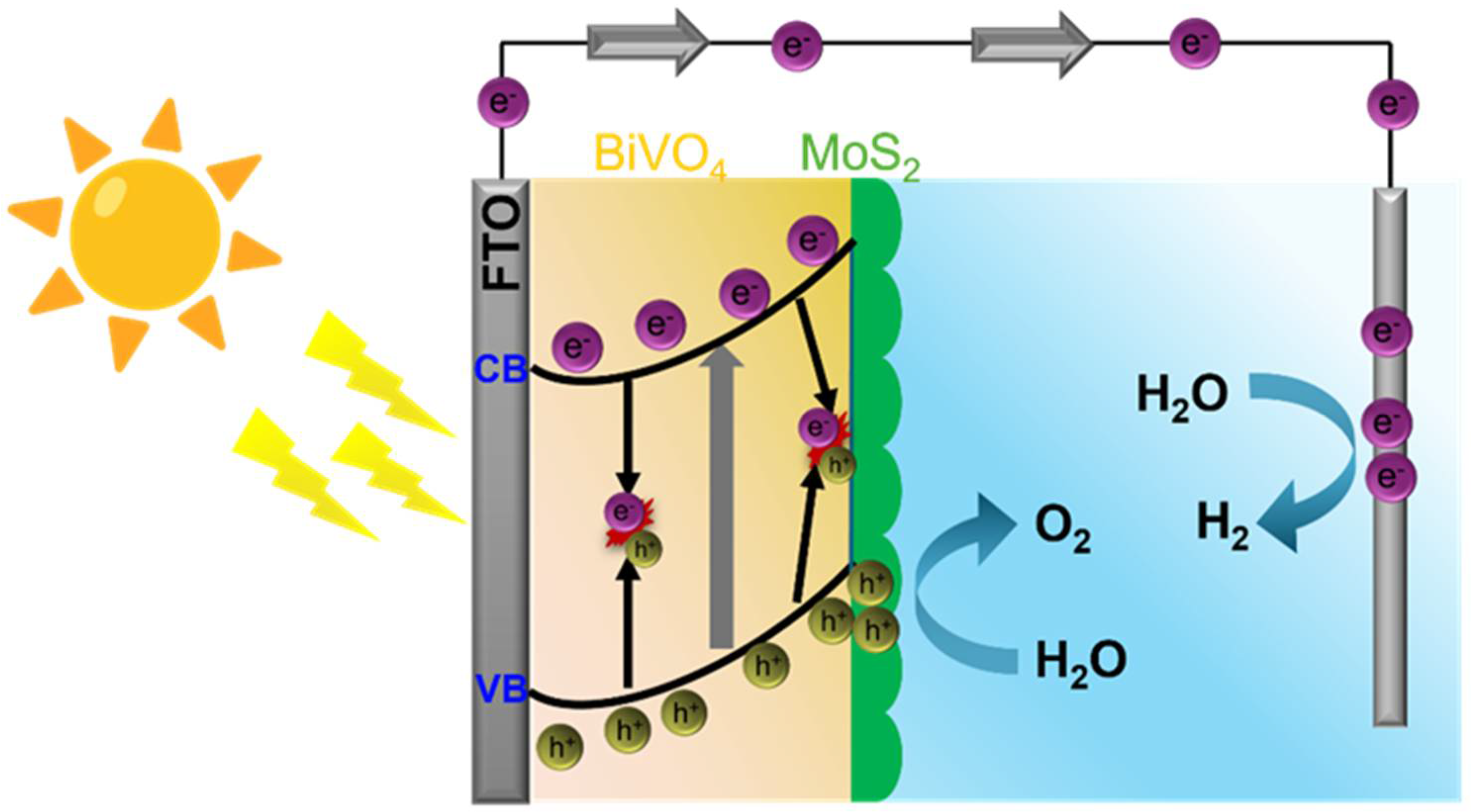
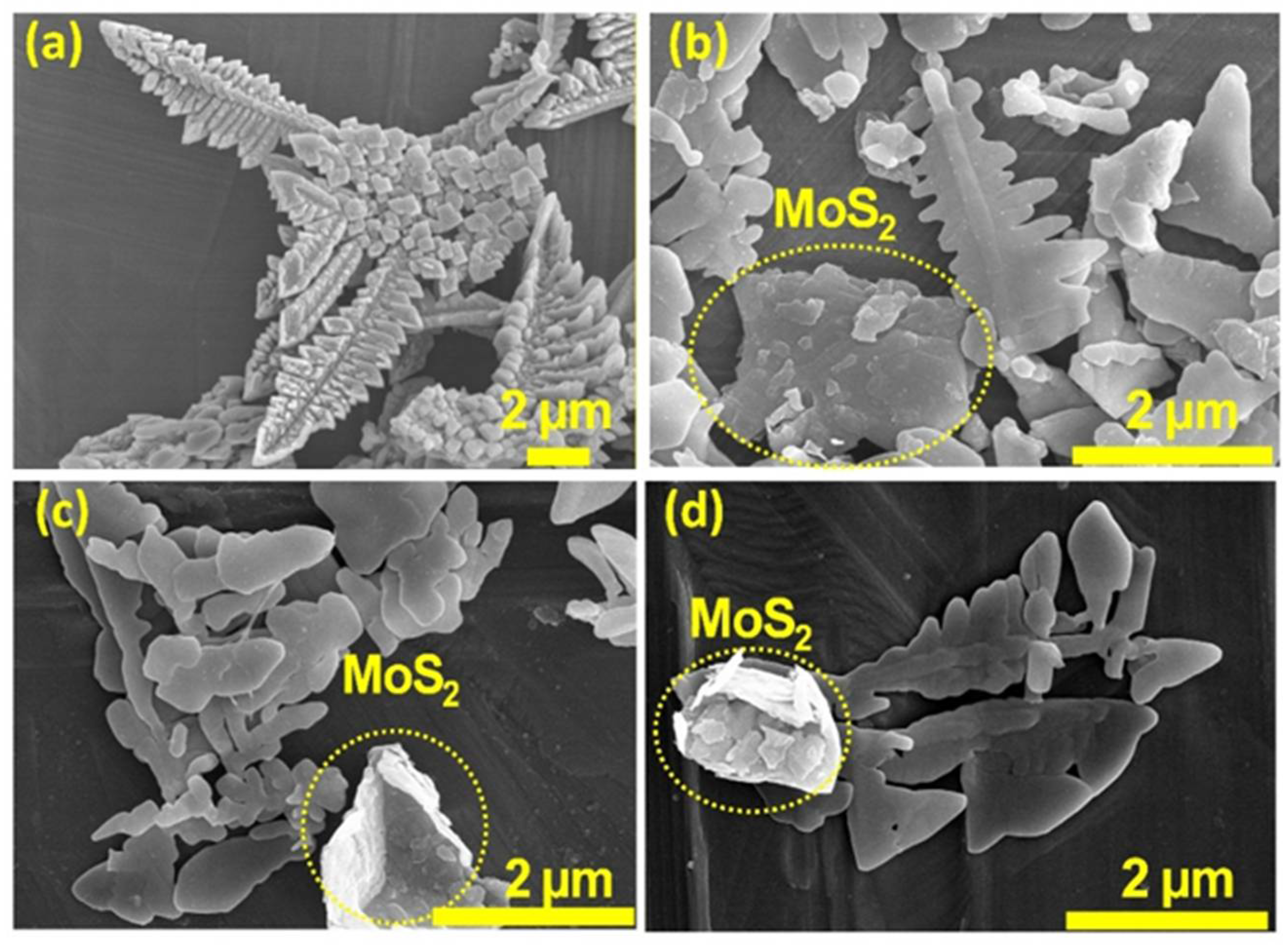
Photoelectrochemical water splitting (PEC-WS) provides a sustainable route to transform solar energy into hydrogen; however, its overall efficiency is constrained by the inherently slow kinetics of the oxygen evolution reaction. Bismuth vanadate (BiVO4) is considered an attractive visible-light-responsive photoanode due to its suitable band gap (~2.4 eV) and chemical stability; however, its efficiency is restricted by limited charge transport and significant charge carrier recombination. To overcome these limitations, BiVO4–MoS2 (BVO–MS) heterostructures were synthesized through a simple in situ hydrothermal approach, ensuring robust interfacial coupling and uniform dispersion of MS nanosheets over BVO dendritic surfaces. This intimate contact promotes rapid charge transfer and improved light-harvesting capability. Structural and spectroscopic analyses confirmed the formation of monoclinic BVO with uniformly integrated amorphous MS. The optimized BVO–MS10 electrode delivered a photocurrent density of 4.72 mA cm−2 at 0.6 V vs. SCE, approximately 5.3 times higher than pristine BVO, and achieved an applied bias photon-to-current efficiency of 0.49%. Mott–Schottky analysis revealed a distinct negative shift in the flat-band potential for BVO–MS10, indicative of an upward movement of its conduction band and the establishment of a strong internal electric field that enhances charge separation and interfacial electron transport. These synergistic effects collectively endow the in situ engineered BVO–MS heterostructure with superior PEC water oxidation performance and highlight its promise for efficient solar-driven hydrogen generation.
Keywords: hydrothermal method; BiVO4-MoS2; hybrid photoanodes; PEC-WS hydrothermal method; BiVO4-MoS2; hybrid photoanodes; PEC-WS