Comparative Evaluation of Different Biomass Ashes as Supplementary Cementitious Materials: Reactivity, Hydration Impact and Environmental Considerations
 , , ,
, , ,
Abstract
1. Introduction
2. Materials and Methods
2.1. Materials
2.1.1. Overview
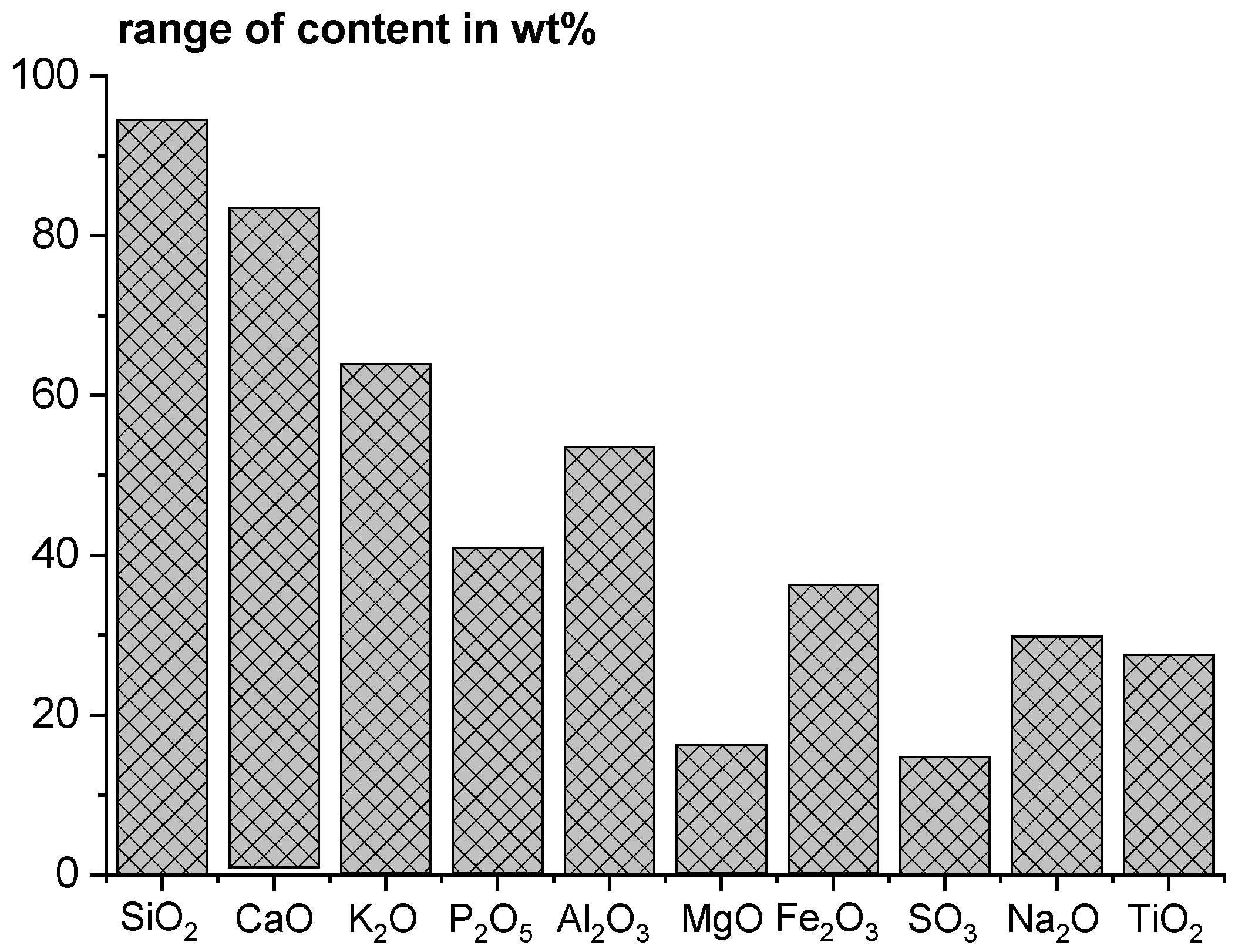
2.1.2. Chemical Composition
2.1.3. Mineralogical Composition
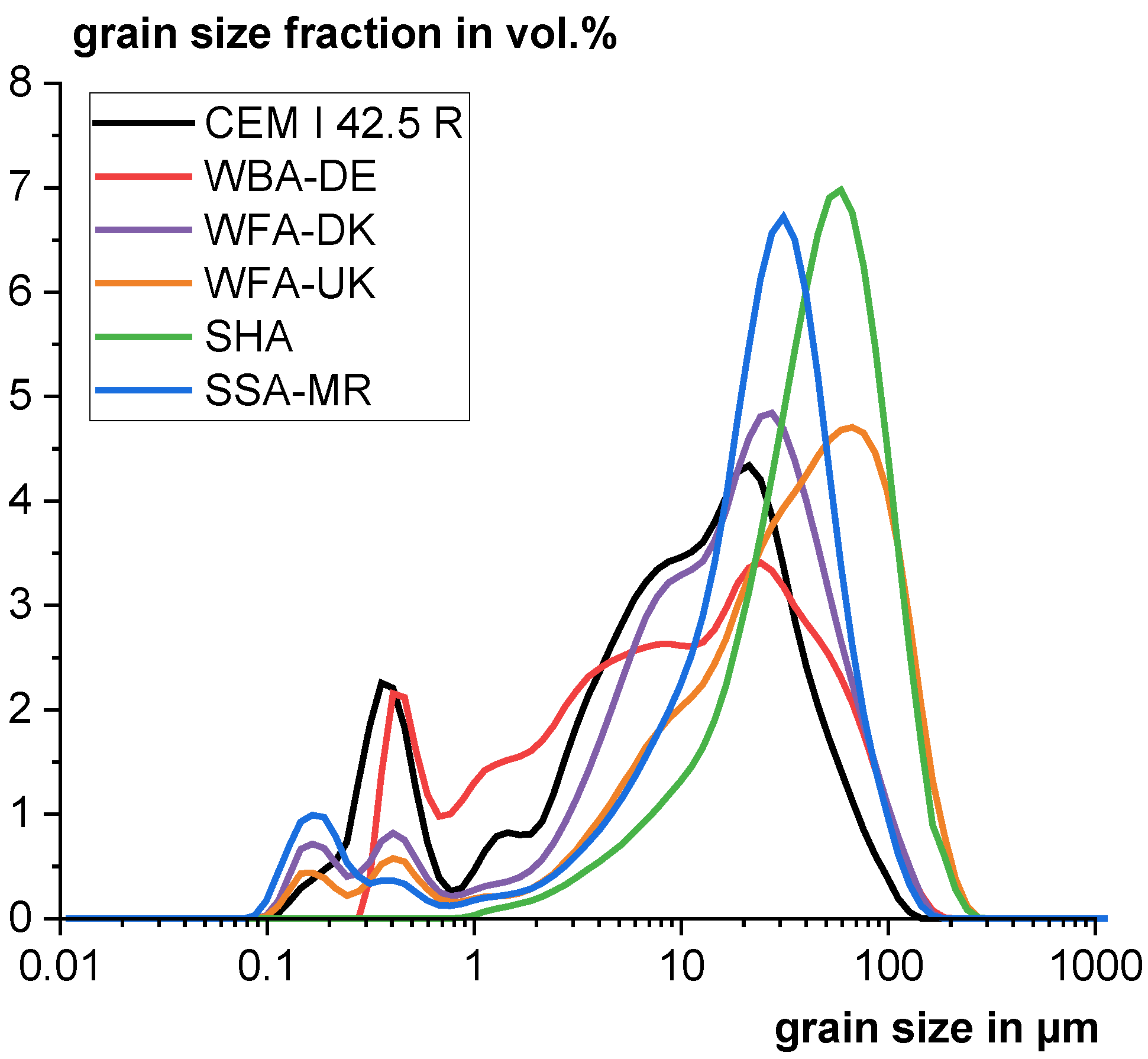
2.1.4. Physical Characterization
2.2. Methods
2.2.1. Environmental Parameter
2.2.2. Grain Morphology
2.2.3. Reactivity Test
2.2.4. Hydration Study
Isothermal Calorimetry
X-Ray Diffractometry (XRD)
Thermodynamic Modeling
2.2.5. Pore Structure
2.2.6. Setting Time, Soundness and Mortar Tests
3. Results and Discussion
3.1. Environmental Parameters
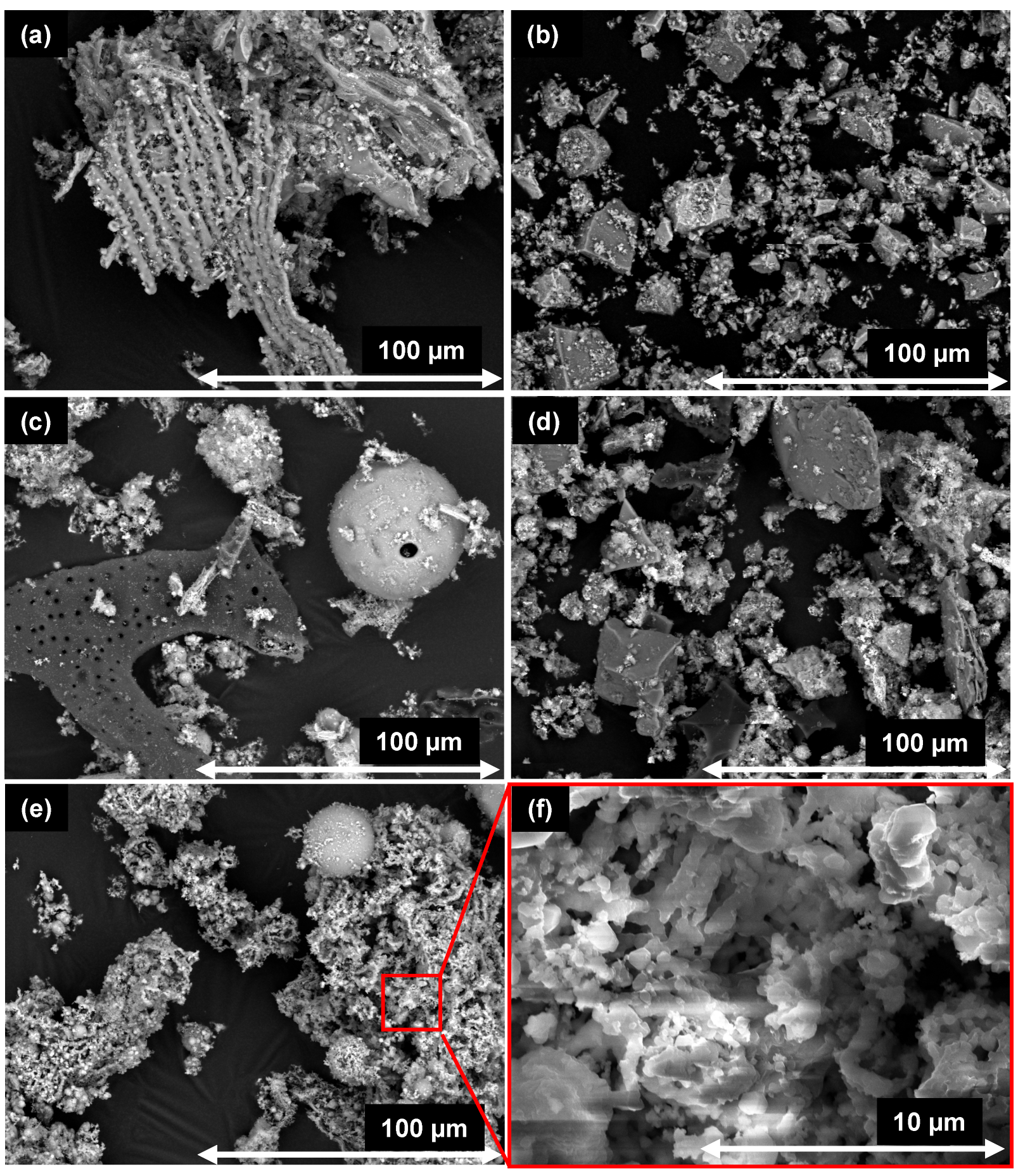
3.2. Grain Morphology
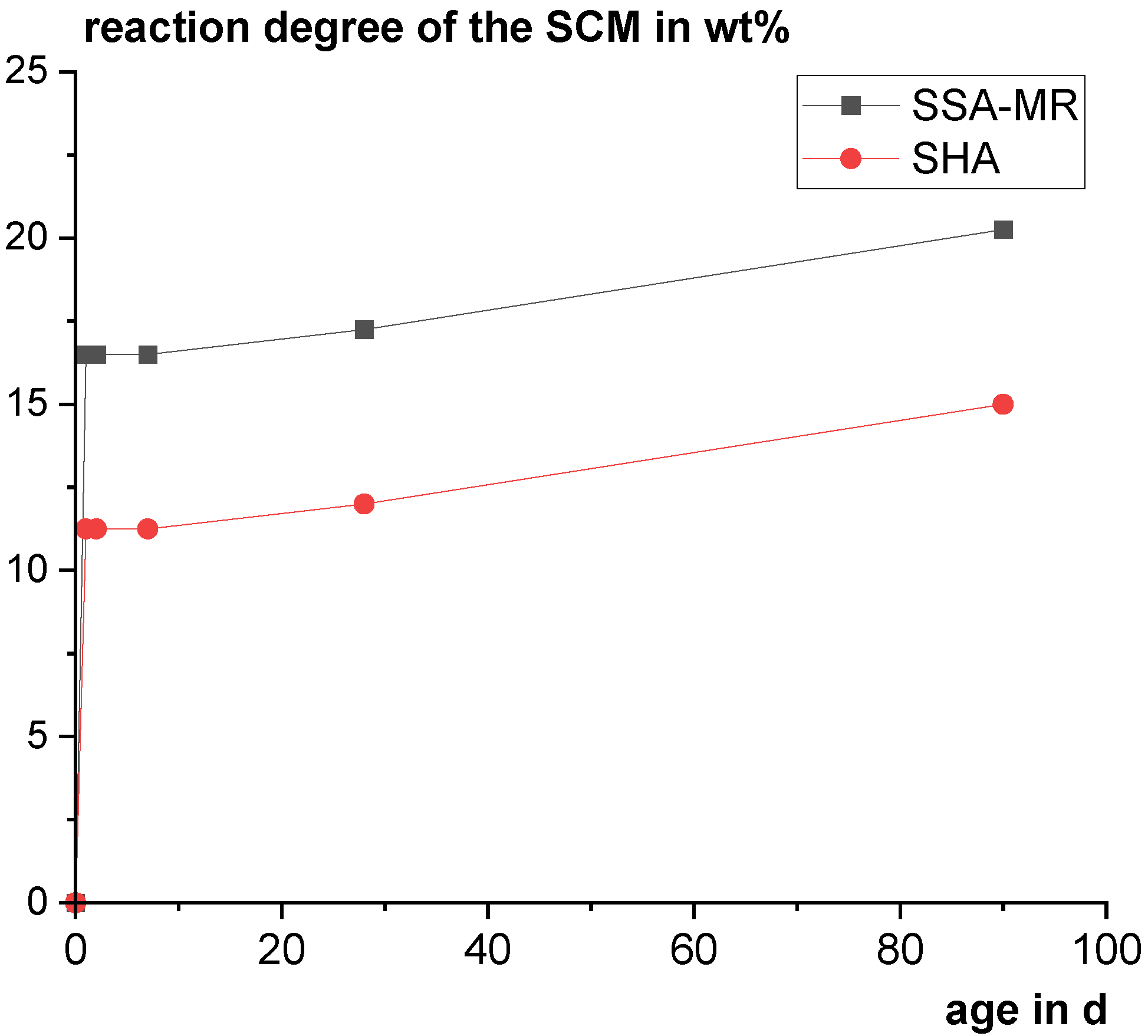
3.3. Reactivity Test
3.4. Hydration Study
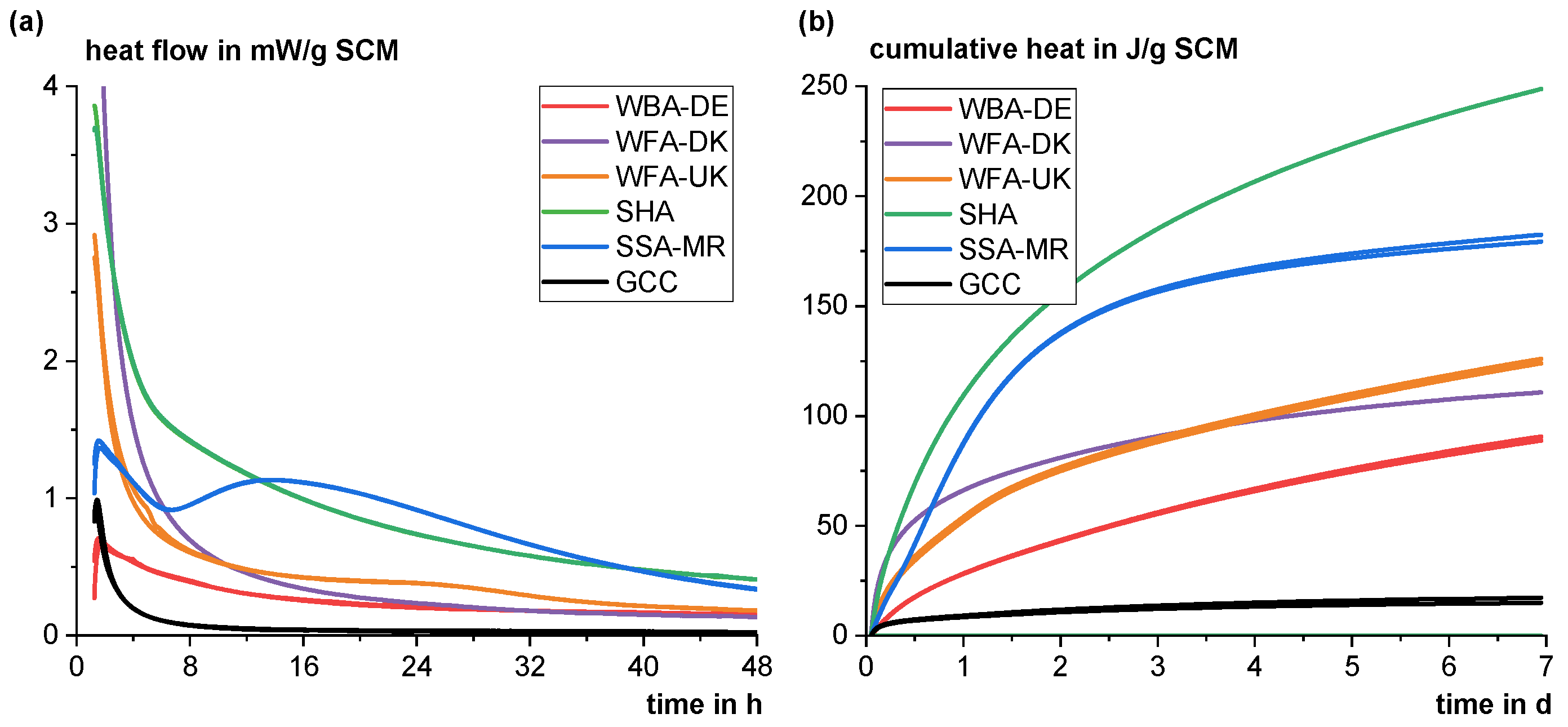
3.4.1. Isothermal Calorimetry
3.4.2. X-Ray Diffractometry
3.4.3. Thermodynamic Modeling
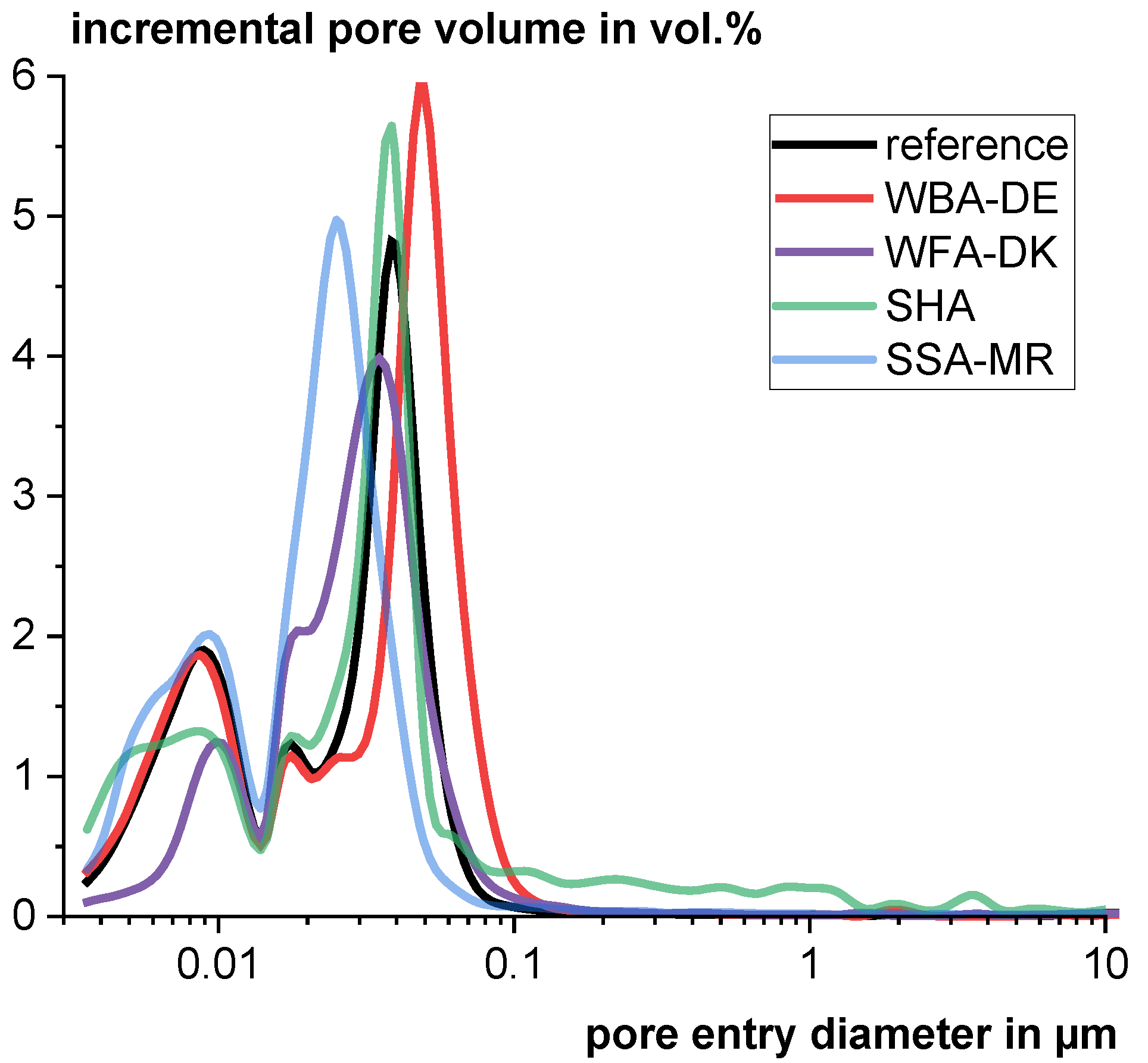
3.5. Pore Structure
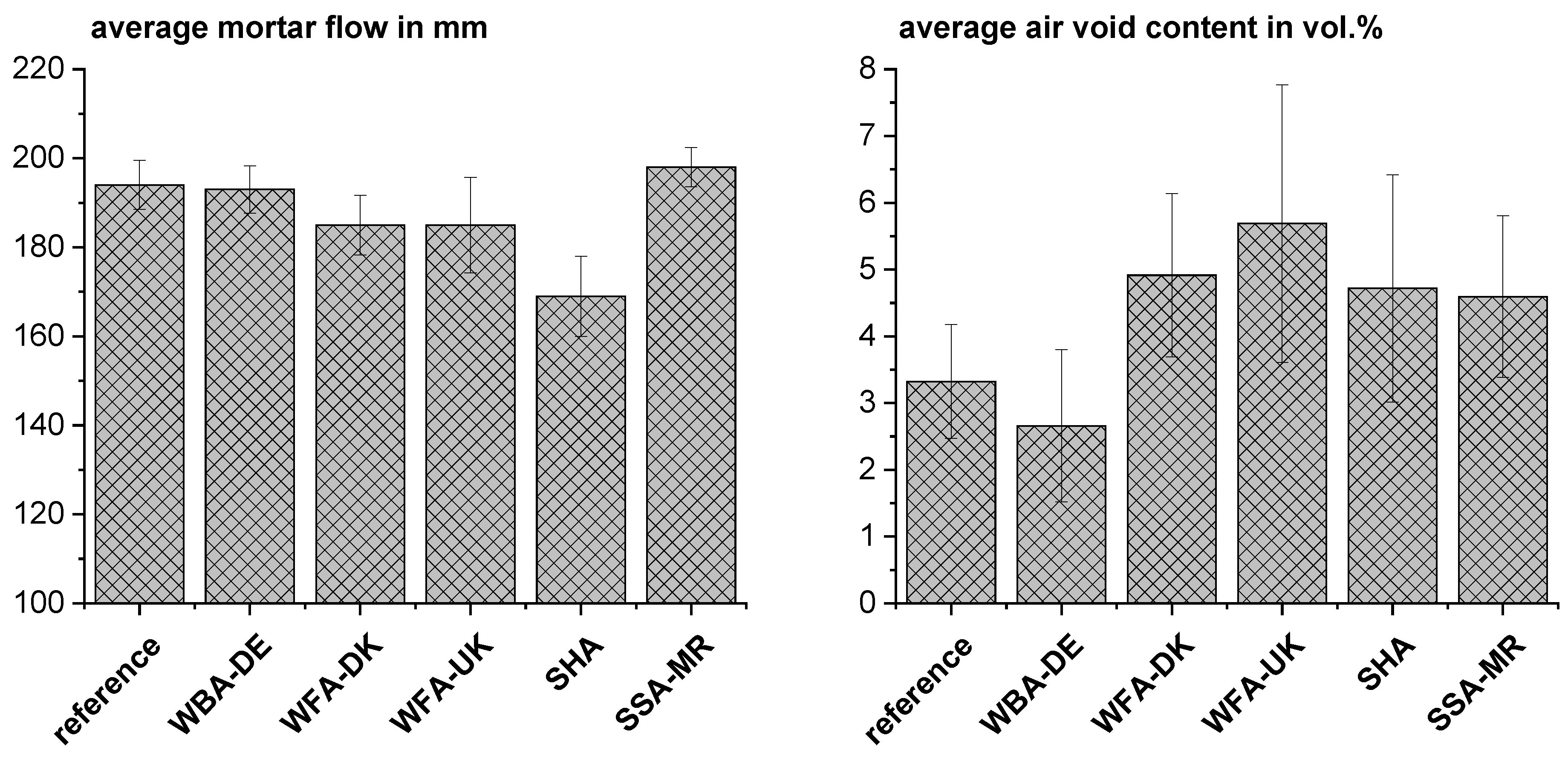
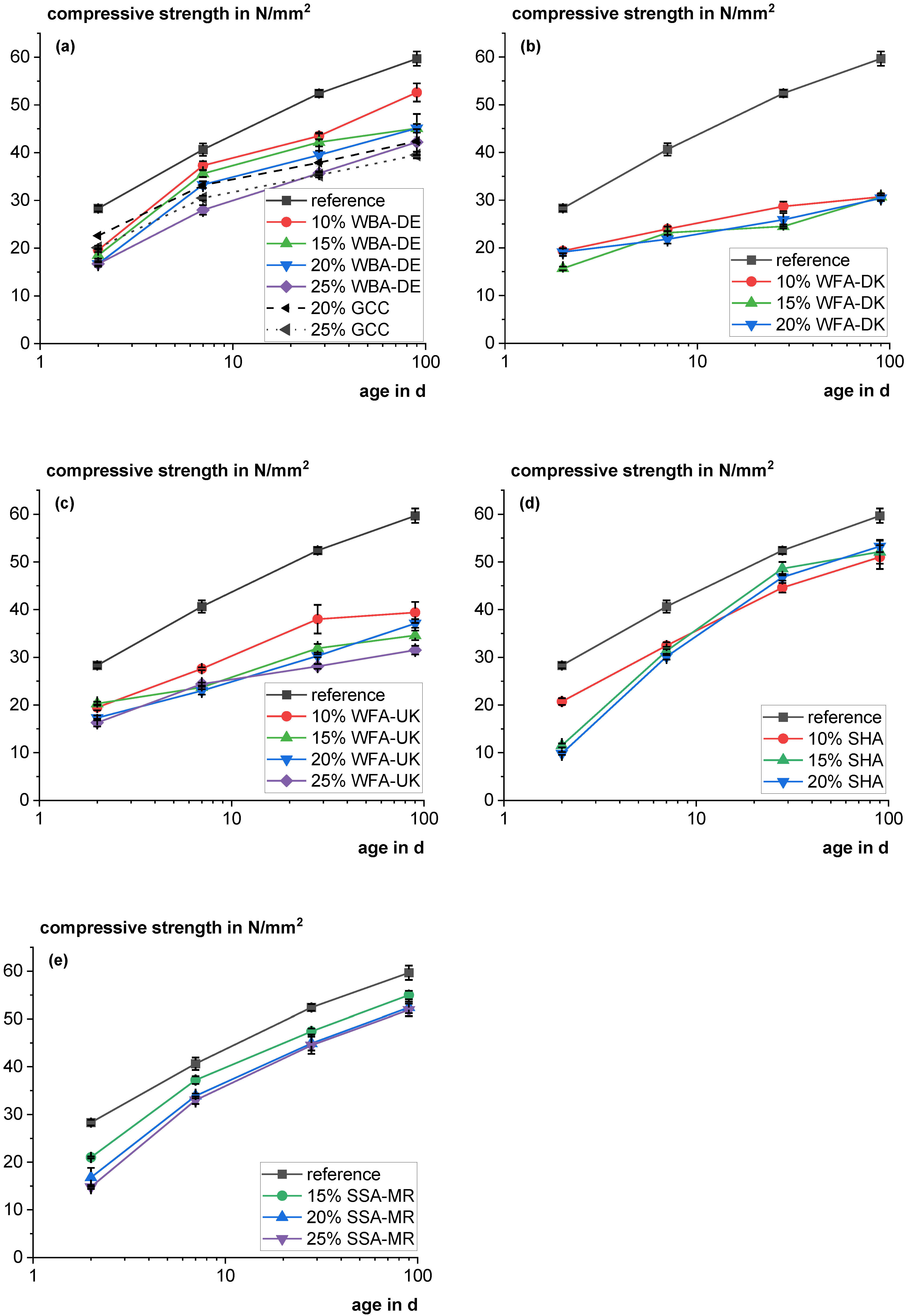
3.6. Setting Time, Soundness and Mortar Tests
4. Conclusions
- −
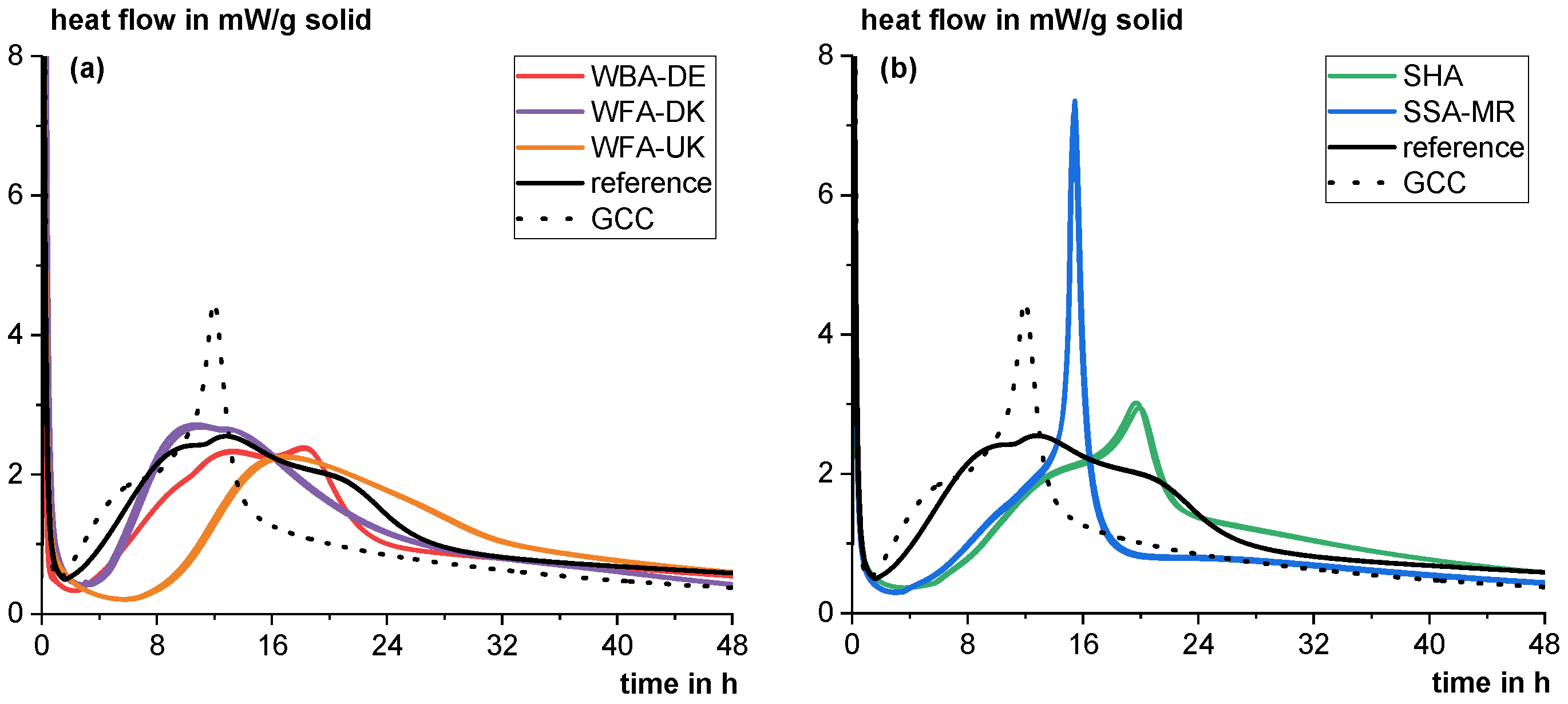
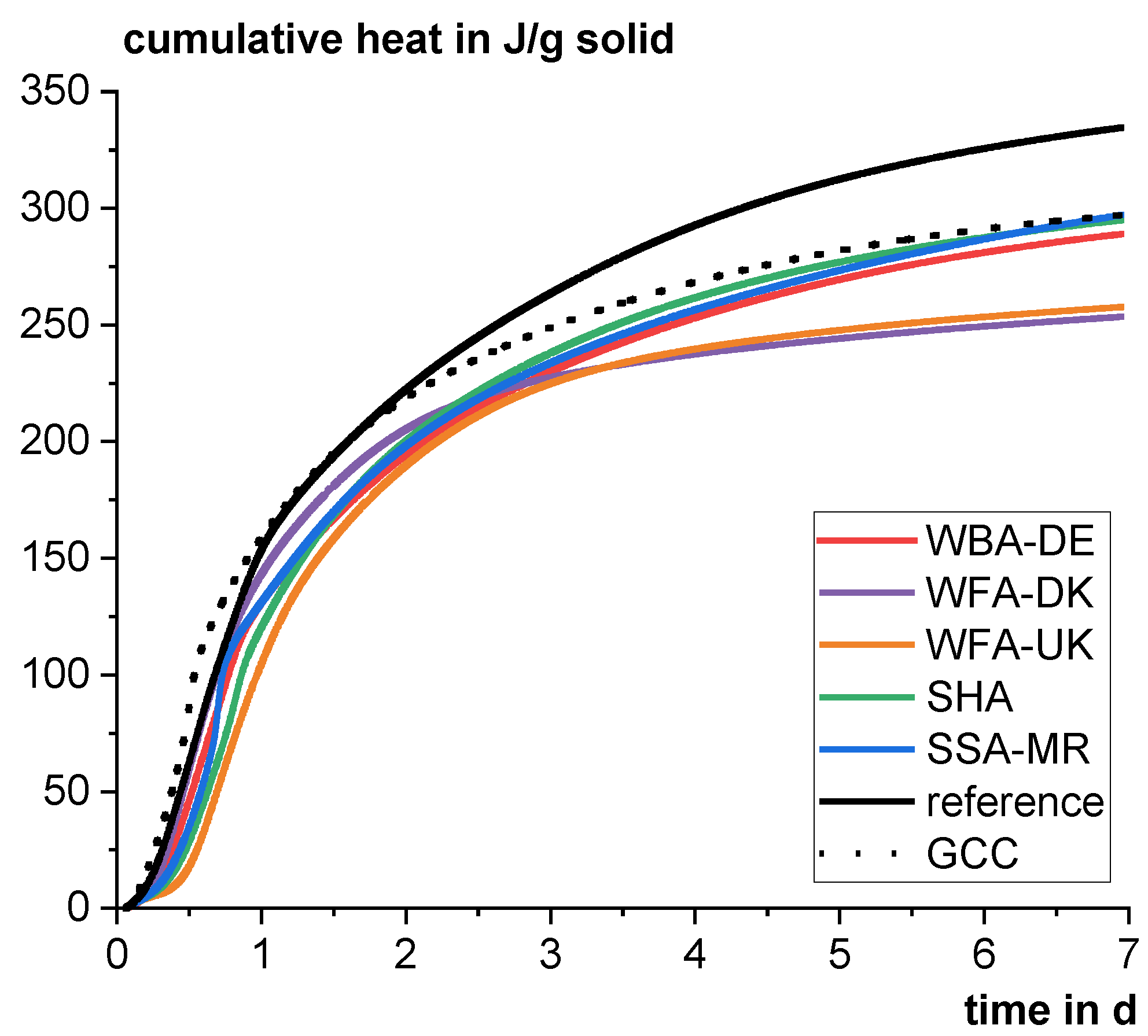
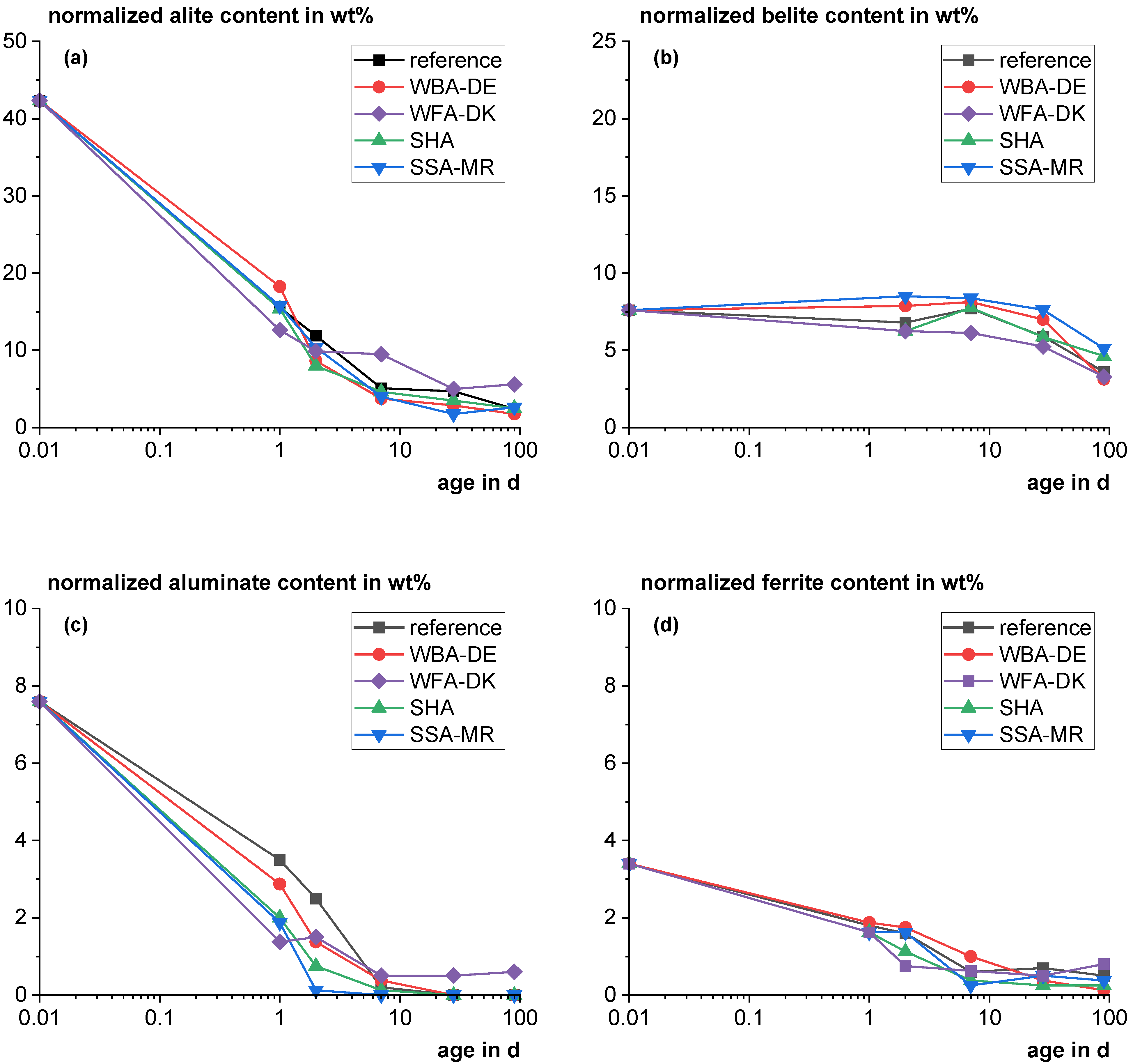
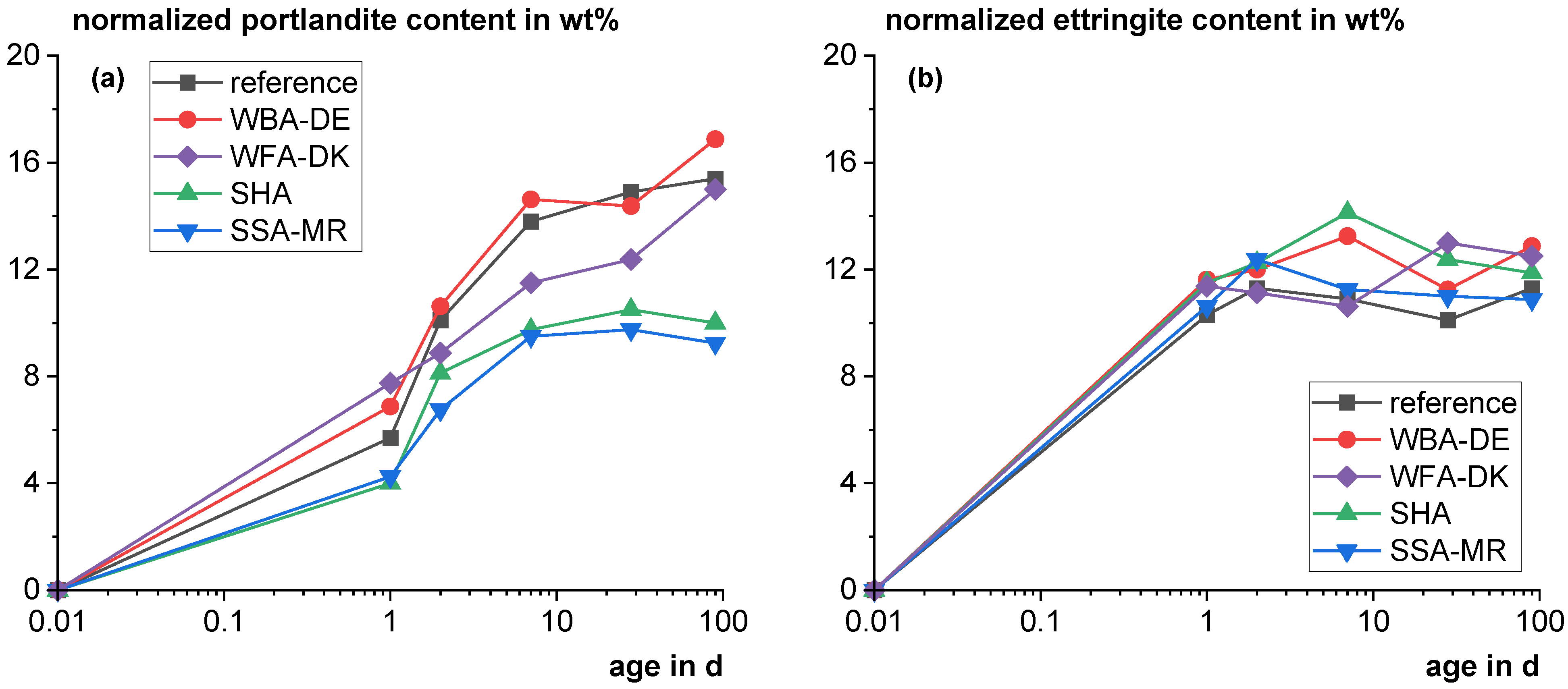
- WFA-DK seems to significantly alter the C-S-H formation since it shows a major negative impact on mortar compressive strength. Whereas the 2-day-strength was comparable with the other blends, no considerable strength increase was observed up to 90 days. Using calorimetry and XRD, it was found that after a rapid initial reaction of the clinker, the reaction rate becomes very slow after a few days. After 28 days, only comparatively small amounts of gel pores had formed, confirming the inhibition of C-S-H formation. The reason for this is not yet clear and might be caused by different overlying negative effects, such as a high concentration of alkalis, soluble chromium and organic components as well as the irregular shaped grain morphology with a highly porous network. A similar strength development was found for WFA-UK. The calorimetry curve indicates a similar behavior; however, due to the low performance, WFA-UK was not investigated more closely.
- −
- WBA-DE shows low contents of chloride and sulfate and no considerable reactivity but perfect workability because of a low content of unburned organic matter and mainly dense isometric particles with even surface. Therefore, it is suitable to be used as filler in cement or concrete. However, the grinding could be adjusted to improve early age performance.
- −
- SHA shows good reactivity, but bad workability in a blended cement due to a very high content of unburned organic matter. Also, the setting time is delayed and the early age strength is low which might be attributed to a high content of soluble phosphate and organic components. As this ash originates from a pilot plant, the burning condition should be adjusted.
- −
- SSA-MR shows a strength contribution comparable to SHA; however, less superplasticizer is needed and the early age strength is slightly better. However, the release of selenium in a batch leaching test appears to be critical from an environmental perspective.
Author Contributions
Funding
Institutional Review Board Statement
Informed Consent Statement
Data Availability Statement
Conflicts of Interest
Appendix A

References
- Andrew, R.M. Global CO2 emissions from cement production, 1928–2018. Earth Syst. Sci. Data 2019, 11, 1675–1710. [Google Scholar] [CrossRef]
- Verein Deutscher Zementwerke, e.V. Ressourcen der Zukunft für Zement und Beton—Potenziale und Handlungsstrategien; Verein Deutscher Zementwerke: Düsseldorf, Germany, 2022. [Google Scholar]
- Bundesministerium für Wirtschaft und Energie (BMWi). Erneuerbare Energien in Zahlen: Nationale und Internationale Entwicklung im Jahr 2019; Bundesministerium für Wirtschaft und Energie (BMWi): Berlin, Germany, 2020. [Google Scholar]
- Vassilev, S.V.; Baxter, D.; Andersen, L.K.; Vassileva, C.G. An overview of the chemical composition of biomass. Fuel 2010, 89, 913–933. [Google Scholar] [CrossRef]
- Fachagentur Nachwachsende Rohstoffe, e.V. Leitfaden Feste Biobrennstoffe; Fachagentur Nachwachsende Rohstoffe: Gülzow-Prüzen, Germany, 2014; ISBN 9783000153891. [Google Scholar]
- Cabrera, M.; Díaz-López, J.L.; Agrela, F.; Rosales, J. Eco-Efficient Cement-Based Materials Using Biomass Bottom Ash: A Review. Appl. Sci. 2020, 10, 8026. [Google Scholar] [CrossRef]
- Ben-Dor, L.; Rubinsztain, Y. The influence of phosphate on the hydration of cement minerals studied by DTA and TG. Thermochim. Acta 1979, 30, 9–14. [Google Scholar] [CrossRef]
- Tan, H.; Zou, F.; Liu, M.; Ma, B.; Guo, Y.; Jian, S. Effect of the Adsorbing Behavior of Phosphate Retarders on Hydration of Cement Paste. J. Mater. Civ. Eng. 2017, 29, 04017088. [Google Scholar] [CrossRef]
- Matalkah, F.; Soroushian, P.; Abideen, S.U.; Peyvandi, A. Use of non-wood biomass combustion ash in development of alkali-activated concrete. Constr. Build. Mater. 2016, 121, 491–500. [Google Scholar] [CrossRef]
- Schenke, L. Entwicklung Eines Kugelrosts zur Verbrennung von Biomassepellets aus Weizenstroh in Kleinfeuerungsanlagen. Ph.D. Thesis, RWTH Aachen University, Aachen, Germany, 2020. [Google Scholar]
- Danish, A.; Karadag, O.; Bilir, T.; Ozbakkaloglu, T. Valorization of biomass ashes in the production of cementitious composites: A comprehensive review of properties and performance. Constr. Build. Mater. 2023, 405, 133244. [Google Scholar] [CrossRef]
- Ercan, E.E.T.; Andreas, L.; Cwirzen, A.; Habermehl-Cwirzen, K. Wood Ash as Sustainable Alternative Raw Material for the Production of Concrete-A Review. Materials 2023, 16, 2557. [Google Scholar] [CrossRef]
- Nascimento, L.C.; Junior, G.B.; Xavier, G.D.C.; Monteiro, S.N.; Vieira, C.M.F.; de Azevedo, A.R.G.; Alexandre, J. Use of wood bottom ash in cementitious materials: A review. J. Mater. Res. Technol. 2023, 23, 4226–4243. [Google Scholar] [CrossRef]
- Al-Kharabsheh, B.N.; Arbili, M.M.; Majdi, A.; Ahmad, J.; Deifalla, A.F.; Hakamy, A. A Review on Strength and Durability Properties of Wooden Ash Based Concrete. Materials 2022, 15, 7282. [Google Scholar] [CrossRef]
- Carević, I.; Baričević, A.; Štirmer, N.; Bajto, J.Š. Correlation between physical and chemical properties of wood biomass ash and cement composites performances. Constr. Build. Mater. 2020, 256, 119450. [Google Scholar] [CrossRef]
- Sigvardsen, N.M.; Geiker, M.R.; Ottosen, L.M. Reaction mechanisms of wood ash for use as a partial cement replacement. Constr. Build. Mater. 2021, 286, 122889. [Google Scholar] [CrossRef]
- Putra, R.D.; Dizaji, H.B.; Kulshresth, D.; Zeng, T.; Overmann, S.; Vollpracht, A. Characterisation of Bottom Ashes from Non-Woody Biomass Combustion for Application as Sustainable Supplementary Cementitious Material. Energies 2024, 17, 468. [Google Scholar] [CrossRef]
- Endale, S.A.; Taffese, W.Z.; Vo, D.-H.; Yehualaw, M.D. Rice Husk Ash in Concrete. Sustainability 2023, 15, 137. [Google Scholar] [CrossRef]
- Siddika, A.; Mamun, M.A.A.; Alyousef, R.; Mohammadhosseini, H. State-of-the-art-review on rice husk ash: A supplementary cementitious material in concrete. J. King Saud Univ. Eng. Sci. 2021, 33, 294–307. [Google Scholar] [CrossRef]
- Amran, M.; Fediuk, R.; Murali, G.; Vatin, N.; Karelina, M.; Ozbakkaloglu, T.; Krishna, R.S.; Sahoo, A.K.; Das, S.K.; Mishra, J. Rice Husk Ash-Based Concrete Composites: A Critical Review of Their Properties and Applications. Crystals 2021, 11, 168. [Google Scholar] [CrossRef]
- Zhao, Y.; Pohl, O.; Bhatt, A.I.; Collis, G.E.; Mahon, P.J.; Rüther, T.; Hollenkamp, A.F. A Review on Battery Market Trends, Second-Life Reuse, and Recycling. Sustain. Chem. 2021, 2, 167–205. [Google Scholar] [CrossRef]
- European Commission. Mitteilung der Kommission an Das Europäische Parlament, den Rat, den Europäischen Wirtschafts-und Sozialaussschuss und den Aussschuss der Regionen: Widerstandsfähigkeit der EU bei Kritischen Rohstoffen: Einen Pfad hin zu Größerer Sicherheit und Nachhaltigkeit Abstecken; European Commission: Brussels, Belgium, 2020. [Google Scholar]
- Bundesministerium der Justiz und für Verbraucherschutz. Verordnung zur Neuordnung der Klärschlammverwertung; Bundesgesetzblatt Teil I Nr. 65; Bundesministerium der Justiz und für Verbraucherschutz: Berlin, Germany, 2017. [Google Scholar]
- Kraus, F.; Zamzow, M.; Conzelmann, L.; Remy, C.; Kleyböcker, A.; Seis, W.; Miehe, U.; Hermann, L.; Hermann, R.; Kabbe, C. Ökobilanzieller Vergleich der P-Rückgewinnung aus dem Abwasserstrom mit der Düngemittel-produktion aus Rohphosphaten Unter Einbeziehung von Umweltfolgeschäden und Deren Vermeidung: Abschlussbericht, 13th ed.; Federal Environment Agency: Dessau-Roßlau, Germany, 2019. [Google Scholar]
- Świerczek, L.; Cieślik, B.M.; Konieczka, P. Challenges and opportunities related to the use of sewage sludge ash in cement-based building materials—A review. J. Clean. Prod. 2021, 287, 125054. [Google Scholar] [CrossRef]
- Donatello, S.; Freeman-Pask, A.; Tyrer, M.; Cheeseman, C.R. Effect of milling and acid washing on the pozzolanic activity of incinerator sewage sludge ash. Cem. Concr. Compos. 2010, 32, 54–61. [Google Scholar] [CrossRef]
- Chang, Z.; Long, G.; Zhou, J.L.; Ma, C. Valorization of sewage sludge in the fabrication of construction and building materials: A review, Resources. Conserv. Recycl. 2020, 154, 104606. [Google Scholar] [CrossRef]
- Lynn, C.J.; Dhir, R.K.; Ghataora, G.S.; West, R.P. Sewage sludge ash characteristics and potential for use in concrete. Constr. Build. Mater. 2015, 98, 767–779. [Google Scholar] [CrossRef]
- Mejdi, M.; Saillio, M.; Chaussadent, T.; Divet, L.; Tagnit-Hamou, A. Hydration mechanisms of sewage sludge ashes used as cement replacement. Cem. Concr. Res. 2020, 135, 106115. [Google Scholar] [CrossRef]
- de Azevedo Basto, P.; Junior, H.S.; de Melo Neto, A.A. Characterization and pozzolanic properties of sewage sludge ashes (SSA) by electrical conductivity. Cem. Concr. Compos. 2019, 104, 103410. [Google Scholar] [CrossRef]
- Xu, Y.; Zhang, L.; Chen, J.; Liu, T.; Li, N.; Xu, J.; Yin, W.; Li, D.; Zhang, Y.; Zhou, X. Phosphorus recovery from sewage sludge ash (SSA): An integrated technical, environmental and economic assessment of wet-chemical and thermochemical methods. J. Environ. Manag. 2023, 344, 118691. [Google Scholar] [CrossRef] [PubMed]
- Liang, S.; Yang, L.; Chen, H.; Yu, W.; Tao, S.; Yuan, S.; Xiao, K.; Hu, J.; Hou, H.; Liu, B.; et al. Phosphorus recovery from incinerated sewage sludge ash (ISSA) and reutilization of residues for sludge pretreated by different conditioners. Resour. Conserv. Recycl. 2021, 169, 105524. [Google Scholar] [CrossRef]
- ASTM C1897-20; Standard Test Methods for Measuring the Reactivity of Supplementary Cementitious Materials by Isothermal Calorimetry and Bound Water Measurements. ASTM International: West Conshohocken, PA, USA, 2020. [CrossRef]
- DIN EN 450-1:2012-10; Flugasche für Beton_-Teil_1: Definition, Anforderungen und Konformitätskriterien; Deutsche Fassung EN_450-1:2012. DIN Media GmbH: Berlin, Germany, 2012. [CrossRef]
- DIN EN 196-2:2013-10; Prüfverfahren für Zement_-Teil_2: Chemische Analyse von Zement; Deutsche Fassung EN_196-2:2013. DIN Media GmbH: Berlin, Germany, 2013. [CrossRef]
- Kochova, K.; Schollbach, K.; Gauvin, F.; Brouwers, H. Effect of saccharides on the hydration of ordinary Portland cement. Constr. Build. Mater. 2017, 150, 268–275. [Google Scholar] [CrossRef]
- Leemann, A.; Lothenbach, B. The influence of potassium–sodium ratio in cement on concrete expansion due to alkali-aggregate reaction. Cem. Concr. Res. 2008, 38, 1162–1168. [Google Scholar] [CrossRef]
- Huang, L.; Yan, P. Effect of alkali content in cement on its hydration kinetics and mechanical properties. Constr. Build. Mater. 2019, 228, 116833. [Google Scholar] [CrossRef]
- Jawed, I.; Skalny, J. Alkalies in cement: A review. Cem. Concr. Res. 1978, 8, 37–51. [Google Scholar] [CrossRef]
- Ma, Y.; Qian, J. Influence of alkali sulfates in clinker on the hydration and hardening of Portland cement. Constr. Build. Mater. 2018, 180, 351–363. [Google Scholar] [CrossRef]
- Skibsted, J.; Snellings, R. Reactivity of supplementary cementitious materials (SCMs) in cement blends. Cem. Concr. Res. 2019, 124, 105799. [Google Scholar] [CrossRef]
- Sigvardsen, N.M.; Geiker, M.R.; Ottosen, L.M. Phase development and mechanical response of low-level cement replacements with wood ash and washed wood ash. Constr. Build. Mater. 2021, 269, 121234. [Google Scholar] [CrossRef]
- Wei, H.; Gao, B.; Ren, J.; Li, A.; Yang, H. Coagulation/flocculation in dewatering of sludge: A review. Water Res. 2018, 143, 608–631. [Google Scholar] [CrossRef] [PubMed]
- Ukrainczyk, N. Reuse of Woody Biomass Ash Waste in Cementitious Materials. Chem. Biochem. Eng. Q. 2016, 30, 137–148. [Google Scholar] [CrossRef]
- Etiégni, L.; Campbell, A.G. Physical and chemical characteristics of wood ash. Bioresour. Technol. 1991, 37, 173–178. [Google Scholar] [CrossRef]
- Misra, M.K.; Ragland, K.W.; Baker, A.J. Wood ash composition as a function of furnace temperature. Biomass Bioenergy 1993, 4, 103–116. [Google Scholar] [CrossRef]
- Overmann, S.; Eggimann, M.; Vollpracht, A.; Matschei, T. Impact of clay reactivity on the hydration of calcined clay limestone cements. Constr. Build. Mater. 2024, 449, 138455. [Google Scholar] [CrossRef]
- Overmann, S.; Vollpracht, A.; Matschei, T. Reactivity of Calcined Clays as SCM-A Review. Materials 2024, 17, 312. [Google Scholar] [CrossRef]
- DIN EN 196-6:2019-03; Prüfverfahren für Zement_-Teil_6: Bestimmung der Mahlfeinheit; Deutsche Fassung EN_196-6:2018. DIN Media GmbH: Berlin, Germany, 2019. [CrossRef]
- DIN EN 13657:2003-01; Charakterisierung von Abfällen_-Aufschluß Zur Anschließenden Bestimmung des in Königswasser Löslichen Anteils an Elementen in Abfällen; Deutsche Fassung EN_13657:2002. DIN Media GmbH: Berlin, Germany, 2003. [CrossRef]
- DIN EN ISO 17294-2:2024-03; Wasserbeschaffenheit_-Anwendung der Induktiv Gekoppelten Plasma-Massenspektrometrie (ICP-MS)_-Teil_2: Bestimmung von ausewählten Elementen einshließlich Uran-Isotope (ISO_17294-2:2023); Deutsche Fassung EN_ISO_17294-2:2023. DIN Media GmbH: Berlin, Germany, 2024. [CrossRef]
- DIN EN ISO 12846:2012-08; Wasserbeschaffenheit_-Bestimmung von Quecksilber_-Verfahren Mittels Atomabsorptionsspektrometrie (AAS) Mit Und Ohne Anreicherung (ISO_12846:2012); Deutsche Fassung EN_ISO_12846:2012. DIN Media GmbH: Berlin, Germany, 2012. [CrossRef]
- DIN EN 17503:2022-08; Boden, Schlamm, Behandelter Bioabfall Und Abfall_-Bestimmung von Polycyclischen Aromatischen Kohlenwasserstoffen_(PAK) Mittels Gaschromatographie_(GC) Und Hochleistungs-Flüssigkeitschromatographie_(HPLC); Deutsche Fassung EN_17503:2022. DIN Media GmbH: Berlin, Germany, 2022. [CrossRef]
- DIN EN 17322:2021-03; Feststoffe in der Umwelt_-Bestimmung von Polychlorierten Biphenylen_(PCB) Mittels Gaschromatographie Und Massenspektrometrischer Detektion (GC-MS) Oder Elektronen-Einfang-Detektion (GC-ECD); Deutsche Fassung EN_17322:2020. DIN Media GmbH: Berlin, Germany, 2021. [CrossRef]
- DIN EN 12457-4:2003-01; Charakterisierung von Abfällen—Auslaugung; Übereinstimmungsuntersuchung Für Die Auslaugung von Körnigen Abfällen Und Schlämmen_-Teil_4: Einstufiges Schüttelverfahren Mit Einem Flüssigkeits-/Feststoffverhältnis von 10_l/kg für Materialien Mit Einer Korngröße Unter 10_mm (Ohne Oder Mit Korngrößenreduzierung); Deutsche Fassung EN_12457-4:2002. DIN Media GmbH: Berlin, Germany, 2003. [CrossRef]
- Avet, F.; Snellings, R.; Diaz, A.A.; Haha, M.B.; Scrivener, K. Development of a new rapid, relevant and reliable (R3) test method to evaluate the pozzolanic reactivity of calcined kaolinitic clays. Cem. Concr. Res. 2016, 85, 1–11. [Google Scholar] [CrossRef]
- Scrivener, K.; Snellings, R.; Lothenbach, B. (Eds.) A Practical Guide to Microstructural Analysis of Cementitious Materials; CRC Press Taylor & Francis Group: Boca Raton, FL, USA; London, UK; New York, NY, USA, 2016. [Google Scholar] [CrossRef]
- Lothenbach, B.; Kulik, D.A.; Matschei, T.; Balonis, M.; Baquerizo, L.; Dilnesa, B.; Miron, G.D.; Myers, R.J. Cemdata18: A chemical thermodynamic database for hydrated Portland cements and alkali-activated materials. Cem. Concr. Res. 2019, 115, 472–506. [Google Scholar] [CrossRef]
- Richardson, I. The nature of the hydration products in hardened cement pastes. Cem. Concr. Compos. 2000, 22, 97–113. [Google Scholar] [CrossRef]
- Avet, F.; Boehm-Courjault, E.; Scrivener, K. Investigation of C-A-S-H composition, morphology and density in Limestone Calcined Clay Cement (LC3). Cem. Concr. Res. 2019, 115, 70–79. [Google Scholar] [CrossRef]
- Zunino, F.; Scrivener, K. Microstructural developments of limestone calcined clay cement (LC3) pastes after long-term (3 years) hydration. Cem. Concr. Res. 2022, 153, 106693. [Google Scholar] [CrossRef]
- Mindess, S.; Young, J.F.; Darwin, D. Concrete, 2nd ed.; Prentice Hall: Saddle River, NJ, USA, 2003. [Google Scholar]
- DIN EN 196-3:2017-03; Prüfverfahren für Zement_-Teil_3: Bestimmung der Erstarrungszeiten und der Raumbeständigkeit; Deutsche Fassung EN_196-3:2016. DIN Media GmbH: Berlin, Germany, 2017. [CrossRef]
- DIN EN 196-1:2016-11; Prüfverfahren für Zement_-Teil_1: Bestimmung der Festigkeit; Deutsche Fassung EN_196-1:2016. DIN Media GmbH: Berlin, Germany, 2016. [CrossRef]
- DIN EN 1015-3:2007-05; Prüfverfahren für Mörtel für Mauerwerk_-Teil_3: Bestimmung der Konsistenz von Frischmörtel (Mit Ausbreittisch); Deutsche Fassung EN_1015-3:1999 + A1:2004 + A2:2006. DIN Media GmbH: Berlin, Germany, 2007. [CrossRef]
- Overmann, S.; Vollpracht, A. Umweltverträglichkeit von Flugaschebeton: Report No. 1077; Institute of Building Materials Research, RWTH Aachen University: Aachen, Germany, 2021. [Google Scholar]
- Vollpracht, A. Literaturstudie zur Reduzierung des Parameterumfangs bei Auslaugversuchen an Beton: Report No. 1103; Institute of Building Materials Research, RWTH Aachen University: Aachen, Germany, 2021. [Google Scholar]
- Deutsches Institut für Bautechnik (DIBt). Muster-Verwaltungsvorschrift Technische Baubestimmungen (MVV TB); Deutsches Institut für Bautechnik (DIBt): Berlin, Germany, 2023. [Google Scholar]
- Bundesregierung und dem Bundesministerium für Umwelt, Naturschutz und Reaktorsicherheit. Verordnung über Deponien und Langzeitlager (Deponieverordnung): DepV; Bundesregierung und dem Bundesministerium für Umwelt, Naturschutz und Reaktorsicherhei: Berlin, Germany, 2021. [Google Scholar]
- Trezza, M.A.; Ferraiuelo, M.F. Hydration study of limestone blended cement in the presence of hazardous wastes containing Cr(VI). Cem. Concr. Res. 2003, 33, 1039–1045. [Google Scholar] [CrossRef]
- Wang, S.; Vipulanandan, C. Solidification/stabilization of Cr(VI) with cement. Cem. Concr. Res. 2000, 30, 385–389. [Google Scholar] [CrossRef]
- Wang, J.N.; Chen, F.X.; Yu, R.; Fan, D.Q.; Zhang, T.S. Effect of heavy metal (Mn, Pb and Cr) on the properties and hydration in low water/binder cement-based composites (LW/B-CC). Constr. Build. Mater. 2023, 386, 131567. [Google Scholar] [CrossRef]
- Da Andrade Neto, J.S.; de La Torre, A.G.; Kirchheim, A.P. Effects of sulfates on the hydration of Portland cement—A review. Constr. Build. Mater. 2021, 279, 122428. [Google Scholar] [CrossRef]
- Dorn, T.; Hirsch, T.; Stephan, D. Working mechanism of calcium nitrate as an accelerator for Portland cement hydration. J. Am. Ceram. Soc. 2023, 106, 752–766. [Google Scholar] [CrossRef]
- Ma, W.; Brown, P.W. Effect of phosphate additions on the hydration of Portland cement. Adv. Cem. Res. 1994, 6, 1–12. [Google Scholar] [CrossRef]
- DIN CEN/TS 16637-2:2014-11; Bauprodukte_-Bewertung der Freisetzung von Gefährlichen Stoffen_-Teil_2: Horizontale Dynamische Oberflächenauslaugprüfung; Deutsche Fassung CEN/TS_16637-2:2014. Beuth Verlag GmbH: Berlin, Germany, 2014. [CrossRef]
- Vollpracht, A.; Brameshuber, W. Binding and leaching of trace elements in Portland cement pastes. Cem. Concr. Res. 2016, 79, 76–92. [Google Scholar] [CrossRef]
- Overmann, S.; Lin, X.; Vollpracht, A. Investigations on the leaching behavior of fresh concrete—A review. Constr. Build. Mater. 2021, 272, 121390. [Google Scholar] [CrossRef]
- Schoknecht, U.; Tietje, O.; Borho, N.; Burkhardt, M.; Rohr, M.; Vollpracht, A.; Weiler, L. Environmental Impact of Construction Products on Aquatic Systems—Principles of an Integrated Source–Path–Target Concept. Water 2022, 14, 228. [Google Scholar] [CrossRef]
- Thomas, J.J.; Musso, S.; Prestini, I. Kinetics and Activation Energy of Magnesium Oxide Hydration. J. Am. Ceram. Soc. 2014, 97, 275–282. [Google Scholar] [CrossRef]
- Asaduzzaman, A. The hydration of periclase: Atomistic insights from quantum-chemical look. Chem. Phys. 2020, 532, 110694. [Google Scholar] [CrossRef]
- Londono-Zuluaga, D.; Gholizadeh-Vayghan, A.; Winnefeld, F.; Avet, F.; Haha, M.B.; Bernal, S.A.; Cizer, Ö.; Cyr, M.; Dolenec, S.; Durdzinski, P.; et al. Report of RILEM TC 267-TRM phase 3: Validation of the R3 reactivity test across a wide range of materials. Mater. Struct. 2022, 55, 142. [Google Scholar] [CrossRef]
- Zunino, F.; Scrivener, K. The influence of the filler effect on the sulfate requirement of blended cements. Cem. Concr. Res. 2019, 126, 105918. [Google Scholar] [CrossRef]
- Scrivener, K.; Ouzia, A.; Juilland, P.; Mohamed, A.K. Advances in understanding cement hydration mechanisms. Cem. Concr. Res. 2019, 124, 105823. [Google Scholar] [CrossRef]
- Rodrigues, M.S.; Payá, J.; Soriano, L.; Monzó, J.; Borrachero, M.V.; Savastano, H.; Beraldo, A.L. Study of the Pozzolanic Reactivity of Sugar Cane Straw Ashes (SCSA) Burned under Controlled Conditions. Materials 2023, 16, 6841. [Google Scholar] [CrossRef]
- Huang, S.; Yao, J.; Yang, Y.; Gu, C.; Liu, J.; Kong, D.; Wen, X. Calorimetric Study of High-Volume Fly Ash-Cement Paste Hydration at Different Temperatures. Crystals 2022, 12, 802. [Google Scholar] [CrossRef]
- Uchima, J.S.; Restrepo, O.J.; Tobón, J.I. Pozzolanicity of the material obtained in the simultaneous calcination of biomass and kaolinitic clay. Constr. Build. Mater. 2015, 95, 414–420. [Google Scholar] [CrossRef]
- Carević, I.; Štirmer, N.; Serdar, M.; Ukrainczyk, N. Effect of Wood Biomass Ash Storage on the Properties of Cement Composites. Materials 2021, 14, 1632. [Google Scholar] [CrossRef]
- Scrivener, K.L.; Füllmann, T.; Gallucci, E.; Walenta, G.; Bermejo, E. Quantitative study of Portland cement hydration by X-ray diffraction/Rietveld analysis and independent methods. Cem. Concr. Res. 2004, 34, 1541–1547. [Google Scholar] [CrossRef]
- Matschei, T.; Lothenbach, B.; Glasser, F.P. The role of calcium carbonate in cement hydration. Cem. Concr. Res. 2007, 37, 551–558. [Google Scholar] [CrossRef]
- Matschei, T.; Lothenbach, B.; Glasser, F.P. The AFm phase in Portland cement. Cem. Concr. Res. 2007, 37, 118–130. [Google Scholar] [CrossRef]
- Lothenbach, B.; Winnefeld, F. Thermodynamic modelling of the hydration of Portland cement. Cem. Concr. Res. 2006, 36, 209–226. [Google Scholar] [CrossRef]
- Scrivener, K.L.; Matschei, T.; Georget, F.; Juilland, P.; Mohamed, A.K. Advances in hydration and thermodynamics of cementitious systems. Cem. Concr. Res. 2023, 174, 107332. [Google Scholar] [CrossRef]
- Haha, M.B.; de Weerdt, K.; Lothenbach, B. Quantification of the degree of reaction of fly ash. Cem. Concr. Res. 2010, 40, 1620–1629. [Google Scholar] [CrossRef]
- Cordoba, G.; Sposito, R.; Köberl, M.; Zito, S.; Beuntner, N.; Tironi, A.; Thienel, K.-C.; Irassar, E.F. Chloride migration and long-term natural carbonation on concretes with calcined clays: A study of calcined clays in Argentina. Case Stud. Constr. Mater. 2022, 17, e01190. [Google Scholar] [CrossRef]
- Khatib, J.M.; Wild, S. Pore size distribution of metakaolin paste. Cem. Concr. Res. 1996, 26, 1545–1553. [Google Scholar] [CrossRef]
- Tironi, A.; Castellano, C.C.; Bonavetti, V.L.; Trezza, M.A.; Scian, A.N.; Irassar, E.F. Kaolinitic calcined clays—Portland cement system: Hydration and properties. Constr. Build. Mater. 2014, 64, 215–221. [Google Scholar] [CrossRef]
- Yu, Z.; Ye, G. The pore structure of cement paste blended with fly ash. Constr. Build. Mater. 2013, 45, 30–35. [Google Scholar] [CrossRef]
- Zeng, Q.; Li, K.; Fen-chong, T.; Dangla, P. Pore structure characterization of cement pastes blended with high-volume fly-ash. Cem. Concr. Res. 2012, 42, 194–204. [Google Scholar] [CrossRef]
- Frølich, L.; Wadsö, L.; Sandberg, P. Using isothermal calorimetry to predict one day mortar strengths. Cem. Concr. Res. 2016, 88, 108–113. [Google Scholar] [CrossRef]
- Tanesi, J.; Ardani, A.A. Isothermal Calorimetry as a Tool to Evaluate Early-Age Performance of Fly Ash Mixtures. Transp. Res. Rec. J. Transp. Res. Board 2013, 2342, 42–53. [Google Scholar] [CrossRef]
- Jansen, D.; Goetz-Neunhoeffer, F.; Lothenbach, B.; Neubauer, J. The early hydration of Ordinary Portland Cement (OPC): An approach comparing measured heat flow with calculated heat flow from QXRD. Cem. Concr. Res. 2012, 42, 134–138. [Google Scholar] [CrossRef]



| Designation | Country of Origin | Fuel | Firing System | Fraction | Burning Temperature |
|---|---|---|---|---|---|
| WBA-DE | Germany | wood chips | grate firing | bottom ash | ~650 °C |
| WFA-DK | Denmark | wood pellets | dust firing | fly ash | ~900–1000 °C |
| WFA-UK | United Kingdom | wood pellets | dust firing | fly ash | ~1400–1500 °C |
| SHA | Germany | spelt husk ash | pilot plant, fixed bed furnace | total ash fraction | ~750 °C |
| SSA-MR * | Germany | sewage sludge | stationary fluidized bed combustion | fly ash | >850 °C |
| Parameter | Unit | WBA-DE | WFA-DK | WFA-UK | SHA | SSA-MR |
|---|---|---|---|---|---|---|
| LOI | wt% | 3.62 | 16.49 | 14.48 | 16.13 | 8.22 |
| total sulfur as SO3 | 0.13 | 4.12 | 1.88 | 0.72 | 0.42 | |
| total carbon as C | 0.78 | 4.27 | 8.55 | 9.96 | 4.65 | |
| chloride | <0.01 | 0.37 | 0.19 | 0.26 | <0.01 | |
| Na2O | 0.01 | 0.01 | 0.62 | 0.01 | 0.81 | |
| K2O | 5.61 | 10.36 | 7.11 | 10.65 | 1.63 | |
| Na2O equivalent | 3.70 | 6.82 | 5.30 | 7.02 | 1.88 | |
| MgO | 2.23 | 6.45 | 4.73 | 1.28 | 0.95 | |
| Al2O3 | 2.61 | 1.67 | 5.16 | 0.29 | 7.80 | |
| SiO2 | 60.62 | 12.19 | 28.65 | 62.73 | 55.98 | |
| P2O5 | 2.65 | 3.83 | 2.40 | 3.35 | 1.24 | |
| CaO | 19.95 | 38.33 | 28.05 | 2.65 | 0.53 | |
| TiO2 | 0.17 | 0.11 | 0.52 | 0.02 | 1.19 | |
| MnO | 0.43 | 1.29 | 1.54 | 0.06 | 0.08 | |
| Fe2O3 | 1.47 | 1.65 | 3.65 | 0.22 | 20.10 | |
| periclase | wt% | n.d. | 4.6 | 2.3 | n.d. | n.d. |
| free lime | n.d. | 11.1 | 7.1 | n.d. | n.d. | |
| portlandite | 0.5 | 1.7 | 0.6 | n.d. | n.d. | |
| carbonates | 3.9 | 27.6 | 12.4 | n.d. | n.d. | |
| sulfates | 0.4 | 9.5 | 7.4 | 3.0 | 1.4 | |
| phosphates | 1.5 | 2.5 | 0.3 | n.d. | 1.7 | |
| chlorides | n.d. | 0.3 | 0.3 | 0.3 | n.d. | |
| silicates | 38.4 | 5.1 | 3.6 | 6.5 | 41.4 | |
| iron oxides | n.d. | n.d. | n.d. | n.d. | 13.9 | |
| X-ray amorphous | 55.4 | 37.7 | 66.3 | 90.1 | 41.7 | |
| true density | g/cm3 | 2.67 | 2.82 | 2.59 | 2.17 | 2.75 |
| Blaine value | cm2/g | 4960 | 9930 | 4502 | 4294 | 7537 |
| BET surface area | 21,450 | 24,790 | 140,000 | 419,000 | 271,000 | |
| D10 | µm | 0.7 | 1.6 | 3.6 | 10.3 | 2.3 |
| D50 | 9.6 | 16.0 | 32.1 | 42.6 | 23.0 | |
| D90 | 51.6 | 49.4 | 102 | 96.9 | 55.1 |
| Phase | Unit | CEM I 42.5 R | GCC |
|---|---|---|---|
| LOI | wt% | 2.25 | - |
| total sulfur as SO3 | 3.26 | ||
| total carbon as CO2 | 1.87 | 43.50 | |
| chloride | 0.02 | - | |
| unsoluble, HCl/KOH | 1.07 | ||
| Na2O | 0.2 | 0.07 | |
| K2O | 0.78 | 0.07 | |
| Na2O equivalent | 0.71 | - | |
| MgO | 1.55 | 1.50 | |
| Al2O3 | 5.55 | 0.21 | |
| SiO2 | 21.21 | 0.95 | |
| P2O5 | 0.11 | - | |
| CaO | 62.75 | 53.60 | |
| TiO2 | 0.31 | - | |
| MnO | 0.07 | ||
| Fe2O3 | 2.43 | 0.10 | |
| alite | wt% | 63.5 | - |
| belite | 11.4 | ||
| aluminate (C3A) | 11.4 | ||
| brownmillerite | 5.1 | ||
| arcanite | - | ||
| anhydrite | 2.1 | ||
| bassanite | 1.6 | ||
| gypsum | 2.4 | ||
| calcite | 1.7 | 95.8 | |
| dolomite | - | 3.7 | |
| quartz | 0.7 | 0.5 | |
| true density | g/cm3 | 3.14 | 2.73 |
| Blaine value | cm2/g | 3200 | 13,500 |
| BET surface | 10,870 | 35,010 | |
| d10 | µm | 0.4 | 0.4 |
| d50 | 9.4 | 2.1 | |
| d90 | 36.8 | 6.6 |
| Sample | Cement Substitution Level | Superplasticizer | Mortar Flow |
|---|---|---|---|
| wt% | wt% from Binder | mm | |
| reference | 0 | 0 | 194 |
| WBA-DE | 10 | 0 | 197 |
| 15 | 194 | ||
| 20 | 193 | ||
| 25 | 189 | ||
| WFA-DK | 10 | 0.3 | 186 |
| 15 | 0.6 | 188 | |
| 20 | 0.7 | 180 | |
| WFA-UK | 10 | 0.6 | 181 |
| 15 | 0.9 | 178 | |
| 20 | 1.3 | 189 | |
| 25 | 1.4 | 193 | |
| SHA | 10 | 0.4 | 172 |
| 15 | 0.9 | 164 | |
| 20 | 2 | 173 | |
| SSA-MR | 15 | 0.4 | 203 |
| 20 | 0.4 | 200 | |
| 25 | 0.6 | 196 |
| Parameter | Unit | WBA-DE | WFA-DK | WFA-UK | SHA | SSA-MR | SFA [66,67] | Reference Threshold [68] |
|---|---|---|---|---|---|---|---|---|
| antimony | mg/kg | <1 | 1 | 4 | <1 | 14 | 1.2–101 | - |
| arsenic | 1.1 | 2.4 | 5.0 | <0.8 | 10.5 | 5–321 | 150 | |
| barium | 318 | 215 | 262 | 66 | 4530 | 475–1645 | - | |
| lead | 19 | 21 | 11 | <2 | 127 | 11.4–817 | 700 | |
| cadmium | 0.7 | 13.3 | 6.3 | <0.2 | 0.6 | 0.403–7.0 | 10 | |
| chromium | 25 | 57 | 72 | 3 | 139 | 29.4–355 | 600 | |
| cobalt | 3 | 8 | 9 | <0.1 | 21 | 9.7–126 | - | |
| copper | 44 | 151 | 84 | 19 | 461 | 21–312 | 400 | |
| molybdenum | <2 | 5 | 5 | 3 | 22 | 7.15–189 | - | |
| nickel | 8 | 14 | 26 | 5 | 166 | 26–298 | 500 | |
| mercury | <0.07 | <0.07 | 0.08 | <0.07 | 2.86 | 0.027–1.3 | 5 | |
| selenium | <1 | <1 | <1 | <1 | 55 | 1.5–25 | - | |
| thallium | <0.2 | 1.4 | 0.5 | <0.2 | 1.3 | 0.1–3.0 | 7 | |
| vanadium | 10 | 8 | 28 | < 1 | 58 | 54.8–1764 | 1500 | |
| zinc | 77 | 2280 | 1010 | 116 | 2150 | 53–1200 | 1500 | |
| PAK16 | <0.026 | <0.016 | <0.037 | <0.039 | n.a. | <0.001 | 30 | |
| PCB6 | <0.0006 | <0.0006 | <0.0006 | <0.0006 | n.a. | 0.0005–0.0008 | 0.5 |
| Parameter | Unit | WBA-DE | WFA-DK | WFA-UK | SHA | SSA-MR | SFA [66] | Reference Threshold [69] |
|---|---|---|---|---|---|---|---|---|
| pH | - | 12.40 | 13.01 | 12.89 | 10.89 | 4.95 | 10.66–12.90 | 5.5–13 |
| el. conductivity | µS/cm | 6770 | 45,150 | 26,235 | 7085 | 300 | 1190–3180 | - |
| antimony | µg/L | <1 | <1 | <1 | <1 | 8.80 | <7–22.7 | 6 |
| arsenic | <1 | <1 | <1 | 11 | 11.7 | 3.9–29.2 | 50 | |
| barium | 518 | 419 | 534 | 142 | 159 | 336–900 | 2000 | |
| lead | 18 | 3 | <1 | <1 | <1 | <1.4 | 50 | |
| cadmium | <0.2 | <0.2 | <0.2 | <0.2 | <1 | <0.2 | 4 | |
| chromium | 34 | 2520 | 1690 | 25.5 | <1 | 50.7–421 | 50 | |
| cobalt | <0.2 | <0.2 | <0.2 | 0.3 | <1 | <0.8 | - | |
| copper | 7 | <1 | <1 | 4 | 4.99 | <1.3 | 200 | |
| molybdenum | 11 | 450 | 251 | 183 | 38.6 | 452–1660 | 50 | |
| nickel | <1 | <1 | <1 | 6 | 7.45 | <0.9 | 40 | |
| mercury | <0.1 | <0.1 | <0.1 | <0.1 | <0.1 | <0.5 | 1 | |
| selenium | <1 | 53 | 40 | <1 | 625 | 10–278 | 10 | |
| thallium | <0.2 | <0.2 | <0.2 | <0.2 | <1 | 0.9–2.3 | - | |
| vanadium | <2 | <2 | <2 | 9 | 2.93 | 41.3–283 | - | |
| zinc | 3 | 107 | 54 | 125 | 48.7 | <1.3 | 400 | |
| sodium | mg/L | 24.2 | 200 | 390 | 15.1 | 19.5 | 93.5–308 | - |
| potassium | 450 | 10,400 | 4510 | 2860 | 13.0 | 60.3–102 | - | |
| calcium | 340 | 400 | 365 | 3.4 | 1.9 | 517–1235 | - | |
| chloride | 3.40 | 345 | 208 | 210.5 | 10.2 | <0.1–20.9 | 1500 | |
| sulfate | 21.5 | 2590 | 984 | 544 | 35.5 | 351–766 | 2000 | |
| fluoride | 0.1 | 0.3 | <0.1 | <0.1 | - | - | 1 | |
| nitrate | 0.3 | 745 | 154 | 0.5 | - | - | - | |
| phosphate | <7.5 | <7.5 | <7.5 | 557.4 | - | - | - |
| Sample | Total Porosity |
|---|---|
| vol.% | |
| reference | 25.5 |
| WBA-DE | 29.4 |
| WFA-DK | 27.1 |
| SHA | 30.4 |
| SSA-MR | 31.4 |
| Property | WBA-DE | WFA-DK | WFA-UK | SHA | SSA-MR |
|---|---|---|---|---|---|
| environmental compatibility | neutral | negative | neutral | negative | |
| R3 reactivity | neutral | positive | |||
| effect on clinker hydration | neutral | negative | neutral | ||
| strength contribution | neutral | negative | positive | ||
Disclaimer/Publisher’s Note: The statements, opinions and data contained in all publications are solely those of the individual author(s) and contributor(s) and not of MDPI and/or the editor(s). MDPI and/or the editor(s) disclaim responsibility for any injury to people or property resulting from any ideas, methods, instructions or products referred to in the content. |
© 2025 by the authors. Licensee MDPI, Basel, Switzerland. This article is an open access article distributed under the terms and conditions of the Creative Commons Attribution (CC BY) license (https://creativecommons.org/licenses/by/4.0/).
Share and Cite
Overmann, S.; Allwicher, I.; Montag, D.; Vollpracht, A.; Matschei, T. Comparative Evaluation of Different Biomass Ashes as Supplementary Cementitious Materials: Reactivity, Hydration Impact and Environmental Considerations. Materials 2025, 18, 4239. https://doi.org/10.3390/ma18184239
Overmann S, Allwicher I, Montag D, Vollpracht A, Matschei T. Comparative Evaluation of Different Biomass Ashes as Supplementary Cementitious Materials: Reactivity, Hydration Impact and Environmental Considerations. Materials. 2025; 18(18):4239. https://doi.org/10.3390/ma18184239
Chicago/Turabian StyleOvermann, Steffen, Isabell Allwicher, David Montag, Anya Vollpracht, and Thomas Matschei. 2025. "Comparative Evaluation of Different Biomass Ashes as Supplementary Cementitious Materials: Reactivity, Hydration Impact and Environmental Considerations" Materials 18, no. 18: 4239. https://doi.org/10.3390/ma18184239
APA StyleOvermann, S., Allwicher, I., Montag, D., Vollpracht, A., & Matschei, T. (2025). Comparative Evaluation of Different Biomass Ashes as Supplementary Cementitious Materials: Reactivity, Hydration Impact and Environmental Considerations. Materials, 18(18), 4239. https://doi.org/10.3390/ma18184239