Review

Multi-Scale Structure–Mechanical Property Relations of Graphene-Based Layer Materials
1
Laboratory for Multi-Scale Mechanics and Medical Science, SV LAB, School of Aerospace, Xi’an Jiaotong University, Xi’an 710049, China
2
Key Laboratory for Intelligent Nano Materials and Devices of the Ministry of Education, Nanjing University of Aeronautics and Astronautics, Nanjing 210016, China
*
Authors to whom correspondence should be addressed.
Materials 2021, 14(16), 4757; https://doi.org/10.3390/ma14164757
Submission received: 23 July 2021 / Revised: 18 August 2021 / Accepted: 20 August 2021 / Published: 23 August 2021

Abstract

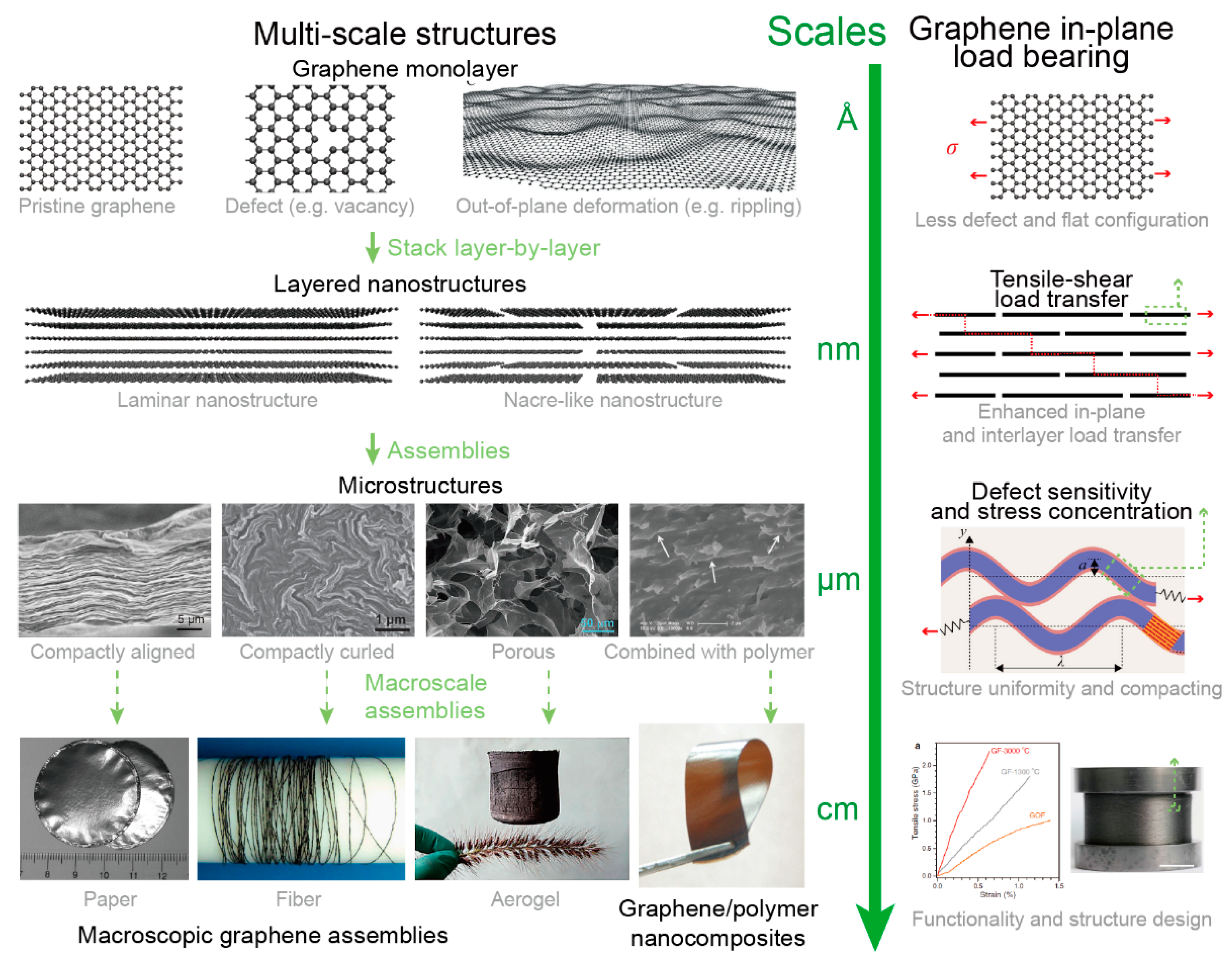
Pristine graphene is one of the strongest materials known in the world, and may play important roles in structural and functional materials. In order to utilize the extraordinary mechanical properties in practical engineering structures, graphene should be assembled into macroscopic structures such as graphene-based papers, fibers, foams, etc. However, the mechanical properties of graphene-based materials such as Young’s modulus and strength are 1–2 orders lower than those of pristine monolayer graphene. Many efforts have been made to unveil the multi-scale structure–property relations of graphene-based materials with hierarchical structures spanning the nanoscale to macroscale, and significant achievements have been obtained to improve the mechanical performance of graphene-based materials through composition and structure optimization across multi-scale. This review aims at summarizing the currently theoretical, simulation, and experimental efforts devoted to the multi-scale structure–property relation of graphene-based layer materials including defective monolayer graphene, nacre-like and laminar nanostructures of multilayer graphene, graphene-based papers, fibers, aerogels, and graphene/polymer composites. The mechanisms of mechanical property degradation across the multi-scale are discussed, based on which some multi-scale optimization strategies are presented to further improve the mechanical properties of graphene-based layer materials. We expect that this review can provide useful insights into the continuous improvement of mechanical properties of graphene-based layer materials.
Keywords: graphene-based layer materials; multi-scale structure–property relations; mechanical behaviors; hierarchical structures; multi-scale optimization graphene-based layer materials; multi-scale structure–property relations; mechanical behaviors; hierarchical structures; multi-scale optimization