2.1. FEM Modelling
In order to obtain adequate residual stress profiles for later statistical prediction, a FEM model is desirable. Considering both accuracy and efficiency of simulations, the complexity of the model is also required to be balanced. Therefore, the simplified 3D cutting model was selected. The finite element simulation software is AdvantEdge (V7.4015, Third Wave Systems, Minneapolis, MN, USA).
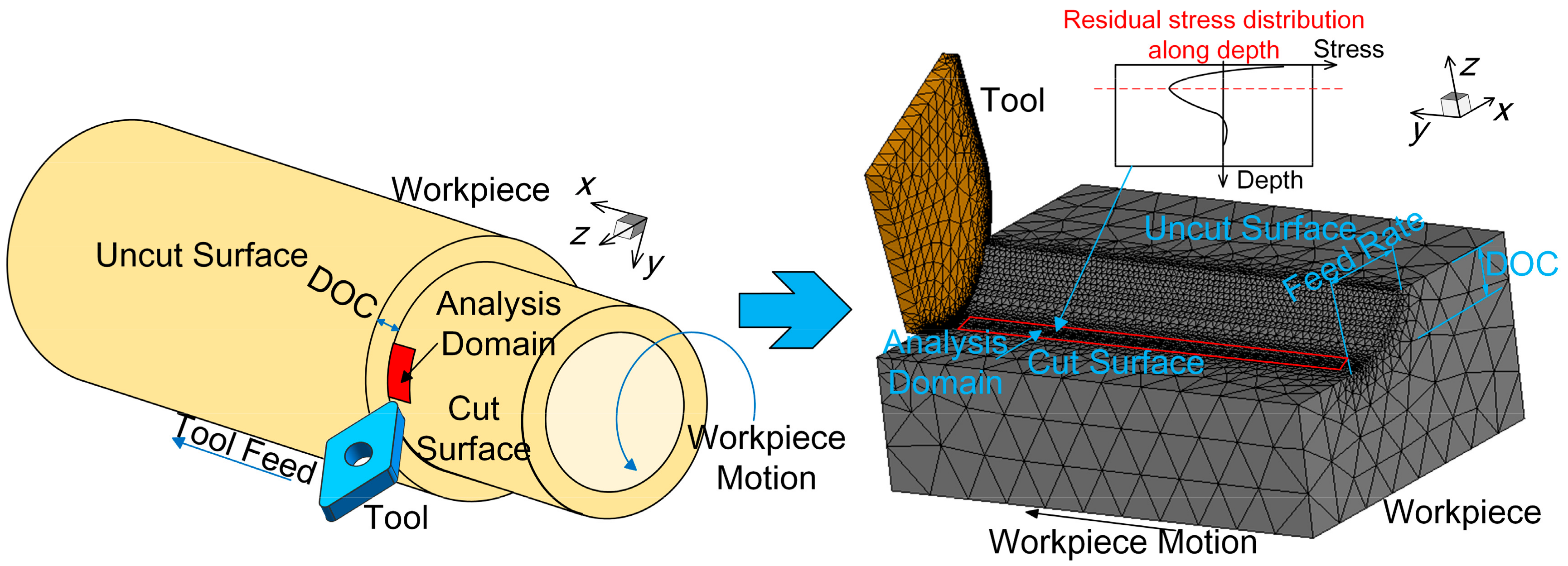
As shown in
Figure 2, the workpiece is a tube part, whose small portion was selected as the analysis domain for reducing the computation time. Therefore, the turning model could be converted to the simplified 3D model. After the turning process, a cooling process was performed to obtain the final residual stress profiles.
Turning parameters, including feed rate (x direction), depth of cut (z direction) and cutting speed (y direction), were set in the cutting model. DOC is the abbreviation of the depth of cut. Considering that the analysis domain is minimal, the curvature of the workpiece is neglected as shown.
The cutting tool was produced by Sandvik company (Stockholm, Sweden), and the finite element geometry model and position of the cutting tool were generated using parameters from the Sandvik website. AdvantEdge could automatically generate the cutting tool when all the tool parameters were put in. The coating material of the tool is TiAlN. The material of the tool is Carbide-Grade-M. The tool has a 0.02 mm edge radius and a 1.2 mm nose radius, with 6° clearance angle, −6° rake angle, −17.5° lead angle and −7° inclination angle. The properties of the cutting tool were input, and then the tetrahedral mesh was automatically generated, with 0.3 mm maximum element size and 0.015 mm minimum element size.
The workpiece was modeled as an elastic-plastic body, and residual stresses would be influenced both by elastic and plastic strain. In the elastic strain region, Young’s modulus and Poisson’s ratio represent mechanical properties of materials and are utilized to compute stress until the yield stress is reached and plastic deformation begins [
21]. The workpiece material is Inconel 718. Young’s modulus of Inconel 718 is 204 GPa, and Poisson’s ratio is 0.3. In the plastic strain region, the influence of strain, strain rate and temperature on flow stress should be considered, which is essential in finite element analysis. Thus, a variety of constitutive models have been proposed to describe the metal cutting process, some of which were improved to more accurately depict the plastic strain of unique materials [
22]. The power law constitutive model, as represented in Equation (1), was used in this paper.
where
is strain hardening,
is strain rate sensitivity and
is thermal softening. Jiang [
23] elaborated the details of this equation, compromising the specific equation of
,
and
as followed.
The strain hardening
is defined by Equations (2) and (3):
where
is the initial yield stress,
is the plastic strain,
is the reference plastic strain,
is the cut off strain and 1/n is the strain hardening exponent.
The thermal softening
is defined by Equations (4) and (5):
where
through
are coefficients for the polynomial fit,
is the temperature,
is the linear cut off temperature and
is the melting temperature.
The strain rate sensitivity
is defined by Equations (6) and (7):
where
is strain rate,
is reference plastic strain rate,
is strain rate where the transition between low and high strain rate sensitivity occurs,
is the low strain rate sensitivity coefficient and
is the high strain rate sensitivity coefficient. Default constitutive model coefficient values of Inconel 718 in the software were used in this paper.
The workpiece material is Inconel 718, with 1613 MPa ultimate tensile strength and 1103 MPa yield strength. The tetrahedral mesh was automatically generated in the workpiece, with 0.5 mm maximum element size, 0.06 mm minimum element size and 0.03 mm adaptive remeshing parameters. Elements in the cutting zone determined by adaptive remeshing parameters would be refined as the contact area between the tool and the workpiece changed.
Then process parameters were input. Afterwards, the simulation was conducted with the residual stress option selected. The cooling simulation would be conducted only when the residual stress option was selected, and in this case, the workpiece was cooled to ambient temperature, which was 20 °C. In order to get accurate simulated residual stresses, the element of the adaptive remeshing area would remain small, with 0.03 mm element size, when the cutting zone went further.
2.2. Bimodal Gaussian Function Fitting
The residual stress is generated by mechanical and thermal loading during the machining process. Ma, Yuan [
24] illustrated the deformation mechanism of the residual stress due to thermo-mechanical loadings. Typically, the residual stress is divided into the compressive residual stress and the tensile residual stress.
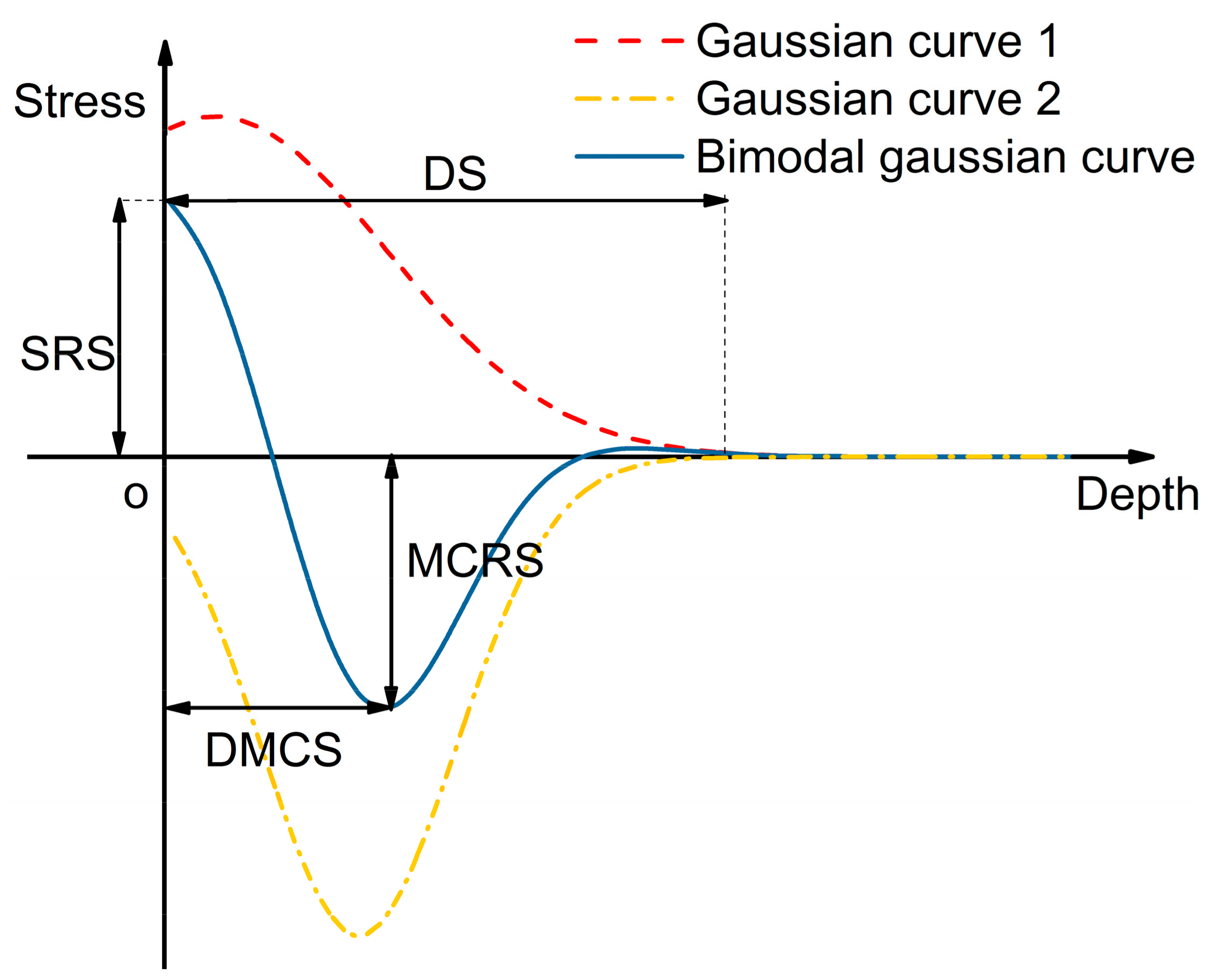
As shown in
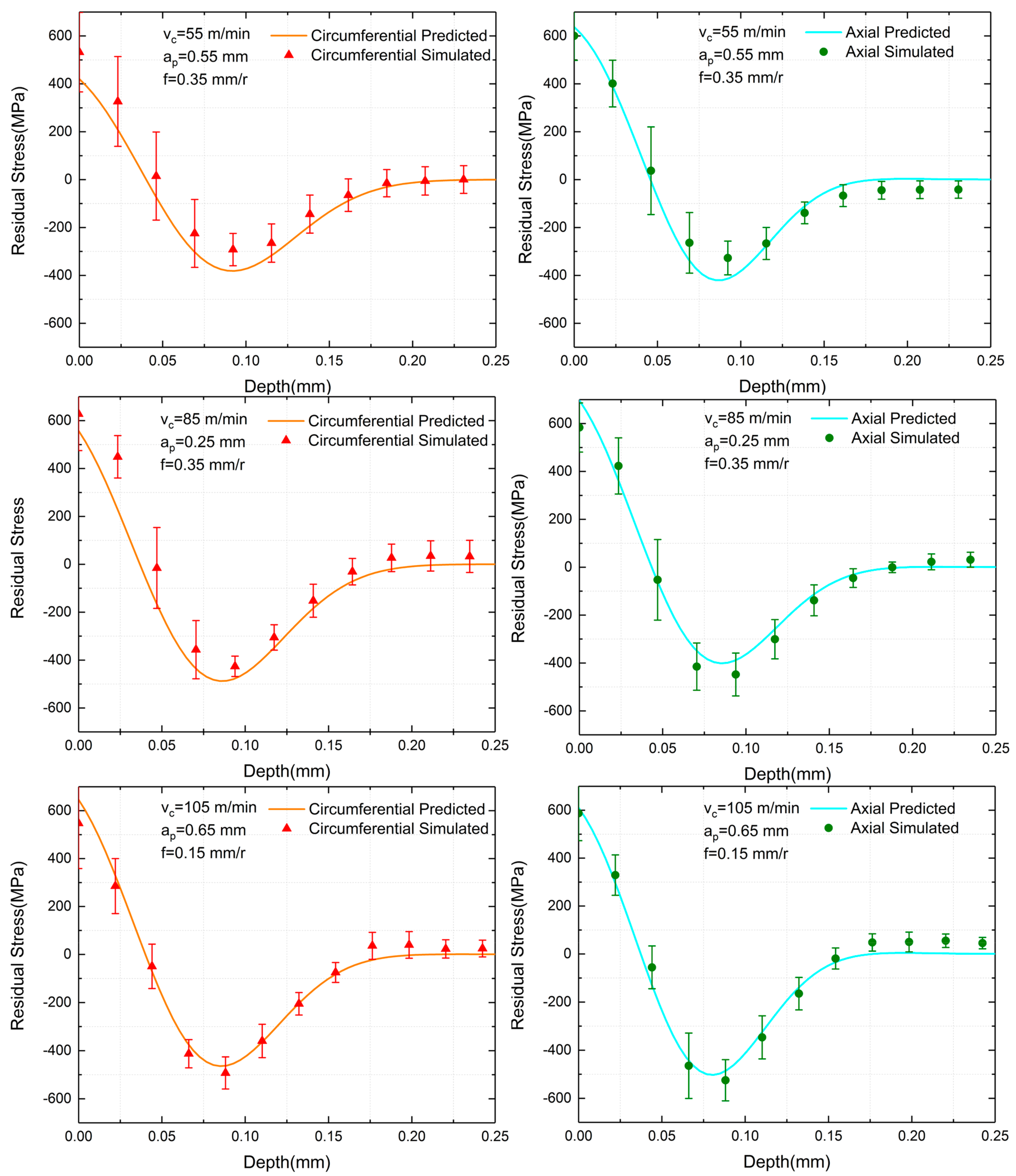
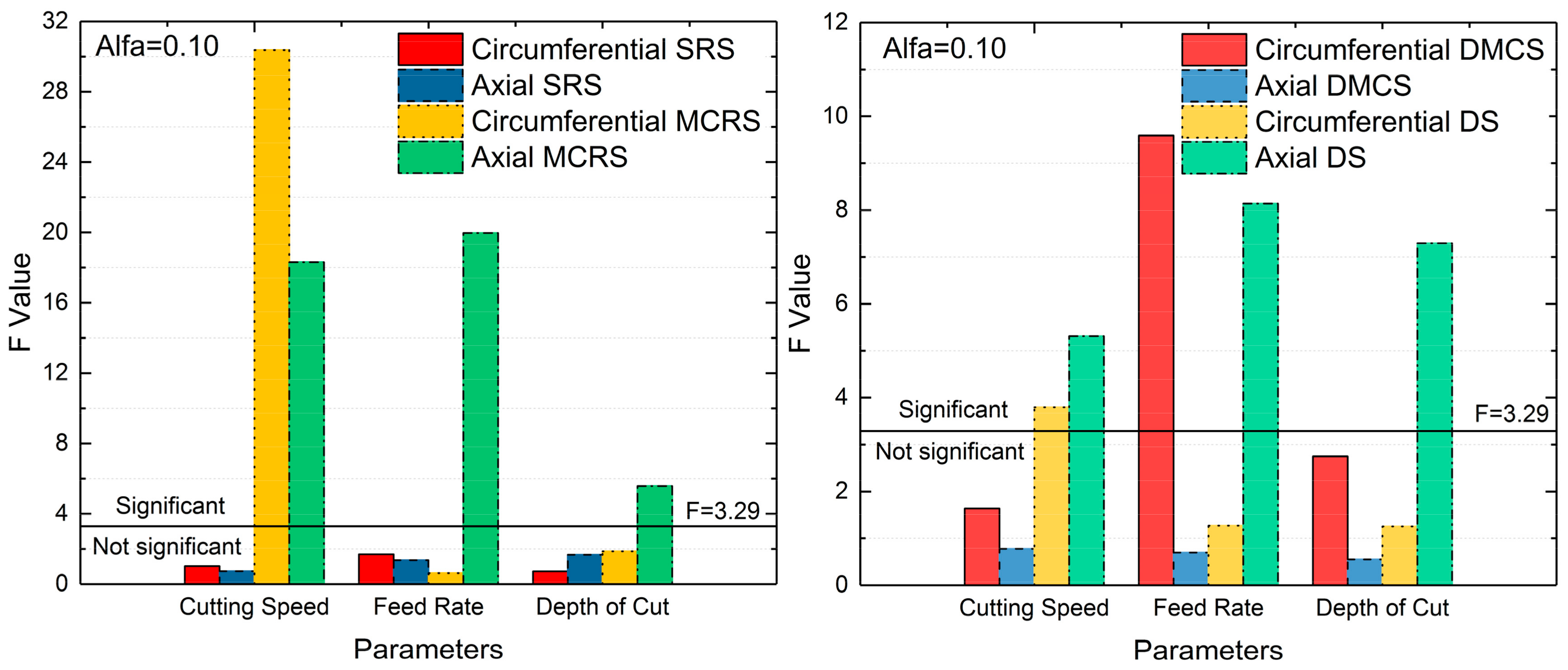
Figure 3, under the effect of plastic and elastic strain of the material arising from the thermal-mechanical loadings, the residual stress distribution along the depth presents a similar hook-shaped distribution curve. There are four indicators to the distribution curve, which are the surface residual stress (SRS), the maximum compressive residual stress (MCRS), the depth of the maximum compressive residual stress (DMCS) and the depth of settling (DS). The distribution curve can be fitted using appropriate functions.
Some investigations have been conducted on the model of fitting residual stress profiles. One polynomial fitting model has been proposed [
16], and it can fit the residual stress well due to the flexibility of the polynomial fit. Based on specific residual stress profiles, the polynomial can be set to specific orders. The number of coefficients of a polynomial function can be adjusted. In order to achieve high fitting accuracy, orders of the polynomial have to be determined when fitting new residual stress profiles. Besides, one sinusoidal decay fitting model has also been proposed [
18], and this model is concise, having only four function coefficients. The sinusoidal decay fitting model fits the residual stress well, and it is an oscillation model, achieving fitting accuracy (R
2) varied from 67% to 93%. Yang [
15] improved sinusoidal decay fitting the model, making the fitting accuracy (R
2) varied from 81.7% to 99.2%.
Based on the distribution rule of the residual stress, the bimodal Gaussian function, which is the superposition of two two-dimensional Gaussian distribution functions, can also be used in fitting the residual stress profiles. The Gaussian distribution is also called the normal distribution. The function curve is shown in
Figure 3. One Gaussian curve is added to another, becoming the bimodal Gaussian curve. With such a function, the number of coefficients is fixed. Thus, it cannot become complicated, and it is always concise. The function also converges to zero very fast, making the function fitting the residual stress well. Such a function can be represented using Equation (8) when the value of n is 2, having six coefficients.
where
is the value of the residual stress.
is the amplitude constant.
is the standard deviation.
is the depth to the machined surface.
is the expectation of the distribution.
However, six coefficients were too redundant for fitting the residual stress distribution curve. During the fitting process, the value of in Gaussian curve 1 was all close to zero. Besides, after many attempts, the bimodal Gaussian curve was found that it still performed well in fitting when was fixed as 0.13. Thus, and were fixed as 0.13 and 0 to make the fitting function more laconic. The Equation (8) can be expressed as Equation (9). Equation (9) was found that it could further improve the fitting accuracy, making the accuracy (R2) varied from 89.0% to 99.6%.
2.3. Random Forest Regression
After the fitting of residual stress profiles, a regression model needs to be established for describing the relationship between coefficients of the bimodal Gaussian function and cutting parameters. The relation of cutting parameters and the residual stress distribution is then finished, achieved the purpose of predicting residual stress profiles using cutting parameters. Typically, a regression model needs a regression function to represent the relationship between dependent variables and independent variables. Researchers need to know the general relation to determine the appropriate regression function. However, the general relation between coefficients of bimodal Gaussian fitting function and cutting parameters is complicated to evaluate. In this case, a regression method that does not need a regression function is of great importance.
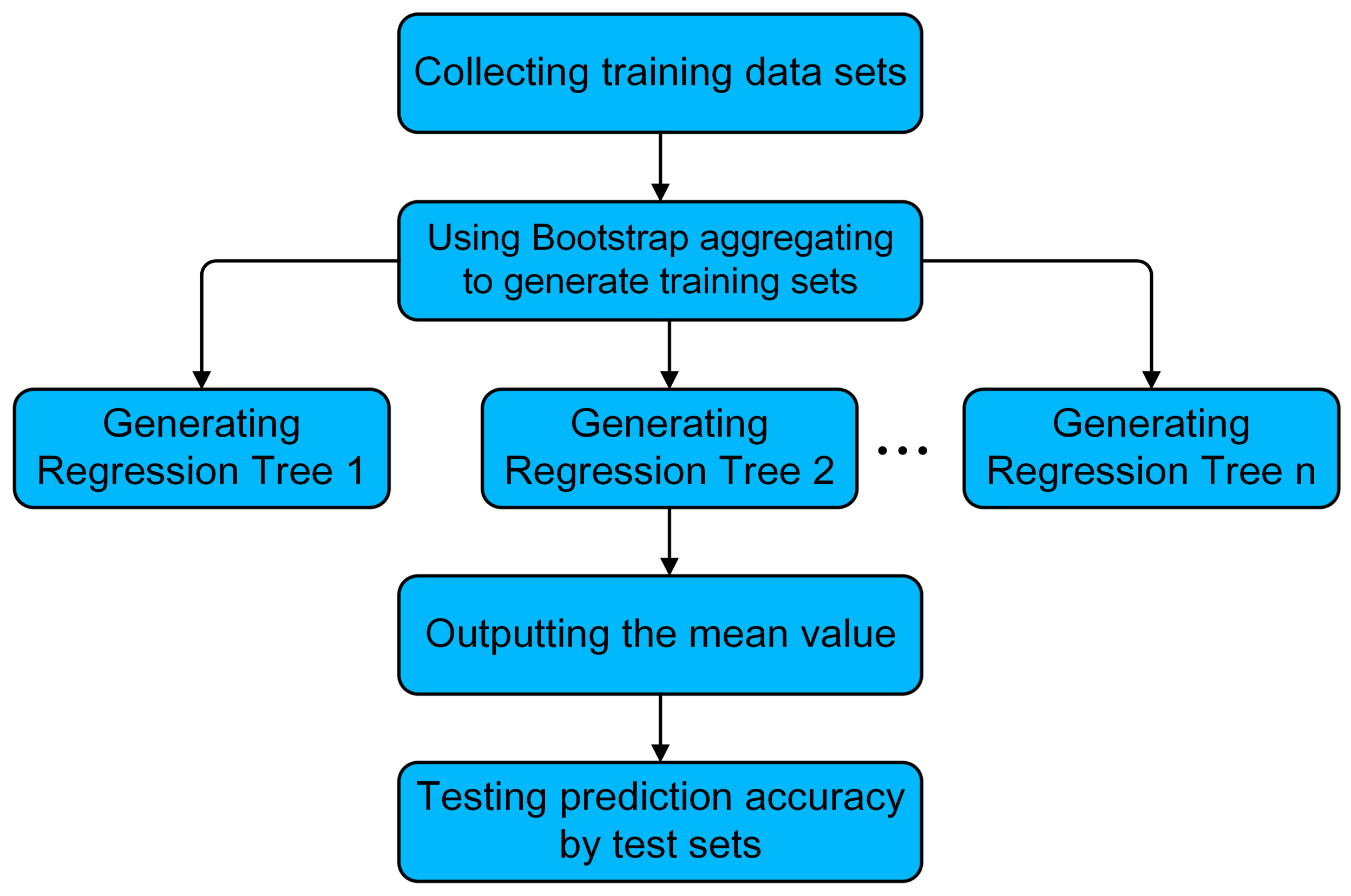
The regression can be made using the random forest regression method without a regression function expression. The random forest algorithm can operate the task by constructing a multitude of regression trees at training time and outputting the mean prediction of the individual trees [
25]. As shown in
Figure 4, the training sets, which are composed of cutting parameters and function coefficients (responses), are collected firstly. Then with training sets, random samples are selected repeatedly using the bagging [
26] method. Samples must be put back to the training sets after one sampling. Regression trees [
27] are fitted to these samples, which can be expressed by Equation (10). After training, predictions for test samples can be made by averaging the predictions from all individual regression trees, so the prediction accuracy is tested. Equation (11) is the averaging function.
where
is one coefficient of the bimodal Gaussian function.
is the depth of cut.
is the feed rate.
is the cutting speed.
where
is one function coefficient’s prediction value.
is the number of regression trees.
,
,
are testing values.