An Improved Analytical Solution for Process-Induced Residual Stresses and Deformations in Flat Composite Laminates Considering Thermo-Viscoelastic Effects


Abstract
1. Introduction
2. Theoretical Development of the Analytical Solution with Thermo-Viscoelastic Effects
2.1. The Governing Differential Equation
- (1)
- The Poisson’ effects are neglected.
- (2)
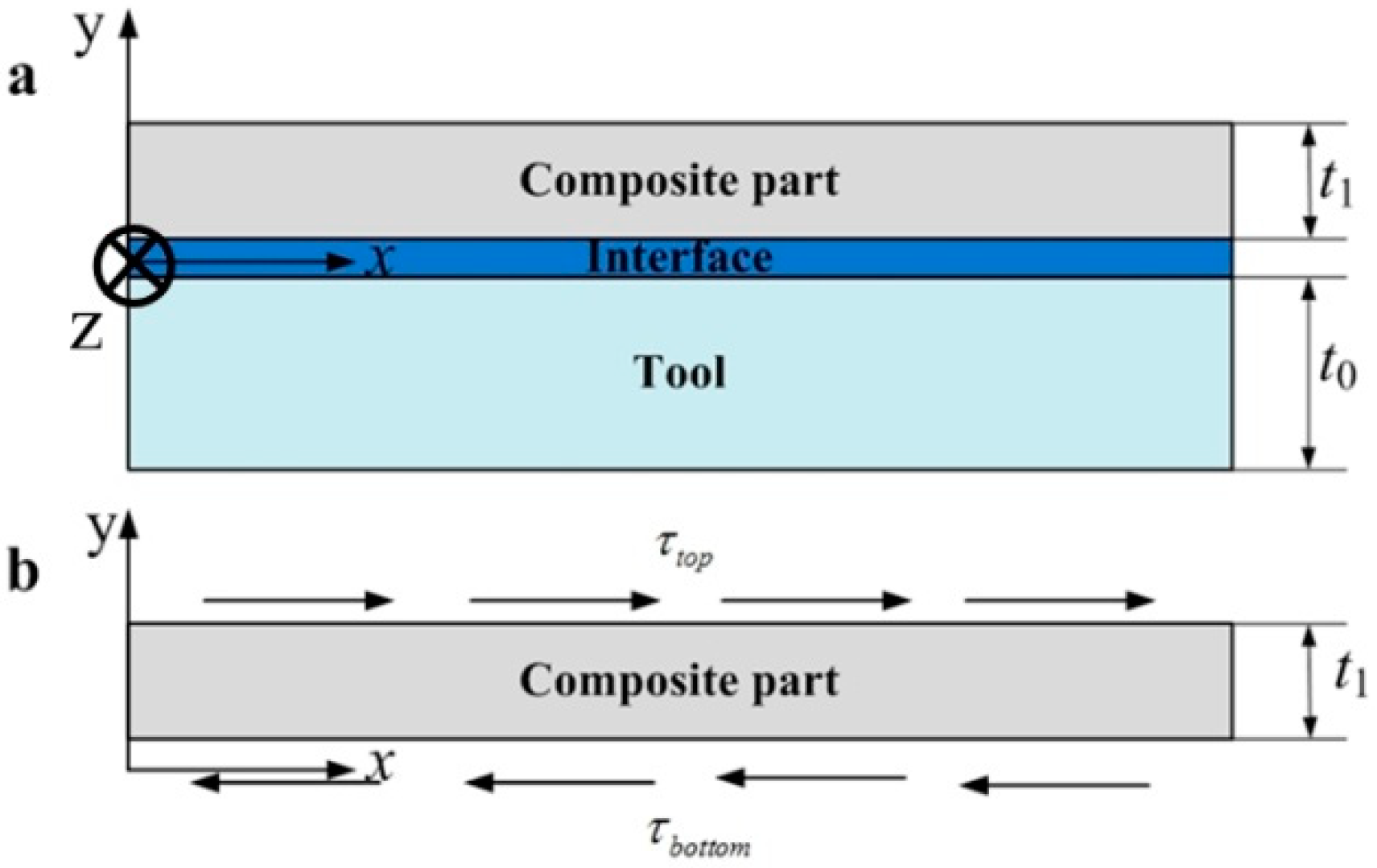
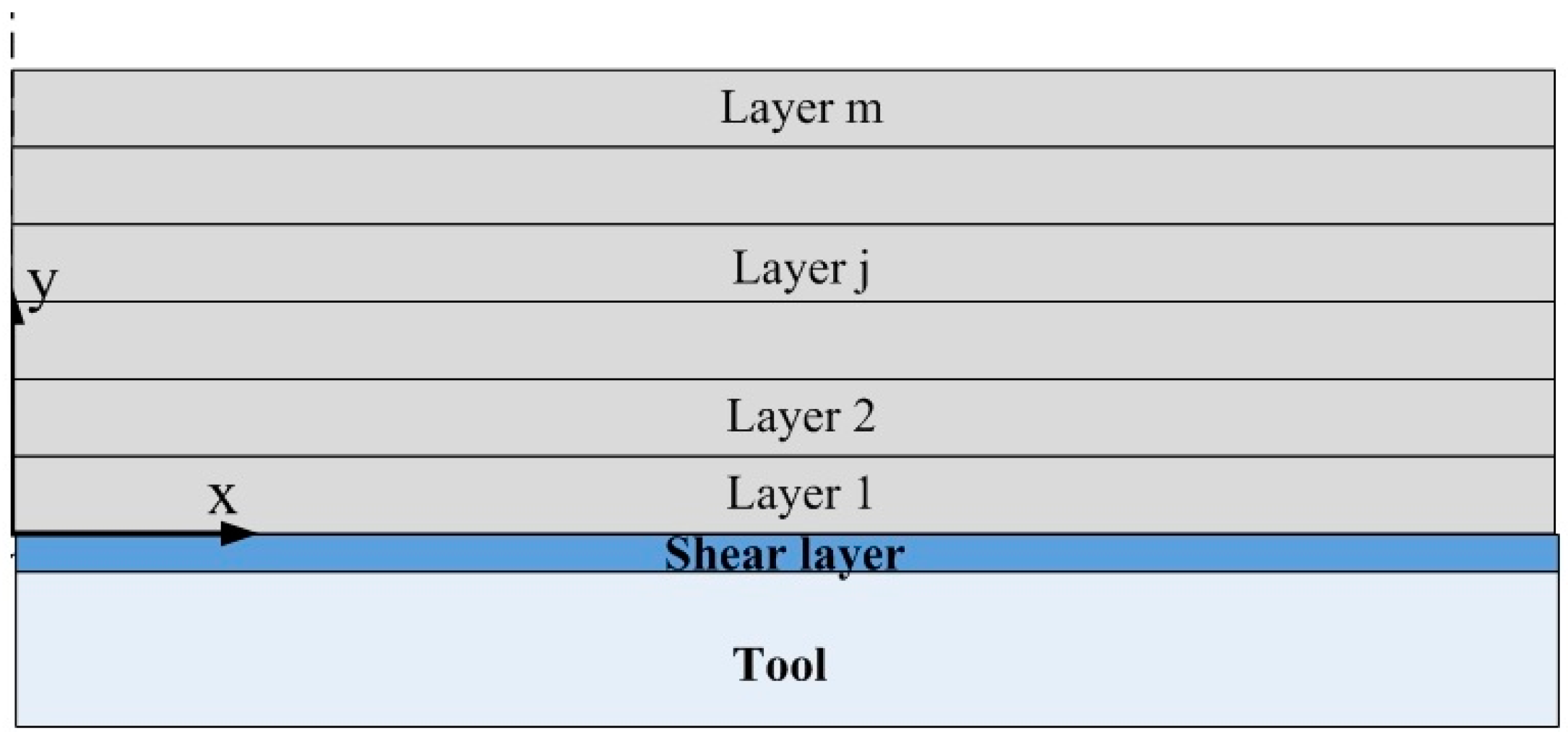
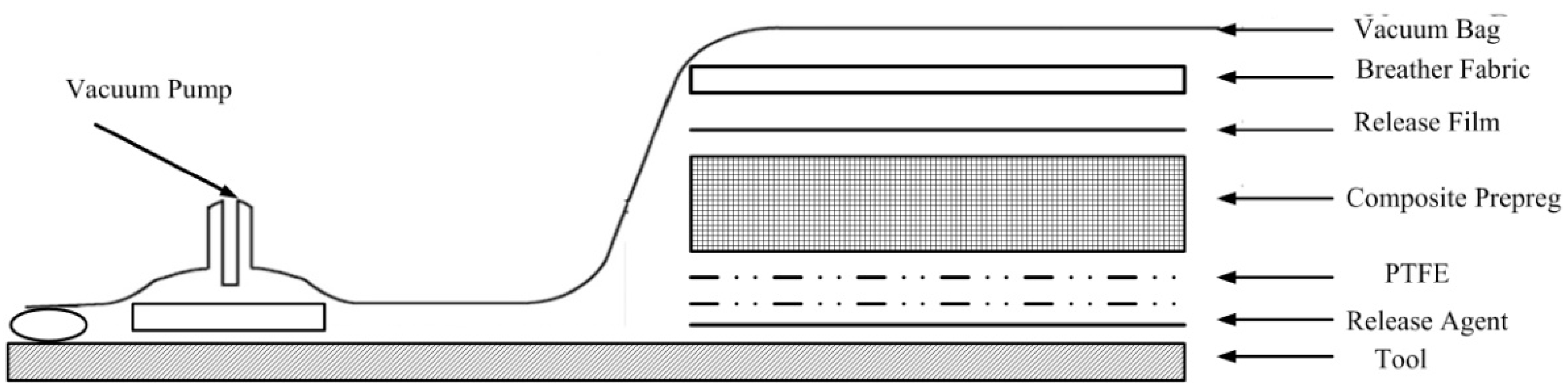
- At the symmetrical y-z plane of the composite laminates shown in Figure 1a, the axial displacement equals zero.
- (3)
- At the end of the composite laminates in the axial direction, the axial stresses are assumed to be zero.
2.2. The Solution of the Governing Differential Equation
2.3. The Solution of Residual Stresses for Multi-Layers Composite Laminates
2.4. Deformations Prediction
3. Numerical Simulation and Experimental Investigation
3.1. Material Properties and MODEL
3.1.1. Material Properties
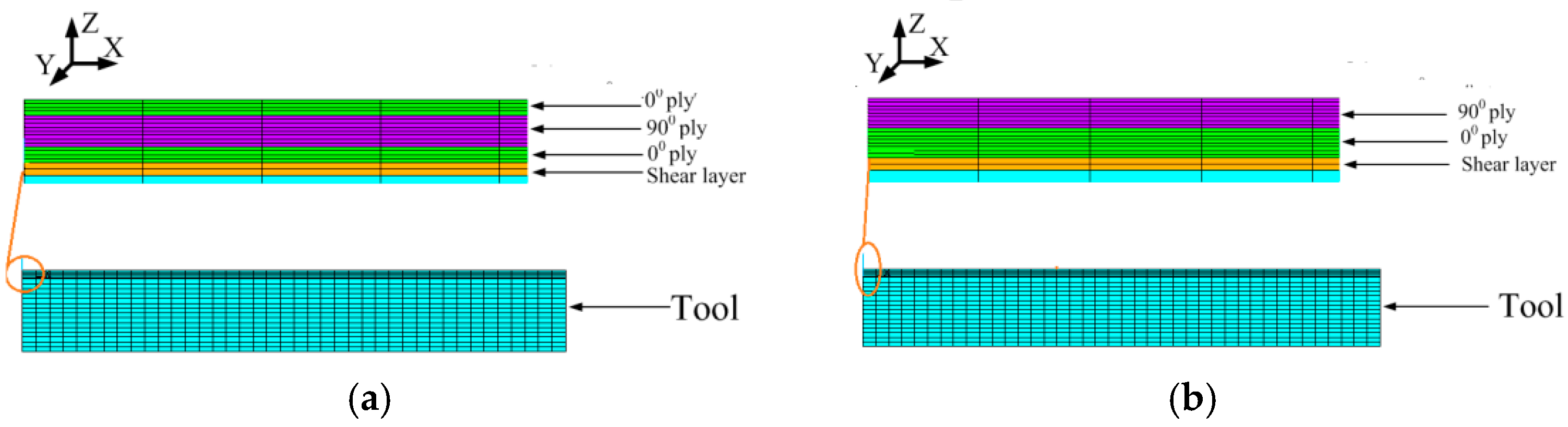
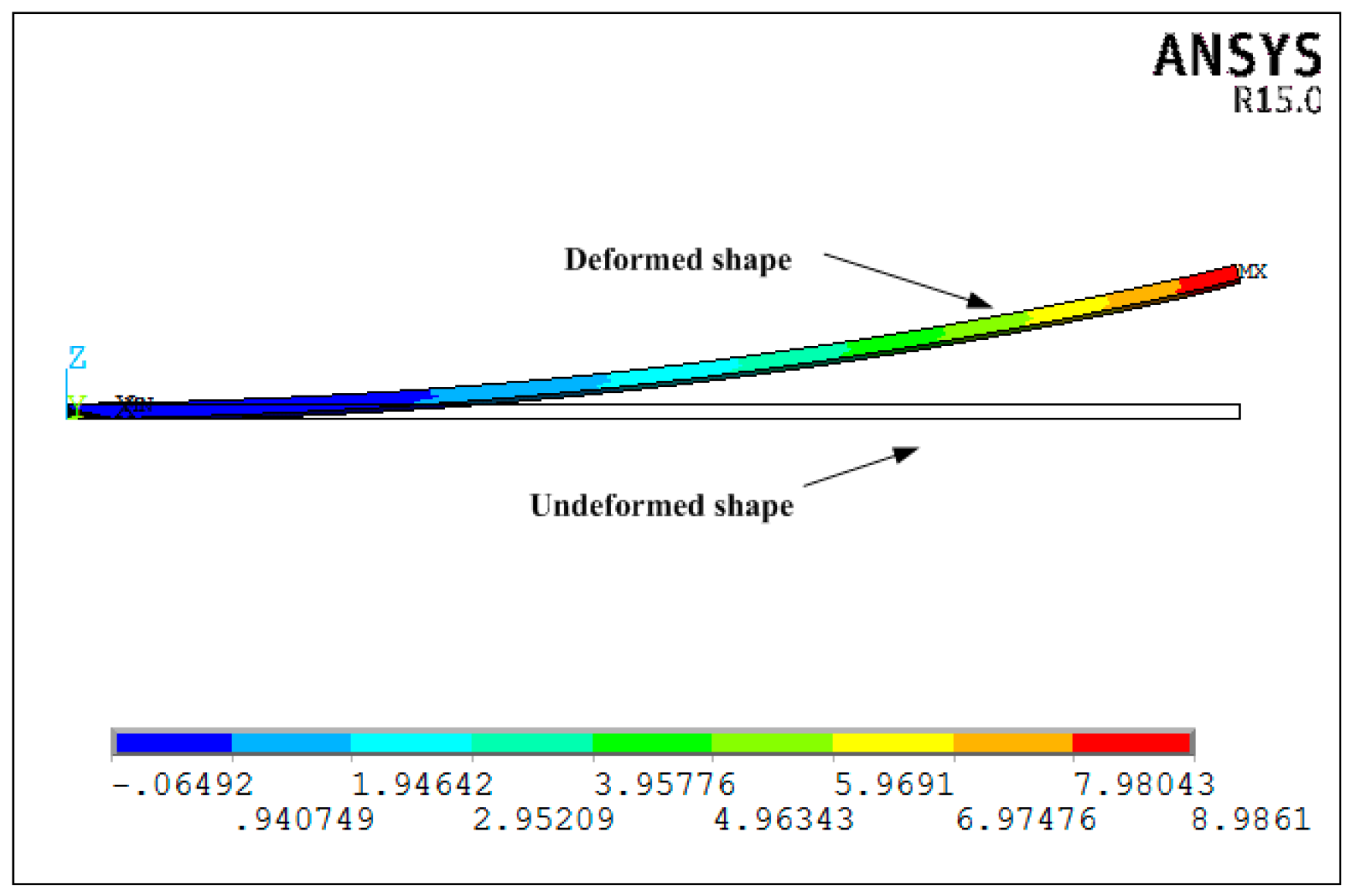
3.1.2. Finite Element Model
3.2. Case 1: Numerical Simulation for Symmetrical Composite Laminates
3.3. Case 2: Numerical and Experimental Investigation for Unsymmetrical Composites
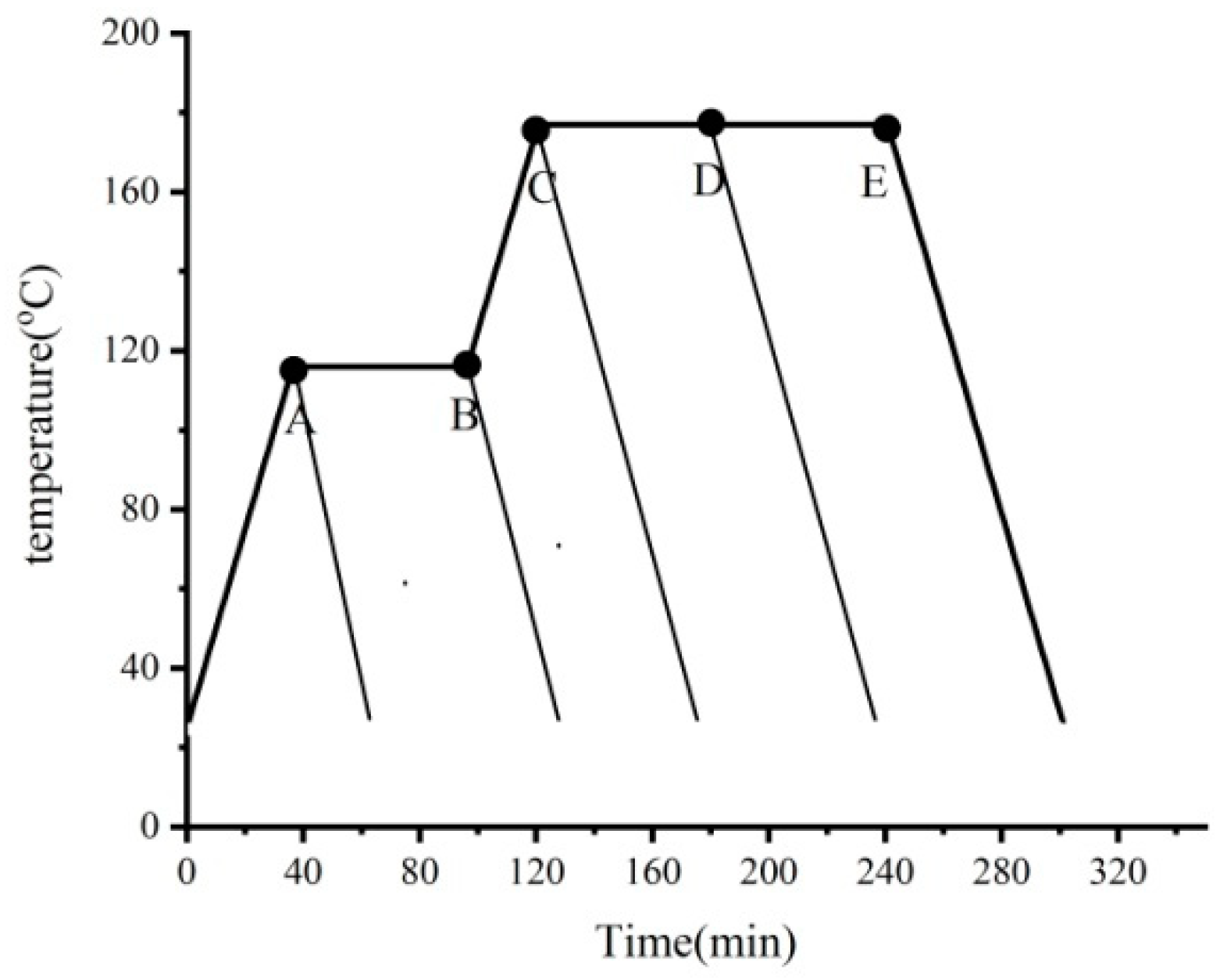
3.3.1. Illustration of the Model
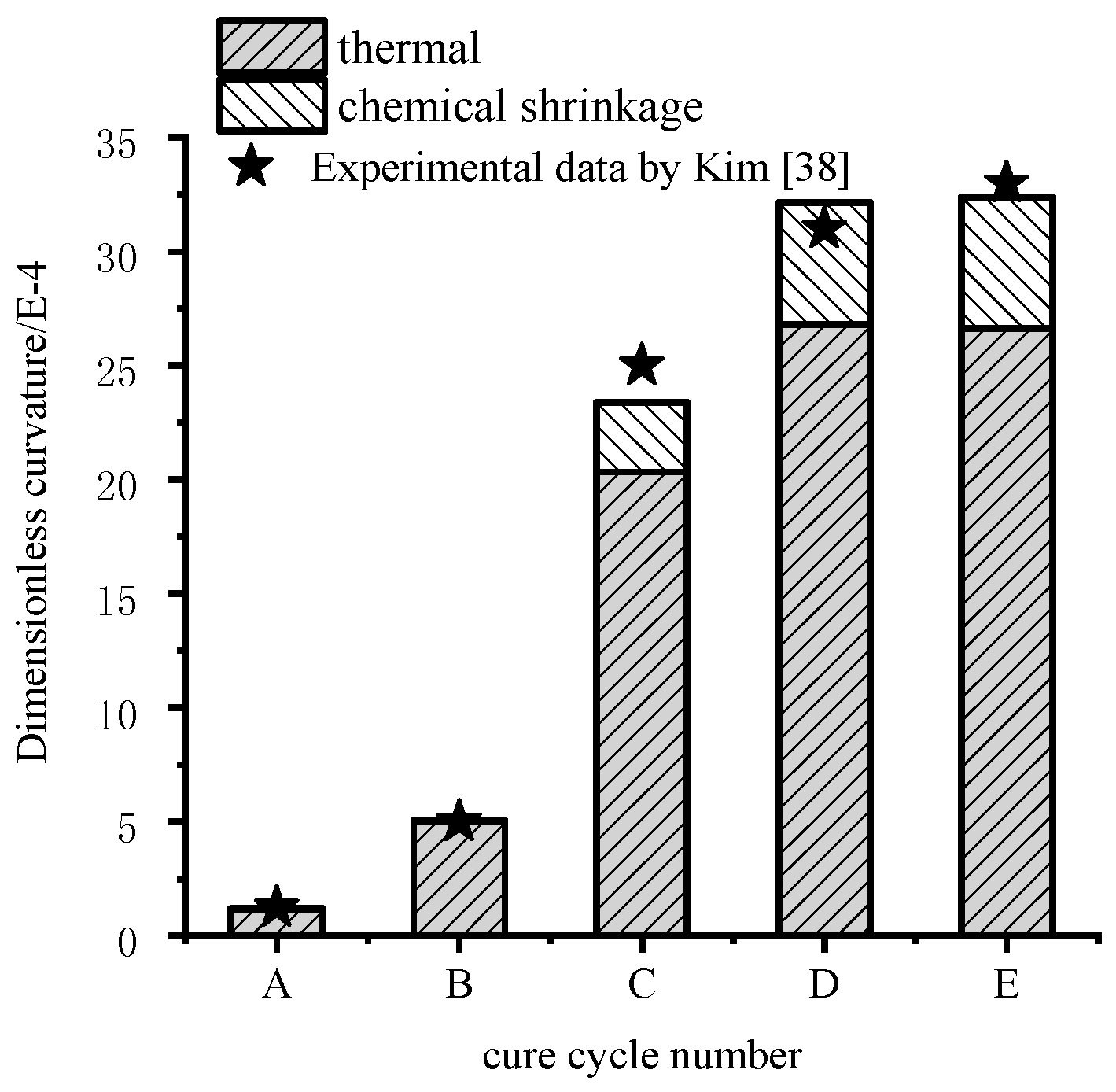
3.3.2. Verification of the Accuracy and Effectiveness
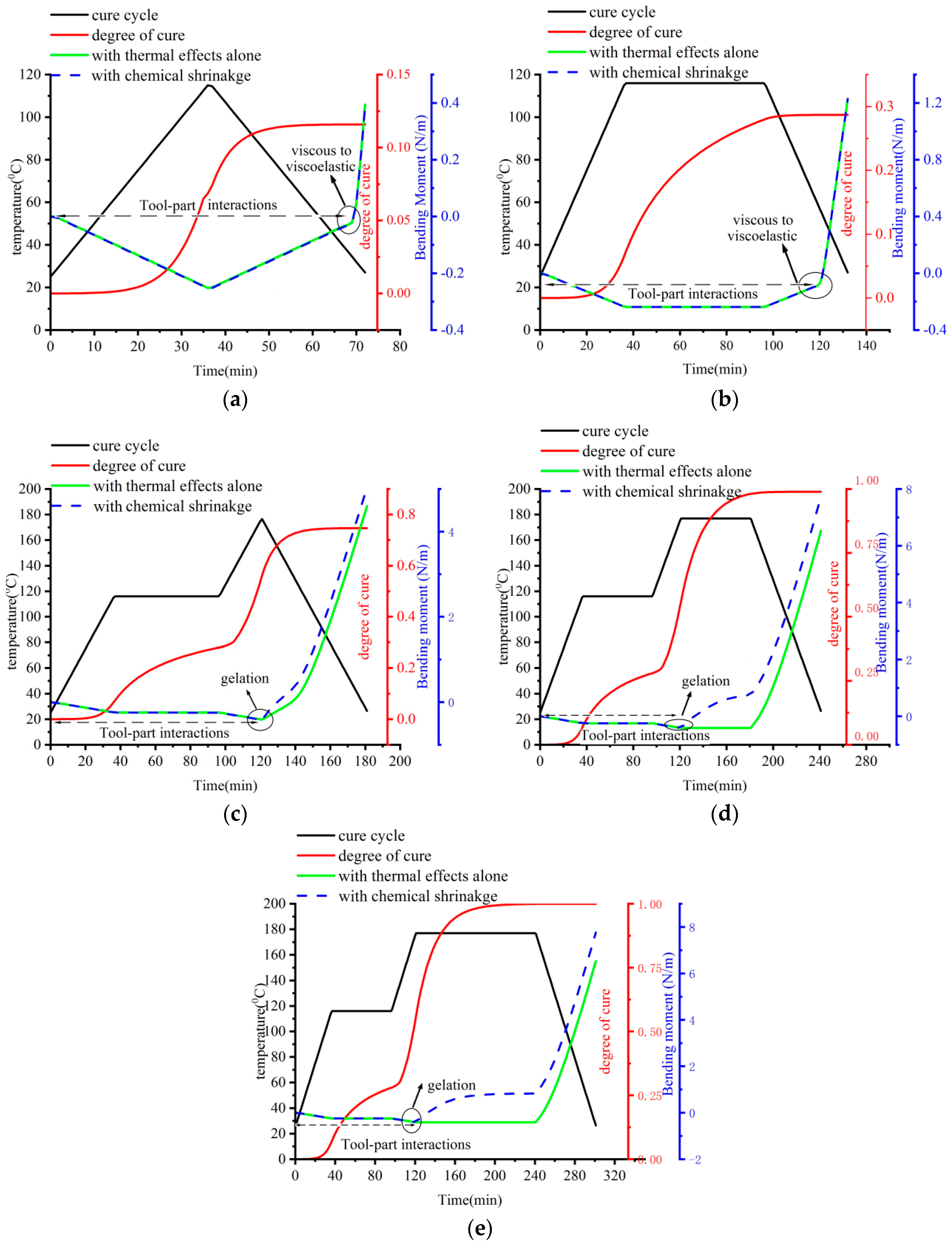
3.3.3. The Further Investigations on the Cure Mechanism
3.3.4. Effects of Chemical Shrinkage
3.3.5. Effects of Tool-Part Interactions
4. Conclusions
- (1)
- The proposed analytical solution can deal well with the viscoelastic effects of the polymer matrix on the residual stresses and deformations during the curing process. The proposed analytical solution is more efficient and has a similar accuracy to 3-D viscoelastic finite element analysis.
- (2)
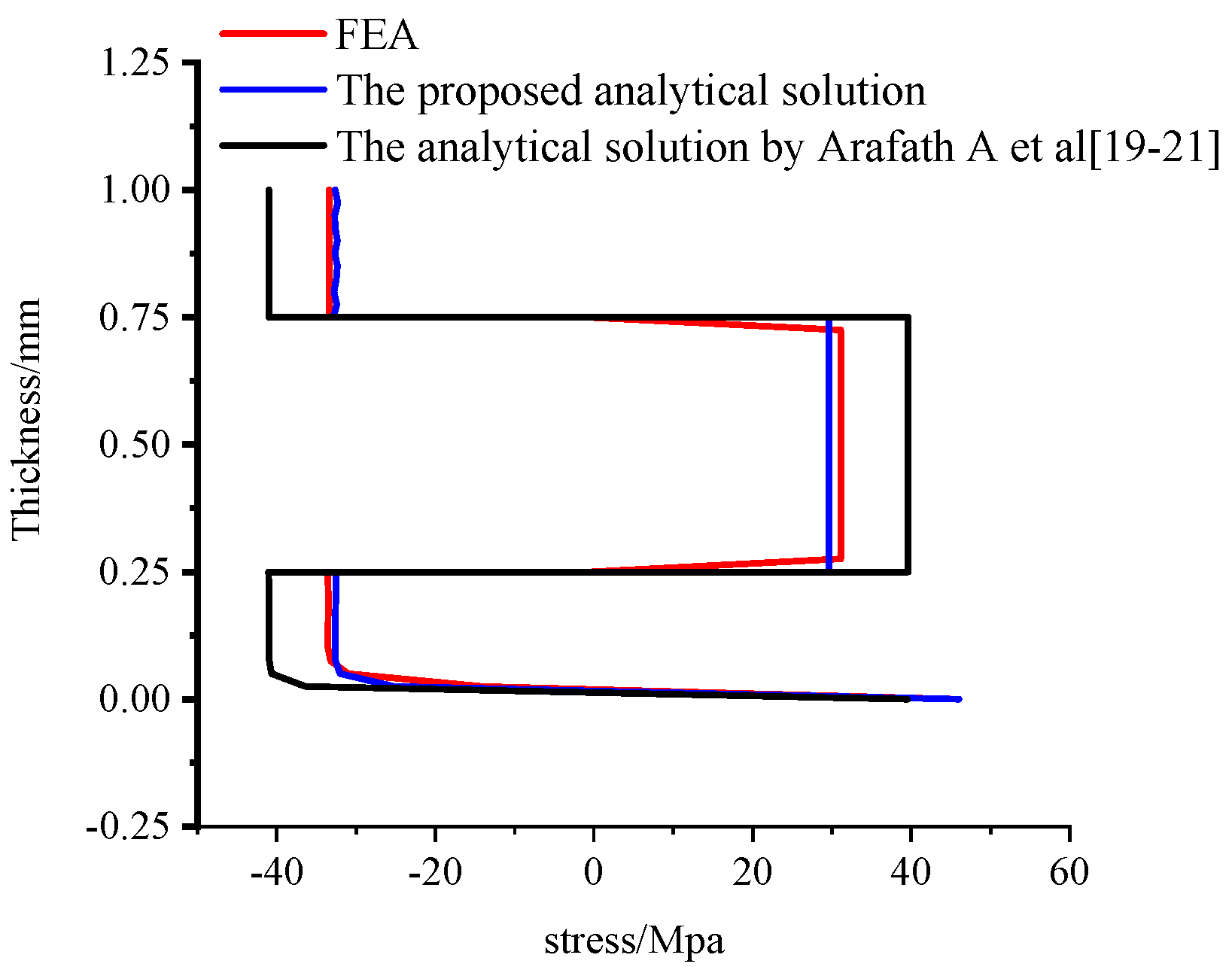
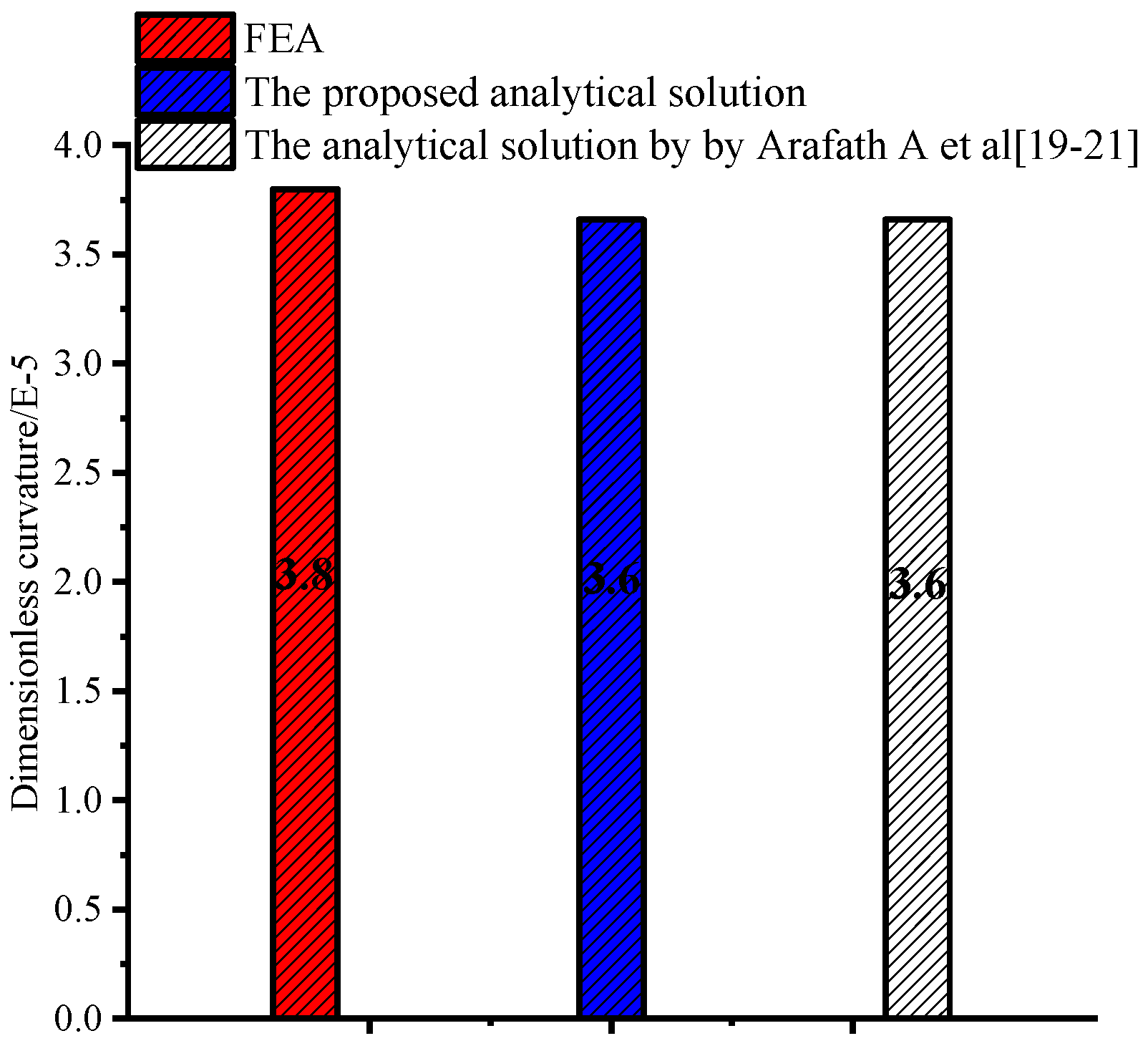
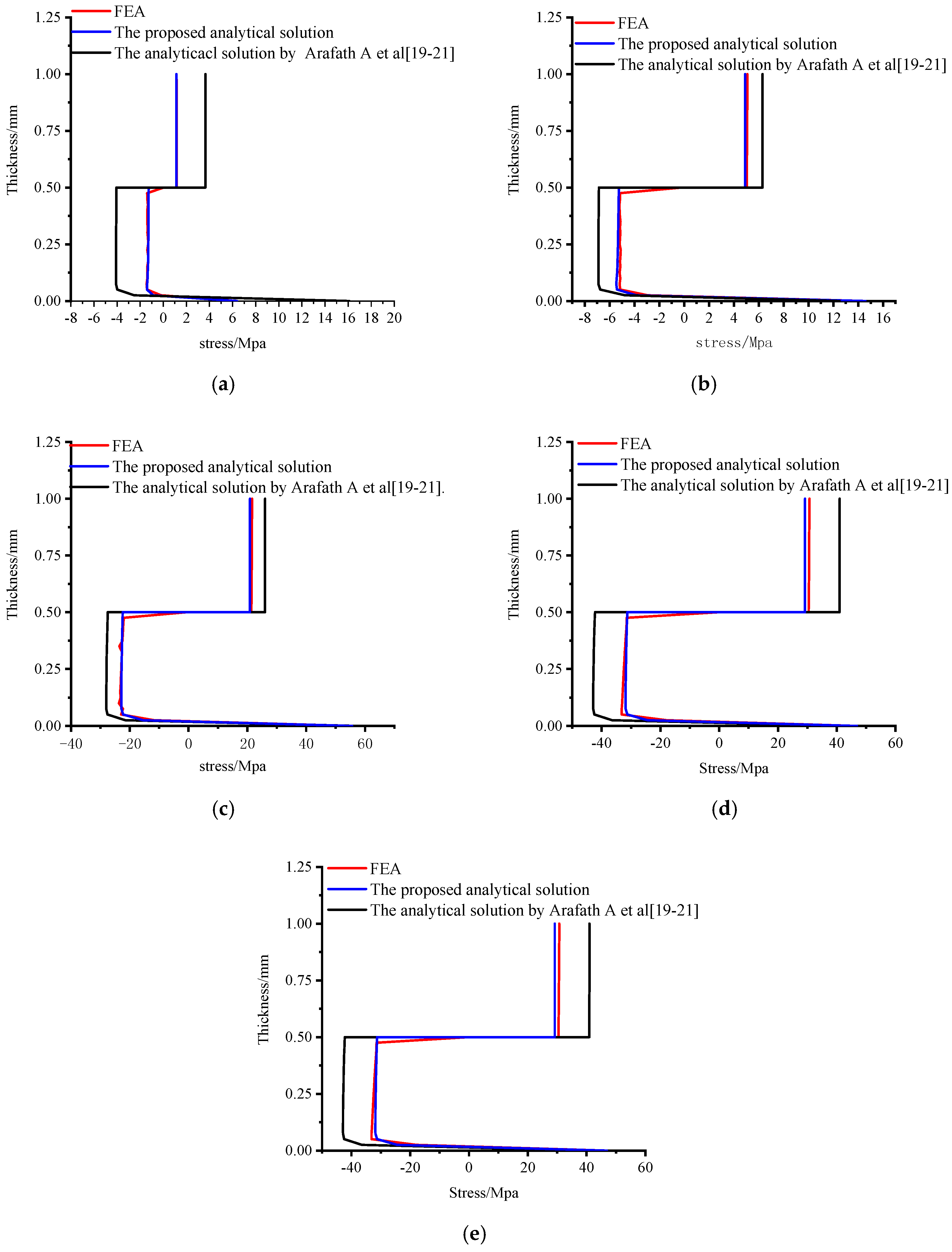
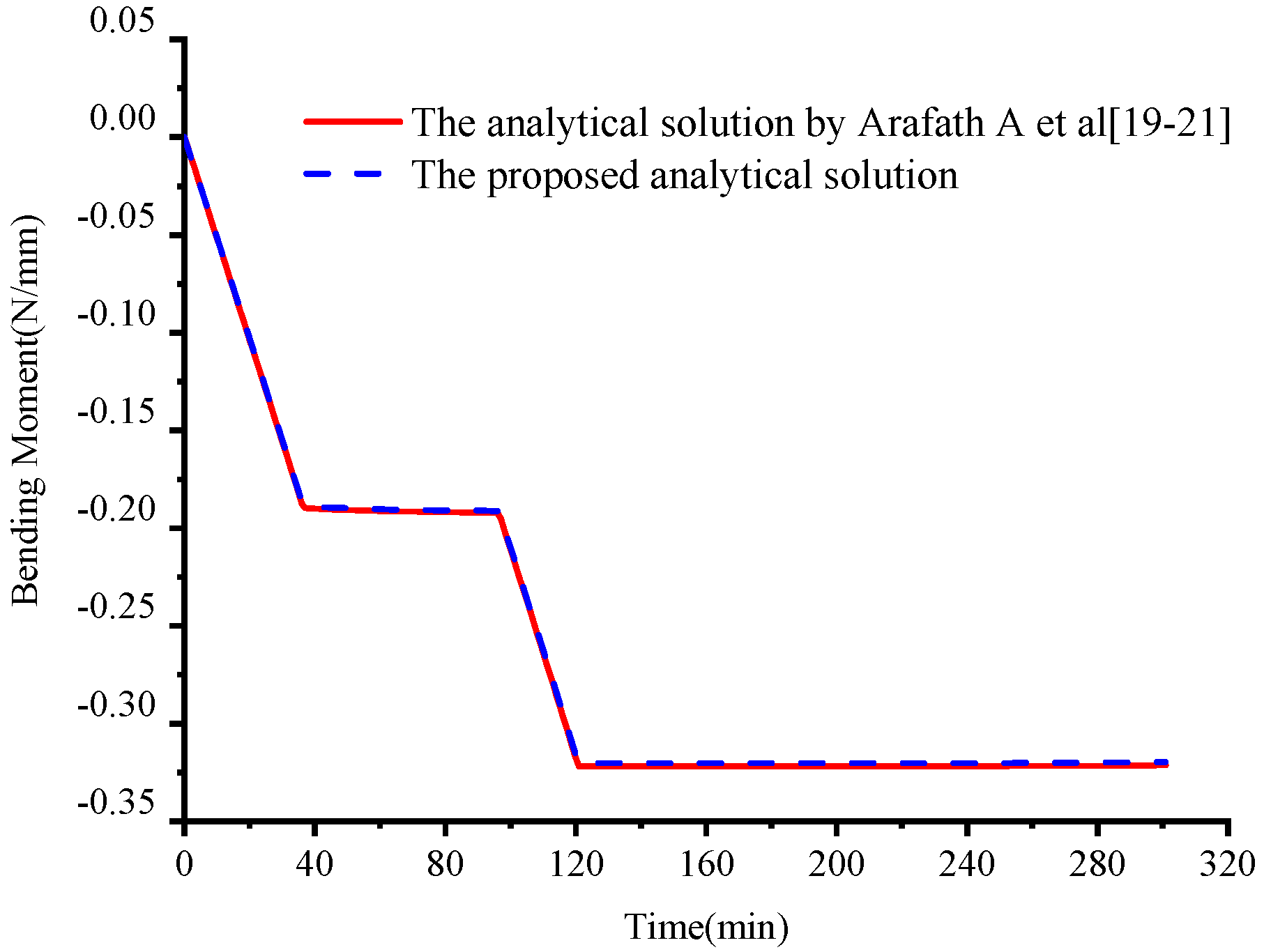
- The prediction of deformation for symmetrical laminates with layups [02/902]s by the proposed analytical solution yields similar results with that of the analytical solution presented by Arafath A et al. [19,20,21]. However, the proposed analytical solution provides much better predictions of the residual stresses for the symmetrical composite laminates with layups [02/902]s.
- (3)
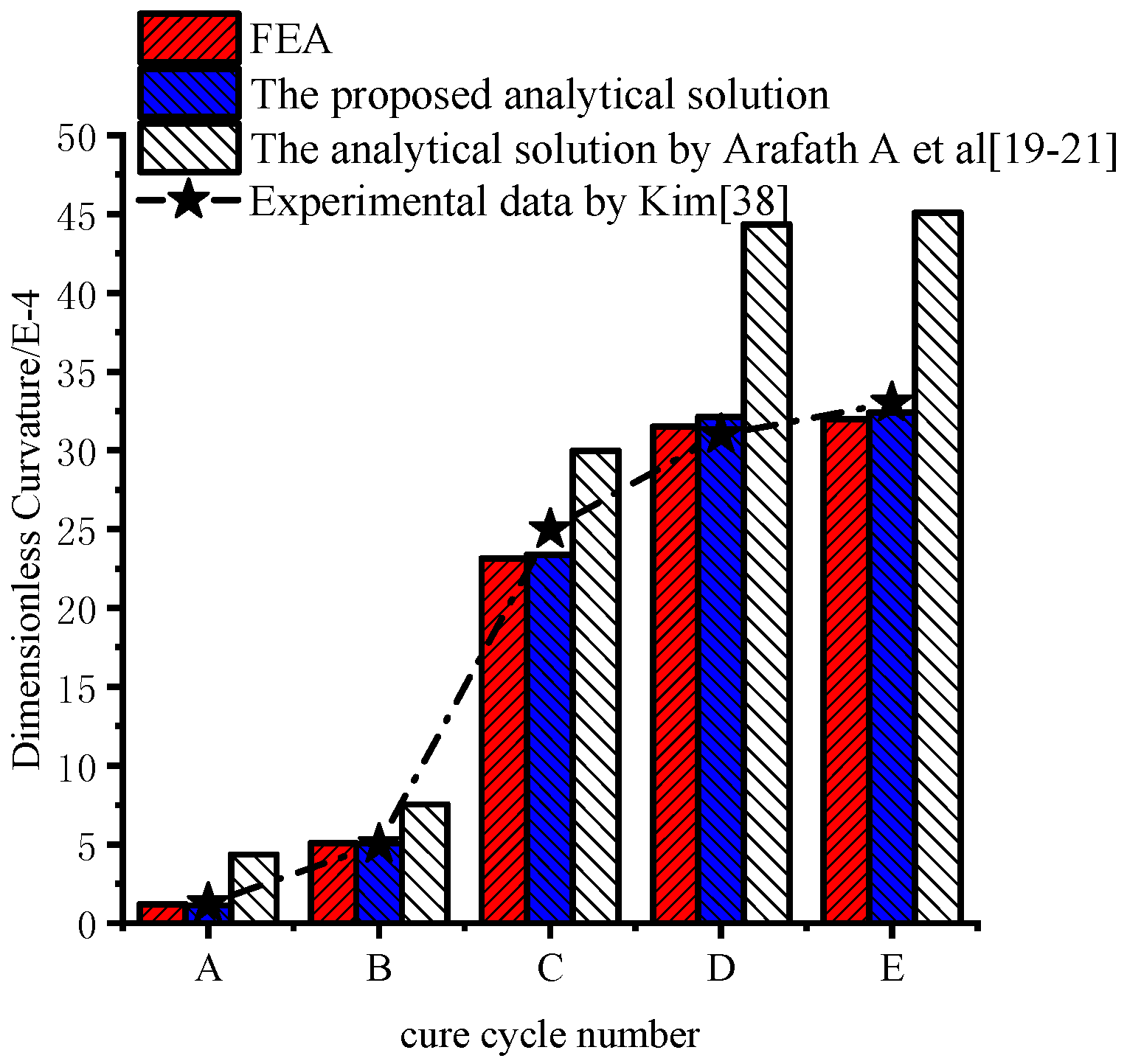
- For the unsymmetrical composite laminates with layups [04/904], the proposed analytical solution can provide much better results of both residual stresses and deformation with an improvement of at least 41% compared with the results obtained by the analytical solution presented by Arafath A et al. [19,20,21].
- (4)
- The effects of cure shrinkage of the polymer matrix on the residual stresses and deformation for unsymmetrical composite laminates depend on the degree of cure and cure cycles. There are almost no clear effects of cure shrinkage of polymer matrix on the residual stresses and deformation before gelation. Chemical shrinkage of the resin during the recommended cure cycle contributes to the residual stresses and curvature by about 17%.
- (5)
- Apart from symmetrical composite laminates, tool-part interactions have little influence on the deformations of unsymmetrical composite laminates. Tool-part interactions contribute to the deformation of unsymmetrical composite laminates with a percentage of 4.8%. However, the effects of tool-part interactions on the residual stresses distribution of unsymmetrical composite laminates are similar to those of symmetrical composite laminates and cannot be neglected.
Author Contributions
Funding
Conflicts of Interest
Appendix A
References
- Ersoy, N.; Potter, K.; Wisnom, M.R.; Clegg, M.J. Development of spring-in angle during cure of a thermosetting composite. Compos. Part A 2005, 36, 1700–1706. [Google Scholar] [CrossRef]
- Salomi, A.; Garstka, T.; Potter, K.; Greco, A.; Maffezzoli, A. Spring-in angle as molding distortion for thermoplastic matrix composite. Compos. Sci. Technol. 2008, 68, 3047–3054. [Google Scholar] [CrossRef]
- Kappel, E.; Stefaniak, D.; Hühne, C. Process distortions in prepreg manufacturing-an experimental study on CFRP L-profiles. Compos. Struct. 2013, 106, 615–625. [Google Scholar] [CrossRef]
- Zhu, Q.; Geubelle, P.H.; Li, M.; Tucker, C.L. Dimensional accuracy of thermoset composites: Simulation of process-induced residual stresses. J. Compos. Mater. 2001, 35, 2171–2205. [Google Scholar] [CrossRef]
- Capehart, T.W.; Muhammad, N.; Kia, H.G. Compensating thermoset composite panel deformation using corrective molding. J. Compos. Mater. 2007, 41, 1675–1701. [Google Scholar] [CrossRef]
- Wucher, B.; Lani, F.; Pardoen, T.; Bailly, C.; Martiny, P. Tooling geometry optimization for compensation of cure-induced distortions of a curved carbon/ epoxy C-spar. Compos. Part A 2014, 56, 27–35. [Google Scholar] [CrossRef]
- Wisnom, M.R.; Gigliotti, M.; Ersoy, N.; Campbell, M.; Potter, K.D. Mechanisms generating residual stresses and distortion during manufacture of polymer matrix composite structures. Compos. Part A 2006, 37, 522–529. [Google Scholar] [CrossRef]
- Fernlund, G.; Rahman, N.; Courdji, R.; Bresslauer, M.; Poursartip, A.; Willden, K. Experimental and numerical study of the effect of cure cycle, tool surface, geometry, and lay-up on the dimensional fidelity of auto-clave-processed composite parts. Compos. Part A 2002, 33, 341–351. [Google Scholar] [CrossRef]
- Ruiz, E.; Trochu, F. Numerical analysis of cure temperature and internal stresses in thin and thick RTM parts. Compos. Part A 2005, 36, 806–826. [Google Scholar] [CrossRef]
- Wang, X.; Jia, Y.; Wang, C. Correlation analysis of heat transfer, cure and mechanical behavior of fiber composite laminates. Polym. Polym. Compos. 2012, 20, 89–93. [Google Scholar] [CrossRef]
- Sorrentino, L.; Polini, W.; Bellini, C. To design the cure process of thick composite parts: Experimental and numerical results. Adv. Compos. Mater. 2014, 23, 225–238. [Google Scholar] [CrossRef]
- Dong, C. Process-induced deformation of composite T-stiffener structures. Compos. Struct. 2010, 92, 1614–1619. [Google Scholar] [CrossRef]
- Gopal, A.G.; Adali, S.; Verijenko, V.E. Optimal temperature profiles for minimum residual stress in the cure process of polymer composites. Compos. Struct. 2000, 48, 99–106. [Google Scholar] [CrossRef]
- Nelson, R.H.; Cairns, D.S. Prediction of Dimensional Changes in Composite Laminates during Cure. In Proceedings of the 34th International ASMPE Symposium, Reno, NV, USA, 8–11 May 1989. [Google Scholar]
- Radford, D.W.; Rennick, T.S. Separating sources of manufacturing distortion in laminated composites. J. Reinf. Plast. Compos. 2000, 19, 621–641. [Google Scholar] [CrossRef]
- Wisnom, M.R.; Potter, K.D.; Ersoy, N. Shear-lag analysis of the effect of thickness on spring-in of curved composites. J. Compos. Mater. 2007, 41, 1311–1324. [Google Scholar] [CrossRef]
- Twigg, G.; Poursartip, A.; Fernlund, G. Tool–part interaction in composites processing. Part I: Experimental investigation and analytical model. Compos. Part A 2004, 35, 121–133. [Google Scholar] [CrossRef]
- Yuan, Z.; Wang, Y.; Peng, X.; Wang, J.; Wei, S. An analytical model on through-thickness stresses and distortions of composite laminates due to tool-part interaction. Compos. Part B 2016, 91, 408–413. [Google Scholar] [CrossRef]
- Arafath, A.; Vaziri, R.; Poursartip, A. Closed-form solution for process-induced stresses and deformation of a composite part cured on a solid tool: Part I: Flat geometries. Compos. Part A 2008, 39, 1106–1117. [Google Scholar] [CrossRef]
- Arafath, A.; Vaziri, R.; Poursartip, A. Closed-form solution for process-induced stresses and deformation of a composite part cured on a solid tool: Part II: Curved geometries. Compos. Part A 2009, 40, 1545–1557. [Google Scholar] [CrossRef]
- Arafath, A. Efficient Numerical Techniques for Predicting Process-Induced Stresses and Deformations in Composite Structures. Ph.D. Thesis, The University of British Columbia, Vancouver, BC, Canada, 2007. [Google Scholar]
- Abouhamzeh, M.; Sinke, J.; Jansen, K.M.B.; Benedictus, R. Closed form expression for residual stresses and warpage during cure of composite laminates. Compos. Struct. 2015, 133, 902–910. [Google Scholar] [CrossRef]
- Ding, A.; Li, S.; Wang, J.; Ni, A. A new analytical solution for spring-in of curved composite parts. Compos. Sci. Technol. 2017, 142, 30–40. [Google Scholar] [CrossRef]
- Erik, K. Forced-interaction and spring-in-Relevant initiators of process-induced distortions in composite manufacturing. Compos. Struct. 2016, 140, 217–229. [Google Scholar]
- Costanzo, B.; Luca, S. Analysis of cure induced deformation of CFRP U-shaped laminates. Compos. Struct. 2016, 197, 1–9. [Google Scholar]
- Schapery, R.A. On the characterization of nonlinear viscoelastic materials. Polym. Eng. Sci. 1969, 9, 295–310. [Google Scholar] [CrossRef]
- Li, J.; Yao, X.; Liu, Y.; Cen, Z.; Kou, Z.; Hu, X.; Dai, D. Thermo-viscoelastic analysis of the integrated T-shaped composite structures. Compos. Sci. Technol. 2010, 70, 1497–1503. [Google Scholar]
- Ding, A.; Li, S.; Sun, J.; Wang, J.; Zu, L. A thermo-viscoelastic model of process induced residual stresses in composite structures with considering thermo dependence. Compos. Struct. 2016, 136, 34–43. [Google Scholar] [CrossRef]
- Abouhamzeh, M.; Sinke, J.; Jansen, K.M.B.; Benedictus, R. A new procedure for thermo-viscoelastic modeling of composites with general orthotropy and geometry. Compos. Struct. 2015, 133, 871–877. [Google Scholar] [CrossRef]
- Abouhamzeh, M.; Sinke, J.; Jansen, K.M.B.; Benedictus, R. Thermo-viscoelastic analysis of GLARE. Compos. Part B 2016, 99, 1–8. [Google Scholar] [CrossRef]
- Zobeiry, N.; Vaziri, R.; Poursartip, A. Computationally efficient pseudo-viscoelastic models for evaluation of residual stresses in thermoset polymer composites during cure. Compos. Part A 2010, 41, 247–256. [Google Scholar] [CrossRef]
- Zobeiry, N.; Vaziri, R.; Poursartip, A. Differential implementation of the viscoelastic response of a curing thermoset matrix for composites processing. J. Eng. Mater. 2005, 128, 90–95. [Google Scholar] [CrossRef]
- Zobeiry, N.; Vaziri, R.; Poursartip, A. A differential approach to finite element modeling of isotropic and transversely isotropic viscoelastic materials. Mech. Mater. 2016, 97, 76–91. [Google Scholar] [CrossRef]
- Zhang, J.; Zhang, M.; Li, S.; Pavier, M.J.; Smith, D.J. Residual stresses created during curing of a polymer matrix composite using a viscoelastic model. Compos. Sci. Technol. 2016, 130, 20–27. [Google Scholar] [CrossRef]
- Kim, Y.K. Process-Induced Viscoelastic Residual Stress Analysis of Graphite/Epoxy Composite Structures. Ph.D. Thesis, University of Illinois at Urbana-Champaign, Ann Arbor, MI, USA, 1996. [Google Scholar]
- Timoshenko, S.P. Analysis of bi-metal thermostats. J. Opt. Soc. Am. A 1925, 11, 233–255. [Google Scholar] [CrossRef]
- Robbins, D.H.; Reddy, J.N. Modelling of thick composites using a layerwise laminate theory. Int. J. Numer. Methods Eng. 1993, 36, 655–677. [Google Scholar] [CrossRef]
- Kim, K.; Hahn, H.T. Residual stress development during processing of graphite/epoxy composites. Compos. Sci. Technol. 1989, 36, 121–132. [Google Scholar] [CrossRef]
- Wijskamp, S.; Akkerman, R.; Lamers, E.A.D. Residual stresses in non-symmetrical Carbon/epoxy laminates. In Proceedings of the ICCM-14 Conference, San Diego, CA, USA, 14–18 July 2003; pp. 1–10. [Google Scholar]
- Gigliotti, M.; Wisnom, M.R.; Potter, K.D. Development of curvature during curing of AS4/8552 [0/90] unsymmetric composite plates. Compos. Sci. Technol. 2003, 63, 187–197. [Google Scholar] [CrossRef]
- Ersoy, N.; Potter, K.; Wisnom, M.R.; Clegg, M.J. An experimental method to study the frictional processes during composites manufacturing. Compos. Part A 2005, 36, 1536–1544. [Google Scholar] [CrossRef]







| Property | AS4 Graphite Fiber | 3501-6 Epoxy Resin |
|---|---|---|
| 207.0 | 3.2 | |
| 20.7 | 3.2 | |
| 27.6 | 1.19 | |
| 6.89 | 1.19 | |
| 0.2 | 0.35 | |
| 0.3 | 0.35 | |
| −0.9 | 57.6 | |
| 7.2 | 57.6 | |
| 0 | −16,950 |
| i | ||
|---|---|---|
| 1 | 0.0591334 | |
| 2 | 0.0661255 | |
| 3 | 0.0826896 | |
| 4 | 0.112314 | |
| 5 | 0.154121 | |
| 6 | 0.2618288 | |
| 7 | 0.1835594 | |
| 8 | 0.0486939 | |
| 9 | 0.0252258 | |
| Properties | Elastic Modulus E (GPa) | Shear Modulus G (GPa) | Poisson’s Ratio ν | Coefficient of Thermo Expansion α (με/°C) | Thickness (mm) |
|---|---|---|---|---|---|
| Aluminum tool | 69.0 | 26 | 0.33 | 26.3 | 10 |
| Shear layer | / | 20 × 10−6 | / | / | 0.2 |
| Total Time Increments | Run Time(s) | ||
|---|---|---|---|
| The Analytical Model Proposed by References [19,20,21] | The Proposed Analytical Model | FEA with Viscoelastic Constitutive Law | |
| 75 | 0.26 | 3.24 | 380.54 |
| 135 | 0.49 | 5.91 | 732.91 |
| 180 | 0.82 | 9.54 | 1033.69 |
| 242 | 1.03 | 12.14 | 1356.72 |
| 302 | 1.18 | 12.69 | 1564.38 |
© 2018 by the authors. Licensee MDPI, Basel, Switzerland. This article is an open access article distributed under the terms and conditions of the Creative Commons Attribution (CC BY) license (http://creativecommons.org/licenses/by/4.0/).
Share and Cite
Liu, C.; Shi, Y. An Improved Analytical Solution for Process-Induced Residual Stresses and Deformations in Flat Composite Laminates Considering Thermo-Viscoelastic Effects. Materials 2018, 11, 2506. https://doi.org/10.3390/ma11122506
Liu C, Shi Y. An Improved Analytical Solution for Process-Induced Residual Stresses and Deformations in Flat Composite Laminates Considering Thermo-Viscoelastic Effects. Materials. 2018; 11(12):2506. https://doi.org/10.3390/ma11122506
Chicago/Turabian StyleLiu, Chao, and Yaoyao Shi. 2018. "An Improved Analytical Solution for Process-Induced Residual Stresses and Deformations in Flat Composite Laminates Considering Thermo-Viscoelastic Effects" Materials 11, no. 12: 2506. https://doi.org/10.3390/ma11122506
APA StyleLiu, C., & Shi, Y. (2018). An Improved Analytical Solution for Process-Induced Residual Stresses and Deformations in Flat Composite Laminates Considering Thermo-Viscoelastic Effects. Materials, 11(12), 2506. https://doi.org/10.3390/ma11122506